
Acts 24:3

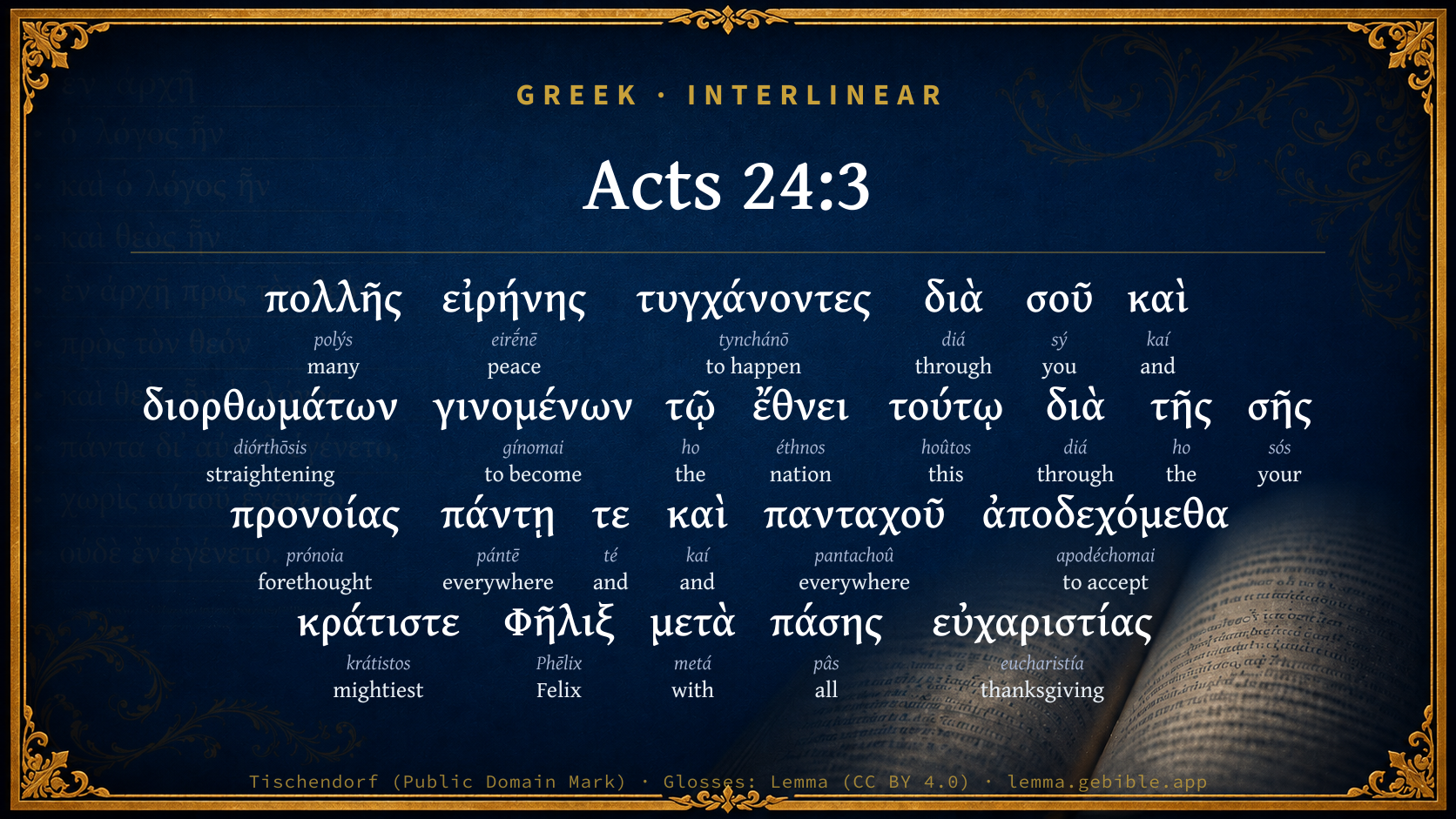
Greek (Tischendorf 8th ed.) Acts 24:3 appears in the Greek New Testament. The text above is from the Tischendorf 8th edition. Each word links to its Strong’s number and a concise gloss. Click any word for its full Thayer’s Greek Lexicon entry.
Download image
Cite this verse

Acts 24:3 (World English Bible). Public Domain. Lemma interlinear Bible study tool, https://lemma.gebible.app/v/acts/24/3.

Show BibTeX & RIS
BibTeX
RIS
English Translation
we accept it in all ways and in all places, most excellent Felix, with all thankfulness.
World English Bible · Public Domain
Highlights
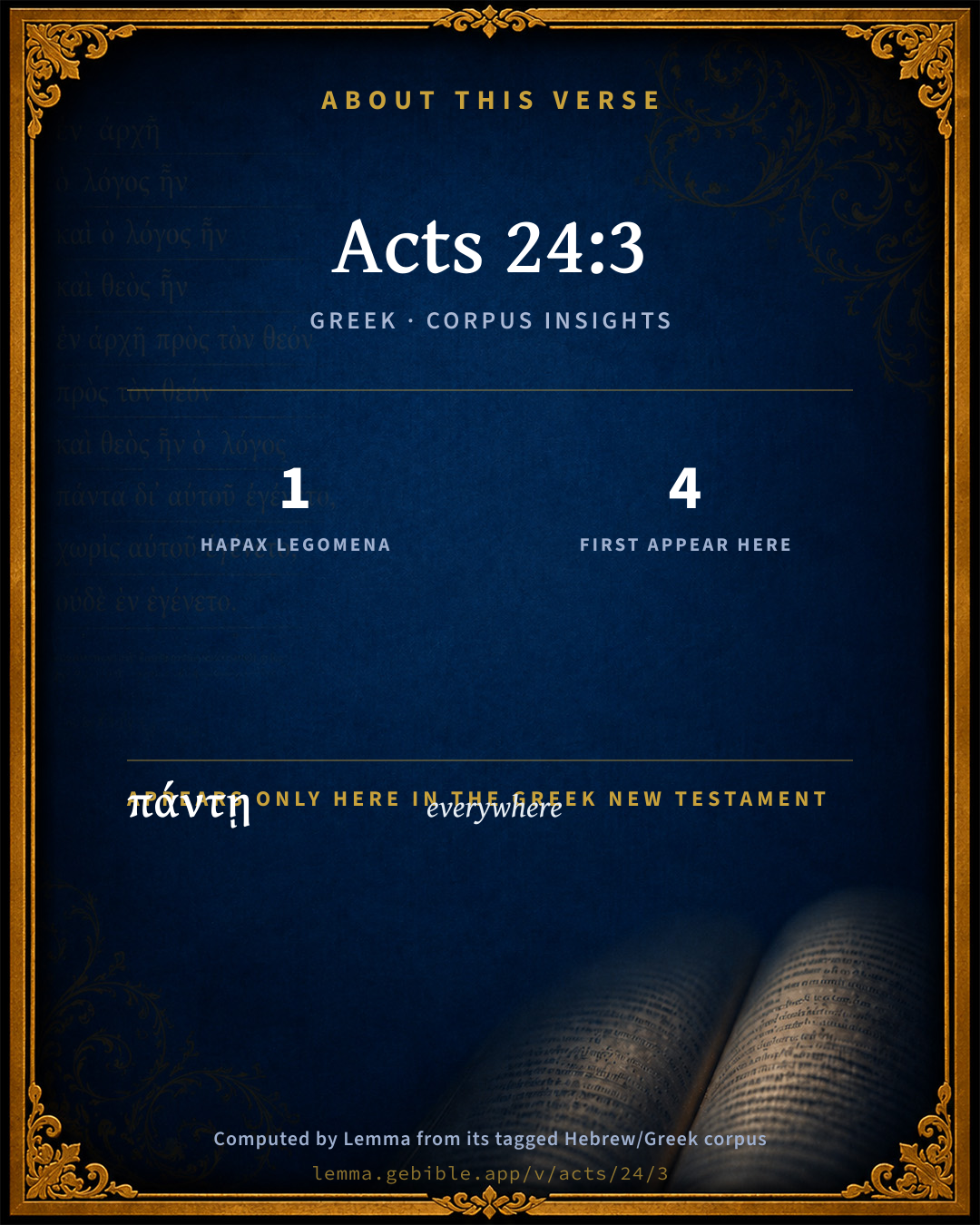
  • 1 hapax legomenon — only here in the Greek New Testament
  • 4 first appearances in the Greek New Testament
Full analysis ↓
Download a study sheet

One document with this verse’s original text, its word-by-word gloss line, the meaning frame, cross-references with their text, attributed commentary, and full source and license credits — printable, and it pastes into notes with its structure intact.

This verse Autodidact and up

Study sheet (.html) Plain text (.txt)

A passage Seminary Student

Up to 50 verses in one chapter. A passage sheet keeps up to 6 commentary sources and 12 cross-references per verse, in the order this page ranks them, and says so on the sheet whenever that leaves anything out. Ask for a single verse and you get the Autodidact verse sheet above.

Everything on this page stays free to read, with no account — the sheet is a download of what is already on screen, not access to it.

Want to remove ads? Support Godless Engineer
Compare translations 3

The same verse in 3 English versions, stacked beneath the original-language interlinear above. Click any original word for its lexicon entry.

Each is an independent rendering of the whole verse — the interlinear is not word-aligned to these translations.

Highlighted words mark where these versions differ — a whole-verse word diff, not a word-by-word alignment.

  • World English Bible Public Domain
    we accept it in all ways and in all places, most excellent Felix, with all thankfulness.
  • King James Version Public Domain
    We accept it always, and in all places, most noble Felix, with all thankfulness.
  • unfoldingWord Literal Text CC BY-SA 4.0
    both in every way and everywhere, we receive, most excellent Felix, with all thankfulness.

unfoldingWord Literal Text — © unfoldingWord, licensed CC BY-SA 4.0. Word-aligned USFM3 via Door43 (git.door43.org/unfoldingWord/en_ult).

Versions to compare (up to 4)

3 of 4 selected

Show all 19 translations

Every available English version of this verse, each an independent rendering of the whole verse.

  • World English Bible Public Domain
    we accept it in all ways and in all places, most excellent Felix, with all thankfulness.
  • Berean Standard Bible Public Domain
    In every way and everywhere, most excellent Felix, we acknowledge this with all gratitude.
  • Majority Standard Bible Public Domain
    In every way and everywhere, most excellent Felix, we acknowledge this with all gratitude.
  • King James Version Public Domain
    We accept it always, and in all places, most noble Felix, with all thankfulness.
  • American Standard Version (1901) Public Domain
    we accept it in all ways and in all places, most excellent Felix, with all thankfulness.
  • Revised Version (1885) Public Domain
    we accept it in all ways and in all places, most excellent Felix, with all thankfulness.
  • Geneva Bible (1599) Public Domain
    We acknowledge it wholy, and in all places most noble Felix, with all thankes,
  • Douay-Rheims (1899) Public Domain
    We accept it always and in all places, most excellent Felix, with all thanksgiving.
  • Young's Literal Translation Public Domain
    always, also, and everywhere we receive it, most noble Felix, with all thankfulness;
  • Literal Standard Version CC BY-SA 4.0
    always, also, and everywhere we receive it, most noble Felix, with all thankfulness;
  • Unlocked Literal Bible CC BY-SA 4.0
    so with all thankfulness we welcome everything that you do, most excellent Felix.
  • unfoldingWord Literal Text CC BY-SA 4.0
    both in every way and everywhere, we receive, most excellent Felix, with all thankfulness.
  • Darby Bible Public Domain
    we receive [it] always and everywhere, most excellent Felix, with all thankfulness.
  • World Messianic Bible Public Domain
    we accept it in all ways and in all places, most excellent Felix, with all thankfulness.
  • Webster's Bible Public Domain
    We accept it always, and in all places, most noble Felix, with all thankfulness.
  • Free Bible Version CC BY-SA 4.0
    All of us throughout the country are so very grateful to you for this.
  • Bible in Basic English Public Domain
    In all things and in all places we are conscious of our great debt to you, most noble Felix.
  • Text-Critical English NT CC BY 4.0
    both in every way and in every place we acknowledge it, most excellent Felix, with the utmost gratitude.
  • Tyndale New Testament (1534) Public Domain
    that alowe we ever and in all places most myghty Felix with all thankes.

Literal Standard Version (2020), Covenant Press — licensed CC BY-SA 4.0. Text via the HelloAO Bible API (eBible.org). Unlocked Literal Bible (unfoldingWord) — licensed CC BY-SA 4.0. Text via the HelloAO Bible API (eBible.org). unfoldingWord Literal Text — © unfoldingWord, licensed CC BY-SA 4.0. Word-aligned USFM3 via Door43 (git.door43.org/unfoldingWord/en_ult). Free Bible Version, Dr. Jonathan Gallagher — licensed CC BY-SA 4.0. Text via the HelloAO Bible API (eBible.org).

Word by word

More ways to search: Search by grammar → Find every occurrence → Compare this word →

Practice this passage: Drill this verse → Learn its vocabulary →

πάντῃ
pántē
G3839
“everywhere”
Adverb
Part of Speech
Adverb
Full Thayer's Definition

Origin: adverb (of manner) from G3956

TDNT: None

1. everywhere, wholly, in all respects, in every way
  1. πολλῆς polýs G4183 “many” Adjective, Genitive, Singular, Feminine
  2. εἰρήνης eirḗnē G1515 “peace” Noun, Genitive, Singular, Feminine
  3. τυγχάνοντες tynchánō G5177 “to happen” Verb, Present, Active, Participle, Nominative, Plural, Masculine
  4. διὰ diá G1223 “through” Preposition
  5. σοῦ sý G4771 “you” Personal pronoun, 2nd person, Genitive, Singular
  6. καὶ kaí G2532 “and” Conjunction
  7. διορθωμάτων diórthōsis G1357 “straightening” Noun, Genitive, Plural, Neuter
  8. γινομένων gínomai G1096 “to become” Verb, Present, Middle or Passive deponent, Participle, Genitive, Plural, Neuter
  9. τῷ ho G3588 “the” Article, Dative, Singular, Neuter
  10. ἔθνει éthnos G1484 “nation” Noun, Dative, Singular, Neuter
  11. τούτῳ hoûtos G3778 “this” Demonstrative pronoun, Dative, Singular, Neuter
  12. διὰ diá G1223 “through” Preposition
  13. τῆς ho G3588 “the” Article, Genitive, Singular, Feminine
  14. σῆς sós G4674 “your” Possessive pronoun, 2nd person, Genitive, Singular, Feminine
  15. προνοίας prónoia G4307 “forethought” Noun, Genitive, Singular, Feminine
  16. τε té G5037 “and” Particle
  17. καὶ kaí G2532 “and” Conjunction
  18. πανταχοῦ pantachoû G3837 “everywhere” Adverb
  19. ἀποδεχόμεθα apodéchomai G588 “to accept” Verb, Present, Middle or Passive deponent, Indicative, 1st person, Plural
  20. κράτιστε krátistos G2903 “mightiest” Adjective, Vocative, Singular, Masculine, Superlative
  21. Φῆλιξ Phēlix G5344 “Felix” Noun, Vocative, Singular, Masculine
  22. μετὰ metá G3326 “with” Preposition
  23. πάσης pâs G3956 “all” Adjective, Genitive, Singular, Feminine
  24. εὐχαριστίας eucharistía G2169 “thanksgiving” Noun, Genitive, Singular, Feminine

About this verse

These counts appear in no published source. They are computed here, from the morphology-tagged text and Lemma’s own curated glosses. What Lemma adds →

25
words
22
distinct lemmas
Acts
section

Notable vocabulary

1 hapax legomenon — a word that appears only here in the entire Greek New Testament:

  • πάντῃ everywhere G3839

First appearance in Scripture

These words make their first canonical appearance in the Greek New Testament here:

  • διορθωμάτων straightening G1357
  • προνοίας forethought G4307
  • πάντῃ everywhere G3839
  • εὐχαριστίας thanksgiving G2169

Shared distinctive vocabulary

διορθωμάτων straightening G1357 occurs in 2 verses of the Greek New Testament. Also found in:
Repetition

Words recur within this verse:

Cross-references

3

Topical passages linked to Acts 24:3 in the Treasury of Scripture Knowledge — connected by theme and wording, ordered by reader-vote popularity; previews shown in the World English Bible.

  • Acts 23:26 "Claudius Lysias to the most excellent governor Felix: Greetings.
  • Acts 26:25 But he said, "I am not crazy, most excellent Festus, but boldly declare words of truth and reasonableness.
  • Luke 1:3 it seemed good to me also, having traced the course of all things accurately from the first, to write to you in order, most excellent Theophilus;

Cross-references courtesy of OpenBible.info (CC BY 4.0).

Commentary

Notes on Acts 24:3 from classic Christian and Jewish commentators (each source and its license shown beneath its notes). The classic Christian expositions comment on the surrounding passage and are grouped to its opening verse, so a note may address several verses; the Jewish commentaries on the Tanakh (Rashi and others) are per-verse, so they appear only where the commentator wrote on this verse.

Lemma curates 59 commentaries, every one of them public domain or Creative Commons licensed, each selected and text-cleaned for this edition rather than reprinted as found. About our sources →

Bengel's Gnomon

Johann Albrecht Bengel

Act 24:3. Πολλῆς, great quietness) A speech utterly unlike that of Paul, which was true, modest, and solid, without any varnish. Felix was a man of flagitious character, and hateful to the Jews.—εἰρήνης) Peace, a blessing most of all to be desired in a state.—κατορθωμάτων) A word grand in itself; which Tertullus borrowed from the philosophers: and for this reason there is no epithet added. There follow others in the same clause.—προνοίας, thy providence) This term they often attributed to the gods.

Bengel's Gnomon of the New Testament — English translation (T&T Clark, Edinburgh, 1860) — public domain. Text from a community e-Sword module.

Expositor's Greek Testament

ed. W. Robertson Nicoll

Act 24:3 . πολλῆς εἰρ . τυγχ .: the governors specially prided themselves on keeping peace in their provinces (Wetstein). On the phrase see Mal 4:6Mal 4:6 ; 2Ma 14:10 . κατορθωμάτων : “very worthy deeds,” A.V., the word might mean “successes,” cf. Polyb., i., 19, 12, or it might mean recte facta , cf. Cic., De Fin. , iii., 14 (see also in Wetstein; the word is found in 3Ma 3:23 , R); but διορθώματα , see critical note, in Arist., Plut. = corrections, reforms ( cf. R.V.), so διόρθωσις in Polyb., Vulgate, multa corrigantur . In LXX διορθοῦν is used of amending, Jer 7:3 ; Jer 7:5 προνοίας : foresight, cf. Rom 13:14 , nowhere else in N.T.; cf. for a close parallel to its use here Mal 4:6Mal 4:6 , referred to above (Lumby). It is possible that the word may be a further proof of the sycophancy of the orator; twice the Latin providentia , A. and R.V. “providence,” was used of the emperors on coins, and also of the gods (Humphry on R.V.), “hoc vocabulum sæpe diis tribuerunt,” Bengel, in loco . πάντη τε καὶ πανταχοῦ ἀποδεχ ., so A. and R.V., “non in os solum laudamus” (Wetstein); but Meyer joins πάν . τε κ . παντ . with what precedes (Lach.), and in this he is followed by Weiss, Wendt, Page and Blass. For similar phrases in Plato, Artistotle, Philo, Josephus, see Wetstein. πάντῃ : only here in N.T., but cf. Sir 50:22 , Mal 4:1Mal 4:1 , cf. Friedrich, p. 5, on Luke’s fondness for ᾶς and kindred words. τῷ ἔθνει τούτῳ , see above on Act 24:1 and also Act 24:10 . If he had been a Jew Wetstein thinks that he would have said τῷ ἔθνει τῷ ἡμετέρῳ , but see Blass, in loco , on ἔθνος “in sermone elegantiore et coram alienigenis”. ἀποδ .: only in Luke and Acts; for its meaning here cf. Act 2:41 , 1Ma 9:71 ( al [377] ), so in classical Greek. εὐχ .: except Rev 4:9 ; Rev 7:12 , elsewhere in N.T. only in St. Paul’s Epistles (frequent); the word is also found in Esth. (LXX) Act 8:13 , Sir 37:11 , Wis 16:28 , 2Ma 2:27 , and for other references see Kennedy, Sources of N.T. Greek , p. 73, and Grimm-Thayer, sub v. There was very little, if anything, to praise in the administration of Felix, but Tertullus fastened on the fact of his suppression of the bands of robbers who had infested the country, Jos., B.J. , ii., 13, 2, Ant. , xx., 8, 5, “ipse tamen his omnibus erat nocentior” (Wetstein). His severity and cruelty was so great that he only added fuel to the flame of outrage and sedition, Jos., Ant. , xx., 8, 6, B.J. , ii., 13, 6, whilst he did not hesitate to employ the Sicarii to get rid of Jonathan the high priest who urged him to be more worthy of his office. In the rule of Felix Schürer sees the turning-point in the drama which opened with the death of Herod and terminated with the bloody conflict of A.D. 70. The uprisings of the people under his predecessors had been isolated and occasional; under him rebellion became permanent. And no wonder when we consider the picture of the public and private life of the man drawn by the hand of the Roman historian, and the fact trading upon the influence of his infamous brother Pallas he allowed himself a free hand to indulge in every licence and excess, Tac., Hist. , Act 24:9 , and Ann. , xii., 54, Schürer, Jewish People , div. i., vol. ii., p. 177 181, E.T.

[377] Alford’s Greek Testament .

The Expositor's Greek Testament, edited by W. Robertson Nicoll (1897–1910) — public domain. Text from a community e-Sword module.

Adam Clarke's Commentary

Verse 3. We accept it always, and in all places] We have at all times a grateful sense of thy beneficent administration, and we talk of it in all places, not only before thy face, but behind thy back.

Adam Clarke's Commentary on the Bible (1810–1826) — public domain. Text from a community e-Sword/MySword module.

The Cambridge Bible for Schools and Colleges

gen. ed. J. J. S. Perowne

3. we accept it always [Better, in all ways] and in all places] The word rendered “in all ways” is only found here in N. T. and does not mean “always.” Some would join “in all ways and in all places” with the former part of the sentence thus: “evils are corrected for this nation in all ways and in all places.” “We accept it” means “we acknowledge and are glad of it.”

most noble [R. V. excellent] Felix] The adjective is the same title which was given to Felix in the letter from Claudius Lysias, and which is afterwards given to Festus by St Paul (Act_26:25).

The Cambridge Bible for Schools and Colleges (gen. ed. J. J. S. Perowne; Cambridge University Press, 1878–1918) — public domain. Text from a community e-Sword module.

John Gill's Exposition

We accept it always, and in all places,.... The sense is, that the Jews observed with pleasure the provident care the governor took of their nation, and at all times spoke well of him; and wherever they came commended his conduct, and owned the favours they received from him, and the blessings they enjoyed under his government: and then giving him his title of honour,

most noble Felix; Tertullus adds, that this the Jews did

with all thankfulness; as sensible of the obligations they were under to him; but this was all a farce, mere artifice, and wretched flattery.

John Gill's Exposition of the Whole Bible (1746–1763) — public domain (CC PDM 1.0). Text via the HelloAO Bible API.

Trapp's Complete Commentary

John Trapp

3 We accept it always, and in all places, most noble Felix, with all thankfulness.

Ver. 3. We accept it always] So they say, the sooner to ingratiate; when in truth they worthily hated Felix for his oppression and cruelty. Nota hypocrisin cum assentatione, saith Beza. "In his estate shall stand up a vile person," Dan 11:21, that is, Antiochus Epiphanes. And yet Josephus reports that the Samaritans writing to him, because he tormented the Jews, to excuse themselves that they were no Jews, styled him, by flattery, Antiochus the mighty God. Romani, propter omnia quae a Nerone fiebant etiam scelera, quasi gratias agentes, sacra faciebant: such was their baseness, and such were these Jews.

John Trapp, A Commentary or Exposition upon All the Books of the Old and New Testament (1647–1656) — public domain. Text from a community e-Sword module.

Albert Barnes' Notes on the Bible

We accept it always - We admit that it is owing to your vigilance, and we accept your interposition to promote peace with gratitude.

Always, and in all places - Not merely in your presence, but we always acknowledge that it is owing to your vigilance that the land is secure. “What we now do in your presence, we do also in your absence; we do not commend you merely when you are present” (Wetstein).

Most noble Felix - This was the title of office.

With all thankfulness - In this there was probably sincerity, for there was no doubt that the peace of Judea was owing to Felix. But at the same time that he was an energetic and vigilant governor, it was also true that he was proud, avaricious, and cruel. Josephus charges him with injustice and cruelty in the case of Jonathan, the high priest (Antiq., book 20, chapter 8, section 5), and Tacitus (History, book 5, chapter 9) and Suetonius (Life of Claudius, chapter 28) concur in the charge.

Albert Barnes' Notes on the Bible (1834–1885) — public domain. Text from a community e-Sword/MySword module.

Matthew Poole's English Annotations

We accept it; we commend and admire it. It is most certain, that inferiors enjoy many benefits by the means of their governors, who bear the burden for the people, watching and caring for them; and that a bad government is better than none; and therefore not only Tertullus, (who may well be thought to speak out of flattery), but St. Paul himself, Act 24:10, speaks with great respect unto Felix.

Matthew Poole's English Annotations on the Holy Bible (1683–1685) — public domain. Text from a community e-Sword/MySword module.

The Pulpit Commentary

In all ways for always, A.V.; excellent for noble, A.V. Meyer connects in all ways and in all places with the preceding diorqwmatwn ginomenwn: "reforms and improvements that have taken place on all sides and in all places." Panth or panth, found only here in the New Testament, means "on all sides," "in every direction.

Most noble Felix;" or, the power of the flatterer.

Felix was not noble at all. Tacitus says of him that "in the practice of all kinds of lust, crime, and cruelty, he exercised the power of a king with the temper of a slave." Tertullus had an end to gain, and adopted flattery as a means. He was a hired pleader, and selected for the sake of his glib eloquence. He could talk well. Men of his class were found in most of the provincial towns of the Roman empire, They were necessary because the local lawyers would not be sufficiently familiar with the proceedings at the Roman courts, or with the minute details of Roman law. Tertullus had "learned the trick of his class, and began with propitiating the judge by flattery." Canon Farrar says, "Tertullus was evidently a practiced speaker, and St. Luke has faithfully preserved an outline of his voluble plausibility. Speaking with polite complaisance, as though he were himself a Jew, he began by a fulsome compliment to Felix, which served as the usual captatio benevolentiae. Alluding to the early exertions of Felix against the banditti, and the recent suppression of the Egyptian false Messiah, he began to assure his excellency, with truly legal rotundity of verbiage, of the quite universal and uninterrupted gratitude of the Jews for the peace which he had secured to them, and for the many reforms which had been initiated by his prudential wisdom." The subject suggested for our consideration is this What are the limits of praise? How far may we go in conciliating othersby words of approval and congratulation? At once it may be answered that no praise may go beyond the truth or be out of harmony with the truth. But in practical life we have to remember that different persons have different estimates of personal character.

1. Some are incompetent to form sound judgment, and such persons give praise that is simply unsuitable, but is not spoken with any purpose of flattering.

2. Others are prejudiced, and can only see the evil sides of a man"s character and actions. Their estimates are wholly unworthy.

3. Others are just as blind to the evil and as prejudiced to the good, and their estimates, though seemingly flattering, are really only exaggerated and untrustworthy; they lack criticism, but are not insincere.

4. Yet others praise with some object which does not appear; they have an end to gain, and the praise is regarded simply as a means towards obtaining the end. These are the flatterers, and their characteristic is insincerity. The following points may be illustrated concerning the power of the flatterer:

I HIS MOTIVES. Always some personal end is in view. Usually the flatterer seeks to get something that is not in itself right. It is an agency to use when a man"s case is bad. If a man lacks arguments, he will flatter the judge. He means to throw him off his guard, and to get him into a favorable mind by praises.

II HIS AIDS IN THE PERSON FLATTERED. There is in us all, even in the best of men, a self-love that makes praise pleasant. If the flattery is kept well in hand and skillfully disguised, even noble natures, even humble natures, may be swayed by it. If the flattery is too open and intense, good men are put on their guard and resent the insult.

III THE MORAL MISCHIEF OF HIS WORK. Show the injury that is done to the flatterer himself, who is confirmed in his insincerity when he finds flattery succeed. A man may get into such a habit of flattering that he will lose the power to recognize the truth, and come to believe in his own exaggerations. Show the injury that is done to the person flattered, who may be led to form an undue estimate of himself, and so be placed in positions of extreme moral peril when the hour of temptation comes. If it is wrong for us to think of ourselves above that which we ought to think, it must be wholly wrong for any one to flatter us so that our self-opinion is unduly raised. Felix was really pushed a little nearer to his fall by. this flattery of Tertullus. For Scripture teachings concerning flattery, see Psa_36:2 Psa_78:36; Pro_2:16 Pro_20:19 Pro_26:28 Pro_29:5, etc. Press the apostolic counsel, "Speak every man truth with his neighbor: for we are members one of another". R.T. (Eph_4:25)

The Pulpit Commentary (1880–1919), ed. H.D.M. Spence-Jones & Joseph S. Exell — public domain. Text from a community e-Sword module.

McGarvey & Pendleton's Commentaries

J. W. McGarvey

See notes on verse 2

J. W. McGarvey (with Philip Y. Pendleton), Commentaries on the New Testament (The Fourfold Gospel, 1914; Acts; and the epistles) — public domain. Text from a community e-Sword/MySword module.

Cambridge Greek Testament for Schools and Colleges

3. πολλῆς εἰρήνης τυγχάνοντες διὰ σοῦ, seeing that by thee we enjoy much peace. The orator seizes on almost the only point in the government of Felix on which he could hang any praise. By severity he had put down false Messiahs, and the partisans of an Egyptian magician, as well as riots in Cæsarea and Jerusalem, so that the country was in a more peaceful condition than it had been for a long time past.

For εἰρήνης τυγχάνειν, cf. 2Ma 14:10, ἄχρι γὰρ Ἰούδας περίεστιν, ἀδύνατον εἰρήνης τυχεῖν τὰ πράγματα. See also the next note.

καὶ διορθωμάτων γινομένων τῷ ἔθνει τούτῳ διὰ τῆς σῆς προνοίας, and that by thy providence evils are corrected for this nation. The sentence, which began with a nominative case τυγχάνοντες, is now varied by the introduction of a genitive absolute. πρόνοια is found in a very parallel passage, 2Ma 4:6, ἑώρα γὰρ ἄνευ βασιλικῆς προνοίας ἀδύνατον εἶναι τυχεῖν εἰρήνης, where A.V. renders ἄ. βασ. πρ. ‘unless the king did look thereto,’ which shews what the force of the word is here. It was by the severe looking thereto of Felix that disorders were corrected, though we learn from Tacitus (Hist. Act 24:9, Ann. XII. 54) that his severity in the end bore evil fruit, and it seems probable that his main motive in suppressing other plunderers was that there might be the more left for himself.

πάντῃ τε καὶ πανταχοῦ ἀποδεχόμεθα, we accept it in all ways and in all places, i.e. we acknowledge and are glad of it. Some would join πάντῃ τε καὶ πανταχοῦ with the previous clause, ‘evils are in all ways and in all places corrected &c.’ But this connexion is not favoured by the order of the Greek.

κράτιστε Φῆλιξ, most excellent Felix. The title is the same which was given to Felix in the letter of Claudius Lysias (Act 23:26), and which is afterwards given to Festus by St Paul (Act 26:25).

Cambridge Greek Testament for Schools and Colleges (Cambridge University Press, 1896; 21 vols, various authors incl. Carr, Maclear, Plummer, Farrar, Lumby, Moule, M. R. James, Simcox) — public domain. Text from a community e-Sword module.

Alford’s Greek Testament

Henry Alford

3. πάντη κ. πανταχοῦ] belongs to ἀποδεχ., not to γινομένων, in which case they would naturally precede the participle,—We receive, &c., not only here in thy presence, but also at all times and in all places. A refinement of flattery.

Henry Alford, The Greek Testament (1849–1861) — public domain. Text from a community e-Sword module.

Vincent's Word Studies in the New Testament

Marvin R. Vincent

Very worthy deeds [κατορθωματων] . From katorqow, to set upright. Hence, a success consequent on right judgment; a right action. The best texts, however, read diorqwmatwn, settings right; amendments. Thus the sentence reads, literally, obtaining much peace through thee, and amendments taking place for this nation through thy providence, we accept, etc.

Providence [προνοιας] . Forethought. Previdentia Augusti (the providence of the emperor) was a common title on the coins of the emperors.

Marvin R. Vincent, Word Studies in the New Testament (1887–1900) — public domain. Text from a community e-Sword/MySword module.

Lesson kit

Teaching starters — assembled from the data on this page, not authored interpretation. Every prompt links to the verse data it draws on. Edit before teaching.

Acts, in the Acts, opens this verse with 25 words (22 distinct Greek lemmas). Its most distinctive word is pántē (“everywhere”). A historical commentator’s framing appears above. Read the whole chapter for the surrounding context.

Discussion questions

  1. What does “everywhere” (pántē) contribute to the verse as a whole?
  2. This verse holds 1 word here found nowhere else in the Greek New Testament. What might the rare word draw attention to?
  3. 4 words here appear for the first time in Scripture. What is being introduced at this debut?
  4. Hebrews 9:10 shares the word «straightening» with this verse. How do the two illuminate each other?
  5. “through” occurs 2× in this one verse. What is the effect of the repetition?
  6. These translations render this verse differently; the difference is in the English rendering, not the original. What questions does that raise?
  7. Reading how Bengel's Gnomon and Expositor's Greek Testament read this verse, where do the two commentators agree and where do they part?

Things to notice

  • 1 word in this verse appears nowhere else in the Greek New Testament.
  • 4 words make their first canonical appearance in Scripture here.
  • These translations choose different wording for 11 words in this verse.
  • “through” occurs 2× in this single verse.
  • 22 distinct Greek lemmas span 25 words in this verse.

Reading settings

Reading text

Shown beneath each verse's original-language words.

Old Testament
Old Testament edition

Read the OT as the Masoretic Hebrew (MT) or the Greek Septuagint (LXX).

English shown for the Greek Septuagint (in the Hebrew ↔ Greek comparison).

Comparing translations? Open the Compare panel on any verse page to stack up to four side by side.