
Acts 9:15

Greek (Tischendorf 8th ed.) Acts 9:15 appears in the Greek New Testament. The text above is from the Tischendorf 8th edition. Each word links to its Strong’s number and a concise gloss. Click any word for its full Thayer’s Greek Lexicon entry.
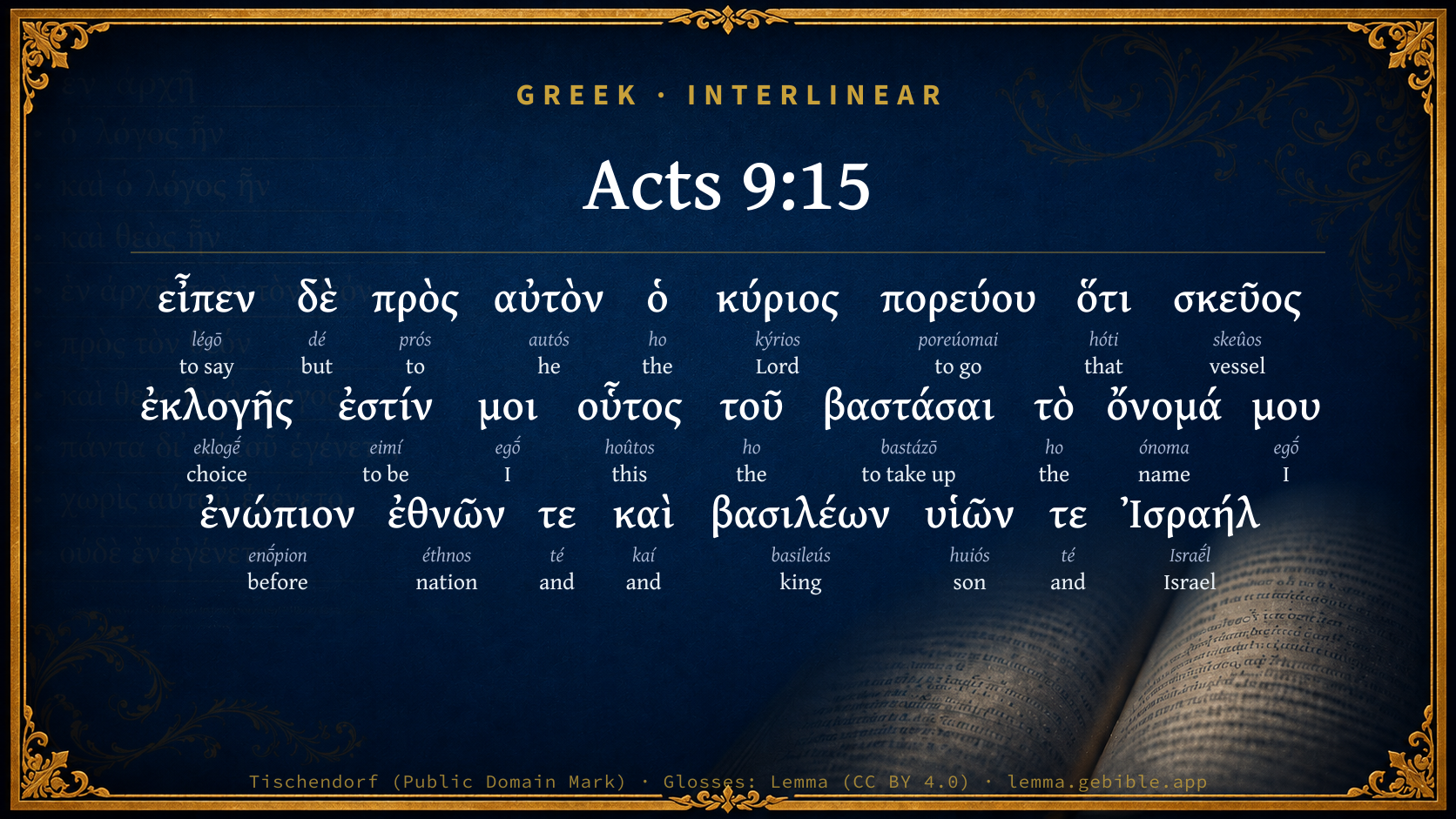
Download image
Cite this verse

Acts 9:15 (World English Bible). Public Domain. Lemma interlinear Bible study tool, https://lemma.gebible.app/v/acts/9/15.

Show BibTeX & RIS
BibTeX
RIS
English Translation
But the Lord said to him, "Go your way, for he is my chosen vessel to bear my name before the nations and kings, and the children of Israel.
World English Bible · Public Domain
Highlights
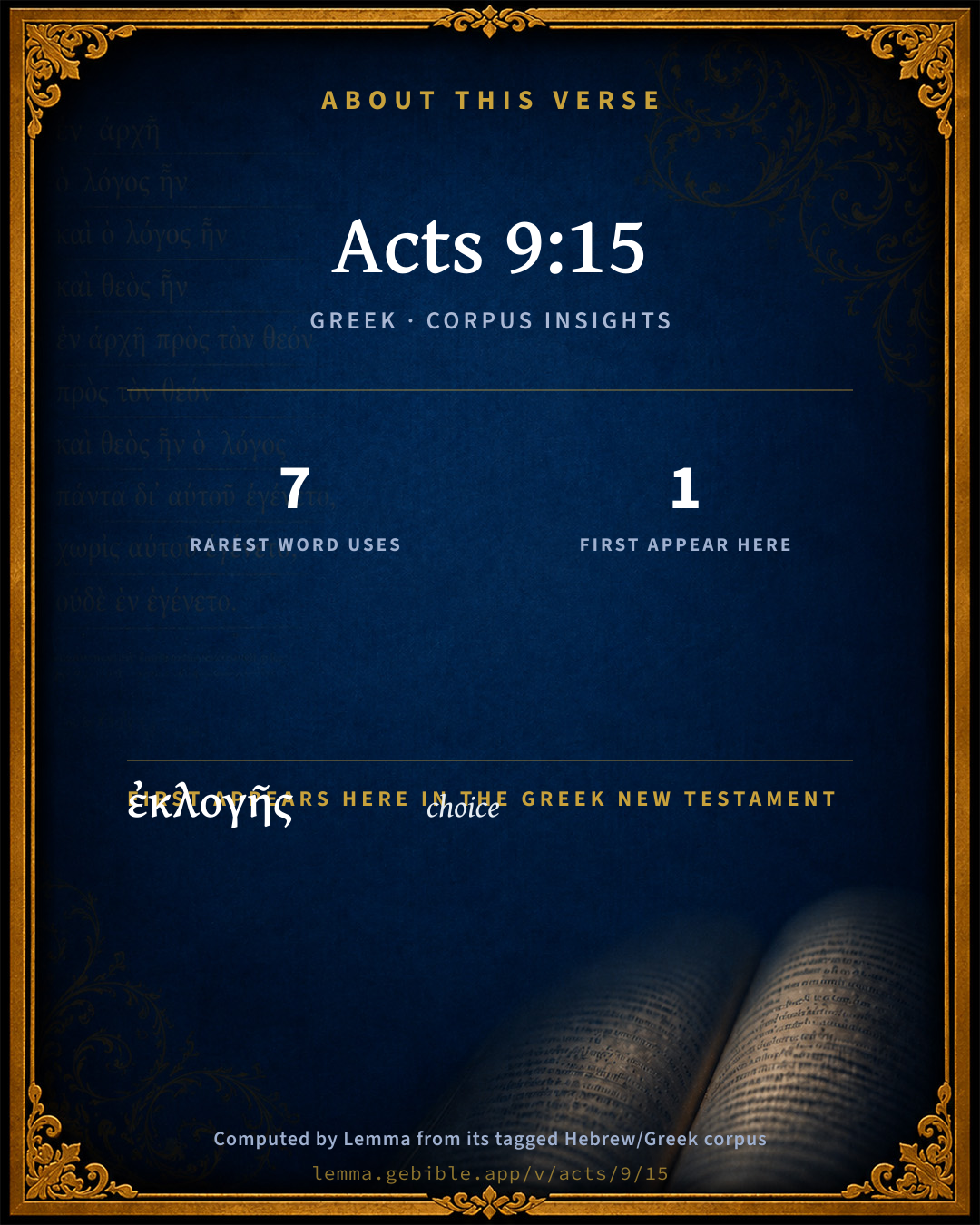
  • 1 first appearance in the Greek New Testament
Full analysis ↓
Download a study sheet

One document with this verse’s original text, its word-by-word gloss line, the meaning frame, cross-references with their text, attributed commentary, and full source and license credits — printable, and it pastes into notes with its structure intact.

This verse Autodidact and up

Study sheet (.html) Plain text (.txt)

A passage Seminary Student

Up to 50 verses in one chapter. A passage sheet keeps up to 6 commentary sources and 12 cross-references per verse, in the order this page ranks them, and says so on the sheet whenever that leaves anything out. Ask for a single verse and you get the Autodidact verse sheet above.

Everything on this page stays free to read, with no account — the sheet is a download of what is already on screen, not access to it.

Want to remove ads? Support Godless Engineer
Compare translations 3

The same verse in 3 English versions, stacked beneath the original-language interlinear above. Click any original word for its lexicon entry.

Each is an independent rendering of the whole verse — the interlinear is not word-aligned to these translations.

Highlighted words mark where these versions differ — a whole-verse word diff, not a word-by-word alignment.

  • World English Bible Public Domain
    But the Lord said to him, "Go your way, for he is my chosen vessel to bear my name before the nations and kings, and the children of Israel.
  • King James Version Public Domain
    But the Lord said unto him, Go thy way: for he is a chosen vessel unto me, to bear my name before the Gentiles, and kings, and the children of Israel:
  • unfoldingWord Literal Text CC BY-SA 4.0
    But the Lord said to him, “Go, for this is to me an instrument of choosing, to carry my name before the nations, and also kings, and the sons of Israel;

unfoldingWord Literal Text — © unfoldingWord, licensed CC BY-SA 4.0. Word-aligned USFM3 via Door43 (git.door43.org/unfoldingWord/en_ult).

Versions to compare (up to 4)

3 of 4 selected

Show all 19 translations

Every available English version of this verse, each an independent rendering of the whole verse.

  • World English Bible Public Domain
    But the Lord said to him, "Go your way, for he is my chosen vessel to bear my name before the nations and kings, and the children of Israel.
  • Berean Standard Bible Public Domain
    “Go!” said the Lord. “This man is My chosen instrument to carry My name before the Gentiles and their kings, and before the people of Israel.
  • Majority Standard Bible Public Domain
    “Go!” said the Lord. “This man is My chosen instrument to carry My name before the Gentiles and their kings, and before the people of Israel.
  • King James Version Public Domain
    But the Lord said unto him, Go thy way: for he is a chosen vessel unto me, to bear my name before the Gentiles, and kings, and the children of Israel:
  • American Standard Version (1901) Public Domain
    But the Lord said unto him, Go thy way: for he is a chosen vessel unto me, to bear my name before the Gentiles and kings, and the children of Israel:
  • Revised Version (1885) Public Domain
    But the Lord said unto him, Go thy way: for he is a chosen vessel unto me, to bear my name before the Gentiles and kings, and the children of Israel:
  • Geneva Bible (1599) Public Domain
    Then the Lord said vnto him, Go thy way: for he is a chosen vessell vnto me, to beare my Name before the Gentiles, and Kings, and the children of Israel.
  • Douay-Rheims (1899) Public Domain
    And the Lord said to him: Go thy way; for this man is to me a vessel of election, to carry my name before the Gentiles, and kings, and the children of Israel.
  • Young's Literal Translation Public Domain
    And the Lord said unto him, `Be going on, because a choice vessel to Me is this one, to bear My name before nations and kings -- the sons also of Israel;
  • Literal Standard Version CC BY-SA 4.0
    And the LORD said to him, “Go, because this one is a chosen vessel to Me, to carry My Name before nations and kings—also the sons of Israel;
  • Unlocked Literal Bible CC BY-SA 4.0
    But the Lord said to him, “Go, for he is a chosen instrument of mine, to carry my name before the Gentiles and kings and the children of Israel;
  • unfoldingWord Literal Text CC BY-SA 4.0
    But the Lord said to him, “Go, for this is to me an instrument of choosing, to carry my name before the nations, and also kings, and the sons of Israel;
  • Darby Bible Public Domain
    And the Lord said to him, Go, for this [man] is an elect vessel to me, to bear my name before both nations and kings and [the] sons of Israel:
  • World Messianic Bible Public Domain
    But the Lord said to him, “Go your way, for he is my chosen vessel to bear my name before the nations and kings, and the children of Israel.
  • Webster's Bible Public Domain
    But the Lord said to him, Go, for he is a chosen vessel to me, to bear my name before the Gentiles, and kings, and the children of Israel.
  • Free Bible Version CC BY-SA 4.0
    But the Lord told him, “Get on your way, because he is the person I have chosen to take my name to foreigners and kings, as well as to Israel.
  • Bible in Basic English Public Domain
    But the Lord said, Go without fear: for he is a special vessel for me, to give to the Gentiles and kings and to the children of Israel the knowledge of my name:
  • Text-Critical English NT CC BY 4.0
    But the Lord said to him, “Go, for he is a vessel chosen by me to bring my name before Gentiles, kings, and the sons of Israel.
  • Tyndale New Testament (1534) Public Domain
    The lorde sayde vnto him: Goo thy wayes: for he is a chosen vessell vnto me to beare my name before the gentyls and kynges and the chyldren of Israel.

Literal Standard Version (2020), Covenant Press — licensed CC BY-SA 4.0. Text via the HelloAO Bible API (eBible.org). Unlocked Literal Bible (unfoldingWord) — licensed CC BY-SA 4.0. Text via the HelloAO Bible API (eBible.org). unfoldingWord Literal Text — © unfoldingWord, licensed CC BY-SA 4.0. Word-aligned USFM3 via Door43 (git.door43.org/unfoldingWord/en_ult). Free Bible Version, Dr. Jonathan Gallagher — licensed CC BY-SA 4.0. Text via the HelloAO Bible API (eBible.org).

Word by word

More ways to search: Search by grammar → Find every occurrence → Compare this word →

Practice this passage: Drill this verse → Learn its vocabulary →

ἐκλογῆς
eklogḗ
G1589
“choice”
Noun, Genitive, Singular, Feminine
Part of Speech
Noun
Case
Genitive
Number
Singular
Gender
Feminine
Full Thayer's Definition

Origin: from G1586

TDNT: 06:56,5

1. the act of picking out, choosing a. of the act of God's free will by which before the foundation of the world he decreed his blessings to certain persons b. the decree made from choice by which he determined to bless certain persons through Christ by grace alone 2. a thing or person chosen a. of persons: God's elect
  1. εἶπεν légō G3004 “to say” Verb, Aorist, Active, Indicative, 3rd person, Singular
  2. δὲ dé G1161 “but” Conjunction
  3. πρὸς prós G4314 “to” Preposition
  4. αὐτὸν autós G846 “he” Personal pronoun, Accusative, Singular, Masculine
  5. ὁ ho G3588 “the” Article, Nominative, Singular, Masculine
  6. κύριος kýrios G2962 “Lord” Noun, Nominative, Singular, Masculine
  7. πορεύου poreúomai G4198 “to go” Verb, Present, Middle or Passive deponent, Imperative, 2nd person, Singular
  8. ὅτι hóti G3754 “that” Conjunction
  9. σκεῦος skeûos G4632 “vessel” Noun, Nominative, Singular, Neuter
  10. ἐστίν eimí G1510 “to be” Verb, Present, Active, Indicative, 3rd person, Singular
  11. μοι egṓ G1473 “I” Personal pronoun, 1st person, Dative, Singular
  12. οὗτος hoûtos G3778 “this” Demonstrative pronoun, Nominative, Singular, Masculine
  13. τοῦ ho G3588 “the” Article, Genitive, Singular, Neuter
  14. βαστάσαι bastázō G941 “to take up” Verb, Aorist, Active, Infinitive
  15. τὸ ho G3588 “the” Article, Accusative, Singular, Neuter
  16. ὄνομά ónoma G3686 “name” Noun, Accusative, Singular, Neuter
  17. μου egṓ G1473 “I” Personal pronoun, 1st person, Genitive, Singular
  18. ἐνώπιον enṓpion G1799 “before” Adverb
  19. ἐθνῶν éthnos G1484 “nation” Noun, Genitive, Plural, Neuter
  20. τε té G5037 “and” Particle
  21. καὶ kaí G2532 “and” Conjunction
  22. βασιλέων basileús G935 “king” Noun, Genitive, Plural, Masculine
  23. υἱῶν huiós G5207 “son” Noun, Genitive, Plural, Masculine
  24. τε té G5037 “and” Particle
  25. Ἰσραήλ Israḗl G2474 “Israel” Noun, Proper, indeclinable

About this verse

These counts appear in no published source. They are computed here, from the morphology-tagged text and Lemma’s own curated glosses. What Lemma adds →

26
words
22
distinct lemmas
Acts
section

Notable vocabulary

The rarest word here is ἐκλογῆς choice G1589 — appearing just 7 times in the whole Greek New Testament.

First appearance in Scripture

This word makes its first canonical appearance in the Greek New Testament here:

  • ἐκλογῆς choice G1589

Shared distinctive vocabulary

ἐκλογῆς choice G1589 occurs in 7 verses of the Greek New Testament. Also found in:
Repetition

Words recur within this verse:

Cross-references

31

Topical passages linked to Acts 9:15 in the Treasury of Scripture Knowledge — connected by theme and wording, ordered by reader-vote popularity; previews shown in the World English Bible.

  • Galatians 1:15–16 But when it was the good pleasure of God, who separated me from my mother's womb, and called me through his grace,
  • Ephesians 3:7–8 of which I was made a servant, according to the gift of that grace of God which was given me according to the working of his power.
  • Romans 11:13 For I speak to you who are Gentiles. Since then as I am an apostle to Gentiles, I glorify my ministry;
  • 2 Timothy 4:16–17 At my first defense, no one came to help me, but all left me. May it not be held against them.
  • Acts 26:17–20 delivering you from the people, and from the Gentiles, to whom I send you,
  • Acts 22:21 "He said to me, 'Depart, for I will send you out far from here to the Gentiles.'"
  • Jeremiah 1:5 Before I formed you in the belly I knew you, and before you came forth out of the womb I sanctified you; I have appointed you a prophet to the nations.
  • Romans 1:5 through whom we received grace and apostleship, for obedience of faith among all the nations, for his name's sake;
  • 1 Timothy 2:7 to which I was appointed a preacher and an apostle (I am telling the truth in Christ, not lying), a teacher of the Gentiles in faith and truth.
  • John 15:16 You didn't choose me, but I chose you, and appointed you, that you should go and bear fruit, and that your fruit should remain; that whatever you will ask of the Father in my name, he may give it to you.
  • Galatians 1:1 Paul, an apostle (not from men, neither through man, but through Jesus Christ, and God the Father, who raised him from the dead),
  • 2 Timothy 1:11 For this, I was appointed as a preacher, an apostle, and a teacher of the Gentiles.
  • Matthew 10:18 Yes, and you will be brought before governors and kings for my sake, for a testimony to them and to the Gentiles.
  • Acts 13:2 As they served the Lord and fasted, the Holy Spirit said, "Separate Barnabas and Saul for me, for the work to which I have called them."
  • Romans 9:21–24 Or hasn't the potter a right over the clay, from the same lump to make one part a vessel for honor, and another for dishonor?
  • Romans 15:15–21 But I write the more boldly to you in part, as reminding you, because of the grace that was given to me by God,
  • 1 Corinthians 15:10 But by the grace of God I am what I am. His grace which was bestowed on me was not futile, but I worked more than all of them; yet not I, but the grace of God which was with me.
  • Galatians 2:7–9 but to the contrary, when they saw that I had been entrusted with the Gospel for the uncircumcision, even as Peter with the Gospel for the circumcision
  • 2 Timothy 2:4 No soldier on service entangles himself in the affairs of life, that he may please him who enrolled him as a soldier.
  • Jonah 3:1–2 The word of Yahweh came to Jonah the second time, saying,
  • Acts 21:19 When he had greeted them, he reported one by one the things which God had worked among the Gentiles through his ministry.
  • Acts 25:22–26:11 Agrippa said to Festus, "I also would like to hear the man myself." "Tomorrow," he said, "you shall hear him."
  • Colossians 1:25–29 of which I was made a servant, according to the stewardship of God which was given me toward you, to fulfill the word of God,
  • 2 Timothy 2:20–21 Now in a great house there are not only vessels of gold and of silver, but also of wood and of clay. Some are for honor, and some for dishonor.
  • Revelation 17:14 These will war against the Lamb, and the Lamb will overcome them, for he is Lord of lords, and King of kings. They also will overcome who are with him, called and chosen and faithful."
  • Exodus 4:12–14 Now therefore go, and I will be with your mouth, and teach you what you shall speak."
  • Jeremiah 1:7 But Yahweh said to me, Don't say, I am a child; for to whoever I shall send you, you shall go, and whatever I shall command you, you shall speak.
  • Acts 26:32 Agrippa said to Festus, "This man might have been set free if he had not appealed to Caesar."
  • Acts 27:24 saying, 'Don't be afraid, Paul. You must stand before Caesar. Behold, God has granted you all those who sail with you.'
  • Romans 1:13–15 Now I don't desire to have you unaware, brothers, that I often planned to come to you, and was hindered so far, that I might have some fruit among you also, even as among the rest of the Gentiles.
  • Acts 28:17 It happened that after three days Paul called together those who were the leaders of the Jews. When they had come together, he said to them, "I, brothers, though I had done nothing against the people, or the customs of our fathers, still was delivered prisoner from Jerusalem into the hands of the Romans,

Cross-references courtesy of OpenBible.info (CC BY 4.0).

Commentary

Notes on Acts 9:15 from classic Christian and Jewish commentators (each source and its license shown beneath its notes). The classic Christian expositions comment on the surrounding passage and are grouped to its opening verse, so a note may address several verses; the Jewish commentaries on the Tanakh (Rashi and others) are per-verse, so they appear only where the commentator wrote on this verse.

Lemma curates 59 commentaries, every one of them public domain or Creative Commons licensed, each selected and text-cleaned for this edition rather than reprinted as found. About our sources →

The Biblical Illustrator

Joseph S. Exell

Act_9:15

He is a chosen vessel unto Me.

A chosen vessel

I. Its material. All the vessels in your house--the strong bowls, the fine vases, and the china tea cups--are made of earth, though some soils suit the potter better than others. And so the whole world is the Great Potters field, and Christs chosen vessels were all at first of the earth, earthy. The apostle tells us that he was the chief of sinners, and that he owes all to the grace of God. What hope for all! Splendid vessels are now made from mere rubbish, broken glass, and old bones, and so the Divine Potters art can triumph over the rudeness of the most unpromising materials.

II. Its maker.

1. That beautiful cup is not self-made. The potter took the clay, tempered, moulded, baked, painted, and fired it, and then put his mark upon it. And Christians are His workmanship, created in Christ Jesus. I have known a boy saying to his minister, Please will you convert me too. I am one of your converts, a man smelling of whisky once said to Rowland Hill. I can believe it, replied Mr. Hill, you look very like my bungling work.

2. In making chosen vessels, the potter attends to the chief parts of the work himself; for all depends on the skill of the workman. With his own hand he mixes the materials, and trims the fire.

3. The potter must also have complete power over the clay, and travellers in the East notice how thoroughly it is in his hands. Many vessels are made partly of flint or granite, but these rocks have first been ground into the softest powder. And Christs chosen vessels are all fashioned in contrite hearts. Contrite means rubbed together and made soft, exactly as stones are ground into the softest clay in our potteries. And youth is the yielding and moulding time in life. The world has a strange power of hardening the soul into an unbending frame.

III. Its use.

1. None of Christs vessels are for ornament only, they are all meet for the Masters use. A great house has some choice vessels, preferred for their size, strength, or beauty. Such a vessel was the apostle. Christs name was the water for the thirsty and balm for the wounded, and Paul was the vessel in which that heavenly treasure was carried round and offered to all. But the humblest vessel has its use. A poor broken cup may hold the water that saves the life of a dying man, and the humblest Christian may carry Christs name to a perishing sinner.

2. The vessel of the heart is already full, and must be emptied ere it can be filled with this heavenly treasure. The Rev. Narayan Sheshadri tells us that as a young Brahmin he was full of pride and self-righteousness. But as he began to think for himself he was emptied of one thing after another, till he was left with nothing in which he could trust. Then the name of Christ filled his soul, and he longed to bear it to the heathen around him (comp. Php_3:4-9).

3. Again, an emptied vessel cannot be filled unless it be rightly set and open a-top. It is a Chinese saying that the light of heaven cannot shine into an inverted bowl. Let your soul be opened heavenwards widely and hopefully, and then the abundance of grace will fill and warm your whole being.

IV. Its beauty.

1. Our makers of vessels strive to unite the useful and the beautiful. Our text may mean that Christs name was to be carried on as well as in the vessel, just as the costly vases in palaces bear the name and fame of the maker before kings. Bernard Palissy once saw a white enamelled cup, and resolved to discover the secret of so beautifying vessels. He spent all his money and sixteen years of his life in making the discovery. He was often at deaths door, had burnt all his furniture for fuel, and his body was lean and dried up from hard work. At last he made some of the chosen vessels, and these have borne his name among nations and kings even to this day. Thus Paul bore his Creators name far and wide, and multitudes glorified God in him.

2. Christs vessels are not all made in one mould. Every Christian should have a beauty of his own, and the charm of that beauty lies in its individuality. Some of the most beautiful of Christs vessels are found among day labourers and cottagers. Many a face deformed by lifelong hardship and disease has been brightened outwardly from inward joy and goodness. The coarsest features have often been adorned by the beauty of the soul within. Such was the case of Joan of Arc, who, the historian says, grew beautiful when the great idea entered her.

3. You can hardly believe what efforts great potters have made to add beauty to their vessels. A Duke of Florence spent ten years in discovering the way to make porcelain. Louis XIV was so interested in this work that, greatest monarch in Europe as he was, he seriously proposed becoming a potter himself. Many have reached perfection in this field, and have ennobled clay as if by miracle. Their masterpieces have an incorruptible beauty; no liquid can stain them, no fire can blacken them, no knife can scratch them. Yet they are as smooth to the touch as an infants flesh. Place a candle behind them and they resemble a fine face lighted up with the best emotions. If potters have done so much for clay, shall they not condemn us if we do not earnestly seek to have the beauty of the Lord our God upon us? If a heathen philosopher reproached a rich man with having silver plate and earthenware principles, should we not reproach ourselves that we are so eager to possess every sort of beauty, except the beauty of the soul? When shall the beauty of holiness find as passionate admirers as the beauty of art has in all our cities? Piety is the finest art under heaven. Many there be who say, A thing of beauty is a joy forever, yes, this chosen vessel is a joy forever to its possessor and to all beholders who know its worth.

4. The secret of making some choice vessels has been lost because it died with the man who had it; but the secret of spiritual beauty is open to all. God is the Great Beautifier, and He will perfect what He begins. He will give the finishing touch to His chosen vessel--perhaps in the sacred fires of affliction--and, having thus perfected its comeliness, He will place it in His mansions above. (J. Wells, M. A.)

Vessels chosen, charged, and used

I. A vessel.

1. The world is full of the instruments which God employs. Every flower, leaf, tendril is designed and fitted for carrying on some process in the vegetable economy.

2. In animals every member of the body is a tool with which Creator and creature alike work. The eye, ear, tongue, foot hang at hand in the workshop ready for the workers use.

3. Each separate part of creation, again, is an instrument of God. The internal fires of the globe are His instruments for heaving up the mountains and making the valleys. The clouds are vessels carrying water from the ocean to every portion of the thirsty land. The rivers are waste pipes for carrying back the soiled water that it may be purified for subsequent use. The sun is an instrument for lighting and warming a troop of revolving worlds, and the earths huge bulk a curtain for screening off the sunlight at stated intervals, and so affording to weary workers a grateful night of rest.

4. Chief of all implements is man--made last, made best for his Authors service; broken, disfigured, and defiled by sin, but, capable of working wondrously yet, when redeemed. God has not cast away the best of all His instruments because it was marred and polluted. A soul won is the best instrument for winning souls.

II. A chosen vessel. God can employ the evil as His unconscious instruments, or make them willing in the day of His power. When He had chastised Israel by the King of Babylon, he broke the rod and threw it away. In other cases He turns the kings heart as a river of water, and then accepts the willing homage of a converted man. It was a polished and capacious vessel that the Great King wrenched from the grasp of the arch-enemy near the gate of Damascus. He was Christs chief enemy in the world. God looks down from heaven on this man, not as an adversary whose assaults are formidable, but as an instrument which may be turned to another use. Arrested at the crisis of its course by a hand unseen, it is turned upside down, emptied, and then filled from heavens pure treasures, and used to water the world with the Word of life. Saul of Tarsus, called to be an apostle, is a conspicuous example of Divine sovereignty. He did not first choose Christ, but Christ chose him.

III. A vessel unto me. Two things lie in every conversion; the man gets an Almighty Saviour, and God gets a willing servant. The true instinct of the new creature burst forth from Pauls breast--Lord, what wilt Thou have me to do? The answer, sent through Ananias, indicated what he should be, rather than what he should do: He is a chosen vessel unto Me. We get a glimpse here of the two tendencies, the human and the Divine. I shall do, says the disciple in the ardour of a first love; thou shalt be, answers that wise and kind Master, who knows that the spirit is willing, but the flesh weak. I shall bear the vessels of the Lord, volunteers the ransomed sinner; the reply is, Thou shalt be the vessel of the Lord. It is a great thing that I should take up instruments and do a work for Christ in the world, but it is a greater that Christ should work out His purposes with me. This is our security alike for safety and usefulness. The star that is in His right hand is held up so that it cannot fall, and held out so that it shines afar.

IV. A vessel to bear My name. Paul was a vessel firmly put together, and filled to overflowing, before Jesus met him. At that meeting he was emptied of his miscellaneous vanities, and filled with the name of Christ. See an account of the whole process by his own pen (Php_3:4-8). Nature abhors a vacuum; and in nature, whether its material or spiritual department, a vacuum is never found. Each man is full either of his own things, or of Christs. The name of Christ is the precious thing wherewith the vessel is charged. So full was Paul of this treasure that he determined to know none other.

V. To bear My name before Gentiles, and kings, and the people of Israel. This bread of life, like the manna which fell in the wilderness, is given to be used, not to be hoarded. To be ever getting, ever giving, is the only way of keeping both the vessel and its treasure sweet.

1. The form of the expression indicates that in this ministry self-denying courage is required. Perhaps the series, in this respect, constitutes a climax. It is easier to speak of Christ to the Gentiles than to kings, and to kings than to His own chosen people. In our day, too, there are various classes who need the testimony of Jesus. Those who possess it should be prepared to bear it about in every place, and hold it forth in any company. If we quail where the majority profess to be on our side, what would have become of us if our lot had been cast when its disciples were obliged to comfort an adverse world? But perhaps we should not speak of more courage being required to maintain a good confession in one place, and less in another: for with God it is as easy to keep the ocean within its bed, as to balance a dewdrop on a blade of grass; and the same principle rules in the distribution of grace to disciples of Christ. Without it the strongest is not sufficient for anything, with it the feeblest is sufficient for all. Our martyr forefathers who were enabled to make good confession at the stake would, if left to themselves, have denied their Lord under the blandishments of a godless drawing room. Not before Gentiles and kings, etc., are we summoned to bear witness for Christ; but in a place and presence where the temptation to deny Him is equally strong. A Christian young man in a great workshop, a Christian young lady in a gay and fashionable family, is either carried away like chaff before the wind, or stands fast by a modern miracle of grace.

2. We are so many vessels labelled on the outside with the name of Christ, what we are really charged with may not be seen at a distance, or discovered in a day. Those, however, who stand near these vessels will by degrees find out what they contain. By its occasional overflowings, especially when violently shaken, the secret will be revealed. Some are looking on who do not believe that the Spirit which fills us is the Spirit of Christ; and they lie in wait for evidence to prove their opinion true. For their own sakes let them find it false.

3. But an indolent, earthly selfishness, under pretence of humility, cunningly suggests the distinction between a common ungifted man and the great apostle of the Gentiles. He was a worthy witness, but what could we do, although we did our best? If you are a sinner forgiven through the blood of Christ, in the greatest things Paul and you are equal, unequal only in the least. In the economy of grace a shallower vessel serves nearly every purpose as well as a deeper, if both are full of Christ. In nature the shallowest lake, provided it be full, sends up as many clouds as the deepest, for the same sunlight beams equally on both their bosoms. Nay, more; as a lake within the tropics, though shallow, gives more incense to the sky than a polar ocean of unfathomable depth, so a Christian of few gifts, whose heart lies open fair and long to the Sun of Righteousness, is a more effectual witness than a man of greater capacity who lies not so near, and looks not so constantly to Jesus. Conclusion: In the coarser work of breaking up His own way at first, God freely uses the powers of nature and the passions of wicked men; but for the nicer touches near the finishing, He employs more sensitive instruments. A work of righteousness is about to be done upon a jailer at Philippi. Mark the method of the omniscient Worker. The earthquake rent the outer searing of the jailers conscience, and made an open path into his soul. But what an earthquake could not do, God did by a renewed human heart and loving human lips. From the same chosen vessel that Ananias had visited at Damascus, the ointment was poured forth which healed the jailers wound. Thus God works today both in individual conversions and in widespread revivals. Bankruptcies, storms, diseases, wars, are charged to batter down the defences, and then living disciples go in by the breach to convert a kingdom or win a soul. (W. Arnot, D. D.)

Saul and Luther chosen vessels

I. How he prepared them.

1. He selected the right materials--a Pharisee for the destruction of Pharisaism, a monk for the overthrow of Popery, yet in both cases the right man.

2. He laid hold of them at the right time--

(1) When the enemies of the faith were at their strongest.

(2) When the need of the Church was deepest.

3. He forged them in the right fire. The fire was the flame of repentance kindled by the Holy Ghost, the hammer was Gods Word. By these means was Paul, as the noblest Damascus blade, forged at Damascus, and Luther in the cloister cell at Erfurt.

II. How he used them.

1. To the confusion of His enemies; Paul and Luther both warriors of the Lord, cutting swords, different from a John and Melancthon.

2. To the protection of His friends: the faithful pastorate of Paul, the loving zeal of Luther.

3. To the use of all: not by attaching ourselves to human means and swearing to human words, but by being directed to Him, whose servants and instruments Paul and Luther were. (K. Gerok.)

The character of St. Paul

I. He is a vessel. The word means either an instrument in the hands of the Divine Agent to carry out His purposes, or a vessel into which the Lord Jesus poured abundantly of His mind and His love. We are not fountains which give forth. All our springs are in Thee. God is an infinite Spring giving inexhaustibly forth; men are empty vessels receiving everlastingly of His fulness. The difference between men is not in their power to originate, but in their power to take in.

II. A vessel unto me, i.e., Paul was now the actual possession of Christ. Heretofore he was in the service of the great enemy, and was the ablest and the most dangerous opponent the young Church had yet encountered. But the vessel was wrested from the enemy, and henceforth is a vessel separated unto and honoured in the service of Christ.

III. A chosen vessel.

1. A choice vessel; earthen, it is true; but there is a great difference in the quality of even earthen vessels. Chemical analysis, it is said, discovers considerable difference in the quality of human brains. The brain of the rustic is coarse and gritty, whereas that of the man of genius is fine, smooth, silky, and sensitive. Be that as it may, Paul was a vessel manufactured with the greatest care out of the finest materials. He was separated unto God from his mothers womb. God even then thought of the purpose to Which he was to be devoted, and proceeded to fashion him accordingly. The same law runs through grace as through nature--the perfect adaptation of means to ends. If God has any special design to accomplish, He always seeks to bring it about by the most suitable means. Saul would have been a public man if he had never been an apostle. He would have been an orator if he had never been a preacher. The raw material of an apostle was wrought into his original make.

2. He was chosen or ordained of God unto the work of the apostleship. He is a vessel of election unto Me. The doctrine of election has been wrongly taught and falsely apprehended. The Scriptural doctrine is that God chooses man before man chooses God, and the latter is only the faint echo of the former. The Divine election should be viewed in much the same light as the Divine love. We love Him because He first loved us. Ye have not chosen Me, but I have chosen you. The fundamental principle of all false religions is that man chooses his God.

IV. To bear my name. Paul bore the name of Jesus--

1. In his intellect. His capacious mind had no room for anything else. I count all things but loss for the excellency of the knowledge, etc. The glorified Form appearing unto him on the way to Damascus photographed itself so deeply upon his mind that it could never afterwards be effaced. To me to live is Christ. Sir David Brewster says that Sir Isaac Newton once gazed so steadfastly on the sun that for days after, turn which way he would, he constantly beheld the image of the sun. And Jesus impressed Himself so deeply in the great light on the mind of Paul that ever afterwards, whichever way the apostle looked, he always perceived the reflection of Christ.

2. In his heart. Paul may be compared to an alabaster box of precious ointment--the box is valuable, but the ointment is more precious. The name of Christ is like ointment poured forth. Paul was possessed of much genius. But only when he received the unction from the Holy One did he fill the world with his perfume. You can quote other ancient authors of surpassing beauty, but I defy you to quote any where the fragrance is so sweet and so abundant. Carry the rose about you and you will scatter scent wherever you go. And Pauls writings are sweetly scented with leaves from the Rose of Sharon. Christ is an offering of sweet smelling savour to men as well as to God. A lump of clay has been made fragrant by being thrown into the midst of a bed of flowers. And although Christians in their original state are not a whir better than other men, yet by holding fellowship with Him whose garments smell of myrrh and aloes and cassia, they catch the fragrance.

3. In his ministry. He shall bear My name before Gentiles, etc. And in verse 28 we see him beginning to fulfil the prediction. What then prompted him so powerfully to bear the name of Christ to perishing millions? To return an adequate answer, two factors must be taken into consideration. The first was a vivid, heartfelt conviction of the exceeding sinfulness of sin. Where the sense of sin is weak the sense of ministerial responsibility is shallow. But the second and more powerful element was his intense love to the Saviour (2Co_5:11; 2Co_5:14). The terror moved, the love constrained. The mill wheel may be turned either by a current of water flowing underneath or else by a stream falling upon it from above. But of the two the latter is the more efficient. In Paul the two currents worked together--the terror from beneath and the love from above; and as a consequence imparted unusual impetuosity and rapidity to his revolutions.

V. Before Gentiles, and kings, and the children of Israel. The wide scope of his ministry required--

1. Certain social qualifications which the other apostles did not possess. Paul enjoyed all the privileges and exemptions of a Roman citizen. Born at Tarsus, he became master of the Greek tongue and sensible to all that was refined in classic life. A pupil of Gamaliel, he was deeply versed in Scriptural and rabbinical lore. Thus in him all that was best in the three dominant types of civilisation met--the freedom of the Roman, the language of the Greek, and the theology of the Jew.

2. Great intellectual culture. The sphere of his labour embraced all classes and ranks of men. Moses, the founder of Judaism, was learned in all the learning of Egypt. Paul, too, the foremost apostle of Gentile Christianity, was learned in all the learning of his own and other nations. We are here introduced to a grand evangelistic principle--the Saviour ordained the most accomplished of the apostles to be His missionary among the heathen. The greatest knowledge is always the best instructor of ignorance.

3. Much moral courage. Before, literally in the face of, Gentiles and kings. Paul would have to encounter innumerable obstacles which only the greatest courage could surmount. And perhaps true courage never towered more sublimely than in his life. Conscience was keen and strong in him, and scrupulous fidelity to its voice marks his whole career. Indomitable strength of his will is nowhere seen to better advantage than in the presence of difficulties. The eagle never soars so high as he does on the day of tempest--the wilder the gale the loftier his flight. Lord Chatham, it is said, made his crutches add to the grandeur of his oratory; and Paul, dangling his chains in the face of his judge, made the most impressive peroration in the literature of eloquence. (J. Cynddylan Jones, D. D.)

The Biblical Illustrator, edited by Joseph S. Exell (c. 1880s–1900s) — public domain. Text from a community e-Sword module.

Joseph Benson's Commentary

Act 9:15-16. But the Lord said, Go thy way — Do not tell me how bad he has been; I know it well; but go with all speed, and execute that message of mercy with which I have charged thee; for — How great and aggravated soever his former transgressions may have been, I assure thee he is a chosen vessel — Or instrument; unto me, to bear my name — That is, to testify of me, and bear witness of my truth; before the Gentiles — Ενωπιον εθνων, before nations, namely, heathen nations; and kings — King Agrippa and Cesar himself; and the children of Israel — To thousands of whom, as well in the Gentile countries as in Judea, he shall testify the gospel of my grace. Beza justly observes, that an instrument of building, agriculture, &c., is often, in Greek, called οκευος, here rendered vessel, because in him the gospel treasure was to be lodged, in order to the conveyance of it to many; and a chosen vessel, because he was destined for eminent services, for which, doubtless, some persons are chosen and set apart from their mother’s womb, as Paul says he was, Gal 1:15. For I will show him how great things he must suffer — He that hath been a persecutor, shall be himself persecuted. Christ’s saying he would show him this, was intended to signify his giving him notice of these sufferings beforehand, that they might be no surprise to him. Observe, reader, those that bear Christ’s name must expect to bear the cross for his name; and those that do most for Christ are often called to suffer most for him. Saul, that was designed for eminent services, was also designed for eminent sufferings.

Joseph Benson's Commentary on the Old and New Testaments (1811–1818) — public domain. Text from a community e-Sword module.

Tyndale Open Study Notes

Tyndale Open Resources

9:15 Saul is my chosen instrument to take my message to the Gentiles: In God’s plan for spreading the Good News, the Gentiles were the next step (see 1:8; cp. chs 10–11). Saul of Tarsus (Paul) was God’s choice to spearhead this expansive missionary effort to bring the Christian message to the Gentiles and to kings, as well as to the people of Israel. The rest of Acts illustrates Saul’s (Paul’s) faithfulness in carrying out this divine commission (e.g., 26:19-23).

Tyndale Open Study Notes — © Tyndale Open Resources, licensed CC BY-SA 4.0. Text via the HelloAO Bible API.

Bengel's Gnomon

Johann Albrecht Bengel

Act 9:15. Ἐκλογῆς—παθεῖν, a vessel of election [a chosen vessel]—suffer) These words are connected. The mention of election dispels every doubt of Ananias. The προορισμὸς, fore-ordination or predestination (Rom 8:29, “Whom He did foreknow, He also did predestinate;” with which comp. Act 9:28), converts things unfavourable unto things favourable.—τοῦ βαστάσαι, that he may bear) An arduous, splendid, and blessed office.—τὸ ὄνομά μου, My name) To this refer, for My name’s sake, Act 9:16.—ἐνώπιον, before) in public.—ἐθνῶν, Gentiles) The Gentiles are put first; for Paul was an apostle of the Gentiles. Paul bore the name of Christ before the people in narrating his own conversion, ch. 22, and before the Gentiles and kings, ch. 26.

Bengel's Gnomon of the New Testament — English translation (T&T Clark, Edinburgh, 1860) — public domain. Text from a community e-Sword module.

Expositor's Greek Testament

ed. W. Robertson Nicoll

Act 9:15 . σκεῦος ἐκλογῆς , cf. St. Paul’s own language in Gal 1:15 , genitive of quality; common Hebraistic mode of expression ( cf. Act 8:23 ) = ἐκλεκτόν , see Blass, Gram. , p. 96; cf. Luk 16:8 ; Luk 18:6 , etc. For σκεῦος similarly used see Jer 22:28 , Hos 8:8 , and Schöttgen, Horæ Hebraicæ, in loco; and in N.T. Rom 9:22-23 , 1Th 4:4 . Grimm and Blass both compare σκ . de homine in Polyb., xiii., 5, 7; xv., 25, 1. Vas electionis: the words are written over what is said to be St. Paul’s tomb in the church dedicated to him near the city of Rome. τοῦ βαστάσαι , genitive of purpose; verb as used here continues the metaphor of σκεῦος ; may mean simply to bear, to carry, or it may denote to bear as a burden; cf. 2Ki 18:14 , Sir 6:25 ; cf. Luk 14:27 , Act 15:10 , Rom 15:1 , etc. ἐθνῶν καὶ βασιλέων ἐθν ., placed first because Saul’s special mission is thus indicated. βασιλ ., cf. Act 26:12 , 2Ti 1:16 ; also before the governors of Cyprus, Achaia, Judæa. υἱῶν τε Ἰ ., see critical notes above, again the closely connecting τε , all three nouns being comprehended under the one article τῶν the Apostle’s work was to include, not to exclude, his brethren according to the flesh, whilst mission to the Gentiles is always emphasised; cf. Act 22:15 ; Act 22:21 , Act 26:17 ; cf. Rom 1:13-14 .

The Expositor's Greek Testament, edited by W. Robertson Nicoll (1897–1910) — public domain. Text from a community e-Sword module.

Geneva Bible (1599)

Geneva Bible translators

To bear my name in.

Geneva Bible (1599) marginal notes — public domain. Text via Bolls.life.

Jamieson, Fausset & Brown

Robert Jamieson, A. R. Fausset & David Brown

Go thy way--Do as thou art bidden, without gainsaying.

he is a chosen vessel--a word often used by Paul in illustrating God's sovereignty in election (Rom 9:21-23; Co2 4:7; Ti2 2:20-21 [ALFORD]. Compare Zac 3:2).

Jamieson, Fausset & Brown — Commentary Critical and Explanatory on the Whole Bible (1871) — public domain (CC PDM 1.0). Text via the HelloAO Bible API.

Adam Clarke's Commentary

Verse 15. Go thy way] He was thus prevented from going farther in his reasoning on this subject.

He is a chosen vessel unto me] The word σκευος in Greek, and כלי keley in Hebrew, though they literally signify a vessel, yet they are both used to signify any kind of instrument, or the means by which an act is done. In the Tract. Sohar Exod. fol. 87, on these words of Boaz to Ruth, Ru 2:9, When thou art athirst, go unto the vessels and drink, c., there are these remarkable words ." כלי keley, vessels that is, the righteous, who are called the vessels or instruments of Jehovah; for it is decreed that the whole world shall bring gifts to the King Messiah; and these are the vessels of the Lord: vessels, I say, which the holy and blessed God uses, although they be brittle; but they are brittle only in this world, that they may establish the law and the worship with which the holy and blessed God is worshipped in this world; neither can this ministry be exercised but by vessels or instruments."

This mode of speech was common also among the Greek and Roman writers. So POLYBIUS, speaking of Damocles, Excerpta, vol. iii. lib. 13, [Edit. Ernesti,] says, Ην ὑπηρετικον σκευος, και πολλας εχων εφορμας εις πραγματων οικονομιαν. "He was a useful instrument, and fit for the management of affairs." We find Paul, in 1Th 4:4, using the same word, σκευος, for the body, agreeable to the expression of Lucretius, iii. 441, Corpus, quod VAS quasi constitit ejus. "The BODY, which is the VESSEL or instrument of the soul." See Bp. Pearce on this passage.

Chosen vessel. - σκευος εκλογης is properly a Hebraism, for an excellent or well-adapted instrument. Every reader of the Bible must have noticed how often the word chosen is used there to signify excelling or eminent: so we use the word choice, "choice men," eminent persons; "choice things," excellent articles. So in Jer 22:7: They shall cut down the choice cedars, וכרתו מבחר ארזיך vecaretu MIBCHAR arazeyca; και εκκοψουσι τας εκλεκτας κεδρους σου, SEPT. They shall cut the most EXCELLENT of thy cedars; or thy cedar trees, which are the most excellent of their kind, they will cut down. Whoever considers the character of St. Paul, his education, attainments in natural knowledge, the distinguished part he took-first against Christianity, and afterwards, on the fullest conviction, the part he took in its favour-will at once perceive how well he was every way qualified for the great work to which God had called him.

To bear my name before the Gentiles] To carry the ensign of the cross among the Greeks and Romans; and, by the demonstration of the Spirit, to confound their wisdom and learning, and prove that neither salvation nor happiness could be found in any other. Hence he was emphatically called, the apostle of the Gentiles, 1Ti 2:7; 2Ti 1:11. See also Ga 2:7-8, and Eph 3:8.

Adam Clarke's Commentary on the Bible (1810–1826) — public domain. Text from a community e-Sword/MySword module.

John Calvin's Commentaries

15. Go; because he is an elect instrument. The commandment repeated the second time, and also the promise of success added, taketh away all doubtfulness. Therefore sloth shall want an excuse, if it be never redressed after that many pricks be used; like as we see that very many, who howsoever the Lord cry unto them continually, do not only loiter during their whole life, but do also cherish their slothfulness by all means possible. If any man object that the Lord speaketh not at this day in a vision, I answer, that forasmuch as the Scripture is abundantly confirmed to us, we must hear God thence.

A vessel of election, or, as Erasmus translateth it, an elect instrument, is taken for an excellent minister. The word instrument doth show that men can do nothing, save inasmuch as God useth their industry at his pleasure. For if we be instruments, he alone is the author; the force and power to do is in his power alone. And that which Christ speaketh in this place of Paul appertaineth to all men, both one and other. Therefore how stoutly soever every man labor, and how carefully soever he behave himself in his duty, yet there is no cause why he should challenge to himself any part of praise. Those which dispute subtilely about the word vessel, dote through ignorance of the Hebrew tongue. Luke putteth the genitive ease for the dative and that according to the common custom of the Hebrew tongue. And he meant to express a certain excellency, as if he should have said, that this man shall be no common minister of Christ, but shall be indued with singular excellency above others. Nevertheless, we must note that if any thing be excellent, it dependeth upon the favor of God, as Paul himself teacheth elsewhere. Who is he that separateth thee? to wit, that thou shouldst excel others, (1 Corinthians 4:7.) To conclude, Christ pronounceth that Paul was chosen unto great and excellent things.

To bear my name amongst the Gentiles. To him who went about before to suppress the name of Christ is the same now committed to be borne. If we please to take שנם (schenos) for a vessel, this should be a continual metaphor, because a minister of the gospel serveth instead of a vessel to publish the name of Christ; but because it signifieth rather amongst the Hebrews any instrument generally, I take these words to carry my name, for to extol the same unto due honor. For Christ is placed after a sort in his princely throne when as the world is brought under his power by the preaching of the gospel.

John Calvin's Commentaries (1540-1563) — public domain. Text from the Calvin Translation Society English edition (1840s-50s) via the Christian Classics Ethereal Library (ccel.org). Calvin's coverage is partial (roughly two-thirds of the Bible); uncommented books and verses are honest gaps, never fabricated. The 19th-century editor's footnotes and remarks are omitted so the notes are faithfully Calvin's own voice.

Ellicott's Commentary for English Readers

(15) He if a chosen vessel unto me.—Literally, a vessel of election. The term has nothing directly analogous to it in the Old Testament, but it is Hebrew in its form; the second noun being used as a genitive of the characteristic attribute, and so equivalent to an intensified adjective. So in Isa_22:7, we have in the LXX. “valleys of election” for the “choicest valleys” of the English version. The term “vessel” is used in the Old Testament of arms (Gen_27:3), of garments (Deu_22:5), of household goods (Gen_31:36-37). In the New Testament its range of meaning is yet wider, as in Mat_12:29; Luk_8:16; Joh_19:29; Rom_9:22; 2Co_4:7. Here our word “instrument” or “implement” comes, perhaps, nearest to its meaning. The persecutor had been chosen by the Lord as the “tool” with which He would work out His gracious will for him and for the Gentiles. In this sense it was used by classical writers of useful and trusty slaves, just as we speak of one man being the “tool” of another. Possibly, however, the words may be interpreted as containing the germ of the parable of the potter’s vessel on which St. Paul dwells in Rom_9:21-23, and implied that the convert was not only chosen, but moulded, for his future work. The word “election,” which occurs here for the first time in the New Testament, and is afterwards so prominent in the teaching of St. Paul (Rom_9:11; Rom_11:5; Rom_11:7-8; 1Th_1:4), affords yet another instance of the influence exercised on the Apostle by the thoughts and language of the instructor through whom alone he could have learnt what is here recorded.

To bear my name before the Gentiles.—The mission of the Apostle was thus revealed to Ananias in the first instance. He is one who welcomes that expansion of the kingdom on which even the chief of the Apostles would have entered, but for the voice from heaven, with doubt and hesitation (Act_10:13; Act_10:28). He is taught to see in the man of whom he had only heard as the persecutor, one who had been trained and chosen as fitter than all others for the work of that expansion.

And kings.—The words find their fulfilment in the speech before Agrippa (Act_26:12); possibly in one before Nero (2Ti_1:16).

A Bible Commentary for English Readers, edited by Charles John Ellicott (1878–1897) — public domain. Text from a community e-Sword module.

The Cambridge Bible for Schools and Colleges

gen. ed. J. J. S. Perowne

15. he is a chosen vessel unto me] Literally, “a vessel of election.” This is a Hebrew form of expression, cp. Jer_22:28, where King Coniah is called “a vessel wherein is no pleasure.” So Jer_51:34, “He hath made me [to be] an empty vessel,” literally, “vessel of emptiness.”

to bear my name] i.e. this shall be the load or duty which I will lay upon this my chosen instrument.

before the Gentiles] This was doubtless a revelation to Ananias, who as a devout Jew would not yet have contemplated the inclusion of the whole world in the Church of Christ. The Gentiles are placed first in the enumeration, because among them specially was Saul’s field of labour to be. For the wide spirit in which the Apostle embraced his commission, see Rom_1:13-14, &c.

and kings] As before Agrippa (Act_26:1; Act_26:32) and at Rome, in consequence of the appeal to be heard before Cæsar.

The Cambridge Bible for Schools and Colleges (gen. ed. J. J. S. Perowne; Cambridge University Press, 1878–1918) — public domain. Text from a community e-Sword module.

John Gill's Exposition

But the Lord said unto him, go thy way,.... The Syriac version reads, "arise, go thy way"; make no delay, nor any excuse, there is no reason for it; nothing is to be feared from him:

for he is a chosen vessel unto me; a choice and excellent one, full of the heavenly treasure of the Gospel, full of the gifts and graces of the Spirit, and so very fit and richly qualified for the use and service of Christ; and was , "a vessel of desire", or a desirable one, as the Jews speak (n): or he was, to render the words literally, "a vessel of election"; both an instrument gathering in the election, or the elect of God, through the preaching of the Gospel; and was himself chosen of God, both to grace and glory, a vessel of mercy, and of honour prepared for glory; and was separated, predestinated, and appointed to the Gospel of God, to preach it among the Gentiles; which sense is confirmed by what follows:

to bear my name before the Gentiles, and kings, and the children of Israel; by "the name" of Christ is meant his Gospel, which is a declaration of his person, perfections, glories, and excellencies, of his offices, grace, righteousness, and salvation; and to "bear" it, is to preach it, to carry it about, spread abroad, and propagate it; in allusion either to the prophets of old, whose prophecies are often called a "burden", which they bore and carried to the several nations to whom they were sent; or to the Levites bearing the tabernacle of the Lord, and its vessels, "be ye clean that bear the vessels of the Lord", Isa 52:11. Upon which Aben Ezra has this note,

"they are the Israelites, , "that bear the law";''

but Saul was a chosen vessel to bear the Gospel; or to the sower of seed, Psa 126:6 "before the Gentiles", or nations of the world; and he was an apostle, and teacher of the Gentiles in faith and verity; the Gospel of the uncircumcision was particularly committed to him: and before "kings", as he did before Agrippa, king of the Jews, and before Nero, emperor of Rome; and his bonds for the Gospel, and so the Gospel through his bonds became manifest in all the palace, or court of Caesar. And before

the children of Israel; the Jews, to whom he first preached it; but when they put it away he turned to the Gentiles, and afterwards, before the Jews, he bore a testimony for it.

(n) T. Bab. Megilla, fol. 6. 1.

John Gill's Exposition of the Whole Bible (1746–1763) — public domain (CC PDM 1.0). Text via the HelloAO Bible API.

Trapp's Complete Commentary

John Trapp

15 But the Lord said unto him, Go thy way: for he is a chosen vessel unto me, to bear my name before the Gentiles, and kings, and the children of Israel:

Ver. 15. A chosen vessel to bear] In matters of holiness we are rather patients than agents, that we may ascribe all to God’s grace; therefore he compares us not to active instruments, as tools in the hand of a workman, but to passive instruments, such as dishes or vessels (as here) that bear and carry treasure, meat, or such-like, 2Co 4:7; Act 13:15; "Ye men and brethren, if there be in you" (as in so many vessels of honour) "any word of exhortation, say on." But what a mouth of blasphemy opened. Quintinus the libertine, who scoffing at every apostle, Paulum vocabat vas fractum (as Calvin testifieth), {a} called Paul a broken vessel: so in the year 1519, Scioli quidam Tiguris iactabant haec tria, scilicet, &c. Quis tandem Paulus? nonne homo est? Apostolus est sed suburbanus tantum, &c. Ego tam cuivis Thomae vel Scoto credo quam Paulo. Some, no wiser than they should be, cast out slighting speeches to this purpose: What was Paul more than another man? an apostle, indeed, but of an inferior order; none of the twelve that conversed with Christ; neither made he any one of the articles of the Creed. I would as soon believe Thomas or Scotus, as Paul, &c. I tremble to relate how basely some Jesuits have spoken of St Paul, as savouring of heresy in some places; and better perhaps he had never written.

Before the Gentiles and kings, &c.] Μεγιστη του κηρυγματος σαλπαγξ ο Παυλος, saith a Greek father. Paul was God’s chief herald, the gospel’s loudest trumpet.

{a} Instruct. adv. Libert., ix.

John Trapp, A Commentary or Exposition upon All the Books of the Old and New Testament (1647–1656) — public domain. Text from a community e-Sword module.

Albert Barnes' Notes on the Bible

Go thy way - This is often the only answer that we obtain to the suggestion of our doubts and hesitations about duty. God tells us still to do what he requires, with an assurance only that his commands are just, and that there are good reasons for them.

A chosen vessel - The usual meaning of the word “vessel” is well known. It commonly denotes a “cup or basin,” such as is used in a house. It then denotes “any instrument which may be used to accomplish a purpose, perhaps particularly with the notion of conveying or communicating.” In the Scriptures it is used to denote the “instrument” or “agent” which God employs to convey his favors to mankind, and is thus employed to represent the ministers of the gospel, 2Co 4:7; 1Th 4:4. Compare Isa 10:5-7. Paul is called “chosen” because Christ had “selected” him, as he did his other apostles, for this service. See the notes on Joh 15:16.

To bear my name - To communicate the knowledge of me.

Before the Gentiles - The nations; all who were not Jews. This was the principal employment of Paul. He spent his life in this, and regarded himself as especially called to be the apostle of the Gentiles, Rom 11:13; Rom 15:16; Gal 2:8.

And kings - This was fulfilled, Act 25:23, etc.; Act 26:32; Act 27:24.

And the children of Israel - The Jews. This was done. He immediately began to preach to them, Act 9:20-22. Wherever he went, he preached the gospel first to them, and then to the Gentiles, Act 13:46; Act 28:17.

Albert Barnes' Notes on the Bible (1834–1885) — public domain. Text from a community e-Sword/MySword module.

Haydock's Catholic Bible Commentary

A vessel of election. A chosen elect vessel, and minister of the gospel. (Witham) --- Greek: Skeous ekloges, an organ, or instrument. Thus Polybius uses the word, speaking of Damocles, Greek: ode en uperetikon skeuos, he was an excellent and choice character.

George Leo Haydock (1774–1849), Haydock's Catholic Family Bible and Commentary, 1859 edition — public domain. Excludes Psalms (Douay-Rheims chapter numbering differs from Protestant) and Deuterocanonical books (Catholic canon only).

Matthew Poole's English Annotations

He is a chosen vessel: the whole world is God’s fabric, and the church especially is his house: not only in the whole world, but in the visible church, there are all sorts of utensils, some for higher, others for meaner uses; Saul was to be a vessel unto honour, Rom 9:21, into which the treasures of God’s word were to be put, 2Co 4:7, though he was but an earthen vessel: Such was indeed chosen by God to preach the gospel, Gal 1:15,16, to suffer for Christ’s name’s sake, 1Th 3:3.

To bear my name before the Gentiles: this mystery of the calling of the Gentiles began now to spread abroad, and to be made more known, which was hid in those promises, Isa 49:6; Jer 1:10.

Matthew Poole's English Annotations on the Holy Bible (1683–1685) — public domain. Text from a community e-Sword/MySword module.

Whedon's Commentary on the Bible

Daniel D. Whedon

15. A chosen vessel—Literally, a vessel of choice. Not merely, however, a choice vessel, but one whom, in view of his fitness as a man, Jesus hath chosen for a great mission. This, however, implies neither any impossibility that he would disobey his call, nor any eternal predestination to salvation.

The word here rendered vessel often signifies instrument or organ; an instrument for carrying something.

Kings—See Act_25:23; Act_26:1-32; Act_27:24.

Daniel D. Whedon (gen. ed.), Commentary on the Old and New Testaments (1874–1909) — public domain. Text from a community e-Sword module.

The Pulpit Commentary

A chosen vessel. (comp. Gal_2:15; Rom_9:21, Rom_9:22) To bear my name before the Gentiles. (see Act_22:21 Act_26:17, Rom_15:16; Gal_2:7-9, etc.) and kings (Act_25:26; 2Ti_4:16, 2Ti_4:17, with reference to Nero) and the children of Israel. The Gentiles are named before the children of Israel, because St. Paul"s special call was to be the apostle of the Gentiles. But we know that even St. Paul"s practice was to preach Christ to the Jews first, in every city where there were Jews.

The choice of perfect forgivingness.

Ananias demurs to the errand assigned. It was not altogether unnatural that he should do so. His hesitation, however, does not resemble that of Moses. And, in expressing the grounds of it, he was only occupying by anticipation the position which it would become necessary to occupy when any and all actual interposition of the great Head of the Church should be withdrawn. Then, as it is to this day, it became among the most critical cares and the most solemn responsibilities of the Church and of its leaders, its "pastors and elders," to consider what prudence may permit, and act as much with the wisdom of the serpent as with the innocuousness of the dove. The hesitation of Ananias does not appear to be reproved, but is plainly overruled; and we are therein reminded still how

I AN ILL REPUTATION AMONG MEN WILL NOT DETER THE CHOICE OF JESUS. The "things that are highly esteemed among men" are not only sometimes "held in abomination in the sight of God," but the things that are with justice lightly "esteemed among men" are taken up sometimes by God, that he may in them magnify his transforming power.

1. Reputation is an uncertain guide. It is even particularly so, perhaps it may be said, when it is a good reputation; for how "many that are first, shall be last"!

2. The tyranny of reputation is not for a moment recognized by Jesus. As peremptorily as he would bid the worst sinner depart from the error of his way, as lovingly as he would persuade the most disreputable to "sin no more," so graciously does he receive such also; and let the censorious world say what it will, he discountenances the censoriousness by word, and here emphatically discountenances by deed, what might contain the germ of the principle. It is a thing to be much thought upon by the true disciples of Christ. The world and a worldly Church aggravate the difficulty of the returning sinner. This is the opposite of the way of Jesus. Jesus helps a man to recover his character; he helps his struggles while he does so; he shows him sympathy, and," though he fall many a time in the struggle, graciously watches him and upholds him again and again that he be not utterly cast down." It is a proverb that the world keeps the man down who is down. And when the Church approaches anything of the like kind, it means to say that it is only in name the Church, and is drained miserably dry of the Spirit.

II THE UNLIKELIEST ANTECEDENTS DO NOT FRIGHTEN JESUS FROM HIS CHOICE. Ananias did not misstate anything, did not exaggerate the case against Saul, was not overridden by strange tales untrue. But he did fear; he had a nervous apprehension; he had not up to that moment learned, what probably he did at that moment learn, and from that moment never forgot, the proud reach of the power of Christ. How long it is before any of us attain to the right conception of Jesus and his heart and his hand! We still think him such as ourself, only something greater, greatly greater; something better, and very much better. We need to see that he is divinely greater, divinely better, and all that divine means.

1. The antecedents of a man"s life may largely betoken its real bent.

2. They will largely have made his habits.

3. They will almost inevitably color all his future way of viewing things. But to these three things the answer for Jesus is that he, ay, he alone, can reverse bent, can undo habit, and can give to see light in God"s light. (Psa_36:9)

III NONE OF THAT RESENTMENT THAT BORROWS SO MUCH VITALITY FROM LIVELY MEMORY OF PAST INJURY BELONGS TO JESUS. Genuinely to forgive is acknowledged to be one of the highest moral achievements of human nature. Nevertheless, there are ascending degrees even to this virtue; and when some men are satisfied that they have done their most and their best, all that nature admits of or that God demands, it must be allowed that these men are but beginning their higher flight. To forgive the bitterest opponent in these senses that you love him again or for the first time, as the case may be; that you sympathize with him and accept his sympathy; work with him and accept his work and devotion nay, select him as your chief man, and set him forth and forward as your champion; is a type of forgiveness rarely reproduced. With sublimity of ease Jesus does all this now. Not Peter, not John, not James, but this wild enemy, Saul, is the man he called and honored to bear his Name before the Gentiles, and kings, and the children of Israel." His sins shall not be remembered against him forever. They are, then, really blotted out. He is not forgiven, but put rather low down; forgiven, but kept rather down, lest he should not be fit to be quite trusted; forgiven, but in deepest truth left still a marked man. No; if he is marked it is for honor, for renown, for grace, and for the unfading crown of glory. In sight of this proof of the perfection of forgiveness that is with Jesus, we may well sing

Mighty Lord, so high above us, Loving Brother, all our own, Who will help us, who will love us, Like to thee, who all hast known?

Who so gentle to the sinners As the soul that never fell? Who so strong to make us winners Of the height he won so well?

IV IN THE CHOICE OF JESUS WE STAND IN THE PRESENCE OF ONE OF THE ULTIMATE MYSTERIES OF HUMAN EXISTENCE AND HUMAN RELATION TO GOD. When we ponder this subject, if we side with the infidel, we ridicule and at the same time we are putting ourselves nowhere. If we side with the reverent, we are in the depths too deep for this. The choosing of Jesus is mystery, unfathomable mystery for us.

1. It is mystery because he gives no account of it nor will be arraigned nor questioned concerning it.

2. It is mystery, because not all our reason, nor all our reverent study of the oracles, nor all our diligent search of history, nor all our scrutiny of human will and character, can trace the law of that choosing. It baffles us in reason and in fact. Its startling anomalies presented to our view in closest juxtaposition, its sudden appearance in the most unexpected place, and its equally conspicuous and impressive absence, speak the mystery of sovereignty.

3. It is mystery in the wonders which it reveals of surpassing condescension, grace, and clinging love. While reason still stands afar off in cold repulsion and haughty distance, hearts draw near. And for its last achievement it works out this harmony for all those, without one exception, who have become the objects of it; they adore the free grace that has drawn and brought them; they condemn in the same breath the perverseness and folly and guilt in themselves, which left them so long outside. B.

God"s chosen vessels.

Take the single sentence, He is a chosen vessel unto me;" literally, "a vessel of election." Illustrate by the apostle"s own figure of the "potter having power over the clay," and refer to prophetic illustrations taken from the potter"s wheel and art. Here, however, the meaning of "vessel" may rather be instrument," or "tool." In every age God has called forth special workers, fitted for the occasions; "with the hour always comes the man." In the ordering of God"s providence, the time had come for the extension of Christianity to the Gentiles, and now we are directed to Saul as God"s chosen vessel, or instrument, for this work. From his case may be illustrated the following points concerning "God"s chosen vessels:

I THEY ARE PREPARED FOR THEIR WORK BY HIS PROVIDENCE, After showing how Saul was being fitted by his earlier experiences, find further illustration in the earlier careers of Joseph, Moses, David, etc. And show how our Lord"s secluded life at Nazareth may be regarded as his preparation-time. Careful observance of men and life and work now brings again and again to view the wonderful ways in which they have been prepared for the stern work of their full manhood. The fact is so fully recognized as to have passed into a proverb, and we say, "The child is father to the man." Then it follows that the wise training of our children should include the careful culture of any special gift or endowment of which we may see indications.

II THEY ARE FOUND IN GOD"S OWN TIME. It is not enough that a man should find out what he can do; he must wait on God to teach him the time for the doing, and the sphere in which his work is to be done. Saul had yet to wait some time before his life-sphere was pointed out to him. But we need have no fear. Willing servants are never left idle, and when God"s work is ready he will call to it the workmen he has prepared. A North-country proverb is, "The tools come to the hands of him who can use them;" and God"s people can tell strange stories of the gracious orderings of providence that brought their great life-work to their hands.

III MIGHTY TO DO THE LORD"S WORK. Because the appointment to a particular service carries with it the assurance that sufficient grace for the work will be given. Fitness is not enough, if it stand alone; it must be followed up by daily grace for efficient working. Compare Moses willing to go on to further journeyings only if the Lord would go with him; and the Apostle Paul "able to do all things through him who strengthened him." We can always do what God calls us to do. We are wrong, as Moses, Jeremiah, and Jonah were wrong, if we shrink back or flee from the Lord"s work.

IV ACKNOWLEDGED BY GOD"S OWN PEOPLE. Sooner or later, God"s chosen vessels are found out by the Divine signs which accompany their labor. There may be temporary prejudice on account of their former life, as in the case of Saul, or on account of the particular form and feature of their work; but if God acknowledges a man"s service with his benedictions, God"s people arc usually ready to acknowledge it too. If in a very strict sense some only can be called God"s chosen vessels," in a large and comforting sense the term may be applied to all God"s people, for each of whom he surely finds work and the grace needed for doing it well. R.T.

The Pulpit Commentary (1880–1919), ed. H.D.M. Spence-Jones & Joseph S. Exell — public domain. Text from a community e-Sword module.

John Wesley's Explanatory Notes

He is a chosen vessel to bear my name - That is, to testify of me. It is undeniable, that some men are unconditionally chosen or elected, to do some works for God

John Wesley, Explanatory Notes Upon the Whole Bible (1754–1765) — public domain. Text via the GEBible commentary corpus.

Godbey's Commentary on the New Testament

William B. Godbey

15. “The Lord said to him, Go, for he is a vessel of election unto me.” “Election,” eklogee, is from ek, “out,” and legoo, “choose.” Hence it means out from the chosen, i. e., chosen from the chosen. You are chosen out of this wicked world in regeneration. In sanctification, you are chosen from the regenerated. Christ does not take a bride from the devil’s people, which would follow if there was but one work in salvation. But He takes a wife from God’s people. While Saul was leading Satan’s host, he was elect in the mind of God. Hence He sends Ananias to call him. In Saul’s conversion, we see the double miracle often repeated in our day, i. e., bodily healing and salvation. His sight was miraculously restored and his soul converted, i. e., filled with the Holy Ghost to the full capacity of spiritual infancy, not his sanctification, as some think. I have seen many converted after the Sauline manner, i. e., filled with the Holy Ghost so they shouted all over the community like Saul throughout Damascus.

William B. Godbey, Commentary on the New Testament (1896–1900) — public domain. Text from a community e-Sword module.

McGarvey & Pendleton's Commentaries

J. W. McGarvey

See notes on verse 13

J. W. McGarvey (with Philip Y. Pendleton), Commentaries on the New Testament (The Fourfold Gospel, 1914; Acts; and the epistles) — public domain. Text from a community e-Sword/MySword module.

The People's New Testament

B. W. Johnson

15. He is a chosen vessel unto me. On this account the Lord appeared to him. See (Acts 26:16). The Lord appeared unto him, “for this purpose to make him a minister and a witness.” Unless a man is called like Saul to be an apostle he need not expect such a vision. To bear my name before the Gentiles. His mission as the apostle to the Gentiles is pointed out. And kings. He not only bore witness before the Roman rulers, but before King Agrippa and the emperor Nero.

B. W. Johnson's The People's New Testament with Notes (1889–1891) — public domain. Electronic text from the Christian Classics Ethereal Library (CCEL) ThML edition.

Cambridge Greek Testament for Schools and Colleges

15. σκεῦος ἐκλογῆς, a chosen vessel. Literally, ‘a vessel of election.’ This is a Hebrew form of expression. Cf. LXX. Jer 22:28, where it is said of king Coniah that he is ὡς σκεῦος οὖ οὐκ ἔστι χρεία. So in Hos 8:8 Israel is called σκεῦος ἄχρηστον.

This qualitative genitive (where one noun serves to another in the place of an adjective) is a common construction in Hebrew because that language is poor in adjectives.

τοῦ βαστάσαι τὸ ὄνομά μου, to bear My name. This shall be the load which I will lay upon this My chosen servant.

This use of the infinitive with the article in the genitive to express purpose or design is very common both in the LXX. and in the N.T. Greek. In the former it is the constant form for rendering the infinitive with ל. Cf. Gen 1:14 and almost every chapter in the Bible. In the N.T. the frequency of this usage is probably due to a familiarity with the LXX., though the classical writers use such a genitival infinitive occasionally. Cf. Winer-Moulton, pp. 410, 411.

ἐνώπιον ἐθνῶν, before the Gentiles. This was doubtless a revelation to Ananias, who as a devout Jew would not yet have contemplated the inclusion of the whole world in the Church of Christ. The Gentiles are placed first in the enumeration, because among them specially was Saul’s field of labour to be. For the wide spirit in which the Apostle embraced his commission, see Rom 1:13-14, &c.

καὶ βασιλέων, and kings. As before Agrippa (Act 26:1; Act 26:32) and at Rome in consequence of the appeal unto Cæsar.

Cambridge Greek Testament for Schools and Colleges (Cambridge University Press, 1896; 21 vols, various authors incl. Carr, Maclear, Plummer, Farrar, Lumby, Moule, M. R. James, Simcox) — public domain. Text from a community e-Sword module.

Alford’s Greek Testament

Henry Alford

15. σκ. ἐκλογῆς] A genit. of quality: as we say, ‘the man of his choice.’ See Winer, edn. 6, § 34. 3, b.

Paul often uses this word σκεῦος in a similar meaning, see reff., especially Rom_9, &c., where it is in illustrating God’s sovereign power in election.

βαστάσαι, perhaps in reference to the metaphor in σκεῦος.

ἐθνῶν] This would hardly be understood at the time: it was afterwards on a remarkable occasion repeated to Paul by the Lord in a vision (see ch. 22:21), and was regarded by him as the specific command which gave the direction to his ministry, see Gal 2:7, Gal 2:8.

βασιλ.] Agrippa, and probably Nero.

Henry Alford, The Greek Testament (1849–1861) — public domain. Text from a community e-Sword module.

Vincent's Word Studies in the New Testament

Marvin R. Vincent

Chosen vessel [σκευος εκλογης] . Lit., an instrument of choice. On vessel, see on Mt 12:29; and on the figure, compare 2Co 4:7.

Marvin R. Vincent, Word Studies in the New Testament (1887–1900) — public domain. Text from a community e-Sword/MySword module.

Lesson kit

Teaching starters — assembled from the data on this page, not authored interpretation. Every prompt links to the verse data it draws on. Edit before teaching.

Acts, in the Acts, opens this verse with 26 words (22 distinct Greek lemmas). Its most distinctive word is eklogḗ (“choice”). A historical commentator’s framing appears above. Read the whole chapter for the surrounding context.

Discussion questions

  1. How does “choice” (eklogḗ) shape what this verse is saying?
  2. The word “choice” first appears here in Scripture. What is being introduced at this debut?
  3. Romans 9:11 shares the word «choice» with this verse. How do the two illuminate each other?
  4. “the” occurs 3× in this one verse. What is the effect of the repetition?
  5. These translations render this verse differently; the difference is in the English rendering, not the original. What questions does that raise?
  6. Reading how The Biblical Illustrator and Joseph Benson's Commentary read this verse, where do the two commentators agree and where do they part?

Things to notice

  • 1 word makes its first canonical appearance in Scripture here.
  • These translations choose different wording for 13 words in this verse.
  • “the” occurs 3× in this single verse.
  • 22 distinct Greek lemmas span 26 words in this verse.

Reading settings

Reading text

Shown beneath each verse's original-language words.

Old Testament
Old Testament edition

Read the OT as the Masoretic Hebrew (MT) or the Greek Septuagint (LXX).

English shown for the Greek Septuagint (in the Hebrew ↔ Greek comparison).

Comparing translations? Open the Compare panel on any verse page to stack up to four side by side.