Acts 14:27

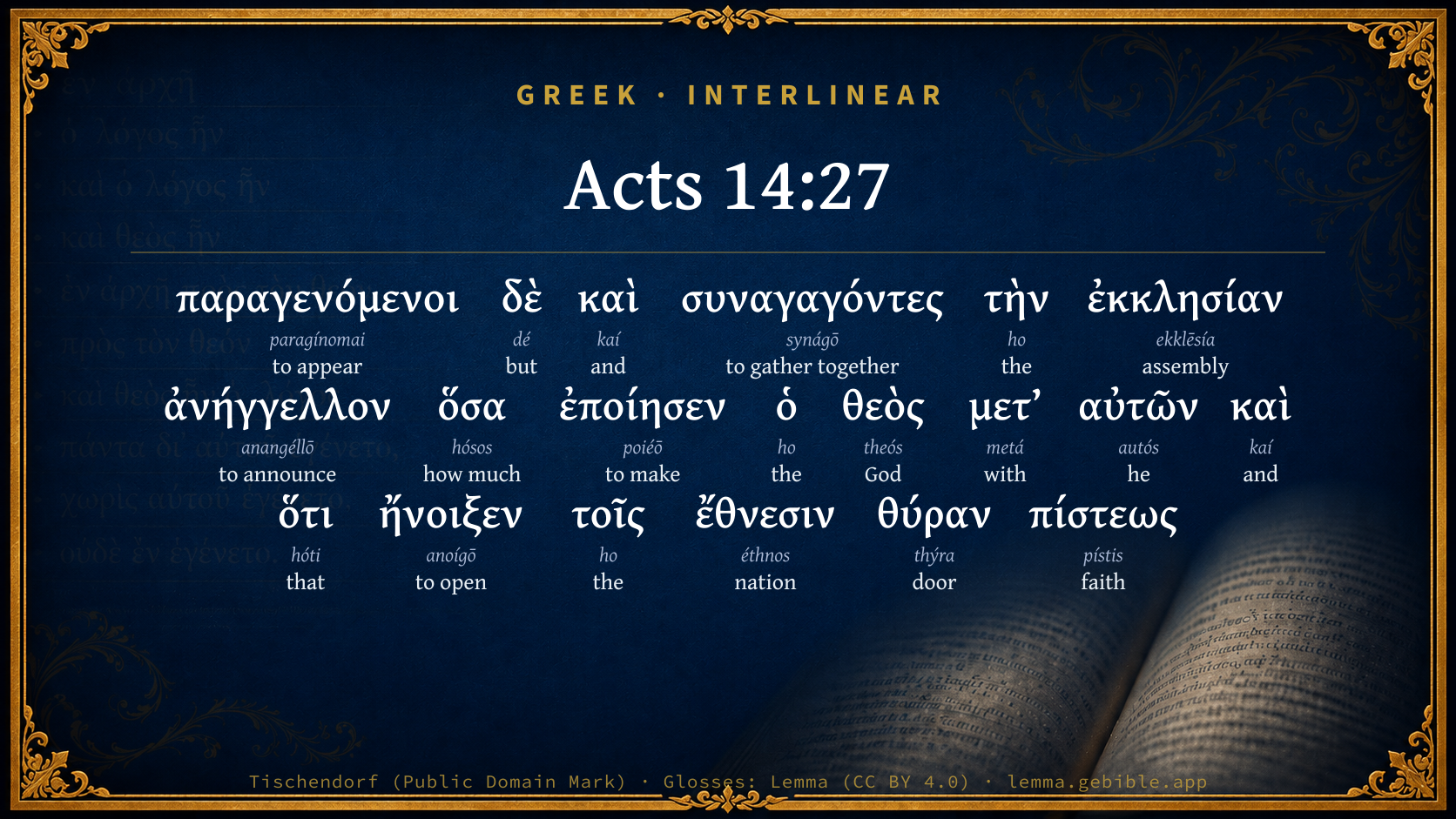
Greek (Tischendorf 8th ed.) Acts 14:27 appears in the Greek New Testament. The text above is from the Tischendorf 8th edition. Each word links to its Strong’s number and a concise gloss. Click any word for its full Thayer’s Greek Lexicon entry.
Download image
Cite this verse

Acts 14:27 (World English Bible). Public Domain. Lemma interlinear Bible study tool, https://lemma.gebible.app/v/acts/14/27.

Show BibTeX & RIS
BibTeX
RIS
English Translation
When they had arrived, and had gathered the assembly together, they reported all the things that God had done with them, and that he had opened a door of faith to the Gentiles.
World English Bible · Public Domain
Download a study sheet

One document with this verse’s original text, its word-by-word gloss line, the meaning frame, cross-references with their text, attributed commentary, and full source and license credits — printable, and it pastes into notes with its structure intact.

This verse Autodidact and up

Study sheet (.html) Plain text (.txt)

A passage Seminary Student

Up to 50 verses in one chapter. A passage sheet keeps up to 6 commentary sources and 12 cross-references per verse, in the order this page ranks them, and says so on the sheet whenever that leaves anything out. Ask for a single verse and you get the Autodidact verse sheet above.

Everything on this page stays free to read, with no account — the sheet is a download of what is already on screen, not access to it.

Want to remove ads? Support Godless Engineer
Compare translations 3

The same verse in 3 English versions, stacked beneath the original-language interlinear above. Click any original word for its lexicon entry.

Each is an independent rendering of the whole verse — the interlinear is not word-aligned to these translations.

Highlighted words mark where these versions differ — a whole-verse word diff, not a word-by-word alignment.

  • World English Bible Public Domain
    When they had arrived, and had gathered the assembly together, they reported all the things that God had done with them, and that he had opened a door of faith to the Gentiles.
  • King James Version Public Domain
    And when they were come, and had gathered the church together, they rehearsed all that God had done with them, and how he had opened the door of faith unto the Gentiles.
  • unfoldingWord Literal Text CC BY-SA 4.0
    And having arrived and having gathered the church together, they were reporting how much God had done with them and that he had opened a door of faith for the Gentiles.

unfoldingWord Literal Text — © unfoldingWord, licensed CC BY-SA 4.0. Word-aligned USFM3 via Door43 (git.door43.org/unfoldingWord/en_ult).

Versions to compare (up to 4)

3 of 4 selected

Show all 19 translations

Every available English version of this verse, each an independent rendering of the whole verse.

  • World English Bible Public Domain
    When they had arrived, and had gathered the assembly together, they reported all the things that God had done with them, and that he had opened a door of faith to the Gentiles.
  • Berean Standard Bible Public Domain
    When they arrived, they gathered the church together and reported all that God had done through them, and how He had opened the door of faith to the Gentiles.
  • Majority Standard Bible Public Domain
    When they arrived, they gathered the church together and reported all that God had done through them, and how He had opened the door of faith to the Gentiles.
  • King James Version Public Domain
    And when they were come, and had gathered the church together, they rehearsed all that God had done with them, and how he had opened the door of faith unto the Gentiles.
  • American Standard Version (1901) Public Domain
    And when they were come, and had gathered the church together, they rehearsed all things that God had done with them, and that he had opened a door of faith unto the Gentiles.
  • Revised Version (1885) Public Domain
    And when they were come, and had gathered the church together, they rehearsed all things that God had done with them, and how that he had opened a door of faith unto the Gentiles.
  • Geneva Bible (1599) Public Domain
    And when they were come and had gathered the Church together, they rehearsed all the things that God had done by them, and howe he had opened the doore of faith vnto the Gentiles.
  • Douay-Rheims (1899) Public Domain
    And they abode no small time with the disciples.
  • Young's Literal Translation Public Domain
    and having come and gathered together the assembly, they declared as many things as God did with them, and that He did open to the nations a door of faith;
  • Literal Standard Version CC BY-SA 4.0
    and having come and gathered the assembly together, they declared as many things as God did with them, and that He opened a door of faith to the nations;
  • Unlocked Literal Bible CC BY-SA 4.0
    When they arrived in Antioch and gathered the church together, they reported all the things that God had done with them, and how he had opened a door of faith for the Gentiles.
  • unfoldingWord Literal Text CC BY-SA 4.0
    And having arrived and having gathered the church together, they were reporting how much God had done with them and that he had opened a door of faith for the Gentiles.
  • Darby Bible Public Domain
    And having arrived, and having brought together the assembly, they related to them all that God had done with them, and that he had opened a door of faith to the nations.
  • World Messianic Bible Public Domain
    When they had arrived and had gathered the assembly together, they reported all the things that God had done with them, and that he had opened a door of faith to the nations.
  • Webster's Bible Public Domain
    And when they had come, and had assembled the church, they rehearsed all that God had done with them, and that he had opened the door of faith to the Gentiles.
  • Free Bible Version CC BY-SA 4.0
    When they arrived, they called the church together. They reported everything God had done through them, and how he had opened a door for the foreigners to trust in him.
  • Bible in Basic English Public Domain
    And when they came there, and had got the church together, they gave them an account of all the things which God had done through them, and how he had made open a door of faith to the Gentiles.
  • Text-Critical English NT CC BY 4.0
    After they arrived and gathered the church together, they reported all that God had done through them, and how he had opened a door of faith to the Gentiles.
  • Tyndale New Testament (1534) Public Domain
    When they were come and had gaddered the congregacion to gedder they rehersed all that God had done by them and how he had opened the dore of faith vnto the getyls.

Literal Standard Version (2020), Covenant Press — licensed CC BY-SA 4.0. Text via the HelloAO Bible API (eBible.org). Unlocked Literal Bible (unfoldingWord) — licensed CC BY-SA 4.0. Text via the HelloAO Bible API (eBible.org). unfoldingWord Literal Text — © unfoldingWord, licensed CC BY-SA 4.0. Word-aligned USFM3 via Door43 (git.door43.org/unfoldingWord/en_ult). Free Bible Version, Dr. Jonathan Gallagher — licensed CC BY-SA 4.0. Text via the HelloAO Bible API (eBible.org).

Word by word

More ways to search: Search by grammar → Find every occurrence → Compare this word →

Practice this passage: Drill this verse → Learn its vocabulary →

ἀνήγγελλον
anangéllō
G312
“to announce”
Verb, Imperfect, Active, Indicative, 3rd person, Plural
Part of Speech
Verb
Tense
Imperfect
Voice
Active
Mood
Indicative
Person
3rd person
Number
Plural
Full Thayer's Definition

Origin: from G303 and the base of G32

TDNT: 02:01,1

1. to announce, make known 2. to report, bring back tidings, rehearse
  1. παραγενόμενοι paragínomai G3854 “to appear” Verb, Aorist, Middle deponent, Participle, Nominative, Plural, Masculine
  2. δὲ dé G1161 “but” Conjunction
  3. καὶ kaí G2532 “and” Conjunction
  4. συναγαγόντες synágō G4863 “to gather together” Verb, Aorist, Active, Participle, Nominative, Plural, Masculine
  5. τὴν ho G3588 “the” Article, Accusative, Singular, Feminine
  6. ἐκκλησίαν ekklēsía G1577 “assembly” Noun, Accusative, Singular, Feminine
  7. ὅσα hósos G3745 “how much” Correlative pronoun, Accusative, Plural, Neuter
  8. ἐποίησεν poiéō G4160 “to make” Verb, Aorist, Active, Indicative, 3rd person, Singular
  9. ὁ ho G3588 “the” Article, Nominative, Singular, Masculine
  10. θεὸς theós G2316 “God” Noun, Nominative, Singular, Masculine
  11. μετ’ metá G3326 “with” Preposition
  12. αὐτῶν autós G846 “he” Personal pronoun, Genitive, Plural, Masculine
  13. καὶ kaí G2532 “and” Conjunction
  14. ὅτι hóti G3754 “that” Conjunction
  15. ἤνοιξεν anoígō G455 “to open” Verb, Aorist, Active, Indicative, 3rd person, Singular
  16. τοῖς ho G3588 “the” Article, Dative, Plural, Neuter
  17. ἔθνεσιν éthnos G1484 “nation” Noun, Dative, Plural, Neuter
  18. θύραν thýra G2374 “door” Noun, Accusative, Singular, Feminine
  19. πίστεως pístis G4102 “faith” Noun, Genitive, Singular, Feminine

About this verse

These counts appear in no published source. They are computed here, from the morphology-tagged text and Lemma’s own curated glosses. What Lemma adds →

20
words
17
distinct lemmas
Acts
section

Notable vocabulary

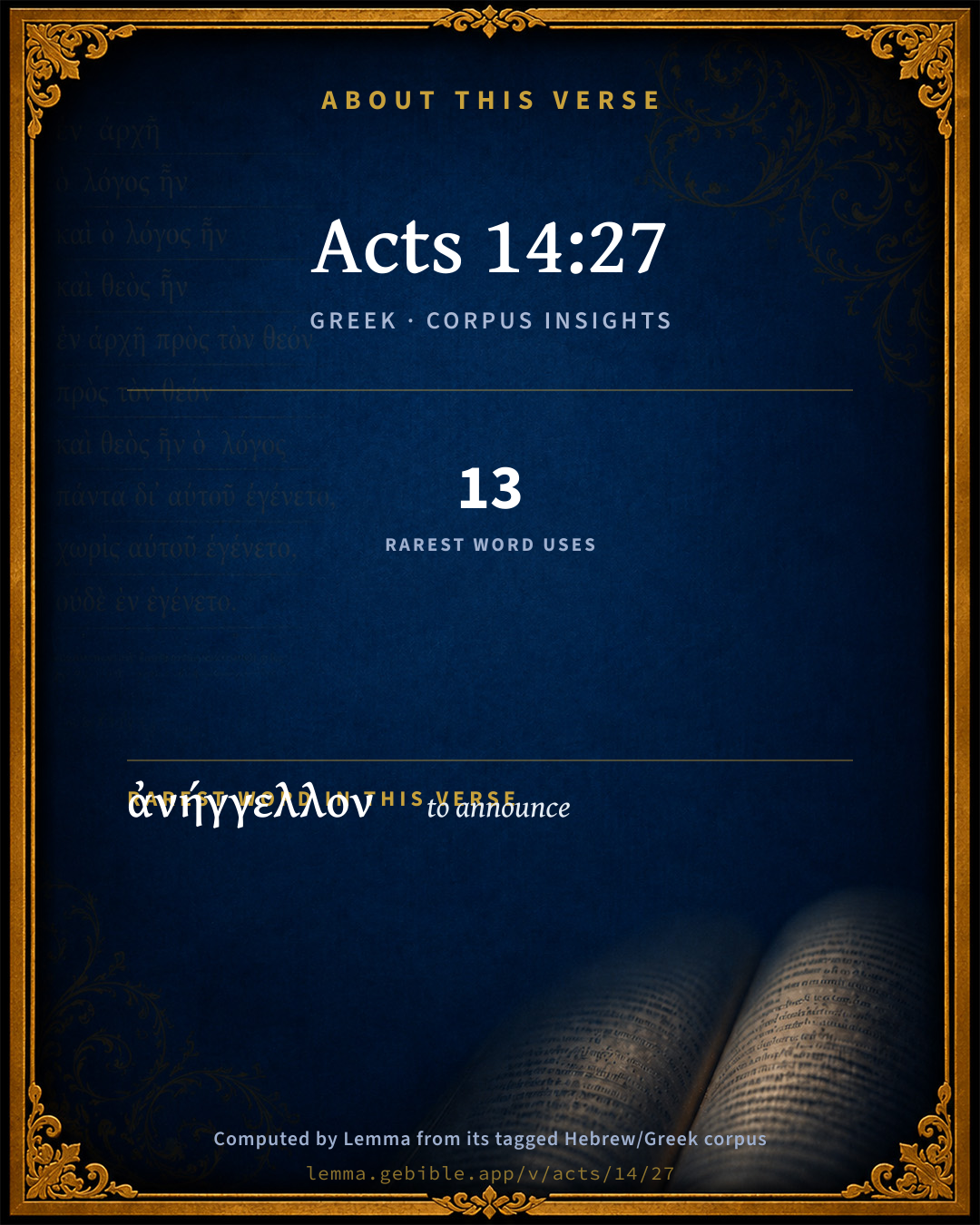
The rarest word here is ἀνήγγελλον to announce G312 — appearing just 13 times in the whole Greek New Testament.

Shared distinctive vocabulary

ἀνήγγελλον to announce G312 occurs in 13 verses of the Greek New Testament. Also found in:

Repetition

Words recur within this verse:

Cross-references

15

Topical passages linked to Acts 14:27 in the Treasury of Scripture Knowledge — connected by theme and wording, ordered by reader-vote popularity; previews shown in the World English Bible.

  • 1 Corinthians 16:9 for a great and effective door has opened to me, and there are many adversaries.
  • Acts 15:12 All the multitude kept silence, and they listened to Barnabas and Paul reporting what signs and wonders God had done among the Gentiles through them.
  • 2 Corinthians 2:12 Now when I came to Troas for the Gospel of Christ, and when a door was opened to me in the Lord,
  • Colossians 4:3 praying together for us also, that God may open to us a door for the word, to speak the mystery of Christ, for which I am also in bonds;
  • 1 Corinthians 5:4 In the name of our Lord Jesus Christ, you being gathered together, and my spirit, with the power of our Lord Jesus Christ,
  • John 9:10 They therefore were asking him, "How were your eyes opened?"
  • Acts 11:18 When they heard these things, they held their peace, and glorified God, saying, "Then God has also granted to the Gentiles repentance to life!"
  • Romans 15:18 For I will not dare to speak of any things except those which Christ worked through me, for the obedience of the Gentiles, by word and deed,
  • 1 Corinthians 3:5–9 Who then is Apollos, and who is Paul, but servants through whom you believed; and each as the Lord gave to him?
  • 1 Corinthians 11:18 For first of all, when you come together in the assembly, I hear that divisions exist among you, and I partly believe it.
  • Revelation 3:7–8 "To the angel of the assembly in Philadelphia write: "He who is holy, he who is true, he who has the key of David, he who opens and no one can shut, and who shuts and no one opens, says these things:
  • Acts 15:3–6 They, being sent on their way by the assembly, passed through both Phoenicia and Samaria, declaring the conversion of the Gentiles. They caused great joy to all the brothers.
  • Acts 21:19–22 When he had greeted them, he reported one by one the things which God had worked among the Gentiles through his ministry.
  • 1 Corinthians 14:23 If therefore the whole assembly is assembled together and all speak with other languages, and unlearned or unbelieving people come in, won't they say that you are crazy?
  • 1 Corinthians 15:10 But by the grace of God I am what I am. His grace which was bestowed on me was not futile, but I worked more than all of them; yet not I, but the grace of God which was with me.

Cross-references courtesy of OpenBible.info (CC BY 4.0).

Commentary

Notes on Acts 14:27 from classic Christian and Jewish commentators (each source and its license shown beneath its notes). The classic Christian expositions comment on the surrounding passage and are grouped to its opening verse, so a note may address several verses; the Jewish commentaries on the Tanakh (Rashi and others) are per-verse, so they appear only where the commentator wrote on this verse.

Lemma curates 59 commentaries, every one of them public domain or Creative Commons licensed, each selected and text-cleaned for this edition rather than reprinted as found. About our sources →

Joseph Benson's Commentary

Act 14:27-28. And when they had gathered the church together — It is probable the Christians at Antioch were more than ordinarily met, or could meet, in one place; but on this occasion they called together the leading persons of them, particularly the ministers and deacons, here termed the church, as the heads of the tribes are often called the congregation of Israel, in the books of Moses. Or, perhaps, as many of the people as the place of meeting could contain, came together on this occasion. They rehearsed all that God had done with, or by, them — In the whole of their voyages and journeys, in all the countries through which they had passed. The same expression is used Act 15:4; but it is explained, (Act 14:12) of the miracles and wonders which God had wrought among the Gentiles by them; of which wonders the chief, no doubt, was, that God had communicated the Holy Ghost to the Gentile converts, and thereby declared his acceptance of them without circumcision; and how he had opened the door of faith unto the Gentiles — Who had continued so long in ignorance, idolatry, and misery; making the gospel to shine into their hearts, and graciously receiving them into the number of his people.

Joseph Benson's Commentary on the Old and New Testaments (1811–1818) — public domain. Text from a community e-Sword module.

MacLaren's Expositions of Holy Scripture

Alexander MacLaren

Acts

‘THE DOOR OF FAITH’

Act 14:27.

There are many instances of the occurrence of this metaphor in the New Testament, but none is exactly like this. We read, for example, of ‘a great door and effectual’ being opened to Paul for the free ministry of the word; and to the angel of the Church in Philadelphia, ‘He that openeth and none shall shut’ graciously says, ‘I have set before thee a door opened, which none can shut.’ But here the door is faith, that is to say faith is conceived of as the means of entrance for the Gentiles into the Kingdom, which, till then, Jews had supposed to be entered by hereditary rite.

I. Faith is the means of our entrance into the Kingdom.

The Jew thought that birth and the rite of circumcision were the door, but the ‘rehearsing’ of the experiences of Paul and Barnabas on their first missionary tour shattered that notion by the logic of facts. Instead of that narrow postern another doorway had been broken in the wall of the heavenly city, and it was wide enough to admit of multitudes entering. Gentiles had plainly come in. How had they come in? By believing in Jesus. Whatever became of previous exclusive theories, there was a fact that had to be taken into account. It distinctly proved that faith was ‘the gate of the Lord into which,’ not the circumcised but the ‘righteous,’ who were righteous because believing, ‘should enter.’

We must not forget the other use of the metaphor, by our Lord Himself, in which. He declares that He is the Door. The two representations are varying but entirely harmonious, for the one refers to the objective fact of Christ’s work as making it possible that we should draw near to and dwell with God, and the other to our subjective appropriation of that possibility, and making it a reality in our own blessed experience.

II. Faith is the means of God’s entrance into our hearts.

We possess the mysterious and awful power of shutting God out of these hearts. And faith, which in one aspect is our means of entrance into the Kingdom of God, is, in another, the means of God’s entrance into us. The Psalm, which invokes the divine presence in the Temple, calls on the ‘everlasting doors’ to be ‘lifted up,’ and promises that then ‘the King of Glory will come in.’ And the voice of the ascended Christ, the King of Glory, knocking at the closed door, calls on us with our own hands to open the door, and promises that He ‘will come in.’

Paul prayed for the Ephesian Christians ‘that Christ may dwell in your hearts through faith,’ and there is no other way by which His indwelling is possible. Faith is not constituted the condition of that divine indwelling by any arbitrary appointment, as a sovereign might determine that he would enter a city by a certain route, chosen without any special reason from amongst many, but in the nature of things it is necessary that trust, and love which follows trust, and longing which follows love should be active in a soul if Christ is to enter in and abide there.

III. Faith is the means of the entrance of the Kingdom into us.

If Christ comes in He comes with His pierced hands full of gifts. Through our faith we receive all spiritual blessings. But we must ever remember, what this metaphor most forcibly sets forth, that faith is but the means of entrance. It has no worth in itself, but is precious only because it admits the true wealth. The door is nothing. It is only an opening. Faith is the pipe that brings the water, the flinging wide the shutters that the light may flood the dark room, the putting oneself into the path of the electric circuit. Salvation is not arbitrarily connected with faith. It is not the reward of faith but the possession of what comes through faith, and cannot come in any other way. Our ‘hearts’ are ‘purified by faith,’ because faith admits into our hearts the life, and instals as dominant in them the powers, the motives, the Spirit, which purify. We are ‘saved by faith,’ for faith brings into our spirits the Christ who saves His people from their sins, when He abides in them and they abide in Him through their faith.

Alexander MacLaren, Expositions of Holy Scripture (1904–1910) — public domain. Text from a community e-Sword module.

Bengel's Gnomon

Johann Albrecht Bengel

Act 14:27. Συναγόντες, when they had gathered together) for this purpose. So ch. Act 15:30.—ἀνήγγειλαν, they reported) they rehearsed all to those who, conscious of Barnabas and Saul’s Divine call, had eagerly looked for their success. [A true rehearsal of the course of the Gospel may often bring with it manifold fruit: ch. Act 15:3-4; Act 15:12. How rare are narrative sermons of this kind!—V. g.]—μετʼ αὐτῶν, with themselves) Comp. μετὰ, with, ch. Act 15:4; Luk 1:58; Luk 10:37.—θύραν, door) Joh 10:1-2, etc.; Psa 118:19. Comp. Act 10:45, note [When the one Gentile, Cornelius, was admitted, the door was thrown open to all]. Paul calls it εἴσοδον entering in, 1Th 1:9

Bengel's Gnomon of the New Testament — English translation (T&T Clark, Edinburgh, 1860) — public domain. Text from a community e-Sword module.

Meyer's Critical & Exegetical Commentary

Heinrich August Wilhelm Meyer

Act_14:27-28. Συναγαγ.] expressly for this object. Comp. Act_15:30. Calvin observes well: quemadmodum solent, qui ex legatione reversi sunt, rationem actorum reddere.

μετʼ αὐτῶν] standing in active connection with them. Comp. Act_10:38; Mat_28:20; also 1Co_15:10; and Mar_16:20 : τοῦ κυρίου συνεργοῦντος. As the text requires no deviation from this first and most natural rendering, both the explanation per ipsos (Beza, Piscator, Heinrichs) and the assumption of a Hebraism עשׂה with עִם (Luk_1:72): quae ipsis Deus fecisset (Calvin, de Dieu, Grotius, Kuinoel, and many others; comp. also de Wette), are to be rejected.

καὶ ὅτι] and, in particular, that, etc.

ἤνοιξε θύραν πίστεως] a figurative designation of admission to the faith in Christ. Corresponding is the figurative use of θύρα in 1Co_16:9; 2Co_2:12; Col_4:3 (of the fulfilling of apostolic work); comp. also εἴσοδος, 1Th_1:9.

χρόνον οὐκ ὀλίγον] is the object of διέτριβον, as in Act_14:3 : they spent not a little time in intercourse with the Christians.

Meyer — Critical and Exegetical Commentary on the New Testament — English translation by Peter Christie, edited by Frederick Crombie (T&T Clark, 1880) — public domain. Text from a community e-Sword module.

Expositor's Greek Testament

ed. W. Robertson Nicoll

Act 14:27 . συν . τὴν ἐκκλ ., cf. Act 15:30 , as was natural, for they had been sent out by them. ἀνήγγειλαν : Act 15:4 (Act 20:20 ; Act 20:27 ), lit [277] , to carry back tidings (so in classical Greek, as from a less to a greater), cf. 2Co 7:7 ; used here as in Æschylus, Xen., Polyb., of messengers reporting what they had seen or heard (Grimm). Blass takes it as simply = ἀπαγγέλλω as in LXX and later Greek. ὅσα : “how many (or ‘how great’) things”. μετʼ αὐτῶν , i.e. , on their behalf; cf. Act 15:4 , Luk 1:58 ; Luk 1:72 ; Luk 10:37 , cf. 1Sa 12:24 , Psa 126:2-3 , Hebrew עָשָׂה עִם , Psa 119:65 , and cannot = per ipsos , which would require διά the phrase may therefore be described as a Hebraism; it occurs only in Luke; Friedrich, p. 33. ὅτι ἤνοιξε … θύραν : a striking coincidence with St. Paul’s use of the same metaphor elsewhere, cf. 1Co 16:9 , 2Co 2:12 , Col 4:3 , and cf. Rev 3:8 . St. Paul’s Galatian Epistle clearly shows that his missionary work in Galatia had met with much success, and that the Churches now founded held a large place in his affections, cf. Gal 4:14-15 . Enough had been accomplished, even if all his desires were still unfulfilled, to make him eager for a continuation of the work to which he had been called as an Apostle of the Gentiles, see McGiffert, Apostolic Age , pp. 191, 192; Hort, Ecclesia , p. 66: “perhaps the greatest epoch in the history of the Ecclesia at large”: Spitta refers the whole verse to his Redactor, p. 171.

[277] literal, literally.

The Expositor's Greek Testament, edited by W. Robertson Nicoll (1897–1910) — public domain. Text from a community e-Sword module.

Jamieson, Fausset & Brown

Robert Jamieson, A. R. Fausset & David Brown

when they had gathered the church together, they rehearsed all that God had done with them, &c.--As their call and mission had been solemn and formal, in the presence of and by the Church as well as the Holy Ghost, they dutifully, and no doubt with eager joy, convened the church and gave their report of "all that God had done with them," that is, by and for them.

and how--in particular.

he had opened the door of faith to the Gentiles--to such even as before had not been proselytes. (See on Act 11:21; and on the language, see Co1 16:9; Co2 2:12; Col 4:3). The ascribing directly to God of such access to the Gentiles is to be noted.

Jamieson, Fausset & Brown — Commentary Critical and Explanatory on the Whole Bible (1871) — public domain (CC PDM 1.0). Text via the HelloAO Bible API.

Adam Clarke's Commentary

Verse 27. Had gathered the Church together] The Church by which they had been sent on this very important and successful mission.

They rehearsed all that God had done with them] Not what they had done themselves; but what GOD made them the instruments of working.

And how he had opened the door of faith] How God by his providence and grace had made a way for preaching Christ crucified among the heathen; and how the heathen had received that Gospel which, through faith in Christ Jesus, was able to save their souls.

Adam Clarke's Commentary on the Bible (1810–1826) — public domain. Text from a community e-Sword/MySword module.

John Calvin's Commentaries

27. After they had called the Church together. As those who return from an embassage used to give an account of their acts, so Paul and Barnabas declared to the Church all the sum of their voyage, that it may thereby appear what good success they had, and how faithfully they behaved themselves in their office; and also that they may exhort the faithful to give thanks to God, as the thing itself gave them large matter; therefore Luke saith, Not that they did extol the things which they themselves had done, but whatsoever things the Lord had done by them. It is word for word with them; but according to the phrase of the Hebrew tongue, it is all one as if it had been said, in them, or by them, or towards them, or simply to them, in the dative case. Therefore Luke doth not say συν αυτοις, but μετα αυτων; which I say for this cause, lest any unskillful man ascribe some part of the praise to Paul and Barnabas, as if they had been partners with God in the work; whereas he doth rather make him the only author of all those famous facts which they had done.

Luke addeth immediately after, that the Lord had opened the door of faith to the Gentiles; for though they were sent unto the Gentiles, yet the strangeness [novelty] of the matter causeth them to wonder not a little; and not only the sudden change did make the Jews astonished, but also because it was to them as it were a monster, that unclean men, and such as were strangers from the kingdom of God, should be mixed with the holy seed of Abraham, that they might both together make one and ‘the same Church of God. They are now taught by the event itself, that it was not for nothing that there were apostles sent to them. Moreover, it is said that the door of faith was set open to the Gentiles, not only because the gospel was preached to them with the external voice, but because, being illuminated by the Spirit of God, they were called effectually unto the faith. The kingdom of heaven is indeed set open to us by the external preaching of the gospel; but no man entereth in save he to whom God reacheth out his hand; no man draweth near unless he be drawn inwardly by the Spirit. Therefore, Paul and Barnabas show and prove by the effect that their calling was approved and ratified by God, because the faith of the Gentiles was, as it were, a seal engraven by the hand of God to establish the same, as Paul saith, (Romans 16:25; 2 Corinthians 3:7.)

John Calvin's Commentaries (1540-1563) — public domain. Text from the Calvin Translation Society English edition (1840s-50s) via the Christian Classics Ethereal Library (ccel.org). Calvin's coverage is partial (roughly two-thirds of the Bible); uncommented books and verses are honest gaps, never fabricated. The 19th-century editor's footnotes and remarks are omitted so the notes are faithfully Calvin's own voice.

Ellicott's Commentary for English Readers

(27) And when they were come.—Two years or thereabouts (A.D. 45-48) had passed since their mission. During that interval little probably had been heard of them, and we can picture to ourselves the eagerness with which the Christiani of Antioch would gather to listen to their report.

How he had opened the door of faith unto the Gentiles.—This is noticeable as the first occurrence, as far as the chronological order of the books of the New Testament is concerned, of a very characteristic phrase. It would seem to have been a favourite metaphor of St. Paul’s (comp. 1Co_16:1; 2Co_2:12; Col_4:3), and comes in here, probably, as a fragment from his speech. From this point of view it is interesting to note the recurrence of the phrase in Rev_3:8, both St. Paul and St. John, representing as they did different sections of the Church (Gal_2:9), agreeing in the thought that the door of the Father’s house was now opened wider than it had ever been before, and that no man might shut it.

A Bible Commentary for English Readers, edited by Charles John Ellicott (1878–1897) — public domain. Text from a community e-Sword module.

The Cambridge Bible for Schools and Colleges

gen. ed. J. J. S. Perowne

27. and had gathered the church together] i.e. the Christian congregation at Antioch who had been moved by the Spirit (Act_13:2) to send them forth. It was fitting therefore that to them should be made a declaration of the results of the Apostolic mission.

opened the door of faith] i.e. had made faith the ground of admission to His kingdom. It was now no longer through circumcision that men should enter in and be known as God’s people, but the Gospel privileges were offered to every one that believed.

The Cambridge Bible for Schools and Colleges (gen. ed. J. J. S. Perowne; Cambridge University Press, 1878–1918) — public domain. Text from a community e-Sword module.

John Gill's Exposition

And there they abode long time with the disciples. That is, Paul and Barnabas continued a considerable time at Antioch with the believers there, before they set out on another journey; and what might detain them the longer, might be the disputes they had with some "judaizing" Christians, concerning the observation of the law; of which, and the issue of them, an account is given in the next chapter.

Next: Acts Chapter 15

John Gill's Exposition of the Whole Bible (1746–1763) — public domain (CC PDM 1.0). Text via the HelloAO Bible API.

Trapp's Complete Commentary

John Trapp

27 And when they were come, and had gathered the church together, they rehearsed all that God had done with them, and how he had opened the door of faith unto the Gentiles.

Ver. 27. Preached the word in Perga] A city of Pamphylia, much addicted to the worship of Diana, who was therehence called Pergea. Gratea nullo modo est gratia, quae non est gratuita, saith Augustine. Note this against the doctrine of merits foreseen, and freewill.

And how he had opened the door of faith] Indeed of heaven, by the preaching of the doctrine of faith: there being no other ordinary way of attaining salvation either for Jews or Gentiles, as St Paul proves in his Epistle to the Romans; {a} as in that to the Colossians, he determineth, that the soul is spoiled by philosophy, if it be not after Christ, Col 2:8. Those school divines, therefore, qui salutem spondet absque Christi cognitione (as Acosta hath it), who open a door to heaven without faith in Christ, were much mistaken. And so were those Collen divines too, that wrote a book of the salvation of Aristotle; whom they make to be Christ’s forerunner in naturals, like as John Baptist was in supernaturals.

{a} Son 8:9; "If she be a door," i.e. if she have faithful ministers, which, as a door, open the way to Christ.

John Trapp, A Commentary or Exposition upon All the Books of the Old and New Testament (1647–1656) — public domain. Text from a community e-Sword module.

Albert Barnes' Notes on the Bible

They rehearsed ... - Act 11:4. They related what had happened; their dangers and their success. This they did because they had been sent out by the church, and it was proper that they should give an account of their work; and because it furnished a suitable occasion of gratitude to God for his mercy.

All that God had done ... - In protecting, guarding them, etc. All was traced to God.

Had opened the door of faith - Had furnished an opportunity of preaching the gospel to the Gentiles, 1Co 16:9; 2Co 2:12.

Albert Barnes' Notes on the Bible (1834–1885) — public domain. Text from a community e-Sword/MySword module.

Haydock's Catholic Bible Commentary

No little time. It is not precisely known how long he remained there, nor what he did. St. Luke relates nothing of what happened from the 46th year of Christ to the 51st [from A.D. 46 to A.D. 51], in which the Council of Jerusalem was held. It is probable St. Paul spent that time carrying the gospel among the neighbouring provinces. (Calmet)

George Leo Haydock (1774–1849), Haydock's Catholic Family Bible and Commentary, 1859 edition — public domain. Excludes Psalms (Douay-Rheims chapter numbering differs from Protestant) and Deuterocanonical books (Catholic canon only).

Matthew Poole's English Annotations

All that God had done with them; God being with them, and they being labourors with God, 1Co 3:9; 2Co 6:1. They showed how much God had honoured them in making them his instruments in the conversion of so many souls.

He had opened the door of faith unto the Gentiles; he had given the Gentiles an opportunity of knowing and believing the gospel. The fleece alone had been wet before, and all the ground round about it dry; and now all the ground is wet, and that fleece was dry; to allude to Jdg 6:37-40, by which this mystery was presignified, and can only be resolved by that of our Saviour, Mat 11:25,26; Even so, Father; for so it seemed good in thy sight.

Matthew Poole's English Annotations on the Holy Bible (1683–1685) — public domain. Text from a community e-Sword/MySword module.

The Pulpit Commentary

All things for all, A.V.; how that for how, A.V.; a door for the door, A.V. A door. The door is preferable, because "the faith" limits the door to one kind of opening. in Col_4:3 the case is a little different both in the A.V. and the R.V., though in the latter "the door of the Word" would be a truer rendering. Observe how the leading idea of the narrative is the conversion of the Gentiles. (See Introduction to the Acts.)

The door of faith.

When may it be said that God has "opened the door of faith" through which men may enter? This is true, as described in the text when

I THE CHRISTIAN FAITH IS FIRST PRESENTED TO THOSE WHO HAVE BEEN BROUGHT UP IN SOME FORM OF ERROR. It was opened, through the hand of Paul, to the Gentiles, and multitudes entered in thereat. This may be said when

II THE CHRISTIAN FAITH IS TAUGHT TO CHILDREN. Then it is gradually widened as their intelligence opens; it is not long before it is sufficiently open for the soul to pass through and hold intimate and living converse with the Divine Friend.

III THE CHRISTIAN FAITH IS FIRST PRESENTED TO THE MIND IN AN APPRECIABLE FORM. Always essentially and fundamentally the same, the truth may be represented in such form as to be wholly inappreciable by some minds; but, on the other hand, it may be unfolded in such wise as exactly to meet the needs and satisfy the cravings of the soul. Then there is an opening through which the satisfied intellect can pass, and where the soul may feed and be sustained. Or when

IV THE CHRISTIAN FAITH IS FIRST URGED ON THE CONSCIENCE WITH DIVINE POWER. When all material considerations Rink into insignificance and the soul feels, profoundly, that the living truth of God as revealed in Jesus Christ is the one supreme and sovereign thing, then the door is opened wide, through which the soul should pass without delay, for on the inner side of it is

(1) rectitude,

(2) peace,

(3) usefulness,

(4) eternal life. C.

The door of faith.

The narrative of the returned missionaries, as given to the assembled Church at Antioch, took two forms in part it was a personal narrative of what they had done and suffered; and in part it was a report of the acceptance which the gospel message had received in the countries they had visited. And in this part of their account, one thing appeared to them to be of peculiar interest God had manifestly "opened the door of faith unto the Gentiles." The expression is a sufficiently striking one to be made the subject of earnest meditation. Two ways of explaining it may be suggested.

1. God had given them large and free access to the Gentiles for the preaching of the faith in Christ.

2. God had manifestly made faith, not circumcision, the ground of admission to his kingdom; and so the Gentiles could be saved. Gospel privileges were offered to everyone that believed. For St. Paul"s use of this figure of the "door" variously applied, see 1Co_16:9, 2Co_2:12; Col_4:3; and comp. Rev_3:8. The figure is a suggestive one. The special favor of God had been enjoyed by the Jews, and in a manner limited to them. They had been, as it were, shut up with God in his house; none else might come in, for the door was shut. But now, in the greatness of God"s mercy to men, he had opened the door, made a new and most gracious condition of admission, and invited "whosoever would" to enter in. The grace of this was too surprising to the Jewish mind, and it was a long time ere it could receive the truth. Such testimonies as Barnabas and Paul brought from Gentile lauds did much to establish the free right of all believing men to enter the one Father"s house, through his graciously opened door.

I THE CHRISTIAN MISSIONARIES FOUND FREE ACCESS TO THE GENTILES. They had gone forth fully understanding that the door was open to preach the gospel to the Jews. They knew that, wherever they went, they could enter the synagogues, expound the Scriptures, and preach Christ; but events that happened brought home to them the conviction that Jewish privileges were no longer exclusive, and that God had "granted unto the Gentiles also repentance unto life." Recall the incidents which brought to the missionaries this conviction. They found Divine providence leading them to speak to Gentile audiences. They found that Divine grace had been before them, creating in the Gentile mind a preparedness for and a susceptibility to the gospel message. And they found that the condition of entrance into the new gospel standing and gospel privileges was one which the Gentiles could meet, since faith is common to human nature, and in no sense special to any one race. It would even seem that the missionaries felt their work among the Gentiles to be more hopeful than that among the Jews. And it led them to cherish serious thoughts about the vast work to be done among the Gentile nations, now God had so evidently opened the door to them all. Illustrate from the way in which the Church of Christ has been led on to preach the gospel to one nation after another, by the opening of providential doors; especially illustrating from China, and more recently Central Africa. The inspiration of Christian missions is this fact, "God has opened the door of faith unto the Gentiles.

II THE CHRISTIAN MISSIONARIES HAD LEARNED TO DECLARE THAT FAITH, AND FAITH ALONE, WAS THE GROUND OF ADMISSION INTO GOD"S KINGDOM, They addressed an audience that was still largely under Jewish mental bonds. Even the early disciples seem for a long time to have cherished the idea that Christianity was only a reformation of Judaism. The very apostles could not readily accept the truth of salvation by faith alone. They thought that at least the Jewish requirement of circumcision must be made. But Barnabas and Paul rendered their testimony to the fact of their finding the "faith-condition" quite sufficient. They had required no other of their Gentile converts, and God had sealed them by the gift of his Spirit, and they had manifested every sign of the true Christian life. Faith is the only door into the kingdom, but there is no entrance save by this door. Still the gospel message is, Believe on the Lord Jesus Christ, and thou shalt be saved. R.T.

The Pulpit Commentary (1880–1919), ed. H.D.M. Spence-Jones & Joseph S. Exell — public domain. Text from a community e-Sword module.

McGarvey & Pendleton's Commentaries

J. W. McGarvey

27, 28. The apostles had now completed their missionary tour, and there could but be great anxiety in the congregation who had sent them forth, to know the result of their labors. It was the first mission ever sent to the heathen world. The missionaries were as eager to report the success with which their sufferings and toil had been crowned, as the congregation were to hear it. He who returns from a hard-fought field bearing good tidings, pants beneath the burden of his untold story. (27) " And having arrived and assembled the Church together, they rehearsed all that God had done with them, and that he had opened a door of faith to the Gentiles. (28) And they continued there no little time with the disciples. " In the statement that God had "opened a door of faith to the Gentiles," this is an allusion both to the opening of that national inclosure which had hitherto confined the gospel almost exclusively to the Jews, and the introduction of the distant Gentiles through that door into the Church. Before this, faith had been to them inaccessible; for "how shall they believe on him of whom they had not heard?" But now that the preachers had been sent out to them, the door was open, and faith was accessible to all.

J. W. McGarvey (with Philip Y. Pendleton), Commentaries on the New Testament (The Fourfold Gospel, 1914; Acts; and the epistles) — public domain. Text from a community e-Sword/MySword module.

unfoldingWord translationNotes

Door43 World Missions Community

General Information:

Here the words "they," "them," and "They" refer to Paul and Barnabas. The word "he" refers to God.

gathered the church together

"called the local believers to meet together"

he had opened a door of faith for the Gentiles

God's enabling the Gentiles to believe is spoken of as if he had opened a door that had prevented them from entering into faith. AT: "God had made it possible for the Gentiles to believe" (See: Metaphor)

translationWords

faith

Gentile

disciple

unfoldingWord translationNotes — © Distant Shores Media and the Door43 World Missions Community, licensed CC BY-SA 4.0. Source: git.door43.org/Door43/en_tn.

Cambridge Greek Testament for Schools and Colleges

27. καὶ συναγαγόντες τὴν ἐκκλησίαν, and having gathered the Church together, i.e. the Christian congregation at Antioch who had been moved by the Spirit (Act 13:2) to send them forth. It was fitting therefore that to them should be made a declaration of the results of the Apostolic mission.

ὅσα ἐποίησεν ὁ θεὸς μετ’ αὐτῶν, all that God had done with them. The expression occurs again in Act 15:4. The preposition implies that they felt through the whole work that their motto was Immanuel = God with us, cooperating and conspiring with every effort. Chrysostom on this verse says, οὐκ εἶπον ὅσα αὐτοὶ ἐποίησαν, ἀλλ’ ὅσα ὁ θεὸς μετ’ αὐτῶν.

ἤνοιξεν τοῖς ἔθνεσι θύραν πίστεως, had opened the door of faith unto the Gentiles, i.e. had made faith the ground of admission to His kingdom. It was now no longer through circumcision that men should enter in and be known as God’s people. The Gospel privileges were offered to every one that believed. The phrase ἀνοίγειν θύραν in this sense first occurs here: cf. 1Co 16:9; 2Co 2:12; Col 4:3; Rev 3:8.

Cambridge Greek Testament for Schools and Colleges (Cambridge University Press, 1896; 21 vols, various authors incl. Carr, Maclear, Plummer, Farrar, Lumby, Moule, M. R. James, Simcox) — public domain. Text from a community e-Sword module.

Alford’s Greek Testament

Henry Alford

27.] μετʼ αὐτῶν, with (i.e. in dealing with) them, see reff.: not to them, as usually: nor per ipsos, as Beza, &c.

θύραν πίστ.] The same metaphor is used in the reff. by Paul, and shews, perhaps, his hand in the narrative.

On χρόν. οὐκ ὀλίγ., see chronol. table in Prolegg.

Henry Alford, The Greek Testament (1849–1861) — public domain. Text from a community e-Sword module.

Vincent's Word Studies in the New Testament

Marvin R. Vincent

With them [μετ αυτων] . In connection with them; assisting them. And how [και οτι] . Better, that. The and has an incressive and particularizing force : "and in particular, above all."

Marvin R. Vincent, Word Studies in the New Testament (1887–1900) — public domain. Text from a community e-Sword/MySword module.

Lesson kit

Teaching starters — assembled from the data on this page, not authored interpretation. Every prompt links to the verse data it draws on. Edit before teaching.

Acts, in the Acts, opens this verse with 20 words (17 distinct Greek lemmas). Its most distinctive word is anangéllō (“to announce”). A historical commentator’s framing appears above. Read the whole chapter for the surrounding context.

Discussion questions

  1. What does “to announce” (anangéllō) contribute to the verse as a whole?
  2. How does John 4:25, which shares the word «to announce», read alongside this verse?
  3. What does the repetition of “the” (3× in this one verse) do in this verse?
  4. These translations render this verse differently; the difference is in the English rendering, not the original. What questions does that raise?
  5. Compare how Joseph Benson's Commentary and MacLaren's Expositions of Holy Scripture read this verse. Where do they agree or differ?

Things to notice

Reading settings

Reading text

Shown beneath each verse's original-language words.

Old Testament
Old Testament edition

Read the OT as the Masoretic Hebrew (MT) or the Greek Septuagint (LXX).

English shown for the Greek Septuagint (in the Hebrew ↔ Greek comparison).

Comparing translations? Open the Compare panel on any verse page to stack up to four side by side.