1 Thessalonians 4:5

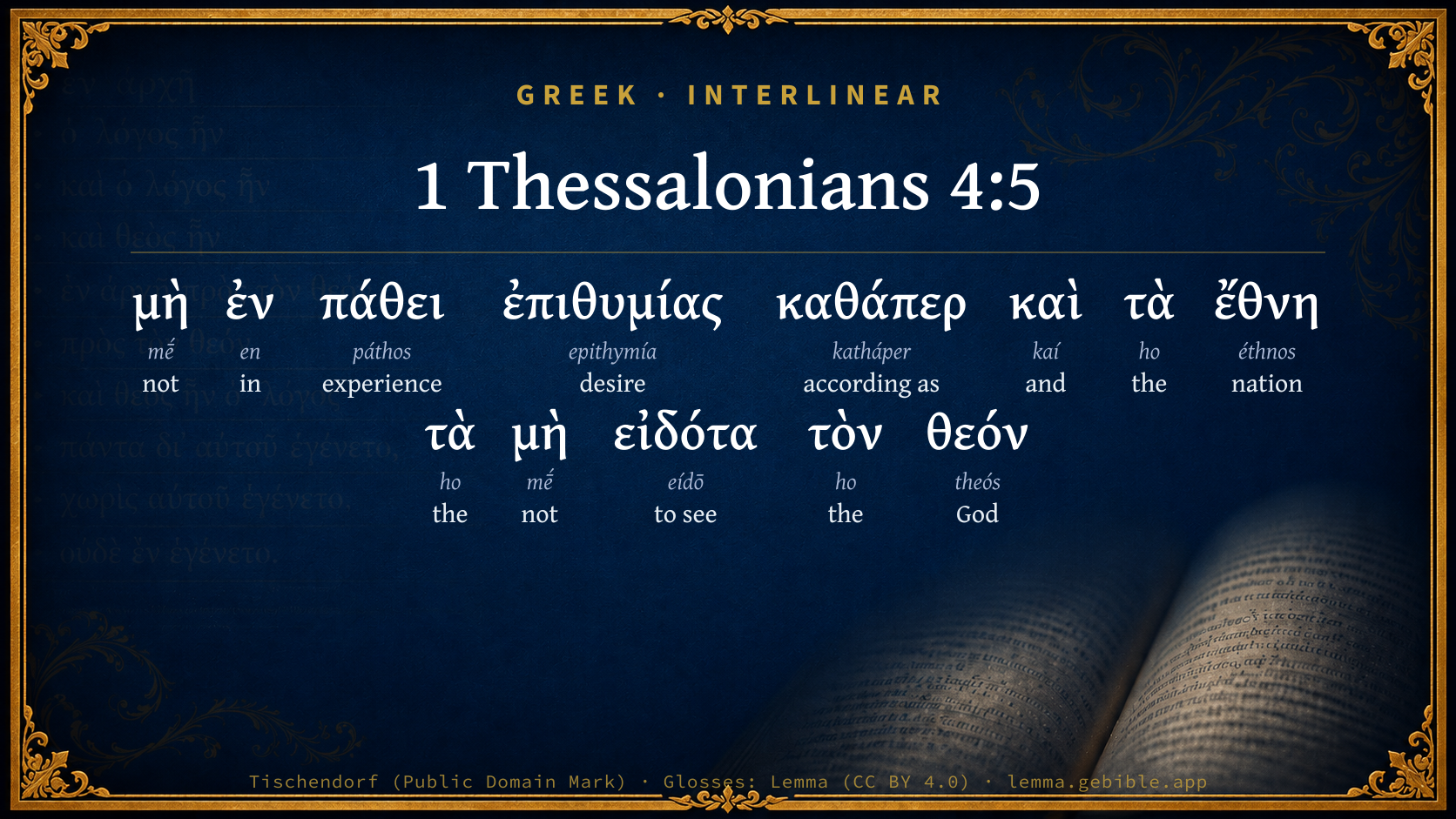
Greek (Tischendorf 8th ed.) 1 Thessalonians 4:5 appears in the Greek New Testament. The text above is from the Tischendorf 8th edition. Each word links to its Strong’s number and a concise gloss. Click any word for its full Thayer’s Greek Lexicon entry.
Download image
Cite this verse

1 Thessalonians 4:5 (World English Bible). Public Domain. Lemma interlinear Bible study tool, https://lemma.gebible.app/v/1-thessalonians/4/5.

Show BibTeX & RIS
BibTeX
RIS
English Translation
not in the passion of lust, even as the Gentiles who don't know God;
World English Bible · Public Domain
Download a study sheet

One document with this verse’s original text, its word-by-word gloss line, the meaning frame, cross-references with their text, attributed commentary, and full source and license credits — printable, and it pastes into notes with its structure intact.

This verse Autodidact and up

Study sheet (.html) Plain text (.txt)

A passage Seminary Student

Up to 50 verses in one chapter. A passage sheet keeps up to 6 commentary sources and 12 cross-references per verse, in the order this page ranks them, and says so on the sheet whenever that leaves anything out. Ask for a single verse and you get the Autodidact verse sheet above.

Everything on this page stays free to read, with no account — the sheet is a download of what is already on screen, not access to it.

Want to remove ads? Support Godless Engineer
Compare translations 3

The same verse in 3 English versions, stacked beneath the original-language interlinear above. Click any original word for its lexicon entry.

Each is an independent rendering of the whole verse — the interlinear is not word-aligned to these translations.

Highlighted words mark where these versions differ — a whole-verse word diff, not a word-by-word alignment.

  • World English Bible Public Domain
    not in the passion of lust, even as the Gentiles who don't know God;
  • King James Version Public Domain
    Not in the lust of concupiscence, even as the Gentiles which know not God:
  • unfoldingWord Literal Text CC BY-SA 4.0
    not in the passion of lust (just as also the Gentiles, the ones not knowing God);

unfoldingWord Literal Text — © unfoldingWord, licensed CC BY-SA 4.0. Word-aligned USFM3 via Door43 (git.door43.org/unfoldingWord/en_ult).

Versions to compare (up to 4)

3 of 4 selected

Show all 19 translations

Every available English version of this verse, each an independent rendering of the whole verse.

  • World English Bible Public Domain
    not in the passion of lust, even as the Gentiles who don't know God;
  • Berean Standard Bible Public Domain
    not in lustful passion like the Gentiles who do not know God;
  • Majority Standard Bible Public Domain
    not in lustful passion like the Gentiles who do not know God;
  • King James Version Public Domain
    Not in the lust of concupiscence, even as the Gentiles which know not God:
  • American Standard Version (1901) Public Domain
    not in the passion of lust, even as the Gentiles who know not God;
  • Revised Version (1885) Public Domain
    not in the passion of lust, even as the Gentiles which know not God;
  • Geneva Bible (1599) Public Domain
    And not in the lust of concupiscence, euen as the Gentiles which know not God:
  • Douay-Rheims (1899) Public Domain
    Not in the passion of lust, like the Gentiles that know not God:
  • Young's Literal Translation Public Domain
    not in the affection of desire, as also the nations that were not knowing God,
  • Literal Standard Version CC BY-SA 4.0
    not in the affection of desire, as also the nations that were not knowing God,
  • Unlocked Literal Bible CC BY-SA 4.0
    not in the passion of lust (as the Gentiles who do not know God).
  • unfoldingWord Literal Text CC BY-SA 4.0
    not in the passion of lust (just as also the Gentiles, the ones not knowing God);
  • Darby Bible Public Domain
    (not in passionate desire, even as the nations who know not God,)
  • World Messianic Bible Public Domain
    not in the passion of lust, even as the Gentiles who don’t know God,
  • Webster's Bible Public Domain
    Not in the lust of concupiscence, even as the Gentiles who know not God:
  • Free Bible Version CC BY-SA 4.0
    not indulging passionate lust like the heathen who have no knowledge of God.
  • Bible in Basic English Public Domain
    Not in the passion of evil desires, like the Gentiles, who have no knowledge of God;
  • Text-Critical English NT CC BY 4.0
    not in lustful passion like the Gentiles who do not know God.
  • Tyndale New Testament (1534) Public Domain
    and not in the lust of concupiscence as do the hethen which knowe not god

Literal Standard Version (2020), Covenant Press — licensed CC BY-SA 4.0. Text via the HelloAO Bible API (eBible.org). Unlocked Literal Bible (unfoldingWord) — licensed CC BY-SA 4.0. Text via the HelloAO Bible API (eBible.org). unfoldingWord Literal Text — © unfoldingWord, licensed CC BY-SA 4.0. Word-aligned USFM3 via Door43 (git.door43.org/unfoldingWord/en_ult). Free Bible Version, Dr. Jonathan Gallagher — licensed CC BY-SA 4.0. Text via the HelloAO Bible API (eBible.org).

Word by word

More ways to search: Search by grammar → Find every occurrence → Compare this word →

Practice this passage: Drill this verse → Learn its vocabulary →

πάθει
páthos
G3806
“experience”
Noun, Dative, Singular, Neuter
Part of Speech
Noun
Case
Dative
Number
Singular
Gender
Neuter
Full Thayer's Definition

Origin: from the alternate of G3958

TDNT: 20:26,8

1. whatever befalls one, whether it be sad or joyous a. spec. a calamity, mishap, evil, affliction 2. a feeling which the mind suffers a. an affliction of the mind, emotion, passion b. passionate deed c. used by the Greeks in either a good or bad sense d. in the NT in a bad sense, depraved passion, vile passions
  1. μὴ mḗ G3361 “not” Particle, Negative
  2. ἐν en G1722 “in” Preposition
  3. ἐπιθυμίας epithymía G1939 “desire” Noun, Genitive, Singular, Feminine
  4. καθάπερ katháper G2509 “according as” Adverb
  5. καὶ kaí G2532 “and” Conjunction
  6. τὰ ho G3588 “the” Article, Nominative, Plural, Neuter
  7. ἔθνη éthnos G1484 “nation” Noun, Nominative, Plural, Neuter
  8. τὰ ho G3588 “the” Article, Nominative, Plural, Neuter
  9. μὴ mḗ G3361 “not” Particle, Negative
  10. εἰδότα eídō G1492 “to see” Verb, Perfect, Active, Participle, Nominative, Plural, Neuter
  11. τὸν ho G3588 “the” Article, Accusative, Singular, Masculine
  12. θεόν theós G2316 “God” Noun, Accusative, Singular, Masculine

About this verse

These counts appear in no published source. They are computed here, from the morphology-tagged text and Lemma’s own curated glosses. What Lemma adds →

13
words
10
distinct lemmas
Pauline Epistles
section

Notable vocabulary

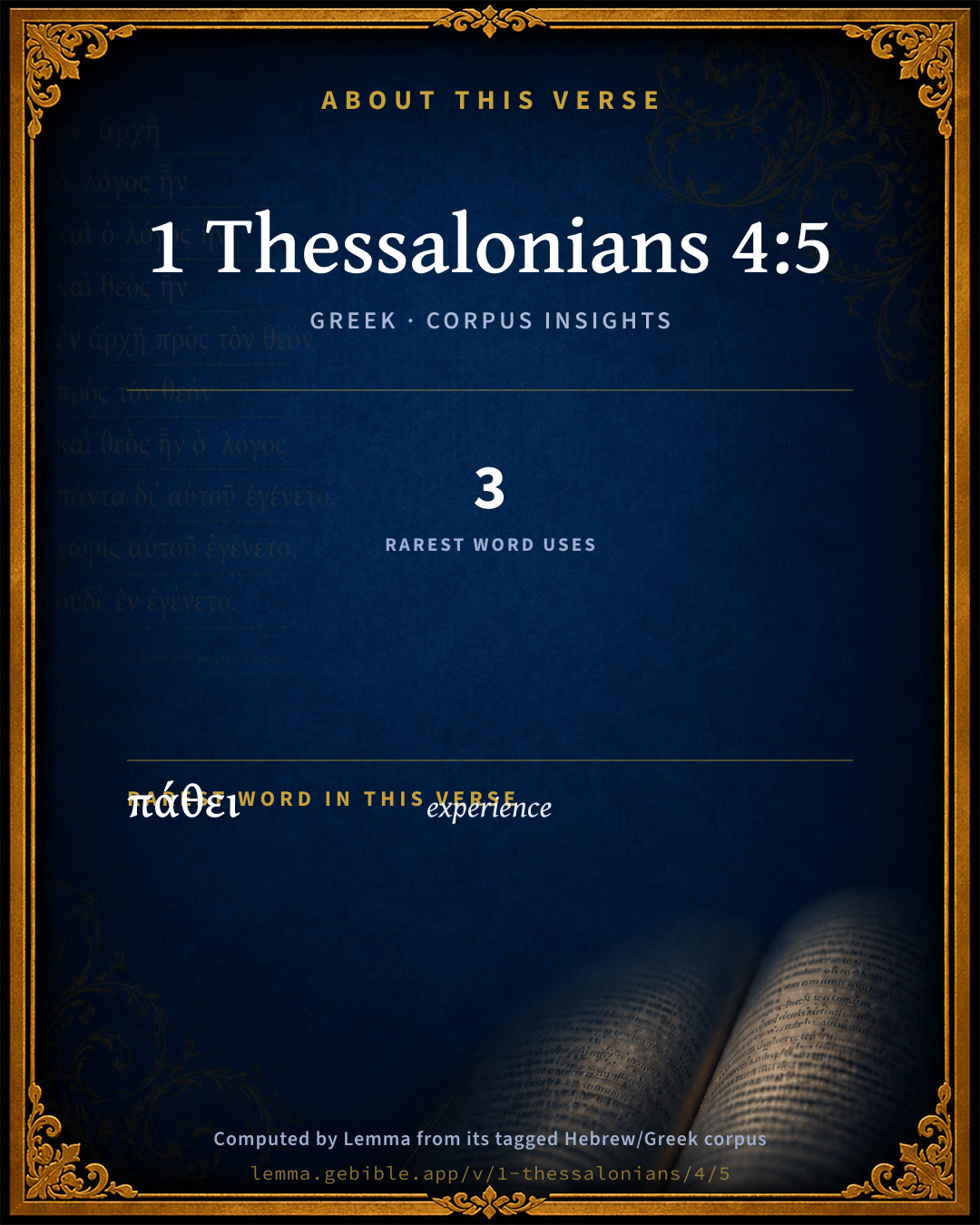
The rarest word here is πάθει experience G3806 — appearing just 3 times in the whole Greek New Testament.

Shared distinctive vocabulary

πάθει experience G3806 occurs in 3 verses of the Greek New Testament. Also found in:

Repetition

Words recur within this verse:

Cross-references

15

Topical passages linked to 1 Thessalonians 4:5 in the Treasury of Scripture Knowledge — connected by theme and wording, ordered by reader-vote popularity; previews shown in the World English Bible.

  • Galatians 4:8 However at that time, not knowing God, you were in bondage to those who by nature are not gods.
  • Acts 17:30–31 The times of ignorance therefore God overlooked. But now he commands that all people everywhere should repent,
  • Ephesians 4:17–19 This I say therefore, and testify in the Lord, that you no longer walk as the rest of the Gentiles also walk, in the futility of their mind,
  • Colossians 3:5 Put to death therefore your members which are on the earth: sexual immorality, uncleanness, depraved passion, evil desire, and covetousness, which is idolatry;
  • 2 Thessalonians 1:8 giving vengeance to those who don't know God, and to those who don't obey the Gospel of our Lord Jesus,
  • Romans 1:26 For this reason, God gave them up to vile passions. For their women changed the natural function into that which is against nature.
  • Romans 1:28 Even as they refused to have God in their knowledge, God gave them up to a reprobate mind, to do those things which are not fitting;
  • 1 Corinthians 15:34 Wake up righteously, and don't sin, for some have no knowledge of God. I say this to your shame.
  • Ephesians 2:12 that you were at that time separate from Christ, alienated from the commonwealth of Israel, and strangers from the covenants of the promise, having no hope and without God in the world.
  • 1 Peter 4:3 For we have spent enough of our past time doing the desire of the Gentiles, and having walked in lewdness, lusts, drunken binges, orgies, carousings, and abominable idolatries.
  • Matthew 6:32 For the Gentiles seek after all these things, for your heavenly Father knows that you need all these things.
  • Luke 12:30 For the nations of the world seek after all of these things, but your Father knows that you need these things.
  • Acts 17:23 For as I passed along, and observed the objects of your worship, I found also an altar with this inscription: 'TO AN UNKNOWN GOD.' What therefore you worship in ignorance, this I announce to you.
  • Romans 1:24 Therefore God also gave them up in the lusts of their hearts to uncleanness, that their bodies should be dishonored among themselves,
  • 1 Corinthians 1:21 For seeing that in the wisdom of God, the world through its wisdom didn't know God, it was God's good pleasure through the foolishness of the preaching to save those who believe.

Cross-references courtesy of OpenBible.info (CC BY 4.0).

Commentary

Notes on 1 Thessalonians 4:5 from classic Christian and Jewish commentators (each source and its license shown beneath its notes). The classic Christian expositions comment on the surrounding passage and are grouped to its opening verse, so a note may address several verses; the Jewish commentaries on the Tanakh (Rashi and others) are per-verse, so they appear only where the commentator wrote on this verse.

Lemma curates 59 commentaries, every one of them public domain or Creative Commons licensed, each selected and text-cleaned for this edition rather than reprinted as found. About our sources →

Tyndale Open Study Notes

Tyndale Open Resources

4:5 Willful ignorance of God and his ways is the root of moral corruption (Rom 1:18-32; Eph 4:17-18). • lustful passion: Sexual immorality was often tolerated in the Mediterranean world. Prostitution was allowed, but sexual relations with another man’s wife were prohibited. Roman marriage customs barred women, but not men, from extramarital affairs. By contrast, Jewish and Christian authors alike prohibited all sexual involvement outside of marriage (Acts 15:20; 1 Cor 6:12-20; Col 3:5-6).

Tyndale Open Study Notes — © Tyndale Open Resources, licensed CC BY-SA 4.0. Text via the HelloAO Bible API.

Bengel's Gnomon

Johann Albrecht Bengel

1Th 4:5. Μὴ ἐν πάθει ἐπιθυμίας, not in the lust of concupiscence) As concupiscence gains the mastery, it at length waxes strong, so as to become a wretched passion and disease, 2Sa 13:4.—τὰ ἔθνη, the Gentiles) These are also denoted at 1Th 4:12-13, by different periphrases [“them that are without,” 1Th 4:11: ‘others,’ οἱ λοιποί, 1Th 4:13].—τὰ μὴ εἰδότα, who know not) Ignorance is the origin of unchastity, Rom 1:24. [Look at the serenity of heaven, and thou wilt conceive a loathing of impurity.—V. g.]

Bengel's Gnomon of the New Testament — English translation (T&T Clark, Edinburgh, 1860) — public domain. Text from a community e-Sword module.

Meyer's Critical & Exegetical Commentary

Heinrich August Wilhelm Meyer

1Th_4:5 brings forward the prescription ἐν ἁγιασμῷ καὶ τιμῇ once more on account of its importance, but now in a negative form.

μὴ ἐν πάθει ἐπιθυμίας] not in the passion of desire. Accordingly, Paul does not here forbid ἐπιθυμία, for this in itself, as a natural impulse, rests on the holy ordinance of God, but a πάθος ἐπιθυμίας, that is, a condition where sense has been converted into the ruling principle or into passion. Theodore Mopsuestius (ed. Fritzsche, p. 165): ὡσὰν τοῦτο ποιοῦντος οὐκέτι ταύτῃ ὡς γυναικὶ συνόντος ἀλλὰ διὰ μίξιν μόνην ἁπλῶς, ὅπερ πάθος ἐπιθυμίας ἐκάλεσεν.

καί] after καθάπερ is not added for the sake of elegance (Pelt), but is the usual καί after particles of comparison; see 1Th_2:14, 1Th_3:6; 1Th_3:12, 1Th_4:6; 1Th_4:13; Rom_4:6, etc.; Hartung, Partikell. I. p. 126.

τὰ μὴ εἰδότα τὸν Θεόν] of whom nothing better is to be expected. Comp. on the expression, Gal_4:8; 2Th_1:8.

Meyer — Critical and Exegetical Commentary on the New Testament — English translation by Peter Christie, edited by Frederick Crombie (T&T Clark, 1880) — public domain. Text from a community e-Sword module.

Geneva Bible (1599)

Geneva Bible translators

The third, because the Saints are discerned from them which know not God, by honesty and purity.

Geneva Bible (1599) marginal notes — public domain. Text via Bolls.life.

Jamieson, Fausset & Brown

Robert Jamieson, A. R. Fausset & David Brown

in the lust--Greek, "passion"; which implies that such a one is unconsciously the passive slave of lust.

which know not God--and so know no better. Ignorance of true religion is the parent of unchastity (Eph 4:18-19). A people's morals are like the objects of their worship (Deu 7:26; Psa 115:8; Rom 1:23-24).

Jamieson, Fausset & Brown — Commentary Critical and Explanatory on the Whole Bible (1871) — public domain (CC PDM 1.0). Text via the HelloAO Bible API.

Adam Clarke's Commentary

Verse 5. Not in the lust of concupiscence] Having no rational object, aim, nor end. Some say, "not like beasts;" but this does not apply as they who use it wish, for the males and females of the brute creation are regular and consistent in their intercourse, and scarcely ever exceed such bounds as reason itself would prescribe to those most capable of observing and obeying its dictates.

The Gentiles which know not God] These are the beasts; their own brutes are rational creatures when compared with them. Enough has been said on this subject on Romans 1, and 2: They who wish to see more may consult Juvenal, and particularly his 6th and 9th Satires; and indeed all the writers on Greek and Roman morals.

Adam Clarke's Commentary on the Bible (1810–1826) — public domain. Text from a community e-Sword/MySword module.

Ellicott's Commentary for English Readers

(5) Not in the lust of concupiscence, for such a method of using one’s faculties, such an attempt to acquire mastery of vital powers, is really to abandon them altogether to others. This notion is involved in the very word here translated “lust,” which is more often rendered “passion,” and implies something which befalls a man, something done to him: “Not in the helpless passivity of concupiscence” or uncontrolled desire.

The Gentiles which know not God.—Mind the punctuation. The readers of the letter were “Gentiles which knew God.” Their brother Thessalonians. are held up to them as melancholy examples of men who are trying in the wrong way to show their power over themselves. Remark that this is not one of the crimes which he alleges against Jews.

A Bible Commentary for English Readers, edited by Charles John Ellicott (1878–1897) — public domain. Text from a community e-Sword module.

The Cambridge Bible for Schools and Colleges

gen. ed. J. J. S. Perowne

5. not in the lust of concupiscence] Far better, not in the passion of lust (R. V.). The sense of the last verb (to possess) is carried on, with a modified application, into this clause: not (to have it: i.e. your body) in a state of lustful passion. (For the altered meaning of the verb, comp. 1Co_3:2 : “I gave you milk to drink, not meat”). This condition—the state of one immersed “in” wicked desire—is the opposite of “sanctification and honour.”

The word “passion” signifies not so much a violent feeling, as an overpowering feeling, one to which the man so yields himself that he is borne along by evil as if he were its passive instrument; he has lost the dignity of self-rule, and is the slave of his lower appetites. Comp. Rom_7:5, “the passions of sins which wrought in our members;” and Rom_7:20, “It is no longer I that do it, but sin that dwelleth in me.”

In such shameful bondage lived the Gentiles which know not God (an O. T. expression, Psa_79:6, Isa_45:4-5; recurring in 2Th_1:8, see note). For impurity, often in most abandoned and revolting forms, was a prevailing feature of Pagan life at this time. In Rom_1:24, &c., St Paul speaks of this as a punishment of the heathen world for its wilful ignorance of God: “He gave them up unto passions of dishonour.” Man first denies his Maker; then degrades himself.

The God Whom these degraded “Gentiles knew not,” is the “living and true God” of ch. 1Th_1:9, to Whom Thessalonian believers had “turned from their idols.” Coming to know Him by His gospel, they had devoted themselves to Him; and so their bodies had been redeemed from vice and dishonour, and the soul had a clean house to live in, a clean vessel to use for holy service.

The Cambridge Bible for Schools and Colleges (gen. ed. J. J. S. Perowne; Cambridge University Press, 1878–1918) — public domain. Text from a community e-Sword module.

John Gill's Exposition

Not in the lust of concupiscence,.... Or "passion of lust"; for the mere gratifying and indulging of that; for a man so to possess his vessel, is to cherish the sin of concupiscence, the first motions of sin in the heart, by which a man is drawn away, and enticed; to blow up the flame of lust, and to make provision for the flesh to fulfil the lusts thereof:

even as the Gentiles which know not God; for, though they knew him, or might know him with a natural knowledge, by the light and works of nature, yet they knew him not savingly and spiritually, as he is revealed in the word, of which they were destitute; or as the God of all grace, and the God and Father of Christ, or as he is in Christ: and though by the light of nature they might know there was a God, yet they knew not who that God was; nor did they act up to that light and knowledge they had; they did not glorify him as God, by ascribing to him what was his due; nor were they thankful for the mercies they received from him; nor did they fear, love, worship, and serve him; nor did they like to retain him in their knowledge, and therefore were given up to judicial blindness and hardness, to a reprobate mind, and to vile affections, and so did things very inconvenient, unnatural, and dishonourable. Wherefore, for a man to use either his wife or his body in any unchaste and dishonourable manner, for the gratifying of his lusts, is to act an Heathenish part; a like argument, dissuading from things unlawful, is used in Mat 6:32.

John Gill's Exposition of the Whole Bible (1746–1763) — public domain (CC PDM 1.0). Text via the HelloAO Bible API.

Trapp's Complete Commentary

John Trapp

5 Not in the lust of concupiscence, even as the Gentiles which know not God:

Ver. 5. Not in the lust of concupiscence] Or, in the disease of lust, that dishonourable disease, Rom 1:26, that wasteth not only the substance of the body, but the honesty and the honour of it.

John Trapp, A Commentary or Exposition upon All the Books of the Old and New Testament (1647–1656) — public domain. Text from a community e-Sword module.

Albert Barnes' Notes on the Bible

Not in the lust of concupiscence - In gross gratifications.

Even as the Gentiles - This was, and is, a common vice among the pagan; see the Act 15:20 note; Rom 1:29 note; Eph 4:17-18 notes, and the reports of missionaries everywhere.

Which know not God - See the Rom 1:21, Rom 1:28 notes; Eph 2:12 note.

Albert Barnes' Notes on the Bible (1834–1885) — public domain. Text from a community e-Sword/MySword module.

Matthew Poole's English Annotations

Any violence of affection we call passion, whether of love, or anger, or desire, because the soul is passive, or suffers thereby. The Stoics said passions were not incident to a wise man; and: They that are Christ’s, saith the apostle, have crucified the flesh with the passions and lusts, Gal 5:24. And lust is usually taken for all inordinate affection, either with respect to the object or degree; though the Greek word doth signify only desire, and is sometimes taken in a good sense, as Phi 1:23; for, there are good lustings as well as evil, as Gal 5:17, the Spirit lusteth against the flesh; but here the word is taken in a bad sense, for the lust of uncleanness, which the apostle here calls

the lust of concupiscence. The philosophers distinguish of the affections or passions of the soul, some are irascible, some concupiscible. The former are conversant about evil, to repel it or fly from it; the latter about good, either real or imaginary, to pursue it or embrace it. And the lusts of concupiscence are either of the mind or of the flesh, Eph 2:3; here we understand the latter, that fleshly concupiscence that is conversant about women, which if by vessel in the former verse is understood man’s lawful wife, then he forbids all unchasteness even towards her; if the body, then he forbids all unchaste usage of the body in any kind, or towards any person whatsoever. And, to avoid fornication, he forbids lust that leads to it.

Even as the Gentiles which know not God; which the apostle useth as an argument to them: Though ye are Gentiles by nation as well as others, yet not in state, such as know not God. There is a natural knowledge of God, which the apostle speaks of, Rom 1:21, which the Gentiles had; and supernatural, which is by the Scriptures; to know the mind, will, nature, decrees, and counsels of God as they are there revealed: and the knowledge of God in Christ; this is meant in the text, and this the Gentiles had not, and therefore no wonder though they followed the lust of concupiscence, they wanted the rule of God’s word to direct them, and that effectual knowledge of God, and presence of his grace, that would have restrained them from such lust. But these Thessalonians now, since their conversion by the gospel, were come to this knowledge of God, which they had not before, and therefore were not to live as before they did. Knowledge ought to influence our hearts and lives, and to sin against knowledge is the great aggravation of sin, and will make men more inexcusable. But yet where knowledge is wanting what wickedness will not men practise! The Gentiles were alienated from the life of God through the ignorance that was in them, Eph 4:18. The Jews crucified Christ, and Saul persecuted the disciples, through ignorance, 1Ti 1:13. Much more are those Christians to be condemned, who, having more knowledge than the Gentiles, yet practise worse than they; as the apostle upbraids the Jews upon this account, Rom 2:27.

Matthew Poole's English Annotations on the Holy Bible (1683–1685) — public domain. Text from a community e-Sword/MySword module.

Whedon's Commentary on the Bible

Daniel D. Whedon

5. Master your body and use it not in the lust, or passion, of concupiscence, or sensual appetite. This seems to give the balance very decisively in the sense of body. Before vessel, however, the Greek has the word own, omitted by our translators. From this Lunemann strongly argues from the antithesis between having a wife of your own and meddling with other women. But, in spite of his logic, the answer of Olshausen is valid. Nothing material is more a man’s own than his body; and St. Paul might well emphasize the thought that every man should take care of the purity of his own. The strongest argument in favour of the meaning wife. is 1Co_7:2. Let every man have his own wife; which looks very strongly like a parallel passage, a saying the same thing in slightly different words.

As the Gentiles—Who not only were licentious, and often made a boast of license, but even transformed it into a religious rite.

Know not God—They know Jupiter, Mars, and Venus, the impersonation of their own ambition, war, and lust; but God, who wills your sanctification, they know not.

Daniel D. Whedon (gen. ed.), Commentary on the Old and New Testaments (1874–1909) — public domain. Text from a community e-Sword module.

The Pulpit Commentary

Not in the lust of concupiscence not in the passion of lust (R.V)even as the Gentiles which know not God; and therefore from whom nothing better was to be expected. The moral sense of the heathen was so perverted, and their natures so corrupt, that they looked upon fornication as a thing indifferent.

The Pulpit Commentary (1880–1919), ed. H.D.M. Spence-Jones & Joseph S. Exell — public domain. Text from a community e-Sword module.

John Wesley's Explanatory Notes

Not in passionate desire - Which had no place in man when in a state of innocence. Who know not God - And so may naturally seek happiness in a creature. What seemingly accidental words slide in; and yet how fine, and how vastly important!

John Wesley, Explanatory Notes Upon the Whole Bible (1754–1765) — public domain. Text via the GEBible commentary corpus.

McGarvey & Pendleton's Commentaries

J. W. McGarvey

not in the passion of lust, even as the Gentiles who know not God [By "will of God" Paul means the divine desire. Not an absolute desire, but one which human perversity may frustrate. "Sanctification" means holiness in its general sense. In all his Epistles to the Gentile churches Paul introduces exhortations to purity of life. He was at this time in Corinth, whose patron goddess was Venus, and where social impurity abounded. "Heathenism," says Whedon, "had made the crime trivial, jocular, rather smart, and even religious and right. All this must Christianity reverse, and place it among the most heinous sins, and subject to the most fearful penalties." There has been much discussion over the phrase "possess himself of his own vessel," some asserting that it means to acquire a wife, and others that it means to control the body and its desires. The problem is surely a difficult one. The verb "possess" is commonly used to indicate the winning or acquiring of a wife, and 1Pe_3:7 is cited to prove that the word "vessel" is used to indicate a wife. One other citation is given from the Talmud, where Ahasuerus is represented as calling his wife his "vessel." But the Talmud does not prove Hebrew usage in Paul's day, being written many centuries later, and the citation from Peter proves nothing, for the word "vessel" is there used to indicate the human body, the man's being the stronger, and the woman's the weaker. The human body or personality is elsewhere called a vessel in the Bible ( Act_9:15 ; Rom_9:21-23 ; 2Co_4:7 ; 2Ti_2:21 ; 1Sa_21:5 ). This Biblical use of the word is strongly against the idea that it could mean a wife. The word "vessel," then, favors the idea that Paul is talking about the body. On the other hand, it is urged that the verb "possess" here used simply means to win or acquire, and never has that ethical use (to possess morally, to subdue, or control) which is claimed for it here. It is true that no classical or Biblical citations can be given of such a use, but that it is used so here is unquestionable, whichever interpretation we put upon "vessel"; for the full phrase is "possess in sanctification and honor," etc., introduced by the phrase "know how." Conceding that Paul is talking about a wife, he certainly does not mean to say that each man should know how to win or acquire a wife; there is nothing moral or spiritual about such knowledge. What he does say is that a man should know how to hold or possess (either his wife or his body) in sanctification and in honor; i. e., in moral cleanliness. We take it that Paul here urges bodily self-control, and that the passage is a parallel rather to Rom_6:19 than to 1Co_7:2 ];

J. W. McGarvey (with Philip Y. Pendleton), Commentaries on the New Testament (The Fourfold Gospel, 1914; Acts; and the epistles) — public domain. Text from a community e-Sword/MySword module.

The People's New Testament

B. W. Johnson

5. Even as the Gentiles which know not God. Even the greatest of heathen moralists, Socrates, instructed a harlot how she should conduct her shameful business. The heathen moralists condemned unchastity only in the case of a child-bearing wife, as it would wrong her husband not to know the paternity of her children.

B. W. Johnson's The People's New Testament with Notes (1889–1891) — public domain. Electronic text from the Christian Classics Ethereal Library (CCEL) ThML edition.

Cambridge Greek Testament for Schools and Colleges

5. μὴ ἐν πάθει ἐπιθυμίας καθάπερ καὶ τὰ ἔθνη τὰ μὴ εἰδότα τὸν θεόν, not (to do this) in passion of lust, even as the Gentiles also (do), who know not God. Ἐν πάθει ἑπιθυμίας, “in a state of lustful passion”: where the man’s action is dominated by animal desire, there is no sanctity nor honour in the union; even a lawful marriage so effected is a πορνεία in spirit. Πάθος is synonymous with ἀκαθαρσία and ἐπιθυμία κακή in Col 3:5, and is qualified by ἀτιμίας (see ἐν τιμῇ above) in Rom 1:26; the παθήματα of Rom 7:5, Gal 5:24, are particular forms or kinds of πάθος. This word signifies not, like Eng. “passion,” a violent feeling, but an overmastering feeling, in which the man is borne along be evil as though its passive instrument; in this sense Rom 7:20 interprets the παθήματα of Rom 7:5. For ἑπιθυμία, cf. 1Th 2:17; this sinister sense of ἐπιθυμέω (-ία) prevails.

For καθάπερ, cf. 1Th 2:11, 1Th 3:6; 1Th 3:12; used freely by St Paul in the two first groups of his Epistles, but not later. “The Gentiles that know not God,” is an O.T. designation for the heathen, whose irreligion accounts for their depravity (Psa 79:6; Jer 10:25); it recurs in 2Th 1:8 (see note), Gal 4:8. Unchastity, often in abominable forms, was a prominent feature of Gentile life at this time; honourable courtship and fidelity in wedlock were comparatively rare. In Rom 1:24 ff. St Paul points to this sexual corruption, by which in fact the classical civilization was destroying itself, as a punishment inflicted upon the heathen world for its idolatry and wilful ignorance of God, and a terrible evidence of His anger on this account. Man first denies his Maker, and then degrades himself. The God, whom these lustful “Gentiles know not,” is “the living and true God” to whom Thessalonian believers had “turned from their idols” (1Th 1:9). Obeying the call of His gospel, they had consecrated themselves to His service (ἐν ἁγιασμῷ), and so they were redeemed from shame; their affections were hallowed, and their homes founded in the sanctities of an honourable love.

To “know God” is more than an intellectual act; it implies acknowledgement and due regard,—the esteeming Him for what He is (see e.g. Jer 9:23 f.; Tit 1:16). Γινώσκειν is the commoner verb in affirmative statements with God for object (Joh 17:3; Gal 4:9, &c.), as it implies tentative, progressive knowledge; cf., for εἰδέναι, 1Th 4:12 below.

Bornemann proposes a new interpretation of the whole passage, 1Th 4:3-6, placing a comma at σκεῦος, thus made the object of εἰδέναι, and reading κτᾶσθαι in the absolute sense, “to make gain,” with τὸ μὴ ὑπερβαίνειν κ.τ.λ. placed in apposition to the latter. So he arrives at the following rendering: “that you abstain from fornication, that each of you know his own vessel (i.e. acknowledge, appreciate and hold to, his own wife: cf. 1Pe 3:7), seek gain in sanctification and honour, not in the passion of covetousness as the Gentiles &c., that he do not overreach and take advantage of his brother in business.” But εἰδέναι τὸ ἑαυτοῦ σκεῦος, thus taken by itself, forms a very obscure clause, and an inadequate complement to ἀπέχεσθαι … πορνείας; nor is the use of κτᾶσθαι without an object sufficiently supported by the parallels drawn from Eze 7:12 f. (LXX) and Thucyd. i. 70. 4. Moreover the transition to the new topic of fairness in business dealings would be abrupt and unprepared for, if made by κτᾶσθαι without a mediating conjunction; while ἐν πάθει ἐπιθυμίας is an expression decidedly suggesting lust and not avarice. This construction introduces more difficulties than it removes.

1Th 4:6 appears to stand in apposition to 1Th 4:3-5, ἀπέχεσθαι … εἰδέναι κ.τ.λ. Τὸ πρᾶγμα, on this interpretation, is the matter of the marriage relationship expressly violated by πορνεία (1Th 4:3), which must be guarded from every kind of wrong (1Th 4:6). In acts of impurity men sin against society; while defiling themselves, they trick and defraud others in what is dearest. To this aspect of “the matter” τὸ μὴ ὑπερβαίνειν κ.τ.λ. seems to point. For the use of τὸ πρᾶγμα as relating to “the matter” in hand, cf. 2Co 7:11. ἐν τῷ πράγματι gives a wide extension, under this veiled form of reference, to the field of injury. No wrongs excite deadlier resentment and are more ruinous to social concord than violations of womanly purity; none more justly call forth the punitive anger of Almighty God (see the next clause).

On the above view, the article in τὸ μὴ ὑπερβαίνειν καὶ πλεονεκτεῖν has an emphatic resumptive force, as in τὸ μηδένα σαίνεσθαι (1Th 3:3; see note): (I say, or I mean) that none (understand τινά, in view of the following αὐτοῦ, rather than ἕκαστον as carried over from 1Th 4:4) transgress (exceed the limit), and take advantage of his brother in the matter. The verbs ὑπερβαίνειν and πλεονεκτεῖν are quite as appropriate to adulterers, and the like, as to perpetrators of commercial fraud; πλεονεξία includes sins of lust as well as greed (Eph 4:19). Ὑπερβαίνειν, “to step over”—a good classical compound, hap. leg. in N.T.—governs, in this sense, an object of the thing (law, limit, &c.), not the person; it is probably intransitive here. Πλεονεκτεῖν in earlier Greek took a genitive of comparison, “to have advantage over”; in the κοινή it adopted an accusative,—“to take advantage of” any one. Τὸν ἀδελφόν appears to denote the wronged person not specifically as a Christian brother, but in his human claim to sympathy and respect: cf. Mat 5:23 f., Mat 7:3 ff.; 1Jn 2:9 ff.; also 1Th 5:15 below.

The interpretation just given is that of the Greek Fathers, followed by Jerome; and of many moderns, including Estius, Bengel, Alford, Ellicott, Lightfoot, Schmiedel. Most of the Latin interpreters (Vulg. in negotio), with Erasmus, Calvin, Beza, Grotius, Winer, de Wette, Hofmann, Lünemann, Bornemann, understand covetousness to be denounced in these words. They take ἐν τῷ πράγματι to signify “in business” generally, like the plural τὰ πράγματα; or “the (particular) business” in hand, each matter of business as it arises—cf. ἐν τῷ ἀνθρώπῳ in Joh 2:25 (τῷ cannot be read as τῳ = τινί—so in A.V.; this usage is foreign to N.T. Greek). But there is no example of πρᾶγμα (singular) used in the sense supposed; and in view of the strong emphasis thrown on the question of sexual morals in 1Th 4:4 f., the transition to another subject should have been clearly marked. Besides, ἀκαθαρσία (1Th 4:7) is applied elsewhere to sins of the flesh (with the possible exception of 1Th 2:3 above), and this topic covers the whole ground of the preceding 1Th 4:3-6.

διότι ἔκδικος Κύριος περὶ πάντων τούτων, because the Lord is an avenger respecting all these things—everything that concerns the honour of the human person and the sacredness of wedded life; cf. Heb 13:4, πόρνους κ. μοιχοὺς κρινεῖ ὁ θεός. For ἔκδικος, see Rom 13:4; Wis 12:12; Sir 30:6; in earlier Greek the adjective signified unjust (exlex). For the maxim, cf. Rom 12:19; Gal 5:21; Eph 5:5 f.; Col 3:6; and in the O.T., Deu 32:35 (Heb.),—the original of St Paul’s allusions. “All these things” lie within the scope of that vengeance of God which pursues the wrongs of men toward each other; cf., in this connexion, Pro 5:21 f., Pro 6:32 ff., Pro 7:22-27. For διότι, see note on 1Th 2:18. There is no reason to suppose that Κύριος means any other than “the Lord Jesus Christ,” through whom God judges the world at the Last Day: cf. 2Th 1:7-9; Act 17:31, &c.

καθὼς καὶ προείπαμεν ὑμῖν καὶ διεμαρτυράμεθα, as indeed we foretold you and solemnly protested. As to the indispensableness of chastity to the Christian life and the fearful consequences of transgression against its laws, the Thessalonians had been plainly and impressively instructed in the first lessons of the Gospel. For προείπαμεν—in the 1st aorist form, which many familiar 2nd aorists assumed in the κοινή (see Winer-Moulton, pp. 86 f., Blass, Grammar of N.T. Greek, p. 45)—cf. προλέγω, 1Th 3:4 and Gal 5:21; προ-, “before” the event. The μαρτύρομαι of 1Th 2:12 (see note) is strengthened by διά, which implies the presence of God, or the Lord, “through” whom—scil. in whose name—this warning is given; cf. διὰ τοῦ κυρίου Ἰησοῦ, 1Th 4:2, and the references there supplied.

Cambridge Greek Testament for Schools and Colleges (Cambridge University Press, 1896; 21 vols, various authors incl. Carr, Maclear, Plummer, Farrar, Lumby, Moule, M. R. James, Simcox) — public domain. Text from a community e-Sword module.

Alford’s Greek Testament

Henry Alford

5.] ἐν πάθει ἐπιθ.,—πάθει having the emphasis,—‘in the mere passio of lust,’—as Thdr. Mops. (Lün.), ὡς ἂν τοῦτο ποιοῦντος οὐκέτι ταύτῃ ὡς γυναικὶ συνόντος ἀλλὰ διὰ μίξιν μόνην ἁπλῶς, ὅπερ πάθος ἐπιθυμίας ἐκάλεσεν.

καθ. καί] the καί so usual after particles of comparison, points to the association in the same category which the particle supposes: καὶ ἡμῖν ταὑτὰ δοκεῖ ἅπερ καὶ βασιλεῖ, Xen. Anab. ii. 1. 22. See examples in Hartung, Partikell. ii. 127: and cf. ch. 2:13; 3:6, 12, &c.

τὰ μὴ εἰδ. τ. θ.] μή, because the Gentiles are spoken of by the writer from this point of view. It is not a mere fact which is stated, but that fact as logically interwoven with the course of the context: and hence the subjective negative. See reff.

Henry Alford, The Greek Testament (1849–1861) — public domain. Text from a community e-Sword module.

International Critical Commentary

5. μὴ ἐν πάθει ἐπιθυμίας κτλ. Without connecting particle, the positive statement is further elucidated by a negative and the contrast between Pauline and pagan ideals of marriage sharply set forth: “not in the passion of lust as is the case with the Gentiles who do not recognise and obey the moral requirements of God.” That pagan marriage was marked by the absence of holiness and respect for the wife and by the presence of passionate lust is the testimony of one familiar with the facts, one who is “as good a source for the life of the people as any satirist” (Dob.).

πάθο signifies any feeling; to 4 Mac. it consists of ἡδονη and πόνο; in Paul it is always used in a bad sense (Rom 1:26, Col 3:5). ἐπιθυμί in Paul has usually a bad sense, but sometimes a good sense (2:17, Php 1:23; cf. κακὴ ἐπιθυμί, Col 3:5). On καθάπερ και, see 3:6. Ellicott, with his wonted exactness, notes the και as having here “its comparative force and instituting a comparison between the Gentiles and the class implied in ἕκαστον ὑμῶ ” On τὰ μἠ εἰδότα τὸν θεό, a Lxx phrase (Jer 10:25, Psa 78:6), cf. II 1:8, Gal 4:8, 1Co 1:21, and contrast Rom 1:21. If the Thessalonians in their pagan state had held πορνεί to be sanctioned by religion, and had also considered πάθος ἐπιθυμία to be compatible with honourable marriage, the clause with καθάπε would be particularly telling. See Jowett, II, 70 ff. “On the Connexion of Immorality and Idolatry.”

International Critical Commentary — older volumes (1896–1929), various authors — public domain. Text from a community e-Sword module.

Vincent's Word Studies in the New Testament

Marvin R. Vincent

Not in the lust of concupiscence [μη εν παθει επιθυμιας] . Lit. in passion of desire. Not with avaricious greed. For ejpiqumia see on Mr 4:19. Its meaning is by no means limited to sensual lust; see, for instance, Luk 22:15. It is used as including all kinds of worldly desires, as Gal 5:16, 24; 1Jo 2:17. In Rom 7:7, especially of covetousness.

Marvin R. Vincent, Word Studies in the New Testament (1887–1900) — public domain. Text from a community e-Sword/MySword module.

Lesson kit

Teaching starters — assembled from the data on this page, not authored interpretation. Every prompt links to the verse data it draws on. Edit before teaching.

1 Thessalonians, in the Pauline Epistles, opens this verse with 13 words (10 distinct Greek lemmas). Its most distinctive word is páthos (“experience”). A historical commentator’s framing appears above. Read the whole chapter for the surrounding context.

Discussion questions

  1. What does “experience” (páthos) contribute to the verse as a whole?
  2. Romans 1:26 shares the word «experience» with this verse. How do the two illuminate each other?
  3. “the” occurs 3× in this one verse. What is the effect of the repetition?
  4. These translations render this verse differently; the difference is in the English rendering, not the original. What questions does that raise?
  5. Reading how Tyndale Open Study Notes and Bengel's Gnomon read this verse, where do the two commentators agree and where do they part?

Things to notice

Reading settings

Reading text

Shown beneath each verse's original-language words.

Old Testament
Old Testament edition

Read the OT as the Masoretic Hebrew (MT) or the Greek Septuagint (LXX).

English shown for the Greek Septuagint (in the Hebrew ↔ Greek comparison).

Comparing translations? Open the Compare panel on any verse page to stack up to four side by side.