

Romans 11:25
Greek (Tischendorf 8th ed.) Romans 11:25 appears in the Greek New Testament. The text above is from the Tischendorf 8th edition. Each word links to its Strong’s number and a concise gloss. Click any word for its full Thayer’s Greek Lexicon entry.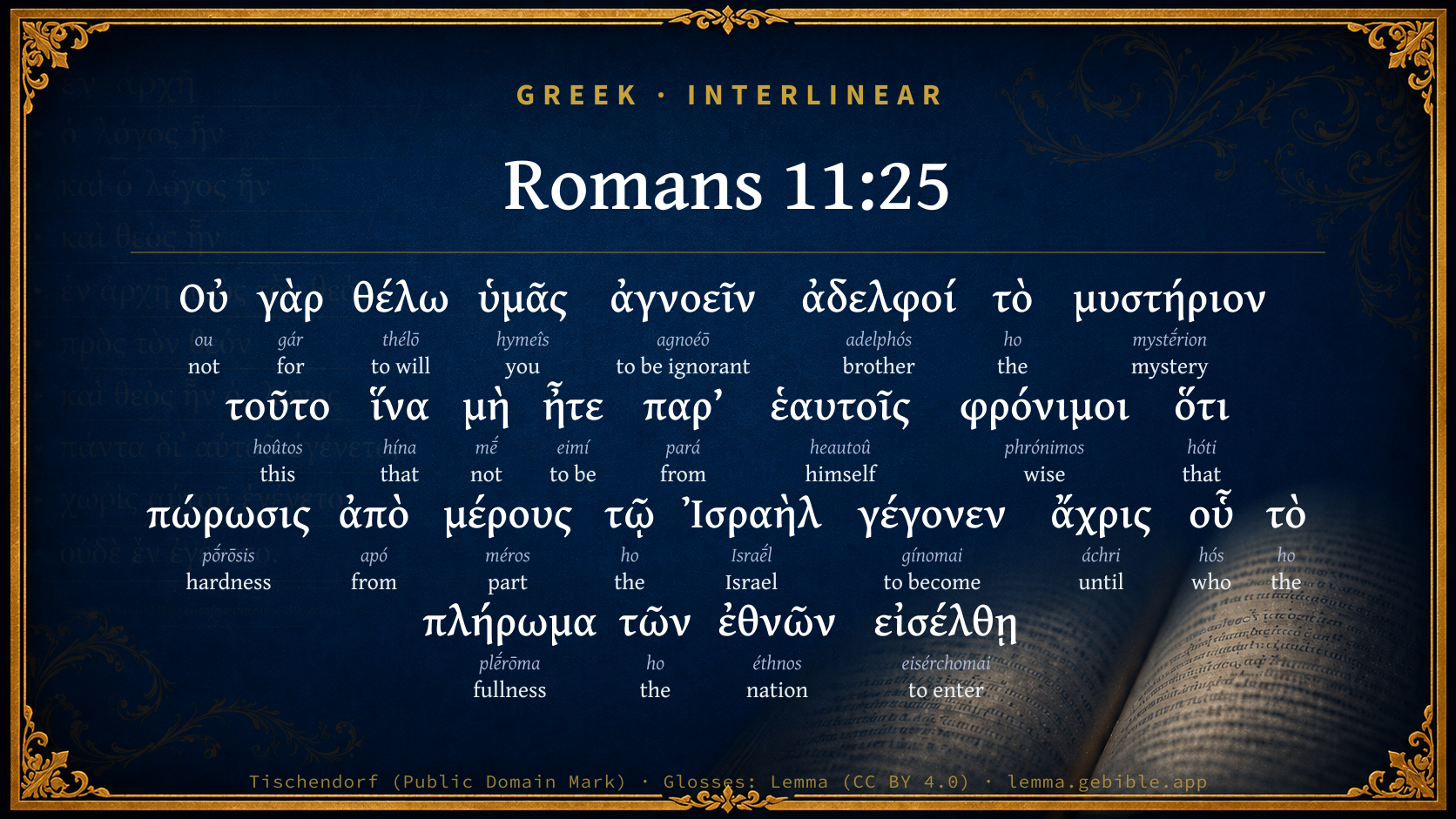
For I don't desire, brothers, to have you ignorant of this mystery, so that you won't be wise in your own conceits, that a partial hardening has happened to Israel, until the fullness of the Gentiles has come in,
Download a study sheet
One document with this verse’s original text, its word-by-word gloss line, the meaning frame, cross-references with their text, attributed commentary, and full source and license credits — printable, and it pastes into notes with its structure intact.
This verse Autodidact and up
A passage Seminary Student
Up to 50 verses in one chapter. A passage sheet keeps up to 6 commentary sources and 12 cross-references per verse, in the order this page ranks them, and says so on the sheet whenever that leaves anything out. Ask for a single verse and you get the Autodidact verse sheet above.
Everything on this page stays free to read, with no account — the sheet is a download of what is already on screen, not access to it.
Compare translations 3
The same verse in 3 English versions, stacked beneath the original-language interlinear above. Click any original word for its lexicon entry.
Each is an independent rendering of the whole verse — the interlinear is not word-aligned to these translations.
Highlighted words mark where these versions differ — a whole-verse word diff, not a word-by-word alignment.
-
World English Bible Public Domain
For I don't desire, brothers, to have you ignorant of this mystery, so that you won't be wise in your own conceits, that a partial hardening has happened to Israel, until the fullness of the Gentiles has come in,
-
King James Version Public Domain
For I would not, brethren, that ye should be ignorant of this mystery, lest ye should be wise in your own conceits; that blindness in part is happened to Israel, until the fulness of the Gentiles be come in.
-
unfoldingWord Literal Text CC BY-SA 4.0
For I do not want you to be ignorant of this mystery, brothers, in order that you might not be wise in yourselves, that a partial hardening has occurred in Israel, until the fullness of the Gentiles has come in;
unfoldingWord Literal Text — © unfoldingWord, licensed CC BY-SA 4.0. Word-aligned USFM3 via Door43 (git.door43.org/unfoldingWord/en_ult).
Show all 19 translations
Every available English version of this verse, each an independent rendering of the whole verse.
-
World English Bible Public Domain
For I don't desire, brothers, to have you ignorant of this mystery, so that you won't be wise in your own conceits, that a partial hardening has happened to Israel, until the fullness of the Gentiles has come in,
-
Berean Standard Bible Public Domain
I do not want you to be ignorant of this mystery, brothers, so that you will not be conceited: A hardening in part has come to Israel, until the full number of the Gentiles has come in.
-
Majority Standard Bible Public Domain
I do not want you to be ignorant of this mystery, brothers, so that you will not be conceited: A hardening in part has come to Israel, until the full number of the Gentiles has come in.
-
King James Version Public Domain
For I would not, brethren, that ye should be ignorant of this mystery, lest ye should be wise in your own conceits; that blindness in part is happened to Israel, until the fulness of the Gentiles be come in.
-
American Standard Version (1901) Public Domain
For I would not, brethren, have you ignorant of this mystery, lest ye be wise in your own conceits, that a hardening in part hath befallen Israel, until the fulness of the Gentiles be come in;
-
Revised Version (1885) Public Domain
For I would not, brethren, have you ignorant of this mystery, lest ye be wise in your own conceits, that a hardening in part hath befallen Israel, until the fulness of the Gentiles be come in;
-
Geneva Bible (1599) Public Domain
For I would not, brethren, that ye should be ignorant of this secret (least ye should bee arrogant in your selues) that partly obstinacie is come to Israel, vntill the fulnesse of the Gentiles be come in.
-
Douay-Rheims (1899) Public Domain
For I would not have you ignorant, brethren, of this mystery, (lest you should be wise in your own conceits), that blindness in part has happened in Israel, until the fulness of the Gentiles should come in.
-
Young's Literal Translation Public Domain
For I do not wish you to be ignorant, brethren, of this secret -- that ye may not be wise in your own conceits -- that hardness in part to Israel hath happened till the fulness of the nations may come in;
-
Literal Standard Version CC BY-SA 4.0
For I do not wish you to be ignorant, brothers, of this secret—that you may not be wise in your own conceits—that hardness in part to Israel has happened until the fullness of the nations may come in;
-
Unlocked Literal Bible CC BY-SA 4.0
For I do not want you to be uninformed, brothers, of this mystery, in order that you will not be wise in your own thinking. This mystery is that a partial hardening has occurred in Israel, until the completion of the Gentiles come in.
-
unfoldingWord Literal Text CC BY-SA 4.0
For I do not want you to be ignorant of this mystery, brothers, in order that you might not be wise in yourselves, that a partial hardening has occurred in Israel, until the fullness of the Gentiles has come in;
-
Darby Bible Public Domain
For I do not wish you to be ignorant, brethren, of this mystery, that ye may not be wise in your own conceits, that blindness in part is happened to Israel, until the fulness of the nations be come in;
-
World Messianic Bible Public Domain
For I don’t desire you to be ignorant, brothers, of this mystery, so that you won’t be wise in your own conceits, that a partial hardening has happened to Israel, until the fullness of the Gentiles has come in,
-
Webster's Bible Public Domain
For I would not, brethren, that ye should be ignorant of this mystery, (lest ye should be wise in your own conceits) that blindness in part hath happened to Israel, until the fullness of the Gentiles shall be come in.
-
Free Bible Version CC BY-SA 4.0
I don't want you, my brothers and sisters to miss this previously-hidden truth, for otherwise you could become conceited. The people of Israel have become hard-hearted in part, until the process of the foreigners coming in is complete.
-
Bible in Basic English Public Domain
For it is my desire, brothers, that this secret may be clear to you, so that you may not have pride in your knowledge, that Israel has been made hard in part, till all the Gentiles have come in;
-
Text-Critical English NT CC BY 4.0
I do not want you to be unaware, brothers, of this mystery, lest you be wise in your own estimation: A partial hardening has come upon Israel until the full number of Gentiles has come in,
-
Tyndale New Testament (1534) Public Domain
I wolde not that this secrete shuld be hyd from you my brethren (lest ye shuld be wyse in youre awne consaytes) that partly blyndnes is happened in Israel vntyll the fulnes of the gentyls be come in:
Literal Standard Version (2020), Covenant Press — licensed CC BY-SA 4.0. Text via the HelloAO Bible API (eBible.org). Unlocked Literal Bible (unfoldingWord) — licensed CC BY-SA 4.0. Text via the HelloAO Bible API (eBible.org). unfoldingWord Literal Text — © unfoldingWord, licensed CC BY-SA 4.0. Word-aligned USFM3 via Door43 (git.door43.org/unfoldingWord/en_ult). Free Bible Version, Dr. Jonathan Gallagher — licensed CC BY-SA 4.0. Text via the HelloAO Bible API (eBible.org).
Word by word
More ways to search: Search by grammar → Find every occurrence → Compare this word →
Practice this passage: Drill this verse → Learn its vocabulary →
- Appears 3× in the Greek New Testament
- First appears at Mark 3:5
- Part of Speech
- Noun
- Case
- Nominative
- Number
- Singular
- Gender
- Feminine
Full Thayer's Definition
- Οὐ ou G3756 “not” Particle, Negative
- γὰρ gár G1063 “for” Conjunction
- θέλω thélō G2309 “to will” Verb, Present, Active, Indicative, 1st person, Singular
- ὑμᾶς hymeîs G5210 “you” Personal pronoun, 2nd person, Accusative, Plural
- ἀγνοεῖν agnoéō G50 “to be ignorant” Verb, Present, Active, Infinitive
- ἀδελφοί adelphós G80 “brother” Noun, Vocative, Plural, Masculine
- τὸ ho G3588 “the” Article, Accusative, Singular, Neuter
- μυστήριον mystḗrion G3466 “mystery” Noun, Accusative, Singular, Neuter
- τοῦτο hoûtos G3778 “this” Demonstrative pronoun, Accusative, Singular, Neuter
- ἵνα hína G2443 “that” Conjunction
- μὴ mḗ G3361 “not” Particle, Negative
- ἦτε eimí G1510 “to be” Verb, Present, Active, Subjunctive, 2nd person, Plural
- παρ’ pará G3844 “from” Preposition
- ἑαυτοῖς heautoû G1438 “himself” Reflexive pronoun, 2nd person, Dative, Plural, Masculine
- φρόνιμοι phrónimos G5429 “wise” Adjective, Nominative, Plural, Masculine
- ὅτι hóti G3754 “that” Conjunction
- πώρωσις pṓrōsis G4457 “hardness” Noun, Nominative, Singular, Feminine
- ἀπὸ apó G575 “from” Preposition
- μέρους méros G3313 “part” Noun, Genitive, Singular, Neuter
- τῷ ho G3588 “the” Article, Dative, Singular, Masculine
- Ἰσραὴλ Israḗl G2474 “Israel” Noun, Proper, indeclinable
- γέγονεν gínomai G1096 “to become” Verb, Perfect, Active, Indicative, 3rd person, Singular
- ἄχρις áchri G891 “until” Adverb
- οὗ hós G3739 “who” Relative pronoun, Genitive, Singular, Masculine
- τὸ ho G3588 “the” Article, Nominative, Singular, Neuter
- πλήρωμα plḗrōma G4138 “fullness” Noun, Nominative, Singular, Neuter
- τῶν ho G3588 “the” Article, Genitive, Plural, Neuter
- ἐθνῶν éthnos G1484 “nation” Noun, Genitive, Plural, Neuter
- εἰσέλθῃ eisérchomai G1525 “to enter” Verb, Aorist, Active, Subjunctive, 3rd person, Singular
About this verse
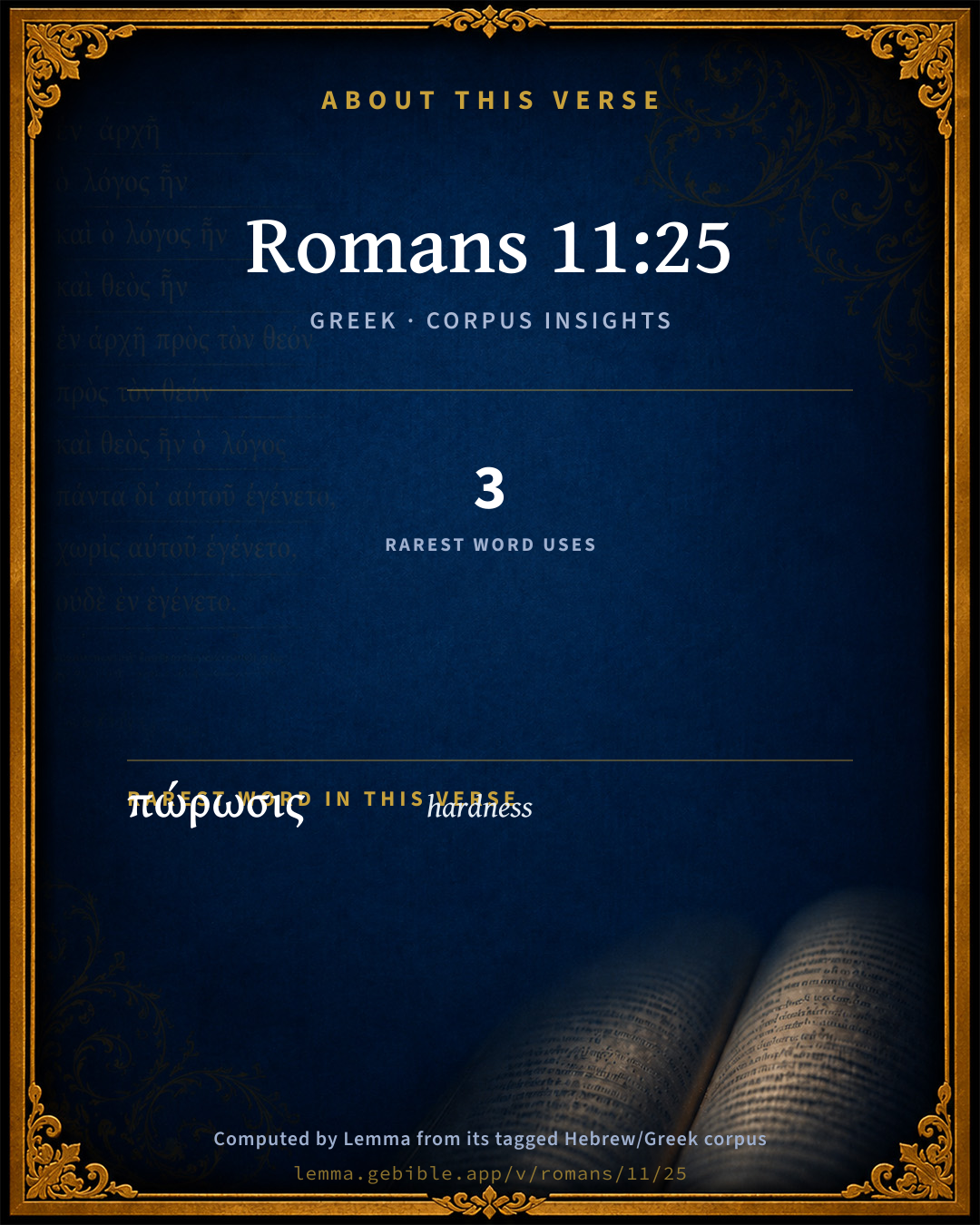
These counts appear in no published source. They are computed here, from the morphology-tagged text and Lemma’s own curated glosses. What Lemma adds →
- 29
- words
- 26
- distinct lemmas
- Pauline Epistles
- section
Cross-references
31Topical passages linked to Romans 11:25 in the Treasury of Scripture Knowledge — connected by theme and wording, ordered by reader-vote popularity; previews shown in the World English Bible.
- Luke 21:24 They will fall by the edge of the sword, and will be led captive into all the nations. Jerusalem will be trampled down by the Gentiles, until the times of the Gentiles are fulfilled.
- 2 Corinthians 3:14–16 But their minds were hardened, for until this very day at the reading of the old covenant the same veil remains, because in Christ it passes away.
- Romans 16:25
- Romans 12:16 Be of the same mind one toward another. Don't set your mind on high things, but associate with the humble. Don't be wise in your own conceits.
- Zechariah 8:20–23 Thus says Yahweh of Hosts: "Many peoples, and the inhabitants of many cities will yet come;
- Zechariah 14:9–21 Yahweh will be King over all the earth. In that day Yahweh will be one, and his name one.
- Romans 11:7–8 What then? That which Israel seeks for, that he didn't obtain, but the chosen ones obtained it, and the rest were hardened.
- Isaiah 2:1–8 This is what Isaiah the son of Amoz saw concerning Judah and Jerusalem.
- Micah 4:1–2 But in the latter days, It will happen that the mountain of Yahweh's temple will be established on the top of the mountains, And it will be exalted above the hills; And peoples will stream to it.
- Ephesians 3:9 and to make all men see what is the administration of the mystery which for ages has been hidden in God, who created all things through Jesus Christ;
- Psalms 22:27 All the ends of the earth shall remember and turn to Yahweh. All the relatives of the nations shall worship before you.
- Isaiah 60:1–22 Arise, shine; for your light is come, and the glory of Yahweh is risen on you.
- Hosea 14:9 Who is wise, that he may understand these things? Who is prudent, that he may know them? For the ways of Yahweh are right, And the righteous walk in them; But the rebellious stumble in them.
- Romans 1:13 Now I don't desire to have you unaware, brothers, that I often planned to come to you, and was hindered so far, that I might have some fruit among you also, even as among the rest of the Gentiles.
- 1 Corinthians 10:1 Now I would not have you ignorant, brothers, that our fathers were all under the cloud, and all passed through the sea;
- Ephesians 3:3–4 how that by revelation the mystery was made known to me, as I wrote before in few words,
- Revelation 7:9 After these things I looked, and behold, a great multitude, which no man could number, out of every nation and of all tribes, peoples, and languages, standing before the throne and before the Lamb, dressed in white robes, with palm branches in their hands.
- Revelation 10:7 but in the days of the voice of the seventh angel, when he is about to sound, then the mystery of God is finished, as he declared to his servants, the prophets.
- Psalms 72:8–14 He shall have dominion also from sea to sea, From the River to the ends of the earth.
- Psalms 72:17 His name endures forever. His name continues as long as the sun. Men shall be blessed by him. All nations will call him blessed.
- Proverbs 3:5–7 Trust in Yahweh with all your heart, And don't lean on your own understanding.
- Isaiah 5:21 Woe to those who are wise in their own eyes, And prudent in their own sight!
- Isaiah 66:18–23 For I [know] their works and their thoughts: [the time] comes, that I will gather all nations and languages; and they shall come, and shall see my glory.
- 2 Peter 3:8 But don't forget this one thing, beloved, that one day is with the Lord as a thousand years, and a thousand years as one day.
- Revelation 11:15 The seventh angel sounded, and great voices in heaven followed, saying, "The kingdom of the world has become the Kingdom of our Lord, and of his Christ. He will reign forever and ever!"
- Revelation 20:2–4 He seized the dragon, the old serpent, which is the devil and Satan, who deceives the whole inhabited earth, and bound him for a thousand years,
- Psalms 107:43 Whoever is wise will pay attention to these things. They will consider the loving kindnesses of Yahweh.
- Psalms 127:1 Unless Yahweh builds the house, They labor in vain who build it. Unless Yahweh watches over the city, The watchman guards it in vain.
- Proverbs 26:12 Do you see a man wise in his own eyes? There is more hope for a fool than for him.
- Proverbs 26:16 The sluggard is wiser in his own eyes Than seven men who answer with discretion.
- 1 Corinthians 12:1 Now concerning spiritual things, brothers, I don't want you to be ignorant.
Cross-references courtesy of OpenBible.info (CC BY 4.0).
Lesson kit
Teaching starters — assembled from the data on this page, not authored interpretation. Every prompt links to the verse data it draws on. Edit before teaching.
Romans, in the Pauline Epistles, opens this verse with 29 words (26 distinct Greek lemmas). Its most distinctive word is pṓrōsis (“hardness”). A historical commentator’s framing appears above. Read the whole chapter for the surrounding context.
Discussion questions
- What does “hardness” (pṓrōsis) contribute to the verse as a whole?
- How does Mark 3:5, which shares the word «hardness», read alongside this verse?
- What does the repetition of “the” (4× in this one verse) do in this verse?
- These translations render this verse differently. What is at stake in choosing one wording over another?
- Compare how The Biblical Illustrator and Joseph Benson's Commentary read this verse. Where do they agree or differ?
Things to notice
- These translations choose different wording for 26 words in this verse.
- “the” occurs 4× in this single verse.
- 26 distinct Greek lemmas span 29 words in this verse.
Commentary
Notes on Romans 11:25 from classic Christian and Jewish commentators (each source and its license shown beneath its notes). The classic Christian expositions comment on the surrounding passage and are grouped to its opening verse, so a note may address several verses; the Jewish commentaries on the Tanakh (Rashi and others) are per-verse, so they appear only where the commentator wrote on this verse.
Lemma curates 59 commentaries, every one of them public domain or Creative Commons licensed, each selected and text-cleaned for this edition rather than reprinted as found. About our sources →
The Biblical Illustrator
Joseph S. Exell
The Biblical Illustrator, edited by Joseph S. Exell (c. 1880s–1900s) — public domain. Text from a community e-Sword module.
Joseph Benson's Commentary
Joseph Benson's Commentary on the Old and New Testaments (1811–1818) — public domain. Text from a community e-Sword module.
Whedon's Commentary on the Bible
Daniel D. Whedon
Daniel D. Whedon (gen. ed.), Commentary on the Old and New Testaments (1874–1909) — public domain. Text from a community e-Sword module.
The Expositor's Bible
William Robertson Nicoll, ed., The Expositor's Bible (London: Hodder & Stoughton, 1887–1910) — public domain. 65 of 66 books (1 Corinthians is not separately keyed, as that volume carries no machine-parseable verse references); section-level commentary keyed to the opening verse. Introductory and overview sections not keyed to a specific passage are excluded.
Tyndale Open Study Notes
Tyndale Open Resources
Tyndale Open Study Notes — © Tyndale Open Resources, licensed CC BY-SA 4.0. Text via the HelloAO Bible API.
Bengel's Gnomon
Johann Albrecht Bengel
Bengel's Gnomon of the New Testament — English translation (T&T Clark, Edinburgh, 1860) — public domain. Text from a community e-Sword module.
Meyer's Critical & Exegetical Commentary
Heinrich August Wilhelm Meyer
Meyer — Critical and Exegetical Commentary on the New Testament — English translation by Peter Christie, edited by Frederick Crombie (T&T Clark, 1880) — public domain. Text from a community e-Sword module.
Expositor's Greek Testament
ed. W. Robertson Nicoll
The Expositor's Greek Testament, edited by W. Robertson Nicoll (1897–1910) — public domain. Text from a community e-Sword module.
Godet's Commentaries
Frédéric Louis Godet
Frédéric Louis Godet — Commentaries on Luke, John, Romans, and 1 Corinthians — English translation (T&T Clark, Edinburgh, 1870s–1890s) — public domain. Text from a community e-Sword module.
Hodge's Commentary on Romans, Ephesians & First Corinthians
Charles Hodge
Charles Hodge — Commentary on Romans (1835), First Corinthians (1857), and Ephesians (1856) — public domain. Text from a community e-Sword module.
Geneva Bible (1599)
Geneva Bible translators
Geneva Bible (1599) marginal notes — public domain. Text via Bolls.life.
Jamieson, Fausset & Brown
Robert Jamieson, A. R. Fausset & David Brown
Jamieson, Fausset & Brown — Commentary Critical and Explanatory on the Whole Bible (1871) — public domain (CC PDM 1.0). Text via the HelloAO Bible API.
Adam Clarke's Commentary
Adam Clarke's Commentary on the Bible (1810–1826) — public domain. Text from a community e-Sword/MySword module.
John Calvin's Commentaries
John Calvin's Commentaries (1540-1563) — public domain. Text from the Calvin Translation Society English edition (1840s-50s) via the Christian Classics Ethereal Library (ccel.org). Calvin's coverage is partial (roughly two-thirds of the Bible); uncommented books and verses are honest gaps, never fabricated. The 19th-century editor's footnotes and remarks are omitted so the notes are faithfully Calvin's own voice.
Ellicott's Commentary for English Readers
A Bible Commentary for English Readers, edited by Charles John Ellicott (1878–1897) — public domain. Text from a community e-Sword module.
The Cambridge Bible for Schools and Colleges
gen. ed. J. J. S. Perowne
The Cambridge Bible for Schools and Colleges (gen. ed. J. J. S. Perowne; Cambridge University Press, 1878–1918) — public domain. Text from a community e-Sword module.
John Gill's Exposition
John Gill's Exposition of the Whole Bible (1746–1763) — public domain (CC PDM 1.0). Text via the HelloAO Bible API.
Trapp's Complete Commentary
John Trapp
John Trapp, A Commentary or Exposition upon All the Books of the Old and New Testament (1647–1656) — public domain. Text from a community e-Sword module.
Albert Barnes' Notes on the Bible
Albert Barnes' Notes on the Bible (1834–1885) — public domain. Text from a community e-Sword/MySword module.
Haydock's Catholic Bible Commentary
George Leo Haydock (1774–1849), Haydock's Catholic Family Bible and Commentary, 1859 edition — public domain. Excludes Psalms (Douay-Rheims chapter numbering differs from Protestant) and Deuterocanonical books (Catholic canon only).
Matthew Poole's English Annotations
Matthew Poole's English Annotations on the Holy Bible (1683–1685) — public domain. Text from a community e-Sword/MySword module.
The Pulpit Commentary
The Pulpit Commentary (1880–1919), ed. H.D.M. Spence-Jones & Joseph S. Exell — public domain. Text from a community e-Sword module.
John Wesley's Explanatory Notes
John Wesley, Explanatory Notes Upon the Whole Bible (1754–1765) — public domain. Text via the GEBible commentary corpus.
Scofield Reference Notes
C. I. Scofield
The Scofield Reference Bible (1917 edition), notes by C. I. Scofield — public domain. Text from a community e-Sword module.
Kretzmann's Popular Commentary
Paul E. Kretzmann
Paul E. Kretzmann, Popular Commentary of the Bible (1921–1924) — public domain. Text from a community e-Sword module.
Burkitt's Expository Notes on the New Testament
William Burkitt
William Burkitt's Expository Notes on the New Testament (1700–1703) — public domain. Text from a community e-Sword module.
Godbey's Commentary on the New Testament
William B. Godbey
William B. Godbey, Commentary on the New Testament (1896–1900) — public domain. Text from a community e-Sword module.
McGarvey & Pendleton's Commentaries
J. W. McGarvey
J. W. McGarvey (with Philip Y. Pendleton), Commentaries on the New Testament (The Fourfold Gospel, 1914; Acts; and the epistles) — public domain. Text from a community e-Sword/MySword module.
The People's New Testament
B. W. Johnson
B. W. Johnson's The People's New Testament with Notes (1889–1891) — public domain. Electronic text from the Christian Classics Ethereal Library (CCEL) ThML edition.
unfoldingWord translationNotes
Door43 World Missions Community
unfoldingWord translationNotes — © Distant Shores Media and the Door43 World Missions Community, licensed CC BY-SA 4.0. Source: git.door43.org/Door43/en_tn.
Cambridge Greek Testament for Schools and Colleges
Cambridge Greek Testament for Schools and Colleges (Cambridge University Press, 1896; 21 vols, various authors incl. Carr, Maclear, Plummer, Farrar, Lumby, Moule, M. R. James, Simcox) — public domain. Text from a community e-Sword module.
Alford’s Greek Testament
Henry Alford
Henry Alford, The Greek Testament (1849–1861) — public domain. Text from a community e-Sword module.
International Critical Commentary
International Critical Commentary — older volumes (1896–1929), various authors — public domain. Text from a community e-Sword module.
Vincent's Word Studies in the New Testament
Marvin R. Vincent
Marvin R. Vincent, Word Studies in the New Testament (1887–1900) — public domain. Text from a community e-Sword/MySword module.