Colossians 1:27

Greek (Tischendorf 8th ed.) Colossians 1:27 appears in the Greek New Testament. The text above is from the Tischendorf 8th edition. Each word links to its Strong’s number and a concise gloss. Click any word for its full Thayer’s Greek Lexicon entry.
Download image
Cite this verse

Colossians 1:27 (World English Bible). Public Domain. Lemma interlinear Bible study tool, https://lemma.gebible.app/v/colossians/1/27.

Show BibTeX & RIS
BibTeX
RIS
English Translation
to whom God was pleased to make known what are the riches of the glory of this mystery among the Gentiles, which is Christ in you, the hope of glory;
World English Bible · Public Domain
Download a study sheet

One document with this verse’s original text, its word-by-word gloss line, the meaning frame, cross-references with their text, attributed commentary, and full source and license credits — printable, and it pastes into notes with its structure intact.

This verse Autodidact and up

Study sheet (.html) Plain text (.txt)

A passage Seminary Student

Up to 50 verses in one chapter. A passage sheet keeps up to 6 commentary sources and 12 cross-references per verse, in the order this page ranks them, and says so on the sheet whenever that leaves anything out. Ask for a single verse and you get the Autodidact verse sheet above.

Everything on this page stays free to read, with no account — the sheet is a download of what is already on screen, not access to it.

Want to remove ads? Support Godless Engineer
Compare translations 3

The same verse in 3 English versions, stacked beneath the original-language interlinear above. Click any original word for its lexicon entry.

Each is an independent rendering of the whole verse — the interlinear is not word-aligned to these translations.

Highlighted words mark where these versions differ — a whole-verse word diff, not a word-by-word alignment.

  • World English Bible Public Domain
    to whom God was pleased to make known what are the riches of the glory of this mystery among the Gentiles, which is Christ in you, the hope of glory;
  • King James Version Public Domain
    To whom God would make known what is the riches of the glory of this mystery among the Gentiles; which is Christ in you, the hope of glory:
  • unfoldingWord Literal Text CC BY-SA 4.0
    to whom God desired to make known what the riches of the glory of this mystery among the Gentiles, which is Christ in you, the hope of glory.

unfoldingWord Literal Text — © unfoldingWord, licensed CC BY-SA 4.0. Word-aligned USFM3 via Door43 (git.door43.org/unfoldingWord/en_ult).

Versions to compare (up to 4)

3 of 4 selected

Show all 19 translations

Every available English version of this verse, each an independent rendering of the whole verse.

  • World English Bible Public Domain
    to whom God was pleased to make known what are the riches of the glory of this mystery among the Gentiles, which is Christ in you, the hope of glory;
  • Berean Standard Bible Public Domain
    To them God has chosen to make known among the Gentiles the glorious riches of this mystery, which is Christ in you, the hope of glory.
  • Majority Standard Bible Public Domain
    To them God has chosen to make known among the Gentiles the glorious riches of this mystery, which is Christ in you, the hope of glory.
  • King James Version Public Domain
    To whom God would make known what is the riches of the glory of this mystery among the Gentiles; which is Christ in you, the hope of glory:
  • American Standard Version (1901) Public Domain
    to whom God was pleased to make known what is the riches of the glory of this mystery among the Gentiles, which is Christ in you, the hope of glory:
  • Revised Version (1885) Public Domain
    to whom God was pleased to make known what is the riches of the glory of this mystery among the Gentiles, which is Christ in you, the hope of glory:
  • Geneva Bible (1599) Public Domain
    To whome God woulde make knowen what is the riches of his glorious mysterie among the Gentiles, which riches is Christ in you, the hope of glory,
  • Douay-Rheims (1899) Public Domain
    To whom God would make known the riches of the glory of this mystery among the Gentiles, which is Christ, in you the hope of glory.
  • Young's Literal Translation Public Domain
    to whom God did will to make known what `is' the riches of the glory of this secret among the nations -- which is Christ in you, the hope of the glory,
  • Literal Standard Version CC BY-SA 4.0
    to whom God willed to make known what [is] the riches of the glory of this secret among the nations—which is Christ in you, the hope of the glory,
  • Unlocked Literal Bible CC BY-SA 4.0
    It is to them that God wanted to make known the riches of the glory of this secret truth among the Gentiles, which is Christ in you, the hope of glory.
  • unfoldingWord Literal Text CC BY-SA 4.0
    to whom God desired to make known what the riches of the glory of this mystery among the Gentiles, which is Christ in you, the hope of glory.
  • Darby Bible Public Domain
    to whom God would make known what are the riches of the glory of this mystery among the nations, which is Christ in you the hope of glory:
  • World Messianic Bible Public Domain
    to whom God was pleased to make known what are the riches of the glory of this mystery among the Gentiles, which is Messiah in you, the hope of glory.
  • Webster's Bible Public Domain
    To whom God would make known what is the riches of the glory of this mystery among the Gentiles; which is Christ in you, the hope of glory:
  • Free Bible Version CC BY-SA 4.0
    God wanted to make known to them the glorious wealth of this mystery to the nations: Christ living in you is the glorious hope!
  • Bible in Basic English Public Domain
    To whom God was pleased to give knowledge of the wealth of the glory of this secret among the Gentiles, which is Christ in you, the hope of glory:
  • Text-Critical English NT CC BY 4.0
    To them God resolved to make known how great among the Gentiles are the glorious riches of this mystery, which is Christ in you, the hope of glory.
  • Tyndale New Testament (1534) Public Domain
    to whom god wolde make knowen the glorious riches of this mistery amonge the gentyls which riches is Christ in you the hope of glory

Literal Standard Version (2020), Covenant Press — licensed CC BY-SA 4.0. Text via the HelloAO Bible API (eBible.org). Unlocked Literal Bible (unfoldingWord) — licensed CC BY-SA 4.0. Text via the HelloAO Bible API (eBible.org). unfoldingWord Literal Text — © unfoldingWord, licensed CC BY-SA 4.0. Word-aligned USFM3 via Door43 (git.door43.org/unfoldingWord/en_ult). Free Bible Version, Dr. Jonathan Gallagher — licensed CC BY-SA 4.0. Text via the HelloAO Bible API (eBible.org).

Word by word

More ways to search: Search by grammar → Find every occurrence → Compare this word →

Practice this passage: Drill this verse → Learn its vocabulary →

πλοῦτος
ploûtos
G4149
“riches”
Noun, Nominative, Singular, Neuter
Part of Speech
Noun
Case
Nominative
Number
Singular
Gender
Neuter
Full Thayer's Definition

Origin: from the base of G4130

TDNT: 11:18,9

1. riches, wealth a. abundance of external possessions b. fulness, abundance, plenitude c. a good i.e. that with which one is enriched
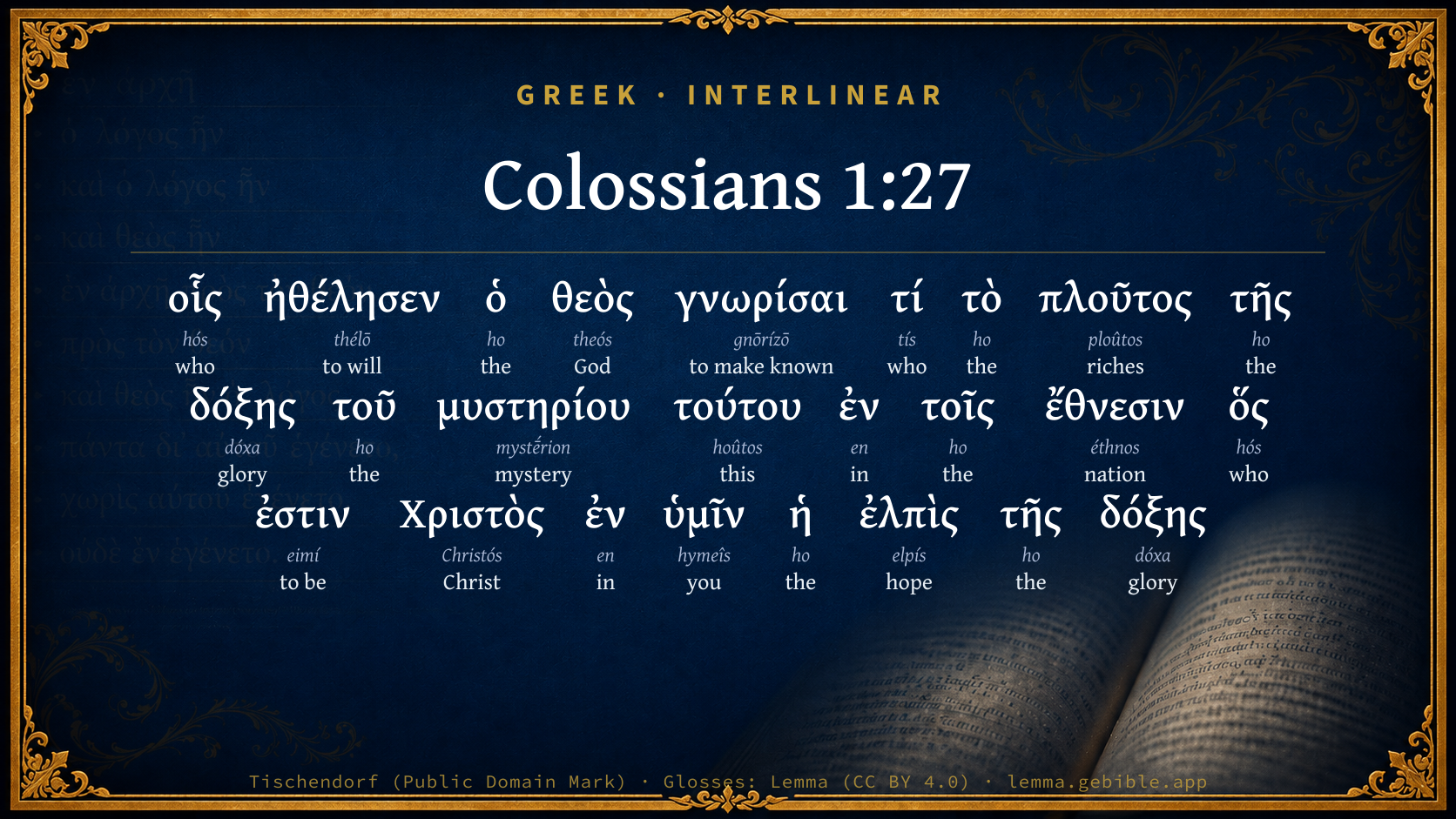
  1. οἷς hós G3739 “who” Relative pronoun, Dative, Plural, Masculine
  2. ἠθέλησεν thélō G2309 “to will” Verb, Aorist, Active, Indicative, 3rd person, Singular
  3. ὁ ho G3588 “the” Article, Nominative, Singular, Masculine
  4. θεὸς theós G2316 “God” Noun, Nominative, Singular, Masculine
  5. γνωρίσαι gnōrízō G1107 “to make known” Verb, Aorist, Active, Infinitive
  6. τί tís G5101 “who” Interrogative pronoun, Nominative, Singular, Neuter
  7. τὸ ho G3588 “the” Article, Nominative, Singular, Neuter
  8. τῆς ho G3588 “the” Article, Genitive, Singular, Feminine
  9. δόξης dóxa G1391 “glory” Noun, Genitive, Singular, Feminine
  10. τοῦ ho G3588 “the” Article, Genitive, Singular, Neuter
  11. μυστηρίου mystḗrion G3466 “mystery” Noun, Genitive, Singular, Neuter
  12. τούτου hoûtos G3778 “this” Demonstrative pronoun, Genitive, Singular, Neuter
  13. ἐν en G1722 “in” Preposition
  14. τοῖς ho G3588 “the” Article, Dative, Plural, Neuter
  15. ἔθνεσιν éthnos G1484 “nation” Noun, Dative, Plural, Neuter
  16. ὅς hós G3739 “who” Relative pronoun, Nominative, Singular, Masculine
  17. ἐστιν eimí G1510 “to be” Verb, Present, Active, Indicative, 3rd person, Singular
  18. Χριστὸς Christós G5547 “Christ” Noun, Nominative, Singular, Masculine
  19. ἐν en G1722 “in” Preposition
  20. ὑμῖν hymeîs G5210 “you” Personal pronoun, 2nd person, Dative, Plural
  21. ἡ ho G3588 “the” Article, Nominative, Singular, Feminine
  22. ἐλπὶς elpís G1680 “hope” Noun, Nominative, Singular, Feminine
  23. τῆς ho G3588 “the” Article, Genitive, Singular, Feminine
  24. δόξης dóxa G1391 “glory” Noun, Genitive, Singular, Feminine

About this verse

These counts appear in no published source. They are computed here, from the morphology-tagged text and Lemma’s own curated glosses. What Lemma adds →

25
words
16
distinct lemmas
Pauline Epistles
section

Notable vocabulary

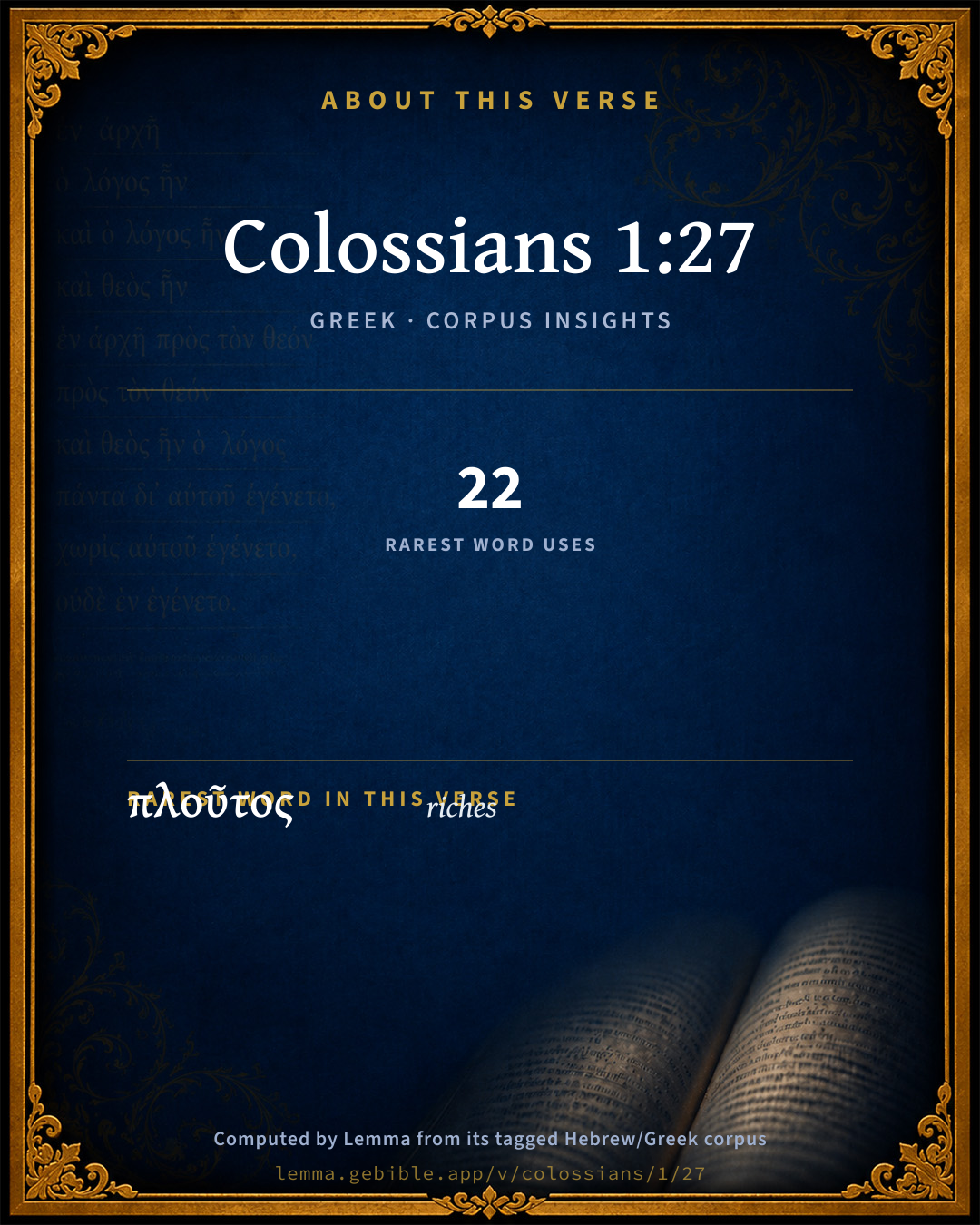
The rarest word here is πλοῦτος riches G4149 — appearing just 22 times in the whole Greek New Testament.

Shared distinctive vocabulary

πλοῦτος riches G4149 occurs in 21 verses of the Greek New Testament. Also found in:

Repetition

Words recur within this verse:

Cross-references

37

Topical passages linked to Colossians 1:27 in the Treasury of Scripture Knowledge — connected by theme and wording, ordered by reader-vote popularity; previews shown in the World English Bible.

  • John 14:20 In that day you will know that I am in my Father, and you in me, and I in you.
  • Romans 8:10 If Christ is in you, the body is dead because of sin, but the spirit is alive because of righteousness.
  • Ephesians 3:16–17 that he would grant you, according to the riches of his glory, that you may be strengthened with power through his Spirit in the inward man;
  • 1 John 4:4 You are of God, little children, and have overcome them; because greater is he who is in you than he who is in the world.
  • Galatians 2:20 I have been crucified with Christ, and it is no longer I that live, but Christ living in me. That life which I now live in the flesh, I live by faith in the Son of God, who loved me, and gave himself up for me.
  • 1 Corinthians 3:16 Don't you know that you are a temple of God, and that God's Spirit lives in you?
  • Revelation 3:20 Behold, I stand at the door and knock. If anyone hears my voice and opens the door, then I will come in to him, and will dine with him, and he with me.
  • John 14:17 the Spirit of truth, whom the world can't receive; for it doesn't see him, neither knows him. You know him, for he lives with you, and will be in you.
  • Ephesians 1:17–18 that the God of our Lord Jesus Christ, the Father of glory, may give to you a spirit of wisdom and revelation in the knowledge of him;
  • 2 Corinthians 4:6 seeing it is God who said, "Light will shine out of darkness," who has shone in our hearts, to give the light of the knowledge of the glory of God in the face of Jesus Christ.
  • Galatians 4:19 My little children, of whom I am again in travail until Christ is formed in you--
  • John 14:23 Jesus answered him, "If a man loves me, he will keep my word. My Father will love him, and we will come to him, and make our home with him.
  • 1 Timothy 1:1 Paul, an apostle of Christ Jesus according to the commandment of God our Savior, and Christ Jesus our hope;
  • Colossians 2:3 in whom are all the treasures of wisdom and knowledge hidden.
  • John 17:26 I made known to them your name, and will make it known; that the love with which you loved me may be in them, and I in them."
  • 2 Corinthians 6:16 What agreement has a temple of God with idols? For you are a temple of the living God. Even as God said, "I will dwell in them, and walk in them; and I will be their God, and they will be my people."
  • John 15:2–5 Every branch in me that doesn't bear fruit, he takes away. Every branch that bears fruit, he prunes, that it may bear more fruit.
  • Colossians 3:11 where there can't be Greek and Jew, circumcision and uncircumcision, barbarian, Scythian, bondservant, freeman; but Christ is all, and in all.
  • John 17:22–23 The glory which you have given me, I have given to them; that they may be one, even as we are one;
  • Ephesians 2:22 in whom you also are built together for a habitation of God in the Spirit.
  • 1 Peter 1:3–4 Blessed be the God and Father of our Lord Jesus Christ, who according to his great mercy became our father again to a living hope through the resurrection of Jesus Christ from the dead,
  • John 6:56 He who eats my flesh and drinks my blood lives in me, and I in him.
  • Romans 9:23 and that he might make known the riches of his glory on vessels of mercy, which he prepared beforehand for glory,
  • Ephesians 1:7 in whom we have our redemption through his blood, the forgiveness of our trespasses, according to the riches of his grace,
  • Philippians 4:19 My God will supply every need of yours according to his riches in glory in Christ Jesus.
  • Psalms 16:9–11 Therefore my heart is glad, and my tongue rejoices. My body shall also dwell in safety.
  • Romans 5:2 through whom we also have our access by faith into this grace in which we stand. We rejoice in hope of the glory of God.
  • Romans 8:18–19 For I consider that the sufferings of this present time are not worthy to be compared with the glory which will be revealed toward us.
  • Colossians 1:5 because of the hope which is laid up for you in the heavens, of which you heard before in the word of the truth of the Gospel,
  • Matthew 13:11 He answered them, "To you it is given to know the mysteries of the Kingdom of Heaven, but it is not given to them.
  • Luke 17:21 neither will they say, 'Look, here!' or, 'Look, there!' for behold, the Kingdom of God is within you."
  • 2 Corinthians 4:17 For our light affliction, which is for the moment, works for us more and more exceedingly an eternal weight of glory;
  • Galatians 1:15–16 But when it was the good pleasure of God, who separated me from my mother's womb, and called me through his grace,
  • Ephesians 3:8–10 To me, the very least of all saints, was this grace given, to preach to the Gentiles the unsearchable riches of Christ,
  • 2 Corinthians 2:14 Now thanks be to God, who always leads us in triumph in Christ, and reveals through us the sweet aroma of his knowledge in every place.
  • 1 Corinthians 2:12–14 But we received, not the spirit of the world, but the Spirit which is from God, that we might know the things that were freely given to us by God.
  • Romans 11:33 Oh the depth of the riches both of the wisdom and the knowledge of God! How unsearchable are his judgments, and his ways past tracing out!

Cross-references courtesy of OpenBible.info (CC BY 4.0).

Commentary

Notes on Colossians 1:27 from classic Christian and Jewish commentators (each source and its license shown beneath its notes). The classic Christian expositions comment on the surrounding passage and are grouped to its opening verse, so a note may address several verses; the Jewish commentaries on the Tanakh (Rashi and others) are per-verse, so they appear only where the commentator wrote on this verse.

Lemma curates 59 commentaries, every one of them public domain or Creative Commons licensed, each selected and text-cleaned for this edition rather than reprinted as found. About our sources →

The Biblical Illustrator

Joseph S. Exell

Col_1:27

To whom God would make known what is the riches of the glory of this mystery.

The gospel mystery

The gospel is the grand secret. To the mass of mankind it was utterly unknown, and the chosen people only perceived dimly through the smoke of sacrifices anal the veil of types. It must ever have been a mystery out for revelation, and must be so still unless Christ comes to dwell within. Then all is clear.

I. The essence of this mystery is Christ. It is uncertain what is the antecedent to which--mystery, riches, or glory. If it be mystery, then Christ is the mystery of godliness; if glory, Christ is the brightness of His Fathers glory; if riches, there are the unsearchable riches of Christ. The essence of this mystery is--

1. Christ Himself: God-Man, in which connection we must remember the glorious work He undertook and finished on our behalf; and

(2) His offices, prophet, priest, king, friend, brother, head, dec. Whatever Christ is His people are in Him: crucified, dead, risen in Him; in Him we live eternally, and sit in heavenly places. This is the essence of the whole gospel, He who does not preach Christ preaches no gospel. There is no more possibility of a gospel without Christ than a day without the sun or a river without water.

2. Christ Himself and no other. Never be put off with books or conversations. Nothing short of reaching and touching Christ will serve your turn.

3. Christ Himself rather than anything which Christ gives. How different He is from all our other friends and helpers. They bring good things, but Jesus gives us Himself. He does not merely give us wisdom, righteousness, etc., He Himself is made of God all these things to us. When you are ill you are glad to see the doctor, but when you are well you want to get rid of him; but you can never do without Christ. When cured we want to see Jesus more than ever.

4. Christ alone is enough. Some hold a candle to the sun by preaching Christ and mans philosophy or priestcraft.

II. The sweetness of this mystery which is Christ in you. This is a grand advance. Christ in heaven, Christ free to poor sinners is precious, but Christ in the heart is most precious of all. A loaf is a good thing, but if we could not get it within us we should die of starvation. A medicine may be a noble cure, but if kept in the phial would do us no good. Christ in you is--

1. Christ accepted by faith. It is a wonderful thing that Christ should enter a man, but still more wonderful that He should enter by so narrow an opening as our little faith. There is the sun, yet it can come through the narrowest chink; but we should pull up the blinds, and let him shine in in all his glory. Grow in faith, then, and take in Christ more fully.

2. Christ possessed. Nothing is so much a mans own as that which is within him. Men may question whether an acre or a house is yours, but not yesterdays meal.

3. Christ experienced. There may be a valuable medicine, but it is of no efficacy to a man until it is within him. When it commences to purify and strengthen, he knows it without the testimony of others. When Christ is in you curing your sin, and filling your soul with love to holiness, then will you know the Lord.

4. Christ reigning.

5. Christ filling.

6. Christ transfiguring. You thrust a bar of iron into the fire, and keep it there till the fire enters it, it is then like fire itself. I live, yet not I, but Christ liveth in me.

III. The outlook of all this is Christ in you the hope of glory.

1. Glory. Surely that belongs to God only. Yes, but Christ says, The glory Thou hast given Me I have given them.

2. How do we know that we are to have glory?

(1) Christ makes us glorious now by His coming, which is a pledge of future glory.

(2) Christ has entered into covenant with God to bring His people home to glory.

(3) The Christ who has come to live with us will never leave us till we are glorified. (C. H. Spurgeon.)

Christ in you

I. Christ in you means Christ embraced by faith as our righteousness and strength. This is the sure ground on which we may hope for glory (Eph_3:17). When a sinners heart is opened to see the excellence of the Saviour, it inwardly embraces Him, and every discovery renews this act of inward cleaving. Then every reproach, temptation, fall, affliction, makes the soul more fully embrace Him (see Gal_4:19; Joh_15:4; Joh_17:23; Joh_17:26).

II. The effects of this union.

1. The mind of Christ is formed in the soul (1Co_2:16). The believer thinks as Christ does, and so has the spirit of a sound mind (2Ti_1:7). Not, of course, that he has the omniscience and infallibe judgment of his Lord, but up to his light he sees as Christ does.

(1) Sin to be abominable.

(2) The gospel,, its glory and completeness.

(3) The world and its vanity.

(4) Time and its value.

(5) Eternity. As did Christ he sees everything in its light.

2. The heart of Christ.

(1) There is the same love to God in both.

(2) The same aversion to Gods frown.

(3) The same love to the saints.

(4) The same compassion for sinners. (R. M. McCheyne, M. A.)

Christ in you an expanding force

When Christ once enters into a soul, by degrees He occupies the whole of it. Did you ever hear the legend of a man whose garden produced nothing else but weeds, till at last he met with a strange foreign flower of singular vitality. The story is that he sowed a handful of this seed in his overgrown garden, and left it to work its own sweet way. He slept and rose, and knew not how the seed was growing till on a day he opened the gate and saw a sight which much astounded him. He knew that the seed would produce a dainty flower and he looked for it; but he had little dreamed that the plant would cover the whole garden. So it was: the flower had exterminated every weed, till as he looked from one end to the other from wall to wall he could see nothing but the fair colours of that rare plant, and smell nothing but its delicious perfume. Christ is that plant of renown. If He be sown in the soil of your soul, He will gradually eat out the roots of all ill weeds and poisonous plants, till over all your nature there shall be Christ in you. God grant we may realize the picture in our own hearts, and then we shall be in paradise. (C. H. Spurgeon.)

Christ in you the hope of glory

I. The subject of the Apostles declaration.

1. Glory refers to the felicity of a future life as discovered by the gospel; the hope is that laid up for us in heaven. Of a life after death the Gentiles knew nothing with certainty, and the Jews only dimly. Life and immortality were brought to light by the gospel.

2. This glory was one of

(1) character, a glory to be revealed, in us--a personal perfection to adorn the world, wherein dwelleth righteousness.

(2) Condition and place. It refers to the light and participation of that incomparable splendour which emanates from the throne and pervades the residence of Deity. God is light, and dwelleth in a light Which no man can approach unto. In consistency with this the heavenly mansions are the inheritance of the saints in light; all the luminaries of heaven are excluded as unnecessary appendages in consequence of the surpassing splendour derived immediately from God and the Lamb.

II. The medium of this hope: Christ. He was the author and bestower of it. He had not only revealed the object, and imparted knowledge respecting it, But had opened the way to its enjoyment. He was the way, the truth, and the life, and they needed nothing besides. It was inconsistent with His grace and truth, omnipotence, love, and with the perfection of His work on earth, for Him to have recourse to Jewish ceremonies, personal suffering, or philosophic speculations, as a means of augumenting their confidence, or securing their possession of the anticipated eternity.

III. The senses in which Christ is in us personally and experimentally.

1. Faith in Christ as the great sacrifice. It is thus that the life is derived that can never perish, and that a union is established with Christ which will lead Him to remember us when He cometh in His kingdom. I am crucified with Christ, etc. That Christ may dwell in your hearts by faith.

2. The influence of His Spirit who effects that change in our nature which makes us meet for the inheritance, etc.

3. The habitual remembrance of His laws and the consequent exhibition in affectionate obedience (Joh_15:4; Joh_15:7; Joh_15:10-11).

Lessons--

1. The unspeakable importance and value of religion.

2. How delightful to have such a hope of glory to cling to; an anchor of the soul, sure and steadfast, among the billows and eddies of that turbulent stream on which we are embarked. (T. Binney.)

I. Glory, another word for heaven, setting forth--

1. Its excellence. Nothing is esteemed glorious but what is of transcendent worth. The Jews felt this, hence the Hebrew word signifies also weight and substance; So heaven is called an exceeding weight of glory.

2. its magnificence. Mere excellence is not glory, to be that it must be known and seen. The sun is not glorious behind a cloud; a diamond must be brought forth and polished to be glorious. So the glory of heaven consists in the discovery of its excellencies--the Father in His majesty, the Son--His grace and love, holiness, in its perfection and beauty, etc. Thine eyes shall see the King in His beauty.

II. The hope of glory. This brings us down to earth, but still with heaven in our sight. But there is a hope even of heaven not worth the having. We read of a hope that perishes, that shall be cut off like a spiders web and the giving up of the ghost. May that be destroyed, for a false hope is worse than none at all. The true hope is distinguished from this by three marks.

1. It comes down from heaven. We cannot create it; no fellow-creature can persuade us into it. It is the gift of the heavenly Spirit to the renewed heart. It resembles faith and rests on the same foundation, yet it differs from it. There is a world of glory, says faith. I am going to it, says hope.

2. It longs and looks for heaven. It is an earnest expectation like that of the storm-tossed mariner for the desired haven.

3. It carries the soul on towards heaven and makes meet for it. Every man that hath this hope in him purifieth himself, etc.

III. Christ. He is connected not with the glory but with the hope, as its foundation. Take Him away and there is no hope.

1. Christ has purchased glory for us. As sinners and rebels we were farther from it than any beggar is from a crown. But He has paid the ransom which delivers us from condemnation, and which entitles us to glory.

2. He has actually taken possession of glory for us. Hence the believers hope is connected with the ascension--The anchor of the soul, He.

3. Christ has pledged Himself to bring believers to glory.

IV. Christ in us. What this means is more than we can tell. Picture to yourselves a house, comfortless within, and falling to decay. Let a stranger enter it, he may act in two ways. He may secrete himself in some dark corner, and, watching his opportunity, do much mischief without its inhabitants even knowing he is there. Thus Satan is acting in the hearts of thousands, who little think he is near them, much less within them. But suppose that stranger to be a man of another character, and, as soon as he goes in, to throw open the windows, and to let in the air and light. See him then discovering himself to the inhabitants of it. I am come to live with you, he says, if you will let me, as your friend and brother. But this filthiness I cannot bear, nor this disorder. I love comfort and cheerfulness. And then he sets about cleansing that house, putting it in order, adorning and repairing it, strengthening its walls and closing up every fissure, so that when the wintry storm heats, no wind or rain can enter it, and nothing shake it. And then while he is doing this, he goes about enlivening it with his presence, and making the voice of joy and praise to be heard from day to day in every room of it. Oh, you would say, what an altered house! What a blessed guest has that man proved in it! Now the Lord Jesus when he enters a sinners soul acts exactly thus. (C. Bradley, M. A.)

Christ in you

This strange thing once startled an emperor. Ignatius,. who had assumed the name Theophorus to express this gospel truth, stood before him to vindicate his profession of Christianity. Who is Theophorus? haughtity asked the heathen monarch. He who has Christ in his breast, said the martyr. Dost thou, then, carry Him, who was crucified, within thee? Raising his voice with holy animation, while an almost heavenly brightness played upon his pallid countenance, the Christian hero replied, I do--I do; for it is written, I dwell in them, and walk in them! (W. H. Luckenbach.)

1. Glory is the greatest word in our language. It is one of Gods most magnificent titles. It is the object of the true believers hope, and whatever else he relinquishes he will not part with this. He lives and dies in hope.

2. This hope arises from the indwelling of the Saviour. He is in us as the source of life and the principle of action.

3. This union is not essential like that which subsists between the sacred Three; nor is it personal like that between the Divine and human natures of our Lord, nor merely an operative or influential union like that between God and His creatures; but a mystical and spiritual union, a union of affection, interest, and design. It is also mutual and reciprocal. He dwells in us, and we dwell in Him (Joh_14:23; Gal_2:20; Rev_3:20).

I. Explain and illustrate the truth of the text.

1. Christ is revealed in the gospel as the hope of glory. In order that He may be received He must be outwardly proposed by the ministration of the Word (Rom_10:14; Rev_1:2). By the discovery the gospel makes of Christs ability and willingness to save, it opens a door of hope to the vilest (Rom_15:4; Col_1:23; Heb_6:18).

2. Christ crucified is the foundation of our hope, by becoming the meritorious cause of it.

3. Christ is the hope of glory efficiently by the operation of His Spirit in our hearts (Rom_8:9). Without that any hope of salvation is visionary.

4. Christ dwelling in the heart is the evidence that He is to us the hope of glory, and by no other means can that hope be ascertained. He is our life; but in order to this He must live in us. After all that He has done and is doing for us, there is something continually to be done within (Rom_10:6-9).

II. Establish and confirm the leading sentiment.

1. Christ being in us is the best evidence of our being in Him, and the testimony of an angel could not make it more satisfactory (1Jn_5:11-12; Eph_1:3-4; 1Ti_1:9).

2. Christ in us is the nourishment of our hope. Greater is He that is in you, etc.

3. Christ in us is the pledge and earnest of our hope. To have Christ in us is the life of grace; to be with Christ is the hope of glory; and the two go together. (B. Beddome, M. A.)

The hope of glory

The late Isaac Pitt was suffering from what appeared to be an attack of rheumatic gout, from which no serious danger was apprehended. His friends were startled by the announcement of the physician, There is no hope. Another medical man was called for consultation. Doctor, said the sick man, I wish to know the very truth; do not conceal anything. Do you think I shall recover? We will do all we can, but we fear there is no hope of recovery. Thank you, he rejoined, I should like you to do all you can; but if not successful, I have a hope. A ransom has been provided, a Saviour has been sent: I accept the ransom, I believe in the Saviour. When the doctor says there is no hope for the body, this hope of glory is an anchor for the soul. (New Testament Anecdotes.)

Christ in the heart

David Hume, the great historian of England, and noted enemy of the Christian faith, once overheard his servant-man John repeating the text, Christ in you, the hope of glory. You know thats all nonsense, said Hume; I wonder that a sensible man like you can believe it. If Christ be in heaven, as you say, how can He be in you? He cant be in two places at one time. And then to be in you, I dont understand it. David Hume, said John, you wrote the History of England, and I read it page by page with great delight. You say in that history that the one redeeming feature in the life of Bloody Mary was, that when she was dying, the news came to her that Calais had been captured, and that on that occasion she raised herself up in bed, and said to her maids of honour, When I die, take out my heart, and you will find Calais written on it. Now, what more Calais written on Marys heart, than Christ on mine? Take out my heart, and you will find Christ written on it. (J. L. Nye.)

Christ in the heart the believers hope

I. Christ dwells in believers.

1. Christ is in you who truly believe in him. Faith brings Him into union with the soul.

2. Christ is in you as He engages your first affections.

3. Christ is in you as His likeness is impressed on your souls. Where this is there will be--

(1) Aversion to sin.

(2) Delight in the law of God.

(3) Zeal for the Divine glory.

(4) Habitual submission to the Divine will.

4. Christ is in you if His Spirit dwell in you--If any man have not the Spirit of Christ, etc.

II. Christ in believers is the hope of glory.

1. Their hope is founded in Christ (1Ti_1:1). Nor can the hope of a sinful creature rest anywhere else with safety.

2. Their hope is communicated by Christ.

3. Their hope is maintained by Christ. They cherish this hope as Christ is in them.

Learn--

1. The happy condition of the believer. He may rejoice in hope of the glory of God.

2. The importance of earnest endeavours to know our state before God.

3. The fallacy of that hope that is not founded on the Saviour, and productive of conformity to Him. (Congregational Remembrancer.)

The Indwelling of Christ

There are four methods by which we arrive at the knowledge of Christ.

1. The historical. Without this we cannot become acquainted with the true portraiture of Christ. It is true that one may study the Gospels intellectually, and derive from them a conception of Christ that is truly noble, but which is not vital and powerful: but this is the abuse of a right thing. The study of the work and character of Christ is antecedent and auxilliary to a true experience of Christ.

2. The theological. This is often carried to excess and abused, but none the less there is a place for it. It is a matter of transcendent interest to know whether Christ believed He was Divine. Views of the Divinity of the Saviour which run low will, averaging them through the ages, be productive of a low tone of spirituality and vice versa. Nevertheless a man may have a right theology of Christ, and yet not be possessed of Christ. It is auxilliary only.

3. The apostle taught that there was something more than this, viz., a living Christ who may be a part of our lives.

I. In order that He may be my Christ He must be one in whose hands is the whole sphere in which I live and act. Lord over all the causes which are influencing me.

1. No man ever contests in himself and strives to release himself from what is low and base, and reaches toward the higher and nobler, if he does not feel the need of God. When we are looking down we are our own gods, but when we strive upwards we feel the necessity of supernal influences.

2. Now as when I hunger, my hunger says there is food, as when my eye was made it said there was light to match it, so I know that certain struggles and yearnings point to something higher.

3. These yearnings are met in Him of whom the previous verses of this chapter point. No man who is limited by specialities, physician, teacher, friend, etc., can give me the help I need. He must be as He is, the embodiment of all power, and Lord over all.

4. But in order to this He must be mine, mine as really as if I were the only human being in the universe: not of course to the exclusion of others--but as my father was not less wholly mine because he was my brothers too.

II. In order to meet the exigency of my nature and experience I must have a Christ who loves me.

1. I cannot live without love; but human love is inadequate.

2. Yet how am I to be loved, and thus live. I can never hope to deserve it. Here the transcendent love of Christ comes in. He loves the loveless, and asks no more but that I let Him love me.

3. The consciousness of this unspeakable love is most potent and inspiring.

III. It is necessary that Christ should be in me, a Being whose love, power, and whole nature and influence I feel within developing in me the superior qualities of the spiritual elements, and giving authority and power to love and hope, and faith and conscience. And there is a direct sympathetic action of the Divine mind on ours. Indeed, we act on each other. If you sigh in the presence of another man, he will sigh; if you laugh, he will smile. And so if the heart be open and the moral nature sensitive, Christ acts upon the thought and feeling so that we are guided by Him. (H. W. Beecher.)

The Indwelling Saviour

There are three features which mark the relationship indicated by the text.

I. It is an intimate relation.

1. It is not a mere sacramental relation. That may exist and be altogether an external thing, and leave the heart possessed entirely by another than Christ.

2. The relationship between Christ and His people is not exhausted by such images as shepherd, husband, etc., which are external, however intimate. Persons may be near and yet be utter strangers.

3. This relation is internal as the branch is in the vine, than which nothing can be closer.

II. An enduring relation. All other relations, parent and child, husband and wife, teacher and scholar, are terminable; but this is not affected by the vicissitudes of time. It is everlasting; by faith now, by sight by and by.

III. An intensely practical relation.

1. There are many relations that are merely nominal and honorary, gratifying to ambition, but conveying no substantial good. It is not so with this. For Christ is in His people.

1. As the ground of their pardon and acceptance.

2. As their best Friend. We turn to a real friend--

(1) To counsel us in perplexity.

(2) To lessen our sorrow.

(3) To heighten our joys.

Jesus does all this as the best earthly friend can never do. Conclusion: The subject suggests its proud point of distinction between the man who is a Christian and the man who is not. (R. Newton, D. D.)

The true Christ of Man

is--

I. In the soul. He is not the Christ of the Book and the creed merely. He is in the soul--

1. As the chief object of love.

2. The chief subject of thought.

3. The chief sovereign of activities.

II. The inspirer of the sublimest hope. This hope is--

1. Directed to the highest object, glory. The glory of goodness, of moral assimilation with God. Hope for goodness is the virtuous hope.

2. Based on the surest foundation--Christs word and influence. (D. Thomas, D. D.)

The Biblical Illustrator, edited by Joseph S. Exell (c. 1880s–1900s) — public domain. Text from a community e-Sword module.

Bengel's Gnomon

Johann Albrecht Bengel

Col 1:27. Οἷς) inasmuch as being persons, to whom. An explanation.—ἠθέλησεν, it was the will of God) most freely.—ὁ πλοῦτος, the riches) [descending] upon all men; see Eph 1:7, note.—ὅς, who) for ὃ, which.—Χριστὸς ἐν ὑμῖν, Christ in you) The parallel expressions are, ἐν τοῖς ἔθνεσιν, and ἐν ὑμῖν, in the Gentiles, and in you. Christ in (among) the Gentiles was the greatest paradox at that time. Comp. in, Eph 3:8, (17); 1Ti 3:16.[3]—ἡ ἐλπὶς τῆς δόξης, the hope of glory) Christ in us is a most delightful thing in itself, but much more delightful in respect of those things which shall be revealed, ch. Col 3:4; Eph 1:18. So Rom 5:2.

[3] Bengel, therefore, not attending to mere emphasis, also acknowledged here the same signification of the word ἐν, which Ernesti approves, in Attone Bibl. th. T. x. p. 130; but in the Germ. Vers., on the margin, he has not hesitated to intimate, that that maturer communion with Christ, which assuredly surpasses all human reason, is the delightful consequence of preaching among the Gentiles, by the quotation of Eph 3:17.—E. B.

Bengel's Gnomon of the New Testament — English translation (T&T Clark, Edinburgh, 1860) — public domain. Text from a community e-Sword module.

Meyer's Critical & Exegetical Commentary

Heinrich August Wilhelm Meyer

Col_1:27. Not exposition of the ἐφανερ. τοῖς ἁγ. αὐτοῦ, since the γνωρίσαι has for its object not the μυστήριον itself, but the glory of the latter among the Gentiles. In reality, οἷς subjoins an onward movement of the discourse, so that to the general τὸ μυστήριον ἐφανερώθη τοῖς ἁγ. αὐτοῦ a particular element is added: The mystery was made manifest to His saints,to them, to whom (quippe quibus) God withal desired especially to make known that, which is the riches of the glory of this mystery among the Gentiles. Along with the general ἐφανερώθη τοῖς ἁγίοις αὐτοῦ God had this special definite direction of His will. From this the reason is plain why Paul has written, not simply οἷς ἐγνώρισεν ὁ Θεός, but οἷς ἠθέλεσεν ὁ Θεὸς γνωρίσαι. The meaning that is usually discovered in ἠθέλησεν, free grace, and the like (so Chrysostom, Theodoret, Calvin, Beza, and many others, including Bähr, Böhmer, de Wette; Huther is, with reason, doubtful), is therefore not the aim of the word, which is also not intended to express the joyfulness of the announcement (Hofmann), but simply and solely the idea: He had a mind.

γνωρίσαι] to make known, like ἐφανερώθη from which it differs in meaning not essentially, but only to this extent, that by ἐφανερ. the thing formerly hidden is designated as openly displayed (Rom_1:19; Rom_3:21; Rom_16:26; Eph_5:13, et al.), and by γνωρίσαι that which was formerly unknown as brought to knowledge. Comp. Rom_16:26; Rom_9:22; Eph_1:9; Eph_3:3; Eph_3:5; Eph_3:10; Eph_6:19; Luk_2:15, et al. The latter is not related to ἐφανερ. either as a something more (Bähr: the making fully acquainted with the nature); or as its result (de Wette); or as entering more into detail (Baumgarten-Crusius); or as making aware, namely by experience (Hofmann).

τί τὸ πλοῦτος τῆς δόξης κ.τ.λ.] what is the riches of the glory of this mystery among the Gentiles, i.e. what rich fulness of the glory contained in this mystery exists among the Gentiles,since, indeed, this riches consists in the fact (ὅς ἐστι), that Christ is among you, in whom ye have the hope of glory. In order to a proper interpretation, let it be observed: (1) τί occupies with emphasis the place of the indirect ὅ τι (see Poppo, ad Xen. Cyrop. i. 2. 10; Kühner, ad Mem. i. 1. 1; Winer, p. 158 f. [E. T. 210]), and denotes quae sint divitiae as regards degree: how great and unspeakable the riches, etc. Comp. on Eph_1:18; Eph_3:18. The text yields this definition of the sense from the very connection with the quantitative idea τὸ πλοῦτος. (2) All the substantives are to be left in their full solemn force, without being resolved into adjectives (Erasmus, Luther, and many others: the glorious riches; Beza: divitiae gloriosi hujus mysterii). Chrysostom aptly remarks: σεμνῶς εἶπε καὶ ὄγκον ἐπέθηκεν ἀπὸ πολλῆς διαθέσεως, ἐπιτάσεις ζητῶς ἐπιτάσεων. Comp. Calvin: magniloquus est in extollenda evangelii dignitate. (3) As τῆς δόξης is governed by τὸ πλοῦτος, so also is τοῦ μυστηρίου governed by τῆς δόξης, and ἐν τοῖς ἔθν. belongs to the ἐστί which is to be supplied, comp. Eph_1:18. (4) According to the context, the δόξα cannot be anything else (see immediately below, ἡ ἐλπὶς τῆς δόξης) than the Messianic glory, the glory of the kingdom (Rom_8:18; Rom_8:21; 2Co_4:17, et al.), the glorious blessing of the κληρονομία (comp. Col_1:12), which before the Parousia (Rom_8:30; Col_3:3 f.) is the ideal (ἐλπίς), but after it is the realized, possession of believers. Hence it is neither to be taken in the sense of the glorious effects generally, which the gospel produces among the Gentiles (Chrysostom, Theophylact, and many others, including Huther, comp. Dalmer), nor in that specially of their conversion from death to life (Hofmann), whereby its glory is unfolded. Just as little, however, is the δόξα of God meant, in particular His wisdom and grace, which manifest themselves objectively in the making known of the mystery, and realize themselves subjectively by moral glorification and by the hope of eternal glory (de Wette), or the splendor internus of true Christians, or the bliss of the latter combined with their moral dignity (Böhmer). (5) The genitive of the subject, τοῦ μυστηρίου τούτου, defines the δόξα as that contained in the μυατήριον, previously unknown, but now become manifest with the mystery that has been made known, as the blessed contents of the latter. Comp. Col_1:23 : ἐλπίς τοῦ εὐαγγελίου. To take the δόξα as attribute of the mystery, is forbidden by what immediately follows, according to which the idea can be none other than the familiar one of that glory, which is the proposed aim of the saving revelation and calling, the object of faith and hope (in opposition to Hofmann and many others); Col_3:4. Comp. on Rom_5:2.

ἐν τοῖς ἔθνεσιν] φαίνεται δὲ ἐν ἑτέροις, πολλῷ δὲ πλέον ἐν τούτοις ἡ πολλὴ τοῦ μυστηρίου δόξα, Chrysostom. Qui tot saeculis demersi fuerant in morte, ut viderentur penitus desperati, Calvin.

ὅς ἐστι Χριστὸς ἐν ὑμῖν] Christus in gentibus, summum illis temporibus paradoxon, Bengel. According to a familiar attraction (Winer, p. 157 [E. T. 207]), this ὅς applies to the previous subject τὸ πλοῦτος τῆς δόξης τοῦ μυστ. τ., and introduces that, in which this riches consists. Namely: Christ among you,in this it consists, and by this information is given at the same time how great it is (τί ἐστιν). Formerly they were χωρὶς Χριστοῦ (Eph_2:12); now Christ, who by His Spirit reigns in the hearts of believers (Rom_8:10; Eph_3:17; Gal_2:20; 2Co_3:17, et al.), is present and active among them. The proper reference of the relative to τὸ πλοῦτος κ.τ.λ., and also the correct connection of ἐν ὑμῖν with Χριστός (not with ἡ ἐλπίς, as Storr and Flatt think), are already given by Theodoret and Oecumenius (comp. also Theophylact), Valla, Luther, Calovius, and others, including Böhmer and Bleek, whereas Hofmann, instead of closely connecting Χριστὸς ἐν ὑμῖν, makes this ἐν ὑμῖν depend on ἐστί, whereby the thoughtful and striking presentation of the fact Christ among the Gentiles is without reason put in the background, and ἐν ὑμῖν becomes superfluous. Following the Vulgate and Chrysostom, ὅς is frequently referred to τοῦ μυστηρ. τούτον: this mystery consists in Christs being among you, the Gentiles, Huther, comp. Ewald. The context, however, is fatal to this view; partly in general, because it is not the mystery itself, but the riches of its glory, that forms the main idea in the foregoing; and partly, in particular, because the way has been significantly prepared for ὅς ἐστι through τί, while ἐν ὑμῖν corresponds[73] to the ἐν τοῖς ἔθνεσιν referring to the ΠΛΟῦΤΟς, and the following Ἡ ἘΛΠῚς Τῆς ΔΌΞΗς glances back to the ΠΛΟῦΤΟς Τῆς ΔΌΞΗς.

ΧΡΙΣΤΌς] Christ Himself, see above. Neither Ἡ ΤΟῦ Χ. ΓΝῶΣΙς (Theophylact) is meant, nor the doctrine, either of Christ (Grotius, Rosenmüller, and others), or about Christ (Flatt). On the individualizing ὑμῖν, although the relation concerns the Gentiles generally, comp. ὙΜᾶς in Col_1:25. Accommodat ipsis Colossensibus, ut efficacius in se agnoscant, Calvin.

Ἡ ἘΛΠῚς Τῆς ΔΌΞΗς] characteristic apposition (comp. Col_3:4) to ΧΡΙΣΤΌς, giving information how the ΧΡΙΣΤῸς ἘΝ ὙΜῖΝ forms the great riches of the glory, etc. among the Gentiles, since Christ is the hope of the Messianic δόξα, in Him is given the possession in hope of the future glory. The emphasis is on ἡ ἐλπίς, in which the probative element lies. Compare on the subject-matter, Rom_8:24 : τῇ γὰρ ἐλπίδι ἐσώθημεν, and the contrast ἘΛΠΊΔΑ ΜῊ ἜΧΟΝΤΕς in Eph_2:12; 1Th_4:13; and on the concrete expression, 1Ti_1:1; Ignat. Eph. 21; Magnes. 11; Sir_31:14; Thuc. iii. 57. 4; Aesch. Ch. 236. 776.

[73] Hence also to be rendered not in vobis (Luther, Böhmer, Olshausen), but inter vos. The older writers combated the rendering in vobis from opposition to the Fanatics.

Meyer — Critical and Exegetical Commentary on the New Testament — English translation by Peter Christie, edited by Frederick Crombie (T&T Clark, 1880) — public domain. Text from a community e-Sword module.

Expositor's Greek Testament

ed. W. Robertson Nicoll

Col 1:27 . Cf. for a partial parallel Eph 1:18 . οἷς ἠθέλησεν ὁ Θεὸς : “inasmuch as to them God willed”; ἠθέλ . is chosen to express the idea that the revelation had its source solely in God’s will. τί τὸ πλοῦτος τῆς δόξης .: cf. Rom 9:23 , Phi 4:19 , Eph 1:18 ; Eph 3:16 . The expression does not mean the glorious riches, but rather how rich is the glory. The use of “glory” immediately after in the sense of the Messianic kingdom favours the adoption of that meaning here. But as it is an attribute of the mystery it probably expresses its glorious character. ἐν τοῖς ἔθνεσιν is generally taken with τί τὸ πλ . κ . τ . λ ., and this gives an excellent sense, for it was as manifested in the Gentile mission that the glory of the Gospel was especially displayed. There is a little awkwardness, since the definition Χριστὸς ἐν ὑμῖν seems to make ἐν τ . ἔθν . unnecessary. The glory of the mystery was itself Χ . ἐν ὑμ . if we take ἐν ὑμῖν to mean among you Gentiles. This hardly justifies us in connecting the words with γνωρίσαι (Haupt), for it already has the recipients of knowledge attached to it ( οἷς ). ὅ ἐστι answers τί τὸ πλοῦτος κ . τ . λ . The riches of the glory of the mystery consist in Χ . ἐν ὑμ . ἡ ἐλπ . τ . δ . Usually ὃ is taken to refer to μυστηρίου alone. Perhaps the practical difference is not great. Χριστὸς ἐν ὑμῖν ἡ ἐλπὶς τῆς δόξης . Haupt thinks no comma should be placed after ὑμῖν , and that the meaning is that the special glory of the Gospel is that Christ among them is the hope of glory. But the usual view which makes, not the fact that Christ among them guarantees their future blessedness, but the presence of Christ itself, the great glory of the mystery seems much finer. Χ . ἐν ὑμ ., and not what Χ . ἐν ὑμ . is, constitutes the riches of the glory. The context shows that ὑμῖν must mean “you Gentiles”. It does not necessarily follow from this that ἐν must be translated “among,” though this is favoured by ἐν τ . ἔθν . It may refer to the indwelling of Christ in the heart, and this is rendered probable by the addition of ἐλπὶς τ . δόξης . The indwelling Christ constitutes in Himself a pledge of future glory. For this combination of the indwelling Christ with the Christian hope, cf. Rom 8:10 .

The Expositor's Greek Testament, edited by W. Robertson Nicoll (1897–1910) — public domain. Text from a community e-Sword module.

Geneva Bible (1599)

Geneva Bible translators

This Paul bridleth the curiosity of men.

Geneva Bible (1599) marginal notes — public domain. Text via Bolls.life.

Jamieson, Fausset & Brown

Robert Jamieson, A. R. Fausset & David Brown

would--rather as Greek, "willed," or "was pleased to make known." He resolves all into God's good pleasure and will, that man should not glory save in God's grace.

what--How full and inexhaustible!

the riches of the glory of this mystery--He accumulates phrase on phrase to enhance the greatness of the blessing in Christ bestowed by God on the Gentiles. Compare Col 2:3, "all the treasures" of wisdom; Eph 3:8, "the unsearchable riches of Christ"; Eph 1:7, "riches of His grace." "The glory of this mystery" must be the glory which this once hidden, and now revealed, truth makes you Gentiles partakers of, partly now, but mainly when Christ shall come (Col 3:4; Rom 5:2; Rom 8:17-18; Eph 1:18). This sense is proved by the following: "Christ in you the hope of the (so Greek) glory." The lower was the degradation of you Gentiles, the higher is the richness of the glory to which the mystery revealed now raises you. You were "without Christ, and having no hope" (Eph 2:12). Now you have "Christ in you the hope of the glory" just mentioned. ALFORD translates, "Christ among you," to answer to "this mystery among the Gentiles." But the whole clause, "Christ IN you (Eph 3:17) the hope of glory," answers to "this mystery," and not to the whole sentence, "this mystery among the Gentiles." What is made known "among you Gentiles" is, "Christ in you (now by faith as your hidden life, Col 3:3; Gal 2:20) the hope of glory" (your manifested life). The contrast (antithesis) between "CHRIST IN YOU" now as your hidden life, and "the hope of glory" hereafter to be manifested, requires this translation.

Jamieson, Fausset & Brown — Commentary Critical and Explanatory on the Whole Bible (1871) — public domain (CC PDM 1.0). Text via the HelloAO Bible API.

Adam Clarke's Commentary

Verse 27. The riches of the glory] God manifests to these how abundantly glorious this Gospel is among the Gentiles; and how effectual is this doctrine of Christ crucified to the salvation of multitudes.

Which is Christ in you, the hope of glory] In this and the following verse there are several remarkable particulars:-

I. We find here the sum and substance of the apostle's preaching.

1. He preached Christ, as the only Saviour of sinners.

2. He proclaimed this Christ as being in them; for the design of the Gospel is to put men in possession of the Spirit and power of Christ, to make them partakers of the Divine nature, and thus prepare them for an eternal union with himself. Should it be said that the preposition εν should be translated among, it amounts to the same; for Christ was among them, to enlighten, quicken, purify, and refine them, and this he could not do without dwelling in them.

3. He preached this present and indwelling Christ as the hope of glory; for no man could rationally hope for glory who had not the pardon of his sins, and whose nature was not sanctified; and none could have pardon but through the blood of his cross; and none could have glorification but through the indwelling, sanctifying Spirit of Christ.

II. We see the manner in which the apostles preached.

1. They warned every one-they showed every man his danger; they proved that both Jews and Gentiles were under sin; and that the wrath of God was revealed against all ungodliness and unrighteousness of men; that time and life were uncertain; and that now was the day of salvation.

2. They taught every man in all wisdom-they considered the world in a state of ignorance and darkness, every man being through sin ignorant of himself and God; and the apostles taught them to know themselves, viz., that they were sinners, wretched, helpless, and perishing; and they taught them to know God, in his purity, justice, and truth, and in his mercy through Christ Jesus. Thus they instructed men in all wisdom; for the knowledge of a man's self and his God constitutes all that is essentially necessary to be known for present and eternal happiness.

III. The end which the apostles had in view in thus preaching Christ: to present every man perfect in Christ Jesus. The words τελειον εν χριστω, perfect in or through Christ, signify two things: 1. That they should be thoroughly instructed in the doctrines of Christianity, so that they should know the truth as it is in Jesus. 2. That they should be made partakers of the grace of the Gospel, so that they might be saved from all their sins, and be filled with His fulness. The succeeding chapter amply proves that nothing less than this entered into the apostle's design. Men may dispute as they please about Christian perfection, but without it no soul shall ever see God. He who is not saved from all sin here, cannot, to his joy, see God hereafter. This perfection of which the apostle speaks, and to which he laboured to bring all men, was something to be attained in and through Christ. The apostles preached Christ in the people; and they preached him as crucified for mankind. He who died for them was to live in them, and fill their whole souls with his own purity. No indwelling sin can be tolerated by an indwelling Christ; for he came into the world to save his people from their sins.

IV. We see who were the objects of the apostle's ministry: the Jews and Gentiles; παντα ανθρωπον, every man, the whole human race. Every man had sinned; and for every sinner Christ had died; and he died for them that they might be saved from all their sins. The apostles never restrained the offers of salvation; they made them frankly to all, believing that it was the will of God that all should believe and be saved: hence they warned and taught every man that they might, at the day of judgment, present every man perfect in Christ Jesus; for, although their own personal ministry could not reach all the inhabitants of the earth, yet it is by the doctrines which they preached, and by the writings which they have left on record, that the earth is to be filled with the knowledge and glory of God, and the souls of men brought to the enjoyment of the fulness of the blessing of the Gospel of peace.

Adam Clarke's Commentary on the Bible (1810–1826) — public domain. Text from a community e-Sword/MySword module.

John Calvin's Commentaries

27. To whom God was pleased to make known. Here he puts a bridle upon the presumption of men, that they may not allow themselves to be wise, or to inquire beyond what they ought, but may learn to rest satisfied with this one thing that it has so pleased God. For the good pleasure of God ought to be perfectly sufficient for us as a reason. This, however, is said principally for the purpose of commending the grace of God; for Paul intimates, that mankind did by no means furnish occasion for God’s making them participants of this secret, when he teaches that he was led to this of his own accord, and because he was pleased to do so. For it is customary for Paul to place the good pleasure of God in opposition to all human merits and external causes.

What are the riches. We must always take notice, in what magnificent terms he speaks in extolling the dignity of the gospel. For he was well aware that the ingratitude of men is so great, that notwithstanding that this treasure is inestimable, and the grace of God in it is so distinguished, they, nevertheless, carelessly despise it, or at least think lightly of it. Hence, not resting satisfied with the term mystery, he adds glory, and that, too, not trivial or common. For riches, according to Paul, denote, as is well known, amplitude. He states particularly, that those riches have been manifested among the Gentiles; for what is more wonderful than that the Gentiles, who had during so many ages been sunk in death, so as to appear to be utterly ruined, are all on a sudden reckoned among the sons of God, and receive the inheritance of salvation?

Which is Christ in you. What he had said as to the Gentiles generally he applies to the Colossians themselves, that they may more effectually recognize in themselves the grace of God, and may embrace it with greater reverence. He says, therefore, which is Christ, meaning by this, that all that secret is contained in Christ, and that all the riches of heavenly wisdom are obtained by them when they have Christ, as we shall find him stating more openly a little afterwards. He adds, in you, because they now possess Christ, from whom they were lately so much estranged, that nothing could exceed it. Lastly, he calls Christ the hope of glory, that they may know that nothing is wanting to them for complete blessedness when they have obtained Christ. This, however, is a wonderful work of God, that in earthen and frail vessels (2 Corinthians 4:7) the hope of heavenly glory resides.

John Calvin's Commentaries (1540-1563) — public domain. Text from the Calvin Translation Society English edition (1840s-50s) via the Christian Classics Ethereal Library (ccel.org). Calvin's coverage is partial (roughly two-thirds of the Bible); uncommented books and verses are honest gaps, never fabricated. The 19th-century editor's footnotes and remarks are omitted so the notes are faithfully Calvin's own voice.

Ellicott's Commentary for English Readers

(27) To whom God would—i.e., God willed. The expression is emphatic. It was of God’s own pleasure, inscrutable to man. So in Eph_1:9, we read “the mystery of His will.” Note also, in Eph_1:4-6, the repeated reference to the predestination of God in His love.

The riches of the glory.—See Eph_1:18; Eph_3:16; and Notes there.

Which is Christ in you.—This mystery specially committed to St. Paul to declare is. in Eph_3:6, defined thus, “That the Gentiles should be (or, are) fellowheirs, and of the same body, and partakers of His promise in Christ by the gospel”; and the nature of this promise is explained below, “That Christ may dwell in your hearts by faith.” Here the mystery itself is boldly defined as “Christ in you;” just as in 1Ti_3:16, according to one interpretation of that difficult passage, “the mystery of godliness” is Christ Himself, “who was manifest,” &c. Here we have again a significant illustration of the difference between the characteristic ideas of the two Epistles. In the Ephesian Epistle the unity of all in God’s covenant is first put forth, and then explained as dependent on the indwelling of Christ in the heart. Here the “Christ in you” is all in all: the unity of all men in Him is an inference, but one which the readers of the Epistle are left to draw for themselves. On the great idea itself, in the purely individual relation, see Php_1:21, and also Gal_2:20; in the more general form, see Rom_8:10; 2Co_13:5; Gal_4:19.

The hope of (the) glory.—So in 1Ti_1:1, “The Lord Jesus Christ, which is our hope.” “The glory” is the glorified state of perfection in heaven, wrapt in the communion with God, and so “changed from glory to glory.” Again we note (as in Col_1:5; Col_1:23) the special emphasis laid on the hope of heaven. Christ is “our hope,” as He is “our life,” i.e., the ground of our sure and certain hope of the future, as of our spiritual life in the present.

A Bible Commentary for English Readers, edited by Charles John Ellicott (1878–1897) — public domain. Text from a community e-Sword module.

The Cambridge Bible for Schools and Colleges

gen. ed. J. J. S. Perowne

27. would] Lit., willed, or (as R.V.) was pleased. All was sovereign mercy. Cp. Mat_11:27.

the riches of the glory] “Riches” is a favourite term with St Paul, in reference to Divine things. Cp. Rom_2:4; Rom_10:12; Rom_11:12; Rom_11:33; 1Co_1:5; 2Co_8:9; 2Co_9:11; Eph_1:7; Eph_2:4; Eph_2:7; Eph_3:8; Php_4:19; below, Col_2:2. For this exact phrase, so pregnant with light and joy, “riches of glory,” see Rom_9:23; Eph_1:18 (a close parallel), Col_3:16.

“Glory:”—the word so used gives us the thought not only of greatness, wonder, and bliss, but of God as the secret of it all.

among the Gentiles] Lit., “in the Gentiles.” i.e., this “wealth of glory” in the disclosed mystery is now shewn to the saints as realized in Gentile as well as Jewish believers. The “Mystery” is, in fact, the Divine plan of a Church gathered from all mankind, and filled, in its every member, and in the resulting total of its life and power, with Jesus Christ. For commentary, see the Ep. to the Ephesians, esp. Col_2:11 to Col_3:21.

which is] “The mystery passes into the living Christ” (Bp Alexander, in The Speaker’s Commentary).

Christ in you] The rendering “among you” (A.V., margin) is equally good grammatically. Alford and Ellicott adopt it, while remarking that it includes and implies “in you.” Lightfoot, not without hesitation, thinks “in you” more probable. R.V. retains “in you,” without marginal alternative. This surely is right. The deeply kindred passage in Ephesians 2 culminates with the wonderful possibility and fact of the “dwelling of Christ in our hearts by faith;” it makes this the central sanctuary, so to speak, of the work and experience of grace. In this briefer but equally intense passage it seems congruous that the climax of thought should be the same.—We would say rather that “in you” includes and implies “among you” than vice versâ. This appears to be, on the whole, Lightfoot’s view. He compares (besides Ephesians 3) Rom_8:10; 2Co_13:5; Gal_4:19. And see Gal_1:16; Gal_2:20; Rev_3:20.

True, “Christ in you” is a thought not identical with “Christ dwelling in the heart.” The latter (see our notes on Eph_3:17) is so to speak the development and full realization of the former. But we mean that the tone of these words, in the light of the fuller kindred (Ephesian) passage, leads us rightly to see here the richest possible meaning in the briefer phrase.

the hope of glory] See again Ephesians 3 for commentary. The Indwelling of the Lord in the saints, received by faith, in the power of the Holy Ghost, is connected by indissoluble links of truth and thought with the foreview of blessings “in the Church, in Christ Jesus, throughout all ages.”

Who shall discuss and analyse such a statement? It is a matter for adoring wonder, simplest faith, and a most blessed and genuine experience, now as when it was written. While our justification in Christ is, from one all-important point, the sure reason and pledge of our coming “glory” (Rom_5:1-2), Christ’s most true and living presence as the Risen One in us is, as it were, the very bud of the celestial flower, the actual dawn of the eternal day. Cp. 1Ti_1:1.

“Glory:”—undoubtedly, in connexion with the word “hope,” the word points to the heavenly Future, in which alike in the saint and in the Church of the saints the unveiled Face of God will develope an eternity of holy bliss and power, all drawn from Him and all spent for Him. Cp. Psa_73:24; Act_7:55; Rom_5:2; Rom_8:18; Rom_8:21; 2Co_4:17; Eph_1:18; Php_3:21; below, Col_3:4; 1Th_2:12; 2Th_2:14; 2Ti_2:10; 1Pe_5:1; 1Pe_5:4; 1Pe_5:10; Jude 24; Rev_21:11; Rev_21:23.

The Cambridge Bible for Schools and Colleges (gen. ed. J. J. S. Perowne; Cambridge University Press, 1878–1918) — public domain. Text from a community e-Sword module.

John Gill's Exposition

To whom God would make known,.... The spring and cause of the manifestation of the Gospel to the saints, and chosen of God, is not their works, for God does not call them with an holy calling according to them, but according to his own grace; nor any preparations and dispositions in them before such manifestation, towards the Gospel and the truths of it, for there are none such naturally in men, but all the reverse; nor a foresight of their better improvement of it, when made known, for this is not the method of divine grace, witness the instances of Sodom and Gomorrha, Tyre and Sidon; nor any holiness in them, or because they were sanctified, for they became so by the power of divine grace, through the Gospel revelation; but it is the pure sovereign good will and pleasure of God; see Eph 1:9; as appears from what they were before the Gospel came unto them, what is made known to them in it and by it; and from this, that they and not others, equally as deserving, are favoured with it:

what is the riches of the glory of this mystery among the Gentiles. The apostle, besides calling the Gospel a "mystery", as before, ascribes "glory" to it; it is a glorious mystery, there is a glory in all the mysteries of it; it is a glorious Gospel, as it is often called, in its author, subject, matter, use, and efficacy: and also "riches" of glory, or glorious riches; containing rich truths, an immense treasure of them, comparable to gold, silver, and precious stones; rich blessings of justification, pardon, reconciliation, adoption, and eternal life; and rich promises, relating both to this life, and that which is to come; all which were opened and made known, not to the Jews only, but "among the Gentiles" also; who before were aliens, enemies, exceeding wicked, poor, blind, and miserable, but now, through the Gospel, were become rich and glorious, wise, knowing, and happy:

which is Christ in you, the hope of glory; this is to be connected with all that goes before: Christ is the riches of the Gospel; the riches of the divine perfections, which the Gospel more clearly displays than the works of creation or providence, are all in Christ, the fulness of them dwells in him; and this is the grace the Gospel reveals, that he, who was rich with all these, became poor to make us rich; the rich promises of the Gospel were all made to Christ, and are all yea and "Amen" in him; the rich blessings of it are all in his hands, righteousness, peace, and pardon, the riches both of grace and glory; the rich treasures of its divine truths are hid in him; and he is the substance of everyone of them: Christ is also the glory of the Gospel, inasmuch as he is the author, preacher, and subject of it; it is full of the glory of his person, both as the only begotten of the Father, and as the only Mediator between God and man; it is the glass through which this is seen: moreover, the glory of God in him is expressed hereby; the glory of his wisdom and power, of his truth and faithfulness, of his justice and holiness, of his love, grace, and mercy, and every other perfection, is eminently held forth in the Gospel; as this is great in the salvation and redemption of his people by Christ, which the Gospel brings the good news of; add to this, that that glory which the saints shall have with Christ, and will lie in the enjoyment of him to all eternity, is brought to light in the Gospel: Christ is also the mystery of the Gospel; he is one of the persons in the mystery of the Trinity; the mystery of his divine sonship, of his divine person, being God and yet man, man and yet God, and both in one person, and of his incarnation and redemption, makes a considerable part of the Gospel: and Christ, who is the sum and substance of it, is "in" his people; not only as the omnipresent God, as the author of the light of nature, as the Creator of all things, in whom all live, move, and have their beings, but in a way of special grace; and the phrase is expressive of a revelation of him in them, of their possession of him, of his inhabitation in them by his Spirit and grace, particularly by faith, and of their communion with him, in consequence of their union to him; and being so, he is the ground and foundation of their hopes of glory. There is a glory which the saints are hoping for, which the glories of this world are but a faint resemblance of; which is unseen at present, and which the sufferings of the present time are not worthy to be compared unto; what is eternal, and which Christ has entered into, and took possession of; and what will greatly consist in beholding his glory, and in everlasting communion with him; this through grace saints have a good hope of, and are waiting for, and even rejoice at times in the hope of it; of which hope Christ is the foundation; for not only the promise of it is with him, but the glory itself is in his hands; the gift of it is with him, and through him; he has made way by his sufferings and death for the enjoyment of it, and is now preparing it for them, by his presence and intercession; his grace makes them meet for it, his righteousness gives them a title to it, and his Spirit is the earnest of it, and the substance of it will be the fruition of himself.

John Gill's Exposition of the Whole Bible (1746–1763) — public domain (CC PDM 1.0). Text via the HelloAO Bible API.

Trapp's Complete Commentary

John Trapp

27 To whom God would make known what is the riches of the glory of this mystery among the Gentiles; which is Christ in you, the hope of glory:

Ver. 27. The hope of glory] All the saints are said to worship in the altar, because they place all their hope of life in Christ’s death alone.

John Trapp, A Commentary or Exposition upon All the Books of the Old and New Testament (1647–1656) — public domain. Text from a community e-Sword module.

Albert Barnes' Notes on the Bible

To whom - To the saints.

God would make known - “Willed (Greek) to make known;” that is, he was pleased to make this known. It was concealed in his bosom until he chose to reveal it to his apostles. It was a doctrine which the Jewish people did not understand; Eph 3:5-6.

What is the riches of the glory of this mystery - The rich glory of this great, long-concealed truth. On the use of the word “riches,” see the notes at Rom 2:4. It is a favorite word with the apostle Paul to denote that which is valuable, or that which abounds. The meaning here is, that the truth that the gospel was to be preached to all mankind, was a truth abounding in glory.

Among the Gentiles - That is, the glory of this truth is manifested by the effects which it has produced among the Gentiles.

Which is Christ in you, the hope of glory - Or, Christ among you. Margin. The meaning is, that the whole of that truth, so full of glory, and so rich and elevated in its effect, is summed up in this - that Christ is revealed among you as the source of the hope of glory in a better world. This was the great truth which so animated the heart and fired the zeal of the apostle Paul. The wonderful announcement had burst on his mind like a flood of day, that the offer of salvation was not to be confined, as he had once supposed, to the Jewish people, but that all men were now placed on a level; that they had a common Saviour; that the same heaven was now opened for all, and that there were none so degraded and vile that they might not have the offer of life as well as others. This great truth Paul burned to communicate to the whole world; and for holding it, and in making it known, he had involved himself in all the difficulties which he had with his own countrymen; had suffered from want, and peril, and toil; and had finally been made a captive, and was expecting to be put to death. It was just such a truth as was fitted to fire such a mind as that of Paul, and to make it; known as worth all the sacrifices and toils which he endured. Life is well sacrificed in making known such a doctrine to the world.

Albert Barnes' Notes on the Bible (1834–1885) — public domain. Text from a community e-Sword/MySword module.

Matthew Poole's English Annotations

To whom God would make known; he refers the manifestation purely to God’s good will and pleasure, as Christ himself doth, Mat 11:26,27; Lu 10:21; so in the like case, Rev 9:18; that having mentioned saints, none might conceit it was for foreseen faith, but the Colossians might value their privilege, reverently receive that grace which was not given to all: in short, to restrain curiosity why God would not do it otherwise or sooner, he cuts the knots of all questions, only by signifying his sovereign pleasure, he would make it known to them; elsewhere, this mystery of his will, according to his good pleasure, Eph 1:9, which was not to be touched till he thought meet to make it known.

What is the riches of the glory of this mystery among the Gentiles: some refer the glory to mystery, as glorious mystery, because it lets forth Divine glory, and promiseth it to believers, Luk 2:14; others, and the most, rather to riches, and that either as its epithet, {Col 1:11} the glorious riches of this mystery, or noting the subject, for salvation of the church amongst the Gentiles, Eph 1:18; 3:7,8. It is usual with the apostle to use the word riches to set forth abundance, Rom 2:4; 11:33; Eph 1:7; here, for the praise of the gospel, he would signify a very great and most abundant glory, far surpassing any former ministration, 2Co 3:8,18. In the law those riches {Eph 2:7} were not only imperfectly and obscurely discovered, but scatteredly with broken beams, as the sun in water when the water is disturbed; one attribute shining out in one work, another in another; but now the harmony of the Divine attributes in man’s redemption shines out most fully, clearly, and gloriously, contracted in Christ, who is the object and revealer of the mystery by his Spirit, the glory whereof breaks forth with much more splendour amongst the Gentiles, Rom 15:7-9; 1Co 2:10; 2Co 3:9,18; all glory before was but a shadow to this. Col 2:17; 2Co 3:18; Gal 3:1; Heb 10:1.

Which is Christ in you; which is Christ, amongst, for, or in them, i.e. who not only was preached amongst them, but whom they possessed, and who dwelt in them by faith, Eph 3:17; the revelation being accompanied with the power of the Spirit in the translating them by his glorious power from the kingdom of darkness into his kingdom, Col 1:13; Luk 17:21; Gal 2:20; 4:19; Eph 3:5,7.

The hope of glory; so is not only the object, 1Ti 1:1, but the ground of their expectation of glory, he in whom the mystery begins and ends, 1Ti 3:16; out of whom all are hopeless of being happy, Eph 2:12, and in whom all have strong consolation, Heb 6:18.

Matthew Poole's English Annotations on the Holy Bible (1683–1685) — public domain. Text from a community e-Sword/MySword module.

Whedon's Commentary on the Bible

Daniel D. Whedon

27. God would make known—Partly by an understanding of the truth, and partly by an individual experience of the glory of his salvation. What a transition for a pagan! Mystery among the Gentiles has its parallel and explication in Christ in you; Christ being the mystery; and he, dwelling in and reigning over the soul, is himself the hope of eternal glory.

Daniel D. Whedon (gen. ed.), Commentary on the Old and New Testaments (1874–1909) — public domain. Text from a community e-Sword module.

The Pulpit Commentary

To whom God willed to make known what is the riches of the glory of this mystery amongst the Gentiles (Eph_3:5-10; Act_11:17, Act_11:18; Rom_11:11, Rom_11:12, 25-32 15:9-12) "Willed" stands emphatically first in the Greek. The revelation was so momentous in its issue, so signal in its method, and so contrary to human foresight and prejudice, that it proceeded evidently from" the will of God". (vers. 1, 9; Col_4:12; comp.: Rom_9:18) "Who was I," said St. Peter, "that I could withstand God?" The Ephesian letter delights to dwell on God"s will as the cause of the whole counsel and work of salvation. The Revisers have rendered the verb by "was pleased," the equivalent of eujdokew. (ver. 19; Eph_1:5, Eph_1:9; etc.) There is no need to seek a reference to free grace in the verb "willed;" the two ideas are concurrent, but distinct (see, however, Lightfoot). The apostle"s mind is filled with amazement as he contemplates the boundless riches which the salvation of the Gentiles revealed in God himself. (comp. Rom_11:33-36 Rom_16:25; Eph_3:8-10) "The glory of this mystery" is the splendour with which it invests the Divine character (on "glory," see note, ver. 11; and for "riches of glory," (Eph_1:18 Eph_3:16; Php_4:19; Rom_9:23) Amongst the Gentiles: "semi-local clause, defining the sphere in which the riches of the glory is more specially evinced" (Ellicott). At last this mystery is defined: which is Christ in you (Col_2:2, Col_2:3; 1Ti_3:16; Eph_3:17; Gal_2:20 Gal_4:19; Rom_8:10) By a bold metonymy, the mystery is identified with its subject or content. It is "Christ" himself, (see Col_2:2, note) the Divine secret of the ages, the burden of all revelation; and "Christ in you", (Col_3:11) Christ dwelling in Gentile carts this is the wonder of wonders! So the "sinners of the Gentiles" receive "the like equal gift" with the heirs of the promises. (Act_11:17) By a further and yet bolder apposition, this mystery of Christ in Colossian believers is made one with the hope of glory. (vers. 5, 23; Col_3:4; Eph_1:12-14, Eph_1:18; Php_3:20, 21; Rom_2:7 Rom_8:18-25; 1Co_15:43; 1Jn_3:2) of which it is a pledge and a foretaste. (vers. 4, 5; Col_3:15; Eph_1:13, Eph_1:14; Rom_8:10-17) This glory is that which the Christian will wear in his perfected, heavenly state (Col_3:4; 1Co_15:43; Rom_8:18) when he will fully reflect the glory he now beholds in God through Christ ("the glory of this mystery"): compare the double "glory" of 2Co_3:18. The rights of the Gentile believer in Christ are therefore complete. (Eph_3:6) Possessing him now in his heart, he anticipates all that he will bestow in heaven (on "hope," see ver. 5).

Christ, the Hope of glory.

I CHRISTIANITY BRINGS A HOPE OF GLORY.

1. It brings a hove. All men who live at all live in the future. The past is irretrievable. The present is but a passing moment. Life reaches out to what lies before it. For this we need to be buoyed up by some hope

Ever by a mighty hope Pressing on and bearing up.

The man without a hope is as good as dead. Who will care to walk on over the weary path of his pilgrimage if no light cheers him in the distance, if only deepening gloom besets his uncertain footsteps? It is the glory of the gospel that it speaks of a hope of glory.

2. The object of the Christian hope is glory. It is more than bare escape from ruin; more than mere gladness. There is something ennobling and elevating in the best sense of the word "glory." It not only includes the greatest blessings; it calls us off from low, selfish, epicurean conceptions of future happiness, and points to a pure and lofty aim for our aspirations.

II THIS CHRISTIAN HOPE IS FOR ALL. The emphasis of the phrase lies on the word "you." "Christ in you, etc.

1. All nations are included. The narrower Jew kept the glory of redemption to himself, though he would allow some of its minor blessings, overflowing

2. from his own full cup, to spread among the Gentries. Christ brings the richest blessings to all peoples without distinction.

3. All characters are included. St. Paul has just been describing the early conditions of the Colossians. They had been alienated and enemies to God in their mind (ver. 21). Yet these men have the hope of glory. Thus there is a wonderful revelation of the love of God in the thought even to you, Colossians, once great enemies to God, Christ is the Hope of glory. And so always the worst sinners, when redeemed by Christ, may anticipate, not only pardon, but the highest glory.

III CHRIST IS THE FOUNDATION OF THE CHRISTIAN HOPE OF GLORY.

1. It is first of all based on the atonement of Christ. By his shame comes our glory. He first reconciles us to God and then leads us on to glorification.

2. The hope of glory for Christians is dependent on the glory of Christ. He wins glory through his triumph over sin and death. But he does not keep the glory to himself; he freely shares it with his people. Then the Christian glory is just a share of this glory of Christ"s. It is no selfish thing, much less is it an earthly, corrupt thing like much that degrades the name of glory among men.

3. Christ himself is the Centre of this glory. Christ is the Hope of glory, not merely the teachings of Christ, the work of Christ, the sacrifice of Christ. In him is glory the glory of the Only begotten from the Father. (Joh_1:14) He is the glory of his Church.

IV WE ENJOY THE HOPE OF GLORY BY RECEIVING CHRIST SPIRITUALLY, Christ in you is the hope of glory. So long as we are separated from Christ we dwell in darkness and no ray of his glory is ours. No external relations with Christ will make the hope ours. We must enter into personal relations with Christ; we must receive him into our hearts. When he dwells in our hearts by faith he brings to us his own life, and with this the glory that belongs to it. W.F.A.

The Pulpit Commentary (1880–1919), ed. H.D.M. Spence-Jones & Joseph S. Exell — public domain. Text from a community e-Sword module.

John Wesley's Explanatory Notes

Christ dwelling and reigning in you, The hope of glory - The ground of your hope.

John Wesley, Explanatory Notes Upon the Whole Bible (1754–1765) — public domain. Text via the GEBible commentary corpus.

Scofield Reference Notes

C. I. Scofield

mystery (See Scofield "Mat 13:11").

Christ (See Scofield "Eph 4:24").

The Scofield Reference Bible (1917 edition), notes by C. I. Scofield — public domain. Text from a community e-Sword module.

The People's New Testament

B. W. Johnson

27. To whom God would make known. To the saints he would reveal the glory of the mystery. The glory of the mystery is Christ in you. Christ dwelling in the saved and filling their hearts with the hope of glory.

B. W. Johnson's The People's New Testament with Notes (1889–1891) — public domain. Electronic text from the Christian Classics Ethereal Library (CCEL) ThML edition.

Cambridge Greek Testament for Schools and Colleges

27. ὅ ἐστιν ABGP, quod est Old Lat. vulg. ὅ ἐστιν Text. Rec. אCDKL. Cf. Col 1:24 note, and the difficult passage Col 2:10.

27. οἷς, almost explanatory, “for it was to them that,” see on Col 1:18, ὅς. His saints alone are the recipients of this act of God’s good will.

ἠθέλησεν ὁ θεός, “liberrime,” Beng. The thought is of the spontaneous or, rather, unconditioned character of God’s love in making the following known to them. Compare θέλημα Col 1:1, and θέλων Col 2:18; also 1Co 15:38, ὁ δὲ θεὸς δίδωσιν αὐτῷ σῶμα καθὼς ἠθέλησεν.

γνωρίσαι, compare Col 1:8, δηλώσας, note. For this word and the whole verse compare Rom 9:22-24.

τί. Probably not including its nature, but only its quantity and value; cf. Alford, “how full, how inexhaustible; this meaning of τί necessarily follows from its being joined with a noun of quantity like πλοῦτος.”

The answer is not ὅ ἐστιν χριστὸς ἐν ὑμῖν (Meyer-Haupt), but indeterminate; compare St Paul’s epithets ὑπερβάλλον (Eph 2:7) and ἀνεξιχνίαστον (Eph 3:8).

τὸ πλοῦτος, “what is the wealth.” The neuter is sometimes found, but in the nom. and acc. sing, only (Blass, Gram. p. 28); cf. Col 2:2, and contrast Eph 1:18; Heb 11:26. See also Moulton, Gram. Proleg. 1906, p. 60.

In Eph 3:16 πλοῦτος has the connotation of the supply from which to draw; here, apparently, solely of the abundance displayed, and so in Rom 9:23, and perhaps Eph 1:18.

τῆς δόξης, “of the glory.” On δόξα see Col 1:11 note. (1) Not to be identified with the “glory” of the end of the verse, i.e. “the splendour with which in the great day those initiated on earth into the Gospel secret will be enriched” (Beet); but (2) the manifestation of moral glory exhibited by this μυστήριον, which is another way of saying the manifestation of God’s moral glory (Col 1:11) seen in it[100].

[100] For a very thoughtful exposition of some meanings of “glory” in the N.T. see A. B. Davidson’s sermon on the Transfiguration in Waiting upon God, 1904. Cf. his sermon on Moses in Called of God, 1902, p. 136.

Thus of the three words πλοῦτος, δόξης, μυστήριον, the weight falls on δόξης.

τοῦ μυστηρίου τούτου. Col 1:26 note. What the secret is, in its essence, he states almost immediately.

ἐν τοῖς ἔθνεσιν. To be joined not directly with τοῦ μυστηρίου τούτου, “this secret among the Gentiles,” but rather with the ἔστι understood in the preceding clause, “what the wealth of the glory of this mystery is among the Gentiles.” St Paul, that is to say, wishes to bring out the surpassing character of the fact that the Gentiles receive the Gospel. In that is the moral glory of the secret to be perceived. “Christus in gentibus, summum illis temporibus paradoxon” (Beng.).

ὅ. See notes on Textual Criticism.

ὅ ἐστιν Χριστός. The antecedent is hardly τὸ πλοῦτος, for this would leave μυστήριον almost without force, but μυστήριον, and Son 2:2. Compare the adaptation of the hymn in 1Ti 3:16, τὸ τῆς εὐσεβείας μυστήριον Ὃς ἐφανερώθη ἐν σαρκί κ.τ.λ.

ἐν. See Col 3:16 note. Compare 2Co 13:5, Eph 3:17.

ὑμῖν, i.e. the Colossians, mentioned partly as the concrete example of Gentiles, and partly to bring home to them the greatness of their privileges.

ἡ ἐλπὶς τῆς δόξης. In apposition; cf. Col 3:4 for construction and thought.

On ἐλπὶς cf. Col 1:5; Col 1:23 notes. Here it designates Christ as the object of hope, 1Ti 1:1; cf. Ignat. Magn. § 11, Ἰησοῦ Χριστοῦ τῆς ἐλπίδος ἡμῶν. Observe that before receiving the Gospel Gentiles were οἱ μὴ ἔχοντες ἐλπίδα (1Th 4:13), ἐλπίδα μὴ ἔχοντες (Eph 2:12).

τῆς δόξης, explaining the nature of the hope referred to.

Christ is not only in us, but we hope to possess Him far more fully, and bound up with that possession is “glory,” primarily (as it seems) the external glory of the heavenly state as seen and enjoyed by individuals. For the twofold use of the word in one verse compare Rom 9:23. The article with δόξης is generic. “Christus in nobis, per se laetissimum: sed multo laetius, respectu eorum, quae revelabuntur” (Beng.).

Cambridge Greek Testament for Schools and Colleges (Cambridge University Press, 1896; 21 vols, various authors incl. Carr, Maclear, Plummer, Farrar, Lumby, Moule, M. R. James, Simcox) — public domain. Text from a community e-Sword module.

Alford’s Greek Testament

Henry Alford

27.] to whom (‘quippe quibus,’ as Mey.: this verse setting forth, not the contents of the mystery before mentioned, but a separate particular, that these ἅγιοι are persons to whom God, &c.) God willed (it is hardly justifiable to find in this word so much as Chrys. and others have done—τὸ δὲ θέλειν αὐτοῦ, οὐκ ἄλογον. τοῦτο δε εἶπε χάριτος αὐτοὺς μᾶλλον ὑπευθύνους ποιῶν, ἢ ἀφιεὶς αὐτοὺς ἐπὶ κατορθώματι μέγα φρονεῖν—and similarly Calv., Beza, and De W. Such an inference from the expression is quite legitimate: but not such an exposition. No prominence is given to the doctrine, but it is merely asserted in passing) to make known (γνωρίσαι is not an interpretation of ἐφανερώθη, nor an addition to it, nor result of it, as has been supposed: see on the reference of the verse above) what (how full, how inexhaustible this meaning of τί, necessarily follows from its being joined with a noun of quantity like πλοῦτος) is the richness of the glory of this mystery among the Gentiles (σεμνῶς εἶπε κ. ὄγκον ἐπέθηκεν ἀπὸ πολλῆς διαθέσεως, ἐπιτάσεις ζητῶν ἐπιτάσεων. Chrys. Beware therefore of all attempts to weaken down the sense by resolving the substantives into adjectives by hendiadys. This the E. V. has here avoided: why not always? Next, as to the meaning of these substantives. All turns on τῆς δόξης. Is this the (subjective) glory of the elevated human character, brought in by the Gospel (so Chrys., Thdrt. (Calv.?)): or is it the glory of God, manifested (objective) by His grace in this mystery, revealing His Person to the Gentiles? Neither of these seems to satisfy the conditions of the sentence, in which τῆς δόξης reappears below with ἡ ἐλπίς prefixed. On this account, we must understand it of the glory of which the Gentiles are to become partakers by the revelation of this mystery: i.e. the glory which is begun here, and completed at the Lord’s coming, see Rom 8:17, Rom 8:18. And it is the glory of, belonging to, this mystery, because the mystery contains and reveals it as a portion of its contents. The richness of this glory is unfolded and made known by God’s Spirit as the Gospel is received ἐν τ. ἔθν., as the most wonderful display of it: the Gentiles having been sunk so low in moral and spiritual degradation. See Chr. and Calv. in Mey.), which (mystery: this is more in analogy with St. Paul’s own method of speaking than to understand ὅ of τὸ πλοῦτος: cf. τὸ ἀνεξιχνίαστον πλοῦτος τοῦ χριστοῦ, Eph 3:8,—and τὸ τῆς εὐσεβείας μυστήριον, ὃς ἐφανερώθη ἐν σαρκὶ κ.τ.λ. 1Ti 3:16. Besides which (τοῦ μυστηρ. τούτου) (ἐν τοῖς ἕθνεσιν) is strictly parallel with, being explained by, (χριστὸς) (ἐν ὑμῖν)) is (consists in) Christ (Himself: not to be weakened away into ἡ τοῦ χρ. γνῶσις (Thl.),—‘doctrina Christi’ (Grot.): cf. Gal 2:20; Eph 3:17; 1Ti 3:16, al.) among you (not to be confined to the rendering, ‘in you,’ individually, though this is the way in which Christ is among you: ἐν ὑμῖν here is parallel with ἐν τοῖς ἔθνεσιν above: before the Gospel came they were χωρὶς χριστοῦ, Eph 2:12), the hope (emphatic; explains how Christ among them was to acquaint them τί τὸ πλοῦτος &c., viz. by being Himself the hope of that glory) of the glory (not abstract, ‘of glory:’ τῆς δόξης is, the glory which has just been mentioned).

Henry Alford, The Greek Testament (1849–1861) — public domain. Text from a community e-Sword module.

International Critical Commentary

27. ἐφανερώθη. The anacoluthon gives more emphasis to the mention of the φανέρωσις; cf. ver. 22.

τοῖς ἁγίοις αὐτοῦ; i.e. Christians in general, not only the apostles and prophets of the N.T., as many both of the older and later commentators take it, in agreement with Eph 3:5. Cod. G even adds ἀποστόλοις (and F, of course, agrees).

οἷς, “quippe quibus.” ἠθέλησεν ὁ Θεός. It was God’s free choice, so that the γνωρίζειν was only to those to whom He chose to make it known.

τί τὸ πλοῦτος τῆς δόξης. Compare Rom 9:23, ἵνα γνωρίσῃ τὸν πλοῦτον τῆς δόξης αὐτοῦ: and Eph 1:18, Eph 3:16. τί joined to a substantive of quantity signifies “how great.” πλοῦτος (indifferently masculine and neuter in St. Paul) is a favourite term in these Epistles as applied to the dispensation of grace.

δόξα is not a mere attribute of πλοῦτος (Erasmus), nor of μυστηρίου (Beza), but is the principal idea; it is of the δόξα τοῦ μυστηρίου that it is said that it has shown itself in rich measure. It is the glorious manifestation of God’s dealings contained in this “magniloquus est in extollenda evangelii dignitate,” Calvin. σεμνῶς εἶπε καὶ ὄγκον ἐπέθηκεν ἀπὸ πολλῆς διαθέσεως, ἐπιτάσεις ζητῶν ἐπιτάσεων, Chrys. The latter, however, understands the words of the glorious results of the gospel amongst the heathen.

ἐν τοῖς ἔθνεσιν. It was amongst these especially that this πλοῦτος was displayed; φαίνεται ἐν ἑτέροις, πολλῷ δὲ πλέον ἐν τούτοις ἡ πολλὴ τοῦ μυστηρίου δόξα, Chrys. For the construction cf. Eph 1:18.

ὅ ἐστιν Χριστὸς ἐν ὑμῖ. The antecedent may be either μυστήριον or πλοῦτος. The former (Vulg., Chrys) is that generally favoured by expositors: “the mystery consists in this, that Christ is ἐν ὑμῖν”; and this seems on the whole the most natural. Μυστήριον is the principal idea in the context (ver. 26, 2:2), τὸ πλοῦτος τῆς δόξης being subsidiary to it. Again, the “mystery” is not something distinct from the riches of the glory of it; those to whom the former is revealed are made acquainted with the latter. This view also agrees with Eph 3:6, where the μυστήριον τοῦ Χριστοῦ is defined as εἶναι τὰ ἔθνη συγκληρονόμα, κ.τ.λ. The strongest objection to this view is that it seems to make ὅ ἐστιν, κ.τ.λ., a merely parenthetical definition, whereas it carries on the thread of the discourse. But this is more apparent than real; it is the thought of the μυστήριον that runs through the whole, and the clause is not parenthetical, but carries on the description of the μυστήριον begun in ver. 26, ἐν ὑμῖν. The parallelism with ἐν τοῖς ἔθνεσιν favours the interpretation “among you,” rather than “in you.”

ἡ ἐλπὶς τῆς δόξης. This δόξης is an echo of the former, but this does not require us to give both the same signification. Oltramare regards this, not as an apposition to ὁ Χρ., but as a second thought succeeding the former in a lively manner, and joining on to it, “It is Christ in the midst of you! the hope of glory !”

τί τὸ πλοῦτος is read by A B Dbc K L (τὸ πλοῦτος without τί, G), while א C P have the masc. τίς ὁ πλ.

ὅ ἐστιν is read by A B G P 17 47 672, probably Lat. Vulg. (quod est); ὅς ἐστιν by אC D K L and most, Chrys., Theodoret, al. With the latter reading, ὅς is attracted to the gender of Χριστός. But this interferes with the sense, for whether the antecedent be πλοῦτος or μυστήριον, it is not Χριστός that is predicated, but Χριστὸς ἐν ὑμῖν.

International Critical Commentary — older volumes (1896–1929), various authors — public domain. Text from a community e-Sword module.

Lightfoot's Colossians and Philemon

J. B. Lightfoot

ἀπὸ τῶν αἴωνων κ.τ.λ.] The preposition is doubtless temporal here, being opposed to νῦν, as in the parallel passage, Ephes. iii. 9: comp. Rom. xvi. 25 κατὰ ἀποκάλυψιν μυστηρίωυ χρόνοις αἰωνίοις σεσιγημένου, 1 Cor. ii. 7 Θεοῦ σοφίαν ἐν μυστηρίῳ τὴν ἀποκεκρυμμένην ἣν προώρισεν ὁ Θεὸς πρὸ τῶν αἰώνων . So too ἀπ’ αἰῶνος, Acts iii. 21, xv. 18, Ps. xcii. 3, etc.; ἀπὸ καταβολῆς κόσμου, Matt. xiii. 35, xxv. 34, etc.

τῶν γενεῶν] An αἲων is made up of many γενεαί; comp. Ephes. iii. 21 εἰς πάσας τὰς γενεὰς τοῦ αἰῶνος τῶν αἰώνων, Is. li. 9 ὡς γενεὰ αἰῶνος (where the Hebrew has the plural ‘generations’). Hence the order here. Not only was this mystery unknown in remote periods of antiquity, but even in recent generations. It came upon the world as a sudden surprise. The moment of its revelation was the moment of its fulfilment.

27. ἠθέλησεν] ‘willed,’ ‘was pleased.’ It was God’s grace: it was no merit of their own. See the note on i. 1 διὰ θελήματος Θεοῦ.

νῦν δὲ κ.τ.λ.] An indicative clause is substituted for a participial, which would otherwise have been more natural, for the sake of emphasizing the statement; comp. ver. 22 νυνὶ δὲ ἀποκατηλλάγητε, and see Winer § lxiii. p. 717.

τὸ πλοῦτος] The ‘wealth of God,’ as manifested in His dispensation of grace, is a prominent idea in these epistles; comp. ii. 2, Ephes. i. 7, 18, iii. 8, 16; comp. Rom. xi. 33. See above p. 43 sq. St Paul uses the neuter and the masculine forms indifferently in these epistles (e.g. τὸ πλοῦτος Ephes. i. 7, ὁ πλοῦτος Ephes. i. 18), as in his other letters (e.g. τὸ πλοῦτος 2 Cor. viii. 2, ὁ πλοῦτος Rom. ix. 23). In most passages however there are various readings. On the neuter forms τὸ πλοῦτος, τὸ ζῆλος, etc., see Winer § ix. p. 76.

τῆς δόξης] i.e. ‘of the glorious manifestation.’ This word in Hellenistic Greek is frequently used of a bright light; e.g. Luke ii. 9 περίελαμψεν, Acts xxii. 11 τοῦ φωτός, 1 Cor. xv. 41 ἡλίου, σελήνης, etc. 2 Cor. iii. 7 τοῦ προσώπου [Μωυσέως]. Hence it is applied generally to a divine manifestation, even where there is no physical accompaniment of light; and more especially to the revelation of God in Christ (e.g. Joh. i. 14, 2 Cor. iv. 4, etc.). The expression πλοῦτος τῆς δόξης occurs again, Rom. ix. 23, Ephes. i. 18, iii. 16. See above ver. 11 with the note.

J. B. Lightfoot, St Paul's Epistles to the Colossians and Philemon: a revised text with introductions, notes and dissertations (London: Macmillan, 1875) — public domain. Electronic text from Project Gutenberg (ebook #50857). Covers Colossians and Philemon only (the verse-by-verse notes; introductions and dissertations are omitted); Lightfoot's companion Galatians and Philippians volumes are not included, as the available public-domain scans carry garbled Greek that cannot be faithfully reproduced.

Lesson kit

Teaching starters — assembled from the data on this page, not authored interpretation. Every prompt links to the verse data it draws on. Edit before teaching.

Colossians, in the Pauline Epistles, opens this verse with 25 words (16 distinct Greek lemmas). Its most distinctive word is ploûtos (“riches”). A historical commentator’s framing appears above. Read the whole chapter for the surrounding context.

Discussion questions

  1. How does “riches” (ploûtos) shape what this verse is saying?
  2. Matthew 13:22 shares the word «riches» with this verse. How do the two illuminate each other?
  3. “glory” occurs 2× in this one verse. What is the effect of the repetition?
  4. These translations render this verse differently. What is at stake in choosing one wording over another?
  5. Reading how The Biblical Illustrator and Bengel's Gnomon read this verse, where do the two commentators agree and where do they part?

Things to notice

  • These translations choose different wording for 3 words in this verse.
  • “glory” occurs 2× in this single verse.
  • 16 distinct Greek lemmas span 25 words in this verse.

Reading settings

Reading text

Shown beneath each verse's original-language words.

Old Testament
Old Testament edition

Read the OT as the Masoretic Hebrew (MT) or the Greek Septuagint (LXX).

English shown for the Greek Septuagint (in the Hebrew ↔ Greek comparison).

Comparing translations? Open the Compare panel on any verse page to stack up to four side by side.