
Romans 11:12

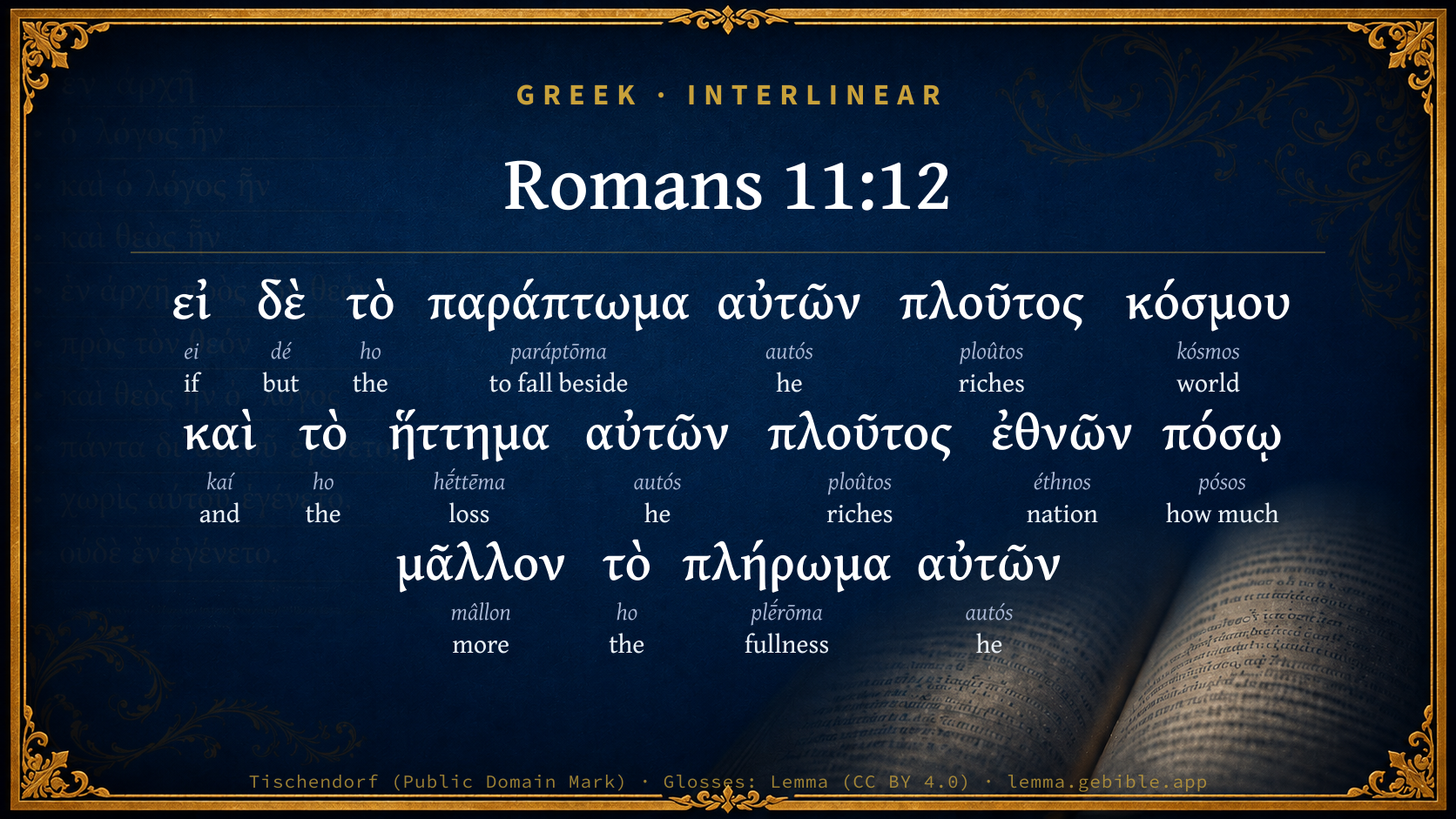
Greek (Tischendorf 8th ed.) Romans 11:12 appears in the Greek New Testament. The text above is from the Tischendorf 8th edition. Each word links to its Strong’s number and a concise gloss. Click any word for its full Thayer’s Greek Lexicon entry.
Download image
Cite this verse

Romans 11:12 (World English Bible). Public Domain. Lemma interlinear Bible study tool, https://lemma.gebible.app/v/romans/11/12.

Show BibTeX & RIS
BibTeX
RIS
English Translation
Now if their fall is the riches of the world, and their loss the riches of the Gentiles; how much more their fullness?
World English Bible · Public Domain
Highlights
  • 1 first appearance in the Greek New Testament
Full analysis ↓
Download a study sheet

One document with this verse’s original text, its word-by-word gloss line, the meaning frame, cross-references with their text, attributed commentary, and full source and license credits — printable, and it pastes into notes with its structure intact.

This verse Autodidact and up

Study sheet (.html) Plain text (.txt)

A passage Seminary Student

Up to 50 verses in one chapter. A passage sheet keeps up to 6 commentary sources and 12 cross-references per verse, in the order this page ranks them, and says so on the sheet whenever that leaves anything out. Ask for a single verse and you get the Autodidact verse sheet above.

Everything on this page stays free to read, with no account — the sheet is a download of what is already on screen, not access to it.

Want to remove ads? Support Godless Engineer
Compare translations 3

The same verse in 3 English versions, stacked beneath the original-language interlinear above. Click any original word for its lexicon entry.

Each is an independent rendering of the whole verse — the interlinear is not word-aligned to these translations.

Highlighted words mark where these versions differ — a whole-verse word diff, not a word-by-word alignment.

  • World English Bible Public Domain
    Now if their fall is the riches of the world, and their loss the riches of the Gentiles; how much more their fullness?
  • King James Version Public Domain
    Now if the fall of them be the riches of the world, and the diminishing of them the riches of the Gentiles; how much more their fulness?
  • unfoldingWord Literal Text CC BY-SA 4.0
    Now if their transgression wealth of the world, and their loss wealth of the Gentiles, how much more their fullness?

unfoldingWord Literal Text — © unfoldingWord, licensed CC BY-SA 4.0. Word-aligned USFM3 via Door43 (git.door43.org/unfoldingWord/en_ult).

Versions to compare (up to 4)

3 of 4 selected

Show all 19 translations

Every available English version of this verse, each an independent rendering of the whole verse.

  • World English Bible Public Domain
    Now if their fall is the riches of the world, and their loss the riches of the Gentiles; how much more their fullness?
  • Berean Standard Bible Public Domain
    But if their trespass means riches for the world, and their failure means riches for the Gentiles, how much greater riches will their fullness bring!
  • Majority Standard Bible Public Domain
    But if their trespass means riches for the world, and their failure means riches for the Gentiles, how much greater riches will their fullness bring!
  • King James Version Public Domain
    Now if the fall of them be the riches of the world, and the diminishing of them the riches of the Gentiles; how much more their fulness?
  • American Standard Version (1901) Public Domain
    Now if their fall, is the riches of the world, and their loss the riches of the Gentiles; how much more their fulness?
  • Revised Version (1885) Public Domain
    Now if their fall is the riches of the world, and their loss the riches of the Gentiles; how much more their fulness?
  • Geneva Bible (1599) Public Domain
    Wherefore if the fall of them be the riches of the world, and the diminishing of them the riches of the Gentiles, how much more shall their aboundance be?
  • Douay-Rheims (1899) Public Domain
    Now if the offence of them be the riches of the world, and the diminution of them, the riches of the Gentiles; how much more the fulness of them?
  • Young's Literal Translation Public Domain
    and if the fall of them `is' the riches of a world, and the diminution of them the riches of nations, how much more the fulness of them?
  • Literal Standard Version CC BY-SA 4.0
    and if their fall [is] the riches of [the] world, and their diminishment the riches of nations, how much more their fullness?
  • Unlocked Literal Bible CC BY-SA 4.0
    Now if their failure is the riches of the world, and if their loss is the riches of the Gentiles, how much greater will their completion be?
  • unfoldingWord Literal Text CC BY-SA 4.0
    Now if their transgression wealth of the world, and their loss wealth of the Gentiles, how much more their fullness?
  • Darby Bible Public Domain
    But if their fall [be the] world's wealth, and their loss [the] wealth of [the] nations, how much rather their fulness?
  • World Messianic Bible Public Domain
    Now if their fall is the riches of the world, and their loss the riches of the Gentiles, how much more their fullness!
  • Webster's Bible Public Domain
    Now if the fall of them be the riches of the world, and the diminishing of them the riches of the Gentiles; how much more their fullness?
  • Free Bible Version CC BY-SA 4.0
    Now if even their failure benefits the world, and their loss profits the foreigners, how much more beneficial it would be if they were to completely fulfill what they were meant to be.
  • Bible in Basic English Public Domain
    Now, if their fall is the wealth of the world, and their loss the wealth of the Gentiles, how much greater will be the glory when they are made full?
  • Text-Critical English NT CC BY 4.0
    Now if their trespass means riches for the world, and their loss means riches for the Gentiles, how much more will it mean when their full number is included?
  • Tyndale New Testament (1534) Public Domain
    Wherfore yf the faule of them be the ryches of the worlde: and the mynysshynge of them the ryches of the gentyls: How moche more shuld it be so yf they all beleved.

Literal Standard Version (2020), Covenant Press — licensed CC BY-SA 4.0. Text via the HelloAO Bible API (eBible.org). Unlocked Literal Bible (unfoldingWord) — licensed CC BY-SA 4.0. Text via the HelloAO Bible API (eBible.org). unfoldingWord Literal Text — © unfoldingWord, licensed CC BY-SA 4.0. Word-aligned USFM3 via Door43 (git.door43.org/unfoldingWord/en_ult). Free Bible Version, Dr. Jonathan Gallagher — licensed CC BY-SA 4.0. Text via the HelloAO Bible API (eBible.org).

Word by word

More ways to search: Search by grammar → Find every occurrence → Compare this word →

Practice this passage: Drill this verse → Learn its vocabulary →

ἥττημα
hḗttēma
G2275
“loss”
Noun, Nominative, Singular, Neuter
Part of Speech
Noun
Case
Nominative
Number
Singular
Gender
Neuter
Full Thayer's Definition

Origin: from G2274

TDNT: None

1. a diminution, decrease: i.e. defeat 2. loss, as respects to salvation
  1. εἰ ei G1487 “if” Conditional
  2. δὲ dé G1161 “but” Conjunction
  3. τὸ ho G3588 “the” Article, Nominative, Singular, Neuter
  4. παράπτωμα paráptōma G3900 “to fall beside” Noun, Nominative, Singular, Neuter
  5. αὐτῶν autós G846 “he” Personal pronoun, Genitive, Plural, Masculine
  6. πλοῦτος ploûtos G4149 “riches” Noun, Nominative, Singular, Neuter
  7. κόσμου kósmos G2889 “world” Noun, Genitive, Singular, Masculine
  8. καὶ kaí G2532 “and” Conjunction
  9. τὸ ho G3588 “the” Article, Nominative, Singular, Neuter
  10. αὐτῶν autós G846 “he” Personal pronoun, Genitive, Plural, Masculine
  11. πλοῦτος ploûtos G4149 “riches” Noun, Nominative, Singular, Neuter
  12. ἐθνῶν éthnos G1484 “nation” Noun, Genitive, Plural, Neuter
  13. πόσῳ pósos G4214 “how much” Correlative/interrogative pronoun, Dative, Singular, Neuter
  14. μᾶλλον mâllon G3123 “more” Adverb
  15. τὸ ho G3588 “the” Article, Nominative, Singular, Neuter
  16. πλήρωμα plḗrōma G4138 “fullness” Noun, Nominative, Singular, Neuter
  17. αὐτῶν autós G846 “he” Personal pronoun, Genitive, Plural, Masculine

About this verse

These counts appear in no published source. They are computed here, from the morphology-tagged text and Lemma’s own curated glosses. What Lemma adds →

18
words
13
distinct lemmas
Pauline Epistles
section

Notable vocabulary

The rarest word here is ἥττημα loss G2275 — appearing just 2 times in the whole Greek New Testament.

First appearance in Scripture

This word makes its first canonical appearance in the Greek New Testament here:

  • ἥττημα loss G2275

Shared distinctive vocabulary

ἥττημα loss G2275 occurs in 2 verses of the Greek New Testament. Also found in:
Repetition

Words recur within this verse:

  • πλοῦτος riches G4149 ×2
  • τὸ the G3588 ×3
  • αὐτῶν he G846 ×3

Cross-references

14

Topical passages linked to Romans 11:12 in the Treasury of Scripture Knowledge — connected by theme and wording, ordered by reader-vote popularity; previews shown in the World English Bible.

  • Romans 11:25 For I don't desire, brothers, to have you ignorant of this mystery, so that you won't be wise in your own conceits, that a partial hardening has happened to Israel, until the fullness of the Gentiles has come in,
  • Romans 11:15 For if the rejection of them is the reconciling of the world, what would their acceptance be, but life from the dead?
  • Colossians 1:27 to whom God was pleased to make known what are the riches of the glory of this mystery among the Gentiles, which is Christ in you, the hope of glory;
  • Isaiah 11:11–12:6 It shall happen in that day, that the Lord will set his hand again the second time to recover the remnant of his people, who shall remain, from Assyria, and from Egypt, and from Pathros, and from Cush, and from Elam, and from Shinar, and from Hamath, and from the islands of the sea.
  • Micah 5:7 The remnant of Jacob will be in the midst of many peoples, Like dew from Yahweh, Like showers on the grass, That don't wait for man, Nor wait for the sons of men.
  • Romans 9:23 and that he might make known the riches of his glory on vessels of mercy, which he prepared beforehand for glory,
  • Ephesians 3:8 To me, the very least of all saints, was this grace given, to preach to the Gentiles the unsearchable riches of Christ,
  • Isaiah 66:8–20 Who has heard such a thing? who has seen such things? Shall a land be born in one day? shall a nation be brought forth at once? for as soon as Zion travailed, she brought forth her children.
  • Zechariah 2:11 Many nations shall join themselves to Yahweh in that day, and shall be my people; and I will dwell in the midst of you, and you shall know that Yahweh of Hosts has sent me to you.
  • Isaiah 60:1–22 Arise, shine; for your light is come, and the glory of Yahweh is risen on you.
  • Zechariah 8:20–23 Thus says Yahweh of Hosts: "Many peoples, and the inhabitants of many cities will yet come;
  • Romans 11:33 Oh the depth of the riches both of the wisdom and the knowledge of God! How unsearchable are his judgments, and his ways past tracing out!
  • Revelation 11:15–19 The seventh angel sounded, and great voices in heaven followed, saying, "The kingdom of the world has become the Kingdom of our Lord, and of his Christ. He will reign forever and ever!"
  • Micah 4:1–2 But in the latter days, It will happen that the mountain of Yahweh's temple will be established on the top of the mountains, And it will be exalted above the hills; And peoples will stream to it.

Cross-references courtesy of OpenBible.info (CC BY 4.0).

Commentary

Notes on Romans 11:12 from classic Christian and Jewish commentators (each source and its license shown beneath its notes). The classic Christian expositions comment on the surrounding passage and are grouped to its opening verse, so a note may address several verses; the Jewish commentaries on the Tanakh (Rashi and others) are per-verse, so they appear only where the commentator wrote on this verse.

Lemma curates 59 commentaries, every one of them public domain or Creative Commons licensed, each selected and text-cleaned for this edition rather than reprinted as found. About our sources →

Bengel's Gnomon

Johann Albrecht Bengel

Rom 11:12. Εἰ δὲ, Now if) This verse has two parts, the first is treated of, Rom 11:13, etc.: the latter, how much more, etc., Rom 11:23-24.—κόσμον—ἐθνῶν, of the world—of the Gentiles) The world denotes quality [in reference to the] παράπτωμα, the original fall [i.e., the fall of man in Adam]; the Gentiles, quantity, or, in other words, multitude, to which fewness [diminishing, Engl. Vers.], ἥττημα, is opposed; whence τὸ πλήρωμα [the fulness] signifies, presently after, the large numbers of Israel abounding in grace.—ἤττημα) the fewness, in opposition to πλήρωμα, fulness [abundance]. Isa 31:8, ἐσονται εἰς ἥττημα, [His young men shall become a mere handful; lit. a fewness].—πόσῳ μᾶλλον, how much more) for where there are many seeds, their increase is the greater.—τὸ πλήρωμα αὐτῶν, their fulness, [abundance]; supply, will be the riches of the Gentiles. Therefore, even if the Jews had believed from the very first, the Gentiles would not have been excluded. The same word occurs in Rom 11:25.

Bengel's Gnomon of the New Testament — English translation (T&T Clark, Edinburgh, 1860) — public domain. Text from a community e-Sword module.

Meyer's Critical & Exegetical Commentary

Heinrich August Wilhelm Meyer

Rom_11:12. Δέ] μεταβατικόν, leading over from what has been said in Rom_11:11 to a very joyful prospect thereby opened into the future.

The conclusion is a felici effectu causae pejoris ad feliciorem effectum causae melioris.

πλοῦτος] for the Gentile world (κόσμος) became enriched with the σωτηρία (Rom_11:11), through the παράπτωμα of the Jews.

τὸ ἥττημα αὐτ. πλοῦτ. ἐθνῶν] and their overthrow riches for Gentile peoples. Parallel to the foregoing.

ἥττημα] is not found in the old Greek, but only in the LXX. Isa_31:8, and 1Co_6:7; it is, however, equivalent to the classical ἧττα, which is the opposite of νίκη (Plato, Lach. p. 196 A, Legg. i. p. 638 A; Dem. 1486. 3; Xen. Cyr. iii. 1. 19, 20), and, corresponding to the signification of ἡττᾶσθαι, profligari, vinci, means clades, both in its proper sense, and also generally: succumbing, decline (comp. Dem. 1466. 23, ἧττα τῆς προαιρέσεως), loss suffered (1Co_6:7), getting the worse. See Perizon. ad Ael. V. H. ii. 25. Here the proper signification is to be retained, and that, as the contrast of τὸ πλήρωμα requires, in a numerical respect. So now also Tholuck, likewise Mangold. Through the fact that a part of the Jews was unbelieving, the people has suffered an overthrow, has, like a vanquished army, been weakened in numbers, inasmuch, namely, as the unbelieving portion by its unbelief practically seceded from the people of God. Comp. Vulg.: diminutio eorum; Luthardt: loss in amount. If it be explained as: loss of the Messianic salvation, which they have suffered (Fritzsche and others), or: the loss which the kingdom of God has suffered in their case (Philippi, comp. Kahnis, Dogm. I. p. 573), the former is not appropriate to the contrast of πλήρωμα, and the latter introduces the reference to the kingdom of God, as that which has suffered the detriment, the more unwarrantably, inasmuch as the genit. αὐτῶν is expressed. The threefold αὐτῶν is to be taken with the like reference as the genitive of the subject, and applies in each instance to the people Israel as a whole (whose collective guilt also is the παράπτωμα), in contrast to the κόσμος and the ἔθνηwhich likewise is not preserved in Philippis view. This very circumstance, and more decisively the utter absence of linguistic proof, tells also against the traditional usual rendering, according to which τὸ ἥττημα is supposed to signify the minority: paucitas Judaeorum credentium (Grotius). So, in substance, Chrysostom, Theodoret, Erasmus, Beza, Estius, Wetstein, Bengel, and many others, including Reiche, Olshausen, Baumgarten-Crusius, Maier, Bisping, Reithmayr; comp. Ewald: their remaining behind.

πόσῳ μᾶλλον τὸ πλήρωμα αὐτῶν] sc. πλοῦτος ἐθνῶν γενήσεται; how much more their becoming full, that is, how much more will it issue in the enrichment of the Gentiles with the Messianic salvation, if the Jews, after the defeat which they have suffered, shall again be reinstated to their plena copia, so that they will then again in their full amount (Rom_11:26), as an integral whole, belong to the people of God,which will take place through the conversion of all Israel to Christ (not would, as Luther has it). The ἥττημα αὐτῶν is then compensated, and the ΠΛΉΡΩΜΑ ΑὐΤῶΝ brought in, which, moreover, may take place even with a continuance of the ΔΙΑΣΠΟΡΆ. On ΠΛΉΡΩΜΑ generally, see Fritzsche, II. p. 469 ff. Comp. on Eph_1:10. The numerical reference of the πλήρωμα αὐτῶν is suggested by the correlative ΤῸ ΠΛΉΡΩΜΑ ΤῶΝ ἘΘΝῶΝ in Rom_11:25; and in so far the view which takes it of the full number of the Jews (Theodoret: πάντες πιστεύσαντες μειζόνων ἀγαθῶν πᾶσιν ἀνθρώποις ἐγένοντο ἂν πρόξενοι, so most) is correct. Comp. Ewald: their full admission, supplying what is wanting. With this Umbreit mixes up at the same time the fulfilment of their predestination; whilst van Hengel sees in the πλήρ. αὐτ., not absolutely the full number, but only the collective body of those destined by God to conversion, which, however, is not expressed, but is supplied by the reader. The various views correspond to the varying explanations of ἥττημα. So e.g. Fritzsche: the fulness of Messianic salvation, which they will possess; Philippi: the filling upwhich takes place through their conversionof the blank in the kingdom of God which arose through their unbelief; Rückert, Köllner: the restoration of Israel to its befitting position; Hofmann: the status, in which they are fully and entirely that which they ought to be (qualitative). Luthardt also takes the correct view.

Meyer — Critical and Exegetical Commentary on the New Testament — English translation by Peter Christie, edited by Frederick Crombie (T&T Clark, 1880) — public domain. Text from a community e-Sword module.

Expositor's Greek Testament

ed. W. Robertson Nicoll

Rom 11:12 . Both ἥττημα and πλήρωμα are difficult words, but it is not necessary to suppose that they answer mathematically to one another, though Wetstein explains them by - and +. ἥττημα may mean (as in Isa 31:8 ) defeat, or (as in 1Co 6:7 ) loss; it can hardly mean diminutio eorum , or paucitas Judœorum credentium ; τὸ πλήρωμα αὐτῶν must mean the making up of them to their full numbers. There is an exhaustive study of the word πλήρωμα by Prof. J. Armitage Robinson in The Expositor , April, 1898. His paraphrase of this verse is very good. “If the Gentiles have been enriched in a sense through the very miscarriage and disaster of Israel, what wealth is in store for them in the great Return, when all Israel shall be saved ‘when God hath made the pile complete!’ ” The enrichment referred to is in both cases that which comes through participating in the blessings of the Gospel.

The Expositor's Greek Testament, edited by W. Robertson Nicoll (1897–1910) — public domain. Text from a community e-Sword module.

Hodge's Commentary on Romans, Ephesians & First Corinthians

Charles Hodge

Rom_11:12

Now, if the fall of them be the riches of the world, and the diminishing of them the riches of the Gentiles, how much more their fullness? Although there is considerable difficulty in fixing the precise sense of the several clauses of this verse, its general meaning seems sufficiently obvious. If the rejection of the Jews has been the occasion of so much good to the world, how much more may be expected from their restoration? In this view it bears directly upon the apostles object, which, in the first place, is to show that the restoration of the Jews is a probable and desirable event. There is in the verse a twofold annunciation of the same idea. In the first, the sentence is incomplete. If the fall of them be the riches of the world, how much more their recovery? if their diminishing, how much more their fullness? The principal difficulty in this passage results from the ambiguity of the words (ἥττημα and πλήρωμα) rendered diminishing and fullness. The former may mean fewness or inferiority, a condition worse than that of others, or worse than a former one. Those who adopt the former of these senses, understand the verse thus: If the few Jews, who have been converted, have been such an advantage to the Gentiles, how much more will the great multitude of them, when brought to Christ, be a source of blessing. But to this interpretation it may be objected,

1. The word has rarely, if ever, the meaning here assigned to it. Passow gives it no such signification in his Lexicon. The cognate verb signifies, I am inferior in strength or condition to any one. 2Pe_2:19; 2Co_12:13. The adjective means inferior, worse: 1Co_11:17, Ye come together not for the better, but for the worse. The only place in which the word here used occurs elsewhere in the New Testament, is 1Co_6:7, There is utterly a fault among you, or as it might be rendered, It is an injury to you. Such too is the meaning of the word in the Old Testament: Isa_31:8, His young men shall be discomfited, which expresses the sense of the original; and so does the Septuagint, which employs the word used by the apostle, His young men shall be brought into an inferior condition, i.e. shall be conquered.

2. This interpretation does not suit the context. Paul does not say that the conversion of the few Jews who had become Christians, had been the occasion of good to the Gentiles, but the rejection of the great body of the nation.

3. It does not at all suit the first clause of the verse. The fall of them, answers to and explains the diminishing of them. As the former clause cannot receive the interpretation objected to, neither can the latter. Tholuck and others take ἥττημα in a moral sense; their fault, so as to correspond with παράπτωμα. But this would make the two clauses of the verse tautological, and destroy the antithesis between ἥττημα and πλήρωμα, as the latter cannot mean, their goodness. The sense is clear and good if we give ἥττημα its natural meaning; their worse estate, or loss. The Jews lost their peculiar privileges and blessings, and their loss was the riches of the Gentiles. It enriched them by being the means of transferring to them the treasures of the gospel.

The word πλήρωμα has various senses in the New Testament. It properly means that with which anything is filled, as in the frequent phrase, the fullness of the earth, or of the sea, etc. So fullness of the Godhead, all that is in God, the plenitude of Deity. Joh_1:16, Of his fullness have all we received; Eph_3:19, That ye might be filled with all the fullness of God. It also means the complement or supplement of anything, the remaining part; see Mat_9:16. So in Eph_1:23, the church may be called the fullness of Christ, because he is the head, the church, the residues or complement, by which the mystical body is completed. Of these several meanings, Storr selects the last, and explains the verse thus: If the ruin of the unbelieving Jews has been a source of blessing to the Gentiles, how much more shall the remaining portion of the nation, i.e. those converted to Christianity, be the means of good. But,

1. This interpretation destroys the obvious antithesis of the sentence; the remaining part does not answer to the word rendered ruin, as it obviously should do.

2. It is not in accordance with the context, which is not designed so much to set forth the usefulness of the Jews then converted, as to declare the blessings likely to be consequent on the final conversion of the whole nation.

3. A comparison of this, with the 15th verse, is unfavorable to this interpretation. These verses evidently express the same idea, and therefore illustrate each other. If the casting away of them be the occasion of reconciling the world, what will the receiving of them be? etc., Rom_11:15. Retaining the sense, complement, the passage admits of a different interpretation from that given by Storr.

The Jewish nation are the πλήρωμα, the complement, that which completes the whole number of the people of God. A rent, or loss had occurred by their rejection; they were, however, the complement by which that loss was to be made good. This is evidently forced.

The common interpretation, therefore, is to be preferred: If the injury or ruin of the Jews has been the occasion of good to the Gentiles, how much more shall their full restoration or blessedness be?

1. This agrees with the antithesis, If the fall, then the recovery; if the ruin, then the blessedness, etc.

2. It suits the context and the design of the apostle.

3. It is in strict accordance with the obviously parallel passage in the 15th verse, just quoted.

The remark of Thomas Aquinas is of great weight: Bonum est potentius ad utilitatem inferendam, quam malum, sed malum Judaeorum gentilibus magnam utilitatem contulit, ergo multo majorem confert mundo eorum bonum. The πλήρωμα of the Gentiles is, therefore, that which fills them, and renders their blessedness full. The word is thus retained in its ordinary sense.

Charles Hodge — Commentary on Romans (1835), First Corinthians (1857), and Ephesians (1856) — public domain. Text from a community e-Sword module.

Geneva Bible (1599)

Geneva Bible translators

By riches he meaneth the knowledge of the Gospel to everlasting life: and by the world, all nations dispersed throughout the whole world.

Of the Jews, when the whole nation without exception shall come to Christ.

Geneva Bible (1599) marginal notes — public domain. Text via Bolls.life.

Jamieson, Fausset & Brown

Robert Jamieson, A. R. Fausset & David Brown

Now if the fall of them--"But if their trespass," or "false step"

be the riches of the--Gentile

world--as being the occasion of their accession to Christ.

and the diminishing of them--that is, the reduction of the true Israel to so small a remnant.

the riches of the Gentiles; how much more their fulness!--that is, their full recovery (see on Rom 11:26); that is, "If an event so untoward as Israel's fall was the occasion of such unspeakable good to the Gentile world, of how much greater good may we expect an event so blessed as their full recovery to be productive?"

Jamieson, Fausset & Brown — Commentary Critical and Explanatory on the Whole Bible (1871) — public domain (CC PDM 1.0). Text via the HelloAO Bible API.

Adam Clarke's Commentary

Verse 12. Now if the fall of them] The English reader may imagine that, because fall is used in both these verses, the original word is the same. But their fall, and the fall of them, is παραπτωμα, the same word which we render offence, Ro 5:15; Ro 5:17-18, and might be rendered lapse. Whereas that they should fall (Ro 11:11) is, ινα πεσωσι. Now, πιπτω, to fall, is used in a sense so very emphatical as to signify being slain. So Homer, Il. viii., ver. 475.

Ηματι τῳ, οτ' αν οἱ μεν επι πρυμνησι μαχωνται,

Στεινει εν αινοτατῳ, περι Πατροκλοιο πεσοντος

Ὡς γαρ θεσφατον εστι.

And for Patroclus slain, the crowded hosts,

In narrow space, shall at the ships contend.

Such the divine decree.

And again, Il. xi., ver. 84.

Οφρα μεν ηως ην και αεξετο ἱερον ημαρ,

Τοφρα μαλ' αμφοτερων βελε' ἡπτετο, πιπτε δε λαος.

While morning lasted, and the light of day

Increased, so long the weapons on both sides

Flew in thick vollies; and the people fell.

COWPER.

It is well known, that to fall in battle means to be killed. It is in such a sense as this that St. Paul used the word fall, when he says, Have they stumbled that they should FALL? He means a fall quite destructive and ruinous; whereas by their fall, and the fall of them, he means no more than such a lapse as was recoverable; as in the case of Adam's offence. See Dr. Taylor.

The riches of the world] If, in consequence of their unbelief, the riches of God's grace and goodness be poured out on the whole Gentile world, how much more shall that dispensation of grace and mercy enrich and aggrandize the Gentiles, which shall bring the whole body of the Jews to the faith of the Gospel! Here the apostle supposes, or rather predicts, that such a dispensation shall take place; and that, therefore, the Jews have not so stumbled as to be finally irrecoverable.

Adam Clarke's Commentary on the Bible (1810–1826) — public domain. Text from a community e-Sword/MySword module.

John Calvin's Commentaries

12. And if their fall, etc. As he had taught us that after the Jews were repudiated, the Gentiles were introduced in their place, that he might not make the salvation of the Jews to be disliked by the Gentiles, as though their salvation depended on the ruin of the Jews, he anticipates this false notion, and lays down a sentiment of an opposite kind, that nothing would conduce more to advance the salvation of the Gentiles, than that the grace of God should flourish and abound among the Jews. To prove this, he derives an argument from the less, — “If their fall had raised the Gentiles, and their diminution had enriched them, how much more their fullness?” for the first was done contrary to nature, and the last will be done according to a natural order of things. And it is no objection to this reasoning, that the word of God had flowed to the Gentiles, after the Jews had rejected, and, as it were, cast it from them; for if they had received it, their faith would have brought forth much more fruit than their unbelief had occasioned; for the truth of God would have been thereby confirmed by being accomplished in them, and they also themselves would have led many by their teaching, whom they, on the contrary, by their perverseness, had turned aside.

Now he would have spoken more strictly correct, if, to the fall, he had opposed rising: of this I remind you, that no one may expect here an adorned language, and may not be offended with this simple mode of speaking; for these things were written to mold the heart and not the tongue.

John Calvin's Commentaries (1540-1563) — public domain. Text from the Calvin Translation Society English edition (1840s-50s) via the Christian Classics Ethereal Library (ccel.org). Calvin's coverage is partial (roughly two-thirds of the Bible); uncommented books and verses are honest gaps, never fabricated. The 19th-century editor's footnotes and remarks are omitted so the notes are faithfully Calvin's own voice.

Ellicott's Commentary for English Readers

(12) And if the fall of the Jews had such good results, much more might be expected from their reinstatement.

Diminishing . . . fulness.—It is, perhaps, difficult to suggest a better translation. The Apostle seems to have in view not only the supersession of the Jews by the Gentiles, but also, under the figure of a defeat in battle, the reduction of their numbers to a small remnant. And, on the other hand, he looks forward to their full and complete restoration, when every Jew shall be a member of the Messianic kingdom, and there shall not be one missing. The full “complement,” as it were, of the nation is what is meant by “fulness;” its temporary reduction and degradation is expressed by “diminishing.”

A Bible Commentary for English Readers, edited by Charles John Ellicott (1878–1897) — public domain. Text from a community e-Sword module.

The Cambridge Bible for Schools and Colleges

gen. ed. J. J. S. Perowne

12. the fall] Same word as in Rom_11:11. See note there.

the riches] “The unsearchable riches of Messiah,” (Eph_3:8,) which “on occasion of” the rejection of Messiah by the Jews were preached to the “world” of the Gentiles.

the diminishing] The Gr. word, by analogy with cognate words in the classics, invites the rendering “defeat.” But it stands here in plain contrast to that rendered “fulness;” and so should be interpreted a lessening, falling short, in respect of numbers. Unbelief in Messiah reduced to woeful fewness the “Israel” which was really in covenant. More and more it proved to be a mere “remnant.” And the causes which brought this about were also, under God, the causes of the spread of the Gospel to the Gentiles.

how much more their fulness?] The better cause shall produce a better effect.—“Their fulness:”—i.e. the filling up of their numbers. The true Israel shall at length include a vastly larger proportion of Israel the nation, whether or no the nation shall be literally all brought in. See further below, on Rom_11:15; Rom_11:26.

The Cambridge Bible for Schools and Colleges (gen. ed. J. J. S. Perowne; Cambridge University Press, 1878–1918) — public domain. Text from a community e-Sword module.

John Gill's Exposition

Now if the fall of them be the riches of the world,.... By "the world", as is clear from the next clause, is meant the Gentiles; who were frequently called so by the Jews, who reckoned themselves to be "the church", and all the nations round about them, "the world"; which observation may serve to illustrate other passages of Scripture; see Joh 3:16; now the fall of the Jews, which was a lessening of them, was the riches of the Gentiles;

and the diminishing of them the riches of the Gentiles; the number of the true believers in Christ among them were very few, the generality of them received him not, but stumbled at him, and fell through unbelief; but the few that did believe were the means of carrying and spreading the Gospel, which is, "the unsearchable riches of Christ", Eph 3:8, in the Gentile world: thus at first a persecution being raised against the church at Jerusalem, the ministers of the Gospel were scattered abroad, and went everywhere preaching the word; and afterwards the Jews behaving in a very indecent manner towards the apostles of Christ, they turned in a manner wholly to the Gentiles; and thus by the means of a few, a diminutive company, of which the Apostle Paul was one, the Gospel, the pearl of great price, treasure hid in a field, and put into earthen vessels, was carried into the Heathen world, and by it they were enriched. This handful of men that went out of Judea, were the means of converting vast numbers, large multitudes of souls among the Gentiles, which may be also designed by "riches": this word sometimes signifying plenty, see Rom 2:4; and also of enriching them with the gifts and graces of the Spirit, and of directing them to Christ, who has durable riches, treasures of wisdom and knowledge, riches of grace, and riches of glory. Now the apostle argues, that if such a small number of the Jews who embraced Christ, were of so much advantage to the Gentiles,

how much more their fulness? when converts to Christ among them will be as the sand of the sea, a nation of them shall be born again at once, and all Israel be saved. This will be a great accession to the Gentile church, bring much glory to it, contribute greatly to its welfare, and be a means of establishing their faith, and of putting fresh life and vigour into them, and of inspiring them with more zeal for Christ, and for his honour and glory.

John Gill's Exposition of the Whole Bible (1746–1763) — public domain (CC PDM 1.0). Text via the HelloAO Bible API.

Trapp's Complete Commentary

John Trapp

12 Now if the fall of them be the riches of the world, and the diminishing of them the riches of the Gentiles; how much more their fulness?

Ver. 12. How much more their fulness] O dieculam illam! dexter mihi prae laetitias alit oculus. How long, Lord, holy and true?

John Trapp, A Commentary or Exposition upon All the Books of the Old and New Testament (1647–1656) — public domain. Text from a community e-Sword module.

Albert Barnes' Notes on the Bible

If the fall of them - If their lapse, or falling. If their temporal rejection and being cast off for a time has already accomplished so much.

Be the riches of the world - The word “riches” means wealth, abundance of property; more than is necessary to the supply of our needs. Hence, it means also anything that may promote our comfort or happiness, as wealth is the means of securing our welfare. The gospel is called riches, as it is the means of our highest enjoyment, and eternal welfare. It is the means of conferring numberless spiritual blessings on the Gentile world; and as this was done by the fall of the Jews, so it could be said that their fall was the riches of the world. It was the occasion or means without which the blessings of the gospel could not be conferred on the world.

The diminishing of them - Margin, “Decay.” “Loss” ἥττημα hēttēma. This word means diminution, defect, what is lacked or missing. Hence, also judgment, condemnation. Here it means their degradation; the withdrawing of their special privileges; their rejection. It stands opposed to “their fulness.”

The riches of the Gentiles - The means of conferring important blessings on the Gentiles.

How much more their fulness - The word “fulness” πλήρωμα plērōma means what fills up, or completes anything. Thus, it is applied to what fills a vessel or cup; also to the piece of cloth which is put in to fill up the rent in a garment; Mat 9:16. To the fragments which were left when Christ had fed the five thousand; Mar 8:20; Rom 13:10. “Love is the fulfilling of the law,” that is, it is the filling up of the law, or what renders the obedience complete; see Gal 5:14. Here it stands opposed to their fall, and their diminution, and evidently means their complete restoration to the favor of God; their recovery from unbelief and apostasy. That there will be such a recovery, the apostle proceeds to show. The sentiment of the passage then is, If their rejection and punishment; their being cut off from the favor of God, an event apparently so unlikely to promote the spread of true religion, if their being withrawn from all active influence in spreading the true knowledge of God, be yet the occasion of so many blessings to mankind as have attended the spread of the gospel in consequence of it; how much more shall we expect when they shall be restored; when the energy and zeal of the Jewish nation shall unite with the efforts of others in spreading the knowledge of the true Messiah. In what way, or when, this shall be, we know not. But it is easy to see, that if the Jewish people should be converted to the Christian faith, they would have facilities for spreading the truth, which the church has never had without them.

(1) They are scattered in all nations, and have access to all people.

(2) Their conversion, after so long unbelief, would have all the power and influence of a miracle performed in view of all nations. It would be seen why they had been preserved, and their conversion would be a most striking fulfillment of the prophecies.

(3) They are familiar with the languages of the world, and their conversion would at once establish many Christian missionaries in the heart of all the kingdoms of the world. It would be kindling at once a thousand lights in all the dark parts of the earth.

(4) The Jews have shown that they are eminently suited to spread the true religion. It was by Jews converted to Christianity, that the gospel was first spread. Each of the apostles was a Jew; and they have lost none of the ardor, enterprise, and zeal that always characterized their nation. Their conversion would be, therefore, to give to the church a host of missionaries prepared for their work, familiar with all customs, languages, and climes, and already in the heart of all kingdoms, and with facilities for their work in advance, which others must gain only by the slow toil of many years.

Albert Barnes' Notes on the Bible (1834–1885) — public domain. Text from a community e-Sword/MySword module.

Matthew Poole's English Annotations

Another anticipation. The apostle having showed, that the falling away of the Jews was an occasion of the coming in of the Gentiles, it might be objected, that the conversion of the Jews might likewise be an occasion of the falling away of the Gentiles. To this he answers negatively, and confirms his answer by an argument from the less to the greater; that if their fall and diminution were the riches of the Gentiles, their calling again would be so much more: q.d. If God hath made use of the fall and rejection of the Jews, for an occasion of pouring out the riches or abundance of his grace upon the nations; and if the number of believing Jews, being so very small, (which is meant by their diminishing), hath occasioned the conversion of such a multitude of Gentiles; then how much more will their fulness have the effect!

How much more their fulness! i.e. their general conversion, the coming in of the Jews, shall so fill the world with wonder, and the gospel with lustre, that a much further accession will be made even to the number of the believing Gentiles.

Matthew Poole's English Annotations on the Holy Bible (1683–1685) — public domain. Text from a community e-Sword/MySword module.

Whedon's Commentary on the Bible

Daniel D. Whedon

12. Diminishing… fulness—Terms of contrast that serve to explain each other. Primarily they signify amount or number, and designate the small number of the Jews by conversion in the kingdom of God. They are the remnant of Rom_11:5. This is the best estate or aspect of modern Israel. It is the smallness instead of its largeness that first calls in the Gentiles. But their fulness of number, including their fulness of Gospel power in the latter day, will prove to be the riches of the Gentiles much more abundantly than their present scant.

Daniel D. Whedon (gen. ed.), Commentary on the Old and New Testaments (1874–1909) — public domain. Text from a community e-Sword module.

John Wesley's Explanatory Notes

The first part of this verse is treated of, ver. 13, &c.; the latter, How much more their fulness, (that is, their full conversion,) ver. 23, &c. So many prophecies refer to this grand event, that it is surprising any Christian can doubt of it. And these are greatly confirmed by the wonderful preservation of the Jews as a distinct people to this day. When it is accomplished, it will be so strong a demonstration, both of the Old and New Testament Revelation, as will doubtless convince many thousand Deists, in countries nominally Christian; of whom there will, of course, be increasing multitudes among merely nominal Christians. And this will be a means of swiftly propagating the gospel among Mahometans and Pagans; who would probably have received it long ago, had they conversed only with real Christians.

John Wesley, Explanatory Notes Upon the Whole Bible (1754–1765) — public domain. Text via the GEBible commentary corpus.

Scofield Reference Notes

C. I. Scofield

world

kosmos = mankind. (See Scofield "Mat 4:8")

The Scofield Reference Bible (1917 edition), notes by C. I. Scofield — public domain. Text from a community e-Sword module.

Burkitt's Expository Notes on the New Testament

William Burkitt

As if the apostle had said, "If the casting off the Jews was so profitable to the Gentile world; if the Gentiles have been such great gainers by occasion of the sin and fall of the Jews; how much more, when they shall become Christians, will they add to the fulness, the glory, and greatness of the Christian church?"

Observe here, The wonderful wisdom, the astonishing goodness, the overruling providence and power of God, in causing the fall of the Jews to be the occasion of God’s manifesting his abundant grace in the conversion of the Gentiles, and spreading the plentiful knowledge of Christ over all the world; and also in causing the general conversion of the Jews, towards the end of the world, to confirm the faith of the believing Gentiles.

William Burkitt's Expository Notes on the New Testament (1700–1703) — public domain. Text from a community e-Sword module.

Godbey's Commentary on the New Testament

William B. Godbey

12. “But if their collapse is the wealth of the world, and their reduction the riches of the Gentiles, how much more will be their fullness. Truly the conversion of the Jews, of which some brilliant scintillations are already flashing out, will prove a sunburst on Christendom.

William B. Godbey, Commentary on the New Testament (1896–1900) — public domain. Text from a community e-Sword module.

McGarvey & Pendleton's Commentaries

J. W. McGarvey

Now if their fall [paraptoma] is the riches of the world, and their loss [hettema, that loss or diminution which an army suffers by defeat, also moral loss, impoverishment, to be defeated, to be reduced, or made inferior. "A reduction in one aspect to a race of scattered exiles, in another to a mere remnant of 'Israelites indeed'"--Moule] the riches of the Gentiles; how much more their fulness? [Pleroma, the full number, the whole body, the totality. To emphasize the situation and impress it upon his readers, Paul makes use of the Hebrew parallelism, presenting two clauses which express substantially the same thing. If there be any difference, we would say that "world" indicates sinners, and "Gentiles" the uncovenanted races. If paraphrased thus, it would read, Now, if the sin or offence of godly Israel enriched the ungodly, sinful world, and if the loss or spiritual impoverishment and numerical diminution of the covenanted people enriched and multiplied the covenanted among the hitherto uncovenanted people, how much more would both the sinful world and its uncovenanted inhabitants have been blessed every way, had Israel been of the right spirit, so as to have received enrichment instead of being cast off and diminished. Because Israel had a proud, narrow, inimical spirit ( 1Th_2:15-16 ), its depletion worked blessing to the world and the Gentiles; but if Israel had yielded to Christ so as to be transformed like that persecuting Saul who became Paul, the apostle to the Gentiles, who can measure the fullness of blessing which would have come to the inhabitants of the earth by the enlargement, enrichment and full spiritual endowment of every son of Abraham dispersed through the world! With millions of Pauls in all lands throughout all generations, we should have measured our heavenward progress by milestones instead of inches. "Goodness," says Thomas Aquinas, "is more capable of bearing blessing than is evil; but the evil of the Jews brought great blessing to the Gentiles; therefore much more should their goodness bring greater blessing to the world."]

J. W. McGarvey (with Philip Y. Pendleton), Commentaries on the New Testament (The Fourfold Gospel, 1914; Acts; and the epistles) — public domain. Text from a community e-Sword/MySword module.

The People's New Testament

B. W. Johnson

12. If the fall of them be the riches of the world. In contributing to the conversion of the Gentiles their fall has been “riches.” How much more their fulness? In the remaining part of the chapter the apostle shows the grand results which will follow the final conversion of the Jewish nation as a body.

B. W. Johnson's The People's New Testament with Notes (1889–1891) — public domain. Electronic text from the Christian Classics Ethereal Library (CCEL) ThML edition.

Cambridge Greek Testament for Schools and Colleges

12. ἥττημα = defeat: they have been defeated in their efforts after righteousness (so 1Co 6:7 of defeat in a case at law); cf. Field ad loc[216] He points out that there is a lack of correspondence between ἥττημα and πλήρωμα as there is between παράπτωμα and πλοῦτος. There is no justification for translating ἥττημα by ‘loss.’

[216] ad loc. ad locum

πόσῳ μᾶλλον. Sc. πλοῦτος ἔσται.

πλήρωμα. cf. Robinson, Eph. p. 255 f.: he shows that substantives in -μα represent the result of the action of the verb, and may be either active or passive. Here = the completing of Israel, i.e. the adding the rest to the remnant; cf. Rom 11:15; Rom 11:26.

Cambridge Greek Testament for Schools and Colleges (Cambridge University Press, 1896; 21 vols, various authors incl. Carr, Maclear, Plummer, Farrar, Lumby, Moule, M. R. James, Simcox) — public domain. Text from a community e-Sword module.

Alford’s Greek Testament

Henry Alford

12.] Then the Apostle argues on this, as Meyer well says, ‘a felici effectu causæ pejoris ad feliciorem effectum causæ melioris;’—But (‘posito, that’—as in last verse—taking for granted the historical fact, that the stumble of the Jews has been coincident with the admission of the Gentiles) if their trespass is the world’s wealth (the occasion of that wealth,—the wealth itself being the participation in the unsearchable riches of Christ), and (this latter clause parallel to and explanatory of the less plainly expressed one before it) their loss, the wealth of the Gentiles, how much more (shall) their replenishment (be all this)? On ἥττημα and πλήρωμα much question has been raised. I have taken both as answering strictly to the comparison here before the Apostle’s mind, viz. that of impoverishing and enriching,—and the genitives αὐτῶν [&c.] as subjective: q. d. ‘if their impoverishment be the wealth of the Gentiles, how much more shall their enrichment be!’

But several other interpretations are possible. (1) ἥττημα may mean as in ref. 1 Cor., degradation, and πλήρωμα would then be fulness, re-exaltation to the former measure of favour,—or perhaps, as where Herod. iii. 22 says ὀγδώκοντα ἔτεα ζόης πλήρωμα, ‘their completion,’ ‘their highest degree of favour.’ (2) If we regard the meaning of πλήρωμα in ver. 25, we shall be tempted here to render it, ‘full number,’ and similarly ἥττημα, ‘small number.’ So the majority of Commentators: Chrys., Theodoret, Erasmus, Beza, Bucer, Grot., Bengel, Reiche, De W. (but only as regards πλήρ.:—he renders ἥττ. with Luther, Schade) and Olsh. (see below). Thus the argument will stand: ‘If their unbelief (i.e. of one part of them) is the world’s wealth, and their small number (i.e. of believers, the other part of them), the wealth of the Gentiles, how much more their full (restored) number!’ i.e. as Olsh. explains it, ‘If so few Jews can do so much for the Gentile world, what will not the whole number do?’ But thus we shall lose the ‘a minori ad majus’ argument—‘if their sin has done so much, how much more their conversion?’ unless indeed it be said that τὸ ἥττημα implies a national παράπτωμα. Besides, it can hardly be shewn that ἥττημα will bear this meaning of ‘a small number.’ (3) Tholuck, from whom mostly this note is taken, notices at length the view of Olsh., after Origen, that the idea of a definite number of the elect is here in the Apostle’s mind,—that the falling off of the Jews produces a deficiency in the number, which is filled up by the elect from the Gentiles, as ver. 25: understanding by πλήρωμα both there and here, if I take his meaning aright, the number required to fill up the roll of the elect, whether of Jews, as here, or Gentiles, as there. Tholuck, while he concedes the legitimacy of the idea of a πλήρωμα τῶν σωζομένων, maintains, and rightly, that in this section no such idea is brought forward: and that it would not have been intended, without some more definite expression of it than we now find.

I have thought it best as above, considering the very various meanings and difficulty of the word πλήρωμα, to keep here to that which seems to be indicated by the immediate context, which is, besides, the primitive meaning of the word.

It must be noticed, that the fact, of Israel being the chosen people of God, lies at the root of all this argument. Israel is the nation, the covenant people,—the vehicle of God’s gracious purposes to mankind. Israel, nationally, is deposed from present favour. That very deposition is, however, accompanied by an outpouring of God’s riches of mercy on the Gentiles; not as rivals to Israel, but still considered as further from God, formally and nationally, than Israel. If then the disgrace of Israel has had such a blessed accompaniment, how much more blessed a one shall Israel’s honour bring with it, when His own people shall once more be set as a praise in the midst of the earth, and the glory of the nations.

Henry Alford, The Greek Testament (1849–1861) — public domain. Text from a community e-Sword module.

International Critical Commentary

12. St. Paul strengthens his statement by an argument drawn from the spiritual character of the Jewish people. If an event which has been so disastrous to the nation has had such a beneficial result, how much more beneficial will be the result of the entrance of the full complement of the nation into the Messianic kingdom?

πλοῦτος κόσμου: the enriching of the world by the throwing open to it of the kingdom of the Messiah: cf. 10:12 ὁ γὰρ αὐτὸς Κύριος πάντων, πλουτῶν εἰς πάντας τοὺς ἐπικαλουμένους αὐτόν.

τὸ ἤττημα αὐτῶν: ‘their defeat.’ From one point of view the unbelief of the Jews was a transgression (παράπτωμα), from another it was a defeat, for they were repulsed from the Messianic kingdom, since they had failed to obtain what they sought.

ἤττημα occurs only twice elsewhere: in Isa 31:8 οἱ δὲ νεανίσκοι ἔσονται εἰς ἥττημα, πέτρᾳ γὰρ περιληφθήσονται ὡς χάρακι καὶ ἡττηθήσονται: and in 1Co 6:7 ἤδη μὲν οὖν ὅλως ἤττημα ὑμῖν ἐστιν, ὅτι κρίματα ἔχετε μεθʼ ἑαυτῶν. The correct interpretation of the word as derived from the verb would be a ‘defeat,’ and this is clearly the meaning in Isaiah. It can equally well apply in 1 Cor., whether it be translated a ‘defeat’ in that it lowers the Church in the opinion of the world, or a ‘moral defeat,’ hence a ‘defect,’ The same meaning suits this passage. The majority of commentators however translate it here ‘diminution’ (see especially Gif. Sp. Comm. pp. 194, 203), in order to make the antithesis to πλήρωμα exact. But as Field points out (Otium Norv. iii. 97) there is no reason why the sentence should not be rhetorically faulty, and it is not much improved by giving ἤττημα the meaning of ‘impoverishment’ as opposed to ‘replenishment.’

τὸ πλήρωμα αὐτῶν: ‘their complement,’ ‘their full and completed number.’ See on 11:25.

The exact meaning of πλήρωμα has still to be ascertained. 1. There is a long and elaborate note on the word in Lft. Col. p. 323 ff. He starts with asserting that ‘substantives in -μα formed from the perfect passive, appear always to have a passive sense. They may denote an abstract notion or a concrete thing; they may signify the action itself regarded as complete, or the product of the action: but in any case they give the result of the agency involved in the corresponding verb.’ He then takes the verb πληροῦν and shows that it has two senses, (i) ‘to fill,’ (ii) ‘to fulfil’ or ‘complete’; and deriving the fundamental meaning of the word πλήρωμα from the latter usage makes it mean in the N. T. always ‘that which is completed.’ 2. A somewhat different view of the termination -μα is given by the late T. S. Evans in a note on 1Co 5:6 in the Sp. Comm. (part of which is quoted above on Rom 4:2.) This would favour the active sense id quod implet or adimplet, which appears to be the proper sense of the English word ‘complement’ (see the Philological Society’s Eng. Dict. s. v.). Perhaps the term ‘concrete’ would most adequately express the normal meaning of the termination.

International Critical Commentary — older volumes (1896–1929), various authors — public domain. Text from a community e-Sword module.

Vincent's Word Studies in the New Testament

Marvin R. Vincent

Diminishing [ηττημα] . The literal translation. Rev. renders loss. Referring apparently to the diminution in numbers of the Jewish people. Other explanations are defeat, impoverishment, injury, minority. Fullness [πληρωμα] . See on Joh 1:16. The word may mean that with which anything is filled (1Co 10:26, 28; Mt 9:16; Mr 6:43); that which is filled (Eph 1:23); possibly the act of filling (Rom 13:10), though this is doubtful. 57 Here in the first sense : the fullness of their number contrasted with the diminution. They will belong as an integral whole to the people of God.

Marvin R. Vincent, Word Studies in the New Testament (1887–1900) — public domain. Text from a community e-Sword/MySword module.

Godet's Commentaries

Frédéric Louis Godet

Vv. 12. The δέ is that of gradation: well then. It is a new and more joyous perspective still which the apostle opens up. If the exclusion of the Jews, by allowing the gospel to be presented to the world freed from every legal form, has opened for it a large entrance among the Gentiles, what will be the result of the restoration of this people, if it shall ever be realized? What blessings of higher excellence for the whole world may not be expected from it! Thus the apostle advances from step to step in the explanation of this mysterious decree of rejection.

Their fall or their false step: this expression, which refers back to the term πταίειν, to stumble, Rom 11:11, denotes Jewish unbelief.

By the riches of the world, Paul understands the state of grace into which the Gentiles are introduced by faith in a free salvation.

The two abstract expressions fall and world are reproduced in a more concrete way in a second proposition parallel to the first; the former in the term ἥττημα, which we translate by diminishing (reduction to a small number); the latter in the plural word the Gentiles. The word ἡττημα comes from the verb ἡττᾶσθαι, the fundamental meaning of which is: to be in a state of inferiority. This inferiority may be one in relation to an enemy; in this case the verb means: to be overcome (2Pe 2:19), and the substantive derived from it signifies defeat (clades). Or the inferiority may refer to a state fixed on as normal, and below which one falls. The substantive in this case denotes a deficit, a fall. Of these two meanings the first is impossible here; for the enemy by whom Israel would be beaten could be no other than God; now in the context this thought is inapplicable. The second and only admissible sense may be applied either qualitatively or numerically. In the former case, the subject in question is a level of spiritual life beneath which Israel has fallen; comp. 1Co 6:7: “There is utterly an inferiority, ἥττημα (a moral deficit), among you because ye go to law one with another,” and 2Co 12:13. Applied here, this meaning would lead to the following explanation: “The moral degradation of Israel has become the cause of the enriching of the Gentiles.” But there is something repugnant in this idea, and, besides, we should be obliged by it to take the substantive πλήρωμα, the fulness, which corresponds to it, also in the moral sense: the perfect spiritual state to which the Jews shall one day be restored. Now this meaning is impossible in view of Rom 11:25, where this expression evidently denotes the totality of the Gentile nations. We are therefore led by this antithesis to the numerical meaning of ἥττημα, diminishing to a small number (of believers): “If their diminishing as God’s people to a very small number of individuals (those who have received the Messiah) has formed the riches of the world, how much more their restoration to the complete state of a people”...! But it is important to observe the shade of difference between this and the often repeated explanation of Chrysostom, which applies the word ἥττημα to the believing Jews themselves, which would lead to an idea foreign to the context, namely this: that if so small a number of believing Jews have already done so much good to the world by becoming the nucleus of the church, the entire nation once converted will do more still. The pronoun αὐτῶν (their) excludes this sense; for in the three propositions it can only apply to the same subject, the Jewish people in general (Meyer).

Instead of “the riches of the world,” the apostle says the second time “the riches of the Gentiles;” because now there presents itself to his mind that indefinite series of Gentile nations who, ever as the preaching of the gospel shall reach them, shall enter successively into the church, and thus fill up the void arising from the reduction of Israel to so small a number of believers.

Their fulness: the totality of the then living members of the people of Israel. The term πλήρωμα, used apparently in such different acceptations by the N. T. writers, has but one fundamental signification, of which all the others are only various applications. It always denotes: that with which an empty space is filled (id quo res impletur); comp. Philippi simplifying Fritzsche. In the application of this term to the people of Israel, we must regard the abstract notion of a people as the empty frame to be filled, and the totality of the individuals in whom this notion is realized, as that which fills the frame.

From what we have said above, we must set aside meanings of a qualitative nature, such as: “the fulness of the Messianic salvation,” or “the restoration of Israel to its normal position,” or the state of spiritual perfection to which it is destined (Fritzs., Rück., Hofm.). Neither can the meaning be admitted which Philippi ascribes to the two words ἥττημα and πλήρωμα; he supplies as their understood complement the idea of the kingdom of God, and explains: “the blank produced in the kingdom of God by their rejection,” and “the filling up of this blank by their readmission.” This is to do violence to the meaning of the genitives αὐτῶν, and to introduce into the text an idea (that of the kingdom of God) which is nowhere indicated.

Frédéric Louis Godet — Commentaries on Luke, John, Romans, and 1 Corinthians — English translation (T&T Clark, Edinburgh, 1870s–1890s) — public domain. Text from a community e-Sword module.

Lesson kit

Teaching starters — assembled from the data on this page, not authored interpretation. Every prompt links to the verse data it draws on. Edit before teaching.

Romans, in the Pauline Epistles, opens this verse with 18 words (13 distinct Greek lemmas). Its most distinctive word is hḗttēma (“loss”). A historical commentator’s framing appears above. Read the whole chapter for the surrounding context.

Discussion questions

  1. The word hḗttēma carries the sense “loss.” How does it shape the verse?
  2. This is the first place “loss” appears in Scripture (first appears here). What does its debut here establish?
  3. How does 1 Corinthians 6:7, which shares the word «loss», read alongside this verse?
  4. What does the repetition of “riches” (2× in this one verse) do in this verse?
  5. The translations on this page render this verse differently — a whole-verse word diff, not a word-by-word alignment. What might account for the different wordings?
  6. Compare how Bengel's Gnomon and Meyer's Critical & Exegetical Commentary read this verse. Where do they agree or differ?

Things to notice

  • 1 word makes its first canonical appearance in Scripture here.
  • These translations choose different wording for 8 words in this verse.
  • “riches” occurs 2× in this single verse.
  • 13 distinct Greek lemmas span 18 words in this verse.

Reading settings

Reading text

Shown beneath each verse's original-language words.

Old Testament
Old Testament edition

Read the OT as the Masoretic Hebrew (MT) or the Greek Septuagint (LXX).

English shown for the Greek Septuagint (in the Hebrew ↔ Greek comparison).

Comparing translations? Open the Compare panel on any verse page to stack up to four side by side.