Revelation 11:2

Greek (Tischendorf 8th ed.) Revelation 11:2 appears in the Greek New Testament. The text above is from the Tischendorf 8th edition. Each word links to its Strong’s number and a concise gloss. Click any word for its full Thayer’s Greek Lexicon entry.
Download image
Cite this verse

Revelation 11:2 (World English Bible). Public Domain. Lemma interlinear Bible study tool, https://lemma.gebible.app/v/revelation/11/2.

Show BibTeX & RIS
BibTeX
RIS
English Translation
Leave out the court which is outside of the temple, and don't measure it, for it has been given to the gentiles. They will tread the holy city under foot for forty-two months.
World English Bible · Public Domain
Download a study sheet

One document with this verse’s original text, its word-by-word gloss line, the meaning frame, cross-references with their text, attributed commentary, and full source and license credits — printable, and it pastes into notes with its structure intact.

This verse Autodidact and up

Study sheet (.html) Plain text (.txt)

A passage Seminary Student

Up to 50 verses in one chapter. A passage sheet keeps up to 6 commentary sources and 12 cross-references per verse, in the order this page ranks them, and says so on the sheet whenever that leaves anything out. Ask for a single verse and you get the Autodidact verse sheet above.

Everything on this page stays free to read, with no account — the sheet is a download of what is already on screen, not access to it.

Want to remove ads? Support Godless Engineer
Compare translations 3

The same verse in 3 English versions, stacked beneath the original-language interlinear above. Click any original word for its lexicon entry.

Each is an independent rendering of the whole verse — the interlinear is not word-aligned to these translations.

Highlighted words mark where these versions differ — a whole-verse word diff, not a word-by-word alignment.

  • World English Bible Public Domain
    Leave out the court which is outside of the temple, and don't measure it, for it has been given to the gentiles. They will tread the holy city under foot for forty-two months.
  • King James Version Public Domain
    But the court which is without the temple leave out, and measure it not; for it is given unto the Gentiles: and the holy city shall they tread under foot forty and two months.
  • unfoldingWord Literal Text CC BY-SA 4.0
    But cast out the courtyard outside the temple and do not measure it, for it has been given to the Gentiles, and they will trample the holy city for 42 months.

unfoldingWord Literal Text — © unfoldingWord, licensed CC BY-SA 4.0. Word-aligned USFM3 via Door43 (git.door43.org/unfoldingWord/en_ult).

Versions to compare (up to 4)

3 of 4 selected

Show all 19 translations

Every available English version of this verse, each an independent rendering of the whole verse.

  • World English Bible Public Domain
    Leave out the court which is outside of the temple, and don't measure it, for it has been given to the gentiles. They will tread the holy city under foot for forty-two months.
  • Berean Standard Bible Public Domain
    But exclude the courtyard outside the temple. Do not measure it, because it has been given over to the nations, and they will trample the holy city for 42 months.
  • Majority Standard Bible Public Domain
    But exclude the courtyard outside the temple. Do not measure it, because it has been given over to the nations, and they will trample the holy city for 42 months.
  • King James Version Public Domain
    But the court which is without the temple leave out, and measure it not; for it is given unto the Gentiles: and the holy city shall they tread under foot forty and two months.
  • American Standard Version (1901) Public Domain
    And the court which is without the temple leave without, and measure it not; for it hath been given unto the nations: and the holy city shall they tread under foot forty and two months.
  • Revised Version (1885) Public Domain
    And the court which is without the temple leave without, and measure it not; for it hath been given unto the nations: and the holy city shall they tread under foot forty and two months.
  • Geneva Bible (1599) Public Domain
    But the court which is without the temple cast out, and mete it not: for it is giuen vnto the Gentiles, and the holy citie shall they treade vnder foote, two and fourtie moneths.
  • Douay-Rheims (1899) Public Domain
    But the court, which is without the temple, cast out, and measure it not: because it is given unto the Gentiles, and the holy city they shall tread under foot two and forty months:
  • Young's Literal Translation Public Domain
    and the court that is without the sanctuary leave out, and thou mayest not measure it, because it was given to the nations, and the holy city they shall tread down forty-two months;
  • Literal Standard Version CC BY-SA 4.0
    and leave out the court that is outside the temple, and you may not measure it, because it was given to the nations, and they will tread down the holy city forty-two months;
  • Unlocked Literal Bible CC BY-SA 4.0
    But do not measure the courtyard outside the temple, for it has been given over to the Gentiles. They will trample the holy city for forty-two months.
  • unfoldingWord Literal Text CC BY-SA 4.0
    But cast out the courtyard outside the temple and do not measure it, for it has been given to the Gentiles, and they will trample the holy city for 42 months.
  • Darby Bible Public Domain
    And the court which [is] without the temple cast out, and measure it not; because it has been given [up] to the nations, and the holy city shall they tread under foot forty-two months.
  • World Messianic Bible Public Domain
    Leave out the court which is outside of the temple, and don’t measure it, for it has been given to the nations. They will tread the holy city under foot for forty-two months.
  • Webster's Bible Public Domain
    But the court which is without the temple, leave out, and measure it not; for it is given to the Gentiles: and the holy city shall they tread under foot forty and two months.
  • Free Bible Version CC BY-SA 4.0
    Don't measure the court outside the Temple, leave that, because it has been handed over to the nations. They will trample down the holy city for forty-two months.
  • Bible in Basic English Public Domain
    But do not take the measure of the space outside the house; because it has been given to the nations: and the holy town will be under their feet for forty-two months.
  • Text-Critical English NT CC BY 4.0
    But exclude the courtyard outside the temple; do not measure it, because it has been given to the Gentiles, and they will trample the holy city for forty-two months.
  • Tyndale New Testament (1534) Public Domain
    and the quyre which is within the temple cast oute and mete it not: for it is gevyn vnto the gentyles and the holy cite shall they treade vnderfote.xlii. monethes.

Literal Standard Version (2020), Covenant Press — licensed CC BY-SA 4.0. Text via the HelloAO Bible API (eBible.org). Unlocked Literal Bible (unfoldingWord) — licensed CC BY-SA 4.0. Text via the HelloAO Bible API (eBible.org). unfoldingWord Literal Text — © unfoldingWord, licensed CC BY-SA 4.0. Word-aligned USFM3 via Door43 (git.door43.org/unfoldingWord/en_ult). Free Bible Version, Dr. Jonathan Gallagher — licensed CC BY-SA 4.0. Text via the HelloAO Bible API (eBible.org).

Word by word

More ways to search: Search by grammar → Find every occurrence → Compare this word →

Practice this passage: Drill this verse → Learn its vocabulary →

πατήσουσιν
patéō
G3961
“to tread”
Verb, Future, Active, Indicative, 3rd person, Plural
Part of Speech
Verb
Tense
Future
Voice
Active
Mood
Indicative
Person
3rd person
Number
Plural
Full Thayer's Definition

Origin: "from a derivative probably of G3817 (meaning a "path")"

TDNT: 20:40,8

1. to tread a. to trample, crush with the feet b. to advance by setting foot upon, tread upon: to encounter successfully the greatest perils from the machinations and persecutions with which Satan would fain thwart the preaching of the gospel c. to tread under foot, trample on, i.e. to treat with insult and contempt: to desecrate the holy city by devastation and outrage
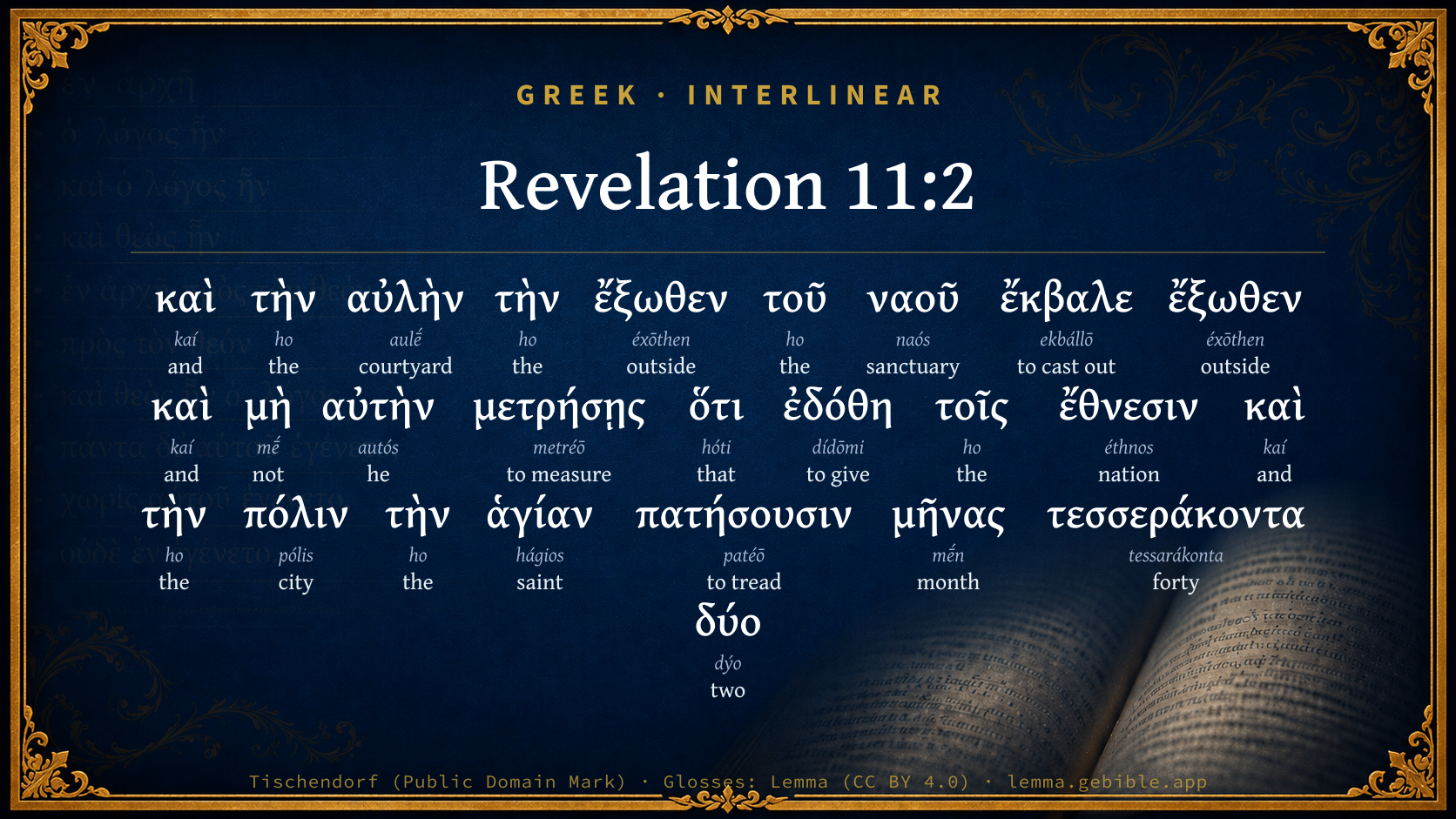
  1. καὶ kaí G2532 “and” Conjunction
  2. τὴν ho G3588 “the” Article, Accusative, Singular, Feminine
  3. αὐλὴν aulḗ G833 “courtyard” Noun, Accusative, Singular, Feminine
  4. τὴν ho G3588 “the” Article, Accusative, Singular, Feminine
  5. ἔξωθεν éxōthen G1855 “outside” Adverb
  6. τοῦ ho G3588 “the” Article, Genitive, Singular, Masculine
  7. ναοῦ naós G3485 “sanctuary” Noun, Genitive, Singular, Masculine
  8. ἔκβαλε ekbállō G1544 “to cast out” Verb, Aorist, Active, Imperative, 2nd person, Singular
  9. ἔξωθεν éxōthen G1855 “outside” Adverb
  10. καὶ kaí G2532 “and” Conjunction
  11. μὴ mḗ G3361 “not” Particle, Negative
  12. αὐτὴν autós G846 “he” Personal pronoun, Accusative, Singular, Feminine
  13. μετρήσῃς metréō G3354 “to measure” Verb, Aorist, Active, Subjunctive, 2nd person, Singular
  14. ὅτι hóti G3754 “that” Conjunction
  15. ἐδόθη dídōmi G1325 “to give” Verb, Aorist, Passive, Indicative, 3rd person, Singular
  16. τοῖς ho G3588 “the” Article, Dative, Plural, Neuter
  17. ἔθνεσιν éthnos G1484 “nation” Noun, Dative, Plural, Neuter
  18. καὶ kaí G2532 “and” Conjunction
  19. τὴν ho G3588 “the” Article, Accusative, Singular, Feminine
  20. πόλιν pólis G4172 “city” Noun, Accusative, Singular, Feminine
  21. τὴν ho G3588 “the” Article, Accusative, Singular, Feminine
  22. ἁγίαν hágios G40 “saint” Adjective, Accusative, Singular, Feminine
  23. μῆνας mḗn G3376 “month” Noun, Accusative, Plural, Masculine
  24. τεσσεράκοντα tessarákonta G5062 “forty” Adjective, Numeral (indeclinable)
  25. δύο dýo G1417 “two” Adjective, Numeral (indeclinable)

About this verse

These counts appear in no published source. They are computed here, from the morphology-tagged text and Lemma’s own curated glosses. What Lemma adds →

26
words
18
distinct lemmas
Revelation
section

Notable vocabulary

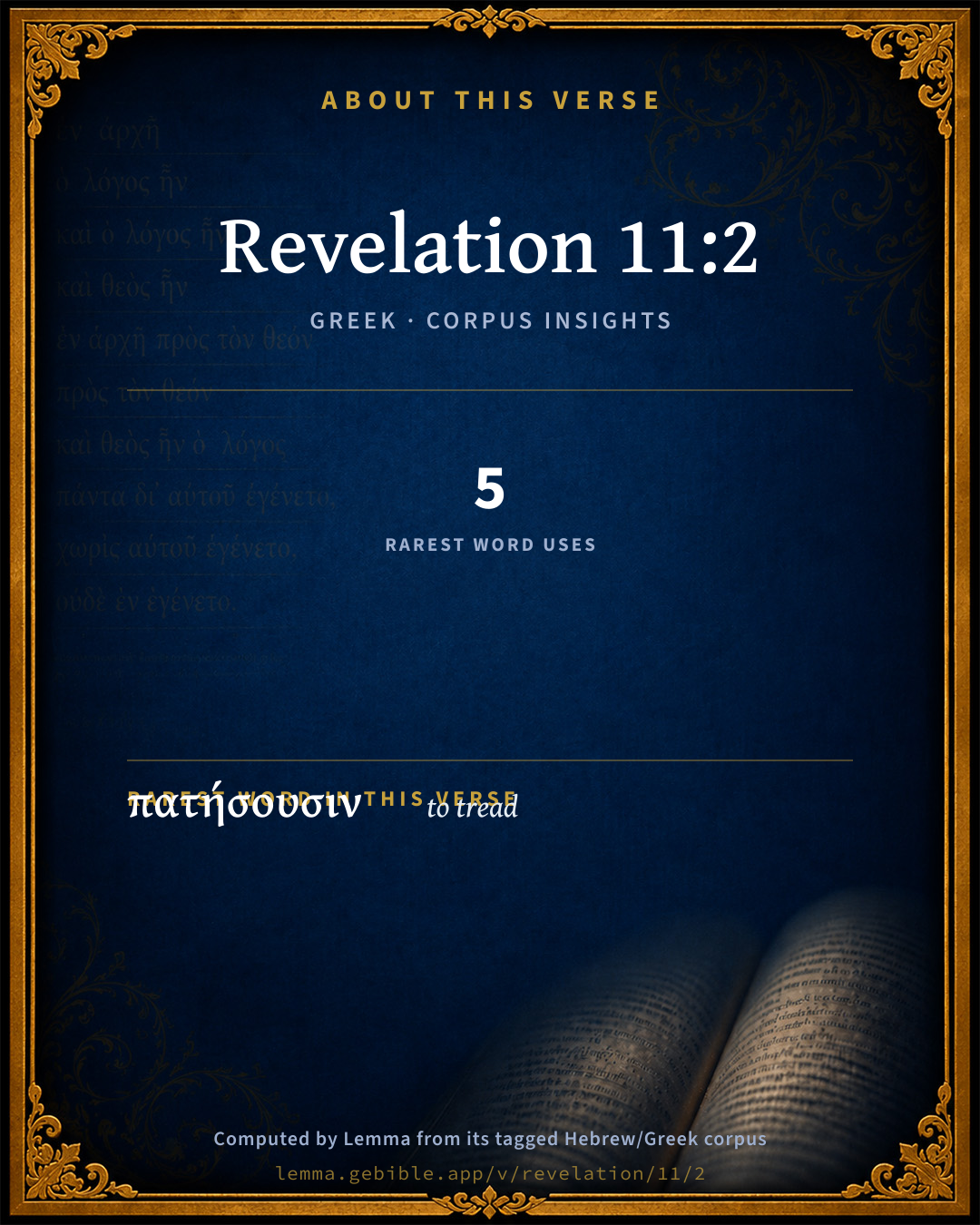
The rarest word here is πατήσουσιν to tread G3961 — appearing just 5 times in the whole Greek New Testament.

Shared distinctive vocabulary

πατήσουσιν to tread G3961 occurs in 5 verses of the Greek New Testament. Also found in:

Repetition

Words recur within this verse:

  • ἔξωθεν outside G1855 ×2
  • τὴν the G3588 ×6
  • καὶ and G2532 ×3

Cross-references

26

Topical passages linked to Revelation 11:2 in the Treasury of Scripture Knowledge — connected by theme and wording, ordered by reader-vote popularity; previews shown in the World English Bible.

  • Daniel 7:25 He shall speak words against the Most High, and shall wear out the saints of the Most High; and he shall think to change the times and the law; and they shall be given into his hand until a time and times and half a time.
  • Luke 21:24 They will fall by the edge of the sword, and will be led captive into all the nations. Jerusalem will be trampled down by the Gentiles, until the times of the Gentiles are fulfilled.
  • Revelation 12:6 The woman fled into the wilderness, where she has a place prepared by God, that there they may nourish her one thousand two hundred sixty days.
  • Daniel 12:7 I heard the man clothed in linen, who was above the waters of the river, when he held up his right hand and his left hand to heaven, and swore by him who lives forever that it shall be for a time, times, and a half; and when they have made an end of breaking in pieces the power of the holy people, all these things shall be finished.
  • Revelation 11:3 I will give power to my two witnesses, and they will prophesy one thousand two hundred sixty days, clothed in sackcloth."
  • Isaiah 52:1 Awake, awake, put on your strength, Zion; put on your beautiful garments, Jerusalem, the holy city: for henceforth there shall no more come into you the uncircumcised and the unclean.
  • Daniel 12:11–12 From the time that the continual [burnt offering] shall be taken away, and the abomination that makes desolate set up, there shall be one thousand two hundred ninety days.
  • Revelation 13:1–18 Then I stood on the sand of the sea. I saw a beast coming up out of the sea, having ten horns and seven heads. On his horns were ten crowns, and on his heads, blasphemous names.
  • Revelation 21:2 I saw the holy city, New Jerusalem, coming down out of heaven from God, made ready like a bride adorned for her husband.
  • Ezekiel 40:17–20 Then brought he me into the outer court; and, behold, there were chambers and a pavement, made for the court round about: thirty chambers were on the pavement.
  • Daniel 8:24–25 His power shall be mighty, but not by his own power; and he shall destroy wonderfully, and shall prosper and do [his pleasure]; and he shall destroy the mighty ones and the holy people.
  • Revelation 22:19 If anyone takes away from the words of the book of this prophecy, may God take away his part from the tree of life, and out of the holy city, which are written in this book.
  • Ezekiel 42:20 He measured it on the four sides: it had a wall round about, the length five hundred, and the breadth five hundred, to make a separation between that which was holy and that which was common.
  • Daniel 7:19 Then I desired to know the truth concerning the fourth animal, which was diverse from all of them, exceedingly terrible, whose teeth were of iron, and its nails of brass; which devoured, broke in pieces, and stamped the residue with its feet;
  • Daniel 8:10 It grew great, even to the host of the sky; and some of the host and of the stars it cast down to the ground, and trampled on them.
  • Matthew 4:5 Then the devil took him into the holy city. He set him on the pinnacle of the temple,
  • Matthew 5:13 "You are the salt of the earth, but if the salt has lost its flavor, with what will it be salted? It is then good for nothing, but to be cast out and trodden under the feet of men.
  • Matthew 27:53 and coming out of the tombs after his resurrection, they entered into the holy city and appeared to many.
  • 2 Thessalonians 2:3–12 Let no one deceive you in any way. For it will not be, unless the departure comes first, and the man of sin is revealed, the son of destruction,
  • Numbers 14:34 After the number of the days in which you spied out the land, even forty days, for every day a year, shall you bear your iniquities, even forty years, and you shall know my alienation.
  • Psalms 79:1 God, the nations have come into your inheritance. They have defiled your holy temple. They have laid Jerusalem in heaps.
  • Isaiah 48:2 (for they call themselves of the holy city, and stay themselves on the God of Israel; Yahweh of Hosts is his name):
  • Lamentations 1:10 The adversary has spread out his hand on all her pleasant things: For she has seen that the nations are entered into her sanctuary, Concerning whom you did command that they should not enter into your assembly.
  • 1 Timothy 4:1–3 But the Spirit says expressly that in later times some will fall away from the faith, paying attention to seducing spirits and doctrines of demons,
  • Hebrews 10:29 How much worse punishment, do you think, will he be judged worthy of, who has trodden under foot the Son of God, and has counted the blood of the covenant with which he was sanctified an unholy thing, and has insulted the Spirit of grace?
  • Revelation 11:11 After the three and a half days, the breath of life from God entered into them, and they stood on their feet. Great fear fell on those who saw them.

Cross-references courtesy of OpenBible.info (CC BY 4.0).

Where the printed editions differ

1 variant

Places in this verse where the major printed Greek editions disagree on the wording in a way that affects the translation — a comparison of editions, not a manuscript-by-manuscript collation. The editions are the modern critical texts (Nestlé-Aland 28/27, SBL, Westcott-Hort, Tregelles, Tyndale House) and the traditional texts behind the KJV (the Textus Receptus and the Byzantine/Majority text). It is not a claim about which reading is original.

  1. Different wording
    ἔξωθεν

    “outside”

    In NA28NA27TynSBLWHTregByzKJV Not in TR

    ἔσωθεν (esōthen) 'within' occurs in a few manuscripts (TR) instead of ἔξωθεν (exōthen) 'outside' in older manuscripts (NA28+NA27+Tyn+SBL+WH+Treg+Byz+KJV)

Textual data: Translators Amalgamated Greek New Testament (STEPBible TAGNT) · CC BY 4.0.

Commentary

Notes on Revelation 11:2 from classic Christian and Jewish commentators (each source and its license shown beneath its notes). The classic Christian expositions comment on the surrounding passage and are grouped to its opening verse, so a note may address several verses; the Jewish commentaries on the Tanakh (Rashi and others) are per-verse, so they appear only where the commentator wrote on this verse.

Lemma curates 59 commentaries, every one of them public domain or Creative Commons licensed, each selected and text-cleaned for this edition rather than reprinted as found. About our sources →

Jamieson, Fausset & Brown

Robert Jamieson, A. R. Fausset & David Brown

But--Greek, "And."

the court . . . without--all outside the Holy Place (Rev 11:1).

leave out--of thy measurement, literally, "cast out"; reckon as unhallowed.

it--emphatic. It is not to be measured; whereas the Holy Place is.

given--by God's appointment.

unto the Gentiles--In the wider sense, there are meant here "the times of the Gentiles," wherein Jerusalem is "trodden down of the Gentiles," as the parallel, Luk 21:24, proves; for the same word is used here [Greek, "patein"], "tread under foot." Compare also Psa 79:1; Isa 63:18.

forty . . . two months-- (Rev 13:5). The same period as Daniel's "time, times, and half" (Rev 12:14); and Rev 11:3, and Rev 12:6, the woman a fugitive in the wilderness "a thousand two hundred and threescore days." In the wider sense, we may either adopt the year-day theory of 1260 years (on which, and the papal rule of 1260 years, see on Dan 7:25; Dan 8:14; Dan 12:11), or rather, regard the 2300 days (Dan 8:14), 1335 days (Dan 12:11-12). 1290 days, and 1260 days, as symbolical of the long period of the Gentile times, whether dating from the subversion of the Jewish theocracy at the Babylonian captivity (the kingdom having been never since restored to Israel), or from the last destruction of Jerusalem under Titus, and extending to the restoration of the theocracy at the coming of Him "whose right it is"; the different epochs marked by the 2300, 1335, 1290, and 1260 days, will not be fully cleared up till the grand consummation; but, meanwhile, our duty and privilege urge us to investigate them. Some one of the epochs assigned by many may be right but as yet it is uncertain. The times of the Gentile monarchies during Israel's seven times punishment, will probably, in the narrower sense (Rev 11:2), be succeeded by the much more restricted times of the personal Antichrist's tyranny in the Holy Land. The long years of papal misrule may be followed by the short time of the man of sin who shall concentrate in himself all the apostasy, persecution, and evil of the various forerunning Antichrists, Antiochus, Mohammed, Popery, just before Christ's advent. His time shall be THE RECAPITULATION and open consummation of the "mystery of iniquity" so long leavening the world. Witnessing churches may be followed by witnessing individuals, the former occupying the longer, the latter, the shorter period. The three and a half (1260 days being three and a half years of three hundred sixty days each, during which the two witnesses prophesy in sackcloth) is the sacred number seven halved, implying the Antichristian world-power's time is broken at best; it answers to the three and a half years' period in which Christ witnessed for the truth, and the Jews, His own people, disowned Him, and the God-opposed world power crucified Him (compare Note, see on Dan 9:27). The three and a half, in a word, marks the time in which the earthly rules over the heavenly kingdom. It was the duration of Antiochus' treading down of the temple and persecution of faithful Israelites. The resurrection of the witnesses after three and a half days, answers to Christ's resurrection after three days. The world power's times never reach the sacred fulness of seven times three hundred sixty, that is, 2520, though they approach to it in 2300 (Dan 8:14). The forty-two months answer to Israel's forty-two sojournings (Num. 33:1-50) in the wilderness, as contrasted with the sabbatic rest in Canaan: reminding the Church that here, in the world wilderness, she cannot look for her sabbatic rest. Also, three and a half years was the period of the heaven being shut up, and of consequent famine, in Elias' time. Thus, three and a half represented to the Church the idea of toil, pilgrimage, and persecution.

Jamieson, Fausset & Brown — Commentary Critical and Explanatory on the Whole Bible (1871) — public domain (CC PDM 1.0). Text via the HelloAO Bible API.

Albert Barnes' Notes on the Bible

But the court which is without the temple - Which is outside of the temple proper, and, therefore, which does not strictly pertain to it. There is undoubtedly reference here to the “court of the Gentiles,” as it was called among the Jews - the outer court of the temple to which the Gentiles had access, and within which they were not permitted to go. For a description of this, see the notes on Mat 21:12. To an observer this would seem to be a part of the temple, and the persons there assembled a portion of the true worshippers of God; but it was necessarily neither the one nor the other. In forming an estimate of those who, according to the Hebrew notions, were true worshippers of God, only those would be regarded as such who had the privilege of access to the inner court, and to the altar. In making such an estimate, therefore, those who had no nearer access than that court, would be omitted; that is, they would not be reckoned as necessarily any part of those who were regarded as the people of God.

Leave out, and measure it not - Margin, “cast out.” So the Greek. The meaning is, that he was not to reckon it as pertaining to the true temple of worshippers. There is, indeed, a degree of force in the words rendered “leave out,” or, in the margin, “cast out” - ἔκβαλε ἔξω ekbale exō - which implies more than a mere passing by, or omission. The word (ἐκβάλλω ekballō) usually has the idea of “force” or “impluse” (Mat 8:12; Mat 15:17; Mat 25:30; Mar 16:9; Act 27:38, et al.); and the word here would denote some decisive or positive act by which it would be indicated that this was not any part of the true temple, but was to be regarded as pertaining to something else. He was not merely not to mention it, or not to include it in the measurement, but he was to do this by some act which would indicate that it was the result of design in the case, and not by accidentally passing it by.

For it is given unto the Gentiles - It properly pertains to them as their own. Though near the temple, and included in the general range of building, yet it does not pertain to those who worship there, but to those who are regarded as pagan and strangers. It is not said that it was then given to the Gentiles; nor is it said that it was given to them to be overrun and trodden down by them, but that it pertained to them, and was to be regarded as belonging to them. They occupied it, not as the people of God, but as those who were without the true church, and who did not pertain to its real communion. This would find a fulfillment if there should arise a state of things in the church in which it would be necessary to draw a line between those who properly constituted the church and those who did not; if there should be such a condition of things that any considerable portion of those who professedly pertained to the church ought to be divided off as not belonging to it, or would have such characteristic marks that it could be seen that they were strangers and aliens. The interpretation would demand that they should sustain some relation to the church, or that they would seem to belong to it - as the court did to the temple; but still that this was in appearance only, and that in estimating the true church it was necessary to leave them out altogether. Of course this would not imply that there might not be some sincere worshippers among them as individuals - as there would be found usually, in the court of the Gentiles in the literal temple, some who were proselytes and devout worshippers, but what is here said relates to them as a mass or body that they did not belong to the true church, but to the Gentiles.

And the holy city - The whole holy city - not merely the outer court of the Gentiles, which it is said was given to them, nor the temple as such, but the entire holy city. There is no doubt that the words “the holy city” literally refer to Jerusalem - a city so called because it was the special place of the worship of God. See the notes on Mat 4:5; compare Neh 11:1, Neh 11:18; Isa 52:1; Dan 9:24; Mat 27:53. But it is not necessary to suppose that this is its meaning here. The “holy city,” Jerusalem, was regarded as sacred to God - as his dwelling-place on earth, and as the abode of his people, and nothing was more natural than to use the term as representing the church. Compare the Gal 4:26 note; Heb 12:22 note. In this sense it is undoubtedly used here as the whole representation is emblematical. John, if he were about to speak of anything that was to occur to the church, would, as a native Jew, be likely to employ such language as this to denote it.

Shall they tread under foot - That is, the Gentiles above referred to; or those who, in the measurement of the city, were set off as Gentiles, and regarded as not belonging to the people of God. This is not spoken of the Gentiles in general, but only of that portion of the multitudes that seemed to constitute the worshippers of God, who, in measuring the temple, were set off or separated as not properly belonging to the true church. The phrase “should tread under foot” is derived from warriors and conquerors, who tread down their enemies, or trample on the fields of grain. It is rendered in this passage by Dr. Robinson (Lexicon), “to profane and lay waste.” As applied literally to a city, this would be the true idea; as applied to the church, it would mean that they would have it under their control or in subjection for the specified time, and that the practical effect of that would be to corrupt and prostrate it.

Forty and two months - Literally, this would be three years and a half; but if the time here is prophetic time - a day for a year - then the period would be twelve hundred and sixty years - reckoning the year at 360 days. For a full illustration of this usage, and for the reasons for supposing that this is prophetic time, see the notes on Dan 7:25. See also Editor’s Preface, p. 25: In addition to what is there said, it may be remarked, in reference to this passage, that it is impossible to show, with any degree of probability, that the city of Jerusalem was “trampled under foot” by the Romans for the exact space of three years and a half. Prof. Stuart, who adopts the opinion that it refers to the conquest of Jerusalem by the Romans, says, indeed, “It is certain that the invasion of the Romans lasted just about the length of the period named, until Jerusalem was taken. And although the city itself was not besieged so long, yet the metropolis in this case, as in innumerable others in both Testaments, appears to stand for the country of Judaea.” But it is to be remembered that the affirmation here is, that “the holy city” was thus to be trodden under foot; and even taking the former supposition, in what sense is it true that the “whole country” was “trodden under foot” by the Romans only three years and a half?

Even the wars of the Romans were not of that exact duration; and, besides, the fact was that Judaea was held in subjection, and trodden down by the Romans for centuries, and never, in fact, regained its independence. If this is to be literally applied to Jerusalem, it has been “trodden down by the Gentiles,” with brief intervals, since the conquest by the Romans, to the present time. There has been no precise period of three years and a half, in respect to which the language used here would be applicable to the literal city of Jerusalem. In regard, then, to the proper application of the language which has thus been explained Rev 11:1-2, it may be remarked, in general, that, for the reasons just stated, it is not to be taken literally. John could not have been directed literally to measure the temple at Jerusalem, and the altar, and the worshippers; nor could he have been requested literally to leave out, or “cast out” the court that was without; nor could it be meant that the holy city literally was to be trodden under foot for three years and a half. The language clearly is symbolical, and the reference must have been to something pertaining to the church. And, if the preceding exposition of the tenth chapter is correct, then it may be presumed that this would refer to something that was to occur at about the period there referred to. Regarding it, then, as applicable to the time of the Reformation, and as being a continuation of the vision in Rev 10:1-11, we shall find, in the events of that period, what would be properly symbolized by the language used here. This will appear by reviewing the particulars which have been explained in these verses:

(1) The command to “measure the temple of God,” Rev 11:1. This, we have seen, was a direction to take an estimate of what constituted the true church; the very work which it was necessary to do in the Reformation, for this was the first point which was to be settled, whether the papacy was the true church or was the antichrist. This involved, of course, the whole inquiry as to what constitutes the church, alike in reference to its organization, its ministry, its sacraments, and its membership. It was long before the Reformers made up their minds that the papacy was not the true church; for the veneration which they had been taught to cherish for that lingered long in their bosoms. And even when they were constrained to admit that that corrupt communion was the predicted form of the great apostasy - antichrist - and had acquired boldness enough to break away from it forever, it was long before they settled down in a uniform belief as to what was essential to the true church. Indeed, the differences of opinion which prevailed, the warm discussions which ensued, and the diversities of sect which sprang up in the Protestant world, showed with what intense interest the mind was fixed on this question, and how important it was to take an exact measurement of the real church of God.

(2) The direction to “measure the altar.” This, as we have seen, would relate to the prevailing opinions on the subject of sacrifice and atonement; on the true method of a sinner’s acceptance with God; and, consequently, on the whole subject of justification. As a matter of fact, it need not be said that this was one of the first questions which came before the Reformers, and was one which it was indispensable to settle, in order to a just notion of the church and of the way of salvation. The papacy had exalted the Lord’s supper into a real sacrifice; had made it a grand and essential point that the bread and wine were changed into the real body and blood of the Lord, and that a real offering of that sacrifice was made every time that ordinance was celebrated; had changed the office of the ministers of the New Testament from preachers to that of priests; had become familiar with the terms altar, and sacrifice, and priest hood, as founded on the notion that a real sacrifice was made in the “mass”; and had fundamentally changed the whole doctrine respecting the justification of a sinner before God. The altar in the Roman Catholic communion had almost displaced the pulpit; and the doctrine of justification by the merits of the great sacrifice made by the death of our Lord, had been superseded by the doctrine of justification by good works, and by the merits of the saints. It became necessary, therefore, to restore the true doctrine respecting sacrifice for sin, and the way of justification before God; and this would be appropriately represented by a direction to “measure the altar.”

(3) The direction to take an estimate of those “who worshipped in the temple.” This, as we have seen, would properly mean that there was to be a true estimate taken of what constituted membership in the church, or of the qualifications of those who should be regarded as true worshippers of God. This, also, was one of the first works necessary to be done in the Reformation. Before that, for ages, the doctrine of baptismal regeneration had been the established doctrine of the church; that all that was necessary to membership was baptism and confirmation, was the common opinion; the necessity of regeneration by the influences of the Holy Spirit, as a condition of church membership, was little understood, if not almost wholly unknown; and the grand requisition in membership was not holy living, but the observance of the rites and ceremonies of the church. One of the first things necessary in the Reformation was to restore to its true place the doctrine laid down by the Saviour, that a change of heart that regeneration by the Holy Spirit - was necessary to membership in the church, and that the true church was composed of those who had been thus renewed in the spirit of their mind. This great work would be appropriately symbolized by a direction to take an estimate of those who “worshipped in the temple of God”; that is, to settle the question who should be regarded as true worshippers of God, and what should be required of those who professed to be such worshippers. No more important point was settled in the Reformation than this.

(4) The direction to leave out, or to “cast out” the court without the temple. This, as we have seen, would properly mean that a separation was to be made between what was the true church and what was not, though it might seem to belong to it. The one was to be measured or estimated; the other was to be left out, as not pertaining to that, or as belonging to the Gentiles, or to paganism. The idea would be, that though it; professedly pertained to the true church, and to the worship of God, yet that it deserved to be characterized as paganism. Now this will apply with great propriety, according to all Protestant notions, to the manner in which the papacy was regarded by the Reformers, and should be regarded at all times. It claimed to be the true church, and to the eye of an observer would seem to belong to it, as much as the outer court seemed to pertain to the temple. But it had the essential characteristics of paganism, and was, therefore, properly to be left out, or, cast out, as not pertaining to the true church.

Can anyone doubt the truth of this representation as applicable to the papacy? Almost everything that was unique in the ancient pagan systems of religion had been introduced into the Roman communion; and a stranger at Rome would see more that would lead him to feel that he was in a pagan land, than he would that he was in a land where the pure doctrines of Christianity prevailed, and where the worship was celebrated which the Redeemer hack designed to set up on the earth. This was true not only in the pomp and splendor of worship, and in the processions and imposing ceremonials; but in the worship of images, in the homage rendered to the dead, in the number of festival days, in the fact that the statues reared in pagan Rome to the honor of the gods had been reconsecrated in the service of Christian devotion to the apostles, saints, and martyrs; and in the robes of the Christian priesthood, derived from those in use in the ancient pagan worship. The direction was, that, in estimating the true church, this was to be “left out,” or “cast out”; and, if this interpretation is correct, the meaning is, that the Roman Catholic communion, as an organized body, is to be regarded as no part of the true church - a conclusion which is inevitable, if the passages of Scripture which are commonly supposed by Protestants to apply to it are correctly applied. To determine this, and to separate the true church from it, was no small part of the work of the Reformation.

(5) The statement that the holy city was to be trodden under foot, Rev 11:2. This, as we have seen, must mean that the true church would thus be trodden down by those who are described as “Gentiles.” So far as pure religion was concerned; so far as pertained to the real condition of the church, and the pure worship of God, it would be as if the whole holy city where God was worshipped were given into the hands of the Gentiles, and they should tread it down, and desecrate all that was sacred for the time here referred to. Everything in Rome at the time of the Reformation would sustain this description. “It is incredible,” says Luther, on his visit to Rome, “what sins and atrocities are committed in Rome; they must be seen and heard to be believed. So that it is usual to say: ‘If there be a hell, Rome is built above it; it is an abyss from which all sins proceed.’” So again he says: “It is commonly observed that he who goes to Rome for the first time, goes to seek a knave there; the second time he finds him; and the third time he brings him away with him under his cloak. But now, people are become so clever, that they make the three journeys in one.”

So Machiavelli, one of the most profound geniuses in Italy, and himself a Roman Catholic, said, “The greatest symptom of the approaching ruin of Christianity is, that the nearer we approach the capital of Christendom, the less do we find of the Christian spirit of the people. The scandalous example and crimes of the court of Rome have caused Italy to lose every principle of piety and every religious sentiment. We Italians are principally indebted to the church and to the priests for having become impious and profane.” See D’Aubigne’s “History of the Reformation,” p. 54, ed. Phila. 1843. In full illustration of the sentiment that the church seemed to be trodden down and polluted by paganism, or by abominations and practices that came out of paganism, we may refer to the general history of the Roman Catholic communion from the rise of the papacy to the Reformation. For a sufficient illustration to justify the application of the passage before us which I am now making, the reader may be referred to the notes on Rev 9:20-21. Nothing would better describe the condition of Rome previous to and at the time of the Reformation - and the remark may be applied to subsequent periods also - than to say that it was a city which once seemed to be a Christian city, and was not improperly regarded as the center of the Christian world and the seat of the church, and that it had been, as it were, overrun and trodden down by pagan rites and customs and ceremonies, so that, to a stranger looking on it, it would seem to be in the possession of the “Gentiles” or the pagans.

(6) The time during which this was to continue - “forty-two months”; that is, according to the explanation above given, twelve hundred and sixty years. This would embrace the whole period of the ascendency and prevalence of the papacy, or the whole time of the continuance of that corrupt domination in which Christendom was to be trodden down and corrupted by it. The prophet of Patmos saw it in vision thus extending its dreary and corrupting reign, and during that time the proper influence of Christianity was trampled down, and the domination of practical paganism was set up where the church should have reigned in its purity. Thus regarded, this would properly express the time of the ascendency of the papal power, and the end of the “forty-two months,” or twelve hundred and sixty years, would denote the time when the influence of that power would cease. If, therefore, the time of the rise of the papacy can be determined, it will not be difficult to determine the time when it will come to an end. But for a full consideration of these points the reader is referred to the extended discussion on Dan 7:25. See also Editor’s Preface, p. 25. As the point is there fully examined it is unnecessary to go into an investigation of it here.

The general remark, therefore, in regard to this passage Rev 11:1-2 is, that it refers to what would be necessary to be done at the Reformation in order to determine what is the true church and what are the doctrines on which it is based; and to the fact that the Roman Catholic communion, to which the church had been given over for a definite time, was to be set aside as not being the true church of Christ.

Albert Barnes' Notes on the Bible (1834–1885) — public domain. Text from a community e-Sword/MySword module.

Whedon's Commentary on the Bible

Daniel D. Whedon

2. The court—The enclosure, or yard, in which the holy temple stands.

Measure it not—For, though formerly the true Church, it is not now the pure Church, but the apostate. Rev_11:2.

Is given—By divine judgment on account of apostasy.

Unto the Gentiles—For in the apocalypse Israel is the Christic Church, and the Gentiles are antichristic.

The holy city—Same as the beloved city of Rev_20:9, of which the holy city of Mat_27:53 is typical.

And here we may notice the futility of the argument drawn from this phrase to prove that the literal Jerusalem was still standing. It might just as well be argued that the great city of Rev_11:8—that is, the literal old Babylon, the type of antichrist’s capital—was still standing. It might even be argued, just as reasonably, that the beloved city of Rev_20:9 was standing at the time of John’s vision.

Tread under foot—In ancient times cities were often built at the base around some high, steep hill, on the summit of which a citadel or strong fort was built. So Athens was built upon the plain surrounding the Acropolis. When the city was attacked in war this citadel furnished the last stronghold for the defenders. The lower city might be trodden under foot by the besiegers, while the citizen soldier firmly held the summit. See note on Rev_20:9. So here, they that worship held the temple, while the Gentiles trod the city under foot. Few, but faithful, the heroes of the holy Church held the fort during the siege.

Forty and two months—A tolerably long siege for a literal citadel to endure. It is typical of the period when the powers of antichrist tread down the capital of Christ’s kingdom. The symbol appears to be based upon our Lord’s words in Luk_21:24. For the forty-two months see our Introduction on numbers of the apocalypse, and note on Rev_13:5.

We have now (3-12) the typical picture of heroic Christian martyrdom during the period of apostasy. Even in the midst of the gentilized city there are two unterrified yet dying witnesses. Their number, two, is based on the duality of ministry and church. Yet they are miniatured, or diminished, as two, to signalize their faithfulness and to centralize our sympathy on their heroic loneliness in the midst of apostate surroundings. Deep and glorious is the lesson for the faithful witnesses of the truth amid ages of darkness.

Daniel D. Whedon (gen. ed.), Commentary on the Old and New Testaments (1874–1909) — public domain. Text from a community e-Sword module.

Tyndale Open Study Notes

Tyndale Open Resources

11:2-3 The outer courtyard in the Jerusalem Temple, outside the stone warning fence, was regarded as the place for the Gentile nations. John makes a clear distinction between the people God recognizes and those he does not. • The 42 months and 1,260 days refer to a period of three and a half years, or a broken seven (see study notes on Dan 7:24-25; 8:26; 9:24-27). John repeatedly uses these time designations in Revelation when persecution is evident and evil appears to dominate the world. God’s people will be secure in him (see study note on Rev 11:1) even though God allows evil forces to persecute them (see 13:7; Mark 10:30).

Tyndale Open Study Notes — © Tyndale Open Resources, licensed CC BY-SA 4.0. Text via the HelloAO Bible API.

Bengel's Gnomon

Johann Albrecht Bengel

Rev 11:2. Τὴν αὐλὴν) In the tabernacle of Moses, in the temple of Solomon, and in the temple of Ezekiel, the Septuagint usually puts αὐλὴ for the Hebrew חצר. A court in the open air is meant (in which חציר, grass, readily grows); wherefore there follows, τὴν ἔξωθεν τοῦ ναοῦ. Ἔσωθεν in some places has crept in, for ἔξωθεν:[109] but this ΑὐΛῊ, since it is the only one, cannot possibly be within the temple, from which it is contradistinguished. Also in Eze 8:16, it is חצר פנימית. But here mention is made only of the outer court (in contradistinction to the temple): which in the measuring ought not to be reckoned as a part of the temple, but as it is an outer court, so it ought to be regarded as outside the temple. The reading ἜΞΩΘΕΝ is much more strongly supported by manuscripts.—ἜΞΩΘΕΝ—ἜΞΩ) The figure Ploce [See Append. of Techn. Terms]: as Isa 32:19, the city shall be low in a low place.—πατήσουσι, shall tread under foot) See Luk 21:24, note.—ΜῆΝΑς ΤΕΣΣΑΡΆΚΟΝΤΑ ΔΎΟ, forty-two months) These months, and the 1260 days in Rev 11:3, are common months and days: for in the event they are later than the number of the beast, which being put in part enigmatically, in part literally, defines the passing of the book from the prophetical times to common times, as I have more fully shown in other places. Moreover, in my Harmony of the Evangelists, A. 1736, I had declared, that I would answer, in the Gnomon, the Mathematical Demonstration of Joh. Christian Seize respecting the 1260 days of the witnesses and the woman, Revelation 11, 12. I had prepared a reply sufficiently copious on this passage, not only to that Demonstration, but also to another, which the same writer published in the beginning of the year 1737, under the title of the Measuring Rod. But in the same year, as occasion then required, I wrote a review, which was inserted by the collectors of the work, which is called Geistliche Fama, in the 23d Part, after other remarks of Seize and myself: and in the meanwhile, the progress of time, bringing a decision of the question, confirmed my opinion, and rendered a reply superfluous. This question, therefore, being put aside, having in the meantime met with other adversaries, I dismiss this one; for I greatly shrink from unnecessary disputes.

[109] Stephens’ Rec. Text (not the Elzev. Rec. Text) has ἔσωθεν for ἔξεθεν, without good authority.—E.

Bengel's Gnomon of the New Testament — English translation (T&T Clark, Edinburgh, 1860) — public domain. Text from a community e-Sword module.

Meyer's Critical & Exegetical Commentary

Heinrich August Wilhelm Meyer

Rev_11:2. Καὶ τὴν αὐλὴν τὴν ἕξωθεν, κ.τ.λ. Incorrectly, Luther: The inner choir, after a bad variation. Also Vitr., Ewald,[2809] Züll., object not only to the expression, but also to what was said in Rev_11:1, since they conceive of τ. αὐλ. τὴν ἔξωθεν τοῦ ναοῦ in the sense of Τ. ΑὐΛ. ΤῊΝ ἘΞΩΤΈΡΑΝ Τ. Ν., and distinguish[2810] an outer and an inner court, the latter of which, as belonging to the ΝΑΌς, is measured with it. But the expression ἜΞΩΘ. Τ. Θ.[2811] confirms rather the idea given, Rev_11:1, of the ΝΑΌς alone to be measured, i.e., the proper temple-building, outside of which the ΑὐΛΉ, i.e., the entire space of the court, lies.[2812] Arbitrarily, the ΑὐΛΉ is interpreted by Weiss: the congregation of unbelieving Jews.

ἜΚΒΑΛΕ ἜΞΩ. The casting out, viz., beyond the reach of that which is to be measured, is determined, according to the sense as well as the form of the idea, by the parallel addition, καὶ μὴ αὐτὴν μετρήσῃς;[2813] yet in the significant expression[2814] the point must not be overlooked, which Eichh. alone, and without the textual reference to the boundaries of the space to be measured, in his unhappy paraphrase makes equivalent to declare profane.[2815]

ὅτι ἐδόθη τοῖς ἔθνεσιν, for it is given to the Gentiles, viz., by the Divine decree; as the immediately following fut. πατήσουσι, which describes the impending fulfilment of this decree, unambiguously declares. Entirely in violation of the context, Beng. remarks that the Gentiles, on account of whose immensity, i.e., innumerableness,[2816] the outer court shall not be measured, shall at one day worship there. Improper also is the mingling of the idea, that the bloody sacrificial service at the altar of burnt offerings is not to be maintained:[2817] it is intended by this, only that according to the Divine decree, the Gentiles shall tread (πατήσουσι, Luk_21:24) the court and the entire holy city.[2818] Allied with this is the determination of the ΚΑΙΡΟῚ ἘΘΝῶΝ by the schematic temporal specification: ΜῆΝΑς ΤΕΣΣΑΡΆΚΟΝΤΑ ΚΑῚ ΔΎΟ, i.e., 3½ years,[2819] according to the type of the treading down of the holy city and the sanctuary by Antiochus Epiphanes.

[2809] Cf. Gött., Gel. Anz., 1861, p. 1013.

[2810] Cf. Eze_40:17 sqq.

[2811] Cf. Rev_14:20; Mar_7:15.

[2812] De Wette, Hengstenb., Ebrard.

[2813] Beng., Ewald, De Wette, Hengstenb., Ebrard.

[2814] Cf. Mat_8:12; Joh_9:34 sqq., Joh_12:31; 3Jn_1:10.

[2815] Cf. Vitr.: Excommunicate.

[2816] Rev_7:4; Rev_7:9.

[2817] Against De Wette, etc.

[2818] Cf. Mat_4:5.

[2819] = 3½ καιροί, Dan_7:25; Dan_12:7; Rev_12:14.

Meyer — Critical and Exegetical Commentary on the New Testament — English translation by Peter Christie, edited by Frederick Crombie (T&T Clark, 1880) — public domain. Text from a community e-Sword module.

Geneva Bible (1599)

Geneva Bible translators

As if he should say, it belongeth nothing unto them to judge those which are without, 1 Cor. 5:12, which be innumerable: look unto those of the household only, or unto the house of the living God.

That is counted to be cast out, which in measuring is refused as profane.

To profane persons wicked and unbelievers, adversaries unto the Church.

Or a thousand and two hundred and threescore days as is said in the next verse: that is a thousand two hundred and threescore years, a day for a year as often in Ezekiel and Daniel, which thing I noted before, 2:10. The beginning of these thousand two hundred and threescore years, we account from the passion of Christ, whereby (the partition wall being broken down) we were made of two one, Eph. 2:14. I say one flock under one Shepherd, John 10:16 and the end of these years precisely falleth into the Popedom of Boniface the eighth who a little before the end of the year of Christ a thousand two hundred ninety four, entered the Popedom of Rome, in the feast of S. Lucie (as Bergomensis saith) having put in prison his predecessor Coelestinus, whom by fraud, under color of oracle, he deceived: for which cause, that well said of him, Intravit ut vulpes, regnavit ut leo, mortuus est ut canis. That is, he entered like a fox, reigned like a lion, and died like a dog. For if from a thousand two hundred ninety four years thou shalt take the age of Christ which he lived on the earth, thou shalt find there remaineth 1260 years, which are mentioned in this place and many others.

He speaketh of the outward court, which was called the peoples court, because all men might come into that.

Geneva Bible (1599) marginal notes — public domain. Text via Bolls.life.

Adam Clarke's Commentary

Verse 2. But the court-is given unto the Gentiles] The measuring of the temple probably refers to its approaching destruction, and the termination of the whole Levitical service; and this we find was to be done by the Gentiles, (Romans,) who were to tread it down forty-two months; i.e., just three years and a half, or twelve hundred and sixty days. This must be a symbolical period.

Adam Clarke's Commentary on the Bible (1810–1826) — public domain. Text from a community e-Sword/MySword module.

Ellicott's Commentary for English Readers

(2) But the court . . .—Translate, And the court which is outside the Temple cast out, and measure not it; because it was given to the nations (Gentiles): and they shall tread down the holy city forty and two months. The outer court—meaning, perhaps, all that lies outside the Temple itself—is to be omitted. A strong word is used; the words “leave out” are far too weak. He is not only not to measure it, but he is, in a sort, to pass it over, as though reckoned profane. The reason of this is that it was given to the Gentiles. Our Lord had said that Jerusalem should be trodden down of the Gentiles (Luk_21:24); the sacred seer catches the thought and the deeper significance. There is a treading down worse than that of the conqueror. It is the treading under of sacred things when the beast-power, or the world-power in men, tramples, like the swine, the pearls of grace under their feet, and turns fiercely upon those who gave them. Such an experience must the Church of Christ undergo. The shrine shall be safe, but the spirit of the nations, though nominally Christian, will be the spirit of Gentilism, worldliness, and even of violence. In the outer court of Church life there will be “the ebbing and flowing mass,” who “sit in the way of knowledge,” who “stand idle in the market-place,” who have no oil in their lamps, and who indirectly pave the way for utter worldliness and practical heathenism. But there is a limit to this desecration: forty and two months it is to last. The same length of time is expressed in different forms throughout the book. Sometimes we have twelve hundred and sixty days, as in Rev_11:3 and in Rev_12:6; at another time forty-two months, as here and in Rev_13:5. A similar period seems to be meant in Rev_12:14, where a time, times, and half a time is probably a way of expressing three years and a half; all three forms describe periods of the same length—not, of course, necessarily the same period. The idea is taken from Daniel, who uses such and similar expressions (Dan_7:25; Dan_12:7; Dan_12:11). This incorporation of the expressions used by Daniel is one of those hints which remind us that the laws and principles of God’s government are the same in all ages: so that the principles which receive illustration in one set of historical events are likely to receive similar illustrations in after times; and that the prophecies of one era may contain seeds of fulfilments which spring to fruit in more than one age. Thus the words of Daniel were not exhausted in the age of Antiochus, nor the visions of the Apocalypse in the overthrow of any one nation or the corruptions of any one Church. So much may this constantly-recurring period of three years and a half, or forty-two months, or twelve hundred and sixty days, teach us. It is not needful, then, to take the period as an exact literal period. It is true that there have been some remarkable historical periods of this length, which various schools of interpreters have pointed out as the fulfilment of these prophecies; but there have been also remarkable blunders on the part of those who, forgetful of Christ’s own warning, have tried to predict the year when certain prophecies will receive their accomplishments. It is true, also, that the future may bring us further light, and enable us to understand these descriptions of time better; but for the present, the period of forty and two months, the equivalent of three years and a half (the half of seven, the complete and divine number), is the symbol of a period limited in length, and under the control of Him who holds the seven stars and lives through the ages. It is the pilgrimage period of the Church, the period of the world’s power, during which it seems to triumph; but the period of sackcloth (see Rev_11:3) and of suffering will not last forever.

A Bible Commentary for English Readers, edited by Charles John Ellicott (1878–1897) — public domain. Text from a community e-Sword module.

The Cambridge Bible for Schools and Colleges

gen. ed. J. J. S. Perowne

2. the court which is without the temple] The words might be translated “the outer court of the Temple.” It must be remembered that “the courts of the Lord’s House” were the ordinary place for the worshippers to assemble, even before the outer and larger “Court of the Gentiles,” with its magnificent colonnades, was added to Herod’s Temple. Probably the latter is thought of, in its assignment to the Gentiles: but the meaning appears to be, that all the courts shall be profaned, up to the walls of the inmost Sanctuary.

leave out] Hardly a strong enough expression: the original is, “cast out outside.” The sense must be, “leave out for profanation.” This excludes the hypothesis (otherwise not without plausibility) that the measurement of the Temple is for destruction, not for preservation: see 2Ki_21:13; Lam_2:8 :—and for the destruction being regarded as the work of the prophet, cf. Eze_43:3.

tread under foot] So St Luk_21:24, which is no doubt referred to. Hitherto, the correspondences in this book with that Prophecy of our Lord’s have been closest with St Matthew’s version of it. Varying parallels like these serve to authenticate the reports of His words in the different Gospels—shewing that they are to be taken as mutually supplementary, not as more or less inaccurate. Of course, St John did not use our Gospels (though St Matthew’s at least was in existence), but wrote independently from his own recollection.

forty and two months] So Rev_13:5. This period is apparently identical with the “1260 days” of the next verse, and Rev_12:6 : and with the “time, times, and half a time” (i.e. 3½ years) of Rev_12:14. In Dan_7:25; Dan_12:7 we have this last measure of the period given, and the time indicated by Daniel must be either identical with or typical of that indicated by St John. It is to be noted, that in Dan_12:11-12, we have the period extended to 1290 and 1335 days.

The key to these prophecies, that speak of definite periods of time, is generally sought in Eze_4:6; it is supposed that each prophetical “day” stands for a year, and by consequence a “week” is equivalent to seven years, a “month” to 30, and a “year” to 360. This gives an approximately satisfactory explanation of the one prophecy of the “70 weeks” in Daniel 9 : they would naturally be understood to extend from b.c. 536 (the decree of Cyrus) to b.c. 5 (the Nativity), a.d. 29–30 (the Crucifixion), and a.d. 70 (the fall of Jerusalem); but the terms in which their beginning and end are described can with a little pressure be applied to b.c. 457 (the decree of Artaxerxes), a.d. 26 (the Baptism of St John), a.d. 29–30, and a.d. 33—possibly the date of the death of St Stephen, and so of the final rejection of the Gospel by the Jews and of the Jewish sacrifices by God. But in no other case has a prophecy been even tolerably interpreted on this principle. If it were admitted in this, we should naturally understand that Jerusalem was to have been restored in a.d. 1330—or at latest 1360 or 1405. Indeed, if the Saracen conquest instead of the Roman were taken as the starting-point, the restoration would not fall due till 1897, and it is humanly speaking quite possible that Palestine may pass into new hands then. But men ought to have learnt by this time to distrust such calculations: as we “know not the day nor the hour,” so we know not the year nor the century. Two or three generations ago a number of independent calculations were made to converge to the year 1866 as the beginning of the end: but in that year nothing considerable happened except the Austrian war, which of all recent wars perhaps had least the character of a war between Christ and Antichrist. It was at worst an instance of the painful and not innocent way in which fallen human nature works out its best desires: the Austrians were technically in the right, while the victory of the Prussians has proved honourable and beneficial to both empires alike.

The Cambridge Bible for Schools and Colleges (gen. ed. J. J. S. Perowne; Cambridge University Press, 1878–1918) — public domain. Text from a community e-Sword module.

John Gill's Exposition

But the court which is without the temple leave out, and measure it not,.... The allusion is to the court of the Israelites, where was the great crowd and company of worshippers, even the national church of the Jews, called by Ezekiel the outer court, Eze 42:14, and which was measured in Eze 42:20; but this must not be measured: this designs not the visible church apostatized, as succeeding the pure, primitive, and apostolical church, or the apostate church of Rome, antichrist and his followers, for these are meant by the Gentiles, to whom this outward court is given; this outward court, or the worshippers in it, intend a distinct set of worshippers from the internal worshippers, the priests of God in the temple, altar, and inner court, and from the Gentiles, the Papists; and are no other than carnal Protestants, the bulk of the reformed churches, who have only the name, but not the nature of living Christians, have a form of godliness, but deny its power, are Jews outwardly, but not inwardly, and worship only in an external manner, attend to outward forms and ceremonies, but know nothing of true doctrine, pure worship, or spiritual religion; and which are very numerous, as the worshippers in the outward court were: now these, upon a new measuring and regulating of the churches, are ordered to be left, or cast out, and not taken into the dimensions of the Gospel church; these were to be separated from, and have been, and not to be admitted members of regular and orderly constituted churches, and which is here reckoned a sort of casting of them out; the reason of which follows;

for it is given unto the Gentiles; by whom are meant the Papists, who are no other than Paganized Christians, having introduced a great deal of Gentilism into the divine service; as the worshipping of the virgin Mary, angels, and saints departed, which is in imitation of the demon worship of the Heathens; as also the dedication of their churches to saints, their saints' days, divers festivals, and many other rites and ceremonies, are plainly of Pagan original; and therefore they may very well be called by this name: now it seems by these words that the bulk of the reformed churches, the crowd of outward court worshippers, will be gained, over to the Popish party, and fall off to the church of Rome, to which their doctrines and practices are plainly verging; the pope of Rome, as low a condition as he now is in, will be set "in status quo", before his utter destruction; he will regain all his former dominions, and be in possession of them at the time of his ruin; the whore of Rome, the antichristian Babylon, will sit as a queen, and promise herself a great deal of peace and pleasure, the inward court worshippers and witnesses being slain, and she restored to all her former power and grandeur; when in one day, on a sudden, her destruction will come upon her, when the term of the beast's reign will be expired, mentioned in the next clause:

and the holy city shall they tread under foot forty and two months; by "the holy city" is meant all the kingdoms of Europe, or what has, been called Christendom, the western empire as Christian, the main seat of the Christian religion, or all the churches styled Christian, and so called in allusion to Jerusalem, which bears this name, Mat 4:5; and which was still of a far larger extent than the outward court: the "treading" of this "underfoot" does not barely design possessing of it, or worshipping in the same place, as the phrase of treading in the courts does in Isa 1:12; but a tyrannical power over it, and a wasting, spoiling, and destroying it, in allusion to Jerusalem being trodden under foot, wasted, and destroyed by the Gentiles or the Romans, Luk 21:24; and the duration of this tyrannical and oppressive reign will be forty and two months; see Rev 13:5, which being reduced to years, make just three years and a half: but then this date cannot be understood strictly and literally; for such a term can never be sufficient for the whore's reign, who was to rule over the kings of the earth, and all nations were to drink of the wine of her fornication: this is too short a time for her to gain so much power, honour, and riches in, as the 13th, 17th, and 18th chapters of this book show, as well as too short for the afflictions and persecutions of the saints by her; wherefore this must be understood prophetically of so many months of years; and a month with the Chaldeans consisting of thirty days, and a year of 360 days, which account Daniel used, and John after him, forty two months, reckoning a day for a year, after the prophetic style, make 1260 years; which is the exact time of the witnesses prophesying in sackcloth, of the church's being hid and nourished in the wilderness, and of the beast's reign, and so of the holy city being trodden under foot. Now this date is not to be reckoned from the outer court being given to the Gentiles, but from the first of antichrist's reign, when the pope of Rome was declared universal bishop; and is only here mentioned to show, that the giving of the outward court to his Gentiles will be towards the expiration of this date.

John Gill's Exposition of the Whole Bible (1746–1763) — public domain (CC PDM 1.0). Text via the HelloAO Bible API.

Trapp's Complete Commentary

John Trapp

2 But the court which is without the temple leave out, and measure it not; for it is given unto the Gentiles: and the holy city shall they tread under foot forty and two months.

Ver. 2. But the court] The antichristian rout, cast out as reprobate silver, as refuse stuff, not worth the measuring.

Given unto the Gentiles] Antichrist and his adherents. Pa-pagans are no better than Pagans. "Are ye not the children of the Ethiopians unto me, O children of Israel? saith the Lord," Amo 9:7.

The holy city] The true Church. See Dan 7:21; Eph 2:19.

Forty and two months] This number is one and the same with 1260 days. The allusion is unto Dan 7:25.

John Trapp, A Commentary or Exposition upon All the Books of the Old and New Testament (1647–1656) — public domain. Text from a community e-Sword module.

Haydock's Catholic Bible Commentary

The holy city they shall tread under foot forty-two months.[1] That is, Gentiles and Jews shall be permitted to persecute the Church and the faithful servants of God; but only for a short time, expressed by forty-two months, as elsewhere by twelve hundred and sixty days, and also by a time, and times, and half a time, which, as St. Jerome observes, is for a year, and two years, and half a year, which three different ways of speaking by years, by months, and by days, are only to signify that God never permits his faithful to be under any violent persecution for any long time. (Witham)

===============================

[BIBLIOGRAPHY]

Atrium autem quod est foris, Greek: ten aulen exothen, not Greek: esothen as in some manuscripts. --- Dr. Wells, when he tells us, on the third verse of this chapter, that the consent of the primitive Church and their unexceptionable authority, require that by the two witnesses we understand Henoch [Enoch] and Elias [Elijah], seems to be convinced of it by the authority (as he imagines) of Dr. Grabe. This we find by his own words, (p. 79) "I shall hear," saith he, "adjoin a note of the late most learned and pious divine, Dr. Grabe, in reference to this matter, in a passage of St. Irenæus, lib. v., chap. v. It is note 4, in p. 405, Oxon. Edit. and runs thus in the doctor’s own words: Disputationem de loco in quam Deus transtulerit et huc usque viventes conservarit Enochum et Eliam Augustinus indicavit ad fidem non pertinere, at cum hic Irenæus doceat Apostolorum discipulos et (N. B.) auditores dixisse, &c. And the note in Dr. Wells ends with these words: Plures alios legendo notes licet. After this Dr. W. adds: I have taken the pains to transcribe all these citations, that the reader may see how generally the Fathers do agree in this matter. And the same Dr. Wells a little after: Whereupon, saith he, the good doctor (Grabe) adds in reference to himself: mihi parum tutum videtur aliter nunc sentire. And had all others the like due esteem for the Fathers, and the like modest opinion of themselves, there would quickly be taken away that great and unhappy difference of opinions, which is now in the Church, as to points of religion." I wish, no less than Dr. Wells, that all others had the like due esteem of the Fathers, and the like modest opinion of themselves as the author of this note, and he who writ, mihi parum tutum videtur aliter nunc sentire. By such dispositions of submission to the doctrine delivered or witnessed by the consent of the primitive Fathers, might be quickly taken away the unhappy differences in points of religion betwixt us, and all pretended reformers, who, by setting up their private judgment against the authority of the Catholic Church, have brought in these differences. Luther led the way: I care not, said he, if a thousand Cyprians, a thousand Augustines, are against me, &c. But I am fully persuaded that Dr. W. did not know that all this Latin note, with the citations of the Fathers, and with those words upon them, (mihi parum tutum videtur aliter nunc sentire) are not the words of the learned and pious divine, Dr. Grabe, but are found word for word in the third note of Franciscus Feuardentius, in his Paris edition of St. Irenæus, in the year 1576, p. 322, from whence they were taken above a hundred years after by Dr. Grabe. Had Dr. W. taken notice that they were the words of so warm an adversary of the pretended reformation as Feuardentius, I doubt whether he would have given such high commendations of the true author, with an N. B. on those words of Feuardentius, mihi parum tutum videtur, &c. But I am glad that Dr. Grabe and Dr. Wells are of the same judgment with the author of the note.

====================

George Leo Haydock (1774–1849), Haydock's Catholic Family Bible and Commentary, 1859 edition — public domain. Excludes Psalms (Douay-Rheims chapter numbering differs from Protestant) and Deuterocanonical books (Catholic canon only).

Matthew Poole's English Annotations

There is no great doubt, but the same persons are here to be understood by

the court which is without the temple, ( that is, without the inward court),

and the holy city; and by them, both the generality of those people who come under the name of the Christian church, who are all of them, in some sense, a holy people, 1Co 7:14, as all the Jews were; yet, for the greatest part of them, John is commanded to omit, or neglect them, as those who would not endure a measure by the reed, and of whose preservation God would take no such care, but give them up to the Gentiles, to be trodden under foot; by which many learned and good men understand God’s suffering antichrist to have a power over and against them. I find some understanding by the altar, and them that worship therein, the primitive church, that for some hundreds of years after Christ kept close to the Divine rule, whom God preserved, though in the midst of the ten first persecutions: and by the outward court, the church after that time, which God suffered to fall under the power of the beast, and antichrist, that is, the papacy; which are well enough called

the Gentiles, as bringing in Gentilism again into the church, and hardly differing in any thing, saving that the old heathens owned many supreme gods, and these new Gentiles but one. God showeth John here, that he would give up the outward court, or this holy city, the generality of Christians, to these Gentiles, that they should rule and domineer over them for

forty and two months, the meaning of which we shall by and by show. A late pious and learned writer differs a little in his sense, as thinking that God here showeth John something further, viz. that under the sixth trumpet he would give the generality of those called Christians, that will not endure the measure of the reed, so over to antichrist, that they shall turn papists, and help to kill the Lord’s witnesses; of which we shall speak, Rev 11:3. So as this is not a new prophecy, but a continuation of what shall happen after the sounding of the sixth, and before the sounding of the seventh trumpet: if so, I conceive that those words,

shall they tread under foot forty and two months, must be understood, until the end of the forty-two months; for the forty-two months being the whole time of antichrist, or the beast, must be in a great measure spent before the sounding of the sixth angel. But it seems to be the opinion of this learned man, that a very great part of those who pretend to constitute the Reformed protestant church at this day, but are but as the outward court, not such as worship within the oracle, shall, before the sounding of the seventh trumpet, apostatize, and fall off to popery, until antichrist’s one thousand two hundred and sixty days shall expire, and join with papists in the killing of the witnesses. The truth of which we must leave to the providence of God in time to discover; although whoso considereth the face of things this day in Europe, (within which the greatest part of the Christian church is), will judge there is too great a probability of what this learned man saith; but I dare determine nothing in it.

Matthew Poole's English Annotations on the Holy Bible (1683–1685) — public domain. Text from a community e-Sword/MySword module.

The Pulpit Commentary

But the court which is without the temple leave out, and measure it not; for it is given unto the Gentiles; it hath been given (Revised Version). Not merely "leave out," but "cast out." The "court which is without the temple" was entered only by Jews. It seems, therefore, here to signify part of the Church, but that part which is separated from the inner circle of true believers, and given over to the world, which is here symbolized by "the Gentiles." The Gentiles, the nations, throughout the Apocalypse, signifies either

(1) all mankind whatsoever; or

(2) that portion of mankind which is left when the true Church of God is withdrawn, and therefore which embraces the unrighteous part of mankind in contrast to the godly. (cf. Rev_2:26 Rev_14:8 Rev_16:19 Rev_18:23 Rev_22:21) The latter is the signification here. And the holy city shall they tread underfoot. The holy city Jerusalem always in the Apocalypse the type of the Church. "They shall tread" need not necessarily refer to "the nations," though the context naturally leads to this signification; but it may be impersonal, amounting to no more than "the holy city shall be trodden underfoot." St. John seems to apply the words of our Lord concerning the literal Jerusalem to the description of the fate in store for the typical Jerusalem. (cf. Luk_21:24) "The nations" are the instrument by which the Church is trodden underfoot, and the mention of the Gentiles in connection with the apostate portion of the Church leads to the description of the oppression of the faithful by the world. The seer is bidden to take courage by a contemplation of the numbers of those preserved by God, but is warned, nevertheless, not to expect from that fact immunity for the Church from the persecution of the world. Forty and two months. Kai , "and," is inserted contrary to the common practice when the larger number precedes. (so also in Joh_2:20 Joh_5:5) This period of three years and a half is certainly symbolical. It is the half of seven years a perfect number. It therefore denotes a broken, uncertain period; a space of time which is certainly finite, but the end of which is uncertain. This seems to point necessarily to the period of the world"s existence during which the Church is to suffer oppression. This period is mentioned

(1) in ver. 3 under the form of twelve hundred and sixty days, where it denotes the same period that is referred to here;

(2) in Rev_12:6 as twelve hundred and sixty days, and inRev 12:14 as "a time, and times, and half a time," in both of which passages the signification is the same as that given above;

(3) in Rev_13:5 it is called, as here, forty-two months, anddescribes the same period. The expression is founded on Dan_7:25 and Rev_12:7. In the latter place the time signified is certainly the period of the world"s existence.

(1) that its natural meaning, in connection with the number seven,

(2) its signification in Daniel, and

(3) its apparent use in all passages in the Apocalypse, tend to cause us to interpret the symbol as above.

The Pulpit Commentary (1880–1919), ed. H.D.M. Spence-Jones & Joseph S. Exell — public domain. Text from a community e-Sword module.

John Wesley's Explanatory Notes

But the court which is without the temple - The old temple had a court in the open air, for the heathens who worshipped the God of Israel. Cast out - Of thy account. And measure it not - As not being holy In so high a degree. And they shall tread - Inhabit. The holy city - Jerusalem, Matt. iv, 5. So they began to do, before St. John wrote. And it has been trodden almost ever since by the Romans, Persians, Saracens, and Turks. But that severe kind of treading which is here peculiarly spoken of, will not be till under the trumpet of the seventh angel, and toward the end of the troublous times. This will continue but forty-two common months, or twelve hundred and sixty common days; being but a small part of the non-chronos.

John Wesley, Explanatory Notes Upon the Whole Bible (1754–1765) — public domain. Text via the GEBible commentary corpus.

Scofield Reference Notes

C. I. Scofield

tread

See "Times of the Gentiles." (See Scofield "Luk 21:24").

The Scofield Reference Bible (1917 edition), notes by C. I. Scofield — public domain. Text from a community e-Sword module.

Burkitt's Expository Notes on the New Testament

William Burkitt

Observe here, What St. John is forbidden to measure, and commanded to leave out, as no part of the true church, namely, The court which is without the temple; that is, that part of the visible church which is over-run with idolatry and Anti-christian worship, as bad as Gentilism, and accordingly shall by treated as Gentiles, and trodden down under foot as drossy hypocrites: Measure the temple, says God, but not the outward court.

The temple had but few worshippers, the priests only, in comparison of the outward court, where the body of the people was; whence we see that the true church is but small, very small, in comparision of the false and Anti-christian church, and consequently multitude can be no right note of the true church.

Observe farther, That whereas these Gentiles are said to tread under foot the holy city forty-two months, thereby is signified, that they should kill and persecute the true spouse and church of Christ, (called the holy city, in allusion to the earthly Jerusalem,) during the time of Anti-christ’s prevalency, shall be but for a limited time, a short time; the holy city shall they tread under foot forty and two months.

William Burkitt's Expository Notes on the New Testament (1700–1703) — public domain. Text from a community e-Sword module.

The People's New Testament

B. W. Johnson

2. And the court which is without the temple. This was the outer court, the court of the Gentiles, the type of the world. This measurement does not relate to the world so much as to the Church. It is given unto the Gentiles. Not only it, but the Holy City. By the Holy City Jerusalem is meant when the term is named literally, but Jerusalem is used often by both Paul and John as a symbol of the Church. See Gal. 4:26; Heb. 12:22; Isa. 2:2; Isa. 52:1; Rev. 21:2. Hence, the prediction is to be fulfilled by a prostration or desecration of the Church by worldly influences. Forty and two months. This period is given several times in prophecy in varied forms. These will all be considered at once below. Here it will suffice to say that this is a period of 1260 days, and a day being a symbol of a year, the period meant is 1260 years.

THE MEANING AND FULFILLMENT.

After this explanation of the meaning of terms, the significance becomes plain. This prediction will be fulfilled if, under the sixth trumpet, before the seventh is blown, a corrupted Church, corrupted during long ages of apostasy shall be compared with some divine standard. Or, in other words, after 1453 there ought to be an effort to reform the Church, and to conform to the New Testament. Let us ask, who shall measure the Church? It has been measured for hundreds of years, not by the Bible, but by the decrees of councils, and by the decisions of Popes. There was during all this time a voice, almost suppressed, asking that it be measured by the divine standard, but it was stifled. This prophecy, however, implies a movement of commanding power which shall seek to apply the divine reed to the measurement of the Church. Who now, according to John, shall make the measurement; what shall be the standard? Not Popes, not councils, not apostolic fathers, but the reed is given to an apostle, the living representative of the apostolic body. The twelve to whom were given twelve thrones, to judge the twelve tribes of Israel, shall also measure the Church of Jesus Christ in the day signified by the symbolism employed. How? The reed was not their own creation but was given to them. There is but one divine measure that has ever been given. The New Testament, written by apostles, given to them by inspiration, is the divine standard with which the Church, the worship and the worshippers, must be tested. Not the traditions of men, not the decisions of councils, not the decrees of synods, or conferences, not the creeds of any uninspired body that ever met on the face of the earth, but the standard measure is the New Testament.

THE TRUE CHURCH.

This is not the only place where the reed is named as the appointed instrument for the measurement of the Church. If the reader will turn to the twenty-first chapter, he will find that the New Jerusalem, the Holy City, is measured by an angel with a golden reed. In Ezekiel, chapter 40, the prophet sees an angel measure with a reed a temple such as never been seen by mortal vision. The temple itself is just equal to the measure, and it is composed of many chambers, all equal in size to the reed, to each other, and to the temple itself, of which they are parts! This strange symbolism, this representation of what is apparently impossible, most beautifully represents the character of the true Church, when it has reached the fullness of divine measure, and appears as the New Jerusalem. The whole temple is just the size, neither larger nor smaller than the reed. The true Church corresponds exactly with the divine measure of the Word. It neither adds to itself things unknown to the apostles, nor omits the things therein enjoined. As the temple of Ezekiel was composed of chambers, each of which was the same size of the temple, so the Church is composed of many congregations, each of which should correspond exactly to the measure of the whole body. These individual congregations, which make up the spiritual temple, should not differ from each other in name, in creeds, in rites, in observances, as do the sects of modern times. In the true Church, when fully restored, there will be one Lord, one faith, one baptism, one spirit, one hope, one name, one practice.

The symbolism recorded by the apostle evidently describes the measurement of the Church, its worship, and of its worshipers by the divine standard of the New Testament. Our next inquiry is whether history records the fulfillment. Do we find aught in history, subsequent to 1453, which can be regarded as fulfillment of the prophecy? Earlier reformers, such as Waldo, Wiclif, and Huss, made an attempt to reform the Church, but the whole world dates the beginning of the Protestant Reformation with Luther. It was in 1517 that he nailed to the doors of the church in Wittenberg his Theses, by which he broke with Rome. It was held by the Papacy, which then lorded over Christendom, that the writings of the Fathers, tradition, and the decrees of councils were not only an additional measure, but might even set aside the Word of God. The great Reformation planted itself upon the principles maintained by Martin Luther, and the corner-stone of Protestantism is that the Bible is the only rule of faith and practice of the Christian Church. Protestantism has not always been true to its principles, but it has always conceded that the final standard of measurement is the Word of God.

THE TWO WITNESSES.

B. W. Johnson's The People's New Testament with Notes (1889–1891) — public domain. Electronic text from the Christian Classics Ethereal Library (CCEL) ThML edition.

Cambridge Greek Testament for Schools and Colleges

2. τὴν αὐλὴν τὴν ἔξωθεν τοῦ ναοῦ. א* reads τῆς αὐλῆς τῆς ἔσωθεν τοῦ λαοῦ, אc τὴν αὐλὴν τὴν … ναοῦ.

ἔκβαλε ἔξωθεν. Text. Rec[371] reads ἔκβ. ἔξω with B2; א* reads ἔκβ. ἔσω, P ἔκβ. ἔσωθεν.

[371] Rec. Textus Receptus as printed by Scrivener.

ἐδόθη. א* reads ἐδ. καί.

2. τὴν αὐλὴν τὴν ἔξωθεν. The words might be translated “the outer court of the Temple.” It must be remembered that “the courts of the Lord’s House” were the ordinary place for the worshippers to assemble, even before the outer and larger “Court of the Gentiles,” with its magnificent colonnades, was added to Herod’s Temple. Probably the latter is thought of, in its assignment to the Gentiles: but the meaning appears to be, that all the courts shall be profaned, up to the walls of the inmost Sanctuary.

μὴ αὐτὴν μετρήσῃς. See Rev 10:4.

ἔκβαλε ἔξωθεν. “Cast out outside.” The sense must be “leave out for profanation.” This excludes the hypothesis (otherwise not without plausibility) that the measurement of the Temple is for destruction, not for preservation: see 2Ki 21:13; Lam 2:8,—and for the destruction being regarded as the work of the prophet, cf. Eze 43:3. The variations in the MSS. between “the inner” and “the outer” court, and “casting out outside” aud “casting out inside” shew that the scribes had long been preoccupied with the thought of the removal of the middle wall of partition between the court of Israel and the court of the Gentiles, for Σ and Ξ are not generally confused in the MSS. of this book.

πατήσουσιν. This doubtless refers to the words of the Lord in St Luk 21:24. Hitherto, the correspondences in this book with that Prophecy of our Lord’s have been closest with St Matthew’s version of it. Here the Vision does not go so far as the Prophecy. When the Witnesses have finished their testimony their bodies are cast out in the streets of Jerusalem, which is still standing and hugs her chains. Hence there can be no reference to the Jewish War: it is a vision of profanation, not of destruction.

μῆνας τεσσεράκοντα δύο. So Rev 13:5. This period is apparently identical with the “1260 days” of the next verse, and Rev 12:6: and with the “time, times, and half a time” (i.e. 3½ years) of Rev 12:14. In Dan 7:25; Dan 12:7 we have this last measure of the period given, and the time indicated by Daniel must be either identical with or typical of that indicated by St John. It is to be noted, that in Dan 12:11-12, we have the period extended to 1290 and 1335 days.

The key to these prophecies, that speak of definite periods of time, is generally sought in Eze 4:6—it is supposed that each prophetical “day” stands for a year, and by consequence a “week” is equivalent to seven years, a “month” to 30, and a “year” to 360. This gives an approximately satisfactory explanation of the one prophecy of the “70 weeks” in Daniel 9 : they would naturally be understood to extend from B.C. 536 (the decree of Cyrus) to B.C. 5 (the Nativity), A.D. 29–30 (the Crucifixion), and A.D. 70 (the fall of Jerusalem); but the terms in which their beginning and end are described can with a little pressure be applied to B.C. 457 (the decree of Artaxerxes), A.D. 26 (the Baptism of St John), A.D. 29–30, and A.D. 33—possibly the date of the death of St Stephen, and so of the final rejection of the Gospel by the Jews and of the Jewish sacrifices by God. But in no other case has a prophecy been even tolerably interpreted on this principle. If it were admitted in this, we should naturally understand that Jerusalem was to have been restored in A.D. 1330—or at latest 1360 or 1405. Indeed, if the Saracen conquest instead of the Roman were taken as the starting-point, the restoration would not fall due till 1897, and it is humanly speaking quite possible that Palestine may pass into new hands then. But men ought to have learnt by this time to distrust such calculations: as we “know not the day nor the hour,” so we know not the year nor the century. Two or three generations ago a number of independent calculations were made to converge to the year 1866 as the beginning of the end: but in that year nothing considerable happened except the Austrian war—which of all recent wars perhaps had least the character of a war between Christ and Antichrist. It was at worst an instance of the painful and not innocent way in which fallen human nature works out its best desires: the Austrians were technically in the right, while the victory of the Prussians has proved honourable and beneficial to both empires alike.

Cambridge Greek Testament for Schools and Colleges (Cambridge University Press, 1896; 21 vols, various authors incl. Carr, Maclear, Plummer, Farrar, Lumby, Moule, M. R. James, Simcox) — public domain. Text from a community e-Sword module.

Alford’s Greek Testament

Henry Alford

2.] Command to measure the temple, but not the outer court, which is given to the Gentiles. And there was given to me (by whom, is not said, but it is left indefinite, as at ch. 6:11, 8:2) a reed like to a staff (see reff.) saying (λέγων is out of the construction, and indefinite: as in ch. 4:1. , in Catena, imagines that it is the reed that speaks, and builds an allegorical interpretation on the idea: πῶς γὰρ ὁ κάλαμος ἄψυχος ὢν ἔλεγεν Ἔγειραι κ.τ.λ.; ἐκ τούτου οὖν δείκνυται, ἀγγελικῇ συνέσει μετρεῖσαι τὸν ναὸν τοῦ θεοῦ. And so in our own time, remarkably enough, Bp. Wordsworth: “The Reed speaks: it is inspired: the Spirit is in it: it is the Word of God. And it measures the Church: that is, the Canon of Scripture is the rule of faith.” (Thus in his Lectures on the Apocalypse. In his notes ad loc., he treats λέγων as absolute.)), Arise (ἔγειρε does not necessarily imply that the Apostle was kneeling before: see reff.) and measure the temple of God and the altar (apparently, the altar of incense: as that alone stood in the ναός. But perhaps we must not be too minute in particularizing), and them that worship in it (see the previous remarks on this prophecy. The measuring here is evidently for the purpose of taking account of, understanding the bearing and dimensions of, that which is to be measured; see ch. 21:15, where the heavenly Jerusalem is measured by the angel. But here two questions arise: 1) What is that which is measured? and 2) when does the measuring take place? 1) I have no doubt that, as above hinted, the ναὸς τ. θεοῦ and its θυσιαστήριον are to be here taken symbolically, as the other principal features of the prophecy: and to one believing this, there can be but little further doubt as to what meaning he shall assign to the terms. Thus understood, they can only bear one meaning: viz., that of the Church of the elect servants of God, every where in this book symbolized by Jews in deed and truth. The society of these, as a whole, is the ναός, agreeably to Scripture symbolism elsewhere, e. g. 1Co 3:16, 1Co 3:17, and is symbolized by the inner or holy place of the Jerusalem temple, in and among which they as true Israelites and priests unto God, have a right to worship and minister. These are they who, properly speaking, alone are measured: estimated again and again in this book by tale and number—partakers in the first resurrection,—the Church of the first-born. Then as to our question 2), it is one which, so far as I know, has not engaged the attention of expositors. When a command is elsewhere in this book given to the Seer, we may observe that his fulfilment of it is commonly indicated. He is commanded to write, and the writing before us proves his obedience. He is ordered to take the little book, καὶ ἀπῆλθον κ.τ.λ. But of the fulfilment by him of this command, ἔγειρε καὶ μέτρησον, no hint appears to be given. The voice goes on continuously, until it melts imperceptibly into the narrative of the vision. After this, we hear no more of the measuring, till another and more glorious building is measured in ch. 21. This being so, either 1) which is inconceivable, the measurement does not take place at all, or, 2) which is hardly probable, it takes place and no result is communicated to us, or 3) the result of it is found in the subsequent prophecies: in the minute and careful distinctions between the servants of God and those who receive the mark of the wild-beast—in all those indications which point out to us the length and breadth and depth and height, both of faith, and of unfaithfulness). And the court which is outside the temple (i. e. apparently, every thing except the ναός itself: not merely the outer court or court of the Gentiles. That only the ναός itself, in the strictest sense, is to be measured, is significant for the meaning above maintained) cast out (of thy measurement. But these strong words, conveying so slight a meaning, doubtless bear in them a tinge also of the stronger meaning, “reckon as profane,” “account not as included in the sacred precinct”), and measure not it (αὐτήν has a slight emphasis: otherwise it need not have been expressed), because it was given (viz. at the time when the state of things subsisting in the vision came in: or, in God’s apportionment) to the Gentiles (if the ναός and the προσκυνοῦντες represent the elect church of the first-born, the ἔθνη will correspond to those who are outside this sacred enclosure: those over whom eventually the millennial reign of ch. 20 shall be exercised: those from among whom shall spring the enmity against God’s church, but among whom also shall be many who shall fear, and give God glory, cf. ver. 13. Of these is formed the outward seeming church, mixed up with the world; in them, though not in each case commensurate with them, is Babylon, is the reign of the wild-beast, the agency of the false prophet: they are the κατοικοῦντες τὴν γῆν or ἐπὶ τῆς γῆς, the material on which judgment and mercy are severally exercised in the rest of this book (cf. especially ver. 18), as contrasted with God’s own people, gathered and to be gathered out from among them), and they shall tread down (i. e. trample as conquerors, the outer church being in subjection to them: see reff. The other meaning, shall tread, merely, is of course included; but must not be made the prevalent one. The period named shall be one during which ἡ βασιλεία τῶν οὐρανῶν βιάζεται, καὶ βιασταὶ ἁρπάζουσιν αὐτήν, Mat 11:12) the holy city (Jerusalem, in the literal sense of the prophecy: the whole temple except the ναός itself being counted with the city outside) forty and two months (this period occurs in three forms in this book: 1) as forty-two months; see ch. 13:5: 2) as 1260 days = 42 months × 30, see ver. 3, ch. 12:6: 3) as time, times, and half a time = 3½ years, 3 × 360 + 180 = 1260 days, see ch.12:14. This latter designation is also found in Dan 7:25, Dan 12:7. With respect to these periods, I may say that, equal as they certainly seem to be, we have no right to suppose them, in any two given Cases, to be identical, unless the context requires such a supposition. For instance, in these two verses, 2 and 3, there is strong temptation to regard the two equal periods as coincident and identical: but it is plain that such a view is not required by the context; the prophecy contains no note of such coincidence, but may be very simply read without it, on the view that the two periods are equal in duration, but independent of one another: and the rather, that this prophecy, as has been already shewn, is of a compendious character, hereafter to be stated at large. I will further remark, and the reader will find this abundantly borne out by research into histories of apocalyptic exegesis, that no solution at all approaching to a satisfactory one has ever yet been given of any one of these periods. This being so, my principle is to regard them as being still among the things unknown to the Church, and awaiting their elucidation by the event. It is our duty to feel our way by all the indications which Scripture furnishes, and by the light which history, in its main and obvious salient events, has thrown on Scripture: and, when those fail us, to be content to confess our ignorance. An apocalyptic commentary which explains every thing, is self-convicted of error).

Henry Alford, The Greek Testament (1849–1861) — public domain. Text from a community e-Sword module.

Vincent's Word Studies in the New Testament

Marvin R. Vincent

The court which is without the temple. Not merely the outer court, or Court of the Gentiles, but including all that is not within the naov, the Holy and Most Holy places.

Leave out [εκβαλε εξω] . Lit., throw out, i e., of the measurement. Unto the Gentiles [τοις εθνεσιν] . See on Luk 2:32. Rev., nations. Forty and two months. A period which appears in three forms in Revelation : forty - two months (ch. 13 5); twelve hundred and sixty days (ver. 3, ch. 12 6); a time, times and half a time, or three years and a half (12, 14, compare Dan 7:25; Dan 12:7)

Marvin R. Vincent, Word Studies in the New Testament (1887–1900) — public domain. Text from a community e-Sword/MySword module.

Lesson kit

Teaching starters — assembled from the data on this page, not authored interpretation. Every prompt links to the verse data it draws on. Edit before teaching.

Revelation, in the Revelation, opens this verse with 26 words (18 distinct Greek lemmas). Its most distinctive word is patéō (“to tread”). A historical commentator’s framing appears above. Read the whole chapter for the surrounding context.

Discussion questions

  1. What does “to tread” (patéō) contribute to the verse as a whole?
  2. How does Luke 10:19, which shares the word «to tread», read alongside this verse?
  3. What does the repetition of “outside” (2× in this one verse) do in this verse?
  4. These translations render this verse differently; the difference is in the English rendering, not the original. What questions does that raise?
  5. Compare how Jamieson, Fausset & Brown and Albert Barnes' Notes on the Bible read this verse. Where do they agree or differ?

Things to notice

Reading settings

Reading text

Shown beneath each verse's original-language words.

Old Testament
Old Testament edition

Read the OT as the Masoretic Hebrew (MT) or the Greek Septuagint (LXX).

English shown for the Greek Septuagint (in the Hebrew ↔ Greek comparison).

Comparing translations? Open the Compare panel on any verse page to stack up to four side by side.