1 Corinthians 12:2

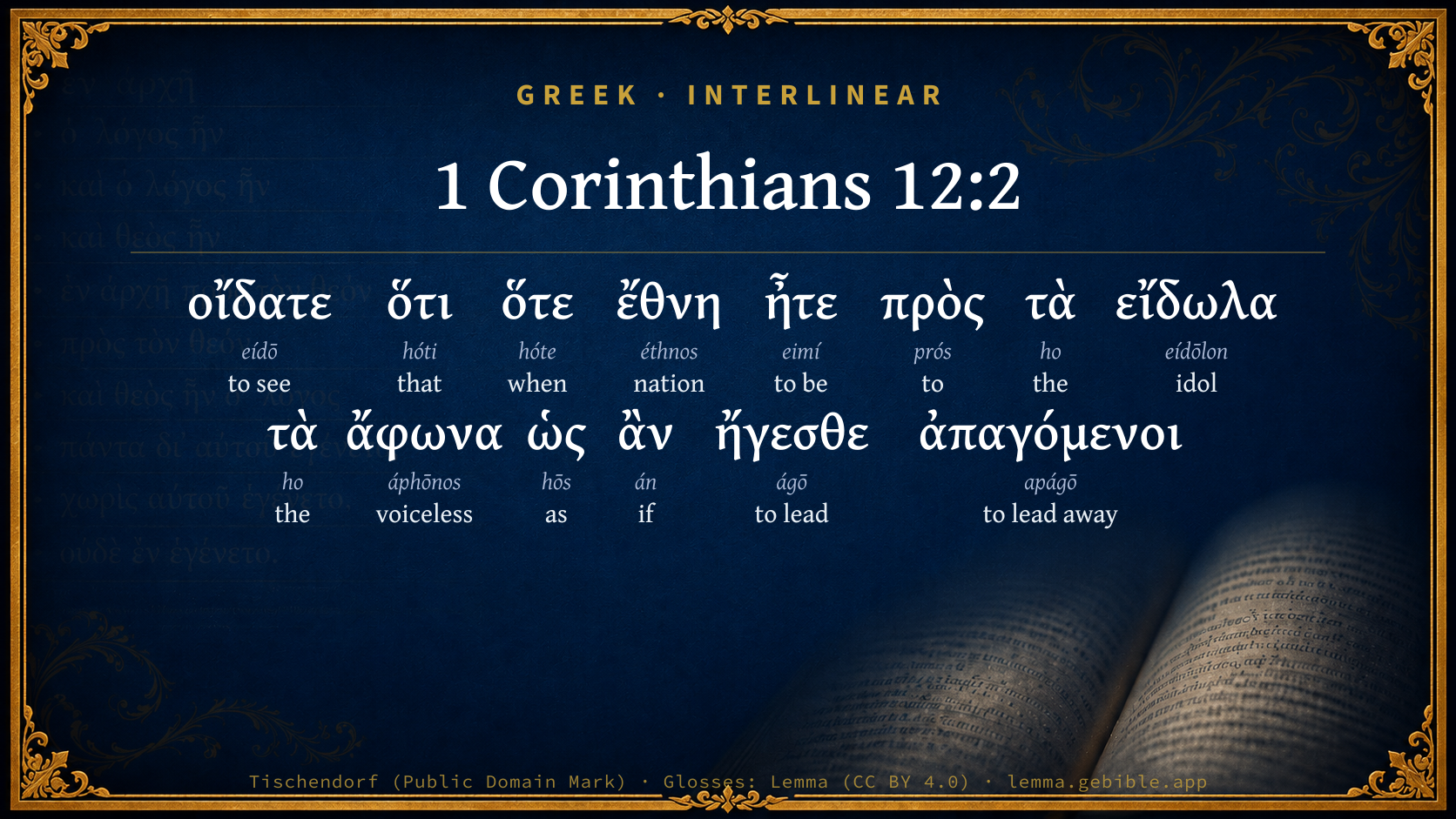
Greek (Tischendorf 8th ed.) 1 Corinthians 12:2 appears in the Greek New Testament. The text above is from the Tischendorf 8th edition. Each word links to its Strong’s number and a concise gloss. Click any word for its full Thayer’s Greek Lexicon entry.
Download image
Cite this verse

1 Corinthians 12:2 (World English Bible). Public Domain. Lemma interlinear Bible study tool, https://lemma.gebible.app/v/1-corinthians/12/2.

Show BibTeX & RIS
BibTeX
RIS
English Translation
You know that when you were heathen, you were led away to those mute idols, however you might be led.
World English Bible · Public Domain
Download a study sheet

One document with this verse’s original text, its word-by-word gloss line, the meaning frame, cross-references with their text, attributed commentary, and full source and license credits — printable, and it pastes into notes with its structure intact.

This verse Autodidact and up

Study sheet (.html) Plain text (.txt)

A passage Seminary Student

Up to 50 verses in one chapter. A passage sheet keeps up to 6 commentary sources and 12 cross-references per verse, in the order this page ranks them, and says so on the sheet whenever that leaves anything out. Ask for a single verse and you get the Autodidact verse sheet above.

Everything on this page stays free to read, with no account — the sheet is a download of what is already on screen, not access to it.

Want to remove ads? Support Godless Engineer
Compare translations 3

The same verse in 3 English versions, stacked beneath the original-language interlinear above. Click any original word for its lexicon entry.

Each is an independent rendering of the whole verse — the interlinear is not word-aligned to these translations.

Highlighted words mark where these versions differ — a whole-verse word diff, not a word-by-word alignment.

  • World English Bible Public Domain
    You know that when you were heathen, you were led away to those mute idols, however you might be led.
  • King James Version Public Domain
    Ye know that ye were Gentiles, carried away unto these dumb idols, even as ye were led.
  • unfoldingWord Literal Text CC BY-SA 4.0
    You know that when you were pagans, you were led astray to the mute idols, in whatever ways you were led.

unfoldingWord Literal Text — © unfoldingWord, licensed CC BY-SA 4.0. Word-aligned USFM3 via Door43 (git.door43.org/unfoldingWord/en_ult).

Versions to compare (up to 4)

3 of 4 selected

Show all 19 translations

Every available English version of this verse, each an independent rendering of the whole verse.

  • World English Bible Public Domain
    You know that when you were heathen, you were led away to those mute idols, however you might be led.
  • Berean Standard Bible Public Domain
    You know that when you were pagans, you were influenced and led astray to mute idols.
  • Majority Standard Bible Public Domain
    You know that when you were pagans, you were influenced and led astray to mute idols.
  • King James Version Public Domain
    Ye know that ye were Gentiles, carried away unto these dumb idols, even as ye were led.
  • American Standard Version (1901) Public Domain
    Ye know that when ye were Gentiles `ye were' led away unto those dumb idols, howsoever ye might led.
  • Revised Version (1885) Public Domain
    Ye know that when ye were Gentiles ye were led away unto those dumb idols, howsoever ye might be led.
  • Geneva Bible (1599) Public Domain
    Ye know that ye were Gentiles, and were caried away vnto the dumme Idoles, as ye were led.
  • Douay-Rheims (1899) Public Domain
    You know that when you were heathens, you went to dumb idols, according as you were led.
  • Young's Literal Translation Public Domain
    ye have known that ye were nations, unto the dumb idols -- as ye were led -- being carried away;
  • Literal Standard Version CC BY-SA 4.0
    you have known that you were nations, being carried away as you were led to the mute idols;
  • Unlocked Literal Bible CC BY-SA 4.0
    You know that when you were pagans, you were led astray to idols who could not speak, in whatever ways you were led by them.
  • unfoldingWord Literal Text CC BY-SA 4.0
    You know that when you were pagans, you were led astray to the mute idols, in whatever ways you were led.
  • Darby Bible Public Domain
    Ye know that when ye were [of the] nations [ye were] led away to dumb idols, in whatever way ye might be led.
  • World Messianic Bible Public Domain
    You know that when you were heathen, you were led away to those mute idols, however you might be led.
  • Webster's Bible Public Domain
    Ye know that ye were Gentiles, carried away to these dumb idols, even as ye were led.
  • Free Bible Version CC BY-SA 4.0
    You know that when you were pagans, you were deceived, being led astray by worshiping idols who couldn't even speak.
  • Bible in Basic English Public Domain
    You are conscious that when you were Gentiles, in whatever way you were guided, you went after images without voice or power.
  • Text-Critical English NT CC BY 4.0
    You know that when you were pagans you were somehow enticed and led astray to mute idols.
  • Tyndale New Testament (1534) Public Domain
    Ye knowe that ye were gentyls and went youre wayes vnto domme ydoles even as ye were ledde.

Literal Standard Version (2020), Covenant Press — licensed CC BY-SA 4.0. Text via the HelloAO Bible API (eBible.org). Unlocked Literal Bible (unfoldingWord) — licensed CC BY-SA 4.0. Text via the HelloAO Bible API (eBible.org). unfoldingWord Literal Text — © unfoldingWord, licensed CC BY-SA 4.0. Word-aligned USFM3 via Door43 (git.door43.org/unfoldingWord/en_ult). Free Bible Version, Dr. Jonathan Gallagher — licensed CC BY-SA 4.0. Text via the HelloAO Bible API (eBible.org).

Word by word

More ways to search: Search by grammar → Find every occurrence → Compare this word →

Practice this passage: Drill this verse → Learn its vocabulary →

About this verse

These counts appear in no published source. They are computed here, from the morphology-tagged text and Lemma’s own curated glosses. What Lemma adds →

14
words
13
distinct lemmas
Pauline Epistles
section

Notable vocabulary

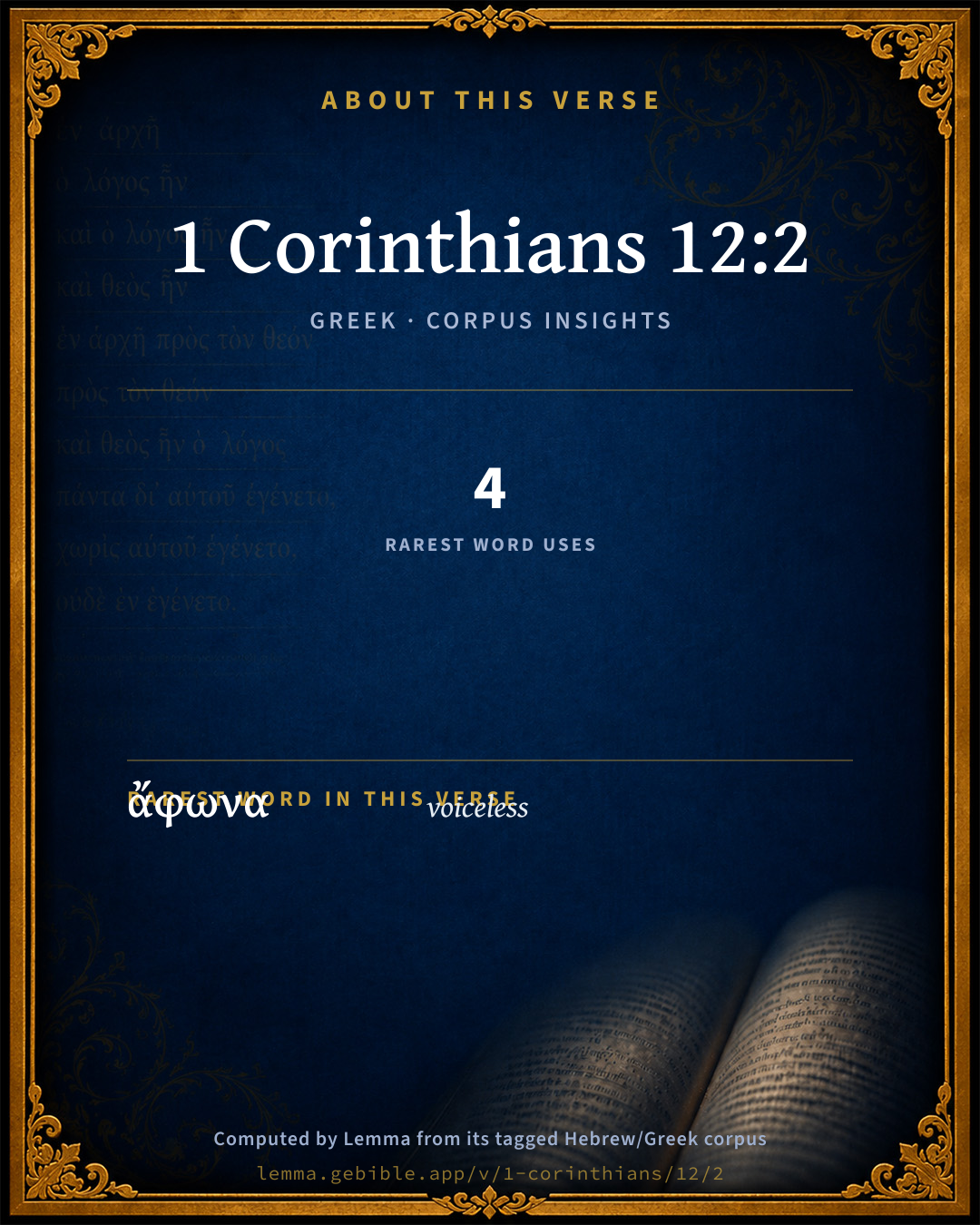
The rarest word here is ἄφωνα voiceless G880 — appearing just 4 times in the whole Greek New Testament.

Shared distinctive vocabulary

ἄφωνα voiceless G880 occurs in 4 verses of the Greek New Testament. Also found in:

Repetition

A word recurs within this verse:

Cross-references

15

Topical passages linked to 1 Corinthians 12:2 in the Treasury of Scripture Knowledge — connected by theme and wording, ordered by reader-vote popularity; previews shown in the World English Bible.

  • 1 Peter 4:3 For we have spent enough of our past time doing the desire of the Gentiles, and having walked in lewdness, lusts, drunken binges, orgies, carousings, and abominable idolatries.
  • 1 Thessalonians 1:9 For they themselves report concerning us what kind of a reception we had from you; and how you turned to God from idols, to serve a living and true God,
  • Psalms 115:5 They have mouths, but they don't speak; They have eyes, but they don't see;
  • Galatians 4:8 However at that time, not knowing God, you were in bondage to those who by nature are not gods.
  • Ephesians 2:11–12 Therefore remember that once you, the Gentiles in the flesh, who are called "uncircumcision" by that which is called "circumcision," (in the flesh, made by hands);
  • 1 Corinthians 6:11 Such were some of you, but you were washed. But you were sanctified. But you were justified in the name of the Lord Jesus, and in the Spirit of our God.
  • Jeremiah 10:5 They are like a palm tree, of turned work, and don't speak: they must be carried, because they can't go. Don't be afraid of them; for they can't do evil, neither is it in them to do good."
  • Habakkuk 2:18–19 "What value does the engraved image have, that its maker has engraved it; the molten image, even the teacher of lies, that he who fashions its form trusts in it, to make mute idols?
  • Psalms 115:7 They have hands, but they don't feel; They have feet, but they don't walk; Neither do they speak through their throat.
  • Ephesians 4:17–18 This I say therefore, and testify in the Lord, that you no longer walk as the rest of the Gentiles also walk, in the futility of their mind,
  • Psalms 135:16 They have mouths, but they can't speak; They have eyes, but they can't see;
  • Isaiah 46:7 They bear it on the shoulder, they carry it, and set it in its place, and it stands, from its place it shall not move: yes, one may cry to it, yet it can not answer, nor save him out of his trouble.
  • Matthew 15:14 Leave them alone. They are blind guides of the blind. If the blind guide the blind, both will fall into a pit."
  • Titus 3:3 For we were also once foolish, disobedient, deceived, serving various lusts and pleasures, living in malice and envy, hateful, and hating one another.
  • 1 Peter 1:18 knowing that you were redeemed, not with corruptible things, with silver or gold, from the useless way of life handed down from your fathers,

Cross-references courtesy of OpenBible.info (CC BY 4.0).

Where the printed editions differ

1 variant

Places in this verse where the major printed Greek editions disagree on the wording in a way that affects the translation — a comparison of editions, not a manuscript-by-manuscript collation. The editions are the modern critical texts (Nestlé-Aland 28/27, SBL, Westcott-Hort, Tregelles, Tyndale House) and the traditional texts behind the KJV (the Textus Receptus and the Byzantine/Majority text). It is not a claim about which reading is original.

  1. Extra text
    ὅτε

    “when”

    In NA28NA27TynSBLWHTregByz Not in TR

    ὅτε (hote) 'when' is only in older manuscripts (NA28+NA27+Tyn+SBL+WH+Treg+Byz)

Textual data: Translators Amalgamated Greek New Testament (STEPBible TAGNT) · CC BY 4.0.

Commentary

Notes on 1 Corinthians 12:2 from classic Christian and Jewish commentators (each source and its license shown beneath its notes). The classic Christian expositions comment on the surrounding passage and are grouped to its opening verse, so a note may address several verses; the Jewish commentaries on the Tanakh (Rashi and others) are per-verse, so they appear only where the commentator wrote on this verse.

Lemma curates 59 commentaries, every one of them public domain or Creative Commons licensed, each selected and text-cleaned for this edition rather than reprinted as found. About our sources →

The Biblical Illustrator

Joseph S. Exell

1Co_12:2

Ye know that ye were Gentiles, carried away unto these dumb idols.

The great change and its obligations

Observe--

I. The condition of the heathen.

1. Worshippers of dumb idols.

2. Carried away by their lusts.

3. Led by the devil and his agents.

II. This condition was yours.

1. Literally in past times.

2. Spiritually in your own former experience.

III. The change in you has been effected by Gods grace.

1. Through the gospel.

2. By the agency of others.

3. Hence your obligation to send it to the world.

Christianity and heathenism

Two things are here expressed--

I. The dead silence of the state of heathenism--the idols standing voiceless, with neither mouths to speak, nor ears to hear--silent amongst their silent worshippers. The oracles are dumb. This is contrasted with the music and speech of Christianity, the sound of a mighty, rushing wind, the voice of many waters, which resounded through the whole Church in the diffusion of the gifts, especially of prophesying and tongues.

II. The unconscious irrational state of heathenism, in which the worshippers were blindly hurried away by some overruling power of fate, or evil spirit of divination or priestly caste, without any will or reason of their own to worship at the shrine of inanimate idols. This is contrasted with the consciousness of an indwelling Spirit, moving in harmony with their spirits, and controlled by a sense of order and wisdom. Possibly there is the further intention of impressing the superiority of the conscious over the unconscious gifts of the Spirit. (Dean Stanley.)

No man speaking by the Spirit of God calleth Jesus accursed: and … no man can say that Jesus is the Lord but by the Holy Ghost.

Jesus anathema

The first thing needed by a Church so inexperienced was to know what was the true character of the Divine influence. The apostle says every utterance, be it prophecy, tongue, or doctrine, which amounts to saying Jesus is accursed, is not Divinely inspired. But to whom can we attribute this language? To the Jews or unbelieving Gentiles who treated Jesus as an impostor, and saw in His ignominious and cruel death a token of the Divine curse (1Co_1:23)? No; for how could Christians be tempted to esteem such as inspired? Besides, we have here to do with discourses uttered in church; and how would anti-Christians have been allowed to speak there? Does, then, Paul admit the possibility of discourses from Christians to this effect? Remember the powerful fermentation of religious ideas then called forth by the gospel. In 2Co_11:3-4, the apostle speaks of teachers newly arrived in Corinth, who preached another Jesus and raised a different spirit to that which the Church had received. It was therefore not only another doctrine, but another breath, a new principle of inspiration, which these people brought with them. In 1Co_16:22 he devotes to anathema certain persons who love not Jesus when the Lord shall come, which would be very severe if it were not a return for the anathema which they threw in His face. How was this possible in a Christian Church? We must observe the term Jesus, detecting the historical and earthly person of our Lord, and hear in mind that from the earliest times there were people who, offended at the idea of the ignominious punishment of the Cross, and the unheard abasement of the Son of God, thought they must set up a distinction between the man Jesus and the true Christ. The first had been, according to them, a pious Jew. A heavenly Being, the true Christ, had chosen Him to serve as His organ while He acted below as the Saviour of humanity. But this Christ from above had parted from Jesus before the Passion, and left the latter to suffer and die alone. It is easy to see how, from this point of view, one might curse the Crucified One who appeared to have been cursed of God on the Cross, and that without thinking he was cursing the true Saviour, and while remaining without scruple a member of the Church. Cerinthus taught this doctrine, and Epiphanius affirms that this Epistle was written against him. The Ophites, or serpent worshippers, too, who existed before the end of the first century, asked those who wished to enter their churches to curse Jesus. In stating this first negative criterion, the apostle therefore means: However ecstatic in form or profound in matter may be a spiritual manifestation, if it tends to degrade Jesus, to make Him an impostor or a man worthy of the Divine wrath, if it does violence in any way to His holiness, you may be sure the inspiring breath of such a discourse is not that of Gods Spirit. Such is the decisive standard which the prophets, e.g., are summoned to use when they sit in judgment on one another (chap. 14:29). (Prof. Godet.)

The denial of Christ

I. Its forms.

1. Infidelity makes Him an impostor.

2. Socinianism robs Him of His Divinity.

3. Impenitence and unbelief resist His claims and authority.

4. All by denying practically declare Him accursed.

II. Its cause. The want of the Spirit. Hence a man is governed in his views and conduct either by a depraved reason or corrupt natural sense.

III. Its consequences.

1. Delusion.

2. Misery.

3. Ruin. (J. Lyth, D.D.)

The confession of Christ

I. What it implies.

1. A full conviction of His supreme authority as Lord and Christ.

2. A believing trust in Him.

3. A willing submission to His authority.

II. How is it elicited? By the Holy Ghost, who--

1. Enlightens.

2. Convinces.

3. Assures.

4. Sanctifies--him that believeth. (J. Lyth, D.D.)

The confession that Jesus is Lord by the Holy Ghost

Note--

I. The general impotency of man in spiritual duties. Here we see--

1. The universality of our loss in Adam. No one hath any power to do this. Which notes their blasphemy that exempt any man from the infection of sin.

2. Where this impotency lies--in man. No man. Which notes their blasphemy that say man may be saved by his natural faculties as he is man.

3. By just occasion of that word can, is able, we see also the laziness of man who, though he can do nothing effectually and primarily, yet does not do so much as he might do.

II. What this spiritual duty is wherein we are all so impotent.

1. An outward act, a profession; not that the outward act is enough, but that the inward affection alone is not enough neither. To think it, to believe it, is not sufficient; we must say it, profess it.

2. And what?

(1) That Jesus is: not only assent to the history, and matter of fact that Jesus was, and did all that is recorded of Him, but that he is still that which He pretended to be. Caesar is not Caesar still, nor is Alexander, Alexander; but Jesus is Jesus still, and shall be for ever.

(2) That He is the Lord. He was not sent hither as the greatest of the prophets, nor as the greatest of the priests; His work consists not only in having preached to us, nor in having sacrificed Himself, thereby to be an example to us; but He is Lord. He purchased a dominion with His blood. He is the Lord, not only the Lord paramount, but the only Lord, no other hath a lordship in our souls and no other any part in saving them but He.

III. This cannot be done but by the Holy Ghost.

1. All recalls but one are excluded, and therefore that one must necessarily be hard to be compassed. The knowledge and discerning of the Holy Ghost is a difficult thing.

2. As all other means are excluded, so this one is included as necessary. Nothing can effect it but having the Holy Ghost, and therefore the Holy Ghost may be had. (J. Donne, D.D.)

Jesus the Lord

I. The truth that Jesus is the Lord. The man Jesus for thirty-three years acted as a man in connection with men, and at last died. This man is the Lord. The word he uses is almost invariably the translation of Jehovah in the LXX., a version in common use among the apostles. Now if Paul, as a Jew, called Jesus Jehovah, he must have demanded for Him all those attributes which his nation was wont to associate with that name; and that he did claim these attributes for Jesus no candid and qualified reader of his sermons and epistles can doubt.

II. This tremendous truth is so transcendent that it cannot be accepted without Divine help. No man of himself can affirm it--can state it as the natural conviction of his judgment. When you tell me that Jesus was born, lived, taught, and died, I understand you; for you have narrated a natural event; but when you tell me that Jesus is the great God, you transport me from the sphere of intelligible statement and testimony into wonderland. I do not mean that the Godhead of Christ is naturally inconceivable, but simply that the doctrine is above me. I cannot say that Jesus is God unless you add some other power to my mind, or stimulate to an unnatural intensity the powers I have. St. Paul affirms that no man can: and if St. Paul had not affirmed it we should have found it out. The history of controversy has repeated it in every age. Modern philosophers maintain this in a spirit of boasting, ill concealed beneath an affectation of scientific certainty; as if it had been left for them to discover; whereas Paul asserted it from the first. And he has described this temper of mind with as much candour and accuracy as if he had been a philosopher himself! The natural man receiveth not the things of the Spirit of God, etc.; neither can he know them. The natural men have been unconsciously repeating Pauls words from his day to ours. Now there is a portion of this wonderful truth which is historic--the works and the resurrection of Jesus. These were visible facts, and might be supposed to lie within the realm of observation and testimony. But see how the natural men treat them--as they dare not treat any other history. They first say that Jesus cannot be God, and then they read the gospels to explain away New Testament facts. I do not blame these men because they are unable to say that Jesus is the Lord, any more than I would rate a blind man for not knowing the sun; but I should censure the blind man if he declared there was no sun because he could not see it.

III. The evidence by which this grand truth can be affirmed. The internal persuasion of the Holy Ghost. This leads us at once into the region of the supernatural. Here we part company with the wise, and the scribe, and the disputer of this world. Here we speak in parables to them that are without. The Spirit is the author of the expression or manifestation of the Christian religion. The lips of prophets were touched, and the pens of scribes were moved, by Him; the holy child Jesus was conceived by Him; the dispensing of the glad tidings, that that child was a light to lighten the Gentiles, was entrusted to Him. Now, the first step towards the confession of the Godhead of Christ is the conviction of sin by the Holy Ghost. The misery following such a conviction of sin will make a man strive against it, and learn by bitter failures his helplessness. When I preach Jesus to a man in this state, with his self-despair and his eager cries for help, he not only sees no difficulty in accepting the Godhead of Christ, but he grasps it as the only truth that can give him comfort. He wants a God-mediator because he has sinned against God. He must take his forgiveness from Him against whom he has sinned; and, being pardoned, he must render Him the full and loyal service of his heart and life. That which makes Jesus our final resting-place is His Godhead: that which gives an omnipotent potency to His blood is His equality with the Father. How easy for those whom the Holy Ghost has convinced of sin, and who have imagined under the tyranny of its power what a counter-power that must be which could redeem us from it--how easy for such to admit that Jesus is God! (E. E. Jenkins, D.D.)

The impossibility of truly believing and savingly confessing Christ, but by the Holy Ghost

I. The statement in the text needs explanation. It does not mean that a person cannot repeat the words, Jesus is the Lord, but by the Holy Ghost. What, then, is the true meaning, of the text? It is that none can without the Holy Spirit make this confession--

1. With a firm belief of its truth.

2. With a firm reliance on Him for salvation. In order to our relying on Jesus Christ for salvation two things are necessary.

(1) We must feel our need of such a salvation.

(2) We must believe that there is such a provision made for our salvation in Christ Jesus, neither of which we can do without the influence of the Holy Spirit.

3. With a full purpose of living to His glory.

II. We are here instructed--

1. In the nature of true religion. Faith in the Lord Jesus Christ lies at the foundation of all true religion. That glorious truth, Jesus is the Lord, that He who died upon the Cross for our sins is the Lord, this truth is the great turning point of salvation, and whoever truly believes it is brought into a state of salvation. By the belief of this glorious truth he is also prepared for Gods service, to confess Him before men, and to maintain a conduct, according to His will, in the face of all difficulties from within and from without.

2. In the need of the Holy Spirit. We cannot know and believe that Jesus is the Lord so as to have our hearts savingly affected by it, so as to depend on Jesus as our Saviour, so as to be renewed thereby after His image in righteousness and true holiness. To attain this faith the special operation of the Holy Ghost is needful.

3. The peculiar office of the Holy Ghost. How He works, and by what means. (G. Maxwell, B.A.)

The work of the Holy Ghost necessary to man

I. The need of the Spirits work. It is a matter of needful preliminary consideration, that we dwell upon the guiltiness of our own nature. And no man wants more evidence than that which he finds concurrently upon the page of the Bible and in the volume of his own heart; he has only to look into the former to see what is holy and right and good; he has only to look into the latter in order to see how utterly we have departed therefrom. And this condition is not to be changed by any power which we can set in motion. It is not to be changed by the force of education. It is true that we may train and discipline our children to a certain outward course; we may bind upon them the necessity of maintaining a certain line of conduct, but this has nothing to do with the heart. It is not even by the ordinances of Gods appointment that we can ensure the conversion of souls.

II. The mode of the Spirits operations. It is a marvellous work which is wrought upon the soul of every man who passes from a state of nature into a state of grace. It is a change of desires, hopes, purposes, objects--a new birth. We can trace it by its results; we cannot always trace it by its accomplishment. The wind bloweth where it listeth, etc. But we are certain that if the effect be really and truly wrought upon any man the results will be manifest. The fruit of the Spirit is love, joy, peace, etc. When the evil has been removed, when the hardness has been subdued, when the door of the understanding has been opened to admit the truth of Christianity, and when the door of the heart has been unclosed to all its blessed influences, the man comes to pursue earnestly and diligently those things for which he had once no esteem. (S. Robins.)

Faith a gift of the Spirit

Perhaps there is no one habit which Scripture attributes more often, either explicitly or implicitly, to the agency of the Holy Spirit than a sound and lively faith; and there is none, therefore, which the soul will more carefully seek and cherish. Faith, in the sense in which we are here concerned with it, is the belief of a professed revelation of God to man, on the authority of God who made it, and a lively faith is such a conviction of its truth as causes it to operate as a motive on our affections and lives. It is itself, then, a habit of the intellect, and appears, so far, to become moral only at the point where it influences, rather than is influenced by, the will. And in this light, as a moral motive, coupled too, as it often is in Scripture, with those effects which it should produce on the will, there seems no greater difficulty in viewing faith as a work of the Spirit than in so regarding repentance, love, or obedience. But in the prior intellectual process--the conviction of the understanding by the force of proof--there is a difficulty which has been felt probably by most minds. There appears, as far as can be seen, no more reason to seek or expect Divine interposition to correct or prevent a logical error, than to stay the effects of any physical power which we ourselves have set in motion. Either would be a miracle which God may work, but which we have no authority to suppose He will. We can no more refuse to believe what is proved, or believe what is destitute of apparent proof, than the eye can reject or change the forms and colours thrown by external objects on the retina. How then can the reception of a doctrine by the reason be affected by the operations of Divine grace? If it is proved, must it not be believed? This difficulty, however, such as it is, is not peculiar to Scripture, or religious truth, or the question of the Holy Spirits influence. It belongs equally to the acknowledged fact that, on almost every subject, men, apparently of equivalent power of intellect, with precisely the same evidence before them, arrive at widely different conclusions. Thus it is every day in history, in politics, in much that is called science, in the judgment we form of each others characters and conduct, and even in the credit that is given to alleged events almost within the sphere of our own observation. Whether it be that a partial and temporal blindness of the judgment is superinduced by the force of passion and the tension of the will; or whether, as seems more probable, attention, the optic glass, or rather the eye of the mind, is directed by the prevailing emotion excited by the subject in question, with more intensity on a certain class of considerations bearing upon it, while others it glances over slightly, or entirely disregards--even as the bodily eye gazing fixedly on one object is as blind for the time to all the rest as if they were not--so that from all the topics which should have been considered in due weight and measure, it culls those only which lead to the desired conclusion, or gives them such undue prominence in the field of vision that the judgment, deceived and misled, arrives, at a partial, though acceptable, decision--these are questions which may be left to the metaphysician to solve. It is enough for us that the fact is admitted, that everywhere, but in the necessary truths of demonstrative reasoning, the conclusions of reason are actually modified by the wishes, interests, or prejudices of the reasoner; so that belief is not merely the result of intellect, but is, in perhaps a large majority of cases, the mixed product of the moral and intellectual faculties combined. And if this be true where the feelings and passions are only remotely affected, and should not be so at all, how much more will it have place when the subject-matter is religion, which must teach the tenderest part of our moral nature; which strikes on hopes and fears; which bears directly on every affection, passion, motive, habit, and act; which, if admitted to be true, requires a complete revolution in the whole inner man and in great part of the outward conduct. The choice of arrangement of the materials with which reason is to work is much in the power of the will; and the will is prejudiced, and cannot, or will not, honestly do its part. It is not, then, surprising that our Lord should have attributed unbelief always to moral, never to purely intellectual causes (see Joh_3:18-20; Joh_5:40-44; Joh_7:17). It will follow, too--which is the point more immediately before us--not only that in the formation of a sound and living faith there is room for the agency of the Holy Spirit, but that without His aid such faith cannot exist. For if the character of our belief depends not merely on the correctness of the reasoning process, but much more on prior operations of the will, by which the antecedents and materials of reason are selected and arranged, and if our moral nature is in our unregenerate state warped and impaired so as to have a disinclination to what is good and a bias to what is evil, it is evident that the gospel, placed before such a tribunal, must be tried by a prejudiced and incapable judge; that, being wished false, and admitting of objections capable of being magnified and coloured into refutations, it is certain to be found false; and that nothing can rectify the balance of judgment, and place truth on an equal footing with falsehood, but the same external and Divine power which changes and renews the will of man, and enables it to love right instead of wrong, and to desire in all things to know and to do Gods will. Let us now, in further illustration of what has been said, endeavour to trace in one or two instances the process by which moral causes, acting on the intellect, may lead to avowed or practical belief.

1. In a certain class of minds infidelity and heresy alike seem to owe their origin to intellectual pride. To believe is to, adopt the same opinions which have been the creed of multitudes before, and to be confounded in the mass of unreasoning minds which have received implicitly the same traditionary tenets. Objections, on the other hand, have an air of novelty. There is at least the appearance of power in striking out difficulties. It is an intoxicating pleasure to feel different from other men--that is, in our own judgment, superior to them--and the brain often reels under it. Besides this, there is a prejudice against the gospel from the mere circumstance of its being old. In every science new discoveries are making daily. In history, in politics, in science, men have been long mistaken, why not in religion also? With such feelings and prepossessions the mind catches up objections to Christianity, or to some of its doctrines, as just what it was expecting to find. It dwells on them; it magnifies them by the exclusion of other presumptions, till they fill the field of mental vision and leave no room for truth. Humility and faith are kindred gifts of the same Spirit.

2. Another source of unbelief is even more evidently moral. It arises when the soul would hide from God after displeasing Him by wilful sin. Some, for example, smother accusing thoughts in worldly amusements and the dissipation of frivolous gaiety. But many--far more, probably, than can be known till the secrets of all hearts are disclosed--take refuge in a kind of partial unbelief. There are difficulties in revelation, and in some of its doctrines--light as a feather, indeed, when weighed impartially in the balance against the accumulated evidences of truth, but not of course without weight when poised and pondered over by themselves. Such the writhing soul is glad to seize. Suppose the gospel should not be true? his obligations are imaginary, and his guilt and ingratitude are unreal. (Bp. Jackson.)

The necessity of Divine influence in the study and use of Holy Scripture

I. What progress may be made in the study and use of Scripture without the special influence of the Holy Spirit.

1. It is obvious that, without such special influence of the Spirit of God, it is possible to arrive at a merely speculative belief in the truth of Scripture. Men of keen faculties in other pursuits do not forfeit them on approaching the Word of God.

2. It is possible for an individual, without the special influence of the Holy Spirit, to obtain a general acquaintance with the contents of the sacred volume. The strongest eye will make the largest discoveries.

3. It is possible, without the special influence of the Holy Spirit, to feel the highest admiration for parts of the sacred volume.

4. Such an individual may proceed clearly and strikingly to display the contents of the sacred volume to others. He may be a man of lively imagination, and conjure up the most attractive images for the illustration of the truth. He may be a master in composition and therefore able to describe forcibly what he sees distinctly. But, nevertheless, all these powers and faculties may be called into action without the operation of any principle of piety, and therefore without the sanctifying influences of the Holy Spirit on the soul.

II. What is that knowledge and use of Scripture of which the Holy Ghost must be considered as the exclusive Author.

1. It is by the Holy Spirit we are led to make a personal application of the holy Scripture to our own case.

2. It is the Spirit of God alone who endears the promises of Scripture to the heart. They nominally called Christ Lord before, but they now use the expression in a higher and more appropriate sense. They are entirely His. They yield their members as instruments of righteousness to Him.

3. It is the Holy Spirit alone who brings the Word of God effectually to bear upon the temper and conduct. As soon as this new influence is felt on the soul our chains begin to drop from us.

Conclusions:

1. Let the text teach us not to confound the results of our natural powers with the fruits of the Spirit.

2. Let the text teach us the transcendent importance of seeking habitually and devoutly the presence and influence of the Spirit of God.

3. If He does not lead us to say that Jesus is the Lord--to acknowledge Him, practically and spiritually, as our Redeemer, our Saviour, our Teacher, our Example--the whole of Scripture is as to us a dead letter, and we have received the grace of God in vain. (J. W. Cunningham.)

The Lordship of Jesus the ground of unity

I. There are reasons for believing that the expression, Jesus is Lord, was the primitive form of Christian creed, out of which all other more elaborate forms have grown (Php_2:11).

1. This simple formula contains in germ the whole faith, both objectively and subjectively. We cannot heartily accept this without accepting with it the truths of His incarnation, atonement, resurrection, reign. It includes also all that we need for our own spiritual welfare. If He is Lord, we are His, He is ours.

2. So full and so mighty is this confession of faith that we cannot heartily make it save by the power of the Holy Ghost (cf. St. Mat_16:16-17)

. To make it on the authority of others, or because our reasoning faculties have been convinced of its truth, is not sufficient. It is real only when the Holy Spirit has convinced our spirit that it is a living truth.

II. From the above considerations we can gain some guidance is the search after unity among Christians. If the essential primitive creed that Jesus is the Lord be held spiritually--

1. It may be permitted us to differ as to the exact methods in which He works upon our spiritual being. St. Paul allows that there are diversities of gifts, differences of administration, differences of operation.

2. We shall learn not to contradict the spiritual experiences of others because they have been gained by methods differing from our own. Our creed is a creed of affirmations, not of denials. The spiritual education of St. Peter differed from that of St. John, and both differed from that of St. Paul or St. James, yet they are united in their belief in the one Lord. (Canon Vernon button.)

The teaching of the Spirit of God

I. The lesson we are to learn, to say. Jesus is the Lord.

1. It is but short, but it is the whole gospel. Here is Jesus, a Saviour and the Lord, and as they are joined together in one Christ, no man must put them asunder. If we wilt have Christ our Saviour, we must make Him our Lord: and if we make Him our Lord, He will then be our Saviour. Had He not been the Lord, the world had been a chaos, the Church a body without a head, a family without a father, an army without a captain, a ship without a pilot, and a kingdom without a king.

2. What it is to say it. It is soon said: it is but three words. The devils themselves did say it (Mat_8:29). And if the heretic will not confess it, saith Hilary, what more fit to convince him than the cry of the devils themselves? The vagabond Jews thought to work miracles with these words (Act_19:13). To say it taketh in the tongue, the heart, the hand, i.e., an outward profession, an inward persuasion, a constant practice answerable to them both.

(1) We are bound to say it (Rom_10:9; 1Jn_4:15).

(a) But if to say it were sufficient, there needed no Holy Ghost to teach it. We might learn to say it as the parrot did to salute Caesar. And indeed, if we take a survey or the conversation of most Christians, we shall find that our confession is much after the fashion of birds.

(b) Some dare not but say it for very shame, lest those they live with should confute them. Yet the voice may be for Jesus and the heart for Mammon. It is a voice, and no more. Thus they may name Him who never name Him but in their execrations.

(2) As there is a word floating on the tongue, so there is the word of the heart, when by due examination we are well persuaded that Jesus is the Lord. We call it faith, which as a fire will not be concealed (Jer_20:9; Psa_39:3; Psa_116:10). Sometimes we read of its valour (Heb_11:33); its policy (2Co_2:11), its strength; but that faith should be idle, or speechless, or dead, is contrary to its nature. Now there are many who maintain the truth, but by those ways which are contrary to the truth (2Ti_3:5); crying, Jesus is the Lord, but scourging Him with their blasphemies, and fighting against Him with their lusts. Therefore--

(3) That we may truly say it, we must speak it to God as God speaketh to us; who, if He saith it, will make it good (Num_23:19). And as He speaketh to us by His benefits, so must we speak to Him by our obedience. For if He be indeed our Lord, then shall we be under His command.

II. The teacher. As the lesson is difficult, we must have a skilful master.

1. Good reason that the Holy Ghost should be our teacher. For as the lesson is, such should the master be. The lesson is spiritual; the teacher a Spirit. The lecture is a lecture of piety; and the Spirit is a Holy Spirit. It is not sharpness of wit, or quickness of apprehension, or force of eloquence, that can raise us to this truth.

2. Christ dwelleth in us by His Spirit (Rom_8:11). Who teaches us--

(1) By sanctifying our knowledge of Christ; by showing us the riches of His gospel, and the majesty of His kingdom, with that evidence that we are forced to fall down and worship.

(2) By quickening, enlivening, and even actuating our faith. For this Spirit dwelleth in our hearts by faith, maketh us to be rooted and grounded in love, enableth us to believe with efficacy (Eph_3:17).

3. A teacher then He is. But great care is to be taken that we mistake Him not, or take some other spirit for Him. And it doth not follow, because some men mistake and abuse the Spirit, that no man is taught by Him. Because I will not learn, doth not the Spirit therefore teach? And if some men take dreams for revelations, must the Holy Ghost needs lose His office?

4. But you will say perhaps that the Holy Ghost was a teacher in the apostles times, but doth He still keep open school? Yes, certainly. Though we be no apostles, yet we are Christians; and the same Spirit teacheth both. And by His light we avoid all by-paths of dangerous error, and discern, though not all truth, yet all that is necessary.

III. His prerogative. He is our sole instructor.

1. There are diversities of gifts, but the same Spirit. And there are diversities of teachers, but the same Spirit.

(1) The Church is the house of learning, and the pillar of the truth.

(2) The Word is a teacher: and Christ by open proclamation hath commanded us to have recourse unto it.

(3) We are taught also by Christs discipline.

2. All these are teachers; but their authority and efficacy is from the Spirit. The Church, if not directed by the Spirit, were but a rout or conventicle; the Word, if not quickened by the Spirit, a dead letter; and His discipline a rod of iron, first to harden us, and then break us to pieces. But the Spirit bloweth upon His garden the Church, and the spices thereof flow (Son_4:16); He sitteth upon the seed of the Word, and hatcheth a new creature, a subject to this Lord; He moveth upon these waters of bitterness, and then they make us fruitful to every good work. Conclusion: Wilt thou know how to speak this language truly, that Jesus is the Lord, and assure thyself that the Spirit teacheth thee so to speak? Mark well then those symptoms of His presence.

Remember--

1. That He is a Spirit, and the Spirit of God, and so is contrary to the flesh, and teacheth nothing that may flatter or countenance it, or let it loose to insult over the spirit.

2. That He is a right Spirit (Psa_51:10); not now glancing on heaven, and having an eye fixed and buried in the earth.

3. That He is a Spirit of truth. And it is the property of truth to be always like unto itself, to change neither shape nor voice. (A. Farindon, B.D.)

Who have, and who have not, the Spirit

I. Who do not speak by the spirit of God, and have not His influences. They that call Jesus accursed (Lev_27:21; Lev_27:28).

1. The test put on Christians by their persecutors was, that they should revile and blaspheme Christ. Pliny, writing to Trajan, says, When they (the Christians) could be induced to call on the gods … and, moreover, to revile Christ, to none of which things it is said that those who are in reality Christians can be compelled, I thought they ought to be released. And the Jews not only uttered blasphemies against Christ themselves, but extorted them, if possible, from those they apprehended to be His disciples (Act_26:11). The apostle, therefore, here signifies that those who reviled Christ had not the Spirit. This is applicable to those who in any way detract from the glory of Christ, or that do not acknowledge Him to be Lord.

2. It includes--

(1) All that blaspheme Him, or account Him, an impostor; as all infidels, heathens, Jews, Mohammedans, and whoever does not acknowledge Jesus to be the Messiah (Joh_8:24; 1Jn_4:3).

(2) All that reject Him (Act_4:11).

(a) As a Teacher, not receiving the whole of His doctrine as infallibly true.

(b) As a Mediator, not making His atonement or intercession the ground of their justification (Rom_9:31; Rom_10:3).

(c) As a Saviour from sin and its consequences.

(d) As a King, by disobeying His laws. For, as the chief end for which the Holy Spirit is given to us is to glorify Christ, if we neglect, or be indifferent about, Him, it is certain we are not inspired by that Spirit.

II. Who have the Holy Spirit? All that say that Jesus is the Lord.

1. What is implied in saying this? To say so is--

(1) To believe and confess that, although He was despised and persecuted, yet He was the Lord Christ promised to the patriarchs, foretold by the prophets (Mal_3:1; Psa_110:1; 1Jn_4:2; Mat_16:16); anointed and qualified to be our Teacher, our Redeemer (Isa_59:20-21; Heb_2:14), our Saviour, our Owner, our King (Php_2:11), our Lord and Master (Rom_14:7-9), our Judge (Rom_14:9-12).

(2) To believe and confess Him to be the Son of God, in a sense that no other being is His Son (1Jn_4:15; Mat_16:16; Heb_1:3, etc.); therefore, to be the heir and lord of all--to be Immanuel, God with us (Rom_9:5). It is impossible He should sustain His offices, or be our Lord, if He be not God.

2. The importance of it.

(1) It is the end of His life, death, and resurrection, that He should be acknowledged such (Php_2:6-11).

(2) It is necessary to our salvation, and certainly connected with it (Rom_10:8-10; 1Jn_4:13-15).

(3) It tends to the glory of God, and the salvation of others.

3. It can only be said by the Holy Ghost. It must be said--

(1) In the mind believingly and sincerely; therefore, it must proceed from knowledge which we cannot have but by the Spirit (Mat_11:27; 1Co_2:10; 1Co_2:12; Joh_16:13-15; Eph_1:17; 2Co_4:6).

(2) In the heart, affectionately (Rom_10:10; and 1Co_16:22; 1Pe_2:7-8); but this love we cannot have but by the Spirit (Rom_5:5).

(3) With lips, openly, whatever it may cost (Rom_10:9; 2Ti_2:8-14; Mat_10:25; Mat_10:28; Mat_10:32-39), which we cannot do of ourselves, or without faith and a new birth (1Jn_5:4-5), and, therefore, without the Spirit.

(4) By the life, consistently. (J. Benson.)

Spiritual discernment

I. What does this statement mean? The Holy Ghost must--

1. Convince us of its truth.

2. Reveal to us its importance.

3. Inspire us to trust in it.

II. Upon what is it based? It is--

1. Necessarily a matter of revelation.

2. Contrary to the carnal mind.

3. Superior to human reason. (W. W. Wythe.)

Divine grace necessary to the right appreciation of revealed truth

It seems a very simple thing to say that Jesus is the Christ, and yet the apostle declares that no man can do this but by the Holy Ghost. This is cutting down human power to a very low point indeed; and if that be so, then must the whole of Revelation be a sealed book to us, unless laid open by the Spirit of God.

I. The text does not assert the incompetency of the human understanding in matters of religion. Though the understanding was greatly injured by the fall, nevertheless in the main it still faithfully executes its part. But it can only judge of things according to the representations laid before it; and if those representations be incorrect, it may deliver a wrong judgment, and yet be no ways in fault. E.g., we lay a case before a lawyer; he delivers a favourable opinion; nevertheless, when we go into court, the verdict is against us. Now, it is possible enough that the lawyer may have been to blame, but the case may not have been fairly submitted to him; a colouring may have been thrown over certain facts, which has distorted them. Then surely the lawyer is not in fault.

II. The understanding may be deceived.

1. By the senses. Let us suppose a man born with impaired senses, but with a clear understanding. Suppose that his eye distorts everything, or is unable to discriminate colours; suppose his touch imperfect, or his ear faulty. Now what will the powers of the mans understanding avail him when such senses make their report? Would he not himself require to be made the subject of a rectifying process ere he could frame any true and fitting conceptions of the world in which he is placed?

2. By the affections. There are in all of us faculties by which we love and by which we hate certain things; the former is in right order if it fix on nothing but what is worthy of our love, and the latter if it fix on nothing but what is worthy of our hatred. But if, like the diseased eye or ear, they misrepresent objects, what will the understanding be able to do, seeing that the impression transmitted to it of evil may make it seem good, and of good may make it seem evil? And is not man in his natural state a being with depraved affections, though he may not be a being with vitiated senses? By nature he regards as worthy of his best love what God would have him despise, and gives his aversion to that which God would have him value; he seeks happiness where God asserts that it cannot be found, and denies that it exists where alone God would place it. The task demanded from the understanding by religion is, that it determine that in God is mans chief good, and that in obedience to God is also true happiness. But whilst the affections in their natural state give preference to some finite good and shrink from Gods service, how can the understanding deliver the verdict required by religion any more than it could form a correct notion of a tree, if the senses represent it as lying on the ground in place of springing from it?

III. The Holy Spirit is required to work on that by which the understanding is deceived, i.e., in the heart; removing the corrupt bias from the affections, and purifying them so that they shall find their chief good in God, ere the head can apprehend the great truths of the gospel, confess their force, and bow to their authority. Men often profess to count it very strange that we should make them out incapable of understanding spiritual things, when they have confessedly so much power in other departments of knowledge. The proper answer is, that the affections are to spiritual things what the senses are to natural things. If, then, the affections misrepresent the objects of which they have to give impressions to the understanding, the result will be of the same kind as if the work were done by the senses. The Holy Ghost did not come to give a new understanding, for there was strength enough in the head; He came to set in order those faculties through which the understanding is necessarily influenced. And it follows indubitably, from such passages as our text, that until a man has submitted himself to the influences of the Spirit, he cannot enter into the meaning of the Bible, and yield himself to the duties of religion. (H. Melvill, B.D.)

Real submission to Christ the effect of Divine influence

I. The manner in which a true Christian is here described.

1. He says Jesus is the Lord. The term Lord is here used to signify Christs Messiahship, including His authority and dominion. He is Lord of all. Christ has authority--

(1) To teach, to prescribe the faith of His followers, to enact laws for His Church, to direct and command in all things pertaining to our present duty, and our hopes for the future.

(2) To rule. As Lord of all, He is the head of that mediatorial government which externals over the world, for the sake of His Church which is in the world. His reign is a reign of grace. His throne is in the hearts of the faithful, who are made willing in the day of His power, and find their pleasure in their obedience.

(3) To pardon and save. When on earth He had power to forgive sins; and He is now exalted to be a Prince and a Saviour, to give remission of sins. We are required to look unto Him, that we might be saved.

(4) He will hereafter come in the clouds of heaven with all authority to judge.

2. But what is meant by saying that Jesus is the Lord?

(1) That to say it aright you must cordially receive Christ, and trust in Him as your Redeemer and Saviour (Joh_1:12-13).

(2) With this is connected a spirit of submission, and a practical acknowledgment of His lordship over us. To say He is the Lord, and yet to refuse to obey Him, is to mock Him with vain words.

(3) To this must be joined those exercises of the mind which are the proper workings of faith, the fruits of the Spirit of grace.

II. The work of the Holy Spirit in producing a cordial subjection to Christ the Lord.

1. The human mind shows a reluctance to that spiritual reception of the gospel which is meant by saying that Jesus is the Lord.

2. It is not to be expected that the heart, under this wrong bias, will cure itself. Nor can so desirable a change be effected, except by our heavenly Fathers gracious assumption of this work to Himself (Eze_36:26). The scriptures connect the sanctification of the Spirit with the belief of the truth. What occasions the rejection of the authority of Jesus the Lord? Is it not ignorance and unbelief? And how shall these be removed but by instruction and evidence? These are to be obtained from the Word of God, and it is by means of His own truth as there revealed that souls are renewed and reconciled. His Spirit helpeth our infirmities, and worketh in us both to will and to do of His good pleasure (1Th_2:13).

Conclusion:

1. Let us infer, for our improvement, the great importance of the work of the Holy Spirit in the concerns of our salvation.

2. Let us all carefully use the means whereby our souls may be quickened to all holy obedience. (Essex Congregational Remembrancer )

The Biblical Illustrator, edited by Joseph S. Exell (c. 1880s–1900s) — public domain. Text from a community e-Sword module.

Tyndale Open Study Notes

Tyndale Open Resources

12:2 pagans: Gentile unbelievers.

Tyndale Open Study Notes — © Tyndale Open Resources, licensed CC BY-SA 4.0. Text via the HelloAO Bible API.

Bengel's Gnomon

Johann Albrecht Bengel

1Co 12:2. Οἴδατε, ye know) nearly related to the verb you remember, which is found in Eph 2:11.—Οἴδατε, ὄτι, ὄτε ἔθνη ἦτε, πρὸς τὰ εἴδωλα τὰ ἄφωνα ὡς ἂν ἤγεσθε ἀπαγόμενοι) The analysis of these words will be easy, if we only keep hold of this thread of connection, ὅτι ἤγεσθε, that you were led; so that ἤγεσθε is not to he regarded as a mere accessory proposition [Syncategorema; end.], but the predicate itself; comp. Eph 2:12; where Gentiles and Gentilism are likewise distinguished in the enunciation. For, instead of ὅτι or ὡς, there is said conjointly ὡς ὁτι, Germ. wie dass (as or how that), and ὅτι ὡς, that as: and that too with another word interposed, as in Xiphilimus, in his Epitome of Dion, λεχθὲν αὐτῷ, ὅτι ἄρα ὡς Ἀλέξανδρος ἐλθὼν αὐτὸν διαδέξεται, it being told to him, that (ὅτι) when (ὡς) Alexander comes, he will succeed him: or even with a longer parenthesis, as in Xenophon, ἐνταῦθα γνόντες οἱ μαντινεῖς ὡς, εἰ μὴ ἀποκρούσονται αὐτοὺς, ὅτι., κ.τ.λ., here the soothsayers knowing, unless they shall repel them, how that, etc.: therefore that is doubled in Greek as אם ä in Hebrew, Gen 17:17, supplying I say. Furthermore ἄν is joined with the verb ἤγεσθε, as we have also in Xenophon καιρὸς δὲ γράψαι ὡς ἄν ὀρθότατα ἐκατέρῳ χρῷτο, I take the opportunity of stating how he should most suitably treat either of these (the spirited or dull horse); where Devarius (who has suggested to us both of these quotations from Xenophon) shows that ἄν in the distribution of the construction is joined potentially to the verb χρῷτο. Therefore the principal meaning will remain, if ὠς ἄν be entirely put aside by itself (parenthetically) in the construction, as in 2Co 10:9 [ἵνα μὴ δόξω ὡς ἄν ἐκφοβεῖν ὑμᾶς], where it signifies as if; and so it might be taken in this passage: nor even is ἄν easily construed with an indicative, such as ἤγεσθε is. Moreover in ἤγεσθε ἀπαγόμενοι, the passive is construed with the middle, the simple with the compound; you were led and led away, you gave yourselves up to any guidance whatever. The Scholium of Chrysostom amounts almost to this [is much the same as this]: though that Scholium has been censured by later writers without a cause; οἴδατε, ὅτε Ἕλληνες ἦτε, πῶς ἀπήγεσθε, ἑλκόμενοι τότε, ye know, when ye were Greeks, how you were led, being at that time drawn away. Add Castellio. ἄφωνα dumb, a proper epithet; comp. 1Co 12:3, you when blind went to the dumb; you dumb [unable to speak as you ought, by the Spirit of God, 1Co 12:3], to the blind.

Bengel's Gnomon of the New Testament — English translation (T&T Clark, Edinburgh, 1860) — public domain. Text from a community e-Sword module.

Meyer's Critical & Exegetical Commentary

Heinrich August Wilhelm Meyer

1Co_12:2. Reason (comp on ΔΙΌ, 1Co_12:3) why he wishes to instruct them concerning the ΠΝΕΥΜΑΤΙΚΆ. The pneumatic condition into which they had entered as Christians was, of course, an entirely new one to men who had been heathen, entirely without precedent or analogy in the experiences of their former sad estate,all the more, therefore, requiring to be subjected to a trustworthy and correct judgment.

The construction, when we adopt the reading ὍΤΙ, ὍΤΕ, is simply this: the object-sentence begins indeed with ὍΤΙ, but instead of ending with ἈΠΉΓΕΣΘΕ, or repeating ἮΤΕ before ἈΠΑΓΌΜ., runs off into the participle,an anakoluthic use of the ὍΤΙ not uncommon also in classic writers, after parenthetic clauses, even when but short, have intervened. See Krüger on Thuc. iv. 37; Stallbaum, a[1915] Plat. Apol. 37 B; Heind. a[1916] Plat. Gorg. p. 481 D. Translate: Ye know that, at the time when ye were heathen, ye were led away to the dumb idols, in whatever way people led you. Buttmann (neut. Gr. p. 329 [E. T. 383]) holds that the sentence after ὅτε ἔθνη ἦτε passes with Ὡς into an indirect question. But Ὡς ἊΝ ἬΓΕΣΘΕ, from its position between ΠΡῸς Τ. ΕἼΔ. Τ. ἌΦ. and ἈΠΑΓΌΜ., can only be a parenthetic clause. In that case, too, ἈΠΑΓ. would be cumbrous and dragging at the end of the verse; it must convey a weighty closing thought, to which Ὡς ἊΝ ἬΓΕΣΘΕ serves as modal definition. Hofmann, although not reading ὍΤΙ, ὍΤΕ, but simply ὍΤΙ with Elz. (which in fact does away of itself with all real difficulty), has twisted and obscured the whole passage in a very unhappy way.[1917]

ὍΤΕ ἜΘΝΗ ἮΤΕ] A reminder to his readers of their sad ΠΟΤΈ, to which Paul often turns back their eyes from their happy ΝῦΝ (Eph_2:2 f., 11, 13, 1Co_5:8; Col_1:21; Col_3:7; Rom_11:30).

ΠΡῸς ΤᾺ ΕἼΔΩΛΑ] namely, in order to worship them, sacrifice to them, invoke them, inquire of them, and the like.

ΤᾺ ἌΦΩΝΑ] (Plat. Pol. I. p. 336 D, and often elsewhere; Dem. 292. 6. 294. 19; 2Ma_3:24) impresses on the readers that idols, which were themselves dumb (comp Hab_2:18; 3Ma_4:16), could produce no pneumatic speaking. Notice the emphatic repetition of the article.

Ὡς ἊΝ ἬΓΕΣΘΕ] as ye were at any time led. Regarding this ἄν of repetition, see Fritzsche, Conject. I. p. 35; Buttmann, neut. Gr. p. 186 f. [E. T. 216]; comp on Act_2:45.

ἈΠΑΓΌΜΕΝΟΙ] becoming led away. The force of the ἀπό is not that of removal from the normal condition of the natural knowledge of God (Rom_1:19 ff.), an interpretation which would need to be suggested by the context; but it serves vividly to set forth the result. The consequence of the ἄγεσθαι, namely, was the ἈΠΆΓΕΣΘΑΙ, the being involuntarily drawn away from the surroundings in which they were actually placed to the temples, statues, altars, etc. of the idols. We may take it for certain, from Pauls views of heathenism (1Co_10:20; Eph_2:2), that he thought of Satan as the leading power. Hilgenfeld aptly compares the passage in Athenagoras, Legat. pro Christ. p. 29, ed. Col: οἱ μὲν περὶ τὰ εἴδωλα αὐτοὺς ἕλκοντες οἱ δαίμονές εἰσιν Κ.Τ.Λ[1920] The opposite is πνεύματι ἄγεσθαι, Rom_8:14; Gal_5:18; Mat_4:1. Others make it: a sacerdotibus (Valckenaer, al[1921]), and the like.

We may note further both that homoioteleuta, such as οἴδατε, ὅτι ὅτε … ἦτε, occur even in the best writers, showing that the resemblances of sound were not offensive to them (Lobeck, a[1922] Aj. 61, Paral. p. 53 ff.), and also that the subject in hand is brought all the more vividly and impressively home by the adnominatio, ἤγεσθε, ἀπαγόμενοι (Bremi, a[1923] Lys. I. Exc. vi. p. 209).

[1915] d refers to the note of the commentator or editor named on the particular passage.

[1916] d refers to the note of the commentator or editor named on the particular passage.

[1917] Hofmann insists, namely (1st), on reading οἶδα τε instead of οἴδατε, and (2d) ὡς ἀνήγεσθε instead of us ὡς αν ἤγεσθε, and (3d) on taking ὅτι ἔθνη ητε as: because ye were heathen, and that as specifying the reason for what follows, in which, for the sake of emphasis, πρὸς … ἄφωνα is put before the ὡς. But how involved the whole general structure of the sentence becomes in that way! How wholly uncalled for, nevertheless, and inappropriate would be the investing of the quite superfluous (quite superfluous, to wit, as specifying a reason) because ye were heathen, with all the emphasis of being put first in a hyperbaton which is, moreover, doubled! And how strange the choice of the compound ἀνήγεσθε, since it does not (as Hofmann supposes) convey the notion of whither (which is expressed by πρός), but that of upward, as ἀνάγειν always means to lead up! The τέ, too, after οἶδα, would not be suitable even in a logical point of view (see note on ver. 3).Laurent, in his neut. Stud. p. 132, agrees with Hofmann in so far that he also reads ὡς ἀνήγεσθε instead of ὡς ἂν ἤγεσθε. For the rest, he retains οἴδατε, and neither reads ὅτι nor ὅτι, ὅτε, but simply ὅτε, which is supported by very slender evidence.

[1920] .τ.λ. καὶ τὰ λοιπά.

[1921] l. and others; and other passages; and other editions.

[1922] d refers to the note of the commentator or editor named on the particular passage.

[1923] d refers to the note of the commentator or editor named on the particular passage.

Meyer — Critical and Exegetical Commentary on the New Testament — English translation by Peter Christie, edited by Frederick Crombie (T&T Clark, 1880) — public domain. Text from a community e-Sword module.

Expositor's Greek Testament

ed. W. Robertson Nicoll

1Co 12:2 . On the critical reading, οἴδατε ὅτι ὅτε ἔθνη ἦτε … ὡς ἂν ἤγεσθε ἀπαγόμενοι , there are two plausible constructions: ( a ) that of Bg [1815] , Bm [1816] (pp. 383 f.), Ed [1817] , who regard ὡς as a resumption of the ὅτι , after the parenthetical ὅτε clause, and thus translate: “You know that, when you were Gentiles, how you were always led to those voiceless idols, being carried away”. There are two reasons against this construction (1) the improbability of ὅτι being forgotten after so short an interruption; (2) the inversion of the proper relation between ὡς ἂν ἤγεσθε and ἀπαγόμενοι , the former of which is naturally construed as subordinate and adverbial to the latter, the “leading to idols”supplying the condition under which the “carrying off” took place. ( b ) We are driven back upon the alternative construction, adopted by Est., Mr [1818] , Hn [1819] , Ev [1820] , Bt [1821] , Gd [1822] , El [1823] (see his note, and Krüger’s Sprachl ., § 354 b , Anm . 1 f., for similar instances), who regard ἀπαγόμεμοι as chief predicate after ὅτι , and complete the ptp [1824] by ἦτε , which is mentally taken up from the interposed temporal clause: “You know that, when you were Gentiles, to those voiceless idols, however you might be led, (you were) carried away”. Since οἶδα with ptpl. complement occurs but once besides in N.T. (2Co 12:2 , and there with acc . ptp [1825] , not nom [1826] as here), the confusion between the ptpl [1827] construction and the ὅτι construction after οἶδα , by which Mr [1828] accounts for the grammatical irregularity, is not very probable. The emendation of W.H [1829] (see txtl. note) is most tempting, in view of Eph 2:11 ; it wholly obviates the difficulty of grammar: “You know that once ( ὅτι ποτέ ) you were Gentiles, carried off to those dumb idols, howsoever you might be led”. The Cor [1830] , now belonging to the λαὸς Θεοῦ , distinguish themselves from the ἔθνη (see 1Co 5:1 , 1Co 10:20 ); to be “led away to the (worship of the) idols” is the characteristic of Gentiles (1Co 8:7 ). ἀπάγω implies force rather than charm in the ἀπάγων ; P. is not thinking of any earlier truth from which the heathen were enticed, but of the overwhelming current by which they were “carried off” ( abreptos , Bz [1831] ), cf. 2Co 4:4 , 2Ti 2:26 , Mat 12:29 . With this agrees the qualifying ὡς ἂν ἤγεσθε (not ἀνήγεσθε , as Hf [1832] and Hn [1833] read; this gives an irrelevant sense “led up,” “led in sacrifice”), indicating the uncertainty and caprice of the directing powers “pro nutu ducentium” (Est.). For the right sort of ἄγεσθαι , see Rom 8:14 , Gal 5:18 . On the εἴδωλα , cf. 1Co 8:4 ; the voicelessness of the idol is part of its nothingness ( cf. Psa 115:4-7 , etc.); the Pagans were led by no intelligent, conscious guidance, but by an occult power behind the idol (1Co 10:19 ff.).

[1815] Bengel’s Gnomon Novi Testamenti.

[1816] A. Buttmann’s Grammar of the N.T. Greek (Eng. Trans., 1873).

[1817] T. C. Edwards’ Commentary on the First Ep. to the Corinthians . 2

[1818] Meyer’s Critical and Exegetical Commentary (Eng. Trans.).

[1819] C. F. G. Heinrici’s Erklärung der Korintherbriefe (1880), or 1 Korinther in Meyer’s krit.-exegetisches Kommentar (1896).

[1820] T. S. Evans in Speaker’s Commentary .

[1821] J. A. Beet’s St. Paul’s Epp. to the Corinthians (1882).

[1822] F. Godet’s Commentaire sur la prem. Ép. aux Corinthiens (Eng. Trans.).

[1823] C. J. Ellicott’s St. Paul’s First Epistle to the Corinthians .

[1824] participle

[1825] participle

[1826] nominative case.

[1827] participial.

[1828] Meyer’s Critical and Exegetical Commentary (Eng. Trans.).

[1829] Westcott and Hort’s The New Testament in Greek: Critical Text and Notes.

[1830] Corinth, Corinthian or Corinthians.

[1831] Beza’s Nov. Testamentum: Interpretatio et Annotationes (Cantab., 1642).

[1832] J. C. K. von Hofmann’s Die heilige Schrift N.T. untersucht , ii. 2 (2te Auflage, 1874).

[1833] C. F. G. Heinrici’s Erklärung der Korintherbriefe (1880), or 1 Korinther in Meyer’s krit.-exegetisches Kommentar (1896).

The Expositor's Greek Testament, edited by W. Robertson Nicoll (1897–1910) — public domain. Text from a community e-Sword module.

Hodge's Commentary on Romans, Ephesians & First Corinthians

Charles Hodge

1Co_12:2

Ye know that ye were Gentiles, carried away unto these dumb idols, even as ye were led.

Here, as in Eph_2:11, the apostle contrasts the former with the present condition of his readers. Formerly, they were Gentiles, now they were Christians. Formerly, they were the worshippers and consulters of dumb idols, now they worshipped the living and true God. Formerly, they were swayed by a blind, unintelligent impulse, which carried them away, they knew not why nor whither; now they were under the influence of the Spirit of God. Their former condition is here adverted to as affording a reason why they needed instruction on this subject. It was one on which their previous experience gave them no information.

Ye know that‹22› ye were Gentiles. This is the comprehensive statement of their former condition. Under it are included the two particulars which follow. First, they were addicted to the worship of dumb idols, i.e. voiceless, comp. Hab_2:18, Hab_2:19, Woe unto him that saith unto the wood, Awake; unto the dumb stone, Arise, it shall teach, and Psa_115:5; Psa_135:16. To worship dumb idols, gods who could neither hear nor save, expresses in the strongest terms at once their folly and their misery. Secondly, they were carried away to this worship just as they were led, i.e. they were controlled by an influence which they could not understand or resist. Compare, as to the force of the word here used, Gal_2:13; 2Pe_3:17. It is often spoken of those who are led away to judgment, to prison, or to execution. Mar_14:53. Joh_18:13. Mat_27:21. Paul means to contrast this (ἀπάγεσθαι) being carried away, as it were, by force, with the (ἄγεσθαι πνεύματι), being led by the Spirit. The one was an irrational influence controlling the understanding and will; the other is an influence from God, congruous to our nature, and leading to good.

Charles Hodge — Commentary on Romans (1835), First Corinthians (1857), and Ephesians (1856) — public domain. Text from a community e-Sword module.

Geneva Bible (1599)

Geneva Bible translators

He proveth the same by comparing their former state with that wherein they were at this time endued with those excellent gifts.

As touching God’s service and the Covenant, mere strangers.

Geneva Bible (1599) marginal notes — public domain. Text via Bolls.life.

Jamieson, Fausset & Brown

Robert Jamieson, A. R. Fausset & David Brown

(Eph 2:11).

that ye were--The best manuscripts read, "That WHEN ye were"; thus "ye were" must be supplied before "carried away"--Ye were blindly transported hither and thither at the will of your false guides.

these dumb idols--Greek, "the idols which are dumb"; contrasted with the living God who "speaks" in the believer by His Spirit (Co1 12:3, &c.). This gives the reason why the Corinthians needed instruction as to spiritual gifts, namely, their past heathen state, wherein they had no experience of intelligent spiritual powers. When blind, ye went to the dumb.

as ye were led--The Greek is, rather, "as ye might (happen to) be led," namely, on different occasions. The heathen oracles led their votaries at random, without any definite principle.

Jamieson, Fausset & Brown — Commentary Critical and Explanatory on the Whole Bible (1871) — public domain (CC PDM 1.0). Text via the HelloAO Bible API.

Adam Clarke's Commentary

Verse 2. Ye were Gentiles] Previously to your conversion to the Christian faith; ye were heathens, carried away, not guided by reason or truth, but hurried by your passions into a senseless worship, the chief part of which was calculated only to excite and gratify animal propensities.

Dumb idols] Though often supplicated, could never return an answer; so that not only the image could not speak, but the god or demon pretended to be represented by it could not speak: a full proof that an idol was nothing in the world.

Adam Clarke's Commentary on the Bible (1810–1826) — public domain. Text from a community e-Sword/MySword module.

Ellicott's Commentary for English Readers

(2) Ye know that ye were Gentiles.—Better (according to the weight of MSS. evidence), Ye know that when ye were Gentiles ye were, &c. In this and the following verse the Apostle reminds his readers that so far from regarding the marvellous manifestations of the Spirit, such as speaking with tongues and prophesying, as the most wonderful miracles, the greatest miracle of all was their conversion. That blind followers of dumb idols should be transformed into intelligent believers in the living Word was the most striking work of the Spirit. They were now no longer led hither and thither by diverse teachings and diverse gods; they had an unchanging principle of life, and an unerring guide of conduct. The contrast of the present state of Christians with their former state as heathens is a topic of frequent occurrence in St. Paul’s writings (Rom_11:30; Col_1:21; Col_3:7, &c.).

A Bible Commentary for English Readers, edited by Charles John Ellicott (1878–1897) — public domain. Text from a community e-Sword module.

The Cambridge Bible for Schools and Colleges

gen. ed. J. J. S. Perowne

2. that ye were Gentiles] Most modern editors read ‘that when ye were Gentiles’ here. The similarity of ὅτε and ὅτι, and the fact that the introduction of the former produces an unfinished construction, may have led to its omission. But if omitted we should be driven to the conclusion that the Corinthian Church was an exclusively Gentile community, which would contradict Act_18:8; Act_18:13, and possibly ch. 8 and 1Co_10:1-11 (where see notes).

unto these dumb idols] Literally, ‘unto the dumb idols.’ The word dumb (see note on next verse) draws attention to the contrast between the voiceless idol and the delusive utterances of its pretended priests or priestesses, as at Delphi, Dodona and elsewhere. Cf. for the expression Hab_2:18; Hab_2:10. Also Psa_115:5; Wis_13:17-19; Bar_6:8.

The Cambridge Bible for Schools and Colleges (gen. ed. J. J. S. Perowne; Cambridge University Press, 1878–1918) — public domain. Text from a community e-Sword module.

John Gill's Exposition

Ye know that ye were Gentiles,.... That is, by religion; hence the Syriac version renders it "profane" persons, given up to wickedness, bigotry, and superstition; for by nation they were Gentiles still; and which must be understood of one part of this church only; for some of them were Jews, as is clear from many passages in the epistle to this church, and practices referred to. This the apostle observes to humble them, by putting them in mind of what they had been formerly; they were born and brought up in the Heathen religion, when they knew not the true God, much less had any knowledge of Christ, and still less of the Spirit of God; and therefore if they were favoured with any of his gifts, these must be owing to his grace, and not to their deserts, and therefore they ought not to glory: he adds, with the same view,

carried away unto these dumb idols; to idols that were nothing in the world, had no divinity in them, as he had before asserted; to dumb ones, that had mouths, but could not speak, the oracles that were delivered from them, being spoken not by them, but were either satanical delusions, or the jugglings of a priest; to these they were carried by the power of Satan, the influence of their priests, and the orders of their magistrates, to consult them as oracles, to pay their devotions to them, and do them service:

even as ye were led; that is, to these dumb idols; the Syriac adds, , "without any difference", not being able to distinguish between these and the true God; and to whom they were led as brute beasts were, that were sacrificed unto them, or as blind men are led by the blind, as they were by their blind and ignorant priests; and therefore, if they had now received the Spirit, and his gifts, they ought to ascribe the whole to the free grace of God, and be humble under a sense of their unworthiness.

John Gill's Exposition of the Whole Bible (1746–1763) — public domain (CC PDM 1.0). Text via the HelloAO Bible API.

Trapp's Complete Commentary

John Trapp

2 Ye know that ye were Gentiles, carried away unto these dumb idols, even as ye were led.

Ver. 2. Even as ye were led] It is the misery of a natural man that hath not his heart stablished with grace, to be carried away as he is led, to be wherried about with every wind of doctrine, to have no mould but what the next seducer casteth him into; being blown like a glass into this or that shape, at the pleasure of his breath.

John Trapp, A Commentary or Exposition upon All the Books of the Old and New Testament (1647–1656) — public domain. Text from a community e-Sword module.

Albert Barnes' Notes on the Bible

Ye know ... - This verse is regarded by many as a parenthesis. But it is not necessary to suppose that it is so, or that it does not cohere with that which follows. The design seems to be to remind them of their former miserable condition as idolaters, in order to make them more sensible of their advantages as Christians, and that they might be led more highly to appreciate their present condition. Paul often refers Christians to their former condition, to excite in them gratitude for the mercies that God has conferred on them in the gospel; see the note at 1Co 6:11, compare Rom 6:17; Eph 2:11-12; Tit 3:3.

That ye were Gentiles - Heathen; worshippers of idols. The idea is, that they were pagans; that they had no knowledge of the true God, but were sunk in miserable superstition and idolatry.

Carried away - Led along; that is, deluded by your passions, deluded by your priests, deluded by your vain and splendid rites of worship. The whole system made an appeal to the senses, and “bore along” its votaries as if by a foreign and irresistible impulse. The word which is used ἀπαγόμενοι apagomenoi conveys properly the idea of being carried into bondage, or being led to punishment, and refers here doubtless to the strong means which had been used by crafty politicians and priests in their former state to delude and deceive them.

Unto these dumb idols - These idols which could not speak - an attribute which is often given to them, to show the folly of worshipping them; Psa 115:5; Psa 135:15; Hab 2:18-19. The ancient priests and politicians deluded the people with the notion that oracles were uttered by the idols whom they worshipped, and thus they maintained the belief in their divinity. The idea of Patti here seems to be:

(1) That their idols never could have uttered the oracles which were ascribed to them, and consequently that they had been deluded.

(2) That these idols could never have endowed them with such spiritual privileges as they now had, and consequently that their present state was far preferable to their former condition.

Even as ye were led - Were led by the priests in the temples of the idols. They were under strong delusions and the arts of cunning and unprincipled people. The idea is, that they had been under a strong infatuation, and were entirely at the control of their spiritual leaders - a description remarkably applicable now to all forms of imposture in the world, No system of paganism consults the freedom and independence of the mind of man; but it is everywhere characterized as a system of “power,” and not of “thought;” and all its arrangements are made to secure that power without an intelligent assent of the understanding and the heart.

Albert Barnes' Notes on the Bible (1834–1885) — public domain. Text from a community e-Sword/MySword module.

Haydock's Catholic Bible Commentary

You went to dumb idols. He speaks to the Gentiles before their conversion, to put them in mind, how much happier they are by receiving the faith of Christ, and such graces and favours from God. (Witham)

George Leo Haydock (1774–1849), Haydock's Catholic Family Bible and Commentary, 1859 edition — public domain. Excludes Psalms (Douay-Rheims chapter numbering differs from Protestant) and Deuterocanonical books (Catholic canon only).

Matthew Poole's English Annotations

Ye know that ye were Gentiles; so they were still in respect of their birth and country; but he speaketh with reference to their religion and way of worship.

Carried away unto these dumb idols; carried away by your idol priests, and by the examples of your friends and neighbours, to idols, which, though they seem to you to speak, and to tell you of things to come, yet indeed have mouths and speak not, only the devil spake from them.

Even as ye were led; wherein you acted not under the conduct of reason, nor as became reasonable creatures, but you were blindly led by the dictates of priests, or by the examples of others. This the apostle puts them in mind of, to let them know, that all those excellent gifts with which they were now endued, as he had told them, 1Co 1:5,6, they had received from God since their conversion to Christianity, and from the Spirit of Christ; for before their conversion they were like brute beasts, knowing nothing, but led by others.

Matthew Poole's English Annotations on the Holy Bible (1683–1685) — public domain. Text from a community e-Sword/MySword module.

Whedon's Commentary on the Bible

Daniel D. Whedon

2. Carried away—Literally, ye were led as ye happened, (by your priests,) to idols that were voiceless. They were bandied about among a multitude of dead and dumb gods, knowing nothing of the living, speaking One.

Daniel D. Whedon (gen. ed.), Commentary on the Old and New Testaments (1874–1909) — public domain. Text from a community e-Sword module.

The Pulpit Commentary

That ye were Gentiles. The undoubted reading is, that when ye were Gentiles. The sentence is then in form an anacoluthon; in other words, it is not grammatically finished. The ancients were much less particular about these small matters of precision and symmetry than the moderns; and writers who are deeply moved by their subject, and hurried along by the strength of their feelings, often fall into these unfinished constructions (see Rom_2:17-21 Rom_15:25-27; Gal_2:6; 2Th_2:3, etc., in the Greek) Dumb idols. This characteristic of Hab_2:18; (Psa_115:5 Psa_135:16) is fixed upon to show that their "oracles" were mere falsity and pretence. We find an illustration of the epithet in the statue of Isis at Pompeii, where the ruined temple shows the secret stair by which the priest mounted to the back of the statue; and the head of the statue (preserved in the Museo Borbonico) shows the tube which went from the back of the head to the parted lips. Through this tube the priest concealed behind the statue spoke the answers of Isis. Even as ye were led; rather, howsoever ye might be led, as in the Revised Version. The Greek phrase shows that, under the oracular guidance of dumb idols, the Gentiles had been, as it were, drifted hither and thither "as the winds listed."

The Pulpit Commentary (1880–1919), ed. H.D.M. Spence-Jones & Joseph S. Exell — public domain. Text from a community e-Sword module.

John Wesley's Explanatory Notes

Ye were heathens - Therefore, whatever gifts ye have received, it is from the free grace of God. Carried away - By a blind credulity. After dumb idols - The blind to the dumb; idols of wood and stone, unable to speak themselves, and much more to open your mouths, as God has done. As ye were led - By the subtlety of your priests.

John Wesley, Explanatory Notes Upon the Whole Bible (1754–1765) — public domain. Text via the GEBible commentary corpus.

Burkitt's Expository Notes on the New Testament

William Burkitt

Observe here, 1. How the apostle reminds the Corinthians of what they were in their heathenish state; namely, idolatrous Gentiles, serving dumb idols; for though the devil sometimes spake in and by the idols, yet the idols themselves had mouths and spake not: and they were carried away unto these dumb idols, even as they were led; that is, as they were led by their idolatrous priests, who had nothing of this divine Spirit amongst them, which they, since their conversion from Gentilism to Christianity, had been made partakers of.

Now from this description of idolaters, that they serve and worship dumb idols, we learn, what an absurd and unreasonable sin idolatry is; the worshipper is better than the god he worships: reasonable men worship unreasonable creatures; sensible men adore senseless stocks and stones; and they who can speak, invocate, and call upon dumb idols, that can neither speak nor hear.

And yet how prone is the nature of man to idolatry and false worship; partly, because it is a worship of our own invention, and we are fond of what is of our own finding out, and setting up; and partly because it is external and pompous, it courts the outward senses with glittering appearances; and men do naturally love and choose that for the object of their worship which may be seen, rather than walk by sight, and not by faith, so do they worship too: an invisible and unseen being is neither the object of their adoration, nor election and choice.

William Burkitt's Expository Notes on the New Testament (1700–1703) — public domain. Text from a community e-Sword module.

McGarvey & Pendleton's Commentaries

J. W. McGarvey

Ye know that when ye were Gentiles ye were led away unto those dumb idols, howsoever ye might be led .

J. W. McGarvey (with Philip Y. Pendleton), Commentaries on the New Testament (The Fourfold Gospel, 1914; Acts; and the epistles) — public domain. Text from a community e-Sword/MySword module.

The People's New Testament

B. W. Johnson

2. Ye were Gentiles, carried away unto these dumb idols. Idolaters worshiping idols. These false gods had oracles, and priests professed to speak under the influence of the spirit of the god. The oracle of Delphos, not far distant from Corinth, was especially celebrated.

B. W. Johnson's The People's New Testament with Notes (1889–1891) — public domain. Electronic text from the Christian Classics Ethereal Library (CCEL) ThML edition.

Cambridge Greek Testament for Schools and Colleges

2. ὅτε אABCDE Vulg. Omit FG Peshito. Origen reads ὅτε. Its omission after ὅτι is easily accounted for, especially as the omission improves the grammar.

2. ὅτι ὅτε … ἀπαγόμενοι. The sentence ends in an anacolouthon, if we adopt the reading in the text—‘that when ye were Gentiles being led away,’ &c. Anacoloutha similar, though not precisely identical, may be found in 2Co 9:10 (rec.); Col 2:2; Col 3:16. They may also be found in the best classical authors. Thus we have in Thuc. IV. 37 γνοὺς δὲ ὁ Κλέων καὶ Δημοσθένης ὅτι, εἰ καὶ ὁποσονοῦν μᾶλλον ἐνδώσουσι, διαφθαρησομένους αὐτοὺς (instead of διαφθαρήσονται). The omission of ὅτε, it may be remarked, would lead to the conclusion that the Corinthian Church was an exclusively Gentile community, which would contradict Act 18:8; Act 18:13, and possibly ch. 8 and 1Co 10:1-11 (where see notes).

τὰ εἴδωλα τὰ ἄφωνα. Literally, ‘unto the dumb idols.’ The word dumb (see note on next verse) draws attention to the contrast between the voiceless idol and the delusive utterances of its pretended priests or priestesses, as at Delphi, Dodona and elsewhere. Cf. for the expression Hab 2:18-19. Also Psa 115:5; Wis 13:17-19; Bar 6:8.

ὡς ἂν ἤγεσθε. By those who pretended to give forth the utterance of the really voiceless idol.

Cambridge Greek Testament for Schools and Colleges (Cambridge University Press, 1896; 21 vols, various authors incl. Carr, Maclear, Plummer, Farrar, Lumby, Moule, M. R. James, Simcox) — public domain. Text from a community e-Sword module.

Alford’s Greek Testament

Henry Alford

2.] Reason why they wanted instruction concerning spiritual gifts—because they once were heathen, and could not therefore have any experience in spiritual things. Thus Meyer, and so far rightly: but the stress of this reason lies in the words ἄφωνα and ὡς ἂν ἤγεσθε, which he has not sufficiently noticed:—Ye know (that) when ye were Gentiles (the construction is an anacoluthon, beginning with οἴδατε ὅτι, and then as if οἴδατε ὅτι had been merely a formula for ‘ye know,’ passing into the construction so common, that of placing ὅτε after such verbs as μέμνημαι, οἶδα, ἀκούω, and the like, an ellipsis taking place of τοῦ χρόνου, as Lysias actually fills it up in one place, ἐκείνου τοῦ χρόνου μνησθέντας, ὅτε … in Poliuch. (περὶ δημεύσεως κ.τ.λ.), p. 151, 34. Thus Il. ξ. 71, ᾔδεα μὲν γὰρ ὅτε πρόφρων Δαναοῖσιν ἄμυνεν: Plato, Menon, p. 79, μέμνησαι ὅτʼ ἐγώ σοι ἄρτι ἀπεκρινάμην. See more examples in Kühner’s Gr. Gramm. ii. 480) led about ([or, carried away] ἀπαγ. not necessarily, ‘led wrong;’ and the context seems rather to favour the idea of being ‘led at will,’ blindly transported hither and thither,—and so De W., and Estius, “qualitercunque, temere, pro nutu ducentium, et huc illuc illos circumagentium, abductos fuisse”) to idols which were without utterance (‘the God in whom you now believe is a living and speaking God—speaking by his Spirit in every believer: how should you know any thing of such spiritual speech or gifts at all, who have been accustomed to dumb idols?’), just as ye happened to be led (scil., on each occasion: the force of ἄν being to indicate the indefiniteness, i.e. in this case, the repetition of the act: so Xen. Anab. i. 5. 2: οἱ μὲν ὄνοι, ἐπεί τις διώκοι (whenever any followed them) προδραμόντες ἂν εἱστήκεισαν,—and Eurip. Phœn. 401: ποτὲ μὲν ἐς ἦμαρ εἶχον, εἶτʼ οὐκ εἶχον ἄν. See other examples in Kühner, ii. 93, 94). These last words seem to me to imply the absence of all fixed principle in the oracles of Heathendom, such as he is about to announce as regulating and furnishing the criterion of the spiritual gifts of Christendom. This ὡς ἂν ἤγεσθε might take a man to contradictory oracles, the whole system being an imposture—their idols being void of all power of utterance, and they being therefore imposed on by the fictions of men, or evil spirits, who led them. Chrys., Œc., Theophyl., make this refer to the difference between the heathen μάντις, who was possessed by an evil spirit, and therefore εἵλκετο ὑπὸ τοῦ πνεύματος δεδεμένος, οὐδὲν εἰδὼς ὧν λέγει, and the Christian προφήτης,—which however is entirely unwarranted by the context.

Henry Alford, The Greek Testament (1849–1861) — public domain. Text from a community e-Sword module.

International Critical Commentary

2. οἴδατε ὅτι ὅτε … ἀπαγόμενοι. The sentence is not grammatical, and the simplest remedy is to understand ἦτε with ἀπαγόμενοι which is not a violent supplement. The main sentence in that case is οἴδατε ὅτι προς τὰ εἴδωλα ἀπαγόμενοι(ἦτε). ‘Ye know that, when ye were heathen, ye were led away, as from time to time ye might be led,* to worship the idols, the speechless things.’ They were hurried along, like dumb brutes, to pay reverence to the dumb idols,—objects of worship which, so far from inspiring others to speak, could not speak themselves. They had no revelation to give, and could not have communicated it, if they had. ‘They have mouths and speak not’ (Psa 115:5; Hab 2:18; Wisd. 13:17-19; Baruch 6:8), and can neither answer questions nor make known their own will coeci ad mutos ibatis, muti ad coecos (Beng.). The insertion of ‘as at any time ye might be led,’ added to ἀπαγόμενοι emphasizes the idea of senseless, and almost unconscious following. They were led, not by any revelation of Divine will, but by local custom, or by the command of priests or rulers.* But ἀπαγόμενοι does not mean ‘led astray’: the heathen were not seduced from a better religion to idolatry. Here only is ἀπάγειν found in the N.T., except in the Synoptics and Acts; and there the common meaning is to lead away by force, rather than by seductive guile, to trial, prison, or punishment (Mat 26:57, Mat 26:27:2, Mat 26:31; etc.; Act 12:19, Act 24:7). The agent who led them on to the worship of idols is not mentioned; but we are probably to understand the evil one as at the back of custom or command, Satan, “the wily wire-puller of moral mischief” (Evans). Contrast πνεύματι ἄγεσθαι (Gal 5:18; Rom 8:14), and with ὅτε ἔθνη ἦτε comp. ὅτε ἦμεν νήπιοι (Gal 4:3). On the verse as a whole Calvin rightly remarks, Perturbata est contructio, sed tamen clarus est sensus.

We may safely adopt ὡς ἂν ἤγεσθε rather than ὡς ἀνήγεσθε. Other donbts are not so easily settled.

Some regard ὡς ἂν ἤγεσθε as a resumption of the cluase introduced by ὅτι: ‘Ye know that, when ye were heathen,—how ye were led to those voiceless odols, being carried away.’ This makes the ἀπαγόμενοι come in very awkwardly. Both ὅτι and ὅτε are found in א A B C D E L E P, Vulg. Arm., but some texts omit ὅτι and some omit ὅτι. WH. Suspect a primitive error, and for ὅτι ὅτε conjecture ὅτι πότε. The error might easily arise in dictation. This is very attractive; it gets rid of all grammatical diffculty and is in accordance with Paulinie usage; ‘Yeknow that once ye were heathen, carrried away to those voiceless idols, as on occasions ye might be led.’ St Paul often contrasts his readers’ previous unhappy paganism (πότε) with their happy condition as belivers (νῦν): Rom 11:30; Col 1:21, Col 1:3:8; Eph 2:11-13, Eph 5:8. But whichever readings or construction we adopt, the import of the verse is clear: it is because they once were idolaters that he is so anxious that they should be properly instructed about τὰ πνευματικά.

2. προφητεία 6. ἀντιλήμψεις

διακρ. πνευμάτων 7. κυβερνήσεις

2. προφητεία 1. ἀπόστολοι

διακονία 2. προφῆται

International Critical Commentary — older volumes (1896–1929), various authors — public domain. Text from a community e-Sword module.

Vincent's Word Studies in the New Testament

Marvin R. Vincent

Ye were carried away [απαγομενοι] . Blindly hurried. Rev., led.

Dumb idols. Compare Psa 115:5, 7. And Milton :

"The oracles are dumb, No voice or hideous hum Runs through the arched roof in words deceiving." " Hymn on the Nativity "

The contrast is implied with the living vocal spirit, which dwells and works in Christ 's people, and responds to their prayers.

Even as ye were led [ως αν ηγεσθε] . Rev., howsoever ye might be led. Better, Ellicott : "As from time to time ye might be led. The imperfect tense with the indefinite particle signifies habitually, whenever the occasion might arise. Compare Greek of Mr 6:56." Now the fatal storm carried the blinded gentile, with a whole procession, to the temple of Jupiter; again it was to the altars of Mars or Venus, always to give them over to one or other of their deified passions " (Godet).

Marvin R. Vincent, Word Studies in the New Testament (1887–1900) — public domain. Text from a community e-Sword/MySword module.

Godet's Commentaries

Frédéric Louis Godet

Vv. 2. Of the three readings given in the note, the first, that of the T. R. (ὅτι alone), is not admissible; would it not be superfluous to say to Corinthian readers, “Ye know that ye were Gentiles”? Holsten answers that the emphasis is not on the predicate Gentiles, but on the explanatory appendix: carried away to idols. Certainly; but even taking this fact into account, the expression retains something offensive. And especially the construction would be so simple in this sense that it would be impossible to account for the origin of the variants. The reading of K and some Fathers (ὅτε alone, when) is not sufficiently supported. And the meaning to which it leads: “Ye know how (ὡς), when ye were Gentiles, ye were carried...,” cannot, as we shall see, be admitted. The true reading is that which has representatives in the three families, and by means of which the other two are most easily explained: ὅτι ὅτε, that when: “ye know that, when ye were Gentiles...” The ὅτι has been confounded with the ὅτε in the one set; the opposite confusion has taken place in the other. This reading no doubt demands that we give to the participle ἀπαγόμενοι, carried away, the force of a finite verb, understanding an ἦτε, ye were; but this word is easily taken from the ἦτε which immediately precedes. Comp. the similar ellipsis Col 3:17, and the examples quoted by Meyer in classic Greek. Heinrici, following Buttmann, prefers, as Bengel had already done, to regard the ὡς as a repetition of the preceding ὅτι, in a slightly different form: “Ye know that, when ye were Gentiles, how, I say, ye were carried away...” But, first of all, the interruption contained in the words: “when ye were Gentiles,” is too short to occasion such a repetition; then the proposition: ὡς ἂν ἤγεσθε, is evidently, as is indicated by its very position between the πρὸς...and the ἀπαγόμενοι, a parenthetical clause. For if the participle ἀπαγόμενοι were taken as qualifying ἤγεσθε, it would be superfluous in meaning and awkward in form. The πρὸς τὰ εἴδωλα, to idols, is the regimen of ἀπαγόμενοι (ἦτε): “Ye were carried away to idols...” This forcible term calls up the idea of a whirlwind of impure blasts, to the power of which the Corinthians were formerly given up. There is opposition between the two prepositions ἀπό and πρός: “far from the true God, toward the objects of a deceptive worship.” These objects were idols, a word in which are combined the ideas of a false divinity and a material statue. This last was regarded as penetrated with the power of the god whose image it was. These inspirations did not proceed from the idols, but they led to them. The epithet is put after the substantive: “the idols, the dumb,” so as to bring out vividly this quality, and so the unworthy character of the worship of these false gods incapable of acting or speaking, and consequently of communicating to the worshipper a Divine inspiration. The parenthetical proposition ὡς ἂν ἤγεσθε, as ye were driven, serves to qualify the ἀπαγόμενοι, ye were carried away. We must beware of reading, as Erasmus, Heinrici, and others do, with some documents of secondary importance, ἀνήγεσθε in a single word: quomodo ascendebatis (Augustine). Not only is the idea of ascending unrelated to the context, but especially we thereby lose the meaning of the particle ἄν, which gives precisely the key to these difficult words. This particle, which contains the notion of contingency, indicates that those breathings were every moment changing their direction, and depended on a capricious will. It has been supposed that Paul had in view the influence of the priests, whose passive instruments the Gentiles were in their worship. Does it not rather follow from 1Co 10:20 that he is thinking of a diabolical influence exercised by the evil spirits, the authors of idolatry? Now, the fatal storm carried the blinded Gentile, with a whole procession, to the temple of Jupiter; again, it was to the altars of Mars or Venus, always to give them over to one or other of their deified passions; comp. Eph 2:2; 2Ti 2:26. To the interesting passage of Athenagoras quoted by Meyer, Edwards adds that of Justin (Apol. 1.5): μάστιγι δαιμόνων φαύλων ἐξελαυνόμενοι, “chased with the scourge of evil demons.”

Frédéric Louis Godet — Commentaries on Luke, John, Romans, and 1 Corinthians — English translation (T&T Clark, Edinburgh, 1870s–1890s) — public domain. Text from a community e-Sword module.

Lesson kit

Teaching starters — assembled from the data on this page, not authored interpretation. Every prompt links to the verse data it draws on. Edit before teaching.

1 Corinthians, in the Pauline Epistles, opens this verse with 14 words (13 distinct Greek lemmas). Its most distinctive word is áphōnos (“voiceless”). A historical commentator’s framing appears above. Read the whole chapter for the surrounding context.

Discussion questions

  1. The word áphōnos carries the sense “voiceless.” How does it shape the verse?
  2. Acts 8:32 shares the word «voiceless» with this verse. How do the two illuminate each other?
  3. “the” occurs 2× in this one verse. What is the effect of the repetition?
  4. The translations on this page render this verse differently — a whole-verse word diff, not a word-by-word alignment. What might account for the different wordings?
  5. Reading how The Biblical Illustrator and Tyndale Open Study Notes read this verse, where do the two commentators agree and where do they part?

Things to notice

Reading settings

Reading text

Shown beneath each verse's original-language words.

Old Testament
Old Testament edition

Read the OT as the Masoretic Hebrew (MT) or the Greek Septuagint (LXX).

English shown for the Greek Septuagint (in the Hebrew ↔ Greek comparison).

Comparing translations? Open the Compare panel on any verse page to stack up to four side by side.