Galatians 2:12

Greek (Tischendorf 8th ed.) Galatians 2:12 appears in the Greek New Testament. The text above is from the Tischendorf 8th edition. Each word links to its Strong’s number and a concise gloss. Click any word for its full Thayer’s Greek Lexicon entry.
Download image
Cite this verse

Galatians 2:12 (World English Bible). Public Domain. Lemma interlinear Bible study tool, https://lemma.gebible.app/v/galatians/2/12.

Show BibTeX & RIS
BibTeX
RIS
English Translation
For before some people came from James, he ate with the Gentiles. But when they came, he drew back and separated himself, fearing those who were of the circumcision.
World English Bible · Public Domain
Download a study sheet

One document with this verse’s original text, its word-by-word gloss line, the meaning frame, cross-references with their text, attributed commentary, and full source and license credits — printable, and it pastes into notes with its structure intact.

This verse Autodidact and up

Study sheet (.html) Plain text (.txt)

A passage Seminary Student

Up to 50 verses in one chapter. A passage sheet keeps up to 6 commentary sources and 12 cross-references per verse, in the order this page ranks them, and says so on the sheet whenever that leaves anything out. Ask for a single verse and you get the Autodidact verse sheet above.

Everything on this page stays free to read, with no account — the sheet is a download of what is already on screen, not access to it.

Want to remove ads? Support Godless Engineer
Compare translations 3

The same verse in 3 English versions, stacked beneath the original-language interlinear above. Click any original word for its lexicon entry.

Each is an independent rendering of the whole verse — the interlinear is not word-aligned to these translations.

Highlighted words mark where these versions differ — a whole-verse word diff, not a word-by-word alignment.

  • World English Bible Public Domain
    For before some people came from James, he ate with the Gentiles. But when they came, he drew back and separated himself, fearing those who were of the circumcision.
  • King James Version Public Domain
    For before that certain came from James, he did eat with the Gentiles: but when they were come, he withdrew and separated himself, fearing them which were of the circumcision.
  • unfoldingWord Literal Text CC BY-SA 4.0
    For before certain ones came from James, he was eating with the Gentiles. But when they came, he was withdrawing and was separating himself, being afraid of the ones from the circumcision.

unfoldingWord Literal Text — © unfoldingWord, licensed CC BY-SA 4.0. Word-aligned USFM3 via Door43 (git.door43.org/unfoldingWord/en_ult).

Versions to compare (up to 4)

3 of 4 selected

Show all 19 translations

Every available English version of this verse, each an independent rendering of the whole verse.

  • World English Bible Public Domain
    For before some people came from James, he ate with the Gentiles. But when they came, he drew back and separated himself, fearing those who were of the circumcision.
  • Berean Standard Bible Public Domain
    For before certain men came from James, he used to eat with the Gentiles. But when they arrived, he began to draw back and separate himself, for fear of those in the circumcision group.
  • Majority Standard Bible Public Domain
    For before certain men came from James, he used to eat with the Gentiles. But when they arrived, he began to draw back and separate himself, for fear of those in the circumcision group.
  • King James Version Public Domain
    For before that certain came from James, he did eat with the Gentiles: but when they were come, he withdrew and separated himself, fearing them which were of the circumcision.
  • American Standard Version (1901) Public Domain
    For before that certain came from James, he ate with the Gentiles; but when they came, he drew back and separated himself, fearing them that were of the circumcision.
  • Revised Version (1885) Public Domain
    For before that certain came from James, he did eat with the Gentiles: but when they came, he drew back and separated himself, fearing them that were of the circumcision.
  • Geneva Bible (1599) Public Domain
    For before that certaine came from Iames, he ate with the Gentiles: but when they were come, he withdrew and separated himselfe, fearing them which were of the Circumcision.
  • Douay-Rheims (1899) Public Domain
    For before that some came from James, he did eat with the Gentiles: but when they were come, he withdrew and separated himself, fearing them who were of the circumcision.
  • Young's Literal Translation Public Domain
    for before the coming of certain from James, with the nations he was eating, and when they came, he was withdrawing and separating himself, fearing those of the circumcision,
  • Literal Standard Version CC BY-SA 4.0
    for before the coming of some from James, he was eating with the nations, and when they came, he was withdrawing and separating himself, fearing those of circumcision,
  • Unlocked Literal Bible CC BY-SA 4.0
    Before certain men came from James, Cephas was eating with the Gentiles. But when these men came, he stopped and kept away from the Gentiles. He was afraid of those who were demanding circumcision.
  • unfoldingWord Literal Text CC BY-SA 4.0
    For before certain ones came from James, he was eating with the Gentiles. But when they came, he was withdrawing and was separating himself, being afraid of the ones from the circumcision.
  • Darby Bible Public Domain
    for before that certain came from James, he ate with [those of] the nations; but when they came, he drew back and separated himself, fearing those of [the] circumcision;
  • World Messianic Bible Public Domain
    For before some people came from Jacob, he ate with the Gentiles. But when they came, he drew back and separated himself, fearing those who were of the circumcision.
  • Webster's Bible Public Domain
    For before that certain came from James, he used to eat with the Gentiles: but when they had come, he withdrew, and separated himself, fearing them who were of the circumcision.
  • Free Bible Version CC BY-SA 4.0
    Before some of James' friends arrived, Peter used to eat with the foreigners. But when these people came he stopped doing this and stayed away from the foreigners. He was afraid of being criticized by those who insisted that men had to be circumcised.
  • Bible in Basic English Public Domain
    For before certain men came from James, he did take food with the Gentiles: but when they came, he went back and made himself separate, fearing those who were of the circumcision.
  • Text-Critical English NT CC BY 4.0
    For he regularly ate with the Gentiles until certain men came from James. But when they came, he drew back and separated himself because he was afraid of the circumcision faction.
  • Tyndale New Testament (1534) Public Domain
    For yerr that certayne came from Iames he ate with the gentyls. But when they were come he withdrue and separated him selfe fearinge them which were of the circumcision.

Literal Standard Version (2020), Covenant Press — licensed CC BY-SA 4.0. Text via the HelloAO Bible API (eBible.org). Unlocked Literal Bible (unfoldingWord) — licensed CC BY-SA 4.0. Text via the HelloAO Bible API (eBible.org). unfoldingWord Literal Text — © unfoldingWord, licensed CC BY-SA 4.0. Word-aligned USFM3 via Door43 (git.door43.org/unfoldingWord/en_ult). Free Bible Version, Dr. Jonathan Gallagher — licensed CC BY-SA 4.0. Text via the HelloAO Bible API (eBible.org).

Word by word

More ways to search: Search by grammar → Find every occurrence → Compare this word →

Practice this passage: Drill this verse → Learn its vocabulary →

ὑπέστελλεν
hypostéllō
G5288
“to shrink”
Verb, Imperfect, Active, Indicative, 3rd person, Singular
Part of Speech
Verb
Tense
Imperfect
Voice
Active
Mood
Indicative
Person
3rd person
Number
Singular
Full Thayer's Definition

Origin: from G5259 and G4724

TDNT: 16:57,1

1. to draw back, let down, lower a. to withdraw: of a timid person 2. to withdraw one's self, i.e. to be timid, to cover, shrink a. of those who from timidity hesitate to avow what they believe b. to be unwilling to utter from fear c. to shrink from declaring, to conceal, dissemble
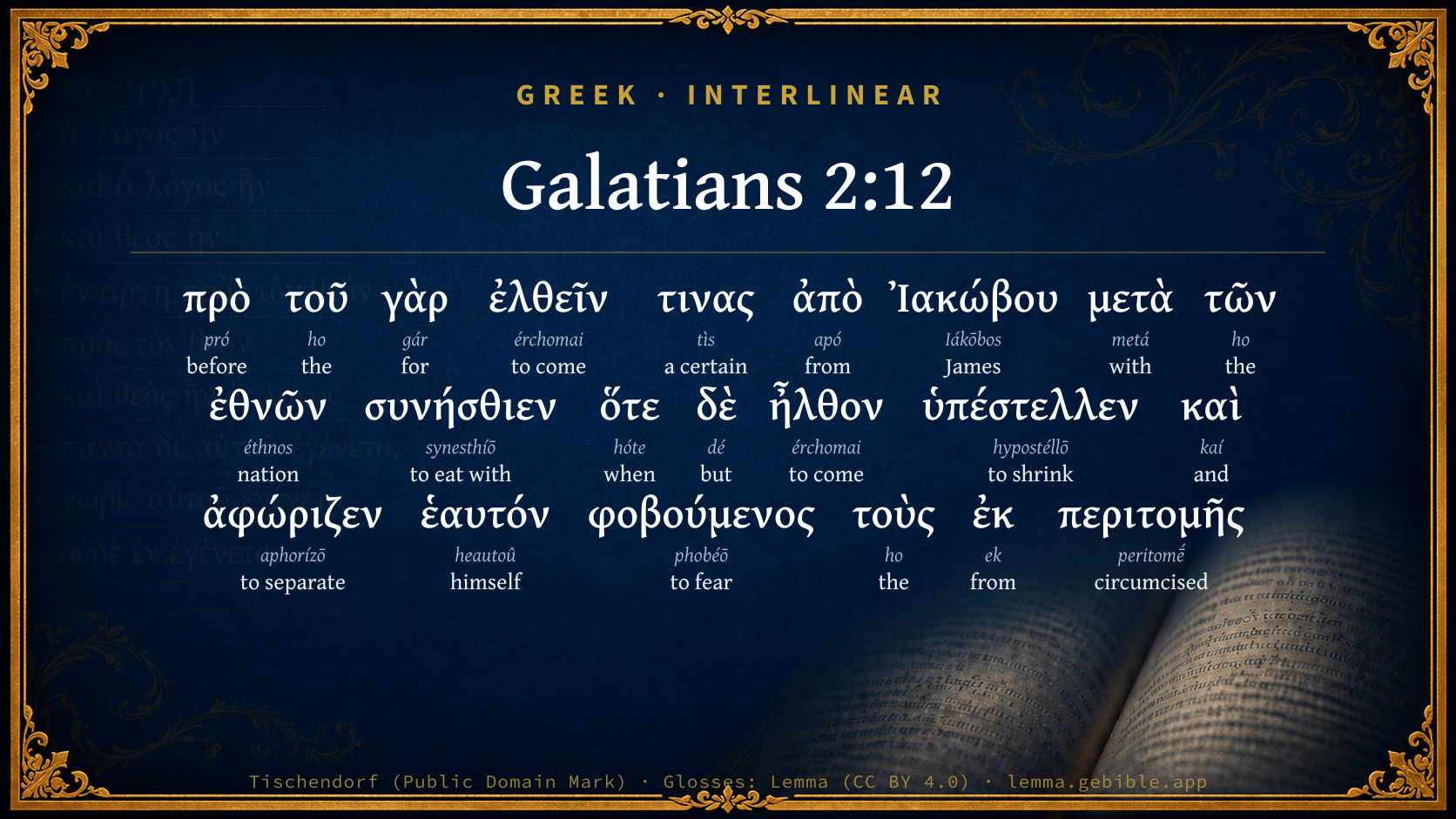
  1. πρὸ pró G4253 “before” Preposition
  2. τοῦ ho G3588 “the” Article, Genitive, Singular, Neuter
  3. γὰρ gár G1063 “for” Conjunction
  4. ἐλθεῖν érchomai G2064 “to come” Verb, Aorist, Active, Infinitive
  5. τινας tìs G5100 “a certain” Indefinite pronoun, Accusative, Plural, Masculine
  6. ἀπὸ apó G575 “from” Preposition
  7. Ἰακώβου Iákōbos G2385 “James” Noun, Genitive, Singular, Masculine
  8. μετὰ metá G3326 “with” Preposition
  9. τῶν ho G3588 “the” Article, Genitive, Plural, Neuter
  10. ἐθνῶν éthnos G1484 “nation” Noun, Genitive, Plural, Neuter
  11. συνήσθιεν synesthíō G4906 “to eat with” Verb, Imperfect, Active, Indicative, 3rd person, Singular
  12. ὅτε hóte G3753 “when” Adverb
  13. δὲ dé G1161 “but” Conjunction
  14. ἦλθον érchomai G2064 “to come” Verb, Aorist, Active, Indicative, 3rd person, Plural
  15. καὶ kaí G2532 “and” Conjunction
  16. ἀφώριζεν aphorízō G873 “to separate” Verb, Imperfect, Active, Indicative, 3rd person, Singular
  17. ἑαυτόν heautoû G1438 “himself” Reflexive pronoun, 3rd person, Accusative, Singular, Masculine
  18. φοβούμενος phobéō G5399 “to fear” Verb, Present, Middle or Passive deponent, Participle, Nominative, Singular, Masculine
  19. τοὺς ho G3588 “the” Article, Accusative, Plural, Masculine
  20. ἐκ ek G1537 “from” Preposition
  21. περιτομῆς peritomḗ G4061 “circumcised” Noun, Genitive, Singular, Feminine

About this verse

These counts appear in no published source. They are computed here, from the morphology-tagged text and Lemma’s own curated glosses. What Lemma adds →

22
words
19
distinct lemmas
Pauline Epistles
section

Notable vocabulary

The rarest word here is ὑπέστελλεν to shrink G5288 — appearing just 4 times in the whole Greek New Testament.

Shared distinctive vocabulary

ὑπέστελλεν to shrink G5288 occurs in 4 verses of the Greek New Testament. Also found in:

Repetition

Words recur within this verse:

  • ἐλθεῖν to come G2064 ×2
  • τοῦ the G3588 ×3

Cross-references

13

Topical passages linked to Galatians 2:12 in the Treasury of Scripture Knowledge — connected by theme and wording, ordered by reader-vote popularity; previews shown in the World English Bible.

  • Acts 10:28 He said to them, "You yourselves know how it is an unlawful thing for a man who is a Jew to join himself or come to one of another nation, but God has shown me that I shouldn't call any man unholy or unclean.
  • Luke 15:2 The Pharisees and the scribes murmured, saying, "This man welcomes sinners, and eats with them."
  • Acts 11:2–3 When Peter had come up to Jerusalem, those who were of the circumcision contended with him,
  • Ephesians 3:6 that the Gentiles are fellow heirs, and fellow members of the body, and fellow partakers of his promise in Christ Jesus through the Gospel,
  • Proverbs 29:25 The fear of man proves to be a snare, But whoever puts his trust in Yahweh is kept safe.
  • Isaiah 57:11 Of whom have you been afraid and in fear, that you lie, and have not remembered me, nor laid it to your heart? Haven't I held my peace even of long time, and you don't fear me?
  • Matthew 26:69–75 Now Peter was sitting outside in the court, and a maid came to him, saying, "You were also with Jesus, the Galilean!"
  • Galatians 2:9 and when they perceived the grace that was given to me, James and Cephas and John, they who were reputed to be pillars, gave to me and Barnabas the right hand of fellowship, that we should go to the Gentiles, and they to the circumcision.
  • Isaiah 65:5 who say, Stand by yourself, don't come near to me, for I am holier than you. These are a smoke in my nose, a fire that burns all the day.
  • Acts 21:18–25 The day following, Paul went in with us to James; and all the elders were present.
  • Ephesians 2:15 having abolished in the flesh the hostility, the law of commandments contained in ordinances, that he might create in himself one new man of the two, making peace;
  • Ephesians 2:19–22 So then you are no longer strangers and foreigners, but you are fellow citizens with the saints, and of the household of God,
  • 1 Thessalonians 5:22 Abstain from every form of evil.

Cross-references courtesy of OpenBible.info (CC BY 4.0).

Where the printed editions differ

1 variant

Places in this verse where the major printed Greek editions disagree on the wording in a way that affects the translation — a comparison of editions, not a manuscript-by-manuscript collation. The editions are the modern critical texts (Nestlé-Aland 28/27, SBL, Westcott-Hort, Tregelles, Tyndale House) and the traditional texts behind the KJV (the Textus Receptus and the Byzantine/Majority text). It is not a claim about which reading is original.

  1. Different wording
    ἦλθον,

    “they came,”

    In NA28NA27TynSBLWHTRByz Not in Treg

    ἦλθεν (ēlthen) 'he came' occurs in a few manuscripts (Treg) instead of ἦλθον, (ēlthon) 'they came,' in older manuscripts (NA28+NA27+Tyn+SBL+WH+TR+Byz)

Textual data: Translators Amalgamated Greek New Testament (STEPBible TAGNT) · CC BY 4.0.

Commentary

Notes on Galatians 2:12 from classic Christian and Jewish commentators (each source and its license shown beneath its notes). The classic Christian expositions comment on the surrounding passage and are grouped to its opening verse, so a note may address several verses; the Jewish commentaries on the Tanakh (Rashi and others) are per-verse, so they appear only where the commentator wrote on this verse.

Lemma curates 59 commentaries, every one of them public domain or Creative Commons licensed, each selected and text-cleaned for this edition rather than reprinted as found. About our sources →

Burkitt's Expository Notes on the New Testament

William Burkitt

A farther account is given us in these verses, of St. Peter’s offense at Antioch, in giving occasion of scandal to the Gentiles, by refusing to converse and eat with them, although he had before, in a vision, received a divine command so to do.

St. Paul calls it fear, Gal 2:12, dissimulation, Gal 2:13, and not walking uprightly, Gal 2:14.

He refused to converse with the believing Gentiles, being uncircumcised, for fear of offending the believing Jews, who were so tenacious of circumcision, and the ceremonial law.

Learn hence, what weakness and inconstancy is found with the best of men, especially when fear gets a prevailing power over them. St. Peter was the minister of the circumcision, in great honour and esteem with the believing Jews, but fearing the loss of his reputation among them, he falls into a sin against God.

Observe, 2. The fatal influence of that sin; it drew others into a partnership with him therein; Barnabas himself was led away with the dissimulation, and the other Jews dissembled with him.

Learn hence, that such as are eminent in the church, had need be exactly careful how they walk; for if they fall, they fall not alone, many do fall with them.

Observe, 3. With what openness and freedom, with what courage and resolution, St. Paul checks and reproves Peter, for his cowardice and timorousness, in refusing to converse with the believing Gentiles, for fear of gaining the displeasure of the circumcised Jews; I said unto Peter before them all, If thou being a Jew, livest, in thy ordinary conversation, after the manner of the Gentiles, why compellest thou the Gentiles, by thy example to live, as do the Jews:

Where note, what a constraining power there is in the example of eminent persons. He is said to compel in scripture, not only who doth violently force, but who, being of authority, doth provoke by his example. The errors of those that do rule, became rulers of error. Men sin through a kind of authority, through the sins of those who are in authority.

William Burkitt's Expository Notes on the New Testament (1700–1703) — public domain. Text from a community e-Sword module.

Tyndale Open Study Notes

Tyndale Open Resources

2:12 That Peter ate with the Gentile believers was consistent with what God had shown him (Acts 10:9-16, 34-35). • The friends of James wanted to reassert Jewish scruples and prevent the free communion between Gentiles and Jews from continuing. • Peter wouldn’t eat with the Gentiles anymore: When Peter refused to share regular meals and the Lord’s Supper (cp. 1 Cor 11:20-22, 33-34) with fellow Christians, he divided the Jewish and Gentile Christians and implied that the Jews’ observances made them more acceptable to God. Peter’s example, if uncorrected, would have undermined the Good News of salvation by grace through faith. • He was afraid: The friends of James intimidated Peter, who had previously withstood the same sort of criticism with power and eloquence (Acts 11:2-18). Peter might have been trying to avoid creating a barrier for the evangelism of Jews, or he might have been concerned for the safety and well-being of the Jewish Christians in Judea, who experienced persecution from non-Christian Jews (cp. 5:11; 6:12). In any case, his actions were inexcusable.

Tyndale Open Study Notes — © Tyndale Open Resources, licensed CC BY-SA 4.0. Text via the HelloAO Bible API.

Bengel's Gnomon

Johann Albrecht Bengel

Gal 2:12. Συνήσθιεν) He ate, like as we did, along with the Gentiles.—ὑπέστελλε, he began to withdraw[11]) gradually.—ἀφώριζεν, separated) entirely.—φοβούμενος, fearing) The fear of man is very injurious.

[11] This is the force of the Imperfect—ED.

Bengel's Gnomon of the New Testament — English translation (T&T Clark, Edinburgh, 1860) — public domain. Text from a community e-Sword module.

Meyer's Critical & Exegetical Commentary

Heinrich August Wilhelm Meyer

ff

Gal_2:12 ff. Paul now relates the particulars of the occurrence.

ἀπὸ Ἰακώβου] sent by James. It belongs to ἐλθεῖν. Comp. Plat. Prot. p. 309 B, ἀπʼ ἐκείνου ἔρχομαι: Mat_26:47; Mar_5:35; 1Th_3:6. Why theyand, to judge from the impression made upon Peter, they were certainly men of importance, strict in their Jewish-Christian observanceswere sent to Antioch by James, we know not, any more than why Peter journeyed thither.[85] But the conjecture that they belonged to the ψευδάδελφοι of Gal_2:4 (Winer, Schott), conflicts directly with the fact, that they were sent by James: for at the apostolic conference the latter had nowise made common cause with the ψευδάδελφοι; and therefore in sending any of them to Antioch he would have acted very unwisely, or would, with reactionary intent (so de Wette, whereby, however, the character of James is placed in a very awkward position, which is not to be supported by Act_21:18), have simply supplied new fuel to the scarcely settled controversy. Others (as Studer, Usteri, Zeller[86]), connecting the words with τινάς, understand adherents of James (comp. οἱ ἀπὸ Πλάτωνος and the like; Schaefer, Melet. p. 26 ff.; Bernhardy, p. 222), or, as Winer (comp. Wolf) says, qui Jacobi auctoritate sive jure seu secus utebantur; but this brings upon James the designation of a party-chief (some Jacobites!), which would be neither necessarily nor wisely introduced here, even supposing Winers modification to be mentally supplied. Lastly, the explanation of Beza, Grotius, Olshausen, Baumgarten-Crusius (following Chrysostom), that ἀπὸ Ἰακώβου means nothing more than from Jerusalem, because James was the president of the church there (comp. Koppe), is an unauthorized setting aside of the person, who is named expressly and not without due reason.

μετὰ τῶν ἐθνῶν συνήσθιεν] he joined in meals with the Gentile Christians. Comp. on συνεσθίειν in this sense, Plat. Legg. ix. p. 881 D; Luk_15:2; 1Co_5:11. Notice the imperfect. The Jew might not eat with Gentiles without incurring Levitical defilement (Act_11:3); but Peter, who previously by special revelation (Acts 10 f.), had been instructed as to the invalidity of this separation in Christianity, had in the apostolic conference defended Christian freedom (Act_15:7 ff.), and taken part in passing the decree that, as regards food, the Gentile brethren should only have to abstain from meat offered to idols, things strangled, and blood (Act_15:29). This decree was received and accepted with joy by the church at Antioch (Act_15:30 f.). It would therefore have been all the easier for Peter in Antioch to follow his divinely attained conviction,[87] and to take part without hesitation in the more familiar intercourse of meals with the Gentile Christians therefree from any scruple that he should defile himself by Gentile food, which no legal enactments restricted except as to those three points. But to this free and correct standpoint the stricter Jewish Christians, who were still entangled in the observances of the Levitical precepts as to purity (comp. Act_21:20), had not been able to rise; and to this class belonged the ΤΙΝΈς (Gal_2:12). When, therefore, these peopled arrived from Jerusalem and from James, Peter unhappily no longer continued his previous liberal-minded conduct in Antioch, but drew back and separated himself from intercourse at meals with the Gentile Christians, whereby he gave a practical denial to his better conviction. How similar to his conduct in his former denial of the Lord! Calovius, however, justly, in conformity with the temperament of Peter, remarks, una haec fuit Petri actio, non habitus.

φοβούμενος τοὺς ἐκ περιτ.] By this are meant the Jewish Christians generally, as a class, so far as they were represented by those τινές, who belonged to the stricter school. Peter feared the Jewish-Christian strictness, displeasure, disapprobation, etc. The explanatory gloss of Chrysostom (Οὐ ΤΟῦΤΟ ΦΟΒΟΎΜΕΝΟς ΜῊ ΚΙΝΔΥΝΕΎΣῌ, ἈΛΛʼ ἽΝΑ ΜῊ ἈΠΟΣΤῶΣΙΝ; comp. Theophylact, ΜῊ ΣΚΑΝΔΑΛΙΣΘΈΝΤΕς ἈΠΟΣΚΙΡΤΉΣΩΣΙ Τῆς ΠΊΣΤΕΩς), which is followed by Piscator, Grotius, Estius, and others, favours Peter quite against the literal sense of the words (Mat_10:26; Mat_14:5; Mar_9:18; Luk_12:5; Act_5:26; Rom_13:3).

Observe also, on the one hand, the graphic force of the imperfects ὑπέστ. and ἈΦΏΡ., and, on the other hand, the expression of his own bad precedent, ἙΑΥΤΌΝ, which belongs not merely to ἈΦΏΡ., but also to ὙΠΈΣΤ. (Polyb. vii. 17. 1, xi. 15. 2, i. 16. 10); he withdrew himself, etc., and thereby induced his Jewish-Christian associates also to enter on a like course (Gal_2:13). It is not, according to the context, correct that these imperfects express an enduring separation (Wieseler); the behaviour begins when the τινὲς ἀπὸ Ἰακώβ. have come; it excites the unfavourable judgment of the church, and Paul immediately places himself in decided opposition to Peter. The imperfects are therefore the usual adumbrativa; they place the withdrawal and separation of Peter, as it were, before the eyes of the readers. On the other hand, the συνυπεκρίθ. which follows is the wider action which took place and served further to challenge Paul; hence the aorist.

[85] The book of Acts is silent both on this point and also as to the whole scene between Peter and Paul,a silence indeed, which, according to Baur and Zeller, is supposed to be maintained intentionally, and in consistency with the false representation of the transactions in Jerusalem. According to Ritschl (altkath. Kirche, p. 145), they were deputed by James to bring the relation between the Jewish and Gentile Christians back to the rule of the apostolic decree, as James understood it, that is, according to Ritschl, in the sense of a retractation of the Jewish-Christian defection from the law, and on behalf of restoring the separation between the two parties as respected their customs of eating. This assumed task of the τινές is neither in any way intimated in the text, nor is there a trace of it in Acts (comp., on the contrary, Act_15:30 ff.). Just as little can it be proved that, as Ewald thinks, a decree had been passed in the church at Jerusalem that the Jewish Christian should refrain from eating in company with Gentile Christians (because he did not know whether blood or something strangled might be among their food), and that those τινές had come to Antioch to make known this new decree. Hilgenfeld also assumes that those sent by James had some charge relating to withdrawal from the Gentile Christians. Comp. Holsten, z. Evang. d. Paul. u. Petr. p. 357, in whose opinion they were sent after Peter, because his intercourse with the Gentiles had been notified at Jerusalem.

[86] So also Vömel, Br. a. d. Gal. mit deutsch. Uebers. u. krit. Anm., Frankf. 1865, p. 29.

[87] That the Christian fellowship in meals included also the joint observance of the agapae (which Thiersch, Hilgenfeld, and others take to be meant), is obvious. It is not, however, expressly denoted by συνήσθιεν.

Meyer — Critical and Exegetical Commentary on the New Testament — English translation by Peter Christie, edited by Frederick Crombie (T&T Clark, 1880) — public domain. Text from a community e-Sword module.

Expositor's Greek Testament

ed. W. Robertson Nicoll

Gal 2:12 . Ἰακώβου . Any visitors from the Church of Jerusalem might perhaps be said to come from James, who was its permanent head; but these brethren appear to have been in special sympathy with James in regard to their strict observance of the Law, and the respect paid by Peter to their opinion suggests that they were representative men, probably deputed for some purpose by their Church. There is, however, no reason to conclude that James prompted or approved the intrigue against Gentile freedom at Antioch. Scrupulous as he was about observing the Law, he had taken a leading part at Jerusalem in shaping the recent contract with their Gentile brethren, and was the last man to sanction an evasion of its terms.

The imperfect tenses ὑπέστελλεν , ἀφώριζεν give a graphic picture of Peter’s irresolute and tentative efforts to withdraw gradually from an intercourse that gave offence to the visitors. τ . ἐκ περιτομῆς . The omission of τῆς before περιτομῆς is conclusive against the rendering of our versions, them … of the circumcision . For περιτομή without an article does not denote the body of men, but the rite. By τ . ἐκ περιτομῆς are meant the party who based their faith on circumcision, and made that the charter of God’s covenant rather than baptism, and not the Jewish Christians in general. It is clear from the context that the Circumcision as a body did eat with their brethren until Peter set the example of withdrawal through fear of this determined minority of partisans. In Act 11:2 the phrase obviously singles out a particular party who pressed the claims of circumcision in an assembly consisting wholly of circumcised men. In Act 10:45 οἱ ἐκ π . πιστοί distinguishes those who believed after circumcision from the uncircumcised who believed; and in Col 4:11 οἱ ὄντες ἐκ π . οὗτοι μόνοι συνεργοί designates those men who were my only fellow-workers after circumcision . (For the force of the elliptical phrase οἱ ἐκ cf. Gal 3:7 ; Gal 3:9 , Rom 4:14 .)

The Expositor's Greek Testament, edited by W. Robertson Nicoll (1897–1910) — public domain. Text from a community e-Sword module.

Geneva Bible (1599)

Geneva Bible translators

Another most vehement proof of his Apostleship, and also of that doctrine, which he had delivered concerning free justification by faith only because that for this thing only he reprehended Peter at Antioch, who offended herein, in that for a few Jews’ sakes which came from Jerusalem he played the Jew, and offended the Gentiles which had believed.

Geneva Bible (1599) marginal notes — public domain. Text via Bolls.life.

Jamieson, Fausset & Brown

Robert Jamieson, A. R. Fausset & David Brown

certain--men: perhaps James' view (in which he was not infallible, any more than Peter) was that the Jewish converts were still to observe Jewish ordinances, from which he had decided with the council the Gentiles should be free (Act 15:19). NEANDER, however, may be right in thinking these self-styled delegates from James were not really from him. Act 15:24 favors this. "Certain from James," may mean merely that they came from the Church at Jerusalem under James' bishopric. Still James' leanings were to legalism, and this gave him his influence with the Jewish party (Act 21:18-26).

eat with . . . Gentiles--as in Act 10:10-20, Act 10:48, according to the command of the vision (Act 11:3-17). Yet after all, this same Peter, through fear of man (Pro 29:25), was faithless to his own so distinctly avowed principles (Act 15:7-11). We recognize the same old nature in him as led him, after faithfully witnessing for Christ, yet for a brief space, to deny Him. "Ever the first to recognize, and the first to draw back from great truths" [ALFORD]. An undesigned coincidence between the Gospels and the Epistle in the consistency of character as portrayed in both. It is beautiful to see how earthly misunderstandings of Christians are lost in Christ. For in Pe2 3:15, Peter praises the very Epistles of Paul which he knew contained his own condemnation. Though apart from one another and differing in characteristics, the two apostles were one in Christ.

withdrew--Greek, "began to withdraw," &c. This implies a gradual drawing back; "separated," entire severance.

Jamieson, Fausset & Brown — Commentary Critical and Explanatory on the Whole Bible (1871) — public domain (CC PDM 1.0). Text via the HelloAO Bible API.

Adam Clarke's Commentary

Verse 12. Before that certain came from James, he did eat with the Gentiles] Here was Peter's fault. He was convinced that God had pulled down the middle wall of partition that had so long separated the Jews and Gentiles, and he acted on this conviction, associating with the latter and eating with them; but when certain Jews came from James, who it appears considered the law still to be in force, lest he should place a stumbling-block before them he withdrew from all commerce with the converted Gentiles, and acted as if he himself believed the law to be still in force, and that the distinction between the Jews and the Gentiles should still be kept up.

Adam Clarke's Commentary on the Bible (1810–1826) — public domain. Text from a community e-Sword/MySword module.

John Calvin's Commentaries

12. For before that certain persons came. The state of the case is here laid down. For the sake of the Jews, Peter had withdrawn himself from the Gentiles, in order to drive them from the communion of the Church, unless they would relinquish the liberty of the Gospel, and submit to the yoke of the Law. If Paul had been silent here, his whole doctrine fell; all the edification obtained by his ministry was ruined. It was therefore necessary that he should rise manfully, and fight with courage. This shews us how cautiously we ought to guard against giving way to the opinions of men, lest an immoderate desire to please, or an undue dread of giving offense, should turn us aside from the right path. If this might happen to Peter, how much more easily may it happen to us, if we are not duly careful!

John Calvin's Commentaries (1540-1563) — public domain. Text from the Calvin Translation Society English edition (1840s-50s) via the Christian Classics Ethereal Library (ccel.org). Calvin's coverage is partial (roughly two-thirds of the Bible); uncommented books and verses are honest gaps, never fabricated. The 19th-century editor's footnotes and remarks are omitted so the notes are faithfully Calvin's own voice.

Ellicott's Commentary for English Readers

(12) Certain came from James.—The expression used leaves it an open question whether the persons intended brought, or claimed to bring, any sort of official authorisation from St. James (comp. Act_15:24), or whether they merely belonged to the Church of Jerusalem, in which, if St. James was not actually bishop, he at least exercised a sort of presidential jurisdiction.

He did eat with the Gentiles.—By eating with Gentiles a Jew contracted Levitical defilement. St. Peter had been accused of this before, on account of his intercourse with Cornelius. (Comp. Act_11:3.) He had not, however, stability and firmness enough to treat the question of principle as settled for him then once for all, and he yielded to a repetition of the old remonstrances. Our Lord Himself had braved Jewish opinion on this point. (Comp. Luk_15:2.)

When they were come.—The reading of the oldest MSS. here is “when he came,” of which it seems impossible to make any satisfactory sense. It may have been a slip of the pen, either in the original or in some very early copy. Other instances of mistakes in the oldest MSS. would be—Mar_4:21, “under a candlestick,” instead of “on a candlestick;” Joh_1:15, “he who said,” for “he of whom I said;” and a Greek form in Php_2:1.

Withdrew and separated himself.—The Greek expression brings out the timid and gradual withdrawal, ending in complete separation.

Them which were of the circumcision.—This appears to mean, not merely “those who advocated circumcision,” but “those who were made converts from a state of circumcision”—i.e., from Judaism.

A Bible Commentary for English Readers, edited by Charles John Ellicott (1878–1897) — public domain. Text from a community e-Sword module.

The Cambridge Bible for Schools and Colleges

gen. ed. J. J. S. Perowne

12, 13. The decree of the Council of Jerusalem had virtually exempted Gentile converts from the observance of the Jewish ceremonial law (see Act_15:1; Act_15:5; Act_15:28-29). It is probable that James, fearing lest the Jewish Christians should be led to claim the same exemption, sent delegates to Antioch to keep them steadfast in their adherence to it. This would be quite in accordance with his conduct as recorded Act_21:20-25. St Peter had been taught by a heavenly vision not to call any man common or unclean (Act_10:28). Before the coming of these delegates, he had boldly exercised his freedom in the Gospel, and had eaten with Gentile believers, not only at the Holy Communion and the Agapæ, or love feasts, but perhaps in social life. The Pharisees regarded such intercourse with abhorrence. They had murmured against our Lord, saying, ‘This man receiveth sinners and eateth with them’. [To those murmurs the Church owes the three parables of Luke 15] But on the arrival of the emissaries from James, Peter began to shew signs of timidity and gradually withdrew from the company of the Gentile Christians.

did eat] used to eat with.

withdrew] A word used of drawing off troops, and in nautical matters of shortening sail. It describes conduct the reverse of that boldness and impetuosity which had marked St Peter’s previous course.

fearing them which were of the circumcision] fearing to give offence to the converts from Judaism. Not for the first time did Peter learn by experience that “the fear of man bringeth a snare”, Pro_29:25.

The Cambridge Bible for Schools and Colleges (gen. ed. J. J. S. Perowne; Cambridge University Press, 1878–1918) — public domain. Text from a community e-Sword module.

John Gill's Exposition

For before that certain came from James,.... The Lord's brother, mentioned before with Cephas and John, who resided at Jerusalem, from whence these persons came; and who are said to come from James, because they came from the place and church where he was, though, it may be, not sent by him, nor with his knowledge. They were such as professed faith in Christ; they were "judaizing" Christians believing in Christ, but were zealous of the law. Now before the coming of these persons to Antioch,

he, Peter,

did eat with the Gentiles; which is to be understood, not of eating at the Lord's table with them, but at their own tables: he knew that the distinction of meats was now laid aside, and that nothing was common and unclean of itself, and that every creature of God was good, and not to be refused if received with thankfulness; wherefore he made use of his Christian liberty, and ate such food dressed in such manner as the Gentiles did, without any regard to the laws and ceremonies of the Jews; and in this he did well, for hereby he declared his sense of things, that the ceremonial law was abolished, that not only the Gentiles are not obliged to it, but even the Jews were freed from it, and that the observance of it was far from being necessary to salvation: all which agreed with the preaching and practice of the Apostle Paul, and served greatly to confirm the same, and for this he was to be commended: nor is this mentioned by way of blame, but for the sake of what follows, which was blameworthy:

but when they were come he withdrew and separated himself; not from the church, and the communion of it, for then he had been guilty of schism, but from private conversation with the Gentiles: he did not visit them in their own houses, and sit down at table and eat with them, as he was wont to do; which argued great inconstancy and instability, very unbecoming one that seemed to be, and was a pillar in the church of God, as well as much dissimulation, for he knew better than he acted; his conduct did not agree with the true sentiments of his mind, which he covered and dissembled; and which must be very staggering to the believing Gentiles, to see so great a man behave in such a manner towards them, as if they were persons not fit to converse with, and as if the observance of Jewish rites and ceremonies was necessary to salvation. What induced him to take such a step was, his

fearing them which were of the circumcision: that is, the circumcised Jews, who professed faith in Christ, and were just now come from Jerusalem; not that he feared any danger from them; that they would abuse his person, or take away his life; but he might either fear he should come under their censure and reproofs, as he formerly had for going to Cornelius, and eating with him and his; or lest that they should be offended with him, and carry back an ill report of him, as not acting up to his character as an apostle of the circumcision. This led him into such a conduct; so true is that of the wise man, that "the fear of man bringeth a snare", Pro 29:25.

John Gill's Exposition of the Whole Bible (1746–1763) — public domain (CC PDM 1.0). Text via the HelloAO Bible API.

Albert Barnes' Notes on the Bible

For before that certain came - Some of the Jews who had been converted to Christianity. They evidently observed in the strictest manner the rites of the Jewish religion.

Came from James - See the note at Gal 1:19. Whether they were sent by James, or whether they came of their own accord, is unknown. It is evident only that they had been intimate with James at Jerusalem, and they doubtless pleaded his authority. James had nothing to do with the course which they pursued; but the sense of the whole passage is, that James was a leading man at Jerusalem, and that the rites of Moses were observed there. When they came down to Antioch, they of course observed those rites, and insisted that others should do it also. It is very evident that at Jerusalem the special rites of the Jews were observed for a long time by those who became Christian converts. They would not at once cease to observe them, and thus needlessly shock the prejudices of their countrymen; see the notes at Act 21:21-25.

He did eat with the Gentiles - Peter had been taught that in the remarkable vision which he saw as recorded in Acts 10. He had learned that God designed to break down the wall of partition between the Jews and the Gentiles, and he familiarly associated with them, and partook with them of their food. He evidently disregarded the special laws of the Jews about meats and drinks, and partook of the common food which was in use among the Gentiles. Thus he showed his belief that all the race was henceforward to be regarded as on a level, and that the special institutions of the Jews were not to be considered as binding, or to be imposed on others.

But when they were come, he withdrew and separated himself - He withdrew from the Gentiles, and probably from the Gentile converts to Christianity. The reason why he did this is stated. He feared those who were of the circumcision, or who had been Jews. Whether they demanded this of him; whether they encountered him in debate; or whether he silently separated himself from the Gentiles without their having said anything to him, is unknown. But he feared the effect of their opposition; he feared their reproaches; he feared the report which would be made to those at Jerusalem; and perhaps he apprehended that a tumult would be excited and a persecution commenced at Antioch by the Jews who resided there. This is a melancholy illustration of Peter’s characteristic trait of mind. We see in this act the same Peter who trembled when he began to sink in the waves; the same Peter who denied his Lord. Bold, ardent, zealous, and forward; he was at the same time timid and often irresolute; and he often had occasion for the deepest humility, and the most poignant regrets at the errors of his course. No one can read his history without loving his ardent and sincere attachment to his Master; and yet no one can read it without a tear of regret that he was left thus to do injury to his cause. No man loved the Saviour more sincerely than he did, yet his constitutional timidity and irresolutehess of character often led him to courses of life suited deeply to wound his cause.

Albert Barnes' Notes on the Bible (1834–1885) — public domain. Text from a community e-Sword/MySword module.

Matthew Poole's English Annotations

It should seem that Peter had been at Antioch some time; while he was there, there came down certain Jews from James, who was at Jerusalem: before they came Peter had communion with those Christians at Antioch, which were by birth Gentiles, and at meals eat as they eat, making no difference of meats, as the Jews did in obedience to the ceremonial law; but as soon as these zealots for the Jewish rites (though Christians) were come, Peter withdrew from the communion of the Gentile Christians, and was the head of a separate party; and all through fear of the Jews, lest they should, at their return to Jerusalem, make some report of him to his disadvantage, and expose him to the anger of the Jews.

Matthew Poole's English Annotations on the Holy Bible (1683–1685) — public domain. Text from a community e-Sword/MySword module.

Whedon's Commentary on the Bible

Daniel D. Whedon

12. Certain came from James—This may mean that they came from the Church of James at Jerusalem. It may be, also, that they came from James himself, but entirely misrepresented James, insisting on a rule that James did not assert. It may, finally, be that James really and truly, at this time, meant that Gentile Antioch should submit, and concede that while circumcision should no be obligatory upon Gentile Christians, yet uncircumcised Gentile Christians should be excluded from the Jewish Christian table. This would have been to establish a Hindoo caste in the Christian Church. How James really stood, however, among parties, we have noted on Act_15:6.

Fearing them—This body of deputies from James must have swept in upon Antioch with an overwhelming power thus to have overawed the senior apostle. It looked like a final defeat of Christian liberty. For, conquered here in its fortress at Antioch, where else could it raise its head?

Daniel D. Whedon (gen. ed.), Commentary on the Old and New Testaments (1874–1909) — public domain. Text from a community e-Sword module.

The Pulpit Commentary

For before that certain came from James (pro tou gar ejlqein tinav ajpobou). Since the apostle writes from James," and not "from Judaea" (as Act_15:1) or "from Jerusalem," the surmise suggests itself that these men had a mission from St. James. Alford"s view appears probable, that St. James, while holding that the Gentile converts were not to have the observance of the Law forced upon them, did nevertheless consider that the Jewish believers were still bound to keep it. Possibly he had sent them to Antioch to remind the Jewish Chris-liens of the city of their obligations in this respect. This would be in no way inconsistent with Act_15:10, where the emphatic words, "them which from the Gentiles turn to God, tacitly imply that the obligations of Jewish believers continued the same as before. (comp. Act_21:18-25) He did eat with the Gentiles (meta twn ejqnwn sunhsqien). The Greek expression is no doubt equivalent to toiv eqnesi sunhsqien. (comp. Act_11:3; see Mat_17:3 compared with Mar_9:4) There appears to be no ground for restricting this "caring with" them to uniting with them at the agape or at the Lord"s Supper. The words in Act_11:3, spoken some ten years before this, "Thou wentest in (eijshlqev) to men still in their uncircumcision, and didst eat with them," pointed to a social participation of food rather than to one merely religious; though, it must be confessed, these two things were not as yet so sharply distinguished from each other as it was afterwards found necessary that they should be. (1Co_11:34) While thus eating with Gentiles, St. Peter may well have fortified his mind with the thought, that the Lord Jesus had been wont to hold, not merely teaching converse, but social intercourse also, with persons whom "the scribes and the Pharisees" regarded as themselves unclean and by contact polluting. (Luk_5:30 Luk_15:2 Luk_19:7) Christ, it is true, both himself observed the Law and taught his disciples to observe it. He wore "the border" (kraspedon) attached to his garment; but he did not wear the "border" unnecessarily "enlarged." On the contrary, the rabbinical exaggerations of legal prescriptions, inconsistent with charity or with reason, he was wont emphatically to repudiate. (Mt 23; Mar_7:1-13) But when they were come, he withdrew and separated himself (ote destelle kairizen eJauton); but when they came, he began to shrink back and separate himself from them. JEauton is governed by uJpestellen as well as by ajfwrizen uJpestellen eJauton being equivalent to uJpestelleto, the use of which middle voice is illustrated bymenob Act_20:27. The Gentile converts could not but perceive that his manner with them was less openly cordial than heretofore. He was no longer so ready to go to their houses. In public, he shrank from being seen with them on terms of frank and equal companionship. Fearing them which were of the circumcision (fobou touv ejk peritomhv); fearing the brethren drawn from the circumcision If the apostle had written fob. thn, the expression would have taken in the not-believing Jews as well; whereas the preposition ejk, like ajpo in Act_15:19, indicates the branch of mankind from which the converts had come (Act_10:45 Act_11:2; Tit_1:10)

The Judaism of the earliest Pentecostal Church not rabbinical. Any one who will be at the pains of reviewing the contents of the four Gospels with an eye to this particular subject, cannot fail to be struck by the frequency with which Christ in his own conduct placed himself in even the sharpest antagonism to the "traditions of the eiders," and encouraged his disciples in likewise setting them at nought. And this he did in cases in which the contrast of his behaviour to the abject submission to those traditions paraded by the Pharisees must have been most striking, and have jarred, no doubt, very often even painfully, upon the ill-instructed religious sensibilities of those, who had grown up in the belief that to observe the traditions was both seemly and pious and to neglect them unseemly and schismatical. For example, in daily life, neither he nor his disciples would "baptize" themselves when coming home from the market, nor even apply lustral water to their hands before taking a meal, though there before their eyes stood tire vessels filled with water which had been provided for the guests and which the other guests were punctual in using. It was not without significance that in his first miracle he withdrew the water which had been set apart for such lustrations from one use of it which he would pronounce to be utterly frivolous and vain, to apply it to one which should really be serviceable and beneficent. Again, many were the restrictions which the traditions imposed upon men"s actions on the sabbath restrictions which not only were additional to those enjoined by the Law, but also in many cases contravened the calls of mercy and benevolence. Such restrictions Christ very frequently, and in the most public and pointed manner, so as to directly challenge attention to what he did, broke through, and taught his disciples to disregard; the Pharisees being repeatedly so enraged at these transgressions of the traditions as to endeavour in consequence to take his life. The fastings enjoined by the traditions, he and his disciples likewise offended the Pharisees by taking no account of. The traditions of especially one popular school of teaching allowed so great a facility of divorce as served to disguise a frightful excess of licentiousness, in which many of the Pharisees were themselves implicated; in opposition to which Christ was wont publicly to declare that "connections formed after divorces not justified by adultery were themselves adulterous. Continually was the Lord warning his followers against the leaven of Pharisaism, to wit, its ostentation in religious observances; its laying so much stress upon the outward act, in neglect of the inward motive and the posture of the spirit; its draining away the forces of moral earnestness from the prosecution of justice, mercy, and truth, to squander them upon scrupulous and vigilant devotion to the veriest trifles of formalism; the consequent hollowness and hypocrisy of the religious character of its votaries; their love of money; their eagerness for social distinction; their cruelty to the poor amid all their ostentatious almsgiving; their hardheartedness to the fallen; their intense, devilish hatred of real piety. All the four Gospels abound in indications of that antipathy to Pharisaism and traditionalism which Christ both entertained himself and was careful to instil into the minds of his disciples. It cannot, therefore, be questioned that the disciples who formed the first nucleus of the Christian community, especially the twelve and the brethren of the Lord, were animated by similar sentiments of anti-Pharisaism; and so also the Pentecostal Church at Jerusalem as moulded under their influence. The Law of Moses, no doubt, they continued to obey, as their Master had done the Law of Moses, however, as construed in the more humane andspiritual sense put upon it by the Sermon on the Mount, and not as stiffened and hardened into intolerable cruelty by the rabbinism which the Pharisees insisted upon. Such, we may feel certain, had been the attitude of St. Peter"s mind in reference to the Law when, years before at Joppa, he had received the summons to go and visit Cornelius at Caesarea. It was with constraint put upon his own hitherto cherished tastes that he submitted to the call; and when he entered the Gentile"s house, the fibre of Israelitism in his soul is seen quivering, shrinking back from the step which he was compelled to take. "Ye yourselves know," he said to the company of uncircumcised men among whom he found himself, "that it is an unlawful thing for a man that is a Jew to join himself or to come unto one of another nation; and yet unto me hath God showed that I should not call any man common or unclean." It was painful to him as an Israelite and a Mosaist; but God"s declared will was leaving him no alternative. Now, whence had arisen those feelings of repulsion? Partly it was, no doubt, a kind of caste sentiment. It had been then more than two thousand years a traditional consciousness with the Hebrew race that their circumcision lifted them to a higher level than the rest of mankind stood upon; and the persuasion inspired them with a disdain of uncircumcised nations, which with the most had little or no admixture of really religious feeling, being felt by the idolatrous Ephraimites as well as by the less unfaithful children of Judah. With the more pious members of the nation, this repulsion from Gentiles was partly the outcome of their sense of the deep degradation, religious and moral, in which heathen nations were sunk, steeped as they were in idolatry; but their sense of this was greatly intensified by the moral effect of the separation from other nations enforced by the ceremonial law. This was effected partly by the distinction between clean and unclean animals, which, recognized in an elementary degree as early as the time of Noah, was made in the Levitical legislation a matter of very minutely definite prescription; (Le 11) and partly by the prohibition of eating either certain kinds of fat. (Lev_3:17) or blood: to partake either of the flesh of an unclean animal, or of suet or blood, was emphatically declared by the Law, and by the long-inherited tradition of the nation had grown to be instinctively felt to be, "defilement" and "abomination." There is no ground for supposing that St. Peter"s shrinking back from Gentiles as common or unclean was caused by rabbinism. Rabbin-ism, no doubt, added much to the bitterness of the repulsion with these who served the traditions; but even where there was no bondage owned to the dicta of the elders, repulsion from the contact of a Gentile was a powerful sentiment, having its roots deep in the instinctive sentiments of the Hebrew race and in the feelings instilled by the peremptory enactments of the Divine Law. Now, however, in Cornelius"s house, St. Peter does not allow his spirit to be dominated by sentiments such as these. God and Christ his Master were making it manifest, as in other ways, so especially by the astonishing illapse of the Holy Spirit into these believing hearers of the gospel message, that they were no longer unclean, and therefore he cannot possibly any longer treat them as unclean. He tarried with them certain days, and, according to the charge immediately after preferred against him and not denied, ate with them. That he partook of the same food as they, whether of a kind forbidden by the Mosaic Law or not, is not stated and is no necessary inference drawn from the circumstances. He would not, we may well believe, scruple now to recline at the same table with them; but it may be readily imagined that for a guest so highly revered, of whose Jewish sensibilities respecting food they could not be unaware, even if he or the six Jewish brethren who accompanied him from Joppa did not make a point of apprising them, the wealthy centurion and his family would be only too anxious to provide such food as both he and his fellow-visitors would find acceptable. Thus St. Peter might have "eaten bread" with the Gentiles, neither, on the one hand, himself breaking the Levitical Law by partaking of food which was forbidden to him as a child of the legal covenant, nor, on the other, declining to recognize the full acceptableness before God and the equal brotherhood in Christ of believers who were still in their uncircumcision. The caste feeling of proud disdain of uncircumcised men as men of an inferior grade, and the dread of ceremonial defilement from contact with those who were levitically unclean, dared no longer assert themselves, could, indeed, no longer be permitted to lodge in his bosom, in the face of the clear proof which had been afforded that the Almighty had in Christ adopted them as his own children equally with himself. Thus it appears that when at Antioch, at the time here referred to by St. Paul, Cephas was seen partaking of social meals in company with the Gentile converts, he was only acting in the same way as he had acted at Caesarea ten years before.

The Pulpit Commentary (1880–1919), ed. H.D.M. Spence-Jones & Joseph S. Exell — public domain. Text from a community e-Sword module.

Luther on Galatians

Martin Luther

VERSE 12. For before that certain came from James, he did eat with the Gentiles.

The Gentiles who had been converted to faith in Christ, ate meats forbidden by the Law. Peter, visiting some of these Gentiles, ate meat and drank wine with them, although he knew that these things were forbidden in the Law. Paul declared that he did likewise, that he became as a Jew to the Jews, and to them that were without law, as without law. He ate and drank with the Gentiles unconcerned about the Jewish Law. When he was with the Jews, however, he abstained from all things forbidden in the Law, for he labored to serve all men, that he "might by all means save some." Paul does not reprove Peter for transgressing the Law, but for disguising his attitude to the Law.

VERSE 12. But when they were come, he withdrew and separated himself, fearing them which were of the circumcision.

Paul does not accuse Peter of malice or ignorance, but of lack of principle, in that he abstained from meats, because he feared the Jews that came from James. Peter’s weak attitude endangered the principle of Christian liberty. It is the deduction rather than the fact which Paul reproves. To eat and to drink, or not to eat and drink, is immaterial. But to make the deduction "If you eat, you sin; if you abstain you are righteous"--this is wrong.

Meats may be refused for two reasons. First, they may be refused for the sake of Christian love. There is no danger connected with a refusal of meats for the sake of charity. To bear with the infirmity of a brother is a good thing. Paul himself taught and exemplified such thoughtfulness. Secondly, meats may be refused in the mistaken hope of thereby obtaining righteousness. When this is the purpose of abstaining from meats, we say, let charity go. To refrain from meats for this latter reason amounts to a denial of Christ. If we must lose one or the other, let us lose a friend and brother, rather than God, our Father.

Jerome, who understood not this passage, nor the whole epistle for that matter, excuses Peter’s action on the ground "that it was done in ignorance." But Peter offended by giving the impression that he was indorsing the Law. By his example he encouraged Gentiles and Jews to forsake the truth of the Gospel. If Paul had not reproved him, there would have been a sliding back of Christians into the Jewish religion, and a return to the burdens of the Law.

It is surprising that Peter, excellent apostle that he was, should have been guilty of such vacillation. In a former council at Jerusalem he practically stood alone in defense of the truth that salvation is by faith, without the Law. Peter at that time valiantly defended the liberty of the Gospel. But now by abstaining from meats forbidden in the Law, he went against his better judgment. You have no idea what danger there is in customs and ceremonies. They so easily tend to error in works.

Martin Luther — Commentary on the Epistle to the Galatians (1535), English translation by Theodore Graebner (Zondervan, 1939) — public domain (U.S. copyright not renewed). Text from a community e-Sword module.

McGarvey & Pendleton's Commentaries

J. W. McGarvey

For before that certain came from James, he ate with the Gentiles; but when they came, he drew back and separated himself, fearing them that were of the circumcision. [The Jews regarded it as unlawful to have social intercourse with, or to eat with, Gentiles; but Peter's great vision, teaching the fact that God was no respecter of races or persons, bore especially on the social difference ( Act_10:11-16 ). Peter, therefore, instructed by the vision, ate with the Gentiles, and defended his conduct in so doing ( Act_11:3-4 ; Act_11:12 ). He therefore knew perfectly what was right and lawful in the matter, but, fearing those who came from James, he played the coward, being, as Alford says, "ever the first to recognize, and the first to draw back from great truths." Peter, therefore, to avoid the censure of these Jerusalem critics, began to withdraw from the Gentiles, and finally to separate himself altogether. Such a withdrawal would mean that Peter could not take the communion with the Gentiles. The "certain" is contemptuous, and corresponds to the "some" of Gal_1:7 . It is not likely that James gave these men any authority for what they did. See his words at Act_15:19 ; and those of the decree, Act_15:24 . But James stood in high favor with the Jewish party, and hence, in his absence, would readily be quoted as sanctioning the teachings of that party.]

J. W. McGarvey (with Philip Y. Pendleton), Commentaries on the New Testament (The Fourfold Gospel, 1914; Acts; and the epistles) — public domain. Text from a community e-Sword/MySword module.

The People's New Testament

B. W. Johnson

12. Before certain came from James. Men sent from Jerusalem by James, who stood now at the head of that church. He did eat with Gentiles. See Acts 11:3. Peter had no scruples about eating with Gentile Christians, but many of the Jewish Christians did. Hence he did before the messengers came from James what he refused to do after they came, “separating himself” from the Gentile Christians at Antioch.

B. W. Johnson's The People's New Testament with Notes (1889–1891) — public domain. Electronic text from the Christian Classics Ethereal Library (CCEL) ThML edition.

Cambridge Greek Testament for Schools and Colleges

12. ὅτε δὲ ἦλθον. ACDb.cHKL vulg. syrutr. ὅτε δὲ ἦλθεν אBD*G. Compare Orig. c. Cels. 11. 1 (ἐλθόντος Ἰακώβον πρὸς αὐτὸν ἀφώριζεν ἑαυτόν). But probably the -εν is due to careless assonance with the preceding and the following verbs.

12. πρὸ τοῦ γὰρ ἐλθεῖν τινὰς ἀπὸ Ἰακώβου. Act 15:24 makes it probable that ἀπὸ Ἰακ. is to be taken with τινάς rather than with ἐλθεῖν. If so there is no need to ask why St James sent them to Antioch. They were from him, perhaps on a tour to get alms for the poor, but they did not come with any special message to Antioch. In Act 15:5 those who assert the necessity of keeping the Law are said to have belonged once to the sect of the Pharisees. Hort, understanding St Peter’s visit to Antioch to have taken place after the Council at Jerusalem, rather strangely supposes ἀπὸ Ἰακώβου to imply that St James himself suggested that St Peter ought not to eat with Gentile Christians for fear of giving further offence to the Jewish Church at Jerusalem, and that St Paul, notwithstanding, had no occasion to include St James in his rebuke because the latter had made no public exhibition of ὑπόκρισις at Antioch (Judaistic Christianity, p. 81).

μετὰ τῶν ἐθνῶν συνήσθιεν. συνέφαγεν in Act 11:3 marked some days at most; the imperfect a long period.

No good Jew eats with Gentiles, because Gentile food is “unclean.” The μετά suggests more intimate relationship than a dative dependent on συνήσθιεν.

ὅτε δὲ ἧλθον. See notes on Textual Criticism.

ὑπέστελλεν καὶ ἀφώριζεν ἑαυτόν. The tenses “give a graphic picture of Peter’s irresolute and tentative efforts to withdraw gradually from an intercourse that gave offence to the visitors” (Rendall). ὑπέστελλεν: elsewhere in the N.T. the verb is always in the middle voice, therefore probably here with ἑαυτόν.

ἀφώριζεν, Gal 1:15 note. Possibly here also there is some play on the word, as though Peter were changing himself into a Pharisee. Whether this be so or not it is a semi-technical word in the LXX. for separation from unclean things, implying that St Peter regarded Gentile Christians under this category (cf. Isa 52:11; Lev 20:25-26).

φοβούμενος τοὺς ἐκ περιτομῆς. Chrysostom (688 B) in accordance with his strange theory of accommodation (vide supra, Gal 2:11) thinks that his fear was not for himself but for these Jewish Christians, lest they should leave the faith. τ. ἐκ περιτ. Col 4:11 note.

Cambridge Greek Testament for Schools and Colleges (Cambridge University Press, 1896; 21 vols, various authors incl. Carr, Maclear, Plummer, Farrar, Lumby, Moule, M. R. James, Simcox) — public domain. Text from a community e-Sword module.

Alford’s Greek Testament

Henry Alford

12.] These τινες ἀπὸ Ἰακώβον have been softened by some Commentators into persons who merely gave themselves out as from James (Winer, &c. and even Ellicott, edn. 2), or who merely came from Jerusalem where James presided (Beza, Grot., Olsh., &c.). But the candid reader will I think at once recognize in the words a mission from James (so Thl., Œc., Estius (doubtfully), Rückert, Meyer, De W.): and will find no difficulty in believing that that Apostle, even after the decision of the council regarding the Gentile converts, may have retained (characteristically, see his recommendatior to St. Paul, in Act 21:18 ff.) his strict view of the duties of Jewish converts,—for that is perhaps all that the present passage requires. And this mission may have been for the very purpose of admonishing the Jewish converts of their obligations, from which the Gentiles were free. Thus we have no occasion to assume (with De W.) that James had in the council been over-persuaded by the earnestness and eloquence of Paul, and had afterwards undergone a reaction: for his course will be consistent throughout. And my view seems to me to be confirmed by his own words, Act 15:19, where the emphatic τοῖς ἀπὸ τῶν ἐθνῶν ἐπιστρέφουσιν tacitly implies, that the Jews would be bound as before.

συνήσθιεν] As he had done, Act_10, on the prompting of a heavenly vision; and himself defended it, Act_11. See below.

ὑπέστελλεν] as well as ἀφώριζεν, governs ἑαυτόν: withdrew himself. So Polyb. i. 16. 10, ὁ δὲ βασιλεὺς Ἱέρων, ὑποστείλας ἑαυτὸν ὑπὸ τὴν Ῥωμαίων σκέπην, and al. freq. The imperfects express that there were more cases than one where he did this—it was the course he took.

φοβούμενος] being afraid of. Chrys., to bear out his interpretation of the whole incident, says, οὐ τοῦτο φοβούμενος, μὴ κινδυνεύσῃ· ὁ γὰρ ἐν ἀρχῇ μὴ φοβηθείς (witness his denial of his Lord), πολλῷ μᾶλλον τότε· ἀλλʼ ἵνα μὴ ἀποστῶσιν. ἐπεὶ καὶ αὐτὸς λέγει Γαλάταις, φοβοῦμαι ὑμᾶς μή πως εἰκῆ κεκοπίακα κ.τ.λ. And so Piscator, Grot., Estius, al. The whole incident is remarkably characteristic of Peter—ever the first to recognize, and the first to draw back from, great principles and truths: see this very ably enlarged on in Jowett’s note on ver. 11.

Henry Alford, The Greek Testament (1849–1861) — public domain. Text from a community e-Sword module.

International Critical Commentary

12. πρὸ τοῦ γὰρ ἐλθεῖν τινὰς ἀπὸ Ἰακώβου μετὰ τῶν ἐθνῶν συνήσθιεν. “For before certain came from James he was eating with the Gentiles.” Not this clause alone but the whole sentence (v. 12) gives the reason why Peter stood condemned, and so the proof (γάρ) of κατεγνωσμένος. ἐθνῶν refers, of course, chiefly or exclusively to the Gentile Christians, as in Rom 15:16, Rom 16:4, and in v. 14 below, and συνήσθιεν, without doubt, to sharing with them in their ordinary meals, as in Luk 15:2, Act 11:3. The imperfect tense implies that he did this, not on a single occasion, but repeatedly or habitually. The significance of the act lay in the fact that he thereby exposed himself to the liability of eating food forbidden by the O. T. law of clean and unclean foods (Lev. chap. 11), and thus in effect declared it not binding upon him.* The question thus brought to the front was, it should be clearly observed, quite distinct from that one which was the centre of discussion at Jerusalem. There it was the obligation of the Gentile Christian to observe the law, and particularly in the matter of circumcision; here it involves the obligation of the Jewish Christian to keep the law, and particularly in the matter of food. By his action in eating with Gentile Christians, whose freedom from the law had been expressly granted at Jerusalem so far as concerned circumcision, and who had doubtless exercised a like freedom in respect to foods, Peter went beyond anything which the action at Jerusalem directly called for, and in effect declared the Jew also, as well as the Gentile, to be free from the law. It does not indeed follow that he would have been prepared to apply the principle consistently to other prescriptions of the law, and to affirm, e. g., that the Jewish Christian need not circumcise his children. Nevertheless, the broad question whether any statute of the law was binding upon Gentile or Jew was now brought out into clear light, and on this question Peter by his conduct took a position which was of great significance.

Yet it can scarcely have been Peter’s conduct that first raised the question. The custom of Jewish Christians eating with Gentiles he no doubt found in existence when he came to Antioch and fell in with it because it appealed to him as right, although contrary to his previous practice. It is wholly improbable probable that not finding it in existence he himself suggested it, or that if he had already been in the habit of eating with Gentiles in Judea, he would have been deterred from continuing to do so in Antioch by the arrival of the messengers from James. The Antioch practice was clearly an expression of the “freedom in Christ Jesus” which Paul advocated, but in all probability a new expression, developed since the conference at Jerusalem (vv. 1-10). It was probably only after that event, in which the full Christianity of the Gentile Christians was recognised even at Jerusalem, that the Jewish Christians at Antioch gained courage to break over their scruples as Jews, and eat with their Gentile brothers in the church. Nor is there any special reason to think that Paul would have pressed the matter at the beginning. Concerning, as it did, not the freedom of the Gentiles, but the adherence of the Jews to their own ancestral custom enforced by O. T. statute, in consistency with his principles (1Co 7:14ff.) and the course he pursued at Jerusalem, where he stood for the freedom of the Gentiles but assumed apparently without demurrer that the Jews would continue to observe the law, it would probably seem to him not a matter to be pressed, but left to the gradual enlightenment of the Jewish Christians themselves. It is difficult to see, moreover, how, if the Jewish Christians in Antioch had before the conference at Jerusalem already begun to disregard the Jewish law of foods, this should not have been even more a burning question at Jerusalem than the circumcision of the Gentiles. Certainly it would have been more difficult for the legalistic party to yield in the former than in the latter matter. Probability, therefore, points to the time between Paul’s return to Antioch and Peter’s arrival there as that in which the Jewish Christians at Antioch began to eat with their Gentile brethren.

If this is correct it furnishes, moreover, a natural explanation of the visit to Antioch both of Peter and of the representatives of James. If news of this new departure at Antioch had come to Jerusalem it might easily seem to Peter that inasmuch as it affected not simply the Gentiles, but also the Jewish Christians, it concerned him as the apostle of the latter to know what was going on. Especially would this be the case if there was any uncertainty in his mind as to whether the division of the field agreed to at Jerusalem assigned to him the Jews, or Jewish lands. See on 2:9. Even if he had come expecting to disapprove what he found, it would be by no means uncharacteristic of him that, captivated with the picture of Christian unity which he saw, he should, instead of reproving, have himself adopted the new custom. And if in turn news of this state of affairs, including Peter’s unexpected conduct, reached Jerusalem, this would furnish natural occasion for the visit of the representatives of James; for to James as well as to the more extreme legalists such conduct might seem not only to violate the Jerusalem agreement, but to create a most serious obstacle to the development of the Christian faith among the Jews.

And this in turn makes clear the important fact that the situation at Antioch was not the result of repudiation of the Jerusalem agreement by any of the parties to it, but was simply the coming to the surface of the contradictory convictions which were only imperfectly harmonised in the compromise in which the Jerusalem conference issued. A new aspect of the question which underlay the discussion at Jerusalem had now come to the front and raised a question concerning which precisely opposite decisions might easily seem to different persons to be involved in the Jerusalem decision. The brethren at Antioch might naturally seem to themselves to be only following out what was logically involved in the Jerusalem decision, when they found in the recognition of uncircumcised Gentile believers as brethren the warrant for full fellowship with them on equal terms, and, in the virtual declaration of the non-essentiality of circumcision, ground for the inference that the O. T. statutes were no longer binding, and ought not to be observed to the detriment of the unity of the Christian community. The Jerusalem brethren, on the other hand, might with equal sincerity maintain that they had never expressed or intimated the belief that the Jews could disregard the statutes of the law, and that the tacit understanding of the Jerusalem decision was that these statutes should be regarded as still in force for the Jews, whatever concessions were made in respect to the Gentiles. It was this derivation of contrary conclusions from the Jerusalem compromise and Peter’s wavering between the two interpretations that created the Antioch situation.

Whether ἀπὸ Ἰακώβου limits τινάς or ἐλθεῖν it is impossible to determine with certainty. The fact that the subject of an infinitive somewhat more frequently precedes it than follows it (see Votaw, Inf. in Bib. Gr. p. 58; cf. Mat 6:8, Luk 22:15; contra Luk 2:21, Gal 3:23) slightly favours explaining the position of τινάς as due to the desire to bring it into connection with ἀπὸ Ἰακώβου. Yet the rarity of any limitation of an indefinite pronoun by any phrase except a partitive one is against this construction. In either case the mention of the personal name, James, the same, of course, who is named in v. 12 and in 1:19, implies that the persons spoken of were sent by him or in some sense represented him. That they did not belong to those whom in v. 4 Paul calls “false brethren” is probable not only from the fact that Paul does not so describe them, but designates them as representing James, who was of the mediating party, but also from the fact, brought out above, that these messengers of James to Antioch probably contended not for obedience to the Jewish law by Gentile Christians, but for the keeping of the Jerusalem compact as they not unnaturally interpreted it.

ὅτε δὲ ἦλθον, ὑπέστελλεν καὶ ἀφώριζεν ἑαυτόν, φοβούμενος τοὺς ἐκ περιτομῆς. “But when they came, he gradually drew back and separated himself, fearing the circumcised.” The verb ὑποστέλλω, used, especially by Polybius, of the drawing back of troops in order to place them under shelter, itself suggests a retreat from motives of caution; ἑαυτόν is the object of both verbs. The imperfect tense is very expressive, indicating that Peter took this step not at once, immediately on the arrival of the men from James, but gradually, under the pressure, as the next phrase implies, of their criticism. The force of the tense can hardly be otherwise expressed than by the word “gradually.” For a possible parallel instance of the use of the tense, see Act 18:5. The circumcised from fear of whom Peter reversed his course of action are manifestly those Jewish Christians who came from James. That Peter should have been to such an extent under their domination illustrates both his own instability and the extent to which the legalistic party had developed and acquired influence in the Jerusalem church and Jewish Christianity generally. In view of this statement it is by no means incredible that at that later time referred to in Act 21:20 such a situation as is there described should have developed. Cf. on 1:24.

Ἠλθεν (understood by Origen (1:386) to refer to James, ἐλθόντος Ἰακώβου) though supported by אBD*FG 39, 442, and the old Latin must be either a primitive error or a Western corruption. See WH. Introd. p. 224, and App. p. 121. The reading ἦλθον is supported by ACDb et cEHKLP, the great body of later manuscripts and the ancient versions with the exception of the old Latin.

Περιτομή is probably not used here as above, by metonymy for “the circumcised”—observe the presence of the article there and its omission here—but in its proper sense. The preposition expresses source, i. e., not of existence but of standing and character (cf. Th. ἐκ, II 7, though the characterisation of the use is not quite broad enough), and the phrase means simply “the circumcised,” “the Jews.” This rather than “converts from Judaism” (Ltft.) seems to be the regular sense of this phrase, found also in Rom 4:12, Col 4:11, Act 10:45, Act 11:2. Cf. the expression ὁ ἐκ πίστεως, chap. 3:7, 9, Rom 3:26, Rom 3:4:16; ὁ ἐκ νόμου, Rom 4:13; see also Gal 3:10.

12. The presence of these men in the private conference at Jerusalem is excluded by the very assertion that it was private, but there is nothing in it either to prove or disprove their presence in the public conference.

International Critical Commentary — older volumes (1896–1929), various authors — public domain. Text from a community e-Sword module.

Vincent's Word Studies in the New Testament

Marvin R. Vincent

Did eat with [συνησθιεν] . A. V. misses the force of the imperfect, marking Peter's custom. Not only at church feasts, but at ordinary meals, in defiance of the Pharisaic that this prohibition was not binding (Act 10:28; Act 11:8, 9), and had defended that position in the apostolic conference (Act 14:7 ff.).

Withdrew and separated himself [υπεστελλεν και αφωριζεν εαυτον] . Or, began to withdraw, etc. Upostellein only here in Paul. It means, originally, to draw in or contract. Thus of furling sails, closing the fingers. Middle voice, to draw or shrink back from through fear. Hence, to dissemble or prevaricate. There seems to be no special reason for making it either a military metaphor, as Lightfoot, or a nautical metaphor, as Farrar. See on Act 20:20.

Marvin R. Vincent, Word Studies in the New Testament (1887–1900) — public domain. Text from a community e-Sword/MySword module.

Lesson kit

Teaching starters — assembled from the data on this page, not authored interpretation. Every prompt links to the verse data it draws on. Edit before teaching.

Galatians, in the Pauline Epistles, opens this verse with 22 words (19 distinct Greek lemmas). Its most distinctive word is hypostéllō (“to shrink”). A historical commentator’s framing appears above. Read the whole chapter for the surrounding context.

Discussion questions

  1. The word hypostéllō carries the sense “to shrink.” How does it shape the verse?
  2. How does Acts 20:20, which shares the word «to shrink», read alongside this verse?
  3. What does the repetition of “to come” (2× in this one verse) do in this verse?
  4. These translations render this verse differently. What is at stake in choosing one wording over another?
  5. Compare how Burkitt's Expository Notes on the New Testament and Tyndale Open Study Notes read this verse. Where do they agree or differ?

Things to notice

Reading settings

Reading text

Shown beneath each verse's original-language words.

Old Testament
Old Testament edition

Read the OT as the Masoretic Hebrew (MT) or the Greek Septuagint (LXX).

English shown for the Greek Septuagint (in the Hebrew ↔ Greek comparison).

Comparing translations? Open the Compare panel on any verse page to stack up to four side by side.