
Acts 21:21

Greek (Tischendorf 8th ed.) Acts 21:21 appears in the Greek New Testament. The text above is from the Tischendorf 8th edition. Each word links to its Strong’s number and a concise gloss. Click any word for its full Thayer’s Greek Lexicon entry.
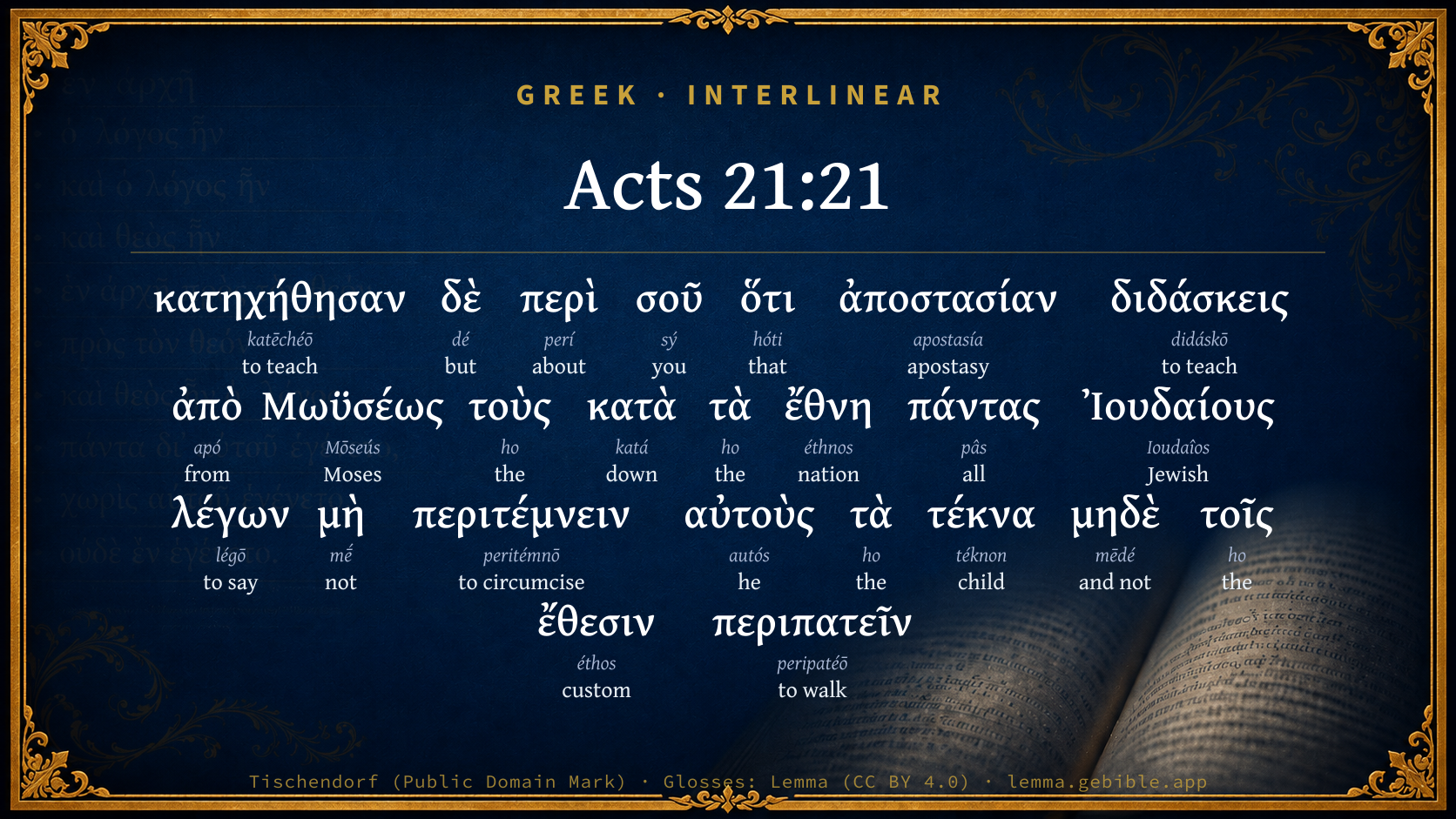
Download image
Cite this verse

Acts 21:21 (World English Bible). Public Domain. Lemma interlinear Bible study tool, https://lemma.gebible.app/v/acts/21/21.

Show BibTeX & RIS
BibTeX
RIS
English Translation
They have been informed about you, that you teach all the Jews who are among the Gentiles to forsake Moses, telling them not to circumcise their children neither to walk after the customs.
World English Bible · Public Domain
Highlights
  • 1 first appearance in the Greek New Testament
Full analysis ↓
Download a study sheet

One document with this verse’s original text, its word-by-word gloss line, the meaning frame, cross-references with their text, attributed commentary, and full source and license credits — printable, and it pastes into notes with its structure intact.

This verse Autodidact and up

Study sheet (.html) Plain text (.txt)

A passage Seminary Student

Up to 50 verses in one chapter. A passage sheet keeps up to 6 commentary sources and 12 cross-references per verse, in the order this page ranks them, and says so on the sheet whenever that leaves anything out. Ask for a single verse and you get the Autodidact verse sheet above.

Everything on this page stays free to read, with no account — the sheet is a download of what is already on screen, not access to it.

Want to remove ads? Support Godless Engineer
Compare translations 3

The same verse in 3 English versions, stacked beneath the original-language interlinear above. Click any original word for its lexicon entry.

Each is an independent rendering of the whole verse — the interlinear is not word-aligned to these translations.

Highlighted words mark where these versions differ — a whole-verse word diff, not a word-by-word alignment.

  • World English Bible Public Domain
    They have been informed about you, that you teach all the Jews who are among the Gentiles to forsake Moses, telling them not to circumcise their children neither to walk after the customs.
  • King James Version Public Domain
    And they are informed of thee, that thou teachest all the Jews which are among the Gentiles to forsake Moses, saying that they ought not to circumcise their children, neither to walk after the customs.
  • unfoldingWord Literal Text CC BY-SA 4.0
    And they have been told about you that you teach all the Jews among the Gentiles apostasy from Moses, telling them not to circumcise children, nor to walk in the customs.

unfoldingWord Literal Text — © unfoldingWord, licensed CC BY-SA 4.0. Word-aligned USFM3 via Door43 (git.door43.org/unfoldingWord/en_ult).

Versions to compare (up to 4)

3 of 4 selected

Show all 19 translations

Every available English version of this verse, each an independent rendering of the whole verse.

  • World English Bible Public Domain
    They have been informed about you, that you teach all the Jews who are among the Gentiles to forsake Moses, telling them not to circumcise their children neither to walk after the customs.
  • Berean Standard Bible Public Domain
    But they are under the impression that you teach all the Jews who live among the Gentiles to forsake Moses, telling them not to circumcise their children or observe our customs.
  • Majority Standard Bible Public Domain
    But they are under the impression that you teach all the Jews who live among the Gentiles to forsake Moses, telling them not to circumcise their children or observe our customs.
  • King James Version Public Domain
    And they are informed of thee, that thou teachest all the Jews which are among the Gentiles to forsake Moses, saying that they ought not to circumcise their children, neither to walk after the customs.
  • American Standard Version (1901) Public Domain
    and they have been informed concerning thee, that thou teachest all the Jews who are among the Gentiles to forsake Moses, telling them not to circumcise their children neither to walk after the customs.
  • Revised Version (1885) Public Domain
    and they have been informed concerning thee, that thou teachest all the Jews which are among the Gentiles to forsake Moses, telling them not to circumcise their children, neither to walk after the customs.
  • Geneva Bible (1599) Public Domain
    Now they are informed of thee, that thou teachest all the Iewes, which are among the Gentiles, to forsake Moses, and sayest that they ought not to circumcise their sonnes, neither to liue after the customes.
  • Douay-Rheims (1899) Public Domain
    Now they have heard of thee that thou teachest those Jews, who are among the Gentiles, to depart from Moses: saying, that they ought not to circumcise their children, nor walk according to the custom.
  • Young's Literal Translation Public Domain
    and they are instructed concerning thee, that apostacy from Moses thou dost teach to all Jews among the nations, saying -- Not to circumcise the children, nor after the customs to walk;
  • Literal Standard Version CC BY-SA 4.0
    and they are instructed concerning you, that you teach departure from Moses to all Jews among the nations, saying not to circumcise the children, nor to walk after the customs;
  • Unlocked Literal Bible CC BY-SA 4.0
    They have been told about you, that you teach all the Jews who live among the Gentiles to abandon Moses, and that you tell them not to circumcise their children, and not to follow the old customs.
  • unfoldingWord Literal Text CC BY-SA 4.0
    And they have been told about you that you teach all the Jews among the Gentiles apostasy from Moses, telling them not to circumcise children, nor to walk in the customs.
  • Darby Bible Public Domain
    And they have been informed concerning thee, that thou teachest all the Jews among the nations apostasy from Moses, saying that they should not circumcise their children, nor walk in the customs.
  • World Messianic Bible Public Domain
    They have been informed about you, that you teach all the Jews who are among the Gentiles to forsake Moses, telling them not to circumcise their children and not to walk after the customs.
  • Webster's Bible Public Domain
    And they are informed concerning thee, that thou teachest all the Jews who are among the Gentiles to forsake Moses, saying, That they ought not to circumcise their children, neither to walk after the customs.
  • Free Bible Version CC BY-SA 4.0
    They have been told that you teach Jews living among the foreigners to ignore the Law of Moses, telling them not to circumcise their children and not to follow our customs.
  • Bible in Basic English Public Domain
    And they have had news of you, how you have been teaching all the Jews among the Gentiles to give up the law of Moses, and not to give circumcision to their children, and not to keep the old rules.
  • Text-Critical English NT CC BY 4.0
    They have been informed that yoʋ teach all the Jews who live among the Gentiles to forsake Moses, telling them not to circumcise their children or walk according to our customs.
  • Tyndale New Testament (1534) Public Domain
    And they are informed of the that thou teachest all the Iewes which are amonge the gentyls to forsake Moses and sayst that they ought not to circumcise their chyldren nether to live after the customes.

Literal Standard Version (2020), Covenant Press — licensed CC BY-SA 4.0. Text via the HelloAO Bible API (eBible.org). Unlocked Literal Bible (unfoldingWord) — licensed CC BY-SA 4.0. Text via the HelloAO Bible API (eBible.org). unfoldingWord Literal Text — © unfoldingWord, licensed CC BY-SA 4.0. Word-aligned USFM3 via Door43 (git.door43.org/unfoldingWord/en_ult). Free Bible Version, Dr. Jonathan Gallagher — licensed CC BY-SA 4.0. Text via the HelloAO Bible API (eBible.org).

Word by word

More ways to search: Search by grammar → Find every occurrence → Compare this word →

Practice this passage: Drill this verse → Learn its vocabulary →

ἀποστασίαν
apostasía
G646
“apostasy”
Noun, Accusative, Singular, Feminine
Part of Speech
Noun
Case
Accusative
Number
Singular
Gender
Feminine
Full Thayer's Definition

Origin: feminine of the same as G647

TDNT: 09:33,9

1. a falling away, defection, apostasy
  1. κατηχήθησαν katēchéō G2727 “to teach” Verb, Aorist, Passive, Indicative, 3rd person, Plural
  2. δὲ dé G1161 “but” Conjunction
  3. περὶ perí G4012 “about” Preposition
  4. σοῦ sý G4771 “you” Personal pronoun, 2nd person, Genitive, Singular
  5. ὅτι hóti G3754 “that” Conjunction
  6. διδάσκεις didáskō G1321 “to teach” Verb, Present, Active, Indicative, 2nd person, Singular
  7. ἀπὸ apó G575 “from” Preposition
  8. Μωϋσέως Mōseús G3475 “Moses” Noun, Genitive, Singular, Masculine
  9. τοὺς ho G3588 “the” Article, Accusative, Plural, Masculine
  10. κατὰ katá G2596 “down” Preposition
  11. τὰ ho G3588 “the” Article, Accusative, Plural, Neuter
  12. ἔθνη éthnos G1484 “nation” Noun, Accusative, Plural, Neuter
  13. πάντας pâs G3956 “all” Adjective, Accusative, Plural, Masculine
  14. Ἰουδαίους Ioudaîos G2453 “Jewish” Adjective, Accusative, Plural, Masculine
  15. λέγων légō G3004 “to say” Verb, Present, Active, Participle, Nominative, Singular, Masculine
  16. μὴ mḗ G3361 “not” Particle, Negative
  17. περιτέμνειν peritémnō G4059 “to circumcise” Verb, Present, Active, Infinitive
  18. αὐτοὺς autós G846 “he” Personal pronoun, Accusative, Plural, Masculine
  19. τὰ ho G3588 “the” Article, Accusative, Plural, Neuter
  20. τέκνα téknon G5043 “child” Noun, Accusative, Plural, Neuter
  21. μηδὲ mēdé G3366 “and not” Conjunction, Negative
  22. τοῖς ho G3588 “the” Article, Dative, Plural, Neuter
  23. ἔθεσιν éthos G1485 “custom” Noun, Dative, Plural, Neuter
  24. περιπατεῖν peripatéō G4043 “to walk” Verb, Present, Active, Infinitive

About this verse

These counts appear in no published source. They are computed here, from the morphology-tagged text and Lemma’s own curated glosses. What Lemma adds →

25
words
22
distinct lemmas
Acts
section

Notable vocabulary

The rarest word here is ἀποστασίαν apostasy G646 — appearing just 2 times in the whole Greek New Testament.

First appearance in Scripture

This word makes its first canonical appearance in the Greek New Testament here:

  • ἀποστασίαν apostasy G646

Shared distinctive vocabulary

ἀποστασίαν apostasy G646 occurs in 2 verses of the Greek New Testament. Also found in:

Repetition

A word recurs within this verse:

  • τοὺς the G3588 ×4

Cross-references

10

Topical passages linked to Acts 21:21 in the Treasury of Scripture Knowledge — connected by theme and wording, ordered by reader-vote popularity; previews shown in the World English Bible.

  • 1 Corinthians 9:19–21 For though I was free from all, I brought myself under bondage to all, that I might gain the more.
  • Galatians 6:12–15 As many as desire to look good in the flesh, they compel you to be circumcised; only that they may not be persecuted for the cross of Christ.
  • Galatians 5:1–6 Stand firm therefore in the liberty by which Christ has made us free, and don't be entangled again with a yoke of bondage.
  • Acts 15:19–21 "Therefore my judgment is that we don't trouble those from among the Gentiles who turn to God,
  • Acts 21:28 crying out, "Men of Israel, help! This is the man who teaches all men everywhere against the people, and the law, and this place. Moreover, he also brought Greeks into the temple, and has defiled this holy place!"
  • Romans 14:1–6 Now receive one who is weak in faith, but not for disputes over opinions.
  • 1 Corinthians 7:18–19 Was anyone called having been circumcised? Let him not become uncircumcised. Has anyone been called in uncircumcision? Let him not be circumcised.
  • Acts 6:13–14 and set up false witnesses who said, "This man never stops speaking blasphemous words against this holy place and the law.
  • Acts 16:3 Paul wanted to have him go out with him, and he took and circumcised him because of the Jews who were in those parts; for they all knew that his father was a Greek.
  • Acts 28:17 It happened that after three days Paul called together those who were the leaders of the Jews. When they had come together, he said to them, "I, brothers, though I had done nothing against the people, or the customs of our fathers, still was delivered prisoner from Jerusalem into the hands of the Romans,

Cross-references courtesy of OpenBible.info (CC BY 4.0).

Commentary

Notes on Acts 21:21 from classic Christian and Jewish commentators (each source and its license shown beneath its notes). The classic Christian expositions comment on the surrounding passage and are grouped to its opening verse, so a note may address several verses; the Jewish commentaries on the Tanakh (Rashi and others) are per-verse, so they appear only where the commentator wrote on this verse.

Lemma curates 59 commentaries, every one of them public domain or Creative Commons licensed, each selected and text-cleaned for this edition rather than reprinted as found. About our sources →

Bengel's Gnomon

Johann Albrecht Bengel

Act 21:21. Κατηχήθησαν, they have been informed, they have heard it said) not merely by rumour, but owing to exaggerated statements, exceeding the real state of the case, they are persuaded of this.—τοῖς ἔθεσι, the customs) of the Jews.

Bengel's Gnomon of the New Testament — English translation (T&T Clark, Edinburgh, 1860) — public domain. Text from a community e-Sword module.

Expositor's Greek Testament

ed. W. Robertson Nicoll

Act 21:21 . κατηχήθησαν : the word seems to imply definite instruction, not merely audierunt , Vulgate. Hort refers to the term as implying here assiduous talking and lecturing, Judaistic Christianity , p. 107. ἀποστασίαν , cf. Mal 2:15Mal 2:15 ( ἀπόστασιν ) when the officers of Antiochus Epiphanes, in the time of Mattathias, tried to compel the people of Modin to forsake the law and to sacrifice upon the idol altar. μὴ περιτέμνειν : these words and those which follow were an entire perversion of St. Paul’s teaching, just as his enemies gave a perverted view of the Apostle’s supposed intrusion with Trophimus into the temple, Act 21:29 . The exemption from the Mosaic law was confined to Jewish converts, Act 16:3 , 1Co 7:18 . τοῖς ἔθεσι , cf. Act 6:14 , Act 15:1 . περιπατεῖν : only here in Luke, but often in the Epistles in this sense, cf. Mar 7:5 .

The Expositor's Greek Testament, edited by W. Robertson Nicoll (1897–1910) — public domain. Text from a community e-Sword module.

Jamieson, Fausset & Brown

Robert Jamieson, A. R. Fausset & David Brown

they are informed . . . that thou teachest all the Jews which are among the Gentiles--those residing in heathen countries.

to forsake Moses, &c.--This calumny of the unbelieving Jews would find easy credence among the Christian zealots for Judaism.

Jamieson, Fausset & Brown — Commentary Critical and Explanatory on the Whole Bible (1871) — public domain (CC PDM 1.0). Text via the HelloAO Bible API.

Adam Clarke's Commentary

Verse 21. Thou teachest - to forsake Moses, c.] From any thing that appears in the course of this book to the contrary, this information was incorrect: we do not find Paul preaching thus to the Jews. It is true that, in his epistles, some of which had been written before this time, he showed that circumcision and uncircumcision were equally unavailable for the salvation, of the soul, and that by the deeds of the law no man could be justified but he had not yet said to any Jew, forsake Moses, and do not circumcise your children. He told them that Jesus Christ had delivered them from the yoke of the law; but they had, as yet, liberty to wear that yoke, if they pleased. He had shown them that their ceremonies were useless but not destructive; that they were only dangerous when they depended on them for salvation. This is the sum of what Paul had taught on this subject.

Adam Clarke's Commentary on the Bible (1810–1826) — public domain. Text from a community e-Sword/MySword module.

Ellicott's Commentary for English Readers

(21) And they are informed of thee . . .—This, it is clear, was the current version of St. Paul’s teaching. How far was it a true representation of its tendencies? As a personal accusation it was, of course, easy to refute it. His rule of adaptation led him to be to the Jews as a Jew (1Co_9:20). He taught that every man, circumcised or uncircumcised, should accept his position with its attendant obligations (1Co_7:18-20). He had himself taken the Nazarite vow (Act_18:18), and had circumcised Timotheus (Act_16:3). It was probably false that he had ever taught that Jews “ought not to circumcise their children.” But fanaticism is sometimes clear-sighted in its bitterness, and the Judaisers felt that when it was proclaimed that “circumcision was nothing,” in its bearing on man’s relations to God (1Co_7:19; Gal_5:6; Gal_6:15), it ceased to have a raison d’être, and sank to the level of a mere badge of the national exclusiveness, which, in its turn, was assailed by St. Paul’s teaching that all middle walls of partition were broken down (Eph_2:14), and that Jews and Gentiles were alike one in Christ. If a Jew had asked, Why then should I circumcise my child? it would not have been easy to return a satisfying answer. If it were said, “To avoid giving offence,” that was clearly only temporary and local in its application, and the practice would die out as people ceased to be offended. If it were urged that it was a divine command, there was the reply that, as a command, it had been virtually though not formally repealed when the promises and privileges connected with it were withdrawn. It was the seal of a covenant (Rom_4:11), and could hardly be looked upon as binding when the covenant itself had been superseded. Few Christians would now hold that a converted Jew was still bound to circumcise, as well as baptise, his children. The writer of the Epistle to the Hebrews did but push St. Paul’s teaching to its legitimate conclusions when he said that the “new covenant had made the first old,” and that “that which is decaying and waxing old is ready to vanish away” (Heb_8:13).

That thou teachest all the Jews . . . to forsake Moses.—Literally, that thou teachest apostasy from Moses, the term used, with all its burden of evil import, adding weight to the charge.

Neither to walk after the customs.—On the general import of this phrase, as including the “traditions of the elders,” as well as the precepts of the Law, see Notes on Act_6:14; Act_15:1.

A Bible Commentary for English Readers, edited by Charles John Ellicott (1878–1897) — public domain. Text from a community e-Sword module.

The Cambridge Bible for Schools and Colleges

gen. ed. J. J. S. Perowne

21. and they are informed of thee] More clearly and in accordance with modern English, the Rev. Ver. “they have been informed concerning thee.” The verb is a very significant one, from which comes our English “catechize.” It implies, therefore, that the process of educating public opinion in Jerusalem about St Paul had been a diligent business. They had taught the lesson persistently till their hearers were fully trained in it. We can hence understand the great hostility which the Apostle experienced, and his strong language about these Judaizers. They must have had their partizans at work in preparation for his visit, and have poisoned men’s minds against him.

that thou teachest … to forsake Moses] The calumniators made use of the Apostle’s earnest words to Gentile converts, that they should not accept Judaism first as a door to Christianity, to bring a charge that, to Jews also, he spake of the law as no longer to be regarded. We can see from what we know of his words and actions how false this was, but at such a time and amid such a populace the charge would rouse great animosity, and have no chance of being refuted.

saying that they ought not to circumcise their children] More simply (with Rev. Ver.), “telling them not to,” &c. This had so long been the mark of the Jew, and the expression “uncircumcised” meant something so abhorrent to his mind, that we cannot wonder that this is put in the forefront of the charge. For the sense of contempt and abomination in the name, cf. 1Sa_17:26; Eze_28:10; Eze_32:29-30.

neither to walk after the customs] The customs being the ceremonial law of the Jews. There is quite a Jewish sound in the frequent Old Testament phrase “to walk after.”

The Cambridge Bible for Schools and Colleges (gen. ed. J. J. S. Perowne; Cambridge University Press, 1878–1918) — public domain. Text from a community e-Sword module.

John Gill's Exposition

And they are informed of thee,.... By persons that came from the several parts of the Gentile world, where the apostle had been preaching; and by letters which came from the Jews in those parts, who were no friends to the apostle's ministry:

that thou teachest all the Jews which are among the Gentiles, to forsake Moses: or "apostatize from Moses"; that is, the law of Moses; that he taught the Gentiles not to regard the rituals of the law of Moses gave them no uneasiness; but that he should teach the Jews that were scattered among the Gentiles, and as many of them that believed in Christ, to disregard and drop the observance of them, who had been always brought up in them, this they could not bear; and that the apostle so taught, they had credible information: particularly,

saying, that they ought not to circumcise their children; though this does not appear; it is true the apostle taught that circumcision was abolished, and that it was nothing; yea, that to submit to it as necessary to salvation, was hurtful and pernicious; but as a thing indifferent, he allowed of it among weak brethren; and in condescension to their weakness, did administer it himself; in which he became a Jew to the Jew, that he might gain some:

neither to walk after the customs; either of the law of Moses, meaning other rites there enjoined, besides circumcision; or of their fathers, and their country, the traditions of the elders, which as yet they had not got clear of; the disuse of old customs is not easily brought about, or it is not easy to bring persons off of them.

John Gill's Exposition of the Whole Bible (1746–1763) — public domain (CC PDM 1.0). Text via the HelloAO Bible API.

Trapp's Complete Commentary

John Trapp

21 And they are informed of thee, that thou teachest all the Jews which are among the Gentiles to forsake Moses, saying that they ought not to circumcise their children, neither to walk after the customs.

Ver. 21. To remake Moses] An odious and false imputation. All that St Paul taught was, that the legal rites and customs were only shadows of things to come, but the body is of Christ, Col 2:17; and that Christians should know and use their freedom in wisdom and charity, Gal 2:3; 1Co 8:13.

John Trapp, A Commentary or Exposition upon All the Books of the Old and New Testament (1647–1656) — public domain. Text from a community e-Sword module.

Albert Barnes' Notes on the Bible

And they are informed of thee - Reports respecting the conduct of Paul would be likely to be in circulation among all at Jerusalem. His remarkable conversion, his distinguished zeal, his success among the Gentiles, would make his conduct a subject of special interest. Evil-minded men among the Jews, who came up to Jerusalem from different places where he had been, would be likely to represent him as the decided enemy of the laws of Moses, and these reports would be likely to reach the ears of the Jewish converts. The reports, as they gained ground, would be greatly magnified, until suspicion might be excited among the Christians at Jerusalem that he was, as he was reputed to be, the settled foe of the Jewish rites and customs.

That thou teachest all the Jews ... - From all the evidence which we have of his conduct, this report was incorrect and slanderous. The truth appears to have been, that he did not enjoin the observance of those laws on the Gentile converts; that the effect of his ministry on them was to lead them to suppose that their observance was not necessary - contrary to the doctrines of the Judaizing teachers (see Acts 15); and that he argued with the Jews themselves, where it could be done, against the obligation of those laws and customs since the Messiah had come. The Jews depended on their observance for justification and salvation. This Paul strenuously opposed; and this view he defended at length in the Epistles which he wrote. See the Epistles to the Romans, the Galatians, and the Hebrews. Yet these facts might be easily misunderstood and perverted, so as to give rise to the slanderous report that he was the enemy of Moses and the Law.

Which are among the Gentiles - Who live in pagan countries. The Jews were extensively scattered and settled in all the large towns and cities of the Roman empire.

To forsake Moses - The Law and the authority of Moses. That is, to regard his laws as no longer binding.

To walk after the customs - To observe the institutions of the Mosaic ritual. See the notes on Act 6:14. The word “customs” denotes “the rites of the Mosaic economy the offering of sacrifices, incense, the oblations, anointings, festivals, etc., which the Law of Moses prescribed.”

Albert Barnes' Notes on the Bible (1834–1885) — public domain. Text from a community e-Sword/MySword module.

Haydock's Catholic Bible Commentary

To forsake Moses. In the Greek, to depart or apostatize from Moses and the law. This is more than was true. For St. Paul circumcised Timothy, (chap. xvi.) and did not absolutely hinder converts who had been Jews, from practising the Jewish ceremonies. (Witham) --- There is a manifest falsity in this accusation against St. Paul. He had never commanded or advised the Jews, to whom he had preached, to renounce the law, abandon the ceremonies of Moses, or reject the ancient customs of the nation. He had never hindered any one from following in this respect the bias of his inclinations. He had indeed defended the liberty of the converts from these ceremonies; he had taught that Christ had taken away the necessity of this yoke; but he left them at liberty still to carry it if they pleased. (Calmet) --- For these things were not then to be sought after as necessary, nor yet to be condemned as sacrilegious. The law of Moses at that time was dead, but not deadly. (St. Augustine, ep. lxxxii.) --- These considerations will sufficiently explain the apostle’s motive for submitting on this occasion to one of their ceremonies. He became all to all, that he might gain all to Christ. (Haydock)

George Leo Haydock (1774–1849), Haydock's Catholic Family Bible and Commentary, 1859 edition — public domain. Excludes Psalms (Douay-Rheims chapter numbering differs from Protestant) and Deuterocanonical books (Catholic canon only).

Matthew Poole's English Annotations

Informed of thee; instructed or catechised concerning thee; the zealots had made it their business to instil such aspersions and odious reflections against Paul, as if their accusations had been the fundamental truths of their religion.

Moses; the ceremonial law, given by his ministry.

To walk, to live, to act in their course of life,

after the customs of their fathers, or the rituals of Moses.

Matthew Poole's English Annotations on the Holy Bible (1683–1685) — public domain. Text from a community e-Sword/MySword module.

The Pulpit Commentary

Have been for are, A.V.; concerning for of, A.V; telling them not for saying that they ought not, A.V. Have been informed (kathchqhsan); see Act_18:25; Luk_1:4; (qesi); Rom_2:18, etc. The verb properly means to instruct by word of mouth, whence our "catechism." The customs (toiv e) see Act_6:14, both for the phrase and the sentiment, and Act_15:1, note; Act_26:3; Act_28:17.

Eqov is a favorite word of St. Luke"s, occurring ten times in his Gospel and in the Acts, and only twice in the New Testament elsewhere. (Joh_19:40; Heb_10:25; see Hobart, on Luk_2:27)

The Pulpit Commentary (1880–1919), ed. H.D.M. Spence-Jones & Joseph S. Exell — public domain. Text from a community e-Sword module.

John Wesley's Explanatory Notes

They have been informed concerning thee, that thou teachest the Jews - not to circumcise their children, nor to walk after the customs - Of the Mosaic law. And so undoubtedly he did. And so he wrote to all the Churches in Galatia, among whom were many Jews. Yea, and James himself had long before assented to Peter, affirming before all the apostles and all the brethren, chap. xv, 10, That this very law was a yoke which (said he) neither our fathers nor we were able to bear - Amazing! that they did not know this! Or, that if they did, they did not openly testify it at all hazards, to every Jewish convert in Jerusalem!

John Wesley, Explanatory Notes Upon the Whole Bible (1754–1765) — public domain. Text via the GEBible commentary corpus.

Burkitt's Expository Notes on the New Testament

William Burkitt

We had Paul’s report to the church at Jerusalem, of the success which God had given him in his ministry amongst the Gentiles; this is related in the foregoing paragraph of the chapter.

In these verses before us, we have the church’s reply to the apostle’s relation, They glorified God; first, for the great success given to the word of his grace amongst the Jews: Thou seest, brother how many thousands of Jews there are which do believe; the original runs, how many tens of thousands do believe; which intimates the great and wonderful success of the gospel.

Well might our Saviour compare it to a grain of mustard-seed, seeing it had spread itself far and near in so short a time. If we consider the smallness of its beginning, the despicableness of the instruments, the shortness of the time, the obstinacy and prejudices of the Jews against the gospel, and yet remark the vast number of thousands and tens of thousands of the Jews that did already believe, embrace, and entertain it; we need not wonder that St. Paul, 1Ti 3:16, reckons it as one of the greatest mysteries of godliness, that Jesus Christ was preached to the Gentiles, and believed on in the world. That is, that so many thousands both of Jews and Gentiles were brought to own him, and submit to him as Lord and Saviour.

Observe next, the advice given by the church at Jerusalem to St. Paul, concerning the Jews which did believe in that place. It seems the Jews, though they had received the gospel, yet thought that the ceremonial law must still be observed; therefore, in condescension to their weakness, and to prevent their taking offence, they advise the apostle, not as a thing necessary in itself, but as an expediency in reference to their weakness, and to conform himself to some of the Jewish ceremonies and purifications; for though they were not then needful, yet they were not then unlawful; they might then be used, when the use of them would any ways conduce to the gaining and bringing over the Jews to a love of Christianity. The synagogue was not hastily to be cast out of the church, like the Heathenish superstitions; but to die by degrees, and be decently interred.

Here note, That the law of Moses, as to its moral part, Christ continued as his law: the ceremonial part, as to the use os types and ceremonies, signifying him that was to come, this was abrogated at Christ’s coming; and the political part ceased, when the Jewish polity was dissolved: but the abrogation of the whole was not fully made known at the first, but by degrees; and the exercise of it long tolerated to the Jews.

Observe, lastly, The particular advise which they give the apostle, to go into the temple, and perform the legal ceremony of purification: We have four men which have a vow; them take, and purify thyself, that all may know that thou walkest orderly, and keepest the law. That is, "Seeing we have four men here which have a Nazarite’s vow upon them, the time of which vow is now expired, and they are to shave themselves ceremoniously in the temple; go thou with them, and perform the legal ceremony of purification there, that the people may know that the report of thee is not true; but thou, being a Jew, dost thyself keep the law."

Here we may observe the truth of what St. Paul elsewhere declared, that to the Jews he became as a Jew, that he might gain the Jews, yea, become all things to all men, that he might gain some. A noble pattern for the ministers of the gospel to write after, in yielding, so far as we may without sin or scandal, to the weakness of others, in order to the furtherance of the great ends of our ministry among our people: To the Jews I became as a Jew.

William Burkitt's Expository Notes on the New Testament (1700–1703) — public domain. Text from a community e-Sword module.

Godbey's Commentary on the New Testament

William B. Godbey

21-26. They very judiciously advised Paul to adopt a procedure in connection with four Jewish brethren, who at that time had on them temporary Nazaritish vows, to fall in with them, becoming a Mosaic Nazarite for the time being [an institution peculiar to Jews only], thus rendering himself conspicuous before all the people for his literal observance of the Mosaic law. Here we have Paul’s example, going unhesitatingly into religious ceremonies which were utterly null and void, merely to gratify the Jews, lest they might receive spiritual detriment by his example, illustrating the fact that while Paul preached to the Gentiles perfect spiritual freedom from ecclesiastical ritualism, when among the Jews he practiced it himself. These Apostolical decrees to the Gentiles (Act 21:25) to abstain from idolatry, blood and fornication, have a purely spiritual signification, culminating in entire sanctification. We are cleansed from all unrighteousness by the blood of Christ, which is symbolized by all animal blood, hence our abstinence from it. The blood has a spiritual and not a physical signification. No one is free from idolatry in some form or other till sanctified wholly, while fornication is the only sin which breaks the marital covenant and forfeits the Bridehood of Christ. Hence its specification here. Nothing at all is said about baptism, the eucharist or any other ceremony. Hence you see the pure spirituality of gospel salvation, temporalities all incidental and optionary.

William B. Godbey, Commentary on the New Testament (1896–1900) — public domain. Text from a community e-Sword module.

McGarvey & Pendleton's Commentaries

J. W. McGarvey

See notes on verse 18

J. W. McGarvey (with Philip Y. Pendleton), Commentaries on the New Testament (The Fourfold Gospel, 1914; Acts; and the epistles) — public domain. Text from a community e-Sword/MySword module.

Cambridge Greek Testament for Schools and Colleges

21. κατηχήθησαν δὲ περὶ σοῦ, and they have been informed concerning thee. κατηχέω is a very significant verb. It is the root of our English ‘catechize.’ It implies, therefore, that the process of educating public opinion in Jerusalem about St Paul had been a diligent business. The Pharisaic party had taught the lesson persistently till their hearers were fully trained in it. We can hence understand the great hostility which the Apostle experienced, and his strong language about these Judaizers. They must have had their partizans at work in preparation for his visit, and have poisoned men’s minds against him.

ὅτι ἀποστασίαν … πάντας Ἰουδαίους, that thou teachest all the Jews that are among the Gentiles to forsake Moses. The calumniators made use of the Apostle’s earnest words to Gentile converts, that they should not accept Judaism first as a door to Christianity, to bring a charge that, to Jews also, he spake of the Law as no longer to be regarded. We can see from what we know of his words and actions how false this was, but at such a time and amid such a populace the charge would rouse great animosity, and have no chance of being refuted.

ἀποστασία is found 1Ma 2:15, of those who were being compelled to forsake the Law and the ordinances and to sacrifice unto idols. οἱ παρὰ τοῦ βασιλέως οἱ καταναγκάζοντες τὴν ἀποστασίαν … ἵνα θυσιάσωσι.

λέγων μὴ περιτέμνειν αὐτοὺς τὰ τέκνα, telling them not to circumcise their children. Circumcision had so long been the mark of the Jew, and the expression ‘uncircumcised’ meant something so abhorrent to his mind, that we cannot wonder that this is put in the forefront of the charge. For the sense of contempt and abomination in the name ‘uncircumcised,’ cf. 1Sa 17:26; Eze 28:10; Eze 32:29-30.

μηδὲ τοῖς ἔθεσιν περιπατεῖν, nor to walk after the customs. The customs are the ceremonial laws of the Jews. The recurrence of words = ‘to walk after’ gives quite an Old Testament ring to the language of these speeches.

Cambridge Greek Testament for Schools and Colleges (Cambridge University Press, 1896; 21 vols, various authors incl. Carr, Maclear, Plummer, Farrar, Lumby, Moule, M. R. James, Simcox) — public domain. Text from a community e-Sword module.

Alford’s Greek Testament

Henry Alford

21. κατηχήθησαν] they were sedulously informed (at some time in the mind of the speaker. The sense of the aor. must be preserved. Below, ver. 24, it is the perfect): viz., by the anti-Pauline judaizers.

τοῖς ἔθεσιν] The dat. of the rule, or form, after which: see reff.

Henry Alford, The Greek Testament (1849–1861) — public domain. Text from a community e-Sword module.

Vincent's Word Studies in the New Testament

Marvin R. Vincent

They are informed [κατηχηθησαν] . More than informed. They had been carefully instructed, probably by the Judaizing teachers. See on instructed, Luk 1:4.

To forsake Moses [αποστασιαν απο, μωσεως] . Lit., apostasy from Moses. Compare 2Th 2:3.

Marvin R. Vincent, Word Studies in the New Testament (1887–1900) — public domain. Text from a community e-Sword/MySword module.

Lesson kit

Teaching starters — assembled from the data on this page, not authored interpretation. Every prompt links to the verse data it draws on. Edit before teaching.

Acts, in the Acts, opens this verse with 25 words (22 distinct Greek lemmas). Its most distinctive word is apostasía (“apostasy”). A historical commentator’s framing appears above. Read the whole chapter for the surrounding context.

Discussion questions

  1. How does “apostasy” (apostasía) shape what this verse is saying?
  2. This is the first place “apostasy” appears in Scripture (first appears here). What does its debut here establish?
  3. How does 2 Thessalonians 2:3, which shares the word «apostasy», read alongside this verse?
  4. What does the repetition of “the” (4× in this one verse) do in this verse?
  5. These translations render this verse differently; the difference is in the English rendering, not the original. What questions does that raise?
  6. Compare how Bengel's Gnomon and Expositor's Greek Testament read this verse. Where do they agree or differ?

Things to notice

  • 1 word makes its first canonical appearance in Scripture here.
  • These translations choose different wording for 17 words in this verse.
  • “the” occurs 4× in this single verse.
  • 22 distinct Greek lemmas span 25 words in this verse.

Reading settings

Reading text

Shown beneath each verse's original-language words.

Old Testament
Old Testament edition

Read the OT as the Masoretic Hebrew (MT) or the Greek Septuagint (LXX).

English shown for the Greek Septuagint (in the Hebrew ↔ Greek comparison).

Comparing translations? Open the Compare panel on any verse page to stack up to four side by side.