
Romans 15:27

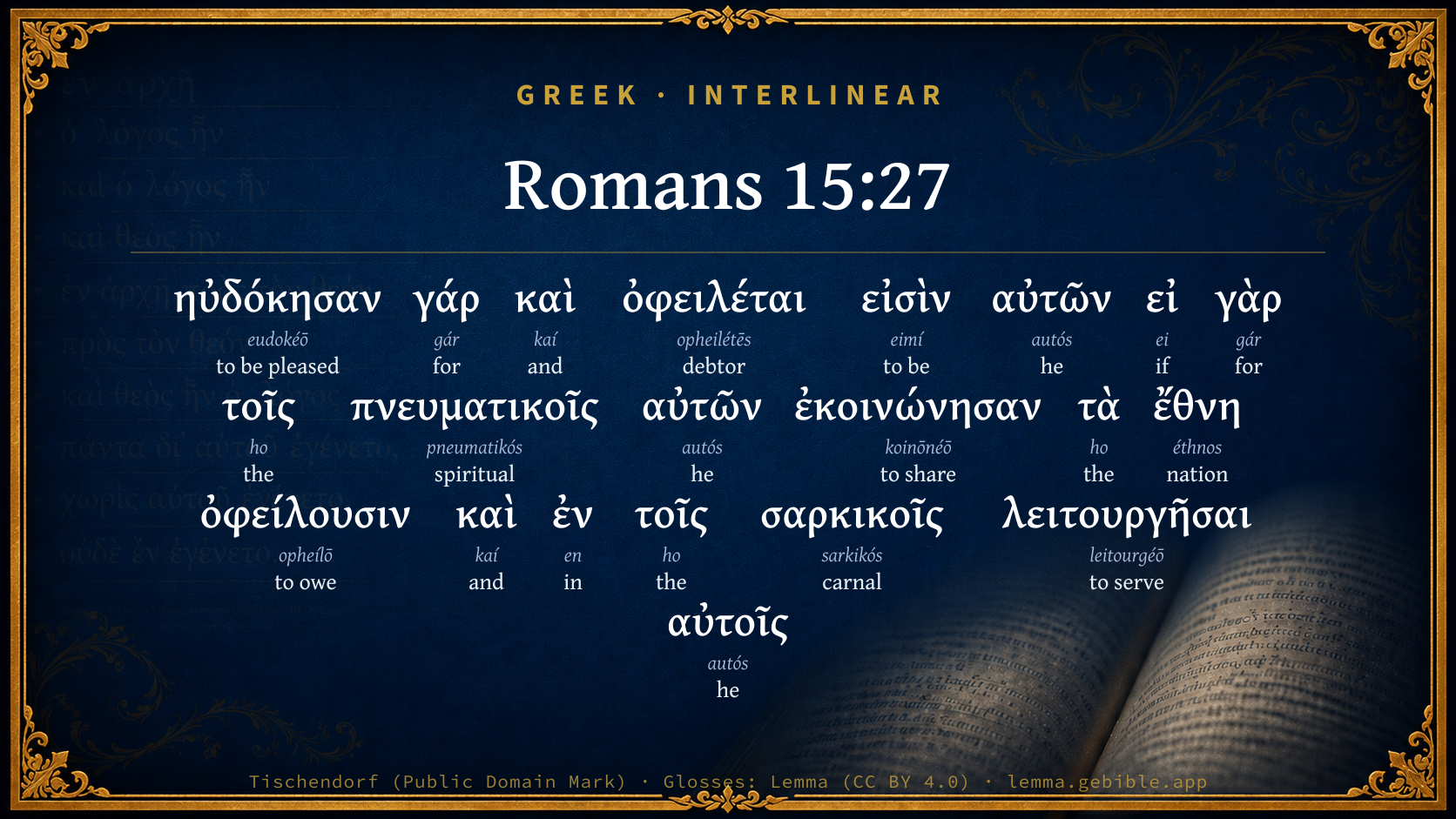
Greek (Tischendorf 8th ed.) Romans 15:27 appears in the Greek New Testament. The text above is from the Tischendorf 8th edition. Each word links to its Strong’s number and a concise gloss. Click any word for its full Thayer’s Greek Lexicon entry.
Download image
Cite this verse

Romans 15:27 (World English Bible). Public Domain. Lemma interlinear Bible study tool, https://lemma.gebible.app/v/romans/15/27.

Show BibTeX & RIS
BibTeX
RIS
English Translation
Yes, it has been their good pleasure, and they are their debtors. For if the Gentiles have been made partakers of their spiritual things, they owe it to them also to serve them in fleshly things.
World English Bible · Public Domain
Highlights
  • 1 first appearance in the Greek New Testament
Full analysis ↓
Download a study sheet

One document with this verse’s original text, its word-by-word gloss line, the meaning frame, cross-references with their text, attributed commentary, and full source and license credits — printable, and it pastes into notes with its structure intact.

This verse Autodidact and up

Study sheet (.html) Plain text (.txt)

A passage Seminary Student

Up to 50 verses in one chapter. A passage sheet keeps up to 6 commentary sources and 12 cross-references per verse, in the order this page ranks them, and says so on the sheet whenever that leaves anything out. Ask for a single verse and you get the Autodidact verse sheet above.

Everything on this page stays free to read, with no account — the sheet is a download of what is already on screen, not access to it.

Want to remove ads? Support Godless Engineer
Compare translations 3

The same verse in 3 English versions, stacked beneath the original-language interlinear above. Click any original word for its lexicon entry.

Each is an independent rendering of the whole verse — the interlinear is not word-aligned to these translations.

Highlighted words mark where these versions differ — a whole-verse word diff, not a word-by-word alignment.

  • World English Bible Public Domain
    Yes, it has been their good pleasure, and they are their debtors. For if the Gentiles have been made partakers of their spiritual things, they owe it to them also to serve them in fleshly things.
  • King James Version Public Domain
    It hath pleased them verily; and their debtors they are. For if the Gentiles have been made partakers of their spiritual things, their duty is also to minister unto them in carnal things.
  • unfoldingWord Literal Text CC BY-SA 4.0
    For they were pleased, and they are obligated to them. For if the Gentiles have shared in their spiritual things, they are obligated also to minister to them in material things.

unfoldingWord Literal Text — © unfoldingWord, licensed CC BY-SA 4.0. Word-aligned USFM3 via Door43 (git.door43.org/unfoldingWord/en_ult).

Versions to compare (up to 4)

3 of 4 selected

Show all 19 translations

Every available English version of this verse, each an independent rendering of the whole verse.

  • World English Bible Public Domain
    Yes, it has been their good pleasure, and they are their debtors. For if the Gentiles have been made partakers of their spiritual things, they owe it to them also to serve them in fleshly things.
  • Berean Standard Bible Public Domain
    They were pleased to do it, and indeed they owe it to them. For if the Gentiles have shared in their spiritual blessings, they are obligated to minister to them with material blessings.
  • Majority Standard Bible Public Domain
    They were pleased to do it, and indeed they owe it to them. For if the Gentiles have shared in their spiritual blessings, they are obligated to minister to them with material blessings.
  • King James Version Public Domain
    It hath pleased them verily; and their debtors they are. For if the Gentiles have been made partakers of their spiritual things, their duty is also to minister unto them in carnal things.
  • American Standard Version (1901) Public Domain
    Yea, it hath been their good pleasure; and their debtors they are. For if the Gentiles have been made partakers of their spiritual things, they owe it `to them' also to minister unto them in carnal things.
  • Revised Version (1885) Public Domain
    Yea, it hath been their good pleasure; and their debtors they are. For if the Gentiles have been made partakers of their spiritual things, they owe it to them also to minister unto them in carnal things.
  • Geneva Bible (1599) Public Domain
    For it hath pleased them, and their detters are they: for if the Gentiles be made partakers of their spirituall things, their duetie is also to minister vnto them in carnall things.
  • Douay-Rheims (1899) Public Domain
    For it hath pleased them; and they are their debtors. For if the Gentiles have been made partakers of their spiritual things, they ought also in carnal things to minister to them.
  • Young's Literal Translation Public Domain
    for it pleased well, and their debtors they are, for if in their spiritual things the nations did participate, they ought also, in the fleshly things, to minister to them.
  • Literal Standard Version CC BY-SA 4.0
    for it pleased well, and their debtors they are, for if the nations participated in their spiritual things, they ought also, in the fleshly things, to minister to them.
  • Unlocked Literal Bible CC BY-SA 4.0
    Yes, it was their good pleasure, and, indeed, they are their debtors. For if the Gentiles have shared in their spiritual things, they owe it to them also to serve them in material things.
  • unfoldingWord Literal Text CC BY-SA 4.0
    For they were pleased, and they are obligated to them. For if the Gentiles have shared in their spiritual things, they are obligated also to minister to them in material things.
  • Darby Bible Public Domain
    They have been well pleased indeed, and they are their debtors; for if the nations have participated in their spiritual things, they ought also in fleshly to minister to them.
  • World Messianic Bible Public Domain
    Yes, it has been their good pleasure, and they are their debtors. For if the Gentiles have been made partakers of their spiritual things, they owe it to them also to serve them in material things.
  • Webster's Bible Public Domain
    It hath pleased them verily; and their debtors they are. For if the Gentiles have been made partakers of their spiritual things, their duty is also to minister to them in carnal things.
  • Free Bible Version CC BY-SA 4.0
    They were happy to do this because they're in their debt. Now that foreigners are sharing their spiritual benefits, they owe it to the Jewish believers to help them in material things.
  • Bible in Basic English Public Domain
    Yes, it has been their good pleasure; and they are in their debt. For if the Gentiles have had a part in the things of the Spirit which were theirs, it is right for them, in the same way, to give them help in the things of the flesh.
  • Text-Critical English NT CC BY 4.0
    They were pleased to do so, and indeed they owe it to them. For if the Gentiles have come to share in the spiritual blessings of the Jews, they owe it to the Jews to share with them their material blessings.
  • Tyndale New Testament (1534) Public Domain
    It hath pleased them verely and their detters are they. For yf the getils be made partetakers of their spirituall thinges their dutie is to minister vnto the in carnall thinges.

Literal Standard Version (2020), Covenant Press — licensed CC BY-SA 4.0. Text via the HelloAO Bible API (eBible.org). Unlocked Literal Bible (unfoldingWord) — licensed CC BY-SA 4.0. Text via the HelloAO Bible API (eBible.org). unfoldingWord Literal Text — © unfoldingWord, licensed CC BY-SA 4.0. Word-aligned USFM3 via Door43 (git.door43.org/unfoldingWord/en_ult). Free Bible Version, Dr. Jonathan Gallagher — licensed CC BY-SA 4.0. Text via the HelloAO Bible API (eBible.org).

Word by word

More ways to search: Search by grammar → Find every occurrence → Compare this word →

Practice this passage: Drill this verse → Learn its vocabulary →

λειτουργῆσαι
leitourgéō
G3008
“to serve”
Verb, Aorist, Active, Infinitive
Part of Speech
Verb
Tense
Aorist
Voice
Active
Mood
Infinitive
Full Thayer's Definition

Origin: from G3011

TDNT: 07:35,5

1. to serve the state at one's own cost a. to assume an office which must be administered at one's own expense b. to discharge a public office at one's own cost c. to render public service to the state 2. to do a service, perform a work a. of priests and Levites who were busied with the sacred rites in the tabernacle or the temple b. of Christians serving Christ, whether by prayer, or by instructing others concerning the way of salvation, or in some other way c. of those who aid others with their resources, and relieve their poverty
  1. ηὐδόκησαν eudokéō G2106 “to be pleased” Verb, Aorist, Active, Indicative, 3rd person, Plural
  2. γάρ gár G1063 “for” Conjunction
  3. καὶ kaí G2532 “and” Conjunction
  4. ὀφειλέται opheilétēs G3781 “debtor” Noun, Nominative, Plural, Masculine
  5. εἰσὶν eimí G1510 “to be” Verb, Present, Active, Indicative, 3rd person, Plural
  6. αὐτῶν autós G846 “he” Personal pronoun, Genitive, Plural, Masculine
  7. εἰ ei G1487 “if” Conditional
  8. γὰρ gár G1063 “for” Conjunction
  9. τοῖς ho G3588 “the” Article, Dative, Plural, Neuter
  10. πνευματικοῖς pneumatikós G4152 “spiritual” Adjective, Dative, Plural, Neuter
  11. αὐτῶν autós G846 “he” Personal pronoun, Genitive, Plural, Masculine
  12. ἐκοινώνησαν koinōnéō G2841 “to share” Verb, Aorist, Active, Indicative, 3rd person, Plural
  13. τὰ ho G3588 “the” Article, Nominative, Plural, Neuter
  14. ἔθνη éthnos G1484 “nation” Noun, Nominative, Plural, Neuter
  15. ὀφείλουσιν opheílō G3784 “to owe” Verb, Present, Active, Indicative, 3rd person, Plural
  16. καὶ kaí G2532 “and” Conjunction
  17. ἐν en G1722 “in” Preposition
  18. τοῖς ho G3588 “the” Article, Dative, Plural, Neuter
  19. σαρκικοῖς sarkikós G4559 “carnal” Adjective, Dative, Plural, Neuter
  20. αὐτοῖς autós G846 “he” Personal pronoun, Dative, Plural, Masculine

About this verse

These counts appear in no published source. They are computed here, from the morphology-tagged text and Lemma’s own curated glosses. What Lemma adds →

21
words
15
distinct lemmas
Pauline Epistles
section

Notable vocabulary

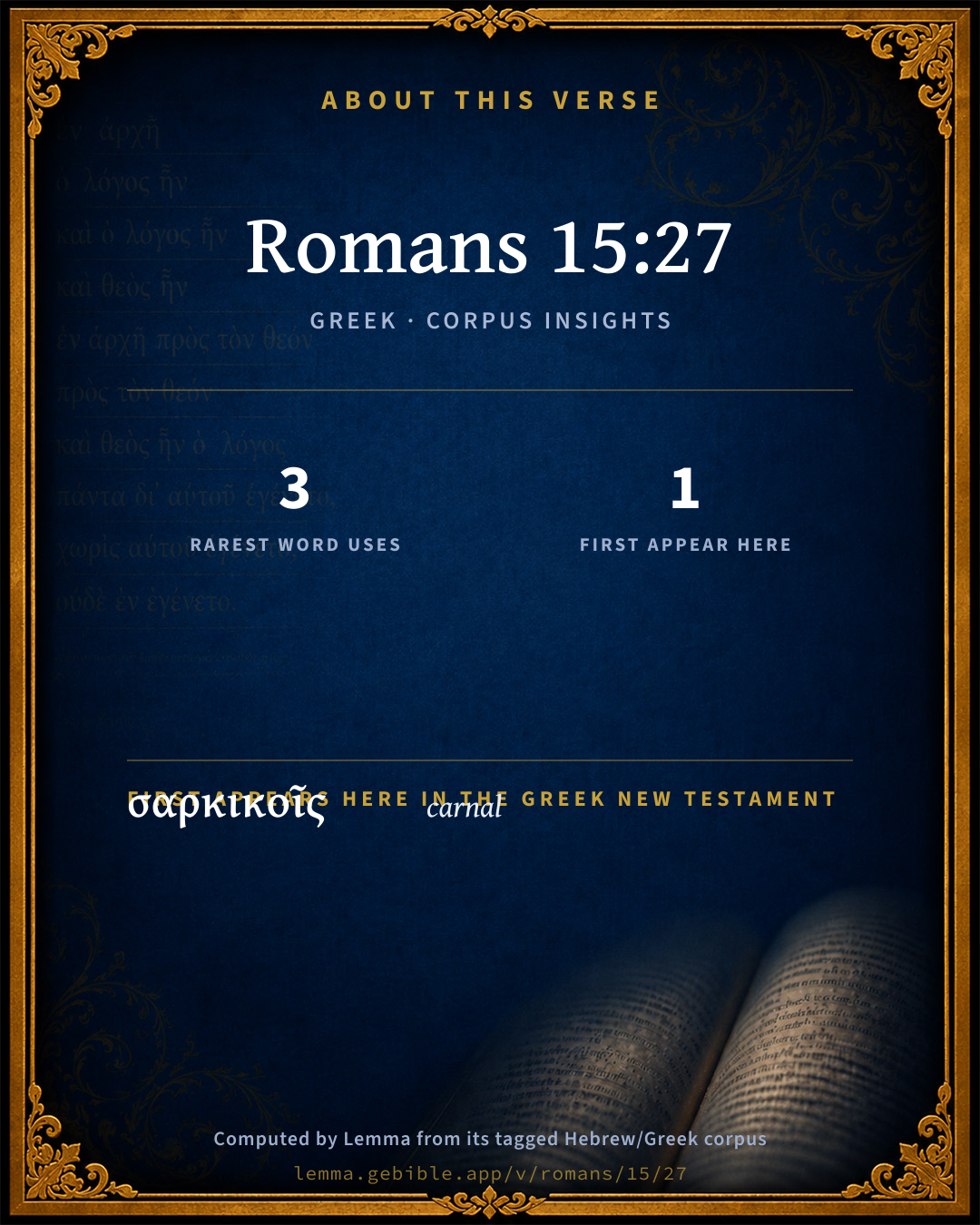
The rarest word here is λειτουργῆσαι to serve G3008 — appearing just 3 times in the whole Greek New Testament.

First appearance in Scripture

This word makes its first canonical appearance in the Greek New Testament here:

  • σαρκικοῖς carnal G4559

Shared distinctive vocabulary

λειτουργῆσαι to serve G3008 occurs in 3 verses of the Greek New Testament. Also found in:
Repetition

Words recur within this verse:

Cross-references

4

Topical passages linked to Romans 15:27 in the Treasury of Scripture Knowledge — connected by theme and wording, ordered by reader-vote popularity; previews shown in the World English Bible.

  • 1 Corinthians 9:11 If we sowed to you spiritual things, is it a great thing if we reap your fleshly things?
  • Galatians 6:6 But let him who is taught in the word share all good things with him who teaches.
  • Philemon 1:19 I, Paul, write this with my own hand: I will repay it (not to mention to you that you owe to me even your own self besides).
  • Romans 11:17 But if some of the branches were broken off, and you, being a wild olive, were grafted in among them, and became partaker with them of the root and of the richness of the olive tree;

Cross-references courtesy of OpenBible.info (CC BY 4.0).

Commentary

Notes on Romans 15:27 from classic Christian and Jewish commentators (each source and its license shown beneath its notes). The classic Christian expositions comment on the surrounding passage and are grouped to its opening verse, so a note may address several verses; the Jewish commentaries on the Tanakh (Rashi and others) are per-verse, so they appear only where the commentator wrote on this verse.

Lemma curates 59 commentaries, every one of them public domain or Creative Commons licensed, each selected and text-cleaned for this edition rather than reprinted as found. About our sources →

Tyndale Open Study Notes

Tyndale Open Resources

15:27 they owe a real debt: Gentile Christians owe their spiritual existence to God’s work among the Israelites (see 11:17-24).

Tyndale Open Study Notes — © Tyndale Open Resources, licensed CC BY-SA 4.0. Text via the HelloAO Bible API.

Bengel's Gnomon

Johann Albrecht Bengel

Rom 15:27. Εὐδόκησαν γὰρ, for they have been pleased) supply, I say, comp. the beginning of the preceding verse. Pleased, and debt, are twice mentioned.—καὶ, and) Liberty and necessity in good works are one and the same [found together].—εἰ γὰρ, for if) This mode of reasoning applies also to the Romans; he therefore mildly invites and admonishes them, in this epilogue of the epistle, to contribute: comp. ch. Rom 12:13.—ὀφειλουσι, they owe it) by virtue of the debt of brotherly kindness, 2Co 9:7.—λειτουργῆσαι, to minister) The inferior ministers to the superior.

Bengel's Gnomon of the New Testament — English translation (T&T Clark, Edinburgh, 1860) — public domain. Text from a community e-Sword module.

Meyer's Critical & Exegetical Commentary

Heinrich August Wilhelm Meyer

Rom_15:27. Information, why they did so, by way of more precisely defining the mere εὐδοκήσαν previously expressed.[30] They have been pleased, namely, to do it, and (this is the added element) their debtors they are.

The Gentiles have acquired a share (ἐκοινώνησαν) in the spiritual possession of the Christians of Jerusalem (ΑὐΤῶΝ), in so far as the mother church of Christianity was in Jerusalem, so that thus the spiritual benefits of Christianity, which in the first instance were destined for and communicated to the Jews and subsequently passed over also to the Gentiles, have been diffused from Jerusalem forth over the Gentile world (which march of diffusion so begun continues), as indeed in Antioch itself the first church of Gentile Christianity was founded from Jerusalem (Act_11:20).

τοῖς πνευματικ.] for the benefits of Christianity (faith, justification, peace, love, hope, etc.) proceed from the Holy Spirit, are τὰ τοῦ πνεύματος δῶρα: comp. on Eph_1:3.

ΤΟῖς ΣΑΡΚΙΚΟῖς] for the earthly possessions concern the material and physical phenomenal nature of man, which is his bodily form of existence. Comp. 1Co_9:11.

The conclusion is a majori, which they have received, ad minus, with which they are under obligation to requite it. Comp. Chrysostom. By λειτουργῆσαι, Paul places the almsgiving of love under the sacred point of view of a sacrificial service (see on Rom_13:6, Rom_15:16), which is performed for the benefit of the recipients. Comp. 2Co_9:12; Php_2:30; Php_2:25.

That further, as Chrysostom, Calvin, Grotius, and many, including Rückert and Olshausen, assume, Paul intended courteously and gently (Luther) to suggest to the Romans that they should likewise bestow alms on those at Jerusalem, is very improbable, inasmuch as no reason is perceivable why he should not have ventured on a direct summons, and seeing, moreover, that he looked upon the work of collection as concluded, Rom_15:25. Without any particular design in view (Th. Schott thinks that he desired to settle the true relation between the Gentile Christians and the apostle to the Gentiles), he satisfies merely his own evident and warm interest.

[30] Est egregia ἀναφορὰ simul cum ἐπανορθώσει, Grotius.

Meyer — Critical and Exegetical Commentary on the New Testament — English translation by Peter Christie, edited by Frederick Crombie (T&T Clark, 1880) — public domain. Text from a community e-Sword module.

Expositor's Greek Testament

ed. W. Robertson Nicoll

Rom 15:27 . εὐδόκησαν γὰρ : they have resolved, I say. Paul felt bound to let this resolution affect his own conduct even to the extent of delaying his journey westward. Indeed he explains in 2 Cor., chaps. 8 and 9, that he expected great spiritual results, in the way of a better understanding between Jewish and Gentile Christianity, from this notable act of Gentile charity; hence his desire to see it accomplished, and the necessity laid on him to go once more to Jerusalem. ὀφειλέται : cf. Rom 1:14 , Rom 8:12 . The resolve of the Gentile Churches to help the poor Jewish Christians, though generous, was not unmotived; in a sense it was the payment of a debt. τοῖς πνευματικοῖς αὐτῶν : the spiritual things belonging to the Jews in which the Gentiles shared are the Gospel and all its blessings “salvation is of the Jews”. All the gifts of Christianity are gifts of the Holy Spirit. ἐν τοῖς σαρκικοῖς : the carnal things of the Gentiles, in which they minister to the Jews, are those which belong to the natural life of man, as a creature of flesh the universal symbol of these is money. There is the same idea in a similar connection (the support of the Gospel ministry) in 1Co 9:2 In neither place has σαρκικὰ any ethical connotation. λειτουργῆσαι is simply “to minister to”: no official, much less sacerdotal association. Cf. Phi 2:30 .

The Expositor's Greek Testament, edited by W. Robertson Nicoll (1897–1910) — public domain. Text from a community e-Sword module.

International Critical Commentary

27. εὐδόκησαν κ.τ.λ. St. Paul emphasizes the good-will with which this contribution was made by repeating the word εὐδόκησαν; he then points out that in another sense it was only the repayment of a debt. The Churches of the Gentiles owed all the spiritual blessings they enjoyed to that of Jerusalem, ‘from whom is Christ according to the flesh,’ and they could only repay the debt by ministering in temporal things.

πνευματικοῖς … σαρκικοῖς. Both are characteristically Pauline words. 1Co 9:11 εἰ ἡμεῖς ὑμῖν τὰ πνευματικὰ ἐσπείραμεν, μέγα εἰ ῆμεῖς ὑμῶν τὰ σαρκικὰ θερίσομεν; σαρκικοῖς is used without any bad association.

ἐκοινώνησαν. The word κοινωνέω, of which the meaning is of course ‘to be a sharer or participator in,’ may be used either of the giver or of the receiver. The giver shares with the receiver by giving contributions, so Rom 12:13 (quoted on ver. 26); the receiver with the giver by receiving contributions, so here. The normal construction in the N. T. is as here with the dative: once (Heb 2:14) it is used with the genitive, and this construction is common in the O. T. (Lft. on Gal 6:6).

The contributions for the poor in Jerusalem are mentioned in Rom 15:26, Rom 15:27; 1Co 16:1-3; 2Co 9:1 ff; Act 24:17, and form the subject of the ablest and most convincing section in Paley’s Horae Paulinae. Without being in any way indebted to one another, and each contributing some new element, all the different accounts fit and dovetail into one another, and thus imply that they are all historical. ‘For the singular evidence which this passage affords of the genuineness of the Epistle, and what is more important, as it has been impugned, of this chapter in particular, see Paley’s Horae Paulinae, chap. ii. No. 1.’ Jowett, ad loc., and for some further reff. see Introd. § 4.

International Critical Commentary — older volumes (1896–1929), various authors — public domain. Text from a community e-Sword module.

Hodge's Commentary on Romans, Ephesians & First Corinthians

Charles Hodge

Rom_15:26, Rom_15:27

For it hath pleased them of Macedonia and Achaia to make a contribution for the poor saints which are at Jerusalem. To make a contribution, κοινωνίαν τινὰ ποιήσασθαι, to bring about a communion or participation. That is, to cause the poor in Jerusalem to partake of the abundance of the brethren in Achaia. In this way the ordinary intransitive sense of the word κοινωνία is retained. Compare, however, 2Co_9:13, and Heb_13:16, where the transitive sense of the word is commonly preferred. Having mentioned this fact, the apostle immediately seizes the opportunity of showing the reasonableness and duty of making these contributions. This he does in such a way as not to detract from the credit due to the Grecian churches, while he shows that it was but a matter of justice to act as they had done. It hath pleased them verily; and their debtors they are; i.e. It hath pleased them, I say (ga&r, redordiendae rationi inservit), they did it voluntarily, yet it was but reasonable they should do it. The ground of this statement is immediately added: For if the Gentiles have been made partakers of their spiritual things, their duty is also to minister to them in carnal things. If the Gentiles have received the greater good from the Jews, they may well be expected to contribute the lesser. The word (λειτουργῆσαι) rendered to minister, may have the general sense of serving; or it may be used with some allusion to the service being a sacred duty, a kind of offering which is acceptable to God. Nec dubito, quin significet Paulus sacrificii speciem esse, quum de suo erogant fideles ad egestatem fratrum levandam. Sic enim persolvunt quod debent caritatis officium, ut Deo simul hostiam grati odoris offerant: sed proprie hoc loco ad illud mutuum jus compensationis respexit. Calvin. This, however, is not very probable, as the expression is, λειτουργῆσαι αὐτοῖς, to minister to them. The λειτουργία was rendered to the brethren, not to God.

Charles Hodge — Commentary on Romans (1835), First Corinthians (1857), and Ephesians (1856) — public domain. Text from a community e-Sword module.

Geneva Bible (1599)

Geneva Bible translators

To serve the turns.

Alms are voluntary, but yet such as we owe by the law of charity.

Geneva Bible (1599) marginal notes — public domain. Text via Bolls.life.

Jamieson, Fausset & Brown

Robert Jamieson, A. R. Fausset & David Brown

For if the Gentiles have been made partakers of their spiritual things, their duty is also--"they owe it also"

to minister unto them in carnal things--(Compare Co1 9:11; Gal 6:6; and see Luk 7:4; Act 10:2).

Jamieson, Fausset & Brown — Commentary Critical and Explanatory on the Whole Bible (1871) — public domain (CC PDM 1.0). Text via the HelloAO Bible API.

Adam Clarke's Commentary

Verse 27. For if the Gentiles have been made partakers, c.] It was through and by means of the Jews that the Gentiles were brought to the knowledge of God and the Gospel of Christ. These were the spiritual things which they had received and the pecuniary contribution was the carnal things which the Gentiles were now returning.

Adam Clarke's Commentary on the Bible (1810–1826) — public domain. Text from a community e-Sword/MySword module.

John Calvin's Commentaries

27. And their debtors they are, etc. Every one perceives, that what is said here of obligation, is said not so much for the sake of the Corinthians as for the Romans themselves; for the Corinthians or the Macedonians were not more indebted to the Jews than the Romans. And he adds the ground of this obligation, — that they had received the gospel from them: and he takes his argument from the comparison of the less with the greater. He employs also the same in another place, that is, that it ought not to have appeared to them an unjust or a grievous compensation to exchange carnal things, which are immensely of less value, for things spiritual. (2 Corinthians 9:11.) And it shows the value of the gospel, when he declares, that they were indebted not only to its ministers, but also to the whole nation, from whom they had come forth.

And mark the verb λειτουργὢσαι, to minister; which means to discharge one’s office in the commonwealth, and to undergo the burden of one’s calling: it is also sometimes applied to sacred things. Nor do I doubt but that Paul meant that it is a kind of sacrifice, when the faithful gave of their own to relieve the wants of their brethren; for they thus perform that duty of love which they owe, and offer to God a sacrifice of an acceptable odor. But in this place what he had peculiarly in view was the mutual right of compensation.

John Calvin's Commentaries (1540-1563) — public domain. Text from the Calvin Translation Society English edition (1840s-50s) via the Christian Classics Ethereal Library (ccel.org). Calvin's coverage is partial (roughly two-thirds of the Bible); uncommented books and verses are honest gaps, never fabricated. The 19th-century editor's footnotes and remarks are omitted so the notes are faithfully Calvin's own voice.

Ellicott's Commentary for English Readers

(27) It hath pleased them.—It pleased the Macedonians and Achaians to make their contribution. And, indeed, they owed a debt to the church at Jerusalem which it was their duty, so well as they could, to discharge.

A Bible Commentary for English Readers, edited by Charles John Ellicott (1878–1897) — public domain. Text from a community e-Sword module.

The Cambridge Bible for Schools and Colleges

gen. ed. J. J. S. Perowne

27. It hath pleased them verily] Lit. For they were pleased; an exact repetition of the first words of Rom_15:26; a note of kindly irony. St Paul was far from thinking with real coldness of these gifts of Christian love: see 2 Corinthians 8, 9.

and their debtors they are] “Debtors” is emphatic. The two reasons stand side by side; the givers’ goodwill, and their duty.

For if the Gentiles, &c.] Lit. For if (or as) the Gentiles shared in their spiritual things, they are bound even in fleshly things to serve them.—“Even in fleshly things:”—i.e., as well as in spiritual things. Such should be their gratitude as to think no service, however earthly its guise, beneath them.—“To serve them:”—the verb is cognate with the Gr. of “minister,” Rom_15:16; where see note. It is significant here: the Gentiles should look on their charitable gifts as a solemn and sacred service, as at an altar.

The Cambridge Bible for Schools and Colleges (gen. ed. J. J. S. Perowne; Cambridge University Press, 1878–1918) — public domain. Text from a community e-Sword module.

John Gill's Exposition

It hath pleased them verily,.... This is repeated from the former verse, and is designed to point out the spring of this contribution, and the manner in which it was performed: it arose from themselves; it was the pure effect of their good will and pleasure; the first motion was from among themselves; it was their own thought, mind, and will; they were willing of themselves unto it, and begun it of themselves, unasked, and not moved unto it by any other: it was not done by constraint or necessity, but was entirely free; they did not make it for ostentation sake, or to gain the applause of men, but from a principle of love to the poor saints; and which showed itself to be sincere, hearty, and genuine, by deeds, and not bare words: they performed this service with great alacrity and cheerfulness; they gave not sparingly, but largely; it was not a matter of covetousness, but of bounty; and they did it not grudgingly, but cheerfully; they took delight and pleasure in it; their hearts and souls were in it, and yet notwithstanding did but what they ought to do.

And their debtors they are; for being debtors to God for their temporal and spiritual mercies; and to Christ for what he has done for them in redemption, and for what he is to them; and to the Spirit for the influences and operations of his grace upon them, they are debtors to the saints; they are bound to love them; they owe the debt of love to them, as they are in the spiritual relation of the children of God, members of Christ, and brethren one of another; and their paying of this debt to them is, in some sense, reckoned a paying it to the divine persons. Moreover, it was not merely a debt of love which these Gentiles owed, and in this way paid to the believing Jews; but it was a debt of justice and equity; they had received what was of valuable consideration from them, and by their means: Christ himself was of the Jews; hence salvation is said to be of them, Joh 4:22. The writings of the Old Testament were committed to them, and faithfully preserved by them; and from them transmitted to the Gentiles; the apostles were all Jews, under whose ministry they were enlightened, converted, and brought to the knowledge of Christ, and salvation by him; the Gospel of the grace of God came out from among them; it was first preached in Judea, and at Jerusalem; and from thence was carried and spread in the Gentile world; yea, it looks very likely, and is not at all unreasonable to suppose, that the charge of carrying and spreading the Gospel among the Gentiles was at first defrayed by the believing Jews, and out of that common stock and fund which was at Jerusalem; for it was not proper that the apostles, at their first setting out, should take anything of the Gentiles, lest they should be thought to be mercenary persons, who only sought their own worldly advantage: hence the apostle argues from the greater to the lesser,

for if the Gentiles have been partakers of their spiritual things: the Gospel, and the doctrines of it, which are spiritual things; contain and make known spiritual blessings; impart spiritual gifts; in which the Spirit of God is greatly concerned, he is the author of them; he leads men into them; qualifies them to preach them unto others; blesses and succeeds them to the conversion; comfort, and edification of souls; and by means of which he himself is received as a Spirit of illumination, sanctification, and faith: and which doctrines also relate to the spiritual and eternal welfare of the souls and spirits of men; hereby they are enlightened, quickened, comforted, and nourished up unto eternal life: wherefore, since this is the case, and these the favours the Gentiles enjoyed through the Jews,

their duty is also to minister unto them in carnal things; in outward and temporal things; in things pertaining to the flesh; or outward man, for the clothing and nourishment of the body. This he said to stir up the Romans, who were Gentiles also, and under the same obligations to make a contribution for them likewise.

John Gill's Exposition of the Whole Bible (1746–1763) — public domain (CC PDM 1.0). Text via the HelloAO Bible API.

Trapp's Complete Commentary

John Trapp

27 It hath pleased them verily; and their debtors they are. For if the Gentiles have been made partakers of their spiritual things, their duty is also to minister unto them in carnal things.

Ver. 27. Their debtors they are] And so are we to pity and pray for them. See my "True Treasure," sect. 2. chapt. 7.

John Trapp, A Commentary or Exposition upon All the Books of the Old and New Testament (1647–1656) — public domain. Text from a community e-Sword module.

Albert Barnes' Notes on the Bible

Their debtors - The reason he immediately states; compare Rom 1:14.

Of their spiritual things - Have received the gospel by the instrumentality of those who had been Jews; and were admitted now to the same privileges with them.

Carnal things - Things pertaining to the flesh; that is, to this life. On this ground the apostle puts the obligation to support the ministers of the gospel; 1Co 9:11. It becomes a matter of “debt” where the hearer of the gospel “receives,” in spiritual blessings, far more than he confers by supporting the ministry. Every man who contributes his due proportion to support the gospel may receive far more, in return, in his own peace, edification, and in the order and happiness of his family, than his money could purchase in any other way. The “gain” is on his side, and the money is not lost. The minister is not a beggar; and what is necessary to his support is not almsgiving. He has an equitable claim - as much as a physician, or a lawyer, or a teacher of youth has - on the necessaries and comforts of life.

Albert Barnes' Notes on the Bible (1834–1885) — public domain. Text from a community e-Sword/MySword module.

Matthew Poole's English Annotations

It hath pleased them verily; he makes this repetition, as to commend the Grecians, so also to admonish the Romans to the like benevolence.

And their debtors they are; i.e. the Gentiles are debtors to the Jews; though what they sent them was a gift, yet it was also a debt, it was due by the law of charity, Rom 13:8, and by the law of gratitude and equity; they had received from them, and they were obliged in some sort to make returns to them.

For if the Gentiles have been made partakers of their spiritual things, their duty is also to minister unto them in carnal things: by the spiritual things of the Jews, of which the Gentiles were made partakers, you may understand all those things of which mention is made, Rom 9:4,5; more particularly, the gospel, with the ministry and ordinances thereof: the gospel was first preached to the Jews, and from Jerusalem it was spread abroad among the Gentiles: see Luk 24:47; Act 1:4,8. By the carnal things of the Gentiles, you may understand their gold and silver, with all things needful for the sustentation of the body: you have a parallel place in 1Co 9:7.

Matthew Poole's English Annotations on the Holy Bible (1683–1685) — public domain. Text from a community e-Sword/MySword module.

Whedon's Commentary on the Bible

Daniel D. Whedon

27. Spiritual… carnal—or secular. The apostle gave his services to the Church, but he fully believed that the minister was as truly entitled to his compensation as the attorney or the carpenter. It may be his duty to God to go; but man has no right to claim his services for nothing. It is doubtless a great injustice that pays the merchant and the politician a fortune, but pays to the teacher and preacher a pittance on which he painfully economizes in mid-life with a prospect of penury in age.

Daniel D. Whedon (gen. ed.), Commentary on the Old and New Testaments (1874–1909) — public domain. Text from a community e-Sword module.

John Wesley's Explanatory Notes

It hath pleased them; and they are their debtors - That is, they are bound to it, in justice as well as mercy. Spiritual things - By the preaching of the gospel. Carnal things - Things needful for the body.

John Wesley, Explanatory Notes Upon the Whole Bible (1754–1765) — public domain. Text via the GEBible commentary corpus.

McGarvey & Pendleton's Commentaries

J. W. McGarvey

Yea, it hath been their good pleasure [The apostle twice notes the free-will or "good pleasure" nature of this offering. It dropped as the ripe fruit of the orchard; it was not squeezed as cider in the mill]; and their debtors they are. [The Gentiles are indebted to the Jews, and hence their offering is but a proper expression of gratitude.] For if the Gentiles have been made partakers of their spiritual things, they owe it to them also to minister unto them in carnal things . [Salvation is from the Jews ( Joh_4:22 ). If, therefore, the Gentiles received eternal and heavenly treasure from the Jews, how small a matter was it that they make return of temporal and earthly treasure to such benefactors. The Gentile still owes this debt to the Jewish race, for of it came the Christ and the Scriptures. The law here announced might well be remembered by many rich congregations in dealing with their ministers in questions of salary, vacations, etc. (Comp. Luk_16:9 ) By mentioning this offering, Paul sowed good seed in the heart of the Roman Church--seed promising a harvest of liberality.]

J. W. McGarvey (with Philip Y. Pendleton), Commentaries on the New Testament (The Fourfold Gospel, 1914; Acts; and the epistles) — public domain. Text from a community e-Sword/MySword module.

The People's New Testament

B. W. Johnson

27. Their debtors they are. It pleased these Gentile Christians to help those at Jerusalem, and, besides, they were under obligation to them, for the church at Jerusalem was the center from which the gospel had been spread abroad.

Why the need of this contribution for the church at Jerusalem? This is often asked. (1) Because it was mainly composed in the start of the poor. (2) Because it had undergone persecution, and this always impoverishes, not only because members are spoiled of their goods, but because they are driven from their employments. Hence, this church, at the center of conflict, and with a great number of poor, had need of the aid of the saints elsewhere, where they were more favored with the worldly blessings.

B. W. Johnson's The People's New Testament with Notes (1889–1891) — public domain. Electronic text from the Christian Classics Ethereal Library (CCEL) ThML edition.

Cambridge Greek Testament for Schools and Colleges

27. γὰρ corroborates—yes indeed; Blass, p. 274 f.

τοῖς πν.—τοῖς σαρκ. Cf. 1Co 9:11.

λειτουργῆσαι. Cf. Php 2:30 (-ία) 25 (-ος) of service from man to man.

Cambridge Greek Testament for Schools and Colleges (Cambridge University Press, 1896; 21 vols, various authors incl. Carr, Maclear, Plummer, Farrar, Lumby, Moule, M. R. James, Simcox) — public domain. Text from a community e-Sword module.

Alford’s Greek Testament

Henry Alford

27.] The fact is re-stated, with a view to an inference from it, viz. that the εὐδόκησαν was not merely a matter of benevolence, but of repayment: the Gentiles being debtors to the Jews for spiritual blessings. This general principle is very similarly enounced in 1Co 9:11. It is suggested by Grot., al., that by this Paul wished to hint to the Romans the duty of a similar contribution.

Henry Alford, The Greek Testament (1849–1861) — public domain. Text from a community e-Sword module.

Vincent's Word Studies in the New Testament

Marvin R. Vincent

To minister [λειτουργησαι] . See on ch. Rom 13:6. By using this word for priestly service, Paul puts the ministry of almsgiving on the footing of a sacrificial service. It expresses the worship of giving.

Marvin R. Vincent, Word Studies in the New Testament (1887–1900) — public domain. Text from a community e-Sword/MySword module.

Godet's Commentaries

Frédéric Louis Godet

Vv. 27. The repetition of the: “it seemed good to them,” emphasizes still more forcibly the free-will of the churches in this course. They felt themselves impelled to pay this homage to the church from which the gift of salvation had come to them; they even judged that it was a small matter to act thus in a lower domain in behalf of those to whom they owed blessings of an infinitely more precious nature. Paul evidently enlarges thus on this subject, not only to praise the churches of Greece, or with the view of leading the church of Rome immediately to carry out a similar work, but with the intention of awaking in the hearts of his hearers the feeling of a duty which they shall also have the opportunity of fulfilling some time or other. After this episode Paul returns to his principal subject.

Frédéric Louis Godet — Commentaries on Luke, John, Romans, and 1 Corinthians — English translation (T&T Clark, Edinburgh, 1870s–1890s) — public domain. Text from a community e-Sword module.

Lesson kit

Teaching starters — assembled from the data on this page, not authored interpretation. Every prompt links to the verse data it draws on. Edit before teaching.

Romans, in the Pauline Epistles, opens this verse with 21 words (15 distinct Greek lemmas). Its most distinctive word is leitourgéō (“to serve”). A historical commentator’s framing appears above. Read the whole chapter for the surrounding context.

Discussion questions

  1. The word leitourgéō carries the sense “to serve.” How does it shape the verse?
  2. This is the first place “carnal” appears in Scripture (first appears here). What does its debut here establish?
  3. How does Acts 13:2, which shares the word «to serve», read alongside this verse?
  4. What does the repetition of “he” (3× in this one verse) do in this verse?
  5. These translations render this verse differently; the difference is in the English rendering, not the original. What questions does that raise?
  6. Compare how Tyndale Open Study Notes and Bengel's Gnomon read this verse. Where do they agree or differ?

Things to notice

  • 1 word makes its first canonical appearance in Scripture here.
  • These translations choose different wording for 19 words in this verse.
  • “he” occurs 3× in this single verse.
  • 15 distinct Greek lemmas span 21 words in this verse.

Reading settings

Reading text

Shown beneath each verse's original-language words.

Old Testament
Old Testament edition

Read the OT as the Masoretic Hebrew (MT) or the Greek Septuagint (LXX).

English shown for the Greek Septuagint (in the Hebrew ↔ Greek comparison).

Comparing translations? Open the Compare panel on any verse page to stack up to four side by side.