Mark 13:10

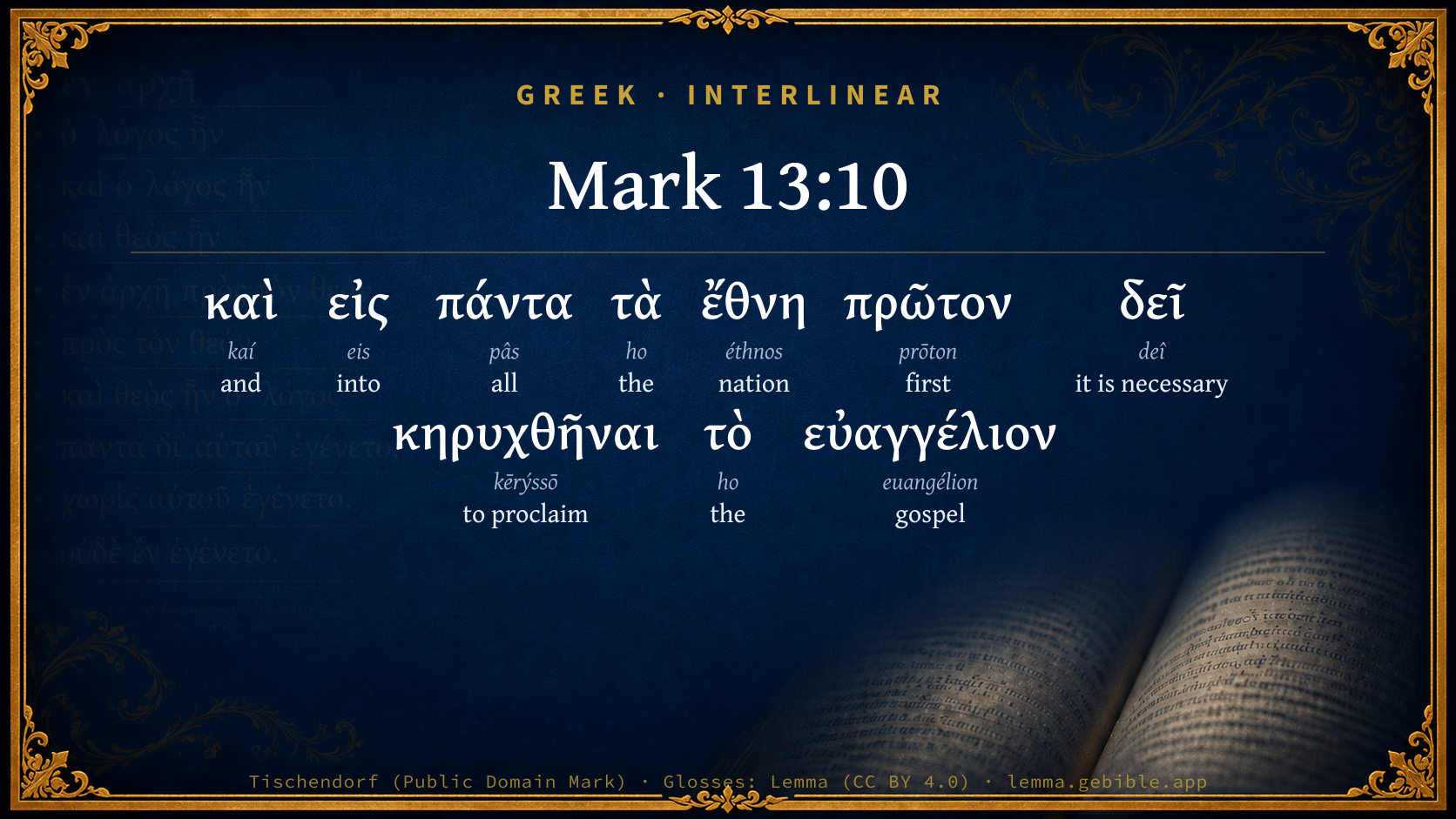
Greek (Tischendorf 8th ed.) Mark 13:10 appears in the Greek New Testament. The text above is from the Tischendorf 8th edition. Each word links to its Strong’s number and a concise gloss. Click any word for its full Thayer’s Greek Lexicon entry.
Download image
Cite this verse

Mark 13:10 (World English Bible). Public Domain. Lemma interlinear Bible study tool, https://lemma.gebible.app/v/mark/13/10.

Show BibTeX & RIS
BibTeX
RIS
English Translation
The Gospel must first be preached to all the nations.
World English Bible · Public Domain
Download a study sheet

One document with this verse’s original text, its word-by-word gloss line, the meaning frame, cross-references with their text, attributed commentary, and full source and license credits — printable, and it pastes into notes with its structure intact.

This verse Autodidact and up

Study sheet (.html) Plain text (.txt)

A passage Seminary Student

Up to 50 verses in one chapter. A passage sheet keeps up to 6 commentary sources and 12 cross-references per verse, in the order this page ranks them, and says so on the sheet whenever that leaves anything out. Ask for a single verse and you get the Autodidact verse sheet above.

Everything on this page stays free to read, with no account — the sheet is a download of what is already on screen, not access to it.

Want to remove ads? Support Godless Engineer
Compare translations 3

The same verse in 3 English versions, stacked beneath the original-language interlinear above. Click any original word for its lexicon entry.

Each is an independent rendering of the whole verse — the interlinear is not word-aligned to these translations.

Highlighted words mark where these versions differ — a whole-verse word diff, not a word-by-word alignment.

  • World English Bible Public Domain
    The Gospel must first be preached to all the nations.
  • King James Version Public Domain
    And the gospel must first be published among all nations.
  • unfoldingWord Literal Text CC BY-SA 4.0
    And first, it is necessary for the gospel to be proclaimed to all the nations.

unfoldingWord Literal Text — © unfoldingWord, licensed CC BY-SA 4.0. Word-aligned USFM3 via Door43 (git.door43.org/unfoldingWord/en_ult).

Versions to compare (up to 4)

3 of 4 selected

Show all 19 translations

Every available English version of this verse, each an independent rendering of the whole verse.

  • World English Bible Public Domain
    The Gospel must first be preached to all the nations.
  • Berean Standard Bible Public Domain
    And the gospel must first be proclaimed to all the nations.
  • Majority Standard Bible Public Domain
    And the gospel must first be proclaimed to all the nations.
  • King James Version Public Domain
    And the gospel must first be published among all nations.
  • American Standard Version (1901) Public Domain
    And the gospel must first be preached unto all the nations.
  • Revised Version (1885) Public Domain
    And the gospel must first be preached unto all the nations.
  • Geneva Bible (1599) Public Domain
    And the Gospel must first be published among all nations.
  • Douay-Rheims (1899) Public Domain
    And unto all nations the gospel must first be preached.
  • Young's Literal Translation Public Domain
    and to all the nations it behoveth first that the good news be proclaimed.
  • Literal Standard Version CC BY-SA 4.0
    and to all the nations it is first necessary that the good news be proclaimed.
  • Unlocked Literal Bible CC BY-SA 4.0
    But the gospel must first be proclaimed to all the nations.
  • unfoldingWord Literal Text CC BY-SA 4.0
    And first, it is necessary for the gospel to be proclaimed to all the nations.
  • Darby Bible Public Domain
    and the gospel must first be preached to all the nations.
  • World Messianic Bible Public Domain
    The Good News must first be preached to all the nations.
  • Webster's Bible Public Domain
    And the gospel must first be published among all nations.
  • Free Bible Version CC BY-SA 4.0
    The good news must first be announced in every nation.
  • Bible in Basic English Public Domain
    And the good news has first to be given to all the nations.
  • Text-Critical English NT CC BY 4.0
    And the gospel must first be proclaimed to all nations.
  • Tyndale New Testament (1534) Public Domain
    And the gospell must fyrste be publysshed amonge all nacions.

Literal Standard Version (2020), Covenant Press — licensed CC BY-SA 4.0. Text via the HelloAO Bible API (eBible.org). Unlocked Literal Bible (unfoldingWord) — licensed CC BY-SA 4.0. Text via the HelloAO Bible API (eBible.org). unfoldingWord Literal Text — © unfoldingWord, licensed CC BY-SA 4.0. Word-aligned USFM3 via Door43 (git.door43.org/unfoldingWord/en_ult). Free Bible Version, Dr. Jonathan Gallagher — licensed CC BY-SA 4.0. Text via the HelloAO Bible API (eBible.org).

Word by word

More ways to search: Search by grammar → Find every occurrence → Compare this word →

Practice this passage: Drill this verse → Learn its vocabulary →

About this verse

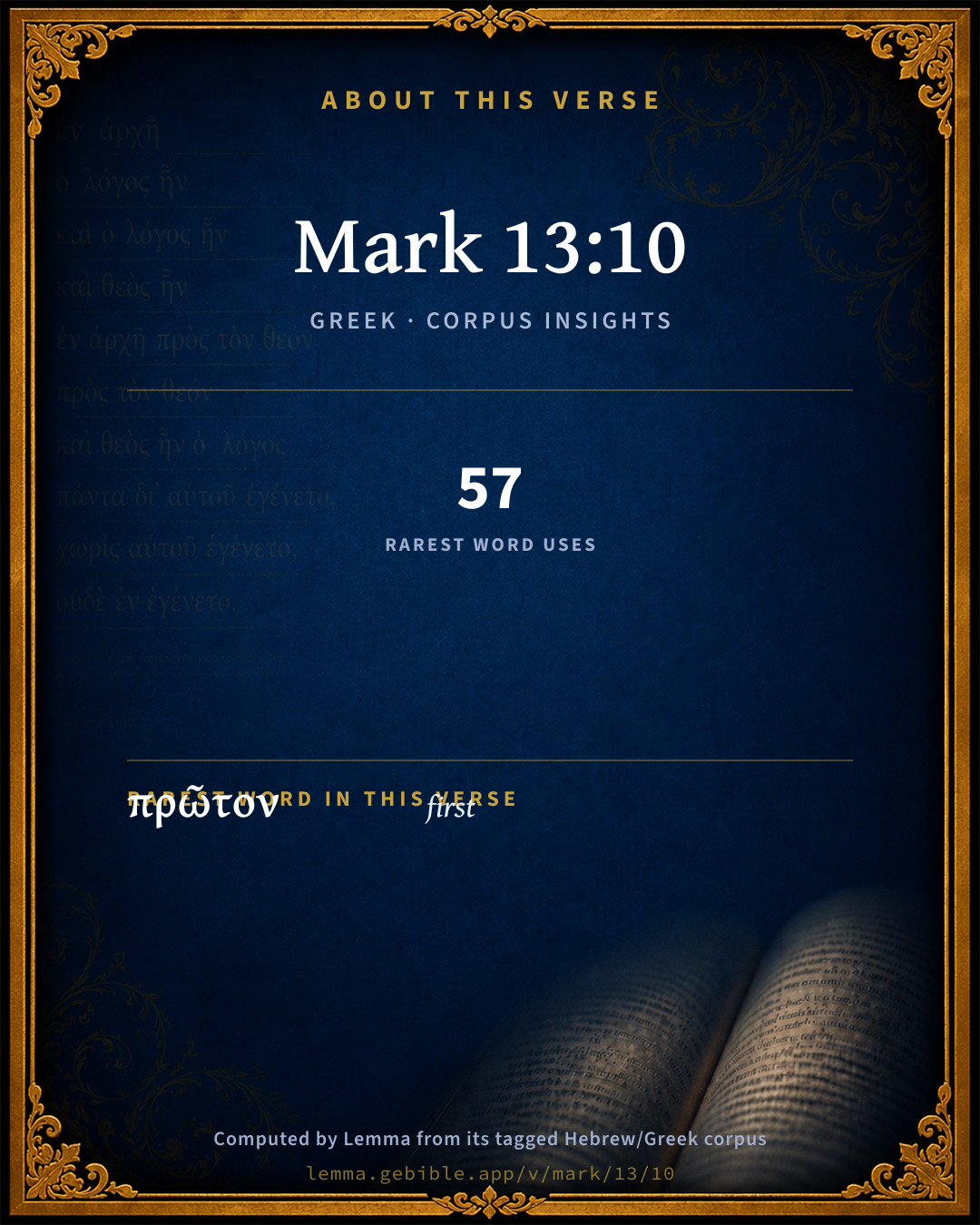
These counts appear in no published source. They are computed here, from the morphology-tagged text and Lemma’s own curated glosses. What Lemma adds →

10
words
9
distinct lemmas
Gospels
section

Shared distinctive vocabulary

πρῶτον first G4412 occurs in 57 verses of the Greek New Testament. Also found in:

Repetition

A word recurs within this verse:

Cross-references

9

Topical passages linked to Mark 13:10 in the Treasury of Scripture Knowledge — connected by theme and wording, ordered by reader-vote popularity; previews shown in the World English Bible.

  • Matthew 24:14 This Gospel of the Kingdom will be preached in the whole world for a testimony to all the nations, and then the end will come.
  • Colossians 1:23 if it is so that you continue in the faith, grounded and steadfast, and not moved away from the hope of the Gospel which you heard, which is being proclaimed in all creation under heaven; of which I, Paul, was made a servant.
  • Mark 16:15 He said to them, "Go into all the world, and preach the Gospel to the whole creation.
  • Romans 10:18 But I say, didn't they hear? Yes, most assuredly, "Their sound went out into all the earth, Their words to the ends of the world."
  • Colossians 1:6 which has come to you; even as it is in all the world and is bearing fruit and growing, as it does in you also, since the day you heard and knew the grace of God in truth;
  • Revelation 14:6 I saw an angel flying in mid heaven, having an eternal Gospel to proclaim to those who dwell on the earth, and to every nation, tribe, language, and people.
  • Matthew 28:18–19 Jesus came to them and spoke to them, saying, "All authority has been given to me in heaven and on earth.
  • Romans 1:8 First, I thank my God through Jesus Christ for all of you, that your faith is proclaimed throughout the whole world.
  • Romans 15:19 in the power of signs and wonders, in the power of God's Spirit; so that from Jerusalem, and around as far as to Illyricum, I have fully preached the Gospel of Christ;

Cross-references courtesy of OpenBible.info (CC BY 4.0).

Commentary

Notes on Mark 13:10 from classic Christian and Jewish commentators (each source and its license shown beneath its notes). The classic Christian expositions comment on the surrounding passage and are grouped to its opening verse, so a note may address several verses; the Jewish commentaries on the Tanakh (Rashi and others) are per-verse, so they appear only where the commentator wrote on this verse.

Lemma curates 59 commentaries, every one of them public domain or Creative Commons licensed, each selected and text-cleaned for this edition rather than reprinted as found. About our sources →

The Biblical Illustrator

Joseph S. Exell

Mar_13:10

And the gospel must first be published among all nations.

Extent of apostolic missionary labours

Doubtless this prediction will only receive its complete accomplishment in the secondary application of the prophesy, but we hardly realize how near it was to fulfilment before the destruction of Jerusalem. The Acts of the Apostles fill us with amazement at the rapid progress of Christianity in Europe and Asia, under the teaching of two of them. What should we not learn if the whole Twelve had found chroniclers to record their labours? Scattered traditions, with more or less of certainty, show at least this, that missionary work was carried on throughout the then known world. There is little doubt that St. Thomas established the church in Parthia and on the shores of India; that St. Andrew penetrated far into Russia; that Bartholomew preached in Arabia and among the fire worshippers of Persia; and it has been said that even Central Africa, which the present generation burns to win back to Christ, was the scene of St. Matthews labours eighteen centuries ago. St. Pauls appeal to the hope of the gospel which was preached to every creature which is under heaven (Col_1:23), though doubtless written with Oriental exaggeration, testifies to a widespread diffusion of the truth. (H. M. Luckock, D. D.)

Progress of the gospel

I remember hearing a story in connection with our battlefields. One weary, dreary night, while our army was on the eve of a great and important battle, a soldier paced up and down before the tent of his general. Wearied with his work, he began to sing half to himself, When I can read my title clear. After a little his voice grew louder, and he sang the hymn as though it were a song of victory. His tones rang out on the still night air. After a little another soldier, off yonder, hearing the music, and fascinated by it, joined in. There was a duet. A little longer, and another voice, farther off, joined, and there was a chorus, and it was not long before the whole army, as far as the mind could reach on either side, were joining in that wondrous chorus, and singing in the presence of the enemy,

When I can read my title clear,

To mansions in the sky.

Well, brethren, when I heard the story, it seemed to me that I could see in the far-off distance that wondrous carpenters Son of Nazareth, standing alone and singing, Glory to God in the highest, and on earth peace and goodwill to men. After a little twelve disciples took up the refrain, and joined in the chorus. After a little longer, in the next century, a still larger company gathered and sang it with all their hearts. In the next century a still larger number added their voices, and now, after eighteen hundred years have gone by, the music of that wondrous song, which began with Him who stood in His fathers workshop, is sung, and echoed, and re-echoed the whole wide world over. It is our revelation from God, and it is the impulse that lifts us all up to God. (Christian Mirror.)

The Biblical Illustrator, edited by Joseph S. Exell (c. 1880s–1900s) — public domain. Text from a community e-Sword module.

Joseph Benson's Commentary

Mar 13:10. The gospel must first be published among all nations — “The fulfilment of this part of the prophecy we learn chiefly from the writings of the New Testament, which inform us that the gospel was preached by Paul in Arabia, and through the vast tract from Jerusalem to Iconium in Lycaonia, and in Galatia, and through all Asia Minor, and in Greece, and round about to Illyricum, and in Crete and Italy, probably also in Spain and Gaul. Besides, the gospel reached much farther than this apostle carried it; for we find him writing to Christians who had never seen his face. Also, we have still remaining Peter’s epistles to the converted Jews in Pontus, Asia, Cappadocia, and Bythynia. Probably the gospel was preached in these and many other countries by the Jews who sojourned there, and who, having come to Jerusalem to the passover, were converted on the day of pentecost. The Ethiopian eunuch, converted by Philip, would carry it likewise into his country. But whatever way it happened, the fact is certain, that in most of these countries churches were planted within thirty years after Christ’s death, or about ten years before the destruction of Jerusalem. Hence we find the apostle telling the Romans, (Rom 10:18,) that the sound of the gospel had gone forth into all the world, and that the faith of the Christians at Rome was spoken of throughout the world, chapter Mar 1:8. And hence, too, he tells the Col 1:23, that the truth of the gospel was come to all the world, and was preached to every creature. And when Mark wrote his gospel the apostles had gone forth, and preached everywhere, Mar 16:20. The preaching of the gospel, through the whole world, by twelve illiterate fishermen, and the destruction of Jerusalem, were events extremely improbable, and therefore the prediction and accomplishment of them deserve to be particularly taken notice of; and the rather, because they were both absolutely necessary for bringing about the conversion of the world to Christianity, and are mentioned in this prophecy as such.” — Macknight.

Joseph Benson's Commentary on the Old and New Testaments (1811–1818) — public domain. Text from a community e-Sword module.

Tyndale Open Study Notes

Tyndale Open Resources

13:10 Such trials (13:9, 11) would be a means through which the Good News would be preached to all nations. This would all take place first—i.e., before the destruction of Jerusalem. For Paul’s understanding of how the Good News had already been preached to every nation in his day, see Rom 16:26; Col 1:6, 23 (see also Rom 1:5, 8; 10:18; 15:19, 23).

Tyndale Open Study Notes — © Tyndale Open Resources, licensed CC BY-SA 4.0. Text via the HelloAO Bible API.

Bengel's Gnomon

Johann Albrecht Bengel

Mar 13:10. Καὶ εἰς, and among) The preaching of the Gospel was helped forward by the very persecutions, Mar 13:9; 2Ti 4:17.—πρῶτον, previously) before that the end shall come, Mar 13:7. [When Jerusalem was being destroyed, already a church was collected from among the Gentiles.—V. g.]

Bengel's Gnomon of the New Testament — English translation (T&T Clark, Edinburgh, 1860) — public domain. Text from a community e-Sword module.

Adam Clarke's Commentary

Verse 10. And the Gospel must first be published among all nations.] Many of the Evangelistaria omit this verse. Its proper place seems to be after verse the thirteenth. Mr 13:13

Adam Clarke's Commentary on the Bible (1810–1826) — public domain. Text from a community e-Sword/MySword module.

The Cambridge Bible for Schools and Colleges

gen. ed. J. J. S. Perowne

10. the gospel must first be published] And even so while many of His hearers were yet alive, the Gospel was proclaimed throughout the Roman Empire, from Arabia to Damascus, from Jerusalem to Illyricum, in Italy and in Spain. Comp. Rom_15:19; Rom_15:24; Rom_15:28; Col_1:6; Col_1:23.

The Cambridge Bible for Schools and Colleges (gen. ed. J. J. S. Perowne; Cambridge University Press, 1878–1918) — public domain. Text from a community e-Sword module.

John Gill's Exposition

And the Gospel must first be published among all nations. The Syriac version reads, "my Gospel"; the Gospel which Christ was the author, subject, and preacher of; this "must be published". There was a necessity of the promulgation of it by the will of God, the command and commission of Christ; and for the gathering in of the Jews, that were the elect of God, "among all nations" of the world, especially in the Roman empire; and that "first", or before the destruction of Jerusalem; See Gill on Mat 24:14.

.

Mark 13:11

mar 13:11

mar 13:11

mar 13:11But when they shall lead you, and deliver you up,.... Lead to councils and courts of judicature, and deliver up to kings and rulers, to the civil magistrate, to be punished by the secular arm:

take no thought before hand; be not previously anxious, and carefully solicitous, in a distressing way:

what ye shall speak: to kings and rulers, by way of apology for yourselves, and your own innocence, and in defence of the Gospel:

neither do ye premeditate; or "meditate", as the generality of copies read: Beza says in one copy it is read, "premeditate": and so in one of Stephens's, as we render it: this clause is omitted in the Vulgate Latin, Arabic, and Ethiopic versions:

but whatsoever shall be given you in that hour; whatever shall be immediately suggested to your thoughts, be put into your minds, and laid upon your hearts:

that speak ye; freely and boldly without the fear of men:

for it is not ye that speak, but the Holy Ghost: not but that they did speak, but they were not the principal authors, either of the matter they spoke, or of the words and language in which they spoke; they were only the instruments of the Holy Ghost; they spoke as they were moved by him: hence their wisdom and eloquence in their self-defence, were amazing, and their arguments strong and unanswerable; See Gill on Mat 10:19, Mat 10:20,

John Gill's Exposition of the Whole Bible (1746–1763) — public domain (CC PDM 1.0). Text via the HelloAO Bible API.

Trapp's Complete Commentary

John Trapp

10 And the gospel must first be published among all nations.

Ver. 10. Among all nations] i.e. Among other nations than the Jews.

John Trapp, A Commentary or Exposition upon All the Books of the Old and New Testament (1647–1656) — public domain. Text from a community e-Sword module.

Matthew Poole's English Annotations

I am prone to think that our Lord gives this not only as a sign of the destruction of Jerusalem, but of the end of the world, and the latter principally; for before the destruction of Jerusalem (which was in less than forty years after Christ’s death) the gospel was not preached to all nations, otherwise than as all signifies very many. And I do think that all places shall have the gospel preached to them before the day of judgment, after another manner than either it was possible it should be preached to them within forty years after the death of Christ, or than many places have had it preached amongst them to this day. For though the Holy Scriptures, and ecclesiastical historians, give us a somewhat large account of the gospel being preached in Europe, Asia, and in Africa, yet we have little account from any of them of its being preached in America. I am not wholly ignorant of what those writers tell us, of Thomas the apostle’s preaching to the Indians, and of Trumentius and his colleague, but there are very few preachers that any stories give an account of gone to the Indians, whither I believe the gospel must go before that Christ comes to judgment.

Matthew Poole's English Annotations on the Holy Bible (1683–1685) — public domain. Text from a community e-Sword/MySword module.

The Pulpit Commentary

And the gospel must first be preached unto all the nations. St. Matthew (Mat_24:14) says it shall be preached "in the whole world, for a testimony unto all the nations" (en olh th oikoumenh eiv marturion). This literally took place, as far as the inhabited world was concerned at that time, before the destruction of Jerusalem. St. Paul (Rom_10:18) reminds us that "their sound is gone out into all lands, and their words unto the ends of the world;" and he tells the Colossians (Col_1:6) that the gospel was come unto them, and was bearing fruit and increasing in all the world. But even if we regard these expressions as somewhat hyperbolic, it is unquestionable that before the armies of Titus entered Jerusalem, the gospel had been published through the principal parts and provinces of the then inhabited world (oikoumenh). And it is certainly a wonderful fact that within fifty years after the death of Christ, Christian Churches had been planted in almost every district of the earth as then known to the Romans. But if we extend these prophetical sayings so as to reach onwards to the end of all things, we must then understand the expression, "all the nations," in its most unrestricted sense; so that the prophecy announces the universal proclamation of the gospel over the whole inhabited earth as an event which is to precede the time of the end. It is interesting to observe the difference in the amount of knowledge possessed by us of this earth and its population at the present time, as compared with the knowledge which men had of it at the time when our Lord delivered this prediction. It was not until the beginning of the sixteenth century, nearly fifteen hundred years after Christ, that Christopher Columbus and Amerigo Vespucci laid open that other hemisphere which takes its name from Amerigo; and there are few facts more interesting to a philosophic mind than the discovery of this new continent, now so important to us in England as the chief receptacle, together with Australia, of our redundant population. But this new world, as we call it, although there are material evidences that portions of it at least were occupied in very remote times by men of high civilization, was present to the mind of our Lord when he said that "the gospel must first be preached unto all the nations." So that the prophecy expands, as the ages roll onwards and the population of this earth increases; and it still demands its fulfillment, embracing the vast multitudes now dwelling on the face of the earth to the number of about 1, 450, 000, 000. Such a consideration may well lead us to the inference that we are now approaching sensibly nearer to the end of the world. There are no other new worlds like America or Australia now to be discovered. The whole face of the earth is now laid open to us; and there is now hardly any part of the world which has not at some time or other received the message of salvation.

The Pulpit Commentary (1880–1919), ed. H.D.M. Spence-Jones & Joseph S. Exell — public domain. Text from a community e-Sword module.

John Wesley's Explanatory Notes

Matt. xxiv, 14.

John Wesley, Explanatory Notes Upon the Whole Bible (1754–1765) — public domain. Text via the GEBible commentary corpus.

Scofield Reference Notes

C. I. Scofield

And

Cf. Mat 24:14 "Gospel of the Kingdom:" See note, Rev 14:6 (See Scofield "Rev 14:6").

The Scofield Reference Bible (1917 edition), notes by C. I. Scofield — public domain. Text from a community e-Sword module.

Cambridge Greek Testament for Schools and Colleges

10. εἰς πάντα τὰ ἔθνη. First, with emphasis. Gentile readers would appreciate the significance of this, which is clearly brought out in Mk. Cf. Mar 11:17; Mar 14:9. The Gospel is for all mankind.

δεῖ κηρυχθῆναι τὸ εὐαγγ. A glorious compensation for the δεῖ γενέσθαι in Mar 13:7. It is a Divine decree that to all the nations, before the end comes, the good tidings must be proclaimed. Note the order of the words. See on Mar 1:14-15, and cf. Mat 28:19; Luk 24:47. It is probable that in all three Gospels this eschatological discourse is augmented by the insertion of Sayings, the setting of which had been lost. Hence the difficulty of interpreting it as a whole.

Cambridge Greek Testament for Schools and Colleges (Cambridge University Press, 1896; 21 vols, various authors incl. Carr, Maclear, Plummer, Farrar, Lumby, Moule, M. R. James, Simcox) — public domain. Text from a community e-Sword module.

International Critical Commentary

10. Κ. εἰς πάντα τὰ ἔθνη—And in all the nations must the glad tidings first be heralded. This is suggested by the mention of Gentile rulers in the preceding. It is a part of that, moreover, which makes it necessary for them to look out for themselves during this period. They are to be subject not only to private persecutions, but to governmental oppositions, and under that pressure they are nevertheless to become heralds of the good news of the kingdom of God in every nation, before the end comes. Hence they have themselves to look out for, and not rumors and portents and signs. Moreover, this shows what he means by the care of themselves that he enjoins upon them. It is not care for their safety, but for their spiritual condition in the face of such opposition, and of so difficult a work.

International Critical Commentary — older volumes (1896–1929), various authors — public domain. Text from a community e-Sword module.

Lesson kit

Teaching starters — assembled from the data on this page, not authored interpretation. Every prompt links to the verse data it draws on. Edit before teaching.

Mark, in the Gospels, opens this verse with 10 words (9 distinct Greek lemmas). Its most distinctive word is prōton (“first”). A historical commentator’s framing appears above. Read the whole chapter for the surrounding context.

Discussion questions

  1. The word prōton carries the sense “first.” How does it shape the verse?
  2. Matthew 5:24 shares the word «first» with this verse. How do the two illuminate each other?
  3. “the” occurs 2× in this one verse. What is the effect of the repetition?
  4. These translations render this verse differently; the difference is in the English rendering, not the original. What questions does that raise?
  5. Reading how The Biblical Illustrator and Joseph Benson's Commentary read this verse, where do the two commentators agree and where do they part?

Things to notice

  • These translations choose different wording for 6 words in this verse.
  • “the” occurs 2× in this single verse.
  • 9 distinct Greek lemmas span 10 words in this verse.

Reading settings

Reading text

Shown beneath each verse's original-language words.

Old Testament
Old Testament edition

Read the OT as the Masoretic Hebrew (MT) or the Greek Septuagint (LXX).

English shown for the Greek Septuagint (in the Hebrew ↔ Greek comparison).

Comparing translations? Open the Compare panel on any verse page to stack up to four side by side.