

Acts 8:9
Greek (Tischendorf 8th ed.) Acts 8:9 appears in the Greek New Testament. The text above is from the Tischendorf 8th edition. Each word links to its Strong’s number and a concise gloss. Click any word for its full Thayer’s Greek Lexicon entry.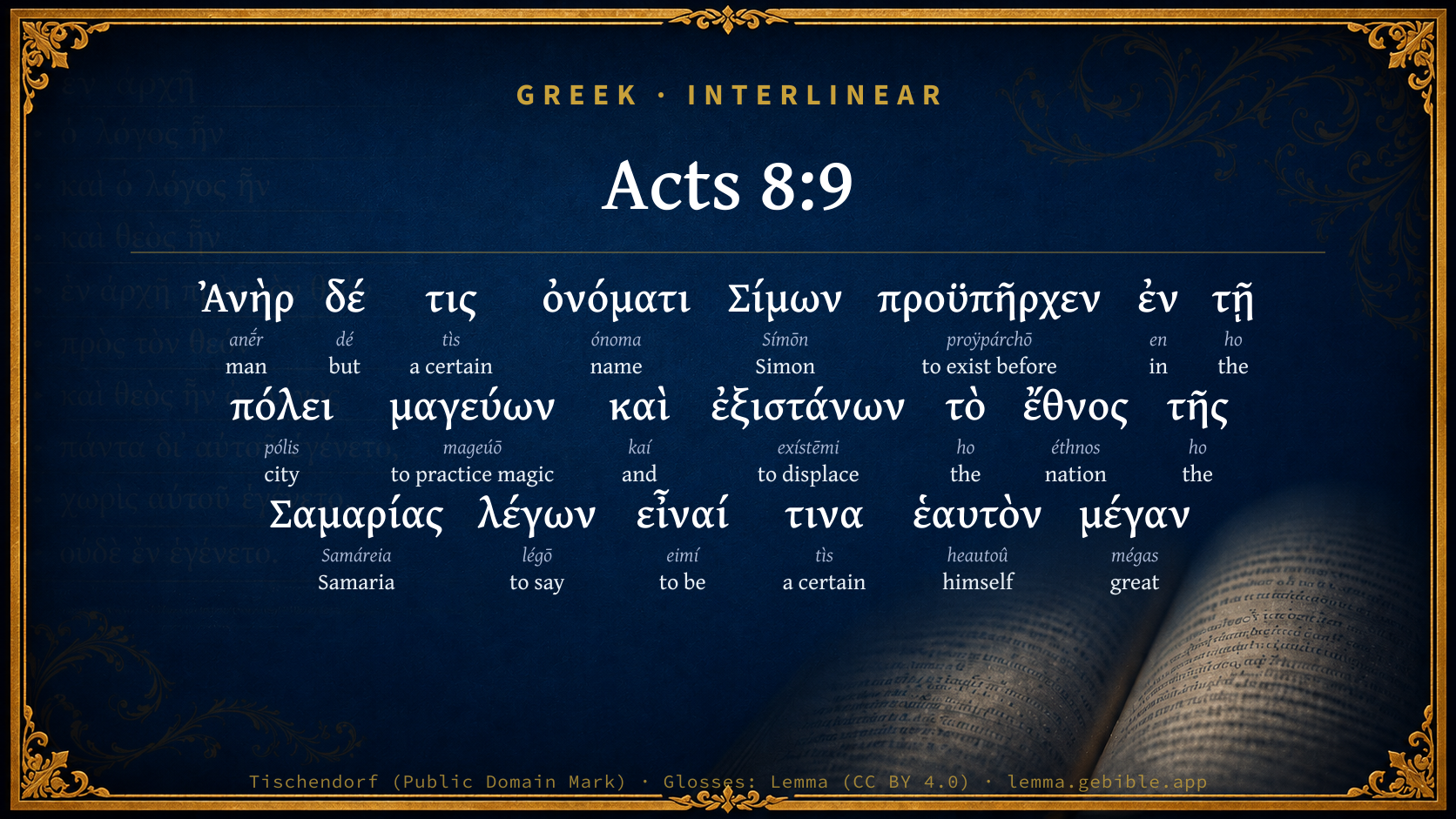
But there was a certain man, Simon by name, who used to practice sorcery in the city, and amazed the people of Samaria, making himself out to be some great one,
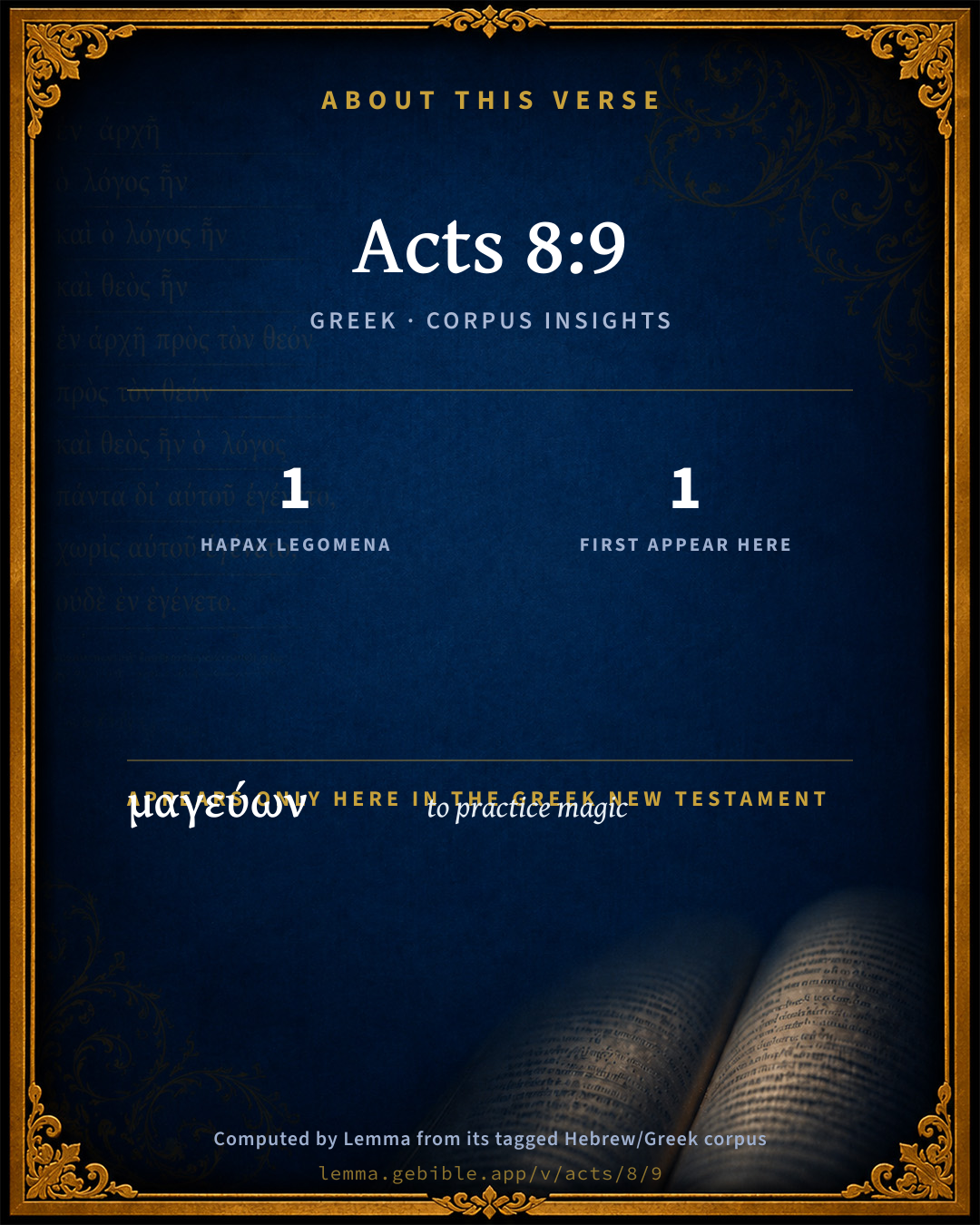
- 1 hapax legomenon — only here in the Greek New Testament
- 1 first appearance in the Greek New Testament
Download a study sheet
One document with this verse’s original text, its word-by-word gloss line, the meaning frame, cross-references with their text, attributed commentary, and full source and license credits — printable, and it pastes into notes with its structure intact.
This verse Autodidact and up
A passage Seminary Student
Up to 50 verses in one chapter. A passage sheet keeps up to 6 commentary sources and 12 cross-references per verse, in the order this page ranks them, and says so on the sheet whenever that leaves anything out. Ask for a single verse and you get the Autodidact verse sheet above.
Everything on this page stays free to read, with no account — the sheet is a download of what is already on screen, not access to it.
Compare translations 3
The same verse in 3 English versions, stacked beneath the original-language interlinear above. Click any original word for its lexicon entry.
Each is an independent rendering of the whole verse — the interlinear is not word-aligned to these translations.
Highlighted words mark where these versions differ — a whole-verse word diff, not a word-by-word alignment.
-
World English Bible Public Domain
But there was a certain man, Simon by name, who used to practice sorcery in the city, and amazed the people of Samaria, making himself out to be some great one,
-
King James Version Public Domain
But there was a certain man, called Simon, which beforetime in the same city used sorcery, and bewitched the people of Samaria, giving out that himself was some great one:
-
unfoldingWord Literal Text CC BY-SA 4.0
But a certain man, Simon by name, was already practicing sorcery in the city and astonishing the people of Samaria, saying himself to be someone great,
unfoldingWord Literal Text — © unfoldingWord, licensed CC BY-SA 4.0. Word-aligned USFM3 via Door43 (git.door43.org/unfoldingWord/en_ult).
Show all 19 translations
Every available English version of this verse, each an independent rendering of the whole verse.
-
World English Bible Public Domain
But there was a certain man, Simon by name, who used to practice sorcery in the city, and amazed the people of Samaria, making himself out to be some great one,
-
Berean Standard Bible Public Domain
Prior to that time, a man named Simon had practiced sorcery in the city and astounded the people of Samaria. He claimed to be someone great,
-
Majority Standard Bible Public Domain
Prior to that time, a man named Simon had practiced sorcery in the city and astounded the people of Samaria. He claimed to be someone great,
-
King James Version Public Domain
But there was a certain man, called Simon, which beforetime in the same city used sorcery, and bewitched the people of Samaria, giving out that himself was some great one:
-
American Standard Version (1901) Public Domain
But there was a certain man, Simon by name, who beforetime in the city used sorcery, and amazed the people of Samaria, giving out that himself was some great one:
-
Revised Version (1885) Public Domain
But there was a certain man, Simon by name, which beforetime in the city used sorcery, and amazed the people of Samaria, giving out that himself was some great one:
-
Geneva Bible (1599) Public Domain
And there was before in the citie a certaine man called Simon, which vsed witchcraft, and bewitched the people of Samaria, saying that he himselfe was some great man.
-
Douay-Rheims (1899) Public Domain
There was therefore great joy in that city. Now there was a certain man named Simon, who before had been a magician in that city, seducing the people of Samaria, giving out that he was some great one:
-
Young's Literal Translation Public Domain
And a certain man, by name Simon, was before in the city using magic, and amazing the nation of Samaria, saying himself to be a certain great one,
-
Literal Standard Version CC BY-SA 4.0
And a certain man, by name Simon, was previously in the city using magic, and amazing the nation of Samaria, saying himself to be a certain great one,
-
Unlocked Literal Bible CC BY-SA 4.0
But there was a certain man in the city named Simon, who had earlier been practicing sorcery; he used to astonish the people of Samaria, while claiming that he was an important person.
-
unfoldingWord Literal Text CC BY-SA 4.0
But a certain man, Simon by name, was already practicing sorcery in the city and astonishing the people of Samaria, saying himself to be someone great,
-
Darby Bible Public Domain
But a certain man, by name Simon, had been before in the city, using magic arts, and astonishing the nation of Samaria, saying that himself was some great one.
-
World Messianic Bible Public Domain
But there was a certain man, Simon by name, who used to practice sorcery in the city and amazed the people of Samaria, making himself out to be some great one,
-
Webster's Bible Public Domain
But there was a certain man called Simon, who before in the same city used sorcery, and bewitched the people of Samaria, giving out that himself was some great one:
-
Free Bible Version CC BY-SA 4.0
Now there was a man named Simon who lived in the city. He practiced sorcery. He claimed that he was someone very important, and had astounded the people of Samaria
-
Bible in Basic English Public Domain
But there was a certain man named Simon, who in the past had been a wonder-worker and a cause of surprise to the people of Samaria, saying that he himself was a great man:
-
Text-Critical English NT CC BY 4.0
Now a man named Simon had previously practiced magic in the city and amazed the people of Samaria, declaring himself to be someone great.
-
Tyndale New Testament (1534) Public Domain
And ther was a certayne man called Simon which before tyme in the same cite vsed witche crafte and bewitched the people of Samarie sayinge that he was a man that coulde do greate thinges
Literal Standard Version (2020), Covenant Press — licensed CC BY-SA 4.0. Text via the HelloAO Bible API (eBible.org). Unlocked Literal Bible (unfoldingWord) — licensed CC BY-SA 4.0. Text via the HelloAO Bible API (eBible.org). unfoldingWord Literal Text — © unfoldingWord, licensed CC BY-SA 4.0. Word-aligned USFM3 via Door43 (git.door43.org/unfoldingWord/en_ult). Free Bible Version, Dr. Jonathan Gallagher — licensed CC BY-SA 4.0. Text via the HelloAO Bible API (eBible.org).
Word by word
More ways to search: Search by grammar → Find every occurrence → Compare this word →
Practice this passage: Drill this verse → Learn its vocabulary →
- Appears 1× in the Greek New Testament
- First appears here
- Part of Speech
- Verb
- Tense
- Present
- Voice
- Active
- Mood
- Participle
- Case
- Nominative
- Number
- Singular
- Gender
- Masculine
Full Thayer's Definition
- Ἀνὴρ anḗr G435 “man” Noun, Nominative, Singular, Masculine
- δέ dé G1161 “but” Conjunction
- τις tìs G5100 “a certain” Indefinite pronoun, Nominative, Singular, Masculine
- ὀνόματι ónoma G3686 “name” Noun, Dative, Singular, Neuter
- Σίμων Símōn G4613 “Simon” Noun, Nominative, Singular, Masculine
- προϋπῆρχεν proÿpárchō G4391 “to exist before” Verb, Imperfect, Active, Indicative, 3rd person, Singular
- ἐν en G1722 “in” Preposition
- τῇ ho G3588 “the” Article, Dative, Singular, Feminine
- πόλει pólis G4172 “city” Noun, Dative, Singular, Feminine
- μαγεύων mageúō G3096 “to practice magic” Verb, Present, Active, Participle, Nominative, Singular, Masculine
- καὶ kaí G2532 “and” Conjunction
- ἐξιστάνων exístēmi G1839 “to displace” Verb, Present, Active, Participle, Nominative, Singular, Masculine
- τὸ ho G3588 “the” Article, Accusative, Singular, Neuter
- ἔθνος éthnos G1484 “nation” Noun, Accusative, Singular, Neuter
- τῆς ho G3588 “the” Article, Genitive, Singular, Feminine
- Σαμαρίας Samáreia G4540 “Samaria” Noun, Genitive, Singular, Feminine
- λέγων légō G3004 “to say” Verb, Present, Active, Participle, Nominative, Singular, Masculine
- εἶναί eimí G1510 “to be” Verb, Present, Active, Infinitive
- τινα tìs G5100 “a certain” Indefinite pronoun, Accusative, Singular, Masculine
- ἑαυτὸν heautoû G1438 “himself” Reflexive pronoun, 3rd person, Accusative, Singular, Masculine
- μέγαν mégas G3173 “great” Adjective, Accusative, Singular, Masculine
About this verse
These counts appear in no published source. They are computed here, from the morphology-tagged text and Lemma’s own curated glosses. What Lemma adds →
- 21
- words
- 18
- distinct lemmas
- Acts
- section
Notable vocabulary
1 hapax legomenon — a word that appears only here in the entire Greek New Testament:
- μαγεύων to practice magic G3096
First appearance in Scripture
This word makes its first canonical appearance in the Greek New Testament here:
- μαγεύων to practice magic G3096
Shared distinctive vocabulary
προϋπῆρχεν to exist before G4391 occurs in 2 verses of the Greek New Testament. Also found in:
Cross-references
19Topical passages linked to Acts 8:9 in the Treasury of Scripture Knowledge — connected by theme and wording, ordered by reader-vote popularity; previews shown in the World English Bible.
- Acts 13:6 When they had gone through the island to Paphos, they found a certain sorcerer, a false prophet, a Jew, whose name was Bar Jesus,
- John 7:18 He who speaks from himself seeks his own glory, but he who seeks the glory of him who sent him, the same is true, and no unrighteousness is in him.
- Acts 5:36 For before these days Theudas rose up, making himself out to be somebody; to whom a number of men, about four hundred, joined themselves: who was slain; and all, as many as obeyed him, were dispersed, and came to nothing.
- Exodus 8:18–19 The magicians tried with their enchantments to bring forth lice, but they couldn't. There were lice on man, and on animal.
- Leviticus 20:6 "'The person that turns to those who are mediums, and to the wizards, to play the prostitute after them, I will even set my face against that person, and will cut him off from among his people.
- Acts 19:18–20 Many also of those who had believed came, confessing, and declaring their deeds.
- Exodus 7:11 Then Pharaoh also called for the wise men and the sorcerers. They also, the magicians of Egypt, did in like manner with their enchantments.
- Exodus 7:22 The magicians of Egypt did in like manner with their enchantments; and Pharaoh's heart was hardened, and he didn't listen to them; as Yahweh had spoken.
- Acts 8:11 They listened to him, because for a long time he had amazed them with his sorceries.
- Acts 16:16–18 It happened, as we were going to prayer, that a certain girl having a spirit of divination met us, who brought her masters much gain by fortune telling.
- Exodus 9:11 The magicians couldn't stand before Moses because of the boils; for the boils were on the magicians, and on all the Egyptians.
- 2 Thessalonians 2:4 he who opposes and exalts himself against all that is called God or that is worshiped; so that he sits as God in the temple of God, setting himself up as God.
- 2 Timothy 3:2 For men will be lovers of self, lovers of money, boastful, arrogant, blasphemers, disobedient to parents, unthankful, unholy,
- 2 Timothy 3:5 holding a form of godliness, but having denied the power thereof. Turn away from these, also.
- 2 Timothy 3:8–9 Even as Jannes and Jambres opposed Moses, so do these also oppose the truth; men corrupted in mind, reprobate concerning the faith.
- 2 Peter 2:18 For, uttering great swelling words of emptiness, they entice in the lusts of the flesh, by licentiousness, those who are indeed escaping from those who live in error;
- Revelation 13:13–14 He performs great signs, even making fire come down out of the sky to the earth in the sight of people.
- Deuteronomy 18:10–12 There shall not be found with you anyone who makes his son or his daughter to pass through the fire, one who uses divination, one who practices sorcery, or an enchanter, or a sorcerer,
- Revelation 22:15 Outside are the dogs, the sorcerers, the sexually immoral, the murderers, the idolaters, and everyone who loves and practices falsehood.
Cross-references courtesy of OpenBible.info (CC BY 4.0).
Lesson kit
Teaching starters — assembled from the data on this page, not authored interpretation. Every prompt links to the verse data it draws on. Edit before teaching.
Acts, in the Acts, opens this verse with 21 words (18 distinct Greek lemmas). Its most distinctive word is mageúō (“to practice magic”). A historical commentator’s framing appears above. Read the whole chapter for the surrounding context.
Discussion questions
- What does “to practice magic” (mageúō) contribute to the verse as a whole?
- This verse holds 1 word here found nowhere else in the Greek New Testament. What might the rare word draw attention to?
- The word “to practice magic” first appears here in Scripture. What is being introduced at this debut?
- Luke 23:12 shares the word «to exist before» with this verse. How do the two illuminate each other?
- “a certain” occurs 2× in this one verse. What is the effect of the repetition?
- The translations on this page render this verse differently — a whole-verse word diff, not a word-by-word alignment. What might account for the different wordings?
- Reading how The Biblical Illustrator and Joseph Benson's Commentary read this verse, where do the two commentators agree and where do they part?
Things to notice
- 1 word in this verse appears nowhere else in the Greek New Testament.
- 1 word makes its first canonical appearance in Scripture here.
- These translations choose different wording for 21 words in this verse.
- “a certain” occurs 2× in this single verse.
- 18 distinct Greek lemmas span 21 words in this verse.
Commentary
Notes on Acts 8:9 from classic Christian and Jewish commentators (each source and its license shown beneath its notes). The classic Christian expositions comment on the surrounding passage and are grouped to its opening verse, so a note may address several verses; the Jewish commentaries on the Tanakh (Rashi and others) are per-verse, so they appear only where the commentator wrote on this verse.
Lemma curates 59 commentaries, every one of them public domain or Creative Commons licensed, each selected and text-cleaned for this edition rather than reprinted as found. About our sources →
The Biblical Illustrator
Joseph S. Exell
The Biblical Illustrator, edited by Joseph S. Exell (c. 1880s–1900s) — public domain. Text from a community e-Sword module.
Joseph Benson's Commentary
Joseph Benson's Commentary on the Old and New Testaments (1811–1818) — public domain. Text from a community e-Sword module.
The Preacher's Complete Homiletical Commentary
Joseph S. Exell (gen. ed.)
The Preacher's Complete Homiletical Commentary (gen. ed. Joseph S. Exell; Funk & Wagnalls, c. 1892) — public domain (pre-1929). A full-Bible homiletical/sermon-outline anthology covering 65 of 66 books (2 John is absent from the source module). Text from a community e-Sword module.
Tyndale Open Study Notes
Tyndale Open Resources
Tyndale Open Study Notes — © Tyndale Open Resources, licensed CC BY-SA 4.0. Text via the HelloAO Bible API.
Bengel's Gnomon
Johann Albrecht Bengel
Bengel's Gnomon of the New Testament — English translation (T&T Clark, Edinburgh, 1860) — public domain. Text from a community e-Sword module.
Meyer's Critical & Exegetical Commentary
Heinrich August Wilhelm Meyer
Meyer — Critical and Exegetical Commentary on the New Testament — English translation by Peter Christie, edited by Frederick Crombie (T&T Clark, 1880) — public domain. Text from a community e-Sword module.
Expositor's Greek Testament
ed. W. Robertson Nicoll
The Expositor's Greek Testament, edited by W. Robertson Nicoll (1897–1910) — public domain. Text from a community e-Sword module.
Geneva Bible (1599)
Geneva Bible translators
Geneva Bible (1599) marginal notes — public domain. Text via Bolls.life.
Jamieson, Fausset & Brown
Robert Jamieson, A. R. Fausset & David Brown
Jamieson, Fausset & Brown — Commentary Critical and Explanatory on the Whole Bible (1871) — public domain (CC PDM 1.0). Text via the HelloAO Bible API.
Adam Clarke's Commentary
Adam Clarke's Commentary on the Bible (1810–1826) — public domain. Text from a community e-Sword/MySword module.
John Calvin's Commentaries
John Calvin's Commentaries (1540-1563) — public domain. Text from the Calvin Translation Society English edition (1840s-50s) via the Christian Classics Ethereal Library (ccel.org). Calvin's coverage is partial (roughly two-thirds of the Bible); uncommented books and verses are honest gaps, never fabricated. The 19th-century editor's footnotes and remarks are omitted so the notes are faithfully Calvin's own voice.
Ellicott's Commentary for English Readers
A Bible Commentary for English Readers, edited by Charles John Ellicott (1878–1897) — public domain. Text from a community e-Sword module.
The Cambridge Bible for Schools and Colleges
gen. ed. J. J. S. Perowne
The Cambridge Bible for Schools and Colleges (gen. ed. J. J. S. Perowne; Cambridge University Press, 1878–1918) — public domain. Text from a community e-Sword module.
John Gill's Exposition
John Gill's Exposition of the Whole Bible (1746–1763) — public domain (CC PDM 1.0). Text via the HelloAO Bible API.
Trapp's Complete Commentary
John Trapp
John Trapp, A Commentary or Exposition upon All the Books of the Old and New Testament (1647–1656) — public domain. Text from a community e-Sword module.
Albert Barnes' Notes on the Bible
Albert Barnes' Notes on the Bible (1834–1885) — public domain. Text from a community e-Sword/MySword module.
Matthew Poole's English Annotations
Matthew Poole's English Annotations on the Holy Bible (1683–1685) — public domain. Text from a community e-Sword/MySword module.
The Pulpit Commentary
The Pulpit Commentary (1880–1919), ed. H.D.M. Spence-Jones & Joseph S. Exell — public domain. Text from a community e-Sword module.
John Wesley's Explanatory Notes
John Wesley, Explanatory Notes Upon the Whole Bible (1754–1765) — public domain. Text via the GEBible commentary corpus.
Kretzmann's Popular Commentary
Paul E. Kretzmann
Paul E. Kretzmann, Popular Commentary of the Bible (1921–1924) — public domain. Text from a community e-Sword module.
Burkitt's Expository Notes on the New Testament
William Burkitt
William Burkitt's Expository Notes on the New Testament (1700–1703) — public domain. Text from a community e-Sword module.
McGarvey & Pendleton's Commentaries
J. W. McGarvey
J. W. McGarvey (with Philip Y. Pendleton), Commentaries on the New Testament (The Fourfold Gospel, 1914; Acts; and the epistles) — public domain. Text from a community e-Sword/MySword module.
The People's New Testament
B. W. Johnson
B. W. Johnson's The People's New Testament with Notes (1889–1891) — public domain. Electronic text from the Christian Classics Ethereal Library (CCEL) ThML edition.
unfoldingWord translationNotes
Door43 World Missions Community
unfoldingWord translationNotes — © Distant Shores Media and the Door43 World Missions Community, licensed CC BY-SA 4.0. Source: git.door43.org/Door43/en_tn.
Cambridge Greek Testament for Schools and Colleges
Cambridge Greek Testament for Schools and Colleges (Cambridge University Press, 1896; 21 vols, various authors incl. Carr, Maclear, Plummer, Farrar, Lumby, Moule, M. R. James, Simcox) — public domain. Text from a community e-Sword module.
Alford’s Greek Testament
Henry Alford
Henry Alford, The Greek Testament (1849–1861) — public domain. Text from a community e-Sword module.
Vincent's Word Studies in the New Testament
Marvin R. Vincent
Marvin R. Vincent, Word Studies in the New Testament (1887–1900) — public domain. Text from a community e-Sword/MySword module.