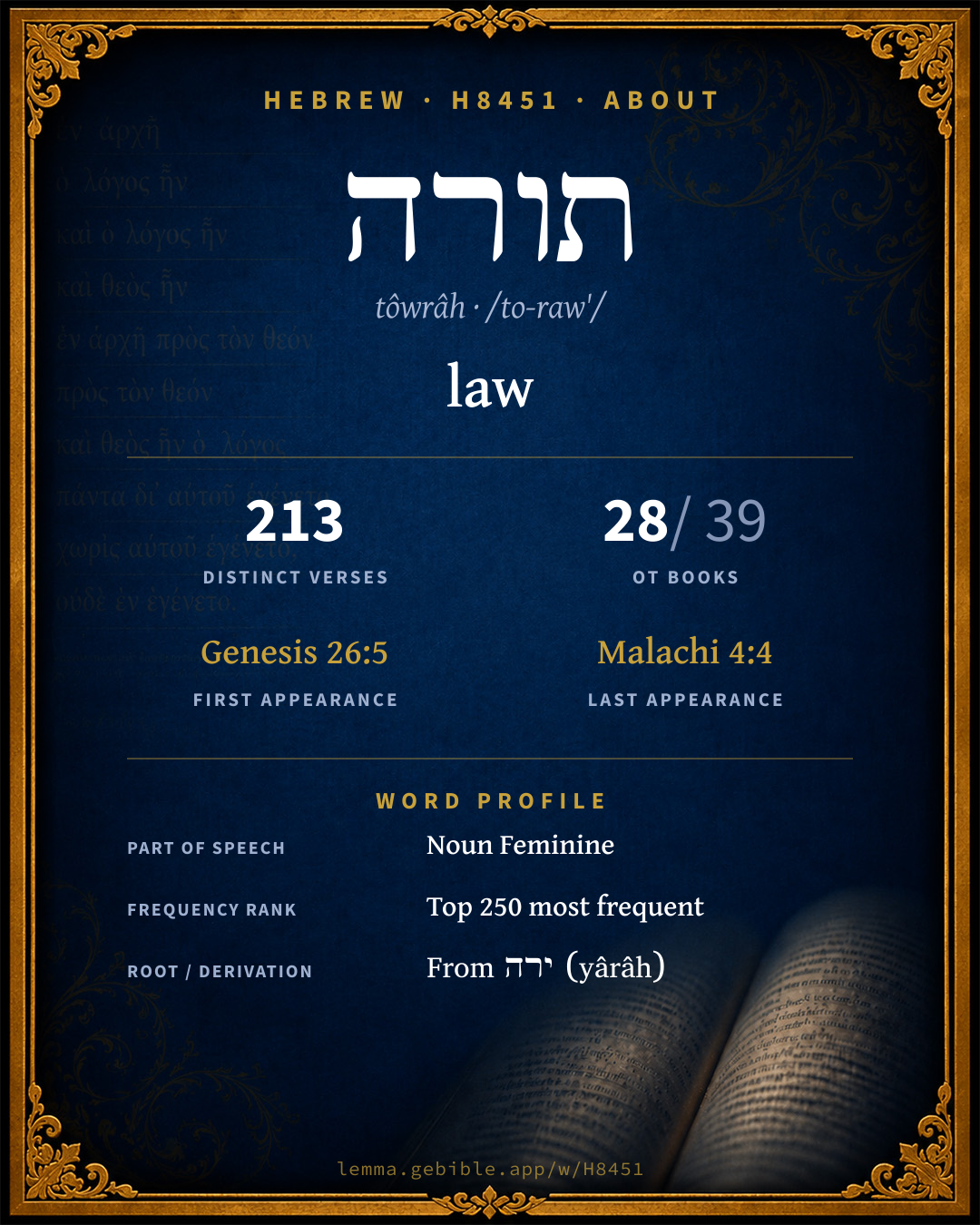
תּוֹרָה
law
also: direction, instruction fuller range ↓
Full lexicon entry — Brown-Driver-Briggs (BDB)
From Brown-Driver-Briggs (BDB)
Where this word appears
See every Construct-state word in the Hebrew Bible →
Grammar key — what these labels mean
Part of speech
- Noun
- A naming word — a person, place, thing, or idea.
Noun type
- Common
- A common noun — a general class of person, place, or thing (“king,” “city,” “water”), not a specific name.
State
- Absolute
- The independent form of a noun, not bound to a following word.
- Construct
- A noun bound to a following noun in a possessive / “of” relationship (the construct chain).
Gender
- Feminine
- Grammatically feminine.
Number
- Singular
- One.
- Plural
- More than one (in Hebrew, generally three or more).
Grammatical forms
- Noun, Common, Feminine, Singular, Construct 118 times (53%)
- Noun, Common, Feminine, Singular, Absolute 89 times (40%)
- Noun, Common, Feminine, Plural, Construct 12 times (5%)
- Noun, Common, Feminine, Plural, Absolute 3 times (1%)
Parsed forms decoded from the imported morphology (morphhb / Westminster Leningrad Codex — WLC text public domain, morphhb tagging CC BY 4.0), counted across 222 parsed occurrences — not distinct verses.
Page 1 of 2 — showing verses 1–200 of 213 distinct verses where H8451 appears, across 28 books. Click any verse to open its interlinear word-by-word view. Verse text shown in the World English Bible for context — . Each verse’s Hebrew form is shown with its reference; the English is not keyword-highlighted, since the data carries no word-level English alignment. Use “Compare translations” on any verse to read it across multiple English versions. This concordance covers the Hebrew Bible; Septuagint (Greek Old Testament) occurrences are not indexed here.
Genesis 1 verse
Exodus 7 verses
- Exodus 12:49 תּוֹרָ֣ה n c fs One law shall be to him who is born at home, and to the stranger who lives as a foreigner among you."
- Exodus 13:9 תּוֹרַ֥ת n c fs cs It shall be for a sign to you on your hand, and for a memorial between your eyes, that the law of Yahweh may be in your mouth; for with a strong hand Yahweh has brought you out of Egypt.
- Exodus 16:4 בְּ/תוֹרָתִ֖/י prep + n c fs cs + sfx pers 1cs Then said Yahweh to Moses, "Behold, I will rain bread from the sky for you, and the people shall go out and gather a day's portion every day, that I may test them, whether they will walk in my law, or not.
- Exodus 16:28 וְ/תוֹרֹתָֽ/י conj + n c fp cs + sfx pers 1cs Yahweh said to Moses, "How long do you refuse to keep my commandments and my laws?
- Exodus 18:16 תּוֹרֹתָֽי/ו n c fp cs + sfx pers 3ms When they have a matter, they come to me, and I judge between a man and his neighbor, and I make them know the statutes of God, and his laws."
- Exodus 18:20 הַ/תּוֹרֹ֑ת ptcl def.art + n c fp You shall teach them the statutes and the laws, and shall show them the way in which they must walk, and the work that they must do.
- Exodus 24:12 וְ/הַ/תּוֹרָה֙ conj + ptcl def.art + n c fs Yahweh said to Moses, "Come up to me on the mountain, and stay here, and I will give you the tables of stone with the law and the commands that I have written, that you may teach them."
Leviticus 16 verses
- Leviticus 6:9 תּוֹרַ֖ת n c fs cs "Command Aaron and his sons, saying, 'This is the law of the burnt offering: the burnt offering shall be on the hearth on the altar all night until the morning; and the fire of the altar shall be kept burning on it.
- Leviticus 6:14 תּוֹרַ֖ת n c fs cs "'This is the law of the meal offering: the sons of Aaron shall offer it before Yahweh, before the altar.
- Leviticus 6:25 תּוֹרַ֖ת n c fs cs "Speak to Aaron and to his sons, saying, 'This is the law of the sin offering: in the place where the burnt offering is killed, the sin offering shall be killed before Yahweh. It is most holy.
- Leviticus 7:1 תּוֹרַ֖ת n c fs cs "'This is the law of the trespass offering. It is most holy.
- Leviticus 7:7 תּוֹרָ֥ה n c fs "'As is the sin offering, so is the trespass offering; there is one law for them. The priest who makes atonement with them shall have it.
- Leviticus 7:11 תּוֹרַ֖ת n c fs cs "'This is the law of the sacrifice of peace offerings, which one shall offer to Yahweh.
- Leviticus 7:37 הַ/תּוֹרָ֗ה ptcl def.art + n c fs This is the law of the burnt offering, of the meal offering, and of the sin offering, and of the trespass offering, and of the consecration, and of the sacrifice of peace offerings;
- Leviticus 11:46 תּוֹרַ֤ת n c fs cs "'This is the law of the animal, and of the bird, and of every living creature that moves in the waters, and of every creature that creeps on the earth,
- Leviticus 12:7 תּוֹרַת֙ n c fs cs and he shall offer it before Yahweh, and make atonement for her; and she shall be cleansed from the fountain of her blood. "'This is the law for her who bears, whether a male or a female.
- Leviticus 13:59 תּוֹרַ֨ת n c fs cs This is the law of the plague of mildew in a garment of wool or linen, either in the warp, or the woof, or in anything of skin, to pronounce it clean, or to pronounce it unclean.
- Leviticus 14:2 תּוֹרַ֣ת n c fs cs "This shall be the law of the leper in the day of his cleansing. He shall be brought to the priest,
- Leviticus 14:32 תּוֹרַ֔ת n c fs cs This is the law for him in whom is the plague of leprosy, who is not able to afford the sacrifice for his cleansing.
- Leviticus 14:54 הַ/תּוֹרָ֑ה ptcl def.art + n c fs This is the law for any plague of leprosy, and for an itch,
- Leviticus 14:57 תּוֹרַ֖ת n c fs cs to teach when it is unclean, and when it is clean. This is the law of leprosy.
- Leviticus 15:32 תּוֹרַ֖ת n c fs cs This is the law of him who has a discharge, and of him who has an emission of semen, so that he is unclean thereby;
- Leviticus 26:46 וְ/הַ/תּוֹרֹת֒ conj + ptcl def.art + n c fp These are the statutes, ordinances and laws, which Yahweh made between him and the children of Israel in Mount Sinai by Moses.
Numbers 9 verses
- Numbers 5:29 תּוֹרַ֖ת n c fs cs "This is the law of jealousy, when a wife, being under her husband, goes astray, and is defiled;
- Numbers 5:30 הַ/תּוֹרָ֖ה ptcl def.art + n c fs or when the spirit of jealousy comes on a man, and he is jealous of his wife; then he shall set the woman before Yahweh, and the priest shall execute on her all this law.
- Numbers 6:13 תּוֹרַ֖ת n c fs cs "This is the law of the Nazirite: when the days of his separation are fulfilled, he shall be brought to the door of the Tent of Meeting,
- Numbers 6:21 תּוֹרַ֣ת תּוֹרַ֥ת n c fs cs n c fs cs "This is the law of the Nazirite who vows, and of his offering to Yahweh for his separation, besides that which he is able to get. According to his vow which he vows, so he must do after the law of his separation."
- Numbers 15:16 תּוֹרָ֥ה n c fs One law and one ordinance shall be for you, and for the stranger who lives as a foreigner with you.
- Numbers 15:29 תּוֹרָ֤ה n c fs You shall have one law for him who does anything unwittingly, for him who is home-born among the children of Israel, and for the stranger who lives as a foreigner among them.
- Numbers 19:2 הַ/תּוֹרָ֔ה ptcl def.art + n c fs This is the statute of the law which Yahweh has commanded, saying, Speak to the children of Israel, that they bring you a red heifer without spot, in which is no blemish, [and] on which never came yoke.
- Numbers 19:14 הַ/תּוֹרָ֔ה ptcl def.art + n c fs This is the law when a man dies in a tent: everyone who comes into the tent, and everyone who is in the tent, shall be unclean seven days.
- Numbers 31:21 הַ/תּוֹרָ֔ה ptcl def.art + n c fs Eleazar the priest said to the men of war who went to the battle, This is the statute of the law which Yahweh has commanded Moses:
Deuteronomy 22 verses
- Deuteronomy 1:5 הַ/תּוֹרָ֥ה ptcl def.art + n c fs Beyond the Jordan, in the land of Moab, began Moses to declare this law, saying,
- Deuteronomy 4:8 הַ/תּוֹרָ֣ה ptcl def.art + n c fs What great nation is there, that has statutes and ordinances so righteous as all this law, which I set before you this day?
- Deuteronomy 4:44 הַ/תּוֹרָ֑ה ptcl def.art + n c fs This is the law which Moses set before the children of Israel:
- Deuteronomy 17:11 הַ/תּוֹרָ֜ה ptcl def.art + n c fs according to the tenor of the law which they shall teach you, and according to the judgment which they shall tell you, you shall do; you shall not turn aside from the sentence which they shall show you, to the right hand, nor to the left.
- Deuteronomy 17:18 הַ/תּוֹרָ֤ה ptcl def.art + n c fs It shall be, when he sits on the throne of his kingdom, that he shall write him a copy of this law in a book, out of [that which is] before the priests the Levites:
- Deuteronomy 17:19 הַ/תּוֹרָ֥ה ptcl def.art + n c fs and it shall be with him, and he shall read therein all the days of his life; that he may learn to fear Yahweh his God, to keep all the words of this law and these statutes, to do them;
- Deuteronomy 27:3 הַ/תּוֹרָ֥ה ptcl def.art + n c fs and you shall write on them all the words of this law, when you are passed over; that you may go in to the land which Yahweh your God gives you, a land flowing with milk and honey, as Yahweh, the God of your fathers, has promised you.
- Deuteronomy 27:8 הַ/תּוֹרָ֥ה ptcl def.art + n c fs You shall write on the stones all the words of this law very plainly.
- Deuteronomy 27:26 הַ/תּוֹרָֽה ptcl def.art + n c fs Cursed be he who doesn't confirm the words of this law to do them. All the people shall say, Amen.
- Deuteronomy 28:58 הַ/תּוֹרָ֣ה ptcl def.art + n c fs If you will not observe to do all the words of this law that are written in this book, that you may fear this glorious and fearful name, YAHWEH YOUR GOD;
- Deuteronomy 28:61 הַ/תּוֹרָ֣ה ptcl def.art + n c fs Also every sickness, and every plague, which is not written in the book of this law, them will Yahweh bring on you, until you are destroyed.
- Deuteronomy 29:21 הַ/תּוֹרָ֖ה ptcl def.art + n c fs Yahweh will set him apart to evil out of all the tribes of Israel, according to all the curses of the covenant that is written in this book of the law.
- Deuteronomy 29:29 הַ/תּוֹרָ֥ה ptcl def.art + n c fs The secret things belong to Yahweh our God; but the things that are revealed belong to us and to our children forever, that we may do all the words of this law.
- Deuteronomy 30:10 הַ/תּוֹרָ֖ה ptcl def.art + n c fs if you shall obey the voice of Yahweh your God, to keep his commandments and his statutes which are written in this book of the law; if you turn to Yahweh your God with all your heart, and with all your soul.
- Deuteronomy 31:9 הַ/תּוֹרָ֣ה ptcl def.art + n c fs Moses wrote this law, and delivered it to the priests the sons of Levi, who bore the ark of the covenant of Yahweh, and to all the elders of Israel.
- Deuteronomy 31:11 הַ/תּוֹרָ֥ה ptcl def.art + n c fs when all Israel is come to appear before Yahweh your God in the place which he shall choose, you shall read this law before all Israel in their hearing.
- Deuteronomy 31:12 הַ/תּוֹרָ֥ה ptcl def.art + n c fs Assemble the people, the men and the women and the little ones, and your foreigner who is within your gates, that they may hear, and that they may learn, and fear Yahweh your God, and observe to do all the words of this law;
- Deuteronomy 31:24 הַ/תּוֹרָֽה ptcl def.art + n c fs It happened, when Moses had made an end of writing the words of this law in a book, until they were finished,
- Deuteronomy 31:26 הַ/תּוֹרָה֙ ptcl def.art + n c fs Take this book of the law, and put it by the side of the ark of the covenant of Yahweh your God, that it may be there for a witness against you.
- Deuteronomy 32:46 הַ/תּוֹרָ֥ה ptcl def.art + n c fs He said to them, Set your heart to all the words which I testify to you this day, which you shall command your children to observe to do, [even] all the words of this law.
- Deuteronomy 33:4 תּוֹרָ֥ה n c fs Moses commanded us a law, An inheritance for the assembly of Jacob.
- Deuteronomy 33:10 וְ/תוֹרָתְ/ךָ֖ conj + n c fs cs + sfx pers 2ms They shall teach Jacob your ordinances, Israel your law: They shall put incense before you, Whole burnt offering on your altar.
Joshua 8 verses
- Joshua 1:7 הַ/תּוֹרָ֗ה ptcl def.art + n c fs Only be strong and very courageous, to observe to do according to all the law, which Moses my servant commanded you: don't turn from it to the right hand or to the left, that you may have good success wherever you go.
- Joshua 1:8 הַ/תּוֹרָ֨ה ptcl def.art + n c fs This book of the law shall not depart out of your mouth, but you shall meditate thereon day and night, that you may observe to do according to all that is written therein: for then you shall make your way prosperous, and then you shall have good success.
- Joshua 8:31 תּוֹרַ֣ת n c fs cs as Moses the servant of Yahweh commanded the children of Israel, as it is written in the book of the law of Moses, an altar of uncut stones, on which no man had lifted up any iron: and they offered thereon burnt offerings to Yahweh, and sacrificed peace-offerings.
- Joshua 8:32 תּוֹרַ֣ת n c fs cs He wrote there on the stones a copy of the law of Moses, which he wrote, in the presence of the children of Israel.
- Joshua 8:34 הַ/תּוֹרָ֔ה הַ/תּוֹרָֽה ptcl def.art + n c fs ptcl def.art + n c fs Afterward he read all the words of the law, the blessing and the curse, according to all that is written in the book of the law.
- Joshua 22:5 הַ/תּוֹרָה֮ ptcl def.art + n c fs Only take diligent heed to do the commandment and the law which Moses the servant of Yahweh commanded you, to love Yahweh your God, and to walk in all his ways, and to keep his commandments, and to cleave to him, and to serve him with all your heart and with all your soul.
- Joshua 23:6 תּוֹרַ֣ת n c fs cs Therefore be you very courageous to keep and to do all that is written in the book of the law of Moses, that you not turn aside from it to the right hand or to the left;
- Joshua 24:26 תּוֹרַ֣ת n c fs cs Joshua wrote these words in the book of the law of God; and he took a great stone, and set it up there under the oak that was by the sanctuary of Yahweh.
1 Kings 1 verse
2 Kings 10 verses
- 2 Kings 10:31 בְּ/תֽוֹרַת prep + n c fs cs But Jehu took no heed to walk in the law of Yahweh, the God of Israel, with all his heart: he didn't depart from the sins of Jeroboam, with which he made Israel to sin.
- 2 Kings 14:6 תּֽוֹרַת n c fs cs but the children of the murderers he didn't put to death; according to that which is written in the book of the law of Moses, as Yahweh commanded, saying, The fathers shall not be put to death for the children, nor the children be put to death for the fathers; but every man shall die for his own sin.
- 2 Kings 17:13 הַ/תּוֹרָ֔ה ptcl def.art + n c fs Yet Yahweh testified to Israel, and to Judah, by every prophet, and every seer, saying, Turn you from your evil ways, and keep my commandments and my statutes, according to all the law which I commanded your fathers, and which I sent to you by my servants the prophets.
- 2 Kings 17:34 וְ/כַ/תּוֹרָ֣ה conj + prep det + n c fs To this day they do after the former manner: they don't fear Yahweh, neither do they after their statutes, or after their ordinances, or after the law or after the commandment which Yahweh commanded the children of Jacob, whom he named Israel;
- 2 Kings 17:37 וְ/הַ/תּוֹרָ֤ה conj + ptcl def.art + n c fs and the statutes and the ordinances, and the law and the commandment, which he wrote for you, you shall observe to do forevermore; and you shall not fear other gods:
- 2 Kings 21:8 הַ֨/תּוֹרָ֔ה ptcl def.art + n c fs neither will I cause the feet of Israel to wander any more out of the land which I gave their fathers, if only they will observe to do according to all that I have commanded them, and according to all the law that my servant Moses commanded them.
- 2 Kings 22:8 הַ/תּוֹרָ֛ה ptcl def.art + n c fs Hilkiah the high priest said to Shaphan the scribe, I have found the book of the law in the house of Yahweh. Hilkiah delivered the book to Shaphan, and he read it.
- 2 Kings 22:11 הַ/תּוֹרָ֑ה ptcl def.art + n c fs It happened, when the king had heard the words of the book of the law, that he tore his clothes.
- 2 Kings 23:24 הַ/תּוֹרָה֙ ptcl def.art + n c fs Moreover those who had familiar spirits, and the wizards, and the teraphim, and the idols, and all the abominations that were seen in the land of Judah and in Jerusalem, did Josiah put away, that he might confirm the words of the law which were written in the book that Hilkiah the priest found in the house of Yahweh.
- 2 Kings 23:25 תּוֹרַ֣ת n c fs cs Like him was there no king before him, who turned to Yahweh with all his heart, and with all his soul, and with all his might, according to all the law of Moses; neither after him arose there any like him.
1 Chronicles 2 verses
- 1 Chronicles 16:40 בְּ/תוֹרַ֣ת prep + n c fs cs to offer burnt offerings to Yahweh on the altar of burnt offering continually morning and evening, even according to all that is written in the law of Yahweh, which he commanded to Israel;
- 1 Chronicles 22:12 תּוֹרַ֖ת n c fs cs May Yahweh give you discretion and understanding, and put you in charge of Israel; that so you may keep the law of Yahweh your God.
2 Chronicles 17 verses
- 2 Chronicles 6:16 בְּ/ת֣וֹרָתִ֔/י prep + n c fs cs + sfx pers 1cs Now therefore, Yahweh, the God of Israel, keep with your servant David my father that which you have promised him, saying, There shall not fail you a man in my sight to sit on the throne of Israel, if only your children take heed to their way, to walk in my law as you have walked before me.
- 2 Chronicles 12:1 תּוֹרַ֣ת n c fs cs It happened, when the kingdom of Rehoboam was established, and he was strong, that he forsook the law of Yahweh, and all Israel with him.
- 2 Chronicles 14:4 הַ/תּוֹרָ֥ה ptcl def.art + n c fs and commanded Judah to seek Yahweh, the God of their fathers, and to do the law and the commandment.
- 2 Chronicles 15:3 תוֹרָֽה n c fs Now for a long season Israel was without the true God, and without a teaching priest, and without law:
- 2 Chronicles 17:9 תּוֹרַ֣ת n c fs cs They taught in Judah, having the book of the law of Yahweh with them; and they went about throughout all the cities of Judah, and taught among the people.
- 2 Chronicles 19:10 תּוֹרָ֣ה n c fs Whenever any controversy shall come to you from your brothers who dwell in their cities, between blood and blood, between law and commandment, statutes and ordinances, you shall warn them, that they not be guilty towards Yahweh, and so wrath come on you and on your brothers: this do, and you shall not be guilty.
- 2 Chronicles 23:18 בְּ/תוֹרַ֥ת prep + n c fs cs Jehoiada appointed the officers of the house of Yahweh under the hand of the priests the Levites, whom David had distributed in the house of Yahweh, to offer the burnt offerings of Yahweh, as it is written in the law of Moses, with rejoicing and with singing, according to the order of David.
- 2 Chronicles 25:4 בַּ/תּוֹרָ֡ה prep det + n c fs But he didn't put their children to death, but did according to that which is written in the law in the book of Moses, as Yahweh commanded, saying, The fathers shall not die for the children, neither shall the children die for the fathers; but every man shall die for his own sin.
- 2 Chronicles 30:16 כְּ/תוֹרַ֖ת prep + n c fs cs They stood in their place after their order, according to the law of Moses the man of God: the priests sprinkled the blood [which they received] of the hand of the Levites.
- 2 Chronicles 31:3 בְּ/תוֹרַ֥ת prep + n c fs cs [He appointed] also the king's portion of his substance for the burnt-offerings, [to wit], for the morning and evening burnt offerings, and the burnt offerings for the Sabbaths, and for the new moons, and for the set feasts, as it is written in the law of Yahweh.
- 2 Chronicles 31:4 בְּ/תוֹרַ֥ת prep + n c fs cs Moreover he commanded the people who lived in Jerusalem to give the portion of the priests and the Levites, that they might give themselves to the law of Yahweh.
- 2 Chronicles 31:21 וּ/בַ/תּוֹרָה֙ conj + prep det + n c fs In every work that he began in the service of the house of God, and in the law, and in the commandments, to seek his God, he did it with all his heart, and prospered.
- 2 Chronicles 33:8 הַ/תּוֹרָ֛ה ptcl def.art + n c fs neither will I any more remove the foot of Israel from off the land which I have appointed for your fathers, if only they will observe to do all that I have commanded them, even all the law and the statutes and the ordinances [given] by Moses.
- 2 Chronicles 34:14 תּֽוֹרַת n c fs cs When they brought out the money that was brought into the house of Yahweh, Hilkiah the priest found the book of the law of Yahweh [given] by Moses.
- 2 Chronicles 34:15 הַ/תּוֹרָ֛ה ptcl def.art + n c fs Hilkiah answered Shaphan the scribe, I have found the book of the law in the house of Yahweh. Hilkiah delivered the book to Shaphan.
- 2 Chronicles 34:19 הַ/תּוֹרָ֑ה ptcl def.art + n c fs It happened, when the king had heard the words of the law, that he tore his clothes.
- 2 Chronicles 35:26 בְּ/תוֹרַ֥ת prep + n c fs cs Now the rest of the acts of Josiah, and his good deeds, according to that which is written in the law of Yahweh,
Ezra 4 verses
- Ezra 3:2 בְּ/תוֹרַ֖ת prep + n c fs cs Then stood up Jeshua the son of Jozadak, and his brothers the priests, and Zerubbabel the son of Shealtiel, and his brothers, and built the altar of the God of Israel, to offer burnt offerings thereon, as it is written in the law of Moses the man of God.
- Ezra 7:6 בְּ/תוֹרַ֣ת prep + n c fs cs this Ezra went up from Babylon: and he was a ready scribe in the law of Moses, which Yahweh, the God of Israel, had given; and the king granted him all his request, according to the hand of Yahweh his God on him.
- Ezra 7:10 תּוֹרַ֥ת n c fs cs For Ezra had set his heart to seek the law of Yahweh, and to do it, and to teach in Israel statutes and ordinances.
- Ezra 10:3 וְ/כַ/תּוֹרָ֖ה conj + prep det + n c fs Now therefore let us make a covenant with our God to put away all the wives, and such as are born of them, according to the counsel of my lord, and of those who tremble at the commandment of our God; and let it be done according to the law.
Nehemiah 21 verses
- Nehemiah 8:1 תּוֹרַ֣ת n c fs cs All the people gathered themselves together as one man into the broad place that was before the water gate; and they spoke to Ezra the scribe to bring the book of the law of Moses, which Yahweh had commanded to Israel.
- Nehemiah 8:2 הַ/תּוֹרָ֞ה ptcl def.art + n c fs Ezra the priest brought the law before the assembly, both men and women, and all who could hear with understanding, on the first day of the seventh month.
- Nehemiah 8:3 הַ/תּוֹרָֽה ptcl def.art + n c fs He read therein before the broad place that was before the water gate from early morning until midday, in the presence of the men and the women, and of those who could understand; and the ears of all the people were [attentive] to the book of the law.
- Nehemiah 8:7 לַ/תּוֹרָ֑ה prep det + n c fs Also Jeshua, and Bani, and Sherebiah, Jamin, Akkub, Shabbethai, Hodiah, Maaseiah, Kelita, Azariah, Jozabad, Hanan, Pelaiah, and the Levites, caused the people to understand the law: and the people [stood] in their place.
- Nehemiah 8:8 בְּ/תוֹרַ֥ת prep + n c fs cs They read in the book, in the law of God, distinctly; and they gave the sense, so that they understood the reading.
- Nehemiah 8:9 הַ/תּוֹרָֽה ptcl def.art + n c fs Nehemiah, who was the governor, and Ezra the priest the scribe, and the Levites who taught the people, said to all the people, This day is holy to Yahweh your God; don't mourn, nor weep. For all the people wept, when they heard the words of the law.
- Nehemiah 8:13 הַ/תּוֹרָֽה ptcl def.art + n c fs On the second day were gathered together the heads of fathers' [houses] of all the people, the priests, and the Levites, to Ezra the scribe, even to give attention to the words of the law.
- Nehemiah 8:14 בַּ/תּוֹרָ֑ה prep det + n c fs They found written in the law, how that Yahweh had commanded by Moses, that the children of Israel should dwell in booths in the feast of the seventh month;
- Nehemiah 8:18 תּוֹרַ֤ת n c fs cs Also day by day, from the first day to the last day, he read in the book of the law of God. They kept the feast seven days; and on the eighth day was a solemn assembly, according to the ordinance.
- Nehemiah 9:3 תּוֹרַ֧ת n c fs cs They stood up in their place, and read in the book of the law of Yahweh their God a fourth part of the day; and [another] fourth part they confessed, and worshiped Yahweh their God.
- Nehemiah 9:13 וְ/תוֹר֣וֹת conj + n c fp cs You came down also on Mount Sinai, and spoke with them from heaven, and gave them right ordinances and true laws, good statutes and commandments,
- Nehemiah 9:14 וְ/תוֹרָ֔ה conj + n c fs and made known to them your holy Sabbath, and commanded them commandments, and statutes, and a law, by Moses your servant,
- Nehemiah 9:26 תּוֹרָֽתְ/ךָ֙ n c fs cs + sfx pers 2ms Nevertheless they were disobedient, and rebelled against you, and cast your law behind their back, and killed your prophets that testified against them to turn them again to you, and they committed awful blasphemies.
- Nehemiah 9:29 תּוֹרָתֶ֗/ךָ n c fs cs + sfx pers 2ms and testified against them, that you might bring them again to your law. Yet they dealt proudly, and didn't listen to your commandments, but sinned against your ordinances, (which if a man do, he shall live in them), and withdrew the shoulder, and hardened their neck, and would not hear.
- Nehemiah 9:34 תּוֹרָתֶ֑/ךָ n c fs cs + sfx pers 2ms neither have our kings, our princes, our priests, nor our fathers, kept your law, nor listened to your commandments and your testimonies with which you did testify against them.
- Nehemiah 10:28 תּוֹרַ֣ת n c fs cs The rest of the people, the priests, the Levites, the porters, the singers, the Nethinim, and all those who had separated themselves from the peoples of the lands to the law of God, their wives, their sons, and their daughters, everyone who had knowledge, and understanding;
- Nehemiah 10:29 בְּ/תוֹרַ֣ת prep + n c fs cs They joined with their brothers, their nobles, and entered into a curse, and into an oath, to walk in God's law, which was given by Moses the servant of God, and to observe and do all the commandments of Yahweh our Lord, and his ordinances and his statutes;
- Nehemiah 10:34 בַּ/תּוֹרָֽה prep det + n c fs We cast lots, the priests, the Levites, and the people, for the wood-offering, to bring it into the house of our God, according to our fathers' houses, at times appointed, year by year, to burn on the altar of Yahweh our God, as it is written in the law;
- Nehemiah 10:36 בַּ/תּוֹרָ֑ה prep det + n c fs also the firstborn of our sons, and of our cattle, as it is written in the law, and the firstborn of our herds and of our flocks, to bring to the house of our God, to the priests who minister in the house of our God;
- Nehemiah 12:44 הַ/תּוֹרָ֔ה ptcl def.art + n c fs On that day were men appointed over the chambers for the treasures, for the heave-offerings, for the first fruits, and for the tithes, to gather into them, according to the fields of the cities, the portions appointed by the law for the priests and Levites: for Judah rejoiced for the priests and for the Levites who waited.
- Nehemiah 13:3 הַ/תּוֹרָ֑ה ptcl def.art + n c fs It came to pass, when they had heard the law, that they separated from Israel all the mixed multitude.
Job 1 verse
Psalms 35 verses
- Psalms 1:2 בְּ/תוֹרַ֥ת וּֽ/בְ/תוֹרָת֥/וֹ prep + n c fs cs conj + prep + n c fs cs + sfx pers 3ms But his delight is in Yahweh's law; On his law he meditates day and night.
- Psalms 19:7 תּ֘וֹרַ֤ת n c fs cs Yahweh's law is perfect, restoring the soul. Yahweh's testimony is sure, making wise the simple.
- Psalms 37:31 תּוֹרַ֣ת n c fs cs The law of his God is in his heart. None of his steps shall slide.
- Psalms 40:8 וְ֝/ת֥וֹרָתְ/ךָ֗ conj + n c fs cs + sfx pers 2ms I delight to do your will, my God. Yes, your law is within my heart."
- Psalms 78:1 תּוֹרָתִ֑/י n c fs cs + sfx pers 1cs Hear my law, my people. Turn your ears to the words of my mouth.
- Psalms 78:5 וְ/תוֹרָה֮ conj + n c fs For he established a testimony in Jacob, And appointed a law in Israel, Which he commanded our fathers, That they should make them known to their children;
- Psalms 78:10 וּ֝/בְ/תוֹרָת֗/וֹ conj + prep + n c fs cs + sfx pers 3ms They didn't keep God's covenant, And refused to walk in his law.
- Psalms 89:30 תּוֹרָתִ֑/י n c fs cs + sfx pers 1cs If his children forsake my law, And don't walk in my ordinances;
- Psalms 94:12 וּֽ/מִ/תּוֹרָתְ/ךָ֥ conj + prep + n c fs cs + sfx pers 2ms Blessed is the man whom you discipline, Yah, And teach out of your law;
- Psalms 105:45 וְ/תוֹרֹתָ֥י/ו conj + n c fp cs + sfx pers 3ms That they might keep his statutes, And observe his laws. Praise Yah!
- Psalms 119:1 בְּ/תוֹרַ֥ת prep + n c fs cs Blessed are those whose ways are blameless, Who walk according to Yahweh's law.
- Psalms 119:18 מִ/תּוֹרָתֶֽ/ךָ prep + n c fs cs + sfx pers 2ms Open my eyes, That I may see wondrous things out of your law.
- Psalms 119:29 וְֽ/תוֹרָתְ/ךָ֥ conj + n c fs cs + sfx pers 2ms Keep me from the way of deceit. Grant me your law graciously!
- Psalms 119:34 תֽוֹרָתֶ֗/ךָ n c fs cs + sfx pers 2ms Give me understanding, and I will keep your law. Yes, I will obey it with my whole heart.
- Psalms 119:44 תוֹרָתְ/ךָ֥ n c fs cs + sfx pers 2ms So I will obey your law continually, Forever and ever.
- Psalms 119:51 מִ֝/תּֽוֹרָתְ/ךָ֗ prep + n c fs cs + sfx pers 2ms The arrogant mock me excessively, But I don't swerve from your law.
- Psalms 119:53 תּוֹרָתֶֽ/ךָ n c fs cs + sfx pers 2ms Indignation has taken hold on me, Because of the wicked who forsake your law.
- Psalms 119:55 תּוֹרָתֶֽ/ךָ n c fs cs + sfx pers 2ms I have remembered your name, Yahweh, in the night, And I obey your law.
- Psalms 119:61 תּֽ֝וֹרָתְ/ךָ֗ n c fs cs + sfx pers 2ms The ropes of the wicked bind me, But I won't forget your law.
- Psalms 119:70 תּוֹרָתְ/ךָ֥ n c fs cs + sfx pers 2ms Their heart is as callous as the fat, But I delight in your law.
- Psalms 119:72 תֽוֹרַת n c fs cs The law of your mouth is better to me than thousands of pieces of gold and silver.
- Psalms 119:77 תֽ֝וֹרָתְ/ךָ֗ n c fs cs + sfx pers 2ms Let your tender mercies come to me, that I may live; For your law is my delight.
- Psalms 119:85 כְ/תוֹרָתֶֽ/ךָ prep + n c fs cs + sfx pers 2ms The proud have dug pits for me, Contrary to your law.
- Psalms 119:92 ת֭וֹרָתְ/ךָ n c fs cs + sfx pers 2ms Unless your law had been my delight, I would have perished in my affliction.
- Psalms 119:97 תוֹרָתֶ֑/ךָ n c fs cs + sfx pers 2ms How love I your law! It is my meditation all day.
- Psalms 119:109 וְ֝/תֽוֹרָתְ/ךָ֗ conj + n c fs cs + sfx pers 2ms My soul is continually in my hand, Yet I won't forget your law.
- Psalms 119:113 וְֽ/תוֹרָתְ/ךָ֥ conj + n c fs cs + sfx pers 2ms I hate double-minded men, But I love your law.
- Psalms 119:126 תּוֹרָתֶֽ/ךָ n c fs cs + sfx pers 2ms It is time to act, Yahweh, For they break your law.
- Psalms 119:136 תוֹרָתֶֽ/ךָ n c fs cs + sfx pers 2ms Streams of tears run down my eyes, Because they don't observe your law.
- Psalms 119:142 וְֽ/תוֹרָתְ/ךָ֥ conj + n c fs cs + sfx pers 2ms Your righteousness is an everlasting righteousness. Your law is truth.
- Psalms 119:150 מִ/תּוֹרָתְ/ךָ֥ prep + n c fs cs + sfx pers 2ms They draw near who follow after wickedness. They are far from your law.
- Psalms 119:153 תֽ֝וֹרָתְ/ךָ֗ n c fs cs + sfx pers 2ms Consider my affliction, and deliver me, For I don't forget your law.
- Psalms 119:163 תּוֹרָתְ/ךָ֥ n c fs cs + sfx pers 2ms I hate and abhor falsehood. I love your law.
- Psalms 119:165 תוֹרָתֶ֑/ךָ n c fs cs + sfx pers 2ms Those who love your law have great peace. Nothing causes them to stumble.
- Psalms 119:174 וְ֝/תֽוֹרָתְ/ךָ֗ conj + n c fs cs + sfx pers 2ms I have longed for your salvation, Yahweh. Your law is my delight.
Proverbs 12 verses
- Proverbs 1:8 תּוֹרַ֥ת n c fs cs My son, listen to your father's instruction, And don't forsake your mother's teaching:
- Proverbs 3:1 תּוֹרָתִ֣/י n c fs cs + sfx pers 1cs My son, don't forget my teaching; But let your heart keep my commandments:
- Proverbs 4:2 תּֽ֝וֹרָתִ֗/י n c fs cs + sfx pers 1cs For I give you sound learning. Don't forsake my law.
- Proverbs 6:20 תּוֹרַ֥ת n c fs cs My son, keep your father's commandment, And don't forsake your mother's teaching.
- Proverbs 6:23 וְ/ת֣וֹרָה conj + n c fs For the commandment is a lamp, And the law is light. Reproofs of instruction are the way of life,
- Proverbs 7:2 וְ֝/תוֹרָתִ֗/י conj + n c fs cs + sfx pers 1cs Keep my commandments and live; Guard my teaching as the apple of your eye.
- Proverbs 13:14 תּוֹרַ֣ת n c fs cs The teaching of the wise is a spring of life, To turn from the snares of death.
- Proverbs 28:4 ת֭וֹרָה ת֝וֹרָ֗ה n c fs n c fs Those who forsake the law praise the wicked; But those who keep the law contend with them.
- Proverbs 28:7 תּ֭וֹרָה n c fs Whoever keeps the law is a wise son; But he who is a companion of gluttons shames his father.
- Proverbs 28:9 תּוֹרָ֑ה n c fs He who turns away his ear from hearing the law, Even his prayer is an abomination.
- Proverbs 29:18 תּוֹרָ֣ה n c fs Where there is no revelation, the people cast off restraint; But one who keeps the law is blessed.
- Proverbs 31:26 וְ/תֽוֹרַת conj + n c fs cs She opens her mouth with wisdom. Faithful instruction is on her tongue.
Isaiah 12 verses
- Isaiah 1:10 תּוֹרַ֥ת n c fs cs Hear the word of Yahweh, you rulers of Sodom! Listen to the law of our God, you people of Gomorrah!
- Isaiah 2:3 תוֹרָ֔ה n c fs Many peoples shall go and say, "Come, let's go up to the mountain of Yahweh, To the house of the God of Jacob; And he will teach us of his ways, And we will walk in his paths. For out of Zion the law shall go forth, And the word of Yahweh from Jerusalem.
- Isaiah 5:24 תּוֹרַת֙ n c fs cs Therefore as the tongue of fire devours the stubble, And as the dry grass sinks down in the flame, So their root shall be as rottenness, And their blossom shall go up as dust; Because they have rejected the law of Yahweh of Hosts, And despised the word of the Holy One of Israel.
- Isaiah 8:16 תּוֹרָ֖ה n c fs Bind up the testimony, seal the law among my disciples.
- Isaiah 8:20 לְ/תוֹרָ֖ה prep + n c fs To the law and to the testimony! if they don't speak according to this word, surely there is no morning for them.
- Isaiah 24:5 תוֹרֹת֙ n c fp The earth also is polluted under the inhabitants of it; because they have transgressed the laws, violated the statutes, broken the everlasting covenant.
- Isaiah 30:9 תּוֹרַ֥ת n c fs cs For it is a rebellious people, lying children, children who will not hear the law of Yahweh;
- Isaiah 42:4 וּ/לְ/תוֹרָת֖/וֹ conj + prep + n c fs cs + sfx pers 3ms He will not fail nor be discouraged, until he have set justice in the earth; and the isles shall wait for his law.
- Isaiah 42:21 תּוֹרָ֖ה n c fs It pleased Yahweh, for his righteousness' sake, to magnify the law, and make it honorable.
- Isaiah 42:24 בְּ/תוֹרָתֽ/וֹ prep + n c fs cs + sfx pers 3ms Who gave Jacob for a spoil, and Israel to the robbers? Didn't Yahweh? he against whom we have sinned, and in whose ways they would not walk, neither were they obedient to his law.
- Isaiah 51:4 תוֹרָה֙ n c fs Attend to me, my people; and give ear to me, my nation: for a law shall go forth from me, and I will establish my justice for a light of the peoples.
- Isaiah 51:7 תּוֹרָתִ֣/י n c fs cs + sfx pers 1cs Listen to me, you who know righteousness, the people in whose heart is my law; don't you fear the reproach of men, neither be you dismayed at their insults.
Jeremiah 11 verses
- Jeremiah 2:8 הַ/תּוֹרָה֙ ptcl def.art + n c fs The priests didn't say, Where is Yahweh? and those who handle the law didn't know me: the rulers also transgressed against me, and the prophets prophesied by Baal, and walked after things that do not profit.
- Jeremiah 6:19 וְ/תוֹרָתִ֖/י conj + n c fs cs + sfx pers 1cs Hear, earth: behold, I will bring evil on this people, even the fruit of their thoughts, because they have not listened to my words; and as for my law, they have rejected it.
- Jeremiah 8:8 וְ/תוֹרַ֥ת conj + n c fs cs How do you say, We are wise, and the law of Yahweh is with us? But, behold, the false pen of the scribes has worked falsely.
- Jeremiah 9:13 תּ֣וֹרָתִ֔/י n c fs cs + sfx pers 1cs Yahweh says, Because they have forsaken my law which I set before them, and have not obeyed my voice, neither walked therein,
- Jeremiah 16:11 תּוֹרָתִ֖/י n c fs cs + sfx pers 1cs Then shall you tell them, Because your fathers have forsaken me, says Yahweh, and have walked after other gods, and have served them, and have worshiped them, and have forsaken me, and have not kept my law;
- Jeremiah 18:18 תּוֹרָ֜ה n c fs Then said they, Come, and let us devise devices against Jeremiah; for the law shall not perish from the priest, nor counsel from the wise, nor the word from the prophet. Come, and let us strike him with the tongue, and let us not give heed to any of his words.
- Jeremiah 26:4 בְּ/ת֣וֹרָתִ֔/י prep + n c fs cs + sfx pers 1cs You shall tell them, Thus says Yahweh: If you will not listen to me, to walk in my law, which I have set before you,
- Jeremiah 31:33 תּֽוֹרָתִ/י֙ n c fs cs + sfx pers 1cs But this is the covenant that I will make with the house of Israel after those days, says Yahweh: I will put my law in their inward parts, and in their heart will I write it; and I will be their God, and they shall be my people:
- Jeremiah 32:23 ו/ב/תרות/ך וּ/בְ/תוֹרָתְ/ךָ֣ conj + prep + n c fp cs + sfx pers 2ms conj + prep + n c fs cs + sfx pers 2ms and they came in, and possessed it, but they didn't obey your voice, neither walked in your law; they have done nothing of all that you commanded them to do: therefore you have caused all this evil to come on them.
- Jeremiah 44:10 בְ/תֽוֹרָתִ/י֙ prep + n c fs cs + sfx pers 1cs They are not humbled even to this day, neither have they feared, nor walked in my law, nor in my statutes, that I set before you and before your fathers.
- Jeremiah 44:23 וּ/בְ/תֹרָת֧/וֹ conj + prep + n c fs cs + sfx pers 3ms Because you have burned incense, and because you have sinned against Yahweh, and have not obeyed the voice of Yahweh, nor walked in his law, nor in his statutes, nor in his testimonies; therefore this evil is happened to you, as it is this day.
Lamentations 1 verse
Ezekiel 6 verses
- Ezekiel 7:26 וְ/תוֹרָה֙ conj + n c fs Mischief shall come on mischief, and rumor shall be on rumor; and they shall seek a vision of the prophet; but the law shall perish from the priest, and counsel from the elders.
- Ezekiel 22:26 תוֹרָתִ/י֮ n c fs cs + sfx pers 1cs Her priests have done violence to my law, and have profaned my holy things: they have made no distinction between the holy and the common, neither have they caused men to discern between the unclean and the clean, and have hid their eyes from my Sabbaths, and I am profaned among them.
- Ezekiel 43:11 תורת/ו תּוֹרֹתָי/ו֙ n c fp cs + sfx pers 3ms n c fp cs + sfx pers 3ms If they be ashamed of all that they have done, make known to them the form of the house, and the fashion of it, and the exits of it, and the entrances of it, and all the forms of it, and all the ordinances of it, and all the forms of it, and all the laws of it; and write it in their sight; that they may keep the whole form of it, and all the ordinances of it, and do them.
- Ezekiel 43:12 תּוֹרַ֣ת תּוֹרַ֥ת n c fs cs n c fs cs This is the law of the house: on the top of the mountain the whole limit of it round about shall be most holy. Behold, this is the law of the house.
- Ezekiel 44:5 תורת/ו תּֽוֹרֹתָ֑י/ו n c fp cs + sfx pers 3ms n c fp cs + sfx pers 3ms Yahweh said to me, Son of man, mark well, and see with your eyes, and hear with your ears all that I tell you concerning all the ordinances of the house of Yahweh, and all the laws of it; and mark well the entrance of the house, with every exit of the sanctuary.
- Ezekiel 44:24 תּוֹרֹתַ֤/י n c fp cs + sfx pers 1cs In a controversy they shall stand to judge; according to my ordinances shall they judge it: and they shall keep my laws and my statutes in all my appointed feasts; and they shall make my Sabbaths holy.
Daniel 3 verses
- Daniel 9:10 בְּ/תֽוֹרֹתָי/ו֙ prep + n c fp cs + sfx pers 3ms neither have we obeyed the voice of Yahweh our God, to walk in his laws, which he set before us by his servants the prophets.
- Daniel 9:11 תּ֣וֹרָתֶ֔/ךָ בְּ/תוֹרַת֙ n c fs cs + sfx pers 2ms prep + n c fs cs Yes, all Israel have transgressed your law, even turning aside, that they should not obey your voice: therefore has the curse been poured out on us, and the oath that is written in the law of Moses the servant of God; for we have sinned against him.
- Daniel 9:13 בְּ/תוֹרַ֣ת prep + n c fs cs As it is written in the law of Moses, all this evil is come on us: yet have we not entreated the favor of Yahweh our God, that we should turn from our iniquities, and have discernment in your truth.
Hosea 3 verses
About this entry
At a glance — auto-summarized from this page’s data, not written by a person. Every figure links to its source below. This summary describes the numbers; it doesn’t interpret them.
The Hebrew noun תורה centers on the idea of “law.” Alongside “law” the lexicon also lists “direction” and “instruction” — part of its full sense range. It turns up in 213 verses across 28 books, a common footprint. Its earliest occurrence is Genesis 26:5. It shares a root with ירה, יורה and מורה. For the data behind this summary, explore the sense tree and the renderings breakdown below.
Gloss history
Strong's 1890 vs modern scholarship
About this word
Strong's H8451 catalogs a Hebrew word from the Hebrew Old Testament.
These counts are not copied from any lexicon or concordance. They are computed here, from the morphology-tagged Hebrew Old Testament. What Lemma adds →
- 213
- distinct verses
- The word appears in 213 distinct verses.
- 28 / 39
- OT books
- The word appears in 28 of 39 Old Testament books.
- #213
- by frequency
- Top 250 most frequent Hebrew words (rank 213 of 8,640 Hebrew words by occurrence).
View all 213 occurrences in the concordance →
Most concentrated in
- Psalms 35 verses 16%
- Deuteronomy 22 verses 10%
- Nehemiah 21 verses 10%
By section of the Old Testament
By traditional corpus
Conventional, traditional groupings — biblical authorship is debated, so this is a traditional corpus grouping, not an authorship claim. Each share is this word’s portion of its verses in that division of the Hebrew canon. Each figure is a share of the word’s 213 distinct verses.
- Writings (Ketuvim) 96 verses · 45%
- Prophets (Nevi'im) 62 verses · 29%
- Torah (Pentateuch) 55 verses · 26%
How translations render this word
Counts come from each version’s own published word-to-Strong’s tagging or interlinear alignment — an approximate guide to how each version renders this word, not a word-level alignment the data otherwise carries. Because each total is that version’s own tagged count, the per-version totals vary from one another and need not match the appearance or distinct-verse counts above. These counts may also differ from a printed concordance because Lemma counts each distinctly tagged rendering and does not collapse phrase taggings into a single head-word total. This is a fixed set of word-tagged versions (KJV, ASV, BSB, ULT) and does not change with the reading translation you choose elsewhere. Each version’s license is shown beside its name below (and on Sources).
- King James Version: Law 160×, Is the law 19×, Laws 11×
- American Standard Version: Law 142×, Is the law 19×, Laws 8×
- Berean Standard Bible: Law 154×, Is the law 19×, Instruction 17×
- unfoldingWord Literal Text: Law 108×, Law of 46×, Teaching 15×
King James Version Public Domain
Renders H8451 across 219 tagged occurrences — most commonly:
Plus 21 renderings that appear only once — usually multi-word phrases or single function words the recovered tagging swept in, not distinct renderings.
American Standard Version Public Domain
Renders H8451 across 219 tagged occurrences — most commonly:
Plus 41 renderings that appear only once — usually multi-word phrases or single function words the recovered tagging swept in, not distinct renderings.
Berean Standard Bible Public Domain
Renders H8451 across 220 tagged occurrences — most commonly:
Plus 6 renderings that appear only once — usually multi-word phrases or single function words the recovered tagging swept in, not distinct renderings.
unfoldingWord Literal Text CC BY-SA 4.0
Renders H8451 across 231 tagged occurrences — most commonly:
Plus 14 renderings that appear only once — usually multi-word phrases or single function words the recovered tagging swept in, not distinct renderings.
10 senses and sub-senses in the full BDB
What do BDB’s symbols mean?
BDB uses these scholarly abbreviations:
| Symbol | Meaning |
|---|---|
| 𝔊 | the Septuagint (the ancient Greek translation, LXX) |
| 𝔙 | the Vulgate (the Latin translation) |
| 𝔖 | the Syriac version (the Peshitta) |
| 𝔗 | the Targum (the Aramaic translation) |
| ψ | the Psalms |
| √ | root (the underlying root or stem) |
| ‖ | parallel passage (a synonymous or contrasted parallel) |
| † | the dagger: every passage where the word occurs is cited |
The 10 senses and sub-senses the full Brown-Driver-Briggs lexicon distinguishes for this word, in lexicon order (not ranked by frequency), with BDB’s own verbatim wording and sub-sense lettering. Shown in Hebrew script with BDB’s own scholarly abbreviations. The condensed entry is in the Lexicon Entry tab. See also the Forms in the corpus table below.
- 1. instruction:
- a. human: of a mother Pr 1:8; 6:20, 23; of a father 3:1; 4:2; 7:2; of sages 13:14; 28:4(×2), 7, 9; 29:18; of a poet ψ 78:1; תּוֹרַת חֶסֶד kind instruction (of a wise wife) Pr 31:26. e.g. Proverbs 1:8
- b. divine ‖ אֲמָרִים Jb 22:22; through his servants Is 30:9 Je 8:8; ‖ אִמְרָה Is 5:24; ‖ דָּבָר Is 1:10; ‖ תְּעוּדָה 8:16, 20; ‖ חָזוֹן La 2:9; pl. תורות Dn 9:10. e.g. Job 22:22
- c. a body of prophetic (or sometimes perhaps priestly) teaching Is 42:21, 24 Je 9:12; 16:11; in the heart Is 51:7 ψ 37:31; 40:9; ‖ משׁפט Hb 1:4; ‖ משׁפטים ψ 89:31; ‖ דְּבָרִים Je 6:19; 26:4 Zc 7:12; ‖ חקים Am 2:4; ‖ חקות Je 44:10, 23; myriads of precepts Ho 8:12. e.g. Isaiah 42:21
- d. instruction in Messianic age Is 2:3 = Mi 4:4, Is 42:4; 51:4 Je 31:33. e.g. Isaiah 2:3
- e. a body of priestly direction or instruction relating to sacred things Ho 4:6 Je 2:8; 18:18 Ez 7:26 Hag 2:11 Mal 2:6, 7, 8, 9 Zp 3:4 Ez 22:26; ‖ לֹא תוֹרָה לֹא כֹּהֵן מוֹרֶה 2 Ch 15:3. e.g. Hosea 4:6
- 2. law (proposes direction): viz.
- a. of special laws, sg. of Feast of Maṣṣoth Ex 13:9 (J), sabbath 16:4 (J); of direction given by priests in partic. case Dt 17:11; of statutes of priest’s code Ex 12:49 (P), Lv 6:2, 7, 18; 7:1, 7, 11, 37; 11:46; 12:7; 13:59; 14:2, 32, 54, 57; 15:32 Nu 5:29, 30; 6:13, 21(×2); 15:16, 29; 19:2, 14; 31:21 (P); תּוֹרַת הַבָּיִת Ez 43:12(×2); בֵּין ת׳ לְמִצְוָה 2 Ch 19:10; pl. תּוֹרוֹת laws, ‖ חקים Ex 18:16, 20 (E; of decisions in civil cases given by Moses), ψ 105:45; ‖ מצות Ex 16:28 (J); ‖ מצות, חקות Gn 26:5 (J); ‖ חקים משׁפטים Lv 26:46 (H); ‖ ברית, חק Is 24:5; ‖ משׁפטים חקים, מצות Ne 9:13; the laws of the new temple Ez 43:11; 44:5, 24; those laws in which men should walk Je 32:23 (Kt). e.g. Exodus 13:9
- b. of codes of law, (1) הַתּוֹרָה as written in the code of the covenant, ‖ הַמִּצְוָה Ex 24:12 (E); ספר תּוֹרַת אלהים Jos 24:26 (E); prob. also Dt 33:4; ‖ משׁפטים v 10, ‖ בְּרִית Ho 8:1 ψ 78:10, ‖ עֵדוּת v 5; (2) the law of the Deuteronomic code, in D and Deuteronomic sections of Kings and sources of Chr., הַתּוֹרָה הַזֹּאת Dt 1:5; 4:8, 44; 17:18; 31:9, 11; דִּבְרֵי הַתּ׳ הזאת 27:26; 31:24, + כל 17:19; 27:3, 8; 28:58; 29:28; 31:12; 32:46; סֵפֶר הַתּ׳ הזאת 28:61; ספר התורה הזה 29:20; 30:10; 31:26 Jos 1:8; ספר התורה 8:34 2 K 22:8 = 2 Ch 34:15; דברי התורה Jos 8:34 2 K 23:24; so התורה אשׁר צוך משׁה Jos 1:7, similarly 22:5 2 K 17:13, 34, 37; 21:8; תּוֹרַת משׁה (ספר) Jos 8:31, 32; 23:6 1 K 2:3 2 K 14:6 = הַתּ׳ בספר מ׳ 2 Ch 25:4, 2 K 23:25; דִּבְרֵי סֵפֶר הַתּ׳ 2 K 22:11 = דברי הַתּ׳ 2 Ch 34:19; תּוֹרַת יהוה 2 K 10:31. It is probable that ת׳ in ψ 1:2(×2); 94:12 and some other parts of Chr., e.g. 1 Ch 22:12 2 Ch 6:16 (= 1 K 8:25 without ת׳), refers to Deuteronomic code. (3) other passages of Chr. may refer to code of D, but most of them certainly refer to the law of the Priests’ code. The same is true of Mal Dn and late ψψ. The phrases are: (ספר) תורת משׁה 2 Ch 23:18; 30:16 Ezr 3:2; 7:6 Ne 8:1 Mal 3:22 Dn 9:11, 13; תורת יהוה (ספר) Ezr 7:10 Ne 9:3 1 Ch 16:40 2 Ch 12:1; 17:9; 31:3, 4; 34:14; 35:26 ψ 19:8; 119:1; (ספר) תורת האלהים Ne 8:18; 10:29, 30; ספר הַתּ׳ 8:3; דִּבְרֵי הַתּ׳ v 9, 13; הַתּוֹרָה 2 Ch 14:3; 31:21; 33:8 Ezr 10:3 Ne 8:2, 7, 14; 10:35, 37; 12:44; 13:3; תּ׳ פִּיךָ ψ 119:72; תורתך Ne 9:26, 29, 34 Dn 9:11 ψ 119:18, 29, 34, 44, 51, 53, 55, 61, 70, 77, 85, 92, 97, 109, 113, 126, 136, 142, 150, 153, 163, 165, 174; תּוֹרָה (indef.) ‖ חקים, מצוות Ne 9:14. e.g. Exodus 24:12
- 3. custom, manner: תּוֹרַת הָאָדָם 2 S 7:19 the manner of man, not of God, i.e. deal with me as man with man, Thes, law for man RV, but EwGesch. iii, 180 reads דּוֹרֹת (וַתַּרְאֵנִי) hast shewed me generations of men; so We Dr.—On ת׳ v. further Dr on Dt 1:10; 24:8; 33:10 and reff. e.g. 2 Samuel 7:19
Senses from the full Brown-Driver-Briggs lexicon (Brown, Driver, Briggs; Oxford 1906 — public domain), digitized via Sefaria, supplemented by the OpenScriptures HebrewLexicon (CC BY 4.0). Full attribution on Sources.
Word origin
n.f. Dt 1:5 direction, instruction, law (poss. in first instance from casting lots, WeG i, 410; H 394 (less confidently WeSkizzen iii, 167), SS SmAT Rel. Gesch. 36 BenzArch. 408 NowArch. ii, 97, opp. by KöOffenb. ii, 347 BaudPriest. 207);—ת׳, Ex 12:49 + 88 times; cstr. תּוֹרַת Ex 13:9 + 65 times; sfs. תּוֹרָתִי ψ 78:1 + 16 times; תֹּרָו֯תְךָ Je 32:23; תֹּרָתוֹ 44:23 + 34 times sfs.; pl. תּוֹרוֹת Ne 9:13; תּוֹרֹת Is 24:5 + 2 times; sf. תּוֹרֹתַי Ez 44:24; תּוֹרֹתָ֯ו 43:11; 44:5 + 5 times sfs.;—
— Brown-Driver-Briggs (Oxford 1906, public domain), digitized via Sefaria, supplemented by the OpenScriptures HebrewLexicon (CC BY 4.0). See Sources.
Derived from ירה (yârâh) (H3384) — to throw.
Jastrow Dictionary
A second Hebrew/Aramaic lexicon for comparison, covering Aramaic and post-biblical (Talmudic, Targumic, Midrashic) usage that the biblical-Hebrew BDB does not. Matched by lemma rather than by Strong’s number, so a lemma may carry more than one Jastrow headword (shown separately below), and the entries cover usage well beyond the Bible.
תּוֹרָה
- 1. teaching, law, esp. ת׳(ה) the Law of Moses, Pentateuch; in gen. the Jewish law, Religion. Ber. 5ᵃ (ref. to Ex. XXIV, 12) ת׳ זה מקרא וכ׳ torah means the Pentateuch, ‘and the mitsvah’ means the Mishnah, ‘which I have written’ means the Phrophets and Hagiographa &c. Ib. כל העוסק בַּתּ׳ וכ׳ he that is engaged in the study of the Law &c., v. בָּדַל. Ib. 6ᵃ דינא נמי היינו ת׳ holding court is also considered a religious act, opp. שלמא בעלמא mere preservation of peace. Ib. 31ᵃ הי ת׳ והי מצוה וכ׳ where is the Law, and where the good deeds, that they may save us? Pes. 87ᵇ שקרוב לשונם ללשון ת׳ because their (the Babylonians’) language comes near the language of the Torah. Meg. 3ᵃ, a. fr. תלמוד ת׳ (abbrev. ת"ת) the study of the Law. Ned. 81ᵃ הזהרו … שמהם תצא ת׳ take heed of the children of the poor, for from them the Law goes forth; a. v. fr.—Gen. R. s. 9, a. fr. בתוֹרָתוֹ של ר׳ מאיר in R. Meir’s (annotated) copy of the Law. Y. Bicc. III, 65ᶜ bot. אין הת׳ עומדת מפני בנה the Torah does not rise before her son, i.e. he that is engaged in the study of the Law need not rise when a scholar passes. Sot. 47ᵇ הת׳ חזרה וכ׳ the Law goes around begging for students.—ת׳ שבכתב, ת׳ שבעל פה, v. כְּתָב.—ספר ת׳, v. סֵפֶר.—תּוֹרַת כהנים, v. כֹּהֵן.—Pl. תּוֹרוֹת. Sabb. 31ᵃ כמה ת׳ יש לכם how many laws have you? Sot. l. c. רבו … ונעשית תורה כשתי ת׳ differences increased in Israel, and the Law became like two laws; a. e.—2) definition, designation; character, nature. Bets. 10ᵃ דאיכא תורת כלי עליו because it bears the denomination of an utensil (v. תּוֹאַר). B. Mets. 62ᵃ בתורת פקדון אתא לידיה it came into his possession as a trust; ib. 62ᵇ בתורת זביני as a sold object. Kidd. 50ᵇ לא נחית לתורת קידושין he had not come down to any form of betrothal (had not done anything to intimate his intention of betrothal); a. fr. e.g. Exodus 24:12
A Dictionary of the Targumim, the Talmud Babli and Yerushalmi, and the Midrashic Literature (Marcus Jastrow; London, Luzac, 1903) — Public Domain. Digitized via Sefaria. Digitized via Sefaria. Full attribution on Sources.
Forms in the corpus
The 117 distinct written forms H8451 takes in the Hebrew Bible, most frequent first — each parse links to that state’s occurrences in the concordance. Hebrew forms include their vowel points and cantillation, so a single lemma takes many written forms.
The 60 most common forms are shown; 57 rarer forms follow in the full concordance.
Same root — word family
Other BDB entries built from the same root as H8451, grouped by Strong’s listed origin. These share a root / origin per the lexicon — not necessarily a shared meaning. Each links to that word’s own entry.
Derives from
Shares the same root
Proper names from this root
People and places named from this root — a name, not an additional meaning of the word.
- יורה Yôwrâh H3139 Jorah
- יורי Yôwray H3140 Jorai
- ירואל Yᵉrûwʼêl H3385 Jeruel
- יריאל Yᵉrîyʼêl H3400 Jeriel
- יריה Yᵉrîyâh H3404 Jerijah
Compare all same-root words → Showing 4 of 9 — not the complete family. 5 of the same-root words are proper names (people or places). They share a root, not necessarily a meaning.
Septuagint verse parallels
This word appears in 158 verses that also exist in the Greek Old Testament (Septuagint), out of the 213 Hebrew verses it occurs in. You can read those verses in Greek by switching the Old Testament edition to the Septuagint.
Read these verses in the Septuagint
- Genesis 26:5
- Exodus 12:49
- Leviticus 6:9
- Numbers 5:29
- Deuteronomy 1:5
- Joshua 1:7
- 1 Kings 2:3
- 2 Kings 10:31
- 1 Chronicles 16:40
- 2 Chronicles 6:16
- Ezra 3:2
- Job 22:22
This is a verse-level parallel only — the same verses exist in both the Hebrew and Greek Old Testaments. No word-level Hebrew↔Greek correspondence is claimed: the data carries no such alignment, so no Greek word is shown as this Hebrew word’s translation. Coverage is not total — the Septuagint omits the deuterocanon and renumbers the Psalms, so some Hebrew verses have no direct Greek parallel.