
Ezekiel 43:11

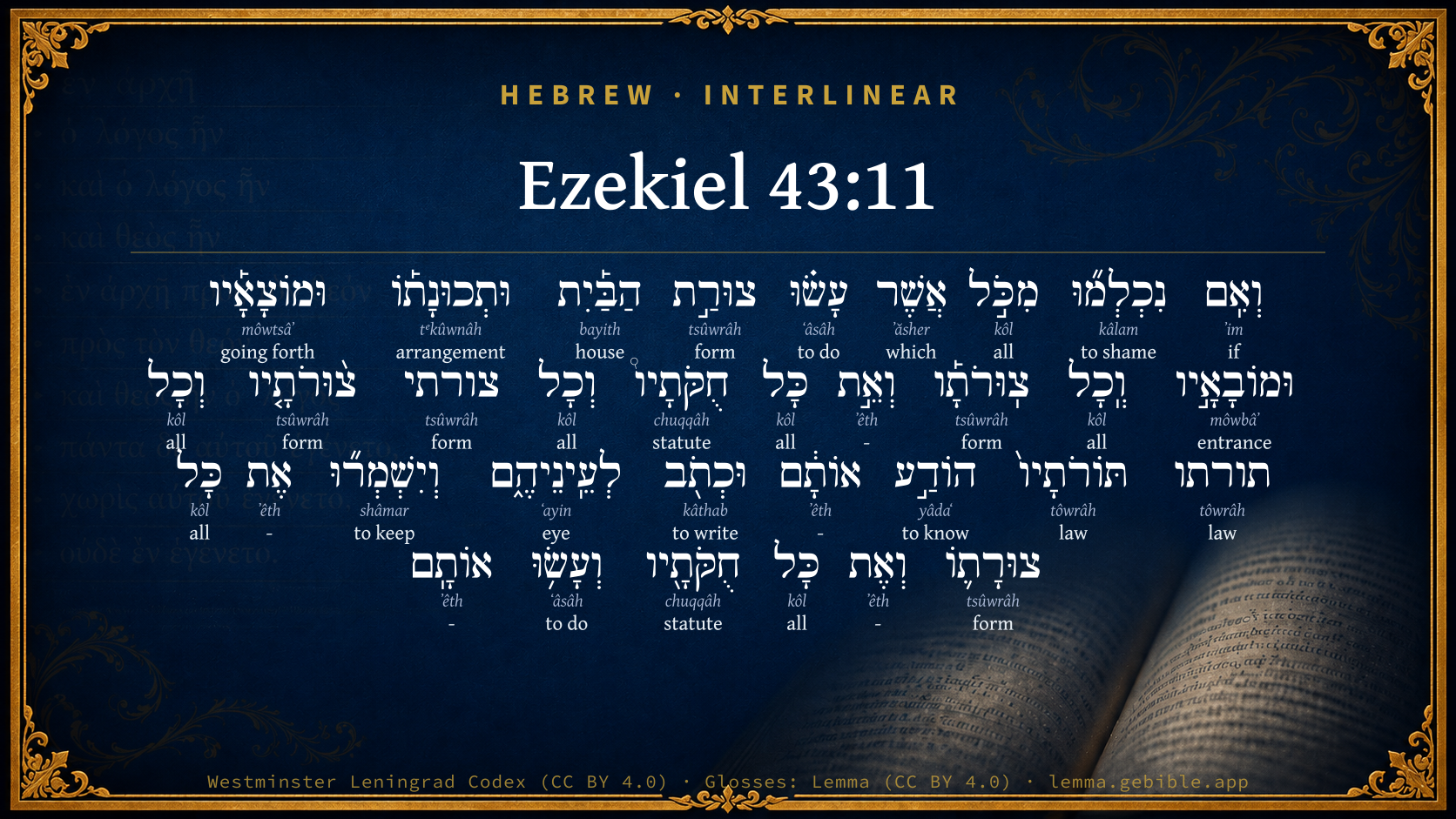
Hebrew (Westminster Leningrad Codex) Ezekiel 43:11 appears in the Hebrew Old Testament. The text above is from the Westminster Leningrad Codex. Each word links to its Strong’s number, a concise gloss, and parsing drawn from the Open Scriptures Hebrew Bible morphology. Click any word for its full Brown-Driver-Briggs (BDB) entry.
Download image
Cite this verse

Ezekiel 43:11 (World English Bible). Public Domain. Lemma interlinear Bible study tool, https://lemma.gebible.app/v/ezekiel/43/11.

Show BibTeX & RIS
BibTeX
RIS
English Translation
If they be ashamed of all that they have done, make known to them the form of the house, and the fashion of it, and the exits of it, and the entrances of it, and all the forms of it, and all the ordinances of it, and all the forms of it, and all the laws of it; and write it in their sight; that they may keep the whole form of it, and all the ordinances of it, and do them.
World English Bible · Public Domain
Highlights
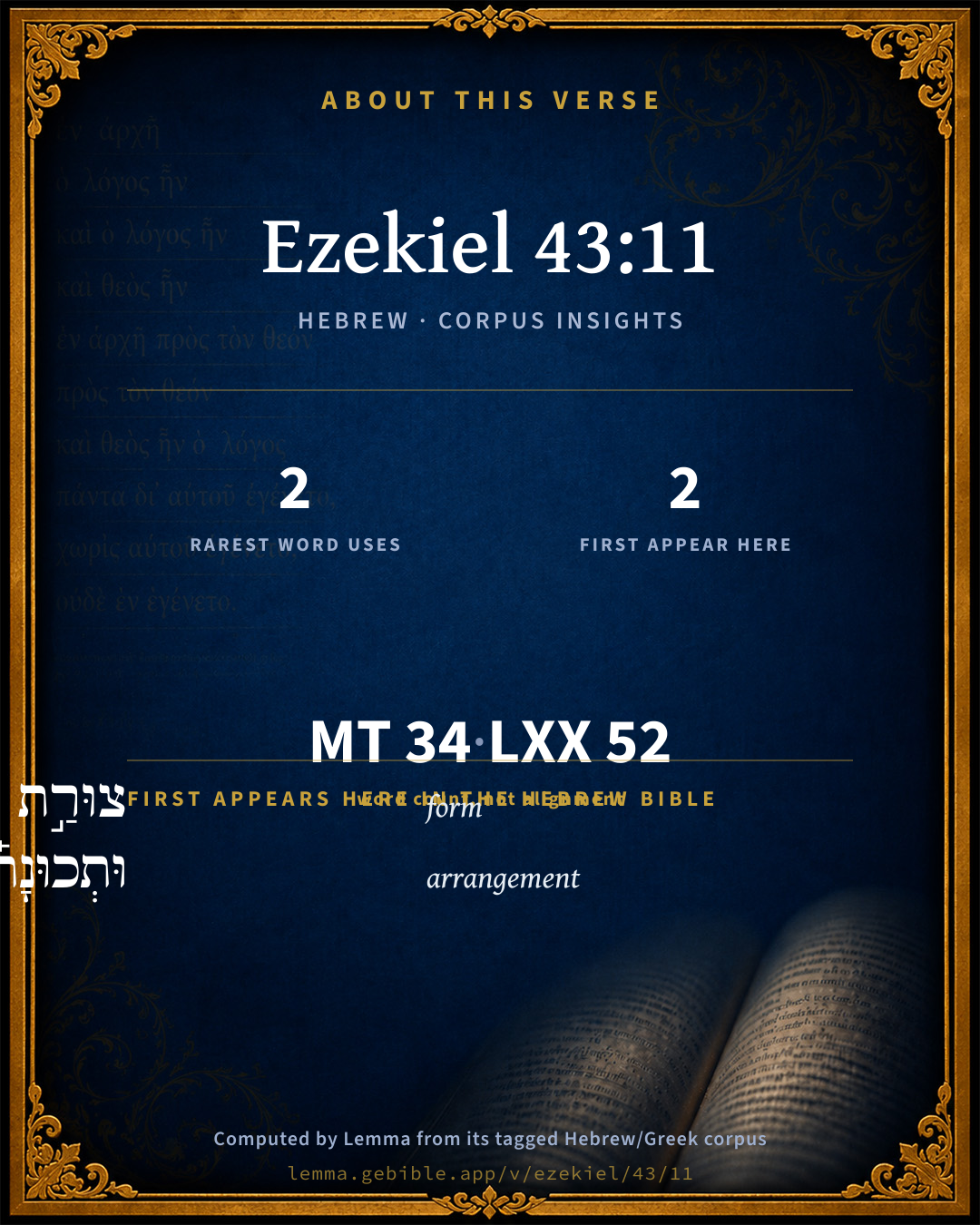
  • 2 first appearances in the Hebrew Bible
Full analysis ↓
Download a study sheet

One document with this verse’s original text, its word-by-word gloss line, the meaning frame, cross-references with their text, attributed commentary, and full source and license credits — printable, and it pastes into notes with its structure intact.

This verse Autodidact and up

Study sheet (.html) Plain text (.txt)

A passage Seminary Student

Up to 50 verses in one chapter. A passage sheet keeps up to 6 commentary sources and 12 cross-references per verse, in the order this page ranks them, and says so on the sheet whenever that leaves anything out. Ask for a single verse and you get the Autodidact verse sheet above.

Everything on this page stays free to read, with no account — the sheet is a download of what is already on screen, not access to it.

Want to remove ads? Support Godless Engineer
Compare translations 3

The same verse in 3 English versions, stacked beneath the original-language interlinear above. Click any original word for its lexicon entry.

Each is an independent rendering of the whole verse — the interlinear is not word-aligned to these translations.

Highlighted words mark where these versions differ — a whole-verse word diff, not a word-by-word alignment.

  • World English Bible Public Domain
    If they be ashamed of all that they have done, make known to them the form of the house, and the fashion of it, and the exits of it, and the entrances of it, and all the forms of it, and all the ordinances of it, and all the forms of it, and all the laws of it; and write it in their sight; that they may keep the whole form of it, and all the ordinances of it, and do them.
  • King James Version Public Domain
    And if they be ashamed of all that they have done, shew them the form of the house, and the fashion thereof, and the goings out thereof, and the comings in thereof, and all the forms thereof, and all the ordinances thereof, and all the forms thereof, and all the laws thereof: and write it in their sight, that they may keep the whole form thereof, and all the ordinances thereof, and do them.
  • unfoldingWord Literal Text CC BY-SA 4.0
    For if they are ashamed of all that they have done, then reveal to them the design of the house, its details, its exits, its entrances, and all its designs, all its decrees and rules. Then write this down before their eyes so they will keep to all its design and all its rules, so as to obey them.

unfoldingWord Literal Text — © unfoldingWord, licensed CC BY-SA 4.0. Word-aligned USFM3 via Door43 (git.door43.org/unfoldingWord/en_ult).

Versions to compare (up to 4)

3 of 4 selected

Show all 18 translations

Every available English version of this verse, each an independent rendering of the whole verse.

  • World English Bible Public Domain
    If they be ashamed of all that they have done, make known to them the form of the house, and the fashion of it, and the exits of it, and the entrances of it, and all the forms of it, and all the ordinances of it, and all the forms of it, and all the laws of it; and write it in their sight; that they may keep the whole form of it, and all the ordinances of it, and do them.
  • Berean Standard Bible Public Domain
    and if they are ashamed of all they have done, then make known to them the design of the temple—its arrangement and its exits and entrances—its whole design along with all its statutes, forms, and laws. Write it down in their sight, so that they may keep its complete design and all its statutes and may carry them out.
  • Majority Standard Bible Public Domain
    and if they are ashamed of all they have done, then make known to them the design of the temple—its arrangement and its exits and entrances—its whole design along with all its statutes, forms, and laws. Write it down in their sight, so that they may keep its complete design and all its statutes and may carry them out.
  • King James Version Public Domain
    And if they be ashamed of all that they have done, shew them the form of the house, and the fashion thereof, and the goings out thereof, and the comings in thereof, and all the forms thereof, and all the ordinances thereof, and all the forms thereof, and all the laws thereof: and write it in their sight, that they may keep the whole form thereof, and all the ordinances thereof, and do them.
  • American Standard Version (1901) Public Domain
    And if they be ashamed of all that they have done, make known unto them the form of the house, and the fashion thereof, and the egresses thereof, and the entrances thereof, and all the forms thereof, and all the ordinances thereof, and all the forms thereof, and all the laws thereof; and write it in their sight; that they may keep the whole form thereof, and all the ordinances thereof, and do them.
  • Revised Version (1885) Public Domain
    And if they be ashamed of all that they have done, make known unto them the form of the house, and the fashion thereof, and the goings out thereof, and the comings in thereof, and all the forms thereof, and all the ordinances thereof, and all the forms thereof, and all the laws thereof, and write it in their sight: that they may keep the whole form thereof, and all the ordinances thereof, and do them.
  • Geneva Bible (1599) Public Domain
    And if they be ashamed of all that they haue done, shew them the forme of the House, and ye paterne thereof, and the going out thereof, and the coming in thereof, and the whole fashion thereof, and all the ordinances thereof, and all the figures thereof, and all the lawes thereof: and write it in their sight, that they may keepe the whole fashion thereof, and all the ordinances thereof, and do them.
  • Douay-Rheims (1899) Public Domain
    But thou, son of man, shew to the house of Israel the temple, and let them be ashamed of their iniquities, and let them measure the building:
  • Young's Literal Translation Public Domain
    And since they have been ashamed of all that they have done, The form of the house, and its measurement, And its outlets, and its inlets, and all its forms, And all its statutes, even all its forms, And all its laws cause them to know, And write `it' before their eyes, And they observe all its forms, And all its statutes, and have done them.
  • Literal Standard Version CC BY-SA 4.0
    And since they have been ashamed of all that they have done, || The form of the house, and its measurement, || And its outlets, and its inlets, and all its forms, || And all its statutes, even all its forms, || And all its laws—cause them to know, || And write [it] before their eyes, || And they observe all its forms, || And all its statutes, and have done them.
  • Unlocked Literal Bible CC BY-SA 4.0
    For if they are ashamed of all that they have done, then reveal to them the design of the house, its details, its exits, its entrances, and all its designs, all its decrees and rules. Then write this down before their eyes so they will keep to all its design and all its rules, so as to obey them.
  • unfoldingWord Literal Text CC BY-SA 4.0
    For if they are ashamed of all that they have done, then reveal to them the design of the house, its details, its exits, its entrances, and all its designs, all its decrees and rules. Then write this down before their eyes so they will keep to all its design and all its rules, so as to obey them.
  • Darby Bible Public Domain
    And if they be confounded at all that they have done, make known to them the form of the house, and its fashion, and its goings out, and its comings in, and all its forms, and all its statutes, yea, all the forms thereof, and all the laws thereof; and write it in their sight, that they may keep the whole form thereof, and all the statutes thereof, and do them.
  • World Messianic Bible Public Domain
    If they are ashamed of all that they have done, make known to them the form of the house, its fashion, its exits, its entrances, its structure, all its ordinances, all its forms, and all its laws; and write it in their sight, that they may keep the whole form of it, and all its ordinances, and do them.
  • Webster's Bible Public Domain
    And if they shall be ashamed of all that they have done, show them the form of the house, and the fashion of it, and its goings out, and its comings in, and all its forms, and all its ordinances, and all its forms, and all its laws: and write it in their sight, that they may keep the whole form of it, and all its ordinances, and do them.
  • Free Bible Version CC BY-SA 4.0
    and if they're ashamed of everything they've done, then explain to them the Temple's design, its layout, exits, and entrances—the complete plan—as well as all its regulations, specifications, and laws. Write them down as they watch, so that they can remember its complete plan and follow all its regulations.
  • Bible in Basic English Public Domain
    And they will be shamed by what they have done; so give them the knowledge of the form of the house and its structure, and the ways out of it and into it, and all its laws and its rules, writing it down for them: so that they may keep all its laws and do them.
  • JPS Tanakh (1917) Public Domain
    And if they be ashamed of all that they have done, make known unto them the form of the house, and the fashion thereof, and the goings out thereof, and the comings in thereof, and all the forms thereof, and all the ordinances thereof, and all the forms thereof, and all the laws thereof, and write it in their sight; that they may keep the whole form thereof, and all the ordinances thereof, and do them.

Literal Standard Version (2020), Covenant Press — licensed CC BY-SA 4.0. Text via the HelloAO Bible API (eBible.org). Unlocked Literal Bible (unfoldingWord) — licensed CC BY-SA 4.0. Text via the HelloAO Bible API (eBible.org). unfoldingWord Literal Text — © unfoldingWord, licensed CC BY-SA 4.0. Word-aligned USFM3 via Door43 (git.door43.org/unfoldingWord/en_ult). Free Bible Version, Dr. Jonathan Gallagher — licensed CC BY-SA 4.0. Text via the HelloAO Bible API (eBible.org).

Word by word

More ways to search: Search by grammar → Find every occurrence → Compare this word →

Practice this passage: Drill this verse → Learn its vocabulary →

וּתְכוּנָת֡וֹ
tᵉkûwnâh
H8498
“and · arrangement · his”
Conjunction + Noun, Common, Feminine, Singular, Construct + Suffix, Personal, 3rd Person, Masculine, Singular
Part of Speech
Conjunction + Noun
Type
Common
Gender
Feminine
Number
Singular
State
Construct
Full BDB Definition

Origin: pass part of H8505

TWOT: 964e

arrangement, preparation, fixed place - arrangement, disposition - preparation - fixed place
  1. וְאִֽם ʼim H518 “and · if” Conjunction + Conjunction
  2. נִכְלְמ֞וּ kâlam H3637 “to shame” Verb, Niphal, Perfect, 3rd Person, Common, Plural
  3. מִכֹּ֣ל kôl H3605 “from · all” Preposition + Noun, Common, Masculine, Singular, Absolute
  4. אֲשֶׁר ʼăsher H834 “which” Particle, Relative
  5. עָשׂ֗וּ ʻâsâh H6213 “to do” Verb, Qal, Perfect, 3rd Person, Common, Plural
  6. צוּרַ֣ת tsûwrâh H6699 “form of” Noun, Common, Feminine, Singular, Construct
  7. הַבַּ֡יִת bayith H1004 “the · house” Particle, Definite Article + Noun, Common, Masculine, Singular, Absolute
  8. וּמוֹצָאָ֡יו môwtsâʼ H4161 “and · goings forth · his” Conjunction + Noun, Common, Masculine, Plural, Construct + Suffix, Personal, 3rd Person, Masculine, Singular
  9. וּמוֹבָאָ֣יו môwbâʼ H4126 “and · entrances · his” Conjunction + Noun, Common, Masculine, Plural, Construct + Suffix, Personal, 3rd Person, Masculine, Singular
  10. וְֽכָל kôl H3605 “and · all of” Conjunction + Noun, Common, Masculine, Singular, Construct
  11. צֽוּרֹתָ֡ו tsûwrâh H6699 “forms · his” Noun, Common, Feminine, Plural, Construct + Suffix, Personal, 3rd Person, Masculine, Singular
  12. וְאֵ֣ת ʼêth H853 “and · -” Conjunction + Particle, Direct Object
  13. כָּל kôl H3605 “all of” Noun, Common, Masculine, Singular, Construct
  14. חֻקֹּתָיו֩ chuqqâh H2708 “statutes · his” Noun, Common, Both, Plural, Construct + Suffix, Personal, 3rd Person, Masculine, Singular
  15. וְכָל kôl H3605 “and · all of” Conjunction + Noun, Common, Masculine, Singular, Construct
  16. צורתי tsûwrâh H6699 “forms · my” Noun, Common, Feminine, Plural, Construct + Suffix, Personal, 1st Person, Common, Singular
  17. צ֨וּרֹתָ֤יו tsûwrâh H6699 “forms · his” Noun, Common, Feminine, Plural, Construct + Suffix, Personal, 3rd Person, Masculine, Singular
  18. וְכָל kôl H3605 “and · all of” Conjunction + Noun, Common, Masculine, Singular, Construct
  19. תורתו tôwrâh H8451 “laws · his” Noun, Common, Feminine, Plural, Construct + Suffix, Personal, 3rd Person, Masculine, Singular
  20. תּוֹרֹתָיו֙ tôwrâh H8451 “laws · his” Noun, Common, Feminine, Plural, Construct + Suffix, Personal, 3rd Person, Masculine, Singular
  21. הוֹדַ֣ע yâdaʻ H3045 “know” Verb, Hiphil, Imperative, 2nd Person, Masculine, Singular
  22. אוֹתָ֔ם ʼêth H853 “- · them” Particle, Direct Object + Suffix, Personal, 3rd Person, Masculine, Plural
  23. וּכְתֹ֖ב kâthab H3789 “and · write” Conjunction + Verb, Qal, Imperative, 2nd Person, Masculine, Singular
  24. לְעֵֽינֵיהֶ֑ם ʻayin H5869 “to/for · eyes · their” Preposition + Noun, Common, Both, Dual, Construct + Suffix, Personal, 3rd Person, Masculine, Plural
  25. וְיִשְׁמְר֞וּ shâmar H8104 “and · to keep” Conjunction + Verb, Qal, Jussive, 3rd Person, Masculine, Plural
  26. אֶת ʼêth H853 “-” Particle, Direct Object
  27. כָּל kôl H3605 “all of” Noun, Common, Masculine, Singular, Construct
  28. צוּרָת֛וֹ tsûwrâh H6699 “form · his” Noun, Common, Feminine, Singular, Construct + Suffix, Personal, 3rd Person, Masculine, Singular
  29. וְאֶת ʼêth H853 “and · -” Conjunction + Particle, Direct Object
  30. כָּל kôl H3605 “all of” Noun, Common, Masculine, Singular, Construct
  31. חֻקֹּתָ֖יו chuqqâh H2708 “statutes · his” Noun, Common, Both, Plural, Construct + Suffix, Personal, 3rd Person, Masculine, Singular
  32. וְעָשׂ֥וּ ʻâsâh H6213 “and · to do” Conjunction + Verb, Qal, Sequential Perfect, 3rd Person, Common, Plural
  33. אוֹתָֽם ʼêth H853 “- · them” Particle, Direct Object + Suffix, Personal, 3rd Person, Masculine, Plural

About this verse

These counts appear in no published source. They are computed here, from the morphology-tagged text and Lemma’s own curated glosses. What Lemma adds →

34
words
17
distinct lemmas
Prophets
section

Notable vocabulary

The rarest word here is וּתְכוּנָת֡וֹ arrangement H8498 — appearing just 2 times in the whole Hebrew Bible.

First appearance in Scripture

These words make their first canonical appearance in the Hebrew Bible here:

  • צוּרַ֣ת form H6699
  • וּתְכוּנָת֡וֹ arrangement H8498

Shared distinctive vocabulary

וּתְכוּנָת֡וֹ arrangement H8498 occurs in 2 verses of the Hebrew Bible. Also found in:

Grammatical profile

  • 6 verbs
  • 21 nouns
  • 1 conjunction
  • 6 particles

Verb forms

  • נִכְלְמ֞וּ Niphal · Perfect
  • עָשׂ֗וּ Qal · Perfect
  • הוֹדַ֣ע Hiphil · Imperative
  • וּכְתֹ֖ב Qal · Imperative
  • וְיִשְׁמְר֞וּ Qal · Jussive
  • וְעָשׂ֥וּ Qal · Sequential Perfect

Repetition

Words recur within this verse — often emphatic in Hebrew:

  • מִכֹּ֣ל all H3605 ×7
  • צוּרַ֣ת form H6699 ×5
  • עָשׂ֗וּ to do H6213 ×2
  • חֻקֹּתָיו֩ statute H2708 ×2
  • תורתו law H8451 ×2

Hebrew & Septuagint length

In English translation the verse runs 82 words from the Hebrew and 62 from the Septuagint (LXX English) — closely comparable.

A rough comparison of the two English renderings, which tokenize alike — not a word-level alignment.

Word counts can differ between the Hebrew and the Greek without any difference in meaning — e.g. the Hebrew direct-object marker אֵת has no separate Greek word, and Greek often adds the article ὁ.

In the original languages it is 34 Hebrew tokens and 52 Greek tokens — but the two are counted differently (Hebrew bundles its prefixes and suffixes into one token; the Greek is in lemma form), so that isn’t a like-for-like length.

Cross-references

9

Topical passages linked to Ezekiel 43:11 in the Treasury of Scripture Knowledge — connected by theme and wording, ordered by reader-vote popularity; previews shown in the World English Bible.

  • Ezekiel 11:20 that they may walk in my statutes, and keep my ordinances, and do them: and they shall be my people, and I will be their God.
  • Ezekiel 36:27 I will put my Spirit within you, and cause you to walk in my statutes, and you shall keep my ordinances, and do them.
  • Ezekiel 12:3 Therefore, you son of man, prepare you stuff for removing, and remove by day in their sight; and you shall remove from your place to another place in their sight: it may be they will consider, though they are a rebellious house.
  • Ezekiel 40:1–42 In the five and twentieth year of our captivity, in the beginning of the year, in the tenth [day] of the month, in the fourteenth year after that the city was struck, in the same day, the hand of Yahweh was on me, and he brought me there.
  • Ezekiel 44:5–6 Yahweh said to me, Son of man, mark well, and see with your eyes, and hear with your ears all that I tell you concerning all the ordinances of the house of Yahweh, and all the laws of it; and mark well the entrance of the house, with every exit of the sanctuary.
  • Matthew 28:20 teaching them to observe all things that I commanded you. Behold, I am with you always, even to the end of the age." Amen.
  • John 13:17 If you know these things, blessed are you if you do them.
  • 1 Corinthians 11:2 Now I praise you, brothers, that you remember me in all things, and hold firm the traditions, even as I delivered them to you.
  • Hebrews 8:5 who serve a copy and shadow of the heavenly things, even as Moses was warned by God when he was about to make the tabernacle, for he said, "See, you shall make everything according to the pattern that was shown to you on the mountain."

Cross-references courtesy of OpenBible.info (CC BY 4.0).

Hebrew and Greek witnesses Masoretic Hebrew ↔ Greek Septuagint

The same verse in the two great witnesses to the Old Testament, shown verse-for-verse.

These are two independent witnesses, not word-aligned to each other, and the Septuagint is shown in lemma (dictionary) form.

Hebrew Ezekiel 43:11 Masoretic · Westminster Leningrad Codex

וְאִֽם נִכְלְמ֞וּ מִכֹּ֣ל אֲשֶׁר עָשׂ֗וּ צוּרַ֣ת הַבַּ֡יִת וּתְכוּנָת֡וֹ וּמוֹצָאָ֡יו וּמוֹבָאָ֣יו וְֽכָל צֽוּרֹתָ֡ו וְאֵ֣ת כָּל חֻקֹּתָיו֩ וְכָל צורתי צ֨וּרֹתָ֤יו וְכָל תורתו תּוֹרֹתָיו֙ הוֹדַ֣ע אוֹתָ֔ם וּכְתֹ֖ב לְעֵֽינֵיהֶ֑ם וְיִשְׁמְר֞וּ אֶת כָּל צוּרָת֛וֹ וְאֶת כָּל חֻקֹּתָ֖יו וְעָשׂ֥וּ אוֹתָֽם

If they be ashamed of all that they have done, make known to them the form of the house, and the fashion of it, and the exits of it, and the entrances of it, and all the forms of it, and all the ordinances of it, and all the forms of it, and all the laws of it; and write it in their sight; that they may keep the whole form of it, and all the ordinances of it, and do them.

World English Bible · Public Domain

Greek LXX Ezekiel 43:11 Septuagint · lemma form

καί αὐτός λαμβάνω ὁ κόλασις αὐτός περί πᾶς ὅς ποιέω καί διαγράφω ὁ οἶκος καί ὁ ἔξοδος αὐτός καί ὁ ὑπόστασις αὐτός καί πᾶς ὁ πρόσταγμα αὐτός καί πᾶς ὁ νόμιμος αὐτός γνωρίζω αὐτός καί διαγράφω ἐναντίον αὐτός καί φυλάσσω πᾶς ὁ δικαίωμα ἐγώ καί πᾶς ὁ πρόσταγμα ἐγώ καί ποιέω αὐτός

And they shall bear their punishment for all the things that they have done: and you shall describe the house, and its entrances, and the plan thereof, and all its ordinances, and you shall make known to them all the regulations of it, and describe them before them: and they shall keep all my commandments, and all my ordinances, and do them.

LXX2012 (modern English Septuagint) · Public Domain

On this verse, The Cambridge Bible for Schools and Colleges discusses the Septuagint’s reading. Read the note in Commentary ↓

Hebrew: Westminster Leningrad Codex (CC BY 4.0). Greek: Septuagint (public domain); English from LXX2012 (modern English Septuagint) (Public Domain). How the Septuagint differs from the Hebrew →

Targum (Aramaic paraphrase)

1

The Targum is the ancient Jewish Aramaic paraphrase of the Hebrew Scriptures — an interpretive translation, not the Hebrew text itself. Onkelos (literal) and Pseudo-Jonathan (expansive) render the Torah, and Jonathan the Prophets. Coverage is partial: where no permissively-licensed English translation exists for a verse, only the Aramaic is shown. This is verse-level text, not a word-by-word alignment to the Hebrew.

  1. Targum Jonathan Prophets (Joshua–Malachi)
    וְאִם יִתְכַּנָעוּן מִכָּל דַעֲבֵדוּ בְמֶחְזֵיהוֹן צוּרַת בֵּיתָא וְטִקוּסֵיהּ וּמַפְקָנוֹהִי וּמַעֲלָנוֹהִי וְכָל צוּרָתֵהּ וְיַת כָּל גְזֵירָתֵהּ וְכָל צוּרָתֵהּ וְכָל דַחֲזֵי לֵיהּ הוֹדַע יַתְהוֹן וּכְתוֹב לְעֵינֵיהוֹן וְיִטְרוּן יַת כָּל צוּרָתֵהּ וְיַת כָּל גְזֵירָתֵהּ וְיַעְבְּדוּן יַתְהוֹן:

    (no public-domain English translation for this verse)

    Targum Jonathan — Aramaic: “Mikraot Gedolot” (public domain). English: “Sefaria Community Translation” (CC0 1.0 (public-domain dedication)); “London "Chaldee Paraphrase," 1871” (public domain). Text via Sefaria.

Commentary

Notes on Ezekiel 43:11 from classic Christian and Jewish commentators (each source and its license shown beneath its notes). The classic Christian expositions comment on the surrounding passage and are grouped to its opening verse, so a note may address several verses; the Jewish commentaries on the Tanakh (Rashi and others) are per-verse, so they appear only where the commentator wrote on this verse.

Lemma curates 59 commentaries, every one of them public domain or Creative Commons licensed, each selected and text-cleaned for this edition rather than reprinted as found. About our sources →

Trapp's Complete Commentary

John Trapp

Eze 43:11 And if they be ashamed of all that they have done, shew them the form of the house, and the fashion thereof, and the goings out thereof, and the comings in thereof, and all the forms thereof, and all the ordinances thereof, and all the forms thereof, and all the laws thereof: and write [it] in their sight, that they may keep the whole form thereof, and all the ordinances thereof, and do them.

Ver. 11. And if they be ashamed of all that they have done.] If they blush and bleed at heart for their iniquities. Penitents are to be taught the truth which is according to godliness, and all such are exactly to know and to do the whole will of God, as had not rather be carnally secured than soundly comforted.

John Trapp, A Commentary or Exposition upon All the Books of the Old and New Testament (1647–1656) — public domain. Text from a community e-Sword module.

The Biblical Illustrator

Joseph S. Exell

Eze_43:11

If they be ashamed of all that they have done.

True penitence

I. The character of true penitents. If they be ashamed of all that they have done. Every principle of corrupted nature lies in direct opposition to penitential shame. Ignorance, pride, deceit, hostility against God, and self-righteousness, combine their influence in hardening the heart against the humiliation of sincere repentance.

1. The shame here spoken of is the effect of a mighty, Divine influence, which entirely changes the views and dispositions of the soul.

2. The radical effect of Gods renewing grace, in this respect, consists in an abiding, gracious disposition of the heart towards penitential exercises. It discovers itself in a peculiar anguish under that darkness and hardness,--a high esteem of repentance for its own intrinsic beauty,--an ingenuity, diligence, and earnestness, in laying open the conscience to Divine light, and in imploring those breathings of the Almighty Spirit, which are effectual to thaw and dissolve the frozen heart.

3. This gracious disposition obtains its aim, and comes forth to its desired exercises, through supernatural discoveries of Divine truth, attended with a heart-melting and heart-turning power.

4. We are led by the text to fix our attention on one particular ingredient of these penitential sensations, namely, shame. This shame is a generous recoiling of the soul from itself, as having once embraced and perpetrated what it now perceives to be unspeakably vile in the sight of God and His holy creatures. It implies in it a sense of the detestable deformity of sin, in its own nature; a recollection of our former love and practice of it; a consideration of our remaining depravity, and want of the perfect beauty of our nature.

5. The text teaches us particularly to take notice of the universal extent of this gracious shame: If they be ashamed of all, etc. Impenitent sinners are disposed to palliate and defend the vilest enormities of their conduct. But whatever may be said of occasional slips, they suppose the general tenor of their lives to be at least harmless. It is far otherwise, when the Spirit effectually breaks in upon the conscience. The true penitent is ashamed, more or less, of his whole life, of all that he hath formerly been, thought, and done. He sees himself to have been opposite to the law of God, in every motion of his heart, in every article of his conduct.

6. This deep-felt shame renders the heart more and more soft, tender, submissive to the authority of God, and ready to receive the impression of every part of His revealed will.

II. What is comprehended in the instruction here described, by such an accumulation of expressions. Shew them the form of the house, etc.

1. This gracious instruction includes peculiar discoveries of the ultimate end, designed by the Author of these ordinances, and to be pursued after in the observance of them. This is the end, for which such a frame of ordinances is divinely created, and for which men are collected into a society for the observance of them; that therein Jehovah may display His own glory, communicate His love, and exalt men to a heavenly communion with Himself and with each other. The glory, importance, and certainty of this sublime end are, to true penitents, manifested in a peculiar manner. Hence they are strongly attached to Divine ordinances, and to the instituted order of Gods house. And hence their attachment to these things differs widely from the random rhapsodies of enthusiasm, superstition, or bigotry.

2. This instruction relates to the authorised methods of acquiring, cherishing, and increasing that holy inward frame of spirit which is necessary in the worshippers of God. This is a capital part of what is here spiritually signified by the goings out, and comings in, and laws of the house. The instructions and counsels of the inspired prophets and apostles, and of Jesus Christ, whose name is called Wonderful, Counsellor, will, through the grace of the Spirit, be effectual for these purposes.

3. The instruction described in the text hath a direct reference to the institutions of God, respecting the external ordinances, order, and government of His Church. (John Love, D. D.)

The Biblical Illustrator, edited by Joseph S. Exell (c. 1880s–1900s) — public domain. Text from a community e-Sword module.

Adam Clarke's Commentary

Verse 11. And if they be ashamed] If, in a spirit of true repentance, they acknowledge their past transgressions, and purpose in his help never more to offend their God, then teach them every thing that concerns my worship, and their profiting by it.

Adam Clarke's Commentary on the Bible (1810–1826) — public domain. Text from a community e-Sword/MySword module.

Ellicott's Commentary for English Readers

(11) If they be ashamed.—The same thing which had already been declared positively is now expressed contingently, showing that the sanctification of the people and God’s dwelling among them were correlative facts; the one could not be without the other. Many expressions of nearly the same meaning are heaped up, as it were, in the latter part of this verse, to emphasise the significance of the arrangements of the new Temple, and to secure for them the thought and consideration of the people.

A Bible Commentary for English Readers, edited by Charles John Ellicott (1878–1897) — public domain. Text from a community e-Sword module.

The Cambridge Bible for Schools and Colleges

gen. ed. J. J. S. Perowne

11. The verse seems overgrown with amplifications or repetitions. LXX. omits: “and the comings in thereof and all the forms thereof.” The second “and all the forms thereof” seems an accidental misreading and consequent duplication of the following “and all the laws thereof.” Cf. Eze_44:5, where the “ordinances” and “laws” of the house again come together.

The Cambridge Bible for Schools and Colleges (gen. ed. J. J. S. Perowne; Cambridge University Press, 1878–1918) — public domain. Text from a community e-Sword module.

John Gill's Exposition

And if they be ashamed of all that they have done,.... As sinful and, criminal, at least as very imperfect and defective, and not answerable to the pattern shown them, from which they have sadly deviated; if made sensible of this, and they acknowledge it with shame, not only the house in general, but the particulars of it, are to be shown with them; for, to sensible and penitent persons, more grace, light, knowledge, and judgment in divine things, are given:

shew them the form of the house, and the fashion thereof; the form and order of a Gospel church; which is not national, provincial, or parochial, nor Presbyterian, but congregational; consisting of persons called out of the world by the grace of God, and who are incorporated and knit together in Gospel bonds; among whom the word of God is faithfully preached, and the ordinances truly administered, and furnished with proper officers, pastors, and deacons; the one to take care of the spiritual, the other of the temporal affairs of the church; and to see a church in such form and order, and thus organized, is a very beautiful sight.

And the goings out thereof, and the comings in thereof; the gates and way of entrance into it, which is only by Christ, and a profession of faith in him; and care should be taken that none be admitted but such who appear to be regenerated and sanctified by the Spirit of God; to be righteous through the righteousness of Christ; and that keep the truth, and hold the doctrines of the Gospel: and also the way and manner of excluding unworthy persons, such who are immoral in their lives, and erroneous in their principles, should be observed. And all the forms thereof; the decorations of it, signified by the cherubim and palm trees; so Jarchi and Kimchi; and these expressive of ministers of the word, and faithful men: this is often repeated, that it might be the more observed; for to have ministers to answer such characters is of great consequence.

And all the ordinances thereof, and all the forms thereof, and all the laws thereof; the ordinances are those of baptism and the Lord's supper, which are to continue until the second coming of Christ: the laws are, besides the moral law, in the hands of Christ the lawgiver, the law of loving one another, called the law of Christ, and his new commandment; and all the laws relating to worship and discipline, concerning the reproof of members, in case of private or public offences; and concerning the exclusion of disorderly or heretical persons:

and write it in their sight; the plan and model of this house, and all things belonging to it, that they may have it before them, as the rule of their conduct and behaviour:

that they may keep the whole form thereof, and all the ordinances thereof, and do them; for all this is shown, not for mere speculation, and to gratify curiosity, but in order to be put in practice; all these rules, laws, and ordinances, are to be kept in faith, from a principle of love, in the name and strength of Christ, and with a view to the glory of God.

John Gill's Exposition of the Whole Bible (1746–1763) — public domain (CC PDM 1.0). Text via the HelloAO Bible API.

Haydock's Catholic Bible Commentary

In the whole fabric, (Menochius) as thou hast described it, (Haydock) or received from the angel, with all the ceremonies to be observed.

George Leo Haydock (1774–1849), Haydock's Catholic Family Bible and Commentary, 1859 edition — public domain. Excludes Psalms (Douay-Rheims chapter numbering differs from Protestant) and Deuterocanonical books (Catholic canon only).

Matthew Poole's English Annotations

They; the house of Israel.

Be ashamed; repent, and show it by manifest tokens.

Of all: it is not true repentance which is ashamed of some only, but not of all sins. The form, ; the model of the temple.

The fashion; the manner of the building, and fitting each part to other.

The goings out there of, and the comings in thereof; all the alleys, gates, stairs, &c.

The forms, which ought to be observed, saith the French version. Now though this be not in the Hebrew, yet the word may imply as much, it being an idea, pattern, or platform to which a thing is to be confirmed.

The ordinances; rites and orders, rules of governing priests, and their services. These are again repeated in the next words of the verse, which is usual in Scripture, and with this prophet.

Write it in their sight: that it may be remembered, they shall have a draught of it from thy hand, and drawn in their sight, that they may inquire of any particular wherein doubt ariseth.

That they may keep the whole form thereof: as Moses and Solomon did, so must the builders of this temple, frame the whole to the pattern or exemplar set before them, for not doing whereof a heavy account lieth on some in the church.

Matthew Poole's English Annotations on the Holy Bible (1683–1685) — public domain. Text from a community e-Sword/MySword module.

The Pulpit Commentary

And if they be ashamed of all that they have done. This cannot signify that Ezekiel was not to show the house until they had evinced a sincere penitence for past wickedness, since the converse has just been stated, that their repentance should flow from a disclosure to them of the house: but that in the event of the presentation to them of the "wellmeasured" building awaking in them any disposition of regret and sorrow, then the prophet should proceed to unfold to them its details. He should show them first the form of the house, i.e. the external shape of the building, and the fashion thereof, or its well-proportioned and harmonious arrangements; the goings out thereof, and the comings in thereof, i.e. its exits and entrances, (Eze_44:5) and all the forms thereof; which can only mean the shapes of its several parts; and all the ordinances thereof, or regulations concerning its use in worship, and all the forms thereof the same words as above, and therefore omitted by the LXX as well as some Hebrew manuscripts, and, after their example, by Dathe, Hitzig, Ewald, Smend, and others, though Keil, Kliefoth, Schroder, and others retain the clause as genuine, and regard it as an illustration of Ezekiel"s habit of crowding words together for the sake of emphasisand all the laws thereof, by which were probably signified "the instructions contained in these statutes for sanctification of life" (Keil). In addition to rehearsing the above in the hearing of the people, the prophet was directed to write them in their sight, if it be not open to understand the "writing" as explanatory of the way in which the" showing" was to be made.

The Pulpit Commentary (1880–1919), ed. H.D.M. Spence-Jones & Joseph S. Exell — public domain. Text from a community e-Sword module.

Rashi

Rabbi Shlomo Yitzchaki (Rashi)

And if they are ashamed i.e., [if] they will be embarrassed and hide their faces because of all they did, then let them know what I am destined to do for them.

the form of the House the perimeter of the House, from front to back, arranged on [all] four sides.

and its scheme the number of its cells and its chambers.

and all its forms the cherubim, palm trees, posts, and halls.

I found: “and all its forms” is unclear.

so that they keep They will learn the matters of the measurements from your mouth so that they will know how to do them at the time of the end. I found [the following]: The second aliyah [to the Holy Land] through Ezra was merited to be like the first entry through Joshua, to come about by force and through a miracle, as expounded (Ber. 4a, Exod. 15:16): “until... pass.” This Building would then have been fit for them as of then, when they emerged from exile, to an everlasting redemption. But [their] sin caused [this not to happen] for their repentance was not suitable, [i.e.,] they did not resolve to stop sinning. [Therefore,] they emerged to freedom [only] through the sanction of Cyrus and his son. Some say that in Babylon they stumbled regarding gentile women.

Rashi on the Tanakh — English translations: “The Judaica Press complete Tanach with Rashi, translated by A. J. Rosenberg” (CC BY 4.0); “Pentateuch with Rashi's commentary by M. Rosenbaum and A.M. Silbermann, 1929-1934” (public domain); “The Metsudah Tanach series, Lakewood, N.J” (CC BY 4.0); and “The Book of Joshua, Metsudah Publications, 1997” (CC BY 4.0). Text via Sefaria.

Lesson kit

Teaching starters — assembled from the data on this page, not authored interpretation. Every prompt links to the verse data it draws on. Edit before teaching.

Ezekiel, in the Prophets, opens this verse with 34 words (17 distinct Hebrew lemmas). Its most distinctive word is tᵉkûwnâh (“arrangement”). A historical commentator’s framing appears above. Read the whole chapter for the surrounding context.

Discussion questions

  1. What does “arrangement” (tᵉkûwnâh) contribute to the verse as a whole?
  2. 2 words here appear for the first time in Scripture. What is being introduced at this debut?
  3. Nahum 2:9 shares the word «arrangement» with this verse. How do the two illuminate each other?
  4. “all” occurs 7× in this one verse. What is the effect of the repetition?
  5. These translations render this verse differently. What is at stake in choosing one wording over another?
  6. The verb «נִכְלְמ֞וּ» is Niphal Perfect. How does its form color the action?
  7. Reading how Trapp's Complete Commentary and The Biblical Illustrator read this verse, where do the two commentators agree and where do they part?

Things to notice

Reading settings

Reading text

Shown beneath each verse's original-language words.

Old Testament
Old Testament edition

Read the OT as the Masoretic Hebrew (MT) or the Greek Septuagint (LXX).

English shown for the Greek Septuagint (in the Hebrew ↔ Greek comparison).

Comparing translations? Open the Compare panel on any verse page to stack up to four side by side.