
Nehemiah 10:28

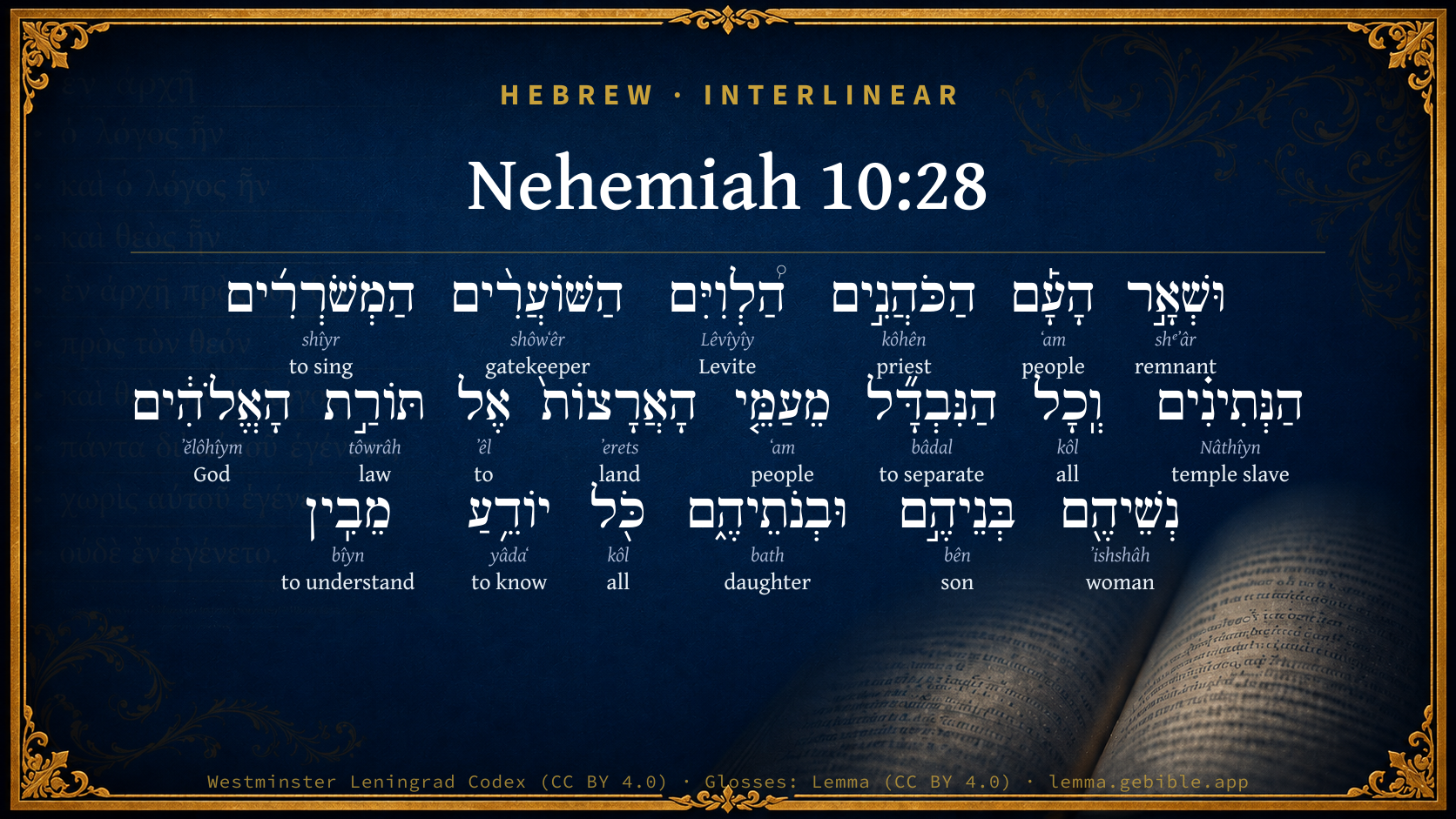
Hebrew (Westminster Leningrad Codex) Nehemiah 10:28 appears in the Hebrew Old Testament. The text above is from the Westminster Leningrad Codex. Each word links to its Strong’s number, a concise gloss, and parsing drawn from the Open Scriptures Hebrew Bible morphology. Click any word for its full Brown-Driver-Briggs (BDB) entry.
Download image
Cite this verse

Nehemiah 10:28 (World English Bible). Public Domain. Lemma interlinear Bible study tool, https://lemma.gebible.app/v/nehemiah/10/28.

Show BibTeX & RIS
BibTeX
RIS
English Translation
The rest of the people, the priests, the Levites, the porters, the singers, the Nethinim, and all those who had separated themselves from the peoples of the lands to the law of God, their wives, their sons, and their daughters, everyone who had knowledge, and understanding;
World English Bible · Public Domain
Download a study sheet

One document with this verse’s original text, its word-by-word gloss line, the meaning frame, cross-references with their text, attributed commentary, and full source and license credits — printable, and it pastes into notes with its structure intact.

This verse Autodidact and up

Study sheet (.html) Plain text (.txt)

A passage Seminary Student

Up to 50 verses in one chapter. A passage sheet keeps up to 6 commentary sources and 12 cross-references per verse, in the order this page ranks them, and says so on the sheet whenever that leaves anything out. Ask for a single verse and you get the Autodidact verse sheet above.

Everything on this page stays free to read, with no account — the sheet is a download of what is already on screen, not access to it.

Want to remove ads? Support Godless Engineer
Compare translations 3

The same verse in 3 English versions, stacked beneath the original-language interlinear above. Click any original word for its lexicon entry.

Each is an independent rendering of the whole verse — the interlinear is not word-aligned to these translations.

Highlighted words mark where these versions differ — a whole-verse word diff, not a word-by-word alignment.

  • World English Bible Public Domain
    The rest of the people, the priests, the Levites, the porters, the singers, the Nethinim, and all those who had separated themselves from the peoples of the lands to the law of God, their wives, their sons, and their daughters, everyone who had knowledge, and understanding;
  • King James Version Public Domain
    And the rest of the people, the priests, the Levites, the porters, the singers, the Nethinims, and all they that had separated themselves from the people of the lands unto the law of God, their wives, their sons, and their daughters, every one having knowledge, and having understanding;
  • unfoldingWord Literal Text CC BY-SA 4.0
    And the rest of the people, the priests, the Levites, the gatekeepers, the ones who sing, the Nethinim, and all the ones who were separating themselves from the peoples of the lands to the law of God, their wives, their sons and their daughters, all who were knowing, being able to understand,

unfoldingWord Literal Text — © unfoldingWord, licensed CC BY-SA 4.0. Word-aligned USFM3 via Door43 (git.door43.org/unfoldingWord/en_ult).

Versions to compare (up to 4)

3 of 4 selected

Show all 18 translations

Every available English version of this verse, each an independent rendering of the whole verse.

  • World English Bible Public Domain
    The rest of the people, the priests, the Levites, the porters, the singers, the Nethinim, and all those who had separated themselves from the peoples of the lands to the law of God, their wives, their sons, and their daughters, everyone who had knowledge, and understanding;
  • Berean Standard Bible Public Domain
    “The rest of the people—the priests, Levites, gatekeepers, singers, temple servants, and all who had separated themselves from the people of the land to obey the Law of God—along with their wives and all their sons and daughters who are able to understand,
  • Majority Standard Bible Public Domain
    “The rest of the people—the priests, Levites, gatekeepers, singers, temple servants, and all who had separated themselves from the people of the land to obey the Law of God—along with their wives and all their sons and daughters who are able to understand,
  • King James Version Public Domain
    And the rest of the people, the priests, the Levites, the porters, the singers, the Nethinims, and all they that had separated themselves from the people of the lands unto the law of God, their wives, their sons, and their daughters, every one having knowledge, and having understanding;
  • American Standard Version (1901) Public Domain
    And the rest of the people, the priests, the Levites, the porters, the singers, the Nethinim, and all they that had separated themselves from the peoples of the lands unto the law of God, their wives, their sons, and their daughters, every one that had knowledge, and understanding;
  • Revised Version (1885) Public Domain
    And the rest of the people, the priests, the Levites, the porters, the singers, the Nethinim, and all they that had separated themselves from the peoples of the lands unto the law of God, their wives, their sons, and their daughters, every one that had knowledge and understanding;
  • Geneva Bible (1599) Public Domain
    And the rest of the people, the Priestes, the Leuites, the porters, the singers, the Nethinims, and all that were separated from the people of the landes vnto the Lawe of God, their wiues, their sonnes, and their daughters, all that coulde vnderstande.
  • Douay-Rheims (1899) Public Domain
    And the rest of the people, priests, Levites, porters, and singing men, Nathinites, and all that had separated themselves from the people of the lands to the law of God, their wives, their sons, and their daughters.
  • Young's Literal Translation Public Domain
    And the rest of the people, the priests, the Levites, the gatekeepers, the singers, the Nethinim, and every one who hath been separated from the peoples of the lands unto the law of God, their wives, their sons, and their daughters, every knowing intelligent one,
  • Literal Standard Version CC BY-SA 4.0
    And the rest of the people, the priests, the Levites, the gatekeepers, the singers, the Nethinim, and everyone who has been separated from the peoples of the lands to the Law of God, their wives, their sons, and their daughters, every knowing intelligent one,
  • Unlocked Literal Bible CC BY-SA 4.0
    As for the rest of the people, who were priests, Levites, gatekeepers, singers, temple servants, and all who had separated themselves from the people of the neighboring lands and pledged themselves to the law of God, including their wives, their sons and their daughters, all who have knowledge and understanding,
  • unfoldingWord Literal Text CC BY-SA 4.0
    And the rest of the people, the priests, the Levites, the gatekeepers, the ones who sing, the Nethinim, and all the ones who were separating themselves from the peoples of the lands to the law of God, their wives, their sons and their daughters, all who were knowing, being able to understand,
  • Darby Bible Public Domain
    And the rest of the people, the priests, the Levites, the doorkeepers, the singers, the Nethinim, and all they that had separated themselves from the peoples of the lands to the law of God, their wives, their sons and their daughters, every one having knowledge [and] having understanding,
  • World Messianic Bible Public Domain
    The rest of the people, the priests, the Levites, the gatekeepers, the singers, the temple servants, and all those who had separated themselves from the peoples of the lands to the law of God, their wives, their sons, and their daughters—everyone who had knowledge and understanding—
  • Webster's Bible Public Domain
    And the rest of the people, the priests, the Levites, the porters, the singers, the Nethinims, and all they that had separated themselves from the people of the lands to the law of God, their wives, their sons, and their daughters, every one having knowledge, and having understanding;
  • Free Bible Version CC BY-SA 4.0
    The rest of the people, including the priests, Levites, gatekeepers, singers, and Temple servants, and everyone who had separated themselves from the people of the land to keep the Law of God, as well as their wives and all their sons and daughters who were old enough to understand,
  • Bible in Basic English Public Domain
    And the rest of the people, the priests, the Levites, the door-keepers, the music-makers, the Nethinim, and all those who had made themselves separate from the peoples of the lands, to keep the law of God, their wives, their sons, and their daughters, everyone who had knowledge and wisdom;
  • JPS Tanakh (1917) Public Domain
    (10-29) And the rest of the people, the priests, the Levites, the porters, the singers, the Nethinim, and all they that had separated themselves from the peoples of the lands unto the law of God, their wives, their sons, and their daughters, every one that had knowledge and understanding;

Literal Standard Version (2020), Covenant Press — licensed CC BY-SA 4.0. Text via the HelloAO Bible API (eBible.org). Unlocked Literal Bible (unfoldingWord) — licensed CC BY-SA 4.0. Text via the HelloAO Bible API (eBible.org). unfoldingWord Literal Text — © unfoldingWord, licensed CC BY-SA 4.0. Word-aligned USFM3 via Door43 (git.door43.org/unfoldingWord/en_ult). Free Bible Version, Dr. Jonathan Gallagher — licensed CC BY-SA 4.0. Text via the HelloAO Bible API (eBible.org).

Word by word

More ways to search: Search by grammar → Find every occurrence → Compare this word →

Practice this passage: Drill this verse → Learn its vocabulary →

הַנְּתִינִ֗ים
Nâthîyn
H5411
“the · temple slaves”
Particle, Definite Article + Noun, Common, Masculine, Plural, Absolute
Part of Speech
Particle + Noun
Type
Common
Gender
Masculine
Number
Plural
State
Absolute
Full BDB Definition

Origin: from H5414

TWOT: 1443a

Nethinims - temple slaves assigned to the Levites and priests for service in the sanctuary
  1. וּשְׁאָ֣ר shᵉʼâr H7605 “and · remnant of” Conjunction + Noun, Common, Masculine, Singular, Construct
  2. הָעָ֡ם ʻam H5971 “the · people” Particle, Definite Article + Noun, Common, Masculine, Singular, Absolute
  3. הַכֹּהֲנִ֣ים kôhên H3548 “the · priests” Particle, Definite Article + Noun, Common, Masculine, Plural, Absolute
  4. הַ֠לְוִיִּם Lêvîyîy H3881 “the · Levites” Particle, Definite Article + Noun, Gentilic, Masculine, Plural, Absolute
  5. הַשּׁוֹעֲרִ֨ים shôwʻêr H7778 “the · gatekeepers” Particle, Definite Article + Noun, Common, Masculine, Plural, Absolute
  6. הַמְשֹׁרְרִ֜ים shîyr H7891 “the · singing” Particle, Definite Article + Verb, Polel, Participle Active, Masculine, Plural, Absolute
  7. וְֽכָל kôl H3605 “and · all of” Conjunction + Noun, Common, Masculine, Singular, Construct
  8. הַנִּבְדָּ֞ל bâdal H914 “the · separating” Particle, Definite Article + Verb, Niphal, Participle Active, Masculine, Singular, Absolute
  9. מֵעַמֵּ֤י ʻam H5971 “from · peoples of” Preposition + Noun, Common, Masculine, Plural, Construct
  10. הָאֲרָצוֹת֙ ʼerets H776 “the · lands” Particle, Definite Article + Noun, Common, Both, Plural, Absolute
  11. אֶל ʼêl H413 “to” Preposition
  12. תּוֹרַ֣ת tôwrâh H8451 “law of” Noun, Common, Feminine, Singular, Construct
  13. הָאֱלֹהִ֔ים ʼĕlôhîym H430 “the · God(s)” Particle, Definite Article + Noun, Common, Masculine, Plural, Absolute
  14. נְשֵׁיהֶ֖ם ʼishshâh H802 “women · their” Noun, Common, Feminine, Plural, Construct + Suffix, Personal, 3rd Person, Masculine, Plural
  15. בְּנֵיהֶ֣ם bên H1121 “sons · their” Noun, Common, Masculine, Plural, Construct + Suffix, Personal, 3rd Person, Masculine, Plural
  16. וּבְנֹתֵיהֶ֑ם bath H1323 “and · daughters · their” Conjunction + Noun, Common, Feminine, Plural, Construct + Suffix, Personal, 3rd Person, Masculine, Plural
  17. כֹּ֖ל kôl H3605 “all” Noun, Common, Masculine, Singular, Absolute
  18. יוֹדֵ֥עַ yâdaʻ H3045 “knowing” Verb, Qal, Participle Active, Masculine, Singular, Absolute
  19. מֵבִֽין bîyn H995 “understanding” Verb, Hiphil, Participle Active, Masculine, Singular, Absolute

About this verse

These counts appear in no published source. They are computed here, from the morphology-tagged text and Lemma’s own curated glosses. What Lemma adds →

20
words
18
distinct lemmas
Historical
section

Notable vocabulary

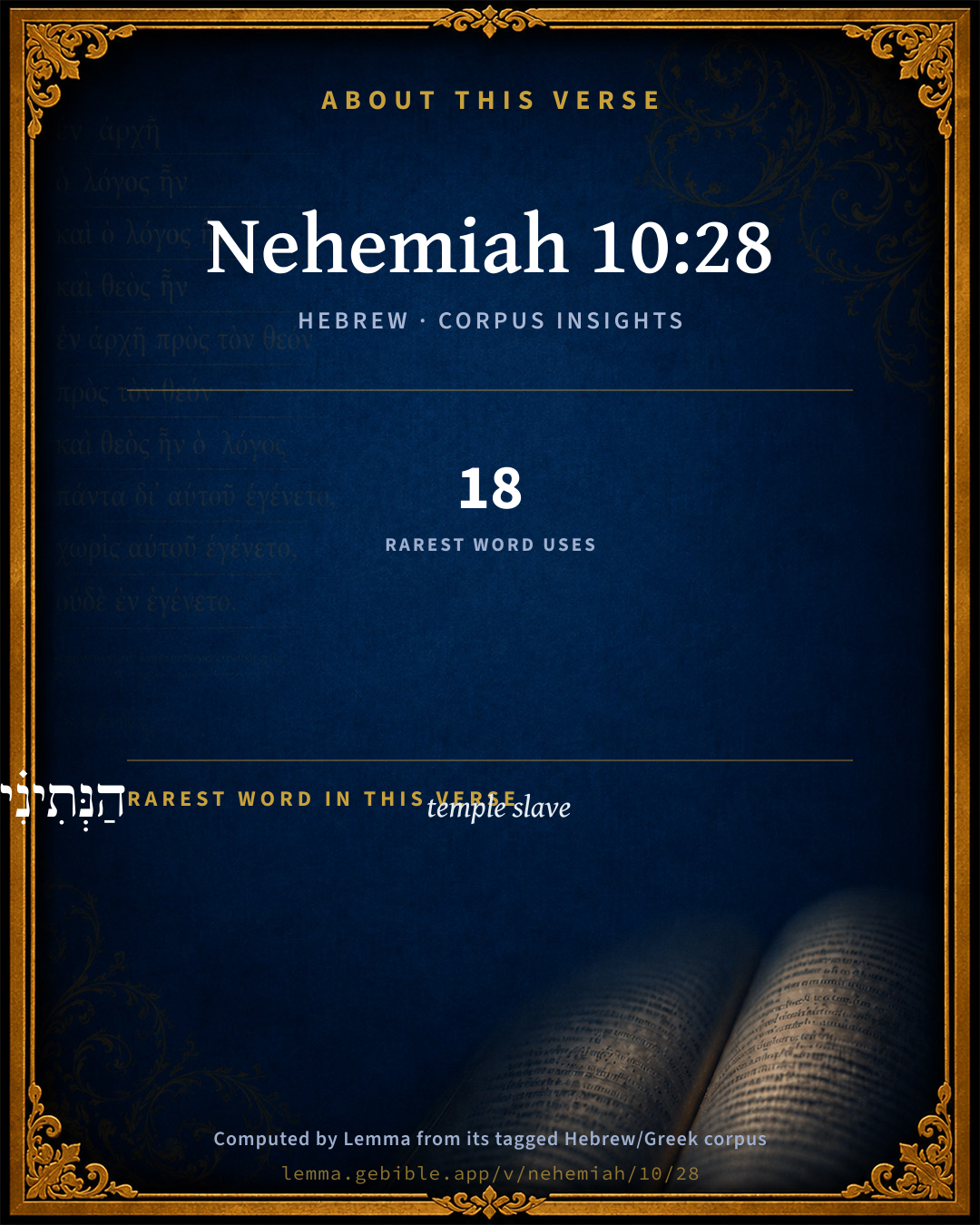
The rarest word here is הַנְּתִינִ֗ים temple slave H5411 — appearing just 18 times in the whole Hebrew Bible.

Shared distinctive vocabulary

הַנְּתִינִ֗ים temple slave H5411 occurs in 15 verses of the Hebrew Bible. Also found in:

Grammatical profile

  • 4 verbs
  • 15 nouns
  • 1 preposition

Verb forms

  • הַמְשֹׁרְרִ֜ים Polel · Participle Active
  • הַנִּבְדָּ֞ל Niphal · Participle Active
  • יוֹדֵ֥עַ Qal · Participle Active
  • מֵבִֽין Hiphil · Participle Active

Repetition

Words recur within this verse — often emphatic in Hebrew:

  • הָעָ֡ם people H5971 ×2
  • וְֽכָל all H3605 ×2

Cross-references

14

Topical passages linked to Nehemiah 10:28 in the Treasury of Scripture Knowledge — connected by theme and wording, ordered by reader-vote popularity; previews shown in the World English Bible.

  • Nehemiah 9:2 The seed of Israel separated themselves from all foreigners, and stood and confessed their sins, and the iniquities of their fathers.
  • Jeremiah 4:2 and you shall swear, As Yahweh lives, in truth, in justice, and in righteousness; and the nations shall bless themselves in him, and in him shall they glory.
  • 2 Corinthians 6:14–17 Don't be unequally yoked with unbelievers, for what fellowship have righteousness and iniquity? Or what communion has light with darkness?
  • Ecclesiastes 5:2 Don't be rash with your mouth, and don't let your heart be hasty to utter anything before God; for God is in heaven, and you on earth. Therefore let your words be few.
  • Romans 1:1 Paul, a servant of Jesus Christ, called to be an apostle, set apart for the Gospel of God,
  • Leviticus 20:24 But I have said to you, "You shall inherit their land, and I will give it to you to possess it, a land flowing with milk and honey." I am Yahweh your God, who has separated you from the peoples.
  • Ezra 2:36–54 The priests: the children of Jedaiah, of the house of Jeshua, nine hundred seventy-three.
  • Ezra 2:70 So the priests, and the Levites, and some of the people, and the singers, and the porters, and the Nethinim, lived in their cities, and all Israel in their cities.
  • Ezra 9:1–2 Now when these things were done, the princes drew near to me, saying, The people of Israel, and the priests and the Levites, have not separated themselves from the peoples of the lands, [doing] according to their abominations, even of the Canaanites, the Hittites, the Perizzites, the Jebusites, the Ammonites, the Moabites, the Egyptians, and the Amorites.
  • Ezra 10:11–19 Now therefore make confession to Yahweh, the God of your fathers, and do his pleasure; and separate yourselves from the peoples of the land, and from the foreign women.
  • Nehemiah 7:72–73 That which the rest of the people gave was twenty thousand darics of gold, and two thousand minas of silver, and sixty-seven priests' garments.
  • Nehemiah 8:2 Ezra the priest brought the law before the assembly, both men and women, and all who could hear with understanding, on the first day of the seventh month.
  • Nehemiah 13:3 It came to pass, when they had heard the law, that they separated from Israel all the mixed multitude.
  • Psalms 47:7 For God is the King of all the earth. Sing praises with understanding.

Cross-references courtesy of OpenBible.info (CC BY 4.0).

Hebrew and Greek witnesses Masoretic Hebrew ↔ Greek Septuagint

The same verse in the two great witnesses to the Old Testament, shown verse-for-verse.

These are two independent witnesses, not word-aligned to each other, and the Septuagint is shown in lemma (dictionary) form.

Hebrew Nehemiah 10:28 Masoretic · Westminster Leningrad Codex

וּשְׁאָ֣ר הָעָ֡ם הַכֹּהֲנִ֣ים הַ֠לְוִיִּם הַשּׁוֹעֲרִ֨ים הַמְשֹׁרְרִ֜ים הַנְּתִינִ֗ים וְֽכָל הַנִּבְדָּ֞ל מֵעַמֵּ֤י הָאֲרָצוֹת֙ אֶל תּוֹרַ֣ת הָאֱלֹהִ֔ים נְשֵׁיהֶ֖ם בְּנֵיהֶ֣ם וּבְנֹתֵיהֶ֑ם כֹּ֖ל יוֹדֵ֥עַ מֵבִֽין

The rest of the people, the priests, the Levites, the porters, the singers, the Nethinim, and all those who had separated themselves from the peoples of the lands to the law of God, their wives, their sons, and their daughters, everyone who had knowledge, and understanding;

World English Bible · Public Domain

Greek LXX Structure differs

The Septuagint has no separate book of Nehemiah. Its Greek text is the second half of Esdras B (2 Esdras), chapters 11–23; Ezra is the first half (1–10).

A verse-for-verse comparison isn’t shown here because the chapters and verses don’t line up. Switch to the LXX edition with the MT / LXX toggle above to read the Greek directly.

On this verse, Haydock's Catholic Bible Commentary discusses the Septuagint’s reading. Read the note in Commentary ↓

Hebrew: Westminster Leningrad Codex (CC BY 4.0). Greek: Septuagint (public domain); English from a public-domain English Septuagint. How the Septuagint differs from the Hebrew →

Commentary

Notes on Nehemiah 10:28 from classic Christian and Jewish commentators (each source and its license shown beneath its notes). The classic Christian expositions comment on the surrounding passage and are grouped to its opening verse, so a note may address several verses; the Jewish commentaries on the Tanakh (Rashi and others) are per-verse, so they appear only where the commentator wrote on this verse.

Lemma curates 59 commentaries, every one of them public domain or Creative Commons licensed, each selected and text-cleaned for this edition rather than reprinted as found. About our sources →

Trapp's Complete Commentary

John Trapp

Neh 10:28 And the rest of the people, the priests, the Levites, the porters, the singers, the Nethinims, and all they that had separated themselves from the people of the lands unto the law of God, their wives, their sons, and their daughters, every one having knowledge, and having understanding;

Ver. 28. That had separated themselves] In St Paul’s sense, 2Co 6:17, "Come out from among them, and be ye separate," &c., from such stand off; stand up from the dead; save yourselves from this untoward generation, shun their sins, lest ye share in their plagues. These holy separates, or proselytes, sealed the covenant, and became free denizens of the commonwealth of Israel; having right to all God’s ordinances, Exo 12:48. Such were Araunah, the Jebusite, 2Sa 24:18-25; Jether, the Ishmaelite, 1Ch 7:17, with 2Sa 17:25; those, Act 2:10; the Jews called them Advenas Iustitiae. Newcomers of justice. Diodati interpreteth this text of such Jews as were come again out of Babylon, to serve the Lord, according to his law. Others of such as had separated themselves from their heathen wives and children.

Their wives, their sons, and their daughters] These also were then, and still may be, covenanters, as partakers of the benefit, 1Ti 6:2 and heirs together of the grace of life, 1Pe 3:7.

Every one having knowledge] Of their own misery by sin, and of the great mystery of godliness.

John Trapp, A Commentary or Exposition upon All the Books of the Old and New Testament (1647–1656) — public domain. Text from a community e-Sword module.

The Biblical Illustrator

Joseph S. Exell

Neh_10:28-30

And all they that had separated themselves from the people of the lands unto the law of God.

A genuine revival

1. The crucial test of any revival is the extent to which it actually purifies and reforms the lives of those who come under its influence.

2. This is the kind of revival which ever and again we all need. For we are constantly liable to fall below the level of our Christian privileges. We are also apt to grow blind to out own defects, and to under-estimate the extent of our own shortcomings. We have need to bring our lives into the light of Gods holy law, and into the light of the life of Christ, that our consciences may be awakened to a truer and deeper penitence.

3. A repentance which is the fruit of A true revival of the religious life naturally goes into the details of conduct. (T. Campbell Finlayson.)

And that we would not give our daughters unto the people of the land.

Marriage and purity

Wherever I find a purely savage life, which means life eaten up by impure sin, there I also find no capacity in the life to advance and grow. You have an instance in the case of Africa, the life of which has not moved for a couple of thousand years, simply because it is soaked with impurity. Turning to the earliest efforts of civilisation, as recorded in the Bible, I find men making effort after effort, getting a little way, and then each effort vanishing in a sink of impure sin. Life ought to grow if natural, but if impurity is natural, it is natural to stagnate, never to grow, to fall to pieces, and for civilisations to be swept out by weakness and impotence. The history of our European civilisation is the history of the gradual rise in the idea of marriage and purity. (Canon Scott-Holland.)

The Biblical Illustrator, edited by Joseph S. Exell (c. 1880s–1900s) — public domain. Text from a community e-Sword module.

Joseph Benson's Commentary

Neh 10:28. And the rest of the people, &c. — Those that did not subscribe and seal, because there were too many, yet gave their consent to what the fore-named persons did. And not only the men, but their wives and their children, who were arrived at years of discretion, engaged themselves to abide by what their brethren the nobles had done. And all that had separated themselves — All those of the heathen who had abjured idolatry and joined themselves to the worship of the Jews.

Joseph Benson's Commentary on the Old and New Testaments (1811–1818) — public domain. Text from a community e-Sword module.

Whedon's Commentary on the Bible

Daniel D. Whedon

OATH OF THE PEOPLE TO KEEP THE LAW, Neh_10:28-31.

28. The rest of the people — Those represented by the heads of the nation who had sealed the covenant. While their chiefs sealed the covenant the people bound themselves, by a most solemn oath, to observe all that the covenant contemplated — to observe all the law.

Daniel D. Whedon (gen. ed.), Commentary on the Old and New Testaments (1874–1909) — public domain. Text from a community e-Sword module.

Tyndale Open Study Notes

Tyndale Open Resources

10:28 separated themselves from the pagan people: See 9:2; cp. Ezra 9–10.

Tyndale Open Study Notes — © Tyndale Open Resources, licensed CC BY-SA 4.0. Text via the HelloAO Bible API.

Geneva Bible (1599)

Geneva Bible translators

Read Ezra 2:43.

Which being idolaters forsook their wickedness, and gave themselves to serve God.

Geneva Bible (1599) marginal notes — public domain. Text via Bolls.life.

Adam Clarke's Commentary

Verse 28. And the rest of the people] All had, in one or other of the classes which sealed, their representatives; and by their sealing they considered themselves bound.

Adam Clarke's Commentary on the Bible (1810–1826) — public domain. Text from a community e-Sword/MySword module.

Ellicott's Commentary for English Readers

(28) All they that had separated themselves.—If these meant proselytes from heathenism, this verse would be a perfect description of the constituents of the people. But we have no record as yet of a recognised body of such proselytes; and the word “separated” is the same as we find, with another meaning, in Neh_9:2. Moreover, the following verses show that the covenant bears specially in mind the danger to God’s law arising out of commerce with the heathen.

Having understanding.—Children who could intelligently take the oath were included.

(28-39) The points of the covenant.

A Bible Commentary for English Readers, edited by Charles John Ellicott (1878–1897) — public domain. Text from a community e-Sword module.

The Cambridge Bible for Schools and Colleges

gen. ed. J. J. S. Perowne

28. And the rest of the people] This may be understood in two different ways: (a) according to some it denotes the mass of the laity, as distinguished from their princes and elders, like ‘the people’ (Neh_10:35), ‘the residue of Israel’ (Neh_11:20), and ‘Israel’ (1Ch_9:2); (b) according to others under this head are included the various classes of the community mentioned in the present verse, but distinct from the representative names which have occupied the previous lists. It is not another group, but stands at the head of the verse in apposition to the groups to be mentioned. ‘The priests’ are the individual members of the great houses whose representatives had taken part ‘in the sealing.’ So also the subordinate religious orders, who are here divided into their classes of (a) Levites proper, (b) porters, (c) singers, (d) Nethinim. With the last name we should also probably associate ‘the servants of Solomon,’ Neh_7:57; Ezr_2:43-54.

Nethinims] R.V. Nethinim.

all they that had separated themselves] See note on Ezr_6:21. By this class are probably intended Jews who had not gone into exile, but, having either in foreign lands or in Palestine been faithless to their religion, had since separated themselves from idolatry. Another explanation, which has some support from the words ‘from the peoples of the lands,’ understands by this expression ‘proselytes who had attached themselves to the Jewish faith.’

from the people (R.V. peoples) of the lands unto the law of God] The antithesis is striking. Not ‘from the peoples of the lands to the people of Israel,’ but ‘from the peoples of the land,’ who were identified with abomination and filthiness (Ezr_6:21), to ‘the law of God,’ which was the one standard of the claim to be a true Israelite.

having knowledge, and having understanding] R.V. that had knowledge and understanding. See note on Neh_8:2-3; i.e. all of age and intelligence to know and understand the law. Vulg. ‘omnes qui poterant sapere.’

their brethren, their nobles] i.e. the representatives of the great families who subscribed to the sealing of the Covenant. The people warmly supported them.

a curse … an oath] The ‘curse’ is the penalty which they invoked if they were faithless to the Covenant; the ‘oath’ is the solemn obligation of a duty which they vowed to perform.

For the phrase ‘enter into an oath,’ cf. Deu_29:12 ‘that thou shouldest enter into the Covenant of the Lord thy God and into his oath.’

to walk in God’s law, &c.] Compare the similar terms of the Covenant in Josiah’s reign, 2Ki_23:3.

the Lord our Lord] i.e. Jahveh (= Jehovah) our Lord.

The Cambridge Bible for Schools and Colleges (gen. ed. J. J. S. Perowne; Cambridge University Press, 1878–1918) — public domain. Text from a community e-Sword module.

John Gill's Exposition

And the rest of the people,.... That did not sign and seal:

the priests, the Levites, the porters, the singers, the Nethinims; the porters and singers were Levites; but those so called were such as waited upon the priests, as the Nethinims were persons that waited on them:

and all they that had separated themselves from the people of the lands unto the law of God; proselytes, who had renounced Heathenism, and embraced the true religion, had received the law of God, and professed to walk according to it:

their wives, their sons, and their daughters, everyone having knowledge, and having understanding; of the nature of the covenant, and the things contained in it, of what was required of them, and of what they promised, of the nature of an oath they entered into, and of the sin of perjury.

John Gill's Exposition of the Whole Bible (1746–1763) — public domain (CC PDM 1.0). Text via the HelloAO Bible API.

Haydock's Catholic Bible Commentary

Lands. Idolaters, (Haydock) namely, the proselytes. (Menochius) --- Daughters. These did not all subscribe in person, but by the hands of the intelligent, and chief men, (ver. 29.) or, (Calmet) as the Septuagint seem to understand, these went through the different ranks of the people, and received their oaths. (Estius) (Menochius)

George Leo Haydock (1774–1849), Haydock's Catholic Family Bible and Commentary, 1859 edition — public domain. Excludes Psalms (Douay-Rheims chapter numbering differs from Protestant) and Deuterocanonical books (Catholic canon only).

Matthew Poole's English Annotations

The rest of the people; those who did not write and seal with their own hands, but only by their deputies above-mentioned.

Matthew Poole's English Annotations on the Holy Bible (1683–1685) — public domain. Text from a community e-Sword/MySword module.

The Pulpit Commentary

The rest of the people. i.e. those who had not appended their seals, whether others had sealed for them or no. The writer makes no exception, and thereby indicates a very general, if not a universal, concurrence on the part of the nation. His enumeration of classes is the same as Ezra"s. (Ezr_2:70) All they that had separated themselves from the people of the lands unto the law of God. Such proselytes from the heathen as had joined themselves to the Jewish people since their return from the captivity. (comp. Ezr_6:21) Every one having knowledge, and having understanding. All who were of age to understand the nature of the covenant and what was meant by sealing to it not a specially "intelligent" or "learned" class, as Ewald supposes ("Hist. of Israel," vol. 5. p. 144, note 4).

The Pulpit Commentary (1880–1919), ed. H.D.M. Spence-Jones & Joseph S. Exell — public domain. Text from a community e-Sword module.

Kretzmann's Popular Commentary

Paul E. Kretzmann

The Provisions of the Covenant

v. 28. And the rest of the people, those who had not personally subscribed the covenant and yet were in hearty accord with all its provisions, the priests, the Levites, the porters, the singers, the Nethinim, and all they that had separated themselves from the people of the lands unto the Law of God, by repudiating both mixed marriages and all other intercourse which might lead to indifference and carelessness toward the pure religion, their wives, their sons, and their daughters, every one having knowledge and having understanding, those who had the correct idea regarding the will of the Lord and were ready to uphold the right understanding in their entire lives,

v. 29. they gave to their brethren, standing upon the side of those who had sealed the covenant, their nobles, and entered into a curse and into an oath to walk in God’s Law which warn given by Moses, the servant of God, and to observe and do all the commandments of the Lord, our Lord, and His judgments and His statutes, calling down the curse of God upon themselves if they would violate their promise;

v. 30. and that we would not give our daughters unto the people of the land, nor take their daughters for our sons, thus doing away with the evil of mixed marriages entirely;

v. 31. and if the people of the land bring ware or any victuals on the Sabbath-day to sell, that we would not buy it of them on the Sabbath or on the holy-day, on any festival-day fixed by the ordinance of God; and that we would leave the seventh year, that is, leave the land fallow each seventh year, Exo 23:11, and the exaction of every debt, remitting in the seventh year the debt of every person, as the Law required, Deu 15:2.

v. 32. Also we made ordinances for us to charge ourselves yearly with the third part of a shekel (about 21 cents) for the service of the house of our God, this sum being afterwards raised to a halt-shekel, Mat 17:24,

v. 33. for the showbread, that for the Holy Place, which was renewed every Sabbath, Lev 24:5, and for the continual meat-offering, and for the continual burnt offering, Numbers 28, 29, the regular sacrifices, both for week-days and for the holidays, of the Sabbaths, of the new moons, for the set feasts, and for the holy things, and for the sin-offerings to make an atonement for Israel, on the annual Day of Atonement, and for all the work of the house of our God. All these expenses were met with the annual tax of the Sanctuary which the people here imposed upon themselves.

v. 34. And we cast the lots among the priests, the Levites, and the people for the wood-offering, for large quantities of wood were used for the sacrifices of the Temple, to bring it into the house of our God, after the houses of our fathers, in a certain rotation, at times appointed year by year, to burn upon the altar of the Lord, our God, as it is written in the Law, Lev 6:12; the small number of returned Nethinim making this burden too heavy for them, the work was distributed in this manner and the Feast of Wood-offering thus instituted, which was celebrated on the 14th of Ab (August);

v. 35. and to bring the first-fruits of our ground and the first-fruits of all fruit of all trees, year by year, unto the house of the Lord, Exo 23:19; Exo 34:26; Lev 19:23; Deu 26:2;

v. 36. also the first-born of our sons and of our cattle, as it is written in the Law, Exo 13:2 to Exo 12:13, a special offering being brought for the release of the first-born sons, Num 18:15-16, and the firstlings of our herds and of our flocks, to bring to the house of our God, unto the priests that minister in the house of our God;

v. 37. and that we should bring the first-fruits of our dough, of groats, or ground barley, and our offerings, the voluntary gifts, and the fruit of all manner of trees, of wine, and of oil unto the priests, to the chambers of the house of our God, where there were cells with special receptacles for storing such offerings, and the tithes of our ground unto the Levites, Lev 27:30; Num 18:21, that the same Levites might have the tithes in all the cities of our tillage.

v. 38. And the priest, the son of Aaron, shall be with the Levites when the Levites take tithes, the dignity of the priest insuring a peaceful and honest delivery of the tithes, both by the people to the Levites and by the Levites to the Temple; and the Levites shall bring up the tithe of the tithes, the tenth part of their income being given to the priests, Num 18:26-28, unto the house of our God, to the chambers, into the treasure-house, for in one of the buildings of the Temple area the treasury of the Temple was kept.

v. 39. For the children of Israel and the children of Levi shall bring the offering of the corn, of the new wine, as just produced from the grapes of the year, and the oil, the olive-oil, as it came from the presses, unto the chambers where are the vessels of the Sanctuary, the Temple goods, and the priests that minister, and the porters, in charge of the Temple gates, and the singers, in charge of the liturgical part of the Temple worship; and we will not forsake the house of our God. It was a vow inspired by ardent devotion and made in all sincerity. The believers of the New Testament, in exercising their Christian liberty, pledge themselves to support the needs of the Church at home and abroad, to spread the Gospel of Jesus Christ in all the world.

Paul E. Kretzmann, Popular Commentary of the Bible (1921–1924) — public domain. Text from a community e-Sword module.

unfoldingWord translationNotes

Door43 World Missions Community

gatekeepers

This refers to the people assigned to each gate, responsible to control access to the city or temple, as well as to open and close the gates at times and for reasons set by the administrator. See how you translated this in Nehemiah 7:1.

singers

You may need to make explicit that these are those who sang in the temple. AT: "temple singers"

all who have knowledge and understanding

This phrase can be made explicit. AT: "all who were old enough to understand what promising to obey God meant" (See: Assumed Knowledge and Implicit Information)

their brothers, their nobles

"their fellow brothers the nobles" or "their brothers the leaders." These phrases refer to the same people.

bound themselves with both a curse and an oath

This speaks of the people taking an oath and a curse as if the oath and the curse were a rope that physically bound them. AT: "swore themselves to an oath and a curse" or "they took an oath and called for a curse to come on themselves if they failed to keep it" (See: Metaphor)

to walk in God's law

This is an idiom. AT: "to live by God's law" or "to obey God's law" (See: Idiom)

which was given by Moses the servant of God

This can be stated in active form. AT: "which Moses the servant of God had given to Israel" (See: Active or Passive)

to observe

"to follow"

translationWords

priest

Levi

temple

servant

neighbor

pledge

law

son

know

brother

curse

oath

walk

Moses

obey

command

Lord Yahweh

decree

statute

unfoldingWord translationNotes — © Distant Shores Media and the Door43 World Missions Community, licensed CC BY-SA 4.0. Source: git.door43.org/Door43/en_tn.

Lesson kit

Teaching starters — assembled from the data on this page, not authored interpretation. Every prompt links to the verse data it draws on. Edit before teaching.

Nehemiah, in the Historical, opens this verse with 20 words (18 distinct Hebrew lemmas). Its most distinctive word is Nâthîyn (“temple slave”). A historical commentator’s framing appears above. Read the whole chapter for the surrounding context.

Discussion questions

  1. The word Nâthîyn carries the sense “temple slave.” How does it shape the verse?
  2. 1 Chronicles 9:2 shares the word «temple slave» with this verse. How do the two illuminate each other?
  3. “people” occurs 2× in this one verse. What is the effect of the repetition?
  4. These translations render this verse differently. What is at stake in choosing one wording over another?
  5. The verb «הַמְשֹׁרְרִ֜ים» is Polel Participle Active. How does its form color the action?
  6. Reading how Trapp's Complete Commentary and The Biblical Illustrator read this verse, where do the two commentators agree and where do they part?

Things to notice

Reading settings

Reading text

Shown beneath each verse's original-language words.

Old Testament
Old Testament edition

Read the OT as the Masoretic Hebrew (MT) or the Greek Septuagint (LXX).

English shown for the Greek Septuagint (in the Hebrew ↔ Greek comparison).

Comparing translations? Open the Compare panel on any verse page to stack up to four side by side.