
Nehemiah 12:44

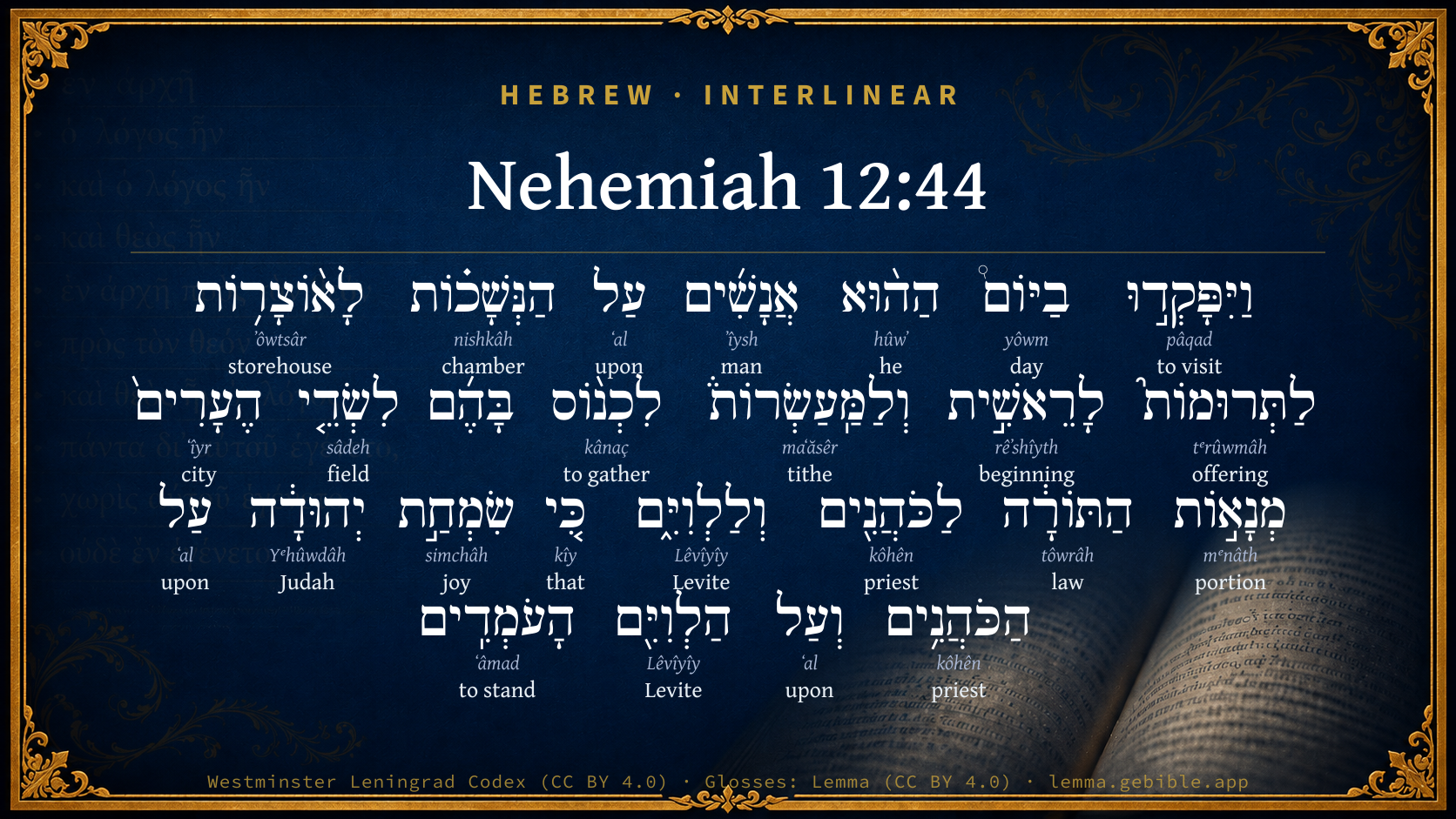
Hebrew (Westminster Leningrad Codex) Nehemiah 12:44 appears in the Hebrew Old Testament. The text above is from the Westminster Leningrad Codex. Each word links to its Strong’s number, a concise gloss, and parsing drawn from the Open Scriptures Hebrew Bible morphology. Click any word for its full Brown-Driver-Briggs (BDB) entry.
Download image
Cite this verse

Nehemiah 12:44 (World English Bible). Public Domain. Lemma interlinear Bible study tool, https://lemma.gebible.app/v/nehemiah/12/44.

Show BibTeX & RIS
BibTeX
RIS
English Translation
On that day were men appointed over the chambers for the treasures, for the heave-offerings, for the first fruits, and for the tithes, to gather into them, according to the fields of the cities, the portions appointed by the law for the priests and Levites: for Judah rejoiced for the priests and for the Levites who waited.
World English Bible · Public Domain
Download a study sheet

One document with this verse’s original text, its word-by-word gloss line, the meaning frame, cross-references with their text, attributed commentary, and full source and license credits — printable, and it pastes into notes with its structure intact.

This verse Autodidact and up

Study sheet (.html) Plain text (.txt)

A passage Seminary Student

Up to 50 verses in one chapter. A passage sheet keeps up to 6 commentary sources and 12 cross-references per verse, in the order this page ranks them, and says so on the sheet whenever that leaves anything out. Ask for a single verse and you get the Autodidact verse sheet above.

Everything on this page stays free to read, with no account — the sheet is a download of what is already on screen, not access to it.

Want to remove ads? Support Godless Engineer
Compare translations 3

The same verse in 3 English versions, stacked beneath the original-language interlinear above. Click any original word for its lexicon entry.

Each is an independent rendering of the whole verse — the interlinear is not word-aligned to these translations.

Highlighted words mark where these versions differ — a whole-verse word diff, not a word-by-word alignment.

  • World English Bible Public Domain
    On that day were men appointed over the chambers for the treasures, for the heave-offerings, for the first fruits, and for the tithes, to gather into them, according to the fields of the cities, the portions appointed by the law for the priests and Levites: for Judah rejoiced for the priests and for the Levites who waited.
  • King James Version Public Domain
    And at that time were some appointed over the chambers for the treasures, for the offerings, for the firstfruits, and for the tithes, to gather into them out of the fields of the cities the portions of the law for the priests and Levites: for Judah rejoiced for the priests and for the Levites that waited.
  • unfoldingWord Literal Text CC BY-SA 4.0
    And on that day men were appointed over the chambers for the storehouses, for the offerings, for the firstfruits, and for the tithes, to gather into them from the fields of the cities the portions of the law for the priests and for the Levites. For Judah rejoiced over the priests and over the Levites, the ones who were standing.

unfoldingWord Literal Text — © unfoldingWord, licensed CC BY-SA 4.0. Word-aligned USFM3 via Door43 (git.door43.org/unfoldingWord/en_ult).

Versions to compare (up to 4)

3 of 4 selected

Show all 18 translations

Every available English version of this verse, each an independent rendering of the whole verse.

  • World English Bible Public Domain
    On that day were men appointed over the chambers for the treasures, for the heave-offerings, for the first fruits, and for the tithes, to gather into them, according to the fields of the cities, the portions appointed by the law for the priests and Levites: for Judah rejoiced for the priests and for the Levites who waited.
  • Berean Standard Bible Public Domain
    And on that same day men were appointed over the rooms that housed the supplies, contributions, firstfruits, and tithes. The portions specified by the Law for the priests and Levites were gathered into these storerooms from the fields of the villages, because Judah rejoiced over the priests and Levites who were serving.
  • Majority Standard Bible Public Domain
    And on that same day men were appointed over the rooms that housed the supplies, contributions, firstfruits, and tithes. The portions specified by the Law for the priests and Levites were gathered into these storerooms from the fields of the villages, because Judah rejoiced over the priests and Levites who were serving.
  • King James Version Public Domain
    And at that time were some appointed over the chambers for the treasures, for the offerings, for the firstfruits, and for the tithes, to gather into them out of the fields of the cities the portions of the law for the priests and Levites: for Judah rejoiced for the priests and for the Levites that waited.
  • American Standard Version (1901) Public Domain
    And on that day were men appointed over the chambers for the treasures, for the heave-offerings, for the first-fruits, and for the tithes, to gather into them, according to the fields of the cities, the portions appointed by the law for the priests and Levites: for Judah rejoiced for the priests and for the Levites that waited.
  • Revised Version (1885) Public Domain
    And on that day were men appointed over the chambers for the treasures, for the heave offerings, for the firstfruits, and for the tithes, to gather into them, according to the fields of the cities, the portions appointed by the law for the priests and Levites: for Judah rejoiced for the priests and for the Levites that waited.
  • Geneva Bible (1599) Public Domain
    Also at the same time were men appointed ouer the chambers of the store for the offerings (for the first fruites, and for the tithes) to gather into them out of the fieldes of the cities, the portions of the Law for the Priests and the Leuites: for Iudah reioyced for the Priests and for the Leuites, that serued.
  • Douay-Rheims (1899) Public Domain
    And they kept the watch of their God, and the observance of expiation, and the singing men, and the porters, according to the commandment of David, and of Solomon his son.
  • Young's Literal Translation Public Domain
    And certain are appointed on that day over the chambers for treasures, for heave-offerings, for first-fruits, and for tithes, to gather into them out of the fields of the cities the portions of the law for priests, and for Levites, for the joy of Judah `is' over the priests, and over the Levites, who are standing up.
  • Literal Standard Version CC BY-SA 4.0
    And certain are appointed on that day over the chambers for treasures, for raised-offerings, for first-fruits, and for tithes, to gather into them out of the fields of the cities the portions of the law for priests, and for Levites, for the joy of Judah [is] over the priests, and over the Levites, who are standing up.
  • Unlocked Literal Bible CC BY-SA 4.0
    On that day men were appointed to be in charge of the storerooms for the contributions, the firstfruits, and the tithes, to gather into them the portions required by the law for the priests and for the Levites. Each was assigned to work the fields near the towns. For Judah rejoiced over the priests and the Levites who were standing before them.
  • unfoldingWord Literal Text CC BY-SA 4.0
    And on that day men were appointed over the chambers for the storehouses, for the offerings, for the firstfruits, and for the tithes, to gather into them from the fields of the cities the portions of the law for the priests and for the Levites. For Judah rejoiced over the priests and over the Levites, the ones who were standing.
  • Darby Bible Public Domain
    And at that time men were appointed over the chambers of the treasures for the heave-offerings, for the first-fruits, and for the tithes, to gather into them, out of the fields of the cities, the portions assigned by the law for the priests and the Levites; for Judah rejoiced over the priests, and over the Levites that waited.
  • World Messianic Bible Public Domain
    On that day, men were appointed over the rooms for the treasures, for the wave offerings, for the first fruits, and for the tithes, to gather into them according to the fields of the cities the portions appointed by the law for the priests and Levites; for Judah rejoiced for the priests and for the Levites who served.
  • Webster's Bible Public Domain
    And at that time were some appointed over the chambers for the treasures, for the offerings, for the first-fruits, and for the tithes, to gather into them out of the fields of the cities the portions of the law for the priests and Levites: for Judah rejoiced for the priests and for the Levites that waited.
  • Free Bible Version CC BY-SA 4.0
    On the same day men were put in charge over the storerooms that contained the offerings, the first part of the crops, and tithes. What was allocated by the Law for the priests and Levites was brought into these storerooms from the fields around the towns, because all the people of Judah were happy for the service of the priests and Levites.
  • Bible in Basic English Public Domain
    And on that day certain men were put over the rooms where the things which had been given were stored, for the lifted offerings and the first-fruits and the tenths, and to take into them the amounts, from the fields of every town, fixed by the law for the priests and the Levites: for Judah was glad on account of the priests and the Levites who were in their places.
  • JPS Tanakh (1917) Public Domain
    And on that day were men appointed over the chambers for the treasures, for the heave-offerings, for the first-fruits, and for the tithes, to gather into them, according to the fields of the cities, the portions appointed by the law for the priests and Levites; for Judah rejoiced for the priests and for the Levites that took their stations.

Literal Standard Version (2020), Covenant Press — licensed CC BY-SA 4.0. Text via the HelloAO Bible API (eBible.org). Unlocked Literal Bible (unfoldingWord) — licensed CC BY-SA 4.0. Text via the HelloAO Bible API (eBible.org). unfoldingWord Literal Text — © unfoldingWord, licensed CC BY-SA 4.0. Word-aligned USFM3 via Door43 (git.door43.org/unfoldingWord/en_ult). Free Bible Version, Dr. Jonathan Gallagher — licensed CC BY-SA 4.0. Text via the HelloAO Bible API (eBible.org).

Word by word

More ways to search: Search by grammar → Find every occurrence → Compare this word →

Practice this passage: Drill this verse → Learn its vocabulary →

הַנְּשָׁכ֗וֹת
nishkâh
H5393
“the · chambers”
Particle, Definite Article + Noun, Common, Feminine, Plural, Absolute
Part of Speech
Particle + Noun
Type
Common
Gender
Feminine
Number
Plural
State
Absolute
Full BDB Definition

Origin: for H3957

TWOT: 1431

chamber, room, cell
  1. וַיִּפָּקְד֣וּ pâqad H6485 “and · to visit” Conjunction + Verb, Niphal, Sequential Imperfect, 3rd Person, Masculine, Plural
  2. בַיּוֹם֩ yôwm H3117 “in/at the · day” Preposition, Determined + Noun, Common, Masculine, Singular, Absolute
  3. הַה֨וּא hûwʼ H1931 “the · he” Particle, Definite Article + Pronoun, Personal, 3rd Person, Masculine, Singular
  4. אֲנָשִׁ֜ים ʼîysh H376 “men” Noun, Common, Masculine, Plural, Absolute
  5. עַל ʻal H5921 “upon” Preposition
  6. לָא֨וֹצָר֥וֹת ʼôwtsâr H214 “to/for the · storehouses” Preposition, Determined + Noun, Common, Masculine, Plural, Absolute
  7. לַתְּרוּמוֹת֮ tᵉrûwmâh H8641 “to/for the · offerings” Preposition, Determined + Noun, Common, Feminine, Plural, Absolute
  8. לָרֵאשִׁ֣ית rêʼshîyth H7225 “to/for the · beginning” Preposition, Determined + Noun, Common, Feminine, Singular, Absolute
  9. וְלַמַּֽעַשְׂרוֹת֒ maʻăsêr H4643 “and · to/for the · tithes” Conjunction + Preposition, Determined + Noun, Common, Masculine, Plural, Absolute
  10. לִכְנ֨וֹס kânaç H3664 “to gather” Preposition + Verb, Qal, Infinitive Construct
  11. לִשְׂדֵ֤י sâdeh H7704 “to/for · fields of” Preposition + Noun, Common, Masculine, Plural, Construct
  12. הֶעָרִים֙ ʻîyr H5892 “the · cities” Particle, Definite Article + Noun, Common, Feminine, Plural, Absolute
  13. מְנָא֣וֹת mᵉnâth H4521 “portions of” Noun, Common, Feminine, Plural, Construct
  14. הַתּוֹרָ֔ה tôwrâh H8451 “the · law” Particle, Definite Article + Noun, Common, Feminine, Singular, Absolute
  15. לַכֹּהֲנִ֖ים kôhên H3548 “to/for the · priests” Preposition, Determined + Noun, Common, Masculine, Plural, Absolute
  16. וְלַלְוִיִּ֑ם Lêvîyîy H3881 “and · to/for the · Levites” Conjunction + Preposition, Determined + Noun, Gentilic, Masculine, Plural, Absolute
  17. כִּ֚י kîy H3588 “that” Conjunction
  18. שִׂמְחַ֣ת simchâh H8057 “joy of” Noun, Common, Feminine, Singular, Construct
  19. יְהוּדָ֔ה Yᵉhûwdâh H3063 “Judah” Noun, Proper
  20. עַל ʻal H5921 “upon” Preposition
  21. הַכֹּהֲנִ֥ים kôhên H3548 “the · priests” Particle, Definite Article + Noun, Common, Masculine, Plural, Absolute
  22. וְעַל ʻal H5921 “and · upon” Conjunction + Preposition
  23. הַלְוִיִּ֖ם Lêvîyîy H3881 “the · Levites” Particle, Definite Article + Noun, Gentilic, Masculine, Plural, Absolute
  24. הָעֹמְדִֽים ʻâmad H5975 “the · standing” Particle, Definite Article + Verb, Qal, Participle Active, Masculine, Plural, Absolute

About this verse

These counts appear in no published source. They are computed here, from the morphology-tagged text and Lemma’s own curated glosses. What Lemma adds →

26
words
21
distinct lemmas
Historical
section

Notable vocabulary

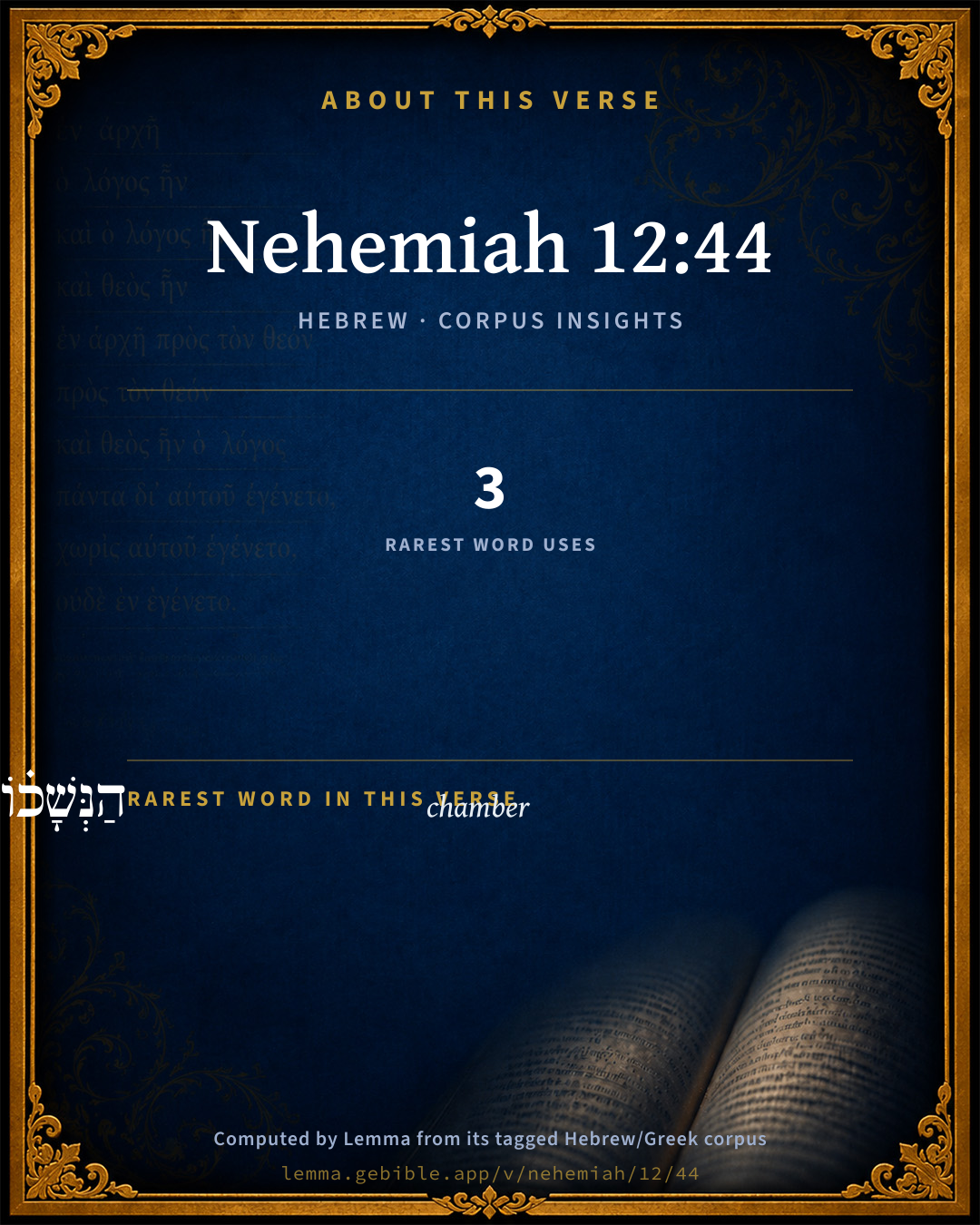
The rarest word here is הַנְּשָׁכ֗וֹת chamber H5393 — appearing just 3 times in the whole Hebrew Bible.

Shared distinctive vocabulary

הַנְּשָׁכ֗וֹת chamber H5393 occurs in 3 verses of the Hebrew Bible. Also found in:

Grammatical profile

  • 3 verbs
  • 17 nouns
  • 1 pronoun
  • 4 prepositions
  • 1 conjunction

Verb forms

  • וַיִּפָּקְד֣וּ Niphal · Sequential Imperfect
  • לִכְנ֨וֹס Qal · Infinitive Construct
  • הָעֹמְדִֽים Qal · Participle Active

Repetition

Words recur within this verse — often emphatic in Hebrew:

  • עַל upon H5921 ×3
  • לַכֹּהֲנִ֖ים priest H3548 ×2
  • וְלַלְוִיִּ֑ם Levite H3881 ×2

Cross-references

14

Topical passages linked to Nehemiah 12:44 in the Treasury of Scripture Knowledge — connected by theme and wording, ordered by reader-vote popularity; previews shown in the World English Bible.

  • Nehemiah 10:37–39 and that we should bring the first fruits of our dough, and our heave-offerings, and the fruit of all manner of trees, the new wine and the oil, to the priests, to the chambers of the house of our God; and the tithes of our ground to the Levites; for they, the Levites, take the tithes in all the cities of our tillage.
  • Nehemiah 13:12–13 Then brought all Judah the tithe of the grain and the new wine and the oil to the treasuries.
  • 2 Chronicles 31:11–13 Then Hezekiah commanded to prepare chambers in the house of Yahweh; and they prepared them.
  • Numbers 3:10 You shall appoint Aaron and his sons, and they shall keep their priesthood. The stranger who comes near shall be put to death."
  • Numbers 8:24–25 "This is that which belongs to the Levites: from twenty-five years old and upward they shall go in to wait on the service in the work of the Tent of Meeting;
  • 1 Chronicles 9:26 for the four chief porters, who were Levites, were in an office of trust, and were over the chambers and over the treasuries in the house of God.
  • 1 Chronicles 23:28 For their office was to wait on the sons of Aaron for the service of the house of Yahweh, in the courts, and in the chambers, and in the purifying of all holy things, even the work of the service of the house of God;
  • 1 Chronicles 26:21–26 The sons of Ladan, the sons of the Gershonites belonging to Ladan, the heads of the fathers' [houses] belonging to Ladan the Gershonite: Jehieli.
  • 2 Chronicles 5:11–12 It happened, when the priests were come out of the holy place, (for all the priests who were present had sanctified themselves, and did not keep their divisions;
  • 2 Chronicles 13:11–12 and they burn to Yahweh every morning and every evening burnt offerings and sweet incense: the show bread also [set they] in order on the pure table; and the lampstand of gold with the lamps of it, to burn every evening: for we keep the charge of Yahweh our God; but you have forsaken him.
  • Nehemiah 13:4–5 Now before this, Eliashib the priest, who was appointed over the chambers of the house of our God, being allied to Tobiah,
  • Proverbs 8:34 Blessed is the man who hears me, Watching daily at my gates, Waiting at my door posts.
  • Isaiah 40:31 but those who wait for Yahweh shall renew their strength; they shall mount up with wings as eagles; they shall run, and not be weary; they shall walk, and not faint.
  • Romans 12:7 or service, let us give ourselves to service; or he who teaches, to his teaching;

Cross-references courtesy of OpenBible.info (CC BY 4.0).

Hebrew and Greek witnesses Masoretic Hebrew ↔ Greek Septuagint

The same verse in the two great witnesses to the Old Testament, shown verse-for-verse.

These are two independent witnesses, not word-aligned to each other, and the Septuagint is shown in lemma (dictionary) form.

Hebrew Nehemiah 12:44 Masoretic · Westminster Leningrad Codex

וַיִּפָּקְד֣וּ בַיּוֹם֩ הַה֨וּא אֲנָשִׁ֜ים עַל הַנְּשָׁכ֗וֹת לָא֨וֹצָר֥וֹת לַתְּרוּמוֹת֮ לָרֵאשִׁ֣ית וְלַמַּֽעַשְׂרוֹת֒ לִכְנ֨וֹס בָּהֶ֜ם לִשְׂדֵ֤י הֶעָרִים֙ מְנָא֣וֹת הַתּוֹרָ֔ה לַכֹּהֲנִ֖ים וְלַלְוִיִּ֑ם כִּ֚י שִׂמְחַ֣ת יְהוּדָ֔ה עַל הַכֹּהֲנִ֥ים וְעַל הַלְוִיִּ֖ם הָעֹמְדִֽים

On that day were men appointed over the chambers for the treasures, for the heave-offerings, for the first fruits, and for the tithes, to gather into them, according to the fields of the cities, the portions appointed by the law for the priests and Levites: for Judah rejoiced for the priests and for the Levites who waited.

World English Bible · Public Domain

Greek LXX Structure differs

The Septuagint has no separate book of Nehemiah. Its Greek text is the second half of Esdras B (2 Esdras), chapters 11–23; Ezra is the first half (1–10).

A verse-for-verse comparison isn’t shown here because the chapters and verses don’t line up. Switch to the LXX edition with the MT / LXX toggle above to read the Greek directly.

Hebrew: Westminster Leningrad Codex (CC BY 4.0). Greek: Septuagint (public domain); English from a public-domain English Septuagint. How the Septuagint differs from the Hebrew →

Commentary

Notes on Nehemiah 12:44 from classic Christian and Jewish commentators (each source and its license shown beneath its notes). The classic Christian expositions comment on the surrounding passage and are grouped to its opening verse, so a note may address several verses; the Jewish commentaries on the Tanakh (Rashi and others) are per-verse, so they appear only where the commentator wrote on this verse.

Lemma curates 59 commentaries, every one of them public domain or Creative Commons licensed, each selected and text-cleaned for this edition rather than reprinted as found. About our sources →

Matthew Henry's Commentary

We have here an account of the remaining good effects of the universal joy that was at the dedication of the wall. When the solemnities of a thanksgiving day leave such impressions on ministers and people as that both are more careful and cheerful in doing their duty afterwards, then they are indeed acceptable to God and turn to a good account. So it was here. 1. The ministers were more careful than they had been of their work; the respect the people paid them upon this occasion encouraged them to diligence and watchfulness, Neh 12:45. The singers kept the ward of their God, attending in due time to the duty of their office; the porters, too, kept the ward of the purification, that is, they took care to preserve the purity of the temple by denying admission to those that were ceremonially unclean. When the joy of the Lord thus engages us to our duty, and enlarges us in it, it is then an earnest of that joy which, in concurrence with the perfection of holiness, will be our everlasting bliss. 2. The people were more careful than they had been of the maintenance of their ministers. The people, at the dedication of the wall, among other things which they made matter of their joy, rejoiced for the priests and for the Levites that waited, Neh 12:44. They had a great deal of comfort in their ministers, and were glad of them. When they observed how diligently they waited, and what pains they took in their work, they rejoiced in them. Note, The surest way for ministers to recommend themselves to their people, and gain an interest in their affections, is to wait on their ministry (Rom 12:7), to be humble and industrious, and to mind their business. When these did so the people thought nothing too much to do for them, to encourage them. The law had provided then their portions (Neh 12:44), but what the better were they for that provision if what the law appointed them either was not duly collected or not justly paid to them? Now, (1.) Care is here taken for the collecting of their dues. They were modest, and would rather lose their right than call for it themselves. The people were many of them careless and would not bring their dues unless they were called upon; and therefore some were appointed whose office it should be to gather into the treasuries, out of the fields of the cities, the portions of the law for the priests and Levites (Neh 12:44), that their portion might not be lost for want of being demanded. This is a piece of good service both to ministers and people, that the one may not come short of their maintenance nor the other of their duty. (2.) Care is taken that, being gathered in, they might be duly paid out, Neh 12:47. They gave the singers and porters their daily portion, over and above what was due to them as Levites; for we may suppose that when David and Solomon appointed them their work (Neh 12:45, Neh 12:46), above what was required from them as Levites, they settled a fund for their further encouragement. Let those that labour more abundantly in the word and doctrine be counted worthy of this double honour. As for the other Levites, the tithes, here called the holy things, were duly set apart for them, out of which they paid the priests their tithe according to the law. Both are said to be sanctified; when what is contributed, either voluntarily or by law, for the support of religion and the maintenance of the ministry, is given with an eye to God and his honour, it is sanctified, and shall be accepted of him accordingly, and it will cause the blessing to rest on the house and all that is in it, Eze 44:30.

Matthew Henry's Commentary on the Whole Bible (1708–1710) — public domain (CC PDM 1.0). Text via the HelloAO Bible API.

Trapp's Complete Commentary

John Trapp

Neh 12:44 And at that time were some appointed over the chambers for the treasures, for the offerings, for the firstfruits, and for the tithes, to gather into them out of the fields of the cities the portions of the law for the priests and Levites: for Judah rejoiced for the priests and for the Levites that waited.

Ver. 44. For Judah rejoiced] Heb. For the joy of Judah, the oil of spiritual gladness had so dilated their hearts, that they were most ready and willing to provide for the sacred ministers; and to pay them that which was appointed, as they had also newly covenanted to do.

For the priests and the Levites that waited] Heb. That stood, sc. before the Lord, and served in their courses. These they not only applauded, but liberally maintained. Today, ministers shall have hard work and good words, but slight wages. Men deal by them as carriers do by their horses, lay heavy burdens upon them, and then hang bells about their necks, &c.

John Trapp, A Commentary or Exposition upon All the Books of the Old and New Testament (1647–1656) — public domain. Text from a community e-Sword module.

Joseph Benson's Commentary

Neh 12:44. For the offerings — Such as they had lately engaged themselves to give, or other voluntary or prescribed offerings. To gather out of the fields the portions of the law — That is, the aforesaid first-fruits and tithes, and other things, which God, by his law, appointed for them. For Judah rejoiced for the priests, &c. — For the eminent gifts and graces which they observed in many of them; for the great benefit which they had now received by their ministry; and for the competent provision which hereby was made for them, that so they might wholly wait upon their office. The sure way for ministers to gain an interest in the affections of their people is, to wait on their ministry, to spend their whole time, and thought, and strength therein.

Joseph Benson's Commentary on the Old and New Testaments (1811–1818) — public domain. Text from a community e-Sword module.

Whedon's Commentary on the Bible

Daniel D. Whedon

SECTION THIRD.

NEHEMIAH’S LATER REFORMS. Neh_12:44 to Neh_13:31.

LEVITICAL APPOINTMENTS, Neh_12:44-47.

44. At that time — This seems certainly to refer to the time of the dedication of the walls of Jerusalem, and hence some have very naturally supposed that the wall was not dedicated till after the thirty-second year of Artaxerxes, when Nehemiah came the second time to Jerusalem. See introductory note before Neh_12:27.

Chambers for the treasures — Store chambers; rooms in the temple for the storing of such things as offerings… firstfruits,… tithes, which were gathered in for the support of the sacred services. It was necessary for certain responsible persons to have charge of these important chambers and their stores.

Fields of the cities — The suburbs or outlying fields that were attached to the different cities of Israel. The Israelites lived not on their lands, but in cities, from which they went forth at seed-time and harvest to sow and reap. So the fields of Boaz were in the vicinity of Bethlehem, but he abode in the city.

Portions of the law — That is, portions prescribed by law for the priests and Levites. See Num_18:20-24; Deu_18:1-8.

Judah rejoiced for the priests — That is, had great joy and comfort in their ministry and service, and gave willingly for their support.

That waited — Literally, the ones standing; that is, standing to minister before the Lord. Compare Deu_10:8.

Daniel D. Whedon (gen. ed.), Commentary on the Old and New Testaments (1874–1909) — public domain. Text from a community e-Sword module.

The Pulpit Commentary

NEHEMIAH"S ARRANGEMENTS FOR THE TEMPLE SERVICE, AND APPOINTMENT OF OFFICERS. (Neh_12:44-47) The good resolutions of the people at the time of the renewal of the covenant Neh_10:28-39) would have borne comparatively little fruit had they not been seconded and rendered effective by formal action on the part of the civil authority. The people, in the first flush of their zeal, had bound themselves to undertake the conveyance of the tithes, firstfruits, and freewill offerings from the country districts to Jerusalem, and the deposition of them in the temple treasuries. (Neh_10:37-39) But in practice this was found too great a burthen. (Neh_13:10) Nehemiah therefore appointed special officers to collect the tithes and other dues throughout the entire territory, and to bring them to Jerusalem, and lay them up in the proper chambers. (Neh_12:44) Over the chambers he appointed treasurers, whose duty it was, not only to collect the ecclesiastical dues, but also to distribute the proceeds among the individuals entitled to share in them. (Neh_13:13) Having in this way provided for the sustenance of the clerical body, he was able to insist on their regular performance of all their duties; and the success of his arrangements was such, that under him the temple service was restored, not merely to the condition established by Zerubbabel, (Neh_12:47) but to one not markedly different from that which had been attained in the time of David and Asaph (ibid. ver. 46). The priests, Levites, singers, and porters respectively performed their duties to his satisfaction, purifying themselves, and taking the service in their turns, "according to the commandment of David and Solomon" (ibid. ver. 45).

At that time. Literally, "On that day;" but a certain latitude must be allowed to the expression. The chambers for the treasures. On these adjuncts of the temple, see the comment on Neh_10:37. The "treasures" themselves consisted chiefly of tithes (including corn, wine, and oil), firstfruits, and free-will offerings. They also included frankincense, (Neh_13:5) and probably other spices. The portions of the law. i.e. the proportion of the produce required by the law to be set apart for sacred uses. These were to be gathered by the officers out of the fields of the cities, that is, out of the portions of cultivable soil attached to each provincial town. (Neh_11:25) For Judah rejoiced. The general satisfaction of the people with their spiritual guides led them to increase their contributions beyond the requirements of the law; whence there was at this time special need of treasurers and treasuries abundant occupation for the one, and abundant material requiring to be stored in the other.

Vers. 44-47. Joy of the Church in her ministers.

In these verses an account is given of the measures taken for the full and regular supply of the wants of the priests and Levites, and the readiness with which the people did their part, because "Judah rejoiced for the priests and Levites that stood before God; and they the priests and Levites kept the charge of their God, and the charge of the purification; and the institutions of the singers and the porters, according to the commandment of David," etc. (vers. 44, 45).

I WHENCE JOY IN MINISTERS ARISES.

1. On the part of ministers, from consistent lives and diligent attention to their duties. Israel felt satisfaction with the priests, etc. because they did their work well (vers. 44, 45), and because they were upright (ver. 47). As the people consecrated of their substance to the Levites, so did the Levites to the priests, according to the law. If ministers are negligent, and show no interest in their work, or if their conduct be inconsistent, they need not be surprised that the people become indifferent to them and their ministrations. But consistent, earnest, faithful, loving, diligent ministers go the way to secure the affections of their congregations and give them pleasure.

2. On the part of the people, the ability to appreciate good ministers. The best ministers fail to give satisfaction to many. They cannot appreciate them, owing to want of piety, the absence of earnest desire for instruction and salvation, love of novelties, "itching ears, censorious spirit, self-conceit, carnality of mind, etc. Some may hate them because of their faithful reproofs of their beloved sins. Thus the very excellences of a minister may prevent joy in him in some quarters. But where a true-hearted minister has the happiness to labour amongst an earnest, godly people, he will be their joy, as they will he his.

II How JOY IN MINISTERS SHOULD BE EXPRESSED. Not by mere words, not merely by praise to God for them and prayer on their behalf, but (as in the case of Israel and the ministers of the temple) by making suitable provision for their sustenance. This is according to the law of Christ no less than that of Moses, (1Co_9:13, 14 Gal_6:6 1Ti_5:17, 1Ti_5:18) and will be cheerfully done by such as rightly rejoice in their ministers. Such provision should be, as in the text,

(1) liberal,

(2) systematic and regular.

III THE IMPORTANCE OF SUCH JOY SO EXPRESSED.

1. To the happiness and vigorous labours of ministers themselves. If good ministers make satisfied and generous congregations, they are also to a great extent made by them. The influence is reciprocal. The mental and spiritual powers of a minister cannot develop and exercise themselves to the full in an atmosphere of coldness, suspicion, dissatisfaction, or illiberality; his physical and mental energies will alike be impaired if he is scantily furnished with material supplies.

2. To the spiritual profit of hearers and their families. The teaching of a pastor in whom lively interest is felt, and to whom generosity is shown, will be listened to with the attention and confidence needful for profit. Children will be taught to respect and love him, and so will be likely to accept him as their guide and friend. But an opposite state of things will produce opposite results. Even satisfaction which expresses itself in words only, where deeds are needful and possible, will tend to give an unreality to the whole religious life, and prevent any real and lasting good.

The Pulpit Commentary (1880–1919), ed. H.D.M. Spence-Jones & Joseph S. Exell — public domain. Text from a community e-Sword module.

Keil & Delitzsch

C. F. Keil & F. Delitzsch

The joint efforts of Nehemiah and Ezra succeeded both in restoring the enactments of the law for the performance and maintenance of the public worship, and in carrying out the separation of the community from strangers, especially by the dissolution of unlawful marriages (Neh 12:44-13:3). When Nehemiah, however, returned to the king at Babylon, in the thirty-second year of Artaxerxes, and remained there some time, the abuses which had been abolished were again allowed by the people. During Nehemiah's absence, Eliashib the priest prepared a chamber in the fore-court of the temple, as a dwelling for his son-in-law Tobiah the Ammonite. The delivery of their dues to the Levites (the first-fruits and tenths) was omitted, and the Sabbath desecrated by field-work and by buying and selling in Jerusalem; Jews married Ashdodite, Ammonitish, and Moabitish wives; even a son of the high priest Joiada allying himself by marriage with Sanballat the Horonite. All these illegal acts were energetically opposed by Nehemiah at his return to Jerusalem, when he strove both to purify the congregation from foreigners, and to restore the appointments of the law with respect to divine worship (13:4-31).

The narration of these events and of the proceedings of Nehemiah in the last section of this book, is introduced by a brief summary (in Neh 12:44-13:3) of what was done for the ordering of divine worship, and for the separation of Israel from strangers; and this introduction is so annexed to what precedes, not only by the formula ההוּא בּיּום (Neh 12:33 and Neh 13:1), but also by its contents, that it might be regarded as a summary of what Nehemiah had effected during his first stay at Jerusalem. It is not till the connective מזּה ולפני, "and before this" (Neh 13:4), with which the recital of what occurred during Nehemiah's absence from Jerusalem, in the thirty-second year of Artaxerxes, beings, that we perceive that this description of the restored legal appointments relates not only to the time before the thirty-second year of Artaxerxes, but applies also to that of Nehemiah's second stay at Jerusalem, and bears only the appearance of an introduction, being in fact a brief summary of all that Nehemiah effected both before and after the thirty-second year of Artaxerxes. This is a form of statement which, is to be explained by the circumstance that Nehemiah did not compile this narrative of his operations till the evening of his days.

Neh 12:44

The reformations in worship and in social life effected by Nehemiah. - Neh 12:44-47. Appointments concerning divine worship. Neh 12:44. And at that time were certain appointed over the chambers of store-places for the heave-offerings, the first-fruits, and the tenths, to gather into them, according to the fields of the cities, the portions appointed by the law for the priests and Levites. Though the definition of time ההוּא בּיּום corresponds with the ההוּא בּיּום of Neh 12:43, it is nevertheless used in a more general sense, and does not refer, as in Neh 12:43, to the day of the dedication of the wall, but only declares that what follows belongs chiefly to the time hitherto spoken of. יום means, not merely a day of twelve or twenty-four hours, but very frequently stands for the time generally speaking at which anything occurs, or certum quoddam temporis spatium; and it is only from the context that we can perceive whether יום is used in its narrower or more extended meaning. Hence ההוּא בּיּום is often used in the historical and prophetical books, de die, or de tempore modo memorato, in contradistinction to הזּה היּום, the time present to the narrator; comp. Sa1 27:6; Sa1 30:25, and the discussion in Gesen. Thes. p. 369. That the expression refers in the present verse not to any particular day, but to the time in question generally, is obvious from the whole statement, Neh 12:44-47. לאוצרות נשׁכות are not chambers for the treasures, i.e., treasure-chambers; but both here and Neh 13:12, אוצרות signify places where stores are kept, magazines; hence: these are chambers for store-places for the heave-offerings, etc.; comp. Neh 10:38-39. With respect to נשׁכות, see rem. on Neh 3:30. הערים לשׂדי, according to the fields of the cities, according to the delivery of the tenth of the crop from the fields of the different cities. These contributions necessitated the appointment of individuals to have the care of the store-chambers; "for Judah rejoiced in the priests and the Levites who were ministering," and therefore contributed willingly and abundantly "the portions of the law," i.e., the portions prescribed in the law. The form מנאות is exchanged for מניות, Neh 12:47 and Neh 13:10. האמדים is a shorter expression for יהוה לפני האמדים, Deu 10:8 : standing before the Lord, i.e., ministering.

Keil & Delitzsch — Biblical Commentary on the Old Testament (1861–1891) — public domain (CC PDM 1.0). Text via the HelloAO Bible API. (Old Testament only.)

Tyndale Open Study Notes

Tyndale Open Resources

12:44-47 On that day, the day of the dedication of the wall (12:44; 13:1), men were appointed to take care of the tithes and gifts given for the physical needs of the priests and Levites. Their duties were to collect the gifts of the people for the priests and Levites (10:32-39; see also Exod 30:11-16; 38:25-26), to perform the service of their God (probably sacrifices; see Lev 1–5), and to oversee the service of purification of those people who were unclean. They also purified pans, knives, and clothing used in Temple worship as described in Lev 11–15 (see also 1 Chr 23:28).

Tyndale Open Study Notes — © Tyndale Open Resources, licensed CC BY-SA 4.0. Text via the HelloAO Bible API.

Geneva Bible (1599)

Geneva Bible translators

Which were chambers appointed by Hezekiah to put in the tithes, and such things, 2 Chron. 31:11 and now were repaired again for the same use.

Geneva Bible (1599) marginal notes — public domain. Text via Bolls.life.

Jamieson, Fausset & Brown

Robert Jamieson, A. R. Fausset & David Brown

portions of the law--that is, "prescribed by the law."

for Judah rejoiced for the priests and . . . Levites that waited--The cause of this general satisfaction was either the full restoration of the temple service and the reorganized provision for the permanent support of the ministry, or it was the pious character and eminent gifts of the guardians of religion.

Jamieson, Fausset & Brown — Commentary Critical and Explanatory on the Whole Bible (1871) — public domain (CC PDM 1.0). Text via the HelloAO Bible API.

Ellicott's Commentary for English Readers

(44) For Judah rejoiced.—Not only was the Temple service restored to something like the completeness of the Davidical period, the people also everywhere took pleasure in the ministrations of the Temple, and provided amply for them. Hence the need of men to take charge of the treasuries of the firstfruits and tithes.

(44-47) Economical arrangements.

A Bible Commentary for English Readers, edited by Charles John Ellicott (1878–1897) — public domain. Text from a community e-Sword module.

The Cambridge Bible for Schools and Colleges

gen. ed. J. J. S. Perowne

44. at that time] R.V. on that day. This is not an allusion to the day of rejoicing in the previous verse (‘that day’ Neh_12:43), but a general definition of time which the Compiler uses again in Neh_8:1. It is only a little less indefinite than ‘in those days,’ Neh_13:15; Neh_13:23.

some] R.V. men.

the chambers] The Hebrew word here used occurs elsewhere only in Neh_3:30, and Neh_13:7.

for the treasures] As in Neh_13:13, Nehemiah records his special appointment of ‘treasurers over the treasuries’ whose business it was ‘to distribute unto their brethren.’ The appointments mentioned in this verse are probably of a somewhat different nature. The men ‘appointed over the chambers’ were the regular receivers and custodians of the treasure, i.e. the firstfruits and tithes, &c.; the four appointed by Nehemiah were commissioners for the purpose of securing an honest distribution.

for the treasures] Either a general term denoting ‘stores’ and ‘provisions,’ of which ‘the heave-offerings’ are items, or a specific term, standing at the head of the list, and denoting special dedications and wealthy gifts. The former is the more probable alternative.

the offerings] R.V. the heave offerings.

the firstfruits] The use of this word seems here to include ‘the firstfruits’ and ‘firstlings’ mentioned in Neh_10:35-37.

the tithes] See on Neh_10:37-38.

It will be observed that there is no reference here to any tithe of cattle. The chambers are only intended for receiving the produce of the field (Neh_13:12). As this passage is clearly based upon Nehemiah’s own Memoirs, it has afforded support to the theory that the cattle tithe was introduced into the text of Lev_27:30; Lev_27:32, after the time of Nehemiah. See note at the end of chap. 10.

out of the fields of the cities] R.V. according to the fields of the cities.

The point of this clause is rather obscure. It probably refers to the method of storing, rather than to the size of the fields or to the succession in which the offerings were received and the tithe exacted.

An account was taken of the contributions from the fields of each city.

the portions of the law] R.V. the portions appointed toy the law. Marg. ‘Heb. of the law’. A unique phrase in the O.T. denoting the special requirements of the Levitical law.

Judah rejoiced &c.] The readiness of the people generally (‘Judah’) to support the priests and Levites according to ‘the law’ was due to their appreciation of their religious services. In proportion to their zeal for the priests and Levites it was necessary to provide officers to receive and regulate the contribution.

that wailed] R.V. Marg. ‘Heb. stood’.

In Deuteronomy the phrase ‘to stand before the Lord’ is the technical term for the ministrations of the priests. Here we find it used of the offices of ‘priests and Levites.’ In 1Ch_6:32-33 ‘And they waited on their office according to their order. And these are they that waited,’ it is applied to the Levites.

The Cambridge Bible for Schools and Colleges (gen. ed. J. J. S. Perowne; Cambridge University Press, 1878–1918) — public domain. Text from a community e-Sword module.

John Gill's Exposition

And all Israel in the days of Zerubbabel, and in the days of Nehemiah, gave the portions of the singers and the porters every day his portion,.... While these two men governed they did their duty, and punctually paid the Levites their dues at the proper season:

and they sanctified holy things unto the Levites; set them apart for their use, and brought them to them, their offerings, firstfruits, and tithes: and the Levites sanctified them unto the children of Aaron; the Levites set apart the tenth part of the tithes, and delivered them to the priests, and so each had what belonged to them.

Next: Nehemiah Chapter 13

John Gill's Exposition of the Whole Bible (1746–1763) — public domain (CC PDM 1.0). Text via the HelloAO Bible API.

Albert Barnes' Notes on the Bible

Judah rejoiced - Judah’s satisfaction with the priests and Levites took the shape of increased offerings, more ample tithes, and the like, from where the appointment of treasuries and treasurers became necessary.

Albert Barnes' Notes on the Bible (1834–1885) — public domain. Text from a community e-Sword/MySword module.

Haydock's Catholic Bible Commentary

Expiation. Or the legal purifications, (Menochius) when necessary. (Haydock)

George Leo Haydock (1774–1849), Haydock's Catholic Family Bible and Commentary, 1859 edition — public domain. Excludes Psalms (Douay-Rheims chapter numbering differs from Protestant) and Deuterocanonical books (Catholic canon only).

Matthew Poole's English Annotations

For the offerings; such as they had lately engaged themselves to give, or other voluntary or prescribed offerings.

The portions of the law, i.e. the foresaid first-fruits, and tithes, and other things which God by his law appointed for them.

Judah rejoiced for the priests and for the Levites that waited; partly for the eminent gifts and graces which they observed in many of them; and partly for the great benefit which they had now received by their ministry; and therefore for the competent provision which hereby was made for them, that so they might wholly wait upon their office to the people’s edification and comfort.

Matthew Poole's English Annotations on the Holy Bible (1683–1685) — public domain. Text from a community e-Sword/MySword module.

John Wesley's Explanatory Notes

Rejoiced - For the eminent gifts and graces which they observed in many of them: for the great benefit which they had now received by their ministry: and for the competent provision which hereby was made for them, that so they might wholly wait upon their office. The sure way for ministers to gain an interest, in the affections of their people, is to wait on their ministry, to spend their whole time, and thought, and strength therein.

John Wesley, Explanatory Notes Upon the Whole Bible (1754–1765) — public domain. Text via the GEBible commentary corpus.

Kretzmann's Popular Commentary

Paul E. Kretzmann

Certain officers Appointed

v. 44. And at that time, at the Festival of the Dedication, were some appointed over the chambers for the treasures, the cells or rooms where the gifts to the Temple were stored, for the offerings, for the first-fruits, and for the tithes, to gather into them out of the fields of the cities, the tilled ground surrounding the various towns, the portions of the Law, the delivery of which the Law required, for the priests and Levites; for Judah rejoiced for the priests and for the Levites that waited, the joy of the people evidenced itself also in their willingness to care properly for the ministers of the Lord who stood at their posts, performing their tasks as commanded by God.

v. 45. And both the singers and the porters kept the ward of their God, performing their appointed duties, and the ward of their purification, attending also to the duties of purifying, according to the commandment of David and of Solomon, his son, 1 Chronicles 25, 26.

v. 46. For in the days of David and Asaph of old there were chief of the singers, 2Ch 29:30, and songs of praise and thanksgiving unto God, and the purpose of Nehemiah was to restore the entire Temple service to its original beauty and completeness.

v. 47. And all Israel in the days of Zerubbabel and in the days of Nehemiah gave the portions of the singers and the porters, the dues intended for their maintenance, every day his portion; and they sanctified holy things unto the Levites, brought in their consecrated or dedicated gifts; and the Levites sanctified them unto the children of Aaron, the priests, the Levites turning over to the priests the tithe of the gifts which were dedicated to them and entrusted to their care. It augurs well for the work of the Church if all its members rejoice for the Lord’s ministers and willingly take upon them the maintenance of the servants of the Word. The sacrifice of the lips is well-pleasing to the Lord only when supported by the sacrifice of the hands.

Paul E. Kretzmann, Popular Commentary of the Bible (1921–1924) — public domain. Text from a community e-Sword module.

unfoldingWord translationNotes

Door43 World Missions Community

men were appointed to be in charge

This can be stated in active form. It is not clear who appointed the men. AT: "they appointed men to be in charge" (See: Active or Passive)

the contributions

things the people gave to the priests

For Judah rejoiced over the priests and the Levites

It seems that the people appointed the men because the people of Judah were grateful for the priests and Levites who were serving.

who were standing before them

The Levites and priests were not just standing, they were serving in their roles. The meaning can be made explicit. AT: "who were standing before them serving God" (See: Assumed Knowledge and Implicit Information)

gatekeepers

These were people assigned to each gate, responsible to control access to the city or temple, as well as to open and close the gates at times and for reasons set by the administrator. See how you translated this in Nehemiah 7:1.

translationWords

firstfruits

tenth

law, laws

priest

Levi

works

kingdom of Judah

God

pure

command

David

Solomon

son

unfoldingWord translationNotes — © Distant Shores Media and the Door43 World Missions Community, licensed CC BY-SA 4.0. Source: git.door43.org/Door43/en_tn.

Rashi

Rabbi Shlomo Yitzchaki (Rashi)

were appointed Heb. וַיִפָקְדוּ, a word meaning appointment.

the chambers Heb. הַנְשָׁכוֹת, like הַלְשָּׁכוֹת, the chambers of the Temple.

to gather in them And in these chambers they would place all the gifts of the priests and the Levites, and from there they would distribute [them] among them.

portions Heb. מְנָאוֹת like מָנוֹת.

for the priests and for the Levites The priests were taking what was due them and the Levites what was due them.

who stood and ministered there before the Holy One, blessed be He, with thanksgiving offerings and thanksgivings.

Rashi on the Tanakh — English translations: “The Judaica Press complete Tanach with Rashi, translated by A. J. Rosenberg” (CC BY 4.0); “Pentateuch with Rashi's commentary by M. Rosenbaum and A.M. Silbermann, 1929-1934” (public domain); “The Metsudah Tanach series, Lakewood, N.J” (CC BY 4.0); and “The Book of Joshua, Metsudah Publications, 1997” (CC BY 4.0). Text via Sefaria.

Lesson kit

Teaching starters — assembled from the data on this page, not authored interpretation. Every prompt links to the verse data it draws on. Edit before teaching.

Nehemiah, in the Historical, opens this verse with 26 words (21 distinct Hebrew lemmas). Its most distinctive word is nishkâh (“chamber”). A historical commentator’s framing appears above. Read the whole chapter for the surrounding context.

Discussion questions

  1. The word nishkâh carries the sense “chamber.” How does it shape the verse?
  2. Nehemiah 3:30 shares the word «chamber» with this verse. How do the two illuminate each other?
  3. “upon” occurs 3× in this one verse. What is the effect of the repetition?
  4. The translations on this page render this verse differently — a whole-verse word diff, not a word-by-word alignment. What might account for the different wordings?
  5. The verb «וַיִּפָּקְד֣וּ» is Niphal Sequential Imperfect. How does its form color the action?
  6. Reading how Matthew Henry's Commentary and Trapp's Complete Commentary read this verse, where do the two commentators agree and where do they part?

Things to notice

Reading settings

Reading text

Shown beneath each verse's original-language words.

Old Testament
Old Testament edition

Read the OT as the Masoretic Hebrew (MT) or the Greek Septuagint (LXX).

English shown for the Greek Septuagint (in the Hebrew ↔ Greek comparison).

Comparing translations? Open the Compare panel on any verse page to stack up to four side by side.