
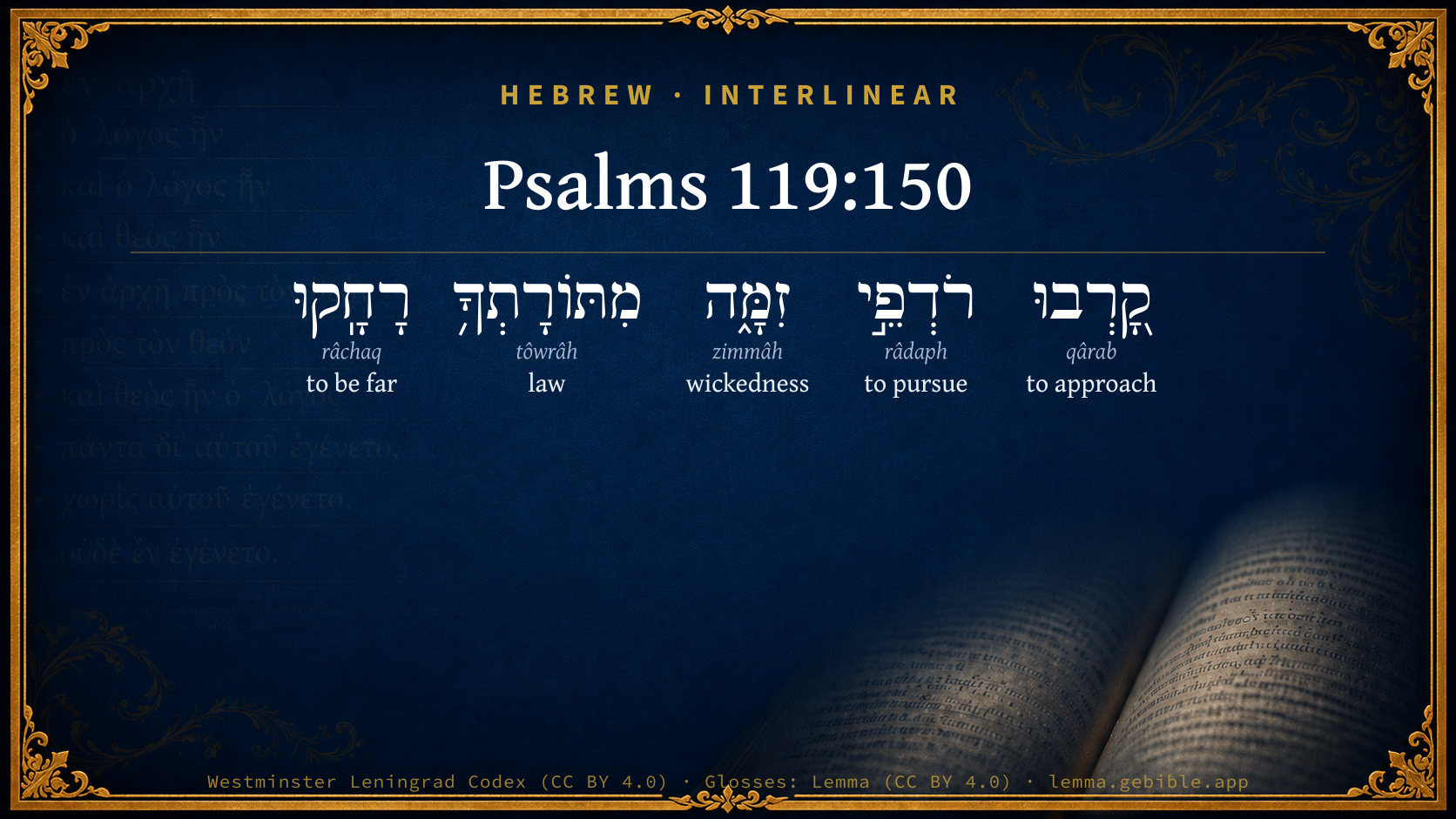
Psalms 119:150

Hebrew (Westminster Leningrad Codex) Psalms 119:150 appears in the Hebrew Old Testament. The text above is from the Westminster Leningrad Codex. Each word links to its Strong’s number, a concise gloss, and parsing drawn from the Open Scriptures Hebrew Bible morphology. Click any word for its full Brown-Driver-Briggs (BDB) entry.
Download image
Cite this verse

Psalms 119:150 (World English Bible). Public Domain. Lemma interlinear Bible study tool, https://lemma.gebible.app/v/psalms/119/150.

Show BibTeX & RIS
BibTeX
RIS
English Translation
They draw near who follow after wickedness. They are far from your law.
World English Bible · Public Domain
Download a study sheet

One document with this verse’s original text, its word-by-word gloss line, the meaning frame, cross-references with their text, attributed commentary, and full source and license credits — printable, and it pastes into notes with its structure intact.

This verse Autodidact and up

Study sheet (.html) Plain text (.txt)

A passage Seminary Student

Up to 50 verses in one chapter. A passage sheet keeps up to 6 commentary sources and 12 cross-references per verse, in the order this page ranks them, and says so on the sheet whenever that leaves anything out. Ask for a single verse and you get the Autodidact verse sheet above.

Everything on this page stays free to read, with no account — the sheet is a download of what is already on screen, not access to it.

Want to remove ads? Support Godless Engineer
Compare translations 3

The same verse in 3 English versions, stacked beneath the original-language interlinear above. Click any original word for its lexicon entry.

Each is an independent rendering of the whole verse — the interlinear is not word-aligned to these translations.

Highlighted words mark where these versions differ — a whole-verse word diff, not a word-by-word alignment.

  • World English Bible Public Domain
    They draw near who follow after wickedness. They are far from your law.
  • King James Version Public Domain
    They draw nigh that follow after mischief: they are far from thy law.
  • unfoldingWord Literal Text CC BY-SA 4.0
    The pursuers of evil purpose have drawn near; from your law they are far away.

unfoldingWord Literal Text — © unfoldingWord, licensed CC BY-SA 4.0. Word-aligned USFM3 via Door43 (git.door43.org/unfoldingWord/en_ult).

Versions to compare (up to 4)

3 of 4 selected

Show all 17 translations

Every available English version of this verse, each an independent rendering of the whole verse.

  • World English Bible Public Domain
    They draw near who follow after wickedness. They are far from your law.
  • Berean Standard Bible Public Domain
    Those who follow after wickedness draw near; they are far from Your law.
  • Majority Standard Bible Public Domain
    Those who follow after wickedness draw near; they are far from Your law.
  • King James Version Public Domain
    They draw nigh that follow after mischief: they are far from thy law.
  • American Standard Version (1901) Public Domain
    They draw nigh that follow after wickedness; They are far from thy law.
  • Revised Version (1885) Public Domain
    They draw nigh that follow after wickedness; they are far from thy law.
  • Geneva Bible (1599) Public Domain
    They drawe neere, that follow after malice, and are farre from thy Lawe.
  • Young's Literal Translation Public Domain
    Near have been my wicked pursuers, From Thy law they have been far off.
  • Literal Standard Version CC BY-SA 4.0
    My wicked pursuers have been near, || They have been far off from Your law.
  • Unlocked Literal Bible CC BY-SA 4.0
    Those who are persecuting me are coming closer to me, but they are far from your law.
  • unfoldingWord Literal Text CC BY-SA 4.0
    The pursuers of evil purpose have drawn near; from your law they are far away.
  • Darby Bible Public Domain
    They have drawn nigh that follow after mischief: they are far from thy law.
  • World Messianic Bible Public Domain
    They draw near who follow after wickedness. They are far from your Torah.
  • Webster's Bible Public Domain
    They draw nigh that follow after mischief: they are far from thy law.
  • Free Bible Version CC BY-SA 4.0
    Evil people come running to attack me—they totally disregard your law.
  • Bible in Basic English Public Domain
    Those who have evil designs against me come near; they are far from your law.
  • JPS Tanakh (1917) Public Domain
    They draw nigh that follow after wickedness; they are far from Thy law.

Literal Standard Version (2020), Covenant Press — licensed CC BY-SA 4.0. Text via the HelloAO Bible API (eBible.org). Unlocked Literal Bible (unfoldingWord) — licensed CC BY-SA 4.0. Text via the HelloAO Bible API (eBible.org). unfoldingWord Literal Text — © unfoldingWord, licensed CC BY-SA 4.0. Word-aligned USFM3 via Door43 (git.door43.org/unfoldingWord/en_ult). Free Bible Version, Dr. Jonathan Gallagher — licensed CC BY-SA 4.0. Text via the HelloAO Bible API (eBible.org).

Word by word

More ways to search: Search by grammar → Find every occurrence → Compare this word →

Practice this passage: Drill this verse → Learn its vocabulary →

About this verse

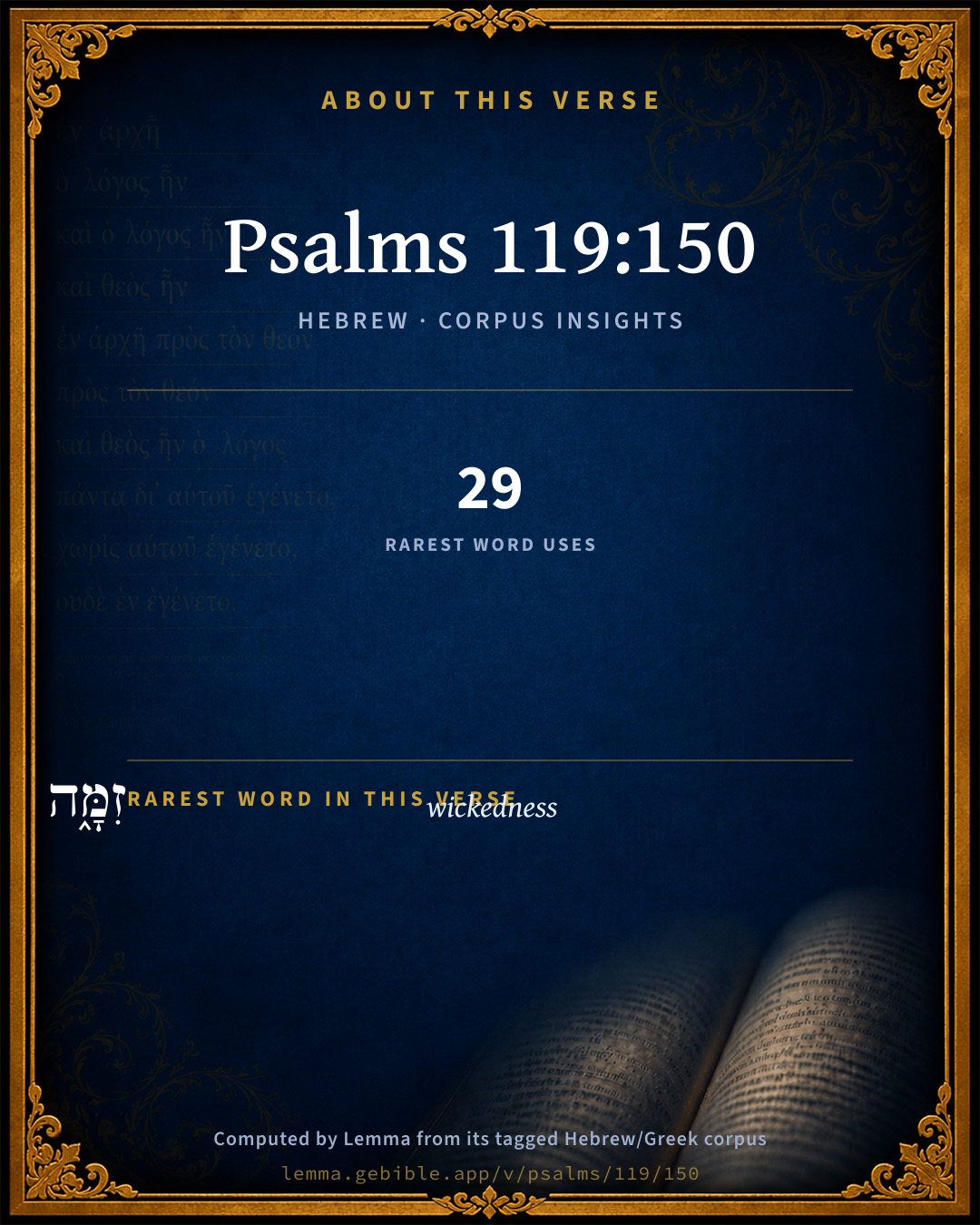
These counts appear in no published source. They are computed here, from the morphology-tagged text and Lemma’s own curated glosses. What Lemma adds →

5
words
5
distinct lemmas
Wisdom
section

Shared distinctive vocabulary

זִמָּ֑ה wickedness H2154 occurs in 27 verses of the Hebrew Bible. Also found in:

Grammatical profile

  • 3 verbs
  • 2 nouns

Verb forms

  • קָ֭רְבוּ Qal · Perfect
  • רֹדְפֵ֣י Qal · Participle Active
  • רָחָֽקוּ Qal · Perfect

Hebrew & Septuagint length

In English translation the verse runs 13 words from the Hebrew and 16 from the Septuagint (LXX English) — closely comparable.

A rough comparison of the two English renderings, which tokenize alike — not a word-level alignment.

Word counts can differ between the Hebrew and the Greek without any difference in meaning — e.g. the Hebrew direct-object marker אֵת has no separate Greek word, and Greek often adds the article ὁ.

Cross-references

12

Topical passages linked to Psalms 119:150 in the Treasury of Scripture Knowledge — connected by theme and wording, ordered by reader-vote popularity; previews shown in the World English Bible.

  • Psalms 27:2 When evil-doers came at me to eat up my flesh, Even my adversaries and my foes, they stumbled and fell.
  • Proverbs 28:9 He who turns away his ear from hearing the law, Even his prayer is an abomination.
  • 1 Samuel 23:16 Jonathan, Saul's son, arose, and went to David into the wood, and strengthened his hand in God.
  • 2 Samuel 17:16 Now therefore send quickly, and tell David, saying, Don't lodge this night at the fords of the wilderness, but by all means pass over; lest the king be swallowed up, and all the people who are with him.
  • Job 21:14 They tell God, 'Depart from us, For we don't want to know about your ways.
  • Psalms 22:11–13 Don't be far from me, for trouble is near. For there is none to help.
  • Psalms 22:16 For dogs have surrounded me. A company of evil-doers have enclosed me. They pierced my hands and my feet.
  • Psalms 50:17 Seeing you hate instruction, And throw my words behind you?
  • Proverbs 1:7 The fear of Yahweh is the beginning of knowledge; But the foolish despise wisdom and instruction.
  • Proverbs 1:22 "How long, you simple ones, will you love simplicity? How long will mockers delight themselves in mockery, And fools hate knowledge?
  • Matthew 26:46–47 Arise, let's be going. Behold, he who betrays me is at hand."
  • Ephesians 2:13–14 But now in Christ Jesus you who once were far off are made near in the blood of Christ.

Cross-references courtesy of OpenBible.info (CC BY 4.0).

Hebrew and Greek witnesses Masoretic Hebrew ↔ Greek Septuagint

The same verse in the two great witnesses to the Old Testament, shown verse-for-verse.

You’re reading Greek Psalm 118 (Hebrew Psalm 119). The Septuagint counts the superscription, so verse numbers can differ from the Hebrew — chapter-level alignment, not verse-by-verse. Numbering follows Rahlfs.

These are two independent witnesses, not word-aligned to each other, and the Septuagint is shown in lemma (dictionary) form.

Hebrew Psalms 119:150 Masoretic · Westminster Leningrad Codex

קָ֭רְבוּ רֹדְפֵ֣י זִמָּ֑ה מִתּוֹרָתְךָ֥ רָחָֽקוּ

They draw near who follow after wickedness. They are far from your law.

World English Bible · Public Domain

Greek LXX Greek Psalm 118:150 Septuagint · lemma form

προςἐγγίζω ὁ καταδιώκω ἐγώ ἀνομία ἀπό δέ ὁ νόμος σύ μακρύνω

They have drawn near who persecuted me unlawfully; and they are far removed from your law.

LXX2012 (modern English Septuagint) · Public Domain

On this verse, The Cambridge Bible for Schools and Colleges discusses the Septuagint’s reading. Read the note in Commentary ↓

Hebrew: Westminster Leningrad Codex (CC BY 4.0). Greek: Septuagint (public domain); English from LXX2012 (modern English Septuagint) (Public Domain). How the Septuagint differs from the Hebrew →

Commentary

Notes on Psalms 119:150 from classic Christian and Jewish commentators (each source and its license shown beneath its notes). The classic Christian expositions comment on the surrounding passage and are grouped to its opening verse, so a note may address several verses; the Jewish commentaries on the Tanakh (Rashi and others) are per-verse, so they appear only where the commentator wrote on this verse.

Lemma curates 59 commentaries, every one of them public domain or Creative Commons licensed, each selected and text-cleaned for this edition rather than reprinted as found. About our sources →

Trapp's Complete Commentary

John Trapp

Psa 119:150 They draw nigh that follow after mischief: they are far from thy law.

Ver. 150. They draw nigh that follow after mischief] Those scelerum assidui sectatores prompti sunt ac parati.

They are far from thy law] And so having nothing to restrain their rage; since they have cast their cords from them.

John Trapp, A Commentary or Exposition upon All the Books of the Old and New Testament (1647–1656) — public domain. Text from a community e-Sword module.

J. A. Alexander on Psalms

Joseph Addison Alexander

150. (Psa 119:150) Near are those pursuing crime; from thy law they are far off. Pursuing, eagerly devising and attempting. Crime, malicious mischief, as in Psa 26:10. In the last clause there is a kind of play upon the words far and near, as if he had said, the nearer they are to harming me, the further are they from obeying thee.

Joseph Addison Alexander, The Psalms Translated and Explained (1850) — public domain. Text from a community e-Sword module.

Tyndale Open Study Notes

Tyndale Open Resources

119:150-151 Coming to attack me (or are coming near to me) is a Hebrew wordplay on but you are near. The wicked remain far from God’s instructions, whereas the psalmist stays near, so he does not need to fear.

Tyndale Open Study Notes — © Tyndale Open Resources, licensed CC BY-SA 4.0. Text via the HelloAO Bible API.

Geneva Bible (1599)

Geneva Bible translators

He showeth the nature of the wicked to be to persecute against their conscience.

Geneva Bible (1599) marginal notes — public domain. Text via Bolls.life.

Matthew Henry's Commentary

Here is, I. The apprehension David was in of danger from his enemies. 1. They were very malicious, and industrious in prosecuting their malicious designs: They follow after mischief, any mischief they could do to David or his friends; they would let slip no opportunity nor let fall any pursuit that might be to his hurt. 2. They were very impious, and had no fear of God before their eyes: They are far from thy law, setting themselves as far as they can out of the reach of its convictions and commands. The persecutors of God's people are such as make light of God himself; we may therefore be sure that God will take his people's part against them. 3. They followed him closely and he was just ready to fall into their hands: They draw nigh, nigher than they were; so that they got ground of him. They were at his heels, just upon his back. God sometimes suffers persecutors to prevail very far against his people, so that, as David said (Sa1 20:3), There is but a step between them and death. Perhaps this comes in here as a reason why David was so earnest in prayer, Psa 119:149. God brings us into imminent perils, as he did Jacob, that, like him, we may wrestle for a blessing.

II. The assurance David had of protection with God: "They draw nigh to destroy me, but thou art near, O Lord! to save me, not only mightier than they and therefore able to help me against them, but nearer than they and therefore ready to help." It is the happiness of the saints that, when trouble is near, God is near, and no trouble can separate between them and him. He is never far to seek, but he is within our call, and means are within his call, Deu 4:7. All thy commandments are truth. The enemies thought to defeat the promises God had made to David, but he was sure it was out of their power; they were inviolably true, and would be infallibly performed.

Matthew Henry's Commentary on the Whole Bible (1708–1710) — public domain (CC PDM 1.0). Text via the HelloAO Bible API.

Adam Clarke's Commentary

Verse 150. They draw nigh] They are just at hand who seek to destroy me.

They are far from thy law.] They are near to all evil, but far from thee.

Adam Clarke's Commentary on the Bible (1810–1826) — public domain. Text from a community e-Sword/MySword module.

John Calvin's Commentaries

150. The pursuers of malice have drawn near. As the Hebrew word רודפי rodphee, translated the pursuers of, is put in the construct state, that is to say, as it is so related to the word זמה, zimmah, rendered wickedness, that in Latin the latter would be put in the genitive ease, I expound the clause as denoting that they draw near to do mischief. I wonder what could move interpreters to translate — The pursuers have approached, or drawn near to wickedness; which the idiom of the language will not admit, to say nothing of the fact that זמה, zimmah, signifies rather perversity or malice, than wickedness. David therefore says, that those who are vehemently bent on malice are pursuing him close behind, and that they rush upon him with such violence in order to do him mischief, as plainly to indicate that they are far off from God’s law, since they east far from them all regard to uprightness and equity. It was a most wretched condition for him to be in, to behold his enemies, who had shaken off all fear of God and reverence for his law, ready with uplifted hand to smite him to death, had not God been near to defend him, as he adds in the subsequent verse —

John Calvin's Commentaries (1540-1563) — public domain. Text from the Calvin Translation Society English edition (1840s-50s) via the Christian Classics Ethereal Library (ccel.org). Calvin's coverage is partial (roughly two-thirds of the Bible); uncommented books and verses are honest gaps, never fabricated. The 19th-century editor's footnotes and remarks are omitted so the notes are faithfully Calvin's own voice.

Ellicott's Commentary for English Readers

(150, 151) Near.—Notice the antithesis. They, the wicked, are near with their temptation to sin and their hindrances to virtue. Thou art near with the aid and support of Thy law.

A Bible Commentary for English Readers, edited by Charles John Ellicott (1878–1897) — public domain. Text from a community e-Sword module.

The Cambridge Bible for Schools and Colleges

gen. ed. J. J. S. Perowne

150, 151. They draw nigh that maliciously persecute me,

That have gone far from thy law.

Thou art nigh, Jehovah &c.

These two verses are closely connected. When my persecutors draw near to assail me, Thou art near to defend (Psa_69:18; Psa_34:18; Deu_4:7); though they have abandoned Thy law, I know the truth of all its commandments, and will not be tempted to join them in apostasy. The reading of LXX, Symm., Syr., Jer., my persecutors in malice seems preferable to that of the Mass. text that follow after malice. The difference is one of vocalisation only.

The Cambridge Bible for Schools and Colleges (gen. ed. J. J. S. Perowne; Cambridge University Press, 1878–1918) — public domain. Text from a community e-Sword module.

John Gill's Exposition

Plead my cause, and deliver me,.... This shows that his affliction was chiefly from men, wicked, ungodly, and unreasonable men; such as were Saul and his courtiers, and a whole ungodly nation: his cause was a good one, and therefore he puts it into the hand of the Lord, and who otherwise would not have undertaken it; and this he did also because he could not plead it himself, nor any other for him but the Lord; his enemies that strove with him being so many, mighty, and crafty; see Psa 35:1. Christ is the advocate of his people, their Redeemer, who is mighty, and thoroughly pleads their cause against the accusations of Satan, the charges of law and justice, and the condemnation of their own hearts; as well as defends their innocence from the calumnies of wicked men, and rights their wrongs, and redresses their grievances;

quicken me according to thy word; See Gill on Psa 119:25.

John Gill's Exposition of the Whole Bible (1746–1763) — public domain (CC PDM 1.0). Text via the HelloAO Bible API.

Albert Barnes' Notes on the Bible

They draw nigh - They follow me; they press hard upon me.

That follow after mischief - That seek to do me wrong.

They are far from thy law - They yield no obedience to it; they are not influenced by it in their conduct toward me.

Albert Barnes' Notes on the Bible (1834–1885) — public domain. Text from a community e-Sword/MySword module.

Matthew Poole's English Annotations

They draw nigh, to wit, to me, or against me, as Psa 27:2; they are at hand, and ready to seize upon me.

They are far from thy law; they cast away far from them all thoughts of and respect to thy law, which forbids such wicked practices.

Matthew Poole's English Annotations on the Holy Bible (1683–1685) — public domain. Text from a community e-Sword/MySword module.

The Treasury of David

Charles H. Spurgeon

Ver. 150. They draw nigh that follow after mischief. He could hear their footfalls close behind him. They are not following him for his benefit, but for his hurt, and therefore the sound of their approach is to be dreaded. They are not prosecuting a good object, but persecuting a good man. As if they had not enough mischief in their own hearts, they are hunting after more. He sees them going a steeple chase over hedge and ditch in order to bring mischief to himself, and he points them out to God, and entreats the Lord to fix his eyes upon them, and deal with them to their confusion. They were already upon him, and he was almost in their grip, and therefore he cries the more earnestly.

They are far from thy law. A mischievous life cannot be an obedient one. Before these men could become persecutors of David they were obliged to get away from the restraints of God's law. They could not hate a saint and yet love the law. Those who keep God's law neither do harm to themselves nor to others. Sin is the greatest mischief in the world. David mentions this to the Lord in prayer, feeling some kind of comfort in the fact that those who hated him hated God also, and found it needful to get away from God before they could be free to act their cruel part towards himself. When we know that our enemies are God's enemies, and ours because they are his, we may well take comfort to ourselves.

Ver. 150. They are far from thy law. Truly it should greatly all the godly, to remember that such as are their enemies are God's also. Since they are far from the obedience of God's law, what marvel be also far from the duty of love which they owe us? It may content want that comfort in men which otherwise we might and would have, we consider that God wants his glory in them. Let this sustain us see that godless men are enemies unto us. William Cowper.

Ver. 150. If we can get a carnal pillow and bolster under our we sleep and dream many a golden dream of ease and safety. Now, God, who is jealous of our trust, will not let us alone, and therefore will put us upon sharp trials. It is not faith, but sense, we live upon before; faith, if we can depend upon God when "they draw near that follow mischief:" "I will not be afraid of ten thousands of people, that have set themselves against me round about": Ps 3:6. A danger at distance is but imagined, it worketh otherwise when it is at hand. Christ himself had other thoughts of approaching danger than danger at a distance: "Now is my soul troubled": Joh 12:27. This vessel of pure water was troubled though he discovered no dross. Thomas Manton.

Ver. 150,151. Our spiritual enemies, like David's earthly persecuters are ever present and active. The devouring "lion, "or the insinuating "serpent" is "nigh to follow after mischief"; and so much the more dangerous, as his approaches are invisible. Nigh also is a tempting, ensnaring world; and nearer still, a lurking world of sin within, separating us from communion with our God. But in turning habitually and immediately to our stronghold, we can enjoy the confidence "Thou art near, O Lord." Though "the High and Lofty One, whose name is Holy" though the just and terrible God, yet art thou made nigh to thy people, and they to thee, "by the blood of the cross." And thou dost manifest thy presence to them in "the Son of thy love." Charles Bridges.

Ver. 150,151. They are "nigh" to persecute and destroy me; thou art nigh, O Lord, to help me. J.J. Stewart Perowne.

Ver. 150,151. They draw nigh...."Thou art near." From the meditation of his enemies' malice he returns again to the meditation of God's mercy; and so it is expedient for us to do, lest the number and greatness and maliciousness of our enemies make us to faint when we look unto them. It is good that we should cast our eyes upward to the Lord; then shall we see that they are not so near to hurt us as the Lord our God is near to help us; and that there is no evil in them which we have cause to fear, but we shall find in our God a contrary good sufficient to preserve us. Otherwise we could not endure, if when Satan and his instruments come near to pursue us, the Lord were not near to protect us. William Cowper.

Ver. 150,151. Against mischief makers.

1. They press as near as they can to, harm us.

2. They get far from right to get more liberty to injure us.

3. The Lord is nearer than they.

4. God's truth is our shield and sword.

Ver. 150,151. Foes near: the Friend nearer.

1. The believer viewing with alarm the approach of his foes: "They draw near."

2. The believer recollecting with comfort the presence of his friend: "Thou art near:" Ge 15:1; 2Ki 6:14-17. C.A.D.

Ver. 150,151. Two beleaguering hosts.

1. The host of evil: NEAR

(a) Demons, godless men, spiritual foes of world and heart.

(b) Mischief in their van.

(c) Law and truth left far behind.

(d) Seeking to narrow their lines.

(e) Thus are all saints beset.

2. The host of God: NEARER Jehovah, his angels, and battalions of truths holy and immortal: "Thou and all thy commandments."

(a) Entrenched in the reason: "are truth."

(b) Camped in the heart's pavilion: "near."

(c) Forming impregnable lines within those of the foe.

W.B.H.

Ver. 150. Consider

1. Whether the description here given does not apply, more or less, to all unbelievers in Christ: "They that follow after mischief."

(a) Some men undoubtedly and of set purpose do follow after

mischief; they make themselves the tempters of others, and

delight in it.

(b) Others, who do not delight in it, yet cannot help the

mischievous effect of their example.

(c) The very morality of many unbelievers enables them to

carry the pernicious influence of their unbelief Where

the immorally wicked cannot come.

(d) Even regular attendants at public worship may by their

indecision encourage others in delay.

2. The dangerous position of all to whom the description, in any measure, belongs: "They are far from thy law."

(a) They are so, in that they are unbelievers; for "this is

his commandment, that we shall believe, "etc.

(b) They are so, in that they are a cause of evil to

others; for we are commanded to love and do good.

(c) To be far from God's law is to be nigh unto God's

righteous wrath.

(d) For the sake of others, as well as their own, men

should believe in Christ, and through faith become

sanctified.

J.F.

Psalms 119:151*

Charles H. Spurgeon's The Treasury of David (1869–1885) — public domain. Psalms only. Text from a community e-Sword/MySword module.

The Pulpit Commentary

They draw nigh; i.e. come near me to threaten me. That follow after mischief; or, "after wickedness." They are far from thy Law (comp. vers. 21, 53, 118, 126, 136, etc.).

The Pulpit Commentary (1880–1919), ed. H.D.M. Spence-Jones & Joseph S. Exell — public domain. Text from a community e-Sword module.

John Wesley's Explanatory Notes

Nigh - To me, they are at hand and ready to seize upon me. Are far - They cast away from them all thoughts of thy law.

John Wesley, Explanatory Notes Upon the Whole Bible (1754–1765) — public domain. Text via the GEBible commentary corpus.

Rashi

Rabbi Shlomo Yitzchaki (Rashi)

Pursuers of lewdness have drawn near a counsel of sins. They follow the counsel of their sins and distance themselves from your Torah to draw near to the counsel of their evil.

Rashi on the Tanakh — English translations: “The Judaica Press complete Tanach with Rashi, translated by A. J. Rosenberg” (CC BY 4.0); “Pentateuch with Rashi's commentary by M. Rosenbaum and A.M. Silbermann, 1929-1934” (public domain); “The Metsudah Tanach series, Lakewood, N.J” (CC BY 4.0); and “The Book of Joshua, Metsudah Publications, 1997” (CC BY 4.0). Text via Sefaria.

Lesson kit

Teaching starters — assembled from the data on this page, not authored interpretation. Every prompt links to the verse data it draws on. Edit before teaching.

Psalms, in the Wisdom, opens this verse with 5 words (5 distinct Hebrew lemmas). Its most distinctive word is zimmâh (“wickedness”). A historical commentator’s framing appears above. Read the whole chapter for the surrounding context.

Discussion questions

  1. The word zimmâh carries the sense “wickedness.” How does it shape the verse?
  2. How does Leviticus 18:17, which shares the word «wickedness», read alongside this verse?
  3. The translations on this page render this verse differently — a whole-verse word diff, not a word-by-word alignment. What might account for the different wordings?
  4. «קָ֭רְבוּ» is a Qal Perfect verb. How does that grammatical form shape the action described?
  5. Compare how Trapp's Complete Commentary and J. A. Alexander on Psalms read this verse. Where do they agree or differ?

Things to notice

Reading settings

Reading text

Shown beneath each verse's original-language words.

Old Testament
Old Testament edition

Read the OT as the Masoretic Hebrew (MT) or the Greek Septuagint (LXX).

English shown for the Greek Septuagint (in the Hebrew ↔ Greek comparison).

Comparing translations? Open the Compare panel on any verse page to stack up to four side by side.