
Psalms 119:70

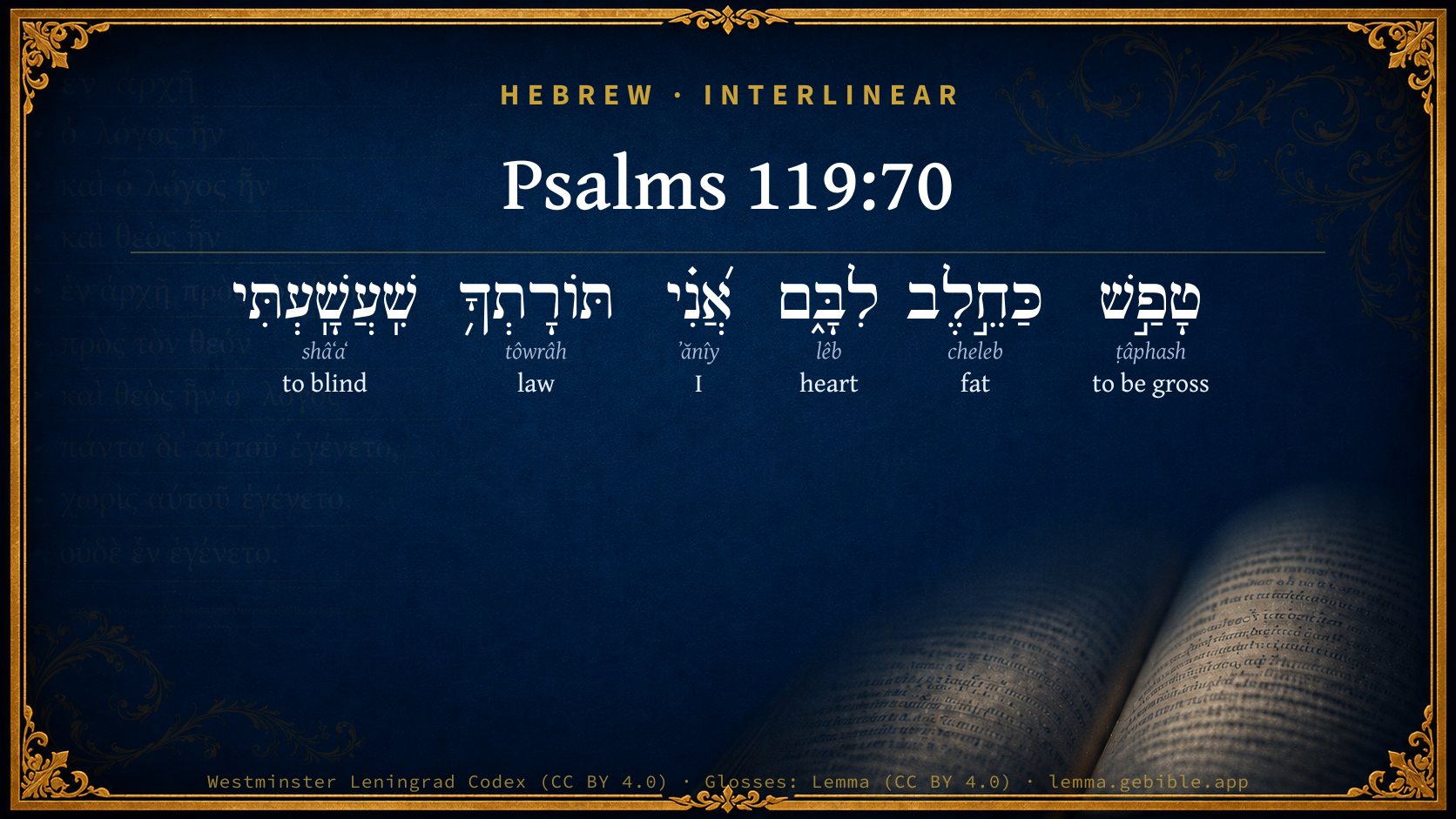
Hebrew (Westminster Leningrad Codex) Psalms 119:70 appears in the Hebrew Old Testament. The text above is from the Westminster Leningrad Codex. Each word links to its Strong’s number, a concise gloss, and parsing drawn from the Open Scriptures Hebrew Bible morphology. Click any word for its full Brown-Driver-Briggs (BDB) entry.
Download image
Cite this verse

Psalms 119:70 (World English Bible). Public Domain. Lemma interlinear Bible study tool, https://lemma.gebible.app/v/psalms/119/70.

Show BibTeX & RIS
BibTeX
RIS
English Translation
Their heart is as callous as the fat, But I delight in your law.
World English Bible · Public Domain
Highlights
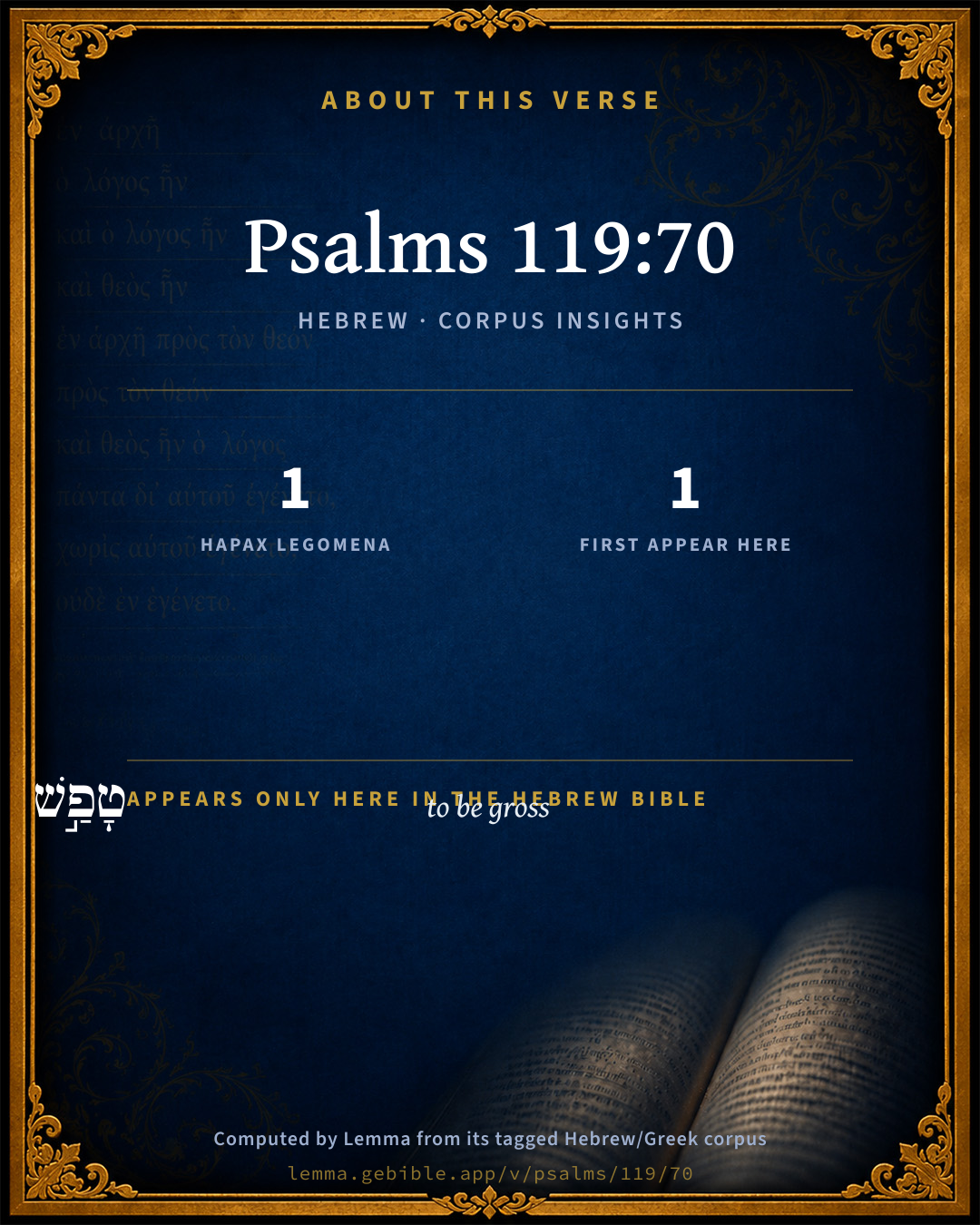
  • 1 hapax legomenon — only here in the Hebrew Bible
  • 1 first appearance in the Hebrew Bible
Full analysis ↓
Download a study sheet

One document with this verse’s original text, its word-by-word gloss line, the meaning frame, cross-references with their text, attributed commentary, and full source and license credits — printable, and it pastes into notes with its structure intact.

This verse Autodidact and up

Study sheet (.html) Plain text (.txt)

A passage Seminary Student

Up to 50 verses in one chapter. A passage sheet keeps up to 6 commentary sources and 12 cross-references per verse, in the order this page ranks them, and says so on the sheet whenever that leaves anything out. Ask for a single verse and you get the Autodidact verse sheet above.

Everything on this page stays free to read, with no account — the sheet is a download of what is already on screen, not access to it.

Want to remove ads? Support Godless Engineer
Compare translations 3

The same verse in 3 English versions, stacked beneath the original-language interlinear above. Click any original word for its lexicon entry.

Each is an independent rendering of the whole verse — the interlinear is not word-aligned to these translations.

Highlighted words mark where these versions differ — a whole-verse word diff, not a word-by-word alignment.

  • World English Bible Public Domain
    Their heart is as callous as the fat, But I delight in your law.
  • King James Version Public Domain
    Their heart is as fat as grease; but I delight in thy law.
  • unfoldingWord Literal Text CC BY-SA 4.0
    Their hearts unfeeling like fat, I, your teaching, I delight.

unfoldingWord Literal Text — © unfoldingWord, licensed CC BY-SA 4.0. Word-aligned USFM3 via Door43 (git.door43.org/unfoldingWord/en_ult).

Versions to compare (up to 4)

3 of 4 selected

Show all 17 translations

Every available English version of this verse, each an independent rendering of the whole verse.

  • World English Bible Public Domain
    Their heart is as callous as the fat, But I delight in your law.
  • Berean Standard Bible Public Domain
    Their hearts are hard and callous, but I delight in Your law.
  • Majority Standard Bible Public Domain
    Their hearts are callous and insensitive, but I delight in Your law.
  • King James Version Public Domain
    Their heart is as fat as grease; but I delight in thy law.
  • American Standard Version (1901) Public Domain
    Their heart is as fat as grease; But I delight in thy law.
  • Revised Version (1885) Public Domain
    Their heart is as fat as grease; but I delight in thy law.
  • Geneva Bible (1599) Public Domain
    Their heart is fatte as grease: but my delite is in thy Lawe.
  • Young's Literal Translation Public Domain
    Insensate as fat hath been their heart, I -- in Thy law I have delighted.
  • Literal Standard Version CC BY-SA 4.0
    Their heart has been thick as fat, || I have delighted in Your law.
  • Unlocked Literal Bible CC BY-SA 4.0
    Their hearts are hardened, but I delight in your law.
  • unfoldingWord Literal Text CC BY-SA 4.0
    Their hearts unfeeling like fat, I, your teaching, I delight.
  • Darby Bible Public Domain
    Their heart is as fat as grease: as for me, I delight in thy law.
  • World Messianic Bible Public Domain
    Their heart is as callous as the fat, but I delight in your Torah.
  • Webster's Bible Public Domain
    Their heart is as gross as fat; but I delight in thy law.
  • Free Bible Version CC BY-SA 4.0
    They are cold and unfeeling, but I love your law.
  • Bible in Basic English Public Domain
    Their hearts are shut up with fat; but my delight is in your law.
  • JPS Tanakh (1917) Public Domain
    Their heart is gross like fat; but I delight in Thy law.

Literal Standard Version (2020), Covenant Press — licensed CC BY-SA 4.0. Text via the HelloAO Bible API (eBible.org). Unlocked Literal Bible (unfoldingWord) — licensed CC BY-SA 4.0. Text via the HelloAO Bible API (eBible.org). unfoldingWord Literal Text — © unfoldingWord, licensed CC BY-SA 4.0. Word-aligned USFM3 via Door43 (git.door43.org/unfoldingWord/en_ult). Free Bible Version, Dr. Jonathan Gallagher — licensed CC BY-SA 4.0. Text via the HelloAO Bible API (eBible.org).

Word by word

More ways to search: Search by grammar → Find every occurrence → Compare this word →

Practice this passage: Drill this verse → Learn its vocabulary →

About this verse

These counts appear in no published source. They are computed here, from the morphology-tagged text and Lemma’s own curated glosses. What Lemma adds →

6
words
6
distinct lemmas
Wisdom
section

Notable vocabulary

1 hapax legomenon — a word that appears only here in the entire Hebrew Bible:

  • טָפַ֣שׁ to be gross H2954

First appearance in Scripture

This word makes its first canonical appearance in the Hebrew Bible here:

  • טָפַ֣שׁ to be gross H2954

Shared distinctive vocabulary

שִֽׁעֲשָֽׁעְתִּי to blind H8173 occurs in 8 verses of the Hebrew Bible. Also found in:

Grammatical profile

  • 2 verbs
  • 3 nouns
  • 1 pronoun

Verb forms

  • טָפַ֣שׁ Qal · Perfect
  • שִֽׁעֲשָֽׁעְתִּי Pilpel · Perfect

Hebrew & Septuagint length

In English translation the verse runs 14 words from the Hebrew and 14 from the Septuagint (LXX English) — the same length.

A rough comparison of the two English renderings, which tokenize alike — not a word-level alignment.

Word counts can differ between the Hebrew and the Greek without any difference in meaning — e.g. the Hebrew direct-object marker אֵת has no separate Greek word, and Greek often adds the article ὁ.

Cross-references

8

Topical passages linked to Psalms 119:70 in the Treasury of Scripture Knowledge — connected by theme and wording, ordered by reader-vote popularity; previews shown in the World English Bible.

  • Psalms 17:10 They close up their callous hearts. With their mouth they speak proudly.
  • Acts 28:27 For this people's heart has grown callous. Their ears are dull of hearing. Their eyes they have closed. Lest they should see with their eyes, Hear with their ears, Understand with their heart, And would turn again, And I would heal them.'
  • Psalms 73:7 Their eyes bulge with fat. Their minds pass the limits of conceit.
  • Psalms 119:16 I will delight myself in your statutes. I will not forget your word.
  • Isaiah 6:10 Make the heart of this people fat; Make their ears heavy, and shut their eyes; Lest they see with their eyes, And hear with their ears, And understand with their heart, And turn again, and be healed."
  • Psalms 40:8 I delight to do your will, my God. Yes, your law is within my heart."
  • Psalms 119:35 Direct me in the path of your commandments, For I delight in them.
  • Romans 7:22 For I delight in God's law after the inward man,

Cross-references courtesy of OpenBible.info (CC BY 4.0).

Hebrew and Greek witnesses Masoretic Hebrew ↔ Greek Septuagint

The same verse in the two great witnesses to the Old Testament, shown verse-for-verse.

You’re reading Greek Psalm 118 (Hebrew Psalm 119). The Septuagint counts the superscription, so verse numbers can differ from the Hebrew — chapter-level alignment, not verse-by-verse. Numbering follows Rahlfs.

These are two independent witnesses, not word-aligned to each other, and the Septuagint is shown in lemma (dictionary) form.

Hebrew Psalms 119:70 Masoretic · Westminster Leningrad Codex

טָפַ֣שׁ כַּחֵ֣לֶב לִבָּ֑ם אֲ֝נִ֗י תּוֹרָתְךָ֥ שִֽׁעֲשָֽׁעְתִּי

Their heart is as callous as the fat, But I delight in your law.

World English Bible · Public Domain

Greek LXX Greek Psalm 118:70 Septuagint · lemma form

τυρόω ὡς γάλα ὁ καρδία αὐτός ἐγώ δέ ὁ νόμος σύ μελετάω

Their heart has been curdled like milk; but I have meditated on your law.

LXX2012 (modern English Septuagint) · Public Domain

On this verse, Trapp's Complete Commentary discusses the Septuagint’s reading. Read the note in Commentary ↓

Hebrew: Westminster Leningrad Codex (CC BY 4.0). Greek: Septuagint (public domain); English from LXX2012 (modern English Septuagint) (Public Domain). How the Septuagint differs from the Hebrew →

Commentary

Notes on Psalms 119:70 from classic Christian and Jewish commentators (each source and its license shown beneath its notes). The classic Christian expositions comment on the surrounding passage and are grouped to its opening verse, so a note may address several verses; the Jewish commentaries on the Tanakh (Rashi and others) are per-verse, so they appear only where the commentator wrote on this verse.

Lemma curates 59 commentaries, every one of them public domain or Creative Commons licensed, each selected and text-cleaned for this edition rather than reprinted as found. About our sources →

Trapp's Complete Commentary

John Trapp

Psa 119:70 Their heart is as fat as grease; [but] I delight in thy law.

Ver. 70. Their heart is as fat as grease] Gross as grease; curdled as milk or cheese, say the Septuagint, congealed and baked as it were in their sins. Obtusum et quasi adipe obductum; fat things are less sensible, and fat-hearted people are noted by Aristotle for dull and stupid.

But I delight in thy law] Illa me pasco et sagino, therewith I feed and fat myself.

John Trapp, A Commentary or Exposition upon All the Books of the Old and New Testament (1647–1656) — public domain. Text from a community e-Sword module.

J. A. Alexander on Psalms

Joseph Addison Alexander

70. (Psa 119:70) Fat as grease (is) their heart. I (in) thy law delight. The connection of the clauses lies in the figurative use of fat to denote insensibility. See above, on Psa 17:10, lxxiii. 7. While they are utterly insensible to spiritual pleasures, and especially to those springing from the knowledge of thy law, I find therein my highest happiness. The verb in the last clause is a cognate form to that in Psa 119:16; Psa 119:47, and identical with that in Isa 11:8, where it means to play, sport, or enjoy one's self.

Joseph Addison Alexander, The Psalms Translated and Explained (1850) — public domain. Text from a community e-Sword module.

Geneva Bible (1599)

Geneva Bible translators

Their heart is indurated and hardened, puffed up with prosperity and vain estimation of themselves.

Geneva Bible (1599) marginal notes — public domain. Text via Bolls.life.

Adam Clarke's Commentary

Verse 70. Their heart is as fat as grease] They are egregiously stupid, they have fed themselves without fear; they are become flesh-brutalized, and given over to vile affections, and have no kind of spiritual relish: but I delight in thy law - I have, through thy goodness, a spiritual feeling and a spiritual appetite.

Adam Clarke's Commentary on the Bible (1810–1826) — public domain. Text from a community e-Sword/MySword module.

Ellicott's Commentary for English Readers

(70) As fat as grease.—For this emblem of pride and insensibility, see Psa_17:10; Psa_73:7; Isa_6:10.

A Bible Commentary for English Readers, edited by Charles John Ellicott (1878–1897) — public domain. Text from a community e-Sword module.

The Cambridge Bible for Schools and Colleges

gen. ed. J. J. S. Perowne

70. Gross is their heart as fat (lit. the fat of the midriff), as insensible and incapable of receiving any spiritual impression as the fat near it (Psa_17:10; Psa_73:7; Isa_6:10); as for me, in thy law do I delight.

The Cambridge Bible for Schools and Colleges (gen. ed. J. J. S. Perowne; Cambridge University Press, 1878–1918) — public domain. Text from a community e-Sword module.

John Gill's Exposition

They that fear thee will be glad when they see me,.... In outward prosperity, delivered from all troubles, set on the throne of Israel, and at rest from all enemies round about: and in spiritual prosperity, being illuminated by the Spirit of God, having a spiritual understanding of divine things, an obedience of faith to the commands of God, in the lively exercise of grace upon him, in comfortable frames of soul, and flourishing circumstances. Now they that fear the Lord, that have the grace of fear in their hearts, and are true worshippers of God, as they delight to meet together, and are glad to see one another; so they rejoice in each other's prosperity, especially spiritual; see Psa 34:1;

because I have hoped in thy Word; in Christ the essential Word, the hope of Israel; in the written word, which gives encouragement to hope; in the word of promise, on which he was caused to hope; and in which hope he was confirmed, and not disappointed, and so it made him not ashamed: and others rejoiced at it, because it was an encouragement to their faith and hope likewise.

John Gill's Exposition of the Whole Bible (1746–1763) — public domain (CC PDM 1.0). Text via the HelloAO Bible API.

Albert Barnes' Notes on the Bible

Their heart is as fat as grease - They are prospered. They have health, property, influence, comforts of all kinds. heaven appears to smile upon them, and it seems as if it were one effect of a wicked course of life to make people prosperous. See Psa 17:10, note; Psa 73:7, note.

But I delight in thy law - Though its observance should not be attended by any such results as seem to follow wickedness, though I am poor, emaciated, pale - disappointed, slandered, persecuted - though my lot in life is among the lowly and the despised - yet I will adhere to my purpose to keep thy law. It is, and it shall be, my delight, whatever may be the effects of so observing it. See Psa 119:35.

Albert Barnes' Notes on the Bible (1834–1885) — public domain. Text from a community e-Sword/MySword module.

Matthew Poole's English Annotations

Their heart is as fat as grease; the sense is either,

1. They are stupid, and insensible, and past feeling, not affected either with the terrors or comforts of God’s word. So the like phrase is used Isa 6:10, compared with Joh 12:40. Or,

2. They prosper exceedingly, and are even glutted with the wealth and comforts of this life.

But I delight in thy law; but I do not envy them their jollity, and I have as much delight in God’s law as they have in worldly things.

Matthew Poole's English Annotations on the Holy Bible (1683–1685) — public domain. Text from a community e-Sword/MySword module.

The Treasury of David

Charles H. Spurgeon

Ver. 70. Their heart is as fat as grease. They delight in fatness, but I delight in thee. Their hearts, through sensual indulgence, have grown insensible, coarse, and grovelling; but thou hast saved me from such a fate through thy chastening hand. Proud men grow fat through carnal luxuries, and this makes them prouder still. They riot in their prosperity, and fill their hearts therewith till they become insensible, effeminate, and self indulgent. A greasy heart is something horrible; it is a fatness which makes a man fatuous, a fatty degeneration of the heart which leads to feebleness and death. The fat in such men is killing the life in them. Dryden wrote,

"O souls! In whom no heavenly fire is found,

Fat minds and ever grovelling on the ground."

In this condition men have no heart except for luxury, their very being seems to swim and stew in the fat of cookery and banqueting. Living on the fat of the land, their nature is subdued to that which they have fed upon; the muscle of their nature has gone to softness and grease.

But I delight in thy law. How much better is it to joy in the law of the Lord than to joy in sensual indulgences! This makes the heart healthy, and keeps the mind lowly. No one who loves holiness has the slightest cause to envy the prosperity of the worldling. Delight in the law elevates and ennobles, while carnal pleasure clogs the intellect and degrades the affections. There is and always ought to be a vivid contrast between the believer and the sensualist, and that contrast is as much seen in the affections of the heart as in the actions of the life: their heart is as fat as grease, and our heart is delighted with the law of the Lord. Our delights are a better test of our character than anything else: as a man's heart is, so is the man. David oiled the wheels of life with his delight in God's law, and not with the fat of sensuality. He had his relishes and dainties, his festivals and delights, and all these he found in doing the will of the Lord his God. When law becomes delight, obedience is bliss. Holiness in the heart causes the soul to eat the fat of the land. To have the law for our delight will breed in our hearts the very opposite of the effects of pride; deadness, sensuality, and obstinacy will be cured, and we shall become teachable, sensitive, and spiritual. How careful should we be to live under the influence of the divine law that we fall not under the law of sin and death.

Ver. 70. Their heart is as fat as grease. The word vpj occurs nowhere else in Scripture, but with the Chaldees vpj signifies to fatten, to make fat; also to make stupid and doltish, because such the fat ofttimes are... For this reason the proud, who are mentioned in the preceding verse, are described by their fixed resolve in evil, because they are almost insensible; as is to be seen in pigs, who pricked through the skin with a bodkin, and that slowly, as long as the bodkin only touches the fat, do not feel the prick until it reaches to the flesh. Thus the proud, whose great prosperity is elsewhere likened to fatness, have a heart totally insusceptible, which is insensible to the severe reproofs of the Divine word, and also to its holy delights and pleasures, by reason of the affluence of carnal things; aye, more, is altogether unfitted for good impulses; just as elsewhere is to be seen with fat animals, how slow they are and unfit for work, when, on the contrary, those are agile and quick which are not hindered by this same fatness. Martin Geier.

Ver. 70. Their heart is as fat as grease. This makes them

1. Senseless and secure; they are past feeling: thus the phrase is used (Isa 6:10): "Make the heart of the people fat." They are not sensible of the teaching of the word of God, or his rod.

2. Sensual and voluptuous: "Their eyes stand out with fatness" (Ps 73:7); they roll themselves in the pleasures of sense, and take up with them as their chief good; and much good may it do them: I would not change conditions with them; "delight in thy law." Matthew Henry.

Ver. 70. Their heart is as fat as grease; but I delight in thy law; as if he should say, My heart is a lean heart, a hungry heart, my soul loveth and rejoiceth in thy word. I have nothing else to fill it but thy word, and the comforts I have from it; but their hearts are fat hearts: fat with the world, fat with lust: they hate the word. As a full stomach loatheth meat and cannot digest it; so wicked men hate the word, it will not go down with them, it will not gratify their lusts. William Fenner.

Being anxious to know the medical significance of fatty heart, I applied to an eminent gentleman who is well known as having been President of the College of Physicians. His reply shows that the language is rather figurative than literal. He kindly replied to me as follows:

There are two forms of so called "fatty heart". In the one there is an excessive amount of fatty tissue covering the exterior of the organ, especially about the base. This may be observed in all cases where the body of the animal is throughout over fat, as in animals fattened for slaughter. It does not necessarily interfere with the action of the heart, and may not be of much importance in a medical point of view. The second form is, however, a much more serious condition. In this, the muscular structure of the heart, on which its all important function, as the central propelling power, depends, undergoes a degenerative change, by which the contractile fibres of the muscles are converted into a structure having none of the properties of the natural fibres, and in which are found a number of fatty, oily globules, which can be readily seen by means of the microscope. This condition, if at all extensive, renders the action of the heart feeble and irregular, and is very perilous, not infrequently causing sudden death. It is found in connection with a general unhealthy condition of system, and is evidence of general mal-nutrition. It is brought about by an indolent, luxurious mode of living, or, at all events, by neglect of bodily exercise and those hygienic rules which are essential for healthy nutrition. It cannot, however, be said to be incompatible with mental rigour, and certainly is not necessarily associated with stupidity. But the heart, in this form of disease, is literally, "greasy", and may be truly described as "fat as grease." So much for physiology and pathology. May I venture on the sacred territory of biblical exegesis without risking the charge of fatuousness. Is not the Psalmist contrasting those who lead an animal, self indulgent, vicious life, by which body and mind are incapacitated for their proper uses, and those who can run in the way of God's commandments, delight to do his will, and meditate on his precepts? Sloth, fatness and stupidity, versus activity, firm muscles, and mental rigour. Body versus mind. Man become as a beast versus man retaining the image of God. Sir James Risdon Bennett, 1881.

Ver. 70.

1. Fatty degeneration of the heart.

2. Thorough regeneration of the heart.

Ver. 70. A fatty heart.

1. The diagnosis of the disease.

2. Its symptoms. Pride; no delight in God, nor in his law; dislike to his people; readiness to lie: Ps 119:69.

3. Its fatal character.

4. Its only cure. Ps 101:10 Eze 36:26. C.A.D.

Charles H. Spurgeon's The Treasury of David (1869–1885) — public domain. Psalms only. Text from a community e-Sword/MySword module.

The Pulpit Commentary

Their heart is as fat as grease; i.e. dull, gross, insensible to spiritual things. (see Psa_17:10 Isa_6:10) But I delight in thy Law. My heart is unlike theirs. Thy Law is a "delight" to it (comp. yore. 16, 24, 35, etc.).

The Pulpit Commentary (1880–1919), ed. H.D.M. Spence-Jones & Joseph S. Exell — public domain. Text from a community e-Sword module.

John Wesley's Explanatory Notes

Fat - They are stupid and insensible.

John Wesley, Explanatory Notes Upon the Whole Bible (1754–1765) — public domain. Text via the GEBible commentary corpus.

Lesson kit

Teaching starters — assembled from the data on this page, not authored interpretation. Every prompt links to the verse data it draws on. Edit before teaching.

Psalms, in the Wisdom, opens this verse with 6 words (6 distinct Hebrew lemmas). Its most distinctive word is ṭâphash (“to be gross”). A historical commentator’s framing appears above. Read the whole chapter for the surrounding context.

Discussion questions

  1. How does “to be gross” (ṭâphash) shape what this verse is saying?
  2. This verse holds 1 word here found nowhere else in the Hebrew Bible. What might the rare word draw attention to?
  3. The word “to be gross” first appears here in Scripture. What is being introduced at this debut?
  4. Psalms 94:19 shares the word «to blind» with this verse. How do the two illuminate each other?
  5. The translations on this page render this verse differently — a whole-verse word diff, not a word-by-word alignment. What might account for the different wordings?
  6. The verb «טָפַ֣שׁ» is Qal Perfect. How does its form color the action?
  7. Reading how Trapp's Complete Commentary and J. A. Alexander on Psalms read this verse, where do the two commentators agree and where do they part?

Things to notice

  • 1 word in this verse appears nowhere else in the Hebrew Bible.
  • 1 word makes its first canonical appearance in Scripture here.
  • These translations choose different wording for 8 words in this verse.
  • 6 distinct Hebrew lemmas span 6 words in this verse.

Reading settings

Reading text

Shown beneath each verse's original-language words.

Old Testament
Old Testament edition

Read the OT as the Masoretic Hebrew (MT) or the Greek Septuagint (LXX).

English shown for the Greek Septuagint (in the Hebrew ↔ Greek comparison).

Comparing translations? Open the Compare panel on any verse page to stack up to four side by side.