
Isaiah 30:9

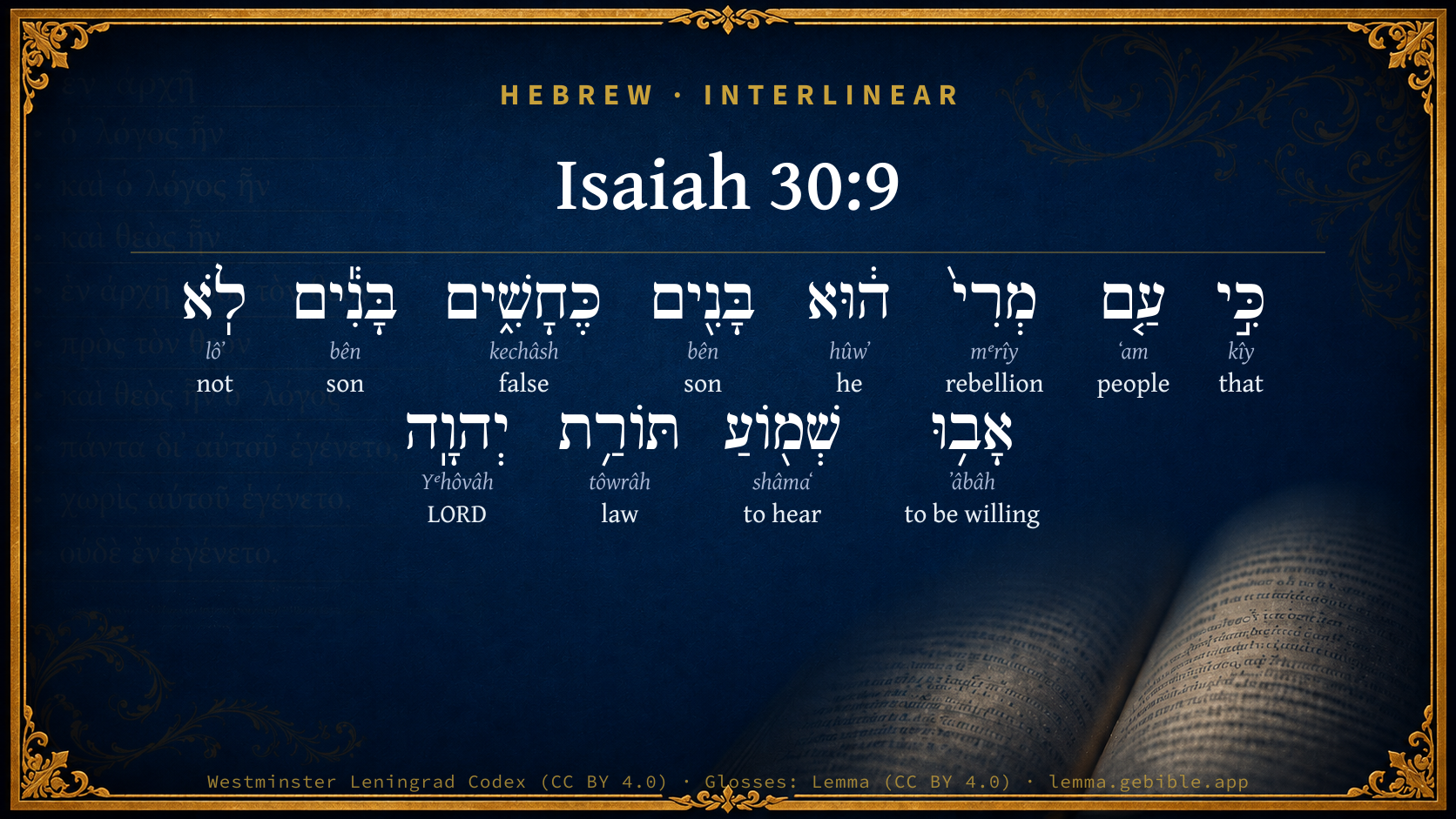
Hebrew (Westminster Leningrad Codex) Isaiah 30:9 appears in the Hebrew Old Testament. The text above is from the Westminster Leningrad Codex. Each word links to its Strong’s number, a concise gloss, and parsing drawn from the Open Scriptures Hebrew Bible morphology. Click any word for its full Brown-Driver-Briggs (BDB) entry.
Download image
Cite this verse

Isaiah 30:9 (World English Bible). Public Domain. Lemma interlinear Bible study tool, https://lemma.gebible.app/v/isaiah/30/9.

Show BibTeX & RIS
BibTeX
RIS
English Translation
For it is a rebellious people, lying children, children who will not hear the law of Yahweh;
World English Bible · Public Domain
Highlights
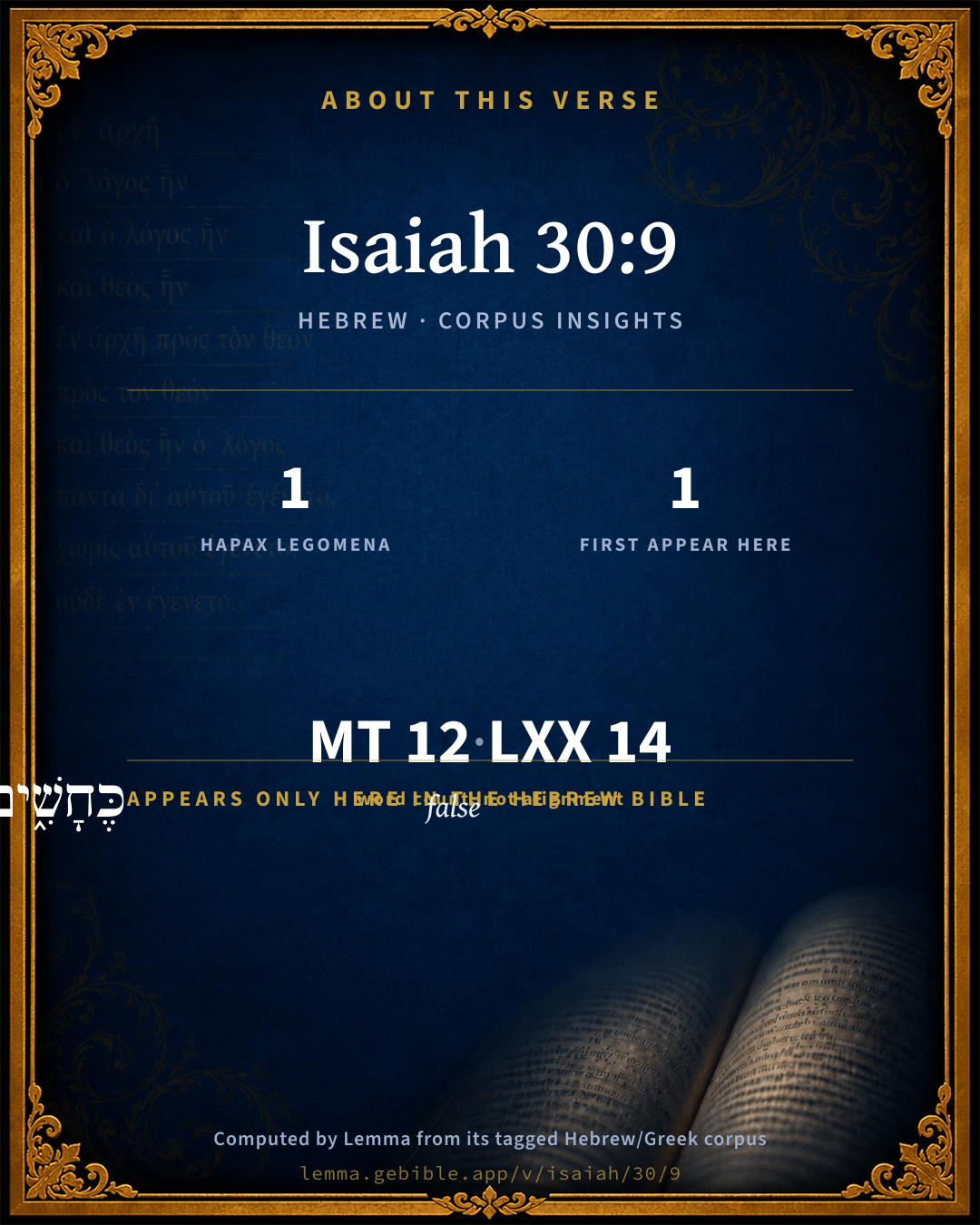
  • 1 hapax legomenon — only here in the Hebrew Bible
  • 1 first appearance in the Hebrew Bible
Full analysis ↓
Download a study sheet

One document with this verse’s original text, its word-by-word gloss line, the meaning frame, cross-references with their text, attributed commentary, and full source and license credits — printable, and it pastes into notes with its structure intact.

This verse Autodidact and up

Study sheet (.html) Plain text (.txt)

A passage Seminary Student

Up to 50 verses in one chapter. A passage sheet keeps up to 6 commentary sources and 12 cross-references per verse, in the order this page ranks them, and says so on the sheet whenever that leaves anything out. Ask for a single verse and you get the Autodidact verse sheet above.

Everything on this page stays free to read, with no account — the sheet is a download of what is already on screen, not access to it.

Want to remove ads? Support Godless Engineer
Compare translations 3

The same verse in 3 English versions, stacked beneath the original-language interlinear above. Click any original word for its lexicon entry.

Each is an independent rendering of the whole verse — the interlinear is not word-aligned to these translations.

Highlighted words mark where these versions differ — a whole-verse word diff, not a word-by-word alignment.

  • World English Bible Public Domain
    For it is a rebellious people, lying children, children who will not hear the law of Yahweh;
  • King James Version Public Domain
    That this is a rebellious people, lying children, children that will not hear the law of the LORD:
  • unfoldingWord Literal Text CC BY-SA 4.0
    For it a people of rebellion, false sons, sons are not willing to hear the law of Yahweh,

unfoldingWord Literal Text — © unfoldingWord, licensed CC BY-SA 4.0. Word-aligned USFM3 via Door43 (git.door43.org/unfoldingWord/en_ult).

Versions to compare (up to 4)

3 of 4 selected

Show all 18 translations

Every available English version of this verse, each an independent rendering of the whole verse.

  • World English Bible Public Domain
    For it is a rebellious people, lying children, children who will not hear the law of Yahweh;
  • Berean Standard Bible Public Domain
    These are rebellious people, deceitful children, children unwilling to obey the LORD’s instruction.
  • Majority Standard Bible Public Domain
    These are rebellious people, deceitful children, children unwilling to obey the LORD’s instruction.
  • King James Version Public Domain
    That this is a rebellious people, lying children, children that will not hear the law of the LORD:
  • American Standard Version (1901) Public Domain
    For it is a rebellious people, lying children, children that will not hear the law of Jehovah;
  • Revised Version (1885) Public Domain
    For it is a rebellious people, lying children, children that will not hear the law of the LORD:
  • Geneva Bible (1599) Public Domain
    That it is a rebellious people, lying children, and children that would not heare the law of the Lord.
  • Douay-Rheims (1899) Public Domain
    For it is a people that provoketh to wrath, and lying children, children that will not hear the law of God.
  • Young's Literal Translation Public Domain
    That a rebellious people `is' this, sons -- liars, Sons not willing to hear the law of Jehovah.
  • Literal Standard Version CC BY-SA 4.0
    That this [is] a people of rebellion, sons—liars, || Sons not willing to hear the Law of YHWH.
  • Unlocked Literal Bible CC BY-SA 4.0
    For these are a rebellious people, lying children, children who will not hear the instruction of Yahweh.
  • unfoldingWord Literal Text CC BY-SA 4.0
    For it a people of rebellion, false sons, sons are not willing to hear the law of Yahweh,
  • Darby Bible Public Domain
    that this is a rebellious people, lying children, children that will not hear the law of Jehovah;
  • World Messianic Bible Public Domain
    For it is a rebellious people, lying children, children who will not hear the LORD’s law;
  • Webster's Bible Public Domain
    That this is a rebellious people, lying children, children that will not hear the law of the LORD:
  • Free Bible Version CC BY-SA 4.0
    For they are a rebellious people, deceitful children, who refuse to listen to the Lord's instructions.
  • Bible in Basic English Public Domain
    For they are an uncontrolled people, false-hearted, who will not give ear to the teaching of the Lord:
  • JPS Tanakh (1917) Public Domain
    For it is a rebellious people, lying children, children that refuse to hear the teaching of the LORD;

Literal Standard Version (2020), Covenant Press — licensed CC BY-SA 4.0. Text via the HelloAO Bible API (eBible.org). Unlocked Literal Bible (unfoldingWord) — licensed CC BY-SA 4.0. Text via the HelloAO Bible API (eBible.org). unfoldingWord Literal Text — © unfoldingWord, licensed CC BY-SA 4.0. Word-aligned USFM3 via Door43 (git.door43.org/unfoldingWord/en_ult). Free Bible Version, Dr. Jonathan Gallagher — licensed CC BY-SA 4.0. Text via the HelloAO Bible API (eBible.org).

Word by word

More ways to search: Search by grammar → Find every occurrence → Compare this word →

Practice this passage: Drill this verse → Learn its vocabulary →

About this verse

These counts appear in no published source. They are computed here, from the morphology-tagged text and Lemma’s own curated glosses. What Lemma adds →

12
words
11
distinct lemmas
Prophets
section

Notable vocabulary

1 hapax legomenon — a word that appears only here in the entire Hebrew Bible:

  • כֶּחָשִׁ֑ים false H3586

First appearance in Scripture

This word makes its first canonical appearance in the Hebrew Bible here:

  • כֶּחָשִׁ֑ים false H3586

Shared distinctive vocabulary

מְרִי֙ rebellion H4805 occurs in 21 verses of the Hebrew Bible. Also found in:

Grammatical profile

  • 2 verbs
  • 6 nouns
  • 1 adjective
  • 1 pronoun
  • 1 conjunction
  • 1 particle

Verb forms

  • אָב֥וּ Qal · Perfect
  • שְׁמ֖וֹעַ Qal · Infinitive Construct

Repetition

A word recurs within this verse — often emphatic in Hebrew:

  • בָּנִ֖ים son H1121 ×2

Hebrew & Septuagint length

In English translation the verse runs 17 words from the Hebrew and 15 from the Septuagint (LXX English) — closely comparable.

A rough comparison of the two English renderings, which tokenize alike — not a word-level alignment.

Word counts can differ between the Hebrew and the Greek without any difference in meaning — e.g. the Hebrew direct-object marker אֵת has no separate Greek word, and Greek often adds the article ὁ.

In the original languages it is 12 Hebrew tokens and 14 Greek tokens — but the two are counted differently (Hebrew bundles its prefixes and suffixes into one token; the Greek is in lemma form), so that isn’t a like-for-like length.

Cross-references

24

Topical passages linked to Isaiah 30:9 in the Treasury of Scripture Knowledge — connected by theme and wording, ordered by reader-vote popularity; previews shown in the World English Bible.

  • Isaiah 30:1 Woe to the rebellious children, says Yahweh, who take counsel, but not of me; and who make a league, but not of my Spirit, that they may add sin to sin,
  • Acts 7:51 "You stiff-necked and uncircumcised in heart and ears, you always resist the Holy Spirit! As your fathers did, so you do.
  • Proverbs 28:9 He who turns away his ear from hearing the law, Even his prayer is an abomination.
  • Isaiah 1:4 Ah sinful nation, A people loaded with iniquity, A seed of evil-doers, Children who deal corruptly! They have forsaken Yahweh. They have despised the Holy One of Israel. They are estranged and backward.
  • Zephaniah 3:2 She didn't obey the voice. She didn't receive correction. She didn't trust in Yahweh. She didn't draw near to her God.
  • Zechariah 1:4–6 Don't you be like your fathers, to whom the former prophets proclaimed, saying: Thus says Yahweh of hosts, 'Return now from your evil ways, and from your evil doings;' but they did not hear, nor listen to me, says Yahweh.
  • Zechariah 7:11–12 But they refused to listen, and turned their backs, and stopped their ears, that they might not hear.
  • Revelation 21:8 But for the cowardly, unbelieving, sinners, abominable, murderers, sexually immoral, sorcerers, idolaters, and all liars, their part is in the lake that burns with fire and sulfur, which is the second death."
  • Deuteronomy 31:27–29 For I know your rebellion, and your stiff neck: behold, while I am yet alive with you this day, you have been rebellious against Yahweh; and how much more after my death?
  • Deuteronomy 32:20 He said, I will hide my face from them, I will see what their end shall be: For they are a very perverse generation, Children in whom is no faithfulness.
  • 2 Chronicles 33:10 Yahweh spoke to Manasseh, and to his people; but they gave no heed.
  • 2 Chronicles 36:15–16 Yahweh, the God of their fathers, sent to them by his messengers, rising up early and sending, because he had compassion on his people, and on his dwelling-place:
  • Nehemiah 9:29–30 and testified against them, that you might bring them again to your law. Yet they dealt proudly, and didn't listen to your commandments, but sinned against your ordinances, (which if a man do, he shall live in them), and withdrew the shoulder, and hardened their neck, and would not hear.
  • Isaiah 1:10 Hear the word of Yahweh, you rulers of Sodom! Listen to the law of our God, you people of Gomorrah!
  • Isaiah 28:15 Because you have said, We have made a covenant with death, and with Sheol are we at agreement; when the overflowing scourge shall pass through, it shall not come to us; for we have made lies our refuge, and under falsehood have we hid ourselves:
  • Isaiah 59:3–4 For your hands are defiled with blood, and your fingers with iniquity; your lips have spoken lies, your tongue mutters wickedness.
  • Isaiah 63:8 For he said, Surely, they are my people, children who will not deal falsely: so he was their Savior.
  • Jeremiah 7:13 Now, because you have done all these works, says Yahweh, and I spoke to you, rising up early and speaking, but you didn't hear; and I called you, but you didn't answer:
  • Jeremiah 9:3 They bend their tongue, [as it were] their bow, for falsehood; and they are grown strong in the land, but not for truth: for they proceed from evil to evil, and they don't know me, says Yahweh.
  • Jeremiah 44:2–17 Thus says Yahweh of Hosts, the God of Israel: You have seen all the evil that I have brought on Jerusalem, and on all the cities of Judah; and, behold, this day they are a desolation, and no man dwells therein,
  • Matthew 23:31–33 Therefore you testify to yourselves that you are children of those who killed the prophets.
  • Romans 2:21–23 You therefore who teach another, don't you teach yourself? You who preach that a man shouldn't steal, do you steal?
  • Revelation 22:15 Outside are the dogs, the sorcerers, the sexually immoral, the murderers, the idolaters, and everyone who loves and practices falsehood.
  • Hosea 4:2 There is cursing, lying, murder, stealing, and committing adultery; They break boundaries, and bloodshed causes bloodshed.

Cross-references courtesy of OpenBible.info (CC BY 4.0).

Hebrew and Greek witnesses Masoretic Hebrew ↔ Greek Septuagint

The same verse in the two great witnesses to the Old Testament, shown verse-for-verse.

These are two independent witnesses, not word-aligned to each other, and the Septuagint is shown in lemma (dictionary) form.

Hebrew Isaiah 30:9 Masoretic · Westminster Leningrad Codex

כִּ֣י עַ֤ם מְרִי֙ ה֔וּא בָּנִ֖ים כֶּחָשִׁ֑ים בָּנִ֕ים לֹֽא אָב֥וּ שְׁמ֖וֹעַ תּוֹרַ֥ת יְהוָֽה

For it is a rebellious people, lying children, children who will not hear the law of Yahweh;

World English Bible · Public Domain

Greek LXX Isaiah 30:9 Septuagint · lemma form

ὅτι λαός ἀπειθής εἰμί υἱός ψευδής ὅς οὐ βούλομαι ἀκούω ὁ νόμος ὁ θεός

For the people is disobedient, false children, who would not hear the law of God:

LXX2012 (modern English Septuagint) · Public Domain

Hebrew: Westminster Leningrad Codex (CC BY 4.0). Greek: Septuagint (public domain); English from LXX2012 (modern English Septuagint) (Public Domain). How the Septuagint differs from the Hebrew →

Targum (Aramaic paraphrase)

1

The Targum is the ancient Jewish Aramaic paraphrase of the Hebrew Scriptures — an interpretive translation, not the Hebrew text itself. Onkelos (literal) and Pseudo-Jonathan (expansive) render the Torah, and Jonathan the Prophets. Coverage is partial: where no permissively-licensed English translation exists for a verse, only the Aramaic is shown. This is verse-level text, not a word-by-word alignment to the Hebrew.

  1. Targum Jonathan Prophets (Joshua–Malachi)
    אֲרֵי עַם סַרְבָן אִינוּן בְנַיָא כַּדִיבַיָא בְּנַיָא לָא אֲבוּ לְקַבָּלָא אוּלְפָן אוֹרַיְתָא דַיָי:

    That this is a rebellious people, lying children, children that will not receive the instruction of the law of the Lord:

    Targum Jonathan — Aramaic: “Mikraot Gedolot” (public domain). English: “Sefaria Community Translation” (CC0 1.0 (public-domain dedication)); “London "Chaldee Paraphrase," 1871” (public domain). Text via Sefaria.

Commentary

Notes on Isaiah 30:9 from classic Christian and Jewish commentators (each source and its license shown beneath its notes). The classic Christian expositions comment on the surrounding passage and are grouped to its opening verse, so a note may address several verses; the Jewish commentaries on the Tanakh (Rashi and others) are per-verse, so they appear only where the commentator wrote on this verse.

Lemma curates 59 commentaries, every one of them public domain or Creative Commons licensed, each selected and text-cleaned for this edition rather than reprinted as found. About our sources →

Jamieson, Fausset & Brown

Robert Jamieson, A. R. Fausset & David Brown

lying--unfaithful to Jehovah, whose covenant they had taken on them as His adopted children (Isa 59:13; Pro 30:9).

Jamieson, Fausset & Brown — Commentary Critical and Explanatory on the Whole Bible (1871) — public domain (CC PDM 1.0). Text via the HelloAO Bible API.

Trapp's Complete Commentary

John Trapp

Isa 30:9 That this [is] a rebellious people, lying children, children [that] will not hear the law of the LORD:

Ver. 9. That this is a rebellious people.] Isaiae concepta verba praeit Deus; God dictateth to the prophet Isaiah what very words he shall set down. So he did to Moses, to Jeremiah, {Jer 36:4} to Habakkuk, {Hab 2:2} to John the divine. {Rev 14:13} The whole Scripture was inspired by God; not for matter only, but for words also; {2Ti 3:16} and is therefore more than a bare commonitory or warning, as Bellarmine calls it, a kind of storehouse for advice in matters of religion. We account them the surest rule of life, {a} the divine beam, and most exact balance. {b} But the Papists see well enough that while the authority of the Scriptures standeth, the traditions of their Popes cannot be established, which they account the touchstone of doctrine and foundation of faith. And in favour of their unwritten verities, as they call them, they tell us, but falsely, that Christ commanded his apostles to preach, but not to write.

Lying children.] And therefore not God’s children. {Isa 63:8}

{a} Divina statera. - Aug.

{b} Exactissima trutina - Chrysost.

John Trapp, A Commentary or Exposition upon All the Books of the Old and New Testament (1647–1656) — public domain. Text from a community e-Sword module.

The Biblical Illustrator

Joseph S. Exell

Isa_30:9-11

This is a rebellious people

Dislike to ministerial fidelity

The Jews have very many followers under the Christian dispensation.

I. STATE THE TRUTHS WHICH ARE USUALLY OBNOXIOUS TO SUCH PERSONS. There are many doctrines to which every faithful preacher of Gods Word feels bound to give ample room in his stated ministry, that are by no means welcome to many of his hearers; such, for instance, as the spirituality and unbending strictness of the Divine law, the deep depravity of human nature, the exceeding sinfulness of mans conduct, the universal necessity of regeneration, the inefficacy of works for justification, and the indispensable obligation to a separation from the world. The Scriptures, not only of the Old Testament, but of the New, abound with the most appalling descriptions of the Divine displeasure against sin. It is a striking fact, that He who was love incarnate--who was named Jesus, because He was to be the Saviour of His people--delivered, during the course of His personal ministry, more fearful descriptions of Divine justice and the punishment of the wicked, than are to be found in any other part of the Word of God. No man can fulfil his ministry, therefore, without frequently alluding to the justice of God in the punishment of sin. But such a subject frequently calm up all the enmity of the carnal mind.

II. THE CAUSES TO WHICH WE MUST TRACE THIS DISLIKE OF MINISTERIAL FIDELITY, and this love of smooth and delusive preaching.

1. In some cases it is occasioned by absolute unbelief. Multitudes who admit in gross the authority of the Bible, deny it in detail.

2. The refinements of modern society and taste lead many to ask for smooth things. There is no respect of persons with God; before Him the distinctions of society have no place.

3. Wounded pride is with some the cause of a dislike of faithful preaching. They hate the doctrine which disturbs their self-complacency, and revile the man who attempts to sink them in their own esteem.

4. But in by far the greater number of instances, this dislike of the truth, and this love of smooth things, is the result of painful forebodings of future misery.

III. THE FOLLY, THE SIN, AND THE DANGER OF A DESIRE TO SUPPRESS THE FAITHFUL VOICE OF TRUTH, and to be flattered with the soothing language of deceit.

1. Its folly is apparent from the consideration that no concealment of the situation of the sinner can alter his condition in the sight of God, or change the relation in which he stands to eternity.

2. The sin of this disposition is equal to its folly. It is sinful alike in its origin, its nature, and its consequences. Why does a person wish to have a false representation of his state? For this one reason, that as he is determined to go on in sin, he may be left to sin with less reluctance and remorse. As it is sinful in its origin, it is manifestly so in its nature, for it is the love of falsehood; a desire to confound the distinction between sin and holiness. Nor is this all; in aiming to suppress the voice of warning and the note of alarm, he acts the part of that infatuated and cruel wretch, who would bribe the sentinel to be silent when the foe is about to rush, sword in hand, into the camp; or would seduce the watchman to be quiet, when the fire had broken out at midnight, and was raging through the city. For thus saith the Lord, O son of man, I have set thee a watchman over the house of Israel, etc. (Eze_33:7-8).

3. The danger of such a disposition to the individual himself, is as great as its sin and its folly. The man who is unwilling to hear of approaching misery, is not likely to use any means by which it may be averted.

By way of APPLICATION I infer, how great are the importance, responsibility, and difficulty which attach to the ministerial office, and how anxious should those be who sustain it, to discharge its duties with uncompromising fidelity.

1. The conversion of sinners should be the leading object of every minister of Christ.

2. This must be sought by suitable means. The means for awakening the unconverted are, of course, various. What might be called the alarming style of preaching is most adapted to convert the impenitent.

3. Ministers are under a great temptation to preach smooth things, and to shrink from what may emphatically be called the burden of the Lord. A false charity leads them, in some instances, to be unwilling to disturb the peace or distress the feelings of their hearers; or, perhaps, there are some in their congregation who may feel an objection to what they contemptuously call the harrowing style. But most of all are those in danger of compromising their duty, who are appointed to minister to well educated and wealthy audiences.

4. A word of admonition is here needed for professing Christians. Are there not many who are dissatisfied with everything but words of comfort and statements of privilege? They object to everything of a searching and practical tendency. (J. A. James.)

Church and world

I. A chief part of the work of the pulpit is THE PLAIN AND FERVENT TEACHING OF DAILY LIFE MORALITY. There is no Gospel without morality, and the morality of Christ, i.e., a morality whose inspiration is the Spirit of Christ, is a very large part of the Gospel indeed. What of our Lords own teachings? Are they chiefly moral teachings or theological? It is needless to answer the question. What do we mean when we talk of being saved from sin? Just what the words say,--that sin shall be taken away; that is, that men shall obey Gods law instead of the devils; that is, that they shall live pure, virtuous, and moral lives.

II. And do not MORALS OCCUPY A VERY FOREMOST PLACE IN THE WELFARE OF MANKIND. What is it makes the world often so miserable? It is sin, that is, immorality; and if we can do away with the sin and immorality, and bring in virtue and morality, then we shall do much to diminish the miseries of our fellow men. And if it is important that morals should be taught for the welfare and happiness of mankind, who are to teach morals, if not the ministers of religion! It is for us to educate the public conscience, until men feel each moral distinction as a solemn fact, until the force of public opinion fall heavily upon him who violates the moral law, until a fairer morality take its place among us.

III. But why have we succeeded so ill? WHY IS THE GENERAL MORALITY SO LOW! It is because the people have said, Speak unto us smooth things, and we have yielded to their words. If you tell men the faults which are diseases in their characters, slowly but surely bringing them down to the grave, they cannot bear it, but keep the disease and dismiss the physician. Whether it hurts or not, the truth must be said, if men are to be saved from the error of their ways. (W. Page-Roberts, B. A.)

Speak unto us smooth things

The smooth things by which men are apt to be deceived

I propose to instance a few of these smooth things which teachers may address to the people who love to be deceived, or wherewith the people themselves lay a flattering unction to their own souls.

I. The first of these, which though not generally ranked among the smooth things, I hold to be the universal deceit, and that in virtue of which we so MAGNIFY THE PRESENT WORLD, give such an exaggerated importance to things present and things sensible, regard time as if it had all the worth and endurance of eternity, and look on eternity as a thing of remote and shadowy insignificance, the care and consideration of which may be indefinitely postponed.

II. A MEAGRE AND SUPERFICIAL IMAGINATION OF THEIR GUILT, AND PROPORTIONALLY TO THIS, A SLIGHT APPREHENSION OF THEIR DANGER.

III. A man who feels his disease so slight, will be satisfied with a very slight remedy; and accordingly the remedy which men are satisfied with, is RESTING ON THE GENERAL MERCY OF GOD. God is represented as a Being full of tenderness, thus making it the whole character of the Godhead, and in this way lulling themselves into a deceitful security--not thinking of one set of attributes, justice, truth, and righteousness, but keeping these in the background, and bringing in the foreground, God being of universal tenderness and benignity, and who will not be severe on the follies of His poor erring creatures.

IV. A CERTAIN ANTINOMIAN SECURITY which they connect with the doctrines of grace and justification by faith. When we see people reposing on their orthodoxy, and making use of it as a soporific to lull themselves, we should ply them with questions founded on the true representation which the New Testament gives. Are they running so as that they may obtain? Are they fighting so as that they may gain a hard won victory? Are they striving so as that they may force an entrance at the strait gate? (T. Chalmers, D. D.)

The craving for the entertaining

What did the speakers want? They wanted what is desired by every age, namely, to be entertained. It is entertainment that is often frittering away the noblest courage and finest faculty of the Church. There may be parts of the service which are instructive, and they are tolerated that the entertainment may be enjoyed: entertain us with ritual, with music, with stories, with something that will give us intellectual excitement and even a degree of intellectual delight: but do not prophesy, do not teach, do not become rigorously moral: let the day of judgment alone; if we have to go to hell let us go down a bank covered with velvet moss. The people make the pulpit. (J. Parker, D. D.)

The demand for smooth things

What was the utility of the Hebrew prophet, and what were the errors to which he was more particularly exposed?

I. It was THE DUTY AND THE PRIVILEGE OF ISRAEL to keep alive monotheism in the world. It was no less the duty of the prophetic school to preserve in the chosen nation itself the spirituality of religion. Both agents were in the same relative position--a hopeless minority. And both had but an imperfect success. Yet the nation and the institution served each an important purpose. Monotheism languished, but did not die. And though the prophets were not very successful in imbuing the nation generally with their own spirituality, yet they kept the flame alive. They served to show to the people the true ideal of spiritual, not ritualistic, Judaism, and thus supplied a corrective to priest taught Judaism.

II. WHAT WAS THE GREAT SOURCE OF ERROR IN THE PROPHETS UTTERANCES? What was the great pressure that pushed, or tended to push him aside from the path of duty? The text has told us. Prophesy not unto us right things, speak unto us smooth things. The desire of man--king or peasant--to hear from the prophet, or the courtier, or the demagogue, not truth, but flattery,--it was that fatal longing which led them to put a pressure on the prophet which often crushed the truth within him.

III. FLATTERY EXISTS STILL. If nations have not prophets to flatter them, they have those whom they trust as much. Far from attempting to correct their faults, the guides whom they trust are constantly labouring to impress on them that they are the most meritorious and the most ill-used nation in the world. Eyes blinded to present faults; eyes sharpened to past wrongs,--there is no treatment which will more completely and more rapidlydemoralise the nation which is subjected to it. There will be no improvement where there is no consciousness of fault; and no forgiveness where the mind is invited, almost compelled, to a constant brooding over wrong. With the growth of such feelings no nation can thrive; and he who encourages them is not the saviour but the destroyer of his country. (J. H.Jellett.)

Cause the Holy One of Israel to cease from before us

The Holy One of Israel repudiated

The meaning is not, of course, that the people disown Jehovah as the national Deity, but that they repudiate Isaiahs conception of Him as the Holy One of Israel, and the teaching based on that conception. (Prof. J. Skinner, D. D.)

Flattery

Smooth talk proves often sweet poison. Flattery is the very spring and mother of all impiety. It unmans a man, it makes him call black white, and white black; it makes a man change pearls for pebbles, and gold for counters; it makes a man judge himself wise, when foolish; knowing, when he is ignorant; holy, when he is profane; free, when he is a prisoner; rich, when he is poor; high, when he is low; full, when he is empty; happy, when he is miserable. (J. Bate.)

Truth sometimes unpopular

An animated debate took place whether Martinelli should continue his History of England to the present day.

Goldsmith: To be sure he should. Johnson: No, sir; he would give great offence. He would have to tell of almost all the living great what they do not wish told. Goldsmith: There are people who tell a hundred political lies every day, and are not hurt by it. Surely, then, one may tell truth with safety. Johnson: Why, sir, in the first place, he who tells a hundred lies has disarmed the force of his lies. But besides, a man had rather have a hundred lies told of him than one truth which he does not wish to be told. Goldsmith: For my part, Id fen the truth, and shame the devil. Johnson: Yes, sir; but the devil will be angry. I wish to shame the devil as much as you do, but I should choose to be out of the reach of his claws. Goldsmith: His claws can do you no harm when you have the shield of truth. (Boswells Johnson.)

Harmless preaching

Two Chinese jugglers have been making a public exhibition of their skill. One of these is set up as a target, and the other shows his dexterity by hurling knives which stick into the board at his comrades back, close to the mans body. These deadly weapons fix themselves between his arms and legs, and between his fingers; they fly past his ears, and over his head and each side of his neck. The art is not to hit him. Are there not to be found preachers who are remarkably proficient in the same art in the mental and spiritual departments? (C. H. Spurgeon.)

Faithful preaching

Our preaching must not be general, but particular. It is not lawful for thee to have her to wife. This was John Baptists style. We must collar men. Thou art the man--I mean you, sir. We are not half enough convinced of the evil of general preaching. The beef must have the salt of truth, and the saltpetre of life, but it must be rubbed in by particular application, and rubbed into every part by a comprehensive mind, and rubbed in by clean hands. (R. Cecil.)

The Biblical Illustrator, edited by Joseph S. Exell (c. 1880s–1900s) — public domain. Text from a community e-Sword module.

The Preacher's Complete Homiletical Commentary

Joseph S. Exell (gen. ed.)

DISLIKE TO MINISTERIAL FIDELITY

Isa_30:9-11. This is a rebellious people, &c.

Many wish to be deceived. They have made truth their enemy and shrink from the light, desiring present relief and peace, even at the expense of future happiness. Many a man does not like to be told the truth about his business or his health. The Jews did not like to be told the truth about their national prospects. The incessant reference of the prophets to the holiness of God was offensive to them, and they tried to silence their faithful monitors. Faithful ministers of Christ meet with the same reception from many of their hearers. These cannot bear to have their consciences roused, their fears alarmed, and their minds rendered uneasy.

I. THE TRUTHS WHICH ARE USUALLY OBNOXIOUS TO SUCH PERSONS. The spirituality and unbending strictness of the divine law, the deep depravity of human nature, the exceeding sinfulness of man’s conduct, the universal necessity of regeneration, the inefficacy of works for justification, the indispensable obligation to a separation from the world, the holiness of God, His irreconcilable hatred to all sin, and His irrevocable purpose to punish it, and the awfulness and interminableness of the doom of the impenitent. Such subjects call up the enmity of the carnal mind. They distress those who are wrongfully at ease in Zion, and they demand that the preacher shall leave them, and discourse on more pleasing themes.

II. THE CAUSE OF THIS DISLIKE OF MINISTERIAL FIDELITY.

1. Unbelief. Multitudes who admit in gross the authority of the Bible deny it in detail. Its unpalatable truths are rejected.

2. The refinements of modern society and taste. It is allowed that the curses of a violated law may be uttered in barns or churches for the poor, and may fall on the rude ears of the multitude, but the doctrine and style of preaching to the congregations of rank and fashion must be smooth and soft.

3. Wounded pride. Persons of outwardly blameless life hate the doctrine which disturbs their self-complacency, and revile the man who attempts to sink them in their own esteem.

4. Painful forebodings of future misery. Resolutely cleaving to their sins, they do not like to be reminded of the doom to which they are hastening.

III. THE CHARACTERISTICS OF THIS DISLIKE OF MINISTERIAL FIDELITY.

1. It is foolish. Is it wise in the victim of vice to ask the physician to tell him that he is in good health, and is carrying on a harmless course of indulgence, &c., &c.? No concealment of the situation of the sinner can alter his condition in the sight of God or change the relation in which he stands to eternity.

2. It is sinful.

(1.) In its origin. It springs from a determination to go on in sin.

(2.) In its nature. It is a love of falsehood, a desire to confound the distinction between sin and holiness. Nor is this all; in aiming to suppress the voice of warning, he acts the part of that infatuated and cruel wretch who would bribe the sentinel to be silent when the foe is about to rush into the camp, or would seduce the watchman to be quiet when the fire had broken out at midnight and was raging through the city. The attempt to induce the preacher to utter “smooth things,” is an attempt to induce him to destroy himself and to contribute to the destruction of them that hear him.

(3.) In its consequences. Notwithstanding the most faithful warnings, they are hurried on by it to ruin. Like infatuated Balaams, they force a passage to destruction.

3. It is dangerous. It leads men to close their ears to what it concerns them especially to know. It is only by a faithful disclosure of their situation that they can escape, but they will not hear it.

APPLICATION.

1. To ministers.

(1.) The guilt of ministers who do not discharge the duties of their office with uncompromising fidelity is indescribable. They are mere pulpit agents of the devil, receiving the wages of the sanctuary while they do his work; keeping all still and quiet among his slaves, preventing all attempts to throw off his hateful yoke by flattering them with the idea that they are the servants of God.

(2.) The conversion of sinners should be the chief object of every minister of Christ. They constitute the majority of every congregation; they will soon be beyond the reach of salvation.

(3.) The conversion of the impenitent must be sought by suitable means. What may be called the alarming style of preaching is most adapted to convert the impenitent. Not gross and revolting descriptions of eternal torment; these are offensive and disgusting, and generally defeat their purpose, especially when done in a harsh, unfeeling manner. But a minister’s habitual preaching should be so discriminating as to leave no unconverted sinner at a loss with whom to class himself, whether with believers or with unbelievers; and it should not unfrequently contain those allusions to and descriptions of the wrath of God which, like the distant rumblings of the gathering and approaching storm, should drive men to the refuge provided by infinite mercy in the cross of Christ.

(4.) It is at our peril that we soften down the terrors of the Lord to please any man; we must not shun to declare the whole counsel of God; we must stand clear of the blood of the rich as well as of the poor. Did Paul regard the feelings of Felix?

2. To professing Christians.

(1.) Many would have the preacher confine himself to words of comfort, and object to everything searching and practical as legal. Upon their principles, all parts of God’s Word but the promises are unnecessary; they are useless to believers, for they are above them by privilege; useless to sinners, for they are below them in respect to obligation. What is this but a requesting that the Holy One of Israel may cease from before His people?

(2.) Inconsistent professors are likewise anxious that the preacher should confine himself to consolatory topics. Hypocrites! he gives you that which belongs to you. Consolation would be to you a deadly poison, a fatal opiate.

(3.) Sometimes even those who have only the ordinary imperfections of even the best men wish to hear less of the alarming parts of divine truth. But have you no concern for the salvation of others? Besides, who can tell but what you dislike may be necessary for keeping you awake?

(4.) Let those who cannot bear to hear the descriptions of future punishment think with themselves how they shall be able to endure it.—John Angell James, Sermons, ii. 181–214.

The Preacher's Complete Homiletical Commentary (gen. ed. Joseph S. Exell; Funk & Wagnalls, c. 1892) — public domain (pre-1929). A full-Bible homiletical/sermon-outline anthology covering 65 of 66 books (2 John is absent from the source module). Text from a community e-Sword module.

Geneva Bible (1599)

Geneva Bible translators

He showeth what was the cause of their destruction, and bringeth also all misery to man: to wit, because they would not hear the word of God, but delighted to be flattered, and led in error.

Geneva Bible (1599) marginal notes — public domain. Text via Bolls.life.

Ellicott's Commentary for English Readers

(9) That this is a rebellious people.—The words that follow were those which were thus written on the tablet. The people did not know the law of the Lord, the eternal law of right, themselves. They wished the seers, like Isaiah, to be as blind as themselves, and would fain have made the prophets tune their voice according to the time.

A Bible Commentary for English Readers, edited by Charles John Ellicott (1878–1897) — public domain. Text from a community e-Sword module.

The Cambridge Bible for Schools and Colleges

gen. ed. J. J. S. Perowne

9. lying children] or faithless sons; see on ch. Isa_1:2, cf. Mal_1:6 the law] the instruction, as ch. Isa_1:10.

9–11. The documents (as in Isa_8:16) are a protest against the persistent disobedience of the people. Render with R.V. For it is, &c.

The Cambridge Bible for Schools and Colleges (gen. ed. J. J. S. Perowne; Cambridge University Press, 1878–1918) — public domain. Text from a community e-Sword module.

John Gill's Exposition

That this is a rebellious people,.... This, with what follows, is what the Lord would have written and engrossed, and remain for ever; or this is a reason why he would have it, for so the words be rendered, "for", or "because, this is a rebellious people (l)"; rebellious against God and his commands; they are called "rebellious children" before, Isa 30:1 and, as it follows,

lying children; false spurious ones, only called, not truly, the children of God, and lied when they called themselves so, and were guilty of lying also, not only to God, but to one another:

children that will not hear the law of the Lord; either read, or explained, at least, not so as to be obedient to it; and such must be rebellious ones, and deserve not to be called the children of God. The Targum is,

"children that like not to receive the doctrine of the law of the Lord.''

(l) "nam populus", Forerius, Junius & Tremellius, Piscator, Cocceius; "quia", Pagninus, Montanus.

John Gill's Exposition of the Whole Bible (1746–1763) — public domain (CC PDM 1.0). Text via the HelloAO Bible API.

Albert Barnes' Notes on the Bible

That this is a rebellious people - (see the note at Isa 1:2).

Lying children - They had promised in solemn covenant to take Yahweh as their God, but they had been unfaithful to their vows.

Albert Barnes' Notes on the Bible (1834–1885) — public domain. Text from a community e-Sword/MySword module.

Matthew Poole's English Annotations

Lying children; which profess one thing, and practise another.

The law of the Lord; the commands of God, either contained in Scripture, or delivered by my mouth, whereby these practices are expressly forbidden to them.

Matthew Poole's English Annotations on the Holy Bible (1683–1685) — public domain. Text from a community e-Sword/MySword module.

Whedon's Commentary on the Bible

Daniel D. Whedon

9-11. The thing witnessed to is, that this is a rebellious people, lying children, etc. See note on Isa_1:2. They were a people unwilling to know any thing about the will of Jehovah; who desired their prophets to speak flatteries, not truths: or to adopt another line of thought, such as should encourage worldly plans, and utter no more of the eternal din, (as they wickedly deem it,) about the Holy One of Israel.

Cause the Holy One… to cease — They would that the prophet should “cease” troubling them with God’s denunciations.

Daniel D. Whedon (gen. ed.), Commentary on the Old and New Testaments (1874–1909) — public domain. Text from a community e-Sword module.

The Pulpit Commentary

That this is a rebellious people; rather, for this is a rebellious people. The words to be written were those of the preceding prophecy. The reason for their being written is now given. (comp. Deu_31:26, Deu_31:27) Lying children. (comp. Isa_59:13) They professed devotion to God; but their acts contradicted their words.

The Pulpit Commentary (1880–1919), ed. H.D.M. Spence-Jones & Joseph S. Exell — public domain. Text from a community e-Sword module.

Keil & Delitzsch

C. F. Keil & F. Delitzsch

It was necessary that the worthlessness of the help of Egypt should be placed in this way before the eyes of the people. "For it is a refractory people, lying children, children who do not like to hear the instruction of Jehovah, who say to the seers, See not; and to the prophets, Prophesy not unto us right things! Speak flatteries to us! Get out of the way, turn aside from the path, remove from our face the Holy One of Israel." On the expression ‛am merı̄ (a people of stubbornness), see at Isa 3:8. The vowel-pointing of כחשׁהים follows the same rule as that of החכם. The prophet traces back their words to an unvarnished expression of their true meaning, just as he does in Isa 28:15. They forbid the prophets of Jehovah to prophesy, more especially nekhōchōth, straight or true things (things not agreeable to their own wishes), but would rather hear chălâqōth, i.e., smooth, insinuating, and flattering things, and even mahăthallōth (from hâthal, Talm. tal, ludere), i.e., illusions or deceits. Their desire was to be entertained and lauded, not repelled and instructed. The prophets are to adopt another course (מנּי only occurs here, and that twice, instead of the more usual מנּי = מן, after the form אלי, עלי), and not trouble them any more with the Holy One of Israel, whom they (at least Isaiah, who is most fond of calling Jehovah by this name) have always in their mouths.

Keil & Delitzsch — Biblical Commentary on the Old Testament (1861–1891) — public domain (CC PDM 1.0). Text via the HelloAO Bible API. (Old Testament only.)

J. A. Alexander on Isaiah

Joseph Addison Alexander

“For a people of rebellion (a rebellious people) is it, lying (or denying) children, children (who) are not willing to learn the law of Jehovah.” The English Version makes this verse state the substance of the inscription, that this is a rebellious people etc.

Joseph Addison Alexander, The Prophecies of Isaiah (1846–1847; New York: Scribner, 1870–1878) — public domain. Text from a community e-Sword module.

Rashi

Rabbi Shlomo Yitzchaki (Rashi)

a rebellious people are they Israel.

Rashi on the Tanakh — English translations: “The Judaica Press complete Tanach with Rashi, translated by A. J. Rosenberg” (CC BY 4.0); “Pentateuch with Rashi's commentary by M. Rosenbaum and A.M. Silbermann, 1929-1934” (public domain); “The Metsudah Tanach series, Lakewood, N.J” (CC BY 4.0); and “The Book of Joshua, Metsudah Publications, 1997” (CC BY 4.0). Text via Sefaria.

Ibn Ezra

Rabbi Abraham ibn Ezra

כחשים Lying. Adjective of the same form as אִבָּרִים husbandmen; the כ has Segol, on account of the guttural letter which follows.

שמוע Infinitive. To hear.

Ibn Ezra on the Tanakh — English translations: “Sefaria Community Translation” (CC0 1.0 (public-domain dedication)); “Yalkut, Sifsei Chachomim Chumash, Metsudah Publications, 2009” (CC BY 4.0); and “Commentary of Ibn Ezra on Isaiah - trans. by M. Friedlander, 1873” (public domain). Text via Sefaria.

Lesson kit

Teaching starters — assembled from the data on this page, not authored interpretation. Every prompt links to the verse data it draws on. Edit before teaching.

Isaiah, in the Prophets, opens this verse with 12 words (11 distinct Hebrew lemmas). Its most distinctive word is kechâsh (“false”). A historical commentator’s framing appears above. Read the whole chapter for the surrounding context.

Discussion questions

  1. The word kechâsh carries the sense “false.” How does it shape the verse?
  2. 1 word here appears nowhere else in the Hebrew Bible. Why might the author reach for such rare wording?
  3. This is the first place “false” appears in Scripture (first appears here). What does its debut here establish?
  4. How does Numbers 17:10, which shares the word «rebellion», read alongside this verse?
  5. What does the repetition of “son” (2× in this one verse) do in this verse?
  6. The translations on this page render this verse differently — a whole-verse word diff, not a word-by-word alignment. What might account for the different wordings?
  7. «אָב֥וּ» is a Qal Perfect verb. How does that grammatical form shape the action described?
  8. Compare how Jamieson, Fausset & Brown and Trapp's Complete Commentary read this verse. Where do they agree or differ?

Things to notice

  • 1 word in this verse appears nowhere else in the Hebrew Bible.
  • 1 word makes its first canonical appearance in Scripture here.
  • This verse counts 12 Hebrew ↔ 14 Greek words.
  • These translations choose different wording for 11 words in this verse.
  • “son” occurs 2× in this single verse.

Reading settings

Reading text

Shown beneath each verse's original-language words.

Old Testament
Old Testament edition

Read the OT as the Masoretic Hebrew (MT) or the Greek Septuagint (LXX).

English shown for the Greek Septuagint (in the Hebrew ↔ Greek comparison).

Comparing translations? Open the Compare panel on any verse page to stack up to four side by side.