
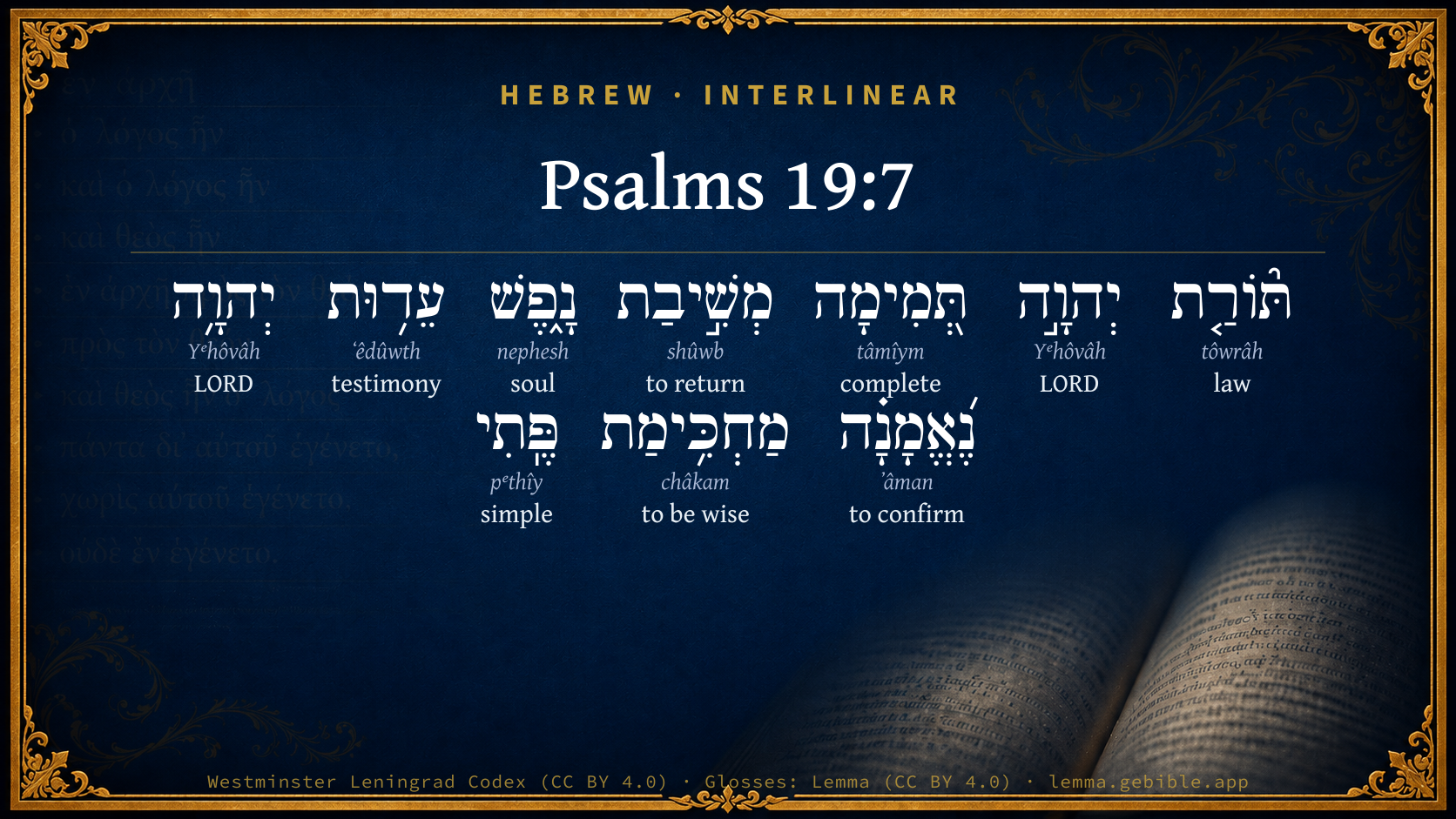
Psalms 19:7

Hebrew (Westminster Leningrad Codex) Psalms 19:7 appears in the Hebrew Old Testament. The text above is from the Westminster Leningrad Codex. Each word links to its Strong’s number, a concise gloss, and parsing drawn from the Open Scriptures Hebrew Bible morphology. Click any word for its full Brown-Driver-Briggs (BDB) entry.
Download image
Cite this verse

Psalms 19:7 (World English Bible). Public Domain. Lemma interlinear Bible study tool, https://lemma.gebible.app/v/psalms/19/7.

Show BibTeX & RIS
BibTeX
RIS
English Translation
Yahweh's law is perfect, restoring the soul. Yahweh's testimony is sure, making wise the simple.
World English Bible · Public Domain
Highlights
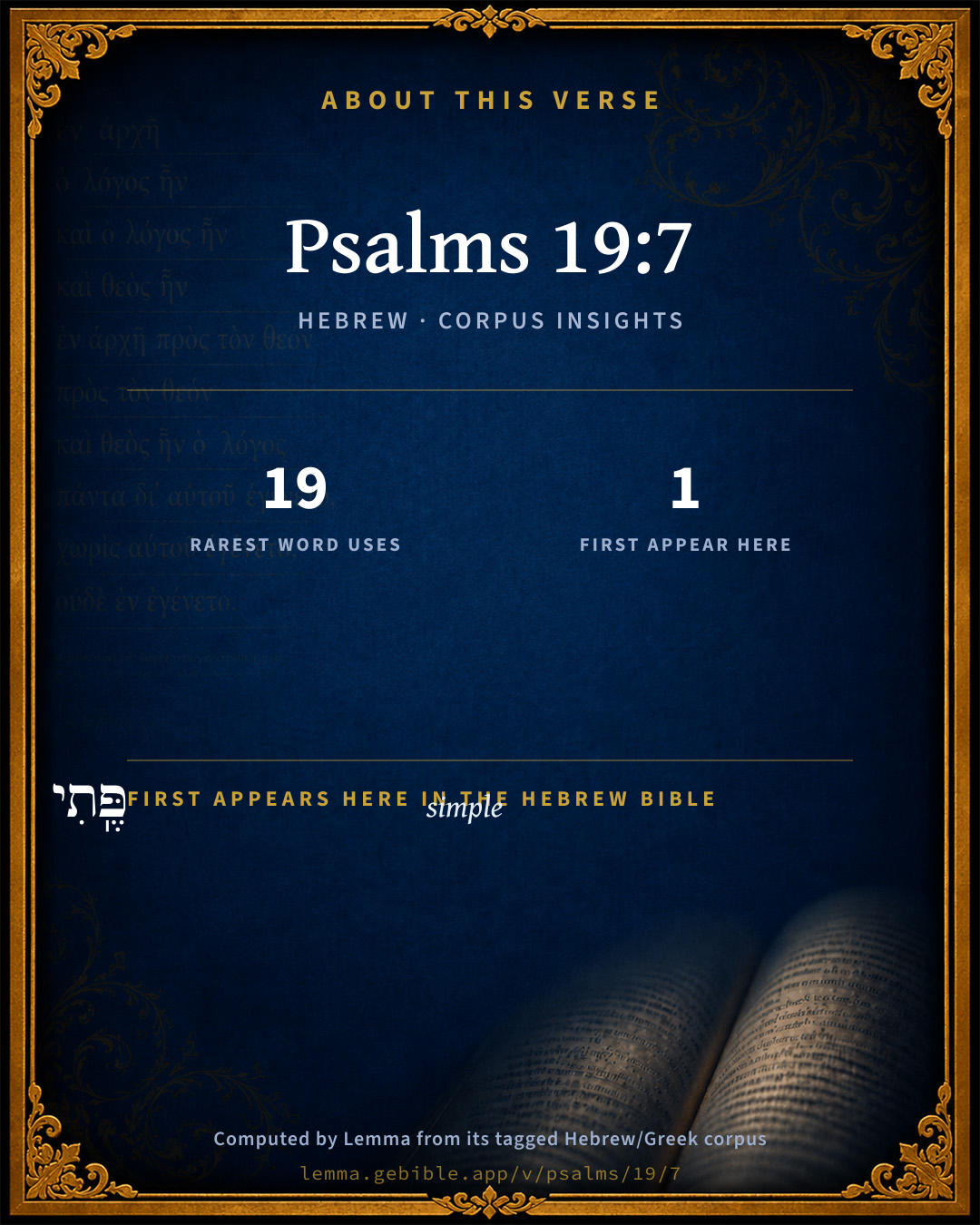
  • 1 first appearance in the Hebrew Bible
Full analysis ↓
Download a study sheet

One document with this verse’s original text, its word-by-word gloss line, the meaning frame, cross-references with their text, attributed commentary, and full source and license credits — printable, and it pastes into notes with its structure intact.

This verse Autodidact and up

Study sheet (.html) Plain text (.txt)

A passage Seminary Student

Up to 50 verses in one chapter. A passage sheet keeps up to 6 commentary sources and 12 cross-references per verse, in the order this page ranks them, and says so on the sheet whenever that leaves anything out. Ask for a single verse and you get the Autodidact verse sheet above.

Everything on this page stays free to read, with no account — the sheet is a download of what is already on screen, not access to it.

Want to remove ads? Support Godless Engineer
Compare translations 3

The same verse in 3 English versions, stacked beneath the original-language interlinear above. Click any original word for its lexicon entry.

Each is an independent rendering of the whole verse — the interlinear is not word-aligned to these translations.

Highlighted words mark where these versions differ — a whole-verse word diff, not a word-by-word alignment.

  • World English Bible Public Domain
    Yahweh's law is perfect, restoring the soul. Yahweh's testimony is sure, making wise the simple.
  • King James Version Public Domain
    The law of the LORD is perfect, converting the soul: the testimony of the LORD is sure, making wise the simple.
  • unfoldingWord Literal Text CC BY-SA 4.0
    The law of Yahweh is perfect, restoring the soul; the testimony of Yahweh is sure, making wise the simple.

unfoldingWord Literal Text — © unfoldingWord, licensed CC BY-SA 4.0. Word-aligned USFM3 via Door43 (git.door43.org/unfoldingWord/en_ult).

Versions to compare (up to 4)

3 of 4 selected

Show all 18 translations

Every available English version of this verse, each an independent rendering of the whole verse.

  • World English Bible Public Domain
    Yahweh's law is perfect, restoring the soul. Yahweh's testimony is sure, making wise the simple.
  • Berean Standard Bible Public Domain
    The Law of the LORD is perfect, reviving the soul; the testimony of the LORD is trustworthy, making wise the simple.
  • Majority Standard Bible Public Domain
    The Law of the LORD is perfect, reviving the soul; the testimony of the LORD is trustworthy, making wise the simple.
  • King James Version Public Domain
    The law of the LORD is perfect, converting the soul: the testimony of the LORD is sure, making wise the simple.
  • American Standard Version (1901) Public Domain
    The law of Jehovah is perfect, restoring the soul: The testimony of Jehovah is sure, making wise the simple.
  • Revised Version (1885) Public Domain
    The law of the LORD is perfect, restoring the soul: the testimony of the LORD is sure, making wise the simple.
  • Geneva Bible (1599) Public Domain
    The Lawe of the Lord is perfite, conuerting the soule: the testimonie of the Lord is sure, and giueth wisedome vnto the simple.
  • Douay-Rheims (1899) Public Domain
    His going out is from the end of heaven, And his circuit even to the end thereof: and there is no one that can hide himself from his heat.
  • Young's Literal Translation Public Domain
    The law of Jehovah `is' perfect, refreshing the soul, The testimonies of Jehovah `are' stedfast, Making wise the simple,
  • Literal Standard Version CC BY-SA 4.0
    The law of YHWH [is] perfect, refreshing the soul, || The testimonies of YHWH [are] steadfast, || Making the simple wise,
  • Unlocked Literal Bible CC BY-SA 4.0
    The law of Yahweh is perfect, restoring the soul; the testimony of Yahweh is reliable, making the simple wise.
  • unfoldingWord Literal Text CC BY-SA 4.0
    The law of Yahweh is perfect, restoring the soul; the testimony of Yahweh is sure, making wise the simple.
  • Darby Bible Public Domain
    The law of Jehovah is perfect, restoring the soul; the testimony of Jehovah is sure, making wise the simple;
  • World Messianic Bible Public Domain
    The LORD’s law is perfect, restoring the soul. The LORD’s covenant is sure, making wise the simple.
  • Webster's Bible Public Domain
    \\19:6\\His going forth is from the end of the heaven, and his circuit to the ends of it: and there is nothing hid from his heat.
  • Free Bible Version CC BY-SA 4.0
    The Lord's law is beneficial, renewing spiritual life. The Lord's teaching is trustworthy, making inexperienced people wise.
  • Bible in Basic English Public Domain
    The law of the Lord is good, giving new life to the soul: the witness of the Lord is certain, giving wisdom to the foolish.
  • JPS Tanakh (1917) Public Domain
    (19-8) The law of the LORD is perfect, restoring the soul; the testimony of the LORD is sure, making wise the simple.

Literal Standard Version (2020), Covenant Press — licensed CC BY-SA 4.0. Text via the HelloAO Bible API (eBible.org). Unlocked Literal Bible (unfoldingWord) — licensed CC BY-SA 4.0. Text via the HelloAO Bible API (eBible.org). unfoldingWord Literal Text — © unfoldingWord, licensed CC BY-SA 4.0. Word-aligned USFM3 via Door43 (git.door43.org/unfoldingWord/en_ult). Free Bible Version, Dr. Jonathan Gallagher — licensed CC BY-SA 4.0. Text via the HelloAO Bible API (eBible.org).

Word by word

More ways to search: Search by grammar → Find every occurrence → Compare this word →

Practice this passage: Drill this verse → Learn its vocabulary →

About this verse

These counts appear in no published source. They are computed here, from the morphology-tagged text and Lemma’s own curated glosses. What Lemma adds →

10
words
9
distinct lemmas
Wisdom
section

Notable vocabulary

The rarest word here is פֶּֽתִי simple H6612 — appearing just 19 times in the whole Hebrew Bible.

First appearance in Scripture

This word makes its first canonical appearance in the Hebrew Bible here:

  • פֶּֽתִי simple H6612

Shared distinctive vocabulary

פֶּֽתִי simple H6612 occurs in 18 verses of the Hebrew Bible. Also found in:

Grammatical profile

  • 3 verbs
  • 6 nouns
  • 1 adjective

Verb forms

  • מְשִׁ֣יבַת Hiphil · Participle Active
  • נֶ֝אֱמָנָ֗ה Niphal · Participle Active
  • מַחְכִּ֥ימַת Hiphil · Participle Active

Repetition

A word recurs within this verse — often emphatic in Hebrew:

  • יְהוָ֣ה LORD H3068 ×2

Hebrew & Septuagint length

In English translation the verse runs 15 words from the Hebrew and 18 from the Septuagint (LXX English) — closely comparable.

A rough comparison of the two English renderings, which tokenize alike — not a word-level alignment.

Word counts can differ between the Hebrew and the Greek without any difference in meaning — e.g. the Hebrew direct-object marker אֵת has no separate Greek word, and Greek often adds the article ὁ.

Cross-references

41

Topical passages linked to Psalms 19:7 in the Treasury of Scripture Knowledge — connected by theme and wording, ordered by reader-vote popularity; previews shown in the World English Bible.

  • Psalms 119:130 The entrance of your words gives light. It gives understanding to the simple.
  • Psalms 111:7 The works of his hands are truth and justice. All his precepts are sure.
  • Colossians 3:16 Let the word of Christ dwell in you richly; in all wisdom teaching and admonishing one another with psalms, hymns, and spiritual songs, singing with grace in your heart to the Lord.
  • Proverbs 1:4 To give prudence to the simple, Knowledge and discretion to the young man:
  • Psalms 23:3 He restores my soul. He guides me in the paths of righteousness for his name's sake.
  • 2 Timothy 3:15–17 From infancy, you have known the sacred writings which are able to make you wise for salvation through faith, which is in Christ Jesus.
  • Psalms 119:105 Your word is a lamp to my feet, And a light for my path.
  • Deuteronomy 32:4 The Rock, his work is perfect; For all his ways are justice: A God of faithfulness and without iniquity, Just and right is he.
  • 2 Timothy 2:19 However God's firm foundation stands, having this seal, "The Lord knows those who are his," and, "Let every one who names the name of the Lord depart from unrighteousness."
  • Psalms 93:5 Your statutes stand firm. Holiness adorns your house, Yahweh, forevermore.
  • Psalms 119:127–128 Therefore I love your commandments more than gold, Yes, more than pure gold.
  • Joshua 1:8 This book of the law shall not depart out of your mouth, but you shall meditate thereon day and night, that you may observe to do according to all that is written therein: for then you shall make your way prosperous, and then you shall have good success.
  • Isaiah 8:20 To the law and to the testimony! if they don't speak according to this word, surely there is no morning for them.
  • 2 Timothy 1:8 Therefore don't be ashamed of the testimony of our Lord, nor of me his prisoner; but endure hardship for the Gospel according to the power of God,
  • James 1:21–25 Therefore, putting away all filthiness and overflowing of wickedness, receive with humility the implanted word, which is able to save your souls.
  • Romans 15:4 For whatever things were written before were written for our learning, that through patience and through encouragement of the Scriptures we might have hope.
  • Psalms 119:111 I have taken your testimonies as a heritage forever, For they are the joy of my heart.
  • James 1:17 Every good gift and every perfect gift is from above, coming down from the Father of lights, with whom can be no variation, nor turning shadow.
  • Psalms 18:30 As for God, his way is perfect. The word of Yahweh is tried. He is a shield to all those who take refuge in him.
  • Psalms 119:72 The law of your mouth is better to me than thousands of pieces of gold and silver.
  • Acts 10:43 All the prophets testify about him, that through his name everyone who believes in him will receive remission of sins."
  • Job 23:12 I haven't gone back from the commandment of his lips. I have treasured up the words of his mouth more than my necessary food.
  • Proverbs 1:22–23 "How long, you simple ones, will you love simplicity? How long will mockers delight themselves in mockery, And fools hate knowledge?
  • Psalms 119:24 Indeed your statutes are my delight, And my counselors.
  • Romans 12:2 Don't be conformed to this world, but be transformed by the renewing of your mind, so that you may prove what is the good, well-pleasing, and perfect will of God.
  • 1 John 5:9–12 If we receive the witness of men, the witness of God is greater; for this is God's testimony which he has testified concerning his Son.
  • Deuteronomy 6:6–9 These words, which I command you this day, shall be on your heart;
  • Psalms 119:14 I have rejoiced in the way of your testimonies, As much as in all riches.
  • Psalms 119:96–100 I have seen a limit to all perfection, But your commands are boundless.
  • 2 Samuel 23:5 Most assuredly my house is not so with God; Yet he has made with me an everlasting covenant, Ordered in all things, and sure: For it is all my salvation, and all [my] desire, Although he doesn't make it grow.
  • Psalms 119:9 How can a young man keep his way pure? By living according to your word.
  • Psalms 119:152 Of old I have known from your testimonies, That you have founded them forever.
  • Isaiah 8:16 Bind up the testimony, seal the law among my disciples.
  • John 5:39 "You search the Scriptures, because you think that in them you have eternal life; and these are they which testify about me.
  • Deuteronomy 17:18–20 It shall be, when he sits on the throne of his kingdom, that he shall write him a copy of this law in a book, out of [that which is] before the priests the Levites:
  • Psalms 78:1–7 Hear my law, my people. Turn your ears to the words of my mouth.
  • Revelation 19:10 I fell down before his feet to worship him. He said to me, "Look! Don't do it! I am a fellow bondservant with you and with your brothers who hold the testimony of Jesus. Worship God, for the testimony of Jesus is the Spirit of Prophecy."
  • John 3:32–33 What he has seen and heard, of that he testifies; and no one receives his witness.
  • Psalms 147:19–20 He shows his word to Jacob; His statutes and his ordinances to Israel.
  • Hebrews 6:18–19 that by two immutable things, in which it is impossible for God to lie, we may have a strong encouragement, who have fled for refuge to take hold of the hope set before us.
  • Romans 3:2 Much in every way! Because first of all, they were entrusted with the oracles of God.

Cross-references courtesy of OpenBible.info (CC BY 4.0).

Hebrew and Greek witnesses Masoretic Hebrew ↔ Greek Septuagint

The same verse in the two great witnesses to the Old Testament, shown verse-for-verse.

You’re reading Greek Psalm 18 (Hebrew Psalm 19). The Septuagint counts the superscription, so verse numbers can differ from the Hebrew — chapter-level alignment, not verse-by-verse. Numbering follows Rahlfs.

These are two independent witnesses, not word-aligned to each other, and the Septuagint is shown in lemma (dictionary) form.

Hebrew Psalms 19:7 Masoretic · Westminster Leningrad Codex

תּ֘וֹרַ֤ת יְהוָ֣ה תְּ֭מִימָה מְשִׁ֣יבַת נָ֑פֶשׁ עֵד֥וּת יְהוָ֥ה נֶ֝אֱמָנָ֗ה מַחְכִּ֥ימַת פֶּֽתִי

Yahweh's law is perfect, restoring the soul. Yahweh's testimony is sure, making wise the simple.

World English Bible · Public Domain

Greek LXX Greek Psalm 18:7 Septuagint · lemma form

ἀπό ἄκρος ὁ οὐρανός ὁ ἔξοδος αὐτός καί ὁ κατάντημα αὐτός ἕως ἄκρος ὁ οὐρανός καί οὐ εἰμί ὅς ἀποκρύπτω ὁ θερμός αὐτός

The law of the Lord is perfect, converting souls: the testimony of the Lord is faithful, instructing babes.

LXX2012 (modern English Septuagint) · Public Domain

On this verse, Whedon's Commentary on the Bible discusses the Septuagint’s reading. Read the note in Commentary ↓

Hebrew: Westminster Leningrad Codex (CC BY 4.0). Greek: Septuagint (public domain); English from LXX2012 (modern English Septuagint) (Public Domain). How the Septuagint differs from the Hebrew →

Commentary

Notes on Psalms 19:7 from classic Christian and Jewish commentators (each source and its license shown beneath its notes). The classic Christian expositions comment on the surrounding passage and are grouped to its opening verse, so a note may address several verses; the Jewish commentaries on the Tanakh (Rashi and others) are per-verse, so they appear only where the commentator wrote on this verse.

Lemma curates 59 commentaries, every one of them public domain or Creative Commons licensed, each selected and text-cleaned for this edition rather than reprinted as found. About our sources →

Matthew Henry's Commentary

God's glory, (that is, his goodness to man) appears much in the works of creation, but much more in and by divine revelation. The holy scripture, as it is a rule both of our duty to God and of our expectation from him, is of much greater use and benefit to us than day or night, than the air we breathe in, or the light of the sun. The discoveries made of God by his works might have served if man had retained his integrity; but, to recover him out of his fallen state, another course must be taken; that must be done by the word of God. And here,

1. The psalmist gives an account of the excellent properties and uses of the word of God, in six sentences (Psa 19:7-9), in each of which the name Jehovah is repeated, and no vain repetition, for the law has its authority and all its excellency from the law-maker. Here are six several titles of the word of God, to take in the whole of divine revelation, precepts and promises, and especially the gospel. Here are several good properties of it, which proves its divine original, which recommend it to our affection, and which extol it above all other laws whatsoever. Here are several good effects of the law upon the minds of men, which show what it is designed for, what use we are to make of it, and how wonderful the efficacy of divine grace is, going along with it, and working by it. 1. The law of the Lord is perfect. It is perfectly free from all corruption, perfectly filled with all good, and perfectly fitted for the end for which it is designed; and it will make the man of God perfect, Ti2 3:17. Nothing is to be added to it nor taken from it. It is of use to convert the soul, to bring us back to ourselves, to our God, to our duty; for it shows us our sinfulness and misery in our departures from God and the indispensable necessity of our return to him. 2. The testimony of the Lord (which witnesses for him to us) is sure, incontestably and inviolably sure, what we may give credit to, may rely upon, and may be confident it will not deceive us. It is a sure discovery of the divine truth, a sure direction in the way of duty. It is a sure foundation of living comforts and a sure foundation of lasting hopes. It is of use to make us wise, wise to salvation, Ti2 3:15. It will give us an insight into things divine and a foresight of things to come. It will employ us in the best work and secure to us our true interests. It will make even the simple (poor contrivers as they may be for the present world) wise for their souls and eternity. Those that are humbly simple, sensible of their own folly and willing to be taught, shall be made wise by the word of God, Psa 25:9. 3. The statutes of the Lord (enacted by his authority, and binding on all wherever they come) are right, exactly agreeing with the eternal rules and principles of good and evil, that is, with the right reason of man and the right counsels of God. All God's precepts, concerning all things, are right (Psa 119:128), just as they should be; and they will set us to rights if we receive them and submit to them; and, because they are right, they rejoice the heart. The law, as we see it in the hands of Christ, gives cause for joy; and, when it is written in our hearts, it lays a foundation for everlasting joy, by restoring us to our right mind. 4. The commandment of the Lord is pure; it is clear, without darkness; it is clean, without dross and defilement. It is itself purified from all alloy, and is purifying to those that receive and embrace it. It is the ordinary means which the Spirit uses in enlightening the eyes; it brings us to a sight and sense of our sin and misery, and directs us in the way of duty. 5. The fear of the Lord (true religion and godliness prescribed in the word, reigning in the heart, and practised in the life) is clean, clean itself, and will make us clean (Joh 15:3); it will cleanse our way, Psa 119:9. And it endureth for ever; it is of perpetual obligation and can never be repealed. The ceremonial law is long since done away, but the law concerning the fear of God is ever the same. Time will not alter the nature of moral good and evil. 6. The judgments of the Lord (all his precepts, which are framed in infinite wisdom) are true; they are grounded upon the most sacred and unquestionable truths; they are righteous, all consonant to natural equity; and they are so altogether: there is no unrighteousness in any of them, but they are all of a piece.

II. He expresses the great value he had for the word of God, and the great advantage he had, and hoped to have, from it, Psa 19:10, Psa 19:11.

1. See how highly he prized the commandments of God. It is the character of all good people that they prefer their religion and the word of God, (1.) Far before all the wealth of the world. It is more desirable than gold, than fine gold, than much fine gold. Gold is of the earth, earthly; but grace is the image of the heavenly. Gold is only for the body and the concerns of time; but grace is for the soul and the concerns of eternity. (2.) Far before all pleasures and delights of sense. The word of God, received by faith, is sweet to the soul, sweeter than honey and the honey comb. The pleasures of sense are the delight of brutes, and therefore debase the great soul of man; the pleasures of religion are the delight of angels, and exalt the soul. The pleasures of sense are deceitful, will soon surfeit, and yet never satisfy; but those of religion are substantial and satisfying, and there is no danger of exceeding in them.

2. See what use he made of the precepts of God's word: By them is thy servant warned. The word of God is a word of warning to the children of men; it warns us of the duty we are to do, the dangers we are to avoid, and the deluge we are to prepare for, Eze 3:17; Eze 33:7. It warns the wicked not to go on in his wicked way, and warns the righteous not to turn from his good way. All that are indeed God's servants take this warning.

3. See what advantage he promised himself by his obedience to God's precepts: In keeping them there is great reward. Those who make conscience of their duty will not only be no losers by it, but unspeakable gainers. There is a reward, not only after keeping, but in keeping, God's commandments, a present great reward of obedience. Religion is health and honour; it is peace and pleasure; it will make our comforts sweet and our crosses easy, life truly valuable and death itself truly desirable.

III. He draws some good inferences from this pious meditation upon the excellency of the word of God. Such thoughts as these should excite in us devout affections, and they are to good purpose.

1. He takes occasion hence to make a penitent reflection upon his sins; for by the law is the knowledge of sin. "Is the commandment thus holy, just, and good? Then who can understand his errors? I cannot, whoever can." From the rectitude of the divine law he learns to call his sins his errors. If the commandment be true and righteous, every transgressions of the commandment is an error, as grounded upon a mistake; every wicked practice takes rise from some corrupt principle; it is a deviation from the rule we are to work by, the way we are to walk in. From the extent, the strictness, and spiritual nature, of the divine law he learns that his sins are so many that he cannot understand the number of them, and so exceedingly sinful that he cannot understand the heinousness and malignity of them. We are guilty of many sins which, through our carelessness and partiality to ourselves, we are not aware of; many we have been guilty of which we have forgotten; so that, when we have been ever so particular in the confession of sin, we must conclude with an et cetera - and such like; for God knows a great deal more evil of us than we do of ourselves. In many things we all offend, and who can tell how often he offends? It is well that we are under grace, and not under the law, else we were undone.

2. He takes occasion hence to pray against sin. All the discoveries of sin made to us by the law should drive us to the throne of grace, there to pray, as David does here, (1.) For mercy to pardon. Finding himself unable to specify all the particulars of his transgressions, he cries out, Lord, cleanse me from my secret faults; not secret to God, so none are, nor only such as were secret to the world, but such as were hidden from his own observation of himself. The best of men have reason to suspect themselves guilty of many secret faults, and to pray to God to cleanse them from that guilt and not to lay it to their charge; for even our sins of infirmity and inadvertency, and our secret sins, would be our ruin if God should deal with us according to the desert of them. Even secret faults are defiling, and render us unfit for communion with God; but, when they are pardoned, we are cleansed from them, Jo1 1:7. (2.) For grace to help in time of need. Having prayed that his sins of infirmity might be pardoned, he prays that presumptuous sins might be prevented, Psa 19:13. All that truly repent of their sins, and have them pardoned, are in care not to relapse into sin, nor to return again to folly, as appears by their prayers, which concur with David's here, where observe, [1.] His petition: "Keep me from ever being guilty of a wilful presumptuous sin." We ought to pray that we may be kept from sins of infirmity, but especially from presumptuous sins, which most offend God and wound conscience, which wither our comforts and shock our hopes. "However, let none such have dominion over me, let me not be at the command of any such sin, nor be enslaved by it." [2.] His plea: "So shall I be upright; I shall appear upright; I shall preserve the evidence and comfort of my uprightness; and I shall be innocent from the great transgression;" so he calls a presumptuous sin, because no sacrifice was accepted for it, Num 15:28-30. Note, First, Presumptuous sins are very heinous and dangerous. those that sin against the habitual convictions and actual admonitions of their consciences, in contempt and defiance of the law and its sanctions, that sin with a high hand, sin presumptuously, and it is a great transgression. Secondly, Even good men ought to be jealous of themselves, and afraid of sinning presumptuously, yea, though through the grace of God they have hitherto been kept from them. Let none be high-minded, but fear. Thirdly, Being so much exposed, we have great need to pray to God, when we are pushing forward towards a presumptuous sin, to keep us back from it, either by his providence preventing the temptation or by his grace giving us victory over it.

3. He takes occasion humbly to beg the divine acceptance of those his pious thoughts and affections, Psa 19:14. Observe the connexion of this with what goes before. He prays to God to keep him from sin, and then begs he would accept his performances; for, if we favour our sins, we cannot expect God should favour us or our services, Psa 66:18. Observe, (1.) What his services were - the words of his mouth and the meditations of his heart, his holy affections offered up to God. The pious meditations of the heart must not be smothered, but expressed in the words of our mouth, for God's glory and the edification of others; and the words of our mouth in prayer and praise must not be formal, but arising from the meditation of the heart, Psa 45:1. (2.) What was his care concerning these services - that they might be acceptable with God; for, if our services be not acceptable to God, what do they avail us? Gracious souls must have all they aim at if they be accepted of God, for that is their bliss. (3.) What encouragement he had to hope for this, because God was his strength and his redeemer. If we seek assistance from God as our strength in our religious duties, we may hope to find acceptance with God in the discharge of our duties; for by his strength we have power with him.

In singing this we should get our hearts much affected with the excellency of the word of God and delivered into it, we should be much affected with the evil of sin, the danger we are in of it and the danger we are in by it, and we should fetch in help from heaven against it.

Matthew Henry's Commentary on the Whole Bible (1708–1710) — public domain (CC PDM 1.0). Text via the HelloAO Bible API.

Ellicott's Commentary for English Readers

(7) The law.—The ear catches even in the English the change of rhythm, which is as marked as the change of subject. Instead of the free lyric movement of the preceding verse, we come suddenly upon the most finished specimen of didactic poetry in regular metre, exhibiting a perfect balance of expression as well as of thought, so perfect in the original, that in Psa_19:7-9 the number of words is the same in each clause. In each clause, too, the Law, under one or another of its many names and aspects, is praised, first for its essential character, then for its results.

The law . . . . the testimony.—These are collective terms embracing, under different regards, the whole body of statutes and precepts in the Jewish code. The law, tôrah, means in its primary use “instruction,” and therefore is used of prophecy (Isa_1:10; Isa_8:16), but here undoubtedly bears its common and more limited sense. Testimony, from a root meaning “to repeat,” suggests the solemn earnestness and insistence of the Divine commands.

The description “perfect” and “sure” suggests the lofty ideal prescribed by the Law, and the reliance which the Hebrew might place upon it as a rule of conduct. The word “simple” is generally used in a bad sense, but here has its primary meaning, “open,” “ingenuous,” “impressible,” easily led either towards folly or wisdom.

A Bible Commentary for English Readers, edited by Charles John Ellicott (1878–1897) — public domain. Text from a community e-Sword module.

The Cambridge Bible for Schools and Colleges

gen. ed. J. J. S. Perowne

7. The law of the Lord] Instruction, teaching, doctrine, are the ideas connected with the word torah, rendered law. See on Psa_1:2. Like Jehovah’s work (Deu_32:4), and His way (Psa_18:30), it is perfect, complete, flawless; without defect or error; a guide which can neither mislead nor fail. Observe that the name Jehovah now takes the place of God (Psa_19:1); for we have entered the sphere of the special revelation to Israel.

converting the soul] Rather, as R.V., restoring the soul; refreshing and invigorating man’s true self (cp. Psa_23:3); like food to the hungry (Lam_1:11; Lam_1:19); like comfort to the sorrowful and afflicted (Lam_1:16; Rth_4:15).

the testimony] The ‘law,’ regarded as bearing witness to Jehovah’s will, and man’s duty (Exo_25:16; Exo_25:21). It is sure, not variable or uncertain. Cp. Psa_93:5, Psa_111:7.

the simple] A character often mentioned in Proverbs (Pro_1:4, &c.): the man whose mind is open to the entrance of good or evil. He has not closed his heart against instruction, but he has no fixed principle to repel temptation. He needs to be made wise. Cp. Psa_119:130; 2Ti_3:15.

7–11. Yet more wonderful than this declaration of God’s glory, more beneficent than the sun’s life-giving light and heat, is Jehovah’s revelation of His will, which quickens and educates man’s moral nature. Its essential characteristics and its beneficent influences are described with an enthusiastic and loving admiration.

Note the peculiar rhythm of Psa_19:7-9, in which each line is divided by a well-marked caesura. Cp. Lam_1:1 ff. See Introd. p. lx.

The Cambridge Bible for Schools and Colleges (gen. ed. J. J. S. Perowne; Cambridge University Press, 1878–1918) — public domain. Text from a community e-Sword module.

Trapp's Complete Commentary

John Trapp

Psa 19:7 The law of the LORD [is] perfect, converting the soul: the testimony of the LORD [is] sure, making wise the simple.

Ver. 7. The law of the Lord is perfect] Or, doctrine; the whole word of God, commonly distinguished into law and gospel, is perfect, immaculate, sincere, entire, complete. If Cicero dared to say, that the law of the twelve tables in Rome did exceed all the libraries of philosophers, both in weight of authority and fruitfulness of matter, how much rather is this true of God’s law! saith a learned writer. Nothing may be added to it without marring it, Pro 30:6. Note this against Jewish, Popish, and Turkish traditions and additions; as also against anti-scripturists, and who at first rejected all books but the Bible, and after that grew so wise as to be religious enough without that also. And last of all they came to blaspheme that blessed book, as a dead letter, and a beggarly element, &c.; when as the apostle telleth us, that all Scripture is pure, precious, and profitable for doctrine, for reproof, &c., that the man of God may be perfect, &c., 2Ti 3:16-17. Here in this and the two following verses it is easy to observe - 1. That every one of them are in the Hebrew written with ten words. 2. That here is a sixfold commendation of God’s holy word. (l.) By the several names thereunto given, law, testimony, statutes, &c (2.) By the nature, perfect, sure, right, &c. (3.) By the effects, converting the soul, making wise the simple, &c.

Converting the soul] This no doctrine besides can do. Integra est doctrina, ae proinde animos redintegrat. Plato went thrice to Sicily to convert Dionysius the tyrant, but could not. Ambrose saith well of Polemo, who of a drunkard, by hearing Xenocrates, became a philosopher, Si resipuit a vino, fuit semper tamen temulentus sacrilegio, If he gave over his drunkenness, yet he continued still drunk with superstition. Seneca the philosopher wrote a book (now lost) against superstitions, but yet lived and died in them; Colebat quod reprohendebat, agebat quod arguebat, quod culpabat adorabat, saith Austin of him, he exercised what he condemned, and would not leave what he did so utterly dislike. But the word works a transmentation, an entire change of the mind and manners, a new creation, 2Co 5:17.

The testimony of the Lord is sure] These words are faithful and true, Rev 22:6, they are all in righteousness, neither is there in them anything perverse or froward, Pro 8:8. Testimonies they are called, 1. Because they testify (as a record) to all ages what the will of the Lord is, Joh 5:39 2. They were given with great contestation, and pressing of all men to keep them. 3. They will be a witness against all such as do not. The gospel also is called a testimony, 1Co 2:1 2Th 1:10 Isa 8:20.

Making wise the simple] That is, the humble, teachable, and such as are not puffed up with a conceit of their own wisdom, 1Co 7:18, the very entrance into God’s word giveth light, it giveth understanding to the simple, or to the persuadable, Psa 119:130. It is reasonable milk, 1Pe 2:2.

John Trapp, A Commentary or Exposition upon All the Books of the Old and New Testament (1647–1656) — public domain. Text from a community e-Sword module.

Albert Barnes' Notes on the Bible

The law of the Lord - Margin, doctrine. The word used here - תורה tôrâh - is that which is commonly employed in the Old Testament with reference to the law of God, and is usually rendered “law.” The word properly means “instruction,” “precept,” from a verb signifying “to teach.” It is then used with reference to instruction or teaching in regard to conduct, and is thus applied to all that God has communicated to guide mankind. It does not here, nor does it commonly, refer exclusively to the commands of God, but it includes all that God has revealed to teach and guide us. It refers here to revealed truth as contradistinguished from the truth made known by the works of creation. Compare the note at Psa 1:2. There are six epithets used in these verses Psa 19:7-9 to describe the revealed truth of God, all referring to the same truths, but with reference to some distinct view of the truths themselves, or of their effect on the soul: to wit, law, testimony, statutes, commandment, fear, and judgments. Of the revealed truth of God, thus characterized by distinct epithets, a particular statement is first made in each case in regard to the truth itself as viewed in that special aspect, and then the effects of that revealed truth on the soul are described corresponding with that truth as so viewed. Thus, of the “law of the Lord” it is said:

(a) that it is perfect,

(b) that it converts the soul;

Of the “testimony of the Lord”:

(a) that it is sure,

(b) that it makes the simple wise;

Of the “statutes of the Lord”:

(a) that they are right,

(b) that they rejoice the heart;

Of the “commandment of the Lord”:

(a) that it is pure,

(b) that it enlightens the eyes;

Of the “fear of the Lord”:

(a) that it is clean,

(b) that it endures forever;

Of the “judgments of the Lord”:

(a) that they are true and righteous,

(b) that they are more to be desired than gold, and that they are sweeter than honey and the honeycomb; that people are warned by them, and that in keeping them there is great reward.

Is perfect - On the meaning of the word used here, see the note at Job 1:1. The meaning is that it lacks nothing in order to its completeness; nothing in order that it might be what it should be. It is complete as a revelation of divine truth; it is complete as a rule of conduct. As explained above, this refers not only to the law of God as the word is commonly employed now, but to the whole of divine truth as revealed. It is absolutely true; it is adapted with consummate wisdom to the wants of man; it is an unerring guide of conduct. There is nothing there which would lead men into error or sin; there is nothing essential for man to know which may not be found there.

Converting the soul - The particular illustration of the perfection of the law is seen in the fact that it “converts the soul;” that is, that it turns it from the ways of sin to holiness. The glory of the works of God - the heavens, the firmament, the sun, as described in the previous verses - is, that they convey the knowledge of God around the world, and that the world is filled with light and life under the genial warmth of the sun; the glory of the law, or the revealed truth of God, is, that it bears directly on the soul of man, turning him from the error of his ways. and leading him to pursue a life of holiness. It is not said of the “law” of God that it does this by its own power, nor can there be any design here to exclude the doctrine of the divine agency on the soul; but the statement is, that when the “law” of God is applied to the heart, or when the truth of God is made to bear on that heart, the legitimate effect is seen in turning the sinner from the error of his ways. This effect of truth is seen everywhere, where it is brought into contact with the heart of man. By placing this first, also, the psalmist may perhaps have intended to intimate that this is the primary design of the revelation which God has given to mankind; that while great and important effects are produced by the knowledge which goes forth from the works of God, converting power goes forth only from the “law” of God, or from revealed truth. It is observable that none of the effects here Psa 19:7-12 ascribed to the revealed truth of God, under the various forms in which it is contemplated, are ascribed to the knowledge which goes forth from the contemplation of his works, Psa 19:1-6. It is not scientific truth which converts men, but revealed truth.

The testimony of the Lord - The word used here - עדות ‛êdûth - means properly that which is borne witness to, and is applied to revealed truth as that which God bears witness to. In reference to the truth of what is stated he is the witness or the voucher; it is that which he declares to be true. Hence, the term is applicable to all that is revealed as being that which he affirms to be true, and the word may be applied to historical truths; or to precepts or laws; or to statements respecting himself, respecting man, respecting the way of salvation, respecting the fallen world. On all these subjects he has borne witness in his word, pledging his veracity as to the correctness of the statements which are thus made. The word, therefore, refers to the whole of what is revealed in his word, considered as that to the truth of which he bears witness. The word is often used in this sense: Psa 81:5; Psa 119:14, Psa 119:31, Psa 119:36, Psa 119:88, Psa 119:99,Psa 119:111, Psa 119:129, Psa 119:144, Psa 119:157; Jer 44:23. It is often also applied to the two tables of the law laid up in the ark, which is hence called “the ark of the testimony:” Exo 16:34; Exo 25:16, Exo 25:21-22; Exo 26:33; Exo 30:26, et saepe.

Is sure - Established, firm. That “testimony,” or that revealed truth, is not unsettled, vacillating, uncertain. It is so certain that it may be relied on; so well established, that it cannot be shaken.

Making wise the simple - The word rendered simple - פתי pethı̂y - means simplicity, folly, Pro 1:22; and then, simple in the sense of being open to persuasion, easily seduced: Pro 7:7; Pro 22:3; Pro 27:12; Psa 116:6. Then it means credulous, Pro 14:15; and inexperienced, Psa 19:7. Gesenius, Lexicon. The meaning here is evidently inexperienced in the sense of being ignorant or untaught. It refers to those who need spiritual guidance and direction, and is applicable to men as they are by nature, as untaught, or needing instruction, but with the idea that their minds are susceptible to impressions, or are open to conviction. Those who are naturally destitute of wisdom, it makes wise. The statement is, that that testimony, or revealed truth, makes them wise in the knowledge of God, or imparts to them real instruction.

Albert Barnes' Notes on the Bible (1834–1885) — public domain. Text from a community e-Sword/MySword module.

The Biblical Illustrator

Joseph S. Exell

Psa_19:7

The law of the Lord is perfect.

The best book

I would not have you forget the true and proper mission of the Bible,--to reveal saving truth. But it is well to remember that, even as a classic, no book equals the Word of God. The Bible has exercised a remarkable influence in the department of literature. The English tongue would lose its grandest monument if the works which the Bible has inspired were blotted from it. Religious books, of course, get everything from the Bible; but writers with no distinctly religious object are enormously beholden to its inspiration. There is not a notable book--a book of transcendent genius or power--which has not culled from the Word of God either thought or illustration or telling phrase. We need not, even in an age of advanced education and culture, be ashamed of the Bible. Its study will confer as much credit on our intellect as on our piety. We are not such Bible readers as were our fathers. This is one evil of the multiplication of books. In this generation we are better educated, we know more than our fathers. But have we the same robust and vigorous intellects? It seems to me that there is a deterioration in this respect along with our neglect of Bible study. There are three things which should make the Bible popular among young people--

1. Its fervid style. There is not a dull passage, if we except a few chronologies and such like, from Genesis to Revelation.

2. Its exuberance of illustration. It is a book of pictures.

3. Its practical wisdom. If you live seventy years you will not have gathered all the practical wisdom you may learn now from studying the Bible. Do not forget that you may find in the Bible eternal life. (A. F. Forrest.)

The Bible a book for all nations

Of what is not the Bible the foundation and the inspiration? To what interest of human life does it not give its great benediction? The system of doctrine and duty which the Bible contains is a fixed final system, not a progressive one, and one introductory to a higher, and the Bible will never become obsolete, and will never be supplemented by any other revelation. This proposition has been most flatly contradicted. It is argued that the Bible has accomplished a very good purpose in the world, but it cannot long satisfy the worlds need, because it does not keep pace with the worlds progress. By and by we shall need a broader basis on which to construct the religion of the future. A time, it is said, must come when the theological will be too narrow in its range for the demands of the race, and too dogmatic in its tone for the more liberal, general, comprehensive religion of the future. We are invited to mark the universality of this beautiful law of progressive development in nature, in literature, in the fine and in the useful arts, in human laws and institutions. But those who reason thus overlook the distinction between the apparent and the real progress of man. The true progress of man is the progress of mails self, apart from all organisation. Those who eulogise modern progress confine their attention to what man does to promote his convenience and comfort. How absurd it is to mark the progress of a man by that which a man manipulates and moulds and makes subservient to his use! The Bible is the book for the soul, and God put into it exactly those truths that He knew were calculated to regenerate the soul. Unless the soul needs to be made over, and given new facilities, you do not want a new Bible, or any annex to the old one. There is another great distinction to keep in mind. While the Bible is fixed and will never be supplemented, the principles contained in it are admissible of universal and of endless application, and for that reason the Bible will never need to be supplemented. It is with the Bible as it is with nature. No new laws have been given to nature from the beginning. And yet how constantly are men discovering laws that for long ages were hidden from human eyes: and men of science will tell you that there are now many latent forces in nature awaiting the genius of the occasion when they shall be discovered and applied to the use of man. What the world wants is not a new Bible, or new principles, or new truths, but the recognition of the old, and the legitimate application of the old to the purposes for which they were intended. So when new forms of old errors arise, we do not want a new Bible to find new truths with which to antagonise these old errors. The fact is, there are no new forms of scepticism. We do not need any other Bible, or a supplement to the old, because the Bible is a book that has a friendly voice and a helping hand to every race. Here is a book equally adapted to the Oriental and the Occidental mind; adapted alike to the Mongolian and the Circassian mind; adapted to all the different divisions into which society is divided. The Bible is sufficient for the worlds need, because it goes down to the very foundation of mans mental and moral structure, and takes hold of that which is sinful in his souls life. As long as sin and sorrow are in the world, so long will this book take hold of that which is deepest, and truest, and profoundest in the souls immortal life. And the Bible gives us a perfect ideal in the character of our blessed Saviour. Moreover, we do not need a new Bible, because we do not want any new motives to the practice of the greatest virtue. (Moses T. Hoge, D. D.)

The perfect law

The law of the Lord is the Bible phrase for describing the duty which God requires of man. This law embraces all those principles by which our inward life of disposition and desire and our outward life of word and action ought to be guided. It is an expression of the Divine will respecting human conduct. But perhaps the most correct view of the Moral Law is that contained in a sentence which has often been used in the pulpits of Scotland, the Law is a transcript of the character of God. Justice and truth and love are the very elements, so to speak, of His own moral being; they have an inherent rightness, and so, while it is true that they are right because He wills them, a deeper truth is that He wills them because they are right. In other words, while the authority of the law rests upon the Divine will, the law itself has its basis in the Divine nature. The law of the Lord is woven into the very nature of the universe. It is graven in indelible lines on the conscience of man. But we must turn to the Holy Scriptures for the fullest exhibition of the Moral Law. The Bible, however, is not a hand book of morals after the common style. We do not find in it a systematic exposition of law for national or individual life; and even those parts of it which, to some extent, have this appearance, come far short of being a full expression of the perfect law. The Mosaic economy, for example, looked at in the light of the higher attainments and the wider wants of Gospel times, is admittedly an imperfect economy on its moral as well as on its ceremonial side. No one would dream of introducing into modern law its enactments respecting (to take a case) usury or divorce. In the same way the moral lessons taught by those histories of nations and individuals of which the Bible is largely composed are often doubtful. All this impresses us with the necessity of some guiding principle to enable us to gather from the rich variety of Holy Scripture the law of God--His will for our guidance. Where, then, shall we go for this guiding and testing principle? We answer without hesitation--to Jesus Christ Himself. The chief cornerstone of the Church is also the chief cornerstone of Christian morality. He came to show us the Father, and so in Him, in His own character and conduct and teaching, we have the clearest and most authoritative revelation of the Fathers law. We cannot overestimate the value of having the law of God exhibited in a life as opposed to any statement of it in words. Ill the life of our blessed Lord, as recorded in Holy Scripture and interpreted to His followers by the Holy Spirit and by the providence of God, we have the final standard of moral theory and practice. He is the incarnate Law. Having defined what the law of the Lord is, we pass on to see wherein its perfection lies, and for one thing, it exhibits the quality of harmony. Every lover of art knows that the chief excellence of a painting lies in the consistency of its various parts and their subordination to the main design. A similar principle applies to music. What is true of beauty presented to the eye or ear holds good of truth and righteousness, the beauty which the mind only can perceive. The ultimate test of any new doctrine lies in its harmony with those Scripture sustained convictions which we have already formed. The law of the Lord has this crowning element of perfection--it is a harmonious unity whose parts never jar or clash. Of course, we are quite familiar with the objection that one precept of Holy Scripture sometimes comes into antagonism with other precepts. The obedience which a child owes to God, for example, can only be rendered sometimes by disobedience to a parent whom God has commanded the child to obey. We revert to our definition of the law, and reply that this objection confounds the law which is perfect and eternal with particular commandments which are from the nature of the case inadequate and temporary expressions of the law. The commandment may be inadequate, for it is only the verbal form in which the spiritual principle is clothed, and the letter can never exhaust or completely unfold the spirit. The commandment, moreover, may be only the temporary form of the eternal law. The Decalogue is indispensable on earth, but how many of the relations which it is intended to regulate will have ceased to exist, or be radically changed, in heaven! Thus the particular precepts of the law may be temporary, but the law of the Lord which is perfect abides in all its force wherever intelligent beings are. (D. MKinnon, M. A.)

A tribute to the law of God

The law is characterised by six names and nine epithets and by nine effects. The names are law, testimony, statutes, commandments, fear, judgments. To it are applied nine epithets, namely, perfect, sure, right, pure, holy, true, righteous, desirable, sweet. To it are ascribed nine effects, namely, it converts the soul, makes wise the simple, rejoices the heart, enlightens the eyes, endures forever, enriches like gold, satisfies like honey, warns against sin, rewards the obedient. The central thought or conception about which all gathers is that of law. There is a profound philosophy in this passage. It presents Jehovah as Lord, i.e. Law-ward, or guardian of law. We are to conceive of Gods law as--

1. A perfect rule of duty, having a basis of common law beneath all its statutory provisions, an eternal basis of essential right and wrong. Thou shalt and thou shalt not, based upon eternal principles, not upon an arbitrary will. We are to think of this fabric of law as--

2. Supported like a grand arch, upon two great pillars: reward and penalty.

The whole passage is therefore a challenge to our adoring homage and obedience.

1. The law is a perfect product of infinite wisdom and love, (Rom_7:12; Rom_7:14) holy, just, good, spiritual.

2. It is enforced by Divine sanctions of reward and penalty, and these are each equally necessary to sustain the law and government of God. The testimonies and the judgment are equally perfect. The love that rewards and the wrath that punishes are equally beautiful and perfect.

The transcendent thought of the whole passage is that obedience is a privilege.

1. Law is the voice of love, not simply of authority, therefore only love can truly fulfil.

2. Obedience is self-rewarding and disobedience self-avenging.

The general thought of this whole passage is, obedience the highest privilege.

1. The law is the expression of Divine perfection; hence leads to perfection.

2. Of the highest love; hence must be interpreted by love and fulfilled by love.

3. Of the highest bliss--key to blessing; hence the door to promises.

4. Our schoolmaster to lead us to Christ. Cannot justify, but only conduct to the obedient One who can justify. (Homiletic Monthly.)

The perfect law of God

By the law we may understand the entire written Word.

I. The character of the law. Perfect, that is, complete and entire. See the testimony--

1. Of Moses (Deu_6:6-8).

2. David, throughout the Psalms, as here in our text.

3. Jesus, the Son of God.

4. Paul (1Ti_1:8-11).

5. Peter.

II. Its effects. Converting the soul. Note what conversion is, the great spiritual change in a mans heart.

III. Practical lessons.

1. That it is not enough to have a mere intellectual acquaintance with the Word of God.

2. The vast criminality of those who would withhold the Word of God from men.

3. How dangerous and wicked to turn from it to the lying fables of deluded or designing men. (J. Allport.)

The light of nature

It was not in the material heavens, which with all their grandeur the Psalmist had been contemplating, that he found the lesson of perfection. He turned from them to the law of the Lord, and there he found it. With all that the contemplation of nature is able to do, it cannot regenerate the spirit. Neither poetry nor philosophy can help man in the great exigencies of life. None of them can do any good to a dying man. The damps of the sepulchre put out their light. Nor is this to be wondered at. The works of nature were not made to last; hence how can they teach lessons for immortality? They may serve man in many ways here, and aid his piety too, if he be a converted man. But they will never convert him. Man needs the Bible to convert him to God and to fit him to die. This truth has to be insisted on in our day which speaks so much of the light of nature, and which subjects the Bible to its pretended discoveries. But we maintain that it is insufficient, and for proof we appeal--

I. To fact--history. Glance--

1. At the heathen world--the people are in gross darkness.

2. At antiquity--they knew nothing of immortality, or the holiness of God. They never had any natural religion; what they had was all unnatural, monstrous. Reason failed them. They knew nothing certainly, though they made many conjectures; what little light they had came from tradition and through the Jews.

II. The scriptures themselves. These teach that the heavens declare the glory of God, but they do not say that man was ever converted thereby.

III. The inconclusiveness of the arguments employed by the disciples of nature. They say, nature teaches the existence of one God. But until the Bible has taught you this you cannot know it. What we see would rather teach that there are two deities, a good and a bad one. And, in fact, without the Bible men never did believe in the unity of God. And so of the Divine attributes. His unchangeableness and goodness, His spirituality and His will, the sanctions of His law and the ,immortality of the soul. The real utility of all the light of nature on the subject of religion consists in this: that it demonstrates its own insufficiency for teaching us a single important truth, and thus turns us over to the Word of God; and having done so, shines as a constant witness, and everywhere, to impress the lessons of Bible teaching upon us. It strikes the infidel dumb, and aids the devotions of the Christian, living or dying. But alone it teaches nothing. God never said it could. And its reasonings, proudly called in the schools science and philosophy, vanish into smoke when we touch them. You will never read Gods world rightly till His Word teaches you how. After it has taught you you may gather proofs of religion from nature which you could not gather before. The lesson is in nature; but nature is a sealed book to a sinner. It may silence a sceptic, it cannot satisfy a soul. She has no Christ to tell of, no atonement, no pardon, no firm foothold on immortal work. She cannot make men wise or good or happy, or inspire with blessed hope. (J. S. Spencer, D. D.)

Converting the soul.--

The restoration of the soul

I. What is here meant by conversion? In margin it is rendered restoring. This restoring the soul is from its fall in Adam to its salvation in Christ.

1. From the darkness of ignorance to the light of Divine knowledge. Ignorance is general where the means of knowledge are not realised. The light of Divine knowledge, employing and enriching the understanding, is essential to the restoration of the soul.

2. From the oppressive weight of contracted guilt to a state of conscious acceptance with God (Rom_5:1).

3. From inward depravity, derived from our first parents, to a conformity to the moral image of God. The removal of guilt from the conscience, and the being sanctified wholly, are distinct attainments in the Christian life.

4. From a state of misery to the possession of real happiness. How can men but be miserable in sin!

II. The means by which this restoration is effected. By the perfect law of the Lord. For law read doctrine. This doctrine is--

1. Divine in its origin.

2. Pure in the means of its communication.

3. Harmonious, and well adapted to the condition of man in all its parts.

4. Energetic in its operations. Improvement,--ministers must understand the doctrine of the Lord before they can make it known to others. (Sketches of Four Hundred Sermons.)

The Word of God converting the soul

The text might be read, The doctrine of the Lord is perfect restoring the soul.

I. The soul of man in its natural state requires to be converted or restored. See how abundant is the Scripture testimony to this truth. Even the best men have confessed their need: David says of himself, Behold, I was shapen in iniquity, etc. There has been but one bright exception amongst men, and that is the Man Christ Jesus. He alone knew no sin. It is the exception which proves the rule.

II. But many take exception to this by denying the fact of the perversion of the human soul. As for God, His way is perfect, as may be clearly seen from those of His works which sin has not depraved. But as for man, Scripture and experience alike attest that he has corrupted his way.

III. By denying that mans recovery is possible. But wherefore? Is anything too hard for the Lord? Cannot He who at first made man upright remodel him after His own image?

IV. By denying the adequacy of the means of recovery. It is said the Word of God is not an adequate instrument. But experience has proved the contrary. For the word, or doctrine, of the Lord is perfect, complete. It will never fail of the desired issue in those who come to the study of it in a right spirit. (Thomas Dale, M. A.)

The excellency of Holy Scripture

There are two methods which God has taken for instructing mankind. He has taught them by the glories of creation and by the words of Holy Scripture. But man as a sinner has no ear to hear the voice of God in His works. It is only by the revealed works of Scripture that he can find the way of pardon and holiness.

I. The excellent properties of the word of God. As a law it is perfect. Nothing can be added to it, nothing taken from it. It contains all our duty and all our consolation; all that is necessary to make us happy and holy. The writings of the heathen philosophers contain a few mutilated principles and some fine sentiments, but they are not directed to any great end, nor are they complete in themselves. As a testimony the Word of God is sure. Considered as the solemn witness and attestation of God to all those truths which concern mans everlasting salvation, it is sure. It comes with a force and authority to the conscience. It follows that the statutes of the Lord are right. The equity and holiness of them equal their completeness and certainty. They are in all respects true and just and excellent. There is nothing harsh, nothing defiling, nothing erroneous, nothing arbitrary in them. They have not only authority, but goodness on their side. It is a further property of the Word of God that, as a commandment, it is pure. The Bible is a clear and perspicuous rule of duty. Its pure light has no need of proofs, reasonings, evidences, or study. When considered producing the fear of the Lord it is eternal. The obligations of revealed truth are perpetual.

II. The surprising effects which the word of God produces.

1. It converts the soul. This is the first thing the fallen creature needs. Scripture begins, where mans necessities begin, with the heart. It unfolds the depravity of our nature. It exhibits the astonishing scheme of redemption in the death of the incarnate Saviour.

2. After conversion follows joy.

3. The sincere student will advance in knowledge.

4. It induces a holy, reverential fear of God. Impress the high and affectionate regard which we should pay to Holy Scripture. (Daniel Wilson, M. A.)

Revelation and conversion

Trees are known by their fruit, and books by their effect upon the mind. By the law of the Lord David means the whole revelation of God, so far as it had been given in his day. It is equally true of all revelation since. We may judge by its effects upon our own selves.

I. The work of the word of God in conversion. Not apart from the Spirit, but as it is used by the Spirit, it--

1. Convinces men of sin: they see what perfection is, that God demands it and that they are far from it.

2. Drives them from false methods of salvation to bring them to self-despair, and to shut them up to Gods method of saving them.

3. Reveals the way of salvation through Christ by faith.

4. Enables the soul to embrace Christ as its all in all, by setting forth promises and invitations which are opened up to the understanding and sealed to the heart.

5. Brings the heart nearer and nearer to God, by awakening love, desire for holiness, etc.

6. Restores the soul when it has wandered, bringing back the tenderness, hope, love, joy, etc., which it had lost.

7. Perfects the nature. The highest flights of holy enjoyment are not above or beyond the Word.

II. The excellence of this work. Its operations are altogether good, timed and balanced with infinite discretion.

1. It removes despair without quenching repentance.

2. Gives pardon, but does not create presumption.

3. Gives rest, but excites the soul to progress.

4. Breathes security, but engenders, watchfulness.

5. Bestows strength and holiness, but begets no boasting.

6. Gives harmony to duties, emotions, hopes, and enjoyments.

7. Brings the man to live for God and with God, and yet makes him none the less fitted for the daily duties of life.

III. The consequent excellence of the word.

1. We need not add to it to secure conversion in any case.

2. We need not keep back any doctrine for fear of damping the flame of a true revival.

3. We need not extraordinary gifts to preach it, the Word will do its own work.

4. We have but to follow it to be converted, and to keep to it to become truly wise. It fits mans needs as the key the lock. Cling to it, study it, use it. (C. H. Spurgeon.)

The Biblical Illustrator, edited by Joseph S. Exell (c. 1880s–1900s) — public domain. Text from a community e-Sword module.

The Treasury of David

Charles H. Spurgeon

Ver. 7. The law of the Lord is perfect; by which he means not merely the law of Moses but the doctrine of God, the whole run and rule of sacred Writ. The doctrine revealed by God he declares to be perfect, and yet David had but a very small part of the Scriptures, and if a fragment, and that the darkest and most historical portion, be perfect, what must the entire volume be? How more than perfect is the book which contains the clearest possible display of divine love, and gives us an open vision of redeeming grace. The gospel is a complete scheme or law of gracious salvation, presenting to the needy sinner everything that his terrible necessities can possibly demand. There are no redundancies and no omissions in the Word of God, and in the plan of grace; why then do men try to paint this lily and gild this refined gold? The gospel is perfect in all its parts, and perfect as a whole: it is a crime to add to it, treason to alter it, and felony to take from it.

Converting the soul. Making the man to be returned or restored to the place from which sin had cast him. The practical effect of the Word of God is to turn the man to himself, to his God, and to holiness; and the turn or conversion is not outward alone, "the soul" is moved and renewed. The great means of the conversion of sinners is the Word of God, and the more closely we keep to it in our ministry the more likely we are to be successful. It is God's Word rather than man's comment on God's Word which is made mighty with souls. When the law drives and the gospel draws, the action is different but the end is one, for by God's Spirit the soul is made to yield, and cries, "Turn me, and I shall be turned." Try men's depraved nature with philosophy and reasoning, and it laughs your efforts to scorn, but the Word of God soon works a transformation.

The testimony of the Lord is sure. God bears his testimony against sin, and on behalf of righteousness; he testifies of our fall and of our restoration; this testimony is plain, decided, and infallible, and is to be accepted as sure. God's witness in his Word is so sure that we may draw solid comfort from it both for time and eternity, and so sure that no attacks made upon it however fierce or subtle can ever weaken its force. What a blessing that in a world of uncertainties we have something sure to rest upon! We hasten from the quicksands of human speculations to the terra firma of Divine Revelation.

Making wise the simple. Humble, candid, teachable minds receive the word, and are made wise unto salvation. Things hidden from the wise and prudent are revealed unto babes. The persuadable grow wise, but the cavillers continue fools. As a law or plan the Word of God converts, and then as a testimony it instructs; it is not enough for us to be converts, we must continue to be disciples; and if we have felt the power of truth, we must go on to prove its certainty by experience. The perfection of the gospel converts, but its sureness edifies; if we would be edified it becomes us not to stagger at the promise through unbelief, for a doubted gospel cannot make us wise, but truth of which we are assured will be our establishment.

Ver. 7. The law of the Lord is perfect, converting the soul. To man fallen, the law only convinceth of sin, and bindeth over to death, it is nothing but a killing letter; but the gospel, accompanied by the power of the Spirit, bringeth life. Again, it is said, "The law of the Lord is perfect, converting the soul; "therefore it seems the law may also be a word of salvation to the creature. I answer; by the law there, is not meant only that part of the word which we call the covenant of works, but there it is put for the whole word, for the whole doctrine of the covenant of life and salvation; as Ps 1:2: "His delight is in the law of the Lord; and in his law doth he meditate day and night." And if you take it in that stricter sense, then it converteth the soul but by accident, as it is joined with the gospel, which is the misery of life and righteousness, but in itself it is the law of sin and death. Look, as a thing taken simply, would be poison and deadly in itself, yet mixed with other wholesome medicines, it is of great use, is an excellent physical ingredient; so the law is of great use as joined with the gospel, to awaken and startle the sinner, to show him his duty, to convince him of sin and judgment; but it is the gospel properly that pulls in the heart. Thomas Manton.

Ver. 7. The law, or doctrine, an orderly manner of instruction, an institution or disposition, called in Hebrew torah, which implies both doctrine and an orderly disposition of the same. Therefore where one prophet, relating David's words, saith the law of man (2Sa 7:19), another saith, the orderly estate, or course of man. 1Ch 17:17. The Holy Ghost, in Greek, calls it Nomos, a law (Heb 8:10), from Jer 31:33. This name is most commonly ascribed to the precepts given by Moses at Mount Sinai (De 32:4; Mal 4:4 Joh 1:17 7:19); it is also largely used for all his writings. For the history of Genesis is called law (Ga 4:21), from Genesis 16. And though sometimes the law be distinguished from the Psalms and Prophets (Lu 16:16, and Lu 24:24), yet the other prophets' books are called law (1Co 14:21), from Isa 28:11; the Psalms are also thus named (Joh 10:24 and Joh 15:25), from Ps 82:6 35:19. Yea, one Psalm is called a law (Ps 78:1); and the many branches of Moses' doctrine as the law of the sin offering, etc. Le 6:25. And generally it is used for any doctrine, as the law of works, the law of faith, etc. Ro 3:27. Henry Ainsworth.

Ver. 7. Converting the soul. This version conveys a sense good and true in itself, but is not in accordance with the design of the psalmist, which is, to express the divine law on the feelings and affections of good men. The Hebrew terms properly mean, "bringing back the spirit, "when it is depressed by adversity, by refreshing and consoling it; like food, it restores the faint, and communicates "vigour to the disconsolate." William Walford, 1837.

Ver. 7. Converting the soul. The heart of man is the most free and hard of anything to work upon, and to make an impression and stamp upon this hard heart, this heart that is so stony, adamantine, "harder than the nether millstones, "as the Scripture teacheth. To compel this free will, this Domina sui actus, the queen in the soul, the empress, it cannot be without a divine power, without a hand that is omnipotent; but the ministers do this by the Wordthey mollify, and wound, and break this heart, they incline, and bow, and draw this free will whither the spirit listeth. And Clemens Alexandrinus is not afraid to say, that if the fables of Orpheus and Amphion were truethat they drew birds, beasts, and stones, with their ravishing melodyyet the harmony of the Word is greater, which translates men from Hellicon to Zion, which softens the hard heart of man obdurate against the truth, that "raises up children to Abraham of stones, "that is (as he interprets), of unbelievers, which he calls stocks and stones, that put their trust in stones and stocks; which metamorphoses men that are beast like, wild birds for their lightness and vanity, serpents for their craft and subtlety, lions for their wrath and cruelty, swine for voluptuousness and luxury, etc.; and charms them so that of wild beasts they become tame men; that makes living stones (as he did others) come of their own accord to the building of the walls of Jerusalem (as he of Thebes), to the building of a living temple to the everlasting God. This must needs be a truly persuasive charm, as he speaks. John Stoughton's "Choice Sermons, "1640.

Ver. 7. Making wise the simple. The apostle Paul, in Eph 1:8, expresses conversion, and the whole work inherently wrought in us, by the making of a man wise. It is usual in the Scriptures, and you may ofttimes meet with it; converting the soul, "making wise the simple." The beginning of conversion, and so all along, the increase of all grace to the end, is expressed by wisdom entering into a man's heart, "If wisdom enter into thy heart, "and so goes on to do more and more; not unto thy head onlya man may have all that, and be a fool in the end, but when it entereth into the heart, and draws all the affections after it, and along with it, "when knowledge is pleasant to thy soul, "then a man is converted; when God breaks open a man's heart, and makes wisdom fall in, enter in, and make a man wise. Thomas Goodwin.

Ver. 7. This verse, and the two next following, which treat of God's law, are in Hebrew, written each of them with ten words, according to the number of the ten commandments, which are called the ten words. Ex 34:28. Henry Ainsworth.

Ver. 7-8. The testimony of the Lord is sure, enlightening the eyes, revealing the object, ennobling the organ. Richard Stock.

Ver. 7-11. All of us are by nature the children of wrath; our souls are like the porches of Bethesda (Joh 5:2), in which are lodged a great many "sick folk, blind, halt, withered; "and the Scriptures are like the pool of Bethesda, into which whoever entereth, after God's Holy Spirit hath a little stirred the water, is "made whole of whatsoever disease he hath." He that hath anger's frenzy, being as furious as a lion, by stepping into this pool shall in good time become as gentle as a lamb; he that hath the blindness of intemperance, by washing in this pool shall easily see his folly; he that hath envy's rust, avarice's leprosy, luxury's palsy, shall have means and medicines here for the curing of his maladies. The word of God is like the drug catholicon, that is instead of all purges; and like the herb panaces, that is good for all diseases. Is any man heavy? the statutes of the Lord rejoice the heart: is any man in want? the judgments of the Lord are more to be desired than gold, yea, than much fine gold, and by keeping of them there is great reward: is any man ignorant? the testimonies of the Lord give wisdom to the simple, that is, to little ones, both in standing and understanding. In standing, as unto little Daniel, little John the evangelist, little Timothy: to little ones in understanding; for the great philosophers who were the wizards of the world, because they were not acquainted with God's law became fools while they professed themselves wise. Ro 1:22. But our prophet saith, "I have more understanding than all my teachers, because thy testimonies are my meditation, "and my study. Ps 119:99. To conclude, whatsoever we are by corruption of nature, God's law converteth us, and maketh us to speak with new tongues, and to sing new songs unto the Lord, and to become new men and new creatures in Christ. 2Co 5:17. J. Boys.

Ver. 7. (first clause). Holy Scripture.

1. What it islaw.

2. Whose it isof the Lord.

3. What is its characterperfect.

4. What its resultconverting the soul.

Ver. 7. (second clause).

1. Scholars.

2. Class book.

3. Teacher.

4. Progress.

Ver. 7-9. The Hexapla. See notes.

Ver. 7. (last clause). The wisdom of a simple faith.

Psalms 19:8*

Ver. 7-8. The testimony of the Lord is sure, enlightening the eyes, revealing the object, ennobling the organ. Richard Stock.

Ver. 7-11. See Psalms on "Ps 19:7" for further information.

Ver. 7-9. The Hexapla. See notes.

Ver. 7-11. See Psalms on "Ps 19:7" for further information.

Ver. 7-9. The Hexapla. See notes.

Ver. 7-11. See Psalms on "Ps 19:7" for further information.

Ver. 7-11. See Psalms on "Ps 19:7" for further information.

Charles H. Spurgeon's The Treasury of David (1869–1885) — public domain. Psalms only. Text from a community e-Sword/MySword module.

Joseph Benson's Commentary

Psa 19:7. The law of the Lord — The doctrine delivered to his church, whether by Moses, or by other prophets and holy men of God after him: for the title law is not only given to the ten commandments, or the moral law, as Rom 2:23-29; but also to the whole word of God, as Psa 1:2; Psa 119:70; Jer 8:8, and elsewhere; and in this general sense it must be here understood, because the effects here mentioned are not produced by, much less are they appropriated to, one part of it merely, but belong to the whole, the doctrines, declarations, narrations, precepts, counsels, exhortations, promises, threatenings, and particularly to that covenant made with man, therein revealed. Having discoursed hitherto of the glory of God, shining forth in, and demonstrated by, the visible heavens, he now proceeds to another demonstration of God’s glory, which he compares with, and prefers before, the former. Is perfect — Completely discovering both the nature and will of God, and the whole duty of man, what he is to believe and practise, and whatsoever is necessary to his present and eternal happiness. Whereas the creation, although it did declare so much of God as left all men without excuse, yet did not fully manifest the will of God, nor bring men to eternal salvation. Converting the soul — From error to truth, from sin to righteousness, from sickness to health, from death to life; Hebrew, משׁיבת נפשׁ, meshibath nephesh, restoring, or bringing back the soul; namely, to God, from whom it had revolted, 1Pe 3:18, to his favour, his image, and communion with him. This law, or word, convinces of sin, holds forth a Saviour, is a mean of grace, and rule of conduct. The testimony of the Lord — The same word, so called, because it is a witness between God and man, testifying what God requires of man, and what, upon the performance of that condition, he will do for man; is sure — Hebrew, נאמנה, neemanah, faithful, or true, a quality most necessary in a witness: it will not mislead or deceive any man that trusts to it, and follows it, but will infallibly bring him to happiness, Making wise — Unto salvation, as is expressed 2Ti 3:15, which is the only true wisdom; the simple — The humble and teachable, who are little in their own eyes; or rather, the weak and foolish, even persons of the lowest capacities, and such as are apt to mistake and are most easily seduced. Even these, if they will hearken to the instructions of God’s word, shall become wise, when those who profess themselves wise shall, by leaning to their own understanding, and despising or neglecting the directions of the divine oracles, become and prove themselves to be fools, Rom 1:22.

Joseph Benson's Commentary on the Old and New Testaments (1811–1818) — public domain. Text from a community e-Sword module.

J. A. Alexander on Psalms

Joseph Addison Alexander

8. (Psa 19:7). The law of Jehovah is perfect, restoring the soul; the testimony of Jehovah is sure, making wise the simple. The God, whose glory is thus shewn forth by the material creation, is the author of a spiritual law, which the Psalmist now describes in the next three verses, by six characteristic names, six qualifying epithets, and six moral effects produced by it. In the verse before us, besides the usual term law, it is called God's testimony, i.e. the testimony which he bears for truth and against iniquity. It is described as perfect, i.e. free from all defect or blemish, and as sure, i.e. definite, decided, and infallible. Its two effects, mentioned in this verse, are, first, that of restoring the soul, i.e. the life and spirits exhausted by calamity. See below, on Psa 23:3, and compare Rth 4:15, Lam 1:11; Lam 1:16. The effect of converting the soul would not have been attributed to the law in this connection, where the writer is describing the affections cherished towards the law by men already converted, which removes all apparent inconsistency with Paul's representation of the law as working death, and at the same time the necessity of making the law mean the gospel, or in any other way departing from the obvious and usual import of the Hebrew word. The other effect ascribed to the law is that of making wise the simple, not the foolish, in the strong sense in which that term is applied to the ungodly—see above, on Psa 14:1—but those imperfectly enlightened and still needing spiritual guidance, a description applicable, more or less, to all believers. It is a singular fact, that while this usage of the Hebrew word is peculiar to David, Solomon constantly applies it to the culpable simplicity of unconverted men. (See Psa 116:6; Psa 119:130, Pro 1:22; Pro 7:7; Pro 9:4; Pro 14:15, etc.)—In like manner Paul describes the "sacred scriptures" as able to make wise unto salvation, 2Ti 3:15.

Joseph Addison Alexander, The Psalms Translated and Explained (1850) — public domain. Text from a community e-Sword module.

Tyndale Open Study Notes

Tyndale Open Resources

19:7-11 God’s instructions to humans reveal his character and wisdom. God’s instruction is precious and pleasant (119:103). It nourishes the person (Prov 16:24; 24:14) and is of more value than objects of human worth (Ps 81:13-16).

Tyndale Open Study Notes — © Tyndale Open Resources, licensed CC BY-SA 4.0. Text via the HelloAO Bible API.

Geneva Bible (1599)

Geneva Bible translators

Though the creatures cannot serve, yet this ought to be sufficient to lead us unto him.

Geneva Bible (1599) marginal notes — public domain. Text via Bolls.life.

Jamieson, Fausset & Brown

Robert Jamieson, A. R. Fausset & David Brown

The law is described by six names, epithets, and effects. It is a rule, God's testimony for the truth, His special and general prescription of duty, fear (as its cause) and judicial decision. It is distinct and certain, reliable, right, pure, holy, and true. Hence it revives those depressed by doubts, makes wise the unskilled (Ti2 3:15), rejoices the lover of truth, strengthens the desponding (Psa 13:4; Psa 34:6), provides permanent principles of conduct, and by God's grace brings a rich reward.

Jamieson, Fausset & Brown — Commentary Critical and Explanatory on the Whole Bible (1871) — public domain (CC PDM 1.0). Text via the HelloAO Bible API.

Adam Clarke's Commentary

Verse 7. The law of the Lord] And here are two books of Divine Revelation:

1. The visible HEAVENS, and the works of creation in general.

2. The BIBLE, or Divinely inspired writings contained in the Old and New Testaments.

These may all be called the LAW of the Lord; תורה torah, from ירה yarah, to instruct, direct, put straight, guide. It is God's system of instruction, by which men are taught the knowledge of God and themselves, directed how to walk so as to please GOD, redeemed from crooked paths, and guided in the way everlasting. Some think that תורה torah means the preceptive part of Revelation. Some of the primitive fathers have mentioned three LAWS given by God to man:

1. The law of nature, which teaches the knowledge of God, as to his eternal power and Deity, by the visible creation.

2. The law given to Moses and the prophets, which teaches more perfectly the knowledge of God, his nature, his will and our duty.

3. The law of grace given by Christ Jesus, which shows the doctrine of the atonement, of purification, and of the resurrection of the body.

The first is written in hieroglyphics in the heavens and the earth. The second was written on tables of stone, and in many rites and ceremonies. The third is to be written on the heart by the power of the Holy Ghost.

Is perfect] תמימה temimah, it is perfection, it is perfect in itself as a law, and requires perfection in the hearts and lives of men. This is ITS character.

Converting the soul] Turning it back to God. Restoring it to right reason, or to a sound mind; teaching it its own interest in reference to both worlds. This is ITS use.

The testimony of the Lord] עדות eduth, from עד ad, beyond, forward. The various types and appointments of the law, which refer to something beyond themselves, and point forward to the Lamb of God who takes away the sin of the world. Some understand, the doctrinal parts of the law.

Is sure] נאמנה neemanah, are faithful; they point out the things beyond them fairly, truly, and fully, and make no vain or false report. They all bear testimony to the great atonement. This is THEIR character.

Making wise the simple.] The simple is he who has but one end in view: who is concerned about his soul, and earnestly inquires, "What shall I do to be saved?" These testimonies point to the atonement, and thus the simple-hearted is made wise unto salvation. This is THEIR use.

Adam Clarke's Commentary on the Bible (1810–1826) — public domain. Text from a community e-Sword/MySword module.

John Calvin's Commentaries

7. The law of the Lord. Here the second part of the psalm commences. After having shown that the creatures, although they do not speak, nevertheless serve as instructors to all mankind, and teach all men so clearly that there is a God, as to render them inexcusable, the Psalmist now turns towards the Jews, to whom God had communicated a fuller knowledge of himself by means of his word. While the heavens bear witness concerning God, their testimony does not lead men so far as that thereby they learn truly to fear him, and acquire a well-grounded knowledge of him; it serves only to render them inexcusable. It is doubtless true, that if we were not very dull and stupid, the signatures and proofs of Deity which are to be found on the theater of the world, are abundant enough to incite us to acknowledge and reverence God; but as, although surrounded with so clear a light, we are nevertheless blind, this splendid representation of the glory of God, without the aid of the word, would profit us nothing, although it should be to us as a loud and distinct proclamation sounding in our ears. Accordingly, God vouchsafes to those whom he has determined to call to salvation special grace, just as in ancient times, while he gave to all men without exception evidences of his existence in his works, he communicated to the children of Abraham alone his Law, thereby to furnish them with a more certain and intimate knowledge of his majesty. Whence it follows, that the Jews are bound by a double tie to serve God. As the Gentiles, to whom God has spoken only by the dumb creatures, have no excuse for their ignorance, how much less is their stupidity to be endured who neglect to hear the voice which proceeds from his own sacred mouth? The end, therefore, which David here has in view, is to excite the Jews, whom God had bound to himself by a more sacred bond, to yield obedience to him with a more prompt and cheerful affection. Farther, under the term law, he not only means the rule of living righteously, or the Ten Commandments, but he also comprehends the covenant by which God had distinguished that people from the rest of the world, and the whole doctrine of Moses, the parts of which he afterwards enumerates under the terms testimonies, statutes, and other names. These titles and commendations by which he exalts the dignity and excellence of the Law would not agree with the Ten Commandments alone, unless there were, at the same time, joined to them a free adoption and the promises which depend upon it; and, in short, the whole body of doctrine of which true religion and godliness consists. As to the Hebrew words which are here used, I will not spend much time in endeavoring very exactly to give the particular signification of each of them, because it is easy to gather from other passages, that they are sometimes confounded or used indifferently. עדות, eduth, which we render testimony, is generally taken for the covenant, in which God, on the one hand, promised to the children of Abraham that he would be their God, and on the other required faith and obedience on their part. It, therefore, denotes the mutual covenant entered into between God and his ancient people. The word פקודים, pikkudim, which I have followed others in translating statutes, is restricted by some to ceremonies, but improperly in my judgment: for I find that it is every where taken generally for ordinances and edicts. The word מצוה, mitsvah, which follows immediately after, and which we translate commandment, has almost the same signification. As to the other words, we shall consider them in their respective places.

The first commendation of the law of God is, that it is perfect. By this word David means, that if a man is duly instructed in the law of God, he wants nothing which is requisite to perfect wisdom. In the writings of heathen authors there are no doubt to be found true and useful sentences scattered here and there; and it is also true, that God has put into the minds of men some knowledge of justice and uprightness; but in consequence of the corruption of our nature, the true light of truth is not to be found among men where revelation is not enjoyed, but only certain mutilated principles which are involved in much obscurity and doubt. David, therefore, justly claims this praise for the law of God, that it contains in it perfect and absolute wisdom. As the conversion of the soul, of which he speaks immediately after, is doubtless to be understood of its restoration, I have felt no difficulty in so rendering it. There are some who reason with too much subtilty on this expression, by explaining it as referring to the repentance and regeneration of man. I admit that the soul cannot be restored by the law of God, without being at the same time renewed unto righteousness; but we must consider what is David’s proper meaning, which is this, that as the soul gives vigor and strength to the body, so the law in like manner is the life of the soul. In saying that the soul is restored, he has an allusion to the miserable state in which we are all born. There, no doubt, still survive in us some small remains of the first creation; but as no part of our constitution is free from defilement and impurity, the condition of the soul thus corrupted and depraved differs little from death, and tends altogether to death. It is, therefore, necessary that God should employ the law as a remedy for restoring us to purity; not that the letter of the law can do this of itself, as shall be afterwards shown more at length, but because God employs his word as an instrument for restoring our souls.

When the Psalmist declares, The testimony of Jehovah is faithful, it is a repetition of the preceding sentence, so that the integrity or perfection of the law and the faithfulness or truth of his testimony, signify the same thing; namely, that when we give ourselves up to be guided and governed by the word of God, we are in no danger of going astray, since this is the path by which he securely guides his own people to salvation. Instruction in wisdom seems here to be added as the commencement of the restoration of the soul. Understanding is the most excellent endowment of the soul; and David teaches us that it is to be derived from the law, for we are naturally destitute of it. By the word babes, he is not to be understood as meaning any particular class of persons, as if others were sufficiently wise of themselves; but by it he teaches us, in the first place, that none are endued with right understanding until they have made progress in the study of the law. In the second place, he shows by it what kind of scholars God requires, namely, those who are fools in their own estimation, (1 Corinthians 3:18,) and who come down to the rank of children, that the loftiness of their own understanding may not prevent them from giving themselves up, with a spirit of entire docility, to the teaching of the word of God.

John Calvin's Commentaries (1540-1563) — public domain. Text from the Calvin Translation Society English edition (1840s-50s) via the Christian Classics Ethereal Library (ccel.org). Calvin's coverage is partial (roughly two-thirds of the Bible); uncommented books and verses are honest gaps, never fabricated. The 19th-century editor's footnotes and remarks are omitted so the notes are faithfully Calvin's own voice.

John Gill's Exposition

The statutes of the Lord are right,.... The word of God may be called "statutes", or "visitations" (d) because that God will visit, in a way of resentment, such persons as despise its authority, do not act according to it, or add unto it, or detract from it; or the word may be rendered "commissions" (e), things committed to trust, as the Scriptures were to the Jews, Rom 3:1; and as the Gospel is committed to the trust of the ministers of it, who faithfully dispense it, Co2 5:19. Now these may be said to be right, as the word of the Lord is, Psa 33:4; since they set men right in their principles, and direct them to right practices; they are the means of making them upright in heart, and in conversation: the doctrines of the word of God have nothing crooked, froward, and perverse in them; are without sophism, and the hidden things of dishonesty; they are all in righteousness, and plain and easy in everything respecting salvation, to those who have a spiritual knowledge and understanding of them, Pro 8:8; they lead into right and straight paths of truth and holiness, in which wayfaring men, though fools, shall not err; and particularly the Gospel directs to the right way of salvation and eternal life by Jesus Christ; the effect of which is

rejoicing the heart. This cannot be understood of the law, which is a voice of terror, pronounces guilty, curses and condemns, is the killing letter, and works wrath; but of the Gospel part of the word, which is a joyful sound; publishes good tidings of good things; and, when applied by the Spirit of God, is found to have this effect, see Jer 15:16;

the commandment of the Lord is pure; not only the Scriptures in general may bear this name, because they deliver out the commands of God to men, as those of a moral and ceremonial kind to the Jews under the former dispensation; so the ordinances of Christ, which are his commands under the Gospel dispensation; yea, the Gospel itself may be so called, though, strictly speaking, it has no command in it; because, according to the commandment of the everlasting God, it is made known to all nations for the obedience of faith, Rom 16:25; besides, the commandment is no other than the word or doctrine, see Jo1 2:7; and as every commandment of the Lord, of what kind soever it is, is pure and holy, so is every word of God, Pro 30:5; being without any mixture of men's inventions, or the dross of corrupt doctrine, sincere, unadulterated, clear of all chaff and impurity, consistent, uniform, and all of a piece, and which tends to promote purity of heart, life, and conversation;

enlightening the eyes: that is, of the understanding, so as for a man to see his lost state and condition by nature; to see the glory, fulness, and grace of Christ; to behold wondrous things in the doctrine of the Gospel, and to observe the way of duty in which he should walk: this is the eyesalve in Rev 3:18; and so the Jewish doctors (f) explaining this text call the law, using the same word as there.

(d) "visitationes", Ainsworth. (e) "Commissiones", Munster; "deposita", so some in Rivetus; "depositum", Gejerus, Michaelis. (f) Vajikra Rabba, s. 12. fol. 155. 3. & Debarim Rabba, s. 8. fol. 243. 3.

John Gill's Exposition of the Whole Bible (1746–1763) — public domain (CC PDM 1.0). Text via the HelloAO Bible API.

Matthew Poole's English Annotations

The law of the Lord, i.e. the doctrine delivered by God to his church, whether by Moses or by other prophets, and holy men of God after him; for the title of law is given not only to the ten commandments, or the moral law, as it is Rom 2:23,25,27; 3:31, but also to the whole word of God, as Psa 1:2; 119:70 &c.; Jer 8:8; Mal 2:6; to the Psalms, as Joh 10:34; 15:25, compared with Psa 82:6; 35:19; and to the writings of the prophets, 1Co 14:21, compared with Isa 28:11; yea, even to the gospel itself, as Isa 2:3; 42:4; 5:4,7; Ro 3:27; Gal 2:21. And in this general sense it must be here understood, because the effects here following do not flow from one, but from all the parts of it, precepts, and counsels, and threatenings, and promises, and God’s gracious covenant made with man therein revealed. Having discoursed hitherto of the glory of God shining forth in and demonstrated by the visible heavens, and the heavenly bodies, he now proceeds to another demonstration of God’s glory, which he compares with and prefers before the former; which he doth partly, to prevent that excessive admiration of the splendour and beauty of the sun and stars, by the contemplation whereof the heathens were brought to adore them, an error which the Israelites were not free from the danger of, Deu 4:19; partly, to make the Israelites sensible of their singular obligations to God, who, besides that common light and influence of the heavenly bodies, had given them a peculiar and a more necessary and beneficial light; and partly, to awaken and provoke the Gentiles (into whose hands these Psalms might come) to the study and love of God’s law, by representing those excellent advantages which they no less than the Jews might obtain by it.

Perfect; without fault or defect, fully and completely discovering both the nature and will of God, and the whole duty and business of man, whom and how he is to worship and serve, what he is to believe and practise, and whatsoever is necessary to his present and eternal happiness; wherein there seems to be a secret reflection upon the former and natural discovery of God by his works of creation, as that which is defective and insufficient for the great and glorious ends here following, which although it did declare so much of God’s being and nature as left all men without excuse, Rom 1:20, yet did not fully nor clearly manifest the mind and will of God, nor direct and bring men to eternal salvation. Converting, to wit, from the errors of mind and conversation, in which men without this light do generally wander and perish, unto God, from whom all men are naturally revolted. Or, comforting or reviving, as this word is used, Rth 4:15; Psa 23:3; Lam 1:11,16. Heb. restoring or bringing back the soul, which was drooping and even going out of the body, through grievous troubles of the outward man, and terrors of the mind and conscience.

The testimony of the Lord, i.e. his law, so called because it is a witness between God and man, what God requires of man, and what upon the performance of tllat condition he will do for man. Is sure, Heb. faithful or true, which is most excellent, and proper, and necessary in a witness· It will not mislead or deceive any man that trusteth to it or followeth it; but will certainly and infallibly bring him to happiness.

Making wise unto salvation, as is expressed, 2Ti 3:15; which is the only true wisdom.

The simple: this is added either,

1. By way of commendation, or as a qualification of the person whom God’s word will make wise; he must be humble, and foolish, and little in his own eyes, and willing to be taught: see Mat 11:25; 1Co 1:25, &c. For God resisteth the proud and scornful, and will not give this wisdom to them. Or rather,

2. By way of contempt, which seems most agreeable both to the use of the words, Pro 1:4; 9:6; 14:15; 22:3, and to the scope of the place, which is to set forth the excellency and efficacy of God’s law in the general, without any restriction to this or that sort of men. So it may note the weak and foolish, even persons of the lowest capacities, and such as are apt to mistake and are easily seduced, as the word implies· And yet these, if they will hearken to the instructions of God’s word, shall become wise, when those who profess themselves wise shall, by leaning to their own understanding, and despising or neglecting the directions of God’s word, become and prove themselves to be fools, Rom 1:22. But this is not spoken exclusively, as if no men of better abilities were thus made wise; but by way of amplification, to show the usefulness of God’s word to men of all sorts and sizes.

Matthew Poole's English Annotations on the Holy Bible (1683–1685) — public domain. Text from a community e-Sword/MySword module.

Whedon's Commentary on the Bible

Daniel D. Whedon

7. The law… testimony—Here begins the second strophe. The transition from material nature to the written law is abrupt, and scarcely to be accounted for by poetic license. “Law,” here, (torah,) is specifically the law of Moses, the whole body of written law, as Psa_78:5; Isa_51:7. “Testimony” is used as a synonyme of law, and is so called because it is God’s witness of himself, of what is fit and right for man, of his hatred of sin and his eternal purpose to punish it unless atoned for and repented of. Exo_25:16; Exo_25:21.

Perfect—Not as containing every possible detail of duty, but as defining the only moral state which is acceptable to God— supreme love—which is ethically the essence of all pure law.

Converting the soul—Restoring, or bringing back the soul. See on Psa_23:3.The idea is that of moral restoration to the favour of God. It is the office of the law to present to the mind that standard of purity which God will accept, and by reproving sin to turn back the soul to God—the New Testament idea of conversion. The Septuagint and New Testament, have the word, ‘επιστρεφω, to turn again, or turn back. Act_3:19 : “Repent and be turned back.” Mat_13:15; 1Co_3:6. The torah, or law of Moses, embraced every means for the restoration of the soul to God.

Sure—Faithful, true, steadfast. Its derivative, amen, (a word of confirmation.) brings out the idea. It is parallel to 2Co_1:20.

Simple—Credulous: the opposite of wise. Those who, from want of experience or judgment, are easily persuaded to a wrong course. Pro_1:32; Pro_14:15. Comp. 2Ti_3:15 : “Wise unto salvation.”

Daniel D. Whedon (gen. ed.), Commentary on the Old and New Testaments (1874–1909) — public domain. Text from a community e-Sword module.

The Pulpit Commentary

Vers. 7-11. The transition from the glories of the material universe to the "law of the Lord" is abrupt and startling. Some go so far as to say that there is no connection at all between the first and second parts of the psalm. But it is the law and order that pervades the material universe which constitutes its main glory; and the analogy between God"s physical laws and his moral laws is evident, and generally admitted (see the great work of Bishop Butler, part 1).

The Law of the Lord is perfect. Whatsoever proceeds from God is perfect in its kind; his "Law" especially the rule of life to his rational creatures. That salvation is not by the Law is not the fault of the Law, but of man, who cannot keep it. "The Law" itself "is holy, and the commandment holy, and just, and good". (Rom_7:12) Converting (rather, as in the margin, restoring) the soul. The word employed, me shibah , is used of restoring from disorder and decay, (Psa_80:19) from sorrow and affliction, (Rth_4:15) from death. (1Ki_17:21, 1Ki_17:22) The Law, by instructing men, restores them from moral blindness to the light which is theirs by nature, (Rom_1:19) and, as a further consequence, in many cases, restores them from sin to righteousness. The testimony of the Lord is sure. "Eduth the word translated "testimony is employed especially of the Decalogue; (Exo_25:16, Exo_25:21, Exo_25:22, 26 Num_9:15 Num_18:2, etc.) but may be regarded as sue of the many synonyms under which the whole Law may be spoken of. (see Psa_119:2, Psa_119:14, Psa_119:22, Psa_119:24, Psa_119:88, etc.) The Law is "surei.e. fixed, firm, stable in comparison with the fleeting, shifting, unstable judgments of human reason. Making wise the simple; i.e. enlightening their moral judgment.

Vers. 7-10. The Word of God.

This passage may be regarded as teaching three things concerning the Word of God, or the Bible.

I WHAT IT IS. Six names are used, and six different statements are made with regard to the Bible.

1. It is "the Law of the Lord," and, as such, it is "perfect.

2. It is "the testimony of the Lord," and, as such, it is "sure." In it God speaks with solemn earnestness and insistence, and what he says may be trusted.

3. It is "the statutes of the Lord;" and the statutes of the Lord are "right." The way of duty is clearly and unmistakably marked out.

4. It is the "commandment of the Lord." It is not mere counsel or instruction, but has all the authority and awfulness of "commandment." And as such it is "pure," clear as crystal, illuminating as the light.

5. It is "the fear of the Lord." This may stand for religion, (Pro_15:33; cf. Deu_17:19) and as such it is "pure and undefiled." It is "our reasonable service.

6. Lastly, the Bible is spoken of as "the judgments of the Lord." This refers to the administration of the Law. God"s "judgments," being the execution of his will, must be "true." Based upon the eternal principles of right, they must themselves be eternal.

II WHAT THE BIBLE DOES.

1. "It converts the soul". (Psa_23:3 1Ti_1:15)

2. It "makes wise the simple". (Psa_119:130 Act_16:31)

3. It "rejoices the heart". (Psa_119:162 Act_8:39)

4. It "enlightens the eyes". (Psa_16:11 Eph_1:18, Eph_1:19)

5. It "endureth for ever". (Psa_100:5 1Jn_2:14-17)

What is here stated as doctrine is elsewhere illustrated as fact. It is, as we believe the doctrine, that we shall become witnesses to the facts. (1Co_6:11 1Pe_1:23-25)

III WHAT THE BIBLE DESERVES. We have it in our hands. We have heard its character, and the claims made in its behalf, and what is our response? The language employed by the psalmist fitly expresses what our feelings and conduct should be, how we should treat God"s most Holy Word.

1. It deserves to be valued more than gold.

2. It deserves to be loved and delighted in as "sweeter than honey and the honey-comb.

3. It deserves to be studied and obeyed with increasing devotion; for thereby our minds are enlightened, and our lives illumined, and great is our reward in purity and peace and the love of God. And if we have learnt its preciousness ourselves, we shall surely labour to make it known to others, that they also may be enriched by its treasures and blessed with its joys. W.F.

The Pulpit Commentary (1880–1919), ed. H.D.M. Spence-Jones & Joseph S. Exell — public domain. Text from a community e-Sword module.

John Wesley's Explanatory Notes

The law - The doctrine delivered to his church, whether by Moses, or by other prophets. Having discoursed hitherto of the glory of God shining forth in, the visible heavens, he now proceeds to another demonstration of God's glory, which he compares with and prefers before the former. Perfect - Completely discovering both the nature and will of God, and the whole duty of man, what he is to believe and practice, and whatsoever is necessary to his present and eternal happiness. Whereas the creation, although it did declare so much of God, as left all men without excuse, yet did not fully manifest the will of God, nor bring men to eternal salvation. Converting - From sin to God, from whom all men are naturally revolted. Testimony - His law, so called because it is a witness between God and man, what God requires of man, and what upon the performance of that condition, he will do for man. Sure - Hebrew. faithful or true, which is most necessary in a witness: it will not mislead any man, but will infallibly bring him to happiness. Simple - Even persons of the lowest capacities.

John Wesley, Explanatory Notes Upon the Whole Bible (1754–1765) — public domain. Text via the GEBible commentary corpus.

Keil & Delitzsch

C. F. Keil & F. Delitzsch

(Heb.: 19:8-10) No sign is made use of to mark the transition from the one part to the other, but it is indicated by the introduction of the divine name יהוה instead of אל. The word of nature declares אל (God) to us, the word of Scripture יהוה (Jahve); the former God's power and glory, the latter also His counsel and will. Now follow twelve encomiums of the Law, of which every two are related as antecedent and consequent, rising and falling according to the caesural schema, after the manner of waves. One can discern how now the heart of the poet begins to beat with redoubled joy as he comes to speak of God's word, the revelation of His will. תּורה does not in itself mean the law, but a pointing out, instruction, doctrine or teaching, and more particularly such as is divine, and therefore positive; whence it is also used of prophecy, Isa 1:10; Isa 8:16, and prophetically of the New Testament gospel, Isa 2:3. But here no other divine revelation is meant than that given by the mediation of Moses, which is become the law, i.e., the rule of life (νόμος), of Israel; and this law, too, as a whole not merely as to its hortatory and disciplinary character, but also including the promises contained in it. The praises which the poet pronounces upon the Law, are accurate even from the standpoint of the New Testament. Even Paul says, Rom 7:12, Rom 7:14, "The Law is holy and spiritual, and the commandment holy, and just, and good." The Law merits these praises in itself; and to him who is in a state of favour, it is indeed no longer a law bringing a curse with it, but a mirror of the God merciful in holiness, into which he can look without slavish fear, and is a rule for the direction of his free and willing obedience. And how totally different is the affection of the psalmists and prophets for the Law, - an affection based upon the essence and universal morality of the commandments, and upon a spiritual realisation of the letter, and the consolation of the promises, - from the pharisaical rabbinical service of the letter and the ceremonial in the period after the Exile!

The divine Law is called תּמימה, "perfect," i.e., spotless and harmless, as being absolutely well-meaning, and altogether directed towards the well-being of man. And משׁיבת נפשׁ restoring, bringing back, i.e., imparting newness of life, quickening the soul (cf. Pil. שׁובב, Psa 23:3), to him, viz., who obeys the will of God graciously declared therein, and enters upon the divine way or rule of salvation. Then in the place of the word תורה we find עדוּת, - as the tables of the Ten Commandments (לחוּת העדוּת) are called, - from עוּד (העיד), which signifies not merely a corroborative, but also a warning and instructive testimony or attestation. The testimony of Jahve is נאמנה, made firm, sure, faithful, i.e., raised above all doubt in its declarations, and verifying itself in its threatenings and promises; and hence מחכּימת פּתי, making wise simplicity, or the simple, lit., openness, the open (root פת to spread out, open, Indo-Germ. prat, πετ, pat, pad), i.e., easily led astray; to such an one it gives a solid basis and stability, σοφίζει αὐτὸν, Ti2 3:15. The Law divides into פּקּוּדים, precepts or declarations concerning man's obligation; these are ישׁרים, straight or upright, as a norma normata, because they proceed from the upright, absolutely good will of God, and as a norma normans they lead along a straight way in the right track. They are therefore משׂמּחי לב, their educative guidance, taking one as it were by the hand, frees one from all tottering, satisfies a moral want, and preserves a joyous consciousness of being in the right way towards the right goal. מצות יהוה, Jahve's statute (from צוּה statuere), is the tenour of His commandments. The statute is a lamp - it is said in Pro 6:23 -and the law a light. So here: it is בּרה, clear, like the light of the sun (Sol 6:10), and its light is imparted to other objects: מאירת עינים, enlightening the eyes, which refers not merely to the enlightening of the understanding, but of one's whole condition; it makes the mind clear, and body as well as mind healthy and fresh, for the darkness of the eyes is sorrow, melancholy, and bewilderment. In this chain of names for the Law, יראת ה is not the fear of God as an act performed, but as a precept, it is what God's revelation demands, effects, and maintains; so that it is the revealed way in which God is to be feared (Psa 34:12) - in short, it is the religion of Jahve (cf. Pro 15:33 with Deu 17:19). This is טהורה, clean, pure, as the word which is like to pure gold, by which it is taught, Psa 12:7, cf. Job 28:19; and therefore עמדת לעד, enduring for ever in opposition to all false forms of reverencing God, which carry their own condemnation in themselves. משׁפּטי ה are the jura of the Law as a corpus juris divini, everything that is right and constitutes right according to the decision of Jahve. These judgments are אמת, truth, which endures and verifies itself; because, in distinction from most others and those outside Israel, they have an unchangeable moral foundation: צדקוּ יחדּו, i.e., they are צדיקים, in accordance with right and appropriate (Deu 4:8), altogether, because no reproach of inappositeness and sanctioned injustice or wrong clings to them. The eternal will of God has attained a relatively perfect form and development in the Law of Jahve according to the standard set up as the law of the nation.

Keil & Delitzsch — Biblical Commentary on the Old Testament (1861–1891) — public domain (CC PDM 1.0). Text via the HelloAO Bible API. (Old Testament only.)

unfoldingWord translationNotes

Door43 World Missions Community

the soul ... the heart ... the eyes

All three of these words refer to the whole person. AT: "a person" (See: Synecdoche)

the simple

"those who have no experience" or "those who have not learned"

are right

"are true" or "are correct"

bringing light

"bringing understanding"

translationWords

law

perfect

restore

soul

testimony

wise

instruct

Yahweh

heart

command

pure

unfoldingWord translationNotes — © Distant Shores Media and the Door43 World Missions Community, licensed CC BY-SA 4.0. Source: git.door43.org/Door43/en_tn.

Rashi

Rabbi Shlomo Yitzchaki (Rashi)

and its circuit is to their ends The circuit of its orbit is from one end to the other.

and none is hidden from its heat Had the sun been placed in the lowest sky, no man would be able to hide from its heat (Mid. Ps. 18:13) for the sun and the moon are in the second sky, as is stated (in Hagigah 12b): There are seven skies—Vilon, Rakia, Shehakim, Zevul, Machon, Ma’on, Aravothand he counts them in order: Vilon does not serve for anything; in Rakia are the sun, the moon, the stars, and the planets, etc.

Rashi on the Tanakh — English translations: “The Judaica Press complete Tanach with Rashi, translated by A. J. Rosenberg” (CC BY 4.0); “Pentateuch with Rashi's commentary by M. Rosenbaum and A.M. Silbermann, 1929-1934” (public domain); “The Metsudah Tanach series, Lakewood, N.J” (CC BY 4.0); and “The Book of Joshua, Metsudah Publications, 1997” (CC BY 4.0). Text via Sefaria.

Radak

Rabbi David Kimhi (Radak)

His going forth is from the end of the heaven – i.e. from the east:

And his circuit over the ends of it: – Over all the ends of the heaven is his course. And he says: And his circuit, the interpretation being “his round,” as “the cycle (round) of the year” (Exod. 34:22), because he goes round the (four) quarters and returns to the place of his rising, as Solomon says (Koh. 1:6): “He goeth toward the south and roundeth unto the north” because his course in a day is seen in the south quarter, and he proceeds to the west, and rounds the north quarter at night until he returns in the morning to the quarter from which he rose. And so, in the words of our Rabbis of blessed memory (Babli, 'Erubin 56a), “He proceeds towards the south by day and goes round to the north at night.” This, however, is in appearance only; for his course inclines toward the south side, but does not go to the angle of the south. But according to Astronomy, this is not said of the cycle of the day, but of the year, because he (the sun) inclines southwards in winter and to the north in summer, and this is apparent to the eyes and clear and certain. And so, in the words of our Rabbis of blessed memory, in the Chapters of Rabbi Eliezer (ch. 6): “He goes towards the south in the Tekuphah of Tisri and in the Tekuphah of Tebeth, and goes round to the north at the Tekuphah of Nisan and the Tekuphah of Tammuz.”

And there is nothing hid from the heat thereof: – for it is the same sun in all the world, and that although he is not equally in every place. And he says: And there is nothing hid from the heat thereof, but does not say And there is nothing hid from the light thereof for man is able to hide from (the sun's) light, but not from his heat; even in his innermost chamber (the sun's) heat reaches him. And the learned Rabbi Abraham ben Ezra ex-pounds: And there is nothing hid from the heat thereof “for the sun gives heat in the world just as the heart produces warmth in the body, as Physiology proves; and he is (gives) life to all bodies.” If this is right, the interpretation will be: There is nothing hid from the benefit of his heat.

Radak on the Tanakh — English translations: “Sefaria Community Translation” (CC0 1.0 (public-domain dedication)); “Eliyahu Munk, HaChut Hameshulash” (CC BY 4.0); “Rabbi Mike Feuer, Jerusalem Anthology” (CC BY 4.0); and “R. David Kimhi on the first book of Psalms, Translated by R.G. Finch, London, 1919” (public domain). Text via Sefaria.

Lesson kit

Teaching starters — assembled from the data on this page, not authored interpretation. Every prompt links to the verse data it draws on. Edit before teaching.

Psalms, in the Wisdom, opens this verse with 10 words (9 distinct Hebrew lemmas). Its most distinctive word is pᵉthîy (“simple”). A historical commentator’s framing appears above. Read the whole chapter for the surrounding context.

Discussion questions

  1. The word pᵉthîy carries the sense “simple.” How does it shape the verse?
  2. This is the first place “simple” appears in Scripture (first appears here). What does its debut here establish?
  3. How does Psalms 116:6, which shares the word «simple», read alongside this verse?
  4. What does the repetition of “LORD” (2× in this one verse) do in this verse?
  5. The translations on this page render this verse differently — a whole-verse word diff, not a word-by-word alignment. What might account for the different wordings?
  6. «מְשִׁ֣יבַת» is a Hiphil Participle Active verb. How does that grammatical form shape the action described?
  7. Compare how Matthew Henry's Commentary and Ellicott's Commentary for English Readers read this verse. Where do they agree or differ?

Things to notice

  • 1 word makes its first canonical appearance in Scripture here.
  • These translations choose different wording for 5 words in this verse.
  • “LORD” occurs 2× in this single verse.
  • 9 distinct Hebrew lemmas span 10 words in this verse.

Reading settings

Reading text

Shown beneath each verse's original-language words.

Old Testament
Old Testament edition

Read the OT as the Masoretic Hebrew (MT) or the Greek Septuagint (LXX).

English shown for the Greek Septuagint (in the Hebrew ↔ Greek comparison).

Comparing translations? Open the Compare panel on any verse page to stack up to four side by side.