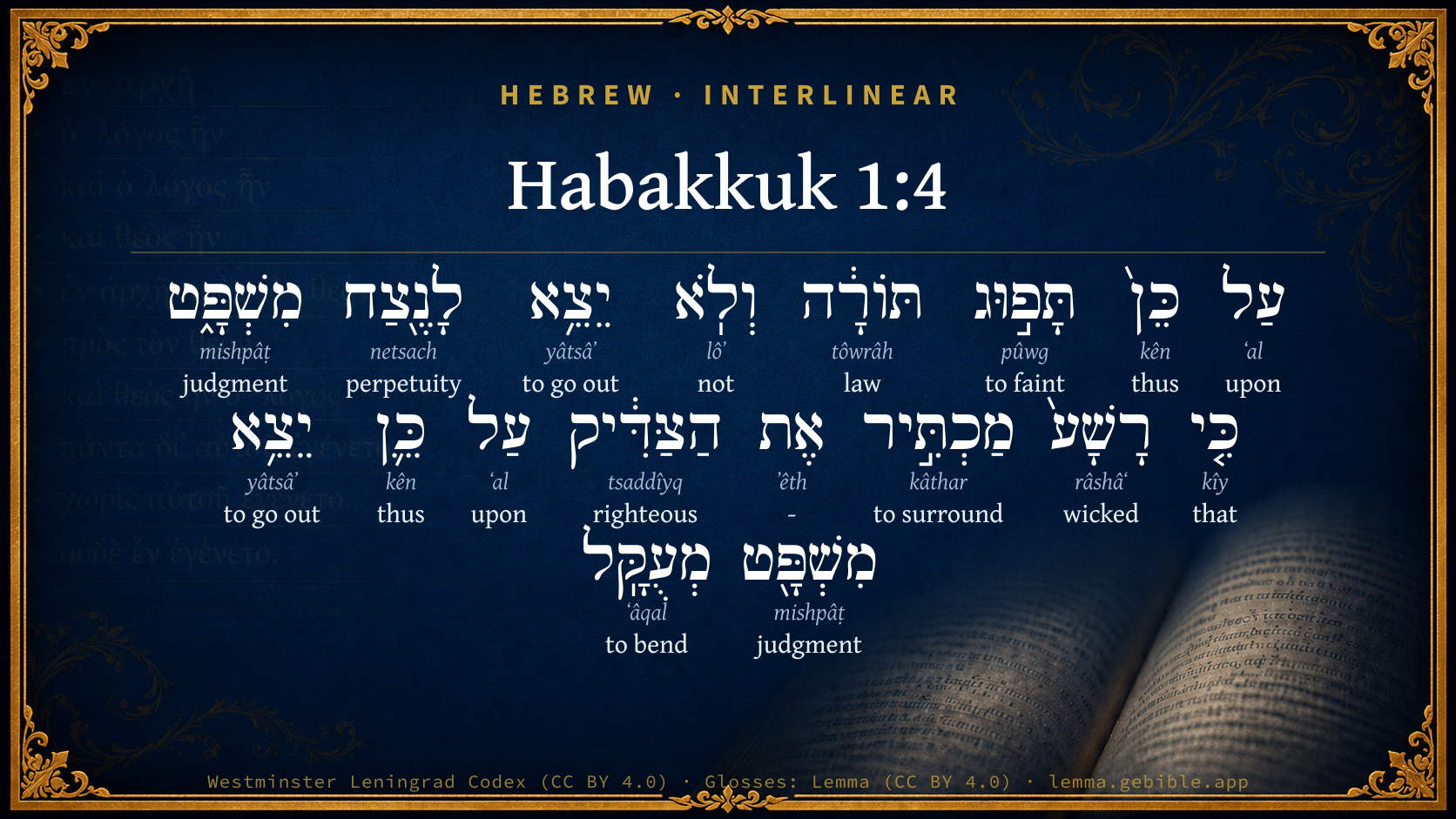
Habakkuk 1:4

Hebrew (Westminster Leningrad Codex) Habakkuk 1:4 appears in the Hebrew Old Testament. The text above is from the Westminster Leningrad Codex. Each word links to its Strong’s number, a concise gloss, and parsing drawn from the Open Scriptures Hebrew Bible morphology. Click any word for its full Brown-Driver-Briggs (BDB) entry.
Download image
Cite this verse

Habakkuk 1:4 (World English Bible). Public Domain. Lemma interlinear Bible study tool, https://lemma.gebible.app/v/habakkuk/1/4.

Show BibTeX & RIS
BibTeX
RIS
English Translation
Therefore the law is paralyzed, and justice never goes forth; for the wicked surround the righteous; therefore justice goes forth perverted.
World English Bible · Public Domain
Highlights
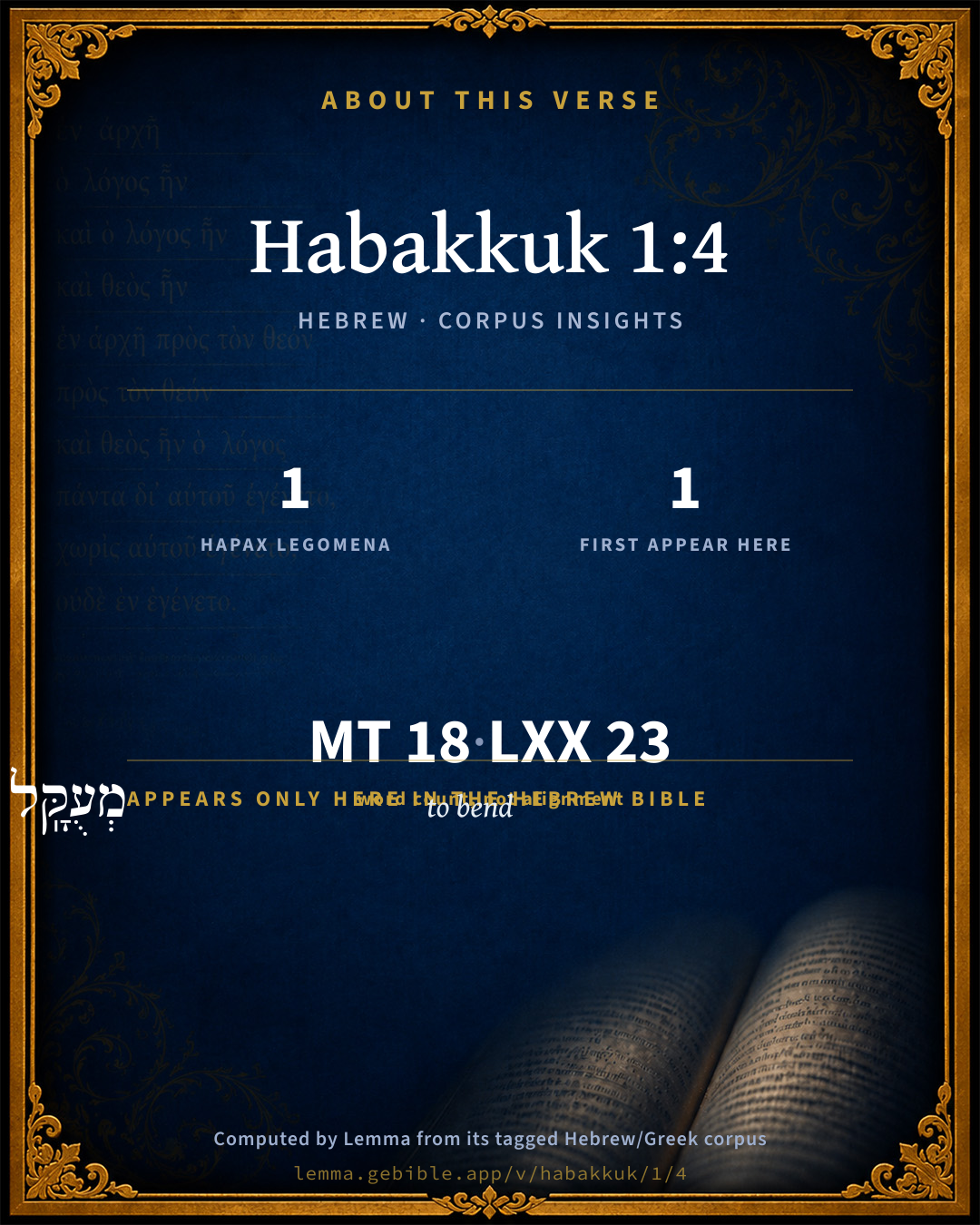
  • 1 hapax legomenon — only here in the Hebrew Bible
  • 1 first appearance in the Hebrew Bible
Full analysis ↓
Download a study sheet

One document with this verse’s original text, its word-by-word gloss line, the meaning frame, cross-references with their text, attributed commentary, and full source and license credits — printable, and it pastes into notes with its structure intact.

This verse Autodidact and up

Study sheet (.html) Plain text (.txt)

A passage Seminary Student

Up to 50 verses in one chapter. A passage sheet keeps up to 6 commentary sources and 12 cross-references per verse, in the order this page ranks them, and says so on the sheet whenever that leaves anything out. Ask for a single verse and you get the Autodidact verse sheet above.

Everything on this page stays free to read, with no account — the sheet is a download of what is already on screen, not access to it.

Want to remove ads? Support Godless Engineer
Compare translations 3

The same verse in 3 English versions, stacked beneath the original-language interlinear above. Click any original word for its lexicon entry.

Each is an independent rendering of the whole verse — the interlinear is not word-aligned to these translations.

Highlighted words mark where these versions differ — a whole-verse word diff, not a word-by-word alignment.

  • World English Bible Public Domain
    Therefore the law is paralyzed, and justice never goes forth; for the wicked surround the righteous; therefore justice goes forth perverted.
  • King James Version Public Domain
    Therefore the law is slacked, and judgment doth never go forth: for the wicked doth compass about the righteous; therefore wrong judgment proceedeth.
  • unfoldingWord Literal Text CC BY-SA 4.0
    Therefore the law weakens, and justice does not go forth to perpetuity. For the wicked surrounds the righteous, therefore justice goes forth perverted.”

unfoldingWord Literal Text — © unfoldingWord, licensed CC BY-SA 4.0. Word-aligned USFM3 via Door43 (git.door43.org/unfoldingWord/en_ult).

Versions to compare (up to 4)

3 of 4 selected

Show all 18 translations

Every available English version of this verse, each an independent rendering of the whole verse.

  • World English Bible Public Domain
    Therefore the law is paralyzed, and justice never goes forth; for the wicked surround the righteous; therefore justice goes forth perverted.
  • Berean Standard Bible Public Domain
    Therefore the law is paralyzed, and justice never goes forth. For the wicked hem in the righteous, so that justice is perverted.
  • Majority Standard Bible Public Domain
    Therefore the law is paralyzed, and justice never goes forth. For the wicked hem in the righteous, so that justice is perverted.
  • King James Version Public Domain
    Therefore the law is slacked, and judgment doth never go forth: for the wicked doth compass about the righteous; therefore wrong judgment proceedeth.
  • American Standard Version (1901) Public Domain
    Therefore the law is slacked, and justice doth never go forth; for the wicked doth compass about the righteous; therefore justice goeth forth perverted.
  • Revised Version (1885) Public Domain
    Therefore the law is slacked, and judgment doth never go forth: for the wicked doth compass about the righteous; therefore judgment goeth forth perverted.
  • Geneva Bible (1599) Public Domain
    Therefore the Lawe is dissolued, and iudgement doeth neuer go forth: for the wicked doeth compasse about the righteous: therefore wrong iudgement proceedeth.
  • Douay-Rheims (1899) Public Domain
    Therefore the law is torn in pieces, and judgment cometh not to the end: because the wicked prevaileth against the just, therefore wrong judgment goeth forth.
  • Young's Literal Translation Public Domain
    Therefore doth law cease, And judgment doth not go forth for ever, For the wicked is compassing the righteous, Therefore wrong judgment goeth forth.
  • Literal Standard Version CC BY-SA 4.0
    Therefore law ceases, || And judgment does not go forth forever, || For the wicked is surrounding the righteous, || Therefore wrong judgment goes forth.
  • Unlocked Literal Bible CC BY-SA 4.0
    Therefore the law is weakened, and justice does not last for any time. For the wicked surround the righteous; therefore false justice goes out.” Yahweh replies to Habakkuk
  • unfoldingWord Literal Text CC BY-SA 4.0
    Therefore the law weakens, and justice does not go forth to perpetuity. For the wicked surrounds the righteous, therefore justice goes forth perverted.”
  • Darby Bible Public Domain
    Therefore the law is powerless, and justice doth never go forth; for the wicked encompasseth the righteous; therefore judgment goeth forth perverted.
  • World Messianic Bible Public Domain
    Therefore the law is paralyzed, and justice never prevails; for the wicked surround the righteous; therefore justice comes out perverted.
  • Webster's Bible Public Domain
    Therefore the law is slackened, and judgment doth never go forth: for the wicked doth encompass the righteous; therefore wrong judgment proceedeth.
  • Free Bible Version CC BY-SA 4.0
    As a result the law is paralyzed, and justice never wins. The wicked crowd out those who do right so that the course of justice is perverted.
  • Bible in Basic English Public Domain
    For this reason the law is feeble and decisions are not effected: for the upright man is circled round by evil-doers; because of which right is twisted.
  • JPS Tanakh (1917) Public Domain
    Therefore the law is slacked, and right doth never go forth; for the wicked doth beset the righteous; therefore right goeth forth perverted.

Literal Standard Version (2020), Covenant Press — licensed CC BY-SA 4.0. Text via the HelloAO Bible API (eBible.org). Unlocked Literal Bible (unfoldingWord) — licensed CC BY-SA 4.0. Text via the HelloAO Bible API (eBible.org). unfoldingWord Literal Text — © unfoldingWord, licensed CC BY-SA 4.0. Word-aligned USFM3 via Door43 (git.door43.org/unfoldingWord/en_ult). Free Bible Version, Dr. Jonathan Gallagher — licensed CC BY-SA 4.0. Text via the HelloAO Bible API (eBible.org).

Word by word

More ways to search: Search by grammar → Find every occurrence → Compare this word →

Practice this passage: Drill this verse → Learn its vocabulary →

מְעֻקָּֽל
ʻâqal
H6127
“bent”
Verb, Pual, Participle Passive, Masculine, Singular, Absolute
Part of Speech
Verb
Stem
Pual
Form
Participle Passive
Gender
Masculine
Number
Singular
State
Absolute
Full BDB Definition

Origin: a primitive root

TWOT: 1680

to bend, twist - (Pual) to be bent out of shape, be distorted, be crooked
  1. עַל ʻal H5921 “upon” Preposition
  2. כֵּן֙ kên H3651 “thus” Particle, Demonstrative
  3. תָּפ֣וּג pûwg H6313 “to faint” Verb, Qal, Imperfect, 3rd Person, Feminine, Singular
  4. תּוֹרָ֔ה tôwrâh H8451 “law” Noun, Common, Feminine, Singular, Absolute
  5. וְלֹֽא lôʼ H3808 “and · not” Conjunction + Particle, Negative
  6. יֵצֵ֥א yâtsâʼ H3318 “to go out” Verb, Qal, Imperfect, 3rd Person, Masculine, Singular
  7. לָנֶ֖צַח netsach H5331 “to/for · perpetuity” Preposition + Noun, Common, Masculine, Singular, Absolute
  8. מִשְׁפָּ֑ט mishpâṭ H4941 “judgment” Noun, Common, Masculine, Singular, Absolute
  9. כִּ֤י kîy H3588 “that” Conjunction
  10. רָשָׁע֙ râshâʻ H7563 “wicked” Adjective, Adjective, Masculine, Singular, Absolute
  11. מַכְתִּ֣יר kâthar H3803 “surrounding” Verb, Hiphil, Participle Active, Masculine, Singular, Absolute
  12. אֶת ʼêth H853 “-” Particle, Direct Object
  13. הַצַּדִּ֔יק tsaddîyq H6662 “the · righteous” Particle, Definite Article + Adjective, Adjective, Masculine, Singular, Absolute
  14. עַל ʻal H5921 “upon” Preposition
  15. כֵּ֛ן kên H3651 “thus” Particle, Demonstrative
  16. יֵצֵ֥א yâtsâʼ H3318 “to go out” Verb, Qal, Imperfect, 3rd Person, Masculine, Singular
  17. מִשְׁפָּ֖ט mishpâṭ H4941 “judgment” Noun, Common, Masculine, Singular, Absolute

About this verse

These counts appear in no published source. They are computed here, from the morphology-tagged text and Lemma’s own curated glosses. What Lemma adds →

18
words
14
distinct lemmas
Prophets
section

Notable vocabulary

1 hapax legomenon — a word that appears only here in the entire Hebrew Bible:

  • מְעֻקָּֽל to bend H6127

First appearance in Scripture

This word makes its first canonical appearance in the Hebrew Bible here:

  • מְעֻקָּֽל to bend H6127

Shared distinctive vocabulary

תָּפ֣וּג to faint H6313 occurs in 4 verses of the Hebrew Bible. Also found in:

Grammatical profile

  • 5 verbs
  • 4 nouns
  • 2 adjectives
  • 2 prepositions
  • 1 conjunction
  • 4 particles

Verb forms

  • תָּפ֣וּג Qal · Imperfect
  • יֵצֵ֥א Qal · Imperfect
  • מַכְתִּ֣יר Hiphil · Participle Active
  • יֵצֵ֥א Qal · Imperfect
  • מְעֻקָּֽל Pual · Participle Passive

Repetition

Words recur within this verse — often emphatic in Hebrew:

  • עַל upon H5921 ×2
  • כֵּן֙ thus H3651 ×2
  • יֵצֵ֥א to go out H3318 ×2
  • מִשְׁפָּ֑ט judgment H4941 ×2

Hebrew & Septuagint length

In English translation the verse runs 21 words from the Hebrew and 23 from the Septuagint (LXX English) — closely comparable.

A rough comparison of the two English renderings, which tokenize alike — not a word-level alignment.

Word counts can differ between the Hebrew and the Greek without any difference in meaning — e.g. the Hebrew direct-object marker אֵת has no separate Greek word, and Greek often adds the article ὁ.

In the original languages it is 18 Hebrew tokens and 23 Greek tokens — but the two are counted differently (Hebrew bundles its prefixes and suffixes into one token; the Greek is in lemma form), so that isn’t a like-for-like length.

Cross-references

43

Topical passages linked to Habakkuk 1:4 in the Treasury of Scripture Knowledge — connected by theme and wording, ordered by reader-vote popularity; previews shown in the World English Bible.

  • Job 21:7 "Why do the wicked live, Become old, yes, and grow mighty in power?
  • Psalms 94:20–21 Shall the throne of wickedness have fellowship with you, Which brings about mischief by statute?
  • Psalms 119:126 It is time to act, Yahweh, For they break your law.
  • Isaiah 1:21–23 How the faithful city has become a prostitute! She was full of justice; righteousness lodged in her, But now murderers.
  • Jeremiah 12:1 Righteous are you, Yahweh, when I contend with you; yet would I reason the cause with you: why does the way of the wicked prosper? why are all they at ease who deal very treacherously?
  • Ezekiel 9:9 Then said he to me, The iniquity of the house of Israel and Judah is exceeding great, and the land is full of blood, and the city full of wrestling [of judgment]: for they say, Yahweh has forsaken the land, and Yahweh doesn't see.
  • Isaiah 5:20 Woe to those who call evil good, and good evil; Who put darkness for light, And light for darkness; Who put bitter for sweet, And sweet for bitter!
  • Isaiah 59:13–15 transgressing and denying Yahweh, and turning away from following our God, speaking oppression and revolt, conceiving and uttering from the heart words of falsehood.
  • Exodus 23:2 You shall not follow a crowd to do evil; neither shall you testify in court to side with a multitude to pervert justice;
  • Exodus 23:6 "You shall not deny justice to your poor people in their lawsuits.
  • Deuteronomy 16:19 You shall not wrest justice: you shall not respect persons; neither shall you take a bribe; for a bribe does blind the eyes of the wise, and pervert the words of the righteous.
  • Psalms 58:1–2 Do you indeed speak righteousness, silent ones? Do you judge blamelessly, you sons of men?
  • Ezekiel 22:25–30 There is a conspiracy of her prophets in the midst of it, like a roaring lion ravening the prey: they have devoured souls; they take treasure and precious things; they have made her widows many in the midst of it.
  • Hosea 10:4 They make promises, swearing falsely in making covenants. Therefore judgment springs up like poisonous weeds in the furrows of the field.
  • Amos 5:12 For I know how many your offenses, And how great are your sins-- You who afflict the just, Who take a bribe, And who turn aside the needy in the courts.
  • Psalms 59:2 Deliver me from the workers of iniquity. Save me from the bloodthirsty men.
  • Psalms 59:4 I have done no wrong, yet they are ready to attack me. Rise up, behold, and help me!
  • Psalms 94:3 Yahweh, how long will the wicked, How long will the wicked triumph?
  • Jeremiah 5:27–29 As a cage is full of birds, so are their houses full of deceit: therefore they are become great, and grew rich.
  • Jeremiah 26:21–23 and when Jehoiakim the king, with all his mighty-men, and all the princes, heard his words, the king sought to put him to death; but when Uriah heard it, he was afraid, and fled, and went into Egypt:
  • Jeremiah 37:14–16 Then said Jeremiah, It is false; I am not falling away to the Chaldeans. But he didn't listen to him; so Irijah laid hold on Jeremiah, and brought him to the princes.
  • Micah 2:1–2 Woe to those who devise iniquity And work evil on their beds! When the morning is light, they practice it, Because it is in the power of their hand.
  • Micah 3:1–3 I said, "Please listen, you heads of Jacob, And rulers of the house of Israel: Isn't it for you to know justice?
  • Micah 7:2–4 The godly man has perished out of the earth, And there is no one upright among men. They all lie in wait for blood; Every man hunts his brother with a net.
  • Matthew 23:34–36 Therefore, behold, I send to you prophets, wise men, and scribes. Some of them you will kill and crucify; and some of them you will scourge in your synagogues, and persecute from city to city;
  • Matthew 26:59–66 Now the chief priests, the elders, and the whole council sought false testimony against Jesus, that they might put him to death;
  • Matthew 27:1–2 Now when morning had come, all the chief priests and the elders of the people took counsel against Jesus to put him to death:
  • Matthew 27:25–26 All the people answered, "May his blood be on us, and on our children!"
  • Mark 7:9 He said to them, "Full well do you reject the commandment of God, that you may keep your tradition.
  • Acts 7:52 Which of the prophets didn't your fathers persecute? They killed those who foretold the coming of the Righteous One, of whom you have now become betrayers and murderers.
  • Acts 7:59 They stoned Stephen as he called out, saying, "Lord Jesus, receive my Spirit!"
  • Acts 23:12–14 When it was day, some of the Jews banded together, and bound themselves under a curse, saying that they would neither eat nor drink until they had killed Paul.
  • Romans 3:31 Do we then nullify the law through faith? May it never be! No, we establish the law.
  • James 2:6–7 But you have dishonored the poor man. Don't the rich oppress you, and personally drag you before the courts?
  • 1 Kings 21:13 The two men, the base fellows, came in and sat before him: and the base fellows bore witness against him, even against Naboth, in the presence of the people, saying, Naboth did curse God and the king. Then they carried him forth out of the city, and stoned him to death with stones.
  • Psalms 11:3 If the foundations are destroyed, What can the righteous do?
  • Psalms 22:16 For dogs have surrounded me. A company of evil-doers have enclosed me. They pierced my hands and my feet.
  • Psalms 82:1–5 God presides in the great assembly. He judges among the gods.
  • Isaiah 59:2–8 but your iniquities have separated between you and your God, and your sins have hidden his face from you, so that he will not hear.
  • Jeremiah 12:6 For even your brothers, and the house of your father, even they have dealt treacherously with you; even they have cried aloud after you: don't believe them, though they speak beautiful words to you.
  • Jeremiah 26:8 It happened, when Jeremiah had made an end of speaking all that Yahweh had commanded him to speak to all the people, that the priests and the prophets and all the people laid hold on him, saying, You shall surely die.
  • Jeremiah 38:4–6 Then the princes said to the king, Let this man, we pray you, be put to death; because he weakens the hands of the men of war who remain in this city, and the hands of all the people, in speaking such words to them: for this man doesn't seek the welfare of this people, but the hurt.
  • Amos 5:7 You who turn justice to wormwood, And cast down righteousness to the earth:

Cross-references courtesy of OpenBible.info (CC BY 4.0).

Hebrew and Greek witnesses Masoretic Hebrew ↔ Greek Septuagint

The same verse in the two great witnesses to the Old Testament, shown verse-for-verse.

These are two independent witnesses, not word-aligned to each other, and the Septuagint is shown in lemma (dictionary) form.

Hebrew Habakkuk 1:4 Masoretic · Westminster Leningrad Codex

עַל כֵּן֙ תָּפ֣וּג תּוֹרָ֔ה וְלֹֽא יֵצֵ֥א לָנֶ֖צַח מִשְׁפָּ֑ט כִּ֤י רָשָׁע֙ מַכְתִּ֣יר אֶת הַצַּדִּ֔יק עַל כֵּ֛ן יֵצֵ֥א מִשְׁפָּ֖ט מְעֻקָּֽל

Therefore the law is paralyzed, and justice never goes forth; for the wicked surround the righteous; therefore justice goes forth perverted.

World English Bible · Public Domain

Greek LXX Habakkuk 1:4 Septuagint · lemma form

διά οὗτος διασκεδάζω νόμος καί οὐ δια ἐκἄγω εἰς τέλος κρίμα ὅτι ὁ ἀσεβής καταδυναστεύω ὁ δίκαιος ἕνεκεν οὗτος ἐκἔρχομαι ὁ κρίμα διαστρέφω

Therefore the law is frustrated, and judgment proceeds not effectually, for the ungodly man prevails over the just; therefore perverse judgment will proceed.

LXX2012 (modern English Septuagint) · Public Domain

On this verse, Trapp's Complete Commentary discusses the Septuagint’s reading. Read the note in Commentary ↓

Hebrew: Westminster Leningrad Codex (CC BY 4.0). Greek: Septuagint (public domain); English from LXX2012 (modern English Septuagint) (Public Domain). How the Septuagint differs from the Hebrew →

Targum (Aramaic paraphrase)

1

The Targum is the ancient Jewish Aramaic paraphrase of the Hebrew Scriptures — an interpretive translation, not the Hebrew text itself. Onkelos (literal) and Pseudo-Jonathan (expansive) render the Torah, and Jonathan the Prophets. Coverage is partial: where no permissively-licensed English translation exists for a verse, only the Aramaic is shown. This is verse-level text, not a word-by-word alignment to the Hebrew.

  1. Targum Jonathan Prophets (Joshua–Malachi)
    עַל כֵּן פָּגַת אוֹרַיְתָא וְלָא נָפֵיק לְאַפְרַשׁ דִינָא אֲרֵי רְשִׁיעַיָא מְסַלְעֲמִין לְצַדִיקַיָא עַל כֵּן לָא נָפֵיק דִינָא כֵיוָן:

    (no public-domain English translation for this verse)

    Targum Jonathan — Aramaic: “Mikraot Gedolot” (public domain). English: “Sefaria Community Translation” (CC0 1.0 (public-domain dedication)); “London "Chaldee Paraphrase," 1871” (public domain). Text via Sefaria.

Commentary

Notes on Habakkuk 1:4 from classic Christian and Jewish commentators (each source and its license shown beneath its notes). The classic Christian expositions comment on the surrounding passage and are grouped to its opening verse, so a note may address several verses; the Jewish commentaries on the Tanakh (Rashi and others) are per-verse, so they appear only where the commentator wrote on this verse.

Lemma curates 59 commentaries, every one of them public domain or Creative Commons licensed, each selected and text-cleaned for this edition rather than reprinted as found. About our sources →

Trapp's Complete Commentary

John Trapp

Hab 1:4 Therefore the law is slacked, and judgment doth never go forth: for the wicked doth compass about the righteous; therefore wrong judgment proceedeth.

Ver. 4. Therefore the law is slacked] Defluit lex. An elegant metaphor from the pulse, which, in a dying man, beateth faintly. The law is the pulse of the commonwealth. If it stir not at all, the commonwealth is dead. If it have but slow motion, the commonwealth is weak. But if it keep an equal course, the commonwealth is in good constitution. Lex lux, the law is a light, saith Solomon; but the deluge of sin had well nigh put out this light in Israel; who was now grown in a manner lawless, through long impunity.

And judgment doth never go forth] Or, it goeth not forth to the utmost, to victory; it is not carried on to a right upshot, as the Septuagint and Latin render it, Usque ad finem, εις τελος.

For the wicked doth compass about the righteous] As a crown compasseth the head; he surroundeth and circumventeth him to his hurt. "The children of this world are wiser in their generation," &c. The Midianites outwitted the Israelites, Num 25:18. The Pharisees hemmed in our Saviour to insnare him; but were disappointed.

Therefore wrong judgment proceedeth] Distorted judgment. So Eze 9:9, the city was full of Mutteh, that is, of (mishpat din mitteh, as Kimchi expoundeth it, κατα προσκλισιν), judgment turned from the bias; the balance of justice was tilted on the one side, 1Ti 5:21. A judge is to retain the decency and gravity of the law; to do nothing of partiality or popularity; to proceed, not according to opinion or appearance; but as a just law is a heart without affection, an eye without lust, a mind without passion, &c., so should he. Else wrong and wrested judgment will soon proceed, to the prejudice of the righteous.

John Trapp, A Commentary or Exposition upon All the Books of the Old and New Testament (1647–1656) — public domain. Text from a community e-Sword module.

Tyndale Open Study Notes

Tyndale Open Resources

1:4 Habakkuk expresses his concern about the injustice and unrighteousness he saw all around him (see 1:12-13; 2:4, 9), even in the courts, where the law was no longer effective in maintaining justice.

Tyndale Open Study Notes — © Tyndale Open Resources, licensed CC BY-SA 4.0. Text via the HelloAO Bible API.

Geneva Bible (1599)

Geneva Bible translators

Because the judges which should redress this excess, are as evil as the rest.

To suppress him, if any should show himself zealous of God’s cause.

Geneva Bible (1599) marginal notes — public domain. Text via Bolls.life.

Jamieson, Fausset & Brown

Robert Jamieson, A. R. Fausset & David Brown

Therefore--because Thou dost suffer such crimes to go unpunished.

law is slacked--is chilled. It has no authority and secures no respect.

judgment--justice.

wrong judgment proceedeth--Decisions are given contrary to right.

Jamieson, Fausset & Brown — Commentary Critical and Explanatory on the Whole Bible (1871) — public domain (CC PDM 1.0). Text via the HelloAO Bible API.

Adam Clarke's Commentary

Verse 4. The law is slacked] They pay no attention to it; it has lost all its vigour, its restraining and correcting power, it is not executed; right judgment is never pronounced; and the poor righteous man complains in vain that he is grievously oppressed by the wicked, and by those in power and authority. That the utmost depravity prevailed in the land of Judah is evident from these verses; and can we wonder, then, that God poured out such signal judgments upon them? When judgment doth not proceed from the seat of judgment upon earth, it will infallibly go forth from the throne of judgment in heaven.

Adam Clarke's Commentary on the Bible (1810–1826) — public domain. Text from a community e-Sword/MySword module.

John Calvin's Commentaries

The Prophet confirms here what I have already said, and brings an excuse for his zeal; he proves that he was not without reason led to so great a warmth; for he saw that the law of God was trodden as it were under foot; he saw men so hardened in every kind of sin, that all religion and the fear of God had nearly been extinguished. Hence I have already said, that the Prophet was not here impelled by a carnal passion, as it often happens to us, when we defend ourselves from wrongs done to us; for when any one of us is injured, he immediately becomes incensed, while, at the same time, we suffer God’s law to be a sport, His whole truth to be despised, and everything that is just to be violated. We are only tender on what concerns us individually, and in the meantime we easily forgive when God is wronged, and His truth despised. But the Prophet shows here that he was not made indignant through a private feeling, but because he could not bear the profanation of God’s worship and the violation of His holy law.

He therefore says, that the law was dissolved or weakened, as though he said that God’s law had no longer any authority or regard. Let us hence learn to rouse up ourselves, for we are very frigid, when the ungodly openly despise and even mock God. As, then, we are too unconcerned in this respect, let us learn, by the Prophet’s example, to stimulate ourselves. For even Paul also shows, in an indirect way, that there is just reason for indignation—‘Be ye angry,’ he says, ‘and sin not,’ (Ephesians 4:26); that is, every one ought to regard his own sins, so as to become an enemy to himself; and he ought also to feel indignant whenever he sees God offended.

This rule the Prophet now follows, Weakened, he says, is the law We know that when a sinful custom prevails, there is but little authority in what is taught: nor are human laws only despised when men’s audacity breaks through all restraints, but even the very law of God is esteemed as nothing; for they think that everything erroneously done, by the consent of all, is lawful. We now then see that the Prophet felt great anguish of mind, like holy Lot (Genesis 19:1-38.), when he saw every regard for God almost extinct in the land, and especially among the chosen people, whom God had above all others consecrated to himself.

He then adds, judgement goes not forth perpetually. Absurdly do many regard this as having been said in the person of foolish men, who think that there is no such thing as divine providence, when things in the world are in a disordered state: but the Prophet simply says, that all justice was suppressed. We have nearly the very same complaint in Isaiah 59:4. He then says, that judgement did not go forth perpetually, because the ungodly thought that no account was to be given by them. When, therefore, any one dared to say a word against them, they immediately boiled with rage, and like wild beasts fiercely attacked him. All then were silent, and nearly made dumb, when the ungodly thus prevailed and gathered boldness from the daily practice of licentiousness. Hence, ‘Go forth perpetually does not judgement;’ that is, “O Lord, things are now past hope, and there appears to be no end to our evils, except thou comest soon and applies a remedy beyond what our flesh can conceive.” For the wicked, he says, surround the righteous; that is, when there was any one who continued to retain some regard for religion and justice, immediately the wicked rose up against him on every side and surrounded him before and behind; so it happened, that no one dared to oppose the torrent, though frauds, rapines, outrages, cruelty, and even murders everywhere prevailed; if any righteous men still remained, they dared not come forth into the public, for the wicked beset them on all sides.

He afterwards adds, Therefore perverted judgement goes forth. The Prophet now rises higher, that even the rulers themselves increased the rage for evils, and as it were supplied fuel to their wickedness, as they confounded all distinction between right and wrong: for the Prophet speaks not here of private wrongs which any one might have done, but he speaks of the very rulers, as though he said, “There might have been one remedy, the judges might have checked so great an audacity; but they themselves stretch out their hands to the wicked and help them.” Hence the tribunals, which ought to have been sacred, were become as it were dens of thieves. The word משפט, meshiphith is taken properly in a good sense: Is not judgement then a desirable thing? Yes, but the Prophet says, that it was perverted. It was then by way of concession that judgement is mentioned; for he afterwards adds a word to it, by which he shows that the administration of the laws was evil and injurious: for when any one oppressed had recourse to the assistance of the laws, he was plundered. In short, the Prophet means, that all things in private and in public were corrupt among the people. It now follows—

John Calvin's Commentaries (1540-1563) — public domain. Text from the Calvin Translation Society English edition (1840s-50s) via the Christian Classics Ethereal Library (ccel.org). Calvin's coverage is partial (roughly two-thirds of the Bible); uncommented books and verses are honest gaps, never fabricated. The 19th-century editor's footnotes and remarks are omitted so the notes are faithfully Calvin's own voice.

Ellicott's Commentary for English Readers

(4) The law—the Mosaic tôrâh—which ought to be a bond of security and social welfare is “slacked” or “paralyzed;” and is, therefore, unable to do its work. “Judgment” (mishpât, i.e., “redress of evils “) “doth never go forth,” for the wicked have hemmed the righteous in; and, therefore, there are no judicial sentences, save such as favour the wicked.

A Bible Commentary for English Readers, edited by Charles John Ellicott (1878–1897) — public domain. Text from a community e-Sword module.

The Cambridge Bible for Schools and Colleges

gen. ed. J. J. S. Perowne

4. law is slacked] lit. numbed, rigid, i.e. motionless, paralysed and ineffectual. The term “law” (torah) means properly divine instruction given orally at the mouth of the priest (Jer_18:18; Mal_2:6-7); then also that given orally by the prophet (Isa_1:10), and more generally any oral instruction (Pro_1:8; Pro_6:20). In a wider sense it is divine instruction regarding any subject, particularly matters of ritual; then specially of the law of Moses in Deuteronomy, and finally of the whole Pentateuch. In some cases the word seems generalized to mean the revelation as a whole communicated to Israel, particularly as being essentially the true knowledge of the true God, which it is the mission of Israel the servant of the Lord to impart to the nations, Isa_42:4; cf. Isa_49:6, Isa_51:4. Parallel to the word in this use is the term “judgment,” e.g. Isa_42:3-4 “till he have set judgment in the earth, and the isles shall look unto his torah.” See next clause.

judgment doth never go forth] The word “never” does not seem anywhere to mean “at no time,” “on no occasion,” it appears always to refer to the future, e.g. Psa_10:11; Isa_13:20; Amo_8:7. The words must therefore be rendered: and judgment shall never go forth—a sense unsuitable to the connexion.

It is probable that the word has here some modified meaning, and that the sense is akin to Isa_42:3 “judgment unto truth,” or, according to truth, paraphrased “unto victory” Mat_12:20. “Law” here hardly means the specific decision of the priest on particular questions, nor “judgment” the sentence of the magistrate in particular causes; rather the sense is: law, i.e. moral (social) law (Amo_2:4; Hos_4:6) is paralysed and cannot assert its validity, and judgment, i.e. “right,” comes not forth in its fulness, but is seen maimed. Others, as Wellhausen, take law and judgment in the sense they have in Isaiah 40 seq., of the true religion of Jehovah, and consider the prophet’s complaint to be that the predominance of the heathen powers represses the true religion and prevents its expansion and effectiveness. This sense is less in harmony with the other statements of the passage.

the wicked doth compass about the righteous] Unlike its use in Psa_142:7 “compass” is employed here in a hostile sense, to hem in, so as to impair one’s liberties and just rights (Job_3:23). Both “righteous” and “wicked” are collective terms, referring to classes. The antithesis was used not only of two classes in Israel (Isa_3:10-11; Isa_5:23; Isa_11:4; Zep_1:3), but particularly in later times “wicked” was used of the heathen nations and “righteous” of Israel. The antithesis is taken in the latter sense here by those who consider Hab_1:1-4 to refer to heathen oppressions, cf. Hab_1:13.

wrong judgment proceedeth] As R.V.: therefore judgment goeth forth perverted, i.e. “right,” the good cause of the righteous, fails to prevail.

The Cambridge Bible for Schools and Colleges (gen. ed. J. J. S. Perowne; Cambridge University Press, 1878–1918) — public domain. Text from a community e-Sword module.

John Gill's Exposition

Therefore the law is slacked,.... Is not put into execution against offenders: the civil magistrates, whose office it is to do justice according to law, are dilatory, and do not proceed with vigour and spirit against the transgressors of it, and in favour of honest and good men oppressed: or "it intermits" (r), or is "intermitted"; it is like a man whose pulse beats low, and is scarce perceived, which is a sign that he is not in good health as the body politic is not, when the law, which is the soul of it, is not suffered to take place, and do its office. So the Targum,

"the law languishes;''

loses its force and vigour, and is ready to expire; which is a sad symptom of the bad estate of a commonwealth.

And judgment doth never go forth; at least not right, to the justifying of the righteous, acquitting the innocent, and giving the cause on the right side; condemning the wicked, and punishing offenders as their crime deserves: it never appears as it should do; it is either not done at all, or done badly and perversely:

for the wicked doth compass about the righteous; to hurt him or ensnare him, and by frauds and wicked artifices, and false witnesses, to carry a cause against him:

therefore wrong judgment proceedeth; the cause is given on the wrong side, against a good man, and for a wicked man; all these things the prophet saw with grief, and complained of to the Lord, from whom he has an answer in the following words:

(r) "intermittitur", Junius & Tremellius, Piscator, Drusius, Burkius; "est, animi deliquium pati", Tarnovius.

John Gill's Exposition of the Whole Bible (1746–1763) — public domain (CC PDM 1.0). Text via the HelloAO Bible API.

Albert Barnes' Notes on the Bible

Therefore - i. e., Because God seemed not to awake to avenge His own cause, people promised themselves that they might sin on with impunity. Sin produces sin, and wrong produces wrong; it spreads like an infectious disease, propagating itself, and each, to whom it reaches, adds to its poison. At last, it reached those also, who should be in God’s stead to restrain it. The divine law itself is silenced, by the power of the wicked, by the sin of the judge, the hopelessness of all. When all around is evil, even those not yet lost are tempted to think; “Why should I be other than they? What evil befalls them? Why stand alone?” Even a Psalmist Psa 73:15, Psa 73:12-13 speaks as if tempted to “speak even as they. These are the ungodly who prosper in the world; they increase in riches; verily I have cleansed my heart in vain, and washed my hands in innocency;” and Solomon Ecc 8:11, “Because sentence against an evil work is not executed speedily, therefore the heart of the sons of men is fully set in them to do evil.”

The law is slacked - literally “is chilled” (as we say, “is paralyzed”), through lack of the fire of love. This is what our Lord says Mat 24:12, Because iniquity shall abound, the love of many shall wax cold. The divine law, the source of all right, being chilled in people’s hearts, “judgment,” i. e., the sentence of human justice, as conformed to divine justice, “doth never go forth.” Human sense of right is powerless, when there is not the love of God’s law. It seems always ready to act, but always falls short, like an arrow from an unstrung bow. The man seems always about to do right; he judges, sees, aright - all but does it - yet, at last, he always fails. “It goes not forth. The children are come to the birth, and there is not strength to bring forth” Isa 37:3.

For the wicked doth compass about the righteous, laying snares for him, as the Jews for our Lord; evil is too strong for a weak will to do right, and overbears it. Pilate sought in many ways, how he might deliver Jesus, yet he finally did deliver Christ into their hands.

Therefore wrong judgment proceedeth - literally, “judgment proceedeth wrested.” He had said, “it never goes forth;” never, that is, in its true character; for, when it does “go forth,” it is distorted. Dion.: “For gifts or favor or fear or hate the guiltless are condemned trod the guilty acquitted, as saith the Psalmist Psa 82:2, ‘How long will ye judge unjustly and accept the persons of the ungodly?’” Theoph.: “‘Judgment goes forth perverted’ in the seat of man’s judgment (the soul), when, bribed by the pleasures of sense, it leans to the side of things seen, and the ungodly one, the rebel angel, besets and overpowers him who has the sense of right; for it is right that things seen should give way to things unseen 2Co 4:18; ‘for the things which are seen are temporal, but the things which are not seen are eternal.’” Why then all this? And how long? Why does God bring it before him and He who “is of purer eyes than to behold iniquity, behold grievance,” which His Holy Eyes could not endure? Neither the unseen presence of God nor the mission of the prophet checks. If he rebukes, no one hearkened; if he intercedes for sinners, or against sin, God made as though He would not hear. God answers that, though to man’s impatience the time seems long, judgment shall come, and that, suddenly and speedily. While the righteous is enquiring, “how long?” and the wicked is saying Mat 24:48, “My Lord delayeth His coming,” He is come, and seen in the midst of them.

Albert Barnes' Notes on the Bible (1834–1885) — public domain. Text from a community e-Sword/MySword module.

Matthew Poole's English Annotations

Therefore; because the wicked go on with impunity, and the punishment they deserve is deferred.

The law of God, given to this people by the hand of Moses, the whole law, moral, ceremonial, and judicial.

Is slacked; is slighted, weakened, and little studied, and less obeyed by all sorts.

And judgment; not only private men neglect the law, but magistrates, judges, and public officers pervert, or divert, or obstruct it also.

Doth never go forth, Heb. to the end, or, unto victory, with prevalence to restrain the unjust, and to protect the innocent, which is the end of magistracy, Rom 13:3.

The wicked; the unjust and violent man. Doth compass about; as it were besiegeth, surroundeth, with design to oppress and ruin by false witness, interest, or bribery.

Wrong judgment; perverse judgment, wherein innocence is condemned and the guilty are acquitted: so the judges are swords in the bowels, when they should be shields over the bodies of the righteous.

Matthew Poole's English Annotations on the Holy Bible (1683–1685) — public domain. Text from a community e-Sword/MySword module.

The Pulpit Commentary

Therefore. Because God has not interfered to put an end to this iniquity, or because of the want of righteous judges, the following consequences ensue. The Law is slacked. The Law. Torah, the revealed code which governed the moral, domestic, and political life, "is chilled," is benumbed, (Gen_45:26) is no longer of any force or efficacy, is become a dead letter. Diaskedastai "is dispersed" (Septuagint); lacerata est (Vulgate). Judgment doth never go forth; i.e. right is powerless, as if it had never been; justice never shows itself in such a case. Septuagint, ouj diexagetai eijv telov, "proceedeth not effectually;" so the Vulgate. The rendering, "goeth not forth unto victory," given by the Syriac, is not so suitable; "unto truth" is a mistake arising from referring the word to a wrong root. Doth compass about. In a hostile sense, with threats and treachery (Jud_1:20:43; Psa_22:13) Septuagint, katadunasteuei, "prevails;" Vulgate, praevalet adversus. Therefore. Because the righteous are unable to act as they desire, being opposed by the wicked. Wrong judgment proceedeth; rather, judgment goeth forth perverted. Eight, or what is so called, when it does come forth, is distorted, wrested, so as to be right no more.

The Pulpit Commentary (1880–1919), ed. H.D.M. Spence-Jones & Joseph S. Exell — public domain. Text from a community e-Sword module.

John Wesley's Explanatory Notes

Therefore - Because the wicked go on with impunity. The law - The whole law, moral, ceremonial, and judicial. Is slacked - Is slighted, and not observed. Go forth - From magistrates, Judges, and public officers. Doth compass about - As it were besieges, with design to oppress and ruin.

John Wesley, Explanatory Notes Upon the Whole Bible (1754–1765) — public domain. Text via the GEBible commentary corpus.

Rashi

Rabbi Shlomo Yitzchaki (Rashi)

Therefore Torah is slackened Because of this, that Israel sees his [the wicked man’s] success, the Torah will slacken and leave them; and they [Israel] will obey him [the wicked man] and prostrate themselves before the idol in the valley of Dura.

and justice does not go out forever I.e., the true decision of the Law.

surrounds surrounds, as in (Ps. 22:13): “Strong bulls of Bashan have surrounded me (כִּתְּרוּנִי).”

Rashi on the Tanakh — English translations: “The Judaica Press complete Tanach with Rashi, translated by A. J. Rosenberg” (CC BY 4.0); “Pentateuch with Rashi's commentary by M. Rosenbaum and A.M. Silbermann, 1929-1934” (public domain); “The Metsudah Tanach series, Lakewood, N.J” (CC BY 4.0); and “The Book of Joshua, Metsudah Publications, 1997” (CC BY 4.0). Text via Sefaria.

Lesson kit

Teaching starters — assembled from the data on this page, not authored interpretation. Every prompt links to the verse data it draws on. Edit before teaching.

Habakkuk, in the Prophets, opens this verse with 18 words (14 distinct Hebrew lemmas). Its most distinctive word is ʻâqal (“to bend”). A historical commentator’s framing appears above. Read the whole chapter for the surrounding context.

Discussion questions

  1. What does “to bend” (ʻâqal) contribute to the verse as a whole?
  2. 1 word here appears nowhere else in the Hebrew Bible. Why might the author reach for such rare wording?
  3. This is the first place “to bend” appears in Scripture (first appears here). What does its debut here establish?
  4. How does Genesis 45:26, which shares the word «to faint», read alongside this verse?
  5. What does the repetition of “upon” (2× in this one verse) do in this verse?
  6. The translations on this page render this verse differently — a whole-verse word diff, not a word-by-word alignment. What might account for the different wordings?
  7. «תָּפ֣וּג» is a Qal Imperfect verb. How does that grammatical form shape the action described?
  8. Compare how Trapp's Complete Commentary and Tyndale Open Study Notes read this verse. Where do they agree or differ?

Things to notice

  • 1 word in this verse appears nowhere else in the Hebrew Bible.
  • 1 word makes its first canonical appearance in Scripture here.
  • This verse counts 18 Hebrew ↔ 23 Greek words.
  • These translations choose different wording for 17 words in this verse.
  • “upon” occurs 2× in this single verse.

Reading settings

Reading text

Shown beneath each verse's original-language words.

Old Testament
Old Testament edition

Read the OT as the Masoretic Hebrew (MT) or the Greek Septuagint (LXX).

English shown for the Greek Septuagint (in the Hebrew ↔ Greek comparison).

Comparing translations? Open the Compare panel on any verse page to stack up to four side by side.