
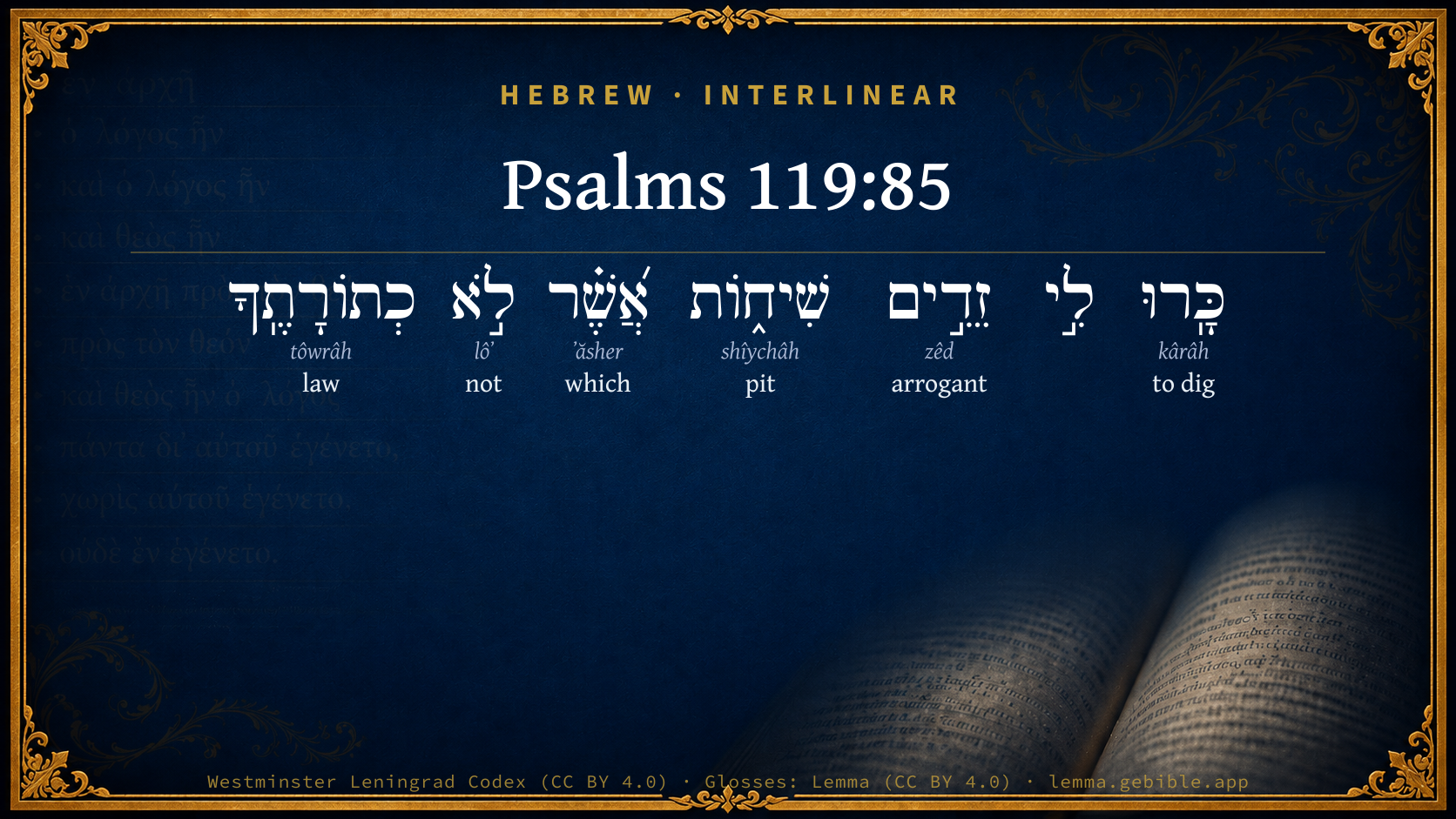
Psalms 119:85

Hebrew (Westminster Leningrad Codex) Psalms 119:85 appears in the Hebrew Old Testament. The text above is from the Westminster Leningrad Codex. Each word links to its Strong’s number, a concise gloss, and parsing drawn from the Open Scriptures Hebrew Bible morphology. Click any word for its full Brown-Driver-Briggs (BDB) entry.
Download image
Cite this verse

Psalms 119:85 (World English Bible). Public Domain. Lemma interlinear Bible study tool, https://lemma.gebible.app/v/psalms/119/85.

Show BibTeX & RIS
BibTeX
RIS
English Translation
The proud have dug pits for me, Contrary to your law.
World English Bible · Public Domain
Download a study sheet

One document with this verse’s original text, its word-by-word gloss line, the meaning frame, cross-references with their text, attributed commentary, and full source and license credits — printable, and it pastes into notes with its structure intact.

This verse Autodidact and up

Study sheet (.html) Plain text (.txt)

A passage Seminary Student

Up to 50 verses in one chapter. A passage sheet keeps up to 6 commentary sources and 12 cross-references per verse, in the order this page ranks them, and says so on the sheet whenever that leaves anything out. Ask for a single verse and you get the Autodidact verse sheet above.

Everything on this page stays free to read, with no account — the sheet is a download of what is already on screen, not access to it.

Want to remove ads? Support Godless Engineer
Compare translations 3

The same verse in 3 English versions, stacked beneath the original-language interlinear above. Click any original word for its lexicon entry.

Each is an independent rendering of the whole verse — the interlinear is not word-aligned to these translations.

Highlighted words mark where these versions differ — a whole-verse word diff, not a word-by-word alignment.

  • World English Bible Public Domain
    The proud have dug pits for me, Contrary to your law.
  • King James Version Public Domain
    The proud have digged pits for me, which are not after thy law.
  • unfoldingWord Literal Text CC BY-SA 4.0
    The proud have dug pits for me, which is not according to your teaching.

unfoldingWord Literal Text — © unfoldingWord, licensed CC BY-SA 4.0. Word-aligned USFM3 via Door43 (git.door43.org/unfoldingWord/en_ult).

Versions to compare (up to 4)

3 of 4 selected

Show all 17 translations

Every available English version of this verse, each an independent rendering of the whole verse.

  • World English Bible Public Domain
    The proud have dug pits for me, Contrary to your law.
  • Berean Standard Bible Public Domain
    The arrogant have dug pits for me in violation of Your law.
  • Majority Standard Bible Public Domain
    The arrogant have dug pits for me in violation of Your law.
  • King James Version Public Domain
    The proud have digged pits for me, which are not after thy law.
  • American Standard Version (1901) Public Domain
    The proud have digged pits for me, Who are not according to thy law.
  • Revised Version (1885) Public Domain
    The proud have digged pits for me, who are not after thy law.
  • Geneva Bible (1599) Public Domain
    The proude haue digged pittes for mee, which is not after thy Lawe.
  • Young's Literal Translation Public Domain
    The proud have digged for me pits, That `are' not according to Thy law.
  • Literal Standard Version CC BY-SA 4.0
    The proud have dug pits for me, || That [are] not according to Your law.
  • Unlocked Literal Bible CC BY-SA 4.0
    The proud have dug pits for me, defying your law.
  • unfoldingWord Literal Text CC BY-SA 4.0
    The proud have dug pits for me, which is not according to your teaching.
  • Darby Bible Public Domain
    The proud have digged pits for me, which is not according to thy law.
  • World Messianic Bible Public Domain
    The proud have dug pits for me, contrary to your Torah.
  • Webster's Bible Public Domain
    The proud have digged pits for me, which are not according to thy law.
  • Free Bible Version CC BY-SA 4.0
    These arrogant people have dug pits to trap me, these people who don't care anything about your law.
  • Bible in Basic English Public Domain
    The men of pride, who are turned away from your law, have put nets for me.
  • JPS Tanakh (1917) Public Domain
    The proud have digged pits for me, which is not according to Thy law.

Literal Standard Version (2020), Covenant Press — licensed CC BY-SA 4.0. Text via the HelloAO Bible API (eBible.org). Unlocked Literal Bible (unfoldingWord) — licensed CC BY-SA 4.0. Text via the HelloAO Bible API (eBible.org). unfoldingWord Literal Text — © unfoldingWord, licensed CC BY-SA 4.0. Word-aligned USFM3 via Door43 (git.door43.org/unfoldingWord/en_ult). Free Bible Version, Dr. Jonathan Gallagher — licensed CC BY-SA 4.0. Text via the HelloAO Bible API (eBible.org).

Word by word

More ways to search: Search by grammar → Find every occurrence → Compare this word →

Practice this passage: Drill this verse → Learn its vocabulary →

About this verse

These counts appear in no published source. They are computed here, from the morphology-tagged text and Lemma’s own curated glosses. What Lemma adds →

7
words
6
distinct lemmas
Wisdom
section

Notable vocabulary

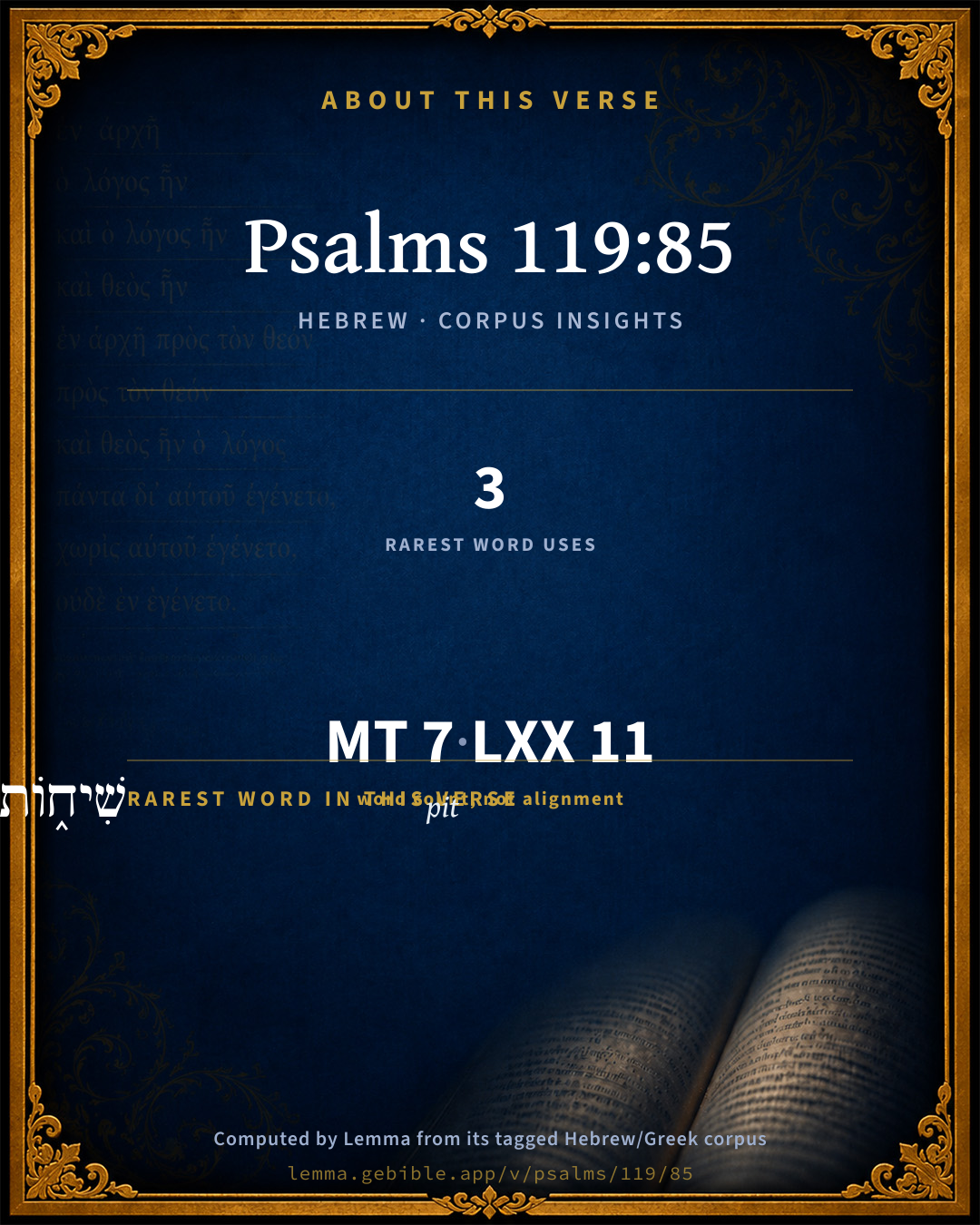
The rarest word here is שִׁיח֑וֹת pit H7882 — appearing just 3 times in the whole Hebrew Bible.

Shared distinctive vocabulary

שִׁיח֑וֹת pit H7882 occurs in 3 verses of the Hebrew Bible. Also found in:

Grammatical profile

  • 1 verb
  • 2 nouns
  • 1 adjective
  • 1 preposition
  • 2 particles

Verb forms

  • כָּֽרוּ Qal · Perfect

Hebrew & Septuagint length

In English translation the verse runs 11 words from the Hebrew and 13 from the Septuagint (LXX English) — closely comparable.

A rough comparison of the two English renderings, which tokenize alike — not a word-level alignment.

Word counts can differ between the Hebrew and the Greek without any difference in meaning — e.g. the Hebrew direct-object marker אֵת has no separate Greek word, and Greek often adds the article ὁ.

In the original languages it is 7 Hebrew tokens and 11 Greek tokens — but the two are counted differently (Hebrew bundles its prefixes and suffixes into one token; the Greek is in lemma form), so that isn’t a like-for-like length.

Cross-references

8

Topical passages linked to Psalms 119:85 in the Treasury of Scripture Knowledge — connected by theme and wording, ordered by reader-vote popularity; previews shown in the World English Bible.

  • Psalms 35:7 For without cause they have hidden their net in a pit for me. Without cause they have dug a pit for my soul.
  • Proverbs 16:27 A worthless man devises mischief. His speech is like a scorching fire.
  • Jeremiah 18:20 Shall evil be recompensed for good? for they have dug a pit for my soul. Remember how I stood before you to speak good for them, to turn away your wrath from them.
  • Psalms 7:15 He has dug a hole, And has fallen into the pit which he made.
  • Psalms 119:78 Let the proud be disappointed, for they have overthrown me wrongfully. I will meditate on your precepts.
  • Psalms 36:11 Don't let the foot of pride come against me. Don't let the hand of the wicked drive me away.
  • Psalms 58:1–2 Do you indeed speak righteousness, silent ones? Do you judge blamelessly, you sons of men?
  • Jeremiah 18:22 Let a cry be heard from their houses, when you shall bring a troop suddenly on them; for they have dug a pit to take me, and hid snares for my feet.

Cross-references courtesy of OpenBible.info (CC BY 4.0).

Hebrew and Greek witnesses Masoretic Hebrew ↔ Greek Septuagint

The same verse in the two great witnesses to the Old Testament, shown verse-for-verse.

You’re reading Greek Psalm 118 (Hebrew Psalm 119). The Septuagint counts the superscription, so verse numbers can differ from the Hebrew — chapter-level alignment, not verse-by-verse. Numbering follows Rahlfs.

These are two independent witnesses, not word-aligned to each other, and the Septuagint is shown in lemma (dictionary) form.

Hebrew Psalms 119:85 Masoretic · Westminster Leningrad Codex

כָּֽרוּ לִ֣י זֵדִ֣ים שִׁיח֑וֹת אֲ֝שֶׁ֗ר לֹ֣א כְתוֹרָתֶֽךָ

The proud have dug pits for me, Contrary to your law.

World English Bible · Public Domain

Greek LXX Greek Psalm 118:85 Septuagint · lemma form

διαἡγέομαι ἐγώ παράνομος ἀδολεσχία ἀλλά οὐ ὡς ὁ νόμος σύ κύριος

Transgressors told me idle tales; but not according to your law, O Lord.

LXX2012 (modern English Septuagint) · Public Domain

On this verse, Adam Clarke's Commentary discusses the Septuagint’s reading. Read the note in Commentary ↓

Hebrew: Westminster Leningrad Codex (CC BY 4.0). Greek: Septuagint (public domain); English from LXX2012 (modern English Septuagint) (Public Domain). How the Septuagint differs from the Hebrew →

Commentary

Notes on Psalms 119:85 from classic Christian and Jewish commentators (each source and its license shown beneath its notes). The classic Christian expositions comment on the surrounding passage and are grouped to its opening verse, so a note may address several verses; the Jewish commentaries on the Tanakh (Rashi and others) are per-verse, so they appear only where the commentator wrote on this verse.

Lemma curates 59 commentaries, every one of them public domain or Creative Commons licensed, each selected and text-cleaned for this edition rather than reprinted as found. About our sources →

Trapp's Complete Commentary

John Trapp

Psa 119:85 The proud have digged pits for me, which [are] not after thy law.

Ver. 85. The proud have digged pits for me] The pride, cruelty, and craftiness of wicked persecutors are foretokens of their utter destruction. The Greek rendereth it, They have told me tales; Pro 16:27, "An ungodly man diggeth up evil."

Which are not after thy law] Neither they nor their pits. But what care they for thee or thy law? and shall they thus escape by iniquity? Psa 56:7.

John Trapp, A Commentary or Exposition upon All the Books of the Old and New Testament (1647–1656) — public domain. Text from a community e-Sword module.

Joseph Benson's Commentary

Psa 119:85-88. The proud have digged pits for me — Have sought to destroy me by deceit and treachery, as well as by violence; which are not after thy law — Which pits, that is, which insidious designs against an innocent person, are not agreeable to thy law, but directly contrary to it. Or the meaning may be, Which men are not after thy law, that is, act and behave without any regard to it, nay, in direct opposition to its injunctions. For all thy commandments are faithful — Are in themselves most just and true, and require righteousness from men, promising many blessings to those that practise it, and severely forbid all fraud or falseness, threatening grievous punishments to those that use them; and such promises and threatenings are true, and shall certainly be executed. They had almost consumed me — As to my present life and all my happiness; upon earth — Whereby be implies that his immortal soul and eternal happiness in heaven were safe and out of their reach. Quicken me after thy loving-kindness — Revive, support, and comfort me by the Spirit of life, which proceeds from thy loving-kindness; so shall I keep the testimony. &c. — Making it the rule of my conduct, and the ground of my confidence and hope, for time and for eternity.

Joseph Benson's Commentary on the Old and New Testaments (1811–1818) — public domain. Text from a community e-Sword module.

J. A. Alexander on Psalms

Joseph Addison Alexander

85. (Psa 119:85) Proud (men) dig for me pits, which (are) not according to thy law. The presumptuous sinners (Psa 119:51; Psa 119:69; Psa 119:78) who are his enemies use the most treacherous means for his destruction, without regard to the divine command or prohibition. See above, on Psa 7:15; Psa 57:6.

Joseph Addison Alexander, The Psalms Translated and Explained (1850) — public domain. Text from a community e-Sword module.

Tyndale Open Study Notes

Tyndale Open Resources

119:85-88 God’s word is trustworthy, in contrast to the deceptions of the enemies who hunt the psalmist down without cause (see 119:78).

Tyndale Open Study Notes — © Tyndale Open Resources, licensed CC BY-SA 4.0. Text via the HelloAO Bible API.

Geneva Bible (1599)

Geneva Bible translators

They have not only oppressed me violently, but also craftily conspired against me.

Geneva Bible (1599) marginal notes — public domain. Text via Bolls.life.

Matthew Henry's Commentary

David's state was herein a type and figure of the state both of Christ and Christians that he was grievously persecuted; as there are many of his psalms, so there are many of the verses of this psalm, which complain of this, as those here. Here observe,

I. The account he gives of his persecutors and their malice against him. 1. They were proud, and in their pride they persecuted him, glorying in this, that they could trample upon one who was so much cried up, and hoping to raise themselves on his ruins. 2. They were unjust: They persecuted him wrongfully; so far was he from giving them any provocation that he had studied to oblige them; but for his love they were his adversaries. 3. They were spiteful: They dug pits for him, which intimates that they were deliberate in their designs against him and that what they did was of malice prepense; it intimates likewise that they were subtle and crafty, and had the serpent's head as well as the serpent's venom, that they were industrious and would refuse no pains to do him a mischief, and treacherous, laying snares in secret for him, as hunters do take wild beasts, Psa 35:7. Such has been the enmity of the serpent's seed to the seed of the woman. 4. They herein showed their enmity to God himself. The pits they dug for him were not after God's law; he means they were very much against his law, which forbids to devise evil to our neighbour, and has particularly said, Touch not my anointed. The law appointed that, if a man dug a pit which occasioned any mischief, he should answer for the mischief (Exo 21:33, Exo 21:34), much more when it was dug with a mischievous design. 5. They carried on their designs against him so far that they had almost consumed him upon earth; they went near to ruin him and all his interests. It is possible that those who shall shortly be consummate in heaven may be, for the present, almost consumed on earth; and it is of the Lord's mercies (and, considering the malice of their enemies, it is a miracle of mercy) that they are not quite consumed. But the bush in which God is, though it burns, shall not be burnt up.

II. His application to God in his persecuted state. 1. He acknowledges the truth and goodness of his religion, though he suffered: "However it be, all thy commandments are faithful, and therefore, whatever I lose for my observance of them, I know I shall not lose by it." True religion, if it be worth any thing, is worth every thing, and therefore worth suffering for. "Men are false; I find them do; men of low degree, men of high degree, are so, there is no trusting them. But all thy commandments are faithful; on them I may rely." 2. He begs that God would stand by him, and succour him: "They persecute me; help thou me; help me under my troubles, that I may bear them patiently, and as becomes me, and may still hold fast my integrity, and in due time help me out of my troubles." God help me is an excellent comprehensive prayer; it is a pity that it should ever be used lightly and as a by-word.

III. His adherence to his duty notwithstanding all the malice of his persecutors (Psa 119:87): But I forsook not thy precepts. That which they aimed at was to frighten him from the ways of God, but they could not prevail; he would sooner forsake all that was dear to him in this world than forsake the word of God, would sooner lose his life than lose the comfort of doing his duty.

Matthew Henry's Commentary on the Whole Bible (1708–1710) — public domain (CC PDM 1.0). Text via the HelloAO Bible API.

Adam Clarke's Commentary

Verse 85. The proud have digged pits] The Vulgate, Septuagint, AEthiopic, and Arabic, translate this verse thus: "They have recited to me unholy fables, which are not according to thy law." They wish us to receive their system of idolatry, and the tales concerning their gods; but these are not according to thy law. The Anglo-Saxon is the same: [A.S.]: They quothed me the unrightwise spells; but no so so law thine.

Adam Clarke's Commentary on the Bible (1810–1826) — public domain. Text from a community e-Sword/MySword module.

John Calvin's Commentaries

85 The proud have digged pits for me. He complains that he had been circumvented by the frauds and artifices of his enemies; as if he had said, They have not only endeavored to injure me by open force and the violence of the sword, but have also maliciously sought to destroy me by snares and secret arts. The additional clause, which thing is not according to thy Law, is introduced as an argument, to excite God to exercise his mercy; for he is the more inclined to succor his servants, when he sees that the attempts made upon their welfare involve the violation of his own Law. At the same time, the Psalmist furnishes a proof of his own innocence, intimating that he had deserved no such treatment at their hands, and that whatever they practiced, he, notwithstanding, patiently kept himself under restraint; not attempting any thing which he knew to be contrary to the Divine Law.

John Calvin's Commentaries (1540-1563) — public domain. Text from the Calvin Translation Society English edition (1840s-50s) via the Christian Classics Ethereal Library (ccel.org). Calvin's coverage is partial (roughly two-thirds of the Bible); uncommented books and verses are honest gaps, never fabricated. The 19th-century editor's footnotes and remarks are omitted so the notes are faithfully Calvin's own voice.

Ellicott's Commentary for English Readers

(85) Which.—Better, who. Its antecedent, of course, the proud, not the pits.

A Bible Commentary for English Readers, edited by Charles John Ellicott (1878–1897) — public domain. Text from a community e-Sword module.

The Cambridge Bible for Schools and Colleges

gen. ed. J. J. S. Perowne

85. pits] A metaphor from the pitfalls used by hunters. Cp. Psa_57:6; and especially Jer_18:20; Jer_18:22.

which] Rather, who. His enemies are presumptuous sinners, who despise and defy God’s law (Psa_119:21; Psa_119:53). Godless Israelites are clearly meant.

The Cambridge Bible for Schools and Colleges (gen. ed. J. J. S. Perowne; Cambridge University Press, 1878–1918) — public domain. Text from a community e-Sword module.

John Gill's Exposition

LAMED.--The Twelfth Part.

LAMED. For ever, O Lord, thy word is settled in heaven. The Syriac version makes two propositions of these words, rendering them thus, "for ever thou art, O Lord; and thy word stands", or "is firm in heaven": and which agrees with the accents: the first of which is expressive of the eternity and immutability of God; and the other of the stability of his word: it is true of the essential Word of God, who was with God from all eternity; in time came down from heaven indeed to earth, and did his work, and then went to heaven again; where he is and will remain, until the times of the restitution of all things. The decrees and purposes of God, what he has said in his heart that he will do, these are firm and sure; these counsels of old are faithfulness and truth; they are mountains of brass settled for ever, and more unalterable than the decrees of the Medes and Persians. The revealed will of God, his word of command, made known to angels in heaven, is regarded, hearkened to, and done by them: the word of the Gospel, published in the church, which is sometimes called heaven, is the everlasting Gospel, the word of God, which lives and abides for ever; what remains and will remain, in spite of all the opposition of men and devils. The word of promise in the covenant made in heaven is sure to all the seed; everyone of the promises is yea and amen in Christ, and as stable as the heavens, and more so; "heaven and earth shall pass away, but my words shall not pass away", Mat 24:35; The firmness of God's word is seen in the upholding and continuing the heavens by the word of his power, by which they were first made; and the certainty of the divine promises is illustrated by the perpetuity of the ordinances of heaven; see Jer 31:35.

John Gill's Exposition of the Whole Bible (1746–1763) — public domain (CC PDM 1.0). Text via the HelloAO Bible API.

Albert Barnes' Notes on the Bible

The proud - Those in high life, or of exalted rank. See the notes at Psa 119:51.

Have digged pits for me - See the notes at Psa 7:15. Compare Psa 35:7; Psa 57:6; Psa 94:13.

Which are not after thy law - The word which here refers not to the pits, but to the proud. They who have done this are people who do not regard thy commands; people who are open and public offenders. It is that class of people with whom I have to contend - inert who set at defiance all the laws of God; men high in rank, who wield great power, and who have no regard to the law of God in their conduct. Even they have sought my destruction in the meanest way possible - by covert arts, by underhanded means, by digging pits, as they would for wild beasts.

Albert Barnes' Notes on the Bible (1834–1885) — public domain. Text from a community e-Sword/MySword module.

Matthew Poole's English Annotations

Have digged pits for me; have sought to destroy me by deceit and treachery, as well as by violence.

Which; either,

1. Which men have no respect to thy law, which forbids such things. Or rather,

2. Which thing, to wit, to dig pits for me, an innocent and just man, is not agreeable to thy law, but directly contrary to it.

Matthew Poole's English Annotations on the Holy Bible (1683–1685) — public domain. Text from a community e-Sword/MySword module.

The Treasury of David

Charles H. Spurgeon

Ver. 85. The proud have digged pits for me, which are not after thy law. As men who hunt wild beasts are wont to make pitfalls and snares, so did David's foes endeavour to entrap him. They went laboriously and cunningly to work to ruin him, "they digged pits"; not one, but many. If one would not take him, perhaps another would, and so they digged again and again. One would think that such haughty people would not have soiled their fingers with digging; but they swallowed their pride in hopes of swallowing their victim. Whereas they ought to have been ashamed of such meanness, they were conscious of no shame, but, on the contrary, were proud of their cleverness; proud of setting a trap for a godly man. "Which are not after thy law." Neither the men nor their pits were according to the divine law: they were cruel and crafty deceivers, and their pits were contrary to the Levitical law, and contrary to the command which bids us love our neighbour. If men would keep to the statutes of the Lord, they would lift the fallen out of the pit, or fill up the pit so that none might stumble into it; but they would never spend a moment in working injury to others. When, however, they become proud, they are sure to despise others; and for this reason they seek to circumvent them, that they may afterwards hold them up to ridicule. It was well for David that his enemies were God's enemies, and that their attacks upon him had no sanction from the Lord. It was also much to his gain that he was not ignorant of their devices, for he was thus put upon his guard, and led to watch his ways lest he should fall into their pits. While he kept to the law of the Lord he was safe, though even then it was an uncomfortable thing to have his path made dangerous by the craft of wanton malice.

Ver. 85. Pits. Hajji said he would tell me a tale or two about crocodiles, and he would begin by telling me how they catch them sometimes. A deep pit, he said, is dug by the side of the river, and then covered with doura straw. The crocodiles fall into these pits, and cannot get out again... There can be no doubt that formerly pits were dug for the crocodiles, as Hajji described, as is the case still in some parts of the world or other animals. To this custom allusion is made in Ps 7:15 9:15 10:2 35:8 141:10 Pr 26:27 Ec 10:8: etc. "He made a pit and digged it, and is fallen into the ditch which he made." Probably also this was the kind of pit referred to in Ex 21:33: "If a man shall dig a pit, and not cover it"; i.e., not cover it effectually; "and an ass or an ox fall therein, "etc.

Prisoners were sometimes shut up in pits, and left without water, literally to die of thirst. What a dreadful death! It is said that nothing can be more terrible. How dreadful must be their groans! John Gadsby.

Ver. 85. The proud have digged pits. It seems strange that a proud man should be a digger of pits; but so it is; for pride for a time can submit itself to gain a greater vantage over him whom it would tread under foot. "The wicked is so proud that he seeks not God, yet he croucheth and boweth, to cause heaps of the poor to fill by his might, "Ps 10:4, 10. So proud Absalom abased himself to meanest subjects that so he might prepare a way to usurpation over his king and father. But mark, he saith not that he had fallen into the pits which his enemies had digged. No, no: in God's righteous judgments, the wicked are snared in the work of their own hands, while the good escape free. "He made a pit, and digged it, "and is fallen into the ditch which he made. His mischief shall return upon his own head, and his violent dealing shall come down upon his own pate. Ps 7:15-16. Thus Haman hanselled the gallows which he raised for Mordecai; and Saul, when he thought by subtlety to slay David with the Philistine's sword (when he sent him out to seek two hundred of their foreskins in a dowry) was disappointed of his purpose; but he himself at length was slain by the sword. William Cowper.

Ver. 85. Let men beware how they dig pits for others. All God's word testifies against such wickedness. How many tests are invented simply for the purpose of entangling men's consciences and furnishing ground for persecution. William S. Plumer.

Ver. 85. Which are not after thy law. Hebrew, Not after thy law. It may refer to the men or to the practice. The men walk not according to thy law, and their fraudulent practices are not agreeable to thy law. The law of God condemned pits for tame beasts: Ex 21:33, 84. Though it was lawful for hunters to take wild beasts, yet they were to take heed that a tame beast fell not therein, at their petal. Thomas Manton.

Ver. 85. Which are not after thy law. After God's law they could not be while they were doing such things. Perhaps he refers to the deed more than to the men "The proud have digged pits for me, which is not after thy law" which is against thy law; and they would seem to do it because it is against thy law delighting in wickedness as they do. Such men would seem to imbibe the foul spirit which Milton ascribes to the fallen archangel: "Evil, be thou my good." Obviously, however, the words contain this sentiment, The proud have sought to overthrow me, because they are not obedient to thy law. Hereupon he sets their conduct in the light of God's holy commandments, that the comparison may be made: "All thy commandments are faithful: they persecute me wrongfully." Whatever the Lord did was done in truth; these men acted against his servant without cause, and in so doing they also acted in defiance of his known will. John Stephen.

Ver. 85. The wicked have told me fables, but mot as thy law (So the Septuagint). The special reason why he desires to be freed from the company of the wicked is, because they always tempt the pious by relating the pleasures of the world, which are nothing but fables, filthy, fleeting pleasures, more fallacious than real nothing like the grand and solid pleasure that always flows from a pious observance of the law of the Lord. Robert Bellarmine.

Ver. 85. Pits; or, the secret schemes of wicked men against the godly.

Psalms 119:86*

Charles H. Spurgeon's The Treasury of David (1869–1885) — public domain. Psalms only. Text from a community e-Sword/MySword module.

The Pulpit Commentary

The proud have digged pits for me; i.e. "have set traps to catch me". (comp. Psa_7:15 Psa_9:15) Which are not after thy Law. God"s Law is opposed to all underhand and treacherous dealing therefore to all traps and snares.

Vers. 85-87. Leaving our enemies with God.

The New Testament teachings concerning the treatment of our enemies is a decided advance upon the Old Testament teachings, but this should not prevent our seeing that the godly men of the Old Testament were in advance of the prevailing sentiments of their day.

I IF A MAN BELIEVES IN HIMSELF, HE WILL ALWAYS TRY TO AVENGE HIMSELF. Then a man"s enemies are entirely in the self-sphere, and must be dealt with in that sphere. This essential idea of unregenerate and self-circumscribed humanity may be efficiently illustrated in the mission of the family blood-avenger. A man was expected to avenge himself upon his enemies. But if he was killed, he could not avenge himself, and so his next of kin had to do this duty for him. Retaliation seems noble and right only so long as a man is self-centered, and thinks the ordering of life is wholly in his own control. Civil government does but make public this system of dealing with our enemies ourselves. The state protects itself, provides its own sanctions and avengements. And the individual and the state are constantly in peril of acting upon impulse, or in the unreasoning sway of vindictive feeling.

II IF A MAN BELIEVES IN GOD, HE WILL LEAVE HIS ENEMIES WITH HIM. To believe in God takes a man out of the self-sphere, and consequently gives him another point of view from which to regard his enemies. To believe in God is to apprehend God"s personal interest in a man"s highest welfare; and this must include concern for the influence which enemies and enmities may have upon a man. To believe in God is to be absolutely assured of his ability to defend from our enemies, and to punish them for their enmity. To believe in God is to be willing to let him undertake dealing with our enemies for us, and upholding us while we have to suffer their power. The godly man prays, "Help thou me.

III IF A MAN BELIEVES GOD IN CHRIST, HE WILL, WITH THE CHRIST-HELP, WIN HIS ENEMIES. This leads into familiar topics. "If thine enemy hunger, feed him;" "Love your enemies;" "Dearly beloved, avenge not yourselves." Let God in Christ undertake our enemies, and he will teach us how to save them from their enmity. R.T.

The Pulpit Commentary (1880–1919), ed. H.D.M. Spence-Jones & Joseph S. Exell — public domain. Text from a community e-Sword module.

John Wesley's Explanatory Notes

Who - Who have no respect to thy law.

John Wesley, Explanatory Notes Upon the Whole Bible (1754–1765) — public domain. Text via the GEBible commentary corpus.

unfoldingWord translationNotes

Door43 World Missions Community

The proud have dug pits for me

The proud are seeking to capture the writer or cause him to do wrong. This is spoken of as if they were hunters digging holes to trap the writer like an animal. (See: Metaphor)

The proud

This nominal adjective can be stated as an adjective. AT: "Proud people" or "Those who are proud" (See: Nominal Adjectives)

translationWords

proud

pit

command

persecute

wrong

unfoldingWord translationNotes — © Distant Shores Media and the Door43 World Missions Community, licensed CC BY-SA 4.0. Source: git.door43.org/Door43/en_tn.

Rashi

Rabbi Shlomo Yitzchaki (Rashi)

Willful sinners have dug pits for me Those who come to disqualify me do not do so according to the Torah.

Rashi on the Tanakh — English translations: “The Judaica Press complete Tanach with Rashi, translated by A. J. Rosenberg” (CC BY 4.0); “Pentateuch with Rashi's commentary by M. Rosenbaum and A.M. Silbermann, 1929-1934” (public domain); “The Metsudah Tanach series, Lakewood, N.J” (CC BY 4.0); and “The Book of Joshua, Metsudah Publications, 1997” (CC BY 4.0). Text via Sefaria.

Lesson kit

Teaching starters — assembled from the data on this page, not authored interpretation. Every prompt links to the verse data it draws on. Edit before teaching.

Psalms, in the Wisdom, opens this verse with 7 words (6 distinct Hebrew lemmas). Its most distinctive word is shîychâh (“pit”). A historical commentator’s framing appears above. Read the whole chapter for the surrounding context.

Discussion questions

  1. How does “pit” (shîychâh) shape what this verse is saying?
  2. Psalms 57:6 shares the word «pit» with this verse. How do the two illuminate each other?
  3. These translations render this verse differently. What is at stake in choosing one wording over another?
  4. The verb «כָּֽרוּ» is Qal Perfect. How does its form color the action?
  5. Reading how Trapp's Complete Commentary and Joseph Benson's Commentary read this verse, where do the two commentators agree and where do they part?

Things to notice

Reading settings

Reading text

Shown beneath each verse's original-language words.

Old Testament
Old Testament edition

Read the OT as the Masoretic Hebrew (MT) or the Greek Septuagint (LXX).

English shown for the Greek Septuagint (in the Hebrew ↔ Greek comparison).

Comparing translations? Open the Compare panel on any verse page to stack up to four side by side.