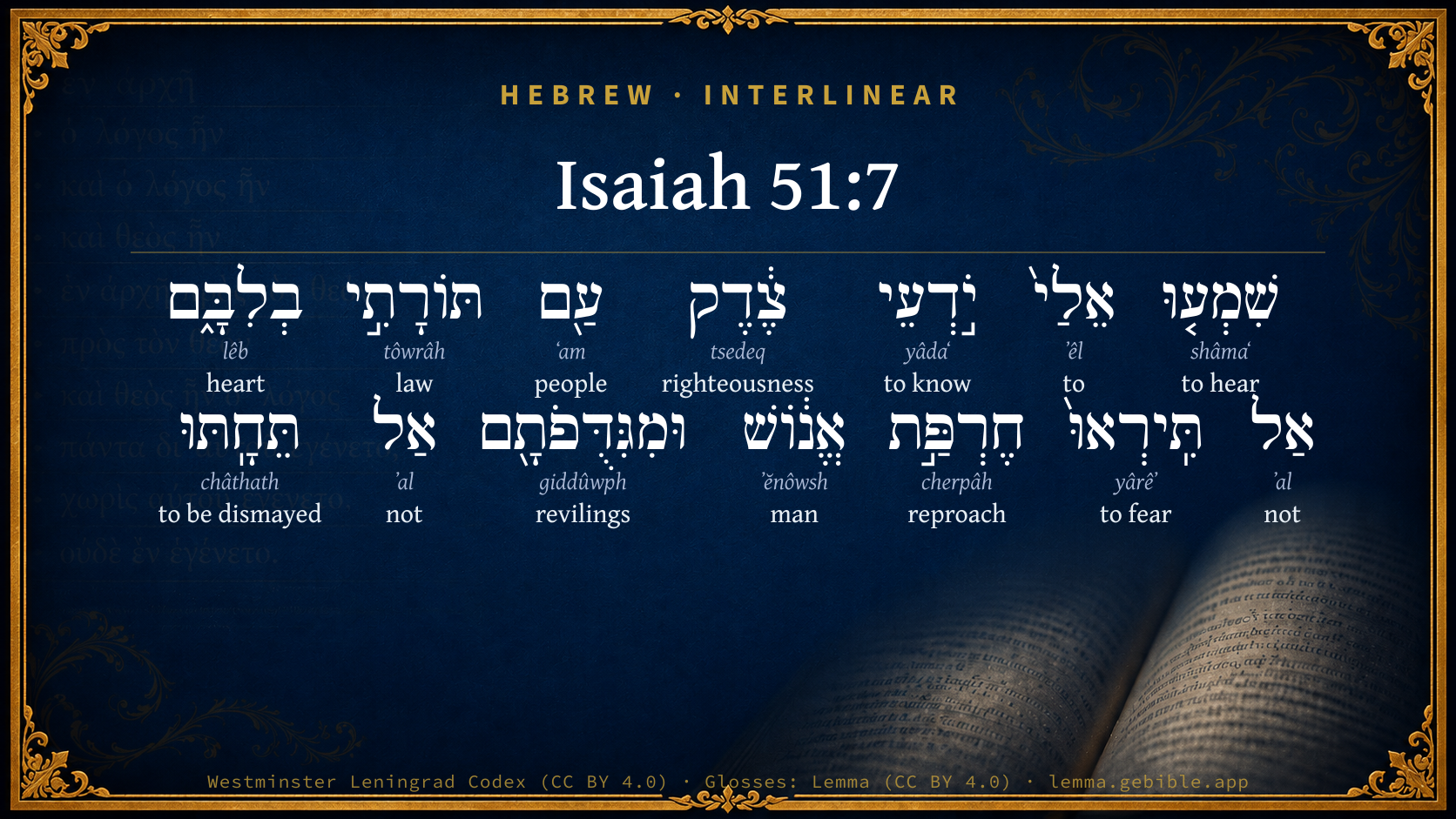
Isaiah 51:7

Hebrew (Westminster Leningrad Codex) Isaiah 51:7 appears in the Hebrew Old Testament. The text above is from the Westminster Leningrad Codex. Each word links to its Strong’s number, a concise gloss, and parsing drawn from the Open Scriptures Hebrew Bible morphology. Click any word for its full Brown-Driver-Briggs (BDB) entry.
Download image
Cite this verse

Isaiah 51:7 (World English Bible). Public Domain. Lemma interlinear Bible study tool, https://lemma.gebible.app/v/isaiah/51/7.

Show BibTeX & RIS
BibTeX
RIS
English Translation
Listen to me, you who know righteousness, the people in whose heart is my law; don't you fear the reproach of men, neither be you dismayed at their insults.
World English Bible · Public Domain
Download a study sheet

One document with this verse’s original text, its word-by-word gloss line, the meaning frame, cross-references with their text, attributed commentary, and full source and license credits — printable, and it pastes into notes with its structure intact.

This verse Autodidact and up

Study sheet (.html) Plain text (.txt)

A passage Seminary Student

Up to 50 verses in one chapter. A passage sheet keeps up to 6 commentary sources and 12 cross-references per verse, in the order this page ranks them, and says so on the sheet whenever that leaves anything out. Ask for a single verse and you get the Autodidact verse sheet above.

Everything on this page stays free to read, with no account — the sheet is a download of what is already on screen, not access to it.

Want to remove ads? Support Godless Engineer
Compare translations 3

The same verse in 3 English versions, stacked beneath the original-language interlinear above. Click any original word for its lexicon entry.

Each is an independent rendering of the whole verse — the interlinear is not word-aligned to these translations.

Highlighted words mark where these versions differ — a whole-verse word diff, not a word-by-word alignment.

  • World English Bible Public Domain
    Listen to me, you who know righteousness, the people in whose heart is my law; don't you fear the reproach of men, neither be you dismayed at their insults.
  • King James Version Public Domain
    Hearken unto me, ye that know righteousness, the people in whose heart is my law; fear ye not the reproach of men, neither be ye afraid of their revilings.
  • unfoldingWord Literal Text CC BY-SA 4.0
    Listen to me, knowers of righteousness, people my law in their heart. May you not fear the reproach of man, and may you not be dismayed by their revilings.

unfoldingWord Literal Text — © unfoldingWord, licensed CC BY-SA 4.0. Word-aligned USFM3 via Door43 (git.door43.org/unfoldingWord/en_ult).

Versions to compare (up to 4)

3 of 4 selected

Show all 18 translations

Every available English version of this verse, each an independent rendering of the whole verse.

  • World English Bible Public Domain
    Listen to me, you who know righteousness, the people in whose heart is my law; don't you fear the reproach of men, neither be you dismayed at their insults.
  • Berean Standard Bible Public Domain
    Listen to Me, you who know what is right, you people with My law in your hearts: Do not fear the scorn of men; do not be broken by their insults.
  • Majority Standard Bible Public Domain
    Listen to Me, you who know what is right, you people with My law in your hearts: Do not fear the scorn of men; do not be broken by their insults.
  • King James Version Public Domain
    Hearken unto me, ye that know righteousness, the people in whose heart is my law; fear ye not the reproach of men, neither be ye afraid of their revilings.
  • American Standard Version (1901) Public Domain
    Hearken unto me, ye that know righteousness, the people in whose heart is my law; fear ye not the reproach of men, neither be ye dismayed at their revilings.
  • Revised Version (1885) Public Domain
    Hearken unto me, ye that know righteousness, the people in whose heart is my law; fear ye not the reproach of men, neither be ye dismayed at their revilings.
  • Geneva Bible (1599) Public Domain
    Hearken vnto me, ye that know righteousnesse, the people in whose heart is my Lawe. Feare ye not the reproche of men, neither be ye afraide of their rebukes.
  • Douay-Rheims (1899) Public Domain
    Hearken to me, you that know what is just, my people who have my law in your heart: fear ye not the reproach of men, and be not afraid of their blasphemies.
  • Young's Literal Translation Public Domain
    Hearken unto Me, ye who know righteousness, A people, in whose heart `is' My law, Fear ye not the reproach of men, And for their reviling be not affrighted,
  • Literal Standard Version CC BY-SA 4.0
    Listen to Me, you who know righteousness, || A people in whose heart [is] My law, || Do not fear the reproach of men, || And do not be frightened of their reviling,
  • Unlocked Literal Bible CC BY-SA 4.0
    Listen to me, you who know what is right, you people who have my law in your heart: Do not fear the insults of men, nor be disheartened by their abuse.
  • unfoldingWord Literal Text CC BY-SA 4.0
    Listen to me, knowers of righteousness, people my law in their heart. May you not fear the reproach of man, and may you not be dismayed by their revilings.
  • Darby Bible Public Domain
    Hearken unto me, ye that know righteousness, the people in whose heart is my law; fear not the reproach of men, and be not afraid of their revilings.
  • World Messianic Bible Public Domain
    “Listen to me, you who know righteousness, the people in whose heart is my law. Don’t fear the reproach of men, and don’t be dismayed at their insults.
  • Webster's Bible Public Domain
    Hearken to me, ye that know righteousness, the people in whose heart is my law; fear ye not the reproach of men, neither be ye afraid of their revilings.
  • Free Bible Version CC BY-SA 4.0
    Listen to me, you who know what's right, and who have really accepted my teachings. Don't be afraid of people's insults—they're just human—or be terrified by their abusive language.
  • Bible in Basic English Public Domain
    Give ear to me, you who have knowledge of righteousness, in whose heart is my law; have no fear of the evil words of men, and give no thought to their curses.
  • JPS Tanakh (1917) Public Domain
    Hearken unto Me, ye that know righteousness, the people in whose heart is My law; fear ye not the taunt of men, neither be ye dismayed at their revilings.

Literal Standard Version (2020), Covenant Press — licensed CC BY-SA 4.0. Text via the HelloAO Bible API (eBible.org). Unlocked Literal Bible (unfoldingWord) — licensed CC BY-SA 4.0. Text via the HelloAO Bible API (eBible.org). unfoldingWord Literal Text — © unfoldingWord, licensed CC BY-SA 4.0. Word-aligned USFM3 via Door43 (git.door43.org/unfoldingWord/en_ult). Free Bible Version, Dr. Jonathan Gallagher — licensed CC BY-SA 4.0. Text via the HelloAO Bible API (eBible.org).

Word by word

More ways to search: Search by grammar → Find every occurrence → Compare this word →

Practice this passage: Drill this verse → Learn its vocabulary →

וּמִגִּדֻּפֹתָ֖ם
giddûwph
H1421
“and · from · revilings · their”
Conjunction + Preposition + Noun, Common, Both, Plural, Construct + Suffix, Personal, 3rd Person, Masculine, Plural
Part of Speech
Conjunction + Preposition + Noun
Type
Common
Gender
Both
Number
Plural
State
Construct
Full BDB Definition

Origin: from H1422

TWOT: 317b

revilings, reviling words
  1. שִׁמְע֤וּ shâmaʻ H8085 “hear” Verb, Qal, Imperative, 2nd Person, Masculine, Plural
  2. אֵלַי֙ ʼêl H413 “to · me” Preposition + Suffix, Personal, 1st Person, Common, Singular
  3. יֹ֣דְעֵי yâdaʻ H3045 “knowing” Verb, Qal, Participle Active, Masculine, Plural, Construct
  4. צֶ֔דֶק tsedeq H6664 “righteousness” Noun, Common, Masculine, Singular, Absolute
  5. עַ֖ם ʻam H5971 “people” Noun, Common, Masculine, Singular, Absolute
  6. תּוֹרָתִ֣י tôwrâh H8451 “law · my” Noun, Common, Feminine, Singular, Construct + Suffix, Personal, 1st Person, Common, Singular
  7. בְלִבָּ֑ם lêb H3820 “in/at · heart · their” Preposition + Noun, Common, Masculine, Singular, Construct + Suffix, Personal, 3rd Person, Masculine, Plural
  8. אַל ʼal H408 “not” Particle, Negative
  9. תִּֽירְאוּ֙ yârêʼ H3372 “to fear” Verb, Qal, Jussive, 2nd Person, Masculine, Plural
  10. חֶרְפַּ֣ת cherpâh H2781 “reproach of” Noun, Common, Feminine, Singular, Construct
  11. אֱנ֔וֹשׁ ʼĕnôwsh H582 “man” Noun, Common, Masculine, Singular, Absolute
  12. אַל ʼal H408 “not” Particle, Negative
  13. תֵּחָֽתּוּ châthath H2865 “to be dismayed” Verb, Niphal, Jussive, 2nd Person, Masculine, Plural

About this verse

These counts appear in no published source. They are computed here, from the morphology-tagged text and Lemma’s own curated glosses. What Lemma adds →

14
words
13
distinct lemmas
Prophets
section

Notable vocabulary

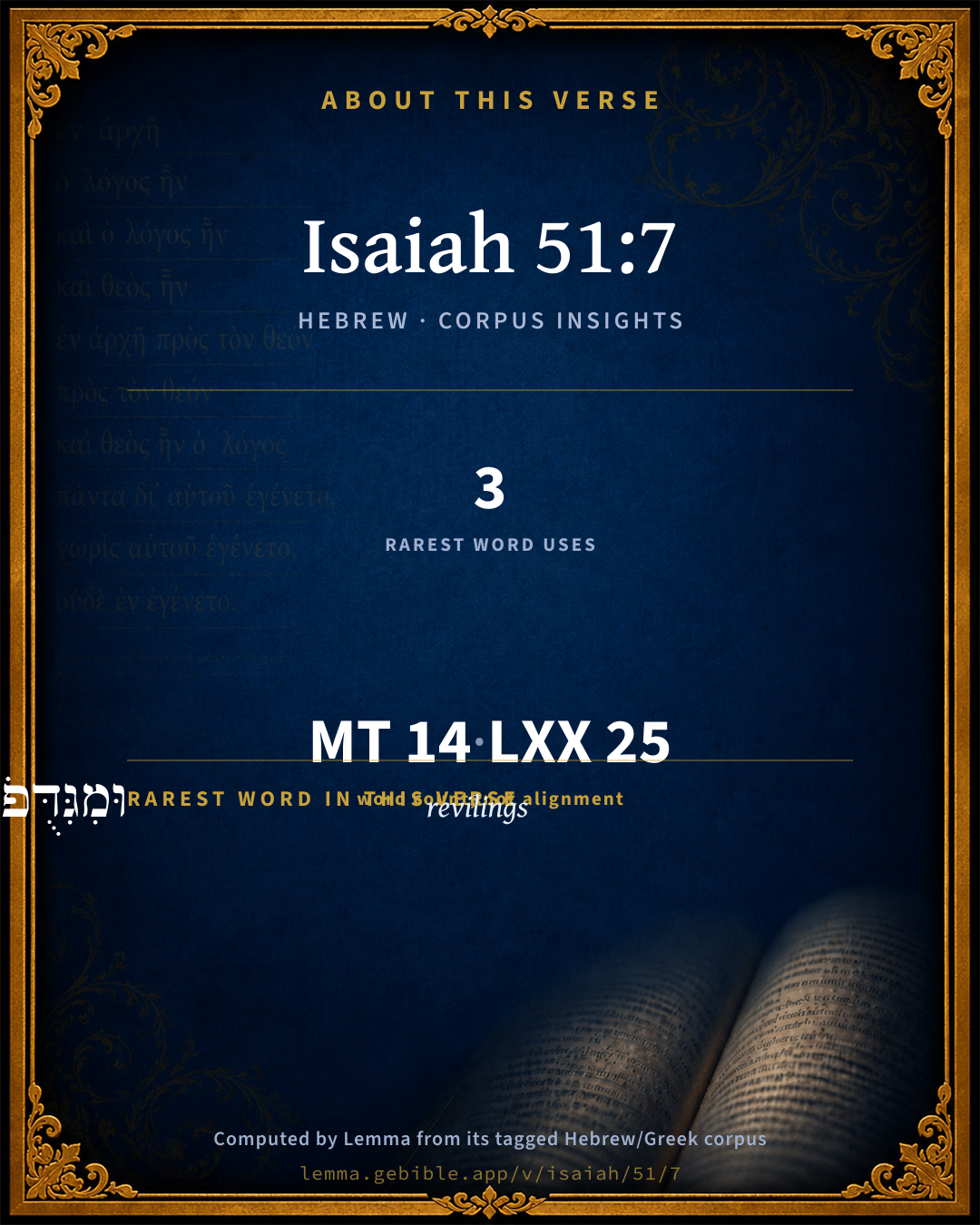
The rarest word here is וּמִגִּדֻּפֹתָ֖ם revilings H1421 — appearing just 3 times in the whole Hebrew Bible.

Shared distinctive vocabulary

וּמִגִּדֻּפֹתָ֖ם revilings H1421 occurs in 3 verses of the Hebrew Bible. Also found in:

Grammatical profile

  • 4 verbs
  • 7 nouns
  • 1 preposition
  • 2 particles

Verb forms

  • שִׁמְע֤וּ Qal · Imperative
  • יֹ֣דְעֵי Qal · Participle Active
  • תִּֽירְאוּ֙ Qal · Jussive
  • תֵּחָֽתּוּ Niphal · Jussive

Repetition

A word recurs within this verse — often emphatic in Hebrew:

  • אַל not H408 ×2

Hebrew & Septuagint length

In English translation the verse runs 29 words from the Hebrew and 27 from the Septuagint (LXX English) — closely comparable.

A rough comparison of the two English renderings, which tokenize alike — not a word-level alignment.

Word counts can differ between the Hebrew and the Greek without any difference in meaning — e.g. the Hebrew direct-object marker אֵת has no separate Greek word, and Greek often adds the article ὁ.

In the original languages it is 14 Hebrew tokens and 25 Greek tokens — but the two are counted differently (Hebrew bundles its prefixes and suffixes into one token; the Greek is in lemma form), so that isn’t a like-for-like length.

Cross-references

18

Topical passages linked to Isaiah 51:7 in the Treasury of Scripture Knowledge — connected by theme and wording, ordered by reader-vote popularity; previews shown in the World English Bible.

  • Matthew 5:11 "Blessed are you when people reproach you, persecute you, and say all kinds of evil against you falsely, for my sake.
  • Psalms 37:31 The law of his God is in his heart. None of his steps shall slide.
  • Ezekiel 2:6 You, son of man, don't be afraid of them, neither be afraid of their words, though briers and thorns are with you, and you do dwell among scorpions: don't be afraid of their words, nor be dismayed at their looks, though they are a rebellious house.
  • 1 Peter 4:14 If you are insulted for the name of Christ, blessed are you; because the Spirit of glory and of God rests on you. On their part he is blasphemed, but on your part he is glorified.
  • Isaiah 51:1 Listen to me, you who follow after righteousness, you who seek Yahweh: look to the rock whence you were hewn, and to the hold of the pit whence you were dug.
  • Acts 5:41 They therefore departed from the presence of the council, rejoicing that they were counted worthy to suffer dishonor for Jesus' name.
  • Psalms 40:8 I delight to do your will, my God. Yes, your law is within my heart."
  • Jeremiah 1:17 You therefore gird up your loins, and arise, and speak to them all that I command you: don't be dismayed at them, lest I dismay you before them.
  • Luke 12:4–5 "I tell you, my friends, don't be afraid of those who kill the body, and after that have no more that they can do.
  • 2 Corinthians 3:3 being revealed that you are a letter of Christ, ministered by us, written not with ink, but with the Spirit of the living God; not in tablets of stone, but in tablets that are hearts of flesh.
  • Philippians 3:8 Yes most assuredly, and I count all things to be loss for the excellency of the knowledge of Christ Jesus, my Lord, for whom I suffered the loss of all things, and count them nothing but refuse, that I may gain Christ
  • Titus 2:11–12 For the grace of God has appeared, bringing salvation to all men,
  • 1 Peter 4:4 They think it is strange that you don't run with them into the same excess of riot, blaspheming:
  • Jeremiah 31:33–34 But this is the covenant that I will make with the house of Israel after those days, says Yahweh: I will put my law in their inward parts, and in their heart will I write it; and I will be their God, and they shall be my people:
  • Matthew 10:28 Don't be afraid of those who kill the body, but are not able to kill the soul. Rather, fear him who is able to destroy both soul and body in Gehenna.
  • Luke 6:22 Blessed are you when men shall hate you, and when they shall exclude and mock you, and throw out your name as evil, for the Son of Man's sake.
  • Philippians 3:10 that I may know him, and the power of his resurrection, and the fellowship of his sufferings, becoming conformed to his death;
  • Hebrews 10:16 "This is the covenant that I will make with them: 'After those days,' says the Lord, 'I will put my laws on their heart, I will also write them on their mind;'" then he says,

Cross-references courtesy of OpenBible.info (CC BY 4.0).

Hebrew and Greek witnesses Masoretic Hebrew ↔ Greek Septuagint

The same verse in the two great witnesses to the Old Testament, shown verse-for-verse.

These are two independent witnesses, not word-aligned to each other, and the Septuagint is shown in lemma (dictionary) form.

Hebrew Isaiah 51:7 Masoretic · Westminster Leningrad Codex

שִׁמְע֤וּ אֵלַי֙ יֹ֣דְעֵי צֶ֔דֶק עַ֖ם תּוֹרָתִ֣י בְלִבָּ֑ם אַל תִּֽירְאוּ֙ חֶרְפַּ֣ת אֱנ֔וֹשׁ וּמִגִּדֻּפֹתָ֖ם אַל תֵּחָֽתּוּ

Listen to me, you who know righteousness, the people in whose heart is my law; don't you fear the reproach of men, neither be you dismayed at their insults.

World English Bible · Public Domain

Greek LXX Isaiah 51:7 Septuagint · lemma form

ἀκούω ἐγώ ὁ εἶδον κρίσις λαός ἐγώ ὅς ὁ νόμος ἐγώ ἐν ὁ καρδία σύ μή φοβέω ὀνειδισμός ἄνθρωπος καί ὁ φαυλισμός αὐτός μή ἡττάω

Hear me, you⌃ that know judgment, the people in whose heart is my law: fear not the reproach of men, and be not overcome by their contempt.

LXX2012 (modern English Septuagint) · Public Domain

Hebrew: Westminster Leningrad Codex (CC BY 4.0). Greek: Septuagint (public domain); English from LXX2012 (modern English Septuagint) (Public Domain). How the Septuagint differs from the Hebrew →

Targum (Aramaic paraphrase)

1

The Targum is the ancient Jewish Aramaic paraphrase of the Hebrew Scriptures — an interpretive translation, not the Hebrew text itself. Onkelos (literal) and Pseudo-Jonathan (expansive) render the Torah, and Jonathan the Prophets. Coverage is partial: where no permissively-licensed English translation exists for a verse, only the Aramaic is shown. This is verse-level text, not a word-by-word alignment to the Hebrew.

  1. Targum Jonathan Prophets (Joshua–Malachi)
    קַבִּילוּ לְמֵימְרִי יָדְעֵי קוּשְׁטָא עַמָא דְאוּלְפַן אוֹרַיְתִי בְּלִבְּהוֹן לָא תִדְחֲלוּן מֵחִיסוּדֵי בְנֵי אֱנָשָׁא וּמֵאִתְרַבְרְבוּתְהוֹן לָא תִתַבְרוּן:

    Hearken unto my WORD, ye that know the truth, the people in whose heart is the instruction of my law; be ye not afraid of the reproaches of the sons of men, neither be terrified on account of their grandeur.

    Targum Jonathan — Aramaic: “Mikraot Gedolot” (public domain). English: “Sefaria Community Translation” (CC0 1.0 (public-domain dedication)); “London "Chaldee Paraphrase," 1871” (public domain). Text via Sefaria.

Commentary

Notes on Isaiah 51:7 from classic Christian and Jewish commentators (each source and its license shown beneath its notes). The classic Christian expositions comment on the surrounding passage and are grouped to its opening verse, so a note may address several verses; the Jewish commentaries on the Tanakh (Rashi and others) are per-verse, so they appear only where the commentator wrote on this verse.

Lemma curates 59 commentaries, every one of them public domain or Creative Commons licensed, each selected and text-cleaned for this edition rather than reprinted as found. About our sources →

Trapp's Complete Commentary

John Trapp

Isa 51:7 Hearken unto me, ye that know righteousness, the people in whose heart [is] my law; fear ye not the reproach of men, neither be ye afraid of their revilings.

Ver. 7. Hearken unto me.] See on Isa 51:2.

Ye that know righteousness.] With a knowledge apprehensive, and affective also.

The people in whose heart is my law.] And not in your heads only.

Fear ye not the reproach of men.] Tertullian thinketh that our Saviour alludeth to this of Isaiah in Luk 6:22. We should not be scoffed out of our religion, but patiently suffer "cruel mockings."

John Trapp, A Commentary or Exposition upon All the Books of the Old and New Testament (1647–1656) — public domain. Text from a community e-Sword module.

The Biblical Illustrator

Joseph S. Exell

Isa_51:7-8

Hearken unto Me, ye that know righteousness

Christians encouraged against the fear of man

I.

THE PERSONS ADDRESSED.

1. Those who know righteousness.

2. They have the law of God in their heart.

II. THE ADDRESS MADE TO THEM. Hearken unto Me, etc.

1. Let us remember who is the speaker of these words.

2. The address may be considered as containing an encouraging exhortation enforced by powerful arguments.

3. Consider by what powerful arguments this exhortation is enforced: They who now revile the people of God will quickly be brought to an end. If their malice be not extinguished, yet the means of gratifying it will be no more. They are mortals, and as such they must soon die.

4. On the other hand, My righteousness (saith the Lord) shall be for ever, and My salvation from generation to generation. In vain do ungodly men speak evil of His cause. It shall survive all their attacks; and shall increase, when they who reviled, or opposed it, shall be silent in darkness. In vain are His people reproached. They cannot be really injured by such attempts. (E. Cooper.)

Mans mortality

The matter is not great which they say of us who must be worms meat shortly. (M. Henry.)

Futility of human opposition to the Gospel

Clouds darken the sun, but give no obstruction to its progress. (M. Henry.)

The Biblical Illustrator, edited by Joseph S. Exell (c. 1880s–1900s) — public domain. Text from a community e-Sword module.

Joseph Benson's Commentary

Isa 51:7-8. Hearken, ye that know righteousness — Who not only understand, but love and practise it; whose persons are justified, whose nature is renewed, and whose lives are subject to my laws. These seem to be distinguished from those who are spoken of (Isa 51:1) as following after righteousness. These had attained what the others were only in pursuit of. The people in whose heart is my law — Who are here opposed to the carnal Jews, that had the law written only on tables of stone. Compare 2Co 3:3; Heb 8:10. Fear ye not the reproach of men — The censures of your carnal countrymen, who load their believing and godly brethren with a world of reproaches; but let not these things discourage you: for the moth shall eat them up, &c. — Those that reproach you shall be easily and soon destroyed, and so God will avenge your cause upon them, and deliver you from their injurious treatment; and the worm shall eat them like wool — Like a woollen garment, which is sooner corrupted by moths, or such creatures, than linen.

Joseph Benson's Commentary on the Old and New Testaments (1811–1818) — public domain. Text from a community e-Sword module.

Tyndale Open Study Notes

Tyndale Open Resources

51:7 cherish my law in your hearts: Beyond simply knowing God’s word, the Lord desires for his people to internalize, treasure, and obey it (see also Ps 37:31; Jer 31:33). • Those who obey the Lord often endure scorn and insults (see also Matt 5:10-12).

Tyndale Open Study Notes — © Tyndale Open Resources, licensed CC BY-SA 4.0. Text via the HelloAO Bible API.

Jamieson, Fausset & Brown

Robert Jamieson, A. R. Fausset & David Brown

know righteousness--(See on Isa 51:1).

Jamieson, Fausset & Brown — Commentary Critical and Explanatory on the Whole Bible (1871) — public domain (CC PDM 1.0). Text via the HelloAO Bible API.

Ellicott's Commentary for English Readers

(7) Ye that know righteousness.—Jehovah, through His Servant, speaks to the Israel within Israel, the Church within the Church. They need support against the scorn and reproach of men, and are to find it in the thought that the revilers perish and that Jehovah is eternal.

A Bible Commentary for English Readers, edited by Charles John Ellicott (1878–1897) — public domain. Text from a community e-Sword module.

The Cambridge Bible for Schools and Colleges

gen. ed. J. J. S. Perowne

7. To know righteousness does not differ in meaning from “follow after righteousness” in Isa_51:1. Both expressions refer to righteousness in the ethical sense; there it is represented as an ideal steadily pursued, here as a rule of life apprehended by the heart and conscience. This inward possession of righteousness is the earnest of the external righteousness, the vindication of right, spoken of in Isa_51:6; Isa_51:8.

the people in whose heart is my instruction] Cf. Jer_31:33.

7, 8. In the hope of this everlasting salvation the true Israelites may well endure for a season the reproach of men.

The Cambridge Bible for Schools and Colleges (gen. ed. J. J. S. Perowne; Cambridge University Press, 1878–1918) — public domain. Text from a community e-Sword module.

John Gill's Exposition

Hearken unto me, ye that know righteousness,.... The righteousness of God, and of his law; the purity of his nature, what righteousness is agreeable to him, and required by him; the imperfection and insufficiency of a man's own righteousness, and the glory and fulness of Christ's righteousness, revealed in the Gospel; and so know that, as to approve of it, follow after it, lay hold upon it, believe in it, and rejoice in it, as their justifying righteousness:

the people in whose heart is my law; not in their heads only, but in their hearts; having an understanding of it, an affection for it, and the bias of their minds toward it; being written there by the finger of the divine Spirit, according to the covenant of grace, Jer 31:33, and not in tables of stone, as the law of Moses, and of which this is not to be understood; but of the law or doctrine of Christ, even the everlasting Gospel; which coming with power, and the Holy Ghost, into the hearts of the Lord's people, is received by them with great approbation and affection, in faith and love; they obey it from their hearts, and are cast into the mould of it:

fear ye not the reproach of men, neither be ye afraid of their revilings; either of the Jews, the Scribes and Pharisees, for renouncing a pharisaical righteousness, and embracing the righteousness of Christ; for rejecting the traditions of the elders, the rituals of the ceremonial law, and the doctrine of justification by the works of the moral law; and for cordially receiving the pure Gospel of Christ: or of idolatrous Heathens, from whom they were called, and that for leaving the religion of their country, and the gods of their fathers, and professing the one only true God, and Jesus Christ, whom he has sent: or of the antichristian worshippers, and of the man of sin at the head of them, who belches out his blasphemies against God and Christ, his tabernacle and saints; but neither their shocking blasphemies, nor spiteful taunts and jeers, nor menacing words, nor even cruel persecutions, should deter the saints from the profession of Christ and his Gospel.

John Gill's Exposition of the Whole Bible (1746–1763) — public domain (CC PDM 1.0). Text via the HelloAO Bible API.

Albert Barnes' Notes on the Bible

Hearken unto me, ye that know righteousness - My people who are acquainted with my law, and who are to be saved. This is addressed to the pious parlor the Jewish nation.

Fear ye not the reproach of men - If we have the promise of God, and the assurance of his favor, we shall have no occasion to dread the reproaches and the scoffs of people (compare Mat 10:28).

Albert Barnes' Notes on the Bible (1834–1885) — public domain. Text from a community e-Sword/MySword module.

Matthew Poole's English Annotations

That know righteousness; that love and practise it, as knowing is commonly used.

In whose heart is my law; who are tacitly opposed to the carnal Jews that had the law written only in tables. Compare 2Co 3:3; Heb 8:10.

The reproach of men; the censures of the carnal Jews. who will lead their believing and godly brethren with a world of reproaches: but let not these things discourage you.

Matthew Poole's English Annotations on the Holy Bible (1683–1685) — public domain. Text from a community e-Sword/MySword module.

Whedon's Commentary on the Bible

Daniel D. Whedon

7, 8. Hearken unto me — Another occasion for a call to God’s people to “hearken” — that of need of fearlessness against reproach and persecutors. These, too, are temporary.

Revilings — Remember Sennacherib.

Like a garment… like wool — The play of the Hebrew here cannot be reached in English. The word “garment” (an old figure) is, in a short space, thus used the third time, and the word “wool” the second time. For explanation see Isa_50:9, last clause.

Daniel D. Whedon (gen. ed.), Commentary on the Old and New Testaments (1874–1909) — public domain. Text from a community e-Sword module.

The Pulpit Commentary

Hearken unto me, ye that know righteousness. The highest grade of faithfulness is here addressed not those who "seek" (ver. 1), but those who have found who know righteousness," and have the "law" of God in their hearts. " Such persons may still be liable to one weakness they may "fear the reproach of men." The prophet exhorts them to put aside this fear, remembering

(1) the nothingness of humanity, and

(2) the eternity and imperishableness of God"s judgments.

HOMILETICS Ver. 7. The servants of God must not fear the reproach of men.

The reproach of men is a thing of small account

I BECAUSE MEN ARE APT TO BE MISTAKEN IN THEIR JUDGMENTS. The bulk of men have no wish even to be fair in their judgments. They praise and blame, acquit and condemn, either as their own interests party or other are concerned, or sometimes quite at random, according as the fancy takes them. Even such as wish to be fair very often misjudge, either

(1) from a want of capacity to judge aright in a delicate ease; or

(2) from not possessing sufficient data upon which to form a right judgment. It is to be remembered that men"s motives are hidden, and can only be guessed at by others; yet the motive is the main point in an action, and that on which its moral character almost wholly depends. If we mistake the motive, we may condemn severely what, if we had really known the motive, we should have highly praised.

II BECAUSE MEN"S JUDGMENTS SO FREQUENTLY CHANGE. The idol of a nation to-day becomes their detestation to-morrow; or, if not to-morrow, at any rote within a few years. Nothing is more fickle than the popular voice, which will cry one day, "Hosanna to the Son of David!" and, a week later, "Crucify him! crucify him!" The opinion formed of.a man by his contemporaries is frequently reversed by posterity; and even posterity is not always steadfast, a later age often contradicting the decisions of an earlier. Historic characters, long condemned with almost absolute unanimity, are rehabilitated from time to time by clever writers, and are given niches in the Valhalla of the future.

III BECAUSE MAN HIMSELF IS ALTOGETHER SO FLEETING, SO WEAK, AND SO LITTLE WORTHY OF REGARD. "Cease ye from man, whose breath is in his nostrils: for wherein is he to be accounted of?". (Isa_2:22) At the best, what is human praise or blame? An opinion, founded on imperfect data, which can at most affect us during the brief term of our sojourn here. What are reproaches and revilings? The weak ways which men have of venting their spite or their ill humour, when some one, of whom they know very little, has acted otherwise than they expected or wished. "Hard words," it is often remarked, "break no bones." Human censure is but a breath. Why should we allow it to affect us at all? It does not matter what men think of us, but what God thinks. No one was ever more reviled than the One only perfect Man whom the world has ever seen.

Vers. 7, 8, 12, 13. A sure criterion of character, etc.

This address of Jehovah to the good and worthy among his people contains

I A SURE CRITERION OF CHARACTER.

1. It is well to be hearers of God"s Word. All the Jews were that; they were all the children of privilege. This, however, was by no means sufficient to prove that they were the children of God.

2. It is better to know his Word and to understand his will. It says something for us if we can be thus addressed, "Ye that know righteousness." But there are many who clearly apprehend their duty, and who, for one reason or another, refrain from doing it.

3. The certain test of spiritual worth is that God"s Law is in the heart: "In whose heart is my Law." They who can say with the psalmist," Oh how love I thy Law! it is my meditation all the day"; (Psa_119:97, Psa_119:111) who esteem God"s precepts as more desirable than gold and more sweet than honey; (Psa_19:10) who delight to do his will, for his Law is within their heart, the object of their affection, the source of their joy, the well-spring of their comfort, the treasury of their hope; these are they whom God loves and honours; and theirs is the kingdom of heaven. (see Joh_14:15, Joh_14:16, Joh_14:21, 23 Mat_7:21)

II A PROBABLE INCIDENT OF A FAITHFUL LIFE. "Fear ye not the reproach of men, neither be ye afraid of their revilings." It is highly probable, indeed morally certain, that if we are thoroughly loyal to our Lord and true to our own convictions we shall incur the secret dislike and also the active opposition of men. Implicitly, if not explicitly, we shall condemn their theories and their doings, and they will turn upon us in anger or in self-detente. He who never comes into sharp collision with the sentiments and habits of wicked men must either live a life of very unusual seclusion or else have grave reason to suspect his fidelity to Christ.

III TWO DECISIVE CONSIDERATIONS.

1. Fidelity to conviction means the preference of God to man. Men are saying, "Hearken unto us unto us, thy fellows, thy partners, thy confederates; unto us who will share thy responsibility and thy sin, and perish with thee when thou tallest. But God is saying, "Hearken unto me unto me, thy Creator, thy Benefactor, thy Divine Friend. A Divine Saviour is saying unto us, "Follow me," in the paths of purity, of integrity, of piety, of consecration (see vers. 12, 13).

2. Fidelity to conviction means ultimate triumph, but unfaithfulness means final ruin. The devices of iniquity will come to nought, and the guilty themselves will perish. "The moth shall eat them up like a garment." But "he that doeth the will of God abideth for ever." "God"s righteousness shall be for ever," and they who are loving and living it shall never be confounded. Theirs is the present favour and everlasting friendship of the Eternal. C.

Vers. 7, 12, 13. "Fear," and "Fear not.

"Fear ye not the reproach of men;" "Afraid of a man that shall die;" "Forgettest the Lord thy Maker." It has been said, "Fear God, and thou shalt have none else to fear." And the apostle, glorifying the fear of God by calling it love, says, "Perfect love casteth out fear." The immediate connection of the passage is Israel"s fear of the Babylonians. But they need not have feared if they had looked to the "Lord as their Defence, and to the God of Jacob as their Refuge unto the Lord who "could perform all things for them." "Let not those who embrace the gospel righteousness be afraid of those who will call them Beelzebub, and will say all manner of evil against them falsely. Let them not be afraid of them; let them not be disturbed by these opprobrious speeches, nor made uneasy by them, as if they would be the ruin of their reputation and honour, and they must for ever lie under the load of them. Let them not be afraid of their executing their menaces, nor be deterred thereby from their duty, nor frightened into any sinful compliances, nor driven to take any indirect courses for their own safety. Those can bear but little for Christ that cannot bear a hard word for him" (Matthew Henry).

I NATURAL FEAR OF MAN. Because the conquest of man by the spirit of self, self-will, self-pleasing, has set every man, in greater or less degree, upon getting advantage over his brother; and so we all go in suspicion and fear of one another. Illustrate from the jealousies and rivalries of society, the competitions of business, the ambitions and conflicts of nations. Governments are organizations to keel) within.safe limits men"s fears of one another. The only natural triumph over such fear is for men to become possessed with the idea of serving one another, instead of taking advantage of, and getting something out of, one another. George Macdonald has a dream in one of his works ("Wingfold, Curate"), in which heaven is pictured as busy earth, just as we know it, only everybody is set upon serving his neighbour, and nobody ever gets the idea of making his neighbour serve him. Nobody has anything to fear in such a heaven or in such an earth.

II PROPER FEAR OF GOD. That must be supreme. It must be the fear that draws us near to him in trust; that gives us the joy of obeying and following him; and that really is filial love. That fear is a sanctifying force to us, just as reverent fear of his father mightily helps the boy to do right. That fear is a resting, quieting influence upon us; it makes us feel safe as the boy feels in the storm, if the father whom he fears is at the helm. R.T.

The Pulpit Commentary (1880–1919), ed. H.D.M. Spence-Jones & Joseph S. Exell — public domain. Text from a community e-Sword module.

John Wesley's Explanatory Notes

Know - That love and practice it.

John Wesley, Explanatory Notes Upon the Whole Bible (1754–1765) — public domain. Text via the GEBible commentary corpus.

Keil & Delitzsch

C. F. Keil & F. Delitzsch

Upon this magnificent promise of the final triumph of the counsel of God, an exhortation is founded to the persecuted church, not to be afraid of men. "Hearken unto me, ye that know about righteousness, thou people with my law in the heart; fear ye not the reproach of mortals, and be ye not alarmed at their revilings. For the moth will devour them like a garment, and the worm devour them like woollen cloth; and my righteousness will stand for ever, and my salvation to distant generations." The idea of the "servant of Jehovah," in its middle sense, viz., as denoting the true Israel, is most clearly set forth in the address here. They that pursue after righteousness, and seek Jehovah (Isa 51:1), that is to say, the servants of Jehovah (Isa 65:8-9), are embraced in the unity of a "people," as in Isa 65:10 (cf., Isa 10:24), i.e., of the true people of God in the people of His choice, and therefore of the kernel in the heart of the whole mass - an integral intermediate link in the organism of the general idea, which Hvernick and, to a certain extent, Hofmann eliminate from it,

(Note: Hvernick, in his Lectures on the Theology of the Old Testament, published by H. A. Hahn, 1848, and in a second edition by H. Schultz, 1863; Drechsler, in his article on the Servant of Jehovah, in the Luth. Zeitschrift, 1852; V. Hofmann, in his Schriftbeweis, ii. 1, 147. The first two understand by the servant of Jehovah as an individual, the true Israel personified: the idea has simply Israel as a whole at its base, i.e., Israel which did not answer to its ideal, and the Messiah as the summit, in whom the ideal of Israel was fully realized. Drechsler goes so far as to call the central link, viz., an Israel true to its vocation, a modern abstraction that has no support in the Scriptures. Hofmann, however, says that he has no wish to exclude this central idea, and merely wishes to guard against the notion that a number of individuals, whether Israelites generally or pious Israelites, are ever intended by the epithet "servant of Jehovah." "The nation," he says himself at p. 145, "was called as a nation to be the servant of God, but it fulfilled its calling as a church of believers." And so say we; but we also add that this church is a kernel always existing within the outer ecclesia mixta, and therefore always a number of individuals, though they are only known to God.)

but not without thereby destroying the typical mirror in which the prophet beholds the passion of the One. The words are addressed to those who know from their own experience what righteousness is as a gift of grace, and as conduct in harmony with the plan of salvation, i.e., to the nation, which bears in its heart the law of God as the standard and impulse of its life, the church which not only has it as a letter outside itself, but as a vital power within (cf., Psa 40:9). None of these need to be afraid of men. Their despisers and blasphemers are men ('ĕnōsh; cf., Isa 51:12, Psa 9:20; Psa 10:18), whose pretended omnipotence, exaltation, and indestructibility, are an unnatural self-convicted lie. The double figure in Isa 51:8, which forms a play upon words that cannot well be reproduced, affirms that the smallest exertion of strength is quite sufficient to annihilate their sham greatness and sham power; and that long before they are actually destroyed, they carry the constantly increasing germ of it within themselves. The sâs, says a Jewish proverb, is brother to the ‛âsh. The latter (from ‛âshēsh, collabi, Arab. ‛aththa, trans. corrodere) signifies a moth; the former (like the Arabic sūs, sūse, Gr. σής) a moth, and also a weevil, curculio. The relative terms in Greek are σής (Armen. tzetz) and κίς. But whilst the persecutors of the church succumb to these powers of destruction, the righteousness and salvation of God, which are even now the confidence and hope of His church, and the full and manifest realization of which it will hereafter enjoy, stand for ever, and from "generation to generation," ledōr dōrı̄m, i.e., to an age which embraces endless ages within itself.

Keil & Delitzsch — Biblical Commentary on the Old Testament (1861–1891) — public domain (CC PDM 1.0). Text via the HelloAO Bible API. (Old Testament only.)

J. A. Alexander on Isaiah

Joseph Addison Alexander

“Hearken unto me, ye that know righteousness, people (with) my law in their heart; fear not the reproach of men, and by their scoffs be not broken (in spirit, (i.e., terrified)).” The distinction here implied is still that between the righteous and the wicked as the two great classes of mankind. Those who are described in v. 1 as seeking after righteousness are here said to ‘know it,’ (i.e., know it by experience). The presence of the law in the heart denotes not mere affection for it but a correct apprehension of it, as the heart in Hebrew is put for the whole mind or soul; it is therefore a just parallel to knowing in the other member of the clause. The opposite class, or those who know not what is right, and who have not God’s law in their heart, are comprehended under the generic title ‘man’, with particular reference to the derivation of the Hebrew word from a root meaning to be weak or sickly, so that its application here suggests the idea of their frailty and mortality, as a sufficient reason why God’s people should not be afraid of them.

Joseph Addison Alexander, The Prophecies of Isaiah (1846–1847; New York: Scribner, 1870–1878) — public domain. Text from a community e-Sword module.

unfoldingWord translationNotes

Door43 World Missions Community

General Information:

Yahweh continues speaking to the people of Israel.

who have my law in your heart

Having God's law in the heart represents knowing God's law and wanting to obey it. AT: "who know and honor my law" (See: Metaphor)

nor be disheartened by their abuse

This can be stated in active form. AT: "and do not lose your courage when they hurt you" (See: Active or Passive)

For the moth will eat them up like a garment, and the worm will eat them like wool

God speaks of people who abuse those who are righteous as if they were wool garments, and of their being destroyed as if insects ate them. (See: Metaphor)

my righteousness will be forever

God's "righteousness" here represents him ruling righteously. AT: "my righteous rule will be forever" or "I will rule righteously forever" (See: Metonymy)

and my salvation to all generations

God's "salvation" here represents the result of his salvation, which is freedom. Being "to all generations" represents lasting forever. AT: "I will save you, and you will be free forever" (See: Metonymy)

translationWords

people of God

law

heart

fear

righteous

eternity

save

generation

unfoldingWord translationNotes — © Distant Shores Media and the Door43 World Missions Community, licensed CC BY-SA 4.0. Source: git.door43.org/Door43/en_tn.

Ibn Ezra

Rabbi Abraham ibn Ezra

The reproach of men. The reproach of the Babylonians and the heathen peoples that have been brought to Babylon as captives.

Ibn Ezra on the Tanakh — English translations: “Sefaria Community Translation” (CC0 1.0 (public-domain dedication)); “Yalkut, Sifsei Chachomim Chumash, Metsudah Publications, 2009” (CC BY 4.0); and “Commentary of Ibn Ezra on Isaiah - trans. by M. Friedlander, 1873” (public domain). Text via Sefaria.

Lesson kit

Teaching starters — assembled from the data on this page, not authored interpretation. Every prompt links to the verse data it draws on. Edit before teaching.

Isaiah, in the Prophets, opens this verse with 14 words (13 distinct Hebrew lemmas). Its most distinctive word is giddûwph (“revilings”). A historical commentator’s framing appears above. Read the whole chapter for the surrounding context.

Discussion questions

  1. How does “revilings” (giddûwph) shape what this verse is saying?
  2. Isaiah 43:28 shares the word «revilings» with this verse. How do the two illuminate each other?
  3. “not” occurs 2× in this one verse. What is the effect of the repetition?
  4. The translations on this page render this verse differently — a whole-verse word diff, not a word-by-word alignment. What might account for the different wordings?
  5. The verb «שִׁמְע֤וּ» is Qal Imperative. How does its form color the action?
  6. Reading how Trapp's Complete Commentary and The Biblical Illustrator read this verse, where do the two commentators agree and where do they part?

Things to notice

Reading settings

Reading text

Shown beneath each verse's original-language words.

Old Testament
Old Testament edition

Read the OT as the Masoretic Hebrew (MT) or the Greek Septuagint (LXX).

English shown for the Greek Septuagint (in the Hebrew ↔ Greek comparison).

Comparing translations? Open the Compare panel on any verse page to stack up to four side by side.