
Nehemiah 9:26

Hebrew (Westminster Leningrad Codex) Nehemiah 9:26 appears in the Hebrew Old Testament. The text above is from the Westminster Leningrad Codex. Each word links to its Strong’s number, a concise gloss, and parsing drawn from the Open Scriptures Hebrew Bible morphology. Click any word for its full Brown-Driver-Briggs (BDB) entry.
Download image
Cite this verse

Nehemiah 9:26 (World English Bible). Public Domain. Lemma interlinear Bible study tool, https://lemma.gebible.app/v/nehemiah/9/26.

Show BibTeX & RIS
BibTeX
RIS
English Translation
Nevertheless they were disobedient, and rebelled against you, and cast your law behind their back, and killed your prophets that testified against them to turn them again to you, and they committed awful blasphemies.
World English Bible · Public Domain
Download a study sheet

One document with this verse’s original text, its word-by-word gloss line, the meaning frame, cross-references with their text, attributed commentary, and full source and license credits — printable, and it pastes into notes with its structure intact.

This verse Autodidact and up

Study sheet (.html) Plain text (.txt)

A passage Seminary Student

Up to 50 verses in one chapter. A passage sheet keeps up to 6 commentary sources and 12 cross-references per verse, in the order this page ranks them, and says so on the sheet whenever that leaves anything out. Ask for a single verse and you get the Autodidact verse sheet above.

Everything on this page stays free to read, with no account — the sheet is a download of what is already on screen, not access to it.

Want to remove ads? Support Godless Engineer
Compare translations 3

The same verse in 3 English versions, stacked beneath the original-language interlinear above. Click any original word for its lexicon entry.

Each is an independent rendering of the whole verse — the interlinear is not word-aligned to these translations.

Highlighted words mark where these versions differ — a whole-verse word diff, not a word-by-word alignment.

  • World English Bible Public Domain
    Nevertheless they were disobedient, and rebelled against you, and cast your law behind their back, and killed your prophets that testified against them to turn them again to you, and they committed awful blasphemies.
  • King James Version Public Domain
    Nevertheless they were disobedient, and rebelled against thee, and cast thy law behind their backs, and slew thy prophets which testified against them to turn them to thee, and they wrought great provocations.
  • unfoldingWord Literal Text CC BY-SA 4.0
    And they disobeyed and rebelled against you, and they cast your law behind their back. And they killed your prophets, who testified against them in order to bring them back to you. And they performed great blasphemies.

unfoldingWord Literal Text — © unfoldingWord, licensed CC BY-SA 4.0. Word-aligned USFM3 via Door43 (git.door43.org/unfoldingWord/en_ult).

Versions to compare (up to 4)

3 of 4 selected

Show all 18 translations

Every available English version of this verse, each an independent rendering of the whole verse.

  • World English Bible Public Domain
    Nevertheless they were disobedient, and rebelled against you, and cast your law behind their back, and killed your prophets that testified against them to turn them again to you, and they committed awful blasphemies.
  • Berean Standard Bible Public Domain
    But they were disobedient and rebelled against You; they flung Your law behind their backs. They killed Your prophets, who had admonished them to return to You. They committed terrible blasphemies.
  • Majority Standard Bible Public Domain
    But they were disobedient and rebelled against You; they flung Your law behind their backs. They killed Your prophets, who had admonished them to return to You. They committed terrible blasphemies.
  • King James Version Public Domain
    Nevertheless they were disobedient, and rebelled against thee, and cast thy law behind their backs, and slew thy prophets which testified against them to turn them to thee, and they wrought great provocations.
  • American Standard Version (1901) Public Domain
    Nevertheless they were disobedient, and rebelled against thee, and cast thy law behind their back, and slew thy prophets that testified against them to turn them again unto thee, and they wrought great provocations.
  • Revised Version (1885) Public Domain
    Nevertheless they were disobedient, and rebelled against thee, and cast thy law behind their back, and slew thy prophets which testified against them to turn them again unto thee, and they wrought great provocations.
  • Geneva Bible (1599) Public Domain
    Yet they were disobedient, and rebelled against thee, and cast thy Lawe behinde their backes, and slewe thy Prophets (which protested among them to turne them vnto thee) and committed great blasphemies.
  • Douay-Rheims (1899) Public Domain
    But they provoked thee to wrath, and departed from thee, and threw thy law behind their backs: and they killed thy prophets, who admonished them earnestly to return to thee: and they were guilty of great blasphemies.
  • Young's Literal Translation Public Domain
    `And they are disobedient, and rebel against Thee, and cast Thy law behind their back, and Thy prophets they have slain, who testified against them, to bring them back unto Thee, and they do great despisings,
  • Literal Standard Version CC BY-SA 4.0
    And they are disobedient, || And rebel against You, || And cast Your law behind their back, || And Your prophets they have slain, || Who testified against them, || To bring them back to You, || And they do great despisings,
  • Unlocked Literal Bible CC BY-SA 4.0
    Then they became disobedient and they rebelled against you. They threw your law behind their backs. They murdered your prophets who had warned them to turn back to you, and they committed great blasphemies.
  • unfoldingWord Literal Text CC BY-SA 4.0
    And they disobeyed and rebelled against you, and they cast your law behind their back. And they killed your prophets, who testified against them in order to bring them back to you. And they performed great blasphemies.
  • Darby Bible Public Domain
    But they were disobedient, and rebelled against thee, and cast thy law behind their backs, and slew thy prophets who testified against them to turn them to thee, and they wrought great provocations.
  • World Messianic Bible Public Domain
    “Nevertheless they were disobedient and rebelled against you, cast your law behind their back, killed your prophets that testified against them to turn them again to you, and they committed awful blasphemies.
  • Webster's Bible Public Domain
    Nevertheless, they were disobedient, and rebelled against thee, and cast thy law behind their backs, and slew thy prophets who testified against them to turn them to thee, and they wrought great provocations.
  • Free Bible Version CC BY-SA 4.0
    But they completely rebelled against you. They tossed your Law over their shoulders. They killed your prophets who warned them to try and bring them back to you, and they committed terrible blasphemies.
  • Bible in Basic English Public Domain
    But they were hard-hearted, and went against your authority, turning their backs on your law, and putting to death your prophets, who gave witness against them with the purpose of turning them back again to you, and they did much to make you angry.
  • JPS Tanakh (1917) Public Domain
    Nevertheless they were disobedient, and rebelled against Thee, and cast Thy law behind their back, and slew Thy prophets that did forewarn them to turn them back unto Thee, and they wrought great provocations.

Literal Standard Version (2020), Covenant Press — licensed CC BY-SA 4.0. Text via the HelloAO Bible API (eBible.org). Unlocked Literal Bible (unfoldingWord) — licensed CC BY-SA 4.0. Text via the HelloAO Bible API (eBible.org). unfoldingWord Literal Text — © unfoldingWord, licensed CC BY-SA 4.0. Word-aligned USFM3 via Door43 (git.door43.org/unfoldingWord/en_ult). Free Bible Version, Dr. Jonathan Gallagher — licensed CC BY-SA 4.0. Text via the HelloAO Bible API (eBible.org).

Word by word

More ways to search: Search by grammar → Find every occurrence → Compare this word →

Practice this passage: Drill this verse → Learn its vocabulary →

גַוָּ֔ם
gav
H1458
“back · their”
Noun, Common, Masculine, Singular, Construct + Suffix, Personal, 3rd Person, Masculine, Plural
Part of Speech
Noun
Type
Common
Gender
Masculine
Number
Singular
State
Construct
Full BDB Definition

Origin: another form for H1460

TWOT: 326a

the back
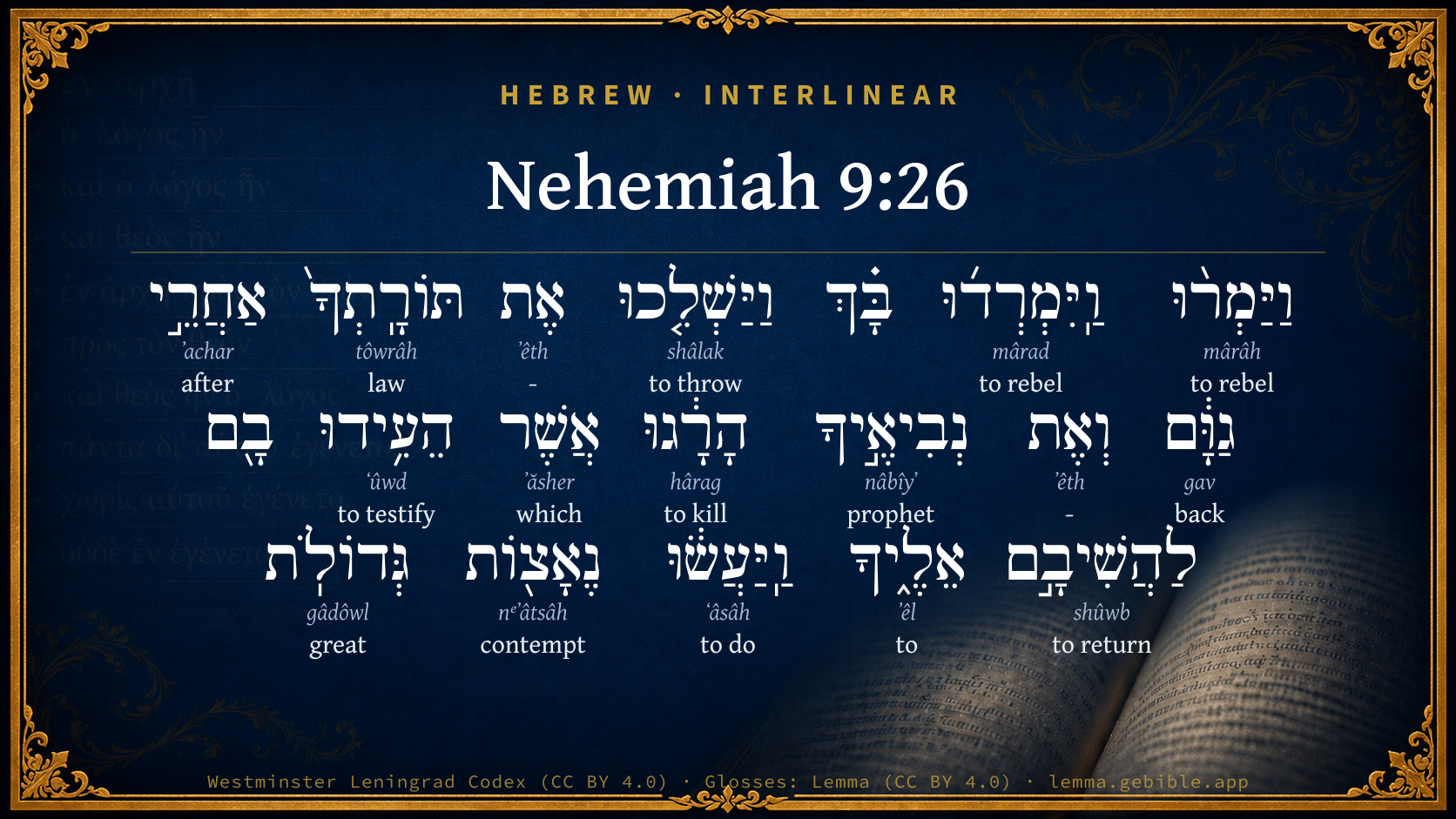
  1. וַיַּמְר֨וּ mârâh H4784 “and · to rebel” Conjunction + Verb, Hiphil, Sequential Imperfect, 3rd Person, Masculine, Plural
  2. וַֽיִּמְרְד֜וּ mârad H4775 “and · to rebel” Conjunction + Verb, Qal, Sequential Imperfect, 3rd Person, Masculine, Plural
  3. וַיַּשְׁלִ֤כוּ shâlak H7993 “and · to throw” Conjunction + Verb, Hiphil, Sequential Imperfect, 3rd Person, Masculine, Plural
  4. אֶת ʼêth H853 “-” Particle, Direct Object
  5. תּוֹרָֽתְךָ֙ tôwrâh H8451 “law · your” Noun, Common, Feminine, Singular, Construct + Suffix, Personal, 2nd Person, Masculine, Singular
  6. אַחֲרֵ֣י ʼachar H310 “after” Preposition
  7. וְאֶת ʼêth H853 “and · -” Conjunction + Particle, Direct Object
  8. נְבִיאֶ֣יךָ nâbîyʼ H5030 “prophets · your” Noun, Common, Masculine, Plural, Construct + Suffix, Personal, 2nd Person, Masculine, Singular
  9. הָרָ֔גוּ hârag H2026 “to kill” Verb, Qal, Perfect, 3rd Person, Common, Plural
  10. אֲשֶׁר ʼăsher H834 “which” Particle, Relative
  11. הֵעִ֥ידוּ ʻûwd H5749 “to testify” Verb, Hiphil, Perfect, 3rd Person, Common, Plural
  12. לַהֲשִׁיבָ֣ם shûwb H7725 “to return · them” Preposition + Verb, Hiphil, Infinitive Construct + Suffix, Personal, 3rd Person, Masculine, Plural
  13. אֵלֶ֑יךָ ʼêl H413 “to · you” Preposition + Suffix, Personal, 2nd Person, Masculine, Singular
  14. וַֽיַּעֲשׂ֔וּ ʻâsâh H6213 “and · to do” Conjunction + Verb, Qal, Sequential Imperfect, 3rd Person, Masculine, Plural
  15. נֶאָצ֖וֹת nᵉʼâtsâh H5007 “acts of contempt” Noun, Common, Feminine, Plural, Absolute
  16. גְּדוֹלֹֽת gâdôwl H1419 “great” Adjective, Adjective, Feminine, Plural, Absolute

About this verse

These counts appear in no published source. They are computed here, from the morphology-tagged text and Lemma’s own curated glosses. What Lemma adds →

19
words
16
distinct lemmas
Historical
section

Notable vocabulary

The rarest word here is גַוָּ֔ם back H1458 — appearing just 3 times in the whole Hebrew Bible.

Shared distinctive vocabulary

גַוָּ֔ם back H1458 occurs in 3 verses of the Hebrew Bible. Also found in:

Grammatical profile

  • 7 verbs
  • 4 nouns
  • 1 adjective
  • 4 prepositions
  • 3 particles

Verb forms

  • וַיַּמְר֨וּ Hiphil · Sequential Imperfect
  • וַֽיִּמְרְד֜וּ Qal · Sequential Imperfect
  • וַיַּשְׁלִ֤כוּ Hiphil · Sequential Imperfect
  • הָרָ֔גוּ Qal · Perfect
  • הֵעִ֥ידוּ Hiphil · Perfect
  • לַהֲשִׁיבָ֣ם Hiphil · Infinitive Construct
  • וַֽיַּעֲשׂ֔וּ Qal · Sequential Imperfect

Cross-references

25

Topical passages linked to Nehemiah 9:26 in the Treasury of Scripture Knowledge — connected by theme and wording, ordered by reader-vote popularity; previews shown in the World English Bible.

  • 1 Kings 14:9 but have done evil above all who were before you, and have gone and made you other gods, and molten images, to provoke me to anger, and have cast me behind your back:
  • Judges 2:11–12 The children of Israel did that which was evil in the sight of Yahweh, and served the Baals;
  • Nehemiah 9:18 Yes, when they had made them a molten calf, and said, This is your God who brought you up out of Egypt, and had committed awful blasphemies;
  • 1 Kings 18:4 for it was so, when Jezebel cut off the prophets of Yahweh, that Obadiah took one hundred prophets, and hid them by fifty in a cave, and fed them with bread and water.)
  • 1 Kings 19:10 He said, I have been very jealous for Yahweh, the God of hosts; for the children of Israel have forsaken your covenant, thrown down your altars, and slain your prophets with the sword: and I, even I only, am left; and they seek my life, to take it away.
  • Acts 7:52 Which of the prophets didn't your fathers persecute? They killed those who foretold the coming of the Righteous One, of whom you have now become betrayers and murderers.
  • 2 Chronicles 24:20–21 The Spirit of God came on Zechariah the son of Jehoiada the priest; and he stood above the people, and said to them, Thus says God, Why disobey you the commandments of Yahweh, so that you can't prosper? because you have forsaken Yahweh, he has also forsaken you.
  • Psalms 50:17 Seeing you hate instruction, And throw my words behind you?
  • Ezekiel 20:21 But the children rebelled against me; they didn't walk in my statutes, neither kept my ordinances to do them, which if a man do, he shall live in them; they profaned my Sabbaths. Then I said I would pour out my wrath on them, to accomplish my anger against them in the wilderness.
  • Matthew 21:35 The farmers took his servants, beat one, killed another, and stoned another.
  • Matthew 23:34–37 Therefore, behold, I send to you prophets, wise men, and scribes. Some of them you will kill and crucify; and some of them you will scourge in your synagogues, and persecute from city to city;
  • Judges 3:6–7 and they took their daughters to be their wives, and gave their own daughters to their sons and served their gods.
  • Judges 10:6 The children of Israel again did that which was evil in the sight of Yahweh, and served the Baals, and the Ashtaroth, and the gods of Syria, and the gods of Sidon, and the gods of Moab, and the gods of the children of Ammon, and the gods of the Philistines; and they forsook Yahweh, and didn't serve him.
  • Judges 10:13–14 Yet you have forsaken me, and served other gods: therefore I will save you no more.
  • 1 Kings 18:13 Wasn't it told my lord what I did when Jezebel killed the prophets of Yahweh, how I hid one hundred men of Yahweh's prophets by fifty in a cave, and fed them with bread and water?
  • 2 Kings 21:11 Because Manasseh king of Judah has done these abominations, and has done wickedly above all that the Amorites did, who were before him, and has made Judah also to sin with his idols;
  • 2 Chronicles 36:16 but they mocked the messengers of God, and despised his words, and scoffed at his prophets, until the wrath of Yahweh arose against his people, until there was no remedy.
  • Nehemiah 9:30 Yet many years did you bear with them, and testified against them by your Spirit through your prophets: yet would they not give ear: therefore gave you them into the hand of the peoples of the lands.
  • Psalms 78:56–57 Yet they tempted and rebelled against the Most High God, And didn't keep his testimonies;
  • Psalms 106:34–40 They didn't destroy the peoples, As Yahweh commanded them,
  • Jeremiah 26:20–23 There was also a man who prophesied in the name of Yahweh, Uriah the son of Shemaiah of Kiriath Jearim; and he prophesied against this city and against this land according to all the words of Jeremiah:
  • Ezekiel 16:15–63 But you did trust in your beauty, and played the prostitute because of your renown, and poured out your prostitution on everyone who passed by; his it was.
  • Ezekiel 22:25–31 There is a conspiracy of her prophets in the midst of it, like a roaring lion ravening the prey: they have devoured souls; they take treasure and precious things; they have made her widows many in the midst of it.
  • Ezekiel 23:4–49 The names of them were Oholah the elder, and Oholibah her sister: and they became mine, and they bore sons and daughters. As for their names, Samaria is Oholah, and Jerusalem Oholibah.
  • Ezekiel 33:3–5 if, when he sees the sword come on the land, he blow the trumpet, and warn the people;

Cross-references courtesy of OpenBible.info (CC BY 4.0).

Hebrew and Greek witnesses Masoretic Hebrew ↔ Greek Septuagint

The same verse in the two great witnesses to the Old Testament, shown verse-for-verse.

These are two independent witnesses, not word-aligned to each other, and the Septuagint is shown in lemma (dictionary) form.

Hebrew Nehemiah 9:26 Masoretic · Westminster Leningrad Codex

וַיַּמְר֨וּ וַֽיִּמְרְד֜וּ בָּ֗ךְ וַיַּשְׁלִ֤כוּ אֶת תּוֹרָֽתְךָ֙ אַחֲרֵ֣י גַוָּ֔ם וְאֶת נְבִיאֶ֣יךָ הָרָ֔גוּ אֲשֶׁר הֵעִ֥ידוּ בָ֖ם לַהֲשִׁיבָ֣ם אֵלֶ֑יךָ וַֽיַּעֲשׂ֔וּ נֶאָצ֖וֹת גְּדוֹלֹֽת

Nevertheless they were disobedient, and rebelled against you, and cast your law behind their back, and killed your prophets that testified against them to turn them again to you, and they committed awful blasphemies.

World English Bible · Public Domain

Greek LXX Structure differs

The Septuagint has no separate book of Nehemiah. Its Greek text is the second half of Esdras B (2 Esdras), chapters 11–23; Ezra is the first half (1–10).

A verse-for-verse comparison isn’t shown here because the chapters and verses don’t line up. Switch to the LXX edition with the MT / LXX toggle above to read the Greek directly.

On this verse, The Cambridge Bible for Schools and Colleges discusses the Septuagint’s reading. Read the note in Commentary ↓

Hebrew: Westminster Leningrad Codex (CC BY 4.0). Greek: Septuagint (public domain); English from a public-domain English Septuagint. How the Septuagint differs from the Hebrew →

Commentary

Notes on Nehemiah 9:26 from classic Christian and Jewish commentators (each source and its license shown beneath its notes). The classic Christian expositions comment on the surrounding passage and are grouped to its opening verse, so a note may address several verses; the Jewish commentaries on the Tanakh (Rashi and others) are per-verse, so they appear only where the commentator wrote on this verse.

Lemma curates 59 commentaries, every one of them public domain or Creative Commons licensed, each selected and text-cleaned for this edition rather than reprinted as found. About our sources →

Trapp's Complete Commentary

John Trapp

Neh 9:26 Nevertheless they were disobedient, and rebelled against thee, and cast thy law behind their backs, and slew thy prophets which testified against them to turn them to thee, and they wrought great provocations.

Ver. 26. Nevertheless they were disobedient, and rebelled] See how full in the mouth these holy Levites were in aggravating their own and their forefathers’ sins, which swelled as so many toads in their eyes; neither could they ever sufficiently disgrace them. This is the property and practice of the true penitentiary.

They cast thy law behind their backs] That is, they vilipended and undervalued it. God drew them by the cords of a man (so the cords of kindness are called, Hos 11:4, because befitting the nature of a man, and likeliest to prevail with rational people), but they, like men (or rather like beasts), transgressed the covenant; and, as if God had even hired them to be wicked, so did they abuse all his benefits to his greatest dishonour; being therefore the worse, because in reason they ought to have been better.

And slew thy prophets which testified against them to turn them to thee] This was the worst they did to them, and that for which they received mercedem mundi, the wages of the mad world, ever beside itself in point of salvation, and falling foul upon such as seek its good. This is that sin that brings ruin without remedy, 2Ch 36:16 Pro 29:1 for, "precious in the sight of the Lord is the death of his saints," Psa 116:15.

And they wrought great provocations] Or, blasphemies. See Neh 9:18.

John Trapp, A Commentary or Exposition upon All the Books of the Old and New Testament (1647–1656) — public domain. Text from a community e-Sword module.

The Biblical Illustrator

Joseph S. Exell

Neh_9:26-29

Nevertheless they were disobedient, and rebelled against Thee.

Provocations and punishment

I. How justly we may be charged, as the Jews in the text, with having wrought great provocations. This will be manifest if we consider--

1. To what a prodigious height all kinds of iniquity are raised amongst us. Atheism, infidelity, blasphemy, intemperance, impurity, commercial immorality.

2. What engagements we are under to abstain from all transgressions of the laws of God.

3. That our sins have been committed against the most prevailing attempts of the Spirit of God to restrain and reclaim us from them.

4. That our sins have been committed against many and great mercies.

5. That our sins have been committed against the discipline of Gods rod and those many judgments He hath sent to teach us righteousness.

II. That we have great reason to fear that our great provocations may be punished by God as those of the Jews were. Conclusion: What is the most effectual means to prevent the punishment our great provocations threaten us with? (Lilly Butler.)

And testifiedst against them, that Thou mightest bring them again unto Thy law.

Gods laws

Some years ago I was enjoying a ramble on the Portsdown Hills, a favourite resort of the Portsmouth people, and commanding a delightful view of the sea. They are all open to the public, except a few places which are carefully fenced off. Are these the most luxurious spots, where the grass is softest and the moss most green? No, indeed, these are the broken and precipitous parts, where serious accidents might occur. Gods laws are just like these fences. Gods love has placed fences there to keep us from hurting ourselves. (F. S. Webster.)

Danger signals

In travelling along our great railroads we pass many signal stations. In connection with each of these there is a man appointed, one of whose duties it is to see that the way is clear. If a bridge should be broken, or any obstruction is on the road, he is expected to ring a bell, wave a flag, or make a signal of some kind, so that the driver of any train coming along the road may know in time to stop his train before any harm is done. And the flag the man waves, or the signal he puts out, is the warring given to approaching trains to save them from injury. In the journey that we are pursuing through this life we are sure to meet with many dangers. The Bible is the guide-book which God has given us to use on the journey. And the warnings found in this book are the signals to tell us of the dangers that lie along our path in order that we may avoid them. We cannot be safe in our journey through the world unless we are careful to mind these warnings.

The Biblical Illustrator, edited by Joseph S. Exell (c. 1880s–1900s) — public domain. Text from a community e-Sword module.

Keil & Delitzsch

C. F. Keil & F. Delitzsch

But even in that good land the fathers were disobedient: they rejected the commands of God, slew the prophets who admonished them, and were not brought back to the obedience of God even by the chastisement inflicted on them, till at length God delivered them into the hands of Gentile kings, though after His great mercy He did not utterly forsake them. - Neh 9:26 "And they were disobedient, and rebelled against Thee, and cast Thy law behind their backs, and slew Thy prophets which testified against them to turn them to Thee, and they wrought great provocations. Neh 9:27 And Thou deliveredst them into the hand of their oppressors, so that they oppressed them; and in the time of their oppression they cried unto Thee. Then Thou heardest them from heaven, and according to Thy manifold mercies Thou gavest them deliverers, who delivered them out of the hand of their oppressors. Neh 9:28 And when they had rest, they again did evil before Thee. Then Thou deliveredst them into the hand of their enemies, so that they had dominion over them; and they cried again unto Thee, and Thou heardest from heaven, and didst deliver them according to Thy great mercy, many times."

Neh 9:26

Neh 9:26 again contains, like Neh 9:16, a general condemnation of the conduct of the children of Israel towards the Lord their God during the period between their entrance into Canaan and the captivity, which is then justified by the facts adduced in the verses following. In proof of their disobedience, it is mentioned that they cast the commands of God behind their back (comp. Kg1 14:19; Eze 23:35), and slew the prophets, e.g., Zechariah (Ch2 24:21), the prophets of the days of Jezebel (Kg1 18:13; Kg1 19:10), and others who rebuked their sins to turn them from them. בּ העיד, to testify against sinners, comp. Kg2 17:13, Kg2 17:15. The last clause of Neh 9:26 is a kind of refrain, repeated from Neh 9:18.

Neh 9:27-28

Neh 9:27 and Neh 9:28 refer to the times of the judges; comp. Jdg 2:11-23. מושׁיעים are the judges whom God raised up to deliver Israel out of the power of their oppressors; comp. Jdg 3:9. with Neh 2:16. עתּים רבּות, multitudes of times, is a co-ordinate accusative: at many times, frequently; רבּות like Lev 25:51.

Neh 9:29-30

"And testifiedst against them, to bring them back again to Thy law; yet they hearkened not to Thy commandments, and sinned against Thy judgments, which if a man do he shall live in them, and gave a resisting shoulder, and hardened their neck, and would not hear. Neh 9:30 And Thou didst bear with them many years, and didst testify against them by Thy Spirit through Thy prophets; but they would not hearken, therefore Thou gavest them into the hand of the people of the lands. Neh 9:31 Nevertheless in Thy great mercy Thou didst not utterly consume them, nor forsake them; for Thou art gracious and merciful."

Neh 9:29 and Neh 9:30 treat of the times of the kings. בּהם ותּעד is the testimony of the prophets against the idolatrous people; comp. Neh 9:26. וּבמשׁפּטיך is emphatically prefixed, and taken up again by בּם. The sentence, which if a man do he shall live in them, is formed upon Lev 18:5, comp. Eze 20:11. On the figurative expression, they gave a resisting shoulder, comp. Zac 7:11. The simile is taken from the ox, who rears against the yoke, and desires not to bear it; comp. Hos 4:16. The sentences following are repeated from Neh 9:16. עליהם תּמשׁך is an abbreviated expression for חסד משׁך, Psa 36:11; Psa 109:12; Jer 31:3, to draw out, to extend for a long time favour to any one: Thou hadst patience with them for many years, viz., the whole period of kingly rule from Solomon to the times of the Assyrians. The delivering into the power of the people of the lands, i.e., of the heathen (comp. Psa 106:40.), began with the invasion of the Assyrians (comp. Neh 9:32), who destroyed the kingdom of the ten tribes, and was inflicted upon Judah also by means of the Chaldeans.

Neh 9:31

But in the midst of these judgments also, God, according to His promise, Jer 4:27; Jer 5:10, Jer 5:18; Jer 30:11, and elsewhere, did not utterly forsake His people, nor make a full end of them; for He did not suffer them to become extinct in exile, but preserved a remnant, and delivered it from captivity.

Keil & Delitzsch — Biblical Commentary on the Old Testament (1861–1891) — public domain (CC PDM 1.0). Text via the HelloAO Bible API. (Old Testament only.)

Tyndale Open Study Notes

Tyndale Open Resources

9:26-27 The prayer recounts the pattern in the book of Judges (see Judg 2:11-23).

Tyndale Open Study Notes — © Tyndale Open Resources, licensed CC BY-SA 4.0. Text via the HelloAO Bible API.

Geneva Bible (1599)

Geneva Bible translators

Taking heaven and earth to witness, that God would destroy them, except they returned, as 2 Chron. 24:19.

Geneva Bible (1599) marginal notes — public domain. Text via Bolls.life.

The Cambridge Bible for Schools and Colleges

gen. ed. J. J. S. Perowne

26. Israel’s Disobedience

26. cast thy law behind their backs] R.V. back. ‘Thy law,’ cf. Neh_9:14. For this phrase cf. 1Ki_14:9; Eze_23:35, ‘Cast me behind thy back,’ where the Lord is the speaker. The ‘law’ of God, which Israel rejected, is not here the ceremonial or even the written law, but the moral and spiritual ‘teaching’ of Jehovah, of which ‘the prophets’ were the Apostles from Moses to Malachi.

slew thy prophets] ‘Jezebel cut off the prophets of the Lord,’ 1Ki_18:4. Not many instances are recorded. But cf. Zechariah (2 Chronicles 24; 2 Chronicles 20-22), Uriah the son of Shemaiah (Jer_26:20-23). The martyrdoms of Isaiah and Jeremiah belong to Jewish tradition. The deaths of the prophets who laid down their lives for their testimony are referred to in the New Test., cf. Mat_5:12; Mat_23:29; Act_7:52 (1Th_2:15); Heb_11:32 ff.

to turn them to thee] R.V. to turn them again unto thee, i.e. to turn them back from following after other gods, and to lead them in ‘the way wherein they should go’ (Neh_9:19). Not as Vulg. ‘ut reverterentur ad te,’ (LXX. ἐπιστρέψαι αὐτοὺς πρός σε). The rebellion of Israel was ‘a turning back’ from Jehovah. Cf. Psa_78:57.

wrought great provocations] Cf. Neh_9:18.

The Cambridge Bible for Schools and Colleges (gen. ed. J. J. S. Perowne; Cambridge University Press, 1878–1918) — public domain. Text from a community e-Sword module.

John Gill's Exposition

Nevertheless, they were disobedient, and rebelled against thee,.... Notwithstanding all these favours and mercies bestowed upon them, which was great ingratitude:

and cast thy law behind their backs; as of no account, and unworthy of their regard; that which they should have had continually before their eyes, as the rule and guide of their actions, they cast behind them, not caring to look into it, and read it:

and slew thy prophets, which testified against them to turn them to thee; the prophets that bore a testimony against their sins, admonished them of them, called heaven and earth to record against them should they continue in them, and all to turn them from them by repentance to the Lord; those they were so wroth with on this account as to slay them, see Mat 23:37,

and they wrought great provocations; serving Baalim and Ashtaroth, and other gods of the nations, than which nothing was more provoking to the Lord.

John Gill's Exposition of the Whole Bible (1746–1763) — public domain (CC PDM 1.0). Text via the HelloAO Bible API.

Albert Barnes' Notes on the Bible

Slew thy prophets - Compare 1Ki 18:4; 1Ki 19:10; 2Ch 24:21. Jewish tradition further affirms that more than one of the great prophets (e. g., Isaiah, Jeremiah, and Ezekiel) were martyred by their countrymen.

Albert Barnes' Notes on the Bible (1834–1885) — public domain. Text from a community e-Sword/MySword module.

Haydock's Catholic Bible Commentary

Earnestly. Literally, called to witness" (Haydock) themselves, (Josue xxiv. 21.) or heaven and earth, Deuteronomy iv. 26., and xxx. 19. (Calmet) --- Blasphemies. See ver. 18. (Menochius)

George Leo Haydock (1774–1849), Haydock's Catholic Family Bible and Commentary, 1859 edition — public domain. Excludes Psalms (Douay-Rheims chapter numbering differs from Protestant) and Deuterocanonical books (Catholic canon only).

Matthew Poole's English Annotations

Cast thy law behind their backs, i.e. neglected and despised thy laws, would not regard nor observe them; whereas they should have had them continually before their eyes, to direct and govern them. Compare Psa 50:17; Eze 23:35.

Matthew Poole's English Annotations on the Holy Bible (1683–1685) — public domain. Text from a community e-Sword/MySword module.

The Pulpit Commentary

Vers. 26-31. Israel"s wickedness and God"s goodness.

A summary of the national history from the entrance into Canaan to the captivity. A dismal story; but, as was natural and suitable in a confession of sin, the more pleasing facts are omitted.

I The great and INVETERATE WICKEDNESS OF THE PEOPLE. This is described by various terms and phrases, and its heinousness exhibited in many particulars.

1. Flagrant disobedience to the Divine laws. Although so good and so adapted to promote their welfare, "which if a man do, he shall live in them" (ver. 29).

2. Proud and stubborn disregard of the Divine remonstrances and warnings.

3. Persecution even unto death of God"s inspired messengers (ver. 26).

4. Repeated relapses after partial reformation. Notwithstanding

(1) The severity of the chastisements which produced it.

(2) The fervour of their prayers for deliverance, and promises of amendment.

(3) The signal and numerous deliverances effected for them in answer to their prayers.

5. The persistence of their disobedience.

II THE MARVELLOUS AND LONG-CONTINUED GOODNESS OF GOD.

1. In sending them successive messengers to warn them and lead them to repentance. Even when they slew some, he sent others.

2. In inflicting punishment upon them for the same end.

3. In repeatedly answering their prayers for deliverance.

4. In bearing with them so long, although "they wrought great provocations.

5. In preserving a remnant when at length he scattered the nation (ver. 31).Showing himself throughout "a gracious and merciful God.

Reflections:

1. Sin and suffering are indissolubly linked together.

2. Suffering is inflicted that sin may be subdued.

3. Amendment produced by suffering is often only temporary.

4. Persistence in sin insures ultimate ruin.

5. The goodness of God is shown in the testimony he maintains against sin, and the chastisements he inflicts on the sinner.

6. God is faithful to his promises, although men prove unfaithful (ver. 31).

7. The history of Israel is a mirror in which all may see their own likeness. Nations and individuals; some more, some less. Even sincere Christians in a measure. Many can say with good George Herbert"Lord, with what care hast thou heart us round! Parents first season us; then schoolmasters Deliver us to laws; they send us bound To rules of reason, holy messengers, Pulpits and Sundays, sorrow dogging sin, Afflictions sorted, anguish of all sizes, Fine nets and stratagems to catch us in, Bibles laid open, millions of surprises, Blessings beforehand, ties of gratefulness, The sound of glory ringing in our ears; Without, our shame; within, our consciences; Angels and grace, eternal hopes and fears: Yet all these fences and their whole array One cunning bosom-sin blows quite away.

The Pulpit Commentary (1880–1919), ed. H.D.M. Spence-Jones & Joseph S. Exell — public domain. Text from a community e-Sword module.

unfoldingWord translationNotes

Door43 World Missions Community

Connecting Statement:

In these verses, the Levites continue to praise Yahweh in the presence of the people of Israel.

They threw your law behind their backs

The law is spoken of as if it were a worthless item that a person could throw away. AT: "They considered your law worthless and paid no attention to it" (See: Metaphor)

They threw your law

The Israelites threw Yahweh's law.

you gave them into the hand of their enemies, who made them suffer

Here "hand" represents power or control. AT: "you allowed their enemies to defeat them and cause them to suffer" (See: Metonymy)

you sent them rescuers who rescued them out of the hand of their enemies

Here "hand" represents power or control. AT: "you sent people to stop their enemies from harming them" (See: Metonymy)

translationWords

disobey

rebel

law

prophet

blasphemy

adversary

suffer

heaven

mercy

unfoldingWord translationNotes — © Distant Shores Media and the Door43 World Missions Community, licensed CC BY-SA 4.0. Source: git.door43.org/Door43/en_tn.

Lesson kit

Teaching starters — assembled from the data on this page, not authored interpretation. Every prompt links to the verse data it draws on. Edit before teaching.

Nehemiah, in the Historical, opens this verse with 19 words (16 distinct Hebrew lemmas). Its most distinctive word is gav (“back”). A historical commentator’s framing appears above. Read the whole chapter for the surrounding context.

Discussion questions

  1. How does “back” (gav) shape what this verse is saying?
  2. 1 Kings 14:9 shares the word «back» with this verse. How do the two illuminate each other?
  3. These translations render this verse differently; the difference is in the English rendering, not the original. What questions does that raise?
  4. The verb «וַיַּמְר֨וּ» is Hiphil Sequential Imperfect. How does its form color the action?
  5. Reading how Trapp's Complete Commentary and The Biblical Illustrator read this verse, where do the two commentators agree and where do they part?

Things to notice

Reading settings

Reading text

Shown beneath each verse's original-language words.

Old Testament
Old Testament edition

Read the OT as the Masoretic Hebrew (MT) or the Greek Septuagint (LXX).

English shown for the Greek Septuagint (in the Hebrew ↔ Greek comparison).

Comparing translations? Open the Compare panel on any verse page to stack up to four side by side.