Jeremiah 26:4

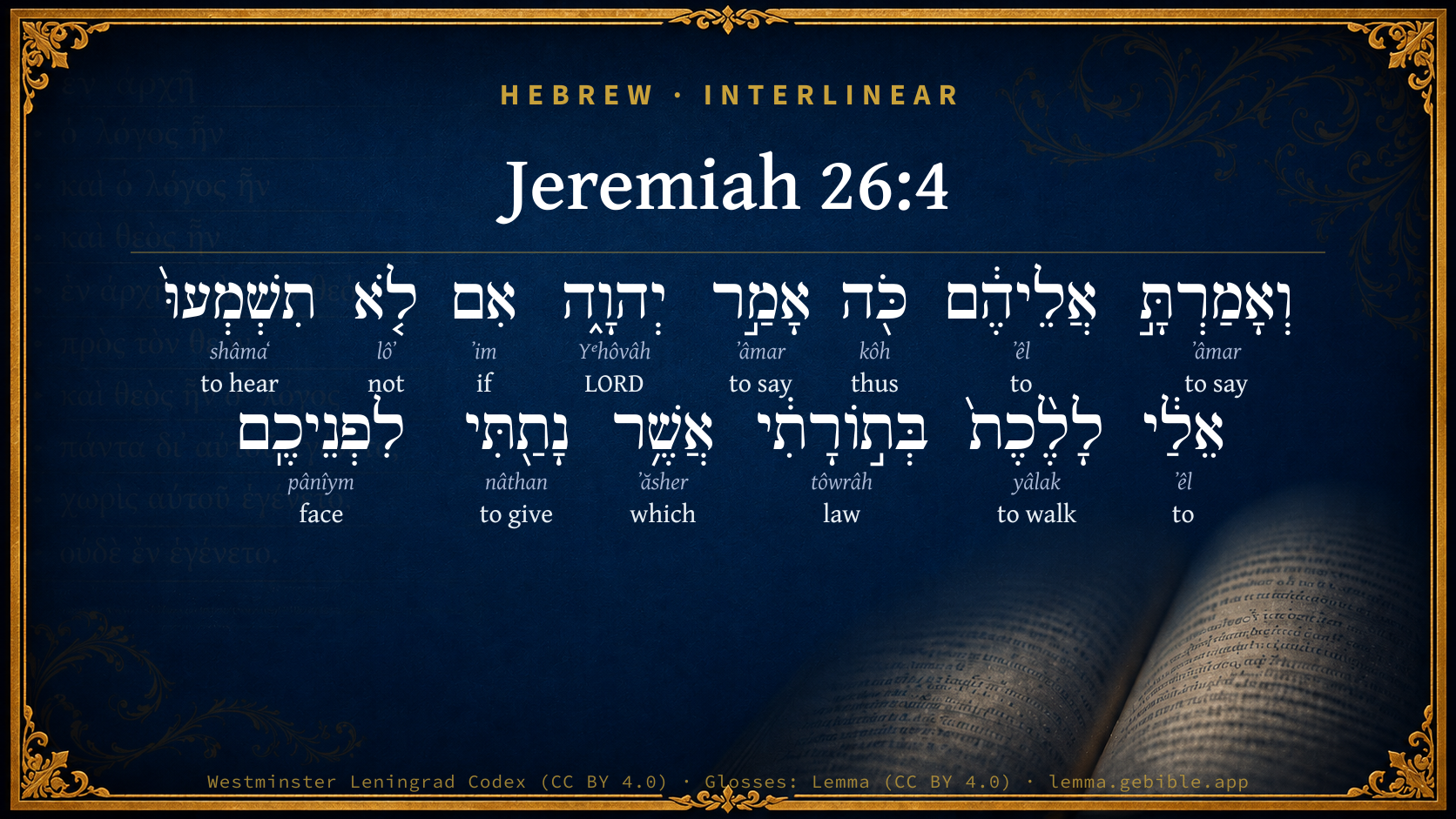
Hebrew (Westminster Leningrad Codex) Jeremiah 26:4 appears in the Hebrew Old Testament. The text above is from the Westminster Leningrad Codex. Each word links to its Strong’s number, a concise gloss, and parsing drawn from the Open Scriptures Hebrew Bible morphology. Click any word for its full Brown-Driver-Briggs (BDB) entry.
Download image
Cite this verse

Jeremiah 26:4 (World English Bible). Public Domain. Lemma interlinear Bible study tool, https://lemma.gebible.app/v/jeremiah/26/4.

Show BibTeX & RIS
BibTeX
RIS
English Translation
You shall tell them, Thus says Yahweh: If you will not listen to me, to walk in my law, which I have set before you,
World English Bible · Public Domain
Download a study sheet

One document with this verse’s original text, its word-by-word gloss line, the meaning frame, cross-references with their text, attributed commentary, and full source and license credits — printable, and it pastes into notes with its structure intact.

This verse Autodidact and up

Study sheet (.html) Plain text (.txt)

A passage Seminary Student

Up to 50 verses in one chapter. A passage sheet keeps up to 6 commentary sources and 12 cross-references per verse, in the order this page ranks them, and says so on the sheet whenever that leaves anything out. Ask for a single verse and you get the Autodidact verse sheet above.

Everything on this page stays free to read, with no account — the sheet is a download of what is already on screen, not access to it.

Want to remove ads? Support Godless Engineer
Compare translations 3

The same verse in 3 English versions, stacked beneath the original-language interlinear above. Click any original word for its lexicon entry.

Each is an independent rendering of the whole verse — the interlinear is not word-aligned to these translations.

Highlighted words mark where these versions differ — a whole-verse word diff, not a word-by-word alignment.

  • World English Bible Public Domain
    You shall tell them, Thus says Yahweh: If you will not listen to me, to walk in my law, which I have set before you,
  • King James Version Public Domain
    And thou shalt say unto them, Thus saith the LORD; If ye will not hearken to me, to walk in my law, which I have set before you,
  • unfoldingWord Literal Text CC BY-SA 4.0
    And you shall say to them, “Thus says Yahweh: If you do not listen to me, to walk in my law that I have given to the face of you,

unfoldingWord Literal Text — © unfoldingWord, licensed CC BY-SA 4.0. Word-aligned USFM3 via Door43 (git.door43.org/unfoldingWord/en_ult).

Versions to compare (up to 4)

3 of 4 selected

Show all 18 translations

Every available English version of this verse, each an independent rendering of the whole verse.

  • World English Bible Public Domain
    You shall tell them, Thus says Yahweh: If you will not listen to me, to walk in my law, which I have set before you,
  • Berean Standard Bible Public Domain
    And you are to tell them that this is what the LORD says: ‘If you do not listen to Me and walk in My law, which I have set before you,
  • Majority Standard Bible Public Domain
    And you are to tell them that this is what the LORD says: ‘If you do not listen to Me and walk in My law, which I have set before you,
  • King James Version Public Domain
    And thou shalt say unto them, Thus saith the LORD; If ye will not hearken to me, to walk in my law, which I have set before you,
  • American Standard Version (1901) Public Domain
    And thou shalt say unto them, Thus saith Jehovah: If ye will not hearken to me, to walk in my law, which I have set before you,
  • Revised Version (1885) Public Domain
    And thou shalt say unto them, Thus saith the LORD: If ye will not hearken to me, to walk in my law, which I have set before you,
  • Geneva Bible (1599) Public Domain
    And thou shalt say vnto them, Thus saith the Lord, If ye will not heare me to walke in my Lawes, which I haue set before you,
  • Douay-Rheims (1899) Public Domain
    And thou shalt say to them: Thus saith the Lord: If you will not hearken to me to walk in my law, which I have given to you:
  • Young's Literal Translation Public Domain
    `And thou hast said unto them: Thus said Jehovah, If ye do not hearken unto Me, to walk in My law, that I set before you,
  • Literal Standard Version CC BY-SA 4.0
    And you have said to them, Thus said YHWH: If you do not listen to Me, to walk in My law that I set before you,
  • Unlocked Literal Bible CC BY-SA 4.0
    So you must say to them, 'Yahweh says this: If you do not listen to me so as to walk in my law that I have placed before you—
  • unfoldingWord Literal Text CC BY-SA 4.0
    And you shall say to them, “Thus says Yahweh: If you do not listen to me, to walk in my law that I have given to the face of you,
  • Darby Bible Public Domain
    And thou shalt say unto them, Thus saith Jehovah: If ye will not hearken unto me, to walk in my law, which I have set before you,
  • World Messianic Bible Public Domain
    You shall tell them, “The LORD says: ‘If you will not listen to me, to walk in my law which I have set before you,
  • Webster's Bible Public Domain
    And thou shalt say to them, Thus saith the LORD, If ye will not hearken to me to walk in my law, which I have set before you,
  • Free Bible Version CC BY-SA 4.0
    Tell them that this is what the Lord says: If you do not listen to me and follow my law, which I have given you,
  • Bible in Basic English Public Domain
    And you are to say to them, This is what the Lord has said: If you do not give ear to me and go in the way of my law which I have put before you,
  • JPS Tanakh (1917) Public Domain
    And thou shalt say unto them: Thus saith the LORD: If ye will not hearken to Me, to walk in My law, which I have set before you,

Literal Standard Version (2020), Covenant Press — licensed CC BY-SA 4.0. Text via the HelloAO Bible API (eBible.org). Unlocked Literal Bible (unfoldingWord) — licensed CC BY-SA 4.0. Text via the HelloAO Bible API (eBible.org). unfoldingWord Literal Text — © unfoldingWord, licensed CC BY-SA 4.0. Word-aligned USFM3 via Door43 (git.door43.org/unfoldingWord/en_ult). Free Bible Version, Dr. Jonathan Gallagher — licensed CC BY-SA 4.0. Text via the HelloAO Bible API (eBible.org).

Word by word

More ways to search: Search by grammar → Find every occurrence → Compare this word →

Practice this passage: Drill this verse → Learn its vocabulary →

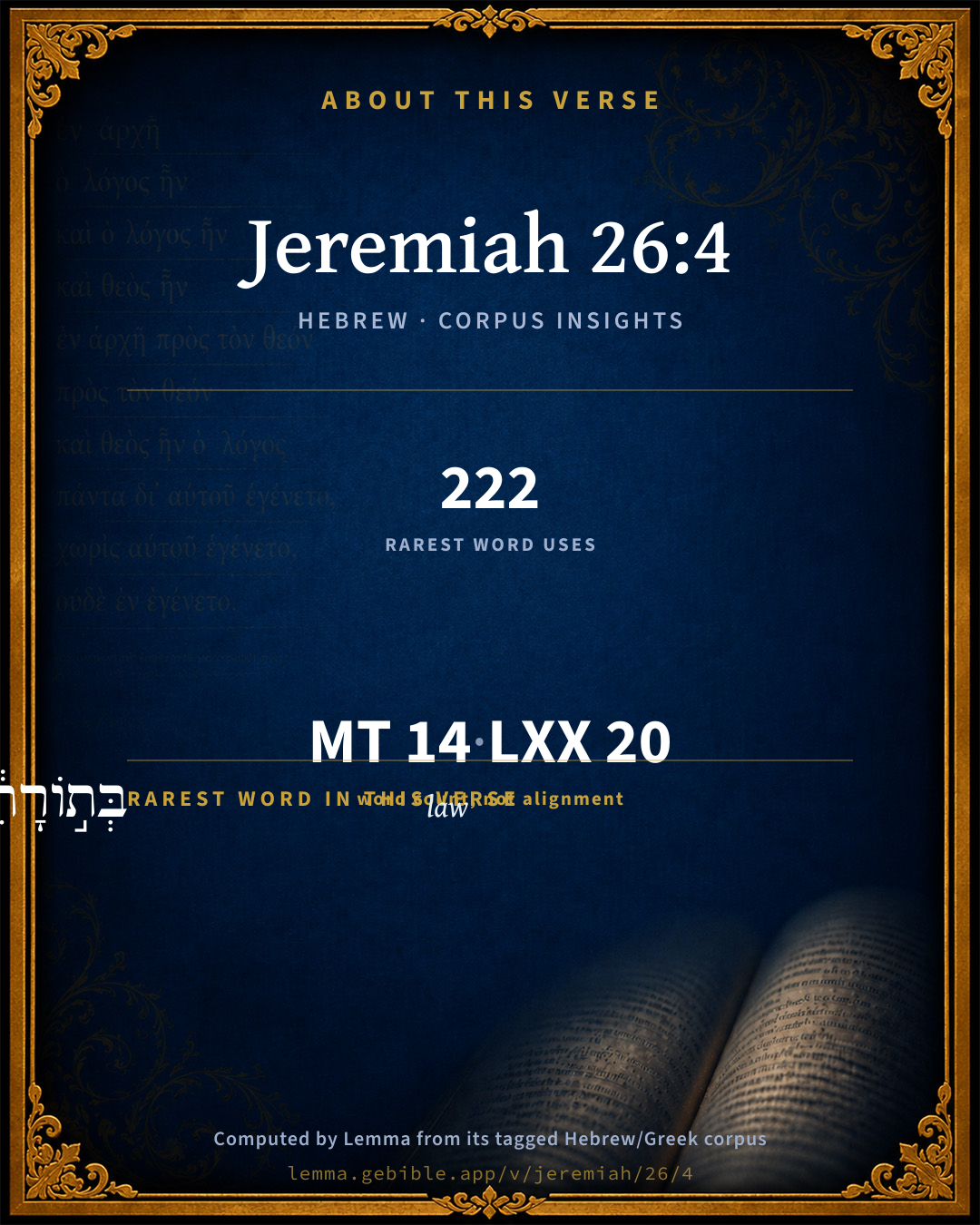
בְּת֣וֹרָתִ֔י
tôwrâh
H8451
“in/at · law · my”
Preposition + Noun, Common, Feminine, Singular, Construct + Suffix, Personal, 1st Person, Common, Singular
Part of Speech
Preposition + Noun
Type
Common
Gender
Feminine
Number
Singular
State
Construct
Full BDB Definition

Origin: from H3384

TWOT: 910d

law, direction, instruction - instruction, direction (human or divine) - body of prophetic teaching - instruction in Messianic age - body of priestly direction or instruction - body of legal directives - law - law of the burnt offering - of special law, codes of law - custom, manner - the Deuteronomic or Mosaic Law
  1. וְאָמַרְתָּ֣ ʼâmar H559 “and · to say” Conjunction + Verb, Qal, Sequential Perfect, 2nd Person, Masculine, Singular
  2. אֲלֵיהֶ֔ם ʼêl H413 “to · them” Preposition + Suffix, Personal, 3rd Person, Masculine, Plural
  3. כֹּ֖ה kôh H3541 “thus” Adverb
  4. אָמַ֣ר ʼâmar H559 “to say” Verb, Qal, Perfect, 3rd Person, Masculine, Singular
  5. יְהוָ֑ה Yᵉhôvâh H3068 “LORD” Noun, Proper
  6. אִם ʼim H518 “if” Conjunction
  7. לֹ֤א lôʼ H3808 “not” Particle, Negative
  8. תִשְׁמְעוּ֙ shâmaʻ H8085 “to hear” Verb, Qal, Imperfect, 2nd Person, Masculine, Plural
  9. אֵלַ֔י ʼêl H413 “to · me” Preposition + Suffix, Personal, 1st Person, Common, Singular
  10. לָלֶ֨כֶת֙ yâlak H3212 “to walk” Preposition + Verb, Qal, Infinitive Construct
  11. אֲשֶׁ֥ר ʼăsher H834 “which” Particle, Relative
  12. נָתַ֖תִּי nâthan H5414 “to give” Verb, Qal, Perfect, 1st Person, Common, Singular
  13. לִפְנֵיכֶֽם pânîym H6440 “to/for · face(s) · your” Preposition + Noun, Common, Both, Plural, Construct + Suffix, Personal, 2nd Person, Masculine, Plural

About this verse

These counts appear in no published source. They are computed here, from the morphology-tagged text and Lemma’s own curated glosses. What Lemma adds →

14
words
12
distinct lemmas
Prophets
section

Grammatical profile

  • 5 verbs
  • 3 nouns
  • 2 prepositions
  • 1 conjunction
  • 1 adverb
  • 2 particles

Verb forms

  • וְאָמַרְתָּ֣ Qal · Sequential Perfect
  • אָמַ֣ר Qal · Perfect
  • תִשְׁמְעוּ֙ Qal · Imperfect
  • לָלֶ֨כֶת֙ Qal · Infinitive Construct
  • נָתַ֖תִּי Qal · Perfect

Repetition

Words recur within this verse — often emphatic in Hebrew:

  • וְאָמַרְתָּ֣ to say H559 ×2
  • אֲלֵיהֶ֔ם to H413 ×2

Hebrew & Septuagint length

In the original languages it is 14 Hebrew tokens and 20 Greek tokens — but the two are counted differently (Hebrew bundles its prefixes and suffixes into one token; the Greek is in lemma form), so that isn’t a like-for-like length.

Cross-references

17

Topical passages linked to Jeremiah 26:4 in the Treasury of Scripture Knowledge — connected by theme and wording, ordered by reader-vote popularity; previews shown in the World English Bible.

  • 1 Kings 9:6 But if you shall turn away from following me, you or your children, and not keep my commandments and my statutes which I have set before you, but shall go and serve other gods, and worship them;
  • Isaiah 1:20 But if you refuse and rebel, you shall be devoured with the sword; For the mouth of Yahweh has spoken it."
  • Jeremiah 44:10 They are not humbled even to this day, neither have they feared, nor walked in my law, nor in my statutes, that I set before you and before your fathers.
  • Leviticus 26:14–46 "'But if you will not listen to me, and will not do all these commandments;
  • Deuteronomy 4:8 What great nation is there, that has statutes and ordinances so righteous as all this law, which I set before you this day?
  • Deuteronomy 4:44 This is the law which Moses set before the children of Israel:
  • Deuteronomy 11:32 You shall observe to do all the statutes and the ordinances which I set before you this day.
  • Deuteronomy 28:15–68 But it shall come to pass, if you will not listen to the voice of Yahweh your God, to observe to do all his commandments and his statutes which I command you this day, that all these curses shall come on you, and overtake you.
  • Deuteronomy 29:18–28 lest there should be among you man, or woman, or family, or tribe, whose heart turns away this day from Yahweh our God, to go to serve the gods of those nations; lest there should be among you a root that bears gall and wormwood;
  • Deuteronomy 31:16–18 Yahweh said to Moses, Behold, you shall sleep with your fathers; and this people will rise up, and play the prostitute after the strange gods of the land, where they go to be among them, and will forsake me, and break my covenant which I have made with them.
  • Deuteronomy 31:20 For when I shall have brought them into the land which I swore to their fathers, flowing with milk and honey, and they shall have eaten and filled themselves, and grown fat; then will they turn to other gods, and serve them, and despise me, and break my covenant.
  • Deuteronomy 32:15–25 But Jeshurun grew fat, and kicked: You have grown fat, you are grown thick, you are become sleek; Then he forsook God who made him, Lightly esteemed the Rock of his salvation.
  • Joshua 23:15–16 It shall happen, that as all the good things are come on you of which Yahweh your God spoke to you, so will Yahweh bring on you all the evil things, until he have destroyed you from off this good land which Yahweh your God has given you.
  • 2 Chronicles 7:19–20 But if you turn away, and forsake my statutes and my commandments which I have set before you, and shall go and serve other gods, and worship them;
  • Nehemiah 9:26–30 Nevertheless they were disobedient, and rebelled against you, and cast your law behind their back, and killed your prophets that testified against them to turn them again to you, and they committed awful blasphemies.
  • Isaiah 42:23–25 Who is there among you who will give ear to this? who will listen and hear for the time to come?
  • Hebrews 6:18 that by two immutable things, in which it is impossible for God to lie, we may have a strong encouragement, who have fled for refuge to take hold of the hope set before us.

Cross-references courtesy of OpenBible.info (CC BY 4.0).

Hebrew and Greek witnesses Masoretic Hebrew ↔ Greek Septuagint

The same verse in the two great witnesses to the Old Testament, shown verse-for-verse.

These are two independent witnesses, not word-aligned to each other, and the Septuagint is shown in lemma (dictionary) form.

Hebrew Jeremiah 26:4 Masoretic · Westminster Leningrad Codex

וְאָמַרְתָּ֣ אֲלֵיהֶ֔ם כֹּ֖ה אָמַ֣ר יְהוָ֑ה אִם לֹ֤א תִשְׁמְעוּ֙ אֵלַ֔י לָלֶ֨כֶת֙ בְּת֣וֹרָתִ֔י אֲשֶׁ֥ר נָתַ֖תִּי לִפְנֵיכֶֽם

You shall tell them, Thus says Yahweh: If you will not listen to me, to walk in my law, which I have set before you,

World English Bible · Public Domain

Greek LXX Structure differs

In the Septuagint, Jeremiah is about an eighth shorter than the Hebrew and arranges its material differently — the Oracles Against the Nations (Hebrew chapters 46–51) appear in the middle of the Greek book, after 25:13. Because the chapter and verse boundaries do not line up, a verse-for-verse comparison with the Hebrew is not shown.

A verse-for-verse comparison isn’t shown here because the chapters and verses don’t line up. Switch to the LXX edition with the MT / LXX toggle above to read the Greek directly.

Hebrew: Westminster Leningrad Codex (CC BY 4.0). Greek: Septuagint (public domain); English from a public-domain English Septuagint. How the Septuagint differs from the Hebrew →

Targum (Aramaic paraphrase)

1

The Targum is the ancient Jewish Aramaic paraphrase of the Hebrew Scriptures — an interpretive translation, not the Hebrew text itself. Onkelos (literal) and Pseudo-Jonathan (expansive) render the Torah, and Jonathan the Prophets. Coverage is partial: where no permissively-licensed English translation exists for a verse, only the Aramaic is shown. This is verse-level text, not a word-by-word alignment to the Hebrew.

  1. Targum Jonathan Prophets (Joshua–Malachi)
    וְתֵימַר לְהוֹן כִּדְנַן אֲמַר יְיָ אִם לָא תְקַבְּלוּן לְמֵימְרִי לִמְהַךְ בְּאוֹרַיְתִי דִיהָבֵית קֳדָמֵיכוֹן:

    (no public-domain English translation for this verse)

    Targum Jonathan — Aramaic: “Mikraot Gedolot” (public domain). English: “Sefaria Community Translation” (CC0 1.0 (public-domain dedication)); “London "Chaldee Paraphrase," 1871” (public domain). Text via Sefaria.

Commentary

Notes on Jeremiah 26:4 from classic Christian and Jewish commentators (each source and its license shown beneath its notes). The classic Christian expositions comment on the surrounding passage and are grouped to its opening verse, so a note may address several verses; the Jewish commentaries on the Tanakh (Rashi and others) are per-verse, so they appear only where the commentator wrote on this verse.

Lemma curates 59 commentaries, every one of them public domain or Creative Commons licensed, each selected and text-cleaned for this edition rather than reprinted as found. About our sources →

Trapp's Complete Commentary

John Trapp

Jer 26:4 And thou shalt say unto them, Thus saith the LORD; If ye will not hearken to me, to walk in my law, which I have set before you,

Ver. 4. If ye will not hearken unto me.] A conditional menace, the contrary promise whereunto see Jer 26:13. And this was the sum of all Jeremiah’s sermons.

John Trapp, A Commentary or Exposition upon All the Books of the Old and New Testament (1647–1656) — public domain. Text from a community e-Sword module.

Tyndale Open Study Notes

Tyndale Open Resources

26:4-6 The people’s ancestors had chosen the way of disobedience; as a result, their sanctuary at Shiloh, north of Jerusalem, had been destroyed (7:12-15; 1 Sam 1–4). Similarly, continued disobedience of the covenant commands by the people in Jeremiah’s day would result in the destruction of the Temple and Jerusalem.

Tyndale Open Study Notes — © Tyndale Open Resources, licensed CC BY-SA 4.0. Text via the HelloAO Bible API.

Adam Clarke's Commentary

Verse 4. If ye will not hearken] This and several of the following verses are nearly the same with those in Jer 7:13, &c., where see the notes.

Adam Clarke's Commentary on the Bible (1810–1826) — public domain. Text from a community e-Sword/MySword module.

John Calvin's Commentaries

The Prophet now briefly includes what he had been teaching, what he had been commanded to declare to the people. No doubt he spoke to them more at large; but he deemed it enough to shew in a few words what had been committed to him. And the sum of it was, that except the Jews so hearkend as to walk in God’s Law, and were submissive to the prophets, final ruin was nigh the Temple and the city. This is the meaning: but it may be useful to consider every particular.

By these words, Except ye hearken to me, to walk in my law, God intimates, that he mainly requires obedience, and esteems nothing as much, according to what he says, that it is better than all sacrifices. (1 Samuel 15:22.) This subject was largely treated in the seventh chapter, where he said,

“Did I command your fathers when they came out of Egypt to offer sacrifices to me? this only I required, even to hear my voice.” (Jeremiah 7:22, 23)

We hence see, that the only way of living piously, justly, holily, and uprightly, is to allow ourselves to be ruled by the Lord. This is one thing. Then what follows is worthy of being noticed, To walk in my law God here testifies that his will is not ambiguous or doubtful, for he has prescribed what is right in his law. Were God then to descend a hundred times from heaven, he would bring nothing but this message, that he has spoken what is necessary to be known, and that his Law is the most perfect wisdom. Had he said only, “Hear me,” men might have still evaded and avowed themselves ready to learn. God therefore does here silence hypocrites, and says that he required nothing else but to follow his Law. And for the same purpose he adds what follows, which I have set before you: for this kind of speaking intimates that the doctrine of the Law was by no means obscure or doubtful, as Moses said,

“I this day call heaven and earth to witness, that I have set life and death before your eyes.” (Deuteronomy 30:19)

And in another place he said,

“Say not, Who shall ascend above the clouds? or, Who shall descend into the abyss? or, Who shall pass beyond the sea? The word is in thy heart and in thy mouth,” (Deuteronomy 30:12-14; Romans 10:6-8)

as though he had said, “God has deprived you of every excuse, for there is no reason for doubting, since he has spoken so familiarly to you, and has explained everything necessary to be known.”

And hereby is confuted the impious blasphemy of the Papists, who impudently assert that not only the Law is obscure, but also the Gospel. And Paul also loudly declares, that the Gospel is not obscure except to those who perish, and who have a veil over their hearts, being visited with judicial blindness. But as to the Law, in which there is no such plainness as in the Gospel, we see what Jeremiah affirms here, that it was set before the eyes of all, that they might learn from it what pleased God, and what was just and right.

John Calvin's Commentaries (1540-1563) — public domain. Text from the Calvin Translation Society English edition (1840s-50s) via the Christian Classics Ethereal Library (ccel.org). Calvin's coverage is partial (roughly two-thirds of the Bible); uncommented books and verses are honest gaps, never fabricated. The 19th-century editor's footnotes and remarks are omitted so the notes are faithfully Calvin's own voice.

Ellicott's Commentary for English Readers

(4, 5) To walk in my law, which I have set before you.—The words present more vividly than in the parallels of Jer_7:25; Jer_25:4 the relation of the Law as the groundwork of the teaching of the Prophets, their office being that of preachers and expounders, making men feel that the commandment was “exceeding broad.” The “Law and the Prophets” are already coupled together, as in Mat_5:17; Mat_22:40, as making up God’s revelation of His will to Israel.

A Bible Commentary for English Readers, edited by Charles John Ellicott (1878–1897) — public domain. Text from a community e-Sword module.

The Cambridge Bible for Schools and Colleges

gen. ed. J. J. S. Perowne

4. my law] See on Jer_8:8. Here the reference, as the following clause indicates, is to the doctrinal rather than the ritual teaching.

I have set before you] See on Jer_9:13.

The Cambridge Bible for Schools and Colleges (gen. ed. J. J. S. Perowne; Cambridge University Press, 1878–1918) — public domain. Text from a community e-Sword module.

John Gill's Exposition

And thou shalt say unto them,.... What follows is the substance of the prophecy, and the sum of the sermon or discourse he was sent to deliver, without diminishing a word of it:

thus saith the Lord, if ye will not hearken to me, to walk in my law which I have set before you; first by Moses, by whose hands it was given to their fathers; and by the prophets, the interpreters of it to them; before whom it was set as a way for them to walk in, and a rule to walk by; a directory for them in their lives and conversations; and which continues to be so, as it is set before us Christians by our King and Lawgiver Jesus Christ; though not to obtain righteousness and life by the works of it; which should not be sought for, nor are attainable thereby.

John Gill's Exposition of the Whole Bible (1746–1763) — public domain (CC PDM 1.0). Text via the HelloAO Bible API.

Matthew Poole's English Annotations

A course of actions in Scripture is ordinarily called a way; in which sense we often read of

the way of the Lord, the way of the wicked, the way of the righteous, & c.; and a motion in this course is usually called walking, Psa 1:1; Eze 18:9, and applied both to God and men. To walk in God’s laws is expounded by hearkening unto them, or (as in other places) by observing, keeping, and doing them. God is said to have set his laws before them, both in respect of their first promulgation to them at Sinai, and writing them in tables; and the daily expositions and urging of them upon their practice by his servants the prophets, as it followeth.

Matthew Poole's English Annotations on the Holy Bible (1683–1685) — public domain. Text from a community e-Sword/MySword module.

The Pulpit Commentary

Vers. 4-6. The contents of the discourse. (see especially on Jer_7:12-15) The priests and the prophets interfere, arrest Jeremiah, and accuse him of a capital crime. It would appear that some at least of the "false prophets" were priests; thus Pashur, we are told, was a priest. (Jer_20:6)

The Pulpit Commentary (1880–1919), ed. H.D.M. Spence-Jones & Joseph S. Exell — public domain. Text from a community e-Sword module.

unfoldingWord translationNotes

Door43 World Missions Community

If you do not listen to me so as to walk in my law that I have placed before you

Yahweh speaks of a person's lifestyle as if it were a path along which the person walks. AT: "If you do not obey me and the law that I have given you" (See: Metaphor)

then I will make this house like Shiloh

Yahweh had destroyed a place of worship at Shiloh, and he was threatening to destroy this place of worship. (See: Simile)

I will turn this city into a curse

What Yahweh would turn the city into is a metonym for what people would use the city for. AT: "I will make this city so that people will ask me to destroy others the way I have destroyed this city" (See: Metonymy)

in the sight of all the nations on earth

"so that all the nations on earth can see me do it"

translationWords

walk

law

servant

prophet

send

Shiloh

turn

curse

nation

earth

unfoldingWord translationNotes — © Distant Shores Media and the Door43 World Missions Community, licensed CC BY-SA 4.0. Source: git.door43.org/Door43/en_tn.

Lesson kit

Teaching starters — assembled from the data on this page, not authored interpretation. Every prompt links to the verse data it draws on. Edit before teaching.

Jeremiah, in the Prophets, opens this verse with 14 words (12 distinct Hebrew lemmas). Its most distinctive word is tôwrâh (“law”). A historical commentator’s framing appears above. Read the whole chapter for the surrounding context.

Discussion questions

  1. The word tôwrâh carries the sense “law.” How does it shape the verse?
  2. How does 1 Kings 9:6, which shares this passage’s theme, read alongside this verse?
  3. What does the repetition of “to say” (2× in this one verse) do in this verse?
  4. The translations on this page render this verse differently — a whole-verse word diff, not a word-by-word alignment. What might account for the different wordings?
  5. «וְאָמַרְתָּ֣» is a Qal Sequential Perfect verb. How does that grammatical form shape the action described?
  6. Compare how Trapp's Complete Commentary and Tyndale Open Study Notes read this verse. Where do they agree or differ?

Things to notice

Reading settings

Reading text

Shown beneath each verse's original-language words.

Old Testament
Old Testament edition

Read the OT as the Masoretic Hebrew (MT) or the Greek Septuagint (LXX).

English shown for the Greek Septuagint (in the Hebrew ↔ Greek comparison).

Comparing translations? Open the Compare panel on any verse page to stack up to four side by side.