
Jeremiah 2:8

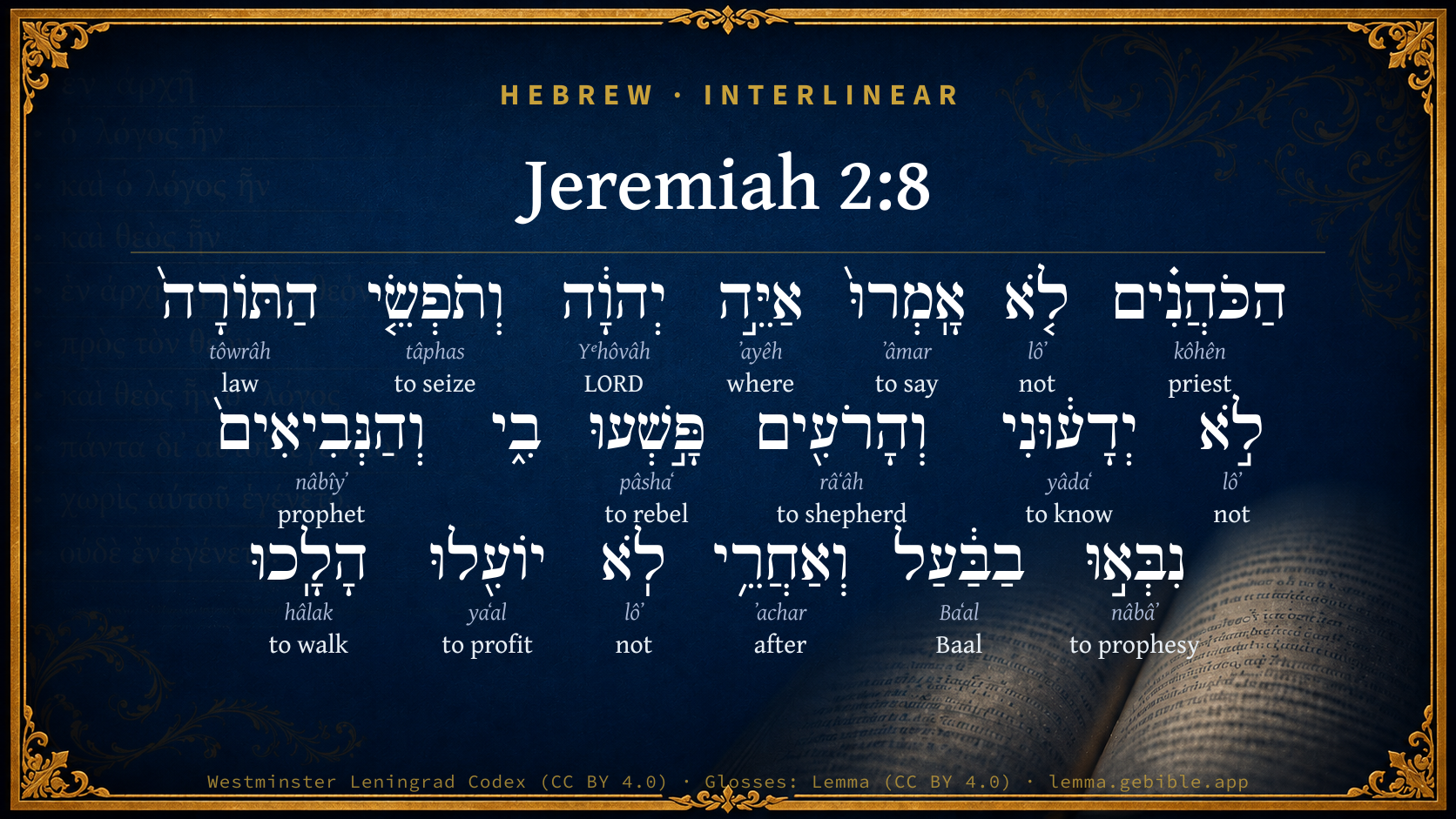
Hebrew (Westminster Leningrad Codex) Jeremiah 2:8 appears in the Hebrew Old Testament. The text above is from the Westminster Leningrad Codex. Each word links to its Strong’s number, a concise gloss, and parsing drawn from the Open Scriptures Hebrew Bible morphology. Click any word for its full Brown-Driver-Briggs (BDB) entry.
Download image
Cite this verse

Jeremiah 2:8 (World English Bible). Public Domain. Lemma interlinear Bible study tool, https://lemma.gebible.app/v/jeremiah/2/8.

Show BibTeX & RIS
BibTeX
RIS
English Translation
The priests didn't say, Where is Yahweh? and those who handle the law didn't know me: the rulers also transgressed against me, and the prophets prophesied by Baal, and walked after things that do not profit.
World English Bible · Public Domain
Download a study sheet

One document with this verse’s original text, its word-by-word gloss line, the meaning frame, cross-references with their text, attributed commentary, and full source and license credits — printable, and it pastes into notes with its structure intact.

This verse Autodidact and up

Study sheet (.html) Plain text (.txt)

A passage Seminary Student

Up to 50 verses in one chapter. A passage sheet keeps up to 6 commentary sources and 12 cross-references per verse, in the order this page ranks them, and says so on the sheet whenever that leaves anything out. Ask for a single verse and you get the Autodidact verse sheet above.

Everything on this page stays free to read, with no account — the sheet is a download of what is already on screen, not access to it.

Want to remove ads? Support Godless Engineer
Compare translations 3

The same verse in 3 English versions, stacked beneath the original-language interlinear above. Click any original word for its lexicon entry.

Each is an independent rendering of the whole verse — the interlinear is not word-aligned to these translations.

Highlighted words mark where these versions differ — a whole-verse word diff, not a word-by-word alignment.

  • World English Bible Public Domain
    The priests didn't say, Where is Yahweh? and those who handle the law didn't know me: the rulers also transgressed against me, and the prophets prophesied by Baal, and walked after things that do not profit.
  • King James Version Public Domain
    The priests said not, Where is the LORD? and they that handle the law knew me not: the pastors also transgressed against me, and the prophets prophesied by Baal, and walked after things that do not profit.
  • unfoldingWord Literal Text CC BY-SA 4.0
    The priests did not say, ‘Where Yahweh?’ and the handlers of the law did not know me, and the shepherds transgressed against me, and the prophets prophesied by Baal and walked after not profitable. ts\*

unfoldingWord Literal Text — © unfoldingWord, licensed CC BY-SA 4.0. Word-aligned USFM3 via Door43 (git.door43.org/unfoldingWord/en_ult).

Versions to compare (up to 4)

3 of 4 selected

Show all 18 translations

Every available English version of this verse, each an independent rendering of the whole verse.

  • World English Bible Public Domain
    The priests didn't say, Where is Yahweh? and those who handle the law didn't know me: the rulers also transgressed against me, and the prophets prophesied by Baal, and walked after things that do not profit.
  • Berean Standard Bible Public Domain
    The priests did not ask, ‘Where is the LORD?’ The experts in the law no longer knew Me, and the leaders rebelled against Me. The prophets prophesied by Baal and followed useless idols.
  • Majority Standard Bible Public Domain
    The priests did not ask, ‘Where is the LORD?’ The experts in the law no longer knew Me, and the leaders rebelled against Me. The prophets prophesied by Baal and followed useless idols.
  • King James Version Public Domain
    The priests said not, Where is the LORD? and they that handle the law knew me not: the pastors also transgressed against me, and the prophets prophesied by Baal, and walked after things that do not profit.
  • American Standard Version (1901) Public Domain
    The priests said not, Where is Jehovah? and they that handle the law knew me not: the rulers also transgressed against me, and the prophets prophesied by Baal, and walked after things that do not profit.
  • Revised Version (1885) Public Domain
    The priests said not, Where is the LORD? and they that handle the law knew me not: the rulers also transgressed against me, and the prophets prophesied by Baal, and walked after things that do not profit.
  • Geneva Bible (1599) Public Domain
    The priests said not, Where is the Lord? and they that should minister the Lawe, knewe me not: the pastours also offended against me, and the Prophets prophesied in Baal, and went after things that did not profite.
  • Douay-Rheims (1899) Public Domain
    The priests did not say: Where is the Lord? and they that held the law knew me not, and the pastors transgressed against me: and the prophets prophesied in Baal, and followed idols.
  • Young's Literal Translation Public Domain
    The priests have not said, `Where `is' Jehovah?' And those handling the law have not known Me. And the shepherds transgressed against Me, And the prophets have prophesied by Baal, And after those who profit not have gone.
  • Literal Standard Version CC BY-SA 4.0
    The priests have not said, Where [is] YHWH? And those handling the Law have not known Me. And the shepherds transgressed against Me, || And the prophets have prophesied by Ba‘al, || And have gone after those who do not profit.
  • Unlocked Literal Bible CC BY-SA 4.0
    The priest did not say, 'Where is Yahweh?' and the experts in the law did not care about me! The shepherds transgressed against me. The prophets prophesied for Baal and walked after unprofitable things.
  • unfoldingWord Literal Text CC BY-SA 4.0
    The priests did not say, ‘Where Yahweh?’ and the handlers of the law did not know me, and the shepherds transgressed against me, and the prophets prophesied by Baal and walked after not profitable. ts\*
  • Darby Bible Public Domain
    The priests said not, Where is Jehovah? and they that handled the law knew me not; and the shepherds transgressed against me; and the prophets prophesied by Baal, and walked after [things that] do not profit.
  • World Messianic Bible Public Domain
    The priests didn’t say, ‘Where is the LORD?’ and those who handle the law didn’t know me. The rulers also transgressed against me, and the prophets prophesied by Baal and followed things that do not profit.
  • Webster's Bible Public Domain
    The priests said not, Where is the LORD? and they that handle the law knew me not: the pastors also transgressed against me, and the prophets prophesied by Baal, and walked after things that do not profit.
  • Free Bible Version CC BY-SA 4.0
    Your priests did not ask, “Where is the Lord?” Your teachers of the law no longer believed in me, and your leaders rebelled against me. Your prophets prophesied by calling on Baal and followed worthless idols.
  • Bible in Basic English Public Domain
    The priests did not say, Where is the Lord? and those who were expert in the law had no knowledge of me: and the rulers did evil against me, and the prophets became prophets of the Baal, going after things without value.
  • JPS Tanakh (1917) Public Domain
    The priests said not: 'Where is the LORD?' And they that handle the law knew Me not, and the rulers transgressed against Me; the prophets also prophesied by Baal, and walked after things that do not profit.

Literal Standard Version (2020), Covenant Press — licensed CC BY-SA 4.0. Text via the HelloAO Bible API (eBible.org). Unlocked Literal Bible (unfoldingWord) — licensed CC BY-SA 4.0. Text via the HelloAO Bible API (eBible.org). unfoldingWord Literal Text — © unfoldingWord, licensed CC BY-SA 4.0. Word-aligned USFM3 via Door43 (git.door43.org/unfoldingWord/en_ult). Free Bible Version, Dr. Jonathan Gallagher — licensed CC BY-SA 4.0. Text via the HelloAO Bible API (eBible.org).

Word by word

More ways to search: Search by grammar → Find every occurrence → Compare this word →

Practice this passage: Drill this verse → Learn its vocabulary →

יוֹעִ֖לוּ
yaʻal
H3276
“to profit”
Verb, Hiphil, Imperfect, 3rd Person, Masculine, Plural
Part of Speech
Verb
Stem
Hiphil
Form
Imperfect
Person
3rd Person
Gender
Masculine
Number
Plural
Full BDB Definition

Origin: a primitive root

TWOT: 882

(Hiphil) to gain, profit, benefit, avail
  1. הַכֹּהֲנִ֗ים kôhên H3548 “the · priests” Particle, Definite Article + Noun, Common, Masculine, Plural, Absolute
  2. לֹ֤א lôʼ H3808 “not” Particle, Negative
  3. אָֽמְרוּ֙ ʼâmar H559 “to say” Verb, Qal, Perfect, 3rd Person, Common, Plural
  4. אַיֵּ֣ה ʼayêh H346 “where” Particle, Interrogative
  5. יְהוָ֔ה Yᵉhôvâh H3068 “LORD” Noun, Proper
  6. וְתֹפְשֵׂ֤י tâphas H8610 “and · seizing” Conjunction + Verb, Qal, Participle Active, Masculine, Plural, Construct
  7. הַתּוֹרָה֙ tôwrâh H8451 “the · law” Particle, Definite Article + Noun, Common, Feminine, Singular, Absolute
  8. לֹ֣א lôʼ H3808 “not” Particle, Negative
  9. יְדָע֔וּנִי yâdaʻ H3045 “to know · me” Verb, Qal, Perfect, 3rd Person, Common, Plural + Suffix, Personal, 1st Person, Common, Singular
  10. וְהָרֹעִ֖ים râʻâh H7462 “and · the · shepherding” Conjunction + Particle, Definite Article + Verb, Qal, Participle Active, Masculine, Plural, Absolute
  11. פָּ֣שְׁעוּ pâshaʻ H6586 “to rebel” Verb, Qal, Perfect, 3rd Person, Common, Plural
  12. וְהַנְּבִיאִים֙ nâbîyʼ H5030 “and · the · prophets” Conjunction + Particle, Definite Article + Noun, Common, Masculine, Plural, Absolute
  13. נִבְּא֣וּ nâbâʼ H5012 “to prophesy” Verb, Niphal, Perfect, 3rd Person, Common, Plural
  14. בַבַּ֔עַל Baʻal H1168 “in/at the · Baal” Preposition, Determined + Noun, Proper
  15. וְאַחֲרֵ֥י ʼachar H310 “and · after” Conjunction + Preposition
  16. לֹֽא lôʼ H3808 “not” Particle, Negative
  17. הָלָֽכוּ hâlak H1980 “to walk” Verb, Qal, Perfect, 3rd Person, Common, Plural

About this verse

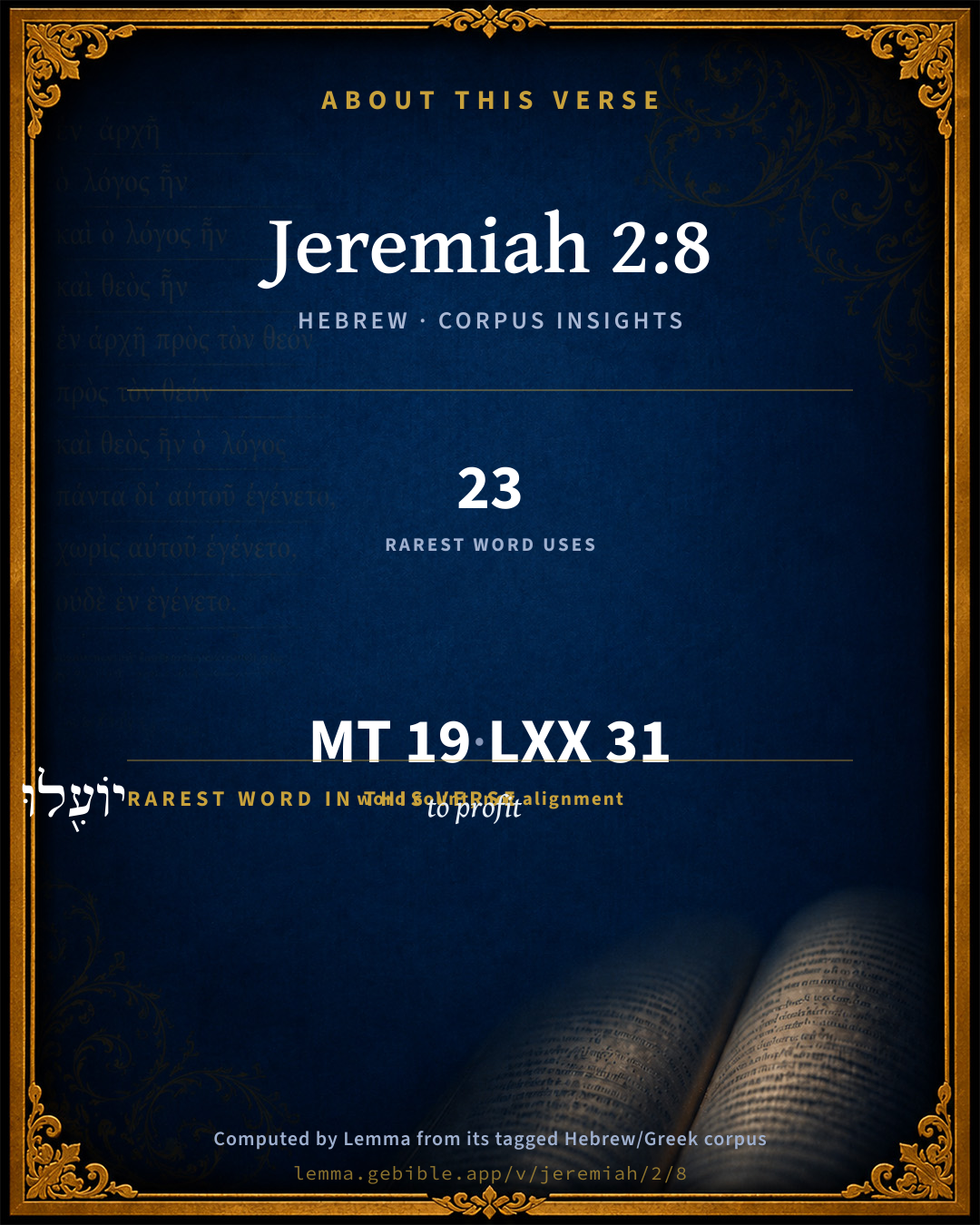
These counts appear in no published source. They are computed here, from the morphology-tagged text and Lemma’s own curated glosses. What Lemma adds →

19
words
16
distinct lemmas
Prophets
section

Notable vocabulary

The rarest word here is יוֹעִ֖לוּ to profit H3276 — appearing just 23 times in the whole Hebrew Bible.

Shared distinctive vocabulary

יוֹעִ֖לוּ to profit H3276 occurs in 21 verses of the Hebrew Bible. Also found in:

Grammatical profile

  • 8 verbs
  • 5 nouns
  • 2 prepositions
  • 4 particles

Verb forms

  • אָֽמְרוּ֙ Qal · Perfect
  • וְתֹפְשֵׂ֤י Qal · Participle Active
  • יְדָע֔וּנִי Qal · Perfect
  • וְהָרֹעִ֖ים Qal · Participle Active
  • פָּ֣שְׁעוּ Qal · Perfect
  • נִבְּא֣וּ Niphal · Perfect
  • יוֹעִ֖לוּ Hiphil · Imperfect
  • הָלָֽכוּ Qal · Perfect

Repetition

A word recurs within this verse — often emphatic in Hebrew:

Hebrew & Septuagint length

In the original languages it is 19 Hebrew tokens and 31 Greek tokens — but the two are counted differently (Hebrew bundles its prefixes and suffixes into one token; the Greek is in lemma form), so that isn’t a like-for-like length.

Cross-references

30

Topical passages linked to Jeremiah 2:8 in the Treasury of Scripture Knowledge — connected by theme and wording, ordered by reader-vote popularity; previews shown in the World English Bible.

  • Habakkuk 2:18 "What value does the engraved image have, that its maker has engraved it; the molten image, even the teacher of lies, that he who fashions its form trusts in it, to make mute idols?
  • Jeremiah 5:31 the prophets prophesy falsely, and the priests bear rule by their means; and my people love to have it so: and what will you do in the end of it?
  • Jeremiah 10:21 For the shepherds are become brutish, and have not inquired of Yahweh: therefore they have not prospered, and all their flocks are scattered.
  • Hosea 4:6 My people are destroyed for lack of knowledge. Because you have rejected knowledge, I will also reject you, That you may be no priest to me. Because you have your God's law, I will also forget your children.
  • Romans 2:17–24 Indeed you bear the name of a Jew, and rest on the law, and glory in God,
  • 2 Corinthians 4:2 But we have renounced the hidden things of shame, not walking in craftiness, nor handling the word of God deceitfully; but by the manifestation of the truth commending ourselves to every man's conscience in the sight of God.
  • Isaiah 29:10 For Yahweh has poured out on you the spirit of deep sleep, and has closed your eyes, the prophets; and your heads, the seers, has he covered.
  • Isaiah 30:5 They shall all be ashamed because of a people that can't profit them, that are not a help nor profit, but a shame, and also a reproach.
  • Luke 11:52 Woe to you lawyers! For you took away the key of knowledge. You didn't enter in yourselves, and those who were entering in, you hindered."
  • John 16:3 They will do these things because they have not known the Father, nor me.
  • Deuteronomy 33:10 They shall teach Jacob your ordinances, Israel your law: They shall put incense before you, Whole burnt offering on your altar.
  • 1 Samuel 2:12 Now the sons of Eli were base men; they didn't know Yahweh.
  • 1 Samuel 12:21 and don't turn aside; for [then would you go] after vain things which can't profit nor deliver, for they are vain.
  • 1 Kings 18:22 Then Elijah said to the people, "I, even I only, am left a prophet of Yahweh; but Baal's prophets are four hundred fifty men.
  • 1 Kings 18:29 It was so, when midday was past, that they prophesied until the time of the offering of the [evening] offering; but there was neither voice, nor any to answer, nor any who regarded.
  • 1 Kings 18:40 and Elijah said to them, Take the prophets of Baal; don't let one of them escape. They took them; and Elijah brought them down to the brook Kishon, and killed them there.
  • Isaiah 28:7 Even these reel with wine, and stagger with strong drink; the priest and the prophet reel with strong drink, they are swallowed up of wine, they stagger with strong drink; they err in vision, they stumble in judgment.
  • Isaiah 56:9–12 All you animals of the field, come to devour, [yes], all you animals in the forest.
  • Jeremiah 2:6 Neither said they, Where is Yahweh who brought us up out of the land of Egypt, who led us through the wilderness, through a land of deserts and of pits, through a land of drought and of the shadow of death, through a land that none passed through, and where no man lived?
  • Jeremiah 2:11 Has a nation changed [its] gods, which yet are no gods? but my people have changed their glory for that which does not profit.
  • Jeremiah 4:22 For my people are foolish, they don't know me; they are foolish children, and they have no understanding; they are wise to do evil, but to do good they have no knowledge.
  • Jeremiah 7:8 Behold, you trust in lying words, that can't profit.
  • Jeremiah 8:8–11 How do you say, We are wise, and the law of Yahweh is with us? But, behold, the false pen of the scribes has worked falsely.
  • Jeremiah 12:10 Many shepherds have destroyed my vineyard, they have trodden my portion under foot, they have made my pleasant portion a desolate wilderness.
  • Jeremiah 16:19 Yahweh, my strength, and my stronghold, and my refuge in the day of affliction, to you shall the nations come from the ends of the earth, and shall say, Our fathers have inherited nothing but lies, [even] vanity and things in which there is no profit.
  • Jeremiah 23:1–2 Woe to the shepherds who destroy and scatter the sheep of my pasture! says Yahweh.
  • Jeremiah 23:9–15 Concerning the prophets. My heart within me is broken, all my bones shake; I am like a drunken man, and like a man whom wine has overcome, because of Yahweh, and because of his holy words.
  • Malachi 2:6–9 The law of truth was in his mouth, and unrighteousness was not found in his lips. He walked with me in peace and uprightness, and turned many away from iniquity.
  • Matthew 16:26 For what will it profit a man, if he gains the whole world, and forfeits his life? Or what will a man give in exchange for his life?
  • John 8:55 You have not known him, but I know him. If I said, 'I don't know him,' I would be like you, a liar. But I know him, and keep his word.

Cross-references courtesy of OpenBible.info (CC BY 4.0).

Hebrew and Greek witnesses Masoretic Hebrew ↔ Greek Septuagint

The same verse in the two great witnesses to the Old Testament, shown verse-for-verse.

These are two independent witnesses, not word-aligned to each other, and the Septuagint is shown in lemma (dictionary) form.

Hebrew Jeremiah 2:8 Masoretic · Westminster Leningrad Codex

הַכֹּהֲנִ֗ים לֹ֤א אָֽמְרוּ֙ אַיֵּ֣ה יְהוָ֔ה וְתֹפְשֵׂ֤י הַתּוֹרָה֙ לֹ֣א יְדָע֔וּנִי וְהָרֹעִ֖ים פָּ֣שְׁעוּ בִ֑י וְהַנְּבִיאִים֙ נִבְּא֣וּ בַבַּ֔עַל וְאַחֲרֵ֥י לֹֽא יוֹעִ֖לוּ הָלָֽכוּ

The priests didn't say, Where is Yahweh? and those who handle the law didn't know me: the rulers also transgressed against me, and the prophets prophesied by Baal, and walked after things that do not profit.

World English Bible · Public Domain

Greek LXX Structure differs

In the Septuagint, Jeremiah is about an eighth shorter than the Hebrew and arranges its material differently — the Oracles Against the Nations (Hebrew chapters 46–51) appear in the middle of the Greek book, after 25:13. Because the chapter and verse boundaries do not line up, a verse-for-verse comparison with the Hebrew is not shown.

A verse-for-verse comparison isn’t shown here because the chapters and verses don’t line up. Switch to the LXX edition with the MT / LXX toggle above to read the Greek directly.

Hebrew: Westminster Leningrad Codex (CC BY 4.0). Greek: Septuagint (public domain); English from a public-domain English Septuagint. How the Septuagint differs from the Hebrew →

Targum (Aramaic paraphrase)

1

The Targum is the ancient Jewish Aramaic paraphrase of the Hebrew Scriptures — an interpretive translation, not the Hebrew text itself. Onkelos (literal) and Pseudo-Jonathan (expansive) render the Torah, and Jonathan the Prophets. Coverage is partial: where no permissively-licensed English translation exists for a verse, only the Aramaic is shown. This is verse-level text, not a word-by-word alignment to the Hebrew.

  1. Targum Jonathan Prophets (Joshua–Malachi)
    כַּהֲנַיָא לָא אֲמַרוּ נִדְחַל מִן קֳדָם יְיָ וּמַלְפֵי אוֹרַיְתָא לָא אֲלִיפוּ לְמֵידַע דְחַלְתִּי וּמַלְכַיָא מְרָדוּ בְמֵימְרִי וּנְבִיאֵי שִׁקְרָא מִתְנַבַּן בְּשׁוּם טַעֲוָתָא וּבָתַר דְלָא יֶהְנוּן לְהוֹן אֲזָלוּ:

    (no public-domain English translation for this verse)

    Targum Jonathan — Aramaic: “Mikraot Gedolot” (public domain). English: “Sefaria Community Translation” (CC0 1.0 (public-domain dedication)); “London "Chaldee Paraphrase," 1871” (public domain). Text via Sefaria.

Commentary

Notes on Jeremiah 2:8 from classic Christian and Jewish commentators (each source and its license shown beneath its notes). The classic Christian expositions comment on the surrounding passage and are grouped to its opening verse, so a note may address several verses; the Jewish commentaries on the Tanakh (Rashi and others) are per-verse, so they appear only where the commentator wrote on this verse.

Lemma curates 59 commentaries, every one of them public domain or Creative Commons licensed, each selected and text-cleaned for this edition rather than reprinted as found. About our sources →

The Cambridge Bible for Schools and Colleges

gen. ed. J. J. S. Perowne

8. The wickedness of the people is matched and encouraged by that of the chief men both in Church and State.

For the denunciation of priests and false prophets on the part of Jeremiah, cp. Hosea and Micah (see Intr. iii. §§ 3, 5), Micaiah (in 1 Kings 22) and Isaiah (Isa_28:7). So later Ezekiel (Jer_13:1 ff.).

Three classes of persons are spoken of.

(1) (this class is subdivided into two) the priests. The duty of the tribe of Levi was not only to serve at the altar, but to handle the law; i.e. to direct its administration, whether in accordance with oral or written regulations. Cp. Jer_8:8 (with note), Jer_18:18; Eze_7:26; Mal_2:7; also Deu_17:1 ff; Deu_33:10.

(2) the rulers (mg. Heb. shepherds), meaning, as elsewhere in the Old Testament, kings or princes. Cp. Jer_3:15, Jer_10:21, Jer_23:1-4, Jer_25:34; 1Ki_22:17; Eze_34:2. So in Homer the kings are “shepherds of the people.”

(3) the prophets, whose duty it was to declare the will of God from time to time, and urge upon the people reformation and a religious life. Jeremiah felt most keenly the wickedness of both priest and prophet, since in his own person he represented both orders, and “by a singularly tragical fate he lived precisely at that age at which both of those great institutions seemed to have reached the utmost point of degradation and corruption” (Stanley, Jewish Church, 11. pp. 439, 440). “He who by each of his callings was naturally led to sympathise with both, was the doomed antagonist of both, victim of one of the strongest of human passions, the hatred of Priests against a Priest who attacks his own order, the hatred of Prophets against a Prophet who ventures to have a voice and a will of his own” (ibid.).

said not, Where is the Lord?] i.e. they were indifferent to God’s will, and thought of nothing less than consulting Him.

transgressed] better, rebelled.

by Baal] lit. by the Baal. The singular is used collectively for false gods in general, and is equivalent to the plural, which occurs Jer_2:23, Jer_9:13. So Hosea uses the singular collectively in Jer_2:8, Jer_13:1; substituting the plural in Jer_2:13; Jer_2:17, Jer_11:2. The word is thus generic, denoting the local deities worshipped in various districts.

things that do not profit] See on Jer_2:5.

The Cambridge Bible for Schools and Colleges (gen. ed. J. J. S. Perowne; Cambridge University Press, 1878–1918) — public domain. Text from a community e-Sword module.

Trapp's Complete Commentary

John Trapp

Jer 2:8 The priests said not, Where [is] the LORD? and they that handle the law knew me not: the pastors also transgressed against me, and the prophets prophesied by Baal, and walked after [things that] do not profit.

Ver. 8. The priests said not, {a} Where is the Lord?] Ignorant they were, and idle. They would not be at the pains of a serious inquisition after God and his will; though he be a "rewarder of all that diligently seek him." {Heb 11:6}

And they that handled the law.] That expounded and applied it. A metaphor from such as are trained in the war, who are said tractate bellum, to handle their arms.

The pastors also transgressed against me.] What marvel, therefore, that the people did so too? For, as in a fish, the corruption of it beginneth at the head; so here.

And the prophets prophesied by Baal.] And taught others to worship idols. We see then, it is nothing new that stars fall from heaven, that church chieftains should fall from God, and draw others after them. It went for a proverb, a little before Luther stirred, Qui theologum seholasticum videt, videt septem peccata mortalia, He that seeth a divine, seeth the seven deadly sins.

{a} Dixerunt, Ubi victimae, ubi nummi? triobolarium Deum faciunt subque hastam mittunt. - Oecol.

John Trapp, A Commentary or Exposition upon All the Books of the Old and New Testament (1647–1656) — public domain. Text from a community e-Sword module.

Tyndale Open Study Notes

Tyndale Open Resources

2:8 Instead of teaching the people about the Lord, the leaders taught them about Baal.

Tyndale Open Study Notes — © Tyndale Open Resources, licensed CC BY-SA 4.0. Text via the HelloAO Bible API.

Geneva Bible (1599)

Geneva Bible translators

Meaning, the Princes and Ministers: signifying, that all estates were corrupt.

That is, spake vain things, and brought the people from the true worship of God to serve idols: for by Baal, which was the chief idol of the Moabites, are meant all idols.

They taught not the people to seek after God.

As the Scribes, which should have expounded the Law to the people.

Geneva Bible (1599) marginal notes — public domain. Text via Bolls.life.

Jamieson, Fausset & Brown

Robert Jamieson, A. R. Fausset & David Brown

The three leading classes, whose very office under the theocracy was to lead the people to God, disowned Him in the same language as the nation at large, "Where is the Lord?" (See Jer 2:6).

priests--whose office it was to expound the law (Mal 2:6-7).

handle--are occupied with the law as the subject of their profession.

pastors--civil, not religious: princes (Jer 3:15), whose duty it was to tend their people.

prophets--who should have reclaimed the people from their apostasy, encouraged them in it by pretended oracles from Baal, the Phœnician false god.

by Baal--in his name and by his authority (compare Jer 11:21).

walked after things . . . not profit--answering to, "walked after vanity," that is, idols (Jer 2:5; compare Jer 2:11; Hab 2:18).

Jamieson, Fausset & Brown — Commentary Critical and Explanatory on the Whole Bible (1871) — public domain (CC PDM 1.0). Text via the HelloAO Bible API.

Adam Clarke's Commentary

Verse 8. They that handle the law] ותפשי vethophe shey, they that draw out the law; they whose office it is to explain it, draw out its spiritual meanings, and show to what its testimonies refer.

The pastors also] Kings, political and civil rulers.

Prophesied by Baal] Became his prophets, and were inspired with the words of lying spirits.

Adam Clarke's Commentary on the Bible (1810–1826) — public domain. Text from a community e-Sword/MySword module.

John Calvin's Commentaries

God assails here especially the teachers and those to whom was committed the power of ruling the people. It often happens that the common people fall away, while yet some integrity remains in the rulers. But God shews here that such was the falling away among the whole community, that priests as well as prophets and all the chief men had departed from the true worship of God, and from all uprightness.

Now, when Jeremiah thus rebukes the teachers and the priests and others, he does not excuse the common people, nor extenuate the crimes, which then prevailed everywhere, as we shall see from what follows. As many think that they set up a shield against God, when they pretend that they are not acquainted with so much learning as to distinguish between light and darkness, but that they are guided by their rulers, the Prophet, therefore, does not here cast the faults of the people upon their rulers, but, on the contrary, he amplifies the atrocity of their impiety, for they had, from the least to the greatest, rejected God and his Law. We now, then, understand the design of the Prophet.

We may learn from this passage how unwise and foolish are they who think that they are in part excusable when they can say, that they have proceeded in their simplicity and have been drawn into error by the faults of others; for it appears evident that the whole community was in a hopeless state when God gave up the priests and rulers unto a reprobate mind; and there is no doubt but that the people had provoked God’s vengeance, when every order, civil as well as religious, was thus corrupt. God then visited the people with deserved punishment, when he blinded the priests, the prophets, and the rulers.

Hence Jeremiah now says, that the priests did not inquire where Jehovah was: and he adds, and they who keep the law, etc. The verb תפש taphesh, means to keep, to lay hold on, and sometimes to cover; so that there may be here a twofold meaning, — that the priests kept the law, — or, that they had it shut up as it were under their keeping. It would not, however, be in harmony with the passage to suppose that the law was suppressed by them; for God, by way of concession, speaks here honorably of them, thought he thereby shews that they were the more wicked, as they had no care for their office. He says, then, that they were the keepers of his law, not that they really kept the law, as though a genuine zeal for it prevailed among them, but because they professed this. They indeed wished to be thought the keepers of the law, who possessed the hidden treasure of celestial truth; for they wished to be consulted as though they were the organs of God’s Spirit. Since, then, they boasted that they kept and preserved the law, the Prophet now more sharply rebukes them, because they knew not God himself. And Paul seems to have taken from this place what he says in the second chapter of the Epistle to the Romans,

“Thou who hast the form of the law — thou who preachest against adultery, committest adultery, and thou who condemnest idols art thyself guilty of sacrilege; for thou keepest the law, restest in it, boastest in God, and with thee is understanding and knowledge.” (Romans 2:20-22.)

Paul in these words detects the wickedness of hypocrites; for the more detestable they were, as they were thus inflated with false glory; they profaned the name of God, while they pretended to be his heralds, and as it were his prophets. We now see that this second clause refers to the priests, and that they are called the keepers of the law, because they were so appointed, according to what we read in Malachi.

He afterwards adds, The pastors have dealt treacherously with God We may apply this to the counselors of the king as well as to the governors of cities. The Prophet, I have no doubt, included all those who possessed authority to rule the people of God; for kings and their counselors, as well as prophets, are in common called pastors.

And he says, that the prophets prophesied by Baal The name of prophet is sacred; but Jeremiah in this place, as in other places, calls those prophets (contrary to the real fact) who were nothing but impostors; for God had taken from them all the light of divine truth. But as they were held still in esteem by the people, as though they were prophets, the Prophet concedes this title to them, derived from their office and vocation. We do the same in the present day; we call those bishops and prelates, and primates and fathers, who under the papacy boast that they possess the pastoral office, and yet we know that some of them are wolves, and some are dumb dogs. We concede to them these titles in which they take pride; and yet a twofold condemnation impends over their heads, as they thus impiously, and with sacrilegious audacity, claim for themselves sacred titles, and deprive God of the honor rightly due to him. So then Jeremiah, speaking of the prophets, does now point out those as impostors who at that time wickedly deceived the people.

He says that they prophesied by Baal: they ascribed more authority to idols than to the true God. The name of Baal, we know, was then commonly known. The prophets often call idols Baalim, in the plural number; but when Baal signifies a patron, when the prophets speak either of Baal in the singular number, or of Baalim in the plural, they mean the inferior gods, who had then been heaped together by the Jews, as though God was not content with his own power alone, but had need of associates and helpers, according to what is done at this day by those under the papacy, who confess that there is but one true God; and yet they ascribe nothing more to him than to their own idols which they invent for themselves at their pleasure. The same vice then prevailed among the Jews, and indeed among all heathen nations; for it was the plain and real confession of all, that there is but one supreme Being; and yet they had gods without number, and these all were called Baalim. When, therefore, the Prophet says here, that the teachers were ministers of Baal, he sets this name in opposition to the only true God, as though he had said that the truth was corrupted by them, because they passed over its limits, and did not acquiesce in the pure doctrine of the law, but mingled with it corruptions derived from all quarters, even from those many gods which heathen nations had invented for themselves.

Nor does the Prophet insist on a name; for it may have been that these false teachers pretended to profess the name of the eternal God, though falsely. But God is no sophist: there is then no reason for the Papists to think that they are at this day unlike these ancient impostors, because they profess the name of the only true God. It has always been so. Satan has not begun for the first time at this day to transform himself into an angel of light; but all his teachers in all ages have presented their poison, even all their errors and fallacies, in a golden cup. Though, then, these prophets boasted that they were sent from above, and confidently affirmed that they were the servants of the God of Abraham, it was yet all an empty profession; for they mingled with the truth those corruptions which they had derived from the ungodly errors of heathen nations.

It follows, And after those who do not profit have they gone He again, by an implied comparison, exaggerates their sin, because they had despised him whom they had known, by so many evidences, to be their Father and the author of salvation, whose infinite power they had as it were felt by their own hands, and then they followed their own inventions, though there was nothing in all their idols which could have justly allured the people of Israel. Since, then, they followed vain and profitless deceptions, the more heinous and inexcusable was their sin. It afterwards follows —

John Calvin's Commentaries (1540-1563) — public domain. Text from the Calvin Translation Society English edition (1840s-50s) via the Christian Classics Ethereal Library (ccel.org). Calvin's coverage is partial (roughly two-thirds of the Bible); uncommented books and verses are honest gaps, never fabricated. The 19th-century editor's footnotes and remarks are omitted so the notes are faithfully Calvin's own voice.

Ellicott's Commentary for English Readers

(8) The priests said not . . .—As throughout the work of Jeremiah and most of the prophets of the Old Testament, that which weighed most heavily on their souls was that those who were called to be guides of the people were themselves the chief agents in the evil. The salt had lost its savour. The light had become darkness. The rebuke, we must remember, came from the lips of one who was himself a priest.

The priests said not, Where is the Lord?—The same failure to seek as that condemned in Jer_2:6. To them, too, all was a routine. Jehovah was absent from their thoughts even in the very act of worship.

They that handle the law.—These, probably, were also of the priestly order, to whom this function was assigned in Deu_33:10. The order of non-priestly scribes, in the sense of interpreters of the law, does not appear till after the captivity. Their sin was that they “dealt with the law” as interpreters and judges, and forgot Jehovah who had given it.

The pastors.—Better, shepherds, the English “pastors” having gained a too definitely religious connotation. The Hebrew word was general in its significance, but in its Old Testament use was applied chiefly to civil rulers, as in Psa_78:71; 1Ki_22:17. Even in Ezekiel 34, where the spiritual aspect of rule is most prominent, the contrast between the false shepherds and the one true shepherd of the house of David (Jer_2:23) shows that the kingly, not the priestly, office was in the prophet’s mind.

The prophets prophesied by Baal.—The precise form of the sin described was probably connected with the oracular power ascribed to Baal-zebub, as in 2Ki_1:2. The evil was of long standing. It was one of the sins of the people in Isaiah’s time that they were “soothsayers like the Philistines” (Isa_2:6). When Ahab first introduced the Phœnician worship, it was by the prophets rather than the priests of Baal that the new cultus was propagated (1Ki_18:19; 1Ki_22:6).

Things that do not profit.—The word had acquired an almost proverbial force as applied to idols (1Sa_12:21; Isa_44:9). So the phrase is repeated in Jer_2:11.

A Bible Commentary for English Readers, edited by Charles John Ellicott (1878–1897) — public domain. Text from a community e-Sword module.

John Gill's Exposition

Wherefore I will yet plead with you, saith the Lord,.... Either verbally, by reasoning with them, and reproving them for their ignorance, stupidity, and idolatry; or by deeds, inflicting punishment upon them; so the Targum,

"therefore I will take vengeance on you, or punish you, saith the Lord:''

and with your children's children will I plead; who imitate their parents, and do the same evil things as they, which the Lord knew they would; and was particularly true of the Jews in the times of Christ, for which reason wrath came upon them to the uttermost.

John Gill's Exposition of the Whole Bible (1746–1763) — public domain (CC PDM 1.0). Text via the HelloAO Bible API.

Albert Barnes' Notes on the Bible

The guilt of this idolatry is ascribed to the four ruling classes:

(a) The accusation brought against the priests is indifference.

(b) “They that handle the law” belonged also to the priestly class Deu 33:10. Their offence was that “they knew not God.” Compare Mic 3:11.

(c) The third class are “the pastors” or shepherds, that is the temporal rulers. Their crime is disobedience.

(d) The fourth class are “the prophets.” It was their business to press the moral and spiritual truths of the law home to the hearts of the people: but they drew their inspiration from Baal, the Sun-god. Upon the corruption of the prophetic order at this time, see the Jer 14:13 note.

Things that do not profit - Here idols, which are not merely unreal, but injurious. See 1Sa 12:21; Isa 44:9.

Albert Barnes' Notes on the Bible (1834–1885) — public domain. Text from a community e-Sword/MySword module.

Haydock's Catholic Bible Commentary

Priests were silent, or abandoned themselves. --- Pastors; "princes." (Chaldean) Manasses, Amon, &c. --- In Baal, promoting his worship. (Haydock) --- The land was full of false prophets, and none stood up for the Lord.

George Leo Haydock (1774–1849), Haydock's Catholic Family Bible and Commentary, 1859 edition — public domain. Excludes Psalms (Douay-Rheims chapter numbering differs from Protestant) and Deuterocanonical books (Catholic canon only).

Matthew Poole's English Annotations

They that handle the law knew me not: q.d. They that should have taught others knew as little as they, or regarded as little to know, Hos 4:6, who are said here to handle or teach the law, viz. the priests and Levites, who Were the ordinary teachers of the law; not that they did so, but that either they ought to do so, or pretended to do so. This was their office, Deu 33:10, and their practice, Neh 8:8. The phrase is a metaphor taken from warriors, that are said tractare bellum, to handle their arms.

The pastors; either teachers, as instructors; or kings and princes, as conductors. See 1Ki 22:17.

The prophets prophesied by Baal; they that should have taught the people the true worship of God were themselves worshippers of Baal, 1Ki 18:22. Or, instead of fetching their oracles from me, saying,

Thus saith the Lord, they would say, Thus saith Baal; or they did make use of lesser deities (for so doth Baal or Baalim signify) in conjunction with God, persuading themselves they could honour God together with them, as the calves, 1Ki 12:28.

Things that do not profit, viz. idols, a periphrasis, that were never able to do them any service, as Jer 2:5,11. See Poole "Isa 44:10". Sure the state must be very bad, when priests, prophets, and people were thus corrupt.

Matthew Poole's English Annotations on the Holy Bible (1683–1685) — public domain. Text from a community e-Sword/MySword module.

Whedon's Commentary on the Bible

Daniel D. Whedon

8. This verse is doubly climacteric. Its subjects are —

1. Priests in general — The priests.

2. Teaching priests — They that handle the law.

3. Kings and princes — Pastors.

4. Inspired men — Prophets. Its predicates are —

1. Indifference — Said not, Where is the Lord?

2. Ignorance — Knew me not.

3. Rebellion — Transgressed against me.

4. Sacrilege — Prophesied by Baal.

Note, also, the adjustment of predicate to subject. The prophet charges the priests, whose office was to serve in holy things and thus to quicken the religious sensibilities of the people, with being themselves insensible. He charges those who should be teachers, with ignorance. He charges those selected to wield and exercise authority, with being themselves rebels. And finally, he charges those who profess to speak under the inspiration of God with going to the extreme of becoming prophets of Baal. Never was a more fearful indictment brought against the leaders of the people.

Daniel D. Whedon (gen. ed.), Commentary on the Old and New Testaments (1874–1909) — public domain. Text from a community e-Sword module.

The Pulpit Commentary

The priests, etc. The blame principally falls on the three leading classes (as in ver. 26; Mic_3:11). First on the priests who "handle the Law," i.e. who have a traditional knowledge of the details of the Law, and teach the people accordingly; (Deu_17:9-11 Deu_33:10 Jer_18:18; see also on Jer_8:8) next on the "pastors," or "shepherds" (in the Homeric sense), the civil and not the spiritual authorities; so generally in the Old Testament; (see Jer_3:15 Jer_10:21 Jer_22:22 Jer_25:34 Zec_10:3 Zec_11:5, Zec_11:8, 16 Isa_44:28) and lastly on the prophets, who sought their inspiration, not from Jehovah (comp. note on ver. 30), but from Baal. To prophesy by (by means of) Baal or rather, the Baal, implies that prophecy is due to an impulse from the supernatural world; that it is not an objectifying of the imaginations of the prophet himself. Even the Baal prophets yielded to an impulse from without, but how that impulse was produced the prophet does not tell us. We are told in 1Ki_22:19-23, that even prophets of Jehovah could be led astray by a "lying spirit;" much more presumably could prophets of the Baal. The Baal is here used as a representative of the idol-gods, in antithesis to Jehovah; sometimes "Baalim," or the Baals, is used instead, (e.g. ver. 23; Jer_9:13) each town or city having its own Baal ("lord"). Things that do not profit. A synonym for idols. (comp. Jer_16:19 Isa_44:9 1Sa_12:21) An enlightened regard for self-interest is encouraged by the religion of the Bible, at any rate educationally. Contrast Comtism.

Wickedness in leading men.

The great indictment of Israel reaches its climax in the accusation of the leaders of the people. Even they who should have been the guardians of truth and the vindicators of right have turned aside to evil ways. After this the defection of the whole nation appears utter and hopeless. We have here an instance of the terrible condition into which a country has fallen when its leaders, its teachers, its responsible civil and religious authorities, are unfaithful to their mission and set examples of wickedness.

I CONSIDER THE SIGNS OF WICKEDNESS IN LEADING MEN.

1. These are often unrecognized until the evil has wrought disastrous effects. For there are circumstances which make them difficult to detect, viz:

(1) External propriety. The priests still minister at the altar, the Law is still slavishly observed in ceremonial details, rulers still exercise authority, prophets still write and preach in orthodox language, and on the outside all things go on respectably, while there is rottenness hidden within. This was specially the case after the reformation of Josiah, when an outward respect for religious observances was established without any purification of heart or revival of spiritual life.

(2) Respect for authority. Many people are too subservient to question the character of their leaders. They would rather unite with their rulers in crucifying Christ than recognize his claims against the authority of these men. They do not judge of the character of their leaders by any standard of morals, but found their standard of morals on that character.

2. The signs of wickedness in leading men may be detected in its bearing on the special functions of their respective offices. The priests are the temple servants of Jehovah, yet they never seek their Master. They who are familiar with the precepts of the Law know nothing of the person and will of the Lawmaker. The civil rulers who are ruling under a theocracy directly transgress the Law of God. The prophets lend themselves to a corrupt source of inspiration. So now again we may see men abusing the powers of office, and sinning in the very exercise of the responsibilities which are entrusted to them for the sake of the maintenance of right and truth. Therefore we must be on our guard, and not simply follow those who claim to lead because of their rank or office. Men of leading are not always men of light. We must try the spirits, (1Jn_4:1) and judge of the character of those who claim to lead us by their actions, "Ye shall know them by their fruits". (Mat_7:16)

II CONSIDER THE PECULIAR GUILT OF WICKEDNESS IN LEADING.

1. It is contrary to knowledge. The priests handle the Law. Men of influence are usually in a position to learn what is wise and good. Teachers of religion may be presumed to know more than the average of men. How great, then, is their guilt when their conduct is corrupt (Rom_2:21-23)

2. It is contrary to profession. These leaders set themselves up as examples to others, and then even they go wrong. They who assume a high position should justify that position by manifesting a high character. More is expected of the professed Christian than of the confessed man of the world.

3. It is an abuse of great responsibility. If men willfully employ positions of trust as means of violating the very objects of those trusts, their guilt is proportionate to the privileges they have received and the honors they have accepted. He who uses a Christian pulpit to propagate doctrines subversive of Christianity is guilty of base treason.

III CONSIDER THE INJURIOUS EFFECTS OF WICKEDNESS IN LEADING MEN. These will be great in proportion to the influence of the men, and will partake of the special characteristics of that influence, viz.:

1. Breadth. Leading men have a wide influence, and the seeds of evil which they sow will be widespread.

2. Depth. Leading men have power at their disposal. Their example is weighty.

3. Subtlety. Dignity, prestige, authority, disguise the evil which would be recognized if it were stripped of the pomp of price. Therefore:

(1) see that good men are chosen for posts of influence, and let the selection and education of civil and religious leaders be a matter of more prayer and thought on the part of the Church; and

(2) be not too ready to follow with blind obedience those who may be in high positions. Be independent and watchful. Follow the one infallible Leader, "the Good Shepherd," Christ.

The Pulpit Commentary (1880–1919), ed. H.D.M. Spence-Jones & Joseph S. Exell — public domain. Text from a community e-Sword module.

John Wesley's Explanatory Notes

They - They that should have taught others, knew as little as they, or regarded as little, who are said here to handle the law, the priests and Levites, who were the ordinary teachers of the law. Pastors - Either teachers, or kings and princes. Prophets - They that should have taught the people the true worship of God, were themselves worshippers of Baal.

John Wesley, Explanatory Notes Upon the Whole Bible (1754–1765) — public domain. Text via the GEBible commentary corpus.

Rashi

Rabbi Shlomo Yitzchaki (Rashi)

and those who hold onto the Torah The Sanhedrin.

and the rulers the kings.

prophesied by Baal In the name of Baal.

Rashi on the Tanakh — English translations: “The Judaica Press complete Tanach with Rashi, translated by A. J. Rosenberg” (CC BY 4.0); “Pentateuch with Rashi's commentary by M. Rosenbaum and A.M. Silbermann, 1929-1934” (public domain); “The Metsudah Tanach series, Lakewood, N.J” (CC BY 4.0); and “The Book of Joshua, Metsudah Publications, 1997” (CC BY 4.0). Text via Sefaria.

Lesson kit

Teaching starters — assembled from the data on this page, not authored interpretation. Every prompt links to the verse data it draws on. Edit before teaching.

Jeremiah, in the Prophets, opens this verse with 19 words (16 distinct Hebrew lemmas). Its most distinctive word is yaʻal (“to profit”). A historical commentator’s framing appears above. Read the whole chapter for the surrounding context.

Discussion questions

  1. What does “to profit” (yaʻal) contribute to the verse as a whole?
  2. How does 1 Samuel 12:21, which shares the word «to profit», read alongside this verse?
  3. What does the repetition of “not” (3× in this one verse) do in this verse?
  4. These translations render this verse differently; the difference is in the English rendering, not the original. What questions does that raise?
  5. «אָֽמְרוּ֙» is a Qal Perfect verb. How does that grammatical form shape the action described?
  6. Compare how The Cambridge Bible for Schools and Colleges and Trapp's Complete Commentary read this verse. Where do they agree or differ?

Things to notice

Reading settings

Reading text

Shown beneath each verse's original-language words.

Old Testament
Old Testament edition

Read the OT as the Masoretic Hebrew (MT) or the Greek Septuagint (LXX).

English shown for the Greek Septuagint (in the Hebrew ↔ Greek comparison).

Comparing translations? Open the Compare panel on any verse page to stack up to four side by side.