
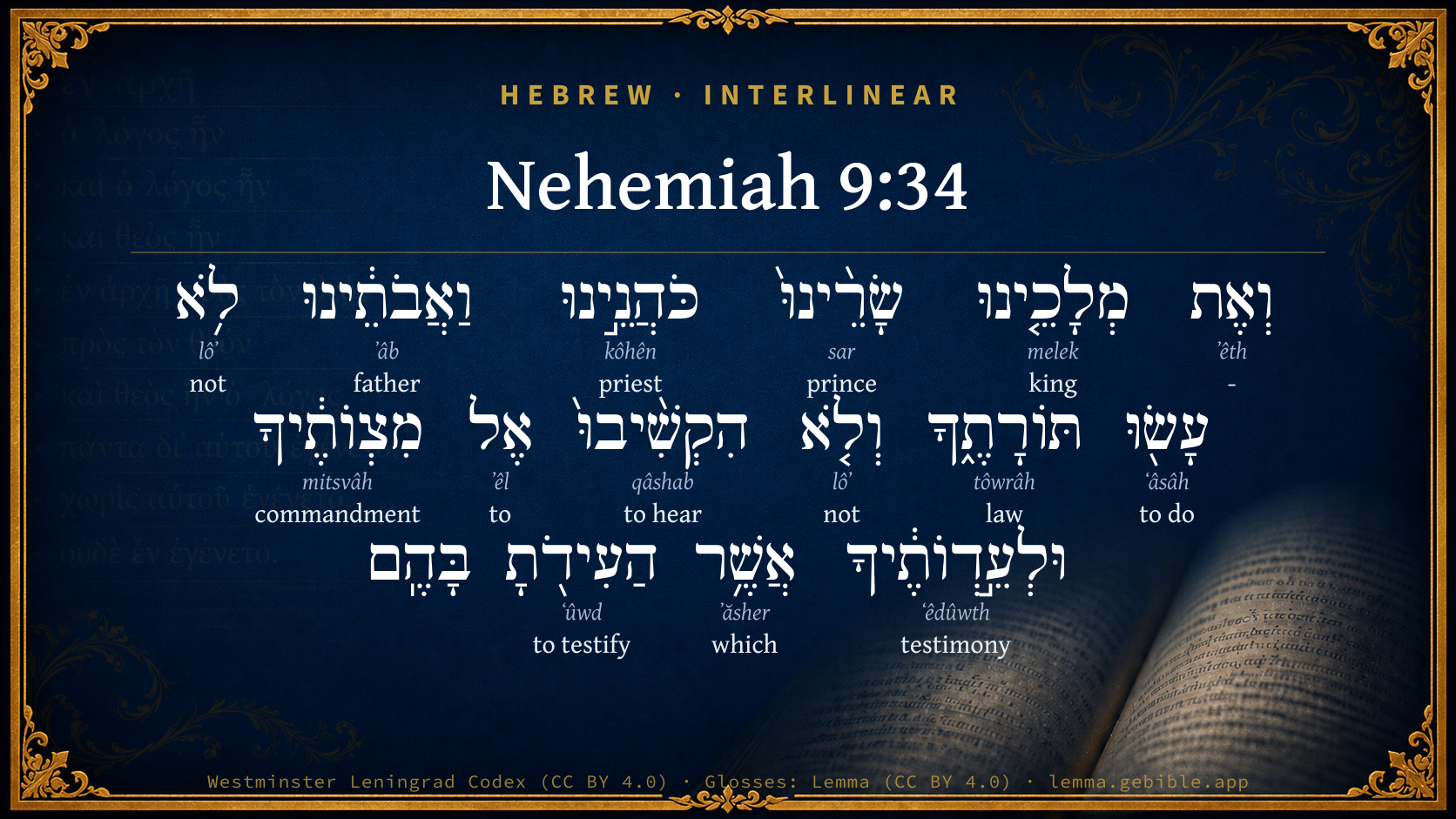
Nehemiah 9:34

Hebrew (Westminster Leningrad Codex) Nehemiah 9:34 appears in the Hebrew Old Testament. The text above is from the Westminster Leningrad Codex. Each word links to its Strong’s number, a concise gloss, and parsing drawn from the Open Scriptures Hebrew Bible morphology. Click any word for its full Brown-Driver-Briggs (BDB) entry.
Download image
Cite this verse

Nehemiah 9:34 (World English Bible). Public Domain. Lemma interlinear Bible study tool, https://lemma.gebible.app/v/nehemiah/9/34.

Show BibTeX & RIS
BibTeX
RIS
English Translation
neither have our kings, our princes, our priests, nor our fathers, kept your law, nor listened to your commandments and your testimonies with which you did testify against them.
World English Bible · Public Domain
Download a study sheet

One document with this verse’s original text, its word-by-word gloss line, the meaning frame, cross-references with their text, attributed commentary, and full source and license credits — printable, and it pastes into notes with its structure intact.

This verse Autodidact and up

Study sheet (.html) Plain text (.txt)

A passage Seminary Student

Up to 50 verses in one chapter. A passage sheet keeps up to 6 commentary sources and 12 cross-references per verse, in the order this page ranks them, and says so on the sheet whenever that leaves anything out. Ask for a single verse and you get the Autodidact verse sheet above.

Everything on this page stays free to read, with no account — the sheet is a download of what is already on screen, not access to it.

Want to remove ads? Support Godless Engineer
Compare translations 3

The same verse in 3 English versions, stacked beneath the original-language interlinear above. Click any original word for its lexicon entry.

Each is an independent rendering of the whole verse — the interlinear is not word-aligned to these translations.

Highlighted words mark where these versions differ — a whole-verse word diff, not a word-by-word alignment.

  • World English Bible Public Domain
    neither have our kings, our princes, our priests, nor our fathers, kept your law, nor listened to your commandments and your testimonies with which you did testify against them.
  • King James Version Public Domain
    Neither have our kings, our princes, our priests, nor our fathers, kept thy law, nor hearkened unto thy commandments and thy testimonies, wherewith thou didst testify against them.
  • unfoldingWord Literal Text CC BY-SA 4.0
    And our kings, our leaders, our priests, and our fathers have not done your law. And they have not attended to your commandments or to your testimonies that you testified against them.

unfoldingWord Literal Text — © unfoldingWord, licensed CC BY-SA 4.0. Word-aligned USFM3 via Door43 (git.door43.org/unfoldingWord/en_ult).

Versions to compare (up to 4)

3 of 4 selected

Show all 18 translations

Every available English version of this verse, each an independent rendering of the whole verse.

  • World English Bible Public Domain
    neither have our kings, our princes, our priests, nor our fathers, kept your law, nor listened to your commandments and your testimonies with which you did testify against them.
  • Berean Standard Bible Public Domain
    Our kings and leaders and priests and fathers did not obey Your law or listen to Your commandments and warnings that You gave them.
  • Majority Standard Bible Public Domain
    Our kings and leaders and priests and fathers did not obey Your law or listen to Your commandments and warnings that You gave them.
  • King James Version Public Domain
    Neither have our kings, our princes, our priests, nor our fathers, kept thy law, nor hearkened unto thy commandments and thy testimonies, wherewith thou didst testify against them.
  • American Standard Version (1901) Public Domain
    neither have our kings, our princes, our priests, nor our fathers, kept thy law, nor hearkened unto thy commandments and thy testimonies wherewith thou didst testify against them.
  • Revised Version (1885) Public Domain
    neither have our kings, our princes, our priests, nor our fathers, kept thy law, nor hearkened unto thy commandments and thy testimonies, wherewith thou didst testify against them.
  • Geneva Bible (1599) Public Domain
    And our kings and our princes, our Priests and our fathers haue not done thy Lawe, nor regarded thy commandements nor thy protestations, wherewith thou hast protested among them.
  • Douay-Rheims (1899) Public Domain
    Our kings, our princes, our priests, and our fathers have not kept thy law, and have not minded thy commandments, and thy testimonies which thou hast testified among them.
  • Young's Literal Translation Public Domain
    and our kings, our heads, our priests, and our fathers, have not done Thy law, nor attended unto Thy commands, and to Thy testimonies, that Thou hast testified against them;
  • Literal Standard Version CC BY-SA 4.0
    And our kings, our heads, || Our priests, and our fathers, || Have not done Your law, || Nor attended to Your commands, || And to Your testimonies, || That You have testified against them;
  • Unlocked Literal Bible CC BY-SA 4.0
    Our kings, our princes, our priests, and our ancestors have not kept your law, nor paid attention to your commandments or your covenant decrees by which you warned them.
  • unfoldingWord Literal Text CC BY-SA 4.0
    And our kings, our leaders, our priests, and our fathers have not done your law. And they have not attended to your commandments or to your testimonies that you testified against them.
  • Darby Bible Public Domain
    And our kings, our princes, our priests, and our fathers, have not performed thy law, nor hearkened unto thy commandments and thy testimonies, wherewith thou didst testify against them.
  • World Messianic Bible Public Domain
    Also our kings, our princes, our priests, and our fathers have not kept your law, nor listened to your commandments and your testimonies with which you testified against them.
  • Webster's Bible Public Domain
    Neither have our kings, our princes, our priests, nor our fathers, kept thy law, nor hearkened to thy commandments and thy testimonies, with which thou didst testify against them.
  • Free Bible Version CC BY-SA 4.0
    Our kings, our leaders, our priests, and our forefathers did not follow your Law, and they ignored your commands and regulations you ordered them to keep.
  • Bible in Basic English Public Domain
    And our kings, our rulers, our priests, and our fathers have not kept your law or given attention to your orders and your witness, with which you gave witness against them.
  • JPS Tanakh (1917) Public Domain
    neither have our kings, our princes, our priests, nor our fathers, kept Thy law, nor hearkened unto Thy commandments and Thy testimonies, wherewith Thou didst testify against them.

Literal Standard Version (2020), Covenant Press — licensed CC BY-SA 4.0. Text via the HelloAO Bible API (eBible.org). Unlocked Literal Bible (unfoldingWord) — licensed CC BY-SA 4.0. Text via the HelloAO Bible API (eBible.org). unfoldingWord Literal Text — © unfoldingWord, licensed CC BY-SA 4.0. Word-aligned USFM3 via Door43 (git.door43.org/unfoldingWord/en_ult). Free Bible Version, Dr. Jonathan Gallagher — licensed CC BY-SA 4.0. Text via the HelloAO Bible API (eBible.org).

Word by word

More ways to search: Search by grammar → Find every occurrence → Compare this word →

Practice this passage: Drill this verse → Learn its vocabulary →

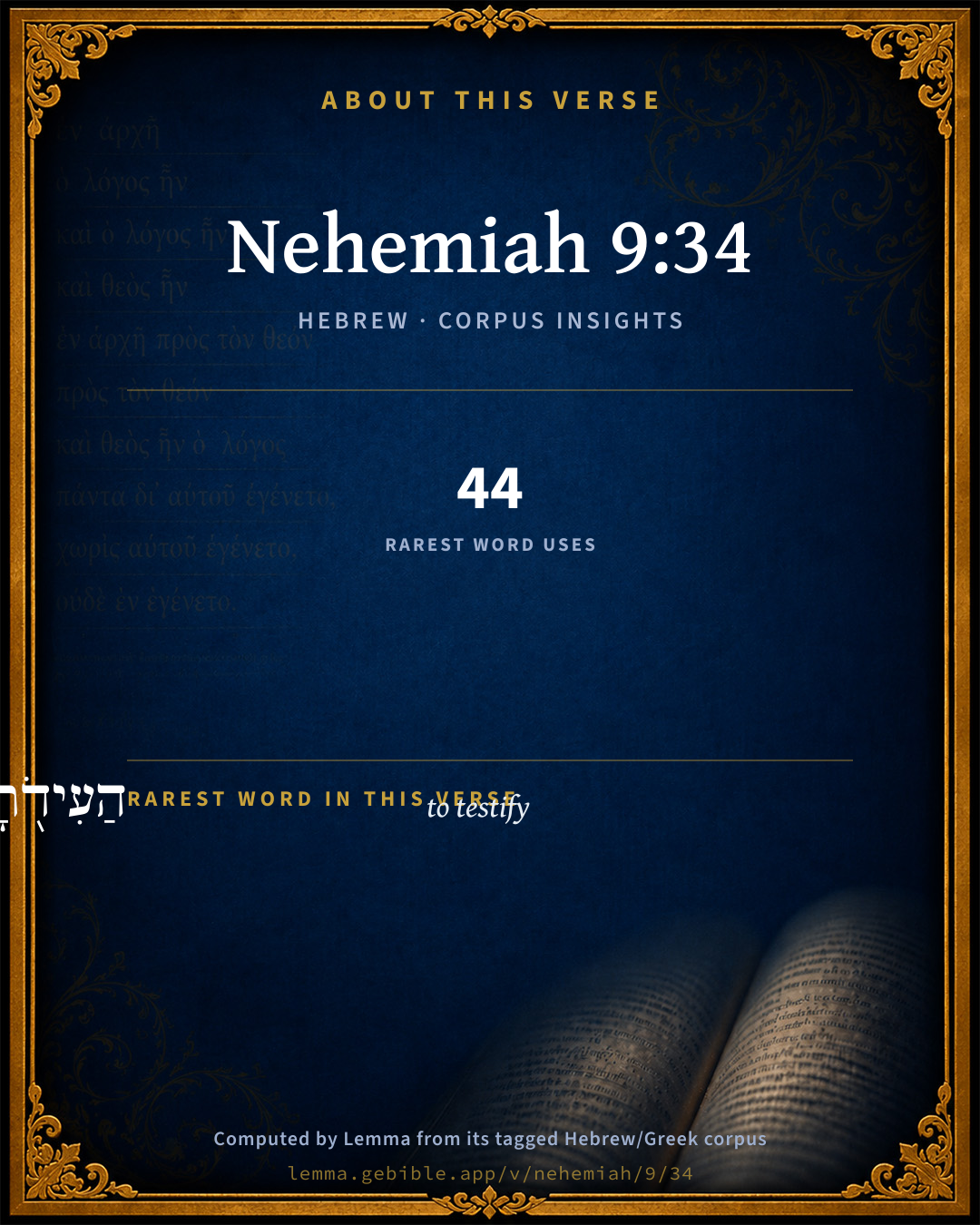
הַעִידֹ֖תָ
ʻûwd
H5749
“to testify”
Verb, Hiphil, Perfect, 2nd Person, Masculine, Singular
Part of Speech
Verb
Stem
Hiphil
Form
Perfect
Person
2nd Person
Gender
Masculine
Number
Singular
Full BDB Definition

Origin: a primitive root

TWOT: 1576 , 1576d

to return, repeat, go about, do again - (Piel) to surround, go round and round - (Pilel) to restore, relieve - (Hithpalel) to be restored - to bear witness - (Qal) to bear witness, say again and again - (Hiphil) - to testify, bear witness - to cause to testify, take or call as witness, invoke - to protest, affirm solemnly, warn, exhort or enjoin solemnly, admonish, charge - (Hophal) to protest, give warning
  1. וְאֶת ʼêth H853 “and · -” Conjunction + Particle, Direct Object
  2. מְלָכֵ֤ינוּ melek H4428 “kings · our” Noun, Common, Masculine, Plural, Construct + Suffix, Personal, 1st Person, Common, Plural
  3. שָׂרֵ֨ינוּ֙ sar H8269 “princes · our” Noun, Common, Masculine, Plural, Construct + Suffix, Personal, 1st Person, Common, Plural
  4. כֹּהֲנֵ֣ינוּ kôhên H3548 “priests · our” Noun, Common, Masculine, Plural, Construct + Suffix, Personal, 1st Person, Common, Plural
  5. וַאֲבֹתֵ֔ינוּ ʼâb H1 “and · fathers · our” Conjunction + Noun, Common, Masculine, Plural, Construct + Suffix, Personal, 1st Person, Common, Plural
  6. לֹ֥א lôʼ H3808 “not” Particle, Negative
  7. עָשׂ֖וּ ʻâsâh H6213 “to do” Verb, Qal, Perfect, 3rd Person, Common, Plural
  8. תּוֹרָתֶ֑ךָ tôwrâh H8451 “law · your” Noun, Common, Feminine, Singular, Construct + Suffix, Personal, 2nd Person, Masculine, Singular
  9. וְלֹ֤א lôʼ H3808 “and · not” Conjunction + Particle, Negative
  10. הִקְשִׁ֨יבוּ֙ qâshab H7181 “to hear” Verb, Hiphil, Perfect, 3rd Person, Common, Plural
  11. אֶל ʼêl H413 “to” Preposition
  12. מִצְוֺתֶ֔יךָ mitsvâh H4687 “commandments · your” Noun, Common, Feminine, Plural, Construct + Suffix, Personal, 2nd Person, Masculine, Singular
  13. וּלְעֵ֣דְוֺתֶ֔יךָ ʻêdûwth H5715 “and · to/for · testimonies · your” Conjunction + Preposition + Noun, Common, Feminine, Plural, Construct + Suffix, Personal, 2nd Person, Masculine, Singular
  14. אֲשֶׁ֥ר ʼăsher H834 “which” Particle, Relative

About this verse

These counts appear in no published source. They are computed here, from the morphology-tagged text and Lemma’s own curated glosses. What Lemma adds →

16
words
14
distinct lemmas
Historical
section

Shared distinctive vocabulary

הַעִידֹ֖תָ to testify H5749 occurs in 40 verses of the Hebrew Bible. Also found in:

Grammatical profile

  • 3 verbs
  • 7 nouns
  • 2 prepositions
  • 4 particles

Verb forms

  • עָשׂ֖וּ Qal · Perfect
  • הִקְשִׁ֨יבוּ֙ Hiphil · Perfect
  • הַעִידֹ֖תָ Hiphil · Perfect

Repetition

A word recurs within this verse — often emphatic in Hebrew:

Cross-references

5

Topical passages linked to Nehemiah 9:34 in the Treasury of Scripture Knowledge — connected by theme and wording, ordered by reader-vote popularity; previews shown in the World English Bible.

  • 2 Kings 17:13 Yet Yahweh testified to Israel, and to Judah, by every prophet, and every seer, saying, Turn you from your evil ways, and keep my commandments and my statutes, according to all the law which I commanded your fathers, and which I sent to you by my servants the prophets.
  • Jeremiah 29:19 because they have not listened to my words, says Yahweh, with which I sent to them my servants the prophets, rising up early and sending them; but you would not hear, says Yahweh.
  • Deuteronomy 31:21 It shall happen, when many evils and troubles are come on them, that this song shall testify before them as a witness; for it shall not be forgotten out of the mouths of their seed: for I know their imagination which they frame this day, before I have brought them into the land which I swore.
  • 2 Kings 17:15 They rejected his statutes, and his covenant that he made with their fathers, and his testimonies which he testified to them; and they followed vanity, and became vain, and [went] after the nations that were round about them, concerning whom Yahweh had charged those who they should not do like them.
  • Nehemiah 9:30 Yet many years did you bear with them, and testified against them by your Spirit through your prophets: yet would they not give ear: therefore gave you them into the hand of the peoples of the lands.

Cross-references courtesy of OpenBible.info (CC BY 4.0).

Hebrew and Greek witnesses Masoretic Hebrew ↔ Greek Septuagint

The same verse in the two great witnesses to the Old Testament, shown verse-for-verse.

These are two independent witnesses, not word-aligned to each other, and the Septuagint is shown in lemma (dictionary) form.

Hebrew Nehemiah 9:34 Masoretic · Westminster Leningrad Codex

וְאֶת מְלָכֵ֤ינוּ שָׂרֵ֨ינוּ֙ כֹּהֲנֵ֣ינוּ וַאֲבֹתֵ֔ינוּ לֹ֥א עָשׂ֖וּ תּוֹרָתֶ֑ךָ וְלֹ֤א הִקְשִׁ֨יבוּ֙ אֶל מִצְוֺתֶ֔יךָ וּלְעֵ֣דְוֺתֶ֔יךָ אֲשֶׁ֥ר הַעִידֹ֖תָ בָּהֶֽם

neither have our kings, our princes, our priests, nor our fathers, kept your law, nor listened to your commandments and your testimonies with which you did testify against them.

World English Bible · Public Domain

Greek LXX Structure differs

The Septuagint has no separate book of Nehemiah. Its Greek text is the second half of Esdras B (2 Esdras), chapters 11–23; Ezra is the first half (1–10).

A verse-for-verse comparison isn’t shown here because the chapters and verses don’t line up. Switch to the LXX edition with the MT / LXX toggle above to read the Greek directly.

Hebrew: Westminster Leningrad Codex (CC BY 4.0). Greek: Septuagint (public domain); English from a public-domain English Septuagint. How the Septuagint differs from the Hebrew →

Commentary

Notes on Nehemiah 9:34 from classic Christian and Jewish commentators (each source and its license shown beneath its notes). The classic Christian expositions comment on the surrounding passage and are grouped to its opening verse, so a note may address several verses; the Jewish commentaries on the Tanakh (Rashi and others) are per-verse, so they appear only where the commentator wrote on this verse.

Lemma curates 59 commentaries, every one of them public domain or Creative Commons licensed, each selected and text-cleaned for this edition rather than reprinted as found. About our sources →

Trapp's Complete Commentary

John Trapp

Neh 9:34 Neither have our kings, our princes, our priests, nor our fathers, kept thy law, nor hearkened unto thy commandments and thy testimonies, wherewith thou didst testify against them.

Ver. 34. Neither have our kings, our princes, our priests, &c.] But as there hath been a general defection, so a well-deserved desolation, wherein we have all justly shared.

Nor hearkened to thy commandments] And that because they testified against their contrary practices. This wicked men cannot away with, they hate him that reproveth in the gate, as Ahab did Micaiah. None but the gracious can say, Let the righteous smite me, be the reproof never so well tempered. No sugar can bereave a pill of its bitterness. Now the ear trieth words, as the mouth tasteth meats, Job 12:11. And ungodly men (as they write of some creatures) have fel in aure, and must get their ears cured ere they can be in case to hear God’s commandments and his testimonies. It is said of Gerson, that he loved a friendly reprover; and of Queen Anne Bullen, that she not only was willing to be admonished, but also required her chaplains freely and plainly to tell her of whatsoever was amiss. Scilicet Christus voluit aliquando etiam reginam in coelum vehere, as Luther once said of Elizabeth, queen of Denmark. These kings and princes of Israel were nonsuch.

John Trapp, A Commentary or Exposition upon All the Books of the Old and New Testament (1647–1656) — public domain. Text from a community e-Sword module.

Geneva Bible (1599)

Geneva Bible translators

That thou wouldest destroy them, except they would return to thee, as verse 26.

Geneva Bible (1599) marginal notes — public domain. Text via Bolls.life.

Adam Clarke's Commentary

Verse 34. Neither have our kings] In this verse he acknowledges that the kings, princes, priests, and fathers, had broken the law: but the prophets are left out; for they continued faithful to God, testifying by his Spirit against the crimes of all; and this even at the risk of their lives.

Adam Clarke's Commentary on the Bible (1810–1826) — public domain. Text from a community e-Sword/MySword module.

Ellicott's Commentary for English Readers

(34) Our kings.—Note that the prophets are omitted in this enumeration.

A Bible Commentary for English Readers, edited by Charles John Ellicott (1878–1897) — public domain. Text from a community e-Sword module.

The Cambridge Bible for Schools and Colleges

gen. ed. J. J. S. Perowne

34. neither have our kings] The construction is the same as in Neh_9:19; Neh_9:32, ‘As for our kings, … they have not.’

kept thy law] Literally ‘done thy law,’ i.e. carried into practice the Divine teaching. Cf. Neh_9:14; Neh_9:29.

nor hearkened] Cf. Zec_1:4, ‘But they (your fathers) did not hear nor hearken unto me, saith the Lord.’

didst testify against them] Probably with special reference to Leviticus 26 and Deuteronomy 28-30.

The Cambridge Bible for Schools and Colleges (gen. ed. J. J. S. Perowne; Cambridge University Press, 1878–1918) — public domain. Text from a community e-Sword module.

John Gill's Exposition

Neither have our kings, our princes, our priests, nor our fathers, kept thy law,.... All ranks of men, from the highest to the lowest, had shown no regard, nor yielded obedience to the holy law of God:

nor hearkened unto thy commandments, and thy testimonies, wherewith thou didst testify against them; moral and ceremonial, which were a testification of the will of God to them, and a testimony against them if they observed them not.

John Gill's Exposition of the Whole Bible (1746–1763) — public domain (CC PDM 1.0). Text via the HelloAO Bible API.

The Pulpit Commentary

Thy testimonies, wherewith thou didst testify against them. i.e. the testimony borne by the prophets (see ver. 30).

The Pulpit Commentary (1880–1919), ed. H.D.M. Spence-Jones & Joseph S. Exell — public domain. Text from a community e-Sword module.

Lesson kit

Teaching starters — assembled from the data on this page, not authored interpretation. Every prompt links to the verse data it draws on. Edit before teaching.

Nehemiah, in the Historical, opens this verse with 16 words (14 distinct Hebrew lemmas). Its most distinctive word is ʻûwd (“to testify”). A historical commentator’s framing appears above. Read the whole chapter for the surrounding context.

Discussion questions

  1. How does “to testify” (ʻûwd) shape what this verse is saying?
  2. How does Genesis 43:3, which shares the word «to testify», read alongside this verse?
  3. What does the repetition of “not” (2× in this one verse) do in this verse?
  4. These translations render this verse differently. What is at stake in choosing one wording over another?
  5. «עָשׂ֖וּ» is a Qal Perfect verb. How does that grammatical form shape the action described?
  6. Compare how Trapp's Complete Commentary and Geneva Bible (1599) read this verse. Where do they agree or differ?

Things to notice

Reading settings

Reading text

Shown beneath each verse's original-language words.

Old Testament
Old Testament edition

Read the OT as the Masoretic Hebrew (MT) or the Greek Septuagint (LXX).

English shown for the Greek Septuagint (in the Hebrew ↔ Greek comparison).

Comparing translations? Open the Compare panel on any verse page to stack up to four side by side.