
Jeremiah 6:19

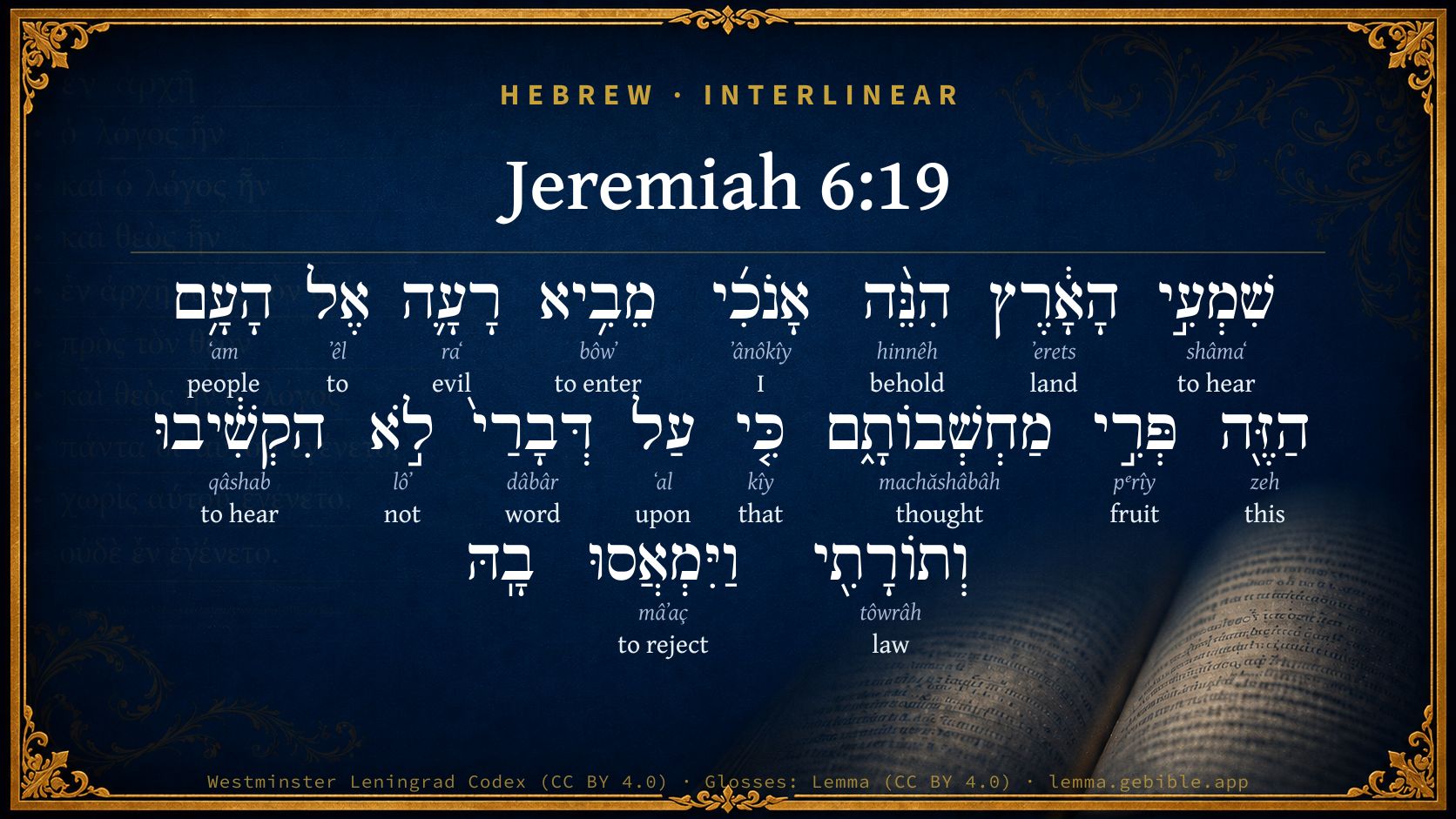
Hebrew (Westminster Leningrad Codex) Jeremiah 6:19 appears in the Hebrew Old Testament. The text above is from the Westminster Leningrad Codex. Each word links to its Strong’s number, a concise gloss, and parsing drawn from the Open Scriptures Hebrew Bible morphology. Click any word for its full Brown-Driver-Briggs (BDB) entry.
Download image
Cite this verse

Jeremiah 6:19 (World English Bible). Public Domain. Lemma interlinear Bible study tool, https://lemma.gebible.app/v/jeremiah/6/19.

Show BibTeX & RIS
BibTeX
RIS
English Translation
Hear, earth: behold, I will bring evil on this people, even the fruit of their thoughts, because they have not listened to my words; and as for my law, they have rejected it.
World English Bible · Public Domain
Download a study sheet

One document with this verse’s original text, its word-by-word gloss line, the meaning frame, cross-references with their text, attributed commentary, and full source and license credits — printable, and it pastes into notes with its structure intact.

This verse Autodidact and up

Study sheet (.html) Plain text (.txt)

A passage Seminary Student

Up to 50 verses in one chapter. A passage sheet keeps up to 6 commentary sources and 12 cross-references per verse, in the order this page ranks them, and says so on the sheet whenever that leaves anything out. Ask for a single verse and you get the Autodidact verse sheet above.

Everything on this page stays free to read, with no account — the sheet is a download of what is already on screen, not access to it.

Want to remove ads? Support Godless Engineer
Compare translations 3

The same verse in 3 English versions, stacked beneath the original-language interlinear above. Click any original word for its lexicon entry.

Each is an independent rendering of the whole verse — the interlinear is not word-aligned to these translations.

Highlighted words mark where these versions differ — a whole-verse word diff, not a word-by-word alignment.

  • World English Bible Public Domain
    Hear, earth: behold, I will bring evil on this people, even the fruit of their thoughts, because they have not listened to my words; and as for my law, they have rejected it.
  • King James Version Public Domain
    Hear, O earth: behold, I will bring evil upon this people, even the fruit of their thoughts, because they have not hearkened unto my words, nor to my law, but rejected it.
  • unfoldingWord Literal Text CC BY-SA 4.0
    Hear, O earth: Behold, I shall bring disaster to this people— the fruit of their plans. For to my words they did not pay attention, and my law, they rejected it.

unfoldingWord Literal Text — © unfoldingWord, licensed CC BY-SA 4.0. Word-aligned USFM3 via Door43 (git.door43.org/unfoldingWord/en_ult).

Versions to compare (up to 4)

3 of 4 selected

Show all 18 translations

Every available English version of this verse, each an independent rendering of the whole verse.

  • World English Bible Public Domain
    Hear, earth: behold, I will bring evil on this people, even the fruit of their thoughts, because they have not listened to my words; and as for my law, they have rejected it.
  • Berean Standard Bible Public Domain
    Hear, O earth! I am bringing disaster on this people, the fruit of their own schemes, because they have paid no attention to My word and have rejected My instruction.
  • Majority Standard Bible Public Domain
    Hear, O earth! I am bringing disaster on this people, the fruit of their own schemes, because they have paid no attention to My word and have rejected My instruction.
  • King James Version Public Domain
    Hear, O earth: behold, I will bring evil upon this people, even the fruit of their thoughts, because they have not hearkened unto my words, nor to my law, but rejected it.
  • American Standard Version (1901) Public Domain
    Hear, O earth: behold, I will bring evil upon this people, even the fruit of their thoughts, because they have not hearkened unto my words; and as for my law, they have rejected it.
  • Revised Version (1885) Public Domain
    Hear, O earth: behold, I will bring evil upon this people, even the fruit of their thoughts, because they have not hearkened unto my words; and as for my law, they have rejected it.
  • Geneva Bible (1599) Public Domain
    Heare, O earth, beholde, I will cause a plague to come vpon this people, euen the fruite of their owne imaginations: because they haue not taken heede vnto my woordes, nor to my Lawe, but cast it off.
  • Douay-Rheims (1899) Public Domain
    Hear, O earth: Behold I will bring evils upon this people, the fruits of their own thoughts: because they have not heard my words, and they have cast away my law.
  • Young's Literal Translation Public Domain
    Hear, O earth, lo, I am bringing evil on this people, The fruit of their devices, For to My words they gave no attention, And My law -- they kick against it.
  • Literal Standard Version CC BY-SA 4.0
    Hear, O earth, behold, I am bringing evil on this people, || The fruit of their plans, || For they gave no attention to My words, || And My law—they kick against it.
  • Unlocked Literal Bible CC BY-SA 4.0
    Hear, earth! See, I am about to bring disaster to this people—the fruit of their thoughts. They paid no attention to my word or law, but they instead rejected it.”
  • unfoldingWord Literal Text CC BY-SA 4.0
    Hear, O earth: Behold, I shall bring disaster to this people— the fruit of their plans. For to my words they did not pay attention, and my law, they rejected it.
  • Darby Bible Public Domain
    Hear, O earth: behold, I will bring evil upon this people, the fruit of their thoughts; for they have not hearkened unto my words, and as to my law, they have rejected it.
  • World Messianic Bible Public Domain
    Hear, earth! Behold, I will bring evil on this people, even the fruit of their thoughts, because they have not listened to my words; and as for my law, they have rejected it.
  • Webster's Bible Public Domain
    Hear, O earth: behold, I will bring evil upon this people, even the fruit of their thoughts, because they have not hearkened to my words, nor to my law, but have rejected it.
  • Free Bible Version CC BY-SA 4.0
    Earth, you listen too! I am bringing disaster down on this people, the end result of what they themselves planned. It's because they paid no attention to what I said, and rejected my instructions.
  • Bible in Basic English Public Domain
    Give ear, O earth: see, I will make evil come on this people, even the fruit of their thoughts, because they have not given attention to my words, and they would have nothing to do with my law.
  • JPS Tanakh (1917) Public Domain
    Hear, O earth: Behold, I will bring evil upon this people, even the fruit of their thoughts, because they have not attended unto My words, and as for My teaching, they have rejected it.

Literal Standard Version (2020), Covenant Press — licensed CC BY-SA 4.0. Text via the HelloAO Bible API (eBible.org). Unlocked Literal Bible (unfoldingWord) — licensed CC BY-SA 4.0. Text via the HelloAO Bible API (eBible.org). unfoldingWord Literal Text — © unfoldingWord, licensed CC BY-SA 4.0. Word-aligned USFM3 via Door43 (git.door43.org/unfoldingWord/en_ult). Free Bible Version, Dr. Jonathan Gallagher — licensed CC BY-SA 4.0. Text via the HelloAO Bible API (eBible.org).

Word by word

More ways to search: Search by grammar → Find every occurrence → Compare this word →

Practice this passage: Drill this verse → Learn its vocabulary →

הִקְשִׁ֔יבוּ
qâshab
H7181
“to hear”
Verb, Hiphil, Perfect, 3rd Person, Common, Plural
Part of Speech
Verb
Stem
Hiphil
Form
Perfect
Person
3rd Person
Gender
Common
Number
Plural
Full BDB Definition

Origin: a primitive root

TWOT: 2084

to hear, be attentive, heed, incline (of ears), attend (of ears), hearken, pay attention, listen - (Qal) incline, attend (of ears), hearken, pay attention, listen - (Hiphil) to pay attention, give attention
  1. שִׁמְעִ֣י shâmaʻ H8085 “hear” Verb, Qal, Imperative, 2nd Person, Feminine, Singular
  2. הָאָ֔רֶץ ʼerets H776 “the · land” Particle, Definite Article + Noun, Common, Both, Singular, Absolute
  3. הִנֵּ֨ה hinnêh H2009 “behold” Particle, Demonstrative
  4. אָנֹכִ֜י ʼânôkîy H595 “I” Pronoun, Personal, 1st Person, Common, Singular
  5. מֵבִ֥יא bôwʼ H935 “entering” Verb, Hiphil, Participle Active, Masculine, Singular, Absolute
  6. רָעָ֛ה raʻ H7451 “evil” Noun, Common, Feminine, Singular, Absolute
  7. אֶל ʼêl H413 “to” Preposition
  8. הָעָ֥ם ʻam H5971 “the · people” Particle, Definite Article + Noun, Common, Masculine, Singular, Absolute
  9. הַזֶּ֖ה zeh H2088 “the · this” Particle, Definite Article + Pronoun, Demonstrative, Masculine, Singular
  10. פְּרִ֣י pᵉrîy H6529 “fruit of” Noun, Common, Masculine, Singular, Construct
  11. מַחְשְׁבוֹתָ֑ם machăshâbâh H4284 “thoughts · their” Noun, Common, Feminine, Plural, Construct + Suffix, Personal, 3rd Person, Masculine, Plural
  12. כִּ֤י kîy H3588 “that” Conjunction
  13. עַל ʻal H5921 “upon” Preposition
  14. דְּבָרַי֙ dâbâr H1697 “words · my” Noun, Common, Masculine, Plural, Construct + Suffix, Personal, 1st Person, Common, Singular
  15. לֹ֣א lôʼ H3808 “not” Particle, Negative
  16. וְתוֹרָתִ֖י tôwrâh H8451 “and · law · my” Conjunction + Noun, Common, Feminine, Singular, Construct + Suffix, Personal, 1st Person, Common, Singular
  17. וַיִּמְאֲסוּ mâʼaç H3988 “and · to reject” Conjunction + Verb, Qal, Sequential Imperfect, 3rd Person, Masculine, Plural

About this verse

These counts appear in no published source. They are computed here, from the morphology-tagged text and Lemma’s own curated glosses. What Lemma adds →

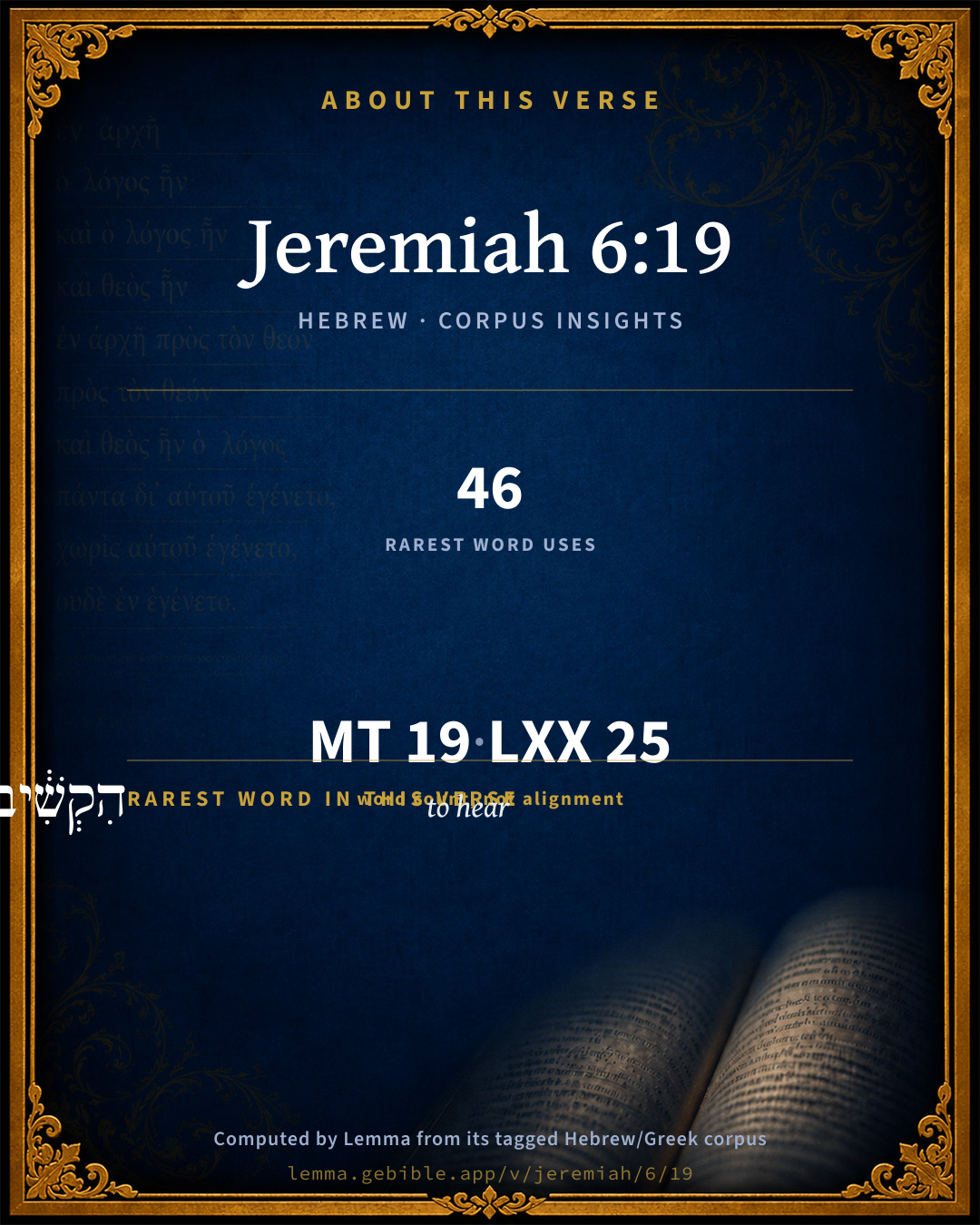
19
words
18
distinct lemmas
Prophets
section

Shared distinctive vocabulary

הִקְשִׁ֔יבוּ to hear H7181 occurs in 45 verses of the Hebrew Bible. Also found in:

Grammatical profile

  • 4 verbs
  • 7 nouns
  • 2 pronouns
  • 3 prepositions
  • 1 conjunction
  • 2 particles

Verb forms

  • שִׁמְעִ֣י Qal · Imperative
  • מֵבִ֥יא Hiphil · Participle Active
  • הִקְשִׁ֔יבוּ Hiphil · Perfect
  • וַיִּמְאֲסוּ Qal · Sequential Imperfect

Hebrew & Septuagint length

In the original languages it is 19 Hebrew tokens and 25 Greek tokens — but the two are counted differently (Hebrew bundles its prefixes and suffixes into one token; the Greek is in lemma form), so that isn’t a like-for-like length.

Cross-references

23

Topical passages linked to Jeremiah 6:19 in the Treasury of Scripture Knowledge — connected by theme and wording, ordered by reader-vote popularity; previews shown in the World English Bible.

  • Isaiah 1:2 Hear, heavens, And listen, earth; for Yahweh has spoken: I have nourished and brought up children, And they have rebelled against me.
  • Jeremiah 8:9 The wise men are disappointed, they are dismayed and taken: behold, they have rejected the word of Yahweh; and what manner of wisdom is in them?
  • Jeremiah 17:10 I, Yahweh, search the mind, I try the heart, even to give every man according to his ways, according to the fruit of his doings.
  • Acts 8:22 Repent therefore of this, your wickedness, and ask God if perhaps the thought of your heart may be forgiven you.
  • Jeremiah 6:10 To whom shall I speak and testify, that they may hear? behold, their ear is uncircumcised, and they can't listen: behold, the word of Yahweh is become to them a reproach; they have no delight in it.
  • Jeremiah 22:29 O earth, earth, earth, hear the word of Yahweh.
  • Hosea 4:6 My people are destroyed for lack of knowledge. Because you have rejected knowledge, I will also reject you, That you may be no priest to me. Because you have your God's law, I will also forget your children.
  • Hosea 10:13 You have plowed wickedness. You have reaped iniquity. You have eaten the fruit of lies, For you trusted in your way, in the multitude of your mighty men.
  • Micah 6:2 Hear, you mountains, Yahweh's controversy, And you enduring foundations of the earth; For Yahweh has a controversy with his people, And he will contend with Israel.
  • John 3:19–21 This is the judgment, that the light has come into the world, and men loved the darkness rather than the light; for their works were evil.
  • John 12:48 He who rejects me, and doesn't receive my sayings, has one who judges him. The word that I spoke, the same will judge him in the last day.
  • Isaiah 66:18 For I [know] their works and their thoughts: [the time] comes, that I will gather all nations and languages; and they shall come, and shall see my glory.
  • Jeremiah 19:15 Thus says Yahweh of Hosts, the God of Israel, Behold, I will bring on this city and on all its towns all the evil that I have pronounced against it; because they have made their neck stiff, that they may not hear my words.
  • Deuteronomy 4:26 I call heaven and earth to witness against you this day, that you shall soon utterly perish from off the land whereunto you go over the Jordan to possess it; you shall not prolong your days on it, but shall utterly be destroyed.
  • Deuteronomy 30:19 I call heaven and earth to witness against you this day, that I have set before you life and death, the blessing and the curse: therefore choose life, that you may live, you and your seed;
  • Deuteronomy 32:1 Give ear, you heavens, and I will speak; Let the earth hear the words of my mouth.
  • 1 Samuel 15:23 For rebellion is as the sin of witchcraft, and stubbornness is as idolatry and teraphim. Because you have rejected the word of Yahweh, he has also rejected you from being king.
  • 1 Samuel 15:26 Samuel said to Saul, I will not return with you; for you have rejected the word of Yahweh, and Yahweh has rejected you from being king over Israel.
  • Proverbs 1:24–31 Because I have called, and you have refused; I have stretched out my hand, and no one has paid attention;
  • Proverbs 15:26 Yahweh detests the thoughts of the wicked, But the thoughts of the pure are pleasing.
  • Proverbs 28:9 He who turns away his ear from hearing the law, Even his prayer is an abomination.
  • Isaiah 59:7 Their feet run to evil, and they make haste to shed innocent blood: their thoughts are thoughts of iniquity; desolation and destruction are in their paths.
  • Jeremiah 4:4 Circumcise yourselves to Yahweh, and take away the foreskins of your heart, you men of Judah and inhabitants of Jerusalem; lest my wrath go forth like fire, and burn so that none can quench it, because of the evil of your doings.

Cross-references courtesy of OpenBible.info (CC BY 4.0).

Hebrew and Greek witnesses Masoretic Hebrew ↔ Greek Septuagint

The same verse in the two great witnesses to the Old Testament, shown verse-for-verse.

These are two independent witnesses, not word-aligned to each other, and the Septuagint is shown in lemma (dictionary) form.

Hebrew Jeremiah 6:19 Masoretic · Westminster Leningrad Codex

שִׁמְעִ֣י הָאָ֔רֶץ הִנֵּ֨ה אָנֹכִ֜י מֵבִ֥יא רָעָ֛ה אֶל הָעָ֥ם הַזֶּ֖ה פְּרִ֣י מַחְשְׁבוֹתָ֑ם כִּ֤י עַל דְּבָרַי֙ לֹ֣א הִקְשִׁ֔יבוּ וְתוֹרָתִ֖י וַיִּמְאֲסוּ בָֽהּ

Hear, earth: behold, I will bring evil on this people, even the fruit of their thoughts, because they have not listened to my words; and as for my law, they have rejected it.

World English Bible · Public Domain

Greek LXX Structure differs

In the Septuagint, Jeremiah is about an eighth shorter than the Hebrew and arranges its material differently — the Oracles Against the Nations (Hebrew chapters 46–51) appear in the middle of the Greek book, after 25:13. Because the chapter and verse boundaries do not line up, a verse-for-verse comparison with the Hebrew is not shown.

A verse-for-verse comparison isn’t shown here because the chapters and verses don’t line up. Switch to the LXX edition with the MT / LXX toggle above to read the Greek directly.

Hebrew: Westminster Leningrad Codex (CC BY 4.0). Greek: Septuagint (public domain); English from a public-domain English Septuagint. How the Septuagint differs from the Hebrew →

Targum (Aramaic paraphrase)

1

The Targum is the ancient Jewish Aramaic paraphrase of the Hebrew Scriptures — an interpretive translation, not the Hebrew text itself. Onkelos (literal) and Pseudo-Jonathan (expansive) render the Torah, and Jonathan the Prophets. Coverage is partial: where no permissively-licensed English translation exists for a verse, only the Aramaic is shown. This is verse-level text, not a word-by-word alignment to the Hebrew.

  1. Targum Jonathan Prophets (Joshua–Malachi)
    שְׁמָעִי אַרְעָא דְיִשְׂרָאֵל הָא אֲנָא מַיְתֵי בִישְׁתָּא עַל עַמָא הָדֵין תּוּשְׁלְמַת עוֹבָדֵיהוֹן אֲרֵי לְפִתְגָמֵי עַבְדֵי נְבִיַיָא לָא קַבִּילוּ וְאוֹרַיְתִי וְקָצוּ בָּהּ:

    (no public-domain English translation for this verse)

    Targum Jonathan — Aramaic: “Mikraot Gedolot” (public domain). English: “Sefaria Community Translation” (CC0 1.0 (public-domain dedication)); “London "Chaldee Paraphrase," 1871” (public domain). Text via Sefaria.

Commentary

Notes on Jeremiah 6:19 from classic Christian and Jewish commentators (each source and its license shown beneath its notes). The classic Christian expositions comment on the surrounding passage and are grouped to its opening verse, so a note may address several verses; the Jewish commentaries on the Tanakh (Rashi and others) are per-verse, so they appear only where the commentator wrote on this verse.

Lemma curates 59 commentaries, every one of them public domain or Creative Commons licensed, each selected and text-cleaned for this edition rather than reprinted as found. About our sources →

Trapp's Complete Commentary

John Trapp

Jer 6:19 Hear, O earth: behold, I will bring evil upon this people, [even] the fruit of their thoughts, because they have not hearkened unto my words, nor to my law, but rejected it.

Ver. 19. Hear, O earth.] In case none else will hear.

Even the fruit of their thoughts.] Why, then, should any man think that "thought is free?" Free they are from men’s courts and consistories, but not from God’s eye, law, or hand.

John Trapp, A Commentary or Exposition upon All the Books of the Old and New Testament (1647–1656) — public domain. Text from a community e-Sword module.

Jamieson, Fausset & Brown

Robert Jamieson, A. R. Fausset & David Brown

(Isa 1:2).

fruit of . . . thoughts-- (Pro 1:31).

nor to my law, but rejected it--literally, "and (as to) My law they have rejected it." The same construction occurs in Gen 22:24. Literally, "To what purpose is this to Me, that incense cometh to Me?"

incense . . . cane-- (Isa 43:24; Isa 60:6). No external services are accepted by God without obedience of the heart and life (Jer 7:21; Psa 50:7-9; Isa 1:11; Mic 6:6, &c.).

sweet . . . sweet--antithesis. Your sweet cane is not sweet to Me. The calamus.

Jamieson, Fausset & Brown — Commentary Critical and Explanatory on the Whole Bible (1871) — public domain (CC PDM 1.0). Text via the HelloAO Bible API.

John Calvin's Commentaries

He then adds, Hear, thou earth This is general, as though he said, “Hear ye, all the inhabitants of the earth: “Behold, I am bringing an evil on this people He would have directly addressed the Jews, had they ears to hear; but as their vices and contempt of God had made them deaf, it was necessary for him to address the earth. Now, God testifies here that he should not act cruelly in visiting with severity this people, as he would only reward them as they deserved. The sum of what is said then is, that however grievous might be the punishment he would inflict, yet the people could not complain of immoderate rigor, for they should only receive what their works justly deserved. But Jeremiah not only speaks of their works, but he mentions the fruit of their thoughts; for they concocted their wickedness within, so that they did not offend God through levity or ignorance. By thoughts, then, he means that daily meditation on evil, to which the Jews had habituated themselves. So then their interior wickedness and obstinacy are here set forth.

He afterwards adds, Because they have not to my words attended, and for nothing have they esteemed my law. We ever see that the guilt of the Jews was increased by the circumstance, that God had exhorted them by his servants, and that they had rejected all instruction. That they then would not hearken, and that they counted the law and instruction as nothing, made it evident that their sin could not by any pretense be excused; for they knowingly and openly carried on war with God himself, according to what is said of the giants.

We may learn from this passage, that nothing is more abominable in the sight of God than the contempt of divine truth; for his majesty, which shines forth in his word, is thereby trampled under foot; and further, it is art extreme ingratitude in men, when God himself invites them to salvation, willfully to seek their own ruin and to reject his favor. It is no wonder then that God cannot endure the contempt of his word; by which his majesty, as I have said, is dishonored, and his goodness, by which he would secure the salvation of men, is treated with the basest ingratitude. He afterwards adds —

John Calvin's Commentaries (1540-1563) — public domain. Text from the Calvin Translation Society English edition (1840s-50s) via the Christian Classics Ethereal Library (ccel.org). Calvin's coverage is partial (roughly two-thirds of the Bible); uncommented books and verses are honest gaps, never fabricated. The 19th-century editor's footnotes and remarks are omitted so the notes are faithfully Calvin's own voice.

The Cambridge Bible for Schools and Colleges

gen. ed. J. J. S. Perowne

19. The conclusion of the threefold appeal. Thus God pledges Himself as it were in the sight of the whole world, that He will no longer forbear.

the fruit of their thoughts] the results of their rebelliousness. Cp. Pro_1:31.

my law] See on Jer_8:8.

The Cambridge Bible for Schools and Colleges (gen. ed. J. J. S. Perowne; Cambridge University Press, 1878–1918) — public domain. Text from a community e-Sword module.

John Gill's Exposition

Hear, O earth: behold, I will bring evil upon this people,.... The people of the Jews; the evil of punishment, for the evil of sin committed by them; wherefore the earth, and the inhabitants of it, are called upon to bear witness to, the righteousness of such a procedure:

even the fruit of their thoughts; which they thought of, contrived, and devised; which shows that they did not do what they did inadvertently, but with thought and design. Kimchi interprets it of sinful deeds and actions, the fruit of thoughts; but his father, of thoughts themselves. The Talmudists, (y) comment upon it thus,

"a thought which brings forth fruit, the holy blessed God joins it to an action; but a thought in which there is no fruit, the holy blessed God does not join to action;''

that is, in punishment; very wrongly. For the sense is, that God would bring upon them the calamities and distresses their thoughts and the evil counsels of their minds deserved. The Targum renders it,

"the retribution or reward of their works.''

Because they have not hearkened unto my words; spoken to them by the prophets:

nor to my law, but rejected it; neither hearkened to the law, nor to the prophets, but despised both. The Targum is,

"because they obeyed not the words of my servants, the prophets, and abhorred my law.''

(y) T. Bab. Kiddushin, fol. 40. 1.

John Gill's Exposition of the Whole Bible (1746–1763) — public domain (CC PDM 1.0). Text via the HelloAO Bible API.

Albert Barnes' Notes on the Bible

The fathers understood this to be the decree rejecting the Jews from being the Church.

Albert Barnes' Notes on the Bible (1834–1885) — public domain. Text from a community e-Sword/MySword module.

Matthew Poole's English Annotations

Hear, O earth; the inhabitants of the earth; or else God having spoken to the rational, he now speaks to the very senseless creatures to observe his proceedings, Eze 36:4.

I will bring evil; the Chaldean army, with all the direful effects of it. The fruit of their thoughts: q.d. They may thank themselves for what is come upon them, being the fruit of all these contrivances and wicked imaginations that their hearts were full of, Pro 1:29-31; see Isa 59:7; Jer 4:14; by which phrase is also intimated that their sins were not some slight oversights, but meditated and digested wickedness; and therefore God will bring upon them the just punishment for their doings.

My words; those messages that I so frequently and earnestly sent unto them by my prophets, Pro 1:24,25.

But rejected it; as it were bidding open defiance to me, scorning to be ruled by me.

Matthew Poole's English Annotations on the Holy Bible (1683–1685) — public domain. Text from a community e-Sword/MySword module.

The Pulpit Commentary

The fruit of their thoughts. That punishment is the ripe fruit of sin, is the doctrine of the Old (Isa_3:10 Psa_58:11, margin) as well as of the New Testament. (Jam_1:15)

The fruit of thought.

I THOUGHT HAS FRUIT. In all departments of life its fruit is seen scientific, political, social, moral, religious. Thoughts are born in some one mind. Sown by words spoken or written, and by the influence of the lives of those in whom they are born; they germinate by contact with other minds; they appear above ground in the tendencies of any given age; they bear fruit in the achievements of the age.

II THOUGHT BEARS GOOD FRUIT OR EVIL, ACCORDING AS THE LAW OF GOD IS HEEDED OR REJECTED. "Wherewithal shall a young man cleanse his way? By taking heed thereto according to that Word.

III THE CHIEF PARTAKER OF THE FRUIT OF THOUGHT WILL BE THE THINKER. (Cf. text.) And it is true both of good thoughts and ill. As a man thinketh so is he.

CONCLUSION. Let it be our prayer that we may come into full sympathy with him who said, "How precious are thy thoughts unto me, O God!" So shall the fruit of our thoughts be precious likewise. C.

The Pulpit Commentary (1880–1919), ed. H.D.M. Spence-Jones & Joseph S. Exell — public domain. Text from a community e-Sword module.

Rashi

Rabbi Shlomo Yitzchaki (Rashi)

the fruit of their thoughts the retribution for their thoughts.

and they rejected My instruction Heb. ותורתי וימאסו בה. This follows the pattern of (Exodus 15:2) “The strength and destruction of God was my salvation (ויהי לי לישועה),” for he should have said: והיה לי לישועה. So too, here it should have said, ותורתי מאסו בה, but it is the style of Scripture to speak in this manner.

Rashi on the Tanakh — English translations: “The Judaica Press complete Tanach with Rashi, translated by A. J. Rosenberg” (CC BY 4.0); “Pentateuch with Rashi's commentary by M. Rosenbaum and A.M. Silbermann, 1929-1934” (public domain); “The Metsudah Tanach series, Lakewood, N.J” (CC BY 4.0); and “The Book of Joshua, Metsudah Publications, 1997” (CC BY 4.0). Text via Sefaria.

Lesson kit

Teaching starters — assembled from the data on this page, not authored interpretation. Every prompt links to the verse data it draws on. Edit before teaching.

Jeremiah, in the Prophets, opens this verse with 19 words (18 distinct Hebrew lemmas). Its most distinctive word is qâshab (“to hear”). A historical commentator’s framing appears above. Read the whole chapter for the surrounding context.

Discussion questions

  1. What does “to hear” (qâshab) contribute to the verse as a whole?
  2. How does 1 Samuel 15:22, which shares the word «to hear», read alongside this verse?
  3. These translations render this verse differently. What is at stake in choosing one wording over another?
  4. «שִׁמְעִ֣י» is a Qal Imperative verb. How does that grammatical form shape the action described?
  5. Compare how Trapp's Complete Commentary and Jamieson, Fausset & Brown read this verse. Where do they agree or differ?

Things to notice

Reading settings

Reading text

Shown beneath each verse's original-language words.

Old Testament
Old Testament edition

Read the OT as the Masoretic Hebrew (MT) or the Greek Septuagint (LXX).

English shown for the Greek Septuagint (in the Hebrew ↔ Greek comparison).

Comparing translations? Open the Compare panel on any verse page to stack up to four side by side.