

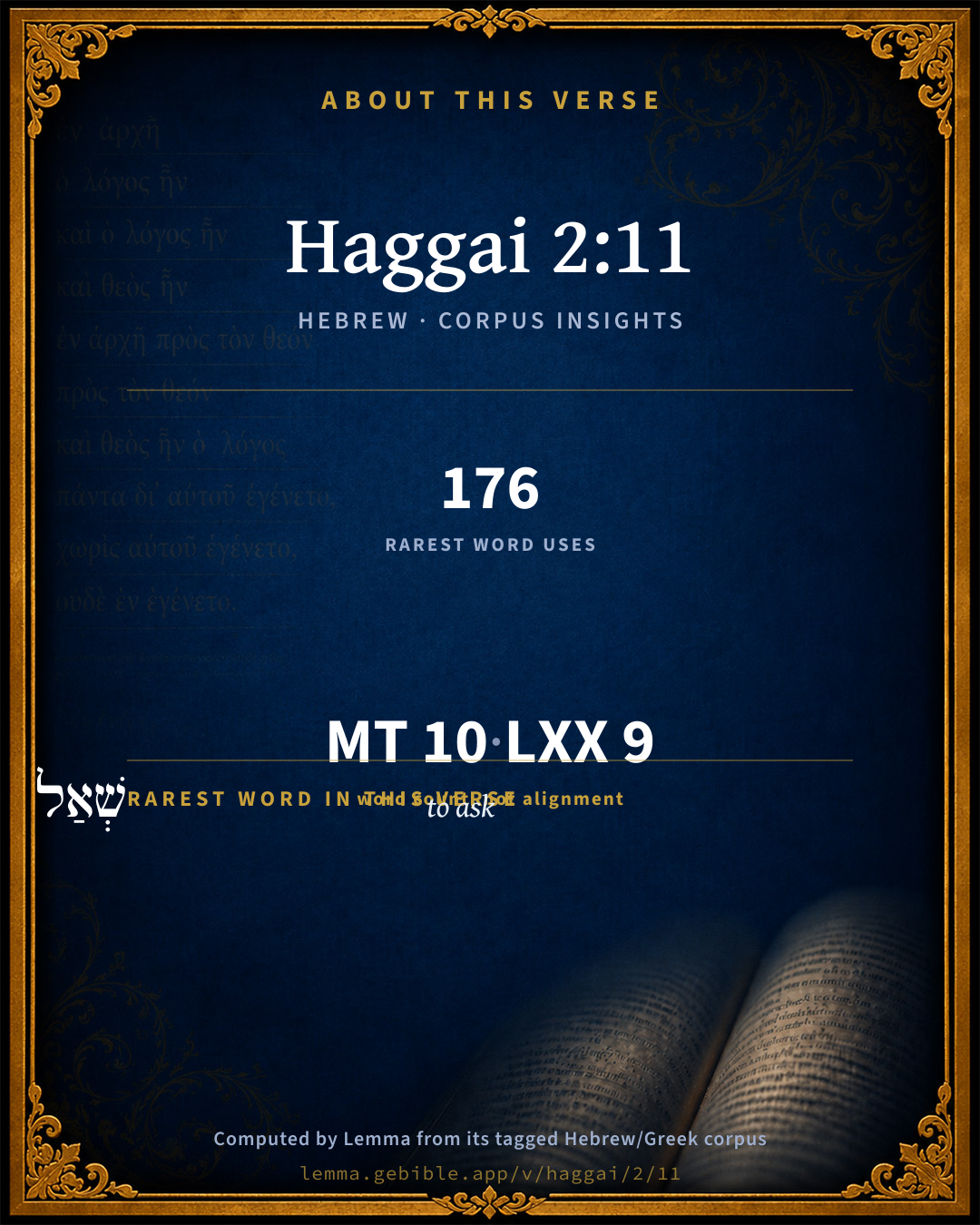
Haggai 2:11

Hebrew (Westminster Leningrad Codex) Haggai 2:11 appears in the Hebrew Old Testament. The text above is from the Westminster Leningrad Codex. Each word links to its Strong’s number, a concise gloss, and parsing drawn from the Open Scriptures Hebrew Bible morphology. Click any word for its full Brown-Driver-Briggs (BDB) entry.
Download image
Cite this verse

Haggai 2:11 (World English Bible). Public Domain. Lemma interlinear Bible study tool, https://lemma.gebible.app/v/haggai/2/11.

Show BibTeX & RIS
BibTeX
RIS
English Translation
"Thus says Yahweh of Hosts: Ask now the priests concerning the law, saying,
World English Bible · Public Domain
Download a study sheet

One document with this verse’s original text, its word-by-word gloss line, the meaning frame, cross-references with their text, attributed commentary, and full source and license credits — printable, and it pastes into notes with its structure intact.

This verse Autodidact and up

Study sheet (.html) Plain text (.txt)

A passage Seminary Student

Up to 50 verses in one chapter. A passage sheet keeps up to 6 commentary sources and 12 cross-references per verse, in the order this page ranks them, and says so on the sheet whenever that leaves anything out. Ask for a single verse and you get the Autodidact verse sheet above.

Everything on this page stays free to read, with no account — the sheet is a download of what is already on screen, not access to it.

Want to remove ads? Support Godless Engineer
Compare translations 3

The same verse in 3 English versions, stacked beneath the original-language interlinear above. Click any original word for its lexicon entry.

Each is an independent rendering of the whole verse — the interlinear is not word-aligned to these translations.

Highlighted words mark where these versions differ — a whole-verse word diff, not a word-by-word alignment.

  • World English Bible Public Domain
    "Thus says Yahweh of Hosts: Ask now the priests concerning the law, saying,
  • King James Version Public Domain
    Thus saith the LORD of hosts; Ask now the priests concerning the law, saying,
  • unfoldingWord Literal Text CC BY-SA 4.0
    “Thus says Yahweh of Armies: ‘Now ask the priests the law, saying,

unfoldingWord Literal Text — © unfoldingWord, licensed CC BY-SA 4.0. Word-aligned USFM3 via Door43 (git.door43.org/unfoldingWord/en_ult).

Versions to compare (up to 4)

3 of 4 selected

Show all 18 translations

Every available English version of this verse, each an independent rendering of the whole verse.

  • World English Bible Public Domain
    "Thus says Yahweh of Hosts: Ask now the priests concerning the law, saying,
  • Berean Standard Bible Public Domain
    “This is what the LORD of Hosts says: ‘Ask the priests for a ruling.
  • Majority Standard Bible Public Domain
    “This is what the LORD of Hosts says: ‘Ask the priests for a ruling.
  • King James Version Public Domain
    Thus saith the LORD of hosts; Ask now the priests concerning the law, saying,
  • American Standard Version (1901) Public Domain
    Thus saith Jehovah of hosts: Ask now the priests concerning the law, saying,
  • Revised Version (1885) Public Domain
    Thus saith the LORD of hosts: Ask now the priests concerning the law, saying,
  • Geneva Bible (1599) Public Domain
    In the foure and twentieth day of the ninth moneth, in the second yeere of Darius, came the worde of the Lord vnto the Prophet Haggai, saying,
  • Douay-Rheims (1899) Public Domain
    In the four and twentieth day of the ninth month, in the second year of Darius the king, the word of the Lord came to Aggeus the prophet, saying:
  • Young's Literal Translation Public Domain
    Thus said Jehovah of Hosts: `Ask, I pray thee, the priests `of' the law, saying:
  • Literal Standard Version CC BY-SA 4.0
    Thus said YHWH of Hosts: “Now ask the priests of the Law, saying,
  • Unlocked Literal Bible CC BY-SA 4.0
    “Yahweh of hosts says this: Ask the priests concerning the law, and say,
  • unfoldingWord Literal Text CC BY-SA 4.0
    “Thus says Yahweh of Armies: ‘Now ask the priests the law, saying,
  • Darby Bible Public Domain
    Thus saith Jehovah of hosts: Ask now the priests [concerning] the law, saying,
  • World Messianic Bible Public Domain
    “The LORD of Hosts says: Ask now the priests concerning the law, saying,
  • Webster's Bible Public Domain
    Thus saith the LORD of hosts, Ask now the priests concerning the law, saying,
  • Free Bible Version CC BY-SA 4.0
    “This is what the Lord Almighty says: Ask the priests about the law.
  • Bible in Basic English Public Domain
    These are the words of the Lord of armies: Put now a point of law to the priests, saying,
  • JPS Tanakh (1917) Public Domain
    'Thus saith the LORD of hosts: Ask now the priests for instruction, saying:

Literal Standard Version (2020), Covenant Press — licensed CC BY-SA 4.0. Text via the HelloAO Bible API (eBible.org). Unlocked Literal Bible (unfoldingWord) — licensed CC BY-SA 4.0. Text via the HelloAO Bible API (eBible.org). unfoldingWord Literal Text — © unfoldingWord, licensed CC BY-SA 4.0. Word-aligned USFM3 via Door43 (git.door43.org/unfoldingWord/en_ult). Free Bible Version, Dr. Jonathan Gallagher — licensed CC BY-SA 4.0. Text via the HelloAO Bible API (eBible.org).

Word by word

More ways to search: Search by grammar → Find every occurrence → Compare this word →

Practice this passage: Drill this verse → Learn its vocabulary →

שְׁאַל
shâʼal
H7592
“ask”
Verb, Qal, Imperative, 2nd Person, Masculine, Singular
Part of Speech
Verb
Stem
Qal
Form
Imperative
Person
2nd Person
Gender
Masculine
Number
Singular
Full BDB Definition

Origin: a primitive root

TWOT: 2303

to ask, enquire, borrow, beg - (Qal) - to ask, ask for - to ask (as a favour), borrow - to enquire, enquire of - to enquire of, consult (of deity, oracle) - to seek - (Niphal) to ask for oneself, ask leave of absence - (Piel) - to enquire, enquire carefully - to beg, practise beggary - (Hiphil) - to be given on request - to grant, make over to, let (one) ask (successfully) or give or lend on request (then) grant or make over to
  1. כֹּ֥ה kôh H3541 “thus” Adverb
  2. אָמַ֖ר ʼâmar H559 “to say” Verb, Qal, Perfect, 3rd Person, Masculine, Singular
  3. יְהוָ֣ה Yᵉhôvâh H3068 “LORD” Noun, Proper
  4. צְבָא֑וֹת tsâbâʼ H6635 “armies” Noun, Common, Both, Plural, Absolute
  5. נָ֧א nâʼ H4994 “please” Particle, Exhortation
  6. אֶת ʼêth H853 “-” Particle, Direct Object
  7. הַכֹּהֲנִ֛ים kôhên H3548 “the · priests” Particle, Definite Article + Noun, Common, Masculine, Plural, Absolute
  8. תּוֹרָ֖ה tôwrâh H8451 “law” Noun, Common, Feminine, Singular, Absolute
  9. לֵאמֹֽר ʼâmar H559 “to say” Preposition + Verb, Qal, Infinitive Construct

About this verse

These counts appear in no published source. They are computed here, from the morphology-tagged text and Lemma’s own curated glosses. What Lemma adds →

10
words
9
distinct lemmas
Prophets
section

Grammatical profile

  • 3 verbs
  • 4 nouns
  • 1 adverb
  • 2 particles

Verb forms

  • אָמַ֖ר Qal · Perfect
  • שְׁאַל Qal · Imperative
  • לֵאמֹֽר Qal · Infinitive Construct

Repetition

A word recurs within this verse — often emphatic in Hebrew:

  • אָמַ֖ר to say H559 ×2

Hebrew & Septuagint length

In English translation the verse runs 13 words from the Hebrew and 27 from the Septuagint (LXX English) — the Septuagint runs noticeably longer here. See the side-by-side →

A rough comparison of the two English renderings, which tokenize alike — not a word-level alignment.

Word counts can differ between the Hebrew and the Greek without any difference in meaning — e.g. the Hebrew direct-object marker אֵת has no separate Greek word, and Greek often adds the article ὁ.

In the original languages it is 10 Hebrew tokens and 9 Greek tokens — but the two are counted differently (Hebrew bundles its prefixes and suffixes into one token; the Greek is in lemma form), so that isn’t a like-for-like length.

Cross-references

6

Topical passages linked to Haggai 2:11 in the Treasury of Scripture Knowledge — connected by theme and wording, ordered by reader-vote popularity; previews shown in the World English Bible.

  • Leviticus 10:10–11 and that you are to make a distinction between the holy and the common, and between the unclean and the clean;
  • Deuteronomy 33:10 They shall teach Jacob your ordinances, Israel your law: They shall put incense before you, Whole burnt offering on your altar.
  • Malachi 2:7 For the priest's lips should keep knowledge, and they should seek the law at his mouth; for he is the messenger of Yahweh of Hosts.
  • Deuteronomy 17:8–11 If there arise a matter too hard for you in judgment, between blood and blood, between plea and plea, and between stroke and stroke, being matters of controversy within your gates; then shall you arise, and go up to the place which Yahweh your God shall choose;
  • Ezekiel 44:23–24 They shall teach my people the difference between the holy and the common, and cause them to discern between the unclean and the clean.
  • Titus 1:9 holding to the faithful word which is according to the teaching, that he may be able to exhort in the sound doctrine, and to convict those who contradict him.

Cross-references courtesy of OpenBible.info (CC BY 4.0).

Hebrew and Greek witnesses Masoretic Hebrew ↔ Greek Septuagint

The same verse in the two great witnesses to the Old Testament, shown verse-for-verse.

Here the Septuagint runs noticeably longer than the Hebrew — LXX2012 (modern English Septuagint) 27 words vs World English Bible 13. A rough length comparison of the two English translations, not a word-level alignment — read both below.

These are two independent witnesses, not word-aligned to each other, and the Septuagint is shown in lemma (dictionary) form.

Hebrew Haggai 2:11 Masoretic · Westminster Leningrad Codex

כֹּ֥ה אָמַ֖ר יְהוָ֣ה צְבָא֑וֹת שְׁאַל נָ֧א אֶת הַכֹּהֲנִ֛ים תּוֹרָ֖ה לֵאמֹֽר

"Thus says Yahweh of Hosts: Ask now the priests concerning the law, saying,

World English Bible · Public Domain

Greek LXX Haggai 2:11 Septuagint · lemma form

ὅδε λέγω κύριος παντοκράτωρ ἐπιἐρωτάω ὁ ἱερεύς νόμος λέγω

On the four and twentieth day of the ninth month, in the second year of Darius, the word of the Lord came to Aggaeus the prophet, saying,

LXX2012 (modern English Septuagint) · Public Domain

Hebrew: Westminster Leningrad Codex (CC BY 4.0). Greek: Septuagint (public domain); English from LXX2012 (modern English Septuagint) (Public Domain). How the Septuagint differs from the Hebrew →

Targum (Aramaic paraphrase)

1

The Targum is the ancient Jewish Aramaic paraphrase of the Hebrew Scriptures — an interpretive translation, not the Hebrew text itself. Onkelos (literal) and Pseudo-Jonathan (expansive) render the Torah, and Jonathan the Prophets. Coverage is partial: where no permissively-licensed English translation exists for a verse, only the Aramaic is shown. This is verse-level text, not a word-by-word alignment to the Hebrew.

  1. Targum Jonathan Prophets (Joshua–Malachi)
    כִּדְנַן אֲמַר יְיָ צְבָאוֹת שְׁאֵיל כְּעַן יַת כַּהֲנַיָא אוֹרַיְתָא לְמֵימָר:

    (no public-domain English translation for this verse)

    Targum Jonathan — Aramaic: “Mikraot Gedolot” (public domain). English: “Sefaria Community Translation” (CC0 1.0 (public-domain dedication)); “London "Chaldee Paraphrase," 1871” (public domain). Text via Sefaria.

Commentary

Notes on Haggai 2:11 from classic Christian and Jewish commentators (each source and its license shown beneath its notes). The classic Christian expositions comment on the surrounding passage and are grouped to its opening verse, so a note may address several verses; the Jewish commentaries on the Tanakh (Rashi and others) are per-verse, so they appear only where the commentator wrote on this verse.

Lemma curates 59 commentaries, every one of them public domain or Creative Commons licensed, each selected and text-cleaned for this edition rather than reprinted as found. About our sources →

Trapp's Complete Commentary

John Trapp

Hag 2:11 Thus saith the LORD of hosts; Ask now the priests [concerning] the law, saying,

Ver. 11. Ask now the priest concerning the law] For who should know the law better than the priests? And who so fit to resolve cases of conscience as they? It was their office, Lev 10:10-11 Deu 33:10 Mal 2:7. See the note there. It was an evil time with God’s people when he was put to complain, "Who is blind, but my servant? or deaf, as my messenger that I sent?" Isa 42:19. When the prophet was a fool, the spiritual man was mad for the multitude of their iniquity, and the great hatred, Hos 9:7. Varro upbraided the Roman priests of old with their gross ignorance of many things in point of their own rites and religions; and Cicero brake a jest upon Gaius Popilius, an ignorant lawyer, at Rome. For when Popilius, being called for a witness to some controversy, answered, Nihil se scire, that he knew nothing, Cicero answered, by way of jeer, Paras fortasse te de iure interrogari, You mean (perhaps) that you know nothing in the law, which yet you profess to have skill in. What a shame was it for the Pharisees, who took upon them to be guides of the blind, teachers of babes, &c., Rom 2:19-20, to be found "blind leaders of the blind!" Mat 15:14 So is it for divines, being asked concerning the law, or will of God, in such and such cases, not to be able to answer discreetly (νουνεχως), and intelligently, as he did Mar 12:34, as an egregie cordatus homo? distinguished wise man. But so bungler-like, and so far from the purpose, that it may well be seen that "desiring to be teachers of the law, they understand neither what they say, nor whereof they affirm," 1Ti 1:7. How like the motion of a puppet, the language of a parrot, is the discourse of such unlearned or uninterested casuists! Every minister of God’s making can truly say, "The Lord God hath given me the tongue of the learned, that I should know to time a word to him that is weary: he wakeneth morning by morning, he wakeneth mine ear to hear as the learned," Isa 10:4. See 1Co 12:8 Tit 1:9 Eph 3:4; Eph 3:7 1Co 2:13.

John Trapp, A Commentary or Exposition upon All the Books of the Old and New Testament (1647–1656) — public domain. Text from a community e-Sword module.

The Biblical Illustrator

Joseph S. Exell

Hag_2:11-14

Ask now the priests concerning the law.

Human duty

I. That the question of human duty is to be decided by an appeal to divine authority. Thus saith the Lord of hosts: Ask now the priests concerning the law. The question, of course, implies two things.

1. That there is a Divine written law for the regulation of human conduct. Though the law here refers to ceremonial institutes which were contained in the Levitical code, there is also a Divinely written law of a far higher significance--that moral law which rises out of mans relations, and is binding upon man as man, here and everywhere, now and for ever. It implies--

2. That there are Divinely appointed interpreters of this law. Ask now the priests. Under the old economy there were men appointed and qualified by God to expound the law to the people; and in every age there are men endowed with that high moral genius which gives them an insight into the eternal principles of moral obligation. The will of God is the standard of moral obligation.

II. That the discharge of duty requires the spirit of obedience. It was the duty of the Jews now to rebuild the temple; but that duty they discharged not by merely bringing the stones and timbers together and placing them in architectural order. It required the spirit of consecration. The prophet sought to impress this upon the mind of his fellow-countrymen engaged in this work by propounding two questions referring to points in the ceremonial law. The first had reference to the communication of the holiness of holy objects to other objects brought into contact with them. If one bear holy flesh in the skirt of his garment, and with his skirt do touch bread or pottage, or wine, or of any meat, shall it be holy In other words, whether, if a person carry holy flesh in a lappet of his garment, and touched any food in the lappet, it should become holy in consequence? The priests said, No! and rightly. Mere ceremonial holiness cannot impart virtue to our actions in daily life; cannot render our efforts in the service of God acceptable to Him. The second question was this: If one that is unclean by a dead body touch any of these, shall it be unclean? The priests answered and said: It shall be unclean. The sum, says an old writer, of these two rules, is, that pollution is more easily communicated than sanctification; that is, there are many ways of vice, but only one of virtue, and a difficult one. Good implies perfection; evil commences with the slightest defect. Let not men think that living among good people will recommend them to God, if they are not good themselves. Conclusion. Mark--

1. The transcendent importance of the spirit of obedience.

2. That man can more easily communicate evil to another than good. (Homilist.)

If one that is unclean by a dead body touch any of these, shall it be unclean?--

The contagion of evil

The warning of the text is not addressed solely to those whose hearts have always been estranged from God, but also to those who have felt the power of God, and whose hearts have been lifted up by Him, and who have been enabled to work for a time in His strength. For even the latter are very apt to fall back into the notion that they have a spring of strength in themselves. The warning is taken from the ordinances of the Levitical law. The uncleanness and holiness spoken of are those pronounced to he such by that law. But the ordinances of the ceremonial law were designed to be typos and witnesses of moral and spiritual truths. Indeed, the prophet himself in the latter part of the text declares this. Thus far we can readily go along with the text. You all know that if a mans hand is covered with dirt, it will defile everything it touches, even that which before may have been clean. In like manner a soul that is covered with any sort of filth or pollution must defile that which it touches. As a jaundiced eye sees the reflection of its own jaundice in the things around it, so does a jaundiced heart. If a soul is full of impurity, though you pour in clean water, it immediately becomes foul. There is a taint of sin in your hearts which runs through all your thoughts and feelings, through all your words and deeds. The first truth we have seen is, that they whose souls are defiled by some great moral impurity, must carry that impurity along with them into everything they may take in hand. Sin is itself death, spiritual death; and the uncleanness from this contact also spreads on everything around. The second truth is, that we are utterly unable to bring forth anything, whether in thought or deed, that shall he perfect in the sight of God. Hereby we betray a secret corruption of our nature, the taint of which spreads through our whole lives. We have seen that, when a man is unclean, he makes everything he touches unclean. But alas! the converse does not hold. Though he were clean, he would not make what he touches clean. We have the power of defiling; but we have not the power of purifying. In every part of the land it may he seen how catching vices are: the plague itself is scarcely more so. Sins will produce sins, rapidly and abundantly, even as the foulest vermin breed the most rapidly and numerously. There are habitual vices to which each age and class are prone--this is a proof how catching uncleanness is. What must the state of the world have been in the eyes of Him who beholds the secrets of the heart, and to whom every impurity is an abomination? As God abhors all manner of impurity, He willed to purge it away from the earth. He willed to speak to the world, Be thou clean. He sent His Son to speak that word to the world, that word which God alone can speak effectively, either to the world at large, or to any individual soul. It is by the body and blood of Christ that our souls must be purified and washed from our sins. By the offering up of that holy body and blood on the Cross a change was wrought in the whole order of the world. The prince of this world was judged. These truths are full of practical consequences with regard to the whole regulation of our lives. We shall fly at once to the Purifier when the sense of our impurity oppresses us; and we shall be very careful in our choice of companions. Moral disease being no less catching than bodily, you should be no less careful in shunning vicious companions. It is indeed the duty of every Christian to go to those who are unclean, with the purpose of making them clean, through the power of God, and the Word of God. At the same time, let us pray continually that He, who alone can purify our hearts, and keep them pure, will vouchsafe to do so, until the time arrives when all the world shall enjoy the blessed vision promised to the pure in heart--when all mankind, being cleansed from every idolatry of the flesh and spirit, shall see God. (J. C. Hare, M. A.)

Pollution

1. Ritualism is the natural religion of the unsanctified heart, and the same tendencies to it that have created popery in the New Testament ages, existed also in the Old (Hag_2:11-13).

2. Pollution is much more readily given and taken than purity. One drop of filth will defile a vase of water, many drops of water will not purify a vase of filth. Evil communications corrupt good manners (Hag_2:11-13).

3. No tithings of mint, anise, and cummin, will compensate for neglecting the weightier matters of the law. Obedience is better than sacrifice. A pure hand is necessary to a pure offering (Hag_2:14).

4. Men are prone to assign any other cause for their sufferings than their sins, yet this is usually the true cause (Hag_2:15).

5. Disappointment of our hopes on earth should make us lift our eyes to heaven to learn the reason (Hag_2:16).

6. Affliction will harden the heart if it is not referred to God as the author (Hag_2:17).

7. Pondering the past is often the best way of providing for the future (Hag_2:18).

8. We may and ought to trust Gods promise to bless us, even though we may see no visible appearance of its fulfilment. The vision will surely come and not tarry (Hag_2:19). (T. V. Moore, D. D.)

The Biblical Illustrator, edited by Joseph S. Exell (c. 1880s–1900s) — public domain. Text from a community e-Sword module.

Keil & Delitzsch

C. F. Keil & F. Delitzsch

The word of God was as follows: Hag 2:11. "Thus saith Jehovah of hosts, Ask now the priests for instruction, saying, Hag 2:12. Behold, one carries holy flesh in the lappet of his garment, and touches with his lappet the bread, and that which is boiled, the wine, and the oil, and any kind of food: does it then become holy? And the priests answered and said, No. Hag 2:13. And Haggai said, If one who is unclean on account of a corpse touches all this, does it become unclean? And the priests answered and said, It does become unclean. Hag 2:14. Then Haggai answered and said, So is this people, and so this nation before my face, is the saying of Jehovah; and so is all the work of their hands, and what they offer to me there: it is unclean." In order to impress most earnestly upon the hearts of the people the fact that it was through their sin that they brought upon themselves the failure of crops that had hitherto prevailed, viz., as a punishment from God, the prophet proposes two questions concerning holy and clean for the priests to answer, in order that he may make an application of the answer they give to the moral condition of the nation. Tōrâh in Hag 2:11, without the article, is used in its primary signification of instruction, and is governed by שׁעל, accus. rei: to ask a person anything, for to ask or solicit anything from him. The first question has reference to the communication of the holiness of holy objects to other objects brought into contact with them: whether, if a person carried holy flesh in the lappet of his garment,

(Note: Luther: "in the geren of his dress." The gehren, or gehre, middle high German gre, old high German kro (English goar), is a triangular piece, forming the gusset of a dress or shirt, then that portion of the dress in which it is inserted, viz., below the waist, probably derived from the Gothic gis, and the conjectural root geisan = to thrust or strike (Weigand, Germ. Dict.).)

and touched any food with the lappet, it would become holy in consequence. Hēn, behold, pointing to an action as possible, has almost the force of a conditional particle, "if," as in Isa 54:15; Jer 3:1 (cf. Ewald, 103, g). "Holy flesh" is flesh of animals slain as sacrifices, as in Jer 11:15. Nâzı̄d, that which is boiled, boiled food (Gen 25:29; Kg2 4:38.). The priests answer the question laid before them quite correctly with "No;" for, according to Lev 6:20, the lappet of the dress itself was made holy by the holy flesh, but it could not communicate this holiness any further. The second question (Hag 2:13) has reference to the spread of legal defilement. טמא נפשׁ is not one who is unclean in his soul; but, as Lev 22:4 shows, it is synonymous with טמא לנפשׁ in Num 5:2; Num 9:10, "defiled on a soul;" and this is a contraction of טמא לנפר אדם, or טמא לנפשׁ מת, in Num 9:6-7, "defiled on (through) the soul of a dead man" (Num 6:6; Lev 21:11 : see at Lev 19:28), hence one who has been defiled through touching a dead body. This uncleanness was one of the strongest kinds; it lasted seven days, and could only be removed by his being twice purified with sprinkling water, prepared from the ashes of the red cow (see at Numbers 19). This question the priests also answered correctly. According to Num 19:22, he who was defiled by touching a dead body made everything unclean that he touched. The prophet now applies these provisions of the law to the ethical relation in which the people stood to Jehovah. "So is this people before me, saith Jehovah." הגּוי is quite synonymous with העם, as in Zep 2:9, without any subordinate meaning of a contemptuous kind, which could at the most be contained in hazzeh (this), but in that case would apply to hâ‛âm just as well. Kēn, ita, refers to the substance of the two legal questions in Hag 2:12 and Hag 2:13. The nation, in its attitude towards the Lord, resembles, on the one hand, a man who carries holy flesh in the lappet of his garment, and on the other hand, a man who has become unclean through touching a corpse. "Israel also possesses a sanctuary in the midst of its land, - namely, the place which Jehovah has chosen for His own abode, and favoured with many glorious promises. But just as no kind of food, neither bread nor vegetables, neither wine nor oil, is sanctified by the fact that a man touches it with his sanctified garment, so will all this not be rendered holy by the fact that it is planted in the soil of the land which surrounds and encloses the sanctuary of Jehovah. For though the land itself becomes a holy land in consequence, it cannot spread this holiness any further, nor communicate it to what grows upon it. All that Israel raises on its holy land, whether corn, wine, or oil, remains unholy or common. No special blessing rests upon the fruits of this land, on account of the holiness of the land itself, so as of necessity to produce fruitfulness as its result; nor, on the other hand, does it in itself communicate any curse. But if, as experience shows, a curse is resting notwithstanding upon the productions of this land, it arises from the fact that they are unclean because Israel has planted them. For Israel it utterly unclean on account of its neglect of the house of Jehovah, like a man who has become unclean through touching a corpse. Everything that Israel takes hold of, or upon which it lays its hand, everything that it plants and cultivates, is from the very first affected with the curse of uncleanness; and consequently even the sacrifices which it offers there upon the altar of Jehovah are unclean" (Koehler). Shâm, there, i.e., upon the altar built immediately after the return from Babylon (Ezr 3:3).

Keil & Delitzsch — Biblical Commentary on the Old Testament (1861–1891) — public domain (CC PDM 1.0). Text via the HelloAO Bible API. (Old Testament only.)

Tyndale Open Study Notes

Tyndale Open Resources

2:11 Ask the priests: The priests’ job was to teach and interpret the law (Deut 33:10; Mal 2:7-9), so the message about ceremonial purity was directed to them.

Tyndale Open Study Notes — © Tyndale Open Resources, licensed CC BY-SA 4.0. Text via the HelloAO Bible API.

Jamieson, Fausset & Brown

Robert Jamieson, A. R. Fausset & David Brown

Ask . . . the priests--Propose this question to them on the law. The priests were the authorized expounders of the law (Lev 10:11; Deu 33:10; Eze 44:23; Mal 2:7).

Jamieson, Fausset & Brown — Commentary Critical and Explanatory on the Whole Bible (1871) — public domain (CC PDM 1.0). Text via the HelloAO Bible API.

The Cambridge Bible for Schools and Colleges

gen. ed. J. J. S. Perowne

11. Ask now the priests concerning the law] Lit., ask of the priests law, or the law. The construction is a double accusative after the verb ask. (Comp. Isa_45:11.) The word law may be used here and in Mal_2:7, without the article, in the sense of “instruction,” or “direction.” Such “law” or instruction would, however, always be derived from “the law” of God by Moses, of which the priests were the authorised interpreters. Lev_10:11; Deu_17:8-13; Deu_33:10.

The Cambridge Bible for Schools and Colleges (gen. ed. J. J. S. Perowne; Cambridge University Press, 1878–1918) — public domain. Text from a community e-Sword module.

John Gill's Exposition

If one bear holy flesh in the skirt of his garment,.... Or, "carry" it (q); from one place to another in his pockets or bags, which were in the skirts of his garments. This is to be understood of the flesh of creatures offered in sacrifice, which were sanctified or separated for holy use; part of which belonged to the priests, who might carry it in their pockets to the proper place of eating it:

and with his skirt do touch bread, or pottage, or wine, or oil, or any meat: which were not holy, and not separated for holy use, but were common meats and drinks: now the question upon this is,

shall it be holy? that is, if either of those common things were touched by the skirt, in the pockets of which the holy flesh were carried, whether they were made holy by such a touch, and no more remained common or profane?

and the priests answered and said, No; they were not sanctified; for though the garment itself was sanctified thereby, and might not be employed in common use till washed, Lev 6:27 yet a garment so touched could not convey holiness to whatsoever that touched, or that touched it.

(q) "portaverit", Munster; "portet", Varenius, Reinbeck.

John Gill's Exposition of the Whole Bible (1746–1763) — public domain (CC PDM 1.0). Text via the HelloAO Bible API.

Albert Barnes' Notes on the Bible

Ask now the priests concerning the law - The priests answer rightly, that, by the law, insulated unholiness spread further than insulated holiness. The flesh of the sacrifice hallowed whatever it should touch, but not further; but the human being, who was defiled by touching a dead body, defiled all he might touch Num 19:22. Haggai does not apply the first part; namely, that the worship on the altar which they reared, while they neglected the building of the temple, did not hallow. The possession of a truly tiring does not counterbalance disobedience. Contrariwise, one defilement defiled the whole man and all which he touched, according to that Jam 2:10, “whosoever shall keep the whole law and yet offend in one point, he is guilty of all.”

In the application, the two melt into one, for the holy thing, namely, the altar which they raised out of fear on their return, so far from hallowing the land or people by the sacrifices offered thereon, was itself defiled. “This people” and “this nation” (not “My people”) since they in act disowned Him. “Whatever they offer there,” i. e., on that altar, instead of the temple which God commanded, is unclean, offending Him who gave all.

Albert Barnes' Notes on the Bible (1834–1885) — public domain. Text from a community e-Sword/MySword module.

Matthew Poole's English Annotations

Thus saith the Lord of hosts: the prophet comes with his double parable, or problem, but not of his own head, but in the name of the Lord of hosts.

Ask; consult with, desire the solution of the following case.

The priests; whose office bound them to study the law, and to answer all cases of conscience, their lips should retain knowledge, Mal 2:7.

Concerning the law; what the law saith in the case; not what the church, but what the Scripture saith.

Matthew Poole's English Annotations on the Holy Bible (1683–1685) — public domain. Text from a community e-Sword/MySword module.

Whedon's Commentary on the Bible

Daniel D. Whedon

11. Ask now the priests concerning the law — The consulting of the priests was only preparatory to the prophet’s real message; their reply was to serve him as a starting point. Literally, ask a law — ask for instruction. For law see on Hos_4:6. Here it is used in the general sense of instruction or legal advice. To give this was the duty of the priests (Deu_17:8-11; Deu_33:10; Mal_2:7).

Daniel D. Whedon (gen. ed.), Commentary on the Old and New Testaments (1874–1909) — public domain. Text from a community e-Sword module.

The Pulpit Commentary

Concerning the Law. Others translate, "for instruction." Ask the priests these two legal questions, such as they were appointed to expound (Deu_17:8, etc.; Deu_33:10; Mal_2:7) By this appeal the prophet makes his lesson sink deeper into the people"s mind.

The Pulpit Commentary (1880–1919), ed. H.D.M. Spence-Jones & Joseph S. Exell — public domain. Text from a community e-Sword module.

John Wesley's Explanatory Notes

Concerning the law - What the law saith in this case.

John Wesley, Explanatory Notes Upon the Whole Bible (1754–1765) — public domain. Text via the GEBible commentary corpus.

Rashi

Rabbi Shlomo Yitzchaki (Rashi)

Now ask the priests the Torah Perhaps in exile they forgot the laws of sanctified things, and of impurity and purity.

Rashi on the Tanakh — English translations: “The Judaica Press complete Tanach with Rashi, translated by A. J. Rosenberg” (CC BY 4.0); “Pentateuch with Rashi's commentary by M. Rosenbaum and A.M. Silbermann, 1929-1934” (public domain); “The Metsudah Tanach series, Lakewood, N.J” (CC BY 4.0); and “The Book of Joshua, Metsudah Publications, 1997” (CC BY 4.0). Text via Sefaria.

Lesson kit

Teaching starters — assembled from the data on this page, not authored interpretation. Every prompt links to the verse data it draws on. Edit before teaching.

Haggai, in the Prophets, opens this verse with 10 words (9 distinct Hebrew lemmas). Its most distinctive word is shâʼal (“to ask”). The Greek Septuagint runs longer here. A historical commentator’s framing appears above. Read the whole chapter for the surrounding context.

Discussion questions

  1. The word shâʼal carries the sense “to ask.” How does it shape the verse?
  2. How does Leviticus 10:10–11, which shares this passage’s theme, read alongside this verse?
  3. What does the repetition of “to say” (2× in this one verse) do in this verse?
  4. The Septuagint runs longer here than the Hebrew. What might account for the difference?
  5. These translations render this verse differently; the difference is in the English rendering, not the original. What questions does that raise?
  6. «אָמַ֖ר» is a Qal Perfect verb. How does that grammatical form shape the action described?
  7. Compare how Trapp's Complete Commentary and The Biblical Illustrator read this verse. Where do they agree or differ?

Things to notice

Reading settings

Reading text

Shown beneath each verse's original-language words.

Old Testament
Old Testament edition

Read the OT as the Masoretic Hebrew (MT) or the Greek Septuagint (LXX).

English shown for the Greek Septuagint (in the Hebrew ↔ Greek comparison).

Comparing translations? Open the Compare panel on any verse page to stack up to four side by side.