
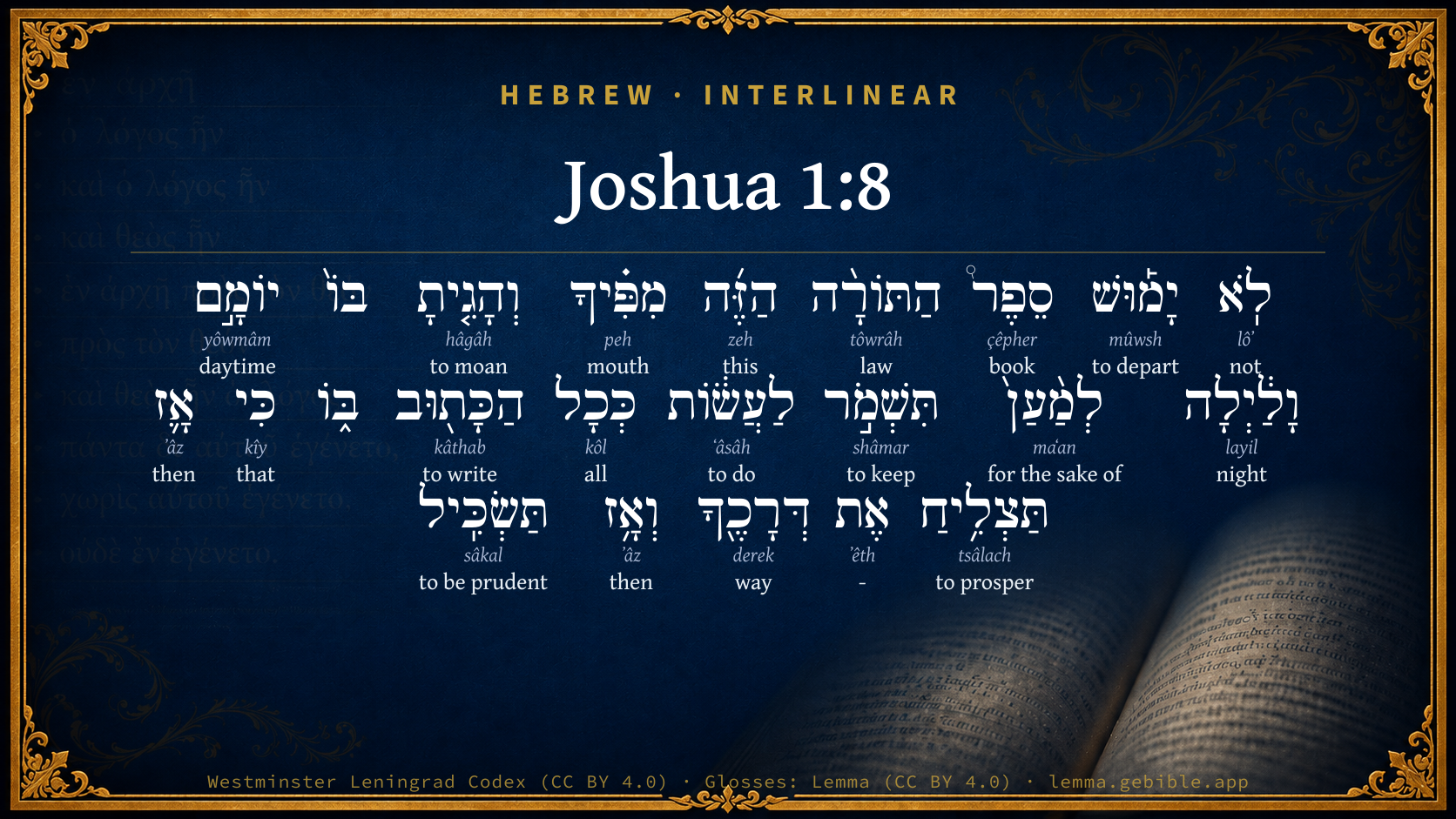
Joshua 1:8

Hebrew (Westminster Leningrad Codex) Joshua 1:8 appears in the Hebrew Old Testament. The text above is from the Westminster Leningrad Codex. Each word links to its Strong’s number, a concise gloss, and parsing drawn from the Open Scriptures Hebrew Bible morphology. Click any word for its full Brown-Driver-Briggs (BDB) entry.
Download image
Cite this verse

Joshua 1:8 (World English Bible). Public Domain. Lemma interlinear Bible study tool, https://lemma.gebible.app/v/joshua/1/8.

Show BibTeX & RIS
BibTeX
RIS
English Translation
This book of the law shall not depart out of your mouth, but you shall meditate thereon day and night, that you may observe to do according to all that is written therein: for then you shall make your way prosperous, and then you shall have good success.
World English Bible · Public Domain
Highlights
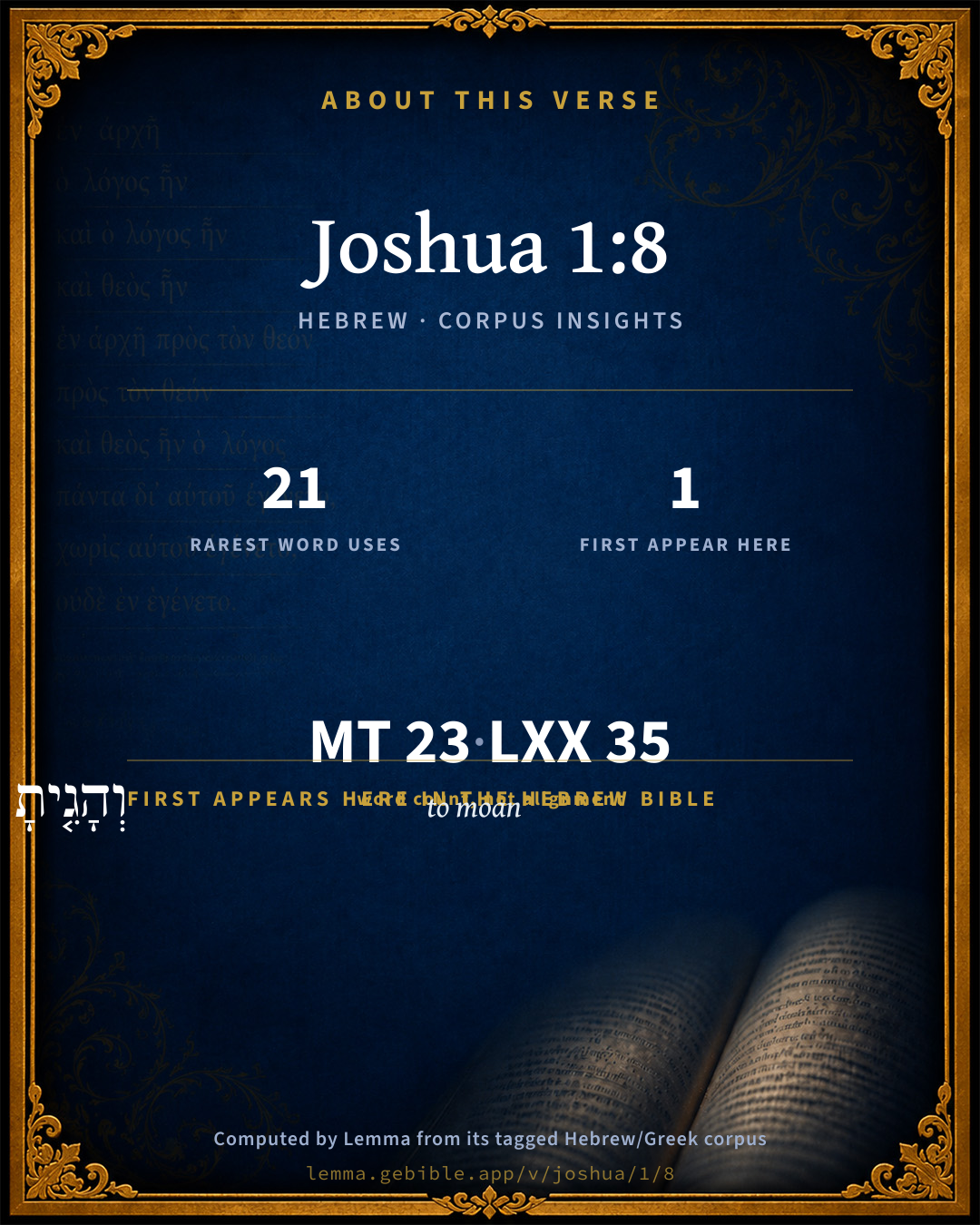
  • 1 first appearance in the Hebrew Bible
Full analysis ↓
Download a study sheet

One document with this verse’s original text, its word-by-word gloss line, the meaning frame, cross-references with their text, attributed commentary, and full source and license credits — printable, and it pastes into notes with its structure intact.

This verse Autodidact and up

Study sheet (.html) Plain text (.txt)

A passage Seminary Student

Up to 50 verses in one chapter. A passage sheet keeps up to 6 commentary sources and 12 cross-references per verse, in the order this page ranks them, and says so on the sheet whenever that leaves anything out. Ask for a single verse and you get the Autodidact verse sheet above.

Everything on this page stays free to read, with no account — the sheet is a download of what is already on screen, not access to it.

Want to remove ads? Support Godless Engineer
Compare translations 3

The same verse in 3 English versions, stacked beneath the original-language interlinear above. Click any original word for its lexicon entry.

Each is an independent rendering of the whole verse — the interlinear is not word-aligned to these translations.

Highlighted words mark where these versions differ — a whole-verse word diff, not a word-by-word alignment.

  • World English Bible Public Domain
    This book of the law shall not depart out of your mouth, but you shall meditate thereon day and night, that you may observe to do according to all that is written therein: for then you shall make your way prosperous, and then you shall have good success.
  • King James Version Public Domain
    This book of the law shall not depart out of thy mouth; but thou shalt meditate therein day and night, that thou mayest observe to do according to all that is written therein: for then thou shalt make thy way prosperous, and then thou shalt have good success.
  • unfoldingWord Literal Text CC BY-SA 4.0
    This Book of the Law shall not depart from your mouth but you shall meditate on it day and night, so that you will be careful to do according to everything written in it. For then you will make your ways prosperous and then you will succeed.

unfoldingWord Literal Text — © unfoldingWord, licensed CC BY-SA 4.0. Word-aligned USFM3 via Door43 (git.door43.org/unfoldingWord/en_ult).

Versions to compare (up to 4)

3 of 4 selected

Show all 18 translations

Every available English version of this verse, each an independent rendering of the whole verse.

  • World English Bible Public Domain
    This book of the law shall not depart out of your mouth, but you shall meditate thereon day and night, that you may observe to do according to all that is written therein: for then you shall make your way prosperous, and then you shall have good success.
  • Berean Standard Bible Public Domain
    This Book of the Law must not depart from your mouth; meditate on it day and night, so that you may be careful to do everything written in it. For then you will prosper and succeed in all you do.
  • Majority Standard Bible Public Domain
    This Book of the Law must not depart from your mouth; meditate on it day and night, so that you may be careful to do everything written in it. For then you will prosper and succeed in all you do.
  • King James Version Public Domain
    This book of the law shall not depart out of thy mouth; but thou shalt meditate therein day and night, that thou mayest observe to do according to all that is written therein: for then thou shalt make thy way prosperous, and then thou shalt have good success.
  • American Standard Version (1901) Public Domain
    This book of the law shall not depart out of thy mouth, but thou shalt meditate thereon day and night, that thou mayest observe to do according to all that is written therein: for then thou shalt make thy way prosperous, and then thou shalt have good success.
  • Revised Version (1885) Public Domain
    This book of the law shall not depart out of thy mouth, but thou shalt meditate therein day and night, that thou mayest observe to do according to all that is written therein: for then thou shalt make thy way prosperous, and then thou shalt have good success.
  • Geneva Bible (1599) Public Domain
    Let not this booke of the Law depart out of thy mouth, but meditate therin day and night, that thou mayest obserue and doe according to all that is written therein: for then shalt thou make thy way prosperous, and then shalt thou haue good successe.
  • Douay-Rheims (1899) Public Domain
    Let not the book of this law depart from thy mouth: but thou shalt meditate on it day and night, that thou mayst observe and do all things that are written in it: then shalt thou direct thy way, and understand it.
  • Young's Literal Translation Public Domain
    the book of this law doth not depart out of thy mouth, and thou hast meditated in it by day and by night, so that thou dost observe to do according to all that is written in it, for then thou dost cause thy way to prosper, and then thou dost act wisely.
  • Literal Standard Version CC BY-SA 4.0
    the scroll of this Law does not depart out of your mouth, and you have meditated in it by day and by night, so that you observe to do according to all that is written in it, for then you cause your way to prosper, and then you act wisely.
  • Unlocked Literal Bible CC BY-SA 4.0
    You will always speak about this book of the law. You will meditate on it day and night so that you can obey all that is written in it. Then you will be prosperous and successful.
  • unfoldingWord Literal Text CC BY-SA 4.0
    This Book of the Law shall not depart from your mouth but you shall meditate on it day and night, so that you will be careful to do according to everything written in it. For then you will make your ways prosperous and then you will succeed.
  • Darby Bible Public Domain
    This book of the law shall not depart from thy mouth; and thou shalt meditate upon it day and night, that thou mayest take heed to do according to all that is written therein; for then shalt thou have good success in thy ways, and then shalt thou prosper.
  • World Messianic Bible Public Domain
    This scroll of the Torah shall not depart from your mouth, but you shall meditate on it day and night, that you may observe to do according to all that is written in it; for then you shall make your way prosperous, and then you shall have good success.
  • Webster's Bible Public Domain
    This book of the law shall not depart out of thy mouth; but thou shalt meditate in it day and night, that thou mayest observe to do according to all that is written therein: for then thou shalt make thy way prosperous, and then thou shalt have good success.
  • Free Bible Version CC BY-SA 4.0
    Keep on reminding the people about the law. Meditate on it day and night, so you can be sure to do what it requires. Then you will be successful and prosper in what you do.
  • Bible in Basic English Public Domain
    Let this book of the law be ever on your lips and in your thoughts day and night, so that you may keep with care everything in it; then a blessing will be on all your way, and you will do well.
  • JPS Tanakh (1917) Public Domain
    This book of the law shall not depart out of thy mouth, but thou shalt meditate therein day and night, that thou mayest observe to do according to all that is written therein; for then thou shalt make thy ways prosperous, and then thou shalt have good success.

Literal Standard Version (2020), Covenant Press — licensed CC BY-SA 4.0. Text via the HelloAO Bible API (eBible.org). Unlocked Literal Bible (unfoldingWord) — licensed CC BY-SA 4.0. Text via the HelloAO Bible API (eBible.org). unfoldingWord Literal Text — © unfoldingWord, licensed CC BY-SA 4.0. Word-aligned USFM3 via Door43 (git.door43.org/unfoldingWord/en_ult). Free Bible Version, Dr. Jonathan Gallagher — licensed CC BY-SA 4.0. Text via the HelloAO Bible API (eBible.org).

Word by word

More ways to search: Search by grammar → Find every occurrence → Compare this word →

Practice this passage: Drill this verse → Learn its vocabulary →

יָמ֡וּשׁ
mûwsh
H4185
“to depart”
Verb, Qal, Imperfect, 3rd Person, Masculine, Singular
Part of Speech
Verb
Stem
Qal
Form
Imperfect
Person
3rd Person
Gender
Masculine
Number
Singular
Full BDB Definition

Origin: a primitive root [perhaps rather the same as H4184 through the idea of receding by contact]

TWOT: 1167

to depart, remove - (Qal) - to depart - to remove - to be removed (of inanimate objects) - (Hiphil) to remove, depart
  1. לֹֽא lôʼ H3808 “not” Particle, Negative
  2. סֵפֶר֩ çêpher H5612 “book of” Noun, Common, Masculine, Singular, Construct
  3. הַתּוֹרָ֨ה tôwrâh H8451 “the · law” Particle, Definite Article + Noun, Common, Feminine, Singular, Absolute
  4. הַזֶּ֜ה zeh H2088 “the · this” Particle, Definite Article + Pronoun, Demonstrative, Masculine, Singular
  5. מִפִּ֗יךָ peh H6310 “from · mouth · your” Preposition + Noun, Common, Masculine, Singular, Construct + Suffix, Personal, 2nd Person, Masculine, Singular
  6. וְהָגִ֤יתָ hâgâh H1897 “and · to moan” Conjunction + Verb, Qal, Sequential Perfect, 2nd Person, Masculine, Singular
  7. יוֹמָ֣ם yôwmâm H3119 “daytime” Adverb
  8. וָלַ֔יְלָה layil H3915 “and · night” Conjunction + Noun, Common, Masculine, Singular, Absolute
  9. לְמַ֨עַן֙ maʻan H4616 “for the sake of” Preposition
  10. תִּשְׁמֹ֣ר shâmar H8104 “to keep” Verb, Qal, Imperfect, 2nd Person, Masculine, Singular
  11. לַעֲשׂ֔וֹת ʻâsâh H6213 “to do” Preposition + Verb, Qal, Infinitive Construct
  12. כְּכָל kôl H3605 “like/as · all of” Preposition + Noun, Common, Masculine, Singular, Construct
  13. הַכָּת֖וּב kâthab H3789 “the · written” Particle, Definite Article + Verb, Qal, Participle Passive, Masculine, Singular, Absolute
  14. כִּי kîy H3588 “that” Conjunction
  15. אָ֛ז ʼâz H227 “then” Adverb
  16. תַּצְלִ֥יחַ tsâlach H6743 “to prosper” Verb, Hiphil, Imperfect, 2nd Person, Masculine, Singular
  17. אֶת ʼêth H853 “-” Particle, Direct Object
  18. דְּרָכֶ֖ךָ derek H1870 “ways · your” Noun, Common, Both, Plural, Construct + Suffix, Personal, 2nd Person, Masculine, Singular
  19. וְאָ֥ז ʼâz H227 “and · then” Conjunction + Adverb
  20. תַּשְׂכִּֽיל sâkal H7919 “to be prudent” Verb, Hiphil, Imperfect, 2nd Person, Masculine, Singular

About this verse

These counts appear in no published source. They are computed here, from the morphology-tagged text and Lemma’s own curated glosses. What Lemma adds →

23
words
20
distinct lemmas
Historical
section

Notable vocabulary

The rarest word here is יָמ֡וּשׁ to depart H4185 — appearing just 21 times in the whole Hebrew Bible.

First appearance in Scripture

This word makes its first canonical appearance in the Hebrew Bible here:

  • וְהָגִ֤יתָ to moan H1897

Shared distinctive vocabulary

יָמ֡וּשׁ to depart H4185 occurs in 19 verses of the Hebrew Bible. Also found in:

Grammatical profile

  • 7 verbs
  • 6 nouns
  • 1 pronoun
  • 3 prepositions
  • 1 conjunction
  • 3 adverbs
  • 2 particles

Verb forms

  • יָמ֡וּשׁ Qal · Imperfect
  • וְהָגִ֤יתָ Qal · Sequential Perfect
  • תִּשְׁמֹ֣ר Qal · Imperfect
  • לַעֲשׂ֔וֹת Qal · Infinitive Construct
  • הַכָּת֖וּב Qal · Participle Passive
  • תַּצְלִ֥יחַ Hiphil · Imperfect
  • תַּשְׂכִּֽיל Hiphil · Imperfect

Repetition

A word recurs within this verse — often emphatic in Hebrew:

  • אָ֛ז then H227 ×2

Hebrew & Septuagint length

In English translation the verse runs 48 words from the Hebrew and 52 from the Septuagint (LXX English) — closely comparable.

A rough comparison of the two English renderings, which tokenize alike — not a word-level alignment.

Word counts can differ between the Hebrew and the Greek without any difference in meaning — e.g. the Hebrew direct-object marker אֵת has no separate Greek word, and Greek often adds the article ὁ.

In the original languages it is 23 Hebrew tokens and 35 Greek tokens — but the two are counted differently (Hebrew bundles its prefixes and suffixes into one token; the Greek is in lemma form), so that isn’t a like-for-like length.

Cross-references

33

Topical passages linked to Joshua 1:8 in the Treasury of Scripture Knowledge — connected by theme and wording, ordered by reader-vote popularity; previews shown in the World English Bible.

  • Psalms 119:15 I will meditate on your precepts, And consider your ways.
  • Psalms 19:14 Let the words of my mouth and the meditation of my heart Be acceptable in your sight, Yahweh, my rock, and my redeemer.
  • Colossians 3:16 Let the word of Christ dwell in you richly; in all wisdom teaching and admonishing one another with psalms, hymns, and spiritual songs, singing with grace in your heart to the Lord.
  • Proverbs 3:1 My son, don't forget my teaching; But let your heart keep my commandments:
  • Deuteronomy 29:9 Keep therefore the words of this covenant, and do them, that you may prosper in all that you do.
  • John 14:21 One who has my commandments, and keeps them, that person is one who loves me. One who loves me will be loved by my Father, and I will love him, and will reveal myself to him."
  • Luke 11:28 But he said, "On the contrary, blessed are those who hear the word of God, and keep it."
  • Deuteronomy 6:6–9 These words, which I command you this day, shall be on your heart;
  • Matthew 7:24 "Everyone therefore who hears these words of mine, and does them, I will liken him to a wise man, who built his house on a rock.
  • Psalms 119:11 I have hidden your word in my heart, That I might not sin against you.
  • James 1:22–25 But be doers of the word, and not only hearers, deluding your own selves.
  • Psalms 1:1–3 Blessed is the man who doesn't walk in the counsel of the wicked, Nor stand in the way of sinners, Nor sit in the seat of scoffers;
  • Psalms 119:97 How love I your law! It is my meditation all day.
  • Deuteronomy 11:18–19 Therefore shall you lay up these my words in your heart and in your soul; and you shall bind them for a sign on your hand, and they shall be for symbols between your eyes.
  • John 13:17 If you know these things, blessed are you if you do them.
  • Proverbs 2:1–5 My son, if you will receive my words, And store up my commandments within you;
  • Matthew 7:21 Not everyone who says to me, 'Lord, Lord,' will enter into the Kingdom of Heaven; but he who does the will of my Father who is in heaven.
  • Psalms 37:30–31 The mouth of the righteous talks of wisdom. His tongue speaks justice.
  • Joshua 1:7 Only be strong and very courageous, to observe to do according to all the law, which Moses my servant commanded you: don't turn from it to the right hand or to the left, that you may have good success wherever you go.
  • Deuteronomy 30:14 But the word is very near to you, in your mouth, and in your heart, that you may do it.
  • Deuteronomy 5:29 Oh that there were such a heart in them, that they would fear me, and keep all my commandments always, that it might be well with them, and with their children forever!
  • Psalms 119:99 I have more understanding than all my teachers, For your testimonies are my meditation.
  • Isaiah 59:21 As for me, this is my covenant with them, says Yahweh: my Spirit who is on you, and my words which I have put in your mouth, shall not depart out of your mouth, nor out of the mouth of your seed, nor out of the mouth of your seed's seed, says Yahweh, from henceforth and forever.
  • Ephesians 4:29 Let no corrupt speech proceed out of your mouth, but such as is good for building up as the need may be, that it may give grace to those who hear.
  • Deuteronomy 5:32–6:3 You shall observe to do therefore as Yahweh your God has commanded you: you shall not turn aside to the right hand or to the left.
  • Matthew 12:35 The good man out of his good treasure brings out good things, and the evil man out of his evil treasure brings out evil things.
  • Deuteronomy 31:11 when all Israel is come to appear before Yahweh your God in the place which he shall choose, you shall read this law before all Israel in their hearing.
  • Psalms 119:42–43 So I will have an answer for him who reproaches me, For I trust in your word.
  • 1 Timothy 4:14–16 Don't neglect the gift that is in you, which was given to you by prophecy, with the laying on of the hands of the elders.
  • Matthew 28:20 teaching them to observe all things that I commanded you. Behold, I am with you always, even to the end of the age." Amen.
  • Deuteronomy 17:18–19 It shall be, when he sits on the throne of his kingdom, that he shall write him a copy of this law in a book, out of [that which is] before the priests the Levites:
  • Psalms 40:10 I have not hidden your righteousness within my heart. I have declared your faithfulness and your salvation. I have not concealed your loving kindness and your truth from the great assembly.
  • Revelation 22:14 Blessed are those who do his commandments, that they may have the right to the tree of life, and may enter in by the gates into the city.

Cross-references courtesy of OpenBible.info (CC BY 4.0).

Hebrew and Greek witnesses Masoretic Hebrew ↔ Greek Septuagint

The same verse in the two great witnesses to the Old Testament, shown verse-for-verse.

These are two independent witnesses, not word-aligned to each other, and the Septuagint is shown in lemma (dictionary) form.

Hebrew Joshua 1:8 Masoretic · Westminster Leningrad Codex

לֹֽא יָמ֡וּשׁ סֵפֶר֩ הַתּוֹרָ֨ה הַזֶּ֜ה מִפִּ֗יךָ וְהָגִ֤יתָ בּוֹ֙ יוֹמָ֣ם וָלַ֔יְלָה לְמַ֨עַן֙ תִּשְׁמֹ֣ר לַעֲשׂ֔וֹת כְּכָל הַכָּת֖וּב בּ֑וֹ כִּי אָ֛ז תַּצְלִ֥יחַ אֶת דְּרָכֶ֖ךָ וְאָ֥ז תַּשְׂכִּֽיל

This book of the law shall not depart out of your mouth, but you shall meditate thereon day and night, that you may observe to do according to all that is written therein: for then you shall make your way prosperous, and then you shall have good success.

World English Bible · Public Domain

Greek LXX Joshua 1:8 Septuagint · lemma form

καί οὐ ἀποἵστημι ὁ βίβλος ὁ νόμος οὗτος ἐκ ὁ στόμα σύ καί μελετάω ἐν αὐτός ἡμέρα καί νύξ ἵνα συνεἰμί ποιέω πᾶς ὁ γράφω τότε εὐοδόω καί εὐοδόω ὁ ὁδός σύ καί τότε συνἵημι

And the book of this law shall not depart out of your mouth, and you shall meditate in it day and night, that you may know how to do all the things that are written in it; then shall you prosper, and make your ways prosperous, and then shall you be wise.

LXX2012 (modern English Septuagint) · Public Domain

Hebrew: Westminster Leningrad Codex (CC BY 4.0). Greek: Septuagint (public domain); English from LXX2012 (modern English Septuagint) (Public Domain). How the Septuagint differs from the Hebrew →

Targum (Aramaic paraphrase)

1

The Targum is the ancient Jewish Aramaic paraphrase of the Hebrew Scriptures — an interpretive translation, not the Hebrew text itself. Onkelos (literal) and Pseudo-Jonathan (expansive) render the Torah, and Jonathan the Prophets. Coverage is partial: where no permissively-licensed English translation exists for a verse, only the Aramaic is shown. This is verse-level text, not a word-by-word alignment to the Hebrew.

  1. Targum Jonathan Prophets (Joshua–Malachi)
    לָא יַעְדֵי סִיפְרָא דְאוֹרַיְתָא הָדֵין מִפּוּמָךְ וּתְהֵי הֲגֵי בֵּיהּ יֵימָם וְלֵילְיָא בְּדִיל דְתִטַר לְמֶעְבַּד כְּכָל דִכְתִיב בֵּיהּ אֲרֵי בְּכֵן תַּצְלַח יַת דַרְכָּךְ וּבְכֵן תַּכְשָׁט:

    (no public-domain English translation for this verse)

    Targum Jonathan — Aramaic: “Mikraot Gedolot” (public domain). English: “Sefaria Community Translation” (CC0 1.0 (public-domain dedication)); “London "Chaldee Paraphrase," 1871” (public domain). Text via Sefaria.

Commentary

Notes on Joshua 1:8 from classic Christian and Jewish commentators (each source and its license shown beneath its notes). The classic Christian expositions comment on the surrounding passage and are grouped to its opening verse, so a note may address several verses; the Jewish commentaries on the Tanakh (Rashi and others) are per-verse, so they appear only where the commentator wrote on this verse.

Lemma curates 59 commentaries, every one of them public domain or Creative Commons licensed, each selected and text-cleaned for this edition rather than reprinted as found. About our sources →

Trapp's Complete Commentary

John Trapp

Jos 1:8 This book of the law shall not depart out of thy mouth; but thou shalt meditate therein day and night, that thou mayest observe to do according to all that is written therein: for then thou shalt make thy way prosperous, and then thou shalt have good success.

Ver. 8. This book of the law shall not depart.] Lex sola omnis sapientiae fons est. The Scripture is the only fountain of all wisdom, saith Luther: {a} who in the same place affirmeth, that he hated his own writings, and wished they were all burnt, because he feared that the reading of them kept men from reading the Bible, that book of books, in comparison whereof all other books are but as waste paper. Charles V, emperor, liked to read three books especially, - Polybius’s history, Machiavel’s Prince, and Castalian’s Courtier. He took such delight in the mathematics, that even in the midst of his whole army, in his tent, he stayed close at this study; having for that purpose, as his instructor, Turrianus of Cremona evermore with him. How well versed he was in the Scriptures, I know not, but at his baptism, among other great gifts bestowed upon him by his father’s friends - as a golden sword, a silver head piece, a charger of gold filled with pearls, &c. - the Abbot of Gaunt, where he was born, gave him a fair Bible with this inscription, scrutamini Scripturas, search the Scriptures. {b} Queen Elizabeth, soon after her coronation, being presented by the Londoners in Cheapside with a Bible, received it with both her hands; and kissing it, laid it to her breast, saying, that the same had ever been her chiefest delight, and should be the rule by which she meant to frame her government. {c} Alphonsus, king of Arragon, is said to have read over the Bible fourteen times with Lyra’s notes. And Charles the Wise of France, not only caused the Bible to be translated into French, but was himself very studious in "the holy Scriptures, which are able to make" a man "wise to salvation."

For then thou shalt make thy way prosperous.] Piety hath prosperity. {See Trapp on "Jos 1:7"}

{a} Luth., in Genes.

{b} Bucholc., Ex Zenocaro.

{c} Speed’s Chron.

John Trapp, A Commentary or Exposition upon All the Books of the Old and New Testament (1647–1656) — public domain. Text from a community e-Sword module.

Joseph Benson's Commentary

Jos 1:8-9. This book of the law shall not depart out of thy mouth — That is, thou shalt constantly read it, and upon occasion discourse of it, and the sentence which shall come out of thy month, shall in all things be given according to this rule. Day and night — That is, diligently study, and upon all occasions consider what is God’s will and thy duty. The greatness of thy place and employments shall not hinder thee from this work, because this is the only rule of thy private actions and public administrations. I command thee — I whom thou art obliged to obey: I who can carry thee through every thing I put thee upon: I of whose faithfulness and almighty power thou hast had great experience!

Joseph Benson's Commentary on the Old and New Testaments (1811–1818) — public domain. Text from a community e-Sword module.

Tyndale Open Study Notes

Tyndale Open Resources

1:8 This Book of Instruction (Hebrew torah) probably refers to the book of Deuteronomy (see Deut 4:44; 29:21; 30:10; 31:9-12). It includes Israel’s foundational law codes as well as God’s moral and spiritual instructions. • God commanded Joshua to think and speak of God’s instruction day and night—i.e., continually (cp. Deut 6:6-7; 17:18-20).

Tyndale Open Study Notes — © Tyndale Open Resources, licensed CC BY-SA 4.0. Text via the HelloAO Bible API.

Geneva Bible (1599)

Geneva Bible translators

Showing that it was not possible to govern well, without continual study of God’s word.

Or, govern wisely.

Geneva Bible (1599) marginal notes — public domain. Text via Bolls.life.

Adam Clarke's Commentary

Verse 8. This book of the law shall not depart out of thy mouth] The law which had already been written by Moses, and from which he and the people were to take all those precepts by which their lives were to be governed. Though there was a copy of the law laid up in the sanctuary, yet this was not sufficient. Joshua must have a copy for himself, and he was to consult it incessantly, that his way might be made prosperous, and that he might have good success. If he kept God's word, God would keep him in body and soul; if he should observe to do according to that word, then God would cause all his way to be prosperous. Those who are obedient to God lack no manner of thing that is good.

Adam Clarke's Commentary on the Bible (1810–1826) — public domain. Text from a community e-Sword/MySword module.

John Calvin's Commentaries

8. This book of the Law, etc Assiduous meditation on the Law is also commanded; because, whenever it is intermitted, even for a short time, many errors readily creep in, and the memory becomes rusted, so that many, after ceasing from the continuous study of it, engage in practical business, as if they were mere ignorant tyros. God therefore enjoins his servant to make daily progress, and never cease, during the whole course of his life, to profit in the Law. Hence it follows that those who hold this study in disdain, are blinded by intolerable arrogance.

But why does he forbid him to allow the Law to depart from his mouth rather than from his eyes? Some interpreters understand that the mouth is here used by synecdoche for face; but this is frigid. I have no doubt that the word used is peculiarly applicable to a person who was bound to prosecute the study in question, not only for himself individually, but for the whole people placed under his rule. He is enjoined, therefore, to attend to the teaching of the Law, that in accordance with the office committed to him, he may bring forward what he has learned for the common benefit of the people. At the same time he is ordered to make his own docility a pattern of obedience to others. For many, by talking and discoursing, have the Law in their mouth, but are very bad keepers of it. Both things, therefore, are commanded, that by teaching others, he may make his own conduct and whole character conformable to the same rule.

What follows in the second clause of the verse shows, that, everything which profane men endeavor to accomplish in contempt of the word of God, must ultimately fail of success, and that however prosperous the commencement may sometimes seem to be, the issue will be disastrous; because prosperous results can be hoped for only from the divine favor, which is justly withheld from counsels rashly adopted, and from all arrogance of which contempt of God himself is the usual accompaniment. Let believers, therefore, in order that their affairs may turn out as they wish, conciliate the divine blessing alike by diligence in learning and by fidelity in obeying.

In the end of the verse, because the term used is ambiguous, as I have already observed, the sentence is repeated, or a second promise is added. The latter is the view I take. For it was most suitable, that after the promised success, Joshua should be reminded that men never act skillfully and regularly except in so far as they allow themselves to be ruled by the word of God. Accordingly, the prudence which believers learn from the word of God, is opposed to the confidence of those who deem their own sense sufficient to guide them aright.

John Calvin's Commentaries (1540-1563) — public domain. Text from the Calvin Translation Society English edition (1840s-50s) via the Christian Classics Ethereal Library (ccel.org). Calvin's coverage is partial (roughly two-thirds of the Bible); uncommented books and verses are honest gaps, never fabricated. The 19th-century editor's footnotes and remarks are omitted so the notes are faithfully Calvin's own voice.

Ellicott's Commentary for English Readers

(8) Thou shalt meditate therein day and night . . . then thou shalt make thy way prosperous.—These words are taken up again in Psa_1:2-3, and a blessing is pronounced on every man who takes Joshua’s position in relation to the written law of God (see Note, Jos_1:1). Thus the true significance of Joshua’s position appears, and also the difference between Moses and all who followed him. Moses was the prophet “whom the Lord knew face to face.” Joshua and all his successors, from the least to the greatest, find their blessing and their portion in the careful study and fulfilment of the written word of God. It is also worthy of notice that God’s Word, from its very first appearance as a collective book (viz., the law), occupies the same position. It is supreme. It is set above Joshua. It is never superseded. And its authority is independent of its quantity. “The law of Moses,” “Moses and the prophets,” “The law, the prophets, and the Psalms,” are descriptions of the Bible differing in the quantity of the matter, but not differing in the authority they exercise or in their relation to the living church. “Blessed is he that readeth and they that hear the words of the prophecy of this book, and keep those things that are written therein,” are words that apply to Holy Scripture equally, in every stage, from the completion of the law of Moses to the completion of the entire book.

A Bible Commentary for English Readers, edited by Charles John Ellicott (1878–1897) — public domain. Text from a community e-Sword module.

The Cambridge Bible for Schools and Colleges

gen. ed. J. J. S. Perowne

8. This book of the law] Joshua is admonished that the Law must be strictly and carefully observed, if the great work, to which he had been called, was to be successfully accomplished. He was “to read, mark, and inwardly digest it,” and carry out its provisions to the letter.

The Cambridge Bible for Schools and Colleges (gen. ed. J. J. S. Perowne; Cambridge University Press, 1878–1918) — public domain. Text from a community e-Sword module.

John Gill's Exposition

This book of the law shall not depart out of thy mouth,.... He was often to read it, frequently repeat it, and speak of it, to refresh his own memory with it, and the memory of those about him. Jarchi restrains it to the book of Deuteronomy now before him:

but thou shalt meditate therein day and night; whenever he had any leisure from the important business of his office, whether by day or night, see Psa 1:2,

that thou mayest observe to do according to all that is written therein; which frequent speaking of it, and constant meditation on it, would lead unto:

for then thou shalt make thy way prosperous, and then thou shalt have good success; in his wars with the Canaanites.

John Gill's Exposition of the Whole Bible (1746–1763) — public domain (CC PDM 1.0). Text via the HelloAO Bible API.

Matthew Poole's English Annotations

Shall not depart out of thy mouth, i.e. thou shalt constantly read it, and upon occasion discourse of it, and the sentence which shall come out of thy mouth shall in all things be given according to this rule.

Meditate therein, i.e. diligently study, and frequently and upon all occasions consider what is God’s will and thy duty. The greatness of thy place and employments shall not hinder thee from this work, because this is the only rule of all thy private actions and public administrations.

According to all that is written therein; whereby he teacheth him that it is his duty to see with his own eyes, and to understand the mind and law of God himself, and not blindly to follow what any other should advise him to.

Matthew Poole's English Annotations on the Holy Bible (1683–1685) — public domain. Text from a community e-Sword/MySword module.

Whedon's Commentary on the Bible

Daniel D. Whedon

8. This book of the law — Already had revelation solidified itself into a book form. The wisdom of God in selecting this form will be evident when we consider, (1) That the human race instinctively put into monumental form all the great truths, laws, discoveries, and historic events which they wish to perpetuate; (2) The untrustworthy character of oral traditions; (3) The difficulty of corrupting documents intrusted to the guardianship of a class solemnly set apart for that purpose, and imbued with a religious awe for the very letter of the sacred manuscript, or as published to the world by the multiplication of copies scattered abroad through all lands.

Shall not depart — The written divine law shall be a theme of constant study, thought, and conversation, the rule of both his private and official life.

Shall meditate — The Hebrew word הגה, sometimes means to mutter, speak aloud, but “we are not to think of this meditation as a learned study, nor as a ‘reading aloud,’ as Bunsen explains it, but rather as a mature reflection upon the law, by which Joshua should penetrate more deeply into its meaning.” — Fay. Happy is the nation of Bible readers ruled by one who receives the law at the mouth of God!

Have good success — Rather, act wisely. Compare Jos_1:7.

Daniel D. Whedon (gen. ed.), Commentary on the Old and New Testaments (1874–1909) — public domain. Text from a community e-Sword module.

The Pulpit Commentary

This book of the law. The law was, therefore, embodied in a written document when the Book of Joshua was written; and as the antiquity of this Book may be regarded as proved, we may quote thus an early authority for the genuineness of at least some portions of the Pentateuch. There was a "book of the law" in Joshua"s time, according to this early testimony, and we may conclude from vers. 3-7 that Deuteronomy formed a part of it (see also Deu_17:19 for a similar precept. And for the fact see Deu_31:24-26). Meditate therein. (cf. Psa_1:2, Psa_63:7, Psa_143:5, in the original. Also Deu_31:26) Observe to do. Literally, keep to do, thus impressing on us the care necessary in deciding on our actions. All that is written therein. (cf. for the expression Deu_28:58, 61 29:19, 20, 26 30:10) Shall have good success. The word is the same as is translated "prosper" above, and not the same as that rendered "prosperous" in this verse. "Men," says Calvin, "never act skilfully, except in so far as they allow themselves to be ruled by the Word of God." Have I not commanded thee? "An emphatic inquiry is a stronger form of affirmation, and is generally employed by those who wish to infuse into another courage and alacrity" (Michaelis). Moreover repetition is a remarkable feature of Hebrew composition, as we may observe from the second chapter of Genesis onward, and is designed to give emphasis to what is commanded or related. Calvin would lay stress on I: "Have not I commanded thee?" But this is not borne out by the Hebrew.

HOMILIES BY S.R. ALDRIDGE Ver. 8. The study of the Bible.

Who without secret misgiving could succeed to the position of Moses, that large-hearted, clear-sighted, faithful servant of God? How overwhelming the anxiety of him who would aspire to be leader of the Israelites; a fickle people who, "like bees about to swarm, were ready to alight on any bough." He who summoned Joshua to occupy the vacant post promised to stand by and strengthen him. He gave him the direction contained in the text, to study well the book of the law. He seemed to say, "Take it; it shall be thy food, live upon it: carry it as a torch, and it will illumine thy pathway in the thickest darkness: in the vigour of thy manhood it shall be thy wand of truth to scatter doubt and error from before thee, and it shall be a staff to sustain thee in the decrepitude of age." Surely the advice given to Joshua is applicable to all who are in positions of responsibility or perplexity. How fitted for the young! What better can any of us do than seek wisdom at the oracles of God? Let us group our thoughts under three headings.

I MEDITATION.

1. Its subject-matter. "This book of the law." This recommendation stamps the Pentateuch with authority. Joshua was favoured with direct communications from the Almighty, sometimes by an inward revelation, sometimes by the appearance of an angel in visible form. He could also consult the wishes of God by means of the high priest"s Urim and Thummim. Yet was he to study the written word. Meteoric flashes were not to make him careless of the steady light that burned in the lamp of God"s truth. Provision was made for a public rehearsal of the law every seven years, at the Feast of Tabernacles, (Deu_31:10) and it was the duty of a king on ascending the throne to write out a copy of the law. (Deu_18:18) How intense should be the eagerness with which we meditate on the whole Bible. The rapturous strains of the Messianic prophets, the simple and sublime gospel narratives, the epistles those commentaries on the preparatory dispensation and on Christian doctrine do not all these "testify" of the Saviour? Well may we "search the Scriptures." Consider the fitness of the Bible to be a general textbook. It contains lessons suited to all capacities; the flowing river for the man, the purling brook for the little child, doctrines for the learned, pictured stories for the common people. It contains all truth needful to make us "wise unto salvation," and contains it in a compact form, so portable that each may have a Mentor always at his side. It tells us things of the utmost importance which we could not know without it; and it comes in to verify the conclusions of our reasoning. It lends to the utterances of conscience the might of Divine testimony.

2. The character of the meditation enjoined. Constant and night." So close a companion that it was not to "depart out of his mouth." It should become his mother tongue; his speech should be redolent of the law. Constant reading alone can make us familiar with the contents of Scripture, so as to be well equipped at all points for the Christian warfare. Many knotty questions would Joshua have to decide; and many are the occasions on which men err grievously through "not knowing the Scriptures." The command of the text implies that it was to be no formal perusal, but an endeavour to grasp the real meaning of the law. Glancing at the pages of the word can do little good; we want to enter into and imbibe the spirit of that we read. A good plan to read the Scriptures regularly through. There will be many an oasis in what we called a desert, and many a pretty flower on what we deemed only a sterile rock. It is profitable to read "at morning and at night." He is well armed for his struggle with temptations and annoyances who goes to his work fortified by previous study of the Scriptures; and after the battle of the day is over, when the shadows of evening surround him or the gloomier shadows of trouble threaten to enclose him, there is naught so effectual to dissipate the darkness as the kindled rays of the heavenly lamp. Then "at evening time it shall be light.

II ACTION. Meditation is to be followed by appropriate conduct. "That thou mayest observe to do according to all that is written therein." The inference is plain that the law contains, as we should expect in a law, precepts to be observed. And the whole Bible may be considered as a law. There are general regulations and positive institutions. "This do and thou shall live" is common both to the Old and New Testament, the difference being in the things to be done, and the spirit that is to characterise the doing thereof. We may test the value of our meditation by the obedience which results. Obedience is a proof of holding the things read in due estimation. "Why call ye me, Lord, and do not... say?" Obedience springs from faith, a hearty acceptance of the will and ways of God. Obedience brings its own confirmation of the truth. "If a man love me, he will keep my words, and my Father will love him, and we will come unto him." "If any man will do his will, he shall know of the doctrine whether it be of God." "Hereby we do know that we know him if we keep his commandments." Obedience is to extend to the smallest matters. "Observe to do according to all." The only question with Joshua to be, "What is written in the law? how readest thou?" We do not plead for the "letter" as against the "spirit," nor forget that many Scripture precepts are expressed in a general form, and one must be compared with another to ascertain the intention of our Lawgiver. But many persons are for drawing distinctions, for keeping greater and violating lesser commandments. Some will compound with God. These ordinances they will observe, those they will neglect. Such resemble the strangers imported into Samaria, who "feared the Lord and served their own gods". (2Ki_17:33) A little Christian service and a little idolatry, a little self denial, and a little worldliness to make the former palatable. We see the necessity of the frequent injunction, "Be strong, very courageous." Joshua would have often to act in opposition to the prejudices and desires and clamours of the multitude. He who will follow Christ must "be courageous," must be prepared to act in the teeth of worldly wisdom, to forego "good openings," to refuse to give dishonest measure, though his gains be thereby slow in accumulating. We want a knowledge of the Bible, not merely as words and sentences but as influential principles. Not the Hebrew and not the Greek do we want so much as a translation of them into thought and feeling and conduct. He has not read his Bible to good purpose who has not repented of sin and thankfully accepted God"s well-beloved Son as his Saviour, his Redeemer "from all iniquity.

III PROSPERITY. The reward of obedience.

1. Regard prosperity, first, as the natural consequence of noting on good advice. The rules framed for the guidance of the Israelites evince consummate wisdom. Experience proved how disastrous was any attempt to depart from the lines of procedure there laid down. And many familiar instances show that, in modern days, he who steers by God s compass and chart is preserved from many rocks and shallows, and is most likely to reach the haven of his legitimate desire. A pure, temperate Christian life is likeliest to win real success in any department of activity.

2. Regard prosperity as a promised result. He who consults Omniscience is helped by Omnipotence. A finger post may indicate the way, it can do no more. God is a living Guide; he has written directions and he aids in the performance of them. "No good thing shall fail of all that he has promised concerning us." "Seek first the kingdom of God, and all other things shall be added unto you." Blessed is the man whose "delight is in the law of the Lord," so that "in it he doth meditate day and night, he shall be like a tree shall prosper". A. (Psa_1:2, Psa_1:3)

The Pulpit Commentary (1880–1919), ed. H.D.M. Spence-Jones & Joseph S. Exell — public domain. Text from a community e-Sword module.

John Wesley's Explanatory Notes

Out of thy mouth - That is, thou shalt constantly read it, and upon occasion discourse of it, and the sentence which shall come out of thy mouth, shall in all things be given according to this rule. Day and night - That is, diligently study, and upon all occasions consider what is God's will and thy duty. The greatness of thy place and employments shall not hinder thee from this work, because this is the only rule of all thy private actions, and publick administrations.

John Wesley, Explanatory Notes Upon the Whole Bible (1754–1765) — public domain. Text via the GEBible commentary corpus.

unfoldingWord translationNotes

Door43 World Missions Community

General Information:

Yahweh continues speaking to Joshua.

You will always speak

The word "always" is an exaggeration for speaking often. (See: Hyperbole and Generalization)

prosperous and successful

These two words mean basically the same thing and emphasize great prosperity. (See: Doublet)

Have I not commanded you?

This refers to Yahweh commanding Joshua. AT: "I have commanded you!" (See: Rhetorical Question)

Be strong and courageous!

Yahweh is commanding Joshua. (See: Imperatives - Other Uses)

translationWords

law

meditate

obey

written

command

Yahweh

unfoldingWord translationNotes — © Distant Shores Media and the Door43 World Missions Community, licensed CC BY-SA 4.0. Source: git.door43.org/Door43/en_tn.

Rashi

Rabbi Shlomo Yitzchaki (Rashi)

This Sefer Torah. implies a specific Book of the Torah. Which one? Thus Rashi comments that it refers to Sefer Devorim that was before Him. The Sefer Devorim was before Him.

And you shall meditate in it. Every expression of הִגָיוֹן in the Torah refers to the [meditation] of the heart, says that הִגָיוֹן sometimes refers to speech as it is written: And my tongue will speak (תֶּהְגֶה) of Your righteousness (Tehillim 35:28). as it is said, ‘And the thoughts of my heart before you;’ ‘Your heart will give forth fearful thoughts.’

Rashi on the Tanakh — English translations: “The Judaica Press complete Tanach with Rashi, translated by A. J. Rosenberg” (CC BY 4.0); “Pentateuch with Rashi's commentary by M. Rosenbaum and A.M. Silbermann, 1929-1934” (public domain); “The Metsudah Tanach series, Lakewood, N.J” (CC BY 4.0); and “The Book of Joshua, Metsudah Publications, 1997” (CC BY 4.0). Text via Sefaria.

Lesson kit

Teaching starters — assembled from the data on this page, not authored interpretation. Every prompt links to the verse data it draws on. Edit before teaching.

Joshua, in the Historical, opens this verse with 23 words (20 distinct Hebrew lemmas). Its most distinctive word is mûwsh (“to depart”). A historical commentator’s framing appears above. Read the whole chapter for the surrounding context.

Discussion questions

  1. What does “to depart” (mûwsh) contribute to the verse as a whole?
  2. This is the first place “to moan” appears in Scripture (first appears here). What does its debut here establish?
  3. How does Exodus 13:22, which shares the word «to depart», read alongside this verse?
  4. What does the repetition of “then” (2× in this one verse) do in this verse?
  5. These translations render this verse differently. What is at stake in choosing one wording over another?
  6. «יָמ֡וּשׁ» is a Qal Imperfect verb. How does that grammatical form shape the action described?
  7. Compare how Trapp's Complete Commentary and Joseph Benson's Commentary read this verse. Where do they agree or differ?

Things to notice

Reading settings

Reading text

Shown beneath each verse's original-language words.

Old Testament
Old Testament edition

Read the OT as the Masoretic Hebrew (MT) or the Greek Septuagint (LXX).

English shown for the Greek Septuagint (in the Hebrew ↔ Greek comparison).

Comparing translations? Open the Compare panel on any verse page to stack up to four side by side.