Joshua 8:34

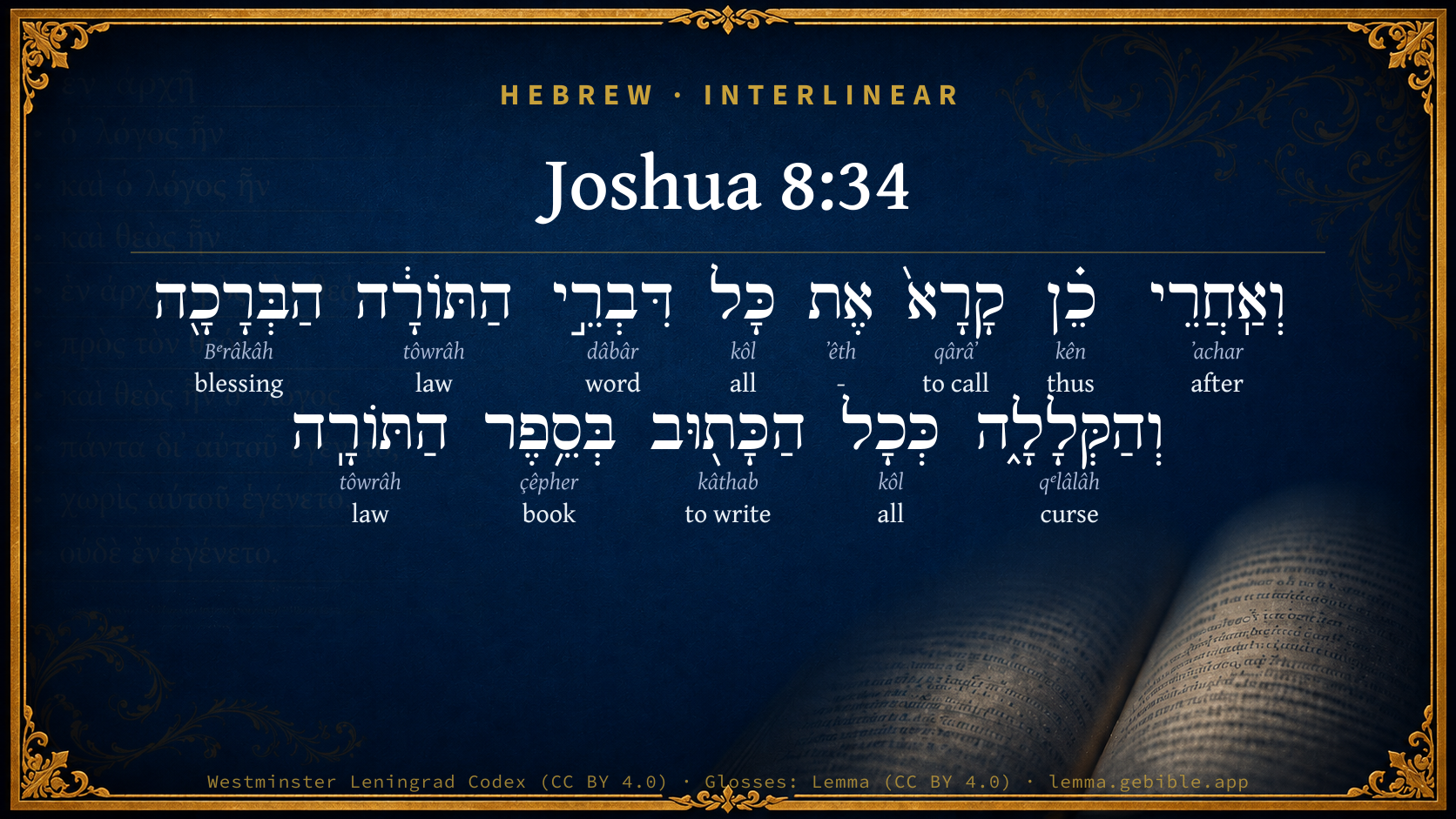
Hebrew (Westminster Leningrad Codex) Joshua 8:34 appears in the Hebrew Old Testament. The text above is from the Westminster Leningrad Codex. Each word links to its Strong’s number, a concise gloss, and parsing drawn from the Open Scriptures Hebrew Bible morphology. Click any word for its full Brown-Driver-Briggs (BDB) entry.
Download image
Cite this verse

Joshua 8:34 (World English Bible). Public Domain. Lemma interlinear Bible study tool, https://lemma.gebible.app/v/joshua/8/34.

Show BibTeX & RIS
BibTeX
RIS
English Translation
Afterward he read all the words of the law, the blessing and the curse, according to all that is written in the book of the law.
World English Bible · Public Domain
Download a study sheet

One document with this verse’s original text, its word-by-word gloss line, the meaning frame, cross-references with their text, attributed commentary, and full source and license credits — printable, and it pastes into notes with its structure intact.

This verse Autodidact and up

Study sheet (.html) Plain text (.txt)

A passage Seminary Student

Up to 50 verses in one chapter. A passage sheet keeps up to 6 commentary sources and 12 cross-references per verse, in the order this page ranks them, and says so on the sheet whenever that leaves anything out. Ask for a single verse and you get the Autodidact verse sheet above.

Everything on this page stays free to read, with no account — the sheet is a download of what is already on screen, not access to it.

Want to remove ads? Support Godless Engineer
Compare translations 3

The same verse in 3 English versions, stacked beneath the original-language interlinear above. Click any original word for its lexicon entry.

Each is an independent rendering of the whole verse — the interlinear is not word-aligned to these translations.

Highlighted words mark where these versions differ — a whole-verse word diff, not a word-by-word alignment.

  • World English Bible Public Domain
    Afterward he read all the words of the law, the blessing and the curse, according to all that is written in the book of the law.
  • King James Version Public Domain
    And afterward he read all the words of the law, the blessings and cursings, according to all that is written in the book of the law.
  • unfoldingWord Literal Text CC BY-SA 4.0
    And afterward, he read all of the words of the law, the blessings and the curses, according to everything written in the book of the law.

unfoldingWord Literal Text — © unfoldingWord, licensed CC BY-SA 4.0. Word-aligned USFM3 via Door43 (git.door43.org/unfoldingWord/en_ult).

Versions to compare (up to 4)

3 of 4 selected

Show all 18 translations

Every available English version of this verse, each an independent rendering of the whole verse.

  • World English Bible Public Domain
    Afterward he read all the words of the law, the blessing and the curse, according to all that is written in the book of the law.
  • Berean Standard Bible Public Domain
    Afterward, Joshua read aloud all the words of the law—the blessings and the curses—according to all that is written in the Book of the Law.
  • Majority Standard Bible Public Domain
    Afterward, Joshua read aloud all the words of the law—the blessings and the curses—according to all that is written in the Book of the Law.
  • King James Version Public Domain
    And afterward he read all the words of the law, the blessings and cursings, according to all that is written in the book of the law.
  • American Standard Version (1901) Public Domain
    And afterward he read all the words of the law, the blessing and the curse, according to all that is written in the book of the law.
  • Revised Version (1885) Public Domain
    And afterward he read all the words of the law, the blessing and the curse, according to all that is written in the book of the law.
  • Geneva Bible (1599) Public Domain
    Then afterwarde hee read all the wordes of the Lawe, the blessings and cursings, according to all that is written in the booke of the Lawe.
  • Douay-Rheims (1899) Public Domain
    After this he read all the words of the blessing and the cursing and all things that were written in the hook of the law.
  • Young's Literal Translation Public Domain
    And afterwards he hath proclaimed all the words of the law, the blessing and the reviling, according to all that is written in the book of the law;
  • Literal Standard Version CC BY-SA 4.0
    And afterward he has proclaimed all the words of the Law, the blessing and the reviling, according to all that is written in the Scroll of the Law;
  • Unlocked Literal Bible CC BY-SA 4.0
    Afterward, Joshua read all the words of the law, the blessings and the curses, just as they had been written in the book of the law.
  • unfoldingWord Literal Text CC BY-SA 4.0
    And afterward, he read all of the words of the law, the blessings and the curses, according to everything written in the book of the law.
  • Darby Bible Public Domain
    And afterwards he read all the words of the law, the blessing and the curse, according to all that is written in the book of the law.
  • World Messianic Bible Public Domain
    Afterward he read all the words of the law, the blessing and the curse, according to all that is written in the scroll of the Torah.
  • Webster's Bible Public Domain
    And afterward he read all the words of the law, the blessings and cursings, according to all that is written in the book of the law.
  • Free Bible Version CC BY-SA 4.0
    Then Joshua read out the whole Law—all the blessings and curses recorded in the book of the Law.
  • Bible in Basic English Public Domain
    And after, he gave them all the words of the law, the blessing and the curse, as it is all recorded in the book of the law;
  • JPS Tanakh (1917) Public Domain
    And afterward he read all the words of the law, the blessing and the curse, according to all that is written in the book of the law.

Literal Standard Version (2020), Covenant Press — licensed CC BY-SA 4.0. Text via the HelloAO Bible API (eBible.org). Unlocked Literal Bible (unfoldingWord) — licensed CC BY-SA 4.0. Text via the HelloAO Bible API (eBible.org). unfoldingWord Literal Text — © unfoldingWord, licensed CC BY-SA 4.0. Word-aligned USFM3 via Door43 (git.door43.org/unfoldingWord/en_ult). Free Bible Version, Dr. Jonathan Gallagher — licensed CC BY-SA 4.0. Text via the HelloAO Bible API (eBible.org).

Word by word

More ways to search: Search by grammar → Find every occurrence → Compare this word →

Practice this passage: Drill this verse → Learn its vocabulary →

וְהַקְּלָלָ֑ה
qᵉlâlâh
H7045
“and · the · curse”
Conjunction + Particle, Definite Article + Noun, Common, Feminine, Singular, Absolute
Part of Speech
Conjunction + Particle + Noun
Type
Common
Gender
Feminine
Number
Singular
State
Absolute
Full BDB Definition

Origin: from H7043

TWOT: 2028d

curse, vilification, execration
  1. וְאַֽחֲרֵי ʼachar H310 “and · after” Conjunction + Preposition
  2. כֵ֗ן kên H3651 “thus” Adverb
  3. קָרָא֙ qârâʼ H7121 “to call” Verb, Qal, Perfect, 3rd Person, Masculine, Singular
  4. אֶת ʼêth H853 “-” Particle, Direct Object
  5. כָּל kôl H3605 “all of” Noun, Common, Masculine, Singular, Construct
  6. דִּבְרֵ֣י dâbâr H1697 “words of” Noun, Common, Masculine, Plural, Construct
  7. הַתּוֹרָ֔ה tôwrâh H8451 “the · law” Particle, Definite Article + Noun, Common, Feminine, Singular, Absolute
  8. הַבְּרָכָ֖ה Bᵉrâkâh H1293 “the · blessing” Particle, Definite Article + Noun, Common, Feminine, Singular, Absolute
  9. כְּכָל kôl H3605 “like/as · all of” Preposition + Noun, Common, Masculine, Singular, Construct
  10. הַכָּת֖וּב kâthab H3789 “the · written” Particle, Definite Article + Verb, Qal, Participle Passive, Masculine, Singular, Absolute
  11. בְּסֵ֥פֶר çêpher H5612 “in/at · book of” Preposition + Noun, Common, Masculine, Singular, Construct
  12. הַתּוֹרָֽה tôwrâh H8451 “the · law” Particle, Definite Article + Noun, Common, Feminine, Singular, Absolute

About this verse

These counts appear in no published source. They are computed here, from the morphology-tagged text and Lemma’s own curated glosses. What Lemma adds →

13
words
11
distinct lemmas
Historical
section

Shared distinctive vocabulary

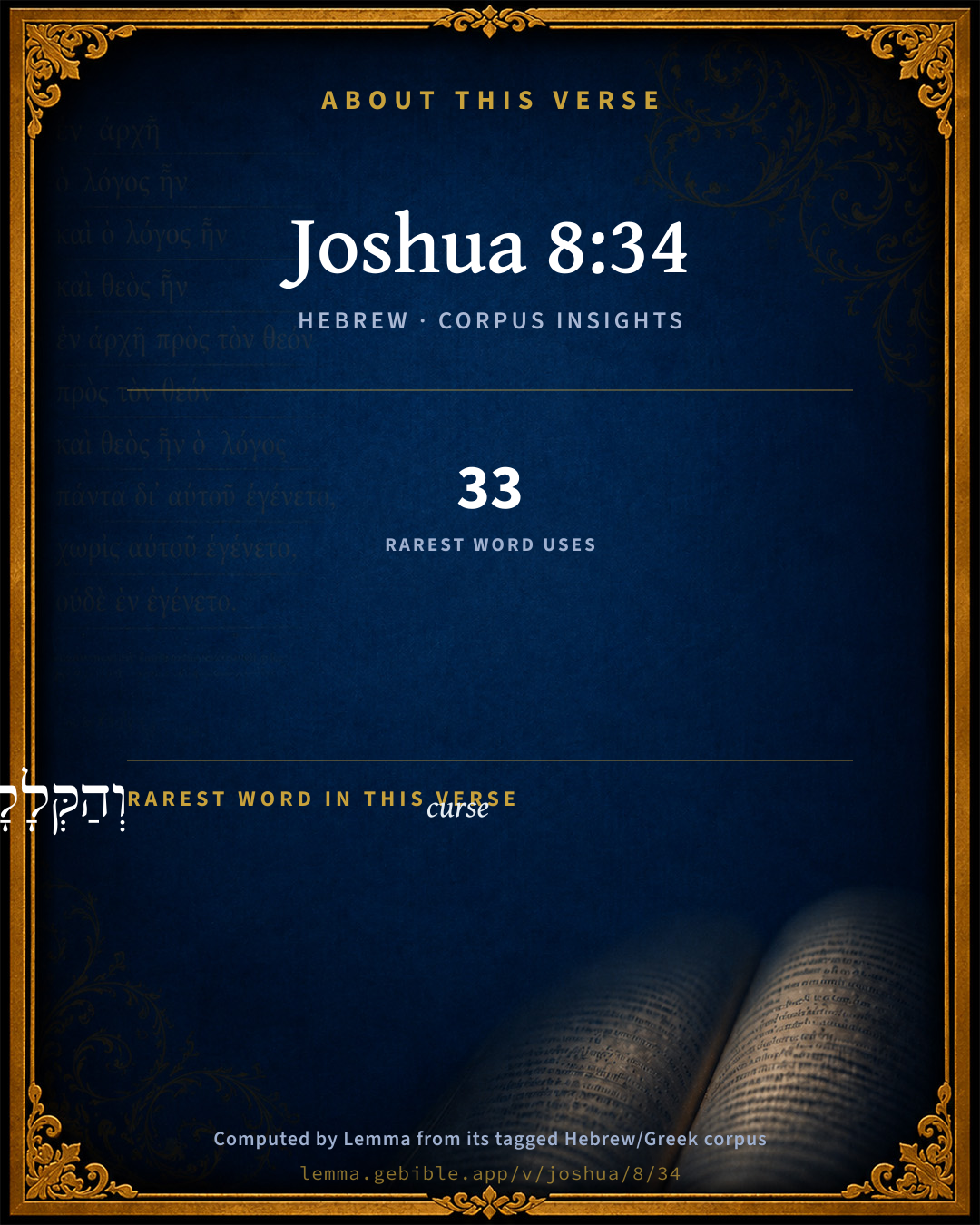
וְהַקְּלָלָ֑ה curse H7045 occurs in 33 verses of the Hebrew Bible. Also found in:

Grammatical profile

  • 2 verbs
  • 8 nouns
  • 1 preposition
  • 1 adverb
  • 1 particle

Verb forms

  • קָרָא֙ Qal · Perfect
  • הַכָּת֖וּב Qal · Participle Passive

Repetition

Words recur within this verse — often emphatic in Hebrew:

  • כָּל all H3605 ×2
  • הַתּוֹרָ֔ה law H8451 ×2

Hebrew & Septuagint length

In English translation the verse runs 26 words from the Hebrew and 26 from the Septuagint (LXX English) — the same length.

A rough comparison of the two English renderings, which tokenize alike — not a word-level alignment.

Word counts can differ between the Hebrew and the Greek without any difference in meaning — e.g. the Hebrew direct-object marker אֵת has no separate Greek word, and Greek often adds the article ὁ.

Cross-references

9

Topical passages linked to Joshua 8:34 in the Treasury of Scripture Knowledge — connected by theme and wording, ordered by reader-vote popularity; previews shown in the World English Bible.

  • Nehemiah 8:2–3 Ezra the priest brought the law before the assembly, both men and women, and all who could hear with understanding, on the first day of the seventh month.
  • Deuteronomy 31:10–12 Moses commanded them, saying, At the end of [every] seven years, in the set time of the year of release, in the feast of tents,
  • Nehemiah 13:1 On that day they read in the book of Moses in the audience of the people; and therein was found written, that an Ammonite and a Moabite should not enter into the assembly of God forever,
  • Leviticus 26:1–46 "'You shall make for yourselves no idols, neither shall you raise up an engraved image or a pillar, neither shall you place any figured stone in your land, to bow down to it: for I am Yahweh your God.
  • Deuteronomy 27:14–28:68 The Levites shall answer, and tell all the men of Israel with a loud voice,
  • Deuteronomy 29:20–21 Yahweh will not pardon him, but then the anger of Yahweh and his jealousy will smoke against that man, and all the curse that is written in this book shall lie on him, and Yahweh will blot out his name from under the sky.
  • Deuteronomy 30:15–20 Behold, I have set before you this day life and good, and death and evil;
  • Joshua 1:8 This book of the law shall not depart out of your mouth, but you shall meditate thereon day and night, that you may observe to do according to all that is written therein: for then you shall make your way prosperous, and then you shall have good success.
  • Nehemiah 9:3 They stood up in their place, and read in the book of the law of Yahweh their God a fourth part of the day; and [another] fourth part they confessed, and worshiped Yahweh their God.

Cross-references courtesy of OpenBible.info (CC BY 4.0).

Hebrew and Greek witnesses Masoretic Hebrew ↔ Greek Septuagint

The same verse in the two great witnesses to the Old Testament, shown verse-for-verse.

These are two independent witnesses, not word-aligned to each other, and the Septuagint is shown in lemma (dictionary) form.

Hebrew Joshua 8:34 Masoretic · Westminster Leningrad Codex

וְאַֽחֲרֵי כֵ֗ן קָרָא֙ אֶת כָּל דִּבְרֵ֣י הַתּוֹרָ֔ה הַבְּרָכָ֖ה וְהַקְּלָלָ֑ה כְּכָל הַכָּת֖וּב בְּסֵ֥פֶר הַתּוֹרָֽה

Afterward he read all the words of the law, the blessing and the curse, according to all that is written in the book of the law.

World English Bible · Public Domain

Greek LXX Joshua 8:34 Septuagint · lemma form
And afterwards Joshua read accordingly all the words of this law, the blessings and the curses, according to all things written in the law of Moses.

LXX2012 (modern English Septuagint) · Public Domain

Hebrew: Westminster Leningrad Codex (CC BY 4.0). Greek: Septuagint (public domain); English from LXX2012 (modern English Septuagint) (Public Domain). How the Septuagint differs from the Hebrew →

Targum (Aramaic paraphrase)

1

The Targum is the ancient Jewish Aramaic paraphrase of the Hebrew Scriptures — an interpretive translation, not the Hebrew text itself. Onkelos (literal) and Pseudo-Jonathan (expansive) render the Torah, and Jonathan the Prophets. Coverage is partial: where no permissively-licensed English translation exists for a verse, only the Aramaic is shown. This is verse-level text, not a word-by-word alignment to the Hebrew.

  1. Targum Jonathan Prophets (Joshua–Malachi)
    וּבָתַר כֵּן קְרָא יַת כָּל פִּתְגָמֵי אוֹרַיְיתָא בִּרְכָן וּלְוָטִין כְּכָל דִכְתִיב בְּסִפְרָא דְאוֹרַיְתָא:

    (no public-domain English translation for this verse)

    Targum Jonathan — Aramaic: “Mikraot Gedolot” (public domain). English: “Sefaria Community Translation” (CC0 1.0 (public-domain dedication)); “London "Chaldee Paraphrase," 1871” (public domain). Text via Sefaria.

Commentary

Notes on Joshua 8:34 from classic Christian and Jewish commentators (each source and its license shown beneath its notes). The classic Christian expositions comment on the surrounding passage and are grouped to its opening verse, so a note may address several verses; the Jewish commentaries on the Tanakh (Rashi and others) are per-verse, so they appear only where the commentator wrote on this verse.

Lemma curates 59 commentaries, every one of them public domain or Creative Commons licensed, each selected and text-cleaned for this edition rather than reprinted as found. About our sources →

Trapp's Complete Commentary

John Trapp

Jos 8:34 And afterward he read all the words of the law, the blessings and cursings, according to all that is written in the book of the law.

Ver. 34. And afterwards he read all the words,] i.e., He caused them to be read by the Levites, {Deu 27:14} and haply the sense to be given, as Neh 8:8.

John Trapp, A Commentary or Exposition upon All the Books of the Old and New Testament (1647–1656) — public domain. Text from a community e-Sword module.

Joseph Benson's Commentary

Jos 8:34-35. Afterward — After the altar was built, and the stones plastered and written upon; he read — That is, he commanded the priests or Levites to read, Deu 27:14. Blessings and cursings —

Which words come in, not by way of explication, as if the words of the law were nothing else besides the blessings and curses; but by way of addition, to denote that these were read, over and above the words of the law. There was not a word which Joshua read not — Therefore, he read not the blessings and curses only, as some think, but the whole law, as the manner was when all Israel, men and women, were assembled together. The strangers that were among them — Who were proselytes, for no others can be supposed to have been with them at this time. Thus, after Joshua had gained these victories, and had had such manifest proofs that God was with the Israelites, and was fighting for them, he laboured the more earnestly to set before them the whole of their duty, and to engage them to walk therein, that they might in that way testify their thankfulness to God at the same time when he was fulfilling his promises to them. Reader, learn from his example thy duty to those whom God hath committed to thy care and government, and endeavour that thy own faith and confidence in the divine goodness, as well as theirs, may thus work by love!

Joseph Benson's Commentary on the Old and New Testaments (1811–1818) — public domain. Text from a community e-Sword module.

Tyndale Open Study Notes

Tyndale Open Resources

8:34 blessings . . . curses: See Deut 27–28.

Tyndale Open Study Notes — © Tyndale Open Resources, licensed CC BY-SA 4.0. Text via the HelloAO Bible API.

Jamieson, Fausset & Brown

Robert Jamieson, A. R. Fausset & David Brown

afterward he read all the words of the law--caused the priests or Levites to read it (Deu 27:14). Persons are often said in Scripture to do that which they only command to be done.

Jamieson, Fausset & Brown — Commentary Critical and Explanatory on the Whole Bible (1871) — public domain (CC PDM 1.0). Text via the HelloAO Bible API.

The Cambridge Bible for Schools and Colleges

gen. ed. J. J. S. Perowne

34. the blessings and cursings] “The twelve curses are directed against idolatry (Deu_27:15), contempt of parents (Deu_27:16), removing a neighbour’s land-mark (Deu_27:17), inhumanity towards the blind, strangers, orphans, widows (Deu_27:18-19), incest and unnatural crimes (Deu_27:20-23), murder (Deu_27:24-25), and finally, in general against the transgression of the Law in any manner (Deu_27:26). Blessings are promised in the city and on the field (Deu_28:3), on all births (Deu_28:4), on the basket and on the kneading-trough (Deu_28:5), on going out and coming in (Deu_28:6), a blessing in particular on the arms of Israel in contest with their enemies (Deu_28:7), a blessing on their position among the nations (Deu_28:9-14). A people standing as the Israelites then did on the scale of morality needed stern discipline, and not only might be allured by promises but must be alarmed by threats.” Keil.

The Cambridge Bible for Schools and Colleges (gen. ed. J. J. S. Perowne; Cambridge University Press, 1878–1918) — public domain. Text from a community e-Sword module.

John Gill's Exposition

And afterwards he read all the words of the law,.... Not the whole Pentateuch, nor the whole book of Deuteronomy, but either some parts of it, the decalogue, or whatsoever he had written on the stones, and as follows:

the blessings and cursings, according to all that was written in the book of the law; Deu 27:14; See Gill on Deu 27:11.

John Gill's Exposition of the Whole Bible (1746–1763) — public domain (CC PDM 1.0). Text via the HelloAO Bible API.

Haydock's Catholic Bible Commentary

Words. Hebrew, "words of the law, the blessings," &c. (Haydock)

George Leo Haydock (1774–1849), Haydock's Catholic Family Bible and Commentary, 1859 edition — public domain. Excludes Psalms (Douay-Rheims chapter numbering differs from Protestant) and Deuterocanonical books (Catholic canon only).

Matthew Poole's English Annotations

Afterward; after the altar was built, and the stones plastered and writ upon.

He read, i.e. he commanded the priests or Levites to read, Deu 27:14.

The blessings and cursings; which words come in not by way of explication, as if the words of the law were nothing else besides the blessings and curses; but by way of addition, to note that these were read over and above the words of the law.

He saith not, according to all that was written upon those stones, but in the book of the law, which shows the mistake of them that think the same things were both read and written upon these stones.

Matthew Poole's English Annotations on the Holy Bible (1683–1685) — public domain. Text from a community e-Sword/MySword module.

The Pulpit Commentary

All the words of the law, the blessings and the curses. The form of this expression, combined with the words of the next verse, seems to include not only the special curses in Deuteronomy 27, but ch. 28, at least, and possibly chs. 29 and 30 as well.

The Pulpit Commentary (1880–1919), ed. H.D.M. Spence-Jones & Joseph S. Exell — public domain. Text from a community e-Sword module.

John Wesley's Explanatory Notes

Afterward - After the altar was built, and the stones plaistered and writ upon. He read - That is, he commanded the priests or Levites to read, Deut. xxvii, 14. Blessings and cursings - Which words came in not by way of explication, as if the words of the law were nothing else besides the blessings and curses; but by way of addition, to note that these were read over and above the words of the law.

John Wesley, Explanatory Notes Upon the Whole Bible (1754–1765) — public domain. Text via the GEBible commentary corpus.

unfoldingWord translationNotes

Door43 World Missions Community

There was not one word from all that Moses commanded that Joshua did not read

This can be expressed positively. AT: "Joshua read every word of all that Moses commanded" or "Joshua read the entire law of Moses" (See: Double Negatives)

Israel

This refers to the nation of Israel. (See: Metonymy)

translationWords

Joshua

law

bless

curse

Moses

command

assembly

Israel

children

alien

unfoldingWord translationNotes — © Distant Shores Media and the Door43 World Missions Community, licensed CC BY-SA 4.0. Source: git.door43.org/Door43/en_tn.

Lesson kit

Teaching starters — assembled from the data on this page, not authored interpretation. Every prompt links to the verse data it draws on. Edit before teaching.

Joshua, in the Historical, opens this verse with 13 words (11 distinct Hebrew lemmas). Its most distinctive word is qᵉlâlâh (“curse”). A historical commentator’s framing appears above. Read the whole chapter for the surrounding context.

Discussion questions

  1. How does “curse” (qᵉlâlâh) shape what this verse is saying?
  2. How does Genesis 27:12, which shares the word «curse», read alongside this verse?
  3. What does the repetition of “all” (2× in this one verse) do in this verse?
  4. These translations render this verse differently; the difference is in the English rendering, not the original. What questions does that raise?
  5. «קָרָא֙» is a Qal Perfect verb. How does that grammatical form shape the action described?
  6. Compare how Trapp's Complete Commentary and Joseph Benson's Commentary read this verse. Where do they agree or differ?

Things to notice

Reading settings

Reading text

Shown beneath each verse's original-language words.

Old Testament
Old Testament edition

Read the OT as the Masoretic Hebrew (MT) or the Greek Septuagint (LXX).

English shown for the Greek Septuagint (in the Hebrew ↔ Greek comparison).

Comparing translations? Open the Compare panel on any verse page to stack up to four side by side.