Isaiah 51:4

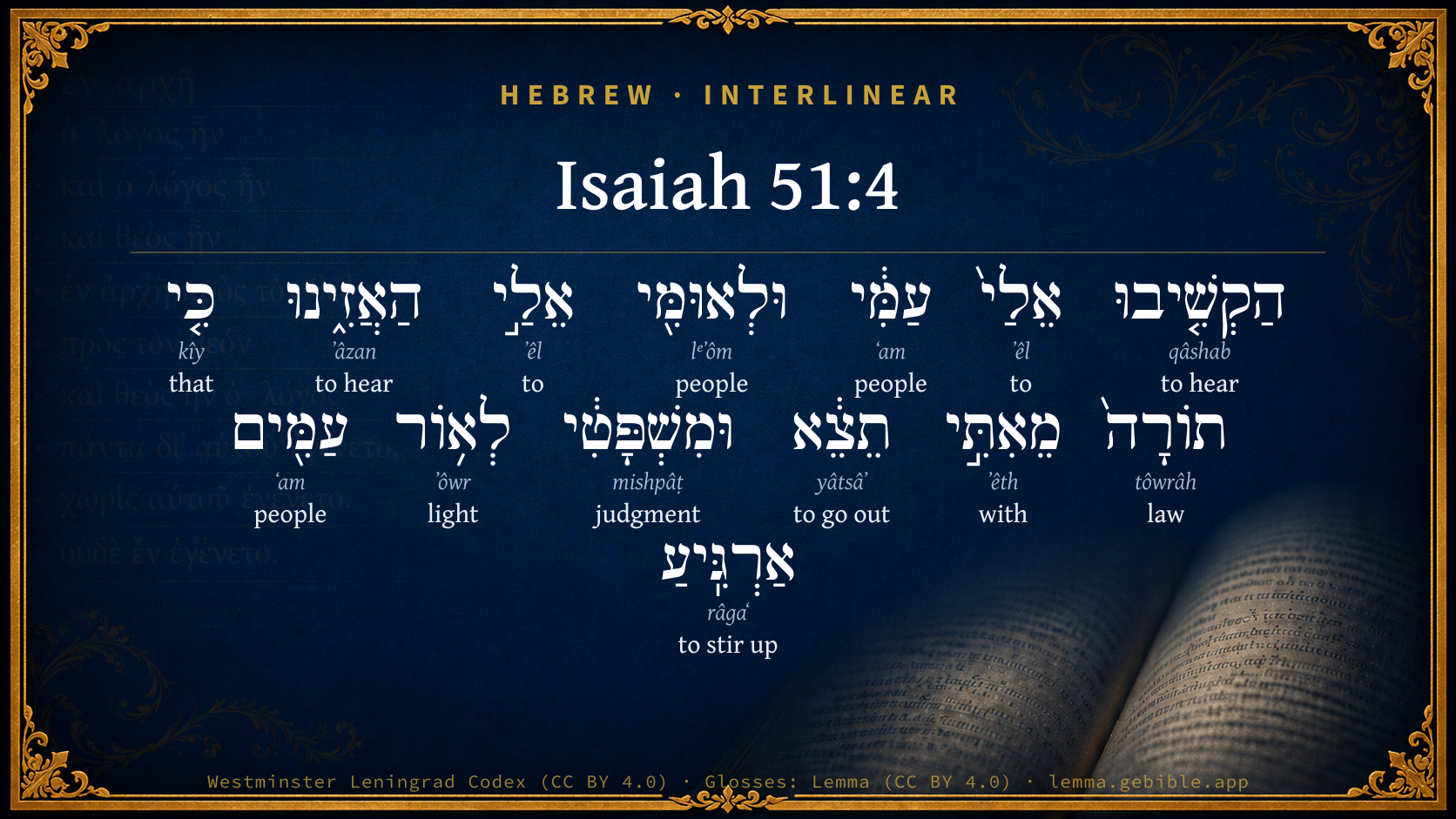
Hebrew (Westminster Leningrad Codex) Isaiah 51:4 appears in the Hebrew Old Testament. The text above is from the Westminster Leningrad Codex. Each word links to its Strong’s number, a concise gloss, and parsing drawn from the Open Scriptures Hebrew Bible morphology. Click any word for its full Brown-Driver-Briggs (BDB) entry.
Download image
Cite this verse

Isaiah 51:4 (World English Bible). Public Domain. Lemma interlinear Bible study tool, https://lemma.gebible.app/v/isaiah/51/4.

Show BibTeX & RIS
BibTeX
RIS
English Translation
Attend to me, my people; and give ear to me, my nation: for a law shall go forth from me, and I will establish my justice for a light of the peoples.
World English Bible · Public Domain
Download a study sheet

One document with this verse’s original text, its word-by-word gloss line, the meaning frame, cross-references with their text, attributed commentary, and full source and license credits — printable, and it pastes into notes with its structure intact.

This verse Autodidact and up

Study sheet (.html) Plain text (.txt)

A passage Seminary Student

Up to 50 verses in one chapter. A passage sheet keeps up to 6 commentary sources and 12 cross-references per verse, in the order this page ranks them, and says so on the sheet whenever that leaves anything out. Ask for a single verse and you get the Autodidact verse sheet above.

Everything on this page stays free to read, with no account — the sheet is a download of what is already on screen, not access to it.

Want to remove ads? Support Godless Engineer
Compare translations 3

The same verse in 3 English versions, stacked beneath the original-language interlinear above. Click any original word for its lexicon entry.

Each is an independent rendering of the whole verse — the interlinear is not word-aligned to these translations.

Highlighted words mark where these versions differ — a whole-verse word diff, not a word-by-word alignment.

  • World English Bible Public Domain
    Attend to me, my people; and give ear to me, my nation: for a law shall go forth from me, and I will establish my justice for a light of the peoples.
  • King James Version Public Domain
    Hearken unto me, my people; and give ear unto me, O my nation: for a law shall proceed from me, and I will make my judgment to rest for a light of the people.
  • unfoldingWord Literal Text CC BY-SA 4.0
    “Attend to me, my people, and listen to me, my nation, for law will go out from me, and I will make my justice rest for a light of the peoples.

unfoldingWord Literal Text — © unfoldingWord, licensed CC BY-SA 4.0. Word-aligned USFM3 via Door43 (git.door43.org/unfoldingWord/en_ult).

Versions to compare (up to 4)

3 of 4 selected

Show all 18 translations

Every available English version of this verse, each an independent rendering of the whole verse.

  • World English Bible Public Domain
    Attend to me, my people; and give ear to me, my nation: for a law shall go forth from me, and I will establish my justice for a light of the peoples.
  • Berean Standard Bible Public Domain
    Pay attention to Me, My people, and listen to Me, My nation; for a law will go out from Me, and My justice will become a light to the nations; I will bring it about quickly.
  • Majority Standard Bible Public Domain
    Pay attention to Me, My people, and listen to Me, My nation; for a law will go out from Me, and My justice will become a light to the nations; I will bring it about quickly.
  • King James Version Public Domain
    Hearken unto me, my people; and give ear unto me, O my nation: for a law shall proceed from me, and I will make my judgment to rest for a light of the people.
  • American Standard Version (1901) Public Domain
    Attend unto me, O my people; and give ear unto me, O my nation: for a law shall go forth from me, and I will establish my justice for a light of the peoples.
  • Revised Version (1885) Public Domain
    Attend unto me, O my people; and give ear unto me, O my nation: for a law shall go forth from me, and I will make my judgment to rest for a light of the peoples.
  • Geneva Bible (1599) Public Domain
    Hearken ye vnto me, my people, and giue eare vnto me, O my people: for a Law shall proceede from me, and I will bring foorth my iudgement for the light of the people.
  • Douay-Rheims (1899) Public Domain
    Hearken unto me, O my people, and give ear to me, O my tribes: for a law shall go forth from me, and my judgment shall rest to be a light of the nations.
  • Young's Literal Translation Public Domain
    Attend unto Me, O My people, And, O My nation, unto Me give ear. For a law from Me goeth out, And My judgment to the light, Peoples I do cause to rest.
  • Literal Standard Version CC BY-SA 4.0
    “Attend to Me, O My people, || And, O My nation, give ear to Me. For a law goes out from Me, || And My judgment to the light, || I cause peoples to rest.
  • Unlocked Literal Bible CC BY-SA 4.0
    “Be attentive to me, my people; and listen to me, my people! For I will issue a decree, and I will make my justice to be a light for the nations.
  • unfoldingWord Literal Text CC BY-SA 4.0
    “Attend to me, my people, and listen to me, my nation, for law will go out from me, and I will make my justice rest for a light of the peoples.
  • Darby Bible Public Domain
    Listen unto me, my people; and give ear unto me, my nation: for a law shall proceed from me, and I will establish my judgment for a light of the peoples.
  • World Messianic Bible Public Domain
    “Listen to me, my people; and hear me, my nation, for a law will go out from me, and I will establish my justice for a light to the peoples.
  • Webster's Bible Public Domain
    Hearken to me, my people; and give ear to me, O my nation: for a law shall proceed from me, and I will make my judgment to rest for a light of the people.
  • Free Bible Version CC BY-SA 4.0
    Pay attention to me, my people; listen to me, my nation: I will send out my law, and my justice will be a light to the nations.
  • Bible in Basic English Public Domain
    Give attention to me, O my people; and give ear to me, O my nation; for teaching will go out from me, and the knowledge of the true God will be a light to the peoples.
  • JPS Tanakh (1917) Public Domain
    Attend unto Me, O My people, and give ear unto Me, O My nation; for instruction shall go forth from Me, and My right on a sudden for a light of the peoples.

Literal Standard Version (2020), Covenant Press — licensed CC BY-SA 4.0. Text via the HelloAO Bible API (eBible.org). Unlocked Literal Bible (unfoldingWord) — licensed CC BY-SA 4.0. Text via the HelloAO Bible API (eBible.org). unfoldingWord Literal Text — © unfoldingWord, licensed CC BY-SA 4.0. Word-aligned USFM3 via Door43 (git.door43.org/unfoldingWord/en_ult). Free Bible Version, Dr. Jonathan Gallagher — licensed CC BY-SA 4.0. Text via the HelloAO Bible API (eBible.org).

Word by word

More ways to search: Search by grammar → Find every occurrence → Compare this word →

Practice this passage: Drill this verse → Learn its vocabulary →

אַרְגִּֽיעַ
râgaʻ
H7280
“to stir up”
Verb, Hiphil, Imperfect, 1st Person, Common, Singular
Part of Speech
Verb
Stem
Hiphil
Form
Imperfect
Person
1st Person
Gender
Common
Number
Singular
Full BDB Definition

Origin: a primitive root

TWOT: 2116 , 2117 , 2118

to act in an instant, stir up, disturb - (Qal) to stir up, disturb - (Hiphil) to make a twinkling - to rest or repose, be at rest or repose, settle, quiet, give rest - (Niphal) - to cause to rest (of sword, of the sea) - to wink (with preposition) - (Hiphil) - to give rest to - to rest, repose - to harden
  1. הַקְשִׁ֤יבוּ qâshab H7181 “hear” Verb, Hiphil, Imperative, 2nd Person, Masculine, Plural
  2. אֵלַי֙ ʼêl H413 “to · me” Preposition + Suffix, Personal, 1st Person, Common, Singular
  3. עַמִּ֔י ʻam H5971 “people · my” Noun, Common, Masculine, Singular, Construct + Suffix, Personal, 1st Person, Common, Singular
  4. וּלְאוּמִּ֖י lᵉʼôm H3816 “and · people · my” Conjunction + Noun, Common, Masculine, Singular, Construct + Suffix, Personal, 1st Person, Common, Singular
  5. אֵלַ֣י ʼêl H413 “to · me” Preposition + Suffix, Personal, 1st Person, Common, Singular
  6. הַאֲזִ֑ינוּ ʼâzan H238 “hear” Verb, Hiphil, Imperative, 2nd Person, Masculine, Plural
  7. כִּ֤י kîy H3588 “that” Conjunction
  8. תוֹרָה֙ tôwrâh H8451 “law” Noun, Common, Feminine, Singular, Absolute
  9. מֵאִתִּ֣י ʼêth H854 “from · with · me” Preposition + Preposition + Suffix, Personal, 1st Person, Common, Singular
  10. תֵצֵ֔א yâtsâʼ H3318 “to go out” Verb, Qal, Imperfect, 3rd Person, Feminine, Singular
  11. וּמִשְׁפָּטִ֔י mishpâṭ H4941 “and · judgment · my” Conjunction + Noun, Common, Masculine, Singular, Construct + Suffix, Personal, 1st Person, Common, Singular
  12. לְא֥וֹר ʼôwr H216 “to/for · light of” Preposition + Noun, Common, Both, Singular, Construct
  13. עַמִּ֖ים ʻam H5971 “peoples” Noun, Common, Masculine, Plural, Absolute

About this verse

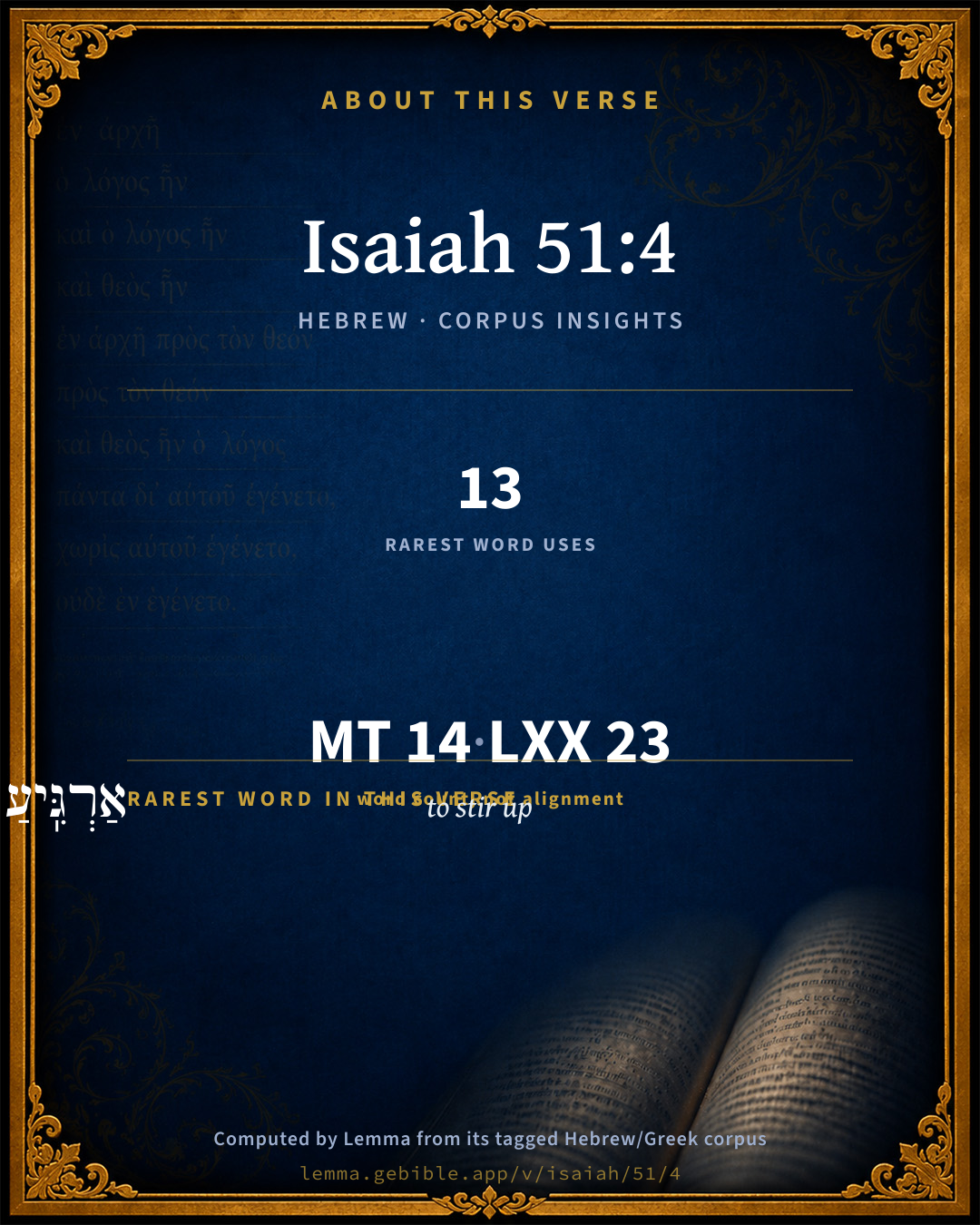
These counts appear in no published source. They are computed here, from the morphology-tagged text and Lemma’s own curated glosses. What Lemma adds →

14
words
12
distinct lemmas
Prophets
section

Notable vocabulary

The rarest word here is אַרְגִּֽיעַ to stir up H7280 — appearing just 13 times in the whole Hebrew Bible.

Shared distinctive vocabulary

אַרְגִּֽיעַ to stir up H7280 occurs in 13 verses of the Hebrew Bible. Also found in:

Grammatical profile

  • 4 verbs
  • 6 nouns
  • 3 prepositions
  • 1 conjunction

Verb forms

  • הַקְשִׁ֤יבוּ Hiphil · Imperative
  • הַאֲזִ֑ינוּ Hiphil · Imperative
  • תֵצֵ֔א Qal · Imperfect
  • אַרְגִּֽיעַ Hiphil · Imperfect

Repetition

Words recur within this verse — often emphatic in Hebrew:

  • עַמִּ֔י people H5971 ×2
  • אֵלַי֙ to H413 ×2

Hebrew & Septuagint length

In English translation the verse runs 32 words from the Hebrew and 30 from the Septuagint (LXX English) — closely comparable.

A rough comparison of the two English renderings, which tokenize alike — not a word-level alignment.

Word counts can differ between the Hebrew and the Greek without any difference in meaning — e.g. the Hebrew direct-object marker אֵת has no separate Greek word, and Greek often adds the article ὁ.

In the original languages it is 14 Hebrew tokens and 23 Greek tokens — but the two are counted differently (Hebrew bundles its prefixes and suffixes into one token; the Greek is in lemma form), so that isn’t a like-for-like length.

Cross-references

20

Topical passages linked to Isaiah 51:4 in the Treasury of Scripture Knowledge — connected by theme and wording, ordered by reader-vote popularity; previews shown in the World English Bible.

  • 1 Peter 2:9 But you are a chosen race, a royal priesthood, a holy nation, a people for God's own possession, that you may show forth the excellencies of him who called you out of darkness into his marvelous light:
  • Isaiah 2:3 Many peoples shall go and say, "Come, let's go up to the mountain of Yahweh, To the house of the God of Jacob; And he will teach us of his ways, And we will walk in his paths. For out of Zion the law shall go forth, And the word of Yahweh from Jerusalem.
  • 1 Corinthians 9:21 to those who are without law, as without law (not being without law toward God, but under law toward Christ), that I might win those who are without law.
  • Isaiah 42:6 I, Yahweh, have called you in righteousness, and will hold your hand, and will keep you, and give you for a covenant of the people, for a light of the Gentiles;
  • Isaiah 49:6 yes, he says, It is too light a thing that you should be my servant to raise up the tribes of Jacob, and to restore the preserved of Israel: I will also give you for a light to the Gentiles, that you may be my salvation to the end of the earth.
  • Psalms 78:1 Hear my law, my people. Turn your ears to the words of my mouth.
  • Micah 4:2 Many nations will go and say, "Come, and let us go up to the mountain of Yahweh, And to the house of the God of Jacob; And he will teach us of his ways, And we will walk in his paths." For out of Zion will go forth the law, And the word of Yahweh from Jerusalem;
  • Exodus 19:6 and you shall be to me a kingdom of priests, and a holy nation.' These are the words which you shall speak to the children of Israel."
  • Exodus 33:13 Now therefore, if I have found favor in your sight, please show me now your ways, that I may know you, so that I may find favor in your sight: and consider that this nation is your people."
  • Psalms 33:12 Blessed is the nation whose God is Yahweh, The people whom he has chosen for his own inheritance.
  • Psalms 50:7 "Hear, my people, and I will speak; Israel, and I will testify against you. I am God, your God.
  • Psalms 106:5 That I may see the prosperity of your chosen, That I may rejoice in the gladness of your nation, That I may glory with your inheritance.
  • Psalms 147:20 He has not done this for just any nation. They don't know his ordinances. Praise Yah!
  • Proverbs 6:23 For the commandment is a lamp, And the law is light. Reproofs of instruction are the way of life,
  • Isaiah 26:2 Open you the gates, that the righteous nation which keeps faith may enter in.
  • Isaiah 42:1–4 Behold, my servant, whom I uphold; my chosen, in whom my soul delights: I have put my Spirit on him; he will bring forth justice to the Gentiles.
  • Matthew 12:18–20 "Behold, my servant whom I have chosen; My beloved in whom my soul is well pleased: I will put my Spirit on him. He will proclaim justice to the Gentiles.
  • Luke 2:32 A light for revelation to the Gentiles, And the glory of your people Israel."
  • John 16:8–11 When he has come, he will convict the world about sin, about righteousness, and about judgment;
  • Romans 8:2–4 For the law of the Spirit of life in Christ Jesus made me free from the law of sin and of death.

Cross-references courtesy of OpenBible.info (CC BY 4.0).

Hebrew and Greek witnesses Masoretic Hebrew ↔ Greek Septuagint

The same verse in the two great witnesses to the Old Testament, shown verse-for-verse.

These are two independent witnesses, not word-aligned to each other, and the Septuagint is shown in lemma (dictionary) form.

Hebrew Isaiah 51:4 Masoretic · Westminster Leningrad Codex

הַקְשִׁ֤יבוּ אֵלַי֙ עַמִּ֔י וּלְאוּמִּ֖י אֵלַ֣י הַאֲזִ֑ינוּ כִּ֤י תוֹרָה֙ מֵאִתִּ֣י תֵצֵ֔א וּמִשְׁפָּטִ֔י לְא֥וֹר עַמִּ֖ים אַרְגִּֽיעַ

Attend to me, my people; and give ear to me, my nation: for a law shall go forth from me, and I will establish my justice for a light of the peoples.

World English Bible · Public Domain

Greek LXX Isaiah 51:4 Septuagint · lemma form

ἀκούω ἐγώ ἀκούω λαός ἐγώ καί ὁ βασιλεύς πρός ἐγώ ἐνωτίζομαι ὅτι νόμος παρά ἐγώ ἐκἔρχομαι καί ὁ κρίσις ἐγώ εἰς φῶς ἔθνος

Hear me, hear me, my people; and you⌃ kings, listen to me: for a law shall proceed from me, and my judgment shall be for a light of the nations.

LXX2012 (modern English Septuagint) · Public Domain

On this verse, The Cambridge Bible for Schools and Colleges discusses the Septuagint’s reading. Read the note in Commentary ↓

Hebrew: Westminster Leningrad Codex (CC BY 4.0). Greek: Septuagint (public domain); English from LXX2012 (modern English Septuagint) (Public Domain). How the Septuagint differs from the Hebrew →

Targum (Aramaic paraphrase)

1

The Targum is the ancient Jewish Aramaic paraphrase of the Hebrew Scriptures — an interpretive translation, not the Hebrew text itself. Onkelos (literal) and Pseudo-Jonathan (expansive) render the Torah, and Jonathan the Prophets. Coverage is partial: where no permissively-licensed English translation exists for a verse, only the Aramaic is shown. This is verse-level text, not a word-by-word alignment to the Hebrew.

  1. Targum Jonathan Prophets (Joshua–Malachi)
    קַבִּילוּ לְמֵימְרִי עַמִי וּכְנִשְׁתִּי לְפוּלְחָנִי אֲצִיתָא אֲרֵי אוֹרַיְתָא מִן קֳדָמַי תִּיפּוֹק וְדִינַי כְּנֵיהוֹר לֵהּ עַמְמִין אֲגַלֵי יִשְׁתַּבְּחוּן:

    Listen to my WORD, O my people, and give ear, O my congregation, to my service; for the law shall go forth from me, and my judgment like a light; the nations which I led into captivity shall praise it.

    Targum Jonathan — Aramaic: “Mikraot Gedolot” (public domain). English: “Sefaria Community Translation” (CC0 1.0 (public-domain dedication)); “London "Chaldee Paraphrase," 1871” (public domain). Text via Sefaria.

Commentary

Notes on Isaiah 51:4 from classic Christian and Jewish commentators (each source and its license shown beneath its notes). The classic Christian expositions comment on the surrounding passage and are grouped to its opening verse, so a note may address several verses; the Jewish commentaries on the Tanakh (Rashi and others) are per-verse, so they appear only where the commentator wrote on this verse.

Lemma curates 59 commentaries, every one of them public domain or Creative Commons licensed, each selected and text-cleaned for this edition rather than reprinted as found. About our sources →

The Cambridge Bible for Schools and Colleges

gen. ed. J. J. S. Perowne

4. Hearken unto me] Better as R.V. Attend unto me, the verb being different from that used in Isa_51:1; Isa_51:7.

a law shall proceed from me] See ch. Isa_2:3 (“for out of Zion shall go forth Tôrâh”). For a law (tôrâh) read, as usual, instruction. The word judgment in the next line is probably to be rendered “religion” as in Isa_42:1; Isa_42:3-4 (see on Isa_42:1).

The verb rendered “make to rest” has three meanings in the O.T. (a) to “cause to rest” (Jer_31:2) or “be at rest” (ch. Isa_34:14), (b) to “set in commotion” (Jer_50:34, see on Isa_51:15 below), and (c) to “do a thing in the twinkling of an eye” (Jer_49:19). Of these (a) is alone possible in the present connexion, though hardly quite suitable; the sense “establish,” given by some critics, seems to have no sufficient support. By the LXX. the word is taken with Isa_51:5, and in the sense (c), and this suggests the true reading, although it requires a slight modification of the following word. The construction would be the same as in Jer_49:19, and the rendering perhaps, “Suddenly I bring near my righteousness.” The word is at all events superfluous in Isa_51:4, the last clause of which reads simply: and my judgement for a light of the peoples (cf. Isa_49:6).

4–6. The universal extension of the true religion is the second ground of comfort which the prophet is commissioned to offer to his fellow believers. The language of Isa_51:4-5 is obviously moulded on that of ch. Isa_42:1-4; the functions there assigned to the Servant of the Lord are here assumed by Jehovah Himself. At the same time the thought is implied that the restored Israel is to be the bearer of salvation to the world at large, and thus the further idea is suggested that the ideal represented by the Servant will be realised by the people of Israel when it emerges purified from the discipline of the Captivity.

The Cambridge Bible for Schools and Colleges (gen. ed. J. J. S. Perowne; Cambridge University Press, 1878–1918) — public domain. Text from a community e-Sword module.

Trapp's Complete Commentary

John Trapp

Isa 51:4 Hearken unto me, my people; and give ear unto me, O my nation: for a law shall proceed from me, and I will make my judgment to rest for a light of the people.

Ver. 4. Hearken unto me.] See on Isa 51:2.

For a law shall proceed from me,] i.e., The gospel of grace, that "perfect law of liberty," "the law of the spirit of life." {Rom 8:2}

And I will make my judgment to rest.] I will firmly and irrevocably establish the government of my word and Spirit in the Church for a secure guide to bring it to eternal life. Some {a} render it thus, "My judgment," i.e., my gospel, shall be for a light of the people, whereby I will give rest. So that here is a double effect of the gospel, viz., saving light, and peace of conscience.

{a} Diod.

John Trapp, A Commentary or Exposition upon All the Books of the Old and New Testament (1647–1656) — public domain. Text from a community e-Sword module.

The Biblical Illustrator

Joseph S. Exell

Isa_51:4-6

Hearken unto Me, My people

The absolute in human history

Time works mighty changes in human life.

Amidst the ceaseless whirl of mutation, is there nothing unchangeable? Is life made up entirely of volatile contingencies? Has it no absolute elements? Oh, for a rock in this ebbing sea, where we might stand secure as the wreck of years floats by! This Scripture responds to our questions, and meets our aspirations. The word law designates Gods revelation; judgment and righteousness are interchangeable terms, expressing the one idea--rectitude. The great truths, therefore, enfolded in this rich oriental garb, are that rectitude and salvation are the elements of Gods revelation; and that these elements are the absolute in human history.

I. THEY ARE FOR ALL LANDS--world-wide in their aspect--a light of the people. Man is, confessedly, a corrupt intelligence; and, in the nature of things, a knowledge of his state is essential to his improvement. Will he ever seek a remedy or ask for a refuge until he has felt the disease or descried the peril? Whence comes this discovery? Nothing less than a special revelation of rectitude can meet the case. By the law is the knowledge of sin. Next comes the other element--salvation. Each of these two elements of our religion is equally necessary for man everywhere. The value, however, of each depends upon mutual connection; each is useless by itself.

II. THESE BLESSINGS ARE FOR ALL TIMES, AS WELL AS FOR ALL LANDS. The heavens shall vanish away like smoke, etc. These words suggest three solemn considerations--

1. That man is related to two distinct systems of things, the one involving the heavens and the earth, the other righteousness and salvation--the one material, the other spiritual. This twofold relation is a peculiarity of our history. The other tenants of the globe are related to the material as we are. But with the spiritual they appear to have no connection.

2. That one of the systems to which man is related is transient, the other is permanent.

3. That the permanent system should command mans chief concern. Hear the sum of this address:--Beware of practical materialism. (D. Thomas, D.D.)

Righteousness and salvation

I. THE CHARACTER OF THOSE SPECIALLY ADDRESSED. By comparing the first and the seventh with the fourth verse of the chapter, we find four leading features of their character set forth:

1. They are said to know righteousness.

2. To follow after righteousness.

3. To seek the Lord.

4. To have the law of God in their hearts.

II. THE ADDRESS ITSELF. It constitutes a sublime prophetic description of those spiritual blessings to be ripened by the advent of the Messiah. It foretells the setting up of that kingdom which cometh not by outward observation, but which is righteousness, and peace, and joy in the Holy Ghost--the publication of that better covenant established on better promises. Many topics of deep interest are suggested by this prophetic setting forth of the blessings and triumphs of the Gospel. The text fully asserts--

1. Their certainty.

2. Their perpetuity. (T. Page, M.A.)

An evangelical law

The law here meant (Isa_51:4) is that of Zion Isa_2:3), as distinguished from that of Sinai--the Gospel of redemption. (F. Delitzsch, D.D.)

The Biblical Illustrator, edited by Joseph S. Exell (c. 1880s–1900s) — public domain. Text from a community e-Sword module.

Joseph Benson's Commentary

Isa 51:4-5. Hearken unto me, my people — Ye Jews, whom I chose to be my peculiar people, do not reject my counsel, which, I have told you, even the Gentiles will receive, nor forsake the mercies of which even they will partake. For a law shall proceed from me — A new law, even the doctrine of the gospel. I will make my judgment to rest for a light — Judgment is here the same thing with law in the former clause, the word of God, or the evangelical doctrine, of which he saith, that he will make it to rest, that is, settle and establish it; whereby he may possibly intimate the stability and perpetuity of this light in the church, that it shall not be like the light of the Mosaic dispensation, which was only to shine for a season, namely, until the time of reformation, (Heb 9:10,) when all those dark shadows were to vanish and give place to the Sun of righteousness, and to that kingdom and state that should never be moved. See Dan 2:44; Heb 12:26-28. Of the people — Hebrew, עמים, the peoples, not only you Jews, but people of all sorts and nations, who shall receive and walk in it. My righteousness is near — My salvation, the redemption of all my people, Jews and Gentiles, which is the effect of my righteousness, of my justice, faithfulness, or mercy, which are all called by the name of righteousness in the Scriptures, and all contributed to the work of man’s redemption. My salvation is gone forth — Shall shortly go forth; my eternal purpose of saving my people shall speedily be fulfilled; and mine arm, my power, shall judge the people — Either, 1st, Shall destroy those who obstruct or oppose this work: or, rather, 2d, Shall subdue the Gentiles to my authority, and rule them by my Word and Spirit. The isles — The remote countries of the Gentiles; shall wait upon me — Shall expect this salvation from me, and from me only.

Joseph Benson's Commentary on the Old and New Testaments (1811–1818) — public domain. Text from a community e-Sword module.

Tyndale Open Study Notes

Tyndale Open Resources

51:4 my law . . . my justice: The work of the servant will prosper because justice will be the rule in God’s kingdom on earth (see 42:1-4). • a light to the nations: The nations will receive the Lord and his revelation (see also 42:6; 49:6; 60:1-3; 66:19-23; Matt 4:15-16; Luke 2:32; John 1:4-9; 12:35-50; Acts 13:47).

Tyndale Open Study Notes — © Tyndale Open Resources, licensed CC BY-SA 4.0. Text via the HelloAO Bible API.

Geneva Bible (1599)

Geneva Bible translators

I will rule and govern my Church by my word and doctrine.

Geneva Bible (1599) marginal notes — public domain. Text via Bolls.life.

Matthew Henry's Commentary

Both these proclamations, as I may call them, end alike with an assurance of the perpetuity of God's righteousness and his salvation; and therefore we put them together, both being designed for the comfort of God's people. Observe,

I. Who they are to whom this comfort belongs: "My people, and my nation, that I have set apart for myself, that own me and are owned by me." Those are God's people and his nation who are subject to him as their King and their God, pay allegiance to him, and put themselves under his protection accordingly. They are a people who know righteousness, who not only have the means of knowledge, and to whom righteousness is made known, but who improve those means, and are able to form a right judgment of truth and falsehood, good and evil. And, as they have good heads, so they have good hearts, for they have the law of God in them, written and ruling there. Those God owns for his people in whose hearts his law is. Even those who know righteousness, and have the law of God in their hearts, may yet be in great distress and sorrow, and loaded with reproach and contempt; but their God will comfort them with the righteousness they know and the law they have in their hearts.

II. What the comfort is that belongs to God's people. 1. That the gospel of Christ shall be preached and published to the world: A law shall proceed from me, an evangelical law, the law of Christ, the law of faith, Isa 2:3. This law is his judgment; for it is that law of liberty by which the world shall be governed and judged. This shall not only go forth, but shall continue and rest, it shall take firm footing and deep root in the world. It shall rest, not only for the benefit of the Jews, who had the first notice of it, but for a light of the people of other nations. It is this law, this judgment, that we are required to hearken and give ear to, at our peril; for how shall we escape if we neglect it and turn a deaf ear to it? When a law proceeds from God, he that has ears to hear, let him hear. 2. That this law and judgment shall bring with them righteousness and salvation, shall open a ready way to the children of men, that they may be justified and saved, Isa 51:5. These are called God's righteousness and his salvation, because of his contriving and bringing them about. The former is a righteousness which he will accept for us and accept us for, and a righteousness which he will work in us and graciously accept of. The latter is the salvation of the Lord, for it arises from him and terminates in him. Observe, There is no salvation without righteousness; and, wherever there is the righteousness of God, there shall be his salvation. All those, and those only, that are justified and sanctified shall be glorified. 3. That this righteousness and salvation shall very shortly appear: My righteousness is near. It is near in time; behold, all things are now ready. It is near in place, not far to seek, but the word is nigh us, and Christ in the word, righteousness in the word, Rom 10:8. My salvation has gone forth. The decree has gone forth concerning it; it shall as certainly be introduced as if it had gone forth already, and the time for it is at hand. 4. That this evangelical righteousness and salvation shall not be confined to the Jewish nation, but shall be extended to the Gentiles; My arms shall judge the people. Those that will not yield to the judgments of God's mouth shall be crushed by the judgments of his hand. Some shall thus be judged by the gospel, for for judgment Christ came into this world; but others, and those of the isles, shall wait upon him, and bid his gospel, and the commands as well as the comforts of it, welcome. It was a comfort to God's people, to his nation, that multitudes should be added to them, and the increase of their number should be the increase of their strength and beauty. It is added, And on my arm shall they trust, that arm of the Lord which is revealed in Christ, Isa 53:1. Observe, God's arm shall judge the people that are impenitent, and yet on his arm shall others trust and be saved by it; for it is to us as we make it, a savour of life or of death. 5. That this righteousness and salvation shall be for ever, and shall never be abolished, Isa 51:8. It is an everlasting righteousness that the Messiah brings in (Dan 9:24), an eternal redemption that he is the author of, Heb 5:9. As it shall spread through all the nations of the earth, so it shall last through all the ages of the world. We must never expect any other way of salvation, any other covenant of peace or rule of righteousness, than what we have in the gospel, and what we have there shall continue to the end, Mat 28:20. It is for ever; for the consequences of it shall be to eternity, and by this law of liberty men's everlasting state will be determined. This perpetuity of the gospel and the blessed things it brings in is illustrated by the fading and perishing of this world and all things in it. Look up to the visible heavens above, which have continued hitherto, and seem likely to continue, but they shall vanish like smoke that soon spends itself and disappears; they shall be rolled like a scroll, and their lights shall fall like leaves in autumn. Look down to the earth beneath; that abides too for a short ever (Ecc 1:4), but it shall wax old like a garment that will be the worse for wearing; and those that dwell therein, all the inhabitants of the earth, even those that seem to have the best settlement in it, shall die in like manner: the soul shall, as to this world, vanish like smoke, and the body be thrown by like a garment waxen old. They shall be easily crushed (Job 4:19), and no loss of them. But when heaven and earth pass away, when all flesh and the glory of it wither as grass, the word of the Lord endures for ever, and not one iota or tittle of that shall fall to the ground. Those whose happiness is bound up in Christ's righteousness and salvation will have the comfort of it when time and days shall be no more.

III. What use they are to make of this comfort. If God's righteousness and salvation are near to them, then let them not fear the reproach of men, of mortal miserable men, nor be afraid of their revilings or spiteful taunts, theirs who bid you sing them the songs of Zion, or who ask you, in scorn, Where is now your God? Let not those who embrace the gospel righteousness be afraid of those who will call them Beelzebub, and will say all manner of evil against them falsely. Let them not be afraid of them; let them not be disturbed by these opprobrious speeches, nor made uneasy by them, as if they would be the ruin of their reputation and honour and they must for ever lie under the load of them. Let them not be afraid of their executing their menaces, nor be deterred thereby from their duty, nor frightened into any sinful compliances, nor driven to take any indirect courses for their own safety. Those can bear but little for Christ that cannot bear a hard word for him. Let us not fear the reproach of men; for, 1. They will be quickly silenced (Isa 51:8): The moth shall eat them up like a garment, Isa 50:9. The worm shall eat them like wool, or woollen cloth. If we have the approbation of a living God, we may despise the censure of dying men; the matter is not great what those say of us who must shortly be food for worms. Or it intimates the judgments of God with which they shall be visited, with which they shall be consumed, for their malice against the people of God; they shall be slowly and silently, but effectually destroyed, when God shall come to reckon with them for all their hard speeches, Jde 1:14, Jde 1:15. 2. The cause we suffer for cannot be run down. The falsehood of their reproaches will be detected, but truth shall triumph, and the righteousness of religion's injured cause shall be for ever plain. Clouds darken the sun, but give no obstruction to his progress.

Matthew Henry's Commentary on the Whole Bible (1708–1710) — public domain (CC PDM 1.0). Text via the HelloAO Bible API.

Jamieson, Fausset & Brown

Robert Jamieson, A. R. Fausset & David Brown

my people--the Jews. This reading is better than that of GESENIUS: "O peoples . . . nations," namely, the Gentiles. The Jews are called on to hear and rejoice in the extension of the true religion to the nations; for, at the first preaching of the Gospel, as in the final age to come, it was from Jerusalem that the gospel law was, and is, to go forth (Isa 2:3).

law . . . judgment--the gospel dispensation and institutions (Isa 42:1, "judgment").

make . . . to rest--establish firmly; found.

light, &c.-- (Isa 42:6).

Jamieson, Fausset & Brown — Commentary Critical and Explanatory on the Whole Bible (1871) — public domain (CC PDM 1.0). Text via the HelloAO Bible API.

Adam Clarke's Commentary

Verse 4. My people - O my nation - "O ye peoples - O ye nations"] For עמי ammi, my people, the Bodleian MS. and another read עמים ammim, ye peoples; and for לאומי leumi, my nation, the Bodleian MS. and eight others, (two of them ancient,) and four of De Rossi's, read לאמים leummim, ye nations; and so the Syriac in both words. The difference is very material; for in this case the address is made not to the Jews, but to the Gentiles, as in all reason it ought to be; for this and the two following verses express the call of the Gentiles, the islands, or the distant lands on the coasts of the Mediterranean and other seas. It is also to be observed that God in no other place calls his people לאמי leummi, my nation. It has been before remarked that transcribers frequently omitted the final מ mem of nouns plural, and supplied it, for brevity's sake, and sometimes for want of room at the end of a line, by a small stroke thus /עמי; which mark, being effaced or overlooked, has been the occasion of many mistakes of this kind.

A law shall proceed from me] The new law, the Gospel of our Lord Jesus. Kimchi says, "After the war with Gog and Magog the King Messiah will teach the people to walk in the ways of the Lord."

Adam Clarke's Commentary on the Bible (1810–1826) — public domain. Text from a community e-Sword/MySword module.

Ellicott's Commentary for English Readers

(4) A law shall proceed.—“Law” and “judgment” include all forms of divine revelation, and specially the “glad tidings” which are the groundwork of the highest law. (Comp. Luk_1:77; Rom_1:17.)

A Bible Commentary for English Readers, edited by Charles John Ellicott (1878–1897) — public domain. Text from a community e-Sword module.

John Gill's Exposition

Hearken unto me, my people,.... His special people, whether Jews or Gentiles, chosen by him, taken into covenant with him; given to Christ, redeemed by him as a peculiar people, and called by his grace; these are exhorted to hearken to him; to his word, as the Targum; see Isa 51:1,

and give ear unto me, O my nation; not the nation of the Jews only, but the Gentiles; a nation taken out of a nation, even out of all nations; a chosen and a holy nation. The Septuagint and Arabic versions render it "kings"; such are made kings and priests unto God: see Pe1 2:9,

for a law shall proceed from me; not the Sinai law, but the Gospel; that doctrine that is said to go out of Zion, Isa 2:3, as Kimchi rightly observes, who adds,

"for the King Messiah shall teach the people to walk in the ways of the Lord; and this shall be after the war of Gog and Magog:''

and this law or doctrine of God comes from Christ, and is dictated, directed, and made effectual by his Spirit:

and I will make my judgment to rest for a light of the people; this is the same with the law, or doctrine of the Gospel, called "judgment", because it comes from the God of judgment, flows from his wisdom and counsel, and is a declaration of his will; it expands his method of justifying sinners, and is the means of awakening, convincing, and judging the consciences of men, and of informing and establishing the judgments of the saints, and by which the world will be judged at the last day. Now this is

for a light of the people; to enlighten unconverted ones, such who sit in darkness, to turn them from it, and call them out of it into marvellous light; and to illuminate the saints yet more and more, both with respect to doctrine and duty. And this is said to be made to "rest"; which denotes both the continuance of it in the world, until all the ends of it are answered; and the spiritual rest it gives to weary souls now, as well as points out to them that which remains for them hereafter. Though the words may be rendered, "I will cause my judgment to break forth" (h); like the morning, suddenly, and in a "moment" (i); to which agrees what follows.

(h) "erumpere faciam", De Dieu. (i) So R. Jonah, in Ben Melech, takes it to have the signification of "a moment"; as if the sense is, "my judgment I will show every moment from this time, to enlighten the people with it."

John Gill's Exposition of the Whole Bible (1746–1763) — public domain (CC PDM 1.0). Text via the HelloAO Bible API.

Albert Barnes' Notes on the Bible

Hearken unto me, my people - Lowth reads this;

Attend unto me, O ye people,

And give ear unto me, O ye nations.

The reason why he proposes this change is, that he supposes the address here is made to the Gentiles and not to the Jews, and in favor of the change he observes, that two manuscripts read it in this manner. Gesenius (Commentary) says that three codices read עמים ‛ammiym (“peoples”), instead of עמי ‛amiy (“my people”); and that thirteen MSS. read לאוּמים le'ûmiym (“nations”), instead of לאוּמי leûmiy (“my nation”). Noyes also has adopted this reading. But the authority is too slight to justify a change in the text. The Vulgate reads it in accordance with the present Hebrew text, and so substantially do the Septuagint. They render it, ‘Hear me, hear me, my people, and ye kings, give ear unto me.’ It is not necessary to suppose any change in the text. The address is to the Jews; and the design is, to comfort them in view of the fact that the pagan would be brought to partake of the privileges and blessings of the true religion. They would not only be restored to their own land, but the true religion would be extended also to the distant nations of the earth. In view of this great and glorious truth, Yahweh calls on his people to hearken to him, and receive the glad announcement. It was a truth in which they were deeply interested, and to which they should therefore attend.

For a law shall proceed from me - The idea here is, that Yahweh would give law to the distant nations by the diffusion of the true religion.

And I will make my judgment to rest for a light - The word ‘judgment’ here is equivalent to law, or statute, or to the institutions of the true religion. The word rendered here ‘to rest’ (ערגיע ‛aregiya‛ from רגע râga‛), Lowth renders, ‘I will cause to break forth.’ Noyes renders it, ‘I will establish.’ The Vulgate, Requiescet - ‘Shall rest.’ The Septuagint renders it simply, ‘My judgment for a light of the nation.’ The word properly means ‘to make afraid,’ to terrify, to restrain by threats; rendered ‘divideth’ in Job 26:12; Isa 51:15; then, to be afraid, to shrink from fear, and hence, to be still, or quiet, as if cowering down from fear. Here it means that he would set firmly his law; he would place it so that it would be established and immovable.

Albert Barnes' Notes on the Bible (1834–1885) — public domain. Text from a community e-Sword/MySword module.

Haydock's Catholic Bible Commentary

Nations. This was verified when the Bible was translated into Greek, and still more by the preaching of the gospel.

George Leo Haydock (1774–1849), Haydock's Catholic Family Bible and Commentary, 1859 edition — public domain. Excludes Psalms (Douay-Rheims chapter numbering differs from Protestant) and Deuterocanonical books (Catholic canon only).

Matthew Poole's English Annotations

Hearken unto me, my people: seeing the Gentiles will hearken to me, as I have formerly told you, take heed that you Jews, whom I chose to be my peculiar people, do not reject my counsel, nor forsake your own mercies, as I fear you will do.

A law; a new law, even the doctrine of the gospel, which ought to have the force of a law with you, and I expect your obedience to it, no less than to my law delivered by Moses.

I will make my judgment to rest: judgment is here the same thing with law in the former clause, the word of God, which is frequently called judgment, as hath been observed again and again, or the evangelical doctrine, of which he saith that he will make it to rest, i.e. settle and establish it; whereby he may-possibly intimate the stability and perpetuity of this light in the church, that it shall not be like the light of the Mosaical dispensation, which was only to shine for a season, even until the time of reformation, Heb 9:10, when all those dark shadows were to vanish and give place to the Sun of righteousness, and to that kingdom and state that should never be moved, as we read, Dan 2:44; Heb 12:26-28, and in many other places.

For a light of the people, Heb. of or to the peoples; not only to you Jews, but unto people of all sorts and nations, who shall receive and walk in that light which you will reject, and use all possible endeavours to extinguish.

Matthew Poole's English Annotations on the Holy Bible (1683–1685) — public domain. Text from a community e-Sword/MySword module.

Whedon's Commentary on the Bible

Daniel D. Whedon

4-6. Hearken unto me — Another change; or rather, another stage of growth as to the importance of this glorious message. The great work of the future is the offer of salvation to all, not to Israel of holy inclination only, but to all the good and the bad alike. All Israel is summoned to learn the extension of the promise. It is here asserted that out of Israel springs the Saviour, and doubtless, (though critics differ — see Lowth, Gesenius, Ewald, Alexander,) the apostleship to the whole Gentile world.

Law… judgment — See Isa_42:1-3. As there, so here, “law” and “judgment” are used in the sense of the true religion, yet to be everywhere firmly established, and the world to be filled with blessings flowing from it.

My righteousness is near — Not in point of time near at hand; but in God’s time there is actually approaching a realm of peace and purity, equity and truth, to all the good and obedient, but a sore retribution to all who resist the truth to the last.

The isles… wait upon me — See Isa_42:4. The command to look on the unchanging order of the heavens — the sun and the stars — has respect to the impression they make of God’s constancy as to his promises. The heavenly bodies are the greatest of objects; yet these, being created and limited, are sometime to end. Not so the divine promises; the true religion shall never fail. The things material and earthly shall grow old, die, and vanish from sight: but salvation and true religion shall not be abolished.

Daniel D. Whedon (gen. ed.), Commentary on the Old and New Testaments (1874–1909) — public domain. Text from a community e-Sword module.

The Pulpit Commentary

Hearken unto me; rather, attend to me a stronger term than "hearken attend, and hear of a greater blessing than the restoration of the land of Judah to cultivation and fruitfulness. God, enthroned anew in Zion, will from thence send forth his light and his truth to the nations, will make his Law known to them, and allow them to partake of his salvation. O my nation. Some manuscripts have "O ye nations." But the reading is undoubtedly a wrong one. A law shall proceed from me. The Christian "law the new covenant is probably intended. This became, by the preaching of the apostles, a light of the people, or rather, of the peoples.

God"s revelation a light.

"I will make my judgment to rest for a light of the people." The terms "law" and "judgment" are designed to include all forms of Divine revelation the various ways in which the Divine will is made known to man. Revelation means light. It is a mistake to assume that there are things revealed which are not intended for our comprehension; they are revealed precisely with the purpose of unfolding so that we might understand them. There are hidden and secret things, but Moses carefully distinguishes them from the revealed things, saying thus: "The secret things belong unto the Lord our God: but the things which are revealed belong unto us and to our children for ever, that we may do all the words of this Law". (Deu_29:29) Only this much is true revelation is not light to every age equally. Some things seem mysterious at one time that are clear enough at another. And in each fresh generation we may say"The Lord hath yet more light and truth To break forth from his Word.

This, at least, we may assert, prove, and illustrate in all essential matters relating to moral conduct and religious faith, God"s revelation is light.

I GOD"S REVELATION IS LIGHT THAT SHOWS UP SIN.

1. It gives us proper apprehensions of God himself, and shows sin by our contrast with him.

2. It unfolds before us the graciousness of his relations with us, and convicts of sin as it makes us feel the weakness of our response to such relations. (Dan_5:23, last clause)

3. It declares to us the laws by which both our conduct and our spirit ought to be ruled; and by the Law is the knowledge of sin.

4. It presents to us the Lord Jesus Christ as the Gift of God; and "this is the condemnation, that light is come into the world, and men love darkness rather than light, because their deeds are evil.

II GOD"S REVELATION IS LIGHT THAT SHOWS THE WAY OUT OF SIN.

1. By removal of the penalties it has involved.

2. By restoring the broken relations it has caused.

3. By changing the spirit of the sinner melting him to penitence, quickening him to believe. Illustrate one feature from the parable of the "prodigal son," and other features by such passages as Rom_3:19-26 Rom_5:8-10.

III GOD"S REVELATION" IS LIGHT THAT SHOWS THE WAY FOR THOSE REDEEMED FROM SIN. There is the "way of holiness" in which they have to walk. There is a sanctifying, through cares and chastisements, which they have to experience. There is a personal and practical application of the Christian principles to the details of common life which has to be made. And, for all this, God"s Word is a "lamp unto our feet, and a light unto our path. R.T.

The Pulpit Commentary (1880–1919), ed. H.D.M. Spence-Jones & Joseph S. Exell — public domain. Text from a community e-Sword module.

John Wesley's Explanatory Notes

My people - Ye Jews, whom I chose to be my peculiar people. A law - A new law, even the doctrine of the gospel. Judgment - Judgment is here the same thing with law, the word of God, or the evangelical doctrine, of which he saith that he will make it to rest, that is settle and establish it. The people - People of all nations.

John Wesley, Explanatory Notes Upon the Whole Bible (1754–1765) — public domain. Text via the GEBible commentary corpus.

Keil & Delitzsch

C. F. Keil & F. Delitzsch

But the great work of the future extends far beyond the restoration of Israel, which becomes the source of salvation to all the world. "Hearken unto me, my people, and give ear unto me, O my congregation! for instruction will go forth from me, and I make a place for my right, to be a light of the nations. My righteousness is near, my salvation is drawn out, and my arms will judge nations: the hoping of the islands looks to me, and for mine arm is their waiting." It is Israel which is here summoned to hearken to the promise introduced with kı̄. לאוּמּי is only used here of Israel, like גּוי in Zep 2:9; and the lxx (καὶ οἱ βασιλεῖς) have quite misunderstood it. An address to the heathen would be quite out of harmony with the character of the whole prophecy, which is carried out quite consistently throughout. עמי and לאומי, therefore, are not plurals, as the Syriac supposes, although it cannot be disputed that it is a rare thing to meet with the plural form apocopated thus, after the form of the talmudic Aramaean; and see also at Psa 45:9). What Isa 42:1. describes as the calling of the servant of Jehovah, viz., to carry out justice among the nations, and to plant it on the earth, appears here as the act of Jehovah; but, as a comparison of מאתּי with מצּיּון (Isa 2:3) clearly shows, as the act of the God who is present in Israel, and works from Israel outwards. Out of Israel sprang the Saviour; out of Israel the apostleship; and when God shall have mercy upon Israel again, it will become to the whole world of nations "life from the dead." The thorâh referred to here is that of Sion, as distinguished from that of Sinai, the gospel of redemption, and mishpât the new order of life in which Israel and the nations are united. Jehovah makes for this a place of rest, a firm standing-place, from which its light to lighten the nations streams forth in all directions. הרגּיע as in Jer 31:2; Jer 50:34, from רגע, in the sense of the Arabic rj‛, to return, to procure return, entrance, and rest; a different word from רגע in Isa 51:15, which signifies the very opposite, viz., to disturb, literally to throw into trembling. צדק and ישע, which occur in Isa 51:5, are synonyms throughout these prophecies. The meaning of the former is determined by the character of the thorah, which gives "the knowledge of salvation" (Luk 1:77), and with that "the righteousness of God" (Rom 1:17; cf., Isa 53:11). This righteousness is now upon the point of being revealed; this salvation has started on the way towards the fullest realization. The great mass of the nations fall under the judgment which the arms of Jehovah inflict, as they cast down to the ground on the right hand and on the left. When it is stated of the islands, therefore, that they hope for Jehovah, and wait for His arm, the reference is evidently to the remnant of the heathen nations, which outlives the judgment, and not only desires salvation, and is susceptible of it, but which actually receives salvation (compare the view given in Joh 11:52, which agrees with that of Isaiah, and which, in fact, is the biblical view generally, e.g., Joe 3:5). To these the saving arm (the singular only was suitable here; cf., Psa 16:11) now brings that salvation, towards which their longing was more or less consciously directed, and which satisfied their inmost need. Observe in Isa 51:5 the majestic and self-conscious movement of the rhythm, with the effective tone of yeyachēlûn.

Keil & Delitzsch — Biblical Commentary on the Old Testament (1861–1891) — public domain (CC PDM 1.0). Text via the HelloAO Bible API. (Old Testament only.)

J. A. Alexander on Isaiah

Joseph Addison Alexander

“Attend (or hearken) unto me, my people; and my nation, unto me give ear.” This may seem to be a violation of the usage which has been already stated as employing this form of speech to indicate a change in the object of address. But such a change, although a slight one, takes place even here; for he seems no longer to address those seeking righteousness exclusively, but the whole body of the people as such. The next clause explains what it is that they are thus called upon to hear, viz. ‘that law from me shall go forth’, (i.e., revelation or the true religion, as an expression of God’s will, and consequently man’s rule of duty). In like manner Paul describes the gospel as the law of faith (Rom 3:27) not binding upon one race or nation merely, but by the commandment of the everlasting God made known to all nations for the obedience of faith (Rom 16:26). The meaning of the clause is that the nations can expect illumination only from one quarter. The same thing is then said in another form. “And my judgment for the light of the nations (as in Isa 42:6; Isa 49:6) will I cause to rest,” (i.e., fix, establish).

Joseph Addison Alexander, The Prophecies of Isaiah (1846–1847; New York: Scribner, 1870–1878) — public domain. Text from a community e-Sword module.

unfoldingWord translationNotes

Door43 World Missions Community

General Information:

Yahweh speaks to the people of Israel.

Be attentive to me ... listen to me

These two phrases mean the same thing. Together they strengthen the command to listen. (See: Parallelism)

I will make my justice to be a light for the nations

Here God's justice represents his law, and a light represents knowledge of what is right. This means the people of the nations will understand and obey God's law. AT: "my law will teach the nations what is right" or "the nations will know my law" (See: Metaphor)

My righteousness is near

The idea of "near" represents "soon." God's righteousness being near represents him soon showing his righteousness. He will do this this by fulfilling his promises and saving people. AT: "I will soon show my righteousness" (See: Metaphor)

my salvation will go out

God speaks of saving people as if his salvation were a thing that could go out to them. AT: "I will save people" (See: Metaphor)

my arm will judge the nations

Here God's arm represents his power, and judging represents ruling. AT: "I will rule the nations with my power" (See: Metonymy)

the coastlands

This refers to the people who live on the coasts of distant lands across the sea. AT: "the people who live on the coastlands" or "the people who live in the lands across the sea" (See: Metonymy)

for my arm they will eagerly wait

Here God's arm represents what he will do. Here it refers to him saving people. AT: "they will eagerly wait for me to do something" or "they will eagerly wait for me to save them" (See: Metonymy and Assumed Knowledge and Implicit Information)

translationWords

people of God

decree

just

light

nation

righteous

save

judge

unfoldingWord translationNotes — © Distant Shores Media and the Door43 World Missions Community, licensed CC BY-SA 4.0. Source: git.door43.org/Door43/en_tn.

Rashi

Rabbi Shlomo Yitzchaki (Rashi)

When Torah shall emanate from Me The words of the prophets are Torah, and the judgments shall eventually mean tranquility and rest for the peoples for whom I will turn a pure language to serve Me.

I will give [them] rest Heb. אַרְגִּיעַ, I will give them rest.

Rashi on the Tanakh — English translations: “The Judaica Press complete Tanach with Rashi, translated by A. J. Rosenberg” (CC BY 4.0); “Pentateuch with Rashi's commentary by M. Rosenbaum and A.M. Silbermann, 1929-1934” (public domain); “The Metsudah Tanach series, Lakewood, N.J” (CC BY 4.0); and “The Book of Joshua, Metsudah Publications, 1997” (CC BY 4.0). Text via Sefaria.

Ibn Ezra

Rabbi Abraham ibn Ezra

Hearken unto me. The first person in this verse refers to God.

A law. The word of God proclaimed by the prophet.

ארגיע I will make to rest. Comp. המרנעה the rest (28:12). One of the commentators explains it: I will do in a moment, without delay. The first explanation is better.

Ibn Ezra on the Tanakh — English translations: “Sefaria Community Translation” (CC0 1.0 (public-domain dedication)); “Yalkut, Sifsei Chachomim Chumash, Metsudah Publications, 2009” (CC BY 4.0); and “Commentary of Ibn Ezra on Isaiah - trans. by M. Friedlander, 1873” (public domain). Text via Sefaria.

Lesson kit

Teaching starters — assembled from the data on this page, not authored interpretation. Every prompt links to the verse data it draws on. Edit before teaching.

Isaiah, in the Prophets, opens this verse with 14 words (12 distinct Hebrew lemmas). Its most distinctive word is râgaʻ (“to stir up”). A historical commentator’s framing appears above. Read the whole chapter for the surrounding context.

Discussion questions

  1. How does “to stir up” (râgaʻ) shape what this verse is saying?
  2. How does Deuteronomy 28:65, which shares the word «to stir up», read alongside this verse?
  3. What does the repetition of “people” (2× in this one verse) do in this verse?
  4. The translations on this page render this verse differently — a whole-verse word diff, not a word-by-word alignment. What might account for the different wordings?
  5. «הַקְשִׁ֤יבוּ» is a Hiphil Imperative verb. How does that grammatical form shape the action described?
  6. Compare how The Cambridge Bible for Schools and Colleges and Trapp's Complete Commentary read this verse. Where do they agree or differ?

Things to notice

Reading settings

Reading text

Shown beneath each verse's original-language words.

Old Testament
Old Testament edition

Read the OT as the Masoretic Hebrew (MT) or the Greek Septuagint (LXX).

English shown for the Greek Septuagint (in the Hebrew ↔ Greek comparison).

Comparing translations? Open the Compare panel on any verse page to stack up to four side by side.