Exodus 18:20

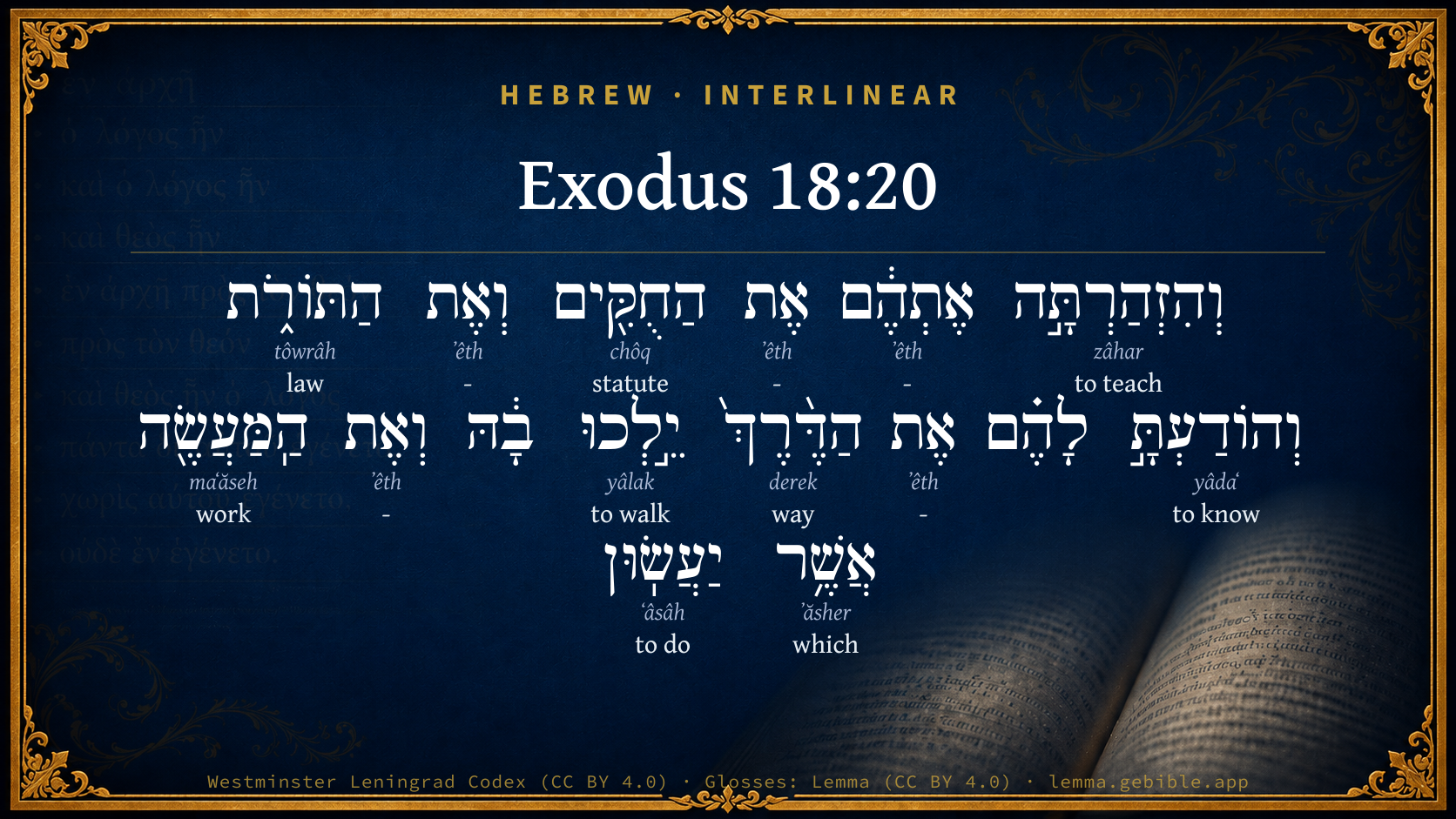
Hebrew (Westminster Leningrad Codex) Exodus 18:20 appears in the Hebrew Old Testament. The text above is from the Westminster Leningrad Codex. Each word links to its Strong’s number, a concise gloss, and parsing drawn from the Open Scriptures Hebrew Bible morphology. Click any word for its full Brown-Driver-Briggs (BDB) entry.
Download image
Cite this verse

Exodus 18:20 (World English Bible). Public Domain. Lemma interlinear Bible study tool, https://lemma.gebible.app/v/exodus/18/20.

Show BibTeX & RIS
BibTeX
RIS
English Translation
You shall teach them the statutes and the laws, and shall show them the way in which they must walk, and the work that they must do.
World English Bible · Public Domain
Highlights
  • 1 first appearance in the Hebrew Bible
Full analysis ↓
Download a study sheet

One document with this verse’s original text, its word-by-word gloss line, the meaning frame, cross-references with their text, attributed commentary, and full source and license credits — printable, and it pastes into notes with its structure intact.

This verse Autodidact and up

Study sheet (.html) Plain text (.txt)

A passage Seminary Student

Up to 50 verses in one chapter. A passage sheet keeps up to 6 commentary sources and 12 cross-references per verse, in the order this page ranks them, and says so on the sheet whenever that leaves anything out. Ask for a single verse and you get the Autodidact verse sheet above.

Everything on this page stays free to read, with no account — the sheet is a download of what is already on screen, not access to it.

Want to remove ads? Support Godless Engineer
Compare translations 3

The same verse in 3 English versions, stacked beneath the original-language interlinear above. Click any original word for its lexicon entry.

Each is an independent rendering of the whole verse — the interlinear is not word-aligned to these translations.

Highlighted words mark where these versions differ — a whole-verse word diff, not a word-by-word alignment.

  • World English Bible Public Domain
    You shall teach them the statutes and the laws, and shall show them the way in which they must walk, and the work that they must do.
  • King James Version Public Domain
    And thou shalt teach them ordinances and laws, and shalt show them the way wherein they must walk, and the work that they must do.
  • unfoldingWord Literal Text CC BY-SA 4.0
    And you should teach them the statutes and the laws. And you should cause them to know the way they should walk in and the work that they should do.

unfoldingWord Literal Text — © unfoldingWord, licensed CC BY-SA 4.0. Word-aligned USFM3 via Door43 (git.door43.org/unfoldingWord/en_ult).

Versions to compare (up to 4)

3 of 4 selected

Show all 18 translations

Every available English version of this verse, each an independent rendering of the whole verse.

  • World English Bible Public Domain
    You shall teach them the statutes and the laws, and shall show them the way in which they must walk, and the work that they must do.
  • Berean Standard Bible Public Domain
    Teach them the statutes and laws, and show them the way to live and the work they must do.
  • Majority Standard Bible Public Domain
    Teach them the statutes and laws, and show them the way to live and the work they must do.
  • King James Version Public Domain
    And thou shalt teach them ordinances and laws, and shalt show them the way wherein they must walk, and the work that they must do.
  • American Standard Version (1901) Public Domain
    and thou shalt teach them the statutes and the laws, and shalt show them the way wherein they must walk, and the work that they must do.
  • Revised Version (1885) Public Domain
    and thou shalt teach them the statutes and the laws, and shalt shew them the way wherein they must walk, and the work that they must do.
  • Geneva Bible (1599) Public Domain
    And admonish them of the ordinances, and of the lawes, and shew them the way, wherein they must walke, and the worke that they must do.
  • Douay-Rheims (1899) Public Domain
    And to shew the people the ceremonies and the manner of worshipping, and the way wherein they ought to walk, and the work that they ought to do.
  • Young's Literal Translation Public Domain
    and thou hast warned them `concerning' the statutes and the laws, and hast made known to them the way in which they go, and the work which they do.
  • Literal Standard Version CC BY-SA 4.0
    and you have warned them [concerning] the statutes and the laws, and have made known to them the way in which they go, and the work which they do.
  • Unlocked Literal Bible CC BY-SA 4.0
    You must teach them his statutes and laws. You must show them the way to walk and the work to do.
  • unfoldingWord Literal Text CC BY-SA 4.0
    And you should teach them the statutes and the laws. And you should cause them to know the way they should walk in and the work that they should do.
  • Darby Bible Public Domain
    and teach them the statutes and the laws, and make known to them the way in which they must walk, and the work that they must do.
  • World Messianic Bible Public Domain
    You shall teach them the statutes and the laws, and shall show them the way in which they must walk, and the work that they must do.
  • Webster's Bible Public Domain
    And thou shalt teach them ordinances and laws, and shalt show them the way in which they must walk, and the work that they must do.
  • Free Bible Version CC BY-SA 4.0
    Go on teaching them the laws and regulations. Show them how to live and the work they are to do.
  • Bible in Basic English Public Domain
    Teaching them his rules and his laws, guiding them in the way they have to go, and making clear to them the work they have to do.
  • JPS Tanakh (1917) Public Domain
    And thou shalt teach them the statutes and the laws, and shalt show them the way wherein they must walk, and the work that they must do.

Literal Standard Version (2020), Covenant Press — licensed CC BY-SA 4.0. Text via the HelloAO Bible API (eBible.org). Unlocked Literal Bible (unfoldingWord) — licensed CC BY-SA 4.0. Text via the HelloAO Bible API (eBible.org). unfoldingWord Literal Text — © unfoldingWord, licensed CC BY-SA 4.0. Word-aligned USFM3 via Door43 (git.door43.org/unfoldingWord/en_ult). Free Bible Version, Dr. Jonathan Gallagher — licensed CC BY-SA 4.0. Text via the HelloAO Bible API (eBible.org).

Word by word

More ways to search: Search by grammar → Find every occurrence → Compare this word →

Practice this passage: Drill this verse → Learn its vocabulary →

וְהִזְהַרְתָּ֣ה
zâhar
H2094
“and · to teach”
Conjunction + Verb, Hiphil, Sequential Perfect, 2nd Person, Masculine, Singular
Part of Speech
Conjunction + Verb
Stem
Hiphil
Form
Sequential Perfect
Person
2nd Person
Gender
Masculine
Number
Singular
Full BDB Definition

Origin: a primitive root

TWOT: 531 , 532

to admonish, warn, teach, shine, send out light, be light, be shining - (Niphal) to be taught, be admonished - (Hiphil) - to teach, warn - to shine, send out light (figuratively)
  1. אֶתְהֶ֔ם ʼêth H853 “- · them” Particle, Direct Object + Suffix, Personal, 3rd Person, Masculine, Plural
  2. אֶת ʼêth H853 “-” Particle, Direct Object
  3. הַחֻקִּ֖ים chôq H2706 “the · statutes” Particle, Definite Article + Noun, Common, Masculine, Plural, Absolute
  4. וְאֶת ʼêth H853 “and · -” Conjunction + Particle, Direct Object
  5. הַתּוֹרֹ֑ת tôwrâh H8451 “the · laws” Particle, Definite Article + Noun, Common, Feminine, Plural, Absolute
  6. וְהוֹדַעְתָּ֣ yâdaʻ H3045 “and · to know” Conjunction + Verb, Hiphil, Sequential Perfect, 2nd Person, Masculine, Singular
  7. אֶת ʼêth H853 “-” Particle, Direct Object
  8. הַדֶּ֨רֶךְ֙ derek H1870 “the · way” Particle, Definite Article + Noun, Common, Both, Singular, Absolute
  9. יֵ֣לְכוּ yâlak H3212 “to walk” Verb, Qal, Imperfect, 3rd Person, Masculine, Plural
  10. וְאֶת ʼêth H853 “and · -” Conjunction + Particle, Direct Object
  11. הַֽמַּעֲשֶׂ֖ה maʻăseh H4639 “the · work” Particle, Definite Article + Noun, Common, Masculine, Singular, Absolute
  12. אֲשֶׁ֥ר ʼăsher H834 “which” Particle, Relative
  13. יַעֲשֽׂוּן ʻâsâh H6213 “to do” Verb, Qal, Imperfect, 3rd Person, Masculine, Plural + Suffix, n

About this verse

These counts appear in no published source. They are computed here, from the morphology-tagged text and Lemma’s own curated glosses. What Lemma adds →

16
words
10
distinct lemmas
Pentateuch
section

Notable vocabulary

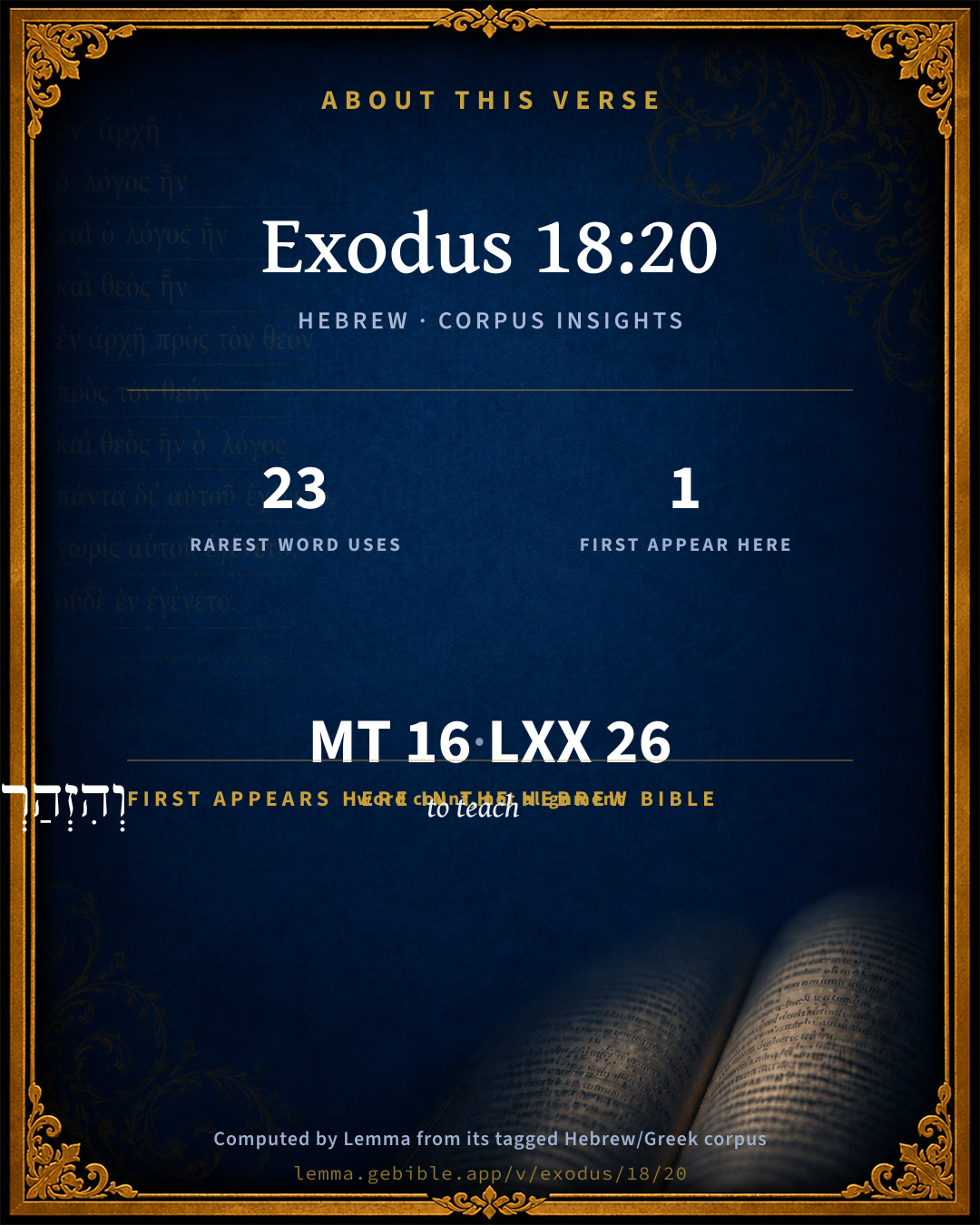
The rarest word here is וְהִזְהַרְתָּ֣ה to teach H2094 — appearing just 23 times in the whole Hebrew Bible.

First appearance in Scripture

This word makes its first canonical appearance in the Hebrew Bible here:

  • וְהִזְהַרְתָּ֣ה to teach H2094

Shared distinctive vocabulary

וְהִזְהַרְתָּ֣ה to teach H2094 occurs in 19 verses of the Hebrew Bible. Also found in:

Grammatical profile

  • 4 verbs
  • 4 nouns
  • 2 prepositions
  • 6 particles

Verb forms

  • וְהִזְהַרְתָּ֣ה Hiphil · Sequential Perfect
  • וְהוֹדַעְתָּ֣ Hiphil · Sequential Perfect
  • יֵ֣לְכוּ Qal · Imperfect
  • יַעֲשֽׂוּן Qal · Imperfect

Hebrew & Septuagint length

In English translation the verse runs 27 words from the Hebrew and 33 from the Septuagint (LXX English) — closely comparable.

A rough comparison of the two English renderings, which tokenize alike — not a word-level alignment.

Word counts can differ between the Hebrew and the Greek without any difference in meaning — e.g. the Hebrew direct-object marker אֵת has no separate Greek word, and Greek often adds the article ὁ.

In the original languages it is 16 Hebrew tokens and 26 Greek tokens — but the two are counted differently (Hebrew bundles its prefixes and suffixes into one token; the Greek is in lemma form), so that isn’t a like-for-like length.

Cross-references

20

Topical passages linked to Exodus 18:20 in the Treasury of Scripture Knowledge — connected by theme and wording, ordered by reader-vote popularity; previews shown in the World English Bible.

  • Deuteronomy 5:1 Moses called to all Israel, and said to them, Hear, Israel, the statutes and the ordinances which I speak in your ears this day, that you may learn them, and observe to do them.
  • Psalms 143:8 Cause me to hear your loving kindness in the morning, For I trust in you. Cause me to know the way in which I should walk, For I lift up my soul to you.
  • Deuteronomy 1:18 I commanded you at that time all the things which you should do.
  • Deuteronomy 4:1 Now, Israel, listen to the statutes and to the ordinances, which I teach you, to do them; that you may live, and go in and possess the land which Yahweh, the God of your fathers, gives you.
  • Deuteronomy 4:5 Behold, I have taught you statutes and ordinances, even as Yahweh my God commanded me, that you should do so in the midst of the land where you go in to possess it.
  • Psalms 32:8 I will instruct you and teach you in the way which you shall go. I will counsel you with my eye on you.
  • Exodus 18:16 When they have a matter, they come to me, and I judge between a man and his neighbor, and I make them know the statutes of God, and his laws."
  • Deuteronomy 6:1–2 Now this is the commandment, the statutes, and the ordinances, which Yahweh your God commanded to teach you, that you might do them in the land where you go over to possess it;
  • Deuteronomy 7:11 You shall therefore keep the commandment, and the statutes, and the ordinances, which I command you this day, to do them.
  • 1 Samuel 12:23 Moreover as for me, far be it from me that I should sin against Yahweh in ceasing to pray for you: but I will instruct you in the good and the right way.
  • Nehemiah 9:13–14 You came down also on Mount Sinai, and spoke with them from heaven, and gave them right ordinances and true laws, good statutes and commandments,
  • Isaiah 30:21 and your ears shall hear a word behind you, saying, This is the way, walk you in it; when you turn to the right hand, and when you turn to the left.
  • Jeremiah 6:16 Thus says Yahweh, Stand you in the ways and see, and ask for the old paths, where is the good way; and walk therein, and you shall find rest for your souls: but they said, We will not walk [therein].
  • Jeremiah 42:3 that Yahweh your God may show us the way in which we should walk, and the thing that we should do.
  • Ezekiel 3:17 Son of man, I have made you a watchman to the house of Israel: therefore hear the word at my mouth, and give them warning from me.
  • Micah 4:2 Many nations will go and say, "Come, and let us go up to the mountain of Yahweh, And to the house of the God of Jacob; And he will teach us of his ways, And we will walk in his paths." For out of Zion will go forth the law, And the word of Yahweh from Jerusalem;
  • 1 Thessalonians 4:1 Finally then, brothers, we beg and exhort you in the Lord Jesus, that as you received from us how you ought to walk and to please God, that you abound more and more.
  • Matthew 28:20 teaching them to observe all things that I commanded you. Behold, I am with you always, even to the end of the age." Amen.
  • Mark 13:34 "It is like a man, traveling to another country, having left his house, and given authority to his servants, and to each one his work, and also commanded the doorkeeper to keep watch.
  • 2 Thessalonians 3:6–12 Now we command you, brothers, in the name of our Lord Jesus Christ, that you withdraw yourselves from every brother who walks in rebellion, and not after the tradition which they received from us.

Cross-references courtesy of OpenBible.info (CC BY 4.0).

Hebrew and Greek witnesses Masoretic Hebrew ↔ Greek Septuagint

The same verse in the two great witnesses to the Old Testament, shown verse-for-verse.

These are two independent witnesses, not word-aligned to each other, and the Septuagint is shown in lemma (dictionary) form.

Hebrew Exodus 18:20 Masoretic · Westminster Leningrad Codex

וְהִזְהַרְתָּ֣ה אֶתְהֶ֔ם אֶת הַחֻקִּ֖ים וְאֶת הַתּוֹרֹ֑ת וְהוֹדַעְתָּ֣ לָהֶ֗ם אֶת הַדֶּ֨רֶךְ֙ יֵ֣לְכוּ בָ֔הּ וְאֶת הַֽמַּעֲשֶׂ֖ה אֲשֶׁ֥ר יַעֲשֽׂוּן

You shall teach them the statutes and the laws, and shall show them the way in which they must walk, and the work that they must do.

World English Bible · Public Domain

Greek LXX Exodus 18:20 Septuagint · lemma form

καί διαμαρτύρομαι αὐτός ὁ πρόσταγμα ὁ θεός καί ὁ νόμος αὐτός καί σημαίνω αὐτός ὁ ὁδός ἐν ὅς πορεύομαι ἐν αὐτός καί ὁ ἔργον ὅς ποιέω

And you shall testify to them the ordinances of God and his law, and you shall show to them the ways in which they shall walk, and the works which they shall do.

LXX2012 (modern English Septuagint) · Public Domain

Hebrew: Westminster Leningrad Codex (CC BY 4.0). Greek: Septuagint (public domain); English from LXX2012 (modern English Septuagint) (Public Domain). How the Septuagint differs from the Hebrew →

Targum (Aramaic paraphrase)

2

The Targum is the ancient Jewish Aramaic paraphrase of the Hebrew Scriptures — an interpretive translation, not the Hebrew text itself. Onkelos (literal) and Pseudo-Jonathan (expansive) render the Torah, and Jonathan the Prophets. Coverage is partial: where no permissively-licensed English translation exists for a verse, only the Aramaic is shown. This is verse-level text, not a word-by-word alignment to the Hebrew.

  1. Targum Onkelos Torah (Genesis–Deuteronomy)
    וְתַזְהַר יָתְהוֹן יָת קְיָמַיָא וְיָת אוֹרַיְתָא וּתְהוֹדַע לְהוֹן יָת אוֹרְחָא דִיְהָכוּן בַּהּ וְיָת עוֹבָדָא דִיַעְבְּדוּן:

    (no public-domain English translation for this verse)

    Targum Onkelos — Aramaic: “Onkelos Genesis” (public domain); “Onkelos Exodus” (public domain); “Onkelos Leviticus” (public domain); “Onkelos Numbers” (public domain); “Onkelos Deuteronomy” (public domain). English: “Sefaria Community Translation” (CC0 1.0 (public-domain dedication)); “J.W. Etheridge. The Targums of Onkelos and Jonathan Ben Uzziel on the Pentateuch. London: Longmans, Green, 1862” (public domain). Text via Sefaria.

  2. Targum Pseudo-Jonathan Torah (Genesis–Deuteronomy)
    וְתַזְהַר יַתְהוֹן יַת קְיָימַיָא וְיַת אוֹרַיְיתָא וּתְהוֹדַע לְהוֹן יַת צְלוֹתָא דְיֵיצְלוּן בְּבֵית כְּנִשְׁתְּהוֹן וְיַת אוֹרְחָא דְּיַבְקְרוּן לְמָרִיעִין וּדְיַהֲכוּן לְמִיקְבּוֹר מֵתַיָא וּלְמִגְמוֹל בָּהּ חִיסְדָא וְיַת עוּבְדָא וְשׁוּרַת דִּינָא וּדְיַעַבְדוּן מִלְגַו לְשׁוּרָתָא לְרַשִׁיעַיָין

    and give them counsel about the statutes and laws, make them understand the prayer they are to offer in the house of congregation, the manner of visiting the sick, of burying the dead, of being fruitful In doing good, and in the work and process of justice, and how to conduct themselves among the wicked.

    Targum Pseudo-Jonathan — Aramaic: “Targum Jonathan on Genesis” (public domain); “Targum Jonathan on Exodus” (public domain); “Targum Jonathan on Leviticus” (public domain); “Targum Jonathan on Numbers” (public domain); “Targum Jonathan on Deuteronomy” (public domain). English: “The Targum of Jonathan ben Uzziel, trans. J. W. Etheridge, London, 1862” (public domain). Text via Sefaria.

Commentary

Notes on Exodus 18:20 from classic Christian and Jewish commentators (each source and its license shown beneath its notes). The classic Christian expositions comment on the surrounding passage and are grouped to its opening verse, so a note may address several verses; the Jewish commentaries on the Tanakh (Rashi and others) are per-verse, so they appear only where the commentator wrote on this verse.

Lemma curates 59 commentaries, every one of them public domain or Creative Commons licensed, each selected and text-cleaned for this edition rather than reprinted as found. About our sources →

Trapp's Complete Commentary

John Trapp

Exo 18:20 And thou shalt teach them ordinances and laws, and shalt shew them the way wherein they must walk, and the work that they must do.

Ver. 20. And thou shalt teach them ordinances.] This alone will be work enough for thee, if done as it ought to be.

And shalt show them the way wherein they must walk.] The Chaldee Paraphrast hath it thus, And shalt show them the prayer which they shall pray in their synagogues.

John Trapp, A Commentary or Exposition upon All the Books of the Old and New Testament (1647–1656) — public domain. Text from a community e-Sword module.

Adam Clarke's Commentary

Verse 20. Thou shalt teach them ordinances] חקים chukkim, all such precepts as relate to the ceremonies of religion and political economy. And laws, התורת hattoroth, the instructions relative to the whole system of morality.

And shalt show them the way] אה הדרך eth hadderech, THAT very WAY, that only way, which God himself has revealed, and in which they should walk in order to please him, and get their souls everlastingly saved.

And the work that they must do.] For it was not sufficient that they should know their duty both to God and man, but they must DO it too; יעשון yaasun, they must do it diligently, fervently, effectually; for the paragogic nun deepens and extends the meaning of the verb.

What a very comprehensive form of a preacher's duty does this verse exhibit!

1. He must instruct the people in the nature, use, and importance of the ordinances of religion.

2. He must lay before them the whole moral law, and their obligations to fulfill all its precepts.

3. He must point out to each his particular duty, and what is expected of him in his situation, connections, c. And,

4. He must set them all their work, and see that they do it.

On such a plan as this he will have full opportunity to show the people,

1. Their sin, ignorance, and folly

2. The pure and holy law which they have broken, and by which they are condemned;

3. The grace of God that bringeth salvation, by which they are to be justified and finally saved; and,

4. The necessity of showing their faith by their works; not only denying ungodliness and worldly lusts, but living soberly, righteously, and godly in this present world, looking for that blessed hope, and the glorious appearing of the great God and our Saviour, Jesus Christ.

Adam Clarke's Commentary on the Bible (1810–1826) — public domain. Text from a community e-Sword/MySword module.

John Gill's Exposition

Moreover, thou shalt provide out of all the people,.... Or look out (t) from among them; see Act 6:3,

able men; or "men of power" (u); meaning not so much men of strong and robust constitutions, who, as Aben Ezra says, are able to bear labour; but men that have strength of heart, as Ben Gersom expresses it, men of spirit and courage, and are not afraid to do justice, to repress vice, and countenance virtue; or, as Maimonides says (w), have a strong heart, or courage and boldness to deliver the oppressed from the hands of the oppressor. Jarchi interprets it of rich men, of men of substance, who have no need to flatter, or play the hypocrite, and to know the faces of men:

such as fear God; who have the fear of God before their eyes, and on their hearts, in all they do, and therefore cannot do those things that others do, who are destitute of it; cannot give a cause the wrong way wilfully, or pervert judgment, and are the reverse of the character of the unjust judge, that neither feared God nor regarded man, Luk 18:2,

men of truth; true men, sincere, upright, and faithful men, that love truth and hate lies and falsehood, and will take some pains to get at the truth of a cause, to inquire where it lies, and pursue and encourage it where it is found, and discourage to the uttermost falsehood, lies, and perjury: hating covetousness; in themselves and others, filthy lucre, dishonest gain, mammon of unrighteousness, and so not to be bribed and corrupted, and execute wrong judgment for the sake of money:

and place such over them to be rulers of thousands, rulers of hundreds, rulers of fifties, and rulers of tens; meaning not courts of judicature, consisting of such a number of judges, for such a court was never known to have a thousand judges upon the bench at once; the highest court of judicature that ever was among the Jews, which was long after this time, consisted but of seventy or seventy one: but the sense is, that each of these should have such a number of persons, or rather families, under their care, who, when they applied unto them for justice, should faithfully administer it to them; See Gill on Exo 18:25.

(t) "videbis", Montanus; "tu prospice", Tigurine version; "tu videto", Drusius. (u) "viros virtutis", Montanus, Vatablus; "viros fortitudinis", Cartwright.

(w) Hilchot Sanhedrin, c. 2. sect. 7.

John Gill's Exposition of the Whole Bible (1746–1763) — public domain (CC PDM 1.0). Text via the HelloAO Bible API.

Albert Barnes' Notes on the Bible

Teach them - The Hebrew word is emphatic, and signifies “enlightenment.” The text gives four distinct points:

(a) the “ordinances,” or specific enactments,

(b) “the laws,” or general regulations,

(c) “the way,” the general course of duty,

(d) “the works,” each specific act.

Albert Barnes' Notes on the Bible (1834–1885) — public domain. Text from a community e-Sword/MySword module.

Haydock's Catholic Bible Commentary

To do. Be a mediator between God and the people: explain their wants, and bring back his decision: but let inferior officers see them executed. (Haydock)

George Leo Haydock (1774–1849), Haydock's Catholic Family Bible and Commentary, 1859 edition — public domain. Excludes Psalms (Douay-Rheims chapter numbering differs from Protestant) and Deuterocanonical books (Catholic canon only).

Matthew Poole's English Annotations

Thou alone shalt deliver and explain God’s law to them, which they may apply to their particular causes and occasions, and so end their differences among themselves without giving thee any trouble.

Matthew Poole's English Annotations on the Holy Bible (1683–1685) — public domain. Text from a community e-Sword/MySword module.

Whedon's Commentary on the Bible

Daniel D. Whedon

20. Teach them ordinances and laws — Equivalent to making “them know the statutes and laws” in Exo_18:16. The word rendered teach (Hiphil of זהר) means to shed light upon. Moses was to exercise the twofold office of appearing in behalf of the people before God and of revealing God’s truth to the people. Thus he was an honoured mediator, being intercessor, advocate, lawgiver, and judge.

The way… the work — Two important and comprehensive phases of godliness, equivalent to life and action.

Daniel D. Whedon (gen. ed.), Commentary on the Old and New Testaments (1874–1909) — public domain. Text from a community e-Sword module.

The Pulpit Commentary

Thou shalt teach them ordinances and laws. Or, "statutes and laws," as in ver. 16. It is not quite clear how these differ. Some regard "statutes" as connected with religion, and laws as regulations with respect to civil and social matters. Others explain the first as "specific" and the second as "general enactments." The way wherein they must walk. The general line of conduct which all are bound to pursue. The work that they must do. The special task which each has to perform individually.

The Pulpit Commentary (1880–1919), ed. H.D.M. Spence-Jones & Joseph S. Exell — public domain. Text from a community e-Sword module.

Ramban (Nachmanides)

Rabbi Moshe ben Nachman (Ramban / Nachmanides)

AND THOU SHALT TEACH THEM THE STATUTES AND THE LAWS, AND SHALT SHOW THEM THE WAY WHEREIN THEY MUST WALK. That is, “according to the law and the commandment with which you will strongly admonish them, and you will teach the law and the commandment.” Thus Jethro also conceded to Moses on this matter, of which he had said, and I make them know the statutes of G-d, and His laws. In this too there was counsel [on the part of Jethro], i.e., that Moses should strongly admonish them and warn them of the commandments and [Divine] punishments [in case of transgression], since he himself would not be involved in the execution of the law. “But in matters of judgment whereof you said, and I judge between a man and his neighbor, designate judges to act with you, for the thing is too heavy for thee. That is, the judging of disputes between them is heavier than all, and it would be good for you and for them to make it easier for you and they shall bear the burden with thee.” Now it is known that Moses had officers in charge of the people. [It was the duty of these officers] to bring before him the persons against whom claims had been made and to force them to comply with the verdict of the judges. He assigned many of these officers as these judges. This is why Moses said in Deuteronomy, and I made them heads over you, captains of thousands… and officers, tribe by tribe. There was no need to mention them here since their appointment was not part of Jethro’s counsel.

Ramban (Nachmanides) on the Tanakh — English translation: “Commentary on the Torah by Ramban (Nachmanides). Translated and annotated by Charles B. Chavel. New York, Shilo Pub. House, 1971-1976” (CC BY 4.0). Text via Sefaria.

Lesson kit

Teaching starters — assembled from the data on this page, not authored interpretation. Every prompt links to the verse data it draws on. Edit before teaching.

Exodus, in the Pentateuch, opens this verse with 16 words (10 distinct Hebrew lemmas). Its most distinctive word is zâhar (“to teach”). A historical commentator’s framing appears above. Read the whole chapter for the surrounding context.

Discussion questions

  1. What does “to teach” (zâhar) contribute to the verse as a whole?
  2. This is the first place “to teach” appears in Scripture (first appears here). What does its debut here establish?
  3. How does 2 Kings 6:10, which shares the word «to teach», read alongside this verse?
  4. The translations on this page render this verse differently — a whole-verse word diff, not a word-by-word alignment. What might account for the different wordings?
  5. «וְהִזְהַרְתָּ֣ה» is a Hiphil Sequential Perfect verb. How does that grammatical form shape the action described?
  6. Compare how Trapp's Complete Commentary and Adam Clarke's Commentary read this verse. Where do they agree or differ?

Things to notice

Reading settings

Reading text

Shown beneath each verse's original-language words.

Old Testament
Old Testament edition

Read the OT as the Masoretic Hebrew (MT) or the Greek Septuagint (LXX).

English shown for the Greek Septuagint (in the Hebrew ↔ Greek comparison).

Comparing translations? Open the Compare panel on any verse page to stack up to four side by side.