
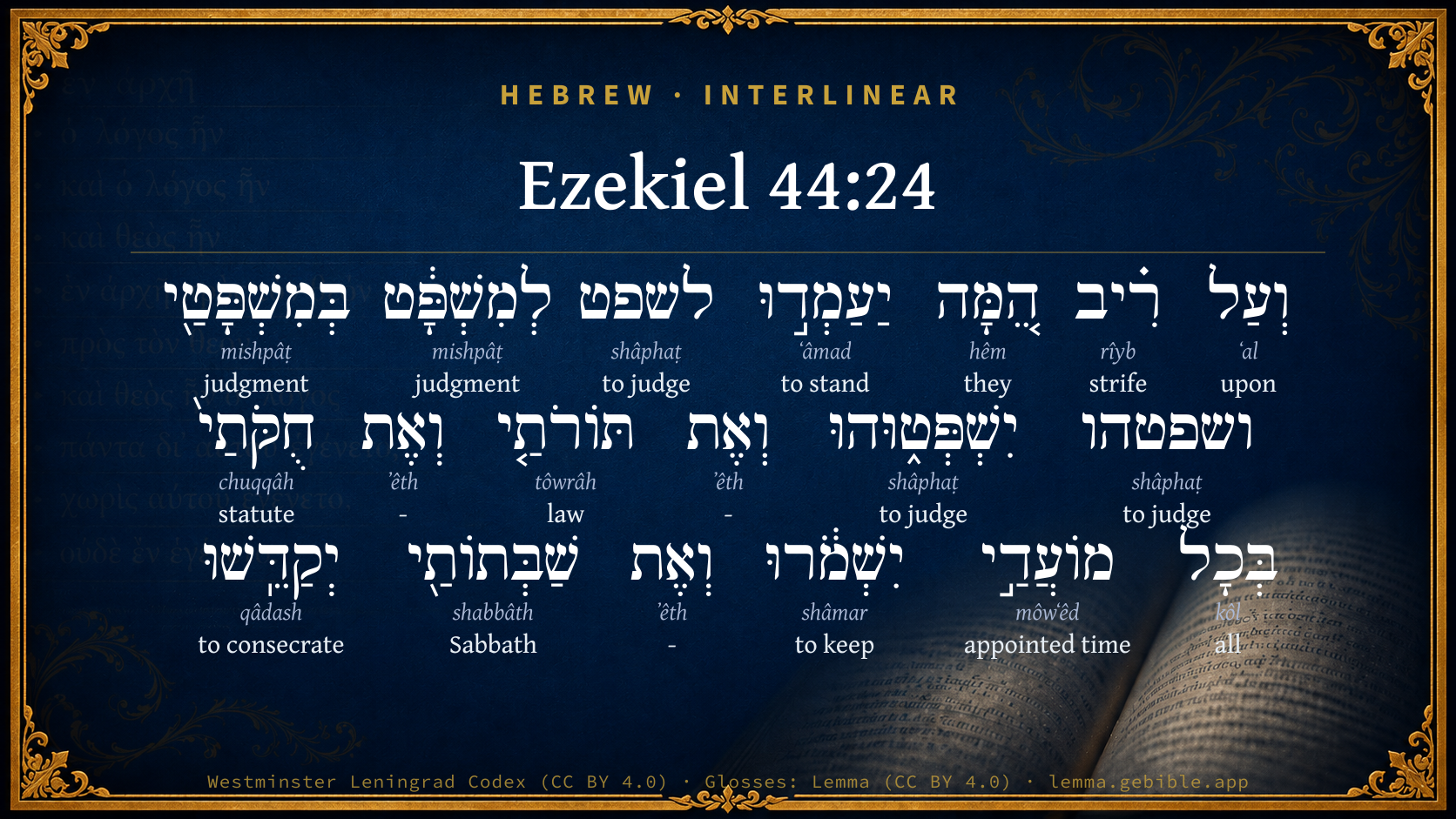
Ezekiel 44:24

Hebrew (Westminster Leningrad Codex) Ezekiel 44:24 appears in the Hebrew Old Testament. The text above is from the Westminster Leningrad Codex. Each word links to its Strong’s number, a concise gloss, and parsing drawn from the Open Scriptures Hebrew Bible morphology. Click any word for its full Brown-Driver-Briggs (BDB) entry.
Download image
Cite this verse

Ezekiel 44:24 (World English Bible). Public Domain. Lemma interlinear Bible study tool, https://lemma.gebible.app/v/ezekiel/44/24.

Show BibTeX & RIS
BibTeX
RIS
English Translation
In a controversy they shall stand to judge; according to my ordinances shall they judge it: and they shall keep my laws and my statutes in all my appointed feasts; and they shall make my Sabbaths holy.
World English Bible · Public Domain
Download a study sheet

One document with this verse’s original text, its word-by-word gloss line, the meaning frame, cross-references with their text, attributed commentary, and full source and license credits — printable, and it pastes into notes with its structure intact.

This verse Autodidact and up

Study sheet (.html) Plain text (.txt)

A passage Seminary Student

Up to 50 verses in one chapter. A passage sheet keeps up to 6 commentary sources and 12 cross-references per verse, in the order this page ranks them, and says so on the sheet whenever that leaves anything out. Ask for a single verse and you get the Autodidact verse sheet above.

Everything on this page stays free to read, with no account — the sheet is a download of what is already on screen, not access to it.

Want to remove ads? Support Godless Engineer
Compare translations 3

The same verse in 3 English versions, stacked beneath the original-language interlinear above. Click any original word for its lexicon entry.

Each is an independent rendering of the whole verse — the interlinear is not word-aligned to these translations.

Highlighted words mark where these versions differ — a whole-verse word diff, not a word-by-word alignment.

  • World English Bible Public Domain
    In a controversy they shall stand to judge; according to my ordinances shall they judge it: and they shall keep my laws and my statutes in all my appointed feasts; and they shall make my Sabbaths holy.
  • King James Version Public Domain
    And in controversy they shall stand in judgment; and they shall judge it according to my judgments: and they shall keep my laws and my statutes in all mine assemblies; and they shall hallow my sabbaths.
  • unfoldingWord Literal Text CC BY-SA 4.0
    In a dispute they will stand to judge with my decrees; they must be just. They will keep my law and my statutes in every feast, and they will celebrate my holy Sabbaths.

unfoldingWord Literal Text — © unfoldingWord, licensed CC BY-SA 4.0. Word-aligned USFM3 via Door43 (git.door43.org/unfoldingWord/en_ult).

Versions to compare (up to 4)

3 of 4 selected

Show all 18 translations

Every available English version of this verse, each an independent rendering of the whole verse.

  • World English Bible Public Domain
    In a controversy they shall stand to judge; according to my ordinances shall they judge it: and they shall keep my laws and my statutes in all my appointed feasts; and they shall make my Sabbaths holy.
  • Berean Standard Bible Public Domain
    In any dispute, they shall officiate as judges and judge according to My ordinances. They must keep My laws and statutes regarding all My appointed feasts, and they must keep My Sabbaths holy.
  • Majority Standard Bible Public Domain
    In any dispute, they shall officiate as judges and judge according to My ordinances. They must keep My laws and statutes regarding all My appointed feasts, and they must keep My Sabbaths holy.
  • King James Version Public Domain
    And in controversy they shall stand in judgment; and they shall judge it according to my judgments: and they shall keep my laws and my statutes in all mine assemblies; and they shall hallow my sabbaths.
  • American Standard Version (1901) Public Domain
    And in a controversy they shall stand to judge; according to mine ordinances shall they judge it: and they shall keep my laws and my statutes in all my appointed feasts; and they shall hallow my sabbaths.
  • Revised Version (1885) Public Domain
    And in a controversy they shall stand to judge; according to my judgments shall they judge it: and they shall keep my laws and my statutes in all my appointed feasts; and they shall hallow my sabbaths.
  • Geneva Bible (1599) Public Domain
    And in controuersie they shall stande to iudge, and they shall iudge it according to my iudgements: and they shall keepe my lawes and my statutes in all mine assemblies, and they shall sanctifie my Sabbaths.
  • Douay-Rheims (1899) Public Domain
    And when there shall be a controversy, they shall stand in my judgments, and shall judge: they shall keep my laws, and my ordinances in all my solemnities, and sanctify my sabbaths.
  • Young's Literal Translation Public Domain
    And concerning controversy, they stand up for judgment; with My judgments they judge it; and My law and My statutes in all My appointed places they keep; and My sabbaths they sanctify.
  • Literal Standard Version CC BY-SA 4.0
    And concerning controversy, they stand up for judgment; they judge it with My judgments; and they keep My law and My statutes in all My appointed places; and they sanctify My Sabbaths.
  • Unlocked Literal Bible CC BY-SA 4.0
    In a dispute they will stand to judge with my decrees; they must be just. They will keep my law and my statutes in every feast, and they will celebrate my holy Sabbaths.
  • unfoldingWord Literal Text CC BY-SA 4.0
    In a dispute they will stand to judge with my decrees; they must be just. They will keep my law and my statutes in every feast, and they will celebrate my holy Sabbaths.
  • Darby Bible Public Domain
    And in controversy they shall stand to judge: they shall judge it according to my judgments; and they shall keep my laws and my statutes in all my solemnities; and they shall hallow my sabbaths.
  • World Messianic Bible Public Domain
    “‘“In a controversy they shall stand to judge. They shall judge it according to my ordinances. They shall keep my laws and my statutes in all my appointed feasts. They shall make my Sabbaths holy.
  • Webster's Bible Public Domain
    And in controversy they shall stand in judgment; and they shall judge it according to my judgments: and they shall keep my laws and my statutes in all my assemblies; and they shall hallow my sabbaths.
  • Free Bible Version CC BY-SA 4.0
    They are to serve as judges in legal cases, and base their decisions on my laws. They are to follow my instructions and regulations regarding all my regular religious festivals, and they are to keep my Sabbaths holy.
  • Bible in Basic English Public Domain
    In any cause, they are to be in the position of judges, judging in harmony with my decisions: they are to keep my laws and my rules in all my fixed feasts; and they are to keep my Sabbaths holy.
  • JPS Tanakh (1917) Public Domain
    And in a controversy they shall stand to judge; according to Mine ordinances shall they judge it; and they shall keep My laws and My statutes in all My appointed seasons, and they shall hallow My sabbaths.

Literal Standard Version (2020), Covenant Press — licensed CC BY-SA 4.0. Text via the HelloAO Bible API (eBible.org). Unlocked Literal Bible (unfoldingWord) — licensed CC BY-SA 4.0. Text via the HelloAO Bible API (eBible.org). unfoldingWord Literal Text — © unfoldingWord, licensed CC BY-SA 4.0. Word-aligned USFM3 via Door43 (git.door43.org/unfoldingWord/en_ult). Free Bible Version, Dr. Jonathan Gallagher — licensed CC BY-SA 4.0. Text via the HelloAO Bible API (eBible.org).

Word by word

More ways to search: Search by grammar → Find every occurrence → Compare this word →

Practice this passage: Drill this verse → Learn its vocabulary →

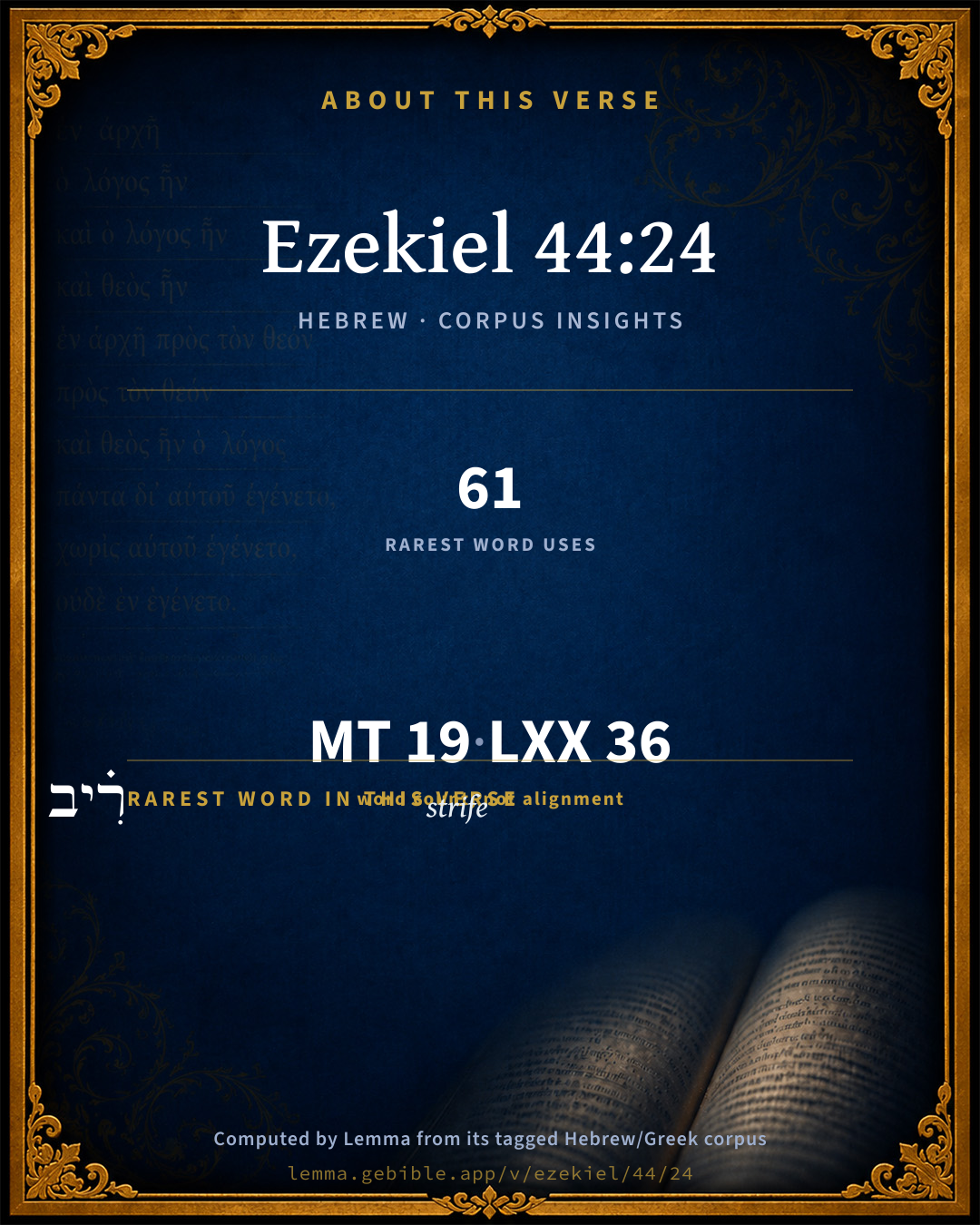
רִ֗יב
rîyb
H7379
“strife”
Noun, Common, Both, Singular, Absolute
Part of Speech
Noun
Type
Common
Gender
Both
Number
Singular
State
Absolute
Full BDB Definition

Origin: from H7378

TWOT: 2159a

strife, controversy, dispute - strife, quarrel - dispute, controversy, case at law
  1. וְעַל ʻal H5921 “and · upon” Conjunction + Preposition
  2. הֵ֚מָּה hêm H1992 “they” Pronoun, Personal, 3rd Person, Masculine, Plural
  3. יַעַמְד֣וּ ʻâmad H5975 “to stand” Verb, Qal, Imperfect, 3rd Person, Masculine, Plural
  4. לשפט shâphaṭ H8199 “to judge” Preposition + Verb, Qal, Infinitive Construct
  5. לְמִשְׁפָּ֔ט mishpâṭ H4941 “to/for · judgment” Preposition + Noun, Common, Masculine, Singular, Absolute
  6. בְּמִשְׁפָּטַ֖י mishpâṭ H4941 “in/at · judgments · my” Preposition + Noun, Common, Masculine, Plural, Construct + Suffix, Personal, 1st Person, Common, Singular
  7. ושפטהו shâphaṭ H8199 “and · to judge · him” Conjunction + Verb, Qal, Perfect, 3rd Person, Common, Plural + Suffix, Personal, 3rd Person, Masculine, Singular
  8. יִשְׁפְּט֑וּהוּ shâphaṭ H8199 “to judge · him” Verb, Qal, Imperfect, 3rd Person, Masculine, Plural + Suffix, Personal, 3rd Person, Masculine, Singular
  9. וְאֶת ʼêth H853 “and · -” Conjunction + Particle, Direct Object
  10. תּוֹרֹתַ֤י tôwrâh H8451 “laws · my” Noun, Common, Feminine, Plural, Construct + Suffix, Personal, 1st Person, Common, Singular
  11. וְאֶת ʼêth H853 “and · -” Conjunction + Particle, Direct Object
  12. חֻקֹּתַי֙ chuqqâh H2708 “statutes · my” Noun, Common, Both, Plural, Construct + Suffix, Personal, 1st Person, Common, Singular
  13. בְּכָל kôl H3605 “in/at · all of” Preposition + Noun, Common, Masculine, Singular, Construct
  14. מוֹעֲדַ֣י môwʻêd H4150 “appointed times · my” Noun, Common, Masculine, Plural, Construct + Suffix, Personal, 1st Person, Common, Singular
  15. יִשְׁמֹ֔רוּ shâmar H8104 “to keep” Verb, Qal, Imperfect, 3rd Person, Masculine, Plural
  16. וְאֶת ʼêth H853 “and · -” Conjunction + Particle, Direct Object
  17. שַׁבְּתוֹתַ֖י shabbâth H7676 “Sabbaths · my” Noun, Common, Both, Plural, Construct + Suffix, Personal, 1st Person, Common, Singular
  18. יְקַדֵּֽשׁוּ qâdash H6942 “to consecrate” Verb, Piel, Imperfect, 3rd Person, Masculine, Plural

About this verse

These counts appear in no published source. They are computed here, from the morphology-tagged text and Lemma’s own curated glosses. What Lemma adds →

19
words
14
distinct lemmas
Prophets
section

Grammatical profile

  • 6 verbs
  • 8 nouns
  • 1 pronoun
  • 1 preposition
  • 3 particles

Verb forms

  • יַעַמְד֣וּ Qal · Imperfect
  • לשפט Qal · Infinitive Construct
  • ושפטהו Qal · Perfect
  • יִשְׁפְּט֑וּהוּ Qal · Imperfect
  • יִשְׁמֹ֔רוּ Qal · Imperfect
  • יְקַדֵּֽשׁוּ Piel · Imperfect

Repetition

Words recur within this verse — often emphatic in Hebrew:

  • לשפט to judge H8199 ×3
  • לְמִשְׁפָּ֔ט judgment H4941 ×2

Hebrew & Septuagint length

In English translation the verse runs 37 words from the Hebrew and 39 from the Septuagint (LXX English) — closely comparable.

A rough comparison of the two English renderings, which tokenize alike — not a word-level alignment.

Word counts can differ between the Hebrew and the Greek without any difference in meaning — e.g. the Hebrew direct-object marker אֵת has no separate Greek word, and Greek often adds the article ὁ.

In the original languages it is 19 Hebrew tokens and 36 Greek tokens — but the two are counted differently (Hebrew bundles its prefixes and suffixes into one token; the Greek is in lemma form), so that isn’t a like-for-like length.

Cross-references

10

Topical passages linked to Ezekiel 44:24 in the Treasury of Scripture Knowledge — connected by theme and wording, ordered by reader-vote popularity; previews shown in the World English Bible.

  • 1 Chronicles 23:4 Of these, twenty-four thousand were to oversee the work of the house of Yahweh; and six thousand were officers and judges;
  • 2 Chronicles 19:8–10 Moreover in Jerusalem did Jehoshaphat set of the Levites and the priests, and of the heads of the fathers' [houses] of Israel, for the judgment of Yahweh, and for controversies. They returned to Jerusalem.
  • Ezekiel 22:26 Her priests have done violence to my law, and have profaned my holy things: they have made no distinction between the holy and the common, neither have they caused men to discern between the unclean and the clean, and have hid their eyes from my Sabbaths, and I am profaned among them.
  • Leviticus 23:1–44 Yahweh spoke to Moses, saying,
  • Numbers 28:1–29 Yahweh spoke to Moses, saying,
  • Deuteronomy 17:8–13 If there arise a matter too hard for you in judgment, between blood and blood, between plea and plea, and between stroke and stroke, being matters of controversy within your gates; then shall you arise, and go up to the place which Yahweh your God shall choose;
  • Ezra 2:63 The governor said to them, that they should not eat of the most holy things, until there stood up a priest with Urim and with Thummim.
  • Nehemiah 8:1–18 All the people gathered themselves together as one man into the broad place that was before the water gate; and they spoke to Ezra the scribe to bring the book of the law of Moses, which Yahweh had commanded to Israel.
  • Isaiah 58:13–14 If you turn away your foot from the Sabbath, from doing your pleasure on my holy day; and call the Sabbath a delight, [and] the holy of Yahweh honorable; and shall honor it, not doing your own ways, nor finding your own pleasure, nor speaking [your own] words:
  • 1 Timothy 3:15 but if I wait long, that you may know how men ought to behave themselves in the house of God, which is the assembly of the living God, the pillar and ground of the truth.

Cross-references courtesy of OpenBible.info (CC BY 4.0).

Hebrew and Greek witnesses Masoretic Hebrew ↔ Greek Septuagint

The same verse in the two great witnesses to the Old Testament, shown verse-for-verse.

These are two independent witnesses, not word-aligned to each other, and the Septuagint is shown in lemma (dictionary) form.

Hebrew Ezekiel 44:24 Masoretic · Westminster Leningrad Codex

וְעַל רִ֗יב הֵ֚מָּה יַעַמְד֣וּ לשפט לְמִשְׁפָּ֔ט בְּמִשְׁפָּטַ֖י ושפטהו יִשְׁפְּט֑וּהוּ וְאֶת תּוֹרֹתַ֤י וְאֶת חֻקֹּתַי֙ בְּכָל מוֹעֲדַ֣י יִשְׁמֹ֔רוּ וְאֶת שַׁבְּתוֹתַ֖י יְקַדֵּֽשׁוּ

In a controversy they shall stand to judge; according to my ordinances shall they judge it: and they shall keep my laws and my statutes in all my appointed feasts; and they shall make my Sabbaths holy.

World English Bible · Public Domain

Greek LXX Ezekiel 44:24 Septuagint · lemma form

καί ἐπί κρίσις αἷμα οὗτος ἐπιἵστημι ὁ διακρίνω ὁ δικαίωμα ἐγώ δικαιόω καί ὁ κρίμα ἐγώ κρίνω καί ὁ νόμιμος ἐγώ καί ὁ πρόσταγμα ἐγώ ἐν πᾶς ὁ ἑορτή ἐγώ φυλάσσω καί ὁ σάββατον ἐγώ ἁγιάζω

And these shall attend at a judgment of blood to decide it: they shall rightly observe my ordinances, and judge my judgments, and keep my statutes and my commandments in all my feasts; and they shall hallow my sabbaths.

LXX2012 (modern English Septuagint) · Public Domain

Hebrew: Westminster Leningrad Codex (CC BY 4.0). Greek: Septuagint (public domain); English from LXX2012 (modern English Septuagint) (Public Domain). How the Septuagint differs from the Hebrew →

Targum (Aramaic paraphrase)

1

The Targum is the ancient Jewish Aramaic paraphrase of the Hebrew Scriptures — an interpretive translation, not the Hebrew text itself. Onkelos (literal) and Pseudo-Jonathan (expansive) render the Torah, and Jonathan the Prophets. Coverage is partial: where no permissively-licensed English translation exists for a verse, only the Aramaic is shown. This is verse-level text, not a word-by-word alignment to the Hebrew.

  1. Targum Jonathan Prophets (Joshua–Malachi)
    וְעַל פַלְגוּת דִינָא אִינוּן יְקוּמוּן לְמִידַן בְּדִינֵי רְעוּתִי יְדוּנוּן וְיַת אוֹרַיְתִי וְיַת קְיָמִי בְּכָל מוֹעֲדֵי יִשְׁרוּן וְיַת יוֹמֵי שַׁבַּיָא דִילִי יְקַדְשׁוּן:

    (no public-domain English translation for this verse)

    Targum Jonathan — Aramaic: “Mikraot Gedolot” (public domain). English: “Sefaria Community Translation” (CC0 1.0 (public-domain dedication)); “London "Chaldee Paraphrase," 1871” (public domain). Text via Sefaria.

Commentary

Notes on Ezekiel 44:24 from classic Christian and Jewish commentators (each source and its license shown beneath its notes). The classic Christian expositions comment on the surrounding passage and are grouped to its opening verse, so a note may address several verses; the Jewish commentaries on the Tanakh (Rashi and others) are per-verse, so they appear only where the commentator wrote on this verse.

Lemma curates 59 commentaries, every one of them public domain or Creative Commons licensed, each selected and text-cleaned for this edition rather than reprinted as found. About our sources →

Trapp's Complete Commentary

John Trapp

Eze 44:24 And in controversy they shall stand in judgment; [and] they shall judge it according to my judgments: and they shall keep my laws and my statutes in all mine assemblies; and they shall hallow my sabbaths.

Ver. 24. They shall stand in judgment,] i.e., Stand to the right, and not stir from it; in matters of religion especially, accounting every parcel of truth precious.

They shall keep my laws.] Not observe them only, but preserve them from the violations of others.

John Trapp, A Commentary or Exposition upon All the Books of the Old and New Testament (1647–1656) — public domain. Text from a community e-Sword module.

Joseph Benson's Commentary

Eze 44:24. And in controversy they shall stand in judgment — The priests were to determine all controversies relating to the law, as well the judicial as the ceremonial part of it, which were brought before them, Deu 17:8-9; and the people were to seek the law at their mouths, (Mal 2:7,) that is, to inquire of them what was the purport and meaning of it, and to abide by their determination. And they shall judge according to my judgments — Which I have declared, and not according to their own fancies, inclinations, or secular interests. Thus ministers must decide controversies among the people of God according to his word; and must take care that they give no countenance to any false or perfidious, fraudulent or dishonest practices, but must set their faces against them. And they shall keep my laws and my statutes in all mine assemblies, &c. — As well upon the solemn festivals, and the assemblies proper to them, as at other times, and on ordinary occasions. And they shall hallow my sabbaths — Whereas the priests before the captivity profaned them: see Eze 22:26.

Joseph Benson's Commentary on the Old and New Testaments (1811–1818) — public domain. Text from a community e-Sword module.

The Cambridge Bible for Schools and Colleges

gen. ed. J. J. S. Perowne

24. They shall also act as judges in causes that arise among the people. It is not certain that Ezek. commits the office of judge to the priests exclusively, cf. Eze_45:9. In Deu_17:8 seq., Deu_19:17, Deu_21:5 the priests sit in difficult cases along with the judges who shall be in those days (cf. Deu_21:19; Deu_22:15; Exo_18:21-22). In Ezekiel’s final state of the kingdom of the Lord, however, only cases of misunderstanding, not of wrong, would arise. Finally it is the duty of the priests to see that the laws and statutes of the Lord be observed at all the appointed seasons (A.V. assemblies), or sacred occasions (Eze_45:17 seq.), and that the sabbath be sanctified, cf. Eze_22:26.

The Cambridge Bible for Schools and Colleges (gen. ed. J. J. S. Perowne; Cambridge University Press, 1878–1918) — public domain. Text from a community e-Sword module.

John Gill's Exposition

And in controversy they shall stand in judgment,.... When any controversy arises among the saints concerning civil things, this shall not be carried into a court of judicature, of the men of the world; but it shall be brought before the church, and there heard, tried, judged, and determined; the ministers of the word there presiding, who shall give the definitive sentence, and stand to it, and abide by it, Co1 6:1 and when any controversy arises about the doctrines of the Gospel, or modes of worship, or rules of discipline, they shall rise up, discuss the point, determine the question, pass the sentence, and not depart from it:

and they shall judge it according to my judgments; not according to their own judgments, or according to their own fancies, or the reasonings of their own minds, but according to those directions and rules given in the word of God; which is profitable for the settling and establishing true doctrine, and the reproof and correction of error, and for the instruction of men in the paths of righteousness:

and they shall keep my laws and my statutes in all mine assemblies; which assemblies are the churches of Christ, gathered according to Gospel order; where the saints assemble together for divine worship, and where the Lord grants his presence; and where his word is preached, and his ordinances administered, and so called his; and of which assemblies Gospel ministers are the masters, and where they preside; and whose business is to observe the laws and statutes the Lord has made, and to interpret them unto the people, and enforce them on them, and see that they are kept by them:

and they shall hallow my sabbaths; such times as are appointed for divine worship; these they shall keep holy themselves, in the exercise both of private and public worship, and shall exhort and stir up all with whom they are concerned to do the same.

John Gill's Exposition of the Whole Bible (1746–1763) — public domain (CC PDM 1.0). Text via the HelloAO Bible API.

Matthew Poole's English Annotations

In controversy; in doubts about lawful and unlawful, in pretences of right and wrong in all contests.

They shall stand in judgment; if the controversy be brought to them, they shall hear and consider.

Shall judge it; shall determine, end the controversy, and reconcile parties.

According to my judgments; not as they favour and affect, or disaffect and hate, but according to what God hath by his laws in that behalf directed.

They shall keep; priests first, and people with them.

Mine assemblies; public congregations for worshipping of God.

Shall hallow my sabbaths; with holy care observe the sabbaths, as days of holy work, to be spent in secret, family, and public worship of God, as he requires.

Matthew Poole's English Annotations on the Holy Bible (1683–1685) — public domain. Text from a community e-Sword/MySword module.

John Wesley's Explanatory Notes

Shall judge - Shall determine the controversy. Assemblies - Publick congregations.

John Wesley, Explanatory Notes Upon the Whole Bible (1754–1765) — public domain. Text via the GEBible commentary corpus.

Lesson kit

Teaching starters — assembled from the data on this page, not authored interpretation. Every prompt links to the verse data it draws on. Edit before teaching.

Ezekiel, in the Prophets, opens this verse with 19 words (14 distinct Hebrew lemmas). Its most distinctive word is rîyb (“strife”). A historical commentator’s framing appears above. Read the whole chapter for the surrounding context.

Discussion questions

  1. How does “strife” (rîyb) shape what this verse is saying?
  2. How does 1 Chronicles 23:4, which shares this passage’s theme, read alongside this verse?
  3. What does the repetition of “to judge” (3× in this one verse) do in this verse?
  4. These translations render this verse differently; the difference is in the English rendering, not the original. What questions does that raise?
  5. «יַעַמְד֣וּ» is a Qal Imperfect verb. How does that grammatical form shape the action described?
  6. Compare how Trapp's Complete Commentary and Joseph Benson's Commentary read this verse. Where do they agree or differ?

Things to notice

Reading settings

Reading text

Shown beneath each verse's original-language words.

Old Testament
Old Testament edition

Read the OT as the Masoretic Hebrew (MT) or the Greek Septuagint (LXX).

English shown for the Greek Septuagint (in the Hebrew ↔ Greek comparison).

Comparing translations? Open the Compare panel on any verse page to stack up to four side by side.