
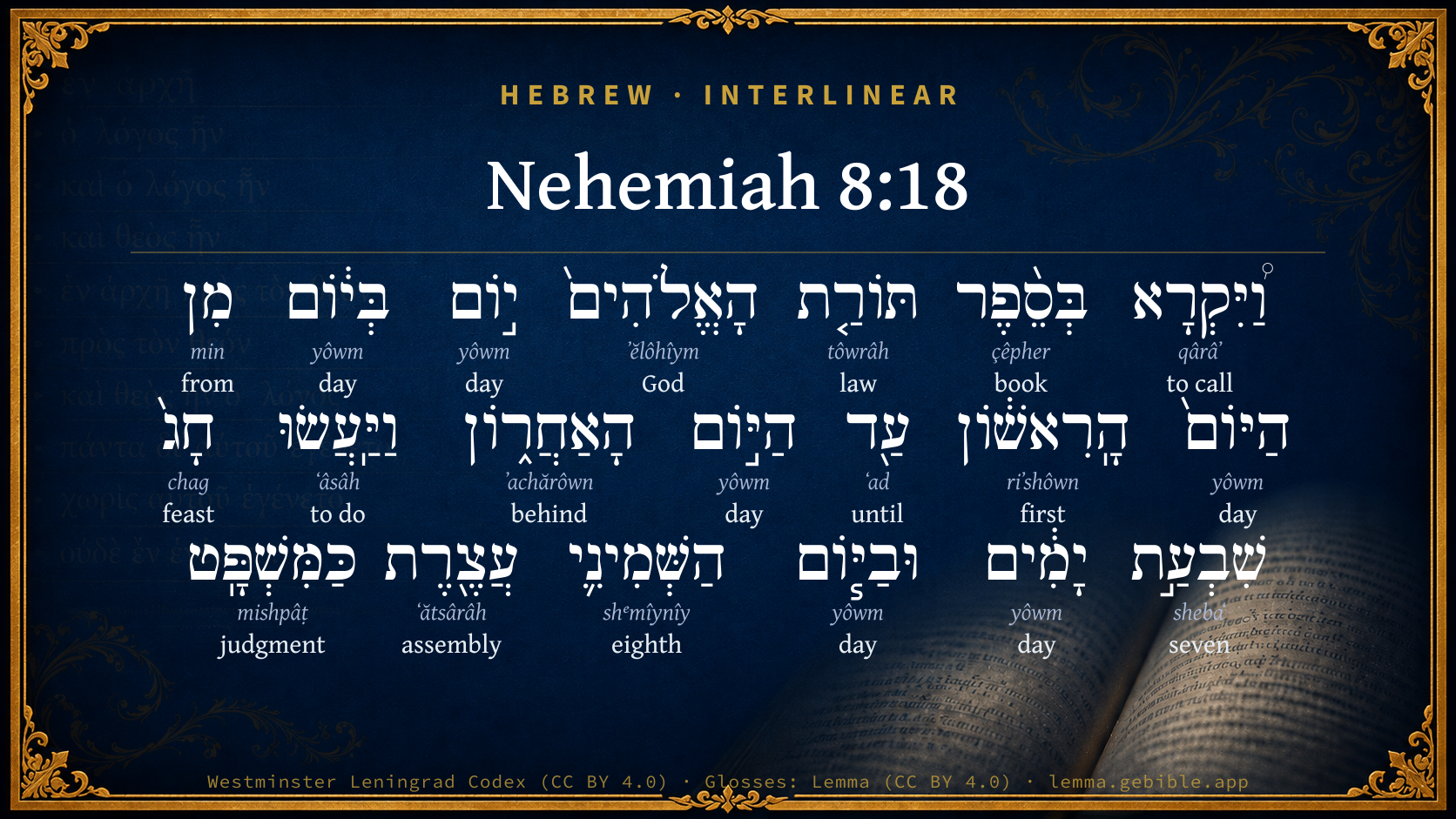
Nehemiah 8:18

Hebrew (Westminster Leningrad Codex) Nehemiah 8:18 appears in the Hebrew Old Testament. The text above is from the Westminster Leningrad Codex. Each word links to its Strong’s number, a concise gloss, and parsing drawn from the Open Scriptures Hebrew Bible morphology. Click any word for its full Brown-Driver-Briggs (BDB) entry.
Download image
Cite this verse

Nehemiah 8:18 (World English Bible). Public Domain. Lemma interlinear Bible study tool, https://lemma.gebible.app/v/nehemiah/8/18.

Show BibTeX & RIS
BibTeX
RIS
English Translation
Also day by day, from the first day to the last day, he read in the book of the law of God. They kept the feast seven days; and on the eighth day was a solemn assembly, according to the ordinance.
World English Bible · Public Domain
Download a study sheet

One document with this verse’s original text, its word-by-word gloss line, the meaning frame, cross-references with their text, attributed commentary, and full source and license credits — printable, and it pastes into notes with its structure intact.

This verse Autodidact and up

Study sheet (.html) Plain text (.txt)

A passage Seminary Student

Up to 50 verses in one chapter. A passage sheet keeps up to 6 commentary sources and 12 cross-references per verse, in the order this page ranks them, and says so on the sheet whenever that leaves anything out. Ask for a single verse and you get the Autodidact verse sheet above.

Everything on this page stays free to read, with no account — the sheet is a download of what is already on screen, not access to it.

Want to remove ads? Support Godless Engineer
Compare translations 3

The same verse in 3 English versions, stacked beneath the original-language interlinear above. Click any original word for its lexicon entry.

Each is an independent rendering of the whole verse — the interlinear is not word-aligned to these translations.

Highlighted words mark where these versions differ — a whole-verse word diff, not a word-by-word alignment.

  • World English Bible Public Domain
    Also day by day, from the first day to the last day, he read in the book of the law of God. They kept the feast seven days; and on the eighth day was a solemn assembly, according to the ordinance.
  • King James Version Public Domain
    Also day by day, from the first day unto the last day, he read in the book of the law of God. And they kept the feast seven days; and on the eighth day was a solemn assembly, according unto the manner.
  • unfoldingWord Literal Text CC BY-SA 4.0
    And he read aloud from the book of the law of God, day by day, from the first day to the last day. And they made a seven-days feast, and on the eighth day an assembly, according to the ordinance.

unfoldingWord Literal Text — © unfoldingWord, licensed CC BY-SA 4.0. Word-aligned USFM3 via Door43 (git.door43.org/unfoldingWord/en_ult).

Versions to compare (up to 4)

3 of 4 selected

Show all 18 translations

Every available English version of this verse, each an independent rendering of the whole verse.

  • World English Bible Public Domain
    Also day by day, from the first day to the last day, he read in the book of the law of God. They kept the feast seven days; and on the eighth day was a solemn assembly, according to the ordinance.
  • Berean Standard Bible Public Domain
    Day after day, from the first day to the last, Ezra read from the Book of the Law of God. The Israelites kept the feast for seven days, and on the eighth day they held an assembly, according to the ordinance.
  • Majority Standard Bible Public Domain
    Day after day, from the first day to the last, Ezra read from the Book of the Law of God. The Israelites kept the feast for seven days, and on the eighth day they held an assembly, according to the ordinance.
  • King James Version Public Domain
    Also day by day, from the first day unto the last day, he read in the book of the law of God. And they kept the feast seven days; and on the eighth day was a solemn assembly, according unto the manner.
  • American Standard Version (1901) Public Domain
    Also day by day, from the first day unto the last day, he read in the book of the law of God. And they kept the feast seven days; and on the eighth day was a solemn assembly, according unto the ordinance.
  • Revised Version (1885) Public Domain
    Also day by day, from the first day unto the last day, he read in the book of the law of God. And they kept the feast seven days; and on the eighth day was a solemn assembly according unto the ordinance.
  • Geneva Bible (1599) Public Domain
    And he read in the booke of the Lawe of God euery day, from the first day vnto the last day. and they kept the feast seuen dayes, and on the eight day a solemne assemblie, according vnto the maner.
  • Douay-Rheims (1899) Public Domain
    And he read in the book of the law of God day by day, from the first day till the last, and they kept the solemnity seven days, and in the eighth day a solemn assembly according to the manner.
  • Young's Literal Translation Public Domain
    And he readeth in the book of the law of God day by day, from the first day till the last day, and they make a feast seven days, and on the eighth day a restraint, according to the ordinance.
  • Literal Standard Version CC BY-SA 4.0
    And he reads in the Scroll of the Law of God day by day, from the first day until the last day, and they make a celebration seven days, and on the eighth day a restraint, according to the ordinance.
  • Unlocked Literal Bible CC BY-SA 4.0
    Also day by day, from the first day to the last, Ezra read from the book of the law of God. They kept the festival for seven days and on the eighth day was a solemn assembly, in obedience to the decree.
  • unfoldingWord Literal Text CC BY-SA 4.0
    And he read aloud from the book of the law of God, day by day, from the first day to the last day. And they made a seven-days feast, and on the eighth day an assembly, according to the ordinance.
  • Darby Bible Public Domain
    Also day by day, from the first day to the last day, he read in the book of the law of God. And they observed the feast seven days; and on the eighth day was a solemn assembly, according to the ordinance.
  • World Messianic Bible Public Domain
    Also day by day, from the first day to the last day, he read in the scroll of the Torah of God. They kept the feast seven days; and on the eighth day was a solemn assembly, according to the ordinance.
  • Webster's Bible Public Domain
    Also day by day, from the first day to the last day, he read in the book of the law of God. And they kept the feast seven days; and on the eighth day was a solemn assembly, according to the manner.
  • Free Bible Version CC BY-SA 4.0
    Ezra read from the Book of the Law of God every day, from the first day to the last. The Israelites observed the festival for seven days, and on the eighth day they met together in assembly, as the Law required.
  • Bible in Basic English Public Domain
    And day by day, from the first day till the last, he was reading from the book of the law of God. And they kept the feast for seven days: and on the eighth day there was a holy meeting, as it is ordered in the law.
  • JPS Tanakh (1917) Public Domain
    Also day by day, from the first day unto the last day, he read in the book of the Law of God. And they kept the feast seven days; and on the eighth day was a solemn assembly, according unto the ordinance.

Literal Standard Version (2020), Covenant Press — licensed CC BY-SA 4.0. Text via the HelloAO Bible API (eBible.org). Unlocked Literal Bible (unfoldingWord) — licensed CC BY-SA 4.0. Text via the HelloAO Bible API (eBible.org). unfoldingWord Literal Text — © unfoldingWord, licensed CC BY-SA 4.0. Word-aligned USFM3 via Door43 (git.door43.org/unfoldingWord/en_ult). Free Bible Version, Dr. Jonathan Gallagher — licensed CC BY-SA 4.0. Text via the HelloAO Bible API (eBible.org).

Word by word

More ways to search: Search by grammar → Find every occurrence → Compare this word →

Practice this passage: Drill this verse → Learn its vocabulary →

עֲצֶ֖רֶת
ʻătsârâh
H6116
“assembly”
Noun, Common, Feminine, Singular, Absolute
Part of Speech
Noun
Type
Common
Gender
Feminine
Number
Singular
State
Absolute
Full BDB Definition

Origin: from H6113

TWOT: 1675c

assembly, solemn assembly - assembly (sacred or festive meeting) - assemblage, company, group
  1. וַ֠יִּקְרָא qârâʼ H7121 “and · to call” Conjunction + Verb, Qal, Sequential Imperfect, 3rd Person, Masculine, Singular
  2. בְּסֵ֨פֶר çêpher H5612 “in/at · book of” Preposition + Noun, Common, Masculine, Singular, Construct
  3. תּוֹרַ֤ת tôwrâh H8451 “law of” Noun, Common, Feminine, Singular, Construct
  4. הָאֱלֹהִים֙ ʼĕlôhîym H430 “the · God(s)” Particle, Definite Article + Noun, Common, Masculine, Plural, Absolute
  5. י֣וֹם yôwm H3117 “day” Noun, Common, Masculine, Singular, Absolute
  6. בְּי֔וֹם yôwm H3117 “in/at · day” Preposition + Noun, Common, Masculine, Singular, Absolute
  7. מִן min H4480 “from” Preposition
  8. הַיּוֹם֙ yôwm H3117 “the · day” Particle, Definite Article + Noun, Common, Masculine, Singular, Absolute
  9. הָֽרִאשׁ֔וֹן riʼshôwn H7223 “the · first” Particle, Definite Article + Adjective, Ordinal number, Masculine, Singular, Absolute
  10. עַ֖ד ʻad H5704 “until” Preposition
  11. הַיּ֣וֹם yôwm H3117 “the · day” Particle, Definite Article + Noun, Common, Masculine, Singular, Absolute
  12. הָאַחֲר֑וֹן ʼachărôwn H314 “the · behind” Particle, Definite Article + Adjective, Adjective, Masculine, Singular, Absolute
  13. וַיַּֽעֲשׂוּ ʻâsâh H6213 “and · to do” Conjunction + Verb, Qal, Sequential Imperfect, 3rd Person, Masculine, Plural
  14. חָג֙ chag H2282 “feast” Noun, Common, Masculine, Singular, Absolute
  15. שִׁבְעַ֣ת shebaʻ H7651 “seven” Adjective, Cardinal number, Masculine, Singular, Construct
  16. יָמִ֔ים yôwm H3117 “days” Noun, Common, Masculine, Plural, Absolute
  17. וּבַיּ֧וֹם yôwm H3117 “and · in/at the · day” Conjunction + Preposition, Determined + Noun, Common, Masculine, Singular, Absolute
  18. הַשְּׁמִינִ֛י shᵉmîynîy H8066 “the · eighth” Particle, Definite Article + Adjective, Ordinal number, Masculine, Singular, Absolute
  19. כַּמִּשְׁפָּֽט mishpâṭ H4941 “like/as the · judgment” Preposition, Determined + Noun, Common, Masculine, Singular, Absolute

About this verse

These counts appear in no published source. They are computed here, from the morphology-tagged text and Lemma’s own curated glosses. What Lemma adds →

20
words
15
distinct lemmas
Historical
section

Notable vocabulary

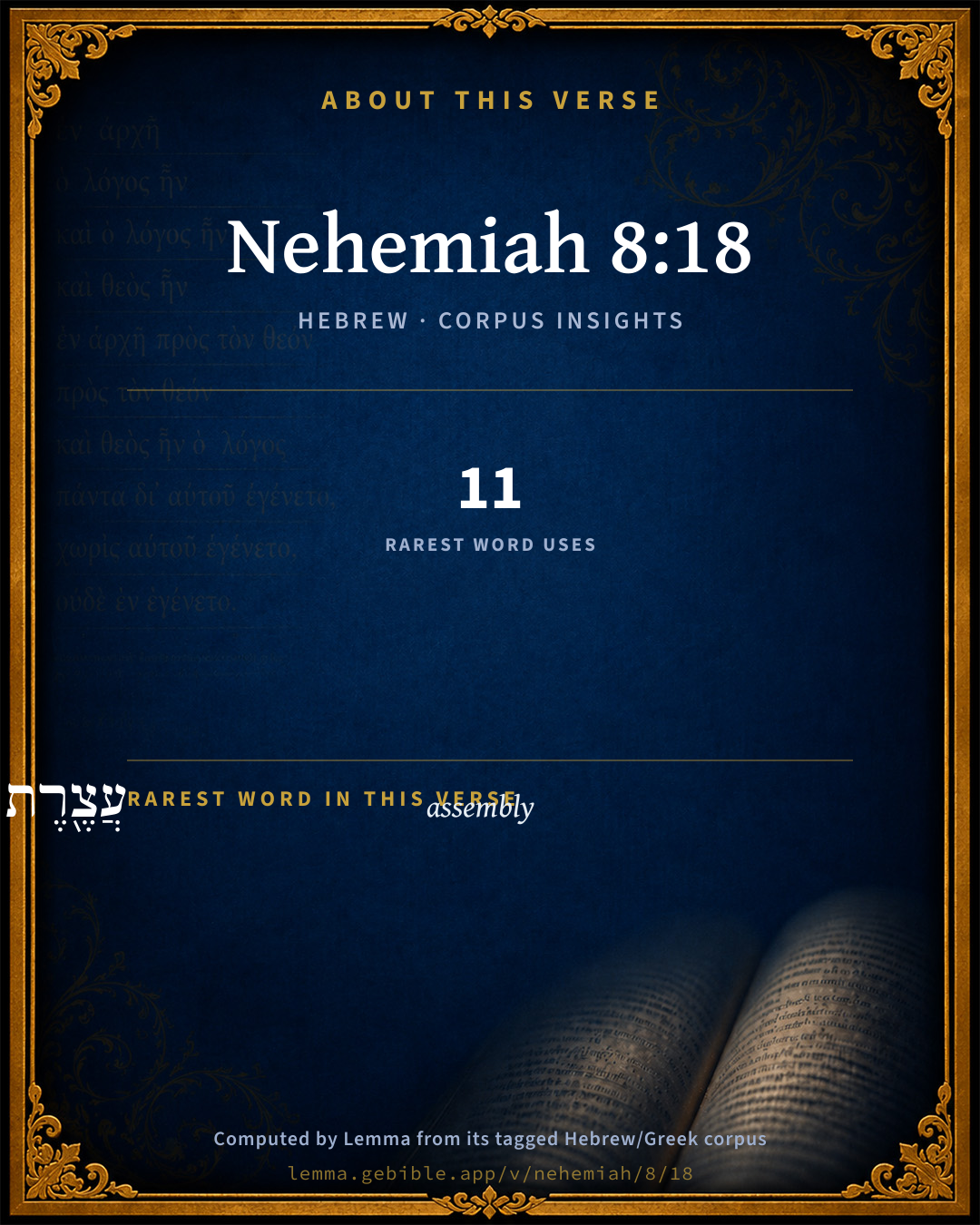
The rarest word here is עֲצֶ֖רֶת assembly H6116 — appearing just 11 times in the whole Hebrew Bible.

Shared distinctive vocabulary

עֲצֶ֖רֶת assembly H6116 occurs in 11 verses of the Hebrew Bible. Also found in:

Grammatical profile

  • 2 verbs
  • 12 nouns
  • 4 adjectives
  • 2 prepositions

Verb forms

  • וַ֠יִּקְרָא Qal · Sequential Imperfect
  • וַיַּֽעֲשׂוּ Qal · Sequential Imperfect

Repetition

A word recurs within this verse — often emphatic in Hebrew:

  • י֣וֹם day H3117 ×6

Cross-references

4

Topical passages linked to Nehemiah 8:18 in the Treasury of Scripture Knowledge — connected by theme and wording, ordered by reader-vote popularity; previews shown in the World English Bible.

  • Leviticus 23:36 Seven days you shall offer an offering made by fire to Yahweh. On the eighth day shall be a holy convocation to you; and you shall offer an offering made by fire to Yahweh. It is a solemn assembly; you shall do no regular work.
  • Numbers 29:35 On the eighth day you shall have a solemn assembly: you shall do no servile work;
  • Deuteronomy 31:10–13 Moses commanded them, saying, At the end of [every] seven years, in the set time of the year of release, in the feast of tents,
  • John 7:37 Now on the last and greatest day of the feast, Jesus stood and cried out, "If anyone is thirsty, let him come to me and drink!

Cross-references courtesy of OpenBible.info (CC BY 4.0).

Hebrew and Greek witnesses Masoretic Hebrew ↔ Greek Septuagint

The same verse in the two great witnesses to the Old Testament, shown verse-for-verse.

These are two independent witnesses, not word-aligned to each other, and the Septuagint is shown in lemma (dictionary) form.

Hebrew Nehemiah 8:18 Masoretic · Westminster Leningrad Codex

וַ֠יִּקְרָא בְּסֵ֨פֶר תּוֹרַ֤ת הָאֱלֹהִים֙ י֣וֹם בְּי֔וֹם מִן הַיּוֹם֙ הָֽרִאשׁ֔וֹן עַ֖ד הַיּ֣וֹם הָאַחֲר֑וֹן וַיַּֽעֲשׂוּ חָג֙ שִׁבְעַ֣ת יָמִ֔ים וּבַיּ֧וֹם הַשְּׁמִינִ֛י עֲצֶ֖רֶת כַּמִּשְׁפָּֽט

Also day by day, from the first day to the last day, he read in the book of the law of God. They kept the feast seven days; and on the eighth day was a solemn assembly, according to the ordinance.

World English Bible · Public Domain

Greek LXX Structure differs

The Septuagint has no separate book of Nehemiah. Its Greek text is the second half of Esdras B (2 Esdras), chapters 11–23; Ezra is the first half (1–10).

A verse-for-verse comparison isn’t shown here because the chapters and verses don’t line up. Switch to the LXX edition with the MT / LXX toggle above to read the Greek directly.

On this verse, The Cambridge Bible for Schools and Colleges discusses the Septuagint’s reading. Read the note in Commentary ↓

Hebrew: Westminster Leningrad Codex (CC BY 4.0). Greek: Septuagint (public domain); English from a public-domain English Septuagint. How the Septuagint differs from the Hebrew →

Commentary

Notes on Nehemiah 8:18 from classic Christian and Jewish commentators (each source and its license shown beneath its notes). The classic Christian expositions comment on the surrounding passage and are grouped to its opening verse, so a note may address several verses; the Jewish commentaries on the Tanakh (Rashi and others) are per-verse, so they appear only where the commentator wrote on this verse.

Lemma curates 59 commentaries, every one of them public domain or Creative Commons licensed, each selected and text-cleaned for this edition rather than reprinted as found. About our sources →

Trapp's Complete Commentary

John Trapp

Neh 8:18 Also day by day, from the first day unto the last day, he read in the book of the law of God. And they kept the feast seven days; and on the eighth day [was] a solemn assembly, according unto the manner.

Ver. 18. Also day by day] Not only on the first and last day ("that great day of the feast," Joh 7:37), but every day, this good man was at it, being insatiabilis Dei cultor (as Chrysostom saith of St Paul), an insatiable worshipper of God; and accounting quod nimis augusta pietas est, ad legem bonum esse, to do nothing for God more than needs must was too little.

And they kept the feast seven days] The people were as willing to hear (and do other holy duties) as Ezra was to preach. So were Chrysostom’s hearers, who were wont to say that they could better be without the sunlight than Chrysostom’s daily sermons. So likewise were Calvin’s hearers at Geneva, where he preached every day in the week for the most part, and had a constant audience that even too admired (some of them at least) his most excellent pains and parts; as Zanchy shows and complains in the Epistle Dedicatory set before his Miscellanies; taxing them of ανθρωπολατρεια, man worship.

And on the eighth day was a solemn assembly] Heb. A restraint, viz. from servile works; or a retention, viz. a holding of the congregation together for holy uses. Tremellius rendereth it diem interdicti forbidden day, the Vulgate Latin of Lyra thus, They made a gathering, sc. for necessaries about the Temple. This eighth day thus kept might prefigure the Christian sabbath, that first day of the week.

John Trapp, A Commentary or Exposition upon All the Books of the Old and New Testament (1647–1656) — public domain. Text from a community e-Sword module.

Joseph Benson's Commentary

Neh 8:18. Day by day he read in the book of the law of God — The law was commanded to be read at this feast, Deu 31:10-12. But the reading of it was not enjoined to be continued every day, as was now done through their singular and very laudable zeal.

Joseph Benson's Commentary on the Old and New Testaments (1811–1818) — public domain. Text from a community e-Sword module.

Tyndale Open Study Notes

Tyndale Open Resources

8:18 Ezra read from the Book of the Law of God: The law was to be read every seven years at the Festival of Shelters (Deut 31:10-12). It reminded the people of the covenant stipulations and of God’s past acts of grace.

Tyndale Open Study Notes — © Tyndale Open Resources, licensed CC BY-SA 4.0. Text via the HelloAO Bible API.

Jamieson, Fausset & Brown

Robert Jamieson, A. R. Fausset & David Brown

Also day by day . . . he read in the book of the law of God--This was more than was enjoined (Deu 31:10-12), and arose from the exuberant zeal of the time.

on the eighth day was a solemn assembly--This was the last and great day of the feast (see on Num 29:35). In later times, other ceremonies which increased the rejoicing were added (Joh 7:37).

Next: Nehemiah Chapter 9

Jamieson, Fausset & Brown — Commentary Critical and Explanatory on the Whole Bible (1871) — public domain (CC PDM 1.0). Text via the HelloAO Bible API.

Ellicott's Commentary for English Readers

(18) According unto the manner.—For the Azereth, or supplementary feast day, see Lev_23:36.

A Bible Commentary for English Readers, edited by Charles John Ellicott (1878–1897) — public domain. Text from a community e-Sword module.

The Cambridge Bible for Schools and Colleges

gen. ed. J. J. S. Perowne

18. he read] i.e. Ezra. This is the usual explanation, so also LXX. ἀνέγνω. Vulg. ‘legit.’ According to another interpretation the 3rd pers. sing. is impersonal = ‘and one read,’ ‘there was reading.’

in the book of the law of God] The command to read at the Feast of Tabernacles only applied to the special usage of the Sabbatic year (Deu_31:10-11), and it is clear from the context in that passage that Moses in using the words ‘thou shalt read this law’ (Deu_31:11) is speaking especially of the Deuteronomic law which he is described as having written and committed to the priests in Deu_31:9 and Deu_31:26. It is a mistake therefore to connect this reading of ‘the law’ by Ezra with any special obedience to Deu_31:10-11, unless it be assumed that it was the Sabbatic year, and that the law read was the Deuteronomic law. For neither assumption is there any sufficient warrant. The fact that the reading went on for seven days makes it probable that the whole, or at any rate by far the greater portion, of the Torah was read.

the eighth day] This eighth day was not originally part of the feast, but an extra day commanded by the Priestly Law to be observed as ‘an holy convocation’ (Lev_23:36; Lev_23:39). Its celebration closed, as it were, the festival calendar of the Jewish sacred year. We do not hear of its observance in early times. As we might expect, it is not mentioned in the brief festival notice of Exo_23:16. In Deu_16:13-17 it is not spoken of, it is only said ‘Seven days shalt thou keep a feast.’ In 1Ki_8:65-66, we are told that after the Feast of Tabernacles Solomon sent the people away on the 8th day. In the Priestly Law, however, the observance of this 8th day is insisted upon as ‘a holy convocation,’ ‘a solemn assembly,’ on which ‘no servile work’ is to be done, ‘the eighth day shall be a solemn rest’ (Lev_23:36; Lev_23:39). It is interesting, therefore, to take notice that in 2Ch_7:8-9 the observance of this 8th day is recorded, although not mentioned in the parallel passage, 1Ki_8:65-66. The Chronicler recounts the celebration of the Feast of Tabernacles in accordance with his knowledge of the Priestly Law. Our passage agrees with the later observance and with the Priestly Law. The complete disappearance of the originally distinct character of ‘the eighth day’ is shown in 2Ma_10:6 ‘eight days … as in the feast of tabernacles.’

a solemn assembly (Heb. a restrain assembly)] R.V. Marg. ‘Or, closing festival’. LXX. ἐξόδιον. Vulg. ‘collectam.’ The Hebrew word e’ câreth is used technically here and in Lev_23:36; Num_29:35; 2Ch_7:9, for the day after the Feast of Tabernacles, and in Deu_16:8, for the 7th and last day of the Feast of Unleavened Bread. With an original sense of ‘shutting,’ ‘packing together,’ it is used of ‘public gatherings’ (Jer_9:2), and sacred festivals (2Ki_10:20; Isa_1:13; Joe_1:14; Amo_5:21), and, in post-Biblical Hebrew, especially of the Feast of Weeks.

the manner] R.V. the ordinance. According to the ordinance (mishpât. LXX. κρίμα. Vulg. ‘ritum’) of the Priestly Law (Lev_23:36). The emphasis of this appeal to authority is perhaps to be explained by the fact that in early times the 8th day had not been observed.

The Cambridge Bible for Schools and Colleges (gen. ed. J. J. S. Perowne; Cambridge University Press, 1878–1918) — public domain. Text from a community e-Sword module.

John Gill's Exposition

Also day by day, from the first day unto the last day, he read in the book of the law of God,.... That is, Ezra; this was done by him every day during the feast, whereas only the first and last days were the holy convocations on which it seems to have been read:

and they kept the feast seven days, and on the eighth day was a solemn assembly, according to the manner; prescribed in Lev 23:39.

Next: Nehemiah Chapter 9

John Gill's Exposition of the Whole Bible (1746–1763) — public domain (CC PDM 1.0). Text via the HelloAO Bible API.

Haydock's Catholic Bible Commentary

Assembly. Literally, "the collect." (Haydock) --- Hebrew, "the day of retention;" the people being kept at the temple. (Calmet) --- Septuagint, "the dismission;" as they were afterwards permitted to depart. (Haydock) --- See Leviticus xxiii. 26. --- It was probably on this occasion, that the sacred fire was found again; (2 Machabees i. 18.; Calmet) and also the ark, the tabernacle, and the altar of incense, which had been hidden by Jeremias, 2 Machabees ii. 4. (Torniel, the year of the world 3610.) (Cano, &c.) --- But this is not so certain. (Haydock) (Calmet, Diss.)

George Leo Haydock (1774–1849), Haydock's Catholic Family Bible and Commentary, 1859 edition — public domain. Excludes Psalms (Douay-Rheims chapter numbering differs from Protestant) and Deuterocanonical books (Catholic canon only).

Matthew Poole's English Annotations

He read in the book of the law of God; which was commanded to be done at this feast, Deu 31:10-12, though not enjoined to be done every day, as now out of a singular zeal they did.

Matthew Poole's English Annotations on the Holy Bible (1683–1685) — public domain. Text from a community e-Sword/MySword module.

Whedon's Commentary on the Bible

Daniel D. Whedon

18. Day by day… he read — The people needed instruction, and the feast of tabernacles afforded a most suitable occasion for the public reading of the law. The law also enjoined such a public reading once in seven years at the feast of tabernacles. Deu_31:10-11.

He read — That is, Ezra read, or caused to be read. He was, doubtless, assisted during the seven days by the priests and the Levites, as he had been on the first day of the month. Neh_8:1-8.

A solemn assembly — The same as the holy convocation mentioned in Lev_23:36.

According unto the manner — Or, according to custom. Aside from the extensive reading of the law and the whole community dwelling in booths, which specially distinguished this particular feast, the other observances followed general usage.

Daniel D. Whedon (gen. ed.), Commentary on the Old and New Testaments (1874–1909) — public domain. Text from a community e-Sword module.

The Pulpit Commentary

Also day by day...he read in the book of the law. Ezra must be intended in the form "he read," though there has been no mention of him since verse 13. The continuous and systematic reading seems to imply that the year was a Sabbatical one, and that the rehearsal commanded in Deu_31:10-13 now took place. The observance was perhaps a new thing to the newly-formed community, and is therefore recorded with so much emphasis. They kept the feast seven days. See Lev_23:34 Num_29:12-34 Deu_16:13. On the eighth day was a solemn assembly, according to the manner. Such a mode of solemnising the octave was commanded in Lev_23:36 and Num_29:35. By "according to the manner" seems to be meant "according to the regularly established custom one proof out of many that the feast had been constantly observed, though not perhaps with all the proper ceremonies (see the comment on ver. 17).

The Pulpit Commentary (1880–1919), ed. H.D.M. Spence-Jones & Joseph S. Exell — public domain. Text from a community e-Sword module.

unfoldingWord translationNotes

Door43 World Missions Community

day by day

This idiom means "each day." (See: Idiom)

from the first day to the last

The implied information is that it was during the entire week of the festival. AT: "from the first day to the last day of the week" (See: Assumed Knowledge and Implicit Information)

They kept the festival

"They made a feast" or "They celebrated the festival"

on the eighth day

"on day 8" (See: Ordinal Numbers)

solemn assembly

This was a special religious gathering.

in obedience to the decree

The implied information is that "the decree" was the command of Yahweh about how the Festival of Shelters was to end. AT: "as God had commanded" (See: Assumed Knowledge and Implicit Information)

translationWords

Ezra

law

festival

assembly

obey

decree

unfoldingWord translationNotes — © Distant Shores Media and the Door43 World Missions Community, licensed CC BY-SA 4.0. Source: git.door43.org/Door43/en_tn.

Rashi

Rabbi Shlomo Yitzchaki (Rashi)

day by day every day.

Rashi on the Tanakh — English translations: “The Judaica Press complete Tanach with Rashi, translated by A. J. Rosenberg” (CC BY 4.0); “Pentateuch with Rashi's commentary by M. Rosenbaum and A.M. Silbermann, 1929-1934” (public domain); “The Metsudah Tanach series, Lakewood, N.J” (CC BY 4.0); and “The Book of Joshua, Metsudah Publications, 1997” (CC BY 4.0). Text via Sefaria.

Lesson kit

Teaching starters — assembled from the data on this page, not authored interpretation. Every prompt links to the verse data it draws on. Edit before teaching.

Nehemiah, in the Historical, opens this verse with 20 words (15 distinct Hebrew lemmas). Its most distinctive word is ʻătsârâh (“assembly”). A historical commentator’s framing appears above. Read the whole chapter for the surrounding context.

Discussion questions

  1. What does “assembly” (ʻătsârâh) contribute to the verse as a whole?
  2. Leviticus 23:36 shares the word «assembly» with this verse. How do the two illuminate each other?
  3. “day” occurs 6× in this one verse. What is the effect of the repetition?
  4. These translations render this verse differently; the difference is in the English rendering, not the original. What questions does that raise?
  5. The verb «וַ֠יִּקְרָא» is Qal Sequential Imperfect. How does its form color the action?
  6. Reading how Trapp's Complete Commentary and Joseph Benson's Commentary read this verse, where do the two commentators agree and where do they part?

Things to notice

Reading settings

Reading text

Shown beneath each verse's original-language words.

Old Testament
Old Testament edition

Read the OT as the Masoretic Hebrew (MT) or the Greek Septuagint (LXX).

English shown for the Greek Septuagint (in the Hebrew ↔ Greek comparison).

Comparing translations? Open the Compare panel on any verse page to stack up to four side by side.