2 Chronicles 17:9

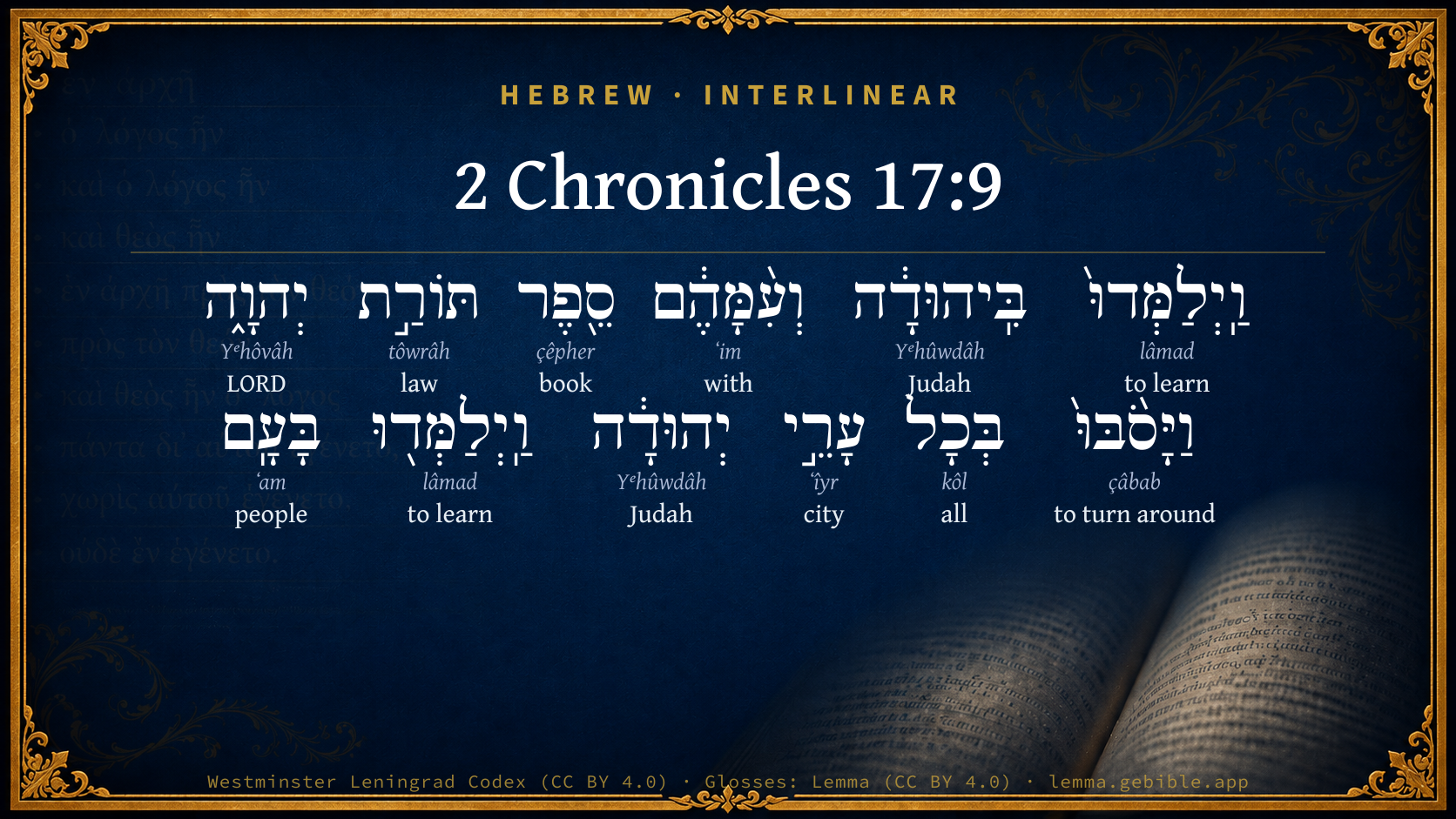
Hebrew (Westminster Leningrad Codex) 2 Chronicles 17:9 appears in the Hebrew Old Testament. The text above is from the Westminster Leningrad Codex. Each word links to its Strong’s number, a concise gloss, and parsing drawn from the Open Scriptures Hebrew Bible morphology. Click any word for its full Brown-Driver-Briggs (BDB) entry.
Download image
Cite this verse

2 Chronicles 17:9 (World English Bible). Public Domain. Lemma interlinear Bible study tool, https://lemma.gebible.app/v/2-chronicles/17/9.

Show BibTeX & RIS
BibTeX
RIS
English Translation
They taught in Judah, having the book of the law of Yahweh with them; and they went about throughout all the cities of Judah, and taught among the people.
World English Bible · Public Domain
Download a study sheet

One document with this verse’s original text, its word-by-word gloss line, the meaning frame, cross-references with their text, attributed commentary, and full source and license credits — printable, and it pastes into notes with its structure intact.

This verse Autodidact and up

Study sheet (.html) Plain text (.txt)

A passage Seminary Student

Up to 50 verses in one chapter. A passage sheet keeps up to 6 commentary sources and 12 cross-references per verse, in the order this page ranks them, and says so on the sheet whenever that leaves anything out. Ask for a single verse and you get the Autodidact verse sheet above.

Everything on this page stays free to read, with no account — the sheet is a download of what is already on screen, not access to it.

Want to remove ads? Support Godless Engineer
Compare translations 3

The same verse in 3 English versions, stacked beneath the original-language interlinear above. Click any original word for its lexicon entry.

Each is an independent rendering of the whole verse — the interlinear is not word-aligned to these translations.

Highlighted words mark where these versions differ — a whole-verse word diff, not a word-by-word alignment.

  • World English Bible Public Domain
    They taught in Judah, having the book of the law of Yahweh with them; and they went about throughout all the cities of Judah, and taught among the people.
  • King James Version Public Domain
    And they taught in Judah, and had the book of the law of the LORD with them, and went about throughout all the cities of Judah, and taught the people.
  • unfoldingWord Literal Text CC BY-SA 4.0
    And they taught in Judah, and with them, the scroll of the law of Yahweh. And they went around in all the cities of Judah, and they taught among the people.

unfoldingWord Literal Text — © unfoldingWord, licensed CC BY-SA 4.0. Word-aligned USFM3 via Door43 (git.door43.org/unfoldingWord/en_ult).

Versions to compare (up to 4)

3 of 4 selected

Show all 18 translations

Every available English version of this verse, each an independent rendering of the whole verse.

  • World English Bible Public Domain
    They taught in Judah, having the book of the law of Yahweh with them; and they went about throughout all the cities of Judah, and taught among the people.
  • Berean Standard Bible Public Domain
    They taught throughout Judah, taking with them the Book of the Law of the LORD. They went throughout the towns of Judah and taught the people.
  • Majority Standard Bible Public Domain
    They taught throughout Judah, taking with them the Book of the Law of the LORD. They went throughout the towns of Judah and taught the people.
  • King James Version Public Domain
    And they taught in Judah, and had the book of the law of the LORD with them, and went about throughout all the cities of Judah, and taught the people.
  • American Standard Version (1901) Public Domain
    And they taught in Judah, having the book of the law of Jehovah with them; and they went about throughout all the cities of Judah, and taught among the people.
  • Revised Version (1885) Public Domain
    And they taught in Judah, having the book of the law of the LORD with them; and they went about throughout all the cities of Judah, and taught among the people.
  • Geneva Bible (1599) Public Domain
    And they taught in Iudah, and had the booke of the Lawe of the Lord with them, and went about throughout all the cities of Iudah, and taught the people.
  • Douay-Rheims (1899) Public Domain
    And they taught the people in Juda, having with them the book of the law of the Lord: and they went about all the cities of Juda, and instructed the people.
  • Young's Literal Translation Public Domain
    And they teach in Judah, and with them `is' the Book of the Law of Jehovah, and they go round about into all cities of Judah, and teach among the people.
  • Literal Standard Version CC BY-SA 4.0
    And they teach in Judah, and the Scroll of the Law of YHWH [is] with them, and they go around into all cities of Judah, and teach among the people.
  • Unlocked Literal Bible CC BY-SA 4.0
    They taught in Judah, having the book of the law of Yahweh with them. They went about throughout all the cities of Judah and taught among the people.
  • unfoldingWord Literal Text CC BY-SA 4.0
    And they taught in Judah, and with them, the scroll of the law of Yahweh. And they went around in all the cities of Judah, and they taught among the people.
  • Darby Bible Public Domain
    And they taught in Judah, and had the book of the law of Jehovah with them; and they went about through all the cities of Judah, and taught among the people.
  • World Messianic Bible Public Domain
    They taught in Judah, having the book of the LORD’s law with them. They went about throughout all the cities of Judah and taught among the people.
  • Webster's Bible Public Domain
    And they taught in Judah, and had the book of the law of the LORD with them, and went about throughout all the cities of Judah, and taught the people.
  • Free Bible Version CC BY-SA 4.0
    Taking with them the Book of the Law of the Lord they taught as they went around Judah. They visited all the towns of Judah, teaching the people.
  • Bible in Basic English Public Domain
    And they gave teaching in Judah and had the book of the law of the Lord with them; they went through all the towns of Judah teaching the people.
  • JPS Tanakh (1917) Public Domain
    And they taught in Judah, having the book of the Law of the LORD with them; and they went about throughout all the cities of Judah, and taught among the people.

Literal Standard Version (2020), Covenant Press — licensed CC BY-SA 4.0. Text via the HelloAO Bible API (eBible.org). Unlocked Literal Bible (unfoldingWord) — licensed CC BY-SA 4.0. Text via the HelloAO Bible API (eBible.org). unfoldingWord Literal Text — © unfoldingWord, licensed CC BY-SA 4.0. Word-aligned USFM3 via Door43 (git.door43.org/unfoldingWord/en_ult). Free Bible Version, Dr. Jonathan Gallagher — licensed CC BY-SA 4.0. Text via the HelloAO Bible API (eBible.org).

Word by word

More ways to search: Search by grammar → Find every occurrence → Compare this word →

Practice this passage: Drill this verse → Learn its vocabulary →

וַֽיְלַמְּדוּ֙
lâmad
H3925
“and · to learn”
Conjunction + Verb, Piel, Sequential Imperfect, 3rd Person, Masculine, Plural
Part of Speech
Conjunction + Verb
Stem
Piel
Form
Sequential Imperfect
Person
3rd Person
Gender
Masculine
Number
Plural
Full BDB Definition

Origin: a primitive root

TWOT: 1116

to learn. teach, exercise in - (Qal) to learn - (Piel) to teach - (Pual) to be taught, be trained
  1. בִּֽיהוּדָ֔ה Yᵉhûwdâh H3063 “in/at · Judah” Preposition + Noun, Proper
  2. וְעִ֨מָּהֶ֔ם ʻim H5973 “and · with · them” Conjunction + Preposition + Suffix, Personal, 3rd Person, Masculine, Plural
  3. סֵ֖פֶר çêpher H5612 “book of” Noun, Common, Masculine, Singular, Construct
  4. תּוֹרַ֣ת tôwrâh H8451 “law of” Noun, Common, Feminine, Singular, Construct
  5. יְהוָ֑ה Yᵉhôvâh H3068 “LORD” Noun, Proper
  6. וַיָּסֹ֨בּוּ֙ çâbab H5437 “and · to turn around” Conjunction + Verb, Qal, Sequential Imperfect, 3rd Person, Masculine, Plural
  7. בְּכָל kôl H3605 “in/at · all of” Preposition + Noun, Common, Masculine, Singular, Construct
  8. עָרֵ֣י ʻîyr H5892 “cities of” Noun, Common, Feminine, Plural, Construct
  9. יְהוּדָ֔ה Yᵉhûwdâh H3063 “Judah” Noun, Proper
  10. וַֽיְלַמְּד֖וּ lâmad H3925 “and · to learn” Conjunction + Verb, Piel, Sequential Imperfect, 3rd Person, Masculine, Plural
  11. בָּעָֽם ʻam H5971 “in/at the · people” Preposition, Determined + Noun, Common, Masculine, Singular, Absolute

About this verse

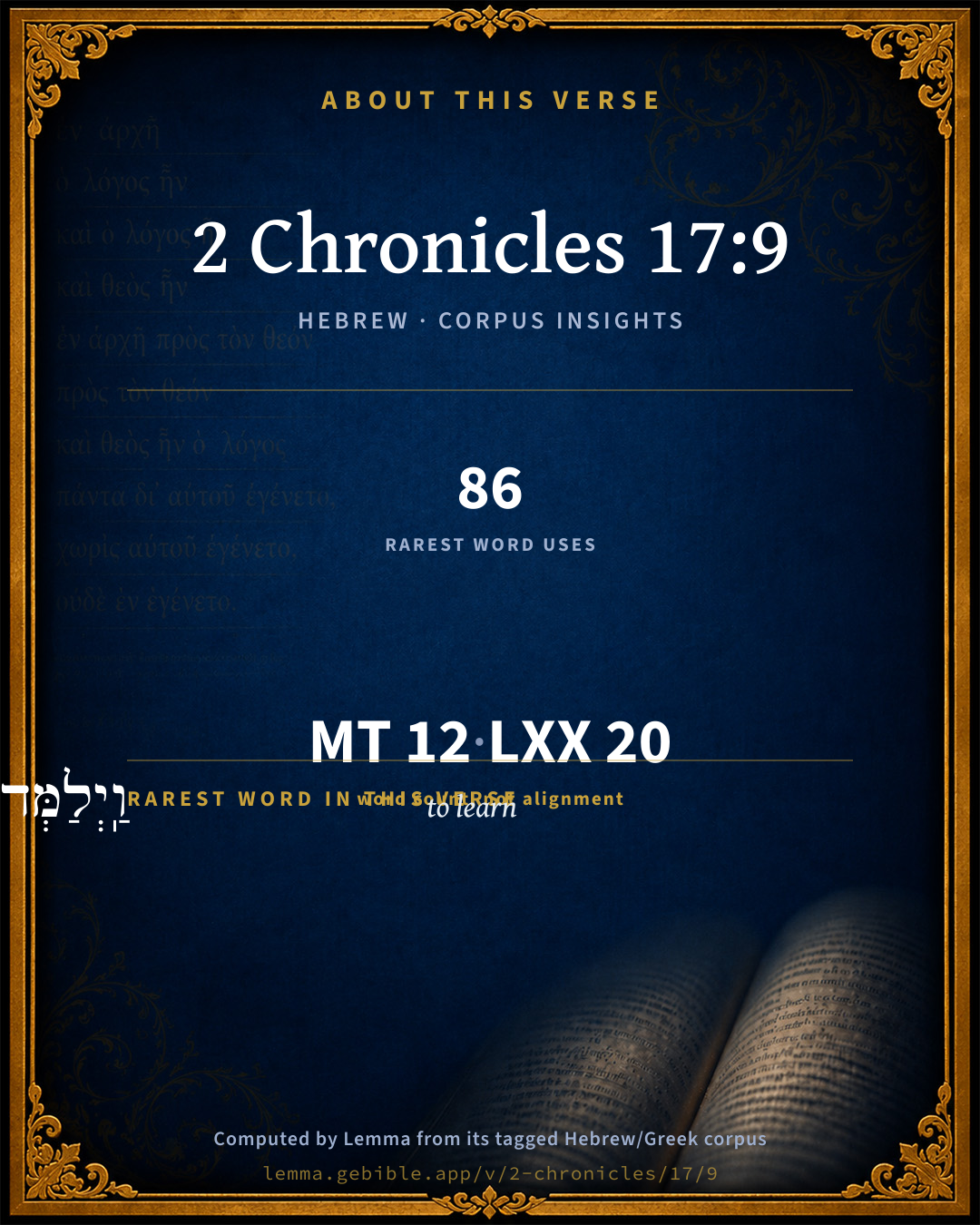
These counts appear in no published source. They are computed here, from the morphology-tagged text and Lemma’s own curated glosses. What Lemma adds →

12
words
10
distinct lemmas
Historical
section

Grammatical profile

  • 3 verbs
  • 8 nouns
  • 1 preposition

Verb forms

  • וַֽיְלַמְּדוּ֙ Piel · Sequential Imperfect
  • וַיָּסֹ֨בּוּ֙ Qal · Sequential Imperfect
  • וַֽיְלַמְּד֖וּ Piel · Sequential Imperfect

Repetition

Words recur within this verse — often emphatic in Hebrew:

  • וַֽיְלַמְּדוּ֙ to learn H3925 ×2
  • בִּֽיהוּדָ֔ה Judah H3063 ×2

Hebrew & Septuagint length

In English translation the verse runs 29 words from the Hebrew and 30 from the Septuagint (LXX English) — closely comparable.

A rough comparison of the two English renderings, which tokenize alike — not a word-level alignment.

Word counts can differ between the Hebrew and the Greek without any difference in meaning — e.g. the Hebrew direct-object marker אֵת has no separate Greek word, and Greek often adds the article ὁ.

In the original languages it is 12 Hebrew tokens and 20 Greek tokens — but the two are counted differently (Hebrew bundles its prefixes and suffixes into one token; the Greek is in lemma form), so that isn’t a like-for-like length.

Cross-references

19

Topical passages linked to 2 Chronicles 17:9 in the Treasury of Scripture Knowledge — connected by theme and wording, ordered by reader-vote popularity; previews shown in the World English Bible.

  • John 5:46 For if you believed Moses, you would believe me; for he wrote about me.
  • Romans 3:2 Much in every way! Because first of all, they were entrusted with the oracles of God.
  • Deuteronomy 6:4–9 Hear, Israel: Yahweh is our God; Yahweh is one:
  • Deuteronomy 31:11–13 when all Israel is come to appear before Yahweh your God in the place which he shall choose, you shall read this law before all Israel in their hearing.
  • Joshua 1:7–8 Only be strong and very courageous, to observe to do according to all the law, which Moses my servant commanded you: don't turn from it to the right hand or to the left, that you may have good success wherever you go.
  • 2 Chronicles 35:3 He said to the Levites who taught all Israel, who were holy to Yahweh, Put the holy ark in the house which Solomon the son of David king of Israel did build; there shall no more be a burden on your shoulders: now serve Yahweh your God, and his people Israel.
  • Nehemiah 8:7 Also Jeshua, and Bani, and Sherebiah, Jamin, Akkub, Shabbethai, Hodiah, Maaseiah, Kelita, Azariah, Jozabad, Hanan, Pelaiah, and the Levites, caused the people to understand the law: and the people [stood] in their place.
  • Isaiah 8:20 To the law and to the testimony! if they don't speak according to this word, surely there is no morning for them.
  • Matthew 10:23 But when they persecute you in this city, flee into the next, for most assuredly I tell you, you will not have gone through the cities of Israel, until the Son of Man has come.
  • Matthew 11:1 It happened that when Jesus had finished directing his twelve disciples, he departed from there to teach and preach in their cities.
  • Matthew 15:2–9 "Why do your disciples disobey the tradition of the elders? For they don't wash their hands when they eat bread."
  • Matthew 28:19–20 Therefore go, and make disciples of all nations, baptizing them in the name of the Father and of the Son and of the Holy Spirit,
  • Luke 4:17–19 The book of the prophet Isaiah was handed to him. He opened the book, and found the place where it was written,
  • John 5:39 "You search the Scriptures, because you think that in them you have eternal life; and these are they which testify about me.
  • Acts 8:40 But Philip was found at Azotus. Passing through, he preached the Gospel to all the cities, until he came to Caesarea.
  • Acts 13:15 After the reading of the law and the prophets, the rulers of the synagogue sent to them, saying, "Brothers, if you have any word of exhortation for the people, speak."
  • Acts 15:21 For Moses from generations of old has in every city those who preach him, being read in the synagogues every Sabbath."
  • Acts 28:23 When they had appointed him a day, many people came to him at his lodging. He explained to them, testifying about the Kingdom of God, and persuading them concerning Jesus, both from the law of Moses and from the prophets, from morning until evening.
  • 1 Peter 4:11 If any man speaks, let it be as it were oracles of God. If any man serves, let it be as of the strength which God supplies, that in all things God may be glorified through Jesus Christ, to whom belong the glory and the dominion forever and ever. Amen.

Cross-references courtesy of OpenBible.info (CC BY 4.0).

Hebrew and Greek witnesses Masoretic Hebrew ↔ Greek Septuagint

The same verse in the two great witnesses to the Old Testament, shown verse-for-verse.

These are two independent witnesses, not word-aligned to each other, and the Septuagint is shown in lemma (dictionary) form.

Hebrew 2 Chronicles 17:9 Masoretic · Westminster Leningrad Codex

וַֽיְלַמְּדוּ֙ בִּֽיהוּדָ֔ה וְעִ֨מָּהֶ֔ם סֵ֖פֶר תּוֹרַ֣ת יְהוָ֑ה וַיָּסֹ֨בּוּ֙ בְּכָל עָרֵ֣י יְהוּדָ֔ה וַֽיְלַמְּד֖וּ בָּעָֽם

They taught in Judah, having the book of the law of Yahweh with them; and they went about throughout all the cities of Judah, and taught among the people.

World English Bible · Public Domain

Greek LXX 2 Chronicles 17:9 Septuagint · lemma form

καί διδάσκω ἐν ἰουδά καί μετά αὐτός βίβλος νόμος κύριος καί διαἔρχομαι ἐν ὁ πόλις ἰουδά καί διδάσκω ὁ λαός

And they taught in Juda, and there was with them the book of the law of the Lord, and they passed through the cities of Juda, and taught the people.

LXX2012 (modern English Septuagint) · Public Domain

Hebrew: Westminster Leningrad Codex (CC BY 4.0). Greek: Septuagint (public domain); English from LXX2012 (modern English Septuagint) (Public Domain). How the Septuagint differs from the Hebrew →

Commentary

Notes on 2 Chronicles 17:9 from classic Christian and Jewish commentators (each source and its license shown beneath its notes). The classic Christian expositions comment on the surrounding passage and are grouped to its opening verse, so a note may address several verses; the Jewish commentaries on the Tanakh (Rashi and others) are per-verse, so they appear only where the commentator wrote on this verse.

Lemma curates 59 commentaries, every one of them public domain or Creative Commons licensed, each selected and text-cleaned for this edition rather than reprinted as found. About our sources →

Trapp's Complete Commentary

John Trapp

2Ch 17:9 And they taught in Judah, and [had] the book of the law of the LORD with them, and went about throughout all the cities of Judah, and taught the people.

Ver. 9. And had the book of the law of the Lord with them.] They taught not traditions, human inventions, or unwritten verities. All their doctrines came cum privilegio, and were Scripture proof.

John Trapp, A Commentary or Exposition upon All the Books of the Old and New Testament (1647–1656) — public domain. Text from a community e-Sword module.

Joseph Benson's Commentary

2Ch 17:9. And they taught in Judah, &c. — The Levites and priests were teachers by office, Deu 33:10. It was a part of the work for which they had their maintenance, and indeed had little else to do. But, it seems, they had neglected it, pretending, probably, that they could not get the people to hear them. Jehoshaphat, therefore, sends them with the princes, who, by their authority, might require the people to assemble together to receive instruction in the laws of God and their duty. “What a great deal of good,” says Henry, “may be done, when Moses and Aaron thus go hand in hand in the doing of it; when princes with their power, and priests and Levites with their Scripture-learning, agree to teach the people the good knowledge of God, and their duty. These itinerant judges, and itinerant preachers together, were instrumental to diffuse a blessed light throughout the cities of Judah.” And had the book of the law of the Lord with them — 1st, For their own guidance, that from thence they might draw all the instructions they gave to the people, and not teach for doctrines the commandments of men. 2d, For the conviction or the people, that they might see these priests and Levites had a divine warrant for what they said, and delivered to them only that which they had received from the Lord.

Joseph Benson's Commentary on the Old and New Testaments (1811–1818) — public domain. Text from a community e-Sword module.

Jamieson, Fausset & Brown

Robert Jamieson, A. R. Fausset & David Brown

the book of the law--that is, either the whole Pentateuch or only the book of Deuteronomy, which contains an abridgment of it.

Jamieson, Fausset & Brown — Commentary Critical and Explanatory on the Whole Bible (1871) — public domain (CC PDM 1.0). Text via the HelloAO Bible API.

Adam Clarke's Commentary

Verse 9. 2Ch 17:7.

Ver. 9. Had the book of the law of the Lord with them] This was their text book: it was the book of God; they taught it as such, and as such the people received it. Its laws were God's laws, and the people felt their obligation, and their consciences were bound. Thus they were obedient to the laws of the land, on the principle of religion. In this they were encouraged and confirmed by the example of all, both in Church and state. The princes were not only pious, but were teachers of piety; the Levites showed them the worth and excellence of their ritual institutions; and the priests showed them the moral use they were to make of the whole: and thus the people became obedient to God as well as to the king, and kept all the civil ordinances, not merely for the sake of a good king, but for the sake of a good and gracious God. By these means the nation enjoyed peace and prosperity; and all insurrections, seditions, and popular commotions, were prevented. The surrounding nations, perceiving this, saw that there was no hope of subduing such a people, so they made no war with Jehoshaphat, 2Ch 17:10. And they took care not to provoke such a people to fall on them; therefore, it is said, The fear of the Lord fell on all the kingdoms and lands that were round about Judah. Such an itinerant ministry established in these kingdoms for upwards of fourscore years, teaching the pure, unadulterated doctrines of the Gospel, with the propriety and necessity of obedience to the laws, has been the principal means, in the hand of God, of preserving these lands from those convulsions and revolutions that have ruined and nearly dissolved the European continent. The itinerant ministry, to which this refers, is that which was established in these lands by the late truly reverend, highly learned and cultivated, deeply pious and loyal JOHN WESLEY, A.M., formerly a fellow of Lincoln College, Oxford, whose followers are known by the name of METHODISTS; a people who are an honour to their country, and a blessing to the government under which they live.

Adam Clarke's Commentary on the Bible (1810–1826) — public domain. Text from a community e-Sword/MySword module.

The Cambridge Bible for Schools and Colleges

gen. ed. J. J. S. Perowne

9. and had the book] R.V. having the book. The Chronicler no doubt means by this the Pentateuch as we have it, but in the source from which he drew the account one of the earlier codes embedded in our present Pentateuch may have been meant. It is improbable that the five books of Moses existed in the time of Jehoshaphat in the form in which we now have them.

The Cambridge Bible for Schools and Colleges (gen. ed. J. J. S. Perowne; Cambridge University Press, 1878–1918) — public domain. Text from a community e-Sword module.

John Gill's Exposition

And they taught in Judah,.... The people their duty to God and man:

and had the book of the law of the Lord with them; as the rule of their instruction, and the people's obedience; out of this they taught them, and by it confirmed what they taught, and enforced it with the divine authority:

and went about throughout all the cities of Judah; not only their own cities, the Levitical ones, but all others:

and taught the people; the law of the Lord, the fear and worship of God.

John Gill's Exposition of the Whole Bible (1746–1763) — public domain (CC PDM 1.0). Text via the HelloAO Bible API.

Albert Barnes' Notes on the Bible

There is no reasonable doubt that this “book of the law” was the Pentateuch - nearly, if not quite, in the shape in which we now have it. Copies of the whole Law were, no doubt, scarce; and therefore Jehoshaphat’s commission took care to carry a copy with them.

Albert Barnes' Notes on the Bible (1834–1885) — public domain. Text from a community e-Sword/MySword module.

Haydock's Catholic Bible Commentary

Book. The Pentateuch, or its abridgment, the book of Deut., (M.) which they read and explained. C. --- People. It was not sufficient to destroy idolatry, (M.) unless the people were taught how to serve the true God. H.

George Leo Haydock (1774–1849), Haydock's Catholic Family Bible and Commentary, 1859 edition — public domain. Excludes Psalms (Douay-Rheims chapter numbering differs from Protestant) and Deuterocanonical books (Catholic canon only).

Whedon's Commentary on the Bible

Daniel D. Whedon

9. The book of the law — Our Pentateuch, in substantially its present form. “Copies of the whole law were, no doubt, scarce; and therefore Jehoshaphat’s commission took care to carry a copy with them.” — Rawlinson.

Daniel D. Whedon (gen. ed.), Commentary on the Old and New Testaments (1874–1909) — public domain. Text from a community e-Sword module.

John Wesley's Explanatory Notes

And they taught, &c. - And these itinerant Judges and itinerant preachers together, Mr. Henry observes were instrumental to diffuse a blessed light throughout the cities of Judah.

John Wesley, Explanatory Notes Upon the Whole Bible (1754–1765) — public domain. Text via the GEBible commentary corpus.

Lesson kit

Teaching starters — assembled from the data on this page, not authored interpretation. Every prompt links to the verse data it draws on. Edit before teaching.

2 Chronicles, in the Historical, opens this verse with 12 words (10 distinct Hebrew lemmas). Its most distinctive word is lâmad (“to learn”). A historical commentator’s framing appears above. Read the whole chapter for the surrounding context.

Discussion questions

  1. How does “to learn” (lâmad) shape what this verse is saying?
  2. How does John 5:46, which shares this passage’s theme, read alongside this verse?
  3. What does the repetition of “to learn” (2× in this one verse) do in this verse?
  4. These translations render this verse differently. What is at stake in choosing one wording over another?
  5. «וַֽיְלַמְּדוּ֙» is a Piel Sequential Imperfect verb. How does that grammatical form shape the action described?
  6. Compare how Trapp's Complete Commentary and Joseph Benson's Commentary read this verse. Where do they agree or differ?

Things to notice

Reading settings

Reading text

Shown beneath each verse's original-language words.

Old Testament
Old Testament edition

Read the OT as the Masoretic Hebrew (MT) or the Greek Septuagint (LXX).

English shown for the Greek Septuagint (in the Hebrew ↔ Greek comparison).

Comparing translations? Open the Compare panel on any verse page to stack up to four side by side.