
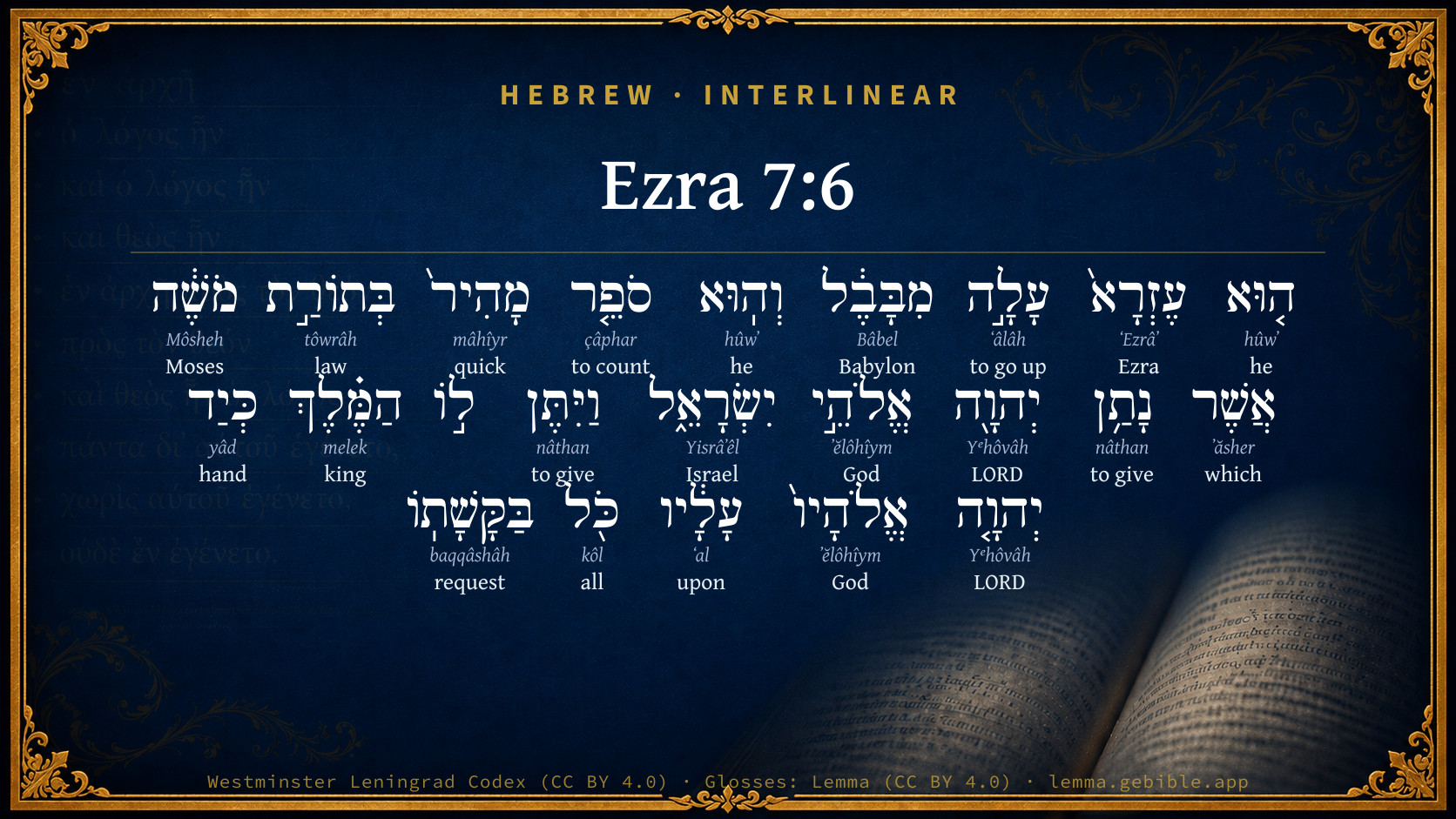
Ezra 7:6

Hebrew (Westminster Leningrad Codex) Ezra 7:6 appears in the Hebrew Old Testament. The text above is from the Westminster Leningrad Codex. Each word links to its Strong’s number, a concise gloss, and parsing drawn from the Open Scriptures Hebrew Bible morphology. Click any word for its full Brown-Driver-Briggs (BDB) entry.
Download image
Cite this verse

Ezra 7:6 (World English Bible). Public Domain. Lemma interlinear Bible study tool, https://lemma.gebible.app/v/ezra/7/6.

Show BibTeX & RIS
BibTeX
RIS
English Translation
this Ezra went up from Babylon: and he was a ready scribe in the law of Moses, which Yahweh, the God of Israel, had given; and the king granted him all his request, according to the hand of Yahweh his God on him.
World English Bible · Public Domain
Highlights
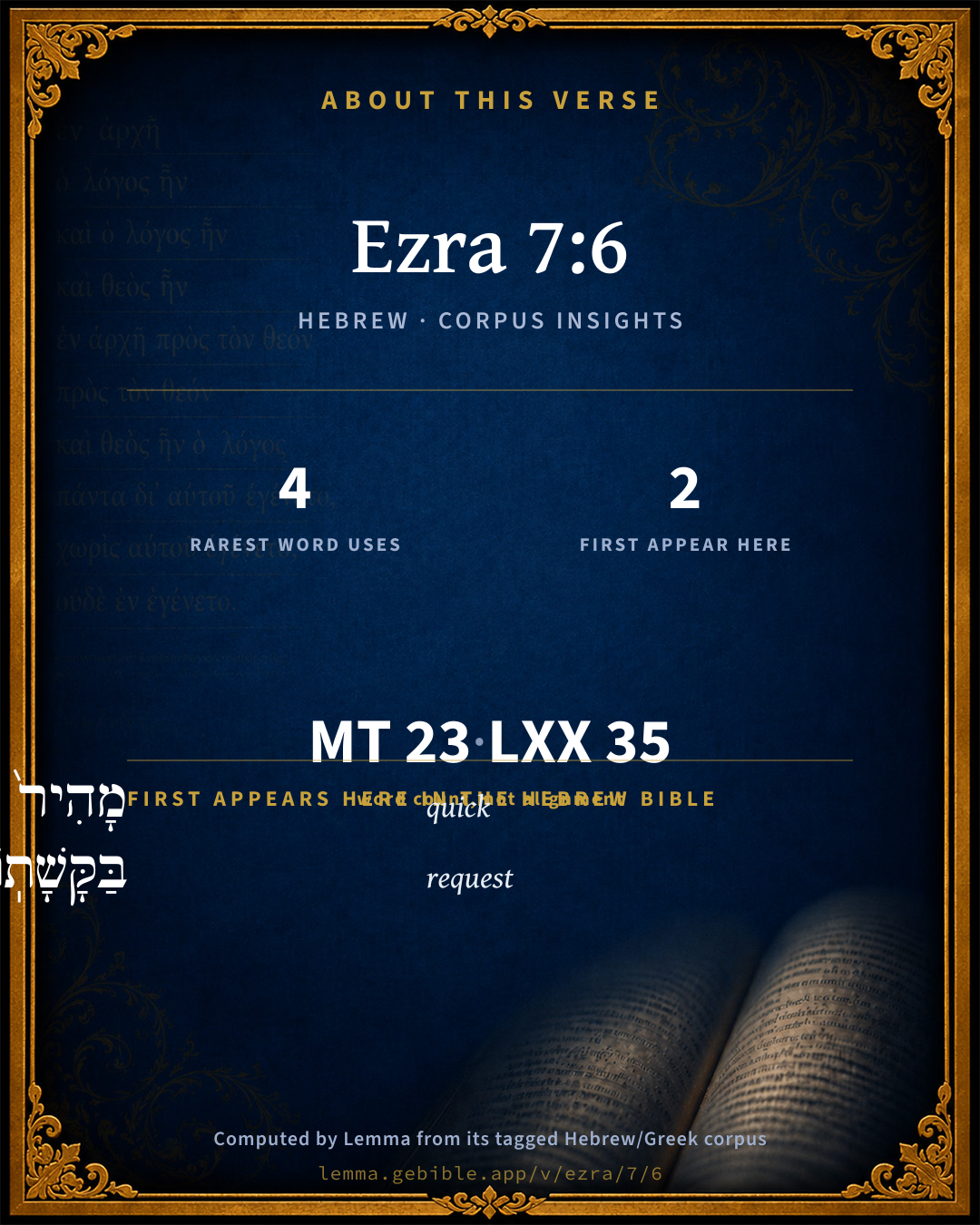
  • 2 first appearances in the Hebrew Bible
Full analysis ↓
Download a study sheet

One document with this verse’s original text, its word-by-word gloss line, the meaning frame, cross-references with their text, attributed commentary, and full source and license credits — printable, and it pastes into notes with its structure intact.

This verse Autodidact and up

Study sheet (.html) Plain text (.txt)

A passage Seminary Student

Up to 50 verses in one chapter. A passage sheet keeps up to 6 commentary sources and 12 cross-references per verse, in the order this page ranks them, and says so on the sheet whenever that leaves anything out. Ask for a single verse and you get the Autodidact verse sheet above.

Everything on this page stays free to read, with no account — the sheet is a download of what is already on screen, not access to it.

Want to remove ads? Support Godless Engineer
Compare translations 3

The same verse in 3 English versions, stacked beneath the original-language interlinear above. Click any original word for its lexicon entry.

Each is an independent rendering of the whole verse — the interlinear is not word-aligned to these translations.

Highlighted words mark where these versions differ — a whole-verse word diff, not a word-by-word alignment.

  • World English Bible Public Domain
    this Ezra went up from Babylon: and he was a ready scribe in the law of Moses, which Yahweh, the God of Israel, had given; and the king granted him all his request, according to the hand of Yahweh his God on him.
  • King James Version Public Domain
    This Ezra went up from Babylon; and he was a ready scribe in the law of Moses, which the LORD God of Israel had given: and the king granted him all his request, according to the hand of the LORD his God upon him.
  • unfoldingWord Literal Text CC BY-SA 4.0
    this Ezra went up from Babylon, and he was a skilled scribe in the law of Moses that Yahweh, the God of Israel, had given. And the king granted to him all his request according to the hand of Yahweh his God upon him.

unfoldingWord Literal Text — © unfoldingWord, licensed CC BY-SA 4.0. Word-aligned USFM3 via Door43 (git.door43.org/unfoldingWord/en_ult).

Versions to compare (up to 4)

3 of 4 selected

Show all 18 translations

Every available English version of this verse, each an independent rendering of the whole verse.

  • World English Bible Public Domain
    this Ezra went up from Babylon: and he was a ready scribe in the law of Moses, which Yahweh, the God of Israel, had given; and the king granted him all his request, according to the hand of Yahweh his God on him.
  • Berean Standard Bible Public Domain
    this Ezra came up from Babylon. He was a scribe skilled in the Law of Moses, which the LORD, the God of Israel, had given. The king had granted Ezra all his requests, for the hand of the LORD his God was upon him.
  • Majority Standard Bible Public Domain
    this Ezra came up from Babylon. He was a scribe skilled in the Law of Moses, which the LORD, the God of Israel, had given. The king had granted Ezra all his requests, for the hand of the LORD his God was upon him.
  • King James Version Public Domain
    This Ezra went up from Babylon; and he was a ready scribe in the law of Moses, which the LORD God of Israel had given: and the king granted him all his request, according to the hand of the LORD his God upon him.
  • American Standard Version (1901) Public Domain
    this Ezra went up from Babylon: and he was a ready scribe in the law of Moses, which Jehovah, the God of Israel, had given; and the king granted him all his request, according to the hand of Jehovah his God upon him.
  • Revised Version (1885) Public Domain
    this Ezra went up from Babylon; and he was a ready scribe in the law of Moses, which the LORD, the God of Israel, had given: and the king granted him all his request, according to the hand of the LORD his God upon him.
  • Geneva Bible (1599) Public Domain
    This Ezra came vp from Babel, and was a Scribe prompt in the Lawe of Moses, which the Lord God of Israel had giuen, and the King gaue him all his request according to the hande of the Lord his God which was vpon him.
  • Douay-Rheims (1899) Public Domain
    This Esdras went up from Babylon, and he was a ready scribe in the law of Moses, which the Lord God had given to Israel: and the king granted him all his request, according to the hand of the Lord his God upon him.
  • Young's Literal Translation Public Domain
    Ezra himself hath come up from Babylon, and he `is' a scribe ready in the law of Moses, that Jehovah God of Israel gave, and the king giveth to him -- according to the hand of Jehovah his God upon him -- all his request.
  • Literal Standard Version CC BY-SA 4.0
    Ezra himself has come up from Babylon, and he [is] a scribe ready in the Law of Moses, that YHWH God of Israel gave, and the king gives to him—according to the hand of his God YHWH on him—all his request.
  • Unlocked Literal Bible CC BY-SA 4.0
    Ezra came up from Babylon and he was a skilled scribe in the law of Moses that Yahweh, the God of Israel, had given. The king gave him anything he asked since the hand of Yahweh was with him.
  • unfoldingWord Literal Text CC BY-SA 4.0
    this Ezra went up from Babylon, and he was a skilled scribe in the law of Moses that Yahweh, the God of Israel, had given. And the king granted to him all his request according to the hand of Yahweh his God upon him.
  • Darby Bible Public Domain
    -- this Ezra went up from Babylon; and he was a ready scribe in the law of Moses, which Jehovah the God of Israel had given. And the king granted him all his request, according to the hand of Jehovah his God upon him.
  • World Messianic Bible Public Domain
    this Ezra went up from Babylon. He was a skilled scribe in the Torah of Moses, which the LORD, the God of Israel, had given; and the king granted him all his request, according to the LORD his God’s hand on him.
  • Webster's Bible Public Domain
    This Ezra went from Babylon; and he was a ready scribe in the law of Moses, which the LORD God of Israel had given: and the king granted him all his request, according to the hand of the LORD his God upon him.
  • Free Bible Version CC BY-SA 4.0
    This Ezra arrived from Babylon, and was a scribe who was an expert in the Law of Moses, which the Lord, the God of Israel, had given to Israel. The king had granted Ezra everything he'd asked for, because the Lord his God was with him.
  • Bible in Basic English Public Domain
    This Ezra went up from Babylon; and he was a scribe, expert in the law of Moses which the Lord, the God of Israel, had given: and the king, moved by the Lord his God, gave him whatever he made request for.
  • JPS Tanakh (1917) Public Domain
    this Ezra went up from Babylon; and he was a ready scribe in the Law of Moses, which the LORD, the God of Israel, had given; and the king granted him all his request, according to the hand of the LORD his God upon him.

Literal Standard Version (2020), Covenant Press — licensed CC BY-SA 4.0. Text via the HelloAO Bible API (eBible.org). Unlocked Literal Bible (unfoldingWord) — licensed CC BY-SA 4.0. Text via the HelloAO Bible API (eBible.org). unfoldingWord Literal Text — © unfoldingWord, licensed CC BY-SA 4.0. Word-aligned USFM3 via Door43 (git.door43.org/unfoldingWord/en_ult). Free Bible Version, Dr. Jonathan Gallagher — licensed CC BY-SA 4.0. Text via the HelloAO Bible API (eBible.org).

Word by word

More ways to search: Search by grammar → Find every occurrence → Compare this word →

Practice this passage: Drill this verse → Learn its vocabulary →

מָהִיר֙
mâhîyr
H4106
“quick”
Adjective, Adjective, Masculine, Singular, Absolute
Part of Speech
Adjective
Type
Adjective
Gender
Masculine
Number
Singular
State
Absolute
Full BDB Definition

Origin: from H4116

TWOT: 1152c

quick, prompt, skilled, ready
  1. ה֤וּא hûwʼ H1931 “he” Pronoun, Personal, 3rd Person, Masculine, Singular
  2. עֶזְרָא֙ ʻEzrâʼ H5830 “Ezra” Noun, Proper
  3. עָלָ֣ה ʻâlâh H5927 “to go up” Verb, Qal, Perfect, 3rd Person, Masculine, Singular
  4. מִבָּבֶ֔ל Bâbel H894 “from · Babylon” Preposition + Noun, Proper
  5. וְהֽוּא hûwʼ H1931 “and · he” Conjunction + Pronoun, Personal, 3rd Person, Masculine, Singular
  6. סֹפֵ֤ר çâphar H5608 “scribe” Noun, Common, Masculine, Singular, Absolute
  7. בְּתוֹרַ֣ת tôwrâh H8451 “in/at · law of” Preposition + Noun, Common, Feminine, Singular, Construct
  8. מֹשֶׁ֔ה Môsheh H4872 “Moses” Noun, Proper
  9. אֲשֶׁר ʼăsher H834 “which” Particle, Relative
  10. נָתַ֥ן nâthan H5414 “to give” Verb, Qal, Perfect, 3rd Person, Masculine, Singular
  11. יְהוָ֖ה Yᵉhôvâh H3068 “LORD” Noun, Proper
  12. אֱלֹהֵ֣י ʼĕlôhîym H430 “God(s) of” Noun, Common, Masculine, Plural, Construct
  13. יִשְׂרָאֵ֑ל Yisrâʼêl H3478 “Israel” Noun, Proper
  14. וַיִּתֶּן nâthan H5414 “and · to give” Conjunction + Verb, Qal, Sequential Imperfect, 3rd Person, Masculine, Singular
  15. הַמֶּ֗לֶךְ melek H4428 “the · king” Particle, Definite Article + Noun, Common, Masculine, Singular, Absolute
  16. כְּיַד yâd H3027 “like/as · hand of” Preposition + Noun, Common, Both, Singular, Construct
  17. יְהוָ֤ה Yᵉhôvâh H3068 “LORD” Noun, Proper
  18. אֱלֹהָיו֙ ʼĕlôhîym H430 “God(s) · his” Noun, Common, Masculine, Plural, Construct + Suffix, Personal, 3rd Person, Masculine, Singular
  19. עָלָ֔יו ʻal H5921 “upon · him” Preposition + Suffix, Personal, 3rd Person, Masculine, Singular
  20. כֹּ֖ל kôl H3605 “all of” Noun, Common, Masculine, Singular, Construct
  21. בַּקָּשָׁתֽוֹ baqqâshâh H1246 “request · his” Noun, Common, Feminine, Singular, Construct + Suffix, Personal, 3rd Person, Masculine, Singular

About this verse

These counts appear in no published source. They are computed here, from the morphology-tagged text and Lemma’s own curated glosses. What Lemma adds →

23
words
18
distinct lemmas
Historical
section

Notable vocabulary

The rarest word here is מָהִיר֙ quick H4106 — appearing just 4 times in the whole Hebrew Bible.

First appearance in Scripture

These words make their first canonical appearance in the Hebrew Bible here:

  • מָהִיר֙ quick H4106
  • בַּקָּשָׁתֽוֹ request H1246

Shared distinctive vocabulary

מָהִיר֙ quick H4106 occurs in 4 verses of the Hebrew Bible. Also found in:

Grammatical profile

  • 3 verbs
  • 14 nouns
  • 1 adjective
  • 2 pronouns
  • 2 prepositions
  • 1 particle

Verb forms

  • עָלָ֣ה Qal · Perfect
  • נָתַ֥ן Qal · Perfect
  • וַיִּתֶּן Qal · Sequential Imperfect

Repetition

Words recur within this verse — often emphatic in Hebrew:

  • נָתַ֥ן to give H5414 ×2
  • יְהוָ֖ה LORD H3068 ×2
  • אֱלֹהֵ֣י God H430 ×2
  • ה֤וּא he H1931 ×2

Hebrew & Septuagint length

In English translation the verse runs 43 words from the Hebrew and 48 from the Septuagint (LXX English) — closely comparable.

A rough comparison of the two English renderings, which tokenize alike — not a word-level alignment.

Word counts can differ between the Hebrew and the Greek without any difference in meaning — e.g. the Hebrew direct-object marker אֵת has no separate Greek word, and Greek often adds the article ὁ.

In the original languages it is 23 Hebrew tokens and 35 Greek tokens — but the two are counted differently (Hebrew bundles its prefixes and suffixes into one token; the Greek is in lemma form), so that isn’t a like-for-like length.

Cross-references

32

Topical passages linked to Ezra 7:6 in the Treasury of Scripture Knowledge — connected by theme and wording, ordered by reader-vote popularity; previews shown in the World English Bible.

  • Ezra 8:22 For I was ashamed to ask of the king a band of soldiers and horsemen to help us against the enemy in the way, because we had spoken to the king, saying, The hand of our God is on all those who seek him, for good; but his power and his wrath is against all those who forsake him.
  • Ezra 7:28 and has extended loving kindness to me before the king, and his counselors, and before all the king's mighty princes. I was strengthened according to the hand of Yahweh my God on me, and I gathered together out of Israel chief men to go up with me.
  • Ezra 8:31 Then we departed from the river Ahava on the twelfth [day] of the first month, to go to Jerusalem: and the hand of our God was on us, and he delivered us from the hand of the enemy and the bandit by the way.
  • Nehemiah 2:18 I told them of the hand of my God which was good on me, as also of the king's words that he had spoken to me. They said, Let us rise up and build. So they strengthened their hands for the good [work].
  • Ezra 7:21 I, even I Artaxerxes the king, do make a decree to all the treasurers who are beyond the River, that whatever Ezra the priest, the scribe of the law of the God of heaven, shall require of you, it be done with all diligence,
  • Nehemiah 2:8 and a letter to Asaph the keeper of the king's forest, that he may give me timber to make beams for the gates of the castle which appertains to the house, and for the wall of the city, and for the house that I shall enter into. The king granted me, according to the good hand of my God on me.
  • Matthew 28:20 teaching them to observe all things that I commanded you. Behold, I am with you always, even to the end of the age." Amen.
  • Ezra 7:9 For on the first [day] of the first month began he to go up from Babylon; and on the first [day] of the fifth month came he to Jerusalem, according to the good hand of his God on him.
  • Ezra 7:11–12 Now this is the copy of the letter that the king Artaxerxes gave to Ezra the priest, the scribe, even the scribe of the words of the commandments of Yahweh, and of his statutes to Israel:
  • Ezra 8:18 According to the good hand of our God on us they brought us a man of discretion, of the sons of Mahli, the son of Levi, the son of Israel; and Sherebiah, with his sons and his brothers, eighteen;
  • Deuteronomy 4:5 Behold, I have taught you statutes and ordinances, even as Yahweh my God commanded me, that you should do so in the midst of the land where you go in to possess it.
  • Deuteronomy 28:1 It shall happen, if you shall listen diligently to the voice of Yahweh your God, to observe to do all his commandments which I command you this day, who Yahweh your God will set you on high above all the nations of the earth:
  • Proverbs 3:6 In all your ways acknowledge him, And he will direct your paths.
  • Psalms 45:1 My heart overflows with a noble theme. I recite my verses for the king. My tongue is like the pen of a skillful writer.
  • Isaiah 59:1 Behold, Yahweh's hand is not shortened, that it can't save; neither his ear heavy, that it can't hear:
  • 1 Corinthians 1:20 Where is the wise? Where is the scribe? Where is the lawyer of this world? Hasn't God made foolish the wisdom of this world?
  • 1 Corinthians 15:1 Now I declare to you, brothers, the Gospel which I preached to you, which also you received, in which you also stand,
  • 1 Thessalonians 4:1–2 Finally then, brothers, we beg and exhort you in the Lord Jesus, that as you received from us how you ought to walk and to please God, that you abound more and more.
  • Isaiah 50:2 Why, when I came, was there no man? when I called, was there none to answer? Is my hand shortened at all, that it can't redeem? or have I no power to deliver? Behold, at my rebuke I dry up the sea, I make the rivers a wilderness: their fish stink, because there is no water, and die for thirst.
  • Matthew 13:52 He said to them, "Therefore, every scribe who has been made a disciple in the Kingdom of Heaven is like a man who is a householder, who brings out of his treasure new and old things."
  • Ezra 5:5 But the eye of their God was on the elders of the Jews, and they did not make them cease, until the matter should come to Darius, and then answer should be returned by letter concerning it.
  • Ezra 6:22 and kept the feast of unleavened bread seven days with joy: for Yahweh had made them joyful, and had turned the heart of the king of Assyria to them, to strengthen their hands in the work of the house of God, the God of Israel.
  • Nehemiah 1:10–11 Now these are your servants and your people, whom you have redeemed by your great power, and by your strong hand.
  • Nehemiah 2:12 I arose in the night, I and some few men with me; neither told I any man what my God put into my heart to do for Jerusalem; neither was there any animal with me, except the animal that I rode on.
  • Nehemiah 4:15 It happened, when our enemies heard that it was known to us, and God had brought their counsel to nothing, that we returned all of us to the wall, everyone to his work.
  • Nehemiah 8:13 On the second day were gathered together the heads of fathers' [houses] of all the people, the priests, and the Levites, to Ezra the scribe, even to give attention to the words of the law.
  • Nehemiah 12:36 and his brothers, Shemaiah, and Azarel, Milalai, Gilalai, Maai, Nethanel, and Judah, Hanani, with the musical instruments of David the man of God; and Ezra the scribe was before them.
  • Genesis 32:28 He said, "Your name will no longer be called 'Jacob,' but, 'Israel,' for you have fought with God and with men, and have prevailed."
  • Nehemiah 8:4 Ezra the scribe stood on a pulpit of wood, which they had made for the purpose; and beside him stood Mattithiah, and Shema, and Anaiah, and Uriah, and Hilkiah, and Maaseiah, on his right hand; and on his left hand, Pedaiah, and Mishael, and Malchijah, and Hashum, and Hashbaddanah, Zechariah, [and] Meshullam.
  • Nehemiah 8:9 Nehemiah, who was the governor, and Ezra the priest the scribe, and the Levites who taught the people, said to all the people, This day is holy to Yahweh your God; don't mourn, nor weep. For all the people wept, when they heard the words of the law.
  • Nehemiah 12:26 These were in the days of Joiakim the son of Jeshua, the son of Jozadak, and in the days of Nehemiah the governor, and of Ezra the priest the scribe.
  • Jeremiah 8:8 How do you say, We are wise, and the law of Yahweh is with us? But, behold, the false pen of the scribes has worked falsely.

Cross-references courtesy of OpenBible.info (CC BY 4.0).

Hebrew and Greek witnesses Masoretic Hebrew ↔ Greek Septuagint

The same verse in the two great witnesses to the Old Testament, shown verse-for-verse.

These are two independent witnesses, not word-aligned to each other, and the Septuagint is shown in lemma (dictionary) form.

Hebrew Ezra 7:6 Masoretic · Westminster Leningrad Codex

ה֤וּא עֶזְרָא֙ עָלָ֣ה מִבָּבֶ֔ל וְהֽוּא סֹפֵ֤ר מָהִיר֙ בְּתוֹרַ֣ת מֹשֶׁ֔ה אֲשֶׁר נָתַ֥ן יְהוָ֖ה אֱלֹהֵ֣י יִשְׂרָאֵ֑ל וַיִּתֶּן ל֣וֹ הַמֶּ֗לֶךְ כְּיַד יְהוָ֤ה אֱלֹהָיו֙ עָלָ֔יו כֹּ֖ל בַּקָּשָׁתֽוֹ

this Ezra went up from Babylon: and he was a ready scribe in the law of Moses, which Yahweh, the God of Israel, had given; and the king granted him all his request, according to the hand of Yahweh his God on him.

World English Bible · Public Domain

Greek LXX Ezra 7:6 Septuagint · lemma form

αὐτός εσδρας ἀναβαίνω ἐκ βαβυλών καί αὐτός γραμματεύς ταχύς ἐν νόμος μωυσῆς ὅς δίδωμι κύριος ὁ θεός ἰσραήλ καί δίδωμι αὐτός ὁ βασιλεύς ὅτι χείρ κύριος θεός αὐτός ἐπί αὐτός ἐν πᾶς ὅς ζητέω αὐτός

This Esdras went up out of Babylon; and he was a ready scribe in the law of Moses, which the Lord God of Israel gave: and the king gave him leave, for the hand of the Lord his God was upon him in all things which he sought.

LXX2012 (modern English Septuagint) · Public Domain

In the Septuagint this is one book — Esdras B (2 Esdras): Ezra is chapters 1–10, Nehemiah 11–23.

Hebrew: Westminster Leningrad Codex (CC BY 4.0). Greek: Septuagint (public domain); English from LXX2012 (modern English Septuagint) (Public Domain). How the Septuagint differs from the Hebrew →

Commentary

Notes on Ezra 7:6 from classic Christian and Jewish commentators (each source and its license shown beneath its notes). The classic Christian expositions comment on the surrounding passage and are grouped to its opening verse, so a note may address several verses; the Jewish commentaries on the Tanakh (Rashi and others) are per-verse, so they appear only where the commentator wrote on this verse.

Lemma curates 59 commentaries, every one of them public domain or Creative Commons licensed, each selected and text-cleaned for this edition rather than reprinted as found. About our sources →

Trapp's Complete Commentary

John Trapp

Ezr 7:6 This Ezra went up from Babylon; and he [was] a ready scribe in the law of Moses, which the LORD God of Israel had given: and the king granted him all his request, according to the hand of the LORD his God upon him.

Ver. 6. This Ezra went up from Babylon] Together with many others, who were moved thereunto by his example and authority. He was (as one saith of Tiberius) imperio magnus, exemplo maior. Great men are looking glasses, according to which most men dress themselves; let them look to it, therefore, and shine as lamps.

And he was a ready scribe] Or a nimble textman: his office was to write out copies of the law, and to interpret it. He wrote (say some) the Hebrew Bible out in Chaldee letters (the same that we now call Hebrew, the ancient Hebrew characters remained with the Samaritans) for the use of his countrymen returned out of Chaldea. He first ordained (say others) the vowels, accents, and Masoreth. A great scholar he was, and excellently well seen in the learning of Scripture: to which all other skill is but straminea candela, a rush candle, a small light, that serveth but to light men into utter darkness. Be wise be learned, saith the Psalmist; but in addition serve the Lord with fear, kiss the Son, &c., Psa 2:12 otherwise ye may be as learned as Varro, that general scholar; as Albertus Magnus, quem nihil penitus fugit, omnia perfecte novit, who knew whatsoever was knowable, as one saith of him or as Tostatus (otherwise called Abulensis), qui omnium scientiarum doctrinarumque arca fuit et emporium, saith Bonosius, that writes his life who was a living library; and yet ye may perish everlastingly. The Jews called their learned men Scribes, as the Persians did theirs Magi the French, Druids; the Indians, Brahmans &c. But he that is not a scribe instructed, and instructing others, to the kingdom of heaven Mat 13:52, shall hear, "Where is the wise? where is the scribe? where is the disputer of this world?" 1Co 1:20, Sapientes sapienter in infernum descendent The wise, wisely descend into hell. (Aug.).

Which the Lord God of Israel had given] The moral law, with his own immediate mouth (so that he might say with Joseph, Gen 45:12, "Behold, your eyes see, that it is my mouth that speaketh unto you"), the other laws he ordained by angels in the hand of a Mediator, i.e. of Moses, Gal 3:19. Hence Josephus calleth the Jewish polity a theocracy; and Prosper thinketh that they were called Judaei, because they received ius Dei, the Law from God. But we can give a better derivation from the Hebrew, viz. Jews, i.e. confessors, such as were those above, Ezr 5:11.

And the king granted him all his request] Giving him more and greater things than he dared desire. So great facility and flexibleness found he in this king, that he needed only to ask, and give thanks; as it is said of Tiberius, that he never denied his favourite Sejanus anything; but often prevented his request, and avowed that be deserved much more.

According to the hand of the Lord his God upon him] i.e. His sweet and singular providence, ever watching over, and working for those that are good, 2Ch 19:11. Such may well sit and sing as one did once,

Una est in trepida mihi re medicina, Iehovae

Cor patrium, Os verax, omnipotensque Manus.

John Trapp, A Commentary or Exposition upon All the Books of the Old and New Testament (1647–1656) — public domain. Text from a community e-Sword module.

Joseph Benson's Commentary

Ezr 7:6. This Ezra went up from Babylon — With the king’s consent and commission. And he was a ready scribe in the law of Moses — He is called a scribe, as Buxtorf observes in his Tiberias, not from writing and describing, but from declaring and explicating those things that are contained in the Scripture. For, as ספר, sepher, signifies a book, so סופר, sopher, signifies one skilful and learned in that book, an interpreter and teacher out of it. And, there being no book comparable to the book of the law, therefore Sopher became a name of great dignity, and signified one that taught God’s law, and expounded it to his people. Thus, in the New Testament, the scribes were those who instructed the people in the law. It is said he was a ready scribe, because he was expert in the law, and understood it thoroughly, both in all things belonging to the priesthood, and to the civil power; in which he was so well versed, that he could give a ready account of any part of it. The Jews say, he collected and collated all the copies of the law, and published an accurate edition of it, with all the books that were given by divine inspiration, and so made up the canon of the Old Testament. Moses in Egypt, and Ezra in Babylon, were wonderfully fitted for eminent service in the church. This was the second time that Ezra came up from Babylon, for he came up at first with Zerubbabel, as we learn from Neh 12:1, and probably returned to Babylon to persuade those who had staid behind to come up to Jerusalem, and to obtain some further assistance from the king. According to the hand of the Lord his God upon him — God not only stirred up Ezra to this undertaking, but was so favourable to him as to incline the king to give a gracious answer to his petition.

Joseph Benson's Commentary on the Old and New Testaments (1811–1818) — public domain. Text from a community e-Sword module.

Tyndale Open Study Notes

Tyndale Open Resources

7:6 Ezra came from Babylon, where there was still a substantial and prosperous Jewish community. • The Hebrew term translated scribe is sometimes translated as “secretary.” It describes an educated and reliable individual who transcribed and interpreted official documents. Accordingly, many scholars think that Ezra functioned like a “Secretary of State for Jewish Affairs” in the Persian government. Here, however, the emphasis is on his scribal role of studying and teaching from the five Books of Moses.

Tyndale Open Study Notes — © Tyndale Open Resources, licensed CC BY-SA 4.0. Text via the HelloAO Bible API.

Geneva Bible (1599)

Geneva Bible translators

He showeth here what a Scribe is, who had charge to write the Law and to expound it, whom Mark calleth a Scribe, Mark 12:28, Matthew and Luke called him a Lawyer or doctor of the Law, Matt. 22:35; Luke 10:25.

Geneva Bible (1599) marginal notes — public domain. Text via Bolls.life.

Jamieson, Fausset & Brown

Robert Jamieson, A. R. Fausset & David Brown

This Ezra . . . was a ready scribe in the law of Moses--The term "scribe" does not mean merely a penman, nor even an attorney well versed in forms of law and skilled in the method of preparing public or private deeds. He was a rabbi, or doctor, learned in the Mosaic law, and in all that related to the civil and ecclesiastical polity and customs of the Hebrew people. Scribes of this description possessed great authority and influence (compare Mat 23:25; Mar 12:28).

the king granted him all his request--left Babylon entrusted with an important commission to be executed in Jerusalem. The manner in which he obtained this office is minutely related in a subsequent passage. Here it is noticed, but with a pious acknowledgment of the divine grace and goodness which disposed the royal mind in favor of Ezra's patriotic objects. The Levites, &c., did not go at that time, but are mentioned here by anticipation.

Jamieson, Fausset & Brown — Commentary Critical and Explanatory on the Whole Bible (1871) — public domain (CC PDM 1.0). Text via the HelloAO Bible API.

Adam Clarke's Commentary

Verse 6. A ready scribe] סופר מחיר sopher machir does not merely signify a speedy writer or an excellent penman, but one who was eminently skilful in expounding the law. In this sense the word γραμματευς, scribe, is repeatedly used in the New Testament, and we find that both in the Old and New Testament it had the same signification. The Syriac gives the sense of the word by translating [Persian] sophro chocimo, a wise scribe, or expounder.

Adam Clarke's Commentary on the Bible (1810–1826) — public domain. Text from a community e-Sword/MySword module.

Ellicott's Commentary for English Readers

(6) A ready scribe.—The “ready writer” of Psa_45:1. Ezra was a priest, and this title is rightly placed before that of scribe in what follows; but here at the outset, when he first appears in history, the title is used which expressed his pre-eminent function, that of guarding and interpreting the law (Ezr_7:10).

All his request.—This anticipates the letter of Ezr_7:11; a series of supplementary notes intervenes.

According to the hand of the Lord his God upon him.—The full formula for that special providence over God’s servants which both Ezra and Nehemiah recognised.

A Bible Commentary for English Readers, edited by Charles John Ellicott (1878–1897) — public domain. Text from a community e-Sword module.

The Cambridge Bible for Schools and Colleges

gen. ed. J. J. S. Perowne

6–10. Arrival at Jerusalem

6. went up from Babylon] i.e. to Jerusalem, cf. Ezr_1:11, Ezr_2:1. It will be observed that this description of Ezra is given in the 3rd person. At Ezr_7:27 there is a change to the 1st person.

and he was a ready scribe in the law of Moses] Cf. Ezr_7:10; Ezr_7:12.

‘the scribe’ (Hebr. Sophêr) in the days of the Monarchy was the king’s State Secretary or Chancellor. Cf. Seraiah, the scribe (2Sa_8:17), Sheva, the scribe (2Sa_20:25) = Shavsha (1Ch_18:16): Elihoreph and Ahijah, scribes (1Ki_4:3): Shebna, the scribe (2Ki_18:18, &c.): Shaphan, the scribe (2Ki_22:3). Cf. Gemariah (Jer_36:10), Elishama (Jer_36:12), Jonathan (Jer_37:15).

During the latter days of the Monarchy, the name began to receive a special meaning as applied to those who were occupied in studying and copying the documents containing the sacred laws of the nation, e.g. Jer_8:8 ‘How do ye say, We are wise, and the law of the Lord is with us? But, behold, the false pen of the scribes hath wrought falsely’.

After the Captivity, the increased importance of the written law and the necessity of explaining its obligation upon the people brought ‘the scribes’ into great prominence. ‘The scribe’ took the place of the prophet and, in his influence upon his countrymen, eclipsed the priest. The name of Ezra is associated with the development of ‘the scribe’ and he is designated ‘the scribe’ as by an honourable title in Ezr_7:11, and Neh_8:1. He was the typical representative and in a measure the founder of the later type of scribes. Devoted to the minute study of the written law, he sought to expound it to his people and to impress upon them the duty of its rigid observance. (See Introduction.) To the same class perhaps belonged ‘the teachers’ mentioned in Ezr_8:16, and ‘Zadok the scribe’ (Neh_13:13).

The word ‘ready’ is the same as appears elsewhere in the O.T. only in Psa_45:1 ‘a ready writer’. Pro_22:29 ‘diligent in his business’. Isa_16:5 ‘swift to do righteousness’. A ‘ready scribe’ would be one prompt and skilful in interpreting the difficulties of the law. His quickness is the dexterity of his erudition, not of his pen.

the law of Moses, which the Lord God of Israel had given] R.V. the Lord the God of Israel, cf. Ezr_1:3. ‘The law of Moses’, see Ezr_3:2, Ezr_6:18, and cf. 1Ki_2:3, 2Ki_14:6; 2Ki_21:8.

The Divine origin of the law is here asserted with reverent emphasis. The expression is well illustrated by Mal_4:4 ‘the law of Moses my servant, which I commanded unto him in Horeb for all Israel, even statutes and judgements’ and Neh_8:14 ‘The law which the Lord had commanded by Moses’.

all his request] What the request was, which Ezra preferred to Artaxerxes, we are not told, but are left to gather it from the letter of Artaxerxes (12–26). The word ‘request’ in the Hebrew denotes an eager quest, and occurs elsewhere in the O.T. only in the book of Esther (Ezr_5:3; Ezr_5:7-8, Ezr_7:3, Ezr_9:12).

according to the hand of the Lord his God upon him] This expression is characteristic of the writer. It occurs again Ezr_7:28, with the adjective ‘good’, Ezr_7:9, Ezr_8:18; Neh_2:8; Neh_2:18, and in a slightly different form Ezr_8:22; Ezr_8:31. ‘The hand of the Lord’ denotes the merciful favour, as may be seen from the context here and in Ezr_7:28, even without the addition of the adjective good: cf. ‘the eye of the Lord’, chap. Ezr_5:5. Similar is the phrase in 2Ch_30:12. From that ‘hand’ comes discipline as well as bounty, Job_2:10 ‘Shall we receive good at the hand of God, and shall we not receive evil?’ Job_19:21 ‘the hand of God hath touched me’. In adversity ‘the hand of the Lord’ is described as ‘against’, not ‘upon’ a person. See Deu_2:15; Rth_1:13.

The Cambridge Bible for Schools and Colleges (gen. ed. J. J. S. Perowne; Cambridge University Press, 1878–1918) — public domain. Text from a community e-Sword module.

John Gill's Exposition

This Ezra went up from Babylon,.... A second time; for that he went up with Zerubbabel is clear from Neh 12:1, and is plainly intimated, Ezr 5:4,

and he was a ready scribe in the law of Moses, which the Lord God of Israel had given; the meaning is, not that he had a quick hand in writing out copies of it, but was well versed in the knowledge of it; had studied it thoroughly, well instructed in it, and was abundantly qualified to teach it others; he was an eminent doctor of the law; so scribes, in the New Testament, who are the same with the lawyers, were such as were teachers of the law; the word here used in the Arabic language signifies to be expert, as Jarchi (o) learned from one of their doctors:

and the king granted him all his request, according to the hand of the Lord his God upon him; either upon Ezra, giving him favour with the king, and so success and prosperity; or it may denote the divine influence of the God of Ezra upon the heart of the king, moving him to grant what he asked of him, even everything he desired: he seems to have been sent upon an embassy to the king from the chief men at Jerusalem; perhaps the governors of Syria had not so fully made the disbursements the king in his decree had required them to make, since the following commission chiefly respects such things; and he was sent on that errand to acquaint the king with it, as well as to persuade those that remained to return, and to obtain leave for it.

(o) Comment. in Psal. xlv. 1. "acutus ingenio et solers fuit", Golius, col. 2272. "in re exercitatus fuit et excultus", Castel. col. 2008. Ethiop. "docuit, erudivit", ib. col. 2007.

John Gill's Exposition of the Whole Bible (1746–1763) — public domain (CC PDM 1.0). Text via the HelloAO Bible API.

Albert Barnes' Notes on the Bible

A ready scribe - Or, “a ready writer” Psa 45:1. The professional scribe was well known in Egypt from an early date (see Gen 39:4 note); and under David and his successors “scribes” were attached to the court as the king’s secretaries (2Sa 8:17; 2Sa 20:25; 2Ki 12:10, etc.). It was scarcely, however, until the time of the captivity that the class to which Ezra belonged arose. The “scribes” of this time, and of later Jewish history, were students, interpreters, and copiers of the Law (see the marginal references and Jer 8:8). They retained the knowledge of the old dialect, which was being rapidly superseded by a new one. The emphatic application of the title “the scribe” to Ezra marks the high honor in which the office was now held. Its glories eclipsed those of the priesthood.

The hand of the Lord ... upon him - The use of this phrase in a good sense is rare elsewhere (compare 1Ki 18:46), but is a favorite one with both Ezra and Nehemiah (see the marginal references; Neh 2:8, Neh 2:18).

Albert Barnes' Notes on the Bible (1834–1885) — public domain. Text from a community e-Sword/MySword module.

Haydock's Catholic Bible Commentary

Went up, a second time, 2 Esdras xii. 1. (Worthington) --- Ready. Hebrew mahir, "diligent," &c. (Haydock) --- Scribe, not so much noted for his skill in writing fast, or drawing up deeds, as for his knowledge of the divine law. (Calmet) --- The gospel sometimes gives the title of scribe to the doctors of the law, Matthew xxii. 35., with Mark xii. 28. It is peculiarly due to Esdras, who gave a correct copy of the Scriptures, and wrote them in a different character, leaving the ancient one to the Samaritans, that the people might be less connected. (Bellarmine, De Verb. xx. 1, citing (Tirinus) the most learned Fathers and Jewish writers. (Calmet, Diss.) --- The author of 4 Esdras (xiv. 19,) intimates that the sacred books had been all destroyed, and were dictated again to Esdras by the Holy Spirit. But this book is not of sufficient authority to establish so dangerous an opinion; (Haydock) which is refuted by the whole context of the Bible, in which we see that the law was never forgotten. (Calmet, Diss.) (Du Hamel) --- As Esdras was inspired, what additions he might make, must be accounted divine and authentic. (Calmet) --- Hand; protection, (Delrio, adag. 217,) or inspiration. (Menochius) --- God can incline the heart of the king, (Proverbs xxi.) to accomplish his decrees. (Haydock)

George Leo Haydock (1774–1849), Haydock's Catholic Family Bible and Commentary, 1859 edition — public domain. Excludes Psalms (Douay-Rheims chapter numbering differs from Protestant) and Deuterocanonical books (Catholic canon only).

Matthew Poole's English Annotations

Ezra went up from Babylon, with the king’s consent and commission.

A ready scribe, i.e. a learned and expert doctor; for in that sense the word scribe is oft used, as Jer 8:8; Mat 7:29; Mat 17:10; 23:2,13; Mr 12:28, compared with Mat 22:35,36.

According to the hand of the Lord his God upon him, i.e. by the grace and favour of God so disposing the heart of the king.

Matthew Poole's English Annotations on the Holy Bible (1683–1685) — public domain. Text from a community e-Sword/MySword module.

Whedon's Commentary on the Bible

Daniel D. Whedon

6. A ready scribe in the law of Moses — Not merely skilled as a copyist, the lowest function of a scribe, but a man thoroughly versed in the history and meaning of the law. From the time of the exile the office of scribe obtained among the Jews a character and worth that it never had before. From being a sort of secretary to the king, (see note on 2Sa_8:17,) he now came to be a professional student and expounder of the sacred books. The age of Ezra was a time when the exiles would be especially anxious to gather up and preserve the ancient laws, and all the sacred literature of their nation. The masses of the people had lost the use of the ancient language, and spoke the Aramaic. The times demanded a class of men competent to collect and transcribe the sacred books, and to explain what was difficult and obscure in them. Ezra seemed providentially raised up for this position and work, and, according to Ezr_7:10, “had prepared his heart to seek the law of the Lord, and to do it, and to teach in Israel statutes and judgments.” This ever after was the high office and work of the scribes in Israel, an order of men of which Ezra may be called the founder, and which superseded and took the place of the schools of the prophets (1Sa_10:5, note) of which Samuel was the founder.

All his request — Ezra had probably asked the king for permission and authority to go up with a body of the exiles to Jerusalem. Perhaps he also made request for the silver and gold and other gifts which the king ordered to be given to him. Ezr_7:14-22.

According to the hand of the Lord… upon him — According as it was evident from his abilities and devotion to the law of his God, that he was a divinely-chosen instrument for some important mission.

Daniel D. Whedon (gen. ed.), Commentary on the Old and New Testaments (1874–1909) — public domain. Text from a community e-Sword module.

The Pulpit Commentary

This Ezra went up. See comment on Ezr_2:1, where the same expression up is used. He was a ready scribe in the law of Moses. On the meaning of this phrase, and the new position occupied by scribes" after the captivity, see "Introduction to Ezra," Which the Lord God of Israel had given. It is characteristic of Ezra"s piety never to forget that the law was not a mere human code given by an earthly lawgiver, not even a national treasure, the accumulation of centuries, but a direct Divine gift "the law of the Lord" (ver. 10), "the words of the commandments of the Lord, and of his statutes to Israel" (ver. 11), "the law which the Lord had commanded by Moses". (Neh_8:14) According to the hand of the Lord his God upon him. i.e. "by reason of God"s favour to him." God, by reason of his favour to Ezra, inclined the heart of Artaxerxes towards him, so that he granted all his request. The nature of the "request" is not directly stated, but may be gathered from the "letter of Artaxerxes," especially vers. 13, 14, 16.

The Pulpit Commentary (1880–1919), ed. H.D.M. Spence-Jones & Joseph S. Exell — public domain. Text from a community e-Sword module.

John Wesley's Explanatory Notes

Went - With the king's consent and commission. Scribe - A learned and expert doctor. The Jews say, he collected and collated all the copies of the law, and published an accurate edition of it, with all the books that were given by Divine inspiration, and so made up the canon of the Old Testament. Moses in Egypt, and Ezra in Babylon, were wonderfully fitted for eminent service to the church. According, &c. - By the favour of God so disposing the heart of the king.

John Wesley, Explanatory Notes Upon the Whole Bible (1754–1765) — public domain. Text via the GEBible commentary corpus.

unfoldingWord translationNotes

Door43 World Missions Community

The king gave him anything he asked

"The king gave Ezra anything he asked for"

the hand of Yahweh was with him

The "hand" of Yahweh represents Yahweh's blessing or help. AT: "the blessing of Yahweh was with Ezra" or "Yahweh was blessing Ezra" (See: Metonymy)

in the seventh year of King Artaxerxes

This refers to the seventh year of his reign. AT: "in the seventh year that Artaxerxes was king" (See: Assumed Knowledge and Implicit Information)

translationWords

Ezra

Babylon

scribe

law

Yahweh

God

Israel

Levi

servant

temple

Jerusalem

Artaxerxes

unfoldingWord translationNotes — © Distant Shores Media and the Door43 World Missions Community, licensed CC BY-SA 4.0. Source: git.door43.org/Door43/en_tn.

Rashi

Rabbi Shlomo Yitzchaki (Rashi)

and the king granted him [i.e., King] Darius.

according to the command of the Lord his God upon him as the Holy One, blessed be He, had commanded him. This verse is transposed [its meaning being]: and the King granted him his entire request, according to the command of the Lord upon him. And our Rabbis said (Meg. 15a) that Ezra and Malachi were one and the same.

Rashi on the Tanakh — English translations: “The Judaica Press complete Tanach with Rashi, translated by A. J. Rosenberg” (CC BY 4.0); “Pentateuch with Rashi's commentary by M. Rosenbaum and A.M. Silbermann, 1929-1934” (public domain); “The Metsudah Tanach series, Lakewood, N.J” (CC BY 4.0); and “The Book of Joshua, Metsudah Publications, 1997” (CC BY 4.0). Text via Sefaria.

Lesson kit

Teaching starters — assembled from the data on this page, not authored interpretation. Every prompt links to the verse data it draws on. Edit before teaching.

Ezra, in the Historical, opens this verse with 23 words (18 distinct Hebrew lemmas). Its most distinctive word is mâhîyr (“quick”). A historical commentator’s framing appears above. Read the whole chapter for the surrounding context.

Discussion questions

  1. What does “quick” (mâhîyr) contribute to the verse as a whole?
  2. 2 words make their first appearance in Scripture here. What does this debut establish?
  3. How does Psalms 45:1, which shares the word «quick», read alongside this verse?
  4. What does the repetition of “to give” (2× in this one verse) do in this verse?
  5. The translations on this page render this verse differently — a whole-verse word diff, not a word-by-word alignment. What might account for the different wordings?
  6. «עָלָ֣ה» is a Qal Perfect verb. How does that grammatical form shape the action described?
  7. Compare how Trapp's Complete Commentary and Joseph Benson's Commentary read this verse. Where do they agree or differ?

Things to notice

Reading settings

Reading text

Shown beneath each verse's original-language words.

Old Testament
Old Testament edition

Read the OT as the Masoretic Hebrew (MT) or the Greek Septuagint (LXX).

English shown for the Greek Septuagint (in the Hebrew ↔ Greek comparison).

Comparing translations? Open the Compare panel on any verse page to stack up to four side by side.