
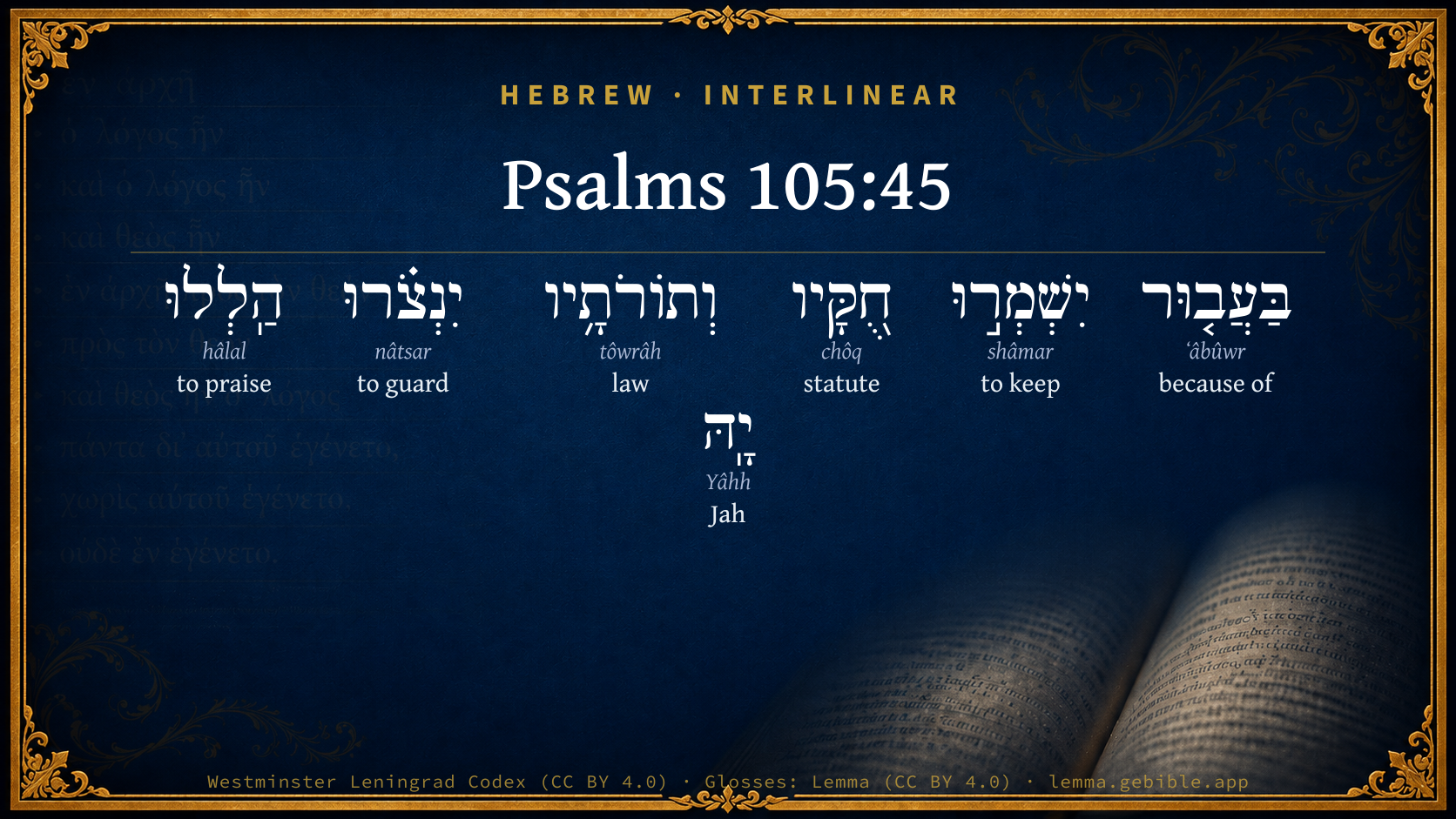
Psalms 105:45

Hebrew (Westminster Leningrad Codex) Psalms 105:45 appears in the Hebrew Old Testament. The text above is from the Westminster Leningrad Codex. Each word links to its Strong’s number, a concise gloss, and parsing drawn from the Open Scriptures Hebrew Bible morphology. Click any word for its full Brown-Driver-Briggs (BDB) entry.
Download image
Cite this verse

Psalms 105:45 (World English Bible). Public Domain. Lemma interlinear Bible study tool, https://lemma.gebible.app/v/psalms/105/45.

Show BibTeX & RIS
BibTeX
RIS
English Translation
That they might keep his statutes, And observe his laws. Praise Yah!
World English Bible · Public Domain
Download a study sheet

One document with this verse’s original text, its word-by-word gloss line, the meaning frame, cross-references with their text, attributed commentary, and full source and license credits — printable, and it pastes into notes with its structure intact.

This verse Autodidact and up

Study sheet (.html) Plain text (.txt)

A passage Seminary Student

Up to 50 verses in one chapter. A passage sheet keeps up to 6 commentary sources and 12 cross-references per verse, in the order this page ranks them, and says so on the sheet whenever that leaves anything out. Ask for a single verse and you get the Autodidact verse sheet above.

Everything on this page stays free to read, with no account — the sheet is a download of what is already on screen, not access to it.

Want to remove ads? Support Godless Engineer
Compare translations 3

The same verse in 3 English versions, stacked beneath the original-language interlinear above. Click any original word for its lexicon entry.

Each is an independent rendering of the whole verse — the interlinear is not word-aligned to these translations.

Highlighted words mark where these versions differ — a whole-verse word diff, not a word-by-word alignment.

  • World English Bible Public Domain
    That they might keep his statutes, And observe his laws. Praise Yah!
  • King James Version Public Domain
    That they might observe his statutes, and keep his laws. Praise ye the LORD.
  • unfoldingWord Literal Text CC BY-SA 4.0
    so that they might keep his statutes and comply with his laws. Hallelu Yah!

unfoldingWord Literal Text — © unfoldingWord, licensed CC BY-SA 4.0. Word-aligned USFM3 via Door43 (git.door43.org/unfoldingWord/en_ult).

Versions to compare (up to 4)

3 of 4 selected

Show all 18 translations

Every available English version of this verse, each an independent rendering of the whole verse.

  • World English Bible Public Domain
    That they might keep his statutes, And observe his laws. Praise Yah!
  • Berean Standard Bible Public Domain
    that they might keep His statutes and obey His laws. Hallelujah!
  • Majority Standard Bible Public Domain
    that they might keep His statutes and obey His laws. Hallelujah!
  • King James Version Public Domain
    That they might observe his statutes, and keep his laws. Praise ye the LORD.
  • American Standard Version (1901) Public Domain
    That they might keep his statutes, And observe his laws. Praise ye Jehovah.
  • Revised Version (1885) Public Domain
    That they might keep his statutes, and observe his laws. Praise ye the LORD.
  • Geneva Bible (1599) Public Domain
    That they might keepe his statutes, and obserue his Lawes. Prayse ye the Lord.
  • Douay-Rheims (1899) Public Domain
    That they might observe his justifications, and seek after his law.
  • Young's Literal Translation Public Domain
    That they may observe His statutes, And His laws may keep. Praise ye Jehovah!
  • Literal Standard Version CC BY-SA 4.0
    That they may observe His statutes, || And may keep His laws. Praise YAH!
  • Unlocked Literal Bible CC BY-SA 4.0
    so that they might keep his statutes and obey his laws. Praise Yahweh.
  • unfoldingWord Literal Text CC BY-SA 4.0
    so that they might keep his statutes and comply with his laws. Hallelu Yah!
  • Darby Bible Public Domain
    That they might keep his statutes, and observe his laws. Hallelujah!
  • World Messianic Bible Public Domain
    that they might keep his statutes, and observe his laws. Praise the LORD!
  • Webster's Bible Public Domain
    That they might observe his statutes, and keep his laws. Praise ye the LORD.
  • Free Bible Version CC BY-SA 4.0
    The Lord did this so they could follow his instructions and keep his laws. Praise the Lord!
  • Bible in Basic English Public Domain
    So that they might keep his orders, and be true to his laws. Give praise to the Lord.
  • JPS Tanakh (1917) Public Domain
    That they might keep His statutes, and observe His laws. Hallelujah.

Literal Standard Version (2020), Covenant Press — licensed CC BY-SA 4.0. Text via the HelloAO Bible API (eBible.org). Unlocked Literal Bible (unfoldingWord) — licensed CC BY-SA 4.0. Text via the HelloAO Bible API (eBible.org). unfoldingWord Literal Text — © unfoldingWord, licensed CC BY-SA 4.0. Word-aligned USFM3 via Door43 (git.door43.org/unfoldingWord/en_ult). Free Bible Version, Dr. Jonathan Gallagher — licensed CC BY-SA 4.0. Text via the HelloAO Bible API (eBible.org).

Word by word

More ways to search: Search by grammar → Find every occurrence → Compare this word →

Practice this passage: Drill this verse → Learn its vocabulary →

About this verse

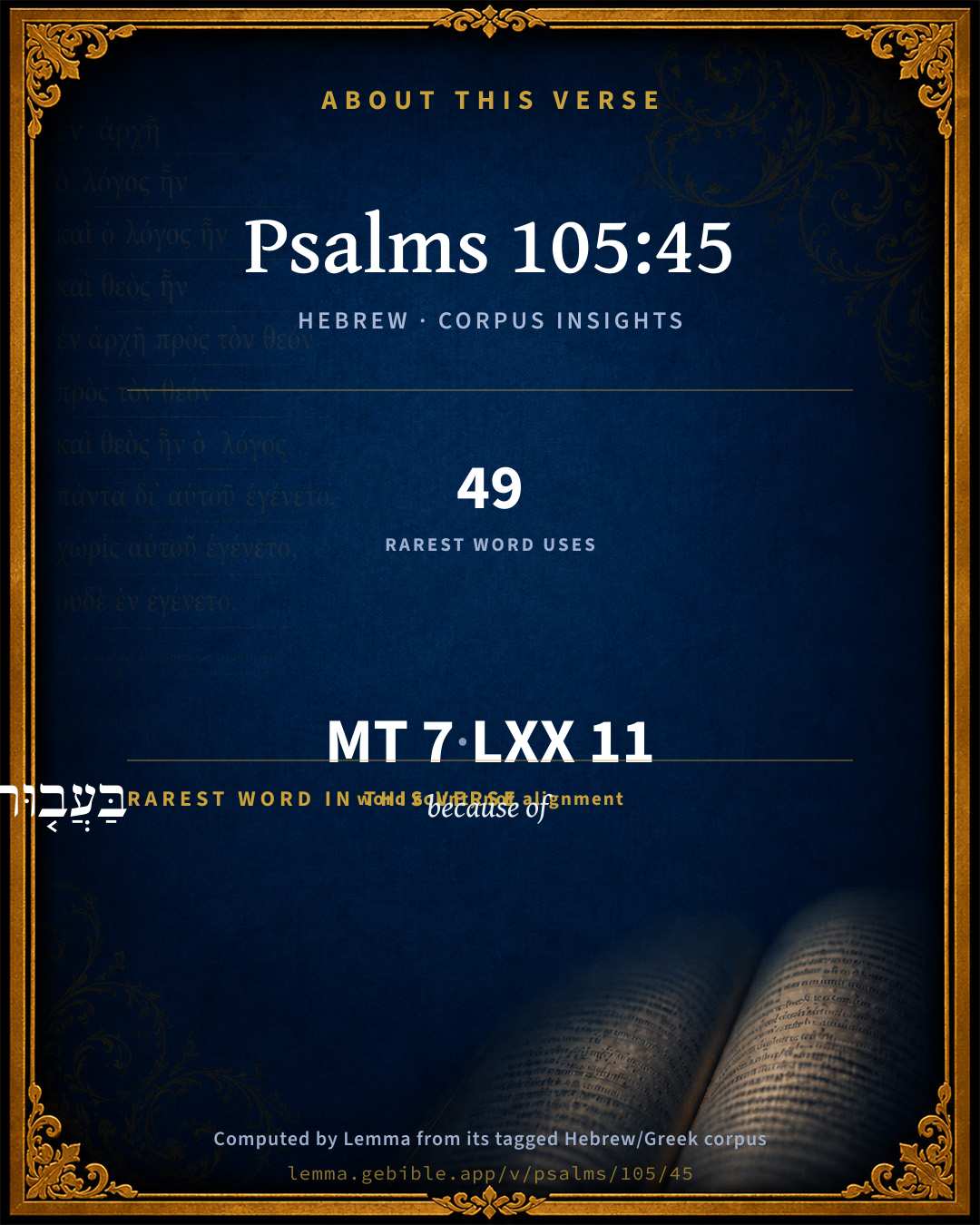
These counts appear in no published source. They are computed here, from the morphology-tagged text and Lemma’s own curated glosses. What Lemma adds →

7
words
7
distinct lemmas
Wisdom
section

Shared distinctive vocabulary

בַּעֲב֤וּר because of H5668 occurs in 47 verses of the Hebrew Bible. Also found in:

Grammatical profile

  • 3 verbs
  • 4 nouns

Verb forms

  • יִשְׁמְר֣וּ Qal · Imperfect
  • יִנְצֹ֗רוּ Qal · Imperfect
  • הַֽלְלוּ Piel · Imperative

Hebrew & Septuagint length

In English translation the verse runs 12 words from the Hebrew and 11 from the Septuagint (LXX English) — closely comparable.

A rough comparison of the two English renderings, which tokenize alike — not a word-level alignment.

Word counts can differ between the Hebrew and the Greek without any difference in meaning — e.g. the Hebrew direct-object marker אֵת has no separate Greek word, and Greek often adds the article ὁ.

In the original languages it is 7 Hebrew tokens and 11 Greek tokens — but the two are counted differently (Hebrew bundles its prefixes and suffixes into one token; the Greek is in lemma form), so that isn’t a like-for-like length.

Cross-references

10

Topical passages linked to Psalms 105:45 in the Treasury of Scripture Knowledge — connected by theme and wording, ordered by reader-vote popularity; previews shown in the World English Bible.

  • Deuteronomy 4:40 You shall keep his statutes, and his commandments, which I command you this day, that it may go well with you, and with your children after you, and that you may prolong your days in the land, which Yahweh your God gives you, forever.
  • Titus 2:14 who gave himself for us, that he might redeem us from all iniquity, and purify for himself a people for his own possession, zealous for good works.
  • Ephesians 2:8–10 for by grace you have been saved through faith, and that not of yourselves; it is the gift of God,
  • Deuteronomy 4:1 Now, Israel, listen to the statutes and to the ordinances, which I teach you, to do them; that you may live, and go in and possess the land which Yahweh, the God of your fathers, gives you.
  • Psalms 106:1 Praise Yahweh! Give thanks to Yahweh, for he is good, For his loving kindness endures forever.
  • Revelation 19:3–4 A second said, "Hallelujah! Her smoke goes up forever and ever."
  • Deuteronomy 5:33–6:2 You shall walk in all the way which Yahweh your God has commanded you, that you may live, and that it may be well with you, and that you may prolong your days in the land which you shall possess.
  • Deuteronomy 6:21–25 then you shall tell your son, We were Pharaoh's bondservants in Egypt: and Yahweh brought us out of Egypt with a mighty hand;
  • Psalms 150:1 Praise Yah! Praise God in his sanctuary! Praise him in his heavens for his acts of power!
  • Ezekiel 36:24–28 For I will take you from among the nations, and gather you out of all the countries, and will bring you into your own land.

Cross-references courtesy of OpenBible.info (CC BY 4.0).

Hebrew and Greek witnesses Masoretic Hebrew ↔ Greek Septuagint

The same verse in the two great witnesses to the Old Testament, shown verse-for-verse.

You’re reading Greek Psalm 104 (Hebrew Psalm 105). The Septuagint counts the superscription, so verse numbers can differ from the Hebrew — chapter-level alignment, not verse-by-verse. Numbering follows Rahlfs.

These are two independent witnesses, not word-aligned to each other, and the Septuagint is shown in lemma (dictionary) form.

Hebrew Psalms 105:45 Masoretic · Westminster Leningrad Codex

בַּעֲב֤וּר יִשְׁמְר֣וּ חֻ֭קָּיו וְתוֹרֹתָ֥יו יִנְצֹ֗רוּ הַֽלְלוּ יָֽהּ

That they might keep his statutes, And observe his laws. Praise Yah!

World English Bible · Public Domain

Greek LXX Greek Psalm 104:45 Septuagint · lemma form

ὅπως ἄν φυλάσσω ὁ δικαίωμα αὐτός καί ὁ νόμος αὐτός ἐκζητέω

that they might keep his ordinances, and diligently seek his law.

LXX2012 (modern English Septuagint) · Public Domain

On this verse, The Cambridge Bible for Schools and Colleges discusses the Septuagint’s reading. Read the note in Commentary ↓

Hebrew: Westminster Leningrad Codex (CC BY 4.0). Greek: Septuagint (public domain); English from LXX2012 (modern English Septuagint) (Public Domain). How the Septuagint differs from the Hebrew →

Commentary

Notes on Psalms 105:45 from classic Christian and Jewish commentators (each source and its license shown beneath its notes). The classic Christian expositions comment on the surrounding passage and are grouped to its opening verse, so a note may address several verses; the Jewish commentaries on the Tanakh (Rashi and others) are per-verse, so they appear only where the commentator wrote on this verse.

Lemma curates 59 commentaries, every one of them public domain or Creative Commons licensed, each selected and text-cleaned for this edition rather than reprinted as found. About our sources →

Trapp's Complete Commentary

John Trapp

Psa 105:45 That they might observe his statutes, and keep his laws. Praise ye the LORD.

Ver. 45. That they might observe his statutes] Here the psalmist showeth the final cause of all the service of God; what should be the result, his praise.

Praise ye the Lord] Loquitur ad prudentes, saith Aben Ezra, this he speaketh to those that are wise; for high words become not a fool, saith Solomon.

John Trapp, A Commentary or Exposition upon All the Books of the Old and New Testament (1647–1656) — public domain. Text from a community e-Sword module.

J. A. Alexander on Psalms

Joseph Addison Alexander

45. (Psa 105:45) To the end that they might keep his statutes and his laws observe. Hallelujah! The emphatic phrase at the beginning, corresponding to our phrases, to the end, for the purpose, or in order that, points this out as the qualification or condition of the promise which had been so gloriously verified. The same condition is expressed or implied elsewhere. See above, on Psa 78:7, and compare Gen 18:19, Deu 4:40; Deu 26:17. Hallelujah (praise ye Jah), as above, in Psa 104:35.

Joseph Addison Alexander, The Psalms Translated and Explained (1850) — public domain. Text from a community e-Sword module.

Tyndale Open Study Notes

Tyndale Open Resources

105:45 The Lord planned for Israel to testify about him by obeying him; Israel was to be his model people.

Tyndale Open Study Notes — © Tyndale Open Resources, licensed CC BY-SA 4.0. Text via the HelloAO Bible API.

Geneva Bible (1599)

Geneva Bible translators

This is the end, why God preserveth his Church, because they should worship, and call upon him in this world.

Geneva Bible (1599) marginal notes — public domain. Text via Bolls.life.

Adam Clarke's Commentary

Verse 45. That they might observe his statutes] That they might be properly instructed, and properly disciplined. This is the end proposed by Divine revelation: men are to be made wise unto salvation, and then to be brought under the yoke of obedience. He who is not conformed to God's word shall not enter into Christ's kingdom.

ANALYSIS OF THE HUNDRED AND FIFTH PSALM

The title of this Psalm is Hallelujah, as are also the two following; and the first fifteen verses of it were sung at the bringing up of the ark by David, 1Ch 16:1; 1Ch 16:7-36.

The scope of it is the same with the two former Psalms, "that we praise God;" but yet with this difference: in the hundred and third, that he be magnified "for his benefits of redemption;" in the hundred and fourth, "for the manifestation of his power and providence in creating, governing, and sustaining the world;" but in this, "for the gracious covenant he made with Abraham, and, in him, with his whole Church."

I. An exhortation to praise God, Ps 105:1-7.

II. An enumeration of the favours God bestowed to persuade to it, Ps 105:7-45.

I. He that loves his prince truly desires also that others should magnify and honour him. This was David's case; he was a true lover of his God, and set a true estimate upon him. He honoured and praised God himself, and desired that others should do the same outwardly and inwards with heart and tongue: he thought all too little, and therefore, he repeats the duty often, and shows how it is to be done.

1. By giving of thanks: "O give thanks unto the Lord."

2. By invocation: "Call upon his name."

3. By communication: "Make known his deeds among the people."

4. By voices, psalms, and hymns: "Sing unto him; sing psalms unto him."

5. By frequent colloquies of his works: "Talk ye of all his wondrous works."

6. By boasting of him: "Glory ye in his holy name." Profess that you are happy men, that God's holy name was ever made known to you. "He that glories, let him glory in the Lord;" 2Co 10:17.

He invites all outwardly to exhibit praise; and now he advises that it be done inwardly also, with exultation and gladness of heart.

1. "Let the heart of them rejoice." The Holy Spirit does not sing but out of a joyous heart.

2. "Let them seek the Lord." For, indeed, they only who seek him rejoice heartily: they can acquiesce in God, in his promises of grace, pardon, and acceptance; which is so necessary to every one who will make his approaches to the throne of grace, and have his praise rendered acceptable, that the prophet seriously urges the duty: -

(1) "Seek the Lord." Cast all impiety and wickedness away: seek him.

(2) "Seek his strength." Which at that time was the ark, it being the symbol of his presence. Seek him in his Church.

(3) "Seek his face evermore." His favour, and grace, and reconciliation; seek them in his word and sacraments, c.

(4) "Evermore seek him." Now and then is too little it must be our constant work.

Having thus spoken of the heart, he comes to the memory: "Remember, forget not." And the things to be remembered are, 1. His marvellous works. 2. His wonders. 3. His judgments; which three are the substance of this whole Psalm, and are explained according to their heads. They ought to be particularly remembered by the Israelites, the posterity of Abraham, and the sons of Jacob.

"Remember his marvellous works," c. "O ye seed of Abraham, his servant ye children of Jacob, his chosen." Remember that he made Abraham and chose Jacob to be his servants, gave you laws, and showed you with what rites he would be worshipped. Forget them not.

II. But at the seventh verse the prophet begins his narration; and tells the Israelites, and in them us, what marvellous works God had done for his people, all which he presses as arguments to his people that they should praise, honour, worship, and obey him. There is much reason for it.

1. "He is the Lord our God." The same argument prefaces the commandments: "I am the Lord thy God."

2. "His judgments are in all the earth." He is a mighty Monarch, and has all nature under his empire.

And if neither of these move, yet there is another, drawn from his many and infinite favours: "On you Israelites," and all mankind as well; for on the fall of man his covenant was, That the seed of the woman should bruise the serpent's head; and this he forgot not: "He hath remembered his covenant," c.

1. "Which covenant he made with Abraham," and confirmed it by sacrifice, Ge 15:13.

2. "His oath unto Isaac," Ge 26:3-4.

3. "And confirmed the same unto Jacob for a law," c. Ge 28:13-15.

4. The form of the covenant recited: "Saying, Unto thee will I give," c. for it was divided to the tribes by lots.

Which covenant God made with their fathers and them, not out of any merit that could be in them De 8:4-6; Jos 24:2.

1. "When there were but a few men," and humble; "yea, very few."

2. And they "strangers" in the land. For the patriarchs only sojourned in Canaan.

3. Yea, "when they went from one nation to another," c.

Now when they were in this condition, very few, strangers, sojourners, and pilgrims, God protected and defended them.

1. "He suffered no man to do them wrong," c. no, not the greatest, for "he reproved even kings for their sakes."

2. For he gave the command: "Touch not mine anointed," - Abraham, Isaac, and Jacob, who were anointed with the Holy Ghost, though not with material oil "and do my prophets no harm," i.e., the same men, for they were prophets. Abraham foresaw the bondage of his seed in Egypt; Isaac foretold what should befall Esau's posterity, Ge 27:38-40; and Jacob, by a prophetical spirit, gave his blessings, Ge 49:1-28. Of Abraham it is expressly said, "He is a prophet, and he shall pray for thee," Ge 20:7.

Two of these mercies, the covenant and protection, are already named; and now he goes on and insists upon the third, Ps 105:16-23, for which there was infinite matter of praise for the wonderful wisdom of God, that brought out of the greatest evils the chiefest good, by preserving their lives in Egypt in the midst of famine, Ge 37:17-36.

1. "Moreover he called for a famine upon the land." It came not by chance.

2. "He brake the whole staff of bread," the upholder of our lives; and this he brake when he ordered that there should be no ploughing, sowing, nor harvest, Ge 45:5-7.

3. By this famine the patriarchs were to suffer; yet God provided for their subsistence: "He sent a man, (a wise man,) before them," - Joseph.

4. This Joseph was sold by the envy and cruelty of his brethren.

And now he comes, 1. To his base usage. 2. His advancement.

1. By the false accusation of Potiphar's wife, who turned her base love into hatred: "His feet were hurt with fetters of iron."

2. "He was laid in iron;" or, as some read, "the iron entered into his soul." Grief that he should lie under foul aspersions.

There he lay: "Until the time that his word came." So long then he lay in prison, and no longer.

1. "Until the time that his word came:" his word - God's word for his deliverance. Or, as others: "Joseph's word to the butler."

2. "The word of the Lord tried him." God tried his patience: or the interpretation of the dreams proved that by the Lord he spake.

And now follows his honour and advancement: -

1. Pharaoh, by his butler, hearing of Joseph's wisdom: "He sent," c.

2. "Even the ruler of the people let him go free." A work fit for a king.

And his advancement follows: -

1. "He made him lord of his house."

2. "A ruler of all his substance." A viceroy, a grand vizier.

The king's end in it not only in the famine to provide bread for their bodies, but for the good of their souls.

1. To punish the rebellious: "To bind his princes at his pleasure."

2. To instruct his counsellors in wisdom, arts, sciences, religion. It is supposed that all the learning in which the Egyptians excelled was first taught them by Joseph.

The fourth benefit follows of God towards his people, Ps 105:22-37, which was their nourishment, increase in Egypt, their oppression, and deliverance.

1. He begins with Jacob's descent thither: 1. "Israel also, Joseph's father, went down into Egypt," Ge 46:2. "And Jacob with all his family," c.

2. He proceeds with their strange increase there for it is wonderful that in so short a time they should grow into such a multitude, Ex 1:7. At their going out they were six hundred thousand, besides children, Ex 12:37: "And he increased his people greatly, and made them stronger than their enemies," Ex 1:9.

This was the occasion of their afflictions, bondage, and sufferings; for, -

1. "He turned the Egyptians' hearts to hate his people." He suffered them to be turned: "For there arose another king," c.

2. "And to deal subtilly with his people. Come on, say they," c.

"To set over them taskmasters," &c. Ex 1:11. But when they saw "that the more they afflicted them, the more they multiplied," Ps 105:12, then they ordered "that all the male children should be strangled by the midwives," Ps 105:16. And when even this would not do, then Pharaoh charged "that every son that was born," c., Ps 105:22. Thus subtilly they dealt but it did not hinder their multiplication. There is no counsel against God.

Now God, seeing their affliction, and hearing their groans, sent them a deliverer.

1. "He sent Moses his servant, and Aaron whom he had chosen."

2. "They showed his signs among them." 1. To the Israelites 2. "And wonders in the land of Ham."

The catalogue follows: -

1. "He sent darkness," c.

2. "He turned their waters into blood," c.

3. "The land brought forth frogs," &c.

4. "He spake, and there came divers sorts of flies," &c.

5. "He gave them hail for rain," &c.

6. "He smote the vines also, and the fig-trees," &c.

7. "He spake, and the locusts came," &c.

8. "He smote also the first-born of their land," &c.

These were the wonders that God wrought in Egypt by the hand of Moses and Aaron for the deliverance of his people, which the psalmist briefly records that they might remember - be thankful, and praise him.

The fifth benefit that the psalmist records is, that God brought not out his people beggars, but enriched them with the spoils of Egypt.

1. "He brought them forth with silver and gold." For they were sent by God to ask jewels: and when the Jews pretend by their example to rob more honest men than themselves, when they can show an immediate commission from God to do it, I am content that they borrow, and never restore rob and spoil whom they please. Till this be shown, they are thieves and sacrilegious persons.

2. Farther, they left the Egyptians afflicted with some strange disease, of which their first-born had died yet they were healthy: "There was not one, no, not one feeble person, among them."

The terror of them was so great, and the fear of death so instant, that, regarding not their jewels, they urged them to be gone - they thrust them out; which the prophet expresses: "Egypt was glad when they departed."

The sixth benefit follows after their departure, which was "the pillar of cloud by day, and of fire by night. He spread a cloud for a covering," c. which most interpret as if the cloud kept off the heat of the sun; and therefore the prophet says: "He spread it for a covering."

The seventh benefit was quails and manna: -

1. "The people asked, and he brought quails." Those given Ex 16:3; Ex 16:8; Ex 16:12-13.

2. "And satisfied them with the bread of heaven" - manna, because it was made of the sweet dew descending from the air, and therefore called heavenly bread; the earth having nothing to do with its production.

The eighth benefit was the water out of the rock; "for they travelled through a dry wilderness."

1. "He opened the rock." He did not turn the rock into water, but opened a passage for the fountain he had made.

2. For the waters gushed out upon the passage being made for them.

3. "And they ran in dry places."

Now here he inserts the reason both of the former and latter benefits, which was his covenant and promise to Abraham: "For he remembered his holy promise," c.

The ninth benefit was, he brought them not only out of Egypt but that too in such a manner that they had reason to exult and triumph, Ex 15:1-21: "And he brought forth his people with joy," &c.

And to make the number of his benefits complete, he adds a tenth, which was the exact fulfilling of his promise, his introduction of them into Canaan, ejection of the inhabitants, and the donation of their inheritances to his people, which they afterwards possessed.

"He gave them the lands of the heathen," &c. The houses they built not, the vines they planted not, the lands they tilled not, fell to them.

For which benefits God requires no more than their obedience: this he requires as his due and tribute. He bestowed so many benefits on them for one end only: "That they might observe his statutes, and keep his laws." Hallelujah! "Let your light so shine before men, that they may glorify your Father who is in heaven."

Adam Clarke's Commentary on the Bible (1810–1826) — public domain. Text from a community e-Sword/MySword module.

The Cambridge Bible for Schools and Colleges

gen. ed. J. J. S. Perowne

45. The object of God’s favour to Israel was

That they might keep his statutes,

And observe his laws,

and obedience was the condition of their retaining these blessings. Cp. Psa_78:7; Deu_4:1; Deu_4:40; Deu_26:17-18; and the terms in which the purpose of Abraham’s call is described in Gen_18:19 (R.V.).

Praise ye the Lord] This Hallelujah is omitted by the LXX and Syr.; see note on Psa_104:35 : but the recital of God’s mercies fitly concludes with a call to praise.

The Cambridge Bible for Schools and Colleges (gen. ed. J. J. S. Perowne; Cambridge University Press, 1878–1918) — public domain. Text from a community e-Sword module.

Albert Barnes' Notes on the Bible

That they might observe his statutes, and keep his laws - The end - the design - of all this was that they might be an obedient people. This was the purpose of all his interventions in their behalf; and their obligation to obedience was enforced and measured by what he had done. The same is true in regard to his people now.

Praise ye the Lord - Hebrew, Hallelu-jah. See Psa 104:35.

Albert Barnes' Notes on the Bible (1834–1885) — public domain. Text from a community e-Sword/MySword module.

The Treasury of David

Charles H. Spurgeon

Ver. 45. That they might observe his statutes, and keep his laws. This was the practical design of it all. The chosen nation was to be the conservator of truth, the exemplar of morality, the pattern of devotion: everything was so ordered as to place them in advantageous circumstances for fulfilling this trust. Theirs was a high calling and a glorious election. It involved great responsibilities, but it was in itself a distinguished blessing, and one for which the nation was bound to give thanks. Most justly then did the music close with the jubilant but solemn shout of HALLELUJAH.

Praise ye the Lord. If this history did trot make Israel praise God, what would?

Ver. 45. Obedience to God the design of his mercies to us.

Charles H. Spurgeon's The Treasury of David (1869–1885) — public domain. Psalms only. Text from a community e-Sword/MySword module.

Whedon's Commentary on the Bible

Daniel D. Whedon

45. That they might observe his statutes—This is the ultimate end of all the wonderful dispensations of God in calling and planting his Church; and in view of so glorious a result of the divine dispensation, and the admirable methods for securing it, we join the psalmist in his closing “hallelujah.”

Daniel D. Whedon (gen. ed.), Commentary on the Old and New Testaments (1874–1909) — public domain. Text from a community e-Sword module.

The Pulpit Commentary

That they might observe his statutes, and keep his laws. This was God"s purpose. How far Israel was from carrying it out appears from the historical books generally, and perhaps still more from the writings of the prophets. (see Psa_104:35 Psa_106:1, 48 111:1 112:1 113:1, etc.)

The Pulpit Commentary (1880–1919), ed. H.D.M. Spence-Jones & Joseph S. Exell — public domain. Text from a community e-Sword module.

Lesson kit

Teaching starters — assembled from the data on this page, not authored interpretation. Every prompt links to the verse data it draws on. Edit before teaching.

Psalms, in the Wisdom, opens this verse with 7 words (7 distinct Hebrew lemmas). Its most distinctive word is ʻâbûwr (“because of”). A historical commentator’s framing appears above. Read the whole chapter for the surrounding context.

Discussion questions

  1. What does “because of” (ʻâbûwr) contribute to the verse as a whole?
  2. How does Genesis 3:17, which shares the word «because of», read alongside this verse?
  3. These translations render this verse differently. What is at stake in choosing one wording over another?
  4. «יִשְׁמְר֣וּ» is a Qal Imperfect verb. How does that grammatical form shape the action described?
  5. Compare how Trapp's Complete Commentary and J. A. Alexander on Psalms read this verse. Where do they agree or differ?

Things to notice

Reading settings

Reading text

Shown beneath each verse's original-language words.

Old Testament
Old Testament edition

Read the OT as the Masoretic Hebrew (MT) or the Greek Septuagint (LXX).

English shown for the Greek Septuagint (in the Hebrew ↔ Greek comparison).

Comparing translations? Open the Compare panel on any verse page to stack up to four side by side.