
1 Kings 2:3

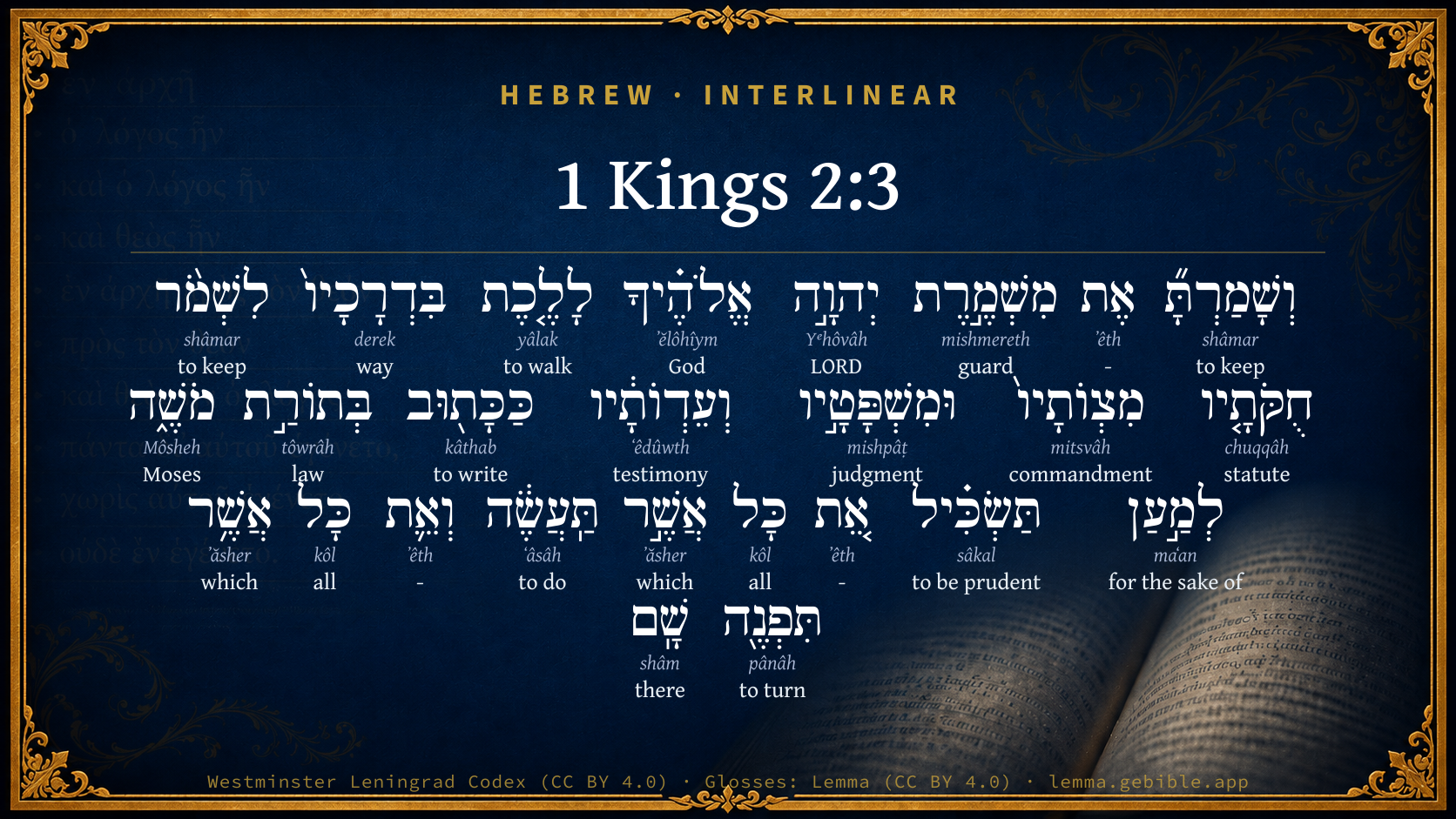
Hebrew (Westminster Leningrad Codex) 1 Kings 2:3 appears in the Hebrew Old Testament. The text above is from the Westminster Leningrad Codex. Each word links to its Strong’s number, a concise gloss, and parsing drawn from the Open Scriptures Hebrew Bible morphology. Click any word for its full Brown-Driver-Briggs (BDB) entry.
Download image
Cite this verse

1 Kings 2:3 (World English Bible). Public Domain. Lemma interlinear Bible study tool, https://lemma.gebible.app/v/1-kings/2/3.

Show BibTeX & RIS
BibTeX
RIS
English Translation
and keep the charge of Yahweh your God, to walk in his ways, to keep his statutes, [and] his commandments, and his ordinances, and his testimonies, according to that which is written in the law of Moses, that you may prosper in all that you do, and wherever you turn yourself.
World English Bible · Public Domain
Download a study sheet

One document with this verse’s original text, its word-by-word gloss line, the meaning frame, cross-references with their text, attributed commentary, and full source and license credits — printable, and it pastes into notes with its structure intact.

This verse Autodidact and up

Study sheet (.html) Plain text (.txt)

A passage Seminary Student

Up to 50 verses in one chapter. A passage sheet keeps up to 6 commentary sources and 12 cross-references per verse, in the order this page ranks them, and says so on the sheet whenever that leaves anything out. Ask for a single verse and you get the Autodidact verse sheet above.

Everything on this page stays free to read, with no account — the sheet is a download of what is already on screen, not access to it.

Want to remove ads? Support Godless Engineer
Compare translations 3

The same verse in 3 English versions, stacked beneath the original-language interlinear above. Click any original word for its lexicon entry.

Each is an independent rendering of the whole verse — the interlinear is not word-aligned to these translations.

Highlighted words mark where these versions differ — a whole-verse word diff, not a word-by-word alignment.

  • World English Bible Public Domain
    and keep the charge of Yahweh your God, to walk in his ways, to keep his statutes, [and] his commandments, and his ordinances, and his testimonies, according to that which is written in the law of Moses, that you may prosper in all that you do, and wherever you turn yourself.
  • King James Version Public Domain
    And keep the charge of the LORD thy God, to walk in his ways, to keep his statutes, and his commandments, and his judgments, and his testimonies, as it is written in the law of Moses, that thou mayest prosper in all that thou doest, and whithersoever thou turnest thyself:
  • unfoldingWord Literal Text CC BY-SA 4.0
    And you shall keep the keeping of Yahweh your God, to walk in his ways, to keep his statutes, his commandments, and his judgments, and his testimonies, as written in the law of Moses, so that you may succeed all that you do and everywhere that you turn there,

unfoldingWord Literal Text — © unfoldingWord, licensed CC BY-SA 4.0. Word-aligned USFM3 via Door43 (git.door43.org/unfoldingWord/en_ult).

Versions to compare (up to 4)

3 of 4 selected

Show all 18 translations

Every available English version of this verse, each an independent rendering of the whole verse.

  • World English Bible Public Domain
    and keep the charge of Yahweh your God, to walk in his ways, to keep his statutes, [and] his commandments, and his ordinances, and his testimonies, according to that which is written in the law of Moses, that you may prosper in all that you do, and wherever you turn yourself.
  • Berean Standard Bible Public Domain
    And keep the charge of the LORD your God to walk in His ways and to keep His statutes, commandments, ordinances, and decrees, as is written in the Law of Moses, so that you may prosper in all you do and wherever you turn,
  • Majority Standard Bible Public Domain
    And keep the charge of the LORD your God to walk in His ways and to keep His statutes, commandments, ordinances, and decrees, as written in the Law of Moses, so that you may prosper in all you do and wherever you turn,
  • King James Version Public Domain
    And keep the charge of the LORD thy God, to walk in his ways, to keep his statutes, and his commandments, and his judgments, and his testimonies, as it is written in the law of Moses, that thou mayest prosper in all that thou doest, and whithersoever thou turnest thyself:
  • American Standard Version (1901) Public Domain
    and keep the charge of Jehovah thy God, to walk in his ways, to keep his statutes, `and' his commandments, and his ordinances, and his testimonies, according to that which is written in the law of Moses, that thou mayest prosper in all that thou doest, and whithersoever thou turnest thyself.
  • Revised Version (1885) Public Domain
    and keep the charge of the LORD thy God, to walk in his ways, to keep his statutes, and his commandments, and his judgments, and his testimonies, according to that which is written in the law of Moses, that thou mayest prosper in all that thou doest, and whithersoever thou turnest thyself:
  • Geneva Bible (1599) Public Domain
    And take heede to the charge of the Lord thy God, to walke in his wayes, and keepe his statutes, and his commandements, and his iudgements, and his testimonies, as it is written in the Law of Moses, that thou mayest prosper in all that thou doest, and in euery thing whereunto thou turnest thee,
  • Douay-Rheims (1899) Public Domain
    And keep the charge of the Lord thy God, to walk in his ways, and observe his ceremonies, and his precepts, and judgments, and testimonies, as it is written in the law of Moses: that thou mayest understand all thou dost, and whithersoever thou shalt turn thyself:
  • Young's Literal Translation Public Domain
    and kept the charge of Jehovah thy God, to walk in His ways, to keep His statutes, His commands, and His judgments, and His testimonies, as it is written in the law of Moses, so that thou dost wisely all that thou dost, and whithersoever thou turnest,
  • Literal Standard Version CC BY-SA 4.0
    and you have kept the charge of your God YHWH, to walk in His ways, to keep His statutes, His commands, and His judgments, and His testimonies, as it is written in the Law of Moses, so that you do wisely [in] all that you do, and wherever you turn,
  • Unlocked Literal Bible CC BY-SA 4.0
    Keep the commands of Yahweh your God to walk in his ways, to obey his statutes, his commandments, his decisions, and his covenant decrees, being careful to do what is written in the law of Moses, so you may prosper in all you do, wherever you go,
  • unfoldingWord Literal Text CC BY-SA 4.0
    And you shall keep the keeping of Yahweh your God, to walk in his ways, to keep his statutes, his commandments, and his judgments, and his testimonies, as written in the law of Moses, so that you may succeed all that you do and everywhere that you turn there,
  • Darby Bible Public Domain
    and keep the charge of Jehovah thy God, to walk in his ways, to keep his statutes, and his commandments, and his ordinances, and his testimonies, as it is written in the law of Moses, that thou mayest prosper in all that thou doest and whithersoever thou turnest thyself;
  • World Messianic Bible Public Domain
    and keep the instruction of the LORD your God, to walk in his ways, to keep his statutes, his commandments, his ordinances, and his testimonies, according to that which is written in the Torah of Moses, that you may prosper in all that you do and wherever you turn yourself.
  • Webster's Bible Public Domain
    And keep the charge of the LORD thy God, to walk in his ways, to keep his statutes, and his commandments, and his judgments, and his testimonies, as it is written in the law of Moses, that thou mayest prosper in all that thou doest, and whithersoever thou turnest thyself.
  • Free Bible Version CC BY-SA 4.0
    Do what God orders you to do, and follow his ways. Keep his rules, his commands, and his laws and regulations, as written in the Law of Moses, so you may be successful in everything you do, and in everything you give your attention to.
  • Bible in Basic English Public Domain
    And keep the orders of the Lord your God, walking in his ways, keeping his laws and his orders and his rules and his words, as they are recorded in the law of Moses; so that you may do well in all you do and wherever you go,
  • JPS Tanakh (1917) Public Domain
    and keep the charge of the LORD thy God, to walk in His ways, to keep His statutes, and His commandments, and His ordinances, and His testimonies, according to that which is written in the law of Moses, that thou mayest prosper in all that thou doest, and whithersoever thou turnest thyself;

Literal Standard Version (2020), Covenant Press — licensed CC BY-SA 4.0. Text via the HelloAO Bible API (eBible.org). Unlocked Literal Bible (unfoldingWord) — licensed CC BY-SA 4.0. Text via the HelloAO Bible API (eBible.org). unfoldingWord Literal Text — © unfoldingWord, licensed CC BY-SA 4.0. Word-aligned USFM3 via Door43 (git.door43.org/unfoldingWord/en_ult). Free Bible Version, Dr. Jonathan Gallagher — licensed CC BY-SA 4.0. Text via the HelloAO Bible API (eBible.org).

Word by word

More ways to search: Search by grammar → Find every occurrence → Compare this word →

Practice this passage: Drill this verse → Learn its vocabulary →

וְעֵדְוֺתָ֔יו
ʻêdûwth
H5715
“and · testimonies · his”
Conjunction + Noun, Common, Feminine, Plural, Construct + Suffix, Personal, 3rd Person, Masculine, Singular
Part of Speech
Conjunction + Noun
Type
Common
Gender
Feminine
Number
Plural
State
Construct
Full BDB Definition

Origin: from H5707

TWOT: 1576f

testimony
  1. וְשָׁמַרְתָּ֞ shâmar H8104 “and · to keep” Conjunction + Verb, Qal, Sequential Perfect, 2nd Person, Masculine, Singular
  2. אֶת ʼêth H853 “-” Particle, Direct Object
  3. מִשְׁמֶ֣רֶת mishmereth H4931 “guard of” Noun, Common, Feminine, Singular, Construct
  4. יְהוָ֣ה Yᵉhôvâh H3068 “LORD” Noun, Proper
  5. אֱלֹהֶ֗יךָ ʼĕlôhîym H430 “God(s) · your” Noun, Common, Masculine, Plural, Construct + Suffix, Personal, 2nd Person, Masculine, Singular
  6. לָלֶ֤כֶת yâlak H3212 “to walk” Preposition + Verb, Qal, Infinitive Construct
  7. בִּדְרָכָיו֙ derek H1870 “in/at · ways · his” Preposition + Noun, Common, Both, Plural, Construct + Suffix, Personal, 3rd Person, Masculine, Singular
  8. לִשְׁמֹ֨ר shâmar H8104 “to keep” Preposition + Verb, Qal, Infinitive Construct
  9. חֻקֹּתָ֤יו chuqqâh H2708 “statutes · his” Noun, Common, Both, Plural, Construct + Suffix, Personal, 3rd Person, Masculine, Singular
  10. מִצְוֺתָיו֙ mitsvâh H4687 “commandments · his” Noun, Common, Feminine, Plural, Construct + Suffix, Personal, 3rd Person, Masculine, Singular
  11. וּמִשְׁפָּטָ֣יו mishpâṭ H4941 “and · judgments · his” Conjunction + Noun, Common, Masculine, Plural, Construct + Suffix, Personal, 3rd Person, Masculine, Singular
  12. כַּכָּת֖וּב kâthab H3789 “like/as the · written” Preposition, Determined + Verb, Qal, Participle Passive, Masculine, Singular, Absolute
  13. בְּתוֹרַ֣ת tôwrâh H8451 “in/at · law of” Preposition + Noun, Common, Feminine, Singular, Construct
  14. מֹשֶׁ֑ה Môsheh H4872 “Moses” Noun, Proper
  15. לְמַ֣עַן maʻan H4616 “for the sake of” Preposition
  16. תַּשְׂכִּ֗יל sâkal H7919 “to be prudent” Verb, Hiphil, Imperfect, 2nd Person, Masculine, Singular
  17. אֵ֚ת ʼêth H853 “-” Particle, Direct Object
  18. כָּל kôl H3605 “all of” Noun, Common, Masculine, Singular, Construct
  19. אֲשֶׁ֣ר ʼăsher H834 “which” Particle, Relative
  20. תַּֽעֲשֶׂ֔ה ʻâsâh H6213 “to do” Verb, Qal, Imperfect, 2nd Person, Masculine, Singular
  21. וְאֵ֛ת ʼêth H853 “and · -” Conjunction + Particle, Direct Object
  22. כָּל kôl H3605 “all of” Noun, Common, Masculine, Singular, Construct
  23. אֲשֶׁ֥ר ʼăsher H834 “which” Particle, Relative
  24. תִּפְנֶ֖ה pânâh H6437 “to turn” Verb, Qal, Imperfect, 2nd Person, Masculine, Singular
  25. שָֽׁם shâm H8033 “there” Adverb

About this verse

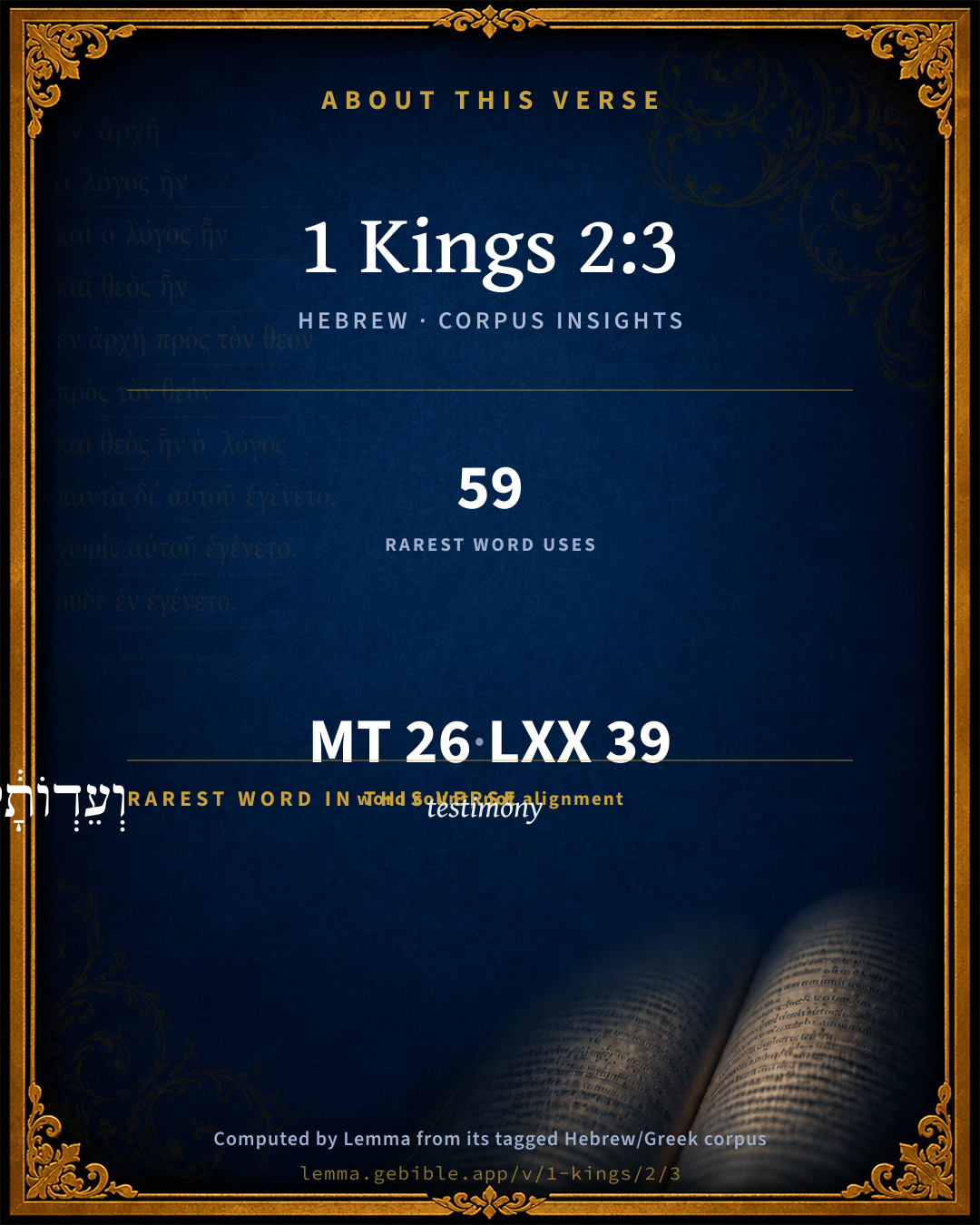
These counts appear in no published source. They are computed here, from the morphology-tagged text and Lemma’s own curated glosses. What Lemma adds →

26
words
21
distinct lemmas
Historical
section

Shared distinctive vocabulary

וְעֵדְוֺתָ֔יו testimony H5715 occurs in 57 verses of the Hebrew Bible. Also found in:

Grammatical profile

  • 7 verbs
  • 12 nouns
  • 1 preposition
  • 1 adverb
  • 5 particles

Verb forms

  • וְשָׁמַרְתָּ֞ Qal · Sequential Perfect
  • לָלֶ֤כֶת Qal · Infinitive Construct
  • לִשְׁמֹ֨ר Qal · Infinitive Construct
  • כַּכָּת֖וּב Qal · Participle Passive
  • תַּשְׂכִּ֗יל Hiphil · Imperfect
  • תַּֽעֲשֶׂ֔ה Qal · Imperfect
  • תִּפְנֶ֖ה Qal · Imperfect

Repetition

Words recur within this verse — often emphatic in Hebrew:

  • וְשָׁמַרְתָּ֞ to keep H8104 ×2
  • כָּל all H3605 ×2
  • אֲשֶׁ֣ר which H834 ×2

Hebrew & Septuagint length

In English translation the verse runs 51 words from the Hebrew and 47 from the Septuagint (LXX English) — closely comparable.

A rough comparison of the two English renderings, which tokenize alike — not a word-level alignment.

Word counts can differ between the Hebrew and the Greek without any difference in meaning — e.g. the Hebrew direct-object marker אֵת has no separate Greek word, and Greek often adds the article ὁ.

In the original languages it is 26 Hebrew tokens and 39 Greek tokens — but the two are counted differently (Hebrew bundles its prefixes and suffixes into one token; the Greek is in lemma form), so that isn’t a like-for-like length.

Cross-references

28

Topical passages linked to 1 Kings 2:3 in the Treasury of Scripture Knowledge — connected by theme and wording, ordered by reader-vote popularity; previews shown in the World English Bible.

  • Deuteronomy 29:9 Keep therefore the words of this covenant, and do them, that you may prosper in all that you do.
  • Proverbs 3:1–4 My son, don't forget my teaching; But let your heart keep my commandments:
  • Deuteronomy 17:18–20 It shall be, when he sits on the throne of his kingdom, that he shall write him a copy of this law in a book, out of [that which is] before the priests the Levites:
  • Psalms 119:2 Blessed are those who keep his statutes, Who seek him with their whole heart.
  • 1 Chronicles 22:12–13 May Yahweh give you discretion and understanding, and put you in charge of Israel; that so you may keep the law of Yahweh your God.
  • Psalms 1:2–3 But his delight is in Yahweh's law; On his law he meditates day and night.
  • Joshua 1:7–8 Only be strong and very courageous, to observe to do according to all the law, which Moses my servant commanded you: don't turn from it to the right hand or to the left, that you may have good success wherever you go.
  • 1 Chronicles 29:19 and give to Solomon my son a perfect heart, to keep your commandments, your testimonies, and your statutes, and to do all these things, and to build the palace, for which I have made provision.
  • 2 Chronicles 31:20–21 Thus did Hezekiah throughout all Judah; and he worked that which was good and right and faithful before Yahweh his God.
  • Deuteronomy 6:1–2 Now this is the commandment, the statutes, and the ordinances, which Yahweh your God commanded to teach you, that you might do them in the land where you go over to possess it;
  • Joshua 22:5 Only take diligent heed to do the commandment and the law which Moses the servant of Yahweh commanded you, to love Yahweh your God, and to walk in all his ways, and to keep his commandments, and to cleave to him, and to serve him with all your heart and with all your soul.
  • 1 Samuel 18:14 David behaved himself wisely in all his ways; and Yahweh was with him.
  • Psalms 119:111 I have taken your testimonies as a heritage forever, For they are the joy of my heart.
  • Psalms 119:138 You have commanded your statutes in righteousness. They are fully trustworthy.
  • Malachi 4:4 "Remember the law of Moses my servant, which I commanded to him in Horeb for all Israel, even statutes and ordinances.
  • Deuteronomy 4:1 Now, Israel, listen to the statutes and to the ordinances, which I teach you, to do them; that you may live, and go in and possess the land which Yahweh, the God of your fathers, gives you.
  • Deuteronomy 4:5 Behold, I have taught you statutes and ordinances, even as Yahweh my God commanded me, that you should do so in the midst of the land where you go in to possess it.
  • Deuteronomy 4:8 What great nation is there, that has statutes and ordinances so righteous as all this law, which I set before you this day?
  • Deuteronomy 4:45 these are the testimonies, and the statutes, and the ordinances, which Moses spoke to the children of Israel, when they came forth out of Egypt,
  • Deuteronomy 5:1 Moses called to all Israel, and said to them, Hear, Israel, the statutes and the ordinances which I speak in your ears this day, that you may learn them, and observe to do them.
  • 1 Samuel 18:5 David went out wherever Saul sent him, [and] behaved himself wisely: and Saul set him over the men of war, and it was good in the sight of all the people, and also in the sight of Saul's servants.
  • 1 Samuel 18:30 Then the princes of the Philistines went forth: and it happened, as often as they went forth, that David behaved himself more wisely than all the servants of Saul; so that his name was much set by.
  • 2 Samuel 8:6 Then David put garrisons in Syria of Damascus; and the Syrians became servants to David, and brought tribute. Yahweh gave victory to David wherever he went.
  • 2 Samuel 8:14 He put garrisons in Edom; throughout all Edom put he garrisons, and all the Edomites became servants to David. Yahweh gave victory to David wherever he went.
  • 2 Kings 18:7 Yahweh was with him; wherever he went forth he prospered: and he rebelled against the king of Assyria, and didn't serve him.
  • 1 Chronicles 28:8–9 Now therefore, in the sight of all Israel, the assembly of Yahweh, and in the audience of our God, observe and seek out all the commandments of Yahweh your God; that you may possess this good land, and leave it for an inheritance to your children after you forever.
  • Psalms 19:7 Yahweh's law is perfect, restoring the soul. Yahweh's testimony is sure, making wise the simple.
  • Psalms 119:98–100 Your commandments make me wiser than my enemies, For your commandments are always with me.

Cross-references courtesy of OpenBible.info (CC BY 4.0).

Hebrew and Greek witnesses Masoretic Hebrew ↔ Greek Septuagint

The same verse in the two great witnesses to the Old Testament, shown verse-for-verse.

These are two independent witnesses, not word-aligned to each other, and the Septuagint is shown in lemma (dictionary) form.

Hebrew 1 Kings 2:3 Masoretic · Westminster Leningrad Codex

וְשָׁמַרְתָּ֞ אֶת מִשְׁמֶ֣רֶת יְהוָ֣ה אֱלֹהֶ֗יךָ לָלֶ֤כֶת בִּדְרָכָיו֙ לִשְׁמֹ֨ר חֻקֹּתָ֤יו מִצְוֺתָיו֙ וּמִשְׁפָּטָ֣יו וְעֵדְוֺתָ֔יו כַּכָּת֖וּב בְּתוֹרַ֣ת מֹשֶׁ֑ה לְמַ֣עַן תַּשְׂכִּ֗יל אֵ֚ת כָּל אֲשֶׁ֣ר תַּֽעֲשֶׂ֔ה וְאֵ֛ת כָּל אֲשֶׁ֥ר תִּפְנֶ֖ה שָֽׁם

and keep the charge of Yahweh your God, to walk in his ways, to keep his statutes, [and] his commandments, and his ordinances, and his testimonies, according to that which is written in the law of Moses, that you may prosper in all that you do, and wherever you turn yourself.

World English Bible · Public Domain

Greek LXX 1 Kings 2:3 Septuagint · lemma form

καί φυλάσσω ὁ φυλακή κύριος ὁ θεός σύ ὁ πορεύομαι ἐν ὁ ὁδός αὐτός φυλάσσω ὁ ἐντολή αὐτός καί ὁ δικαίωμα καί ὁ κρίμα ὁ γράφω ἐν νόμος μωυσής ἵνα συνἵημι ὅς ποιέω κατά πᾶς ὅσος ἄν ἐντέλλομαι σύ

and keep the charge of the Lord your God, to walk in his ways, to keep the commandments and the ordinances and the judgments which are written in the law of Moses; that you may understand what you shall do in all things that I command you:

LXX2012 (modern English Septuagint) · Public Domain

Hebrew: Westminster Leningrad Codex (CC BY 4.0). Greek: Septuagint (public domain); English from LXX2012 (modern English Septuagint) (Public Domain). How the Septuagint differs from the Hebrew →

Targum (Aramaic paraphrase)

1

The Targum is the ancient Jewish Aramaic paraphrase of the Hebrew Scriptures — an interpretive translation, not the Hebrew text itself. Onkelos (literal) and Pseudo-Jonathan (expansive) render the Torah, and Jonathan the Prophets. Coverage is partial: where no permissively-licensed English translation exists for a verse, only the Aramaic is shown. This is verse-level text, not a word-by-word alignment to the Hebrew.

  1. Targum Jonathan Prophets (Joshua–Malachi)
    וְתִטַר יַת מַטְרַת מֵימְרָא דַייָ אֱלָהָךְ לִמְהַךְ בְּאוֹרְחָן דְתַקְנָן קֳדָמוֹהִי לְמִטַר קְיָמוֹהִי פִּקוּדוֹהִי וְדִינוֹהִי וְסַהֲדוּתֵיהּ כְּמָא דִכְתִיב בְּאוֹרַיְתָא דְמֹשֶׁה בְּדִיל דְתַצְלַח יַת כָּל דְתַעְבֵיד וְיַת כָּל אֲתַר דְתִתְפְּנֵי לְתַמָן:

    (no public-domain English translation for this verse)

    Targum Jonathan — Aramaic: “Mikraot Gedolot” (public domain). English: “Sefaria Community Translation” (CC0 1.0 (public-domain dedication)); “London "Chaldee Paraphrase," 1871” (public domain). Text via Sefaria.

Commentary

Notes on 1 Kings 2:3 from classic Christian and Jewish commentators (each source and its license shown beneath its notes). The classic Christian expositions comment on the surrounding passage and are grouped to its opening verse, so a note may address several verses; the Jewish commentaries on the Tanakh (Rashi and others) are per-verse, so they appear only where the commentator wrote on this verse.

Lemma curates 59 commentaries, every one of them public domain or Creative Commons licensed, each selected and text-cleaned for this edition rather than reprinted as found. About our sources →

Trapp's Complete Commentary

John Trapp

1Ki 2:3 And keep the charge of the LORD thy God, to walk in his ways, to keep his statutes, and his commandments, and his judgments, and his testimonies, as it is written in the law of Moses, that thou mayest prosper in all that thou doest, and whithersoever thou turnest thyself:

Ver. 3. And keep the charge of the Lord.] Piety maketh true magnanimity. The "spirit of a sound mind" is "a spirit of power," {2Ti 1:7} and "the fear of the Lord is the beginning of wisdom." {Pro 1:7}

To walk in his ways,] i.e., To imitate him, saith Vatablus, and to resemble him, as much as is possible.

John Trapp, A Commentary or Exposition upon All the Books of the Old and New Testament (1647–1656) — public domain. Text from a community e-Sword module.

Joseph Benson's Commentary

1Ki 2:3-4. And keep the charge of the Lord thy God — Here we find David inculcating, in his last moments, the great ruling principle; the foundation-stone of the Hebrew state, and which in some measure distinguishes it from all other governments that have ever subsisted. For the whole strength and stability of that state was built, not upon the riches or forces of the kingdom, but upon a strict observance of the statutes and commandments of the Lord. As it is written in the law of Moses — Which the prince was enjoined to transcribe and read, (Deu 17:11,) that he might govern his own and his people’s actions by it. That thou mayest prosper — Or, behave thyself prudently. Hereby he intimates that religion is the truest reason of state, and that all true wisdom and good success depend upon piety. That the Lord may confirm his word — Fulfil his promise, the condition upon which it was suspended being performed. Thus, to engage him to keep the charge of the Lord, he represents unto him the gracious promise which God had made him, to perpetuate the kingdom in his family without interruption, provided his children sincerely and heartily cleaved to God in faithful and conscientious obedience to his commandments.

Joseph Benson's Commentary on the Old and New Testaments (1811–1818) — public domain. Text from a community e-Sword module.

Geneva Bible (1599)

Geneva Bible translators

Or, do wisely.

He showeth how hard a thing it is to govern, and that none can do it well except he obey God.

Geneva Bible (1599) marginal notes — public domain. Text via Bolls.life.

Jamieson, Fausset & Brown

Robert Jamieson, A. R. Fausset & David Brown

keep the charge of the Lord thy God--that is, the divine law in all its ceremonial as well as moral requirements. But particular reference was intended to its political institutions, as it was only by strictly maintaining the conduct that became the Hebrew monarch (Deu 17:10-20), that he would secure the blessing of peace and prosperity to his reign (see on Deu 4:5; Deu 29:10).

Jamieson, Fausset & Brown — Commentary Critical and Explanatory on the Whole Bible (1871) — public domain (CC PDM 1.0). Text via the HelloAO Bible API.

Adam Clarke's Commentary

Verse 3. Keep the charge of the Lord] Keep what God has given thee to keep.

1. Walk in his ways. Not in thine own, nor in the ways of a wicked, perishing world.

2. Keep his statutes. Consider all his appointments to be holy, just, and good; receive them as such, and conscientiously observe them.

3. Keep his commandments. Whatever he has bidden thee to do, perform; what he has forbidden thee to do, omit.

4. Keep his judgments. What he has determined to be right, is essentially and inherently right; what he has determined to be wrong or evil, is inherently and essentially so. A thing is not good because God has commanded it; a thing is not evil because he has forbidden it. He has commanded the good, because it is in its own nature good and useful; he has forbidden the evil, because it is in its own nature bad and hurtful. Keep therefore his judgments.

5. Keep his testimonies. Bear witness to all to which he has borne witness. His testimonies are true; there is no deceit or falsity in them. His testimonies refer also to future good things and good times; they are the significators of coming blessedness: as such, respect them.

That thou mayest prosper] If thou hast God's approbation, thou wilt have God's blessing. If thy ways please him, he will not withhold from thee any manner of thing that is good.

Adam Clarke's Commentary on the Bible (1810–1826) — public domain. Text from a community e-Sword/MySword module.

Ellicott's Commentary for English Readers

(3) Keep the charge.—The main charge to Solomon is noble enough. He is to “show himself a man,” in spite of his youth; he is to take heed in all things to follow the Law of the Lord; he is to trust both in the general promise of God to obedience, and in the special promise made to the house of David (2Sa_7:12-16). It is remarkably in harmony with the beautiful Psalm, “the last words of David,” preserved in 2Sa_23:3-5, telling how “he that ruleth over men must be just, ruling in the fear of God,” and, in spite of consciousness of shortcomings from this high ideal, trusting in the “everlasting covenant of God” with him, “ordered in all things, and sure.” Nor does it accord less with the equally beautiful prayer of 1Ch_29:18-19, for Solomon and for the people. In all this David speaks in the spirit of a true servant and saint of God. But in the special charges that follow we see the worldly prudence of the old statesman, and in one case some trace of long-remembered grudge, singularly true to imperfect human nature, although utterly unworthy of an ideal picture of a hero-king.

A Bible Commentary for English Readers, edited by Charles John Ellicott (1878–1897) — public domain. Text from a community e-Sword module.

The Cambridge Bible for Schools and Colleges

gen. ed. J. J. S. Perowne

3. keep the charge of the Lord] The word rendered ‘charge’ here has no connexion with the verb used in 1Ki_2:1, but is the customary expression in the Book of Numbers for the care and oversight of the Tabernacle and other things committed to the Levites. (See Num_1:53; Num_3:7-8 &c.) It is used also of other sacred offices and the duties attached thereto. Thus is imported into the word a solemn signification, though in etymology it is connected with the word which precedes it, rendered ‘keep’.

to keep his statutes, and his commandments, and his judgements] These words appear to refer to the three portions of the divine law, the ceremonial, the moral, and the judicial ordinances revealed by God in the Mosaic code; while testimonies may be interpreted of those evidences of God’s will towards man which are made clear by His dealings with bygone generations. Thus God in His word bears witness to Himself.

as it is written in the law of Moses] The allusion is to Deu_17:18-20, where the king, in time to come, is bidden to keep a copy of the Law, and to study it, that so his days may be prolonged.

The Cambridge Bible for Schools and Colleges (gen. ed. J. J. S. Perowne; Cambridge University Press, 1878–1918) — public domain. Text from a community e-Sword module.

John Gill's Exposition

And keep the charge of the Lord thy God,.... Which may in general respect his whole walk and conversation, and his obedience to the law and will of God; and in particular his just government of Israel committed to his charge:

to walk in his ways; directed to in his word:

to keep his statutes and his judgments; his laws, ceremonial, moral, and judicial:

and his testimonies; as the above laws, which testify of his mind, and declare what he would have done and observed:

as it is written in the law of Moses; which a king of Israel was obliged to write a copy of, keep by him, and read it, and rule according to it, Deu 17:18,

that thou mayest prosper in all that thou doest, and whithersoever thou turnest thyself; to reign in righteousness, and according to the law of God, is the only way to have a prosperous and happy reign: or "that thou mayest act wisely" (p); the law of God furnishing out the best rules of government and maxims of policy; see Deu 4:6.

(p) "ut prudenter agas", Montanus, Tigurine version; "ut intelligas universa", V. L.

John Gill's Exposition of the Whole Bible (1746–1763) — public domain (CC PDM 1.0). Text via the HelloAO Bible API.

Albert Barnes' Notes on the Bible

The “statutes” have been explained to be the positive ordinances of the Law; the “commandments” the moral precepts, not to steal, etc.; the “judgments” the laws belonging to civil government; and the “testimonies” the laws directing the commemoration of certain events. Compare Psa 19:7-8.

Albert Barnes' Notes on the Bible (1834–1885) — public domain. Text from a community e-Sword/MySword module.

Haydock's Catholic Bible Commentary

Charge, what he orders. --- Understand. Hebrew, "act prudently," (Menochius) or "with success," Greek interpreters (Calmet) and Chaldean. (Menochius) --- The observance of God’s law, both in private and in public, will ensure to thee the title of a wise prince.

George Leo Haydock (1774–1849), Haydock's Catholic Family Bible and Commentary, 1859 edition — public domain. Excludes Psalms (Douay-Rheims chapter numbering differs from Protestant) and Deuterocanonical books (Catholic canon only).

Matthew Poole's English Annotations

The charge of the Lord thy God, i.e. what God hath charged or commanded thee to do; the act being put for the object; as is usual.

In the law of Moses; which the prince was enjoined to transcribe and read, Deu 17:18, that he might govern his own and his people’s actions by it.

That thou mayest prosper; or, behave thyself prudently; for the word signifies both. Hereby he intimates that religion is the truest reason of state, and that all true wisdom and good success depends upon piety.

Matthew Poole's English Annotations on the Holy Bible (1683–1685) — public domain. Text from a community e-Sword/MySword module.

Whedon's Commentary on the Bible

Daniel D. Whedon

3. Keep the charge of the Lord — That is, take care of God; charge thyself with the responsibility of guarding his name and honour. See the Divine charge to kings, in Deu_17:16-20. The manner of doing this is immediately designated.

Walk in his ways — To have the whole life in conformity to his revealed will.

Keep his statutes — Observe them in thine own conduct, and see that they are properly respected by all thy people. Statutes, commandments, judgments, and testimonies are probably not to be sharply defined and distinguished from each other, but rather, as Keil observes, they serve to denote collectively the whole law of Moses in its various aspects and bearings on human life and conduct. Statutes denote more particularly those divine decrees which show the relations of right and wrong in the abstract. Commandments are the revealed laws which, like the decalogue, are designed to regulate the daily life. Judgments point rather to the rewards of human conduct as meted out by God himself, and revealed in the history of the Divine administration, all serving to impress men with the infallibility and justice of the decisions of Jehovah. Testimonies comprehend statutes, laws, judgments, ceremonies, every thing in the history of Israel that conveys declarations against sin and in favour of holiness.

Daniel D. Whedon (gen. ed.), Commentary on the Old and New Testaments (1874–1909) — public domain. Text from a community e-Sword module.

John Wesley's Explanatory Notes

The law - Which the prince was enjoined to transcribe and read, Deut. xvii, 11, that be might govern his own and his peoples actions by it. Mayest profit - Or, behave thyself prudently. Hereby he intimates, that religion is the truest reason of state, and that all true wisdom and good success depend upon piety.

John Wesley, Explanatory Notes Upon the Whole Bible (1754–1765) — public domain. Text via the GEBible commentary corpus.

Lesson kit

Teaching starters — assembled from the data on this page, not authored interpretation. Every prompt links to the verse data it draws on. Edit before teaching.

1 Kings, in the Historical, opens this verse with 26 words (21 distinct Hebrew lemmas). Its most distinctive word is ʻêdûwth (“testimony”). A historical commentator’s framing appears above. Read the whole chapter for the surrounding context.

Discussion questions

  1. The word ʻêdûwth carries the sense “testimony.” How does it shape the verse?
  2. Exodus 16:34 shares the word «testimony» with this verse. How do the two illuminate each other?
  3. “to keep” occurs 2× in this one verse. What is the effect of the repetition?
  4. These translations render this verse differently; the difference is in the English rendering, not the original. What questions does that raise?
  5. The verb «וְשָׁמַרְתָּ֞» is Qal Sequential Perfect. How does its form color the action?
  6. Reading how Trapp's Complete Commentary and Joseph Benson's Commentary read this verse, where do the two commentators agree and where do they part?

Things to notice

Reading settings

Reading text

Shown beneath each verse's original-language words.

Old Testament
Old Testament edition

Read the OT as the Masoretic Hebrew (MT) or the Greek Septuagint (LXX).

English shown for the Greek Septuagint (in the Hebrew ↔ Greek comparison).

Comparing translations? Open the Compare panel on any verse page to stack up to four side by side.