2 Chronicles 14:4

Hebrew (Westminster Leningrad Codex) 2 Chronicles 14:4 appears in the Hebrew Old Testament. The text above is from the Westminster Leningrad Codex. Each word links to its Strong’s number, a concise gloss, and parsing drawn from the Open Scriptures Hebrew Bible morphology. Click any word for its full Brown-Driver-Briggs (BDB) entry.
Download image
Cite this verse

2 Chronicles 14:4 (World English Bible). Public Domain. Lemma interlinear Bible study tool, https://lemma.gebible.app/v/2-chronicles/14/4.

Show BibTeX & RIS
BibTeX
RIS
English Translation
and commanded Judah to seek Yahweh, the God of their fathers, and to do the law and the commandment.
World English Bible · Public Domain
Download a study sheet

One document with this verse’s original text, its word-by-word gloss line, the meaning frame, cross-references with their text, attributed commentary, and full source and license credits — printable, and it pastes into notes with its structure intact.

This verse Autodidact and up

Study sheet (.html) Plain text (.txt)

A passage Seminary Student

Up to 50 verses in one chapter. A passage sheet keeps up to 6 commentary sources and 12 cross-references per verse, in the order this page ranks them, and says so on the sheet whenever that leaves anything out. Ask for a single verse and you get the Autodidact verse sheet above.

Everything on this page stays free to read, with no account — the sheet is a download of what is already on screen, not access to it.

Want to remove ads? Support Godless Engineer
Compare translations 3

The same verse in 3 English versions, stacked beneath the original-language interlinear above. Click any original word for its lexicon entry.

Each is an independent rendering of the whole verse — the interlinear is not word-aligned to these translations.

Highlighted words mark where these versions differ — a whole-verse word diff, not a word-by-word alignment.

  • World English Bible Public Domain
    and commanded Judah to seek Yahweh, the God of their fathers, and to do the law and the commandment.
  • King James Version Public Domain
    And commanded Judah to seek the LORD God of their fathers, and to do the law and the commandment.
  • unfoldingWord Literal Text CC BY-SA 4.0
    And he said to Judah to seek Yahweh, the God of their fathers, and to do the law and the commandment.

unfoldingWord Literal Text — © unfoldingWord, licensed CC BY-SA 4.0. Word-aligned USFM3 via Door43 (git.door43.org/unfoldingWord/en_ult).

Versions to compare (up to 4)

3 of 4 selected

Show all 18 translations

Every available English version of this verse, each an independent rendering of the whole verse.

  • World English Bible Public Domain
    and commanded Judah to seek Yahweh, the God of their fathers, and to do the law and the commandment.
  • Berean Standard Bible Public Domain
    He commanded the people of Judah to seek the LORD, the God of their fathers, and to observe the law and the commandments.
  • Majority Standard Bible Public Domain
    He commanded the people of Judah to seek the LORD, the God of their fathers, and to observe the law and the commandments.
  • King James Version Public Domain
    And commanded Judah to seek the LORD God of their fathers, and to do the law and the commandment.
  • American Standard Version (1901) Public Domain
    and commanded Judah to seek Jehovah, the God of their fathers, and to do the law and the commandment.
  • Revised Version (1885) Public Domain
    and commanded Judah to seek the LORD, the God of their fathers, and to do the law and the commandment.
  • Geneva Bible (1599) Public Domain
    And commanded Iudah to seeke the Lord God of their fathers, and to doe according to the Lawe and the comandement.
  • Douay-Rheims (1899) Public Domain
    And he commanded Juda to seek the Lord the God of their fathers, and to do the law, and all the commandments.
  • Young's Literal Translation Public Domain
    and saith to Judah to seek Jehovah, God of their fathers, and to do the law and the command;
  • Literal Standard Version CC BY-SA 4.0
    and commands to Judah to seek YHWH, God of their fathers, and to do the Law and the command;
  • Unlocked Literal Bible CC BY-SA 4.0
    He commanded Judah to seek Yahweh, the God of their ancestors, and to carry out the law and the commandments.
  • unfoldingWord Literal Text CC BY-SA 4.0
    And he said to Judah to seek Yahweh, the God of their fathers, and to do the law and the commandment.
  • Darby Bible Public Domain
    and commanded Judah to seek Jehovah the God of their fathers, and to practise the law and the commandment.
  • World Messianic Bible Public Domain
    and commanded Judah to seek the LORD, the God of their fathers, and to obey his law and command.
  • Webster's Bible Public Domain
    And commanded Judah to seek the LORD God of their fathers, and to do the law and the commandment.
  • Free Bible Version CC BY-SA 4.0
    He ordered Judah to worship the Lord, the God of their forefathers, and to observe the law and the commandments.
  • Bible in Basic English Public Domain
    And he made Judah go after the Lord, the God of their fathers, and keep his laws and his orders.
  • JPS Tanakh (1917) Public Domain
    (14-3) and commanded Judah to seek the LORD, the God of their fathers, and to do the law and the commandment.

Literal Standard Version (2020), Covenant Press — licensed CC BY-SA 4.0. Text via the HelloAO Bible API (eBible.org). Unlocked Literal Bible (unfoldingWord) — licensed CC BY-SA 4.0. Text via the HelloAO Bible API (eBible.org). unfoldingWord Literal Text — © unfoldingWord, licensed CC BY-SA 4.0. Word-aligned USFM3 via Door43 (git.door43.org/unfoldingWord/en_ult). Free Bible Version, Dr. Jonathan Gallagher — licensed CC BY-SA 4.0. Text via the HelloAO Bible API (eBible.org).

Word by word

More ways to search: Search by grammar → Find every occurrence → Compare this word →

Practice this passage: Drill this verse → Learn its vocabulary →

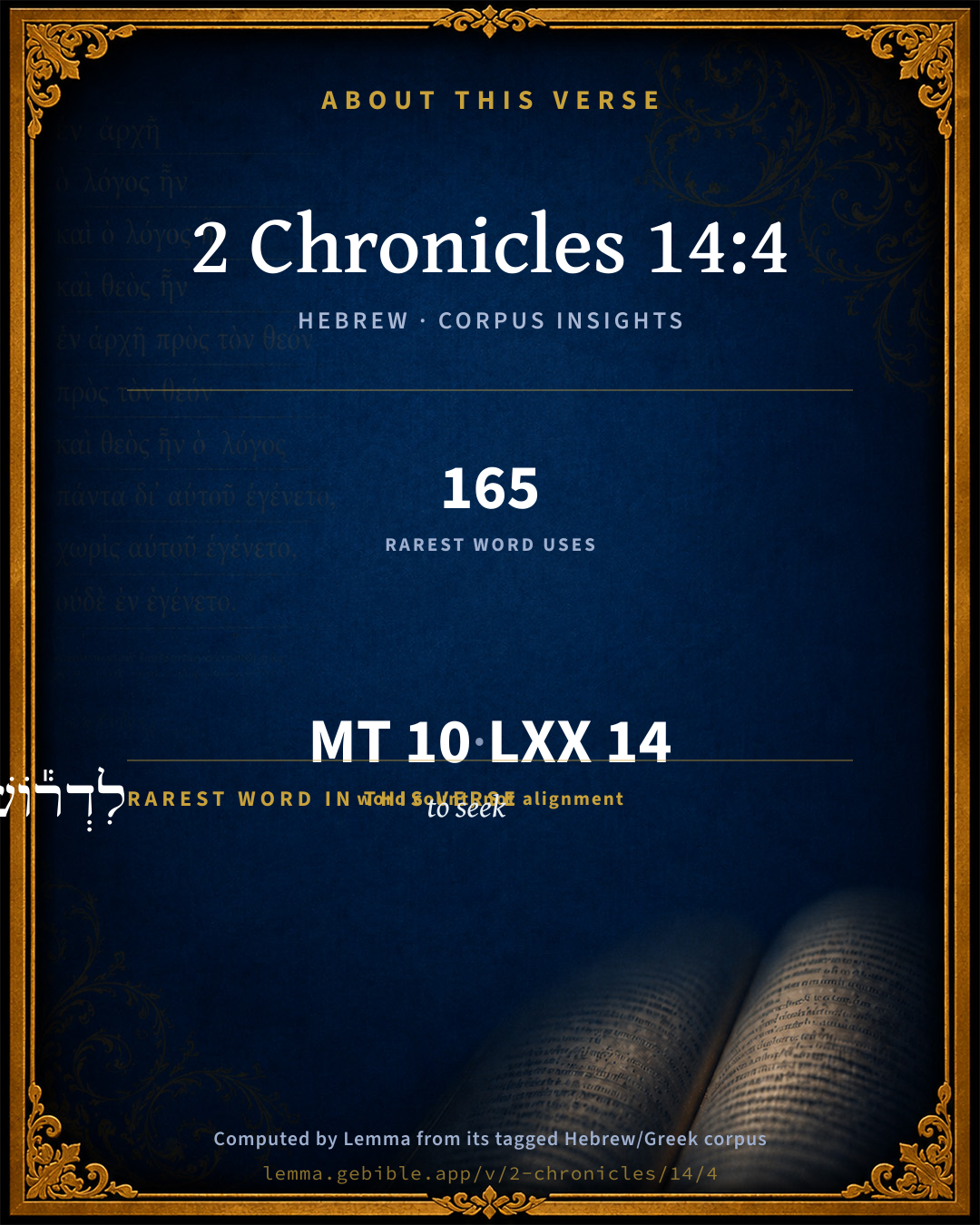
לִדְר֕וֹשׁ
dârash
H1875
“to seek”
Preposition + Verb, Qal, Infinitive Construct
Part of Speech
Preposition + Verb
Stem
Qal
Form
Infinitive Construct
Full BDB Definition

Origin: a primitive root

TWOT: 455

to resort to, seek, seek with care, enquire, require - (Qal) - to resort to, frequent (a place), (tread a place) - to consult, enquire of, seek - of God - of heathen gods, necromancers - to seek deity in prayer and worship - God - heathen deities - to seek (with a demand), demand, require - to investigate, enquire - to ask for, require, demand - to practice, study, follow, seek with application - to seek with care, care for - (Niphal) - to allow oneself to be enquired of, consulted (only of God) - to be sought, be sought out - to be required (of blood)

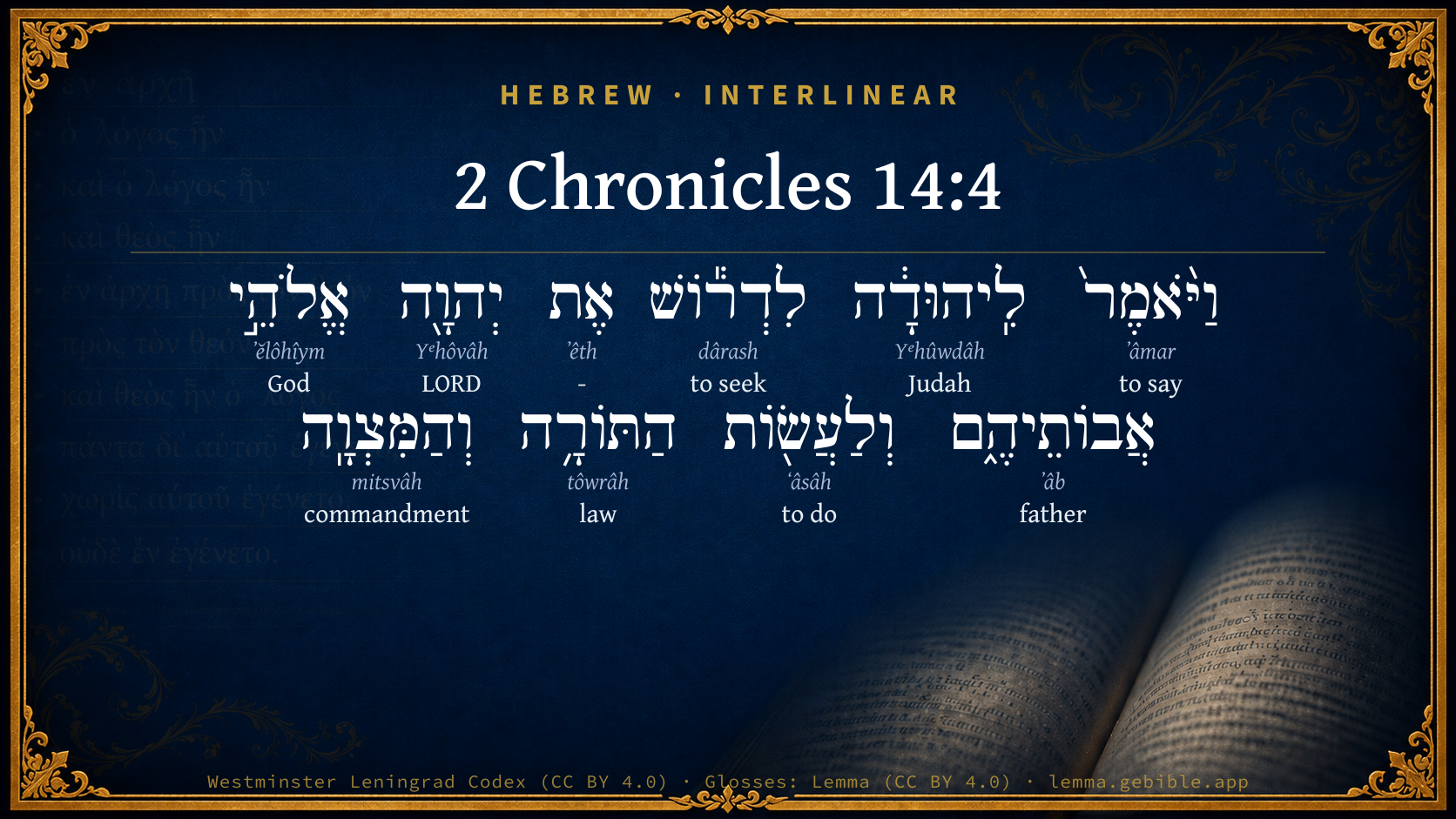
  1. וַיֹּ֨אמֶר֙ ʼâmar H559 “and · to say” Conjunction + Verb, Qal, Sequential Imperfect, 3rd Person, Masculine, Singular
  2. לִֽיהוּדָ֔ה Yᵉhûwdâh H3063 “to/for · Judah” Preposition + Noun, Proper
  3. אֶת ʼêth H853 “-” Particle, Direct Object
  4. יְהוָ֖ה Yᵉhôvâh H3068 “LORD” Noun, Proper
  5. אֱלֹהֵ֣י ʼĕlôhîym H430 “God(s) of” Noun, Common, Masculine, Plural, Construct
  6. אֲבוֹתֵיהֶ֑ם ʼâb H1 “fathers · their” Noun, Common, Masculine, Plural, Construct + Suffix, Personal, 3rd Person, Masculine, Plural
  7. וְלַעֲשׂ֖וֹת ʻâsâh H6213 “and · to do” Conjunction + Preposition + Verb, Qal, Infinitive Construct
  8. הַתּוֹרָ֥ה tôwrâh H8451 “the · law” Particle, Definite Article + Noun, Common, Feminine, Singular, Absolute
  9. וְהַמִּצְוָֽה mitsvâh H4687 “and · the · commandment” Conjunction + Particle, Definite Article + Noun, Common, Feminine, Singular, Absolute

About this verse

These counts appear in no published source. They are computed here, from the morphology-tagged text and Lemma’s own curated glosses. What Lemma adds →

10
words
10
distinct lemmas
Historical
section

Grammatical profile

  • 3 verbs
  • 6 nouns
  • 1 particle

Verb forms

  • וַיֹּ֨אמֶר֙ Qal · Sequential Imperfect
  • לִדְר֕וֹשׁ Qal · Infinitive Construct
  • וְלַעֲשׂ֖וֹת Qal · Infinitive Construct

Hebrew & Septuagint length

In English translation the verse runs 19 words from the Hebrew and 20 from the Septuagint (LXX English) — closely comparable.

A rough comparison of the two English renderings, which tokenize alike — not a word-level alignment.

Word counts can differ between the Hebrew and the Greek without any difference in meaning — e.g. the Hebrew direct-object marker אֵת has no separate Greek word, and Greek often adds the article ὁ.

In the original languages it is 10 Hebrew tokens and 14 Greek tokens — but the two are counted differently (Hebrew bundles its prefixes and suffixes into one token; the Greek is in lemma form), so that isn’t a like-for-like length.

Cross-references

19

Topical passages linked to 2 Chronicles 14:4 in the Treasury of Scripture Knowledge — connected by theme and wording, ordered by reader-vote popularity; previews shown in the World English Bible.

  • Genesis 18:19 For I have known him, to the end that he may command his children and his household after him, that they may keep the way of Yahweh, to do righteousness and justice; to the end that Yahweh may bring on Abraham that which he has spoken of him."
  • Joshua 24:15 If it seem evil to you to serve Yahweh, choose you this day whom you will serve; whether the gods which your fathers served that were beyond the River, or the gods of the Amorites, in whose land you dwell: but as for me and my house, we will serve Yahweh.
  • 1 Samuel 3:13 For I have told him that I will judge his house forever, for the iniquity which he knew, because his sons did bring a curse on themselves, and he didn't restrain them.
  • 2 Chronicles 11:16 After them, out of all the tribes of Israel, such as set their hearts to seek Yahweh, the God of Israel, came to Jerusalem to sacrifice to Yahweh, the God of their fathers.
  • 2 Chronicles 29:21 They brought seven bulls, and seven rams, and seven lambs, and seven male goats, for a sin-offering for the kingdom and for the sanctuary and for Judah. He commanded the priests the sons of Aaron to offer them on the altar of Yahweh.
  • 2 Chronicles 29:27 Hezekiah commanded to offer the burnt offering on the altar. When the burnt offering began, the song of Yahweh began also, and the trumpets, together with the instruments of David king of Israel.
  • 2 Chronicles 29:30 Moreover Hezekiah the king and the princes commanded the Levites to sing praises to Yahweh with the words of David, and of Asaph the seer. They sang praises with gladness, and they bowed their heads and worshiped.
  • 2 Chronicles 30:12 Also on Judah came the hand of God to give them one heart, to do the commandment of the king and of the princes by the word of Yahweh.
  • 2 Chronicles 30:19 who sets his heart to seek God, Yahweh, the God of his fathers, though not [cleansed] according to the purification of the sanctuary.
  • 2 Chronicles 33:16 He built up the altar of Yahweh, and offered thereon sacrifices of peace-offerings and of thanksgiving, and commanded Judah to serve Yahweh, the God of Israel.
  • 2 Chronicles 34:32–33 He caused all who were found in Jerusalem and Benjamin to stand [to it]. The inhabitants of Jerusalem did according to the covenant of God, the God of their fathers.
  • Ezra 10:7–12 They made proclamation throughout Judah and Jerusalem to all the children of the captivity, that they should gather themselves together to Jerusalem;
  • Nehemiah 10:29–39 They joined with their brothers, their nobles, and entered into a curse, and into an oath, to walk in God's law, which was given by Moses the servant of God, and to observe and do all the commandments of Yahweh our Lord, and his ordinances and his statutes;
  • Nehemiah 13:9 Then I commanded, and they cleansed the chambers: and there brought I again the vessels of the house of God, with the meal-offerings and the frankincense.
  • Psalms 101:2–8 I will be careful to live a blameless life. When will you come to me? I will walk within my house with a blameless heart.
  • Psalms 119:10 With my whole heart, I have sought you. Don't let me wander from your commandments.
  • Isaiah 55:6–7 Seek you Yahweh while he may be found; call you on him while he is near:
  • Amos 5:4 For thus says Yahweh to the house of Israel: "Seek me, and you will live;
  • Nehemiah 13:19–22 It came to pass that, when the gates of Jerusalem began to be dark before the Sabbath, I commanded that the doors should be shut, and commanded that they should not be opened until after the Sabbath: and some of my servants set I over the gates, that there should no burden be brought in on the Sabbath day.

Cross-references courtesy of OpenBible.info (CC BY 4.0).

Hebrew and Greek witnesses Masoretic Hebrew ↔ Greek Septuagint

The same verse in the two great witnesses to the Old Testament, shown verse-for-verse.

These are two independent witnesses, not word-aligned to each other, and the Septuagint is shown in lemma (dictionary) form.

Hebrew 2 Chronicles 14:4 Masoretic · Westminster Leningrad Codex

וַיֹּ֨אמֶר֙ לִֽיהוּדָ֔ה לִדְר֕וֹשׁ אֶת יְהוָ֖ה אֱלֹהֵ֣י אֲבוֹתֵיהֶ֑ם וְלַעֲשׂ֖וֹת הַתּוֹרָ֥ה וְהַמִּצְוָֽה

and commanded Judah to seek Yahweh, the God of their fathers, and to do the law and the commandment.

World English Bible · Public Domain

Greek LXX 2 Chronicles 14:4 Septuagint · lemma form

καί ἀποἵστημι ἀπό πᾶς ὁ πόλις ἰουδά ὁ θυσιαστήριον καί ὁ εἴδωλον καί εἰρηνεύω

and he told Juda to seek earnestly the Lord God of their fathers, and to perform the law and commandments.

LXX2012 (modern English Septuagint) · Public Domain

Hebrew: Westminster Leningrad Codex (CC BY 4.0). Greek: Septuagint (public domain); English from LXX2012 (modern English Septuagint) (Public Domain). How the Septuagint differs from the Hebrew →

Commentary

Notes on 2 Chronicles 14:4 from classic Christian and Jewish commentators (each source and its license shown beneath its notes). The classic Christian expositions comment on the surrounding passage and are grouped to its opening verse, so a note may address several verses; the Jewish commentaries on the Tanakh (Rashi and others) are per-verse, so they appear only where the commentator wrote on this verse.

Lemma curates 59 commentaries, every one of them public domain or Creative Commons licensed, each selected and text-cleaned for this edition rather than reprinted as found. About our sources →

Trapp's Complete Commentary

John Trapp

2Ch 14:4 And commanded Judah to seek the LORD God of their fathers, and to do the law and the commandment.

Ver. 4. And commanded Judah.] It is not enough to pull down superstition; but God’s sincere service also must be set up.

John Trapp, A Commentary or Exposition upon All the Books of the Old and New Testament (1647–1656) — public domain. Text from a community e-Sword module.

Joseph Benson's Commentary

2Ch 14:4-5. He commanded Judah to seek the Lord — By his royal edicts he commanded them to worship God, and him only. And to do the law, and the commandment — To observe all divine institutions, which many had neglected, and to practise all that the law of Moses required of them. And the kingdom was quiet before him — Though, it is probable, they were much in love with their idols, and very loath to part with them; yet the convictions of their consciences sided with the commands of Asa, and they could not, for shame, but comply with them. They that have power in their hands, and will use it vigorously for the suppression of profaneness, and the reformation of manners, will, in general, not meet with so much difficulty and opposition as, perhaps, they might expect. Vice is a mean and base thing, and carries its own shame and condemnation on the face of it; while virtue has always reason enough on its side to make iniquity stop her mouth, Psa 107:42.

Joseph Benson's Commentary on the Old and New Testaments (1811–1818) — public domain. Text from a community e-Sword module.

Tyndale Open Study Notes

Tyndale Open Resources

14:4 The phrase seek the Lord is the Chronicler’s formula for restoration; it both highlights and critiques Asa’s reign (see 15:2, 12-13; 16:12).

Tyndale Open Study Notes — © Tyndale Open Resources, licensed CC BY-SA 4.0. Text via the HelloAO Bible API.

Ellicott's Commentary for English Readers

(4) And commanded Judah to seek.—‘amar with infinitive. (Comp. 1Ch_21:17.) The chronicler’s own style is visible in this verse.

To seek the Lord God of their fathers.—The same phrase recurs in 2Ch_15:12.

The law and the commandment.—Exo_24:12, “That I may give thee the tables of stone, and the law and the commandment that I have written” (Deu_6:25).

And the images.—Hammanîm. (Comp. the word hammah, “sun.”) Pillars or statues to the sun-god, standing before or upon the altars of Baal, are intended (see Lev_26:30; Isa_17:8; 2Ch_34:4.) Comp. the Phenician deity Baal-hamman.

The kingdom was quiet before him.—Enjoyed peace under his oversight. Compare the use of the word “before,” in Num_8:22; Psa_72:5 (“before the moon”).

A Bible Commentary for English Readers, edited by Charles John Ellicott (1878–1897) — public domain. Text from a community e-Sword module.

The Cambridge Bible for Schools and Colleges

gen. ed. J. J. S. Perowne

4. to seek the Lord] Cp. 2Ch_15:12-13.

The Cambridge Bible for Schools and Colleges (gen. ed. J. J. S. Perowne; Cambridge University Press, 1878–1918) — public domain. Text from a community e-Sword module.

John Gill's Exposition

Also he took away out of all the cities of Judah the high places and the images,.... Perhaps the high places in Ch2 14:3 design only the high places and altars in Jerusalem, and near it; these in all the rest of the cities of the land; the "images were", as the word signifies, "sun images", either made in the form of the sun, or dedicated to it, or temples for it; See Gill on Lev 26:30,

and the kingdom was quiet before him; he had no foreign enemy to molest him, and so took that opportunity to reform divine worship, and in that he met with no opposition from his people.

John Gill's Exposition of the Whole Bible (1746–1763) — public domain (CC PDM 1.0). Text via the HelloAO Bible API.

Matthew Poole's English Annotations

By his royal edicts he required them to worship God, and him only, and to practise all which the laws of Moses required of them.

Matthew Poole's English Annotations on the Holy Bible (1683–1685) — public domain. Text from a community e-Sword/MySword module.

The Pulpit Commentary

And commanded Judah to seek the Lord God of their fathers. What an indication lies couched in this word "commanded" (confirmatory of the spirit of what is said above, in our previous verse-note) of the moral efforts of Asa, and that the efforts on which he may have largely relied for "taking away the high places" were moral efforts, rather than those of physical force.

The Pulpit Commentary (1880–1919), ed. H.D.M. Spence-Jones & Joseph S. Exell — public domain. Text from a community e-Sword module.

Lesson kit

Teaching starters — assembled from the data on this page, not authored interpretation. Every prompt links to the verse data it draws on. Edit before teaching.

2 Chronicles, in the Historical, opens this verse with 10 words (10 distinct Hebrew lemmas). Its most distinctive word is dârash (“to seek”). A historical commentator’s framing appears above. Read the whole chapter for the surrounding context.

Discussion questions

  1. How does “to seek” (dârash) shape what this verse is saying?
  2. How does Genesis 18:19, which shares this passage’s theme, read alongside this verse?
  3. The translations on this page render this verse differently — a whole-verse word diff, not a word-by-word alignment. What might account for the different wordings?
  4. «וַיֹּ֨אמֶר֙» is a Qal Sequential Imperfect verb. How does that grammatical form shape the action described?
  5. Compare how Trapp's Complete Commentary and Joseph Benson's Commentary read this verse. Where do they agree or differ?

Things to notice

Reading settings

Reading text

Shown beneath each verse's original-language words.

Old Testament
Old Testament edition

Read the OT as the Masoretic Hebrew (MT) or the Greek Septuagint (LXX).

English shown for the Greek Septuagint (in the Hebrew ↔ Greek comparison).

Comparing translations? Open the Compare panel on any verse page to stack up to four side by side.