
Jeremiah 32:23

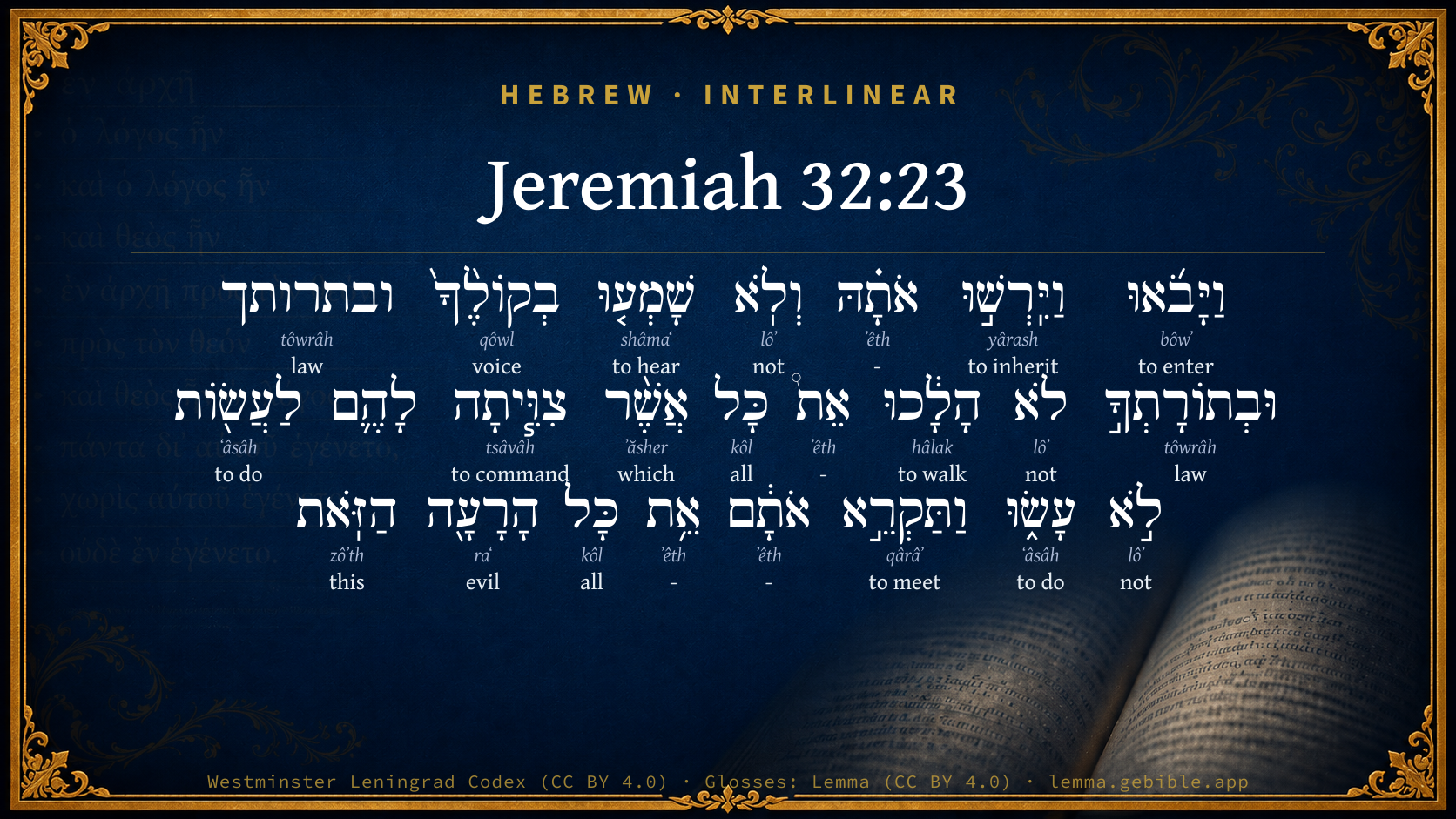
Hebrew (Westminster Leningrad Codex) Jeremiah 32:23 appears in the Hebrew Old Testament. The text above is from the Westminster Leningrad Codex. Each word links to its Strong’s number, a concise gloss, and parsing drawn from the Open Scriptures Hebrew Bible morphology. Click any word for its full Brown-Driver-Briggs (BDB) entry.
Download image
Cite this verse

Jeremiah 32:23 (World English Bible). Public Domain. Lemma interlinear Bible study tool, https://lemma.gebible.app/v/jeremiah/32/23.

Show BibTeX & RIS
BibTeX
RIS
English Translation
and they came in, and possessed it, but they didn't obey your voice, neither walked in your law; they have done nothing of all that you commanded them to do: therefore you have caused all this evil to come on them.
World English Bible · Public Domain
Download a study sheet

One document with this verse’s original text, its word-by-word gloss line, the meaning frame, cross-references with their text, attributed commentary, and full source and license credits — printable, and it pastes into notes with its structure intact.

This verse Autodidact and up

Study sheet (.html) Plain text (.txt)

A passage Seminary Student

Up to 50 verses in one chapter. A passage sheet keeps up to 6 commentary sources and 12 cross-references per verse, in the order this page ranks them, and says so on the sheet whenever that leaves anything out. Ask for a single verse and you get the Autodidact verse sheet above.

Everything on this page stays free to read, with no account — the sheet is a download of what is already on screen, not access to it.

Want to remove ads? Support Godless Engineer
Compare translations 3

The same verse in 3 English versions, stacked beneath the original-language interlinear above. Click any original word for its lexicon entry.

Each is an independent rendering of the whole verse — the interlinear is not word-aligned to these translations.

Highlighted words mark where these versions differ — a whole-verse word diff, not a word-by-word alignment.

  • World English Bible Public Domain
    and they came in, and possessed it, but they didn't obey your voice, neither walked in your law; they have done nothing of all that you commanded them to do: therefore you have caused all this evil to come on them.
  • King James Version Public Domain
    And they came in, and possessed it; but they obeyed not thy voice, neither walked in thy law; they have done nothing of all that thou commandedst them to do: therefore thou hast caused all this evil to come upon them:
  • unfoldingWord Literal Text CC BY-SA 4.0
    So they entered and took possession of it. But they did not obey your voice or live in obedience to your law. They did nothing of what you had commanded them to do, so you brought all this disaster on them.

unfoldingWord Literal Text — © unfoldingWord, licensed CC BY-SA 4.0. Word-aligned USFM3 via Door43 (git.door43.org/unfoldingWord/en_ult).

Versions to compare (up to 4)

3 of 4 selected

Show all 18 translations

Every available English version of this verse, each an independent rendering of the whole verse.

  • World English Bible Public Domain
    and they came in, and possessed it, but they didn't obey your voice, neither walked in your law; they have done nothing of all that you commanded them to do: therefore you have caused all this evil to come on them.
  • Berean Standard Bible Public Domain
    They came in and possessed it, but they did not obey Your voice or walk in Your law. They failed to perform all that You commanded them to do, and so You have brought upon them all this disaster.
  • Majority Standard Bible Public Domain
    They came in and possessed it, but they did not obey Your voice or walk in Your law. They failed to perform all that You commanded them to do, and so You have brought upon them all this disaster.
  • King James Version Public Domain
    And they came in, and possessed it; but they obeyed not thy voice, neither walked in thy law; they have done nothing of all that thou commandedst them to do: therefore thou hast caused all this evil to come upon them:
  • American Standard Version (1901) Public Domain
    and they came in, and possessed it, but they obeyed not thy voice, neither walked in thy law; they have done nothing of all that thou commandedst them to do: therefore thou hast caused all this evil to come upon them.
  • Revised Version (1885) Public Domain
    and they came in, and possessed it; but they obeyed not thy voice, neither walked in thy law; they have done nothing of all that thou commandedst them to do: therefore thou hast caused all this evil to come upon them:
  • Geneva Bible (1599) Public Domain
    And they came in, and possessed it, but they obeyed not thy voyce, neither walked in thy Law: all that thou commaundedst them to doe, they haue not done: therefore thou hast caused this whole plague to come vpon them.
  • Douay-Rheims (1899) Public Domain
    And they came in, and possessed it: but they obeyed not thy voice, and they walked not in thy law: and they did not any of those things that thou didst command them to do, and all these evils are come upon them.
  • Young's Literal Translation Public Domain
    And they come in, and possess it, and they have not hearkened to Thy voice, and in Thy law have not walked, all that which Thou didst lay a charge on them to do they have not done, and Thou dost proclaim `to' them all this evil.
  • Literal Standard Version CC BY-SA 4.0
    and they come in, and possess it, and they have not listened to Your voice, and have not walked in Your law, all that which You laid a charge on them to do they have not done, and You proclaim all this calamity [to] them.
  • Unlocked Literal Bible CC BY-SA 4.0
    So they entered and took possession of it. But they did not obey your voice or live in obedience to your law. They did nothing of what you had commanded them to do, so you brought all this disaster on them.
  • unfoldingWord Literal Text CC BY-SA 4.0
    So they entered and took possession of it. But they did not obey your voice or live in obedience to your law. They did nothing of what you had commanded them to do, so you brought all this disaster on them.
  • Darby Bible Public Domain
    And they came in and possessed it: but they hearkened not unto thy voice, neither walked in thy law; they have done nothing of all that thou commandedst them to do; so that thou hast caused all this evil to come upon them.
  • World Messianic Bible Public Domain
    They came in and possessed it, but they didn’t obey your voice and didn’t walk in your law. They have done nothing of all that you commanded them to do. Therefore you have caused all this evil to come upon them.
  • Webster's Bible Public Domain
    And they came in, and possessed it; but they obeyed not thy voice, neither walked in thy law; they have done nothing of all that thou commandedst them to do: therefore thou hast caused all this evil to come upon them:
  • Free Bible Version CC BY-SA 4.0
    They came and took it over, but they didn't do what you said or follow your laws. They didn't do everything you ordered them to do, which is why you've brought all this disaster down on them.
  • Bible in Basic English Public Domain
    And they came in and took it for their heritage, but they did not give ear to your voice, and were not ruled by your law; they have done nothing of all you gave them orders to do: so you have made all this evil come on them:
  • JPS Tanakh (1917) Public Domain
    and they came in, and possessed it; but they hearkened not to Thy voice, neither walked in Thy law; they have done nothing of all that Thou commandedst them to do; therefore Thou hast caused all this evil to befall them;

Literal Standard Version (2020), Covenant Press — licensed CC BY-SA 4.0. Text via the HelloAO Bible API (eBible.org). Unlocked Literal Bible (unfoldingWord) — licensed CC BY-SA 4.0. Text via the HelloAO Bible API (eBible.org). unfoldingWord Literal Text — © unfoldingWord, licensed CC BY-SA 4.0. Word-aligned USFM3 via Door43 (git.door43.org/unfoldingWord/en_ult). Free Bible Version, Dr. Jonathan Gallagher — licensed CC BY-SA 4.0. Text via the HelloAO Bible API (eBible.org).

Word by word

More ways to search: Search by grammar → Find every occurrence → Compare this word →

Practice this passage: Drill this verse → Learn its vocabulary →

וַתַּקְרֵ֣א
qârâʼ
H7122
“and · to meet”
Conjunction + Verb, Hiphil, Sequential Imperfect, 2nd Person, Masculine, Singular
Part of Speech
Conjunction + Verb
Stem
Hiphil
Form
Sequential Imperfect
Person
2nd Person
Gender
Masculine
Number
Singular
Full BDB Definition

Origin: a primitive root, to encounter, whether accidentally or in a hostile manner

TWOT: 2064

to encounter, befall, meet - (Qal) - to meet, encounter - to befall (figuratively) - (Niphal) to meet, meet unexpectedly - (Hiphil) to cause to meet
  1. וַיָּבֹ֜אוּ bôwʼ H935 “and · to enter” Conjunction + Verb, Qal, Sequential Imperfect, 3rd Person, Masculine, Plural
  2. וַיִּֽרְשׁ֣וּ yârash H3423 “and · to inherit” Conjunction + Verb, Qal, Sequential Imperfect, 3rd Person, Masculine, Plural
  3. אֹתָ֗הּ ʼêth H853 “- · her” Particle, Direct Object + Suffix, Personal, 3rd Person, Feminine, Singular
  4. וְלֹֽא lôʼ H3808 “and · not” Conjunction + Particle, Negative
  5. שָׁמְע֤וּ shâmaʻ H8085 “to hear” Verb, Qal, Perfect, 3rd Person, Common, Plural
  6. בְקוֹלֶ֨ךָ֙ qôwl H6963 “in/at · voice · your” Preposition + Noun, Common, Masculine, Singular, Construct + Suffix, Personal, 2nd Person, Masculine, Singular
  7. ובתרותך tôwrâh H8451 “and · in/at · laws · your” Conjunction + Preposition + Noun, Common, Feminine, Plural, Construct + Suffix, Personal, 2nd Person, Masculine, Singular
  8. וּבְתוֹרָתְךָ֣ tôwrâh H8451 “and · in/at · law · your” Conjunction + Preposition + Noun, Common, Feminine, Singular, Construct + Suffix, Personal, 2nd Person, Masculine, Singular
  9. לֹא lôʼ H3808 “not” Particle, Negative
  10. הָלָ֔כוּ hâlak H1980 “to walk” Verb, Qal, Perfect, 3rd Person, Common, Plural
  11. אֵת֩ ʼêth H853 “-” Particle, Direct Object
  12. כָּל kôl H3605 “all of” Noun, Common, Masculine, Singular, Construct
  13. אֲשֶׁ֨ר ʼăsher H834 “which” Particle, Relative
  14. צִוִּ֧יתָה tsâvâh H6680 “to command” Verb, Piel, Perfect, 2nd Person, Masculine, Singular
  15. לַעֲשׂ֖וֹת ʻâsâh H6213 “to do” Preposition + Verb, Qal, Infinitive Construct
  16. לֹ֣א lôʼ H3808 “not” Particle, Negative
  17. עָשׂ֑וּ ʻâsâh H6213 “to do” Verb, Qal, Perfect, 3rd Person, Common, Plural
  18. אֹתָ֔ם ʼêth H853 “- · them” Particle, Direct Object + Suffix, Personal, 3rd Person, Masculine, Plural
  19. אֵ֥ת ʼêth H853 “-” Particle, Direct Object
  20. כָּל kôl H3605 “all of” Noun, Common, Masculine, Singular, Construct
  21. הָרָעָ֖ה raʻ H7451 “the · evil” Particle, Definite Article + Noun, Common, Feminine, Singular, Absolute
  22. הַזֹּֽאת zôʼth H2063 “the · this” Particle, Definite Article + Pronoun, Demonstrative, Feminine, Singular

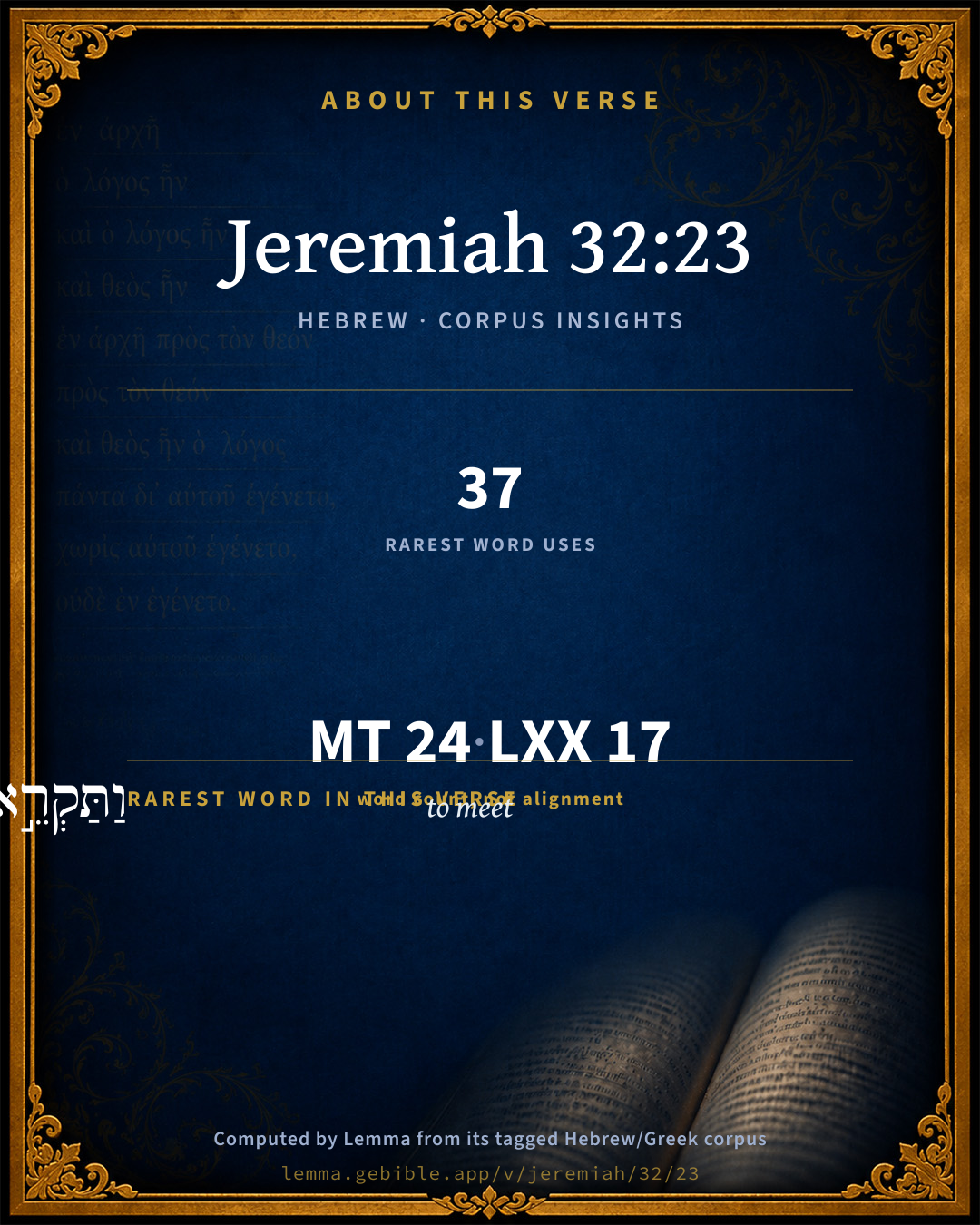
About this verse

These counts appear in no published source. They are computed here, from the morphology-tagged text and Lemma’s own curated glosses. What Lemma adds →

24
words
15
distinct lemmas
Prophets
section

Shared distinctive vocabulary

וַתַּקְרֵ֣א to meet H7122 occurs in 35 verses of the Hebrew Bible. Also found in:

Grammatical profile

  • 8 verbs
  • 6 nouns
  • 1 pronoun
  • 1 preposition
  • 8 particles

Verb forms

  • וַיָּבֹ֜אוּ Qal · Sequential Imperfect
  • וַיִּֽרְשׁ֣וּ Qal · Sequential Imperfect
  • שָׁמְע֤וּ Qal · Perfect
  • הָלָ֔כוּ Qal · Perfect
  • צִוִּ֧יתָה Piel · Perfect
  • לַעֲשׂ֖וֹת Qal · Infinitive Construct
  • עָשׂ֑וּ Qal · Perfect
  • וַתַּקְרֵ֣א Hiphil · Sequential Imperfect

Repetition

Words recur within this verse — often emphatic in Hebrew:

  • ובתרותך law H8451 ×2
  • כָּל all H3605 ×2
  • לַעֲשׂ֖וֹת to do H6213 ×2
  • וְלֹֽא not H3808 ×3

Hebrew & Septuagint length

In the original languages it is 24 Hebrew tokens and 17 Greek tokens — but the two are counted differently (Hebrew bundles its prefixes and suffixes into one token; the Greek is in lemma form), so that isn’t a like-for-like length.

Cross-references

26

Topical passages linked to Jeremiah 32:23 in the Treasury of Scripture Knowledge — connected by theme and wording, ordered by reader-vote popularity; previews shown in the World English Bible.

  • Ezra 9:7 Since the days of our fathers we have been exceeding guilty to this day; and for our iniquities have we, our kings, and our priests, been delivered into the hand of the kings of the lands, to the sword, to captivity, and to plunder, and to confusion of face, as it is this day.
  • Psalms 78:54–55 He brought them to the border of his sanctuary, To this mountain, which his right hand had taken.
  • Daniel 9:10–14 neither have we obeyed the voice of Yahweh our God, to walk in his laws, which he set before us by his servants the prophets.
  • Psalms 44:2–3 You drove out the nations with your hand, But you planted them. You afflicted the peoples, But you spread them abroad.
  • Lamentations 1:18 Yahweh is righteous; for I have rebelled against his commandment: Please hear all you peoples, and see my sorrow: My virgins and my young men are gone into captivity.
  • Leviticus 26:14–46 "'But if you will not listen to me, and will not do all these commandments;
  • Deuteronomy 28:15–68 But it shall come to pass, if you will not listen to the voice of Yahweh your God, to observe to do all his commandments and his statutes which I command you this day, that all these curses shall come on you, and overtake you.
  • Joshua 23:16 When you disobey the covenant of Yahweh your God, which he commanded you, and go and serve other gods, and bow down yourselves to them; then will the anger of Yahweh be kindled against you, and you shall perish quickly from off the good land which he has given to you.
  • Judges 2:11–13 The children of Israel did that which was evil in the sight of Yahweh, and served the Baals;
  • Judges 10:6–18 The children of Israel again did that which was evil in the sight of Yahweh, and served the Baals, and the Ashtaroth, and the gods of Syria, and the gods of Sidon, and the gods of Moab, and the gods of the children of Ammon, and the gods of the Philistines; and they forsook Yahweh, and didn't serve him.
  • Nehemiah 9:15 and gave them bread from the sky for their hunger, and brought forth water for them out of the rock for their thirst, and commanded those who they should go in to possess the land which you had sworn to give them.
  • Nehemiah 9:22–30 Moreover you gave them kingdoms and peoples, which you did allot after their portions: so they possessed the land of Sihon, even the land of the king of Heshbon, and the land of Og king of Bashan.
  • Psalms 105:44–45 He gave them the lands of the nations. They took the labor of the peoples in possession,
  • Jeremiah 7:23–24 but this thing I commanded them, saying, Listen to my voice, and I will be your God, and you shall be my people; and walk you in all the way that I command you, that it may be well with you.
  • Jeremiah 11:7–8 For I earnestly protested to your fathers in the day that I brought them up out of the land of Egypt, even to this day, rising early and protesting, saying, Obey my voice.
  • Lamentations 1:8 Jerusalem has grievously sinned; therefore she is become as an unclean thing; All who honored her despise her, because they have seen her nakedness: Yes, she sighs, and turns backward.
  • Lamentations 5:16–17 The crown is fallen from our head: Woe to us! for we have sinned.
  • Ezekiel 20:8 But they rebelled against me, and would not listen to me; they did not every man cast away the abominations of their eyes, neither did they forsake the idols of Egypt. Then I said I would pour out my wrath on them, to accomplish my anger against them in the midst of the land of Egypt.
  • Ezekiel 20:18 I said to their children in the wilderness, Don't you walk in the statutes of your fathers, neither observe their ordinances, nor defile yourselves with their idols.
  • Ezekiel 20:21 But the children rebelled against me; they didn't walk in my statutes, neither kept my ordinances to do them, which if a man do, he shall live in them; they profaned my Sabbaths. Then I said I would pour out my wrath on them, to accomplish my anger against them in the wilderness.
  • Daniel 9:4–6 I prayed to Yahweh my God, and made confession, and said, Oh, Lord, the great and dreadful God, who keeps covenant and loving kindness with those who love him and keep his commandments,
  • Zechariah 1:2–4 "Yahweh was very displeased with your fathers.
  • Luke 17:10 Even so you also, when you have done all the things that are commanded you, say, 'We are unworthy servants. We have done our duty.'"
  • John 15:14 You are my friends, if you do whatever I command you.
  • Galatians 3:10 For as many as are of the works of the law are under a curse. For it is written, "Cursed is everyone who doesn't continue in all things that are written in the book of the law, to do them."
  • James 2:10 For whoever shall keep the whole law, and yet stumble in one point, he has become guilty of all.

Cross-references courtesy of OpenBible.info (CC BY 4.0).

Hebrew and Greek witnesses Masoretic Hebrew ↔ Greek Septuagint

The same verse in the two great witnesses to the Old Testament, shown verse-for-verse.

These are two independent witnesses, not word-aligned to each other, and the Septuagint is shown in lemma (dictionary) form.

Hebrew Jeremiah 32:23 Masoretic · Westminster Leningrad Codex

וַיָּבֹ֜אוּ וַיִּֽרְשׁ֣וּ אֹתָ֗הּ וְלֹֽא שָׁמְע֤וּ בְקוֹלֶ֨ךָ֙ ובתרותך וּבְתוֹרָתְךָ֣ לֹא הָלָ֔כוּ אֵת֩ כָּל אֲשֶׁ֨ר צִוִּ֧יתָה לָהֶ֛ם לַעֲשׂ֖וֹת לֹ֣א עָשׂ֑וּ וַתַּקְרֵ֣א אֹתָ֔ם אֵ֥ת כָּל הָרָעָ֖ה הַזֹּֽאת

and they came in, and possessed it, but they didn't obey your voice, neither walked in your law; they have done nothing of all that you commanded them to do: therefore you have caused all this evil to come on them.

World English Bible · Public Domain

Greek LXX Structure differs

In the Septuagint, Jeremiah is about an eighth shorter than the Hebrew and arranges its material differently — the Oracles Against the Nations (Hebrew chapters 46–51) appear in the middle of the Greek book, after 25:13. Because the chapter and verse boundaries do not line up, a verse-for-verse comparison with the Hebrew is not shown.

A verse-for-verse comparison isn’t shown here because the chapters and verses don’t line up. Switch to the LXX edition with the MT / LXX toggle above to read the Greek directly.

Hebrew: Westminster Leningrad Codex (CC BY 4.0). Greek: Septuagint (public domain); English from a public-domain English Septuagint. How the Septuagint differs from the Hebrew →

Targum (Aramaic paraphrase)

1

The Targum is the ancient Jewish Aramaic paraphrase of the Hebrew Scriptures — an interpretive translation, not the Hebrew text itself. Onkelos (literal) and Pseudo-Jonathan (expansive) render the Torah, and Jonathan the Prophets. Coverage is partial: where no permissively-licensed English translation exists for a verse, only the Aramaic is shown. This is verse-level text, not a word-by-word alignment to the Hebrew.

  1. Targum Jonathan Prophets (Joshua–Malachi)
    וְעָלוּ וְאַחְסִינוּ יָתָהּ וְלָא קַבִּילוּ לְמֵימְרָךְ וּבְאוֹרַיְתָךְ לָא הַלִיכוּ יַת כָּל דְפַקֵידְתָּא לְהוֹן לְמֶעְבֵּד לָא עֲבָדוּ וַעֲרַעַת יַתְהוֹן יַת כָּל בִּישְׁתָּא הָדָא:

    (no public-domain English translation for this verse)

    Targum Jonathan — Aramaic: “Mikraot Gedolot” (public domain). English: “Sefaria Community Translation” (CC0 1.0 (public-domain dedication)); “London "Chaldee Paraphrase," 1871” (public domain). Text via Sefaria.

Commentary

Notes on Jeremiah 32:23 from classic Christian and Jewish commentators (each source and its license shown beneath its notes). The classic Christian expositions comment on the surrounding passage and are grouped to its opening verse, so a note may address several verses; the Jewish commentaries on the Tanakh (Rashi and others) are per-verse, so they appear only where the commentator wrote on this verse.

Lemma curates 59 commentaries, every one of them public domain or Creative Commons licensed, each selected and text-cleaned for this edition rather than reprinted as found. About our sources →

Trapp's Complete Commentary

John Trapp

Jer 32:23 And they came in, and possessed it; but they obeyed not thy voice, neither walked in thy law; they have done nothing of all that thou commandedst them to do: therefore thou hast caused all this evil to come upon them:

Ver. 23. {See Trapp on "Jer 32:21"}

John Trapp, A Commentary or Exposition upon All the Books of the Old and New Testament (1647–1656) — public domain. Text from a community e-Sword module.

The Biblical Illustrator

Joseph S. Exell

Jer_32:23

They have done nothing of all that Thou commandedst them to do.

Sins of omission

Omissions cannot be trivial, if we only reflect what an influence they would have upon an ordinary commonwealth, if they were perpetrated as they are in Gods commonwealth. If one person has a right to omit his duty, another has and all have. Then the watchman would omit to guard the house, the policeman would omit to arrest the thief, the judge would omit to sentence the offender, the sheriff would omit to punish the culprit, the government would omit to carry out its laws; then every occupation would cease, and the world die of stagnation; the merchant would omit to attend to his calling, the husband-man would omit to plough his land: where would the commonwealth be? The kingdom would be out of joint; the machine would break down, for no cog of the wheel would act upon its fellow. How would societies exist at all? And surely if this is not to be tolerated in a society of men, much less in that great commonwealth of which God is king. (C. H. Spurgeon.)

The Biblical Illustrator, edited by Joseph S. Exell (c. 1880s–1900s) — public domain. Text from a community e-Sword module.

Joseph Benson's Commentary

Jer 32:23-25. And they came in and possessed it — In the former two verses he acknowledges God’s goodness to Israel, here he owns his truth and faithfulness in bringing them into the land which he had promised them. But they obeyed not thy voice — Having borne testimony to God’s power, wisdom, and faithfulness, he comes now to own his justice, confessing that this people for whom he had done so much, had very ill requited him. They have done nothing at all that thou commandedst them, &c. — They have not only broken some particular laws, but thy whole law. Therefore thou hast caused all this evil, &c. — Therefore thou art righteous in bringing these judgments upon them. Behold the mounts — The ramparts raised against the walls for placing battering engines on, and engines to cast weapons against the defenders, or for the purpose of making a general assault and taking the city. And the city is given — Is ready to be given; into the hand of the Chaldeans, because of the sword, &c. — Such is the havoc that the sword, the famine, and the pestilence make among the people, that they cannot make head against the besiegers, but must be overcome by them. And thou hast said unto me, Buy thee the field for money — In this posture of affairs, when the city, and the country round about it, are in the power of the enemy, thou hast commanded me to make this purchase, which I have no prospect of ever enjoying. As if he had said, Lord I expound thy meaning to me, why thou shouldest set me to make purchases for thine enemies to possess.

Joseph Benson's Commentary on the Old and New Testaments (1811–1818) — public domain. Text from a community e-Sword module.

Tyndale Open Study Notes

Tyndale Open Resources

32:23 After Israel entered the Promised Land, they quickly turned from faithfully obeying the Lord. Generation after generation up to Jeremiah’s day was guilty of rebellion. This long history of sin was the cause of the present terrible disaster. Previously, Jeremiah had trouble accepting that this act of God was just, but now he saw that the Lord’s word was true.

Tyndale Open Study Notes — © Tyndale Open Resources, licensed CC BY-SA 4.0. Text via the HelloAO Bible API.

Jamieson, Fausset & Brown

Robert Jamieson, A. R. Fausset & David Brown

all . . . thou commandedst . . . all this evil--Their punishment was thus exactly commensurate with their sin. It was not fortuitous.

Jamieson, Fausset & Brown — Commentary Critical and Explanatory on the Whole Bible (1871) — public domain (CC PDM 1.0). Text via the HelloAO Bible API.

John Calvin's Commentaries

The Prophet in this verse confesses that. God’s vengeance was just, when the people were cast out of the land and driven into exile, because they, after having entered into the land, did not obey the voice of God. The very sight of the land ought to have made the people obedient to God; for they could not have eaten a crumb of bread, without being always reminded whence their food came, even because God had expelled the Gentiles from that land. When, therefore, they were filled with all kinds of good things, and at the same time despised God, no excuse could have been pretended; for if they made ignorance their pretense, the very land itself was before their eyes, which recalled them to the fear of God. This, then, is the reason why the Prophet joins those two things together, that the Israelites entered into the land, and that they disobeyed the voice of God

Now, by this clause he intimates that they had not fallen through ignorance, because God had sufficiently made known his will. God had indeed spoken, but it was to the deaf. The Prophet then here shews that there was no other cause for the sin of the people, but that they obstinately refused to attend to the voice of God.

Then he adds for the same purpose, that they had not walked in his Law The Law is often compared to a way; for except God prescribes to us what his will is, and regulates all the actions of our life according to a certain rule, we should be perpetually going astray. God’s Law, then, is justly said to be like a way, according to what Moses also speaks,

“This is the way, walk ye in it.” (Deuteronomy 5:33; see also Isaiah 30:21)

Then Jeremiah, after having shewn that the people had been taught, mentions this, — that the way had been made known to them, so that they went astray knowingly and wilfully; for they could not have turned aside either to the right hand or to the left without being called back by the doctrine of the Law.

He says, in the third place, What thou hast commanded them to do they did not He explains here the same thing more clearly and without any figurative expression, even that they had been unwilling to obey God, while yet they sufficiently understood what was right; for the Law suffered them not to go astray, and God had included in it everything necessary to be known. The Prophet then shews that they had not turned aside except through perverseness, because they knew what God required. As a certain Lacedaemonian said, that the Athenians knew what was right, but were unwilling to do it; so the Prophet in this place distinguishes the open impiety and contempt of the people from ignorance and inadvertence, and does not mean that the people did not satisfy all the precepts of the Law.

And this passage also Jerome explains very absurdly; for he says that the Israelites did not stand to their promises, because they had said that they would do whatever God commanded. But the Prophet here does not condemn them as to one thing only, as though he had said that there had been some defect, but he says that they had been wholly disobedient, for they had not despised only one precept of the Law, but had as it were designedly cast aside the whole Law, and obeyed none of God’s commandments. Then this negative sets forth the defection of the people as to the whole law, and as to every precept of it.

And this passage is worthy of special notice, because the Prophet advisedly repeats the same thing, — that the people had not walked in the Law, — that they had not obeyed the voice of God, — that they had done nothing of what had been commanded; for a heavier condemnation and vengeance await those who have been faithfully taught what pleases God and what is right, and yet follow their own will, and are carried away by the passions and lusts of the flesh. In a word, Jeremiah points out the highest pitch of impiety, that is, when people clearly and familiarly know what the will of God is, and yet disregard it and shake off the yoke, and thus shew manifestly a contempt for the whole Law.

It follows, Therefore thou hast made to come on them all this evil The Prophet here testifies that whatever had happened to the people, was not by chance, but that a reward was rendered to their sins. Men in some measure acknowledge God’s judgments, but this acknowledgment presently vanishes. Wisely then does the Prophet here shew that God’s vengeance is evident in adversities, and that the people thus received the reward which they had deserved. It now follows, —

John Calvin's Commentaries (1540-1563) — public domain. Text from the Calvin Translation Society English edition (1840s-50s) via the Christian Classics Ethereal Library (ccel.org). Calvin's coverage is partial (roughly two-thirds of the Bible); uncommented books and verses are honest gaps, never fabricated. The 19th-century editor's footnotes and remarks are omitted so the notes are faithfully Calvin's own voice.

John Gill's Exposition

Behold, the mounts, they are come unto the city, to take it,.... These were ramparts or batteries, that were erected against the city, the more easily to annoy it: some take them to be engines from which they cast out stones; and others suppose them to be battering rams, used to break down the walls of the city; be they what they will, they were now brought near the city to make way for the Chaldeans to enter into it, and take it:

and the city is given into the hands of the Chaldeans that fight against it; not only it the purpose of God that if should be, but it was plain case that he had withdrawn his protection from it, and that the city was indefensible; and that, humanly speaking, it was impossible it should hold out long, for the reasons following:

because of the sword, and of the famine, and of the pestilence: the sword of the Chaldeans, without, destroyed those that sallied out upon them, or endeavoured to make their escape; and the famine and pestilence, within, made such ravages, and so much weakened them, that they would never be able to stand it out against the enemy long, but must surrender:

and what thou hast spoken is come to pass; what was foretold by the prophets, and by himself, was now fulfilling:

and, behold, thou seest it; and therefore he had no need to observe it to him, or dwell any longer on this subject; only he hints what follows, as having some difficulty in it on his own account.

John Gill's Exposition of the Whole Bible (1746–1763) — public domain (CC PDM 1.0). Text via the HelloAO Bible API.

Albert Barnes' Notes on the Bible

Possessed - See Jer 8:10 note.

Albert Barnes' Notes on the Bible (1834–1885) — public domain. Text from a community e-Sword/MySword module.

Haydock's Catholic Bible Commentary

Any of. Literally, "all those," which seems better, as he who offends in one, becomes guilty of all; and the Jews certainly had observed some precepts, though they did not persevere unto the end. (Haydock)

George Leo Haydock (1774–1849), Haydock's Catholic Family Bible and Commentary, 1859 edition — public domain. Excludes Psalms (Douay-Rheims chapter numbering differs from Protestant) and Deuterocanonical books (Catholic canon only).

Matthew Poole's English Annotations

In the former passage he acknowledged God’s goodness, here he owns his truth and faithfulness, in so conducting this people by his providence, that they came into the Promised Land and possessed it. Having acknowledged God’s power, omniscience, goodness, truth, and faithfulness, he comes to own his justice, confessing that this people for whom God had done so much had very ill requited him, not obeying his voice, which he expounds by not walking in his law; for the law was God’s voice to them. This he aggravateth by saying they had done nothing of what he had commanded, not breaking some particular law, but the whole law of God. Therefore God was righteous in bringing this sword, pestilence, and famine upon them.

Matthew Poole's English Annotations on the Holy Bible (1683–1685) — public domain. Text from a community e-Sword/MySword module.

Whedon's Commentary on the Bible

Daniel D. Whedon

23. Law — Literally, in Hebrew text, laws; but the text here is probably corrupt.

Daniel D. Whedon (gen. ed.), Commentary on the Old and New Testaments (1874–1909) — public domain. Text from a community e-Sword module.

Keil & Delitzsch

C. F. Keil & F. Delitzsch

These wonders of grace which the Lord wrought for His people, Israel requited with base unthankfulness. When they had got into possession of the land, they did not listen to the voice of their God, and did the reverse of what He had commanded. (The Kethib בתרותך might be read as a plural. But since תּורה in the plural is always written elsewhere תּורת (cf. Gen 26:5; Exo 16:28; Exo 18:20; Lev 26:46, etc.), and the omission of the י in plural suffixes is unusual (cf. Jer 38:22), the word rather seems to have been incorrectly written for בּתורתך (cf. Jer 26:4; Jer 44:10, Jer 44:23), i.e., the w seems to have been misplaced. Therefore the Lord brought on them this great calamity, the Chaldean invasion (תּקרא for תּקרה); cf. Jer 13:22, Deu 31:29. With this thought, the prophet makes transition to the questions addressed to the Lord, into which the prayer glides. In Jer 32:24, the great calamity is more fully described. The ramparts of the besieging enemy have come to the city (בּוא with acc.), to take it, and the city is given (נתּנה, prophetic perfect) into the hands of the Chaldeans. "Because of the sword;" i.e., the sword, famine, and pestilence (cf. Jer 14:16; Jer 25:16, etc.) bring them into the power of the enemy. "What Thou spakest," i.e., didst threaten through the prophets, "is come to pass; and, behold, Thou seest it (viz., what has happened), and yet (ואתּה adversative) Thou sayest to me, 'Buy the field,' " etc. The last clause, 'והעיר נ, is a "circumstantial" one, and is not a part of God's address, but is added by Jeremiah in order to give greater prominence to the contrast between the actual state of matters and the divine command regarding the purchase. The prayer concludes with this, which is for men an inexplicable riddle, not (as Ngelsbach thinks) for the purpose of leaving to the reader the solution of the problem, after all aids have been offered him - for Jeremiah would not need to direct his question to God for that purpose - but in order to ask from God an explanation regarding the future. This explanation immediately follows in the word of the Lord, which, from Jer 32:26 onwards, is addressed to the prophet.

Keil & Delitzsch — Biblical Commentary on the Old Testament (1861–1891) — public domain (CC PDM 1.0). Text via the HelloAO Bible API. (Old Testament only.)

Rashi

Rabbi Shlomo Yitzchaki (Rashi)

then You caused...to come upon them You caused to happen to them, an expression of a happening (מִקְרֶה).

Rashi on the Tanakh — English translations: “The Judaica Press complete Tanach with Rashi, translated by A. J. Rosenberg” (CC BY 4.0); “Pentateuch with Rashi's commentary by M. Rosenbaum and A.M. Silbermann, 1929-1934” (public domain); “The Metsudah Tanach series, Lakewood, N.J” (CC BY 4.0); and “The Book of Joshua, Metsudah Publications, 1997” (CC BY 4.0). Text via Sefaria.

Lesson kit

Teaching starters — assembled from the data on this page, not authored interpretation. Every prompt links to the verse data it draws on. Edit before teaching.

Jeremiah, in the Prophets, opens this verse with 24 words (15 distinct Hebrew lemmas). Its most distinctive word is qârâʼ (“to meet”). A historical commentator’s framing appears above. Read the whole chapter for the surrounding context.

Discussion questions

  1. The word qârâʼ carries the sense “to meet.” How does it shape the verse?
  2. How does Genesis 42:4, which shares the word «to meet», read alongside this verse?
  3. What does the repetition of “law” (2× in this one verse) do in this verse?
  4. These translations render this verse differently. What is at stake in choosing one wording over another?
  5. «וַיָּבֹ֜אוּ» is a Qal Sequential Imperfect verb. How does that grammatical form shape the action described?
  6. Compare how Trapp's Complete Commentary and The Biblical Illustrator read this verse. Where do they agree or differ?

Things to notice

Reading settings

Reading text

Shown beneath each verse's original-language words.

Old Testament
Old Testament edition

Read the OT as the Masoretic Hebrew (MT) or the Greek Septuagint (LXX).

English shown for the Greek Septuagint (in the Hebrew ↔ Greek comparison).

Comparing translations? Open the Compare panel on any verse page to stack up to four side by side.