
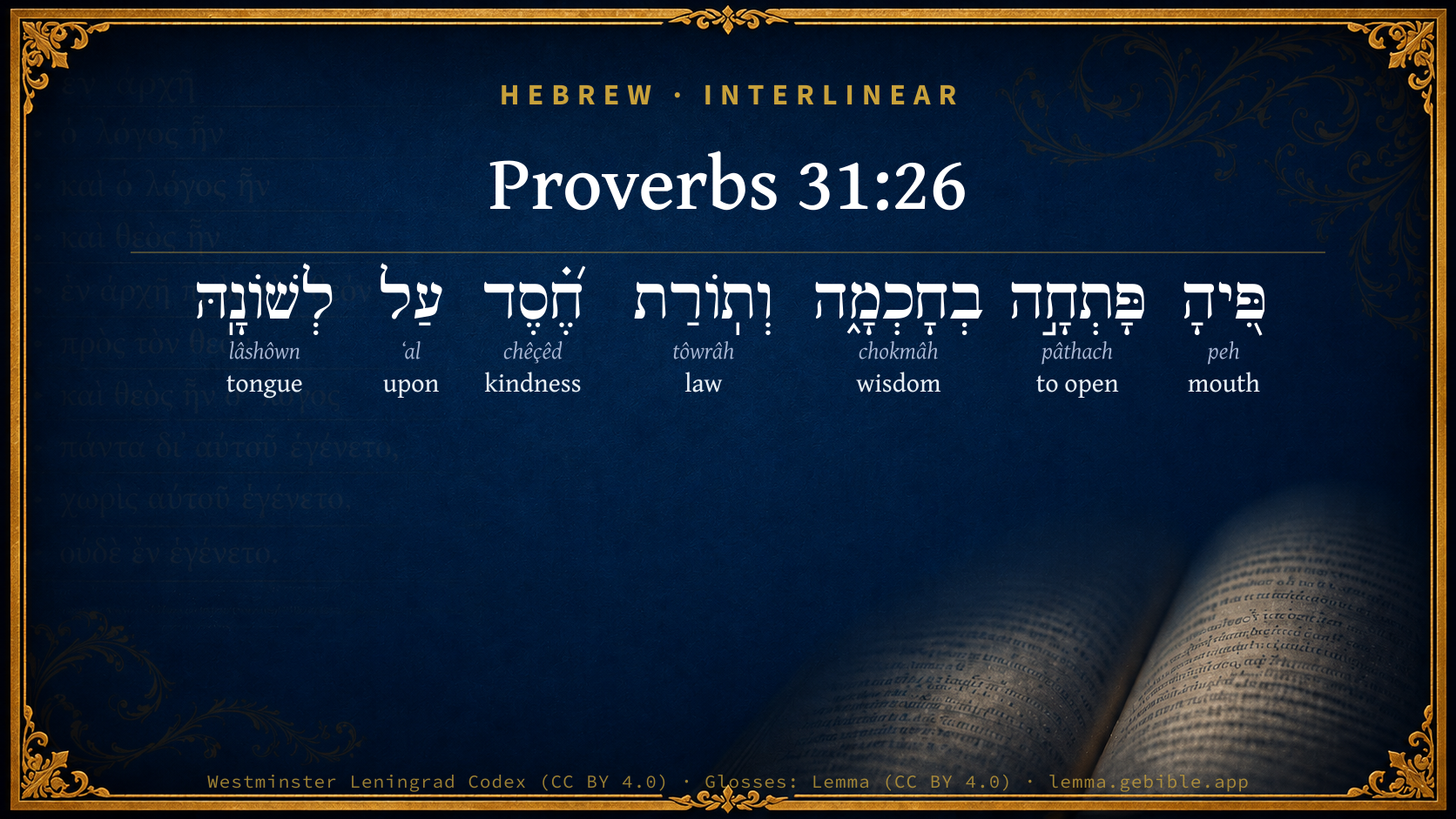
Proverbs 31:26

Hebrew (Westminster Leningrad Codex) Proverbs 31:26 appears in the Hebrew Old Testament. The text above is from the Westminster Leningrad Codex. Each word links to its Strong’s number, a concise gloss, and parsing drawn from the Open Scriptures Hebrew Bible morphology. Click any word for its full Brown-Driver-Briggs (BDB) entry.
Download image
Cite this verse

Proverbs 31:26 (World English Bible). Public Domain. Lemma interlinear Bible study tool, https://lemma.gebible.app/v/proverbs/31/26.

Show BibTeX & RIS
BibTeX
RIS
English Translation
She opens her mouth with wisdom. Faithful instruction is on her tongue.
World English Bible · Public Domain
Download a study sheet

One document with this verse’s original text, its word-by-word gloss line, the meaning frame, cross-references with their text, attributed commentary, and full source and license credits — printable, and it pastes into notes with its structure intact.

This verse Autodidact and up

Study sheet (.html) Plain text (.txt)

A passage Seminary Student

Up to 50 verses in one chapter. A passage sheet keeps up to 6 commentary sources and 12 cross-references per verse, in the order this page ranks them, and says so on the sheet whenever that leaves anything out. Ask for a single verse and you get the Autodidact verse sheet above.

Everything on this page stays free to read, with no account — the sheet is a download of what is already on screen, not access to it.

Want to remove ads? Support Godless Engineer
Compare translations 3

The same verse in 3 English versions, stacked beneath the original-language interlinear above. Click any original word for its lexicon entry.

Each is an independent rendering of the whole verse — the interlinear is not word-aligned to these translations.

Highlighted words mark where these versions differ — a whole-verse word diff, not a word-by-word alignment.

  • World English Bible Public Domain
    She opens her mouth with wisdom. Faithful instruction is on her tongue.
  • King James Version Public Domain
    She openeth her mouth with wisdom; and in her tongue is the law of kindness.
  • unfoldingWord Literal Text CC BY-SA 4.0
    Her mouth opens with wisdom, and the law of covenant faithfulness on her tongue.

unfoldingWord Literal Text — © unfoldingWord, licensed CC BY-SA 4.0. Word-aligned USFM3 via Door43 (git.door43.org/unfoldingWord/en_ult).

Versions to compare (up to 4)

3 of 4 selected

Show all 18 translations

Every available English version of this verse, each an independent rendering of the whole verse.

  • World English Bible Public Domain
    She opens her mouth with wisdom. Faithful instruction is on her tongue.
  • Berean Standard Bible Public Domain
    She opens her mouth with wisdom, and faithful instruction is on her tongue.
  • Majority Standard Bible Public Domain
    She opens her mouth with wisdom, and faithful instruction is on her tongue.
  • King James Version Public Domain
    She openeth her mouth with wisdom; and in her tongue is the law of kindness.
  • American Standard Version (1901) Public Domain
    She openeth her mouth with wisdom; And the law of kindness is on her tongue.
  • Revised Version (1885) Public Domain
    She openeth her mouth with wisdom; and the law of kindness is on her tongue.
  • Geneva Bible (1599) Public Domain
    She openeth her mouth with wisdome, and the lawe of grace is in her tongue.
  • Douay-Rheims (1899) Public Domain
    She hath opened her mouth to wisdom, and the law of clemency is on her tongue.
  • Young's Literal Translation Public Domain
    Her mouth she hath opened in wisdom, And the law of kindness `is' on her tongue.
  • Literal Standard Version CC BY-SA 4.0
    She has opened her mouth in wisdom, || And the law of kindness [is] on her tongue.
  • Unlocked Literal Bible CC BY-SA 4.0
    She opens her mouth with wisdom and the law of kindness is on her tongue.
  • unfoldingWord Literal Text CC BY-SA 4.0
    Her mouth opens with wisdom, and the law of covenant faithfulness on her tongue.
  • Darby Bible Public Domain
    She openeth her mouth with wisdom; and upon her tongue is the law of kindness.
  • World Messianic Bible Public Domain
    She opens her mouth with wisdom. Kind instruction is on her tongue.
  • Webster's Bible Public Domain
    She openeth her mouth with wisdom; and on her tongue is the law of kindness.
  • Free Bible Version CC BY-SA 4.0
    She speaks wise words, and she's kind when she gives instructions.
  • Bible in Basic English Public Domain
    Her mouth is open to give out wisdom, and the law of mercy is on her tongue.
  • JPS Tanakh (1917) Public Domain
    She openeth her mouth with wisdom; and the law of kindness is on her tongue.

Literal Standard Version (2020), Covenant Press — licensed CC BY-SA 4.0. Text via the HelloAO Bible API (eBible.org). Unlocked Literal Bible (unfoldingWord) — licensed CC BY-SA 4.0. Text via the HelloAO Bible API (eBible.org). unfoldingWord Literal Text — © unfoldingWord, licensed CC BY-SA 4.0. Word-aligned USFM3 via Door43 (git.door43.org/unfoldingWord/en_ult). Free Bible Version, Dr. Jonathan Gallagher — licensed CC BY-SA 4.0. Text via the HelloAO Bible API (eBible.org).

Word by word

More ways to search: Search by grammar → Find every occurrence → Compare this word →

Practice this passage: Drill this verse → Learn its vocabulary →

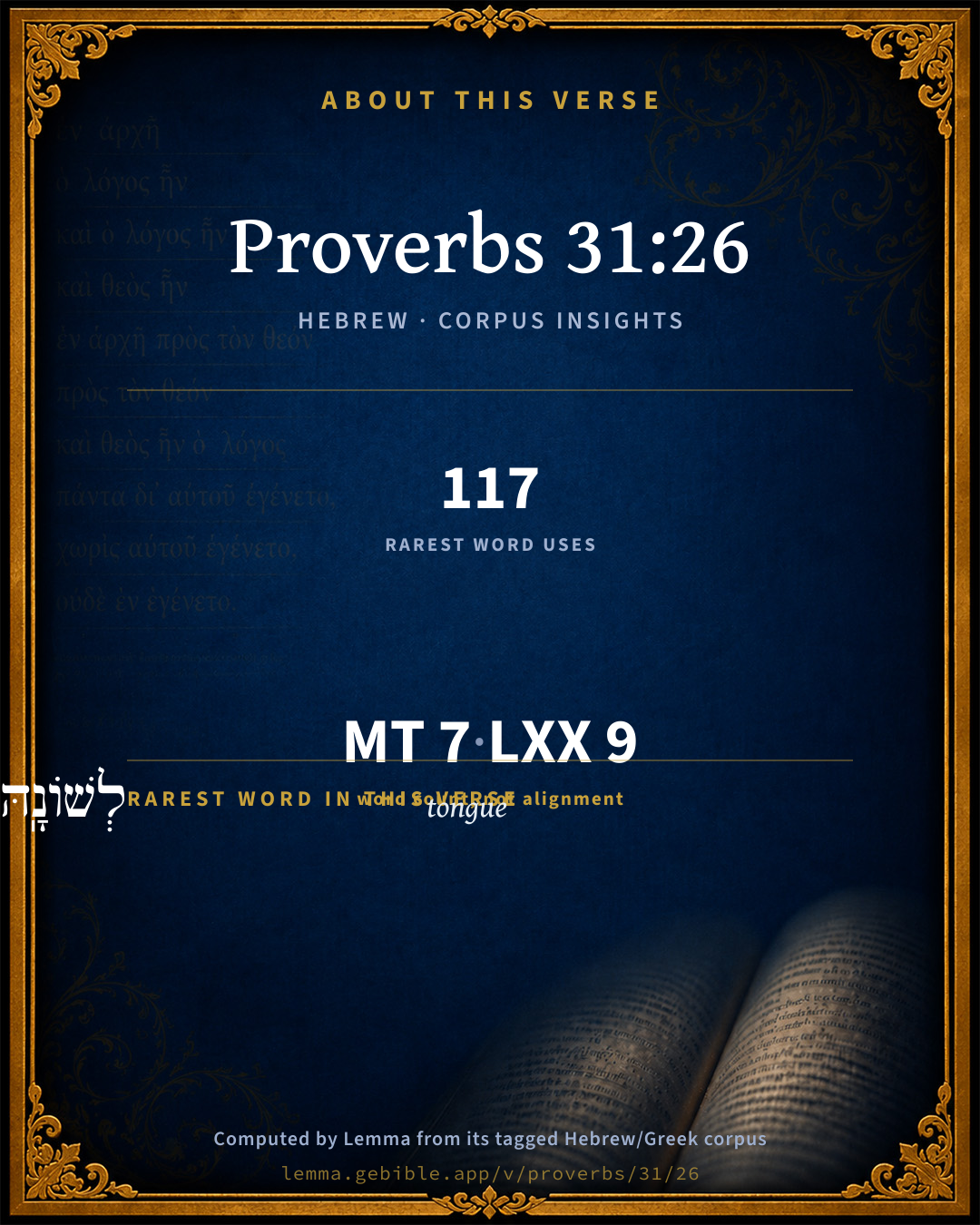
About this verse

These counts appear in no published source. They are computed here, from the morphology-tagged text and Lemma’s own curated glosses. What Lemma adds →

7
words
7
distinct lemmas
Wisdom
section

Grammatical profile

  • 1 verb
  • 5 nouns
  • 1 preposition

Verb forms

  • פָּתְחָ֣ה Qal · Perfect

Hebrew & Septuagint length

In English translation the verse runs 12 words from the Hebrew and 10 from the Septuagint (LXX English) — closely comparable.

A rough comparison of the two English renderings, which tokenize alike — not a word-level alignment.

Word counts can differ between the Hebrew and the Greek without any difference in meaning — e.g. the Hebrew direct-object marker אֵת has no separate Greek word, and Greek often adds the article ὁ.

In the original languages it is 7 Hebrew tokens and 9 Greek tokens — but the two are counted differently (Hebrew bundles its prefixes and suffixes into one token; the Greek is in lemma form), so that isn’t a like-for-like length.

Cross-references

26

Topical passages linked to Proverbs 31:26 in the Treasury of Scripture Knowledge — connected by theme and wording, ordered by reader-vote popularity; previews shown in the World English Bible.

  • Ephesians 4:29 Let no corrupt speech proceed out of your mouth, but such as is good for building up as the need may be, that it may give grace to those who hear.
  • Proverbs 16:24 Pleasant words are a honeycomb, Sweet to the soul, and health to the bones.
  • Proverbs 10:31 The mouth of the righteous brings forth wisdom, But the perverse tongue will be cut off.
  • Proverbs 12:18 There is one who speaks rashly like the piercing of a sword, But the tongue of the wise heals.
  • Colossians 4:5 Walk in wisdom toward those who are outside, redeeming the time.
  • 1 Peter 3:4–5 but in the hidden person of the heart, in the incorruptible adornment of a gentle and quiet spirit, which is in the sight of God very precious.
  • Proverbs 31:8–9 Open your mouth for the mute, In the cause of all who are left desolate.
  • Malachi 2:6 The law of truth was in his mouth, and unrighteousness was not found in his lips. He walked with me in peace and uprightness, and turned many away from iniquity.
  • 1 Peter 3:8–9 Finally, be all like-minded, compassionate, loving as brothers, tenderhearted, courteous,
  • Judges 13:23 But his wife said to him, If Yahweh were pleased to kill us, he wouldn't have received a burnt offering and a meal-offering at our hand, neither would he have shown us all these things, nor would at this time have told such things as these.
  • Proverbs 25:15 By patience a ruler is persuaded. A soft tongue breaks the bone.
  • 1 Peter 3:1 In like manner, wives, be in subjection to your own husbands; so that, even if any don't obey the Word, they may be won by the behavior of their wives without a word;
  • 1 Samuel 25:24–31 She fell at his feet, and said, On me, my lord, on me be the iniquity; and please let your handmaid speak in your ears. Hear the words of your handmaid.
  • Esther 5:8 if I have found favor in the sight of the king, and if it please the king to grant my petition, and to perform my request, let the king and Haman come to the banquet that I shall prepare for them, and I will do tomorrow as the king has said.
  • Esther 7:3–6 Then Esther the queen answered, If I have found favor in your sight, O king, and if it please the king, let my life be given me at my petition, and my people at my request:
  • Esther 8:3–6 Esther spoke yet again before the king, and fell down at his feet, and begged him with tears to put away the mischief of Haman the Agagite, and his device that he had devised against the Jews.
  • Luke 1:42–56 She called out with a loud voice, and said, "Blessed are you among women, and blessed is the fruit of your womb!
  • 2 Samuel 20:16–22 Then cried a wise woman out of the city, "Hear, hear! Please say to Joab, 'Come near here, that I may speak with you.'"
  • 2 Kings 22:15–20 She said to them, Thus says Yahweh, the God of Israel: Tell you the man who sent you to me,
  • Song of Solomon 2:14 My dove in the clefts of the rock, In the hiding places of the mountainside, Let me see your face. Let me hear your voice; For your voice is sweet, and your face is lovely.
  • Song of Solomon 4:11 Your lips, my bride, drip like the honeycomb. Honey and milk are under your tongue. The smell of your garments is like the smell of Lebanon.
  • Luke 1:38 Mary said, "Behold, the handmaid of the Lord; be it to me according to your word." The angel departed from her.
  • Acts 6:15 All who sat in the council, fastening their eyes on him, saw his face like it was the face of an angel.
  • Acts 18:26 He began to speak boldly in the synagogue. But when Priscilla and Aquila heard him, they took him aside, and explained to him the way of God more accurately.
  • Esther 4:4 Esther's maidens and her chamberlains came and told it her; and the queen was exceedingly grieved: and she sent clothing to clothe Mordecai, and to take his sackcloth from off him; but he didn't receive it.
  • Genesis 24:18–20 She said, "Drink, my lord." She hurried, and let down her pitcher on her hand, and gave him drink.

Cross-references courtesy of OpenBible.info (CC BY 4.0).

Hebrew and Greek witnesses Masoretic Hebrew ↔ Greek Septuagint

The same verse in the two great witnesses to the Old Testament, shown verse-for-verse.

These are two independent witnesses, not word-aligned to each other, and the Septuagint is shown in lemma (dictionary) form.

Hebrew Proverbs 31:26 Masoretic · Westminster Leningrad Codex

פִּ֭יהָ פָּתְחָ֣ה בְחָכְמָ֑ה וְתֽוֹרַת חֶ֝֗סֶד עַל לְשׁוֹנָֽהּ

She opens her mouth with wisdom. Faithful instruction is on her tongue.

World English Bible · Public Domain

Greek LXX Proverbs 31:26 Septuagint · lemma form

ἰσχύς καί εὐπρέπεια ἐνδύω καί εὐφραίνω ἐν ἡμέρα ἔσχατος

But she opens her mouth wisely, and according to law.

LXX2012 (modern English Septuagint) · Public Domain

On this verse, The Pulpit Commentary discusses the Septuagint’s reading. Read the note in Commentary ↓

Hebrew: Westminster Leningrad Codex (CC BY 4.0). Greek: Septuagint (public domain); English from LXX2012 (modern English Septuagint) (Public Domain). How the Septuagint differs from the Hebrew →

Commentary

Notes on Proverbs 31:26 from classic Christian and Jewish commentators (each source and its license shown beneath its notes). The classic Christian expositions comment on the surrounding passage and are grouped to its opening verse, so a note may address several verses; the Jewish commentaries on the Tanakh (Rashi and others) are per-verse, so they appear only where the commentator wrote on this verse.

Lemma curates 59 commentaries, every one of them public domain or Creative Commons licensed, each selected and text-cleaned for this edition rather than reprinted as found. About our sources →

Trapp's Complete Commentary

John Trapp

Pro 31:26 She openeth her mouth with wisdom; and in her tongue [is] the law of kindness.

Ver. 26. She openeth her mouth with wisdom.] Her mouth is not always open, but duly shut and discreetly opened - her words are few, true, and ponderous; the stream and current of her conference tends either to wisdom or kindness - that is, to duties either of piety or charity. The Jesuits forbid women to speak of God and his ways, either in good sort or in bad, and to meddle only with the distaff. But the good women in both Testaments, Abigail, Hannah, Esther, the Virgin Mary, Priscilla, Lois, &c., never heard of this new doctrine. Tatianus tells us that in the primitive Church every age and sex among the Christians were Christian philosophers; yea, that the very virgins and maids, as they sat at their work in wool, were wont to speak of God’s word. And Nicephorus writes that the Christians, even as they laboured or journeyed, were wont to sing psalms, and that thereby there was at a certain time a Jew converted. {a} It were surely a great grace, saith Lambert the martyr: if we might have the word of God diligently and often spoken and sung unto us in such wise that women and children might understand it. {b} Then should it come to pass that craftsmen should sing spiritual psalms sitting at their work, the husbandman at his plough, the good housewife at her wheel, as wisheth St Jerome.

And in her tongue is the law of kindness.] It is worthy the mark, saith the chronicler, {c} that Edward I and his grandson, Edward III, the best of our kings, had the two best wives, ladies of excellent virtue, that drew evenly with them in all the courses of honour that appertained to their side. The first of these Edwards being traitorously wounded while he was yet prince in the Holy Land, as they called it, by the poisoned knife of an assassin, the Lady Eleanor his wife extracted the poison with her tongue, licking daily, while her husband slept, his rankling wounds, whereby they perfectly closed, and yet herself received no hurt {d} So sovereign a medicine is a wife’s tongue, anointed with the virtue of kindness and affection.

{a} Hist. Eccles., lib. iii. cap. 37.

{b} Acts and Mon., fol. 1015.

{c} Dan, 262.

{d} Speed, 646; Cavid. in Middlesex, fol. 432.

John Trapp, A Commentary or Exposition upon All the Books of the Old and New Testament (1647–1656) — public domain. Text from a community e-Sword module.

Joseph Benson's Commentary

Pro 31:26. She openeth her mouth with wisdom — She is neither sullenly silent, nor full of impertinent talk, but speaks discreetly and piously, as occasion offers. In her tongue is the law of kindness — Her speeches are guided by wisdom and grace, and not by inordinate passions. And this practice is called a law in her tongue, because it is constant and customary, and proceeds from an inward and powerful principle of true wisdom.

Joseph Benson's Commentary on the Old and New Testaments (1811–1818) — public domain. Text from a community e-Sword module.

Geneva Bible (1599)

Geneva Bible translators

Her tongue is as a book whereby one might learn many good things: for she delighteth to talk of the word of God.

Geneva Bible (1599) marginal notes — public domain. Text via Bolls.life.

Jamieson, Fausset & Brown

Robert Jamieson, A. R. Fausset & David Brown

Her conversation is wise and gentle.

Jamieson, Fausset & Brown — Commentary Critical and Explanatory on the Whole Bible (1871) — public domain (CC PDM 1.0). Text via the HelloAO Bible API.

Adam Clarke's Commentary

Verse 26. She openeth her mouth with wisdom]

17. He comes now to the moral management of her family.

1) She is wise and intelligent; she has not neglected the cultivation of her mind.

2) She is amiable in her carriage, full of good nature, well tempered, and conciliating in her manners and address.

In her tongue is the law of kindness.] This is the most distinguishing excellence of this woman. There are very few of those who are called managing women who are not lords over their husbands, tyrants over their servants, and insolent among their neighbours. But this woman, with all her eminence and excellence, was of a meek and quiet spirit. Blessed woman!

Adam Clarke's Commentary on the Bible (1810–1826) — public domain. Text from a community e-Sword/MySword module.

Ellicott's Commentary for English Readers

(26) She openeth her mouth with wisdom.—She is not a mere household drudge, with no thought beyond providing food and clothing for her family. She cares for their higher interests, and knows how to guide them with her wisdom.

In her tongue is the law of kindness.—Kindness is the law by which she regulates all her words.

A Bible Commentary for English Readers, edited by Charles John Ellicott (1878–1897) — public domain. Text from a community e-Sword module.

The Cambridge Bible for Schools and Colleges

gen. ed. J. J. S. Perowne

26. the law] “Or, teaching,” R.V. marg. The wise instruction and counsel she gives is so combined with kindness, as to win rather than compel obedience. Comp. “the gracious words which proceeded out of His lips.” Luk_4:22.

The Cambridge Bible for Schools and Colleges (gen. ed. J. J. S. Perowne; Cambridge University Press, 1878–1918) — public domain. Text from a community e-Sword module.

John Gill's Exposition

She openeth her mouth with wisdom,.... When she opens her mouth, for it is not always open, she expresses herself in a discreet and prudent manner; as well as speaks of things not foolish and trifling, but of moment and importance, and of usefulness to others: or "concerning wisdom" (a); the church and people of Christ talk of the wisdom of God in the works of creation, providence, and redemption; of Christ, the Wisdom of God, and as made so to them; of the Gospel, the wisdom of God in a mystery, the hidden wisdom; and of wisdom in the hidden part, or the truth of grace in their souls; of their gracious experiences; nor will they suffer any foolish, filthy, and corrupt communication to proceed out of their mouths, but speak the pure language of Canaan; what is for the use of edifying, and being taken out of the Scriptures is profitable for instruction in righteousness; see Psa 37:30;

and in her tongue is the law of kindness; or "the law of love" (b), grace and mercy; which is the law of Christ, Gal 6:2; speaking kindly and tenderly to everyone, exhorting to acts of mercy and kindness, and doing them herself: or "the doctrine of grace is in her tongue" (c); the Gospel, which is called the Gospel of the grace of God, and the grace of God itself; it is the doctrine of the grace and love of God the Father towards men in Christ, as it appears in their election in him and redemption by him; of the grace of Christ in his incarnation, sufferings, and death; and of the grace of the Spirit in regeneration, conversion, and sanctification; and which contains various doctrines of grace, as of justification, pardon of sin, and effectual calling; and of salvation itself, which is all of grace: and this doctrine of grace, in the several branches of it, the church, and all gracious souls, cannot forbear speaking of; it is often in their mouths, it dwells upon their tongues; and careful are they in other respects that their speech be seasoned with grace, and be such that ministers grace to the hearers, Eph 4:29.

(a) "de sapientia", Mercerus. (b) "lex misericordiae", Montanus. (c) "Instructio gratiae", Gejerus; "lex, vel doctrina gratiae", Cocceius, so the Targum; "doctrina benigniatis", Junius & Tremellius, Piscator.

John Gill's Exposition of the Whole Bible (1746–1763) — public domain (CC PDM 1.0). Text via the HelloAO Bible API.

Albert Barnes' Notes on the Bible

Law of kindness - The words which come from the lips of the true wife are as a law giving guidance and instruction to those that hear them; but the law is not proclaimed in its sterner aspects, but as one in which “mercy tempers justice,” and love, the fulfilling of the law, is seen to be the source from which it springs.

Albert Barnes' Notes on the Bible (1834–1885) — public domain. Text from a community e-Sword/MySword module.

Haydock's Catholic Bible Commentary

Tongue. She is ever bent on doing good. (Haydock) --- Very different from many of her sex, who are taken up with vanity and complaints. (Calmet)

George Leo Haydock (1774–1849), Haydock's Catholic Family Bible and Commentary, 1859 edition — public domain. Excludes Psalms (Douay-Rheims chapter numbering differs from Protestant) and Deuterocanonical books (Catholic canon only).

Matthew Poole's English Annotations

She openeth her mouth with wisdom; she is neither sullenly silent, nor full of vain and impertinent talk, as many women are, but speaks directly and piously, as occasion offereth itself.

In her tongue is the law of kindness; her speeches are not froward and provoking, as those of foolish women frequently are, but most obliging and amiable, as being guided by wisdom and grace, and not by inordinate lusts and passions. And this practice is called

a law in her tongue, because it is constant and customary, and proceeds from an inward and powerful principle of true wisdom, which in a manner necessitates and constrains her to discourse like herself, so that in a moral sense she cannot speak otherwise, unless she offer violence to herself, or the nature of the thing require sharp and severe expressions.

Matthew Poole's English Annotations on the Holy Bible (1683–1685) — public domain. Text from a community e-Sword/MySword module.

Whedon's Commentary on the Bible

Daniel D. Whedon

26. With wisdom — She has not neglected the cultivation of her mind, consequently she is no idle talker, no mere prattler; spends not her breath in trifling gossip; but converses with intelligence and discretion. Moreover, she is habitually kind in her deportment and discourse.

The law of kindness — Or pity, is on her tongue. Dr. Clarke, who was not an admirer of “strong-minded women,” thinks this the most remarkable characteristic of this remarkable woman. Hear him: “There are very few of those called managing women who are not lords over their husbands, tyrants over their servants, and insolent among their neighbours. But this woman, with all her eminence and excellence, was of a meek and quiet spirit.”

Daniel D. Whedon (gen. ed.), Commentary on the Old and New Testaments (1874–1909) — public domain. Text from a community e-Sword module.

The Pulpit Commentary

PE. She openeth her mouth with wisdom. She is not merely a good housewife, attending diligently to material interests; she guides her family with words of wisdom. When she speaks, it is not gossip, or slander, or idle talk, that she utters, but sentences of prudence and sound sense, such as may minister grace to the hearers. The Septuagint has this verse before ver. 25, and the first hemistich Again. after ver. 27. So in La 2, 3, 4, the pe and ayin vetoes change places. This is also the case in Ps 37. In the former passage the LXX: renders, "She openeth her mouth heedfully and lawfully (proecontwv kai ennomwv );" and in the other, "wisely and in accordance with law (sofwv kai nomoyesmwv )." In her tongue is the law of kindness (thorath chesed); i.e. her language to those around her is animated and regulated by love. As mistress of a family, she has to teach and direct her dependents, and she performs this duty with gracious kindness and ready sympathy. Septuagint, "She places order on her tongue."

The Pulpit Commentary (1880–1919), ed. H.D.M. Spence-Jones & Joseph S. Exell — public domain. Text from a community e-Sword module.

John Wesley's Explanatory Notes

Openeth her mouth - She is neither sullenly silent, nor full of impertinent talk, but speaks discreetly and piously, as occasion offers. In her tongue - Her speeches are guided by wisdom and grace, and not by inordinate passions. And this practice is called a law in her tongue, because it is constant and customary, and proceeds from an inward and powerful principle of true wisdom.

John Wesley, Explanatory Notes Upon the Whole Bible (1754–1765) — public domain. Text via the GEBible commentary corpus.

Keil & Delitzsch

C. F. Keil & F. Delitzsch

The next verse presents one of the most beautiful features in the portrait:

26 פ She openeth her mouth with wisdom,

And amiable instruction is on her tongue.

The ב of בּחכמה is, as also at Psa 49:5; Psa 78:2, that of means: when she speaks, then it is wisdom pressing itself from her heart outward, by means of which she breaks the silence of her mouth. With על, in the expression 26b, elsewhere תּהת interchanges: under the tongue, Psa 10:7, one has that which is ready to be spoken out, and on the tongue, Psa 15:3, that which is in the act of being spoken out. תּורת־חסד is a genitive connection after the manner of tôrath אמת, Mal 2:6. The gen. is not, as at Lev 6:2, in tôrath העלה, the gen. of the object (thus e.g., Fleischer's institutio ad humanitatem), but the gen. of property, but not so that חסד denotes grace (Symmachus, νόμος ἐπίχαρις; Theodotion, νόμος χάριτος), because for this meaning there is no example except Isa 40:6; and since חסד in the O.T. is the very same as in the N.T., love, which is the fulfilling of the law, Hos 6:6, cf. Kg1 20:31,

(Note: Immanuel remarks that Tôrath חסד probably refers to the Tôra, and שׁכוהל חסד, i.e., which is wholly love, which goes forth in love, to the Gesetz = statute.)

it is supposed that the poet, since he writes תורת חסד, and not תורת חן, means to designate by חסד this property without which her love for her husband, her industry, her high sentiment, would be no virtues, viz., unselfish, sympathizing, gentle love. Instruction which bears on itself the stamp of such amiability, and is also gracious, i.e., awakening love, because going forth from love (according to which Luther, translating holdselige Lere = pleasing instructions, thus understands it) - such instruction she carries, as house-mother (Pro 1:8), in her mouth. Accordingly the lxx translate (vid., Lagarde regarding the mistakes of this text before us) θεσμοὶ ἐλεημοσύνης, and Jerome lex clementiae. חסד is related to אהבה as grace to love; it denotes love showing itself in kindness and gracefulness, particularly condescending love, proceeding from a compassionate sympathy with the sufferings and wants of men. Such graceful instruction she communicates now to this and now to that member of her household, for nothing that goes on in her house escapes her observation.

Keil & Delitzsch — Biblical Commentary on the Old Testament (1861–1891) — public domain (CC PDM 1.0). Text via the HelloAO Bible API. (Old Testament only.)

unfoldingWord translationNotes

Door43 World Missions Community

opens her mouth with wisdom

The act of opening her mouth is a metonym for speaking. The abstract noun "wisdom" can be translated as an adverb or an adjective. AT: "she speaks wisely" or "she speaks wise words" (See: Metonymy and Abstract Nouns)

the law of kindness is on her tongue

The phrase "on her tongue" refers to her speaking, as the tongue is part of the mouth. The phrase "the law of kindness" refers to her teaching people to be kind. AT: "she teaches people to be kind" (See: Metonymy)

watches over the ways of her household

The word "ways" refers to the way people live. AT: "makes sure her whole family lives in a way that pleases God" (See: Metaphor)

does not eat the bread of idleness

To "eat the bread of" something means to do something. AT: "she is not idle" (See: Idiom)

idleness

doing nothing and being lazy

translationWords

wise

law, laws

household

unfoldingWord translationNotes — © Distant Shores Media and the Door43 World Missions Community, licensed CC BY-SA 4.0. Source: git.door43.org/Door43/en_tn.

Lesson kit

Teaching starters — assembled from the data on this page, not authored interpretation. Every prompt links to the verse data it draws on. Edit before teaching.

Proverbs, in the Wisdom, opens this verse with 7 words (7 distinct Hebrew lemmas). Its most distinctive word is lâshôwn (“tongue”). A historical commentator’s framing appears above. Read the whole chapter for the surrounding context.

Discussion questions

  1. What does “tongue” (lâshôwn) contribute to the verse as a whole?
  2. How does Ephesians 4:29, which shares this passage’s theme, read alongside this verse?
  3. These translations render this verse differently. What is at stake in choosing one wording over another?
  4. «פָּתְחָ֣ה» is a Qal Perfect verb. How does that grammatical form shape the action described?
  5. Compare how Trapp's Complete Commentary and Joseph Benson's Commentary read this verse. Where do they agree or differ?

Things to notice

Reading settings

Reading text

Shown beneath each verse's original-language words.

Old Testament
Old Testament edition

Read the OT as the Masoretic Hebrew (MT) or the Greek Septuagint (LXX).

English shown for the Greek Septuagint (in the Hebrew ↔ Greek comparison).

Comparing translations? Open the Compare panel on any verse page to stack up to four side by side.