
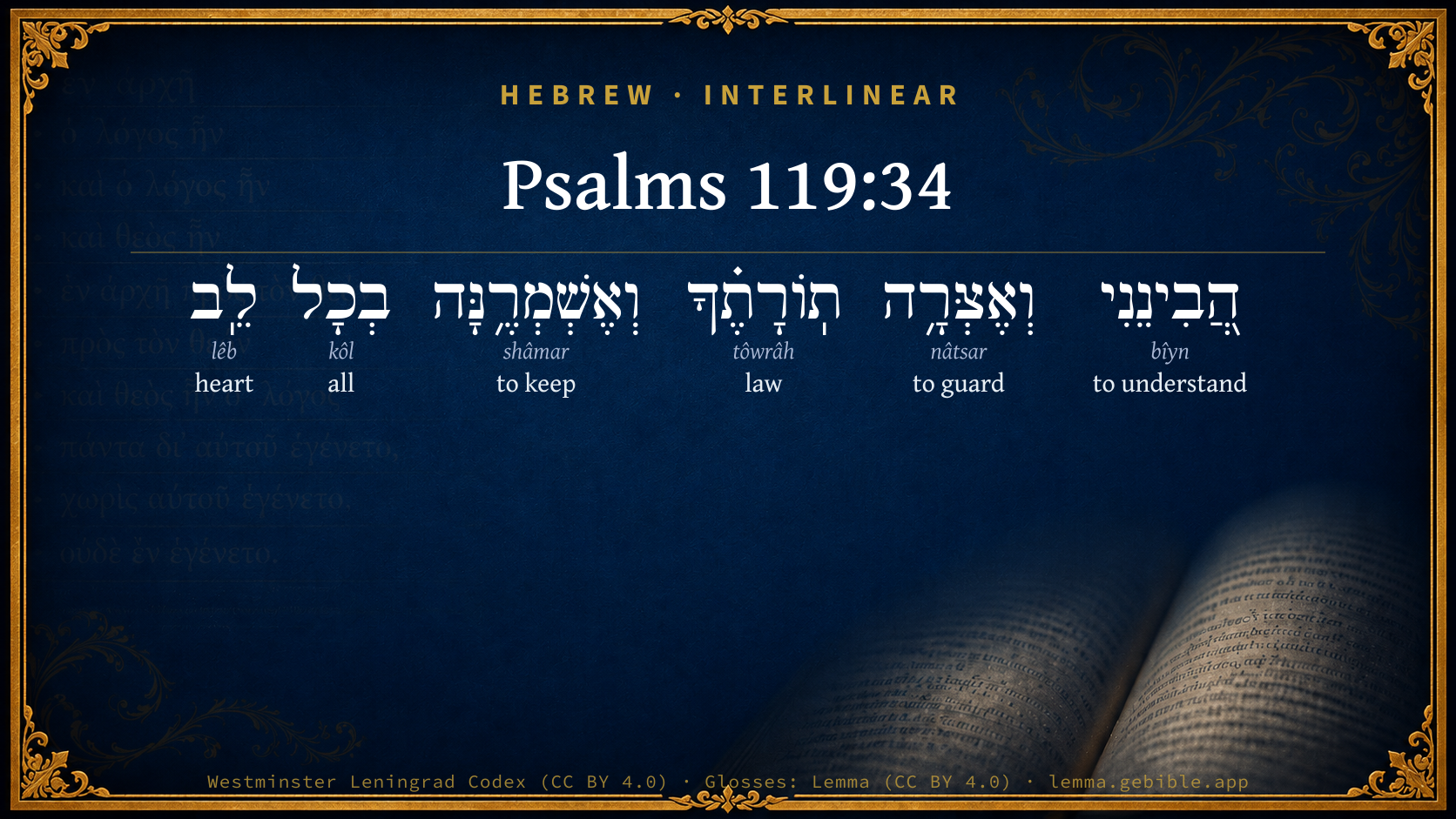
Psalms 119:34

Hebrew (Westminster Leningrad Codex) Psalms 119:34 appears in the Hebrew Old Testament. The text above is from the Westminster Leningrad Codex. Each word links to its Strong’s number, a concise gloss, and parsing drawn from the Open Scriptures Hebrew Bible morphology. Click any word for its full Brown-Driver-Briggs (BDB) entry.
Download image
Cite this verse

Psalms 119:34 (World English Bible). Public Domain. Lemma interlinear Bible study tool, https://lemma.gebible.app/v/psalms/119/34.

Show BibTeX & RIS
BibTeX
RIS
English Translation
Give me understanding, and I will keep your law. Yes, I will obey it with my whole heart.
World English Bible · Public Domain
Download a study sheet

One document with this verse’s original text, its word-by-word gloss line, the meaning frame, cross-references with their text, attributed commentary, and full source and license credits — printable, and it pastes into notes with its structure intact.

This verse Autodidact and up

Study sheet (.html) Plain text (.txt)

A passage Seminary Student

Up to 50 verses in one chapter. A passage sheet keeps up to 6 commentary sources and 12 cross-references per verse, in the order this page ranks them, and says so on the sheet whenever that leaves anything out. Ask for a single verse and you get the Autodidact verse sheet above.

Everything on this page stays free to read, with no account — the sheet is a download of what is already on screen, not access to it.

Want to remove ads? Support Godless Engineer
Compare translations 3

The same verse in 3 English versions, stacked beneath the original-language interlinear above. Click any original word for its lexicon entry.

Each is an independent rendering of the whole verse — the interlinear is not word-aligned to these translations.

Highlighted words mark where these versions differ — a whole-verse word diff, not a word-by-word alignment.

  • World English Bible Public Domain
    Give me understanding, and I will keep your law. Yes, I will obey it with my whole heart.
  • King James Version Public Domain
    Give me understanding, and I shall keep thy law; yea, I shall observe it with my whole heart.
  • unfoldingWord Literal Text CC BY-SA 4.0
    Give me understanding, and I will guard your teaching, and I will keep it with a whole heart.

unfoldingWord Literal Text — © unfoldingWord, licensed CC BY-SA 4.0. Word-aligned USFM3 via Door43 (git.door43.org/unfoldingWord/en_ult).

Versions to compare (up to 4)

3 of 4 selected

Show all 17 translations

Every available English version of this verse, each an independent rendering of the whole verse.

  • World English Bible Public Domain
    Give me understanding, and I will keep your law. Yes, I will obey it with my whole heart.
  • Berean Standard Bible Public Domain
    Give me understanding that I may obey Your law, and follow it with all my heart.
  • Majority Standard Bible Public Domain
    Give me understanding that I may obey Your law, and follow it with all my heart.
  • King James Version Public Domain
    Give me understanding, and I shall keep thy law; yea, I shall observe it with my whole heart.
  • American Standard Version (1901) Public Domain
    Give me understanding, and I shall keep thy law; Yea, I shall observe it with my whole heart.
  • Revised Version (1885) Public Domain
    Give me understanding, and I shall keep thy law; yea, I shall observe it with my whole heart.
  • Geneva Bible (1599) Public Domain
    Giue mee vnderstanding, and I will keepe thy Law: yea, I wil keepe it with my whole heart.
  • Young's Literal Translation Public Domain
    Cause me to understand, and I keep Thy law, And observe it with the whole heart.
  • Literal Standard Version CC BY-SA 4.0
    Cause me to understand, and I keep Your law, || And observe it with the whole heart.
  • Unlocked Literal Bible CC BY-SA 4.0
    Give me understanding, and I will keep your law; I will observe it with all my heart.
  • unfoldingWord Literal Text CC BY-SA 4.0
    Give me understanding, and I will guard your teaching, and I will keep it with a whole heart.
  • Darby Bible Public Domain
    Give me understanding, and I will observe thy law; and I will keep it with [my] whole heart.
  • World Messianic Bible Public Domain
    Give me understanding, and I will keep your Torah. Yes, I will obey it with my whole heart.
  • Webster's Bible Public Domain
    Give me understanding, and I shall keep thy law; yes, I shall observe it with my whole heart.
  • Free Bible Version CC BY-SA 4.0
    Help me to understand so I can be totally committed to doing what you want.
  • Bible in Basic English Public Domain
    Give me wisdom, so that I may keep your law; going after it with all my heart.
  • JPS Tanakh (1917) Public Domain
    Give me understanding, that I keep Thy law and observe it with my whole heart.

Literal Standard Version (2020), Covenant Press — licensed CC BY-SA 4.0. Text via the HelloAO Bible API (eBible.org). Unlocked Literal Bible (unfoldingWord) — licensed CC BY-SA 4.0. Text via the HelloAO Bible API (eBible.org). unfoldingWord Literal Text — © unfoldingWord, licensed CC BY-SA 4.0. Word-aligned USFM3 via Door43 (git.door43.org/unfoldingWord/en_ult). Free Bible Version, Dr. Jonathan Gallagher — licensed CC BY-SA 4.0. Text via the HelloAO Bible API (eBible.org).

Word by word

More ways to search: Search by grammar → Find every occurrence → Compare this word →

Practice this passage: Drill this verse → Learn its vocabulary →

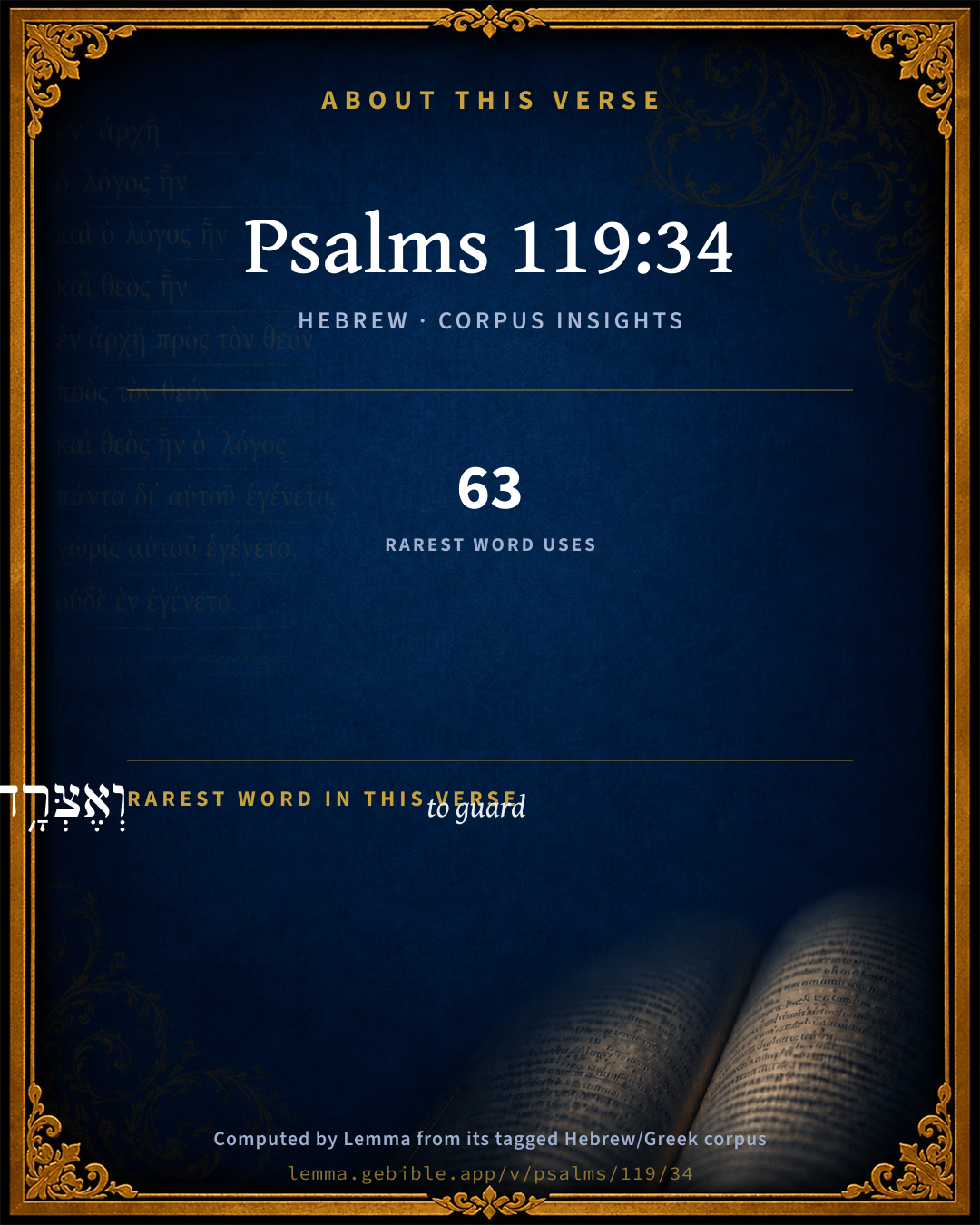
וְאֶצְּרָ֥ה
nâtsar
H5341
“and · to guard”
Conjunction + Verb, Qal, Cohortative, 1st Person, Common, Singular
Part of Speech
Conjunction + Verb
Stem
Qal
Form
Cohortative
Person
1st Person
Gender
Common
Number
Singular
Full BDB Definition

Origin: a primitive root

TWOT: 1407

to guard, watch, watch over, keep - (Qal) - to watch, guard, keep - to preserve, guard from dangers - to keep, observe, guard with fidelity - to guard, keep secret - to be kept close, be blockaded - watchman (participle)
  1. הֲ֭בִינֵנִי bîyn H995 “understand · me” Verb, Hiphil, Imperative, 2nd Person, Masculine, Singular + Suffix, Personal, 1st Person, Common, Singular
  2. תֽוֹרָתֶ֗ךָ tôwrâh H8451 “law · your” Noun, Common, Feminine, Singular, Construct + Suffix, Personal, 2nd Person, Masculine, Singular
  3. וְאֶשְׁמְרֶ֥נָּה shâmar H8104 “and · to keep · her” Conjunction + Verb, Qal, Imperfect, 1st Person, Common, Singular + Suffix, Personal, 3rd Person, Feminine, Singular
  4. בְכָל kôl H3605 “in/at · all of” Preposition + Noun, Common, Masculine, Singular, Construct
  5. לֵֽב lêb H3820 “heart” Noun, Common, Masculine, Singular, Absolute

About this verse

These counts appear in no published source. They are computed here, from the morphology-tagged text and Lemma’s own curated glosses. What Lemma adds →

6
words
6
distinct lemmas
Wisdom
section

Grammatical profile

  • 3 verbs
  • 3 nouns

Verb forms

  • הֲ֭בִינֵנִי Hiphil · Imperative
  • וְאֶצְּרָ֥ה Qal · Cohortative
  • וְאֶשְׁמְרֶ֥נָּה Qal · Imperfect

Hebrew & Septuagint length

In English translation the verse runs 18 words from the Hebrew and 17 from the Septuagint (LXX English) — closely comparable.

A rough comparison of the two English renderings, which tokenize alike — not a word-level alignment.

Word counts can differ between the Hebrew and the Greek without any difference in meaning — e.g. the Hebrew direct-object marker אֵת has no separate Greek word, and Greek often adds the article ὁ.

Cross-references

15

Topical passages linked to Psalms 119:34 in the Treasury of Scripture Knowledge — connected by theme and wording, ordered by reader-vote popularity; previews shown in the World English Bible.

  • Matthew 7:24 "Everyone therefore who hears these words of mine, and does them, I will liken him to a wise man, who built his house on a rock.
  • James 1:5 But if any of you lacks wisdom, let him ask of God, who gives to all liberally and without reproach; and it will be given to him.
  • Proverbs 2:5–6 Then you will understand the fear of Yahweh, And find the knowledge of God.
  • Psalms 119:73 Your hands have made me and formed me. Give me understanding, that I may learn your commandments.
  • James 1:25 But he who looks into the perfect law, the law of freedom, and continues, not being a hearer who forgets but a doer of the work, this man will be blessed in what he does.
  • Psalms 111:10 The fear of Yahweh is the beginning of wisdom. All those who do his work have a good understanding. His praise endures forever!
  • Psalms 119:10 With my whole heart, I have sought you. Don't let me wander from your commandments.
  • Psalms 119:69 The proud have smeared a lie upon me. With my whole heart, I will keep your precepts.
  • John 7:17 If anyone desires to do his will, he will know about the teaching, whether it is from God, or if I am speaking from myself.
  • James 2:8–12 However, if you fulfill the royal law, according to the Scripture, "You shall love your neighbor as yourself," you do well.
  • Matthew 5:19 Whoever, therefore, shall break one of these least commandments, and teach others to do so, shall be called least in the Kingdom of Heaven; but whoever shall do and teach them shall be called great in the Kingdom of Heaven.
  • James 3:13–18 Who is wise and understanding among you? Let him show by his good conduct that his deeds are done in gentleness of wisdom.
  • Job 28:28 To man he said, 'Behold, the fear of the Lord, that is wisdom. To depart from evil is understanding.'"
  • Psalms 119:58 I sought your favor with my whole heart. Be merciful to me according to your word.
  • James 4:11 Don't speak against one another, brothers. He who speaks against a brother and judges his brother, speaks against the law and judges the law. But if you judge the law, you are not a doer of the law, but a judge.

Cross-references courtesy of OpenBible.info (CC BY 4.0).

Hebrew and Greek witnesses Masoretic Hebrew ↔ Greek Septuagint

The same verse in the two great witnesses to the Old Testament, shown verse-for-verse.

You’re reading Greek Psalm 118 (Hebrew Psalm 119). The Septuagint counts the superscription, so verse numbers can differ from the Hebrew — chapter-level alignment, not verse-by-verse. Numbering follows Rahlfs.

These are two independent witnesses, not word-aligned to each other, and the Septuagint is shown in lemma (dictionary) form.

Hebrew Psalms 119:34 Masoretic · Westminster Leningrad Codex

הֲ֭בִינֵנִי וְאֶצְּרָ֥ה תֽוֹרָתֶ֗ךָ וְאֶשְׁמְרֶ֥נָּה בְכָל לֵֽב

Give me understanding, and I will keep your law. Yes, I will obey it with my whole heart.

World English Bible · Public Domain

Greek LXX Greek Psalm 118:34 Septuagint · lemma form

συνέτιζω ἐγώ καί ἐκἐρευνάω ὁ νόμος σύ καί φυλάσσω αὐτός ἐν ὅλος καρδία ἐγώ

Instruct me, and I will search out your law, and will keep it with my whole heart.

LXX2012 (modern English Septuagint) · Public Domain

Hebrew: Westminster Leningrad Codex (CC BY 4.0). Greek: Septuagint (public domain); English from LXX2012 (modern English Septuagint) (Public Domain). How the Septuagint differs from the Hebrew →

Commentary

Notes on Psalms 119:34 from classic Christian and Jewish commentators (each source and its license shown beneath its notes). The classic Christian expositions comment on the surrounding passage and are grouped to its opening verse, so a note may address several verses; the Jewish commentaries on the Tanakh (Rashi and others) are per-verse, so they appear only where the commentator wrote on this verse.

Lemma curates 59 commentaries, every one of them public domain or Creative Commons licensed, each selected and text-cleaned for this edition rather than reprinted as found. About our sources →

Trapp's Complete Commentary

John Trapp

Psa 119:34 Give me understanding, and I shall keep thy law; yea, I shall observe it with [my] whole heart.

Ver. 34. Give me understanding] We can neither know nor do God’s will without divine light and aid, as appears clearly by this fifth octonary, which, therefore, Austin made so great use of against the Pelagians.

John Trapp, A Commentary or Exposition upon All the Books of the Old and New Testament (1647–1656) — public domain. Text from a community e-Sword module.

The Biblical Illustrator

Joseph S. Exell

Psa_119:34

Give me understanding, and I shall keep Thy law; yes, I shall observe it with my whole heart.

Davids prayer and resolution

I. Their order. Knowledge must necessarily precede obedience, since there can be nothing chosen by the will but what the understanding has first allowed; the will being destitute of all light save what is borrowed: for as the stars derive their light from the sun, so does the will her light from the understanding, that directive faculty of the soul, the candle of the Lord, that light whereby we discern good from evil.

II. Their connection.

1. Knowledge and obedience are not things inseparable, for one may be without the other; we may have understanding, and yet not keep Gods law; for knowledge does not change the will, but direct it; it does only rationally persuade, not effectually convert it; so that the will must he sanctified, as well as the understanding illuminated, before our obedience to Gods law can be answerable to our knowledge of it.

2. We may both understand Gods law, and keep it. God that employs, enables us; lie that calls us gives us a power to come, otherwise His invitation would be a mockery; tie that saith, Depart from evil, and do good, has doubtless made us capable of so doing.

III. The main scope and design of the words. Do this for me, and I do promise on my part to keep Thy law, to meditate upon Thy precepts, and to have respect unto Thy ways, to delight myself in Thy statutes, and not to forget Thy Word. Our obedience must be--

1. Sincere. This renders our endeavours acceptable to God, and profitable to ourselves.

2. Universal. Catholic faith without catholic obedience is of little value.

3. Constant. If we faint, we shall never reap; if we are weary of running, we shall never obtain the prize. (E. Lake, D. D.)

The need of understanding

Understanding. That is what he urgently prays for. If only the poor man could understand what God was about; if only he could detect the track, catch the clue, hear the voice behind him saying, This is the way? what a relief, what a strength it would be. He is ready, eager, willing; his heart is aflame; he desires keenly to do the right, to walk with God--so, at least, it seems to him; so he thinks. He may discover, later on, that his will is not so strong as he imagines. But, at any rate, as he stands, it is his head, rather than his heart, which he feels to be at fault. He feels, but cannot see; he desires, but cannot decide. That will of God which he would so delightedly follow refuses to pronounce itself and give clear utterance. It vanishes. It hides itself. It is dissipated into hesitating and disappointing negations. Just when he fancied he had got his grip upon it it slips through his fingers. What ought he to do? What ought he not to do? How much does God ask of him? or how little? What is the rule he must obey? If he did but know, he would be loyal enough. O give me understanding, and I shall keep Thy law! Yea, I shall keep it with my whole heart. His whole heart, for then the whole man would go along with what it saw to be so right. The fitness, the meaning, the method, the end would all commend themselves. As the reason joyfully assented, the heart would commit itself to a plan so sound and so intelligible. And there would be no disappointing blunders to check the hearts advance; no slips, no doubtful experiments, no foolish hesitation in moments of uncertain suspense. The heart would not cringe in fear, trying its road before it with trembling anxiety. It would go with a swing, sure of itself; sure of its direction, sure of its success. Oh! to have this confidence, this security, this understanding--then he would keep the law with all his heart and soul. Give me understanding! A true prayer for us all! What a lot of harm is done in the world by the folly, the stupidity, the blindness of those who are on Gods side, and genuinely desire to keep His law! We make so little way in carrying Gods law into effective action, because our grasp on its principles is so frail, our apprehension of its height and depth is so cheap, and poor, and thin. A whole world of assumptions, moral and religious, are under challenge; and are undergoing the transformation which such challenges enforce. We are compelled to reconsider our familiar language; to recast our phrases; to review our apologetics. A resettlement of the entire position is proceeding, in the sense that the proportion and balance of our modes of expressing and defending our convictions are shifting. It seems as if the world of spirit and of grace had slipped out of our ken--as if we had lost our way in it, and could not move in it with any confidence. It has grown to feel far-off and out of touch--a strange land, where we are not at home. So our religious life conies to a halt, gets in a tangle, grows timid and dolorous. If we did but know better what it is that God is saying to us! If our ears were but open, if our apprehension of Him were but more firm and clear! Understanding, moral insight, spiritual intelligence, an instructed conscience, a purer and truer judgment, a power to decide, to resolve, a skill in discernment. Oh, pray for that--our grievous lack! It can come from God only. He not only commands, but enables us to understand His commands. Yet this is left us--to bring our faculties under His handling, under His discipline. We have got minds; we have got the gift of reason. We can set these to work, with a little more seriousness and efficiency. First, we can recognize that this law of God which we do genuinely desire to keep with our whole heart is no light and easy affair, to be known straight off at a hearing. It is a serious business; and calls upon our reason to search it out. Can we apply the moral law, as Christ gave it to us, to modern life, to commerce, to luxury, to social intercourse? Can the modern conditions of big cities allow for Sunday? Can the Christian ideal of marriage stand the strain of the present freedom of relationship between man and woman? Can it justify its rigidity? Can we say why, or how it should be when we are asked? These questions cannot be answered without thought and care and trouble; they cry out for an intelligent understanding. Oh, grant us understanding that we may keep Thy law. Secondly, it is a prayer that implies the incessant revelation of fresh law to be kept. We desire to serve God not only better than we now do, but better than we yet know how to serve. He has a law for us which is far above out of our sight. His law is making demands of us of which we have as yet no intelligence. Oh, if we saw and knew, how bitter would be our shame at failing Him so totally! Oh, pray to understand more of what He wants of us! Be ever occupied in lifting your standard, in pushing forward your moral frontiers, in raising the demands. (Canon Scott Holland.)

On the identity of wisdom and religion

Let us survey,, one by one, the characteristic marks of wisdom; and examine whether they are not, singly and collectively, exemplified in the conduct of the man who fixes his heart upon God through Jesus Christ.

I. Wisdom selects such objects of pursuit as she discerns a satisfactory prospect of attaining.

II. Wisdom sets its affections upon those things which are in their own nature the most excellent.

III. Wisdom chooses for its portion those acquisitions which, in the possession, are accompanied with the highest delight. How, then, stands the case with respect to religion?

1. Consider the point first with regard to present satisfaction.

2. With respect to the life to come, comparison cannot be mentioned. Whether the blessedness of heaven or the pains of hell be preferable; whether it be wisdom to choose the future rewards of religion, or the future punishments of guilt; these are questions which require not an answer.

IV. Wisdom occupies itself in the pursuit of efficient remedies for evils actual or probable. Is this position descriptive of religion? Evils are temporal, or spiritual. Compare as to evils of each class the advantages of the righteous and of the unrighteous.

V. Wisdom fixes her attention on those desirable objects which, other circumstances being equal, are the most durable. Is this characteristic of wisdom to be found in religion? How long do the pleasures of sin continue? Suppose that the wicked man grasps his good things, be they what they may, until death. The righteous man, travelling by his side, enjoys his delights unto the same period. So far as to duration, the servant of God is not under any disadvantage. But from the instant of death how stands the comparison? That instant which for ever extinguishes the pleasures of the wicked, sees the happiness of the righteous only in its commencement. (T. Gisborne, M. A.)

The Biblical Illustrator, edited by Joseph S. Exell (c. 1880s–1900s) — public domain. Text from a community e-Sword module.

J. A. Alexander on Psalms

Joseph Addison Alexander

34. (Psa 119:34) Make me understand (it) and I will keep thy law, and will observe it with a whole heart. The first verb is too vaguely rendered in the English versions (give me understanding). It has here the same sense as in Psa 119:27, and the object is to be supplied from the next member of the sentence. The form of the last verb is one expressing strong desire and fixed determination. With a whole heart, or with all (my) heart, as in Psa 119:2.

Joseph Addison Alexander, The Psalms Translated and Explained (1850) — public domain. Text from a community e-Sword module.

Geneva Bible (1599)

Geneva Bible translators

Not only in outward conversation, but also with inward affection.

Geneva Bible (1599) marginal notes — public domain. Text via Bolls.life.

Adam Clarke's Commentary

Verse 34. With my whole heart.] I will not trifle with my God, I will not divide my affections with the world; God shall have all.

Adam Clarke's Commentary on the Bible (1810–1826) — public domain. Text from a community e-Sword/MySword module.

John Calvin's Commentaries

34. Make me to understand We are here informed that true wisdom consists in being wise according to the law of God, that it may preserve us in fear and obedience to him. In asking God to confer this wisdom upon him, he owns that men, in consequence of their natural blindness, aim at anything rather than this. And, indeed, it is quite foreign to the notions usually prevalent among mankind to strain every nerve to keep God’s law. The world esteems as wise those only who look well to their own interests, are acute and politic in temporal matters, and who even excel in the art of beguiling the simple. In opposition to such a sentiment, the prophet pronounces men to be void of true understanding as long as the fear of God does not predominate among them. For himself he asks no other prudence than the surrendering of himself entirely to God’s direction. At the same time, he acknowledges this to be the special gift of God, which none can procure by his own power or policy; for were each adequate to be his own teacher in this matter, then this petition would be superfluous.

Moreover, as the observance of the law is no common occurrence, he employs two terms in reference to it. “Lord, it is a high and hard thing to keep thy law strictly as it ought, which demands from us purity beyond what we are able to attain; yet, depending on the heavenly illumination of thy Spirit, I will not cease my endeavors to keep it.” The following, however, renders the meaning more clear: “Give me understanding to keep and observe thy law with my whole heart.” Mention is made of the whole heart, to tell us how far they are from the righteousness of the law who obey it only in the letter, doing nothing deserving of blame in the sight of men. God puts a restraint principally on the heart, that genuine uprightness may flourish there, whose fruits may afterwards appear in the life. This spiritual observance of the law is a most convincing evidence of the necessity of being divinely prepared and formed for it.

John Calvin's Commentaries (1540-1563) — public domain. Text from the Calvin Translation Society English edition (1840s-50s) via the Christian Classics Ethereal Library (ccel.org). Calvin's coverage is partial (roughly two-thirds of the Bible); uncommented books and verses are honest gaps, never fabricated. The 19th-century editor's footnotes and remarks are omitted so the notes are faithfully Calvin's own voice.

John Gill's Exposition

Incline my heart unto thy testimonies,.... To read the word of God, to hear it opened and explained, to observe and keep the things contained in it; to which there is a disinclination in men naturally: but the Lord, who fashions the hearts of men, and has them in his hands, can bend and incline them by his efficacious grace to regard these his testimonies; which, as Aben Ezra observes, are more precious than all substance, and so are opposed to what follows:

and not to covetousness; not to mammon or money, as the Targum; the love of it, which is the root of all evil, and very pernicious and harmful; in hearing the word it chokes it, and makes it unfruitful, Ti1 6:9. Not that God inclines the heart to evil, as he does to good; but he may suffer the heart to be inclined, and may leave a man to the natural inclinations of his heart, and to the temptations of Satan, and the snares of the world, which may have great influence upon him; and this is what is here deprecated; see Psa 141:4.

John Gill's Exposition of the Whole Bible (1746–1763) — public domain (CC PDM 1.0). Text via the HelloAO Bible API.

Albert Barnes' Notes on the Bible

Give me understanding, and I shall keep thy law - Give me right views of it, of its nature and obligation. It is not a prayer that God would give him the faculty of understanding or intelligence; but that he would enable him to take just views of the law. The word is the same as in Psa 119:27, rendered there, “Make me to understand.”

Yea, I shall observe it with my whole heart - See Psa 119:2. I will keep it with undivided affections; I will make it the sole guide of my life.

Albert Barnes' Notes on the Bible (1834–1885) — public domain. Text from a community e-Sword/MySword module.

The Treasury of David

Charles H. Spurgeon

Ver. 34. Give me understanding, and I shall keep thy law. This is the same prayer enlarged, or rather it is a supplement which intensifies it. He not only needs teaching, but the power to learn: he requires not only to understand, but to obtain an understanding. How low has sin brought us; for we even lack the faculty to understand spiritual things, and are quite unable to know them till we are endowed with spiritual discernment. Will God in very deed give us understanding? This is a miracle of grace. It will, however, never be wrought upon us till we know our need of it; and we shall not even discover that need till God gives us a measure of understanding to perceive it. We are in a state of complicated ruin, from which nothing but manifold grace can deliver us. Those who feel their folly are by the example of the Psalmist encouraged to pray for understanding: let each man by faith cry, "Give me understanding." Others have had it, why may it not come to me? It was a gift to them; will not the Lord also freely bestow it upon me?

We are not to seek this blessing that we may be famous for wisdom, but that we may be abundant in our love to the law of God. He who has understanding will learn, remember, treasure up, and obey the commandment of the Lord. The gospel gives us grace to keep the law; the free gift leads us to holy service; there is no way of reaching to holiness but by accepting the gift of God. If God gives, we keep; but we never keep the law in order to obtaining grace. The sure result of regeneration, or the bestowal of understanding, is a devout reverence for the law and a resolute keeping of it in the heart. The Spirit of God makes us to know the Lord and to understand somewhat of his love, wisdom, holiness, and majesty; and the result is that we honour the law and yield our hearts to the obedience of the faith.

Yea, I shall observe it with my whole heart. The understanding operates upon the affections; it convinces the heart of the beauty of the law, so that the soul loves it with all its powers; and then it reveals the majesty of the lawgiver, and the whole nature bows before his supreme will. An enlightened judgment heals the divisions of the heart, and bends the united affections to a strict and watchful observance of the one rule of life. He alone obeys God who can say, "My Lord, I would serve thee, and do it with all my heart"; and none can truly say this till they have received as a free grant the inward illumination of the Holy Ghost. To observe God's law with all our heart at all times is a great grace, and few there be that find it; yet it is to be had if we will consent to be taught of the Lord.

Observe the parallel of Ps 119:2 and Ps 119:10 where the whole heart is spoken of in reference to seeking, and in Ps 119:58 in pleading for mercy; these are all second verses in their octonaries. The frequent repetition of the phrase shows the importance of undivided love: the heart is never whole or holy till it is whole or united. The heart is never one with God till it is one within itself.

Ver. 34. THE WORD SET BEFORE THE MIND. Give me understanding. The word used here refers to mental comprehension, as distinguished from the mere direction, or pointing out, asked for in the previous verse. Here the prayer is, "Make me to discern, ""Cause me to perceive, "i.e., with the understanding "Faith cometh by hearing and hearing, by the word of God." The outer senses must first see the way, then the mind must understand it, then, with faith and love, the heart should follow it. Thus, too, the Psalmist, if God will cause him to understand the law, will keep it with all his heart. Still, the heart is prone to lean to things earthly and sinful, and divine help has presently to be invoked for that also.

Ver. 34. Give me understanding. The Psalmist goes to the root of the matter; he is taught to do so by the Spirit of all teaching. He would not merely be taught, as a master would teach, but he would have his mind remoulded and informed as only the Creator could do. The words imply as much. "Give me understanding" make me to understand. Not merely did he want to know a thing the general nature of it; but he wished to understand the beginning, the outgoing and the end of it. He wanted to attain the power of distinction between right and wrong spiritual discernment that so he might discern the right, and, at the same time, all that was contrary to it; he wanted understanding, that so he might know, and discern, and prize the truth, the true way of God, carefully avoiding all that would be aside from it. John Stephen.

Ver. 34. Give me understanding. This is that which we are indebted to Christ for; for "the Son of God is come, and hath given us an understanding" (1Jo 5:20). Matthew Henry.

Ver. 34. Understanding. The understanding is the pilot and guide of the whole man; that faculty which sits at the stern of the soul: but as the most expert guide may mistake in the dark, so may the understanding, when it wants the light of knowledge. "Without knowledge the mind cannot be good" (Pr 19:2); nor the life good; nor the external condition safe (Eph 4:18). "My people are destroyed for the lack of knowledge" (Ho 4:6).

It is ordinary in Scripture to set profaneness, and all kinds of miscarriages, upon the score of ignorance. Diseases in the body have many times their rise from distempers in the head;and exorbitance in practice, from errors in the judgment. And, indeed, in every sin, there is something both of ignorance and error at the bottom: for did sinners truly know what they do in sinning, we might say of every sin what the Apostle speaks concerning that great sin, "Had they known him, they would not have crucified the Lord of glory" (1Co 2:8). Did they truly know that every sin is a provoking the Lord to jealousy, a proclaiming war against heaven, a crucifying the Lord Jesus afresh, a treasuring up wrath afresh unto themselves against the day of wrath; and that if ever they be pardoned, it must be at no lower a rate than the price of his blood it were scarce possible but sin, instead of alluring, should affright, and instead of tempting, scare. From the "Recommendatory Epistle prefixed to the Westminster Confession and Catechisms."

Ver. 34. My whole heart. The whole man is God's by every kind of right and title; and therefore, when he requireth the whole heart, he doth but require that which is his own. God gave us the whole by creation, preserveth the whole, redeemeth the whole, and promises to glorify the whole. If we had been mangled in creation we would have been troubled; if born without hands or feet. If God should turn us off to ourselves to keep that part to ourselves which we reserved from him, or if he should make such a division at death, take a part to heaven, or if Christ had bought part: "Ye are bought with a price: therefore glorify God iri your body, and in your spirit, which are God's" (1Co 6:20). If you have had any good work upon you, God sanctified the whole in a gospel sense, that is every part: "And the very God of peace sanctify you wholly; and I pray God your whole spirit and soul and body be preserved blameless unto the coming of our Lord Jesus Christ" (1Th 5:23). Not only conscience, but will and affections, appetite and body. And you have given all to him for his use: "I am my beloved's"! not a part, but the whole. He could not endure Ananias that kept back part of the price; all is his due. When the world, pleasure, ambition, pride, desire of riches, unchaste love, desire a part in us, we may remember we have no affections to dispose of without God's leave. It is all his, and it is sacrilege to rob or detain any part from God. Shall I alienate that which is God's to satisfy the world, the flesh, and the Devil? Thomas Manton.

Ver. 34, 35. Give me understanding. Make me to go. The understanding which he seeks leads to going, and is sought to that end. God's teaching begets obedience; he showeth us the path of life, and he maketh us to go in it. It is such instruction as giveth strength, that excites the sluggish will, and breaketh the force of corrupt inclinations; it removeth sluggish will and the darkness which corruption and sin have brought upon the mind, and maketh us pliable and ready to obey; yea, it giveth not only the will, but the deed; in short, it engages us in a watchful, careful, uniform, and constant obedience. Thomas Manton.

Ver. 34. The influence of the understanding upon the heart, and the united power of understanding and heart over the life.

Ver. 34. Seeing and loving.

1. When men see they love (the whole verse).

2. When men love they see. Only the loving heart would have seen enough to write such a verse. F. G. M.

Psalms 119:35*

Charles H. Spurgeon's The Treasury of David (1869–1885) — public domain. Psalms only. Text from a community e-Sword/MySword module.

The Pulpit Commentary

Give me understanding, and I shall keep thy Law; i.e. make me fully to understand thy Law, and then I shall assuredly keep it. If I fail now, it is from lack of wisdom, not of will. Yea, I shall observe it with my whole heart (comp. ver. 69).

The Pulpit Commentary (1880–1919), ed. H.D.M. Spence-Jones & Joseph S. Exell — public domain. Text from a community e-Sword module.

Lesson kit

Teaching starters — assembled from the data on this page, not authored interpretation. Every prompt links to the verse data it draws on. Edit before teaching.

Psalms, in the Wisdom, opens this verse with 6 words (6 distinct Hebrew lemmas). Its most distinctive word is nâtsar (“to guard”). A historical commentator’s framing appears above. Read the whole chapter for the surrounding context.

Discussion questions

  1. The word nâtsar carries the sense “to guard.” How does it shape the verse?
  2. Matthew 7:24 shares this passage’s theme. How do the two illuminate each other?
  3. These translations render this verse differently; the difference is in the English rendering, not the original. What questions does that raise?
  4. The verb «הֲ֭בִינֵנִי» is Hiphil Imperative. How does its form color the action?
  5. Reading how Trapp's Complete Commentary and The Biblical Illustrator read this verse, where do the two commentators agree and where do they part?

Things to notice

Reading settings

Reading text

Shown beneath each verse's original-language words.

Old Testament
Old Testament edition

Read the OT as the Masoretic Hebrew (MT) or the Greek Septuagint (LXX).

English shown for the Greek Septuagint (in the Hebrew ↔ Greek comparison).

Comparing translations? Open the Compare panel on any verse page to stack up to four side by side.