
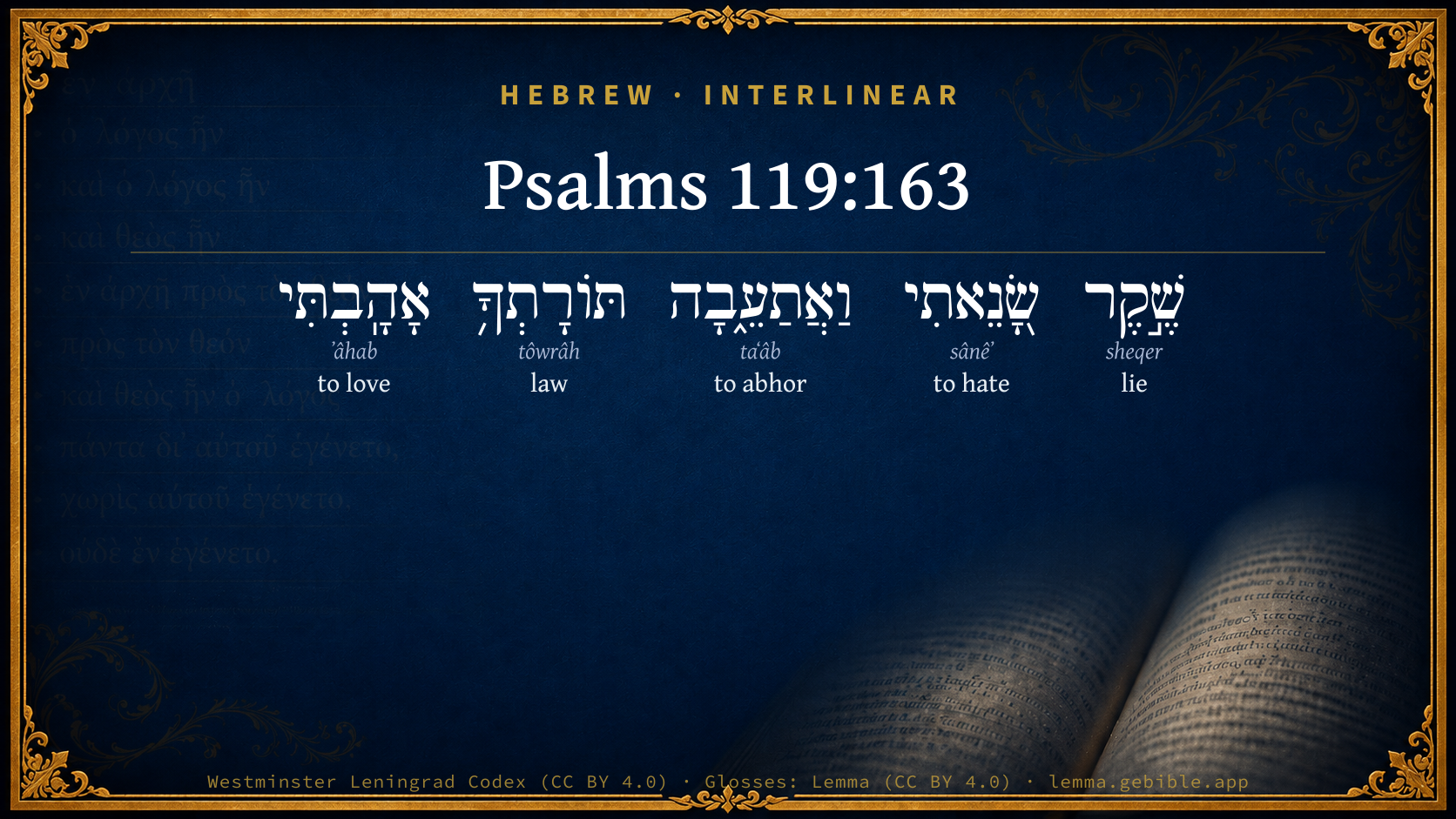
Psalms 119:163

Hebrew (Westminster Leningrad Codex) Psalms 119:163 appears in the Hebrew Old Testament. The text above is from the Westminster Leningrad Codex. Each word links to its Strong’s number, a concise gloss, and parsing drawn from the Open Scriptures Hebrew Bible morphology. Click any word for its full Brown-Driver-Briggs (BDB) entry.
Download image
Cite this verse

Psalms 119:163 (World English Bible). Public Domain. Lemma interlinear Bible study tool, https://lemma.gebible.app/v/psalms/119/163.

Show BibTeX & RIS
BibTeX
RIS
English Translation
I hate and abhor falsehood. I love your law.
World English Bible · Public Domain
Download a study sheet

One document with this verse’s original text, its word-by-word gloss line, the meaning frame, cross-references with their text, attributed commentary, and full source and license credits — printable, and it pastes into notes with its structure intact.

This verse Autodidact and up

Study sheet (.html) Plain text (.txt)

A passage Seminary Student

Up to 50 verses in one chapter. A passage sheet keeps up to 6 commentary sources and 12 cross-references per verse, in the order this page ranks them, and says so on the sheet whenever that leaves anything out. Ask for a single verse and you get the Autodidact verse sheet above.

Everything on this page stays free to read, with no account — the sheet is a download of what is already on screen, not access to it.

Want to remove ads? Support Godless Engineer
Compare translations 3

The same verse in 3 English versions, stacked beneath the original-language interlinear above. Click any original word for its lexicon entry.

Each is an independent rendering of the whole verse — the interlinear is not word-aligned to these translations.

Highlighted words mark where these versions differ — a whole-verse word diff, not a word-by-word alignment.

  • World English Bible Public Domain
    I hate and abhor falsehood. I love your law.
  • King James Version Public Domain
    I hate and abhor lying: but thy law do I love.
  • unfoldingWord Literal Text CC BY-SA 4.0
    Falsehood I hate and I abhor; your law I love.

unfoldingWord Literal Text — © unfoldingWord, licensed CC BY-SA 4.0. Word-aligned USFM3 via Door43 (git.door43.org/unfoldingWord/en_ult).

Versions to compare (up to 4)

3 of 4 selected

Show all 17 translations

Every available English version of this verse, each an independent rendering of the whole verse.

  • World English Bible Public Domain
    I hate and abhor falsehood. I love your law.
  • Berean Standard Bible Public Domain
    I hate and abhor falsehood, but Your law I love.
  • Majority Standard Bible Public Domain
    I hate and abhor falsehood, but Your law I love.
  • King James Version Public Domain
    I hate and abhor lying: but thy law do I love.
  • American Standard Version (1901) Public Domain
    I hate and abhor falsehood; `But' thy law do I love.
  • Revised Version (1885) Public Domain
    I hate and abhor falsehood; but thy law do I love.
  • Geneva Bible (1599) Public Domain
    I hate falshoode and abhorre it, but thy Lawe doe I loue.
  • Young's Literal Translation Public Domain
    Falsehood I have hated, yea I abominate `it', Thy law I have loved.
  • Literal Standard Version CC BY-SA 4.0
    I have hated falsehood, indeed I detest [it], || I have loved Your law.
  • Unlocked Literal Bible CC BY-SA 4.0
    I hate and despise falsehood, but I love your law.
  • unfoldingWord Literal Text CC BY-SA 4.0
    Falsehood I hate and I abhor; your law I love.
  • Darby Bible Public Domain
    I hate and abhor falsehood; thy law do I love.
  • World Messianic Bible Public Domain
    I hate and abhor falsehood. I love your Torah.
  • Webster's Bible Public Domain
    I hate and abhor lying: but thy law do I love.
  • Free Bible Version CC BY-SA 4.0
    I hate and detest lies, but I love your teachings.
  • Bible in Basic English Public Domain
    I am full of hate and disgust for false words; but I am a lover of your law.
  • JPS Tanakh (1917) Public Domain
    I hate and abhor falsehood; Thy law do I love.

Literal Standard Version (2020), Covenant Press — licensed CC BY-SA 4.0. Text via the HelloAO Bible API (eBible.org). Unlocked Literal Bible (unfoldingWord) — licensed CC BY-SA 4.0. Text via the HelloAO Bible API (eBible.org). unfoldingWord Literal Text — © unfoldingWord, licensed CC BY-SA 4.0. Word-aligned USFM3 via Door43 (git.door43.org/unfoldingWord/en_ult). Free Bible Version, Dr. Jonathan Gallagher — licensed CC BY-SA 4.0. Text via the HelloAO Bible API (eBible.org).

Word by word

More ways to search: Search by grammar → Find every occurrence → Compare this word →

Practice this passage: Drill this verse → Learn its vocabulary →

וַאֲתַעֵ֑בָה
taʻâb
H8581
“and · to abhor”
Conjunction + Verb, Piel, Cohortative, 1st Person, Common, Singular
Part of Speech
Conjunction + Verb
Stem
Piel
Form
Cohortative
Person
1st Person
Gender
Common
Number
Singular
Full BDB Definition

Origin: a primitive root

TWOT: 2530

to abhor, be abominable, do abominably - (Niphal) to be abhorred, be detested - in the ritual sense - in the ethical sense - (Piel) - to loathe, abhor, regard as an abomination - in the ritual sense - in the ethical sense - to cause to be an abomination - (Hiphil) to make abominable, do abominably - in the ritual sense - in the ethical sense
  1. שֶׁ֣קֶר sheqer H8267 “lie” Noun, Common, Masculine, Singular, Absolute
  2. שָׂ֭נֵאתִי sânêʼ H8130 “to hate” Verb, Qal, Perfect, 1st Person, Common, Singular
  3. תּוֹרָתְךָ֥ tôwrâh H8451 “law · your” Noun, Common, Feminine, Singular, Construct + Suffix, Personal, 2nd Person, Masculine, Singular
  4. אָהָֽבְתִּי ʼâhab H157 “to love” Verb, Qal, Perfect, 1st Person, Common, Singular

About this verse

These counts appear in no published source. They are computed here, from the morphology-tagged text and Lemma’s own curated glosses. What Lemma adds →

5
words
5
distinct lemmas
Wisdom
section

Notable vocabulary

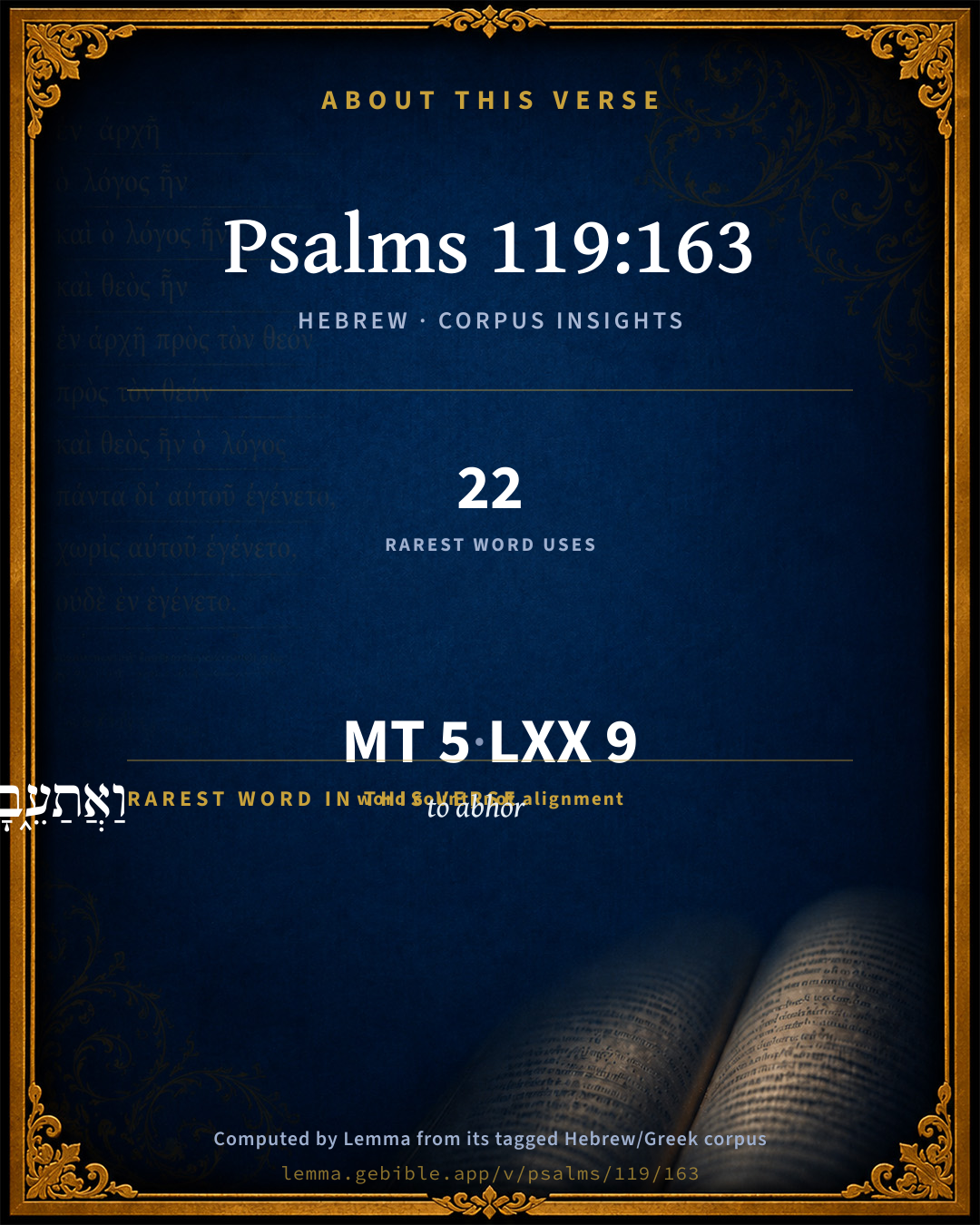
The rarest word here is וַאֲתַעֵ֑בָה to abhor H8581 — appearing just 22 times in the whole Hebrew Bible.

Shared distinctive vocabulary

וַאֲתַעֵ֑בָה to abhor H8581 occurs in 20 verses of the Hebrew Bible. Also found in:

Grammatical profile

  • 3 verbs
  • 2 nouns

Verb forms

  • שָׂ֭נֵאתִי Qal · Perfect
  • וַאֲתַעֵ֑בָה Piel · Cohortative
  • אָהָֽבְתִּי Qal · Perfect

Hebrew & Septuagint length

In English translation the verse runs 9 words from the Hebrew and 10 from the Septuagint (LXX English) — closely comparable.

A rough comparison of the two English renderings, which tokenize alike — not a word-level alignment.

Word counts can differ between the Hebrew and the Greek without any difference in meaning — e.g. the Hebrew direct-object marker אֵת has no separate Greek word, and Greek often adds the article ὁ.

In the original languages it is 5 Hebrew tokens and 9 Greek tokens — but the two are counted differently (Hebrew bundles its prefixes and suffixes into one token; the Greek is in lemma form), so that isn’t a like-for-like length.

Cross-references

10

Topical passages linked to Psalms 119:163 in the Treasury of Scripture Knowledge — connected by theme and wording, ordered by reader-vote popularity; previews shown in the World English Bible.

  • Psalms 119:128 Therefore I consider all of your precepts to be right. I hate every false way.
  • Proverbs 6:16–19 There are six things which Yahweh hates; Yes, seven which are an abomination to him:
  • Romans 12:9 Let love be without hypocrisy. Abhor that which is evil. Cling to that which is good.
  • Psalms 119:29 Keep me from the way of deceit. Grant me your law graciously!
  • Amos 5:15 Hate evil, love good, And establish justice in the courts. It may be that Yahweh, the God of hosts, will be gracious to the remnant of Joseph."
  • Psalms 101:7 He who practices deceit won't dwell within my house. He who speaks falsehood won't be established before my eyes.
  • Psalms 119:113 I hate double-minded men, But I love your law.
  • Proverbs 30:8 Remove far from me falsehood and lies. Give me neither poverty nor riches. Feed me with the food that is needful for me;
  • Ephesians 4:25 Therefore, putting away falsehood, speak truth each one with his neighbor. For we are members one of another.
  • Revelation 22:15 Outside are the dogs, the sorcerers, the sexually immoral, the murderers, the idolaters, and everyone who loves and practices falsehood.

Cross-references courtesy of OpenBible.info (CC BY 4.0).

Hebrew and Greek witnesses Masoretic Hebrew ↔ Greek Septuagint

The same verse in the two great witnesses to the Old Testament, shown verse-for-verse.

You’re reading Greek Psalm 118 (Hebrew Psalm 119). The Septuagint counts the superscription, so verse numbers can differ from the Hebrew — chapter-level alignment, not verse-by-verse. Numbering follows Rahlfs.

These are two independent witnesses, not word-aligned to each other, and the Septuagint is shown in lemma (dictionary) form.

Hebrew Psalms 119:163 Masoretic · Westminster Leningrad Codex

שֶׁ֣קֶר שָׂ֭נֵאתִי וַאֲתַעֵ֑בָה תּוֹרָתְךָ֥ אָהָֽבְתִּי

I hate and abhor falsehood. I love your law.

World English Bible · Public Domain

Greek LXX Greek Psalm 118:163 Septuagint · lemma form

ἀδικία μισέω καί βδελύσσω ὁ δέ νόμος σύ ἀγαπάω

I hate and abhor unrighteousness; but I love your law.

LXX2012 (modern English Septuagint) · Public Domain

Hebrew: Westminster Leningrad Codex (CC BY 4.0). Greek: Septuagint (public domain); English from LXX2012 (modern English Septuagint) (Public Domain). How the Septuagint differs from the Hebrew →

Commentary

Notes on Psalms 119:163 from classic Christian and Jewish commentators (each source and its license shown beneath its notes). The classic Christian expositions comment on the surrounding passage and are grouped to its opening verse, so a note may address several verses; the Jewish commentaries on the Tanakh (Rashi and others) are per-verse, so they appear only where the commentator wrote on this verse.

Lemma curates 59 commentaries, every one of them public domain or Creative Commons licensed, each selected and text-cleaned for this edition rather than reprinted as found. About our sources →

Trapp's Complete Commentary

John Trapp

Psa 119:163 I hate and abhor lying: [but] thy law do I love.

Ver. 163. I hate and abhor lying] Utitur atroci verbo, abominatus sum, I hate it as I hate hell itself; and yet lying was David’s sin after a special manner. See Psa 119:29. {See Trapp on "Psa 119:29"}

But thy law do I love] All hatred comes from love of the contrary. "Ye that love the Lord, hate evil," Psa 97:10.

John Trapp, A Commentary or Exposition upon All the Books of the Old and New Testament (1647–1656) — public domain. Text from a community e-Sword module.

J. A. Alexander on Psalms

Joseph Addison Alexander

163. (Psa 119:163) Falsehood I hate and abhor; thy law I love. Hate and have hated, love and have loved. Falsehood or lying, as in Psa 119:29. The second verb has the same augmented and intensive form that occurs above, Psa 119:147; Psa 119:158.

Joseph Addison Alexander, The Psalms Translated and Explained (1850) — public domain. Text from a community e-Sword module.

Matthew Henry's Commentary

Love and hatred are the leading affections of the soul; if those be fixed aright, the rest move accordingly. Here we have them fixed aright in David. 1. He had a rooted antipathy to sin; he could not endure to think of it: I hate and abhor lying, which may be taken for all sin, inasmuch as by it we deal treacherously and perfidiously with God and put a cheat upon ourselves. Hypocrisy is lying; false doctrine is lying; breach of faith is lying. Lying, in commerce or conversation, is a sin which every good man hates and abhors, hates and doubly hates, because of the seven things which the Lord hates one is a lying tongue and another is a false witness that speaks lies, Pro 6:16. Every man hates to have a lie told him; but we should more hate telling a lie because by the former we only receive an affront from men, by the latter we give an affront to God. 2. He had a rooted affection to the word of God: Thy law do I love. And therefore he abhorred lying, for lying is contrary to the whole law of God; and the reason why he loved the law of God was because of the truth of it. The more we see of the amiable beauty of truth the more we shall see of the detestable deformity of a lie.

Matthew Henry's Commentary on the Whole Bible (1708–1710) — public domain (CC PDM 1.0). Text via the HelloAO Bible API.

Adam Clarke's Commentary

Verse 163. I - abhor lying] Perhaps they might have made the confessions which the Chaldeans required, and by mental reservation have kept an inward firm adherence to their creed; but this, in the sight of the God of truth, must have been lying; and at such a sacrifice they would not purchase their enlargement, even from their captivity.

Adam Clarke's Commentary on the Bible (1810–1826) — public domain. Text from a community e-Sword/MySword module.

John Calvin's Commentaries

163. I have hated and abhorred deceit. In this verse he declares more distinctly what I have adverted to a little before, that he was cleansed from corrupt affections that he might bestow upon the law of God such honor and estimation as it deserved. Having elsewhere met with almost the same sentence, I shall but briefly touch upon the reason why the Prophet affirms that he hated deceit before he speaks of his love and devotedness to the law. As hypocrisy is in the hearts of all men by nature, and as we are naturally prone to vanity and deceitfulness, we ought diligently to labor to purge our hearts, that the love of the law may reign in them. Now if the beginning of a good life and the first point of righteousness is to hate and abhor deceit, it follows that nothing is more excellent than integrity; for unless that virtue hold the chief place, all the other virtues speedily disappear. Nor is abhorring superfluously added to hating, the design being to teach us that it is not enough to hate falsehood with a common hatred, but that God’s children must hate it with a deadly hatred. Now if the love of the law and the hatred of falsehood are inseparably conjoined, it is a plain inference that all who are not taught in the school of God are infected with deceit and hypocrisy.

John Calvin's Commentaries (1540-1563) — public domain. Text from the Calvin Translation Society English edition (1840s-50s) via the Christian Classics Ethereal Library (ccel.org). Calvin's coverage is partial (roughly two-thirds of the Bible); uncommented books and verses are honest gaps, never fabricated. The 19th-century editor's footnotes and remarks are omitted so the notes are faithfully Calvin's own voice.

The Cambridge Bible for Schools and Colleges

gen. ed. J. J. S. Perowne

163. I hate falsehood and will abhor it] Falsehood denotes heathenism and heathenish tendencies, in contrast to the truth of God’s law. Cp. Psa_119:29; Psa_119:104; Psa_119:128. The best attested text reads will abhor.

The Cambridge Bible for Schools and Colleges (gen. ed. J. J. S. Perowne; Cambridge University Press, 1878–1918) — public domain. Text from a community e-Sword module.

John Gill's Exposition

I have kept thy precepts and thy testimonies,.... Both the preceptive and doctrinal part of the word, he preserved and observed both; this is repeated for the certainty of it, and to show his great affection to them;

for all my ways are before thee; this is either an appeal to God for the truth of what he had said, who saw and knew all the ways in which he walked, and which he had endeavoured should be conformable to the word of God; or it is a reason why he kept the precepts and testimonies of the Lord, because he knew his eyes were upon him; the omniscience of God had an influence over him, and caused him to be more attentive to the word, as the rule of his actions; see Psa 139:1.

John Gill's Exposition of the Whole Bible (1746–1763) — public domain (CC PDM 1.0). Text via the HelloAO Bible API.

Albert Barnes' Notes on the Bible

I hate and abhor lying - The mention of lying here particularly seems to have been suggested by the necessity, from the structure of the psalm, of finding some word at the beginning of the verse which commenced with the letter Schin. At the same time, it is an illustration of the nature of piety, and doubtless there had been numerous occasions in the life of the psalmist when he had seen and experienced the effects of falsehood. This sin, therefore, might occur to him as readily as any other. It is unnecessary to say that religion “forbids” this sin in all its forms.

But thy law do I love - Particularly here the law which forbids lying. The psalmist was conscious, as every good man must be, that he truly loved that pure law which forbids falsehood in all its forms.

Albert Barnes' Notes on the Bible (1834–1885) — public domain. Text from a community e-Sword/MySword module.

Matthew Poole's English Annotations

Lying; or, falsehood; either,

1. In my speech and actions; all hypocrisy and deceit, which is the common practice of mine enemies, and of all godless politicians: or,

2. In doctrine and worship, as this word seems to be used, Psa 119:29, because both there and here it is opposed to God’s law.

Matthew Poole's English Annotations on the Holy Bible (1683–1685) — public domain. Text from a community e-Sword/MySword module.

The Treasury of David

Charles H. Spurgeon

Ver. 163. I hate and abhor lying. A double expression for an inexpressible loathing. Falsehood in doctrine, in life, or in speech, falsehood in any form or shape, had become utterly detestable to the Psalmist. This was a remarkable state for an Oriental, for generally lying is the delight of Easterns, and the only wrong they see in it is a want of skill in its exercise so that the liar is found out. David himself had made much progress when he had come to this. He does not, however, alone refer to falsehood in conversation; he evidently intends perversity in faith and teaching. He set down all opposition to the God of truth as lying, and then he turned his whole soul against it in the most intense form of indignation. Godly men should detest false doctrine even as they abhor a lie.

But thy law do I love, because it is all truth. His love was as ardent as his hate. True men love truth, and hate lying. It is well for us to know which way our hates and loves run, and we may do essential service to others by declaring what are their objects. Both love and hate are contagious, and when they are sanctified the wider their influence the better.

Ver. 163. I hate and abhor lying, etc. One sees here how the light on David's soul was increasing more and more unto the perfect day. In the earlier part of this psalm, David in the recollects of his own sin had prayed, "Remove from me the way of lying, "and the Lord had indeed answered his prayer, for he now declares his utter loathing of every false way: "I hate and abhor lying." And we see, in some measure, the instrument by which the Holy Spirit wrought the change: "Thy law do I love"; nay, as he adds in a later verse, "I love them exceedingly." And so it ever must be, the heart must have some holier object of its affection to fill up the void, or there will be no security against a relapse into sin! might talk for ever on the sin, the disgrace, and the danger of lying, and though at the time and for a time my words might have some influence, yet, unless the heart be filled with the love of God and of God's law, the first temptation would prove too powerful. The Bible teaches us this in a variety of ways. God says to Israel, not only "cease to do evil, "but, "learn to do well." And still more pointedly does the apostle, when he was warring against drunkenness, say, "Be not drunk with wine, wherein is excess, but be filled with the Spirit." Barton Bouchier.

Ver. 163. I hate and abhor lying. "Lying, "according to Scripture usage, not only signifies speaking contrary to what one thinks, but also thinking contrary to the truth of things, and, particularly, the giving to other of that worship and glory which are due to the true God alone to think and act aside from God's truth. The men who persecuted that godly man thought of earthly prosperity and power as they should not have thought; they judged God's servant falsely, and they thought wickedly Of God himself. The man of God took a view of these things; he saw wickedness and the vileness of them, and he continued "Falsehood I hate and abhor: thy law do I love." From all the false and delusive ways of men, from all the pride and pomp that surround courts, from the sinful and pursuits of worldly men, as well as from the ostentatious idolatry heathen nations, he could turn with heart delight to the contemplation Jehovah, in that wonderful ritual which manifested the divine mercy in vicarious sacrifices, and observances, and festivals; and to that holy law which was given as man's rule of duty and grateful obedience, and these he loved as the manifestations of God's grace. John Stephen.

Ver. 163. I hate and abhor lying: not only "hate" it, nor simply I "abhor" it, but "hate and abhor, "to strengthen and increase the sense, and make it more vehement. Where the enmity is not great against the sin, the matter may be compounded and taken up; but David will have nothing to do with it, for he saith, I loathe and abhor it, and hate it with a deadly hatred. Slight hatred of a sinful course is not sufficient to guard us against ft. Thomas Manton.

Ver. 163. Sin seemeth to have its name from the Hebrew word "sana", to hate, the word here used, because it is most of all to be hated, as the greatest evil, as that which setteth us furthest from God the greatest good. None can hate it but those that love the law of God; for all hatred comes from love. A natural man may be angry with his sin, but hate it he cannot; nay, he may leave it, but not loathe it; if he did, he would loathe all sin as well as any one sin. Abraham Wright.

Ver. 163. Lying. All injustice is abominable: to do any sort of wrong is a heinous crime, but lying is that crime which, above all others, tendeth to the dissolution of society and disturbance of human life; which God therefore doth most loathe, and men have reason especially to detest. Of this the slanderer is most deeply guilty. "A witness of Belial scorneth judgment, and the month of the wicked devoureth iniquity, "saith the wise man: Pr 19:28. He is indeed, according to just estimation, guilty of all kinds of injury, breaking all the second table of commands respecting our neighbour. Most distinctly he beareth false witness against his neighbour: he doth covet his neighbour's goods, for 'tis constantly out of such an irregular desire, for his own presumed advantage, to dispossess his neighbour of some good, and transfer it on himself, that the slanderer uttereth his tale: he is also a thief and robber of his good name, a deflowerer and defiler of his reputation, an assassin and murderer of his honour. So doth he violate all the rules of justice, and perpetrates all sorts of wrong against his neighbour. Isaac Barrow.

Ver. 163. Opposite poles of the Christian character.

1. Why I hate lying, because it comes from the devil (Pr 8:44, Ac 5:3): it leads to the devil (Re 11:8, 22:15): it is base, dangerous, degrading (Pr 19:5, 1Ti 4:2, 2Ti 3:13): it is hated by the Lord (Pr 6:16, 17, 7:22).

2. Why I love the law. Because it emanates from God; is the reflection of his character; is the ideal of my character.

3. How I came thus to hate and love. By the grace of God: ver. 29.

G.A.D.

Ver. 163.

1. Opposite things.

2. Opposite feelings.

Psalms 119:164*

Charles H. Spurgeon's The Treasury of David (1869–1885) — public domain. Psalms only. Text from a community e-Sword/MySword module.

The Pulpit Commentary

I hate and abhor lying; or, "falsehood." False systems of religion are in the psalmist"s thoughts; or, at any rate, false moral teaching, lie is not speaking of the habit of lying. But thy Law do I love (see the comment on ver. 159).

Self-serving and time-serving.

By the term "lying" is specially meant "false faiths," deviations from, or misrepresentations of, the true religion, which is "the truth." Compare the antichrist of Christianity.

I FALSEHOOD IN RELIGION REGARDED AS SELF-SERVING. It is necessary to keep in mind that to the Israelite the very essence of falsehood was idolatry. Represent the unseen, spiritual Jehovah by any earthly form or figure, and to him the representation was a lie. No form or figure could represent all God, or anything about God perfectly. But it was falsehood in another way, for it did but hide the fact that the man who made the image was really worshipping himself, his own idea, and that was acting a lie. In whatever way man constructs his own religion, and creates his own deity, in thought and imagination he is not only false to revelation, but he is false to himself; for he deceives himself with the idea that he is worshipping God, when all the while he is only projecting himself outside himself, in order to worship himself. Both formal and mental idolatry are phases of idol-worship; and in them both man is false to himself and false to God.

II FALSEHOOD IN RELIGION REGARDED AS TIME-SERVING. The stronger man thinks for himself, and makes his own religion; the weaker man simply is carried along the current of his age, and does as his generation does. But he is false to the responsibility under which his manhood lies, lee he is bound to decide for himself whom or what he will serve. In the way of agreeing with what exists around him, common opinion and common worship, with the ease and comfort of life. Resisting the age for the sake of truth means disability. So the man is willing to be false. And timeserving in religion is really the same thing as worshipping self. However it is done, it is always being false to God to say we are worshipping him when we, in fact, only bow in the temple of self. R.T.

The Pulpit Commentary (1880–1919), ed. H.D.M. Spence-Jones & Joseph S. Exell — public domain. Text from a community e-Sword module.

unfoldingWord translationNotes

Door43 World Missions Community

hate and despise

These two words mean almost the same thing. AT: "hate very strongly" (See: Doublet)

falsehood

Possible meanings are this is a metonym for 1) "people who lie" or 2) "the false words that people say." (See: Metonymy)

translationWords

love

law

praise

righteous

decree

unfoldingWord translationNotes — © Distant Shores Media and the Door43 World Missions Community, licensed CC BY-SA 4.0. Source: git.door43.org/Door43/en_tn.

Lesson kit

Teaching starters — assembled from the data on this page, not authored interpretation. Every prompt links to the verse data it draws on. Edit before teaching.

Psalms, in the Wisdom, opens this verse with 5 words (5 distinct Hebrew lemmas). Its most distinctive word is taʻâb (“to abhor”). A historical commentator’s framing appears above. Read the whole chapter for the surrounding context.

Discussion questions

  1. The word taʻâb carries the sense “to abhor.” How does it shape the verse?
  2. How does Deuteronomy 7:26, which shares the word «to abhor», read alongside this verse?
  3. The translations on this page render this verse differently — a whole-verse word diff, not a word-by-word alignment. What might account for the different wordings?
  4. «שָׂ֭נֵאתִי» is a Qal Perfect verb. How does that grammatical form shape the action described?
  5. Compare how Trapp's Complete Commentary and J. A. Alexander on Psalms read this verse. Where do they agree or differ?

Things to notice

Reading settings

Reading text

Shown beneath each verse's original-language words.

Old Testament
Old Testament edition

Read the OT as the Masoretic Hebrew (MT) or the Greek Septuagint (LXX).

English shown for the Greek Septuagint (in the Hebrew ↔ Greek comparison).

Comparing translations? Open the Compare panel on any verse page to stack up to four side by side.