
Proverbs 28:7

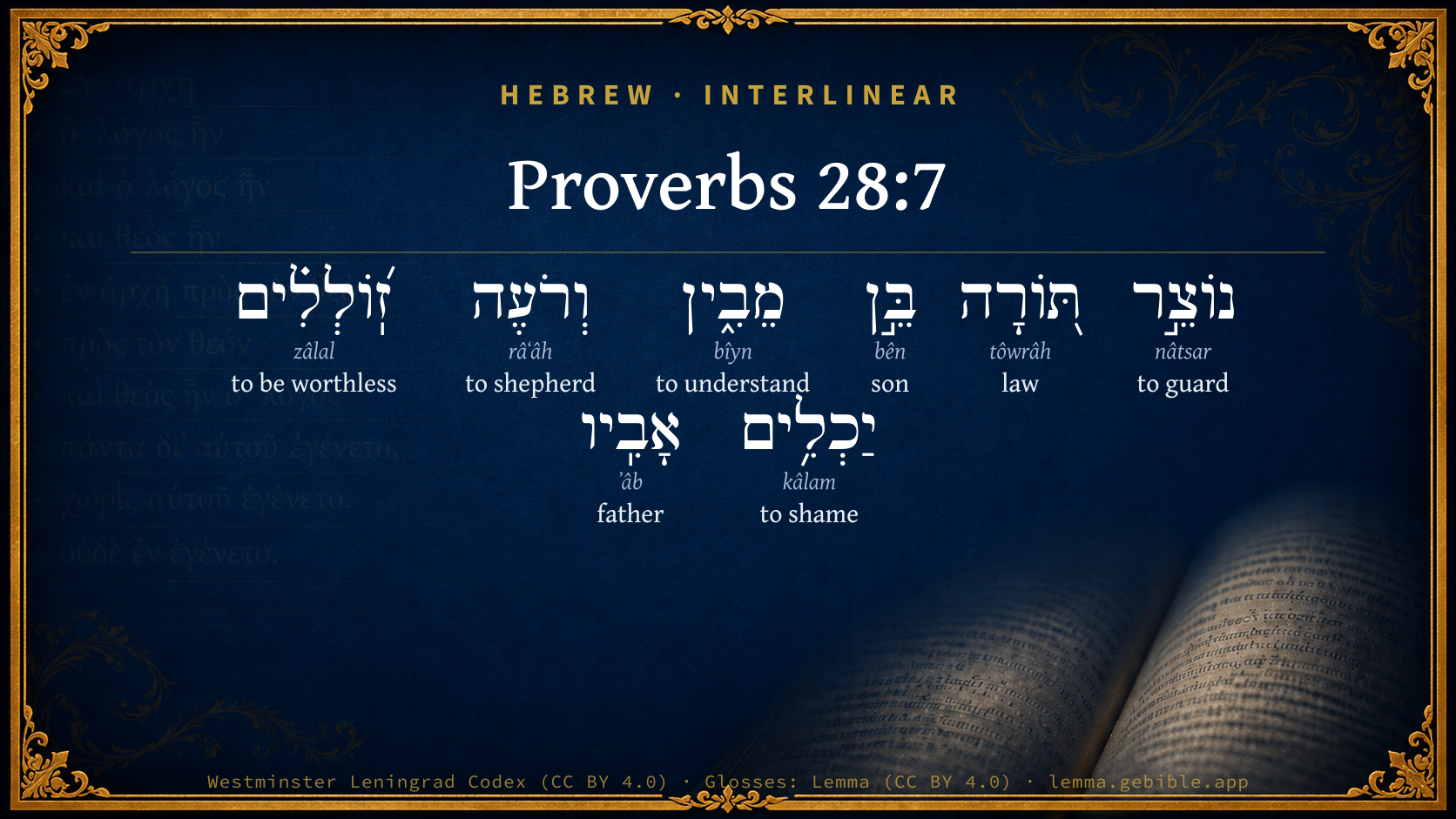
Hebrew (Westminster Leningrad Codex) Proverbs 28:7 appears in the Hebrew Old Testament. The text above is from the Westminster Leningrad Codex. Each word links to its Strong’s number, a concise gloss, and parsing drawn from the Open Scriptures Hebrew Bible morphology. Click any word for its full Brown-Driver-Briggs (BDB) entry.
Download image
Cite this verse

Proverbs 28:7 (World English Bible). Public Domain. Lemma interlinear Bible study tool, https://lemma.gebible.app/v/proverbs/28/7.

Show BibTeX & RIS
BibTeX
RIS
English Translation
Whoever keeps the law is a wise son; But he who is a companion of gluttons shames his father.
World English Bible · Public Domain
Download a study sheet

One document with this verse’s original text, its word-by-word gloss line, the meaning frame, cross-references with their text, attributed commentary, and full source and license credits — printable, and it pastes into notes with its structure intact.

This verse Autodidact and up

Study sheet (.html) Plain text (.txt)

A passage Seminary Student

Up to 50 verses in one chapter. A passage sheet keeps up to 6 commentary sources and 12 cross-references per verse, in the order this page ranks them, and says so on the sheet whenever that leaves anything out. Ask for a single verse and you get the Autodidact verse sheet above.

Everything on this page stays free to read, with no account — the sheet is a download of what is already on screen, not access to it.

Want to remove ads? Support Godless Engineer
Compare translations 3

The same verse in 3 English versions, stacked beneath the original-language interlinear above. Click any original word for its lexicon entry.

Each is an independent rendering of the whole verse — the interlinear is not word-aligned to these translations.

Highlighted words mark where these versions differ — a whole-verse word diff, not a word-by-word alignment.

  • World English Bible Public Domain
    Whoever keeps the law is a wise son; But he who is a companion of gluttons shames his father.
  • King James Version Public Domain
    Whoso keepeth the law is a wise son: but he that is a companion of riotous men shameth his father.
  • unfoldingWord Literal Text CC BY-SA 4.0
    One who guards the law a son who understands, but one who associates with gluttonous eaters humiliates his father.

unfoldingWord Literal Text — © unfoldingWord, licensed CC BY-SA 4.0. Word-aligned USFM3 via Door43 (git.door43.org/unfoldingWord/en_ult).

Versions to compare (up to 4)

3 of 4 selected

Show all 18 translations

Every available English version of this verse, each an independent rendering of the whole verse.

  • World English Bible Public Domain
    Whoever keeps the law is a wise son; But he who is a companion of gluttons shames his father.
  • Berean Standard Bible Public Domain
    A discerning son keeps the law, but a companion of gluttons disgraces his father.
  • Majority Standard Bible Public Domain
    A discerning son keeps the law, but a companion of gluttons disgraces his father.
  • King James Version Public Domain
    Whoso keepeth the law is a wise son: but he that is a companion of riotous men shameth his father.
  • American Standard Version (1901) Public Domain
    Whoso keepeth the law is a wise son; But he that is a companion of gluttons shameth his father.
  • Revised Version (1885) Public Domain
    Whoso keepeth the law is a wise son: but he that is a companion of gluttonous men shameth his father.
  • Geneva Bible (1599) Public Domain
    He that keepeth the Law, is a childe of vnderstanding: but hee that feedeth the gluttons, shameth his father.
  • Douay-Rheims (1899) Public Domain
    He that keepeth the law is a wise son: but he that feedeth gluttons, shameth his father.
  • Young's Literal Translation Public Domain
    Whoso is keeping the law is an intelligent son, And a friend of gluttons, Doth cause his father to blush.
  • Literal Standard Version CC BY-SA 4.0
    Whoever is keeping the Law is an intelligent son, || And a friend of gluttons || Causes his father to blush.
  • Unlocked Literal Bible CC BY-SA 4.0
    He who keeps the law is a son who has understanding, but one who is a companion of gluttons shames his father.
  • unfoldingWord Literal Text CC BY-SA 4.0
    One who guards the law a son who understands, but one who associates with gluttonous eaters humiliates his father.
  • Darby Bible Public Domain
    Whoso observeth the law is a son that hath understanding; but he that is a companion of profligates bringeth shame to his father.
  • World Messianic Bible Public Domain
    Whoever keeps the Torah is a wise son; but he who is a companion of gluttons shames his father.
  • Webster's Bible Public Domain
    He who keepeth the law is a wise son: but he that is a companion of riotous men shameth his father.
  • Free Bible Version CC BY-SA 4.0
    If you keep the law, you're a wise son, but if you keep bad company you shame your father.
  • Bible in Basic English Public Domain
    He who keeps the law is a wise son, but he who keeps company with feasters puts shame on his father.
  • JPS Tanakh (1917) Public Domain
    A wise son observeth the teaching; but he that is a companion of gluttonous men shameth his father.

Literal Standard Version (2020), Covenant Press — licensed CC BY-SA 4.0. Text via the HelloAO Bible API (eBible.org). Unlocked Literal Bible (unfoldingWord) — licensed CC BY-SA 4.0. Text via the HelloAO Bible API (eBible.org). unfoldingWord Literal Text — © unfoldingWord, licensed CC BY-SA 4.0. Word-aligned USFM3 via Door43 (git.door43.org/unfoldingWord/en_ult). Free Bible Version, Dr. Jonathan Gallagher — licensed CC BY-SA 4.0. Text via the HelloAO Bible API (eBible.org).

Word by word

More ways to search: Search by grammar → Find every occurrence → Compare this word →

Practice this passage: Drill this verse → Learn its vocabulary →

זֽ֝וֹלְלִ֗ים
zâlal
H2151
“being worthless”
Verb, Qal, Participle Active, Masculine, Plural, Absolute
Part of Speech
Verb
Stem
Qal
Form
Participle Active
Gender
Masculine
Number
Plural
State
Absolute
Full BDB Definition

Origin: a primitive root [compare H2107 ]

TWOT: 553

to be worthless, be vile, be insignificant, be light - (Qal) - to be worthless, be insignificant - to make light of, squander, be lavish with - to shake, tremble, quake - (Niphal) to shake, quake
  1. נוֹצֵ֣ר nâtsar H5341 “guarding” Verb, Qal, Participle Active, Masculine, Singular, Absolute
  2. תּ֭וֹרָה tôwrâh H8451 “law” Noun, Common, Feminine, Singular, Absolute
  3. בֵּ֣ן bên H1121 “son” Noun, Common, Masculine, Singular, Absolute
  4. מֵבִ֑ין bîyn H995 “understanding” Verb, Hiphil, Participle Active, Masculine, Singular, Absolute
  5. וְרֹעֶה râʻâh H7462 “and · shepherding” Conjunction + Verb, Qal, Participle Active, Masculine, Singular, Absolute
  6. יַכְלִ֥ים kâlam H3637 “to shame” Verb, Hiphil, Imperfect, 3rd Person, Masculine, Singular
  7. אָבִֽיו ʼâb H1 “father · his” Noun, Common, Masculine, Singular, Construct + Suffix, Personal, 3rd Person, Masculine, Singular

About this verse

These counts appear in no published source. They are computed here, from the morphology-tagged text and Lemma’s own curated glosses. What Lemma adds →

8
words
8
distinct lemmas
Wisdom
section

Notable vocabulary

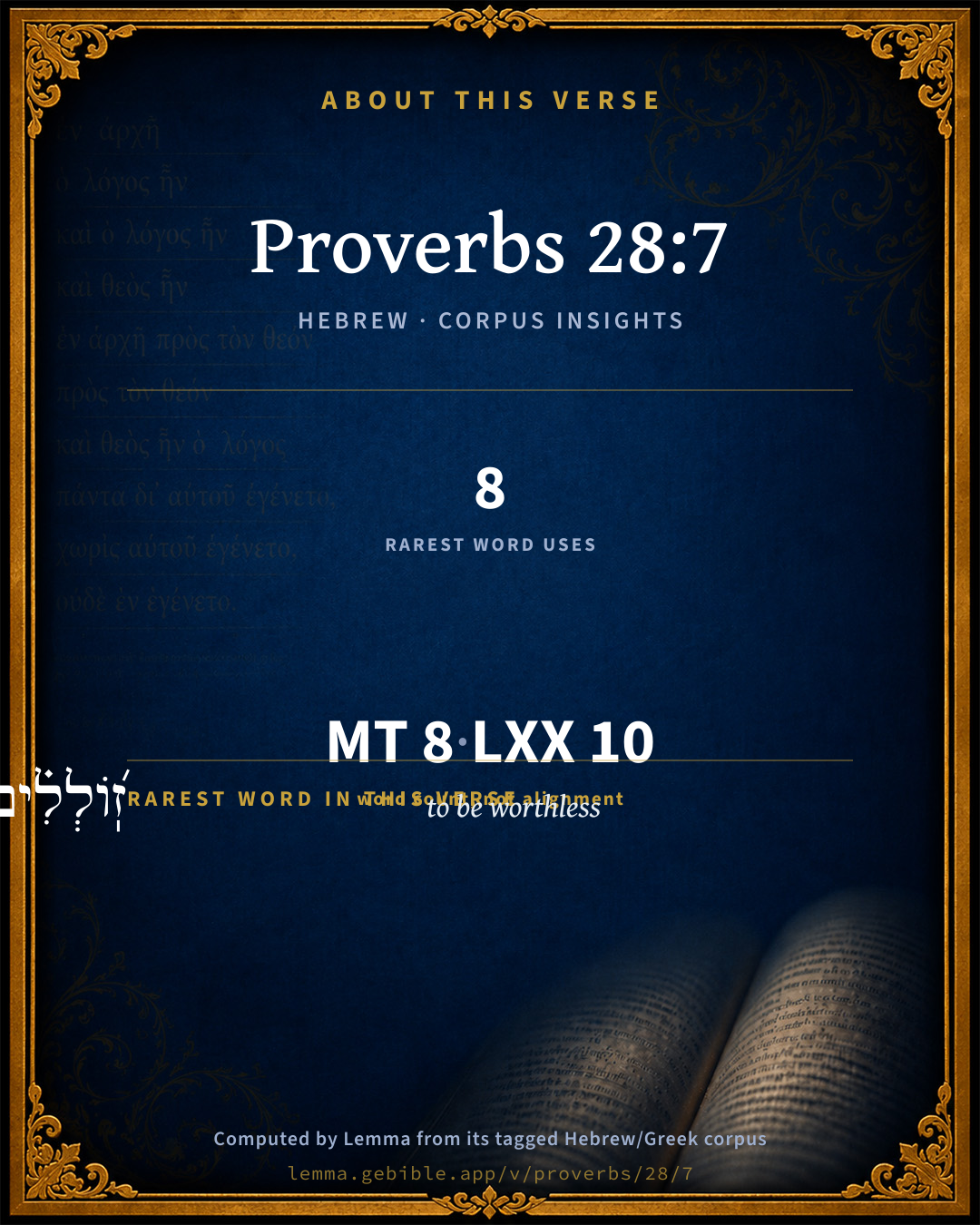
The rarest word here is זֽ֝וֹלְלִ֗ים to be worthless H2151 — appearing just 8 times in the whole Hebrew Bible.

Shared distinctive vocabulary

זֽ֝וֹלְלִ֗ים to be worthless H2151 occurs in 8 verses of the Hebrew Bible. Also found in:

Grammatical profile

  • 5 verbs
  • 3 nouns

Verb forms

  • נוֹצֵ֣ר Qal · Participle Active
  • מֵבִ֑ין Hiphil · Participle Active
  • וְרֹעֶה Qal · Participle Active
  • זֽ֝וֹלְלִ֗ים Qal · Participle Active
  • יַכְלִ֥ים Hiphil · Imperfect

Hebrew & Septuagint length

In English translation the verse runs 19 words from the Hebrew and 15 from the Septuagint (LXX English) — closely comparable.

A rough comparison of the two English renderings, which tokenize alike — not a word-level alignment.

Word counts can differ between the Hebrew and the Greek without any difference in meaning — e.g. the Hebrew direct-object marker אֵת has no separate Greek word, and Greek often adds the article ὁ.

In the original languages it is 8 Hebrew tokens and 10 Greek tokens — but the two are counted differently (Hebrew bundles its prefixes and suffixes into one token; the Greek is in lemma form), so that isn’t a like-for-like length.

Cross-references

10

Topical passages linked to Proverbs 28:7 in the Treasury of Scripture Knowledge — connected by theme and wording, ordered by reader-vote popularity; previews shown in the World English Bible.

  • Proverbs 29:3 Whoever loves wisdom brings joy to his father; But a companion of prostitutes squanders his wealth.
  • Proverbs 29:15 The rod of correction gives wisdom, But a child left to himself causes shame to his mother.
  • 1 Peter 4:3–4 For we have spent enough of our past time doing the desire of the Gentiles, and having walked in lewdness, lusts, drunken binges, orgies, carousings, and abominable idolatries.
  • Proverbs 2:1–6 My son, if you will receive my words, And store up my commandments within you;
  • Proverbs 3:1–35 My son, don't forget my teaching; But let your heart keep my commandments:
  • Proverbs 19:26 He who robs his father and drives away his mother, Is a son who causes shame and brings reproach.
  • Proverbs 23:19–22 Listen, my son, and be wise, And keep your heart on the right path!
  • Proverbs 28:24 Whoever robs his father or his mother, and says, "It's not wrong." He is a partner with a destroyer.
  • Luke 15:13 Not many days after, the younger son gathered all of this together and traveled into a far country. There he wasted his property with riotous living.
  • Luke 15:30 But when this, your son, came, who has devoured your living with prostitutes, you killed the fattened calf for him.'

Cross-references courtesy of OpenBible.info (CC BY 4.0).

Hebrew and Greek witnesses Masoretic Hebrew ↔ Greek Septuagint

The same verse in the two great witnesses to the Old Testament, shown verse-for-verse.

These are two independent witnesses, not word-aligned to each other, and the Septuagint is shown in lemma (dictionary) form.

Hebrew Proverbs 28:7 Masoretic · Westminster Leningrad Codex

נוֹצֵ֣ר תּ֭וֹרָה בֵּ֣ן מֵבִ֑ין וְרֹעֶה זֽ֝וֹלְלִ֗ים יַכְלִ֥ים אָבִֽיו

Whoever keeps the law is a wise son; But he who is a companion of gluttons shames his father.

World English Bible · Public Domain

Greek LXX Proverbs 28:7 Septuagint · lemma form

φυλάσσω νόμος υἱός συνετός ὅς δέ ποιμαίνω ἀσωτία ἀτιμάζω πατήρ

A wise son keeps the law: but he that keeps up debauchery dishonors his father.

LXX2012 (modern English Septuagint) · Public Domain

On this verse, The Pulpit Commentary discusses the Septuagint’s reading. Read the note in Commentary ↓

Hebrew: Westminster Leningrad Codex (CC BY 4.0). Greek: Septuagint (public domain); English from LXX2012 (modern English Septuagint) (Public Domain). How the Septuagint differs from the Hebrew →

Commentary

Notes on Proverbs 28:7 from classic Christian and Jewish commentators (each source and its license shown beneath its notes). The classic Christian expositions comment on the surrounding passage and are grouped to its opening verse, so a note may address several verses; the Jewish commentaries on the Tanakh (Rashi and others) are per-verse, so they appear only where the commentator wrote on this verse.

Lemma curates 59 commentaries, every one of them public domain or Creative Commons licensed, each selected and text-cleaned for this edition rather than reprinted as found. About our sources →

Trapp's Complete Commentary

John Trapp

Pro 28:7 Whoso keepeth the law [is] a wise son: but he that is a companion of riotous [men] shameth his father.

Ver. 7. He that keepeth the law is a wise son.] It is neither good nature, nor good nurture or breeding, that can prove a man to be truly wise, but obedience to God’s statutes. {Deu 4:6} Aiphonsus, king of Spain, surnamed the Wise, was a rank fool and an arrant atheist; so are all the world’s wizards.

But he that is a companion to riotous men.] Or, That feedeth gluttons, whose belly hath no bottom.

‘Ingluvies et tempestas, barathrumque macelli.’

They say the locust is all belly, which is joined to his mouth, and endeth at his tail: such are riotous belly gods. To feed such is to cast away all, and bring an indelible infamy upon the family.

John Trapp, A Commentary or Exposition upon All the Books of the Old and New Testament (1647–1656) — public domain. Text from a community e-Sword module.

Tyndale Open Study Notes

Tyndale Open Resources

28:7 their parents: This proverb applies to both fathers and mothers.

Tyndale Open Study Notes — © Tyndale Open Resources, licensed CC BY-SA 4.0. Text via the HelloAO Bible API.

Matthew Henry's Commentary

Note, 1. Religion is true wisdom, and it makes men wise in every relation. He that conscientiously keeps the law is wise, and he will be particularly a wise son, that is, will act discreetly towards his parents, for the law of God teaches him to do so. 2. Bad company is a great hindrance to religion. Those that are companions of riotous men, that choose such for their companions and delight in their conversation, will certainly be drawn from keeping the law of God and drawn to transgress it, Psa 119:115. 3. Wickedness is not only a reproach to the sinner himself, but to all that are akin to him. He that keeps rakish company, and spends his time and money with them, not only grieves his parents, but shames them; it turns to their disrepute, as if they had not done their duty to him. They are ashamed that a child of theirs should be scandalous and abusive to their neighbours.

Matthew Henry's Commentary on the Whole Bible (1708–1710) — public domain (CC PDM 1.0). Text via the HelloAO Bible API.

Jamieson, Fausset & Brown

Robert Jamieson, A. R. Fausset & David Brown

(Compare Pro 17:25).

riotous men--or, "gluttons" (Pro 23:20-21).

Jamieson, Fausset & Brown — Commentary Critical and Explanatory on the Whole Bible (1871) — public domain (CC PDM 1.0). Text via the HelloAO Bible API.

The Cambridge Bible for Schools and Colleges

gen. ed. J. J. S. Perowne

7. riotous] Rather, gluttonous. See Pro_23:20, note.

The Cambridge Bible for Schools and Colleges (gen. ed. J. J. S. Perowne; Cambridge University Press, 1878–1918) — public domain. Text from a community e-Sword module.

John Gill's Exposition

Whoso keepeth the law is a wise son,.... That observes the law of God; for, though he cannot perfectly keep it, yet he delights in it after the inward man; and with his spirit serves it, from a principle of love, in faith, and with a view to the glory of God, without mercenary and sinister ends. Such a man enjoys peace, and has a reward "in" though not "for" keeping the commands of it; so that it is his wisdom to observe it; and he may be truly called a wise man, Deu 4:6; Or that observes the law or commandments of his parents, which they enjoin him; see Pro 6:20; and particularly the law of God, which requires honour and obedience to be given to parents, and which turns to the account of children; it is well with them, and their days are prolonged on earth, and therefore they are wise that keep it, Eph 6:1; and such a wise son makes a glad father, as the contrary brings shame to him, as in the next clause;

but he that is a companion of riotous men shameth his father: that keeps company with gluttons, and indulges his sensual appetite with them; that "feeds" (d) such persons and himself, as some render the word; that gives up himself to an epicurean life: he brings himself at last to disgrace and poverty, and so causes shame to his father; who will be charged with neglecting his education, and indulging him in such a luxurious way of living; see Pro 10:5.

(d) "qui pascit", V. L. Pagninus, Piscator, Gejerus, Schultens; "pascitar", Michaelis; "pascens", Montanus.

John Gill's Exposition of the Whole Bible (1746–1763) — public domain (CC PDM 1.0). Text via the HelloAO Bible API.

Matthew Poole's English Annotations

Is a wise son; and consequently a credit and comfort to his father, as hath been oft noted before.

Is a companion of riotous men; which is both a manifest violation of God’s law, which forbids this society, and is the ready way to a total and final apostacy from God, and from his law.

Shameth his father, because he is a foolish son.

Matthew Poole's English Annotations on the Holy Bible (1683–1685) — public domain. Text from a community e-Sword/MySword module.

Whedon's Commentary on the Bible

Daniel D. Whedon

7. Keepeth the law — Is moral in deportment and character. Comp. Mar_10:19; Mar_10:21.

Wise son — Discreet, intelligent, he also imparts instruction by his example.

A companion of riotous men — Profligates; margin, feedeth gluttons, “delighteth in prodigals.” — Stuart and Muenscher. But others, with the Authorized Version, read, companion, messmate. The idea probably is, that of a spendthrift who associates with prodigals like himself, feasting them at his own and his father’s expense.

Shameth, etc. — This may mean, wounds or injures, possibly by his shameful conduct.

Daniel D. Whedon (gen. ed.), Commentary on the Old and New Testaments (1874–1909) — public domain. Text from a community e-Sword module.

The Pulpit Commentary

Whoso keepeth the Law is a wise son. "Law" is torah, as ver. 4; but it seems here to include not only the Decalogue, but also the father"s instruction and commands. Such an obedient and prudent son brings honour and joy to a parent"s heart. (see Pro_10:1 Pro_29:3) He that is a companion of riotous men shameth his father; literally, he that feedeth, hath fellowship with, gluttons. (Pro_23:20) The son who herds with debauchers, and wastes his substance in riotous living, brings shame on, wounds, and insults, all connected with him. Such a one transgresses the Law and his father"s commands, and brings them into contempt. (comp. Pro_27:11) Hence the antithesis of the two clauses. Septuagint, "He that cherishes debauchery (poimainei aswtian ) dishonours his father." Aswtia occurs only in RAPC 2Ma 6:4, but is common in the New Testament; e.g. Eph_5:18 Tit_1:6.

The Pulpit Commentary (1880–1919), ed. H.D.M. Spence-Jones & Joseph S. Exell — public domain. Text from a community e-Sword module.

Keil & Delitzsch

C. F. Keil & F. Delitzsch

7 He who keepeth instruction is a wise son;

But he that is a companion of profligates bringeth his father into shame.

We have translated תורה at Pro 28:4 by "law;" here it includes the father's instruction regarding the right way of life. נוצר תּורה, according to the nearest lying syntax, has to be taken as pred. זוללים are such as squander their means and destroy their health, vid., under Pro 23:20. רעה signifies, as frequently from the idea of (cf. Pro 29:3) pasturing, or properly of tending, to take care of, and to have fellowship with. יכלים shall put to shame denotes both that he himself does disgrace to him, and that he brings disgrace to him on the part of others.

Keil & Delitzsch — Biblical Commentary on the Old Testament (1861–1891) — public domain (CC PDM 1.0). Text via the HelloAO Bible API. (Old Testament only.)

Bridges on Proverbs

Charles Bridges

Keeping the law is national wisdom and honor. (Deu 4:6 .) Invaluable is that training, which leads young persons, under the Lord’s blessing, to this happy personal choice. (Isa 56:6-7 .) Such are manifestly taught of God, and guided by his Spirit into true wisdom. For suppose a son of polished manners and intellectual endowments, yet without right principle; or one of moderate ability, in an humble walk of life, yet deeply imbued with practical godliness; could we hesitate, which was the wise son, bringing honor to his father’s name? (Pro 23:24 .) Yet how often is shame instead of honor, the father’s bitter exercise! For how is his name blotted, when the depraved son, bent upon his own gratification, chooses the companionship of the ungodly, and shortly becomes one of them!†1 Young man! in thy noisy mirth hast thou found solid enduring peace?†2 Let the man of God direct you in the "cleansing thy way, by taking heed thereto according to the word."†3 Let his choice be thine — "I am a companion," not of riotous men, but "of all them that fear thee, and of them that keep thy precepts."†4 Meet the enticements of thy former companions with a decided protest — "Depart from me, ye evil-doers; I will keep the commandments of my God."†5 Here is honor to thy father, happiness to thyself, usefulness to the Church, meetness for heaven.

Parents! Do we shrink from this overwhelming shame? Let us more diligently, more prayerfully cultivate that wise and holy training of our children, which is God’s appointed ordinance; and which, however long or severely he may try our faith, he will not fail to honor in his fittest time. (Pro 22:6 .)

Footnotes:

†1 Pro 19:26; Pro 23:19-22 ; Pro 29:3, Pro 29:15 . Luk 15:13 .

†2 Pro 14:13. Ecc 2:2 ; Ecc 7:6 .

†3 Psa 119:9, Psa 119:11 .

†4 Psa 119:63.

†5 Psa 119:115.

Charles Bridges, An Exposition of the Book of Proverbs (1846) — public domain. Text from a community e-Sword module.

unfoldingWord translationNotes

Door43 World Missions Community

He who keeps the law

To "keep the law" means to do what God's law requires. AT: "He who obeys God's law" (See: Metaphor)

a son who has understanding

The abstract noun "understanding" can be expressed as a verb. AT: "a son who understands" (See: Abstract Nouns)

of gluttons

"of people who eat too much." A "glutton" is a person who often eats and drinks excessively.

shames his father

"puts his father to shame" or "dishonors his father"

makes his fortune

"increases his wealth"

charging too much interest

"charging extra money to borrow"

interest

money paid by a borrower for the use of someone else's money

gathers his wealth

"brings his wealth together"

for another

"for another person"

pity

a strong feeling of sadness or sympathy for someone

translationWords

law, laws

understand

companion

shame

unfoldingWord translationNotes — © Distant Shores Media and the Door43 World Missions Community, licensed CC BY-SA 4.0. Source: git.door43.org/Door43/en_tn.

Rashi

Rabbi Shlomo Yitzchaki (Rashi)

but he who befriends gluttons Heb. ורעה. He associates with gluttons. This is an expression of friends (רעים).

Rashi on the Tanakh — English translations: “The Judaica Press complete Tanach with Rashi, translated by A. J. Rosenberg” (CC BY 4.0); “Pentateuch with Rashi's commentary by M. Rosenbaum and A.M. Silbermann, 1929-1934” (public domain); “The Metsudah Tanach series, Lakewood, N.J” (CC BY 4.0); and “The Book of Joshua, Metsudah Publications, 1997” (CC BY 4.0). Text via Sefaria.

Lesson kit

Teaching starters — assembled from the data on this page, not authored interpretation. Every prompt links to the verse data it draws on. Edit before teaching.

Proverbs, in the Wisdom, opens this verse with 8 words (8 distinct Hebrew lemmas). Its most distinctive word is zâlal (“to be worthless”). A historical commentator’s framing appears above. Read the whole chapter for the surrounding context.

Discussion questions

  1. How does “to be worthless” (zâlal) shape what this verse is saying?
  2. Deuteronomy 21:20 shares the word «to be worthless» with this verse. How do the two illuminate each other?
  3. These translations render this verse differently; the difference is in the English rendering, not the original. What questions does that raise?
  4. The verb «נוֹצֵ֣ר» is Qal Participle Active. How does its form color the action?
  5. Reading how Trapp's Complete Commentary and Tyndale Open Study Notes read this verse, where do the two commentators agree and where do they part?

Things to notice

Reading settings

Reading text

Shown beneath each verse's original-language words.

Old Testament
Old Testament edition

Read the OT as the Masoretic Hebrew (MT) or the Greek Septuagint (LXX).

English shown for the Greek Septuagint (in the Hebrew ↔ Greek comparison).

Comparing translations? Open the Compare panel on any verse page to stack up to four side by side.