

Psalms 119:153

Hebrew (Westminster Leningrad Codex) Psalms 119:153 appears in the Hebrew Old Testament. The text above is from the Westminster Leningrad Codex. Each word links to its Strong’s number, a concise gloss, and parsing drawn from the Open Scriptures Hebrew Bible morphology. Click any word for its full Brown-Driver-Briggs (BDB) entry.
Download image
Cite this verse

Psalms 119:153 (World English Bible). Public Domain. Lemma interlinear Bible study tool, https://lemma.gebible.app/v/psalms/119/153.

Show BibTeX & RIS
BibTeX
RIS
English Translation
Consider my affliction, and deliver me, For I don't forget your law.
World English Bible · Public Domain
Download a study sheet

One document with this verse’s original text, its word-by-word gloss line, the meaning frame, cross-references with their text, attributed commentary, and full source and license credits — printable, and it pastes into notes with its structure intact.

This verse Autodidact and up

Study sheet (.html) Plain text (.txt)

A passage Seminary Student

Up to 50 verses in one chapter. A passage sheet keeps up to 6 commentary sources and 12 cross-references per verse, in the order this page ranks them, and says so on the sheet whenever that leaves anything out. Ask for a single verse and you get the Autodidact verse sheet above.

Everything on this page stays free to read, with no account — the sheet is a download of what is already on screen, not access to it.

Want to remove ads? Support Godless Engineer
Compare translations 3

The same verse in 3 English versions, stacked beneath the original-language interlinear above. Click any original word for its lexicon entry.

Each is an independent rendering of the whole verse — the interlinear is not word-aligned to these translations.

Highlighted words mark where these versions differ — a whole-verse word diff, not a word-by-word alignment.

  • World English Bible Public Domain
    Consider my affliction, and deliver me, For I don't forget your law.
  • King James Version Public Domain
    Consider mine affliction, and deliver me: for I do not forget thy law.
  • unfoldingWord Literal Text CC BY-SA 4.0
    See my affliction and rescue me, for I have not forgotten your law.

unfoldingWord Literal Text — © unfoldingWord, licensed CC BY-SA 4.0. Word-aligned USFM3 via Door43 (git.door43.org/unfoldingWord/en_ult).

Versions to compare (up to 4)

3 of 4 selected

Show all 17 translations

Every available English version of this verse, each an independent rendering of the whole verse.

  • World English Bible Public Domain
    Consider my affliction, and deliver me, For I don't forget your law.
  • Berean Standard Bible Public Domain
    Look upon my affliction and rescue me, for I have not forgotten Your law.
  • Majority Standard Bible Public Domain
    Look upon my affliction and rescue me, for I have not forgotten Your law.
  • King James Version Public Domain
    Consider mine affliction, and deliver me: for I do not forget thy law.
  • American Standard Version (1901) Public Domain
    RESH. Consider mine affliction, and deliver me; For I do not forget thy law.
  • Revised Version (1885) Public Domain
    Consider mine affliction, and deliver me; for I do not forget thy law.
  • Geneva Bible (1599) Public Domain
    RESH. Beholde mine affliction, and deliuer mee: for I haue not forgotten thy Lawe.
  • Young's Literal Translation Public Domain
    `Resh.' See my affliction, and deliver Thou me, For Thy law I have not forgotten.
  • Literal Standard Version CC BY-SA 4.0
    [RESH] See my affliction, and deliver me, || For I have not forgotten Your law.
  • Unlocked Literal Bible CC BY-SA 4.0
    Look on my affliction and help me, for I do not forget your law.
  • unfoldingWord Literal Text CC BY-SA 4.0
    See my affliction and rescue me, for I have not forgotten your law.
  • Darby Bible Public Domain
    RESH. See mine affliction, and deliver me; for I have not forgotten thy law.
  • World Messianic Bible Public Domain
    Consider my affliction, and deliver me, for I don’t forget your Torah.
  • Webster's Bible Public Domain
    RESH. Consider my affliction, and deliver me: for I do not forget thy law.
  • Free Bible Version CC BY-SA 4.0
    Please look at my suffering and save me! I have not forgotten your teachings.
  • Bible in Basic English Public Domain
    RESH O see my trouble, and be my saviour; for I keep your law in my mind,
  • JPS Tanakh (1917) Public Domain
    RESH. O see mine affliction, and rescue me; for I do not forget Thy law.

Literal Standard Version (2020), Covenant Press — licensed CC BY-SA 4.0. Text via the HelloAO Bible API (eBible.org). Unlocked Literal Bible (unfoldingWord) — licensed CC BY-SA 4.0. Text via the HelloAO Bible API (eBible.org). unfoldingWord Literal Text — © unfoldingWord, licensed CC BY-SA 4.0. Word-aligned USFM3 via Door43 (git.door43.org/unfoldingWord/en_ult). Free Bible Version, Dr. Jonathan Gallagher — licensed CC BY-SA 4.0. Text via the HelloAO Bible API (eBible.org).

Word by word

More ways to search: Search by grammar → Find every occurrence → Compare this word →

Practice this passage: Drill this verse → Learn its vocabulary →

About this verse

These counts appear in no published source. They are computed here, from the morphology-tagged text and Lemma’s own curated glosses. What Lemma adds →

7
words
7
distinct lemmas
Wisdom
section

Shared distinctive vocabulary

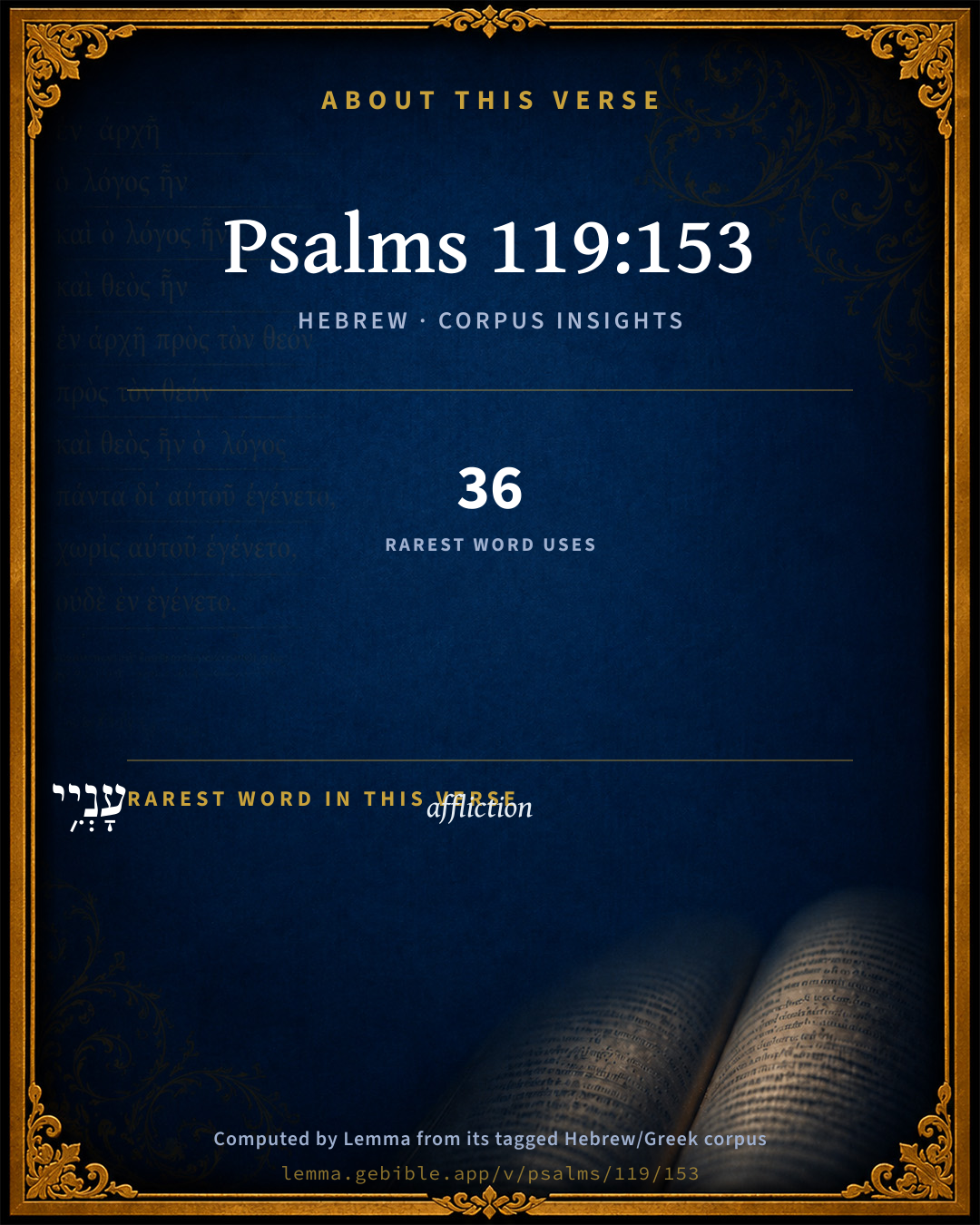
עָנְיִ֥י affliction H6040 occurs in 36 verses of the Hebrew Bible. Also found in:

Grammatical profile

  • 3 verbs
  • 2 nouns
  • 1 conjunction
  • 1 particle

Verb forms

  • רְאֵֽה Qal · Imperative
  • וְחַלְּצֵ֑נִי Piel · Imperative
  • שָׁכָֽחְתִּי Qal · Perfect

Hebrew & Septuagint length

In English translation the verse runs 12 words from the Hebrew and 14 from the Septuagint (LXX English) — closely comparable.

A rough comparison of the two English renderings, which tokenize alike — not a word-level alignment.

Word counts can differ between the Hebrew and the Greek without any difference in meaning — e.g. the Hebrew direct-object marker אֵת has no separate Greek word, and Greek often adds the article ὁ.

Cross-references

14

Topical passages linked to Psalms 119:153 in the Treasury of Scripture Knowledge — connected by theme and wording, ordered by reader-vote popularity; previews shown in the World English Bible.

  • Psalms 119:176 I have gone astray like a lost sheep. Seek your servant, for I don't forget your commandments.
  • Lamentations 5:1 Remember, Yahweh, what has come on us: Look, and see our reproach.
  • Psalms 9:13 Have mercy on me, Yahweh. See my affliction by those who hate me, And lift me up from the gates of death;
  • Psalms 25:19 Consider my enemies, for they are many. They hate me with cruel hatred.
  • Psalms 119:16 I will delight myself in your statutes. I will not forget your word.
  • Psalms 119:141 I am small and despised. I don't forget your precepts.
  • Psalms 119:159 Consider how I love your precepts. Revive me, Yahweh, according to your loving kindness.
  • Proverbs 3:1 My son, don't forget my teaching; But let your heart keep my commandments:
  • Exodus 3:7–8 Yahweh said, "I have surely seen the affliction of my people who are in Egypt, and have heard their cry because of their taskmasters, for I know their sorrows.
  • Nehemiah 9:32 Now therefore, our God, the great, the mighty, and the awesome God, who keep covenant and loving kindness, don't let all the travail seem little before you, that has come on us, on our kings, on our princes, and on our priests, and on our prophets, and on our fathers, and on all your people, since the time of the kings of Assyria to this day.
  • Psalms 13:3–4 Behold, and answer me, Yahweh, my God. Give light to my eyes, lest I sleep in death;
  • Psalms 119:98 Your commandments make me wiser than my enemies, For your commandments are always with me.
  • Psalms 119:109 My soul is continually in my hand, Yet I won't forget your law.
  • Lamentations 2:20 Look, Yahweh, and see to whom you have done thus! Shall the women eat their fruit, the children that are dandled in the hands? Shall the priest and the prophet be killed in the sanctuary of the Lord?

Cross-references courtesy of OpenBible.info (CC BY 4.0).

Hebrew and Greek witnesses Masoretic Hebrew ↔ Greek Septuagint

The same verse in the two great witnesses to the Old Testament, shown verse-for-verse.

You’re reading Greek Psalm 118 (Hebrew Psalm 119). The Septuagint counts the superscription, so verse numbers can differ from the Hebrew — chapter-level alignment, not verse-by-verse. Numbering follows Rahlfs.

These are two independent witnesses, not word-aligned to each other, and the Septuagint is shown in lemma (dictionary) form.

Hebrew Psalms 119:153 Masoretic · Westminster Leningrad Codex

רְאֵֽה עָנְיִ֥י וְחַלְּצֵ֑נִי כִּי תֽ֝וֹרָתְךָ֗ לֹ֣א שָׁכָֽחְתִּי

Consider my affliction, and deliver me, For I don't forget your law.

World English Bible · Public Domain

Greek LXX Greek Psalm 118:153 Septuagint · lemma form

ρης ὁράω ὁ ταπείνωσις ἐγώ καί ἐκαἱρέω ἐγώ ὅτι ὁ νόμος σύ οὐ ἐπιλανθάνω

Look upon my affliction, and rescue me; for I have not forgotten your law.

LXX2012 (modern English Septuagint) · Public Domain

Hebrew: Westminster Leningrad Codex (CC BY 4.0). Greek: Septuagint (public domain); English from LXX2012 (modern English Septuagint) (Public Domain). How the Septuagint differs from the Hebrew →

Commentary

Notes on Psalms 119:153 from classic Christian and Jewish commentators (each source and its license shown beneath its notes). The classic Christian expositions comment on the surrounding passage and are grouped to its opening verse, so a note may address several verses; the Jewish commentaries on the Tanakh (Rashi and others) are per-verse, so they appear only where the commentator wrote on this verse.

Lemma curates 59 commentaries, every one of them public domain or Creative Commons licensed, each selected and text-cleaned for this edition rather than reprinted as found. About our sources →

Trapp's Complete Commentary

John Trapp

Psa 119:153 RESH. Consider mine affliction, and deliver me: for I do not forget thy law.

Ver. 153. Consider mine affliction, and deliver me] Vide commiserationes oculis, look upon it, and let thine eye affect thy heart; say as once, "I have seen, I have seen the affliction of thy people."

John Trapp, A Commentary or Exposition upon All the Books of the Old and New Testament (1647–1656) — public domain. Text from a community e-Sword module.

The Treasury of David

Charles H. Spurgeon

Ver. 153. Consider mine affliction, and deliver me. The writer has a good case, though it be a grievous one, and he is ready, yea anxious, to submit it to the divine arbitration. His matters are right, and he is ready to lay them before the supreme court. His manner is that of one who feels safe at the throne. Yet there is no impatience: he does not ask for hasty action, but for consideration. In effect he cries "Look into my grief, and see whether I do not need to be delivered. From my sorrowful condition judge as to the proper method and time for my rescue." The Psalmist desires two things, and these two things blended: first, a full consideration of his sorrow; secondly, deliverance; and, then, that this deliverance should come with a consideration of his affliction. It should be the desire of every gracious man who is in adversity that the Lord should look upon his need, and relieve it in such a way as shall be most for the divine glory, and for his own benefit. The words, "mine affliction, "are picturesque; they seem to portion off a special spot of woe as the writer's own inheritance: he possesses it as no one else had ever done, and he begs the Lord to have that special spot under his eye: even as a husbandman looking over all his fields may yet take double care of a certain selected plot. His prayer is eminently practical, for he seeks to be delivered; that is, brought out of the trouble and preserved from sustaining any serious damage by it. For God to consider is to act in due season: men consider and do nothing; but such is never the case with our God.

For I do not forget thy law. His affliction was not sufficient, with all its bitterness, to drive out of his mind the memory of God's law; nor could it lead him to act contrary to the divine command. He forgot prosperity, but he did not forget obedience. This is a good plea when it can be honestly urged. If we are kept faithful to God's law we may be sure that God will remain faithful to his promise. If we do not forget his law the Lord will not forget us. He will not long leave that man in trouble whose only fear in trouble is lest he should leave the way of right.

Ver. 153. Consider mine affliction, and deliver me. God looks upon or considers man in various ways, and for different ends. To give him light; for "as Jesus passed by, he saw a man which was blind from his birth" (Joh 9:1). To convert him; "He saw a man, named Matthew, sitting at the receipt of custom: and he saith unto him, Follow me" (Mt 9:9). To restore him; "And the Lord turned, and looked upon Peter" (Lu 22:61). To deliver him; "I have surely seen the affliction of my people which are in Egypt" (Ex 3:7). To advance him; "He hath regarded the low estate of his handmaiden" (Lu 1:48): and to reward him; "The Lord had respect unto Abel and to his offering" (Ge 4:4). Hugh de St. Victor (1098-1141), in Neale and Littledale.

Ver. 153. Consider mine affliction, and deliver me. We must pray that God will help and deliver us, not after the device of our own brains, but after such wise as seemeth best unto his tender wisdom, or else that he will mitigate our pain, that our weakness may not utterly faint. Like as a sick person, although he doubt nothing of the faithfulness and tenderness of his physician, yet, for all that, desireth him to handle his wound as tenderly as possible, even so may we call upon God, that, if it be not against his honour and glory, he will vouchsafe to give some mitigation of the pain. Otto Wermuellerus.

Ver. 153. Consider mine affliction. These prayers of David are penned with such heavenly wisdom that they are convenient for the state of the whole church, and every member thereof. The church is the bush that burneth with fire, but cannot be consumed; every member thereof beareth a part of the cross of Christ; they are never without some affliction, for which they have need to pray with David, "Behold mine affliction."

We know that in afflictions it is some comfort to us to have our crosses known to those of whom we are assured that they love us: it mitigates our dolour when they mourn with us, albeit they be not able to help us. But the Christian hath a more solid comfort; to wit, that in all his troubles the Lord beholds him; like a king, rejoicing to see his own servant wrestle with the enemy. He looks on with a merciful eye, pitying the infirmity of his own, when he sees it; and with a powerful hand ready to help them. But because many a time the cloud of our corruption cometh between the Lord and us, and lets us not see his helping hand, nor his loving face looking upon us, we have need to pray at such times with David, "Behold mine affliction." William Cowper.

Verses 153-160. Divine consideration besought. "Consider my affliction" (Ps 119:153); my cause (Ps 119:154); "for thy mercies' sake" (Ps 119:156). Consider my persecutors (Ps 119:157-158), and my love to thy precepts (Ps 119:160) and act accordingly.

Ver. 153-159. The two considers. The subjects, the prayers, the arguments.

Ver. 153,154. Here

1. David prays for succour in distress. "Is any afflicted? let him pray"; let him pray as David doth here.

(a) He hath an eye to God's pity, and prays, "Consider mine

affliction"; take it unto thy thoughts, and all the

circumstances, and sit not by as one unconcerned. God is

never unmindful of his people's afflictions, but he will

have us to "put him in remembrance" (Isa 43:26), to

spread our case before him, and then leave it to his

compassionate consideration to do in it as in his wisdom he

shall think fit, in his own time and way.

(b) He has an eye to God's power, and prays, "Deliver me, "

and again, "Deliver me." Consider my troubles and bring me

out of them. God has promised deliverance (Ps 1:15), and

we may pray for it with submission to his will, and with

regard to his glory, that we may serve him the better.

(c) He has an eye to God's righteousness, and prays, "Plead

my cause": be thou my patron and advocate, and take me

for thy client. David had a just cause, but his adversaries

were many and mighty, and he was in danger of being

run down by them: he therefore begs of God to clear his

integrity, and silence their false accusations. If God do

not plead his people's cause, who will? He is righteous,

and they commit themselves to him, and therefore he will do

it, and do it effectually: Isa 51:22; Jer 1:34.

(d) He has an eye to God's grace, and prays, "Quicken me."

Lord, I am weak, and unable to bear my troubles; my spirit

is apt to droop and sink: Oh, that thou wouldst revive and

comfort me, till the deliverance is wrought!

2. He pleads his dependence upon the word of God, and his devotedness to his conduct. "Quicken" and "deliver me according to thy word" of promise; "for I do not forget thy precepts." The closer we cleave to the word of God, both as our rule and as our stay, the more assurance we may have of deliverance in due time. M. Henry.

Ver. 153. The sick man's prayer.

1. The medicine remembered.

2. The physician sent for.

3. The physician considering the case.

4. The healing wrought.

C.A.D.

Ver. 153.

1. Lord, do not forget my sorrow.

2. I do not forget thy law.

Psalms 119:154*

Charles H. Spurgeon's The Treasury of David (1869–1885) — public domain. Psalms only. Text from a community e-Sword/MySword module.

J. A. Alexander on Psalms

Joseph Addison Alexander

153. (Psa 119:153) See my suffering and deliver me; for thy law I forget not. The first petition, in the same words, occurs above, Psa 9:13. The first verb originally signifies to extricate or disembarrass. I forget not, and have not forgotten, both of which ideas would be necessarily suggested to aHebrew reader.

Joseph Addison Alexander, The Psalms Translated and Explained (1850) — public domain. Text from a community e-Sword module.

Tyndale Open Study Notes

Tyndale Open Resources

119:153-160 Resh (ר): This petition for life can be found throughout Ps 119, but it is concentrated in this stanza.

Tyndale Open Study Notes — © Tyndale Open Resources, licensed CC BY-SA 4.0. Text via the HelloAO Bible API.

Matthew Henry's Commentary

Here, I. David prays for succour in distress. Is any afflicted? let him pray; let him pray as David does here. 1. He has an eye to God's pity, and prays, "Consider my affliction; take it into thy thoughts, and all the circumstances of it, and sit not by as one unconcerned." God is never unmindful of his people's afflictions, but he will have us to put him in remembrance (Isa 43:26), to spread our case before him, and then leave it to his compassionate consideration to do in it as in his wisdom he shall think fit, in his own time and way. 2. He has an eye to God's power and prays, Deliver me; and again, "Deliver me; consider my troubles and bring me out of them." God has promised deliverance (Psa 50:15) and we may pray for it, with submission to his will and with regard to his glory, that we may serve him the better. 3. He has an eye to God's righteousness, and prays, "Plead my cause; be thou my patron and advocate, and take me for thy client." David had a just cause, but his adversaries were many and mighty, and he was in danger of being run down by them; he therefore begs of God to clear his integrity and silence their false accusations. If God do not plead his people's cause, who will? He is righteous, and they commit themselves to him, and therefore he will do it, and do it effectually, Isa 51:22; Jer 50:34. (4.) He has an eye to God's grace, and prays, "Quicken me. Lord, I am weak, and unable to bear my troubles; my spirit is apt to droop and sink. O that thou wouldst revive and comfort me, till the deliverance is wrought!"

II. He pleads his dependence upon the word oaf God and his obedient regard to its directions: Quicken and deliver me according to thy word of promise, for I do not forget thy precepts. The more closely we cleave to the word of God, both as our rule and as our stay, the more assurance we may have of deliverance in due time.

Matthew Henry's Commentary on the Whole Bible (1708–1710) — public domain (CC PDM 1.0). Text via the HelloAO Bible API.

Adam Clarke's Commentary

LETTER ר RESH. - Twentieth Division

Verse 153. Consider mine affliction] See mine affliction or humiliation: but the eye of the Lord affects his heart; and therefore he never sees the distresses of his followers without considering their situation, and affording them help.

Adam Clarke's Commentary on the Bible (1810–1826) — public domain. Text from a community e-Sword/MySword module.

John Calvin's Commentaries

153. Behold my affliction and rescue me. The Psalmist teaches by his own example that those who are devoted to the service and fear of God, must not be discouraged though they are not rewarded for it in this world. Their condition upon earth is one of warfare, and therefore they should not be dismayed by diversity, but rather rest satisfied with the consolatory consideration, that the gate of prayer is open to them. Yet the Prophet does not boast of his, endeavors to keep the law, as if he would have God to pay him wages for his service, but only to show that he was one of God’s servants, just as he has spoken of his hope that he was so in other places. This reason, for I have not forgotten thy law, on account of which he beseeches God to consider his affliction and to rescue him, is peculiarly forcible in the present case; for it is an evidence of no ordinary courage when, instead of being led away from the fear of God by adversity, we wrestle against temptations and seek him even when he seems purposely to drive us away from him.

John Calvin's Commentaries (1540-1563) — public domain. Text from the Calvin Translation Society English edition (1840s-50s) via the Christian Classics Ethereal Library (ccel.org). Calvin's coverage is partial (roughly two-thirds of the Bible); uncommented books and verses are honest gaps, never fabricated. The 19th-century editor's footnotes and remarks are omitted so the notes are faithfully Calvin's own voice.

The Cambridge Bible for Schools and Colleges

gen. ed. J. J. S. Perowne

153. Consider mine affliction] Lit. see. It was the prayer of Israel in exile (Lam_1:9), reminding God of His own words when He was about to deliver His people from Egypt (Exo_3:7).

153–160. Rçsh. More urgent prayers for deliverance from his persecutors. Note the thrice-repeated ‘quicken me.’

The Cambridge Bible for Schools and Colleges (gen. ed. J. J. S. Perowne; Cambridge University Press, 1878–1918) — public domain. Text from a community e-Sword module.

John Gill's Exposition

Many are my persecutors and mine enemies,.... Because they were his enemies, therefore they were his persecutors; and they became enemies to him, or hated him, because of his religion, and on that account persecuted him: and this has always been the lot and case of God's people in all ages; and whose persecutors are many, even the whole world, as well as fierce and furious;

yet do I not decline from thy testimonies; from reading and hearing the word of God; and from embracing and professing the doctrines contained in it; and from the worship of God according to it, for which he was hated and persecuted: yet none of these things moved him from them, which showed that his heart was principled with the grace of God; for otherwise, when persecution arises because of the word, carnal professors are offended, and apostatize from it; see Mat 13:22.

John Gill's Exposition of the Whole Bible (1746–1763) — public domain (CC PDM 1.0). Text via the HelloAO Bible API.

Albert Barnes' Notes on the Bible

Consider mine affliction ... - This commences a new division of the psalm, indicated by the Hebrew letter Resh (ר r), corresponding to our “r.” The prayer here is, that God would look upon his trial; that he would regard it as it really was; that he would not turn away from it, or pass it by, as if it were a trifle - a thing not worthy to claim his attention. See the notes at Psa 9:13.

For I do not forget thy law - I endeavor to be obedient, submissive, patient. As a suffering child of thine, I come to thee, and beseech thee to interpose and save me.

Albert Barnes' Notes on the Bible (1834–1885) — public domain. Text from a community e-Sword/MySword module.

Whedon's Commentary on the Bible

Daniel D. Whedon

ר, Resh.

153-160. Plead my cause—The prayer is here as if the honour of God were involved in the deliverance of those who put their trust in him. The pleading is, for that very reason, the more earnest. Very touching and trustful is the appeal in Psa_119:159. Luther sums up Psa_119:160, “Thy word is nothing but truth.”

Daniel D. Whedon (gen. ed.), Commentary on the Old and New Testaments (1874–1909) — public domain. Text from a community e-Sword module.

The Pulpit Commentary

rRESH.

Consider mine affliction (see above, vers. 50, 67, 71, 75, 92, etc.). And deliver me. The "affliction" intended is that which the psalmist suffers at the hands of his enemies, who "reproach" him (ver. 22), "deride" him (ver. 51), and otherwise "persecute" him (ver. 161). For I do not forget thy Law (comp. vers. 16, 83, 93, 109, 141, 176).

Vers. 153-160. God"s quickening grace the real help in affliction.

It is evident from these verses that

I AFFLICTION WAS ABUNDANTLY PRESENT. (Vers. 153, 154, 157) He prays God to consider it, to deliver him from it, and he tells how that it was caused by many persecutors and enemies. Hence, here as throughout the psalm we have presented to us the case of a man much troubled, but also much helped of God by means of his Word; and who can over-estimate the worth of this portraiture to the troubled children of God, who have needed his comfort in all the ages of the Church"s history? (2Co_1:4)

II THE RESORT OF THE AFFLICTED SOUL WAS TO GOD. He prays God to "consider," etc., that is, as of old he considered the affliction of Israel when in Egypt, and in many like distresses since, for such considering ever led to his delivering them. The psalmist trusts to no stratagem, or clever policy, or armed force for his help, but to God alone.

III THAT WHICH HE ESPECIALLY DESIRED OF GOD WAS HIS QUICKENING GRACE. "Quicken me" is the repeated prayer of this section, as indeed of the whole psalm, where it occurs nine times, three of which are in these verses before us (vers. 154, 156, 159).

1. It does not imply that there was no spiritual life. He was not dead in trespasses and sins, so that he needed to be quickened from that; unconverted, unregenerate men do need this, but the psalmist was not such as they. For he possessed a true and deep spiritual life, as all this psalm testifies (see here, vers. 153, 157-159).

2. But what he craved was a renewed and intensified life. More, far more of what he had already that "more abundant life." which our Lord said he came to give: ha would be "filled with the Spirit.

IV THIS DESIRE MOST REASONABLE. For if it were granted:

1. He would be strong for his burden. It would not matter how heavy that burden, if he had as he would have if this quickened life were given him the strength to sustain it.

2. He would be able to rise above his affliction. His soul would mount up on wings as eagles, he would be able to run and not be weary, to walk and not faint. This is one of the choice present privileges of the soul that is filled with the Spirit of God. Often and often has it been proved (cf. Romans 8., at end).

3. He would be able to enjoy God in the midst of it. Many such a one as himself had done so. God and his Word had never been so precious, nor so clearly seen and understood.

4. He would be able to comfort others as he could not have done before. Then his words would come with power, for he himself would know not merely what deep affliction was, but how God can sustain the soul beneath it all.

5. This very affliction would prove a means of heavenward ascent a ladder reaching from earth to heaven, up which his soul would surely mount.

6. And God would be glorified. His persecutors would see how God-sustained he was, and they would be compelled to confess the mighty power of God. How reasonable, therefore, was and ever is this prayer! Let it be our own. S.C.

Conditions beyond self-help.

"Oh, consider my adversity, and deliver me." Plainly the adversity is such that the psalmist feels he cannot deliver himself. Therefore he pleads with God to deliver him. Some of the trials and afflictions of life are within the man s own reach and control, if he has the help of God. But there are some forms of adversity which bring to a man an overwhelming sense of self-helpless-ness. Then, if he be a good man, he makes absolute committal of his case to God, and seeks Divine intervention in his behalf. Illustrate by the helplessness of Israel at the shores of the Red Sea. Then they were bidden "Stand still, and see the salvation of Jehovah." Men, however, often seriously mistake if they ask Divine intervention when what they really need is Divine help; not that God should do for them, but should enable them to do. Apply this to the deliverance of the soul from sin. Here man is helpless. "God must save, and God alone." But usually the saved man must unite his labor and his dependence on God in every endeavor to live out the godly life. Only very occasionally has he to put down his tools and absolutely wait while God works for him. Bunyan"s pilgrim only once in his journey had to put down his weapons, and betake himself to "All-Prayer." It is weak sectarian feeling that exaggerates self-helplessness, and thinks thus to honor God. Here the psalmist shows his anxiety by two petitions.

I "CONSIDER MY AFFLICTION." He wants God to consider it, estimate it, see what it really is, involves, and needs, because he feels how easily he might misapprehend it. It might not really be as serious as he thought it was. He might so easily read it through his feeling rather than through his judgment. So he wants God to take it into his consideration, and so find out what could best be done with it. Was not this what St. Paul wanted when he prayed about his "thorn"?

II "DELIVER ME." If God would give the matter consideration, he felt sure he would invent the wisest way of deliverance. He would be well content whichever way of deliverance God thought to be best. Help me to do it, Lord, or do it altogether thyself. R.T.

The Pulpit Commentary (1880–1919), ed. H.D.M. Spence-Jones & Joseph S. Exell — public domain. Text from a community e-Sword module.

Keil & Delitzsch

C. F. Keil & F. Delitzsch

The eightfold Resh. Because God cannot suffer those who are faithful to His word to succumb, he supplicates His help against his persecutors. ריבה is Milra before the initial (half-guttural) Resh, as in Psa 43:1; Psa 74:22. The Lamed of לאמרתך is the Lamed of reference (with respect to Thine utterance), whether the reference be normative (= כאמרתך, Psa 119:58), as in Isa 11:3, or causal, Isa 25:2, Isa 55:5; Job 42:5. The predicate רחוק, like ישׂר in Psa 119:137, stands first in the primary, as yet indefinite form. Concerning Psa 119:156 vid., on Psa 119:149. At the sight of the faithless he felt a profound disgust; ואתקוטטה, pausal aorist, supply בּהם, Psa 139:21. It is all the same in the end whether we render אשׁר quippe qui or siquidem. ראשׁ in Psa 119:160 signifies the head-number of sum. If he reckons up the word of God in its separate parts and as a whole, truth is the denominator of the whole, truth is the sum-total. This supplicatory חיּני is repeated three times in this group. The nearer it draws towards its end the more importunate does the Psalm become.

Keil & Delitzsch — Biblical Commentary on the Old Testament (1861–1891) — public domain (CC PDM 1.0). Text via the HelloAO Bible API. (Old Testament only.)

Kretzmann's Popular Commentary

Paul E. Kretzmann

Resh. The Increasing Confidence of the Believer. —

v. 153. Consider mine affliction, taking careful note of its severity, and deliver me; for I do not forget Thy Law, and he sets up his childlike obedience as a reason why God should regard his prayer favorably.

v. 154. Plead my cause, God Himself acting as the great Advocate of His servant, and deliver me; quicken me, with new life and strength, according to Thy Word.

v. 155. Salvation is far from the wicked, on account of their own obstinate disobedience; for they seek not Thy statutes, refusing to heed the Word of the Lord.

v. 156. Great are Thy tender mercies, O Lord, to which the inspired singer appeals throughout the psalm, to the unmerited favor of the Lord; quicken me according to Thy judgments, reviving his soul with the wonderful and merciful decisions of approval found in His Word.

v. 157. Many are my persecutors and mine enemies, their number increasing in proportion to his faithfulness to the Word; yet do I not decline from Thy testimonies, refusing to be turned aside from the Word, with its revelation of the great God and His love.

v. 158. I beheld the transgressors, those who willfully reject the Word, and was grieved, filled with loathing; because they kept not Thy Word, for this fact, with its accompanying unbelief, shuts them out from the mercies of God.

v. 159. Consider how I love Thy precepts, marking well this love for the Word which is characteristic of all true children of God. Quicken me, O Lord, according to Thy loving-kindness, the appeal being again to God’s mercy and grace alone.

v. 160. Thy Word is true from the beginning, its sum, the whole body of revelation, the Bible, being the truth; and everyone of Thy righteous judgments endureth forever, His decisions of approval encouraging His children in the midst of all the present tribulations and opening up vistas of eternal glory before them.

Paul E. Kretzmann, Popular Commentary of the Bible (1921–1924) — public domain. Text from a community e-Sword module.

unfoldingWord translationNotes

Door43 World Missions Community

RESH

This is the name of the twentieth letter of the Hebrew alphabet. In the Hebrew language, each line of verses 153-160 begins with this letter.

Look on my affliction

The psalmist speaks of affliction as if it were an object that people could see. AT: "Look at how much I am suffering" (See: Metaphor)

Plead my cause

"Defend me against those who accuse me"

keep me

"protect my life" or "give me life"

translationWords

afflicted

law

redeem

promise

word of God

unfoldingWord translationNotes — © Distant Shores Media and the Door43 World Missions Community, licensed CC BY-SA 4.0. Source: git.door43.org/Door43/en_tn.

Lesson kit

Teaching starters — assembled from the data on this page, not authored interpretation. Every prompt links to the verse data it draws on. Edit before teaching.

Psalms, in the Wisdom, opens this verse with 7 words (7 distinct Hebrew lemmas). Its most distinctive word is ʻŏnîy (“affliction”). A historical commentator’s framing appears above. Read the whole chapter for the surrounding context.

Discussion questions

  1. How does “affliction” (ʻŏnîy) shape what this verse is saying?
  2. Genesis 16:11 shares the word «affliction» with this verse. How do the two illuminate each other?
  3. These translations render this verse differently; the difference is in the English rendering, not the original. What questions does that raise?
  4. The verb «רְאֵֽה» is Qal Imperative. How does its form color the action?
  5. Reading how Trapp's Complete Commentary and The Treasury of David read this verse, where do the two commentators agree and where do they part?

Things to notice

Reading settings

Reading text

Shown beneath each verse's original-language words.

Old Testament
Old Testament edition

Read the OT as the Masoretic Hebrew (MT) or the Greek Septuagint (LXX).

English shown for the Greek Septuagint (in the Hebrew ↔ Greek comparison).

Comparing translations? Open the Compare panel on any verse page to stack up to four side by side.