
Psalms 119:44

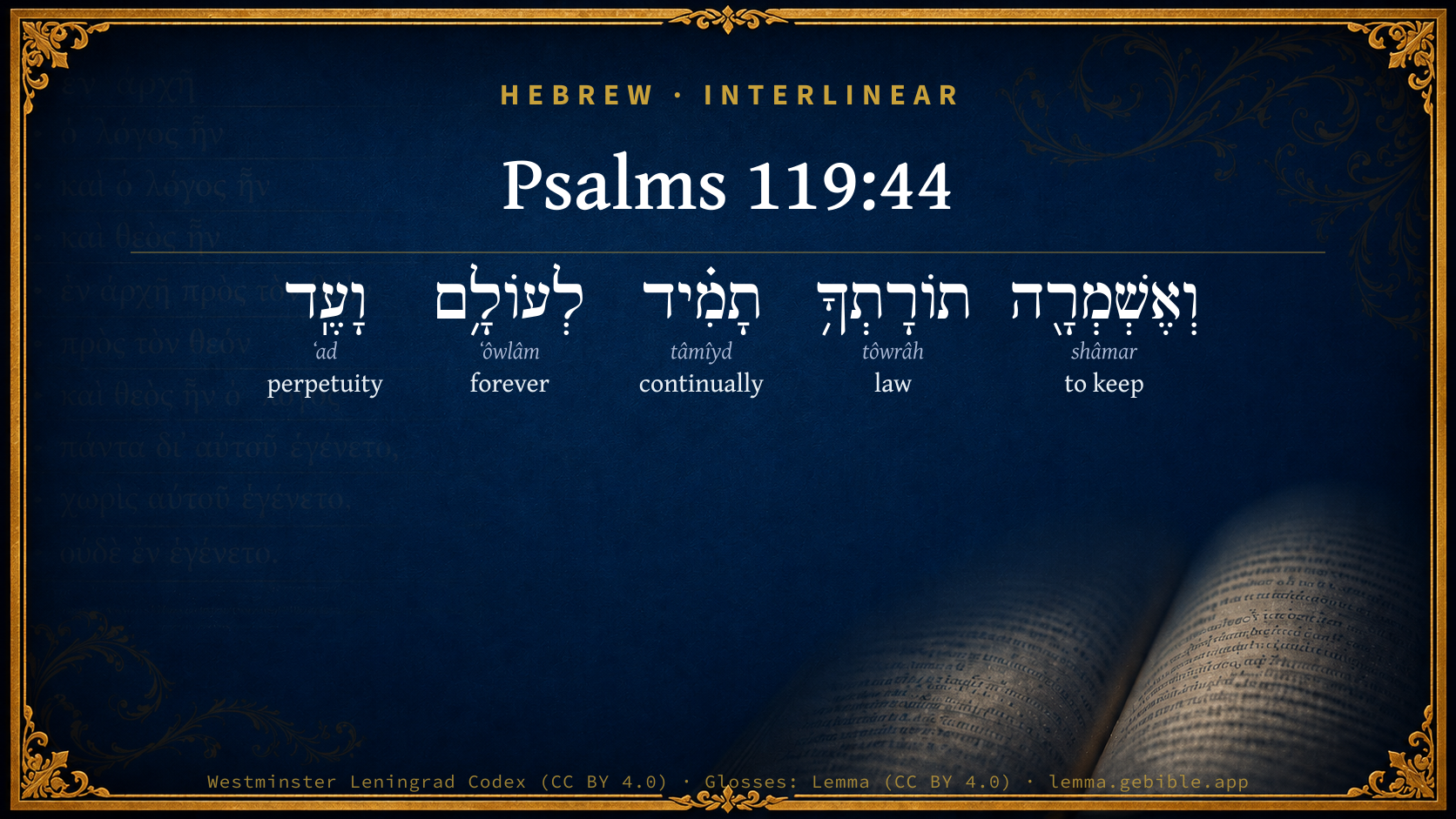
Hebrew (Westminster Leningrad Codex) Psalms 119:44 appears in the Hebrew Old Testament. The text above is from the Westminster Leningrad Codex. Each word links to its Strong’s number, a concise gloss, and parsing drawn from the Open Scriptures Hebrew Bible morphology. Click any word for its full Brown-Driver-Briggs (BDB) entry.
Download image
Cite this verse

Psalms 119:44 (World English Bible). Public Domain. Lemma interlinear Bible study tool, https://lemma.gebible.app/v/psalms/119/44.

Show BibTeX & RIS
BibTeX
RIS
English Translation
So I will obey your law continually, Forever and ever.
World English Bible · Public Domain
Download a study sheet

One document with this verse’s original text, its word-by-word gloss line, the meaning frame, cross-references with their text, attributed commentary, and full source and license credits — printable, and it pastes into notes with its structure intact.

This verse Autodidact and up

Study sheet (.html) Plain text (.txt)

A passage Seminary Student

Up to 50 verses in one chapter. A passage sheet keeps up to 6 commentary sources and 12 cross-references per verse, in the order this page ranks them, and says so on the sheet whenever that leaves anything out. Ask for a single verse and you get the Autodidact verse sheet above.

Everything on this page stays free to read, with no account — the sheet is a download of what is already on screen, not access to it.

Want to remove ads? Support Godless Engineer
Compare translations 3

The same verse in 3 English versions, stacked beneath the original-language interlinear above. Click any original word for its lexicon entry.

Each is an independent rendering of the whole verse — the interlinear is not word-aligned to these translations.

Highlighted words mark where these versions differ — a whole-verse word diff, not a word-by-word alignment.

  • World English Bible Public Domain
    So I will obey your law continually, Forever and ever.
  • King James Version Public Domain
    So shall I keep thy law continually for ever and ever.
  • unfoldingWord Literal Text CC BY-SA 4.0
    Then I will observe your teaching continually, forever and ever.

unfoldingWord Literal Text — © unfoldingWord, licensed CC BY-SA 4.0. Word-aligned USFM3 via Door43 (git.door43.org/unfoldingWord/en_ult).

Versions to compare (up to 4)

3 of 4 selected

Show all 17 translations

Every available English version of this verse, each an independent rendering of the whole verse.

  • World English Bible Public Domain
    So I will obey your law continually, Forever and ever.
  • Berean Standard Bible Public Domain
    I will always obey Your law, forever and ever.
  • Majority Standard Bible Public Domain
    I will always obey Your law, forever and ever.
  • King James Version Public Domain
    So shall I keep thy law continually for ever and ever.
  • American Standard Version (1901) Public Domain
    So shall I observe thy law continually For ever and ever.
  • Revised Version (1885) Public Domain
    So shall I observe thy law continually for ever and ever.
  • Geneva Bible (1599) Public Domain
    So shall I alway keepe thy Lawe for euer and euer.
  • Young's Literal Translation Public Domain
    And I keep Thy law continually, To the age and for ever.
  • Literal Standard Version CC BY-SA 4.0
    And I keep Your law continually, || For all time and forever.
  • Unlocked Literal Bible CC BY-SA 4.0
    I will observe your law continually, forever and ever.
  • unfoldingWord Literal Text CC BY-SA 4.0
    Then I will observe your teaching continually, forever and ever.
  • Darby Bible Public Domain
    Then will I keep thy law continually, for ever and ever;
  • World Messianic Bible Public Domain
    So I will obey your Torah continually, forever and ever.
  • Webster's Bible Public Domain
    So shall I keep thy law continually for ever and ever.
  • Free Bible Version CC BY-SA 4.0
    I will continue to follow your teachings, forever and ever.
  • Bible in Basic English Public Domain
    So that I may keep your law for ever and ever;
  • JPS Tanakh (1917) Public Domain
    So shall I observe Thy law continually for ever and ever;

Literal Standard Version (2020), Covenant Press — licensed CC BY-SA 4.0. Text via the HelloAO Bible API (eBible.org). Unlocked Literal Bible (unfoldingWord) — licensed CC BY-SA 4.0. Text via the HelloAO Bible API (eBible.org). unfoldingWord Literal Text — © unfoldingWord, licensed CC BY-SA 4.0. Word-aligned USFM3 via Door43 (git.door43.org/unfoldingWord/en_ult). Free Bible Version, Dr. Jonathan Gallagher — licensed CC BY-SA 4.0. Text via the HelloAO Bible API (eBible.org).

Word by word

More ways to search: Search by grammar → Find every occurrence → Compare this word →

Practice this passage: Drill this verse → Learn its vocabulary →

About this verse

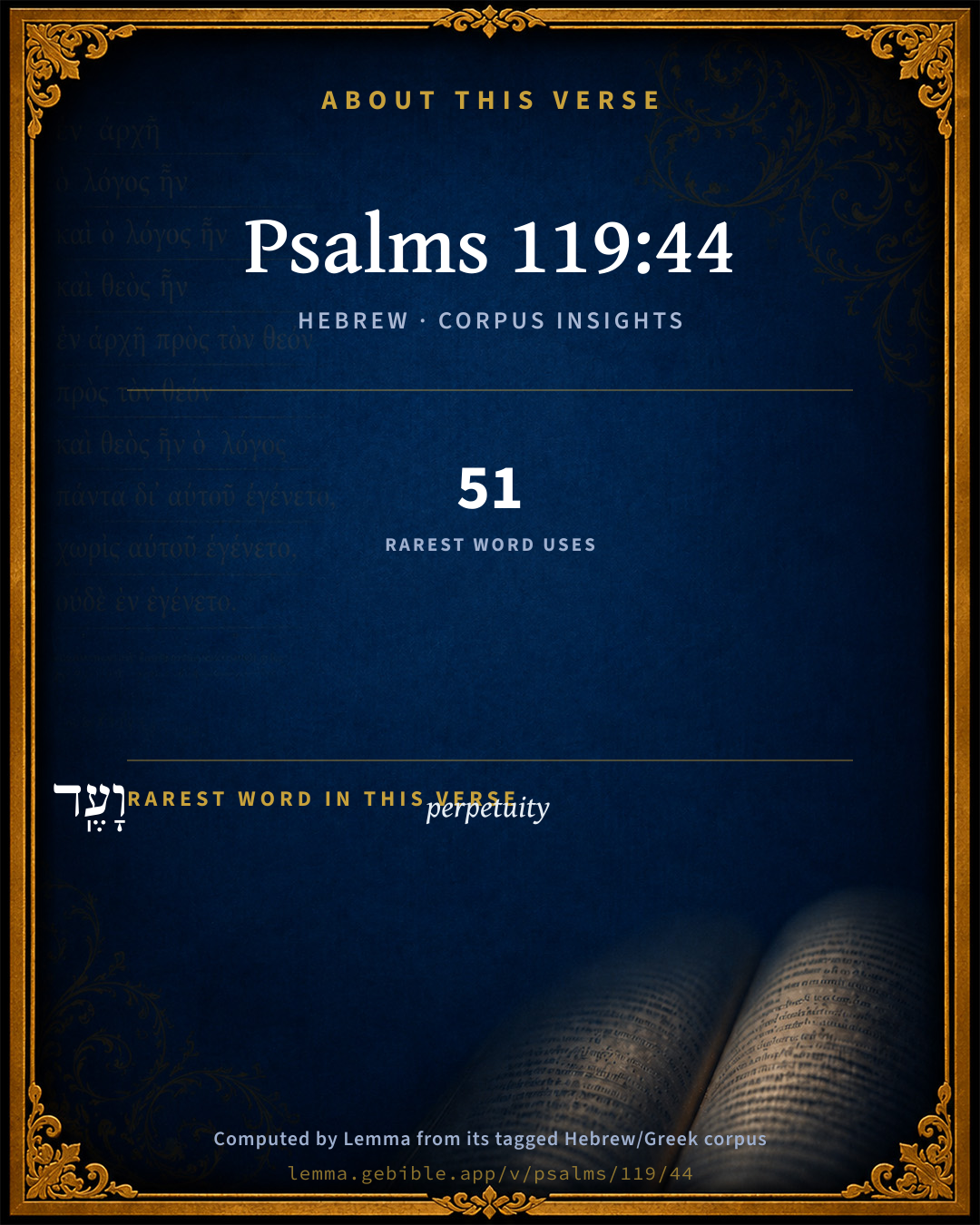
These counts appear in no published source. They are computed here, from the morphology-tagged text and Lemma’s own curated glosses. What Lemma adds →

5
words
5
distinct lemmas
Wisdom
section

Shared distinctive vocabulary

וָעֶֽד perpetuity H5703 occurs in 49 verses of the Hebrew Bible. Also found in:

Grammatical profile

  • 1 verb
  • 4 nouns

Verb forms

  • וְאֶשְׁמְרָ֖ה Qal · Cohortative

Cross-references

3

Topical passages linked to Psalms 119:44 in the Treasury of Scripture Knowledge — connected by theme and wording, ordered by reader-vote popularity; previews shown in the World English Bible.

  • Psalms 119:33–34 Teach me, Yahweh, the way of your statutes. I will keep them to the end.
  • Revelation 22:11 He who acts unjustly, let him act unjustly still. He who is filthy, let him be filthy still. He who is righteous, let him do righteousness still. He who is holy, let him be holy still."
  • Revelation 7:15 Therefore they are before the throne of God, they serve him day and night in his temple. He who sits on the throne will spread his tent over them.

Cross-references courtesy of OpenBible.info (CC BY 4.0).

Hebrew and Greek witnesses Masoretic Hebrew ↔ Greek Septuagint

The same verse in the two great witnesses to the Old Testament, shown verse-for-verse.

You’re reading Greek Psalm 118 (Hebrew Psalm 119). The Septuagint counts the superscription, so verse numbers can differ from the Hebrew — chapter-level alignment, not verse-by-verse. Numbering follows Rahlfs.

These are two independent witnesses, not word-aligned to each other, and the Septuagint is shown in lemma (dictionary) form.

Hebrew Psalms 119:44 Masoretic · Westminster Leningrad Codex

וְאֶשְׁמְרָ֖ה תוֹרָתְךָ֥ תָמִ֗יד לְעוֹלָ֥ם וָעֶֽד

So I will obey your law continually, Forever and ever.

World English Bible · Public Domain

Greek LXX Greek Psalm 118:44 Septuagint · lemma form

καί φυλάσσω ὁ νόμος σύ διά πᾶς εἰς ὁ αἰών καί εἰς ὁ αἰών ὁ αἰών

No English rendering of this Greek verse — the small residue in the structurally divergent books.

On this verse, The Treasury of David discusses the Septuagint’s reading. Read the note in Commentary ↓

Hebrew: Westminster Leningrad Codex (CC BY 4.0). Greek: Septuagint (public domain); English from a public-domain English Septuagint. How the Septuagint differs from the Hebrew →

Commentary

Notes on Psalms 119:44 from classic Christian and Jewish commentators (each source and its license shown beneath its notes). The classic Christian expositions comment on the surrounding passage and are grouped to its opening verse, so a note may address several verses; the Jewish commentaries on the Tanakh (Rashi and others) are per-verse, so they appear only where the commentator wrote on this verse.

Lemma curates 59 commentaries, every one of them public domain or Creative Commons licensed, each selected and text-cleaned for this edition rather than reprinted as found. About our sources →

Trapp's Complete Commentary

John Trapp

Psa 119:44 So shall I keep thy law continually for ever and ever.

Ver. 44. So shall I keep thy law continually] If thou please to give me to believe with the heart, and to confess with the mouth, I shall surely persevere in the profession and practice of the truth.

John Trapp, A Commentary or Exposition upon All the Books of the Old and New Testament (1647–1656) — public domain. Text from a community e-Sword module.

The Biblical Illustrator

Joseph S. Exell

Psa_119:44-48

So shall I keep Thy law continually for ever and ever.

A noble resolution

I. To be constantly obedient (verse 44). What is obedience? Not conformity to the letter of the law, but the incarnation of the spirit of the law It is to have the Divine will not only written in the heart, hut living and reigning in the heart.

II. To be morally free (verse 45). Soul liberty is not mere freedom to act, not licence; it is the spontaneous action of love. Where the spirit of the Lord is, there is liberty. A reigning love for God breaks all the shackles of the soul, and dispreads a sphere of action as wide as immensity.

III. To he heroic in teaching (verse 46).

1. Here is a resolution--

(1) To speak truth,

(2) To speak it in the highest circles,

(3) With the greatest boldness. Will not he ashamed.

2. We should be bold in speaking out truths

(1) Because it is Divine,

(2) Because it is rational,

(3) Because it is powerful,

(4) Because it is restorative,

(5) Because it is universal.

IV. To be happy in duty (verse 47). You cannot be happy by merely resolving to be happy, but you can by resolving to obey with a loving heart. Happiness, like a deep crystal stream, follows every step in the path of true obedience. All the creatures in the universe that obey the laws of their natures are happy.

V. To be devout in life (verse 48).

1. Religious love is devout. I have loved.

2. Religious love is contemplative. I will meditate.

3. True living is devotion. (Homilist)

The Biblical Illustrator, edited by Joseph S. Exell (c. 1880s–1900s) — public domain. Text from a community e-Sword module.

J. A. Alexander on Psalms

Joseph Addison Alexander

44. (Psa 119:44) And I will observe thy law always, unto eternity and perpetuity. Not merely for a time, or for the purpose of securing this triumph over his enemies, but for ever, to express which idea the three strongest terms afforded by the language are combined. As the keeping of the law, so often mentioned in this psalm, has evident reference to the present life, the strong promise of perpetual obedience, in the verse before us, is considered by some writers as a proof that the ideal speaker is not an individual believer, but the church or chosen people.

Joseph Addison Alexander, The Psalms Translated and Explained (1850) — public domain. Text from a community e-Sword module.

Tyndale Open Study Notes

Tyndale Open Resources

119:44-46 The psalmist is determined to obey the Lord.

Tyndale Open Study Notes — © Tyndale Open Resources, licensed CC BY-SA 4.0. Text via the HelloAO Bible API.

John Calvin's Commentaries

44. I will keep thy law continually He resolves to devote himself to the study of the law, not for a short time only, but even to the termination of his life. The employing of three synonymous words, תמיד, tamid, עולם, olam, עד, ed, so far from being viewed as a superfluous accumulation of terms, contains an implied indication, that, unless the faithful make a strenuous and steady opposition, the fear of God may be gradually effaced from their minds by various temptations, and they will lose the affection which they bear for the law. In order, therefore, that he may be the better prepared for meeting these trials, he alludes to the difficulty and danger connected with them.

John Calvin's Commentaries (1540-1563) — public domain. Text from the Calvin Translation Society English edition (1840s-50s) via the Christian Classics Ethereal Library (ccel.org). Calvin's coverage is partial (roughly two-thirds of the Bible); uncommented books and verses are honest gaps, never fabricated. The 19th-century editor's footnotes and remarks are omitted so the notes are faithfully Calvin's own voice.

The Cambridge Bible for Schools and Colleges

gen. ed. J. J. S. Perowne

44. So shall I observe thy law] This is his desire and purpose, if God will grant him grace.

continually for ever and ever] Unceasingly to the end of his life. Or does he merge his own personality in that of the nation, and look forward to the service of the generations to come?

The Cambridge Bible for Schools and Colleges (gen. ed. J. J. S. Perowne; Cambridge University Press, 1878–1918) — public domain. Text from a community e-Sword module.

John Gill's Exposition

I will speak of thy testimonies also before kings,.... As very likely he did before Saul and his courtiers, before the king of Achish and the princes of the Philistines, when as yet he was not a king himself; and when he was come to the throne, such kings as came to visit him, instead of talking with them about affairs of state, he spoke of the Scriptures, and of the excellent things they bear witness of; and such a practice he determined to pursue and continue in;

and will not be ashamed; of the testimonies of God, and of the truths contained in them; and of speaking of them and for them; or of being reproached and vilified on that account. So the Apostle Paul was a chosen vessel to bear the name of Christ before kings; nor was he ashamed to speak of him and of his Gospel before Nero the Roman emperor, Agrippa king of the Jews, and before Felix and Festus, Roman governors; nor ashamed of the reproaches and afflictions he endured on that account.

John Gill's Exposition of the Whole Bible (1746–1763) — public domain (CC PDM 1.0). Text via the HelloAO Bible API.

Albert Barnes' Notes on the Bible

So shall I keep thy law continually forever and ever - At all times and in all places; in this world and the world to come. This indicates a purpose to do it, and an assurance that he would do it, if God should enable him to retain even the slightest hold on the truth.

Albert Barnes' Notes on the Bible (1834–1885) — public domain. Text from a community e-Sword/MySword module.

Matthew Poole's English Annotations

So shall I be obliged and encouraged to the constant and perpetual study and observation of thy laws.

Matthew Poole's English Annotations on the Holy Bible (1683–1685) — public domain. Text from a community e-Sword/MySword module.

The Treasury of David

Charles H. Spurgeon

Ver. 44. So shall I keep thy law continually for ever and ever. Nothing more effectually binds a man to the way of the Lord than an experience of the truth of his word, embodied in the form of mercies and deliverances. Not only does the Lord's faithfulness open our mouths against his adversaries, but it also knits our hearts to his fear, and makes our union with him more and more intense. Great mercies lead us to feel an inexpressible gratitude which, falling to utter itself in time, promises to engross eternity with praises. To a heart on flame with thankfulness, the "always, unto eternity and perpetuity, "of the text will not seem to be redundant; yea, the hyperbole of Addison in his famous verse will only appear to be solid sense:

"Through all eternity to thee

A joyful song I will raise;

But oh! eternity's too short

To utter all thy praise." Addison.

God's grace alone can enable us to keep his commandments without break and without end; eternal love must grant us eternal life, and out of this will come everlasting obedience. There is no other way to ensure our perseverance in holiness but by the word of truth abiding in us, as David prayed it might abide with him.

The verse begins with "So, "as did Ps 119:42. When God grants his salvation we are so favoured that we silence our worst enemy and glorify our best friend. Mercy answereth all things. If God doth but give us salvation we can conquer hell and commune with heaven, answering reproaches and keeping the law, and that to the end, world without end.

We may not overlook another sense which suggests itself here. David prayed that the word of truth might not be taken out of his mouth, and so would he keep God's law: that is to say, by public testimony as well as by personal life, he would fulfil the divine will, and confirm the bonds which bound him to his Lord for ever. Undoubtedly the grace which enables us to bear witness with the mouth is a great help to ourselves as well as to others: we feel that the vows of the Lord are upon us, and that we cannot run back.

Ver. 44. So shall I keep thy law continually, etc. The Lord's keeping our heart in faith, and our mouth and outward man in the course of confession and obedience, is the cause of our perseverance. David Dickson.

Ver. 44. So shall I keep. Mark, the promise of obedience is brought in by way of argument; "So shall I keep, ""so, "that is, this will encourage me, this will enable me.

First, The granting of his requests would give him encouragement: when God answers our hope and expectation, gratitude should excite and quicken us to give all manner of obedience. If he will give us a heart, and a little liberty to confess his name, and serve him, we should not be backward or uncertain, but walk closely with him.

Secondly, This would give him assistance and strength. If God do daily give assistance, we shall stand; if not, we fall and falter; this will be a means of his perseverance, not only to engage and oblige him, but to help him to hold on to the end.

Then mark the consistency of this obedience, "Continually, and for ever and ever." David would not keep it for a fit, or for a few days, or a year, but always, even to the end of his life. Here are three words to the same sense: "continually, ""for ever, ""and ever." And the Septuagint expresses it thus: "I shall keep thy law always, and for ever, and for ever, and ever; "four words there. This heaping of words is not in vain.

1. It shows the difficulty of perseverance: unless believers do strongly persist in the resistance of temptation, they will soon be turned out of the way; therefore David binds his heart firmly: we must do it now, yea, always, unto the end.

2. He expresses his vehemence of affection: those that are deeply affected with anything are wont to express themselves as largely as they can. As Paul, who had a deep sense of God's power: "Exceeding greatness of his power, according to the working of his mighty power" (Eph 1:19). He heaps up several words, because his sense of them was so great: so David here doth heap up words "continually, and for ever, and ever, and ever."

3. Some think the words are so many, that they may express not only this life, but that which is to come. I will keep them continually, and for ever, and ever; that is, all the days of my life, and in the other world. So Chrysostom, "I will keep them continually, "etc., points out the other life, where there will be pure and exact keeping of the law of God. Here we are every hour in danger, but then we shall be put out of all danger, and without fear of sinning, we shall remain in a full and perfect righteousness; we hope for that which we have not attained unto, and this doth encourage us for the present: so would he make David express himself.

4. If we must distinguish these words, I suppose they imply the continuity and perpetuity of obedience; the continuity of obedience, that he would serve God continually, without intermission; and the perpetuity of obedience, that he would serve God for ever and ever, without defection or revolt, at all times, and to the end. Constancy and perseverance in obedience is the commendation of it. Thomas Manton.

Ver. 44. So shall I keep thy law continually. That is, if thou wilt not take the word of thy truth out of my mouth, "I will alway keep thy law." "Yea, unto age, and age of age:" he showeth what is meant by alway. For sometimes by "alway" is meant, as long as we live here; but this is not, "unto age, and age of age." For it is better thus translated than as some copies have, "to eternity, and to age of age, "since they could not say, and to eternity of eternity. That law therefore should be understood, of which the apostle saith, "Love is the fulfilling of the law." For this will be kept by the saints, from whose mouth the word of truth is not taken, that is, by the church of Christ herself, not only during this world, that is, until this world is ended; but for another world which is styled world without end. For we shall not there receive the commandments of the law, as here, to keep them, but we shall keep the fulness of the law itself without any fear of sinning; for we shall love God the more fully when we shall have seen him; and our neighbour too; for "God will be all in all"; nor will there be room for any false suspicion concerning our neighbour, where no man will be hidden to any. Augustine.

Ver. 44. Continually, for ever and ever. The language of this verse is very emphatic. Perfect obedience will constitute a large proportion of heavenly happiness to all eternity; and the nearer we approach to it on earth, the more we anticipate the felicity of heaven. Note in Bagster's Comprehensive Bible.

Ver. 44. The perpetuity of gracious living. On what it is conditioned: "So." How entirely it is consistent with free agency: "I

keep." How continuous it is, and how eternal.

Ver. 44. Heaven begun below.

1. The present life of the believer keeping God's law.

2. The continual care of the believer to keep God's law.

3. The eternal prospect of the believer keeping God's law for ever and ever. C.A.D.

Psalms 119:45*

Charles H. Spurgeon's The Treasury of David (1869–1885) — public domain. Psalms only. Text from a community e-Sword/MySword module.

The Pulpit Commentary

So shall I keep thy Law continually forever and ever. God"s mercy will draw forth the psalmist"s gratitude, and make his obedience perfect and perpetual.

The Pulpit Commentary (1880–1919), ed. H.D.M. Spence-Jones & Joseph S. Exell — public domain. Text from a community e-Sword module.

Lesson kit

Teaching starters — assembled from the data on this page, not authored interpretation. Every prompt links to the verse data it draws on. Edit before teaching.

Psalms, in the Wisdom, opens this verse with 5 words (5 distinct Hebrew lemmas). Its most distinctive word is ʻad (“perpetuity”). A historical commentator’s framing appears above. Read the whole chapter for the surrounding context.

Discussion questions

  1. What does “perpetuity” (ʻad) contribute to the verse as a whole?
  2. How does Exodus 15:18, which shares the word «perpetuity», read alongside this verse?
  3. The translations on this page render this verse differently — a whole-verse word diff, not a word-by-word alignment. What might account for the different wordings?
  4. «וְאֶשְׁמְרָ֖ה» is a Qal Cohortative verb. How does that grammatical form shape the action described?
  5. Compare how Trapp's Complete Commentary and The Biblical Illustrator read this verse. Where do they agree or differ?

Things to notice

Reading settings

Reading text

Shown beneath each verse's original-language words.

Old Testament
Old Testament edition

Read the OT as the Masoretic Hebrew (MT) or the Greek Septuagint (LXX).

English shown for the Greek Septuagint (in the Hebrew ↔ Greek comparison).

Comparing translations? Open the Compare panel on any verse page to stack up to four side by side.