
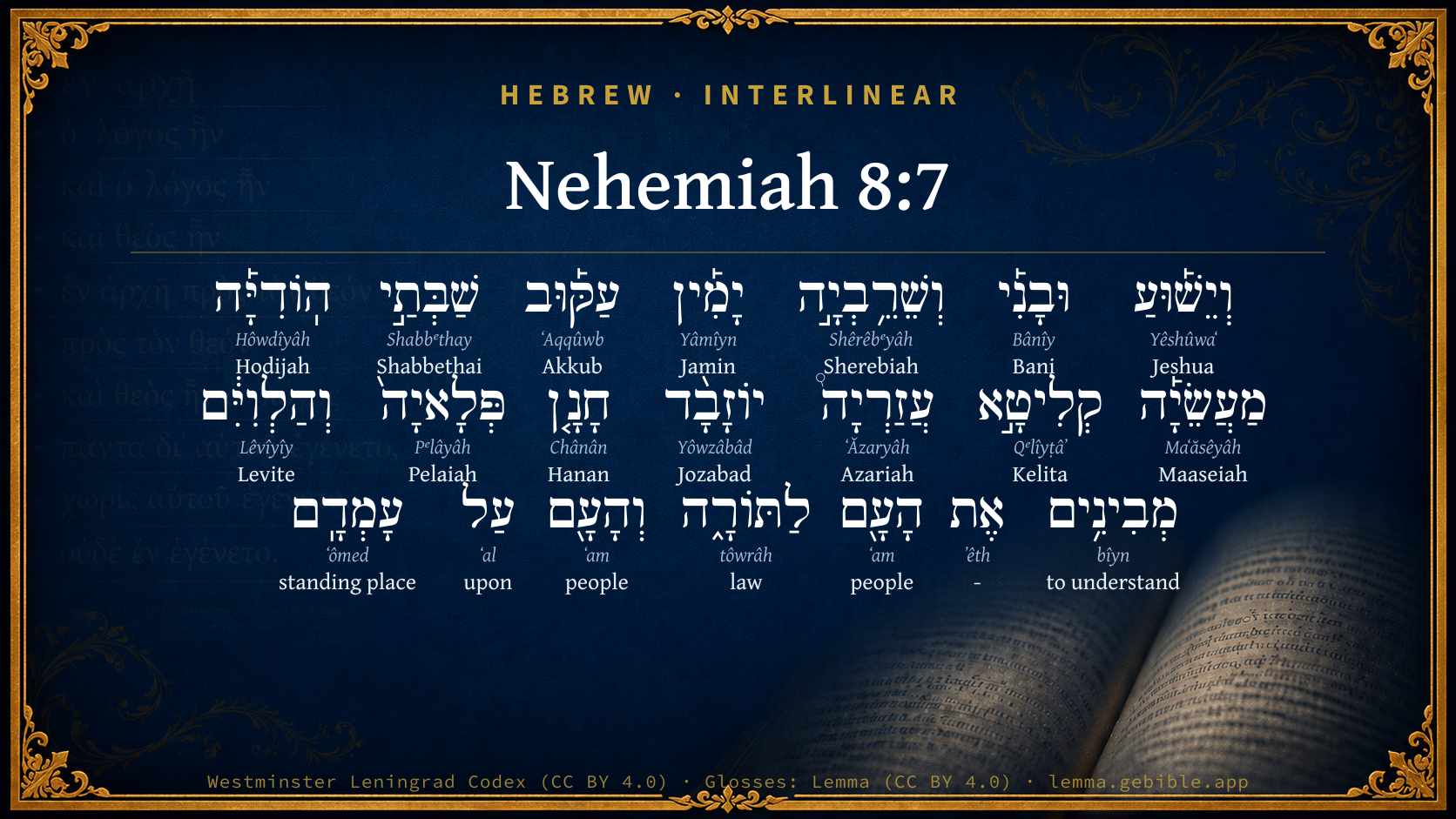
Nehemiah 8:7

Hebrew (Westminster Leningrad Codex) Nehemiah 8:7 appears in the Hebrew Old Testament. The text above is from the Westminster Leningrad Codex. Each word links to its Strong’s number, a concise gloss, and parsing drawn from the Open Scriptures Hebrew Bible morphology. Click any word for its full Brown-Driver-Briggs (BDB) entry.
Download image
Cite this verse

Nehemiah 8:7 (World English Bible). Public Domain. Lemma interlinear Bible study tool, https://lemma.gebible.app/v/nehemiah/8/7.

Show BibTeX & RIS
BibTeX
RIS
English Translation
Also Jeshua, and Bani, and Sherebiah, Jamin, Akkub, Shabbethai, Hodiah, Maaseiah, Kelita, Azariah, Jozabad, Hanan, Pelaiah, and the Levites, caused the people to understand the law: and the people [stood] in their place.
World English Bible · Public Domain
Highlights
  • 1 first appearance in the Hebrew Bible
Full analysis ↓
Download a study sheet

One document with this verse’s original text, its word-by-word gloss line, the meaning frame, cross-references with their text, attributed commentary, and full source and license credits — printable, and it pastes into notes with its structure intact.

This verse Autodidact and up

Study sheet (.html) Plain text (.txt)

A passage Seminary Student

Up to 50 verses in one chapter. A passage sheet keeps up to 6 commentary sources and 12 cross-references per verse, in the order this page ranks them, and says so on the sheet whenever that leaves anything out. Ask for a single verse and you get the Autodidact verse sheet above.

Everything on this page stays free to read, with no account — the sheet is a download of what is already on screen, not access to it.

Want to remove ads? Support Godless Engineer
Compare translations 3

The same verse in 3 English versions, stacked beneath the original-language interlinear above. Click any original word for its lexicon entry.

Each is an independent rendering of the whole verse — the interlinear is not word-aligned to these translations.

Highlighted words mark where these versions differ — a whole-verse word diff, not a word-by-word alignment.

  • World English Bible Public Domain
    Also Jeshua, and Bani, and Sherebiah, Jamin, Akkub, Shabbethai, Hodiah, Maaseiah, Kelita, Azariah, Jozabad, Hanan, Pelaiah, and the Levites, caused the people to understand the law: and the people [stood] in their place.
  • King James Version Public Domain
    Also Jeshua, and Bani, and Sherebiah, Jamin, Akkub, Shabbethai, Hodijah, Maaseiah, Kelita, Azariah, Jozabad, Hanan, Pelaiah, and the Levites, caused the people to understand the law: and the people stood in their place.
  • unfoldingWord Literal Text CC BY-SA 4.0
    And Jeshua, and Bani, and Sherebiah, Jamin, Akkub, Shabbethai, Hodiah, Maaseiah, Kelita, Azariah, Jozabad, Hanan, Pelaiah, and the Levites were causing the people to understand the law. And the people were in their place.

unfoldingWord Literal Text — © unfoldingWord, licensed CC BY-SA 4.0. Word-aligned USFM3 via Door43 (git.door43.org/unfoldingWord/en_ult).

Versions to compare (up to 4)

3 of 4 selected

Show all 18 translations

Every available English version of this verse, each an independent rendering of the whole verse.

  • World English Bible Public Domain
    Also Jeshua, and Bani, and Sherebiah, Jamin, Akkub, Shabbethai, Hodiah, Maaseiah, Kelita, Azariah, Jozabad, Hanan, Pelaiah, and the Levites, caused the people to understand the law: and the people [stood] in their place.
  • Berean Standard Bible Public Domain
    The Levites—Jeshua, Bani, Sherebiah, Jamin, Akkub, Shabbethai, Hodiah, Maaseiah, Kelita, Azariah, Jozabad, Hanan, and Pelaiah—instructed the people in the Law as they stood in their places.
  • Majority Standard Bible Public Domain
    The Levites—Jeshua, Bani, Sherebiah, Jamin, Akkub, Shabbethai, Hodiah, Maaseiah, Kelita, Azariah, Jozabad, Hanan, and Pelaiah—instructed the people in the Law as they stood in their places.
  • King James Version Public Domain
    Also Jeshua, and Bani, and Sherebiah, Jamin, Akkub, Shabbethai, Hodijah, Maaseiah, Kelita, Azariah, Jozabad, Hanan, Pelaiah, and the Levites, caused the people to understand the law: and the people stood in their place.
  • American Standard Version (1901) Public Domain
    Also Jeshua, and Bani, and Sherebiah, Jamin, Akkub, Shabbethai, Hodiah, Maaseiah, Kelita, Azariah, Jozabad, Hanan, Pelaiah, and the Levites, caused the people to understand the law: and the people `stood' in their place.
  • Revised Version (1885) Public Domain
    Also Jeshua, and Bani, and Sherebiah, Jamin, Akkub, Shabbethai, Hodiah, Maaseiah, Kelita, Azariah, Jozabad, Hanan, Pelaiah, and the Levites, caused the people to understand the law: and the people stood in their place.
  • Geneva Bible (1599) Public Domain
    Also Ieshua, and Bani, and Sherebiah, Iamin, Akkub, Shabbethai, Hodiiah, Maaseiah, Kelita, Azariah, Iozabad, Hanan, Pelaiah, and the Leuites caused the people to vnderstand the lawe, and the people stood in their place.
  • Douay-Rheims (1899) Public Domain
    Now Josue, and Bani, and Serebia, Jamin, Accub, Sephtai, Odia, Maasia, Celtia, Azarias, Jozabed, Hanan, Phalaia, the Levites, made silence among the people to hear the law: end the people stood in their place.
  • Young's Literal Translation Public Domain
    And Jeshua, and Bani, and Sherebiah, Jamin, Akkub, Shabbethai, Hodijah, Maaseiah, Kelita, Azariah, Jozabad, Hanan, Pelaiah, and the Levites, giving the people understanding in the law, and the people, `are' on their station,
  • Literal Standard Version CC BY-SA 4.0
    And Jeshua, and Bani, and Sherebiah, Jamin, Akkub, Shabbethai, Hodijah, Maaseiah, Kelita, Azariah, Jozabad, Hanan, Pelaiah, and the Levites, giving the people understanding in the Law, and the people, [are] on their station,
  • Unlocked Literal Bible CC BY-SA 4.0
    Also Jeshua, Bani, Sherebiah, Jamin, Akkub, Shabbethai, Hodiah, Maaseiah, Kelita, Azariah, Jozabad, Hanan, Pelaiah—the Levites—helped the people understand the law, while the people remained in their place.
  • unfoldingWord Literal Text CC BY-SA 4.0
    And Jeshua, and Bani, and Sherebiah, Jamin, Akkub, Shabbethai, Hodiah, Maaseiah, Kelita, Azariah, Jozabad, Hanan, Pelaiah, and the Levites were causing the people to understand the law. And the people were in their place.
  • Darby Bible Public Domain
    And Jeshua, and Bani, and Sherebiah, Jamin, Akkub, Shabbethai, Hodijah, Maaseiah, Kelita, Azariah, Jozabad, Hanan, Pelaiah, and the Levites, caused the people to understand the law; and the people [stood] in their place.
  • World Messianic Bible Public Domain
    Also Yeshua, Bani, Sherebiah, Jamin, Akkub, Shabbethai, Hodiah, Maaseiah, Kelita, Azariah, Jozabad, Hanan, Pelaiah, and the Levites, caused the people to understand the law; and the people stayed in their place.
  • Webster's Bible Public Domain
    Also Jeshua, and Bani, and Sherebiah, Jamin, Akkub, Shabbethai, Hodijah, Maaseiah, Kelita, Azariah, Jozabad, Hanan, Pelaiah, and the Levites, caused the people to understand the law: and the people stood in their place.
  • Free Bible Version CC BY-SA 4.0
    Jeshua, Bani, Sherebiah, Jamin, Akkub, Shabbethai, Hodiah, Maaseiah, Kelita, Azariah, Jozabad, Hanan, and Pelaiah, who were the Levites present, explained the Law to the people as they remained standing there.
  • Bible in Basic English Public Domain
    And Jeshua and Bani and Sherebiah and Jamin, Akkub, Shabbethai, Hodiah, Maaseiah, Kelita, Azariah, Jozabad, Hanan, Pelaiah, and the Levites made the law clear to the people: and the people kept in their places.
  • JPS Tanakh (1917) Public Domain
    Also Jeshua, and Bani, and Sherebiah, Jamin, Akkub, Shabbethai, Hodiah, Maaseiah, Kelita, Azariah, Jozabad, Hanan, Pelaiah, even the Levites, caused the people to understand the Law; and the people stood in their place.

Literal Standard Version (2020), Covenant Press — licensed CC BY-SA 4.0. Text via the HelloAO Bible API (eBible.org). Unlocked Literal Bible (unfoldingWord) — licensed CC BY-SA 4.0. Text via the HelloAO Bible API (eBible.org). unfoldingWord Literal Text — © unfoldingWord, licensed CC BY-SA 4.0. Word-aligned USFM3 via Door43 (git.door43.org/unfoldingWord/en_ult). Free Bible Version, Dr. Jonathan Gallagher — licensed CC BY-SA 4.0. Text via the HelloAO Bible API (eBible.org).

Word by word

More ways to search: Search by grammar → Find every occurrence → Compare this word →

Practice this passage: Drill this verse → Learn its vocabulary →

הֽוֹדִיָּ֡ה
Hôwdîyâh
H1941
“Hodijah”
Noun, Proper
Part of Speech
Noun
Type
Proper
Full BDB Definition

Origin: a form of H1938

TWOT: None

Hodijah = "my majesty is Jehovah" - a Levite in the time of Ezra and Nehemiah - another Levite at the same time - a chief of the people at the same time
  1. וְיֵשׁ֡וּעַ Yêshûwaʻ H3442 “and · Jeshua” Conjunction + Noun, Proper
  2. וּבָנִ֡י Bânîy H1137 “and · Bani” Conjunction + Noun, Proper
  3. וְשֵׁרֵ֥בְיָ֣ה Shêrêbᵉyâh H8274 “and · Sherebiah” Conjunction + Noun, Proper
  4. יָמִ֡ין Yâmîyn H3226 “Jamin” Noun, Proper
  5. עַקּ֡וּב ʻAqqûwb H6126 “Akkub” Noun, Proper
  6. שַׁבְּתַ֣י Shabbᵉthay H7678 “Shabbethai” Noun, Proper
  7. מַעֲשֵׂיָ֡ה Maʻăsêyâh H4641 “Maaseiah” Noun, Proper
  8. קְלִיטָ֣א Qᵉlîyṭâʼ H7042 “Kelita” Noun, Proper
  9. עֲזַרְיָה֩ ʻĂzaryâh H5838 “Azariah” Noun, Proper
  10. יוֹזָבָ֨ד Yôwzâbâd H3107 “Jozabad” Noun, Proper
  11. חָנָ֤ן Chânân H2605 “Hanan” Noun, Proper
  12. פְּלָאיָה֙ Pᵉlâyâh H6411 “Pelaiah” Noun, Proper
  13. וְהַלְוִיִּ֔ם Lêvîyîy H3881 “and · the · Levites” Conjunction + Particle, Definite Article + Noun, Gentilic, Masculine, Plural, Absolute
  14. מְבִינִ֥ים bîyn H995 “understanding” Verb, Hiphil, Participle Active, Masculine, Plural, Absolute
  15. אֶת ʼêth H853 “-” Particle, Direct Object
  16. הָעָ֖ם ʻam H5971 “the · people” Particle, Definite Article + Noun, Common, Masculine, Singular, Absolute
  17. לַתּוֹרָ֑ה tôwrâh H8451 “to/for the · law” Preposition, Determined + Noun, Common, Feminine, Singular, Absolute
  18. וְהָעָ֖ם ʻam H5971 “and · the · people” Conjunction + Particle, Definite Article + Noun, Common, Masculine, Singular, Absolute
  19. עַל ʻal H5921 “upon” Preposition
  20. עָמְדָֽם ʻômed H5977 “standing place · their” Noun, Common, Masculine, Singular, Construct + Suffix, Personal, 3rd Person, Masculine, Plural

About this verse

These counts appear in no published source. They are computed here, from the morphology-tagged text and Lemma’s own curated glosses. What Lemma adds →

21
words
20
distinct lemmas
Historical
section

Notable vocabulary

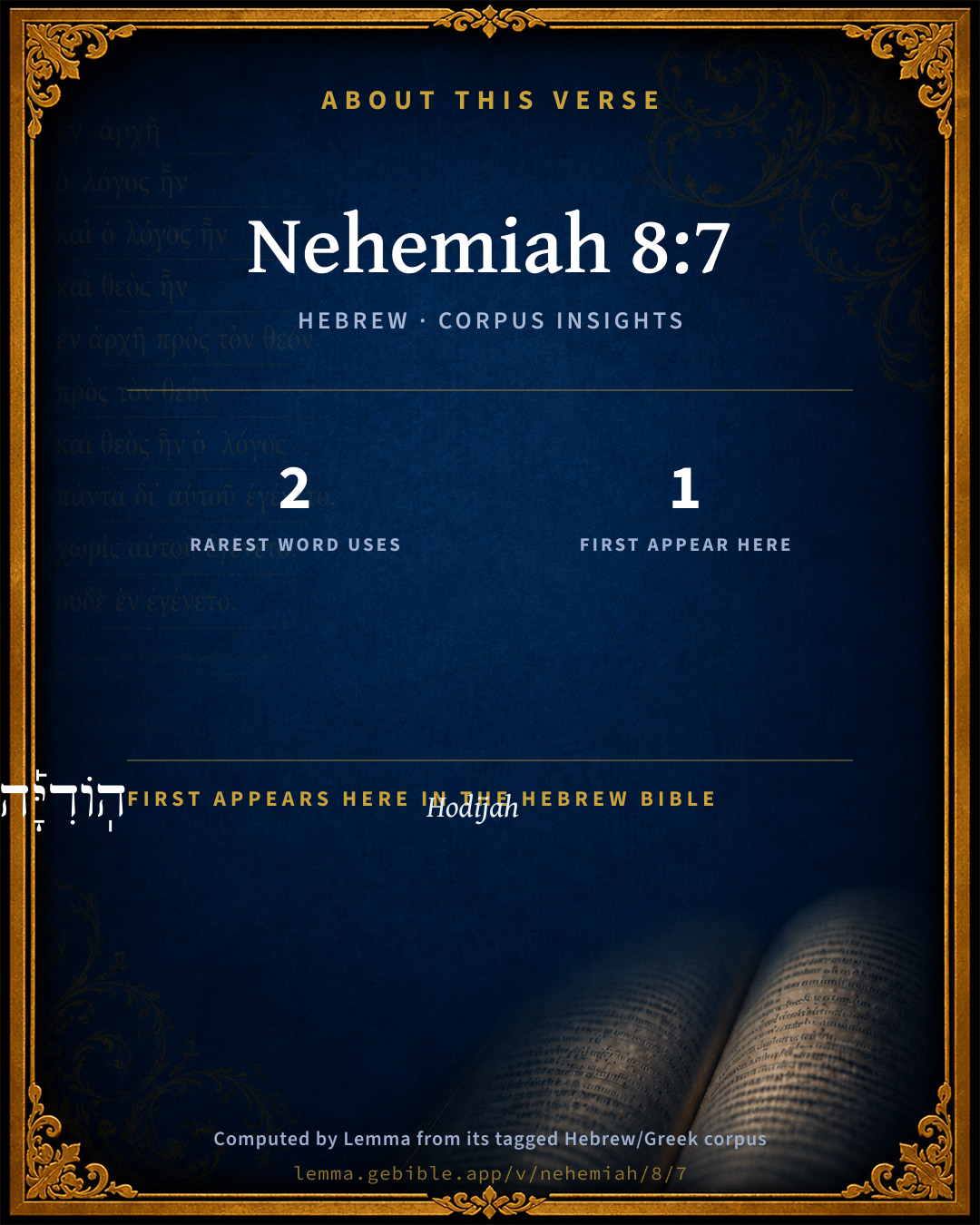
The rarest word here is הֽוֹדִיָּ֡ה Hodijah H1941 — appearing just 2 times in the whole Hebrew Bible.

First appearance in Scripture

This word makes its first canonical appearance in the Hebrew Bible here:

  • הֽוֹדִיָּ֡ה Hodijah H1941

Shared distinctive vocabulary

הֽוֹדִיָּ֡ה Hodijah H1941 occurs in 2 verses of the Hebrew Bible. Also found in:

Grammatical profile

  • 1 verb
  • 18 nouns
  • 1 preposition
  • 1 particle

Verb forms

  • מְבִינִ֥ים Hiphil · Participle Active

Repetition

A word recurs within this verse — often emphatic in Hebrew:

  • הָעָ֖ם people H5971 ×2

Cross-references

21

Topical passages linked to Nehemiah 8:7 in the Treasury of Scripture Knowledge — connected by theme and wording, ordered by reader-vote popularity; previews shown in the World English Bible.

  • Nehemiah 9:4 Then stood up on the stairs of the Levites, Jeshua, and Bani, Kadmiel, Shebaniah, Bunni, Sherebiah, Bani, [and] Chenani, and cried with a loud voice to Yahweh their God.
  • Leviticus 10:11 and that you are to teach the children of Israel all the statutes which Yahweh has spoken to them by Moses."
  • Ezra 10:22–23 Of the sons of Pashhur: Elioenai, Maaseiah, Ishmael, Nethanel, Jozabad, and Elasah.
  • Nehemiah 3:23 After them repaired Benjamin and Hasshub over against their house. After them repaired Azariah the son of Maaseiah the son of Ananiah beside his own house.
  • Malachi 2:7 For the priest's lips should keep knowledge, and they should seek the law at his mouth; for he is the messenger of Yahweh of Hosts.
  • Deuteronomy 33:10 They shall teach Jacob your ordinances, Israel your law: They shall put incense before you, Whole burnt offering on your altar.
  • 2 Chronicles 17:7–9 Also in the third year of his reign he sent his princes, even Ben Hail, and Obadiah, and Zechariah, and Nethanel, and Micaiah, to teach in the cities of Judah;
  • 2 Chronicles 30:22 Hezekiah spoke comfortably to all the Levites who had good understanding [in the service] of Yahweh. So they ate throughout the feast for the seven days, offering sacrifices of peace-offerings, and making confession to Yahweh, the God of their fathers.
  • Ezra 8:18 According to the good hand of our God on us they brought us a man of discretion, of the sons of Mahli, the son of Levi, the son of Israel; and Sherebiah, with his sons and his brothers, eighteen;
  • Nehemiah 3:17 After him repaired the Levites, Rehum the son of Bani. Next to him repaired Hashabiah, the ruler of half the district of Keilah, for his district.
  • Nehemiah 3:19 Next to him repaired Ezer the son of Jeshua, the ruler of Mizpah, another portion, over against the ascent to the armory at the turning [of the wall].
  • Nehemiah 8:4 Ezra the scribe stood on a pulpit of wood, which they had made for the purpose; and beside him stood Mattithiah, and Shema, and Anaiah, and Uriah, and Hilkiah, and Maaseiah, on his right hand; and on his left hand, Pedaiah, and Mishael, and Malchijah, and Hashum, and Hashbaddanah, Zechariah, [and] Meshullam.
  • Nehemiah 10:2 Seraiah, Azariah, Jeremiah,
  • Nehemiah 10:9–10 The Levites: namely, Jeshua the son of Azaniah, Binnui of the sons of Henadad, Kadmiel;
  • Nehemiah 10:12–13 Zaccur, Sherebiah, Shebaniah,
  • Nehemiah 10:18 Hodiah, Hashum, Bezai,
  • Nehemiah 11:16 and Shabbethai and Jozabad, of the chiefs of the Levites, who had the oversight of the outward business of the house of God;
  • Nehemiah 11:19 Moreover the porters, Akkub, Talmon, and their brothers, who kept watch at the gates, were one hundred seventy-two.
  • Nehemiah 12:24–25 The chiefs of the Levites: Hashabiah, Sherebiah, and Jeshua the son of Kadmiel, with their brothers over against them, to praise and give thanks, according to the commandment of David the man of God, watch next to watch.
  • Nehemiah 12:33 and Azariah, Ezra, and Meshullam,
  • Nehemiah 12:41–42 and the priests, Eliakim, Maaseiah, Miniamin, Micaiah, Elioenai, Zechariah, and Hananiah, with trumpets;

Cross-references courtesy of OpenBible.info (CC BY 4.0).

Hebrew and Greek witnesses Masoretic Hebrew ↔ Greek Septuagint

The same verse in the two great witnesses to the Old Testament, shown verse-for-verse.

These are two independent witnesses, not word-aligned to each other, and the Septuagint is shown in lemma (dictionary) form.

Hebrew Nehemiah 8:7 Masoretic · Westminster Leningrad Codex

וְיֵשׁ֡וּעַ וּבָנִ֡י וְשֵׁרֵ֥בְיָ֣ה יָמִ֡ין עַקּ֡וּב שַׁבְּתַ֣י הֽוֹדִיָּ֡ה מַעֲשֵׂיָ֡ה קְלִיטָ֣א עֲזַרְיָה֩ יוֹזָבָ֨ד חָנָ֤ן פְּלָאיָה֙ וְהַלְוִיִּ֔ם מְבִינִ֥ים אֶת הָעָ֖ם לַתּוֹרָ֑ה וְהָעָ֖ם עַל עָמְדָֽם

Also Jeshua, and Bani, and Sherebiah, Jamin, Akkub, Shabbethai, Hodiah, Maaseiah, Kelita, Azariah, Jozabad, Hanan, Pelaiah, and the Levites, caused the people to understand the law: and the people [stood] in their place.

World English Bible · Public Domain

Greek LXX Structure differs

The Septuagint has no separate book of Nehemiah. Its Greek text is the second half of Esdras B (2 Esdras), chapters 11–23; Ezra is the first half (1–10).

A verse-for-verse comparison isn’t shown here because the chapters and verses don’t line up. Switch to the LXX edition with the MT / LXX toggle above to read the Greek directly.

On this verse, The Cambridge Bible for Schools and Colleges discusses the Septuagint’s reading. Read the note in Commentary ↓

Hebrew: Westminster Leningrad Codex (CC BY 4.0). Greek: Septuagint (public domain); English from a public-domain English Septuagint. How the Septuagint differs from the Hebrew →

Commentary

Notes on Nehemiah 8:7 from classic Christian and Jewish commentators (each source and its license shown beneath its notes). The classic Christian expositions comment on the surrounding passage and are grouped to its opening verse, so a note may address several verses; the Jewish commentaries on the Tanakh (Rashi and others) are per-verse, so they appear only where the commentator wrote on this verse.

Lemma curates 59 commentaries, every one of them public domain or Creative Commons licensed, each selected and text-cleaned for this edition rather than reprinted as found. About our sources →

Trapp's Complete Commentary

John Trapp

Neh 8:7 Also Jeshua, and Bani, and Sherebiah, Jamin, Akkub, Shabbethai, Hodijah, Maaseiah, Kelita, Azariah, Jozabad, Hanan, Pelaiah, and the Levites, caused the people to understand the law: and the people [stood] in their place.

Ver. 7. Also Jeshua, and Bani, &c., caused the people to understand the law] As the audience was great, so, great was the company of preachers, Psa 68:11. The people were too many to be taught by one; therefore they made sundry companies and congregations, and had several teachers; as had likewise those primitive Christians, Act 6:1, when once they grew numerous.

And the people stood in their places] Heb. And the people upon their stand; they kept their stations according to their divisions; not shuffling or shifting from preacher to preacher, but abiding and attending with utmost intention and retention.

John Trapp, A Commentary or Exposition upon All the Books of the Old and New Testament (1647–1656) — public domain. Text from a community e-Sword module.

Joseph Benson's Commentary

Neh 8:7. The Levites caused the people to understand the law — As well the words, which, being Hebrew, needed to be translated into the Chaldee or Syriac language, now the common language of that people; who, together with their religion, had also, in a great part, lost their language; as also the meaning of them: they expounded the mind and will of God in what they read, and applied it to the people’s present condition. The people stood in their place — That is, in their several places and stations, into which the company seems to have been distributed for convenience of hearing; it not being likely that so vast a congregation could distinctly hear one man’s voice. Or, by their stations; that is, by the several stations of the Levites, and persons last named, who seem to have had several scaffolds, by comparing this with Neh 9:4, upon which they stood, as Ezra, and those mentioned Neh 8:4, did upon their pulpit.

Joseph Benson's Commentary on the Old and New Testaments (1811–1818) — public domain. Text from a community e-Sword module.

Tyndale Open Study Notes

Tyndale Open Resources

8:7-9 The Levites always had the role of teaching people God’s word (Deut 33:10; Mal 2:5-6). In this case, they probably explained the meaning of the Hebrew Scriptures to smaller groups of people in Aramaic. Most of the people spoke Aramaic, the language of Babylon, rather than Hebrew as their first language. Jewish leaders eventually translated large portions of the Hebrew Bible into Aramaic, allowing people to hear and study the Bible in a language they understood.

Tyndale Open Study Notes — © Tyndale Open Resources, licensed CC BY-SA 4.0. Text via the HelloAO Bible API.

Jamieson, Fausset & Brown

Robert Jamieson, A. R. Fausset & David Brown

caused the people to understand the law . . . gave the sense--Commentators are divided in opinion as to the import of this statement. Some think that Ezra read the law in pure Hebrew, while the Levites, who assisted him, translated it sentence by sentence into Chaldee, the vernacular dialect which the exiles spoke in Babylon. Others maintain that the duty of these Levites consisted in explaining to the people, many of whom had become very ignorant, what Ezra had read.

Jamieson, Fausset & Brown — Commentary Critical and Explanatory on the Whole Bible (1871) — public domain (CC PDM 1.0). Text via the HelloAO Bible API.

The Cambridge Bible for Schools and Colleges

gen. ed. J. J. S. Perowne

7. Also Jeshua &c.] Of the 13 names here mentioned we find four, i.e. Jeshua, Bani, Sherebiah, Hodiah, mentioned among the Levites in chap. Neh_9:5, and seven, i.e. Jeshua, Bani, Sherebiah, Hodiah, Kelita, Hanan, Pelaiah, among the Levites in chap. Neh_10:9-14. Perhaps these seven were representative of Levitical houses, whose names they bore; if so, the remaining six mentioned here, whose names do not occur again, possibly represented branches of some other Levitical families mentioned under different collective names in chaps. 10 and 12. The LXX. here only gives the first three names.

Hodijah] R.V. Hodiah.

and the Levites] So the LXX. But 1 Esdr. οἱ Λευῖαι, Vulg. ‘Levitæ,’ omitting the copula which gives the better rendering. The ‘copula’ if the text is correct, must define the list of names just given in the sense of ‘even.’ The writer adds that they were Levites. The rendering ‘And the Levites’ in the sense of ‘And all the rest of the Levites’ would give a scene of confusion. For the use of the copula = ‘even,’ cf. Neh_8:13. But very possibly the words have been interpolated.

caused the people … the law] i.e. they expounded what Ezra read. We must suppose that only short passages were read at a time.

stood in their place] Literally, ‘And the people were upon their standing.’ LXX. καὶ ὁ λαὸς ἐν τῇ στάσει αὐτοῦ. Cf. 2Ch_30:16, ‘And they stood in their place,’ 2Ch_35:10. It will be noticed that in this passage the Levites share with the priests the duty of instructing the people out of the Law; and we are led to infer that this was customary from the Chronicler’s statements in 2Ch_15:3; 2Ch_17:8-9; 2Ch_35:3. In the Levitical law we only find the priests entrusted with this duty (Lev_10:10-11).

The Cambridge Bible for Schools and Colleges (gen. ed. J. J. S. Perowne; Cambridge University Press, 1878–1918) — public domain. Text from a community e-Sword module.

John Gill's Exposition

Also Jeshua, and Bani, and Sherebiah, Jamin, Akkub, Shabbethai, Hodijah, Maaseiah, Kelita, Azariah, Jozabad, Hanan, Pelaiah, and the Levites,.... That is, others of them besides those named; for they seem all to be Levites, unless they can be thought to be priests, and so the Levites are distinguished from them; but the former seems evident from Neh 9:4 these also

caused the people to understand the law; as well as Ezra; from whence it is plain that he did not only read the law, but gave the sense of it, especially where there was any seeming difficulty, and these men were assisting in the same work: and the people stood in their place; to hear the law read and explained; they did not move from their first station, but continued in it from morning to noon; they were both attentive and constant.

John Gill's Exposition of the Whole Bible (1746–1763) — public domain (CC PDM 1.0). Text via the HelloAO Bible API.

Albert Barnes' Notes on the Bible

The names here (and in Neh 9:4, Neh 9:5; Neh 10:9) seem not to be the personal appellations of individuals, but rather designations of Levitical families, the descendants respectively of Jeshua, etc., who lived not later than the time of Zerubbabel Neh 7:43; Neh 12:8.

Albert Barnes' Notes on the Bible (1834–1885) — public domain. Text from a community e-Sword/MySword module.

Matthew Poole's English Annotations

Caused the people to understand the law; as well the words, which being Hebrew, now needed to be translated into the Chaldee or Syriac language, which was now and henceforth the common language of that people, who together with their religion had also in a great part lost their language; as also the sense and meaning of them; they expounded the mind and will of God in what they read, and applied it to the people’s present condition, as they saw fit, as the manner of the prophets generally was. And hence the people were so deeply affected with it.

The people stood in their place, i.e. in their several places and stations into which the company seems to have been distributed for conveniency of hearing; it not being likely that so vast a congregation could distinctly hear one man’s voice. Or, by their stations, i.e. by the several stations of the Levites and persons last named; who seem to have had several scaffolds, by comparing this with Neh 9:4, upon which they stood, as Ezra did upon his pulpit, Neh 8:4.

Matthew Poole's English Annotations on the Holy Bible (1683–1685) — public domain. Text from a community e-Sword/MySword module.

Whedon's Commentary on the Bible

Daniel D. Whedon

7. And the Levites — Or, even the Levites. We understand that the persons named in this verse were all Levites, in distinction from the priests named in Neh_8:4.

Caused the people to understand the law — This was a part of the regular work of the priests and Levites. See marginal references. On this occasion it was probably necessary for them to translate and explain the law in the vulgar tongue for the benefit of a large part of the people. See note on next verse.

The people… in their place — That is, around the platform, and in sight and hearing of the priests and Levites.

Daniel D. Whedon (gen. ed.), Commentary on the Old and New Testaments (1874–1909) — public domain. Text from a community e-Sword module.

The Pulpit Commentary

Joshua, Bani, Sherebiah, etc. Levitical families, not individual Levites. (see Neh_9:4, 5 10:10-13 12:8, etc.) And the Levites. i.e. "the rest of the Levites." Caused the people to understand the law. Expounding it, during pauses in the reading. The people stood in their place. Rather, were in their place remained throughout the whole of the reading and exposition without quitting their places. It is not probable that they stood.

The Pulpit Commentary (1880–1919), ed. H.D.M. Spence-Jones & Joseph S. Exell — public domain. Text from a community e-Sword module.

John Wesley's Explanatory Notes

Understand - As well the words, which being Hebrew, now needed to be translated into the Chaldee or Syriack language, now, the common language of that people, who together with their religion, had also in a great part lost their language; as also the meaning of them: they expounded the mind and will of God in what they read, and applied it to the peoples present condition. Place - That is, In their several places and stations into which the company seems to have been distributed for conveniency of hearing; it not being likely that so vast a congregation could distinctly hear one man's voice. Or, by their stations, that is, by the several stations of the Levites, and persons last named; who seem to have had several scaffolds, by comparing this with chap. ix, 4, upon which thy stood, as Ezra did upon his pulpit, ver. viii, 4.

John Wesley, Explanatory Notes Upon the Whole Bible (1754–1765) — public domain. Text via the GEBible commentary corpus.

Rashi

Rabbi Shlomo Yitzchaki (Rashi)

explained...to the people meaning that they would translate the words of the Torah to the people.

in their place meaning that they were standing on their feet.

Rashi on the Tanakh — English translations: “The Judaica Press complete Tanach with Rashi, translated by A. J. Rosenberg” (CC BY 4.0); “Pentateuch with Rashi's commentary by M. Rosenbaum and A.M. Silbermann, 1929-1934” (public domain); “The Metsudah Tanach series, Lakewood, N.J” (CC BY 4.0); and “The Book of Joshua, Metsudah Publications, 1997” (CC BY 4.0). Text via Sefaria.

Lesson kit

Teaching starters — assembled from the data on this page, not authored interpretation. Every prompt links to the verse data it draws on. Edit before teaching.

Nehemiah, in the Historical, opens this verse with 21 words (20 distinct Hebrew lemmas). Its most distinctive word is Hôwdîyâh (“Hodijah”). A historical commentator’s framing appears above. Read the whole chapter for the surrounding context.

Discussion questions

  1. What does “Hodijah” (Hôwdîyâh) contribute to the verse as a whole?
  2. The word “Hodijah” first appears here in Scripture. What is being introduced at this debut?
  3. Nehemiah 9:5 shares the word «Hodijah» with this verse. How do the two illuminate each other?
  4. “people” occurs 2× in this one verse. What is the effect of the repetition?
  5. These translations render this verse differently; the difference is in the English rendering, not the original. What questions does that raise?
  6. The verb «מְבִינִ֥ים» is Hiphil Participle Active. How does its form color the action?
  7. Reading how Trapp's Complete Commentary and Joseph Benson's Commentary read this verse, where do the two commentators agree and where do they part?

Things to notice

  • 1 word makes its first canonical appearance in Scripture here.
  • These translations choose different wording for 6 words in this verse.
  • “people” occurs 2× in this single verse.
  • 20 distinct Hebrew lemmas span 21 words in this verse.

Reading settings

Reading text

Shown beneath each verse's original-language words.

Old Testament
Old Testament edition

Read the OT as the Masoretic Hebrew (MT) or the Greek Septuagint (LXX).

English shown for the Greek Septuagint (in the Hebrew ↔ Greek comparison).

Comparing translations? Open the Compare panel on any verse page to stack up to four side by side.